
FRANK26….10-11-26….FROZEN !!!
KTFA
Sunday Night Video
FRANK26….10-11-26….FROZEN !!!
This video is in Frank’s and his team’s opinion only
Frank’s team is Walkingstick, Eddie and Omar in Iraq and guests
Playback Number: 605-313-5163 PIN: 156996#
KTFA
Sunday Night Video
FRANK26….10-11-26….FROZEN !!!
This video is in Frank’s and his team’s opinion only
Frank’s team is Walkingstick, Eddie and Omar in Iraq and guests
Playback Number: 605-313-5163 PIN: 156996#
Rob Cunningham: What if the World’s Wealth Could Finally Work for Everyone?
Rob Cunningham: What if the World’s Wealth Could Finally Work for Everyone?
10-11-2026
XRP: WHAT IF THE WORLD’S WEALTH COULD FINALLY WORK FOR EVERYONE?
Imagine a world where humanity’s greatest financial problem isn’t a shortage of wealth, resources or productive capacity – but an outdated system that makes accessing them unnecessarily expensive, complicated and restrictive.
Now imagine a better system.
Rob Cunningham: What if the World’s Wealth Could Finally Work for Everyone?
10-11-2026
XRP: WHAT IF THE WORLD’S WEALTH COULD FINALLY WORK FOR EVERYONE?
Imagine a world where humanity’s greatest financial problem isn’t a shortage of wealth, resources or productive capacity – but an outdated system that makes accessing them unnecessarily expensive, complicated and restrictive.
Now imagine a better system.
Not by confiscating anyone’s property. Not by forcing nations to surrender sovereignty. Not by creating more debt disguised as wealth.
But by connecting the world’s existing assets through one voluntary, transparent, interoperable financial infrastructure.
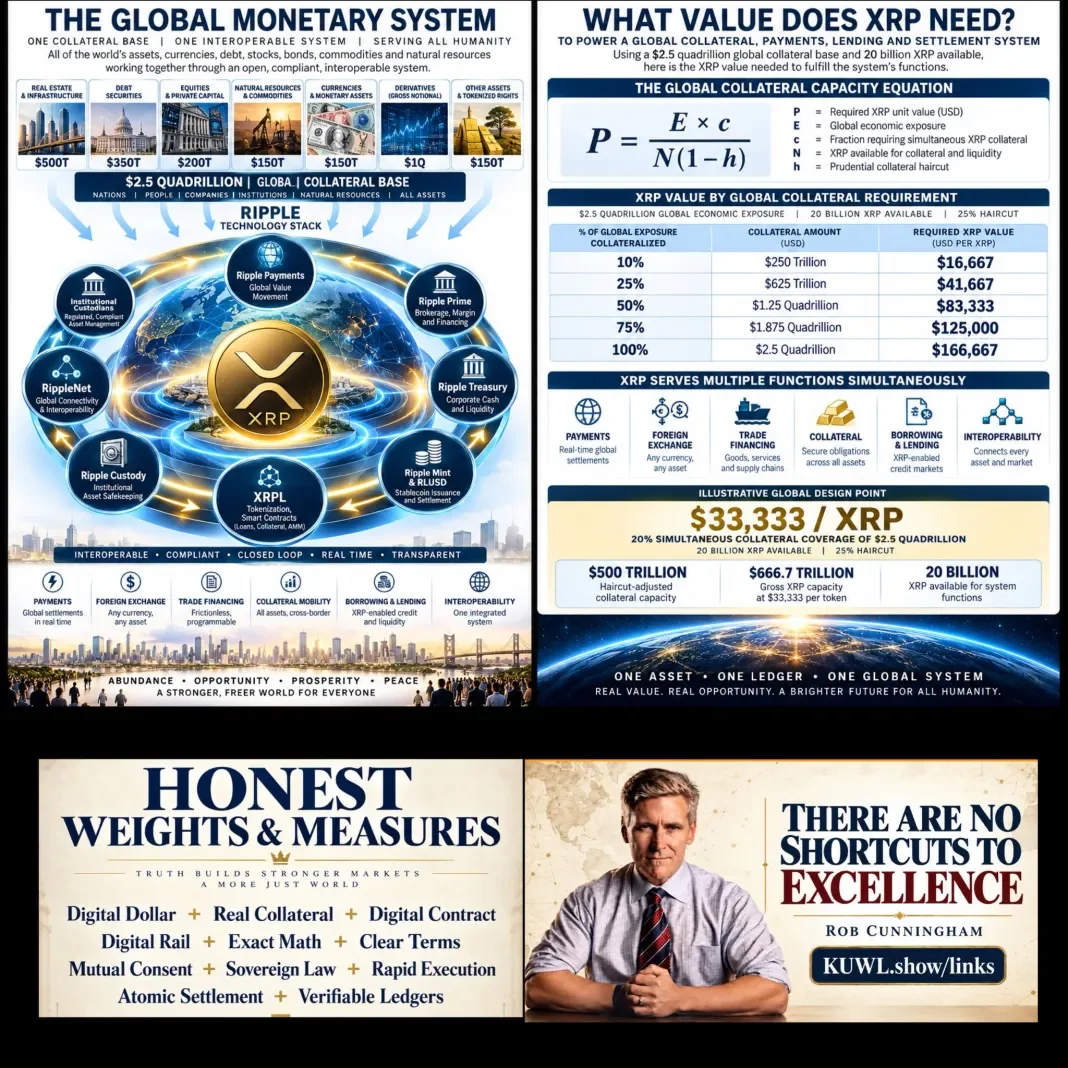
THE VISION: ONE WORLD OF RESOURCES. ONE CONNECTED MONETARY SYSTEM. TRUE FREEDOM TO PARTICIPATE.
Our planet possesses extraordinary abundance: land, energy, minerals, agriculture, infrastructure, businesses, currencies, stocks, bonds and countless other assets.
Much of this wealth already exists. Yet access to financing against it is fragmented by borders, banking networks, intermediaries, incompatible systems and expensive, opaque, slow processes.
A farmer can own valuable land and still struggle to obtain affordable financing.
A business can possess valuable inventory and still lack working capital.
An entire nation can possess tremendous natural resources while its people remain financially constrained and impoverished.
The resources exist. The ability to access their economic value is has long been bottlenecked.
THE ARCHITECTURE: XRP + XRPL + RIPPLE NET + ILP + GENIUS ACT REGULATED CUSTODY
Imagine these components working together as one engineered global monetary system:
1. REAL ASSETS PROVIDE THE FOUNDATION
The world’s eligible assets can be legally verified, valued, registered and represented digitally, while ownership and property rights remain intact.
2. XRP PROVIDES THE NATIVE MONETARY UTILITY
XRP serves as a common asset for payments, foreign exchange, collateral, borrowing, lending and interoperability.
3. XRPL PROVIDES THE SHARED LEDGER
Transactions, ownership records, obligations and settlement instructions can be recorded and verified through transparent, programmable infrastructure.
4. RIPPLE’S TECHNOLOGY CONNECTS FINANCIAL ACTIVITY
Payments, treasury operations, stablecoins, custody, liquidity and institutional financing become interoperable parts of the larger system.
5. REGULATED CUSTODIANS PROTECT PROPERTY AND ENFORCE AGREEMENTS
Eligible assets are safeguarded, collateral obligations are enforced, and participants retain their lawful ownership rights.
6. CREDIT BECOMES CONNECTED TO VERIFIABLE VALUE
Borrowing is supported by identifiable collateral, enforceable agreements and transparent risk controls – not simply promises hidden behind layers of intermediaries.
THE ASSUMPTIONS: HOW BIG COULD THIS BECOME?
For illustration, imagine a $2.5 quadrillion global universe of assets and financial obligations connected through this infrastructure.
Assume 20 billion XRP are available for institutional monetary functions, with a 25% collateral haircut.
If XRP must directly secure 20% of that modeled exposure simultaneously, the required collateral capacity implies approximately:
$33,333 PER XRP
That number is not a market-price prediction.
It is the mathematical result of a specific engineering requirement: $500 trillion of simultaneous collateral exposure supported by 20 billion available XRP, after accounting for a 25% haircut.
The larger principle matters more than the number.
An asset used to move money has one kind of demand. An asset also required to secure and finance enormous amounts of value has an entirely different monetary role.
THE HUMAN BENEFIT: ABUNDANCE INSTEAD OF ARTIFICIAL SCARCITY
Imagine a farmer in Africa, a manufacturer in America, a family business in India and an energy producer in South America accessing the same underlying financial standards.
Their property is respected
Their assets can be verified
Their collateral can be recognized.
Their financing can be priced transparently.
Their payments can settle rapidly.
Their participation is voluntary.
And no single intermediary needs to control their access to the entire system.
Instead of paying layers of institutions merely to establish trust, participants benefit from a shared infrastructure that makes verification, accountability and settlement dramatically more efficient.
Lower friction can mean lower financing costs.
Better collateral mobility can mean more productive capital.
Greater transparency can mean less room for hidden manipulation.
And broader access can allow more people to put their existing resources to productive use.
This is not about manufacturing wealth out of thin air. It is about unlocking the productive potential of wealth humanity already possesses.
THE BIG PICTURE
The world does not need another financial system that concentrates power by making everyone dependent on expensive permission.
Imagine one engineered around honest measurement, lawful ownership, mutual consent, transparent obligations and equal technical standards.
A closed-loop financial engine with open, voluntary access.
A system where nations remain sovereign, people retain property rights, and institutions compete to serve rather than control.
Where money moves efficiently, collateral works productively, credit supports real economic activity and prosperity is no longer unnecessarily restricted by disconnected financial machinery.
THE ULTIMATE VISION IS NOT A $33,333 XRP
It is 8 billion human beings living in a world where access to legitimate economic opportunity is no longer needlessly constrained by the cost, complexity and concentration of financial infrastructure.
REAL ASSETS
REAL OWNERSHIP
REAL COLLATERAL
REAL CREDIT
REAL OPPORTUNITY
No manufactured scarcity.
No forced dependency.
No private cartel operations.
A world where humanity’s existing abundance can finally be connected, measured, protected and put to work – for all humanity.
Source(s):
• https://x.com/KuwlShow/status/2109075624576925820
A Historic Team, New Monetary System, Asset-connected Future, America
A Historic Team, New Monetary System, Asset-connected Future, America
And We Know: 10-10-2026
A recent discussion from And We Know Official on YouTube dives deep into the current chaotic financial environment, particularly highlighting the intersection of midterm elections, shifting monetary policies, and the evolving roles of precious metals and digital currency.
As global markets react to shifting political landscapes and central bank decisions, understanding the broader economic picture has never been more vital for long-term planning and asset protection.
A Historic Team, New Monetary System, Asset-connected Future, America
And We Know: 10-10-2026
A recent discussion from And We Know Official on YouTube dives deep into the current chaotic financial environment, particularly highlighting the intersection of midterm elections, shifting monetary policies, and the evolving roles of precious metals and digital currency.
As global markets react to shifting political landscapes and central bank decisions, understanding the broader economic picture has never been more vital for long-term planning and asset protection.
The conversation begins by examining how short-term investor psychology frequently drives market volatility. For instance, recent sharp declines in the cryptocurrency market following a Federal Reserve rate increase highlight a classic herd mentality.
Many market participants react impulsively to brief news soundbites rather than evaluating underlying fundamentals. This phenomenon underscores the critical importance of patient, informed investing, especially when navigating emerging digital asset classes.
Rather than getting swept up in day-to-day market fluctuations, successful investors often focus on long-term value and strategic positioning.
Beyond traditional markets, the evolution of the banking system introduces entirely new paradigms, including the rise of programmable digital money.
Financial institutions, such as Canada’s six largest banks, are actively implementing programmable digital tokens capable of automating conditional payments like rent and contractor fees. While this technology promises unprecedented convenience and efficiency, it also introduces significant risks regarding financial privacy and freedom.
The ability to program money means that restrictions can theoretically be imposed on how, when, and by whom funds are spent. This dual-edged sword raises valid concerns about potential financial censorship, prompting many to look toward decentralized alternatives.
To combat ongoing monetary challenges, discussions are swirling around a potential “dream team” of financial leaders influenced by former President Trump.
Among them is Scott Bessent, whose role as Treasury Secretary involves the delicate task of balancing dollar stability against persistent inflation pressures and the quantitative easing policies required to support the bond market.
Bessent’s pragmatic approach highlights the immense balancing act facing modern U.S. financial leadership as they attempt to steady the economy within a complex global framework.
Adding to this strategic vision is Judy Shelton and her innovative proposal for a gold-backed bond. Shelton’s concept introduces a convertible treasury bond that allows investors to choose between gold redemption and standard fiat currency.
This mechanism serves as a monetary anchor, striking a compromise between unrestricted fiat currency printing and strict gold backing. By offering market participants this flexibility, such a system could significantly boost investor confidence, counter dollar weakness, and help mitigate long-term inflation concerns.
Furthermore, the inclusion of experienced market figures like David Zervos brings deep Federal Reserve and investment expertise to the table. Positioned as a potential market engineer, Zervos could play a pivotal role in overseeing the mechanics and timing of a systemic monetary transition. His involvement signals that these discussions extend far beyond theoretical economics, pointing toward serious, strategic planning at high levels of governance.
This potential shift comes at a time when global central banks are actively reducing their U.S. dollar reserves in favor of gold, driven by widespread concerns over currency depreciation.
Introducing gold-backed U.S. sovereign debt could potentially reverse international capital flight, restore faith in the dollar, and catalyze a broader global movement toward asset-backed financial systems. For everyday investors, this global trend reinforces the value of holding tangible, decentralized assets.
Iraq Economic News and Points To Ponder Sunday Afternoon 10-11-26
"Raising The Dollar Is Not A Solution Without A Price," Maliki asserts, emphasizing that the success of adjusting the exchange rate hinges on the government's ability to contain its repercussions and protect citizens' incomes
Sunday, October 11, 2026 Baghdad - One News - Nouri al-Maliki, head of the State of Law Coalition, warned of the economic and living repercussions of raising the dollar exchange rate, stressing that the success of the exchange rate adjustment measures depends on the government’s ability to contain its negative effects and protect citizens’ incomes and purchasing power, as well as maintain market stability.
"Raising The Dollar Is Not A Solution Without A Price," Maliki asserts, emphasizing that the success of adjusting the exchange rate hinges on the government's ability to contain its repercussions and protect citizens' incomes
Sunday, October 11, 2026 Baghdad - One News - Nouri al-Maliki, head of the State of Law Coalition, warned of the economic and living repercussions of raising the dollar exchange rate, stressing that the success of the exchange rate adjustment measures depends on the government’s ability to contain its negative effects and protect citizens’ incomes and purchasing power, as well as maintain market stability.
Al-Maliki said in a post on the X platform that those concerned with Iraqi economic affairs are divided between supporters and opponents of the decision to raise the dollar exchange rate, based on concern for the citizen’s purchasing power and standard of living.
He explained that adjusting the exchange rate of the national currency is one of the measures adopted by some countries to confront economic crises, but the success of this step remains dependent on the government’s ability to address its negative repercussions, protect citizens’ incomes, and reduce its impact on the markets.
Al-Maliki indicated that the government is about to take clear measures and mechanisms to ensure the preservation of citizens’ income and purchasing power, the stability of markets and the continuation of economic activities, in order to prevent citizens from bearing the burdens of economic remedies.
He called for the decision to raise the dollar exchange rate not to be used as a pretext to cause concern or create a tense atmosphere, stressing the importance of quickly announcing solutions and measures that would protect the individual's income and standard of living. He voted for the change.
Al-Maliki stressed the need to prioritize citizens' interests when dealing with economic challenges, and to adopt measures that preserve economic stability and mitigate the impact of exchange rate adjustments on people's livelihoods, ensuring that citizens are not burdened with the cost of government procedures. https://1news-iq.net/رفع-الدولار-ليس-حلاً-بلا-ثمن-المالكي/
An Economic Matter, And No Involvement Of Security Forces... Security Media Clarifies The Dollar Exchange Rate
economy sharing Clock Network Published on: October 11, 2026 The Security Media Cell confirmed on Sunday that the directives of the Commander-in-Chief of the Armed Forces, Ali Faleh al-Zaidi, emphasize that the issue of the exchange rate of the dollar and foreign currencies is a financial and economic matter, and does not fall within the jurisdiction of the security forces.
The cell stated in a statement that "the directives of the Commander-in-Chief of the Armed Forces stressed that the issue of the exchange rate of the dollar and foreign currencies is a financial and economic issue, governed by market mechanisms and supply and demand equations, and falls within the jurisdiction of the relevant financial and monetary authorities, foremost among them the Central Bank of Iraq, and is not considered a security issue."
She added that "the directives emphasize the need to deal with this file in accordance with legal and institutional jurisdictions," stressing that "there are no directives for the security forces to interfere in market activity or influence the exchange rate, and that their role does not exceed their legal duties in enforcing the law and implementing the original judicial orders issued by the competent authorities."
She added that “any measures taken against violators or those involved in illegal practices in dealing with foreign currencies are carried out in accordance with the approved legal and judicial procedures, and in coordination with the Central Bank of Iraq, each within its powers and jurisdictions, in order to prevent arbitrary procedures or infringement on the rights of dealers in a proper manner.”
The cell clarified that "the Central Bank of Iraq is the sectoral body responsible for supervising financial and banking institutions, regulating the work of exchange companies, monitoring their compliance with applicable regulations and instructions, and taking the necessary administrative and regulatory measures to protect the integrity of financial transactions, support the work of duly licensed companies, and reduce violations and illegal practices."
She stressed that "the security forces do not interfere in determining exchange rates or managing commercial and financial transactions, and that their procedures do not target legitimate economic activity, but are limited to implementing the law and judicial decisions, in coordination with the relevant sectoral authorities."
The cell called on citizens, merchants, money exchange companies and market participants to remain calm and continue their legitimate financial and commercial activities as normal, stressing that "the directives of the Commander-in-Chief are based on respecting institutional jurisdictions, consolidating the rule of law, and ensuring that economic and financial matters are handled by the competent authorities."
Al-Mada: The Framework Hints At Dismissing Al-Zidi From The Premiership To Appease The Dollar's Anger
10/11/2026 Baghdad - One News - 10/11/2026 Al-Mada newspaper revealed moves within the coordination framework to promote the possibility of dismissing Prime Minister Ali al-Zidi, (probably Maliki) in an attempt to contain the escalating public anger resulting from the decision to raise the exchange rate of the dollar against the Iraqi dinar.
According to the newspaper's information, the forces of the Coordination Framework were surprised by the extent of the popular reactions to the decision, despite their prior agreement to amend the exchange rate during their internal meetings.
The newspaper indicated that a meeting held by the Shiite forces at the home of the leader of the Wisdom Movement, Ammar al-Hakim, witnessed the discussion and approval of an economic plan that included three main measures: raising the dollar exchange rate, selling indebted institutions, and recovering funds from corrupt individuals.
It added that some of the political forces that approved the plan began looking for ways to contain its repercussions, amid escalating popular and political pressure on the al-Zaidi government. https://1news-iq.net/المدى-الإطار-يلوح-بإقالة-الزيدي-من-رئا/
CBI Strictly Monitors Banks Over Exchange Rate Fees After October 7 Adjustment
At a Glance
The Central Bank of Iraq is strictly monitoring financial operations following the October 7 currency adjustment to protect merchants.
Import companies must contact commercial banks to verify the execution of all remittances due prior to October 7.
The apex bank has already pre-funded commercial bank accounts to fully cover these specific legacy orders.
The Central Bank of Iraq (CBI) announced it is strictly monitoring banking operations following its recent exchange rate adjustment to ensure commercial banks do not penalize merchants with unauthorized currency fees on pre-existing import remittances.
Key Statements and Focus Area
The Central Bank has urged merchants to confirm pre-October 7 remittances, warning banks against charging extra exchange rate differences.
The CBI stated that it is "monitoring banking operations executed before and after the exchange rate adjustment and is verifying banks' compliance with effective instructions and regulations to ensure the protection of the rights of merchants and clients."
The Central Bank has urged import companies and merchants to contact their commercial banks to verify the execution of all remittances due prior to October 7, 2026.
The regulator emphasized that this verification is vital because the central bank has already pre-funded commercial bank accounts to fully cover these specific remittance orders.
Additionally, the apex bank reaffirmed that it is closely monitoring transaction delays to guarantee that merchants are exempt from paying exchange rate differentials on remittances verified and funded under the previous tariff.
Looking forward, the CBI is collaborating with commercial banks and electronic payment providers to introduce specialized foreign trade cards designed to streamline import financing for small-scale merchants under upcoming central bank regulations.
FYI
The banking regulator's rigorous compliance campaign follows market instability triggered by the sudden devaluation of the Iraqi dinar on October 7.
Acting on an emergency recommendation from the Ministry of Finance, the Iraqi Cabinet issued Resolution No. 544 to overhaul the state’s fiscal policy structure.
The new monetary mandates established an aggressive restructuring of the official USD/IQD exchange window, raising Ministry of Finance purchases from approximately 1,300 IQD to 1,500 IQD, sales to commercial banks from roughly 1,310 IQD to 1,510 IQD, and retail sales to the public from 1,320 IQD to 1,520 IQD per US dollar.
This policy shift effectively made purchasing foreign currency 15% more expensive at the official window, dealing an immediate blow to domestic purchasing power.
The sudden policy change instantly caused friction between local merchants and commercial banks as the street value of the dollar rapidly drifted toward 1,685 IQD, prompting several local banking institutions to attempt to extract the newly introduced exchange rate differences from business accounts on pre-existing orders.
Consequently, to minimize economic disruption, the Central Bank of Iraq intervened by ordering commercial entities to execute all import financing transactions initiated before October 7 at the legacy rate. https://channel8.com/english/news/67521
Seeds of Wisdom RV and Economics Updates Sunday Afternoon 10-11-26
Good Afternoon Dinar Recaps,
GLOBAL DEBT RESET WATCH: WORLD BANK WEIGHS CRISIS AID AS DEVELOPING NATIONS FACE A TRIPLE ECONOMIC SHOCK
As the World Bank discusses emergency assistance with dozens of countries, rising energy prices, climate threats and borrowing costs are intensifying pressure on government budgets and the global financial system.
Good Afternoon Dinar Recaps,
GLOBAL DEBT RESET WATCH: WORLD BANK WEIGHS CRISIS AID AS DEVELOPING NATIONS FACE A TRIPLE ECONOMIC SHOCK
As the World Bank discusses emergency assistance with dozens of countries, rising energy prices, climate threats and borrowing costs are intensifying pressure on government budgets and the global financial system.
OVERVIEW
The World Bank is discussing potential crisis assistance with 30–40 countries affected by the Middle East energy shock.
The UN Development Programme warns that high fuel and food prices, a potentially severe El Niño and expensive borrowing are creating a dangerous combination for developing economies.
Debt-service costs are consuming more public revenue, increasing pressure for affordable international financing and putting long-term development spending at risk.
KEY DEVELOPMENTS
1. World Bank Opens Discussions With Dozens of Countries
The World Bank is in discussions with approximately 30–40 countries about potential crisis assistance to help them manage energy-price increases associated with the Middle East conflict, according to Reuters.
Higher diesel and fertilizer prices are increasing costs for transportation, agriculture and food production. For countries that already face limited financial resources, these increases can quickly become a wider economic problem.
The discussions signal that international financial institutions are preparing for further pressure on vulnerable economies. However, discussions about aid do not mean every country will receive funding, nor do they establish the amount, timing or conditions of any assistance.
The immediate challenge is to help countries manage rising costs without allowing emergency spending to create still greater debt burdens.
2. UN Warns of a Triple Shock to Developing Economies
A new UN Development Programme report identifies three overlapping pressures: higher energy prices, climate risks associated with El Niño, and elevated borrowing costs.
The report estimates that the median developing country now spends approximately 9.5% of government revenue on interest payments, the highest share in 25 years. It also notes that ten-year government bond yields in a median group of weaker-credit countries are around 9%.
These expenses leave governments with less money for healthcare, education, infrastructure and assistance to households facing higher living costs.
The UNDP estimates that if higher food and energy costs were fully passed on to households, an additional 130 million people worldwide could be pushed below the report’s poverty threshold of $6.85 per day this year. This is a projected risk—not a count of people already pushed into poverty.
3. Debt Pressure Is Becoming a Global Financial Concern
The crisis comes as international policymakers prepare for the annual meetings of the International Monetary Fund and World Bank.
Reuters reports that the IMF expects global public debt to exceed 100% of world GDP before 2030. Developing countries are especially vulnerable when higher interest rates make refinancing existing debt more expensive and investors redirect capital toward higher-yielding markets.
At the same time, governments are being asked to cushion households and businesses from energy and food price increases. Maintaining subsidies and other support measures can protect consumers in the short term, but these programs become harder to sustain when borrowing costs rise.
The policy challenge is to provide immediate relief while preserving enough fiscal capacity for long-term economic development.
WHY IT MATTERS
This development shows how an energy shock can spread far beyond oil markets. Higher fuel prices raise transportation and production costs, while expensive borrowing limits governments’ ability to respond.
If countries are forced to reduce essential services, raise taxes or cut investment to meet debt payments, the consequences can extend to employment, economic growth and political stability.
International crisis assistance may help countries manage the immediate pressure. Its effectiveness will depend on the scale of funding, the speed at which it becomes available, and whether the financing terms leave governments able to support recovery.
The broader issue is not simply how much debt countries carry, but whether they can finance essential services, meet their obligations and invest in future growth at the same time.
WHY IT MATTERS TO FOREIGN CURRENCY HOLDERS
For foreign currency holders following developments surrounding the Global Financial Reset, debt pressure is an important indicator of how the international financial system may evolve.
Countries facing high interest expenses and limited access to affordable financing may seek debt restructuring, new lending arrangements or changes in how international institutions support them. These developments can influence investor confidence, capital flows and exchange-rate volatility.
However, a debt crisis does not automatically lead to a stronger currency, a currency revaluation or a new monetary system. Outcomes differ by country and depend on economic fundamentals, policy decisions, external financing and market confidence.
For currency holders, the practical approach is to watch for confirmed lending agreements, actual debt restructuring, policy changes and measurable economic results rather than interpreting every financial emergency as proof of an imminent reset.
IMPLICATIONS FOR THE GLOBAL RESET
Pillar 1: Debt
Higher interest payments can divert public revenue from infrastructure, healthcare and education. Discussions about crisis assistance highlight the need to balance emergency financing with sustainable debt obligations.
Pillar 2: Trade
Higher diesel, fertilizer and food prices increase the cost of producing and transporting goods. Countries that depend heavily on imported energy and food can face pressure on trade balances and domestic prices.
Pillar 3: Assets and Investment
When borrowing becomes more expensive, governments and businesses may delay infrastructure projects and other investments. Investors may also reassess risk in countries with large financing needs or limited fiscal flexibility.
Pillar 4: Energy
Energy security remains directly connected to economic stability. Disruptions that keep fuel prices elevated can increase inflation and make it harder for governments to protect consumers.
Pillar 5: International Financial Cooperation
The World Bank’s discussions with dozens of countries highlight the role of multilateral institutions in responding to cross-border economic shocks. The terms, accessibility and effectiveness of future assistance will help determine whether vulnerable economies can stabilize without deepening their debt problems.
THE BOTTOM LINE
The World Bank’s crisis-aid discussions and the UN’s warning point to the same challenge: developing economies are being squeezed between higher living costs, climate risks and expensive debt.
International assistance could help stabilize affected countries, but the results will depend on whether financing arrives in time, whether its terms are sustainable and whether governments can protect vulnerable households without sacrificing future development.
The evolution of the global financial system will be measured not only by new currencies and payment technologies, but by whether nations can build a more resilient way to finance growth, manage debt and withstand global shocks.
Seeds of Wisdom Team
Newshounds News
SOURCES
~~~~~~~~~~
Seeds of Wisdom Team RV Currency Facts Youtube and Rumble
Newshound's News Telegram Room Link
RV Facts with Proof Links Link
RV Updates Proof links - Facts Link
Start Here room with Most Asked Questions Link
Follow the Gold/Silver Rate COMEX
Follow Fast Facts
Seeds of Wisdom Team™ Website
Thank you Dinar Recaps
Sunday Iraq News Posted by Tishwash at TNT 10-11-2026
TNT:
Tishwash: Al-Moussawi reveals the date when the 2027 budget will reach Parliament
MP Mukhtar al-Moussawi confirmed on Sunday that the 2027 budget draft will reach the Parliamentary Finance Committee this week for discussion of its articles. He also indicated that there are seven complex issues that the upcoming budget will face.
Al-Moussawi explained to Al-Maalouma that "the 2027 budget draft will arrive this week from the Council of Ministers to the Parliamentary Finance Committee, in preparation for a thorough discussion of its articles."
TNT:
Tishwash: Al-Moussawi reveals the date when the 2027 budget will reach Parliament
MP Mukhtar al-Moussawi confirmed on Sunday that the 2027 budget draft will reach the Parliamentary Finance Committee this week for discussion of its articles. He also indicated that there are seven complex issues that the upcoming budget will face.
Al-Moussawi explained to Al-Maalouma that "the 2027 budget draft will arrive this week from the Council of Ministers to the Parliamentary Finance Committee, in preparation for a thorough discussion of its articles."
He added that "available information indicates the presence of seven complex issues, most notably updating the dollar exchange rate, the price of a barrel of oil, the size of the operational budget, the rights of the provinces, as well as issues related to regularizing the employment of thousands of workers and guaranteeing the rights of contract workers."
He pointed out that "the budget will witness extensive discussions, but there are significant difficulties it will face, given the financial and economic crisis the country is experiencing," noting that "the upcoming discussions will reveal more details and complexities related to its articles."
Al-Moussawi affirmed that "everyone agrees on the necessity of guaranteeing the rights of various segments of society in the 2027 budget, in line with the requirements of the next phase. link
Tishwash: Government policy to adopt the Iraqi dinar in transactions within Iraq
On Saturday, October 10, 2026, Mazhar Muhammad Saleh, an advisor to Prime Minister Ali al-Zidi, revealed a government plan to adopt the Iraqi dinar for transactions within Iraq.
Saleh said in a statement followed by “Ultra Iraq” that “there is a governmental trend to adopt the Iraqi dinar in transactions within Iraq in accordance with the relevant legal provisions, which supports confidence in the national currency and regulates transactions in the market,” as he put it.
Saleh spoke about “government oversight measures” and considered them “a fundamental pillar for controlling markets and limiting unjustified price increases, and confronting monopoly, speculation and exploitation of citizens’ need for food and consumer goods,” stressing that “the continuation of oversight campaigns, strengthening institutional coordination, supporting local production, facilitating the flow of goods and holding violators accountable, represent important factors for protecting the consumer and enhancing market stability.”
He pointed to "the importance of coordination between the concerned authorities to ensure the smooth flow of goods to the markets, in parallel with government measures aimed at facilitating trade and addressing obstacles facing the processing and distribution operations, which enhances market efficiency and contributes to price stability and the availability of basic materials," as well as "the importance of adhering to the applicable legislation that regulates financial and commercial transactions," indicating that "the integration of the work of commercial and regulatory bodies contributes to monitoring markets, detecting violations and applying legal measures against violators, which enhances fair competition and protects the purchasing power of citizens, especially those with limited income."
The advisor pointed out that "price stability is not achieved by monitoring alone, but requires its integration with economic and supply policies and procedures that facilitate commercial activity, in order to support living, economic and social stability in Iraq."
He also said that "effective oversight does not target legitimate business activity, but rather seeks to prevent monopolistic practices, price manipulation, and exploitation of economic conditions to achieve unjustified profits, while maintaining a balance between the rights of consumers and the interests of committed traders, and establishing a business environment based on transparency and fairness."
On October 7, 2026, the financial authorities in Iraq announced a reduction in the value of the dinar for the third time in six years, bringing it to 152,000 dinars per 100 dollars, for the currency sold to the public, or the "end user".
The Central Bank decided to adopt a new exchange rate for the dollar, according to a document issued by the bank, which stated: “With reference to the Cabinet’s decision taken in its twenty-second session on October 6, 2026, which included amending the exchange rates of the Iraqi dinar against the US dollar in a way that meets the relevant financial, economic and monetary requirements.”
He added: "Based on the provisions of the Central Bank of Iraq Law No. 56 of 2004, as amended, it was decided to adopt the following exchange rates:
The purchase price of the US dollar from the Ministry of Finance: (1500) dinars per dollar.
The selling price of the US dollar to banks: (1510) dinars per dollar.
The selling price of the US dollar to the public: (1520) dinars per dollar.
The Iraqi parliament hosted Prime Minister Ali al-Zaidi to "clarify the details and necessities related to changing the foreign currency exchange rate."
Al-Zaydi told the House of Representatives that "the government had three options: the first was to resort to mandatory savings and leave the employee to live on promises, the second was to distribute salaries every 45 days, and the third was to resort to borrowing and drown the country in debt, which it is already burdened with."
Al-Zaydi revealed that “the difference in the dollar exchange rate was previously taken over by speculators,” adding: “I took over the task when the size of the public debt was more than 208 trillion dinars, and the government is required to provide 10 trillion dinars monthly, and despite the crisis, we provided the salaries.”
Al-Zaydi pointed out that "in the coming days, good quantities of dollars will arrive and we will inject them into circulation." link
*************
Tishwash: Minister of Finance: Digital transformation and modern systems are a fundamental pillar for enhancing transparency and reducing corruption.
About the news
Finance Minister Faleh Sari chairs a meeting of the ministry's advisory board.
The meeting was attended by the Undersecretary, the Advisor to the Ministry, and the Directors General to discuss the paths of financial reform.
Discussion of accelerating digital transformation and automating work processes in line with the goals of the government program.
The meeting, according to a statement from the Ministry of Finance, a copy of which was received by Channel 8, stressed the importance of linking financial allocations to clear performance indicators and tangible results, and evaluating the performance of the ministry's formations based on the efficiency of project implementation and the achievement of financial and administrative targets.
The attendees discussed developing collection mechanisms and raising collection efficiency in the various departments of the ministry.
Diversifying income sources, maximizing non-oil revenues, and reducing dependence on oil revenues.
The importance of continuous training and developing the technical and professional capabilities of the staff.
The Minister of Finance affirmed that “accelerating digital transformation and adopting modern systems represent a fundamental pillar for simplifying procedures, enhancing transparency, and reducing waste and corruption,” stressing “the importance of continuous training and developing the technical and professional capabilities of the staff.” link
Tishwash: MPs and experts: Government measures to control prices enhance market stability and protect purchasing power.
Deputies, government advisors, and economic experts affirmed that regulating markets and combating monopolies and price manipulation requires the integration of regulatory and legislative measures with facilitating trade and imports and supporting local production, noting the importance of these steps in enhancing market stability and protecting citizens' purchasing power.
Member of the Parliamentary Committee on Economy and Trade, MP Hamed Al-Moussawi, said that protecting the Iraqi economy requires supporting government measures with legislation and laws that prevent monopolies and limit manipulation of food, medicine and commodity prices.
Al-Moussawi added that it is necessary to establish a national food and drug authority and grant it broad powers to control prices and monitor markets, noting that the draft law for the authority is in the House of Representatives and has been read for the first time.
He explained that the existence of a specialized institution would contribute to determining the actual need for the dollar and uncovering the practices in which some speculators and monopolists exploit exchange rate changes to achieve private gains.
For his part, the Prime Minister’s financial advisor, Mazhar Muhammad Saleh, affirmed that government oversight measures represent a fundamental pillar for controlling markets, curbing unjustified price increases, and confronting monopolies, speculation, and the exploitation of citizens’ need for basic commodities.
Saleh explained that the integration of the work of commercial and regulatory bodies contributes to monitoring violations and applying legal measures against violators, which enhances fair competition and protects purchasing power, especially for those with limited income.
He pointed to the importance of coordination between the concerned parties to ensure the smooth flow of goods and to address the obstacles facing preparation and distribution, stressing that effective oversight aims to prevent monopolistic practices and price manipulation, while preserving the rights of consumers and the interests of compliant traders.
He pointed to the importance of adhering to the applicable legislation, indicating that there is a governmental trend to adopt the Iraqi dinar in transactions within the country in accordance with the relevant legal provisions, which supports confidence in the national currency and regulates transactions in the market.
Saleh stressed that price stability is not achieved by monitoring alone, but requires its integration with economic and supply policies and procedures that facilitate commercial activity, in order to support living, economic and social stability.
For his part, Yahya Kamal Al-Bayati, an advisor in the Department of Private Sector Development at the Ministry of Trade, confirmed that the government has taken practical measures to achieve price stability and protect the consumer, including tightening control over markets, supporting the hypermarket project for food and construction goods, and allowing employees to buy dollars for personal purposes according to specific controls.
Al-Bayati said that tightening control through the competent authorities, especially the Directorate for Combating Organized Crime in the Ministry of Interior, along with activating the role of the Council for Competition Affairs and Prevention of Monopoly, would confront monopolistic practices and price manipulation.
He added that supporting the hypermarket project contributes to increasing competition and the supply of goods, as well as facilitating monitoring of prices, invoices and the movement of goods, which enhances market stability and protects the consumer.
For his part, economist Ahmed Abdel Rabbo stressed that monitoring markets and deploying oversight committees to follow up on violators contribute to reducing unjustified price increases and enhancing the stability of food and consumer markets.
Abdel Rabbo explained that achieving price stability requires ensuring the smooth flow of goods, facilitating customs procedures, monitoring supply chains, reducing transportation and storage costs, and enhancing the supply of basic commodities.
He pointed out the need to distinguish between price increases resulting from monopolies and commercial violations, and those related to actual increases in import, transportation and production costs, in order to avoid restricting legitimate business activity or affecting the movement of supply and processing.
He stressed the importance of striking a balance between consumer protection, ensuring fair competition, and preserving the freedom of commercial activity within the law, in order to enhance market stability and protect those with limited incomes from the pressures of living.
In addition, economist Ziad Al-Hashemi stressed that government measures aimed at controlling prices and reducing monopolies can achieve positive results when implemented within a clear and well-thought-out plan, in conjunction with facilitating foreign transfers for traders.
Al-Hashemi said that these measures should be accompanied by media campaigns to raise awareness among traders and dealers about the importance of adhering to prices and not exploiting the current circumstances to raise prices or monopolize goods and merchandise.
He added that coordinating with the Central Bank of Iraq to facilitate foreign transfers and reduce delays and additional auditing procedures would speed up the completion of transactions and enable traders to import their goods at lower costs.
He explained that facilitating foreign transfers may contribute to attracting a portion of the trade and remittance activity currently in the parallel market towards the official transfer platform, which would help traders complete their transactions faster and provide goods in local markets.
He pointed out that accelerating transfers and providing sufficient stock of goods and products can contribute to reducing opportunities for monopolies and selling goods at reasonable prices, stressing the importance of these measures in supporting market stability and protecting the purchasing power of citizens. link
News, Rumors and Opinions Sunday 10-11-2026
KTFA
Clare: Al-Zaidi will conduct a Gulf tour that includes Saudi Arabia and Kuwait next Wednesday.
10/10/2026
Iraqi Prime Minister Ali al-Zaidi is expected to conduct a Gulf tour next Wednesday, which will include Saudi Arabia, after which he will head to Kuwait.
An informed government source told Shafaq News Agency that Al-Zaidi will discuss with the Gulf states joint security and economic files, as well as the situation in the region and its impact on security and economic conditions, in addition to common issues at various levels.
KTFA
Clare: Al-Zaidi will conduct a Gulf tour that includes Saudi Arabia and Kuwait next Wednesday.
10/10/2026
Iraqi Prime Minister Ali al-Zaidi is expected to conduct a Gulf tour next Wednesday, which will include Saudi Arabia, after which he will head to Kuwait.
An informed government source told Shafaq News Agency that Al-Zaidi will discuss with the Gulf states joint security and economic files, as well as the situation in the region and its impact on security and economic conditions, in addition to common issues at various levels.
The source explained that Al-Zaidi will emphasize during the tour Iraq’s rejection of launching any attacks from its territory against any of the Gulf states and the region, and that his government will not hesitate to hold accountable any party involved in such cross-border operations.
This anticipated tour comes after the cancellation of a visit that Al-Zaidi was scheduled to make to Riyadh last July, against the backdrop of rapidly evolving security developments in the region.
Iraqi-Gulf relations have been marked by anticipation and caution since the launch of regional military operations in February 2016, amid repeated accusations from countries in the region that armed factions are exploiting Iraqi territory to launch drone attacks targeting regional economic interests. LINK
Clare: The head of the Badr parliamentary bloc told NINA: The cabinet will be completed next week... and in this format.
10/10/2026
MP Mahdi Taqi Amerli, head of the Badr parliamentary bloc, confirmed that the cabinet will be completed next week, in a different format than the initial vote on the cabinet.
Amerli told the Iraqi National News Agency ( NINA ): "This week will not see a vote on the remaining vacant ministerial positions due to ongoing political discussions among the blocs regarding the nominated candidates, and the country's political and economic circumstances following the rise in the dollar exchange rate. Therefore, the vote will be postponed until next week."
He emphasized that "there are no disagreements among the political blocs regarding the candidates presented to the Prime Minister for him to choose from for the vacant ministries."
Amerli explained that "the vote on the remaining cabinet members and deputy prime ministers will be conducted as a single package, not as individual votes for each candidate." LINK
*************
Clare: The Central Bank of Iraq issues a statement regarding outstanding merchant remittances.
The Central Bank of Iraq issued a statement on Saturday regarding outstanding merchant remittances, and indicated that it is working on launching cards specifically for foreign trade.
The bank said, "The Central Bank of Iraq is monitoring banking operations carried out before and after the exchange rate adjustment and is verifying that banks are complying with the applicable instructions and regulations to ensure the protection of the rights of traders and customers."
The statement added that "the Central Bank calls on companies and traders whose import financing transfers were due for execution before 10/7/2026 to review their banks and ensure their execution, especially since the Central Bank had previously strengthened the banks' accounts to cover those transfers," stressing "the monitoring of any delay and verification that traders are not charged exchange rate differences for transfers that have been proven to have been purchased and covered at the previous rate."
He pointed out that “in the event of a delay in implementation or a demand for additional amounts, a complaint can be submitted through (the complaints platform of the Central Bank of Iraq)
or an email can be sent to the email address (media.office@cbi.iq)
to follow up with the bank concerned.”
He added that "the Central Bank is working in coordination with banks and electronic payment companies to launch special cards for foreign trade for small traders to facilitate the financing of their imports, according to the mechanisms and controls set by the Central Bank of Iraq."
Media Office
10/10/2026
Courtesy of Dinar Guru: https://www.dinarguru.com/
Frank26 They had to devalue in order to revalue. What if they had not devalued? Then they wouldn't be revaluing...
Stephen Iraq just proved it can change the dinar rate without parliament approval...We've always known the CBI can pull the trigger at any moment they want. This further solidifies that argument...The news is coming fast and furious.
Jeff Iraq devalued their currency...Does the fact that the rate has already changed matter? IMO no...Iraq can adjust its exchange rate while the budget is still being...drafted but not approved... What we care about is Tuesday 15th, that's when they stated multiple times the budget would go to parliament for approval...We're looking for parliament to boycott the budget and not approve it. That's exactly what you want. As long as the budget remains unapproved that leaves the door open...Iraq is still eligible to change the rate again and go international.
Guy The citizens are waiting for movement from their government. They've been promised this-and-that-and-the other for the last 25 years. They want to see movement. A lot of them have their physical currency stuffed in their mattresses. The average Iraqi adult has multiple millions of dinars. They don't trust the banking system to bring them in right now. But when Al-Zaidi rolls out all his new reforms and...the governor of the central bank announces the new exchange rate, it's pretty clear you're going to see a flood of currency notes coming into Iraq banks...
*************
Silver Could Hit $100 As Global Money Printing Accelerates | Tavi Costa
Liberty and Finance: 10-10-2026
Tavi Costa warns that accelerating money supply growth in the U.S. and China could fuel another major inflationary wave.
With government debt soaring and Treasury yields pressuring the economy, he believes policymakers will eventually turn to monetary dilution to manage the crisis.
Costa sees silver at $50–$60 as an attractive accumulation range and expects prices to eventually reach triple digits. He also argues that mining stocks remain deeply undervalued, with constrained metal supplies potentially amplifying future gains.
From gold and silver to emerging markets and Latin America, Costa believes investors may be witnessing the early stages of a transformative 5–10 year commodities trend.
INTERVIEW TIMELINE: 0:00 Intro 1:00 Inflation 7:48 10-year Treasury yield 11:00 Silver 12:30 Silver miners 17:33 Azuria Capital 19:00 Last thoughts
MilitiaMan & Crew: Stop What You Are Doing: Militia Man's Latest Update
MilitiaMan & Crew: Stop What You Are Doing: Militia Man's Latest Update
10-10-2026
The Crew: Samson, PompeyPeter, Petra, Daytrader, Sunkissed, GIGI and Militia Man
No drama. No intrigue. No songs and dances. Just straight, factual news that I read and interpret to the best of my ability after being an avid Dinar investor and insanely obsessed Dinarian for over 15 years.
Follow MM on X == https://x.com/Slashn
MilitiaMan & Crew: Stop What You Are Doing: Militia Man's Latest Update
10-10-2026
The Crew: Samson, PompeyPeter, Petra, Daytrader, Sunkissed, GIGI and Militia Man
No drama. No intrigue. No songs and dances. Just straight, factual news that I read and interpret to the best of my ability after being an avid Dinar investor and insanely obsessed Dinarian for over 15 years.
Follow MM on X == https://x.com/Slashn
Be sure to listen to full video for all the news……..
Iraq Amends the Official Exchange Rate
Iraq Amends the Official Exchange Rate: Legal and Economic Implications of Cabinet Decision No. 544 of 2026
Al-Nesoor Law Firm examines Iraq’s new exchange rate and its impact on contracts, imports, businesses, government revenues, and consumers.
Al-Nesoor Law Firm October 07, 2026 On 6 October 2026, the Iraqi Council of Ministers issued Decision No. 544 of 2026, amending the official exchange rate of the Iraqi dinar against the U.S. dollar. The new rates took effect on 7 October 2026, leaving only a very short period between the decision and its implementation.
Under the new framework, the exchange rates are:
Iraq Amends the Official Exchange Rate: Legal and Economic Implications of Cabinet Decision No. 544 of 2026
Al-Nesoor Law Firm examines Iraq’s new exchange rate and its impact on contracts, imports, businesses, government revenues, and consumers.
Al-Nesoor Law Firm October 07, 2026 On 6 October 2026, the Iraqi Council of Ministers issued Decision No. 544 of 2026, amending the official exchange rate of the Iraqi dinar against the U.S. dollar. The new rates took effect on 7 October 2026, leaving only a very short period between the decision and its implementation.
Under the new framework, the exchange rates are:
IQD 1,500 per U.S. dollar for the purchase of dollars from the Ministry of Finance;
IQD 1,510 per U.S. dollar for sales to banks; and
IQD 1,520 per U.S. dollar for sales to the final beneficiary through banks and non-bank financial institutions.
The change represents a significant adjustment from the previous official rates, under which the final beneficiary rate was IQD 1,320 per U.S. dollar.
Immediate Implementation and the Need for Transitional Rules
The short period between the issuance of the decision and its implementation raises important legal and commercial considerations.
A change in the official exchange rate affects not only monetary policy, but also existing contracts, banking transactions, imports, government projects, pricing arrangements, and other obligations denominated or settled in foreign currency.
Businesses and financial institutions may need time to update accounting systems, banking procedures, contractual calculations, invoices, and payment arrangements. Equally important is the need for clear transitional rules addressing transactions that were already underway when the new rate became effective.
The issue, therefore, is not limited to whether an exchange-rate adjustment was economically justified. The manner and timing of implementation are also important. Advance notice and clear transitional procedures can help businesses, banks, contracting parties, and consumers understand their obligations and reduce uncertainty.
What Does the New Rate Mean?
The adjustment means that more Iraqi dinars are now required to purchase one U.S. dollar, representing a decline in the dinar's value against the dollar at the official rate.
For the final beneficiary, the rate increased from IQD 1,320 to IQD 1,520 per U.S. dollar.
For example, an imported product costing USD 100 would have represented approximately IQD 132,000 under the previous official rate. At IQD 1,520 per dollar, the same USD 100 represents approximately IQD 152,000, before considering shipping, customs duties, taxes, transportation, insurance, distribution costs, or commercial margins.
This does not necessarily mean that every product in Iraq should immediately increase in price by the same percentage. The actual effect depends on several factors, including the nature of the product, its dependence on imports, existing inventory, the source of financing, the timing of payment, transportation costs, and market competition.
Impact on Salaries and Purchasing Power
Government and private-sector salaries paid in Iraqi dinars do not automatically change in nominal terms as a result of the exchange-rate adjustment.
The more significant concern is purchasing power.
If the cost of imported goods and services rises while nominal salaries remain unchanged, households may be able to purchase fewer goods and services with the same income. The impact can be particularly significant for fixed-income households and lower-income groups.
The ultimate effect will depend on how extensively the exchange-rate adjustment is reflected in consumer prices and what measures are taken to maintain market stability.
Impact on Importers and Existing Transactions
For importers, the consequences depend heavily on the stage each transaction had reached when the new exchange rate became effective.
Where an importer had already purchased the necessary U.S. dollars and paid the foreign supplier before 7 October, the historical cost of that transaction would not ordinarily change merely because a new exchange rate was subsequently introduced.
Similarly, goods already imported and held in inventory retain the historical acquisition costs actually incurred by the trader.
The position may be different where goods were ordered or shipped before the decision but payment remained outstanding. If the importer must purchase dollars after the new rate became effective, the dinar cost of completing the transaction may increase.
Accordingly, determining the financial effect on an existing transaction may require examination of several factors, including:
the contractual currency and payment terms; the date on which foreign currency was purchased; the date of the bank transfer; letters of credit or other trade-finance arrangements; the date payment became due; and any contractual provisions dealing with exchange-rate fluctuations or changes in law.
The fact that an import or supply contract was signed before the exchange-rate decision does not, by itself, establish that payment or settlement must be calculated using the previous exchange rate.
Existing Inventory and Price Increases
Another important issue concerns goods already held in warehouses or retail inventories.
Some traders may seek to price existing inventory according to the anticipated cost of replacing that inventory under the new exchange rate. From a commercial perspective, replacement cost may influence future pricing decisions.
However, replacement cost should be distinguished from the actual historical cost incurred in acquiring existing inventory.
This distinction is important when assessing market behavior and whether particular price increases genuinely reflect higher costs or constitute an attempt to take advantage of uncertainty surrounding the exchange-rate adjustment.
Effective market monitoring will therefore be important to distinguish legitimate cost increases from unjustified price increases.
Effect on Government Revenues and Expenditures
Iraq receives a substantial portion of its public revenue from oil exports denominated in U.S. dollars.
When those dollar revenues are converted into Iraqi dinars at a higher exchange rate, each dollar generates a larger nominal amount of dinars. This may provide the government with additional dinar-denominated resources and may help address certain budgetary pressures.
However, this should not be viewed in isolation.
A higher exchange rate may also increase the dinar cost of government imports, foreign-currency obligations, international contracts, equipment, medicines, infrastructure inputs, and other expenditures linked to foreign currencies.
The fiscal impact therefore depends on both sides of the equation: the additional dinars generated from dollar-denominated revenues and the additional costs created by a weaker dinar.
Commercial and Contractual Implications
The exchange-rate adjustment may have consequences extending beyond the banking and retail sectors.
Companies operating in Iraq should review contracts involving foreign-currency payments, particularly long-term supply agreements, construction contracts, government contracts, distribution arrangements, financing agreements, and other transactions where costs or payments are linked to the U.S. dollar.
Particular attention should be given to clauses concerning currency, price adjustment, change in law, hardship, force majeure, taxes and duties, and mechanisms for renegotiating prices.
Whether a party is entitled to adjust its contractual price because of the new exchange rate will depend on the wording of the relevant contract and the applicable Iraqi law. The exchange-rate decision should therefore not automatically be treated as permitting unilateral modification of existing contractual obligations.
The Importance of Transparency and Transition
Major monetary decisions can have immediate consequences across the economy. Providing advance notice, clear implementation instructions, and transitional arrangements for transactions already underway can substantially reduce uncertainty.
Further clarification regarding pending bank transfers, letters of credit, government contracts, customs calculations, and other transactions affected by the change would help businesses assess their positions and manage their obligations.
The authorities will also need to monitor market prices, facilitate access to foreign currency for legitimate trade, discourage unjustified price increases, and provide reliable information concerning the effect of the adjustment on public finances and the broader economy.
Conclusion
Cabinet Decision No. 544 of 2026 represents a significant change in Iraq's exchange-rate framework.
While the adjustment increases the number of dinars generated when dollar-denominated state revenues are converted into local currency, it may also increase import costs, affect existing commercial arrangements, place pressure on consumer purchasing power, and require businesses to reassess foreign-currency obligations.
For companies operating in Iraq, the immediate priority should be to review transactions and contracts affected by the change rather than assume that either the previous or new rate automatically applies in every circumstance.
The broader lesson extends beyond the exchange-rate figures themselves. Decisions of this scale benefit from clear implementation procedures, transparency, and appropriate transitional arrangements. These measures are particularly important where monetary policy changes directly affect contracts, businesses, financial institutions, and consumers across the Iraqi economy.
This article is intended for general informational purposes only and does not constitute legal, financial, or investment advice. The application of the exchange-rate decision to a particular contract or transaction should be assessed based on its specific terms and circumstances.
Published By Al-Nesoor Law Firm END https://alnesoor.com/en
https://alnesoor.com/en/blog/iraq-exchange-rate-decision-544-2026
Seeds of Wisdom RV and Economics Updates Sunday Morning 10-11-26
Good Morning Dinar Recaps,
GLOBAL ENERGY RESET WATCH: U.S. EASES RUSSIA DIESEL SANCTIONS AS FUEL COSTS PRESSURE TRUCKERS AND TRADE
The Trump administration has temporarily eased restrictions on Russian diesel supplies following an agreement with Moscow, seeking to relieve fuel-price pressure on truckers, farmers and businesses while raising new questions about sanctions, energy security and global trade.
Good Morning Dinar Recaps,
GLOBAL ENERGY RESET WATCH: U.S. EASES RUSSIA DIESEL SANCTIONS AS FUEL COSTS PRESSURE TRUCKERS AND TRADE
The Trump administration has temporarily eased restrictions on Russian diesel supplies following an agreement with Moscow, seeking to relieve fuel-price pressure on truckers, farmers and businesses while raising new questions about sanctions, energy security and global trade.
OVERVIEW
U.S. President Donald Trump announced a diesel supply agreement with Russia following a conversation with Russian President Vladimir Putin on October 9.
The U.S. Treasury Department issued a temporary general license allowing certain transactions involving Russian-origin diesel through April 7, 2027.
The move aims to increase fuel availability and ease costs, but the actual effect on U.S. diesel prices remains uncertain.
KEY DEVELOPMENTS
1. Washington Opens a Temporary Path for Russian Diesel
Trump announced that Russia would immediately supply more than 300,000 metric tons of diesel to U.S. and global markets. He also described additional shipments planned for November and subsequent months, with larger future volumes dependent on the condition of Russian refineries.
Following the announcement, the U.S. Treasury Department issued a temporary general license authorizing specified transactions involving the sale, delivery, offloading and importation of Russian-origin diesel through April 7, 2027.
This is a limited easing of restrictions on diesel transactions, not a wholesale removal of U.S. sanctions against Russia. Other sanctions and restrictions remain relevant, and the license does not guarantee that all announced fuel volumes will reach U.S. buyers.
Source: Reuters — “Trump says Russia to immediately supply 300,000 tons of diesel fuel.”
2. Why Diesel Prices Matter Beyond the Fuel Pump
Diesel powers much of the freight transportation and heavy equipment that keep the economy moving. Trucking companies, farmers, construction businesses and distributors all face higher operating expenses when diesel prices rise.
Those costs can eventually affect the prices of groceries, building materials, manufactured products and other goods. Smaller trucking operators may be particularly vulnerable because fuel can consume a substantial share of their operating budgets.
The administration's stated goal is to increase supply and reduce this pressure. However, an announcement of additional supply does not automatically translate into lower prices. The result will depend on delivery schedules, refinery capacity, shipping costs, market demand and competing sources of fuel.
3. The Agreement Raises Questions About Sanctions and Diplomacy
The diesel agreement also has geopolitical consequences. Western sanctions were imposed on Russia following its full-scale invasion of Ukraine in 2022. Easing restrictions on Russian energy transactions can create additional revenue opportunities for Russian suppliers.
Ukrainian President Volodymyr Zelensky criticized the agreement, arguing that easing restrictions could benefit Russia while the war continues. The disagreement illustrates the challenge of balancing immediate energy-market pressures against broader foreign-policy objectives.
The arrangement does not itself resolve the war in Ukraine or establish a broader normalization of U.S.-Russia economic relations. Its longer-term significance will depend on how the temporary license is implemented and whether further policy changes follow.
WHY IT MATTERS
This development connects energy supply, transportation costs, inflation and international policy.
When fuel prices rise, the impact extends well beyond energy companies. Higher freight costs can place pressure on businesses and households, while prolonged inflation can complicate central-bank decisions about interest rates.
Increasing available diesel supplies could help relieve some of that pressure if the announced volumes are delivered and materially improve market conditions. But the scale of any price reduction remains uncertain, especially when global energy disruptions and refinery limitations continue to influence supply.
The story also demonstrates that sanctions are not always static. Governments can adjust specific restrictions in response to changing economic or strategic priorities, even when major geopolitical disagreements remain unresolved.
WHY IT MATTERS TO FOREIGN CURRENCY HOLDERS
For foreign currency holders following developments surrounding the Global Financial Reset, this agreement is worth watching because energy costs influence inflation, trade balances and currency-market expectations.
Lower diesel prices, if sustained, could ease some transportation costs and reduce inflationary pressure. Conversely, continued energy disruptions could keep costs elevated and complicate economic planning.
Currency values, however, respond to many factors—including interest rates, economic growth, capital flows, government policy and investor confidence. This agreement does not establish that any foreign currency is about to be revalued or that a formal global monetary reset is imminent.
The practical lesson is to follow the measurable results: whether shipments occur, whether diesel prices ease, and whether transportation and goods costs begin to respond.
IMPLICATIONS FOR THE GLOBAL RESET
Pillar 1: Energy
The agreement highlights the importance of reliable fuel supplies to economic stability. Access to additional diesel may help if deliveries arrive in meaningful quantities, but refinery capacity and global supply conditions remain important constraints.
Pillar 2: Trade
Diesel is a key input in the movement of goods. Any sustained reduction in fuel costs could help trucking companies, farmers and distributors manage expenses. If prices remain elevated, those costs may continue to work their way through supply chains.
Pillar 3: Debt and Inflation
Higher transportation costs can add to inflation, making it more difficult for central banks to reduce interest rates. Persistent inflation and borrowing costs can also place pressure on governments, companies and households carrying debt.
Pillar 4: International Financial Relationships
The decision illustrates how energy trade can influence sanctions policy and diplomatic relationships. Changes in trade restrictions can redirect commercial flows and affect revenue, but they do not by themselves establish a new international monetary system.
THE BOTTOM LINE
The U.S.-Russia diesel agreement is a significant energy-policy development, but its economic value will be judged by what happens after the announcement: whether fuel is delivered, whether supply improves and whether costs actually fall for businesses and consumers.
For truckers, farmers and families, the most meaningful outcome would be sustained relief from fuel and transportation expenses. For global markets, the development underscores the close relationship between energy security, diplomacy, inflation and financial stability.
The evolution of the global financial system is shaped not only by currencies and digital payments, but also by the energy, trade routes and policy decisions that keep the real economy moving.
Seeds of Wisdom Team
Newshounds News
SOURCES
Reuters — “Trump says Russia to immediately supply 300,000 tons of diesel fuel”
The Washington Post — “Trump announces diesel deal with Russia in bid to lower prices”
~~~~~~~~~~
🌱 A Message to Our Currency Holders🌱
If you’ve been holding foreign currency for many years, you were not foolish.
You were not wrong to believe the global financial system would change.
What failed was not your patience — it was the information you were given.
For years, dates, rumors, and personalities replaced facts, structure, and proof. “This week” predictions created cycles of hope and disappointment that were never based on how currencies actually change.
That is not your failure.
Our mission here is different: • No dates • No rates • No hype • No gurus
Instead, we focus on:
• Verifiable developments • Institutional evidence
• Global financial structure • Where countries actually sit in the process
Currency value changes only come after sovereignty, trade, banking, settlement systems, and fiscal coordination are in place. History and institutions confirm this sequence.
You will see silence. You will see denials. That is not delay — that is discipline.
Protect your identity. Organize your documents. Verify everything.
Never hand your discernment to anyone who cannot show proof.
You deserve truth — not timelines.
Seeds of Wisdom Team
Newshounds News
~~~~~~~~~~
Seeds of Wisdom Team RV Currency Facts Youtube and Rumble
Newshound's News Telegram Room Link
RV Facts with Proof Links Link
RV Updates Proof links - Facts Link
Start Here room with Most Asked Questions Link
Follow the Gold/Silver Rate COMEX
Follow Fast Facts
Seeds of Wisdom Team™ Website
Thank you Dinar Recaps
Iraq Economic News and Points To Ponder Sunday Morning 10-11-26
CBI Protects Pre-Devaluation Import Transfers
2026-10-10 Shafaq News- Baghdad Iraqi traders should not be charged exchange-rate differences on import-financing transfers due for execution before October 7 that were purchased and covered at the old rate, the Central Bank of Iraq (CBI) said on Saturday.
CBI Protects Pre-Devaluation Import Transfers
2026-10-10 Shafaq News- Baghdad Iraqi traders should not be charged exchange-rate differences on import-financing transfers due for execution before October 7 that were purchased and covered at the old rate, the Central Bank of Iraq (CBI) said on Saturday.
The CBI urged companies and traders to check with their banks and confirm the transfers had been executed. It has already provided banks with the funds needed to cover those transfers and was monitoring any delays and compliance with “applicable instructions and regulations.”
Traders facing delays or demands for additional payments can file complaints through the CBI’s official complaints platform for follow-up with the banks concerned.
The CBI is also working with banks and electronic payment companies to introduce special foreign-trade cards for small traders to facilitate import financing under mechanisms and regulations set by the bank.
Iraq’s new exchange-rate structure took effect on October 7. Under the new structure, the CBI buys dollars from the Finance Ministry at 1,500 dinars, sells them to banks at 1,510, and sells cash dollars to the public at 1,520, while the previous end-user rate was 1,320 dinars per dollar. The bank said at the time that its foreign reserves guaranteed full and immediate coverage of external transfers used to finance trade, bank-card settlements, and cash dollar sales to travelers without restrictions.
Read more: Iraqi dinar devaluation sparks backlash from blocs inside the cabinet
Carlyle Ends Pursuit Of Lukoil’s Overseas Assets
2026-10-10 Shafaq News- Washington US investment firm Carlyle has stopped “actively pursuing” the acquisition of Russian oil giant Lukoil’s international assets after their agreement expired, S&P Global Energy’s Platts reported on October 9, citing a Carlyle spokesperson.
According to a document Lukoil submitted to Austrian authorities on September 30, the agreement signed in January 2026 expired at the end of July after failing to secure approval from the US Treasury Department’s Office of Foreign Assets Control (OFAC).
Lukoil, meanwhile, disclosed that it was engaged in intensive negotiations with other potential buyers for its international subsidiary, which holds most of its overseas assets.
The proposed sale followed US sanctions imposed on Lukoil in October 2025, which complicated its international operations. OFAC said on September 18 that it renewed its sanctions general license until October 22 to allow Lukoil to continue negotiating and enter contingent agreements for the sale of its international assets. Any actual sale, disposition, or transfer would still require separate OFAC authorization.
Lukoil’s international portfolio includes stakes in three European refineries with a combined processing capacity of 400,000 barrels per day, fuel retail networks across Central and Eastern Europe, and oil and gas projects in Azerbaijan, Iraq, and several other countries.
In Iraq, its assets include the West Qurna 2 oilfield, which accounts for approximately 10% of the country's crude production and 0.5% of global oil supply. In July, Basra Oil Company Director General Bassem Abdul Karim told Shafaq News that negotiations with US energy company Chevron over the field’s development had made progress, with no major obstacles remaining to a final agreement. He explained that the state-owned company would manage West Qurna 2 temporarily for six months following Lukoil’s withdrawal while talks with Chevron continued.
https://shafaq.com/en/Economy/Carlyle-ends-pursuit-of-Lukoil-s-overseas-assets
Iraqi Economists Downplay Broad Price Surge After Dollar Hike
2026-10-10 Shafaq News- Baghdad Prices of goods in Iraq could decline if the dollar stabilizes between 1,600 and 1,630 dinars, an Iraqi economist told Shafaq News on Saturday, after the dollar fell to around 1,630 dinars in the local market.
Nabil Al-Marsoumi said the decline could have a positive effect on local prices, noting that traders had priced many goods at around 1,600 dinars to the dollar even before the exchange-rate adjustment.
Manar Al-Obaidi, head of the Iraq Future Foundation for Economic Studies and Consultations, cautioned against drawing early conclusions about the impact of the government’s decision. He cited Iraq’s 2021 experience, when the official dollar rate rose from 1,190 to 1,460 dinars —a 22.7% increase— while food prices rose by about 5% during the year, according to World Bank figures. Al-Obaidi said the figures show that changes in the exchange rate do not necessarily translate into equivalent increases across all goods.
Al-Obaidi called for monitoring prices over the coming weeks and reviewing inflation data over the next several months before assessing the impact on purchasing power and household finances.
He attributed some of the criticism of the decision to a lack of clear communication about its economic objectives and expected results, adding that speculation before the announcement had already heightened public concern.
Read more: Source: Iraqi leaders backed dollar hike before announcement
Prime Minister Ali Al-Zaidi addressed parliament over the exchange-rate decision. He said the government had faced three alternatives: compulsory savings that would leave employees waiting for future payment, paying salaries every 45 days or borrowing more despite the country’s existing debt burden.
The cabinet approved the exchange-rate adjustment following an emergency recommendation from the finance minister and the Central Bank governor. Under the new rates, the dollar is priced at 1,500 dinars for purchases from the Finance Ministry, 1,510 for banks and 1,520 for the public.
Read more: Iraqi dinar devaluation sparks backlash from blocs inside the cabinet
https://shafaq.com/en/Economy/Iraqi-economists-downplay-broad-price-surge-after-dollar-hike
EIA: US Crude Imports From Iraq Remain Zero
2026-10-11 Shafaq News- Baghdad/ Washington US crude oil imports from Iraq remained at zero for a second consecutive week, data from the US Energy Information Administration (EIA) showed on Sunday.
Overall US crude imports from nine major suppliers averaged 6.145 million bpd, up 1.067 million bpd from 5.078 million bpd the previous week.
Canada remained the largest supplier at 3.891 million bpd, followed by Venezuela at 624,000 bpd, Nigeria at 376,000 bpd, and Guyana at 354,000 bpd. Brazil supplied 301,000 bpd, Saudi Arabia 228,000 bpd, Mexico 186,000 bpd, Argentina 112,000 bpd, and Colombia 73,000 bpd. https://shafaq.com/en/Economy/EIA-US-crude-imports-from-Iraq-remain-zero
Dollar Edges Lower In Baghdad, Erbil
2026-10-11 Shafaq News- Baghdad/ Erbil The US dollar opened Sunday’s trading lower in Iraq, hovering around 163,000 dinars per 100 dollars.
According to a Shafaq News market survey, the dollar traded in Baghdad’s Al-Kifah and Al-Harithiya exchanges at 163,300 dinars per 100 dollars, down from Saturday morning’s 163,600 dinars.
In the Iraqi capital, exchange shops sold the dollar at 163,750 dinars and bought it at 162,750 dinars, while in Erbil, selling prices stood at 163,100 dinars and buying prices at 163,000 dinars.
https://shafaq.com/en/Economy/Dollar-edges-lower-in-Baghdad-Erbil-3
Gold Prices Fall In Baghdad, Rise In Erbil
2026-10-11 Shafaq News- Baghdad/ Erbil On Sunday, gold prices hovered around 970,000 IQD per mithqal in Baghdad and Erbil markets, showing mixed movements, according to a Shafaq News market survey.
Gold prices on Baghdad's Al-Nahr Street recorded a selling price of 963,000 IQD per mithqal (equivalent to five grams) for 21-carat gold, including Gulf, Turkish, and European varieties, with a buying price of 959,000 IQD. The same gold had sold for 965,000 IQD on Saturday.
The selling price for 21-carat Iraqi gold stood at 933,000 IQD, with a buying price of 929,000 IQD.
In jewelry stores, the selling price per mithqal of 21-carat Gulf gold ranged between 965,000 and 975,000 IQD, while Iraqi gold sold for between 935,000 and 945,000 IQD.
In Erbil, 22-carat gold was sold at 1,019,000 IQD per mithqal, 21-carat gold at 974,000 IQD, and 18-carat gold at 834,000 IQD. https://shafaq.com/en/Economy/Gold-prices-fall-in-Baghdad-rise-in-Erbil-1
South Korea’s Iraqi Oil Imports Fall 45.6%
2026-10-11 Shafaq News- Baghdad Iraq, OPEC’s second-largest oil producer, ranked fourth among South Korea’s crude oil suppliers in the first eight months of 2026, with exports falling 45.6% year-on-year to 38.344 million barrels, according to the Korea National Oil Corporation (KNOC).
The data showed that Iraqi crude shipments declined from 70.550 million barrels during the same period in 2025.
Saudi Arabia led the list with 196.215 million barrels, down approximately 15.6% from a year earlier, followed by the United States with 131.094 million barrels and the United Arab Emirates with 101.556 million barrels.
Kuwait ranked fifth with 36.708 million barrels, followed by Oman with 19.404 million barrels.
https://shafaq.com/en/Economy/South-Korea-s-Iraqi-oil-imports-fall-45-6