
Iraq Economic News and Points To Ponder Thursday Morning 8-6-26
Trade Grows At Iraq's Trebil And Al-Waleed Crossings
2026-08-05 Shafaq News- Al-Anbar Commercial traffic through two of Iraq's western border crossings has increased, driven by improved security along the trade routes, the commissioner of Al-Rutba district in western Al-Anbar province said Tuesday.
Imad Al-Rishawi told Shafaq News that about 1,000 tankers depart daily through the Trebil crossing with Jordan and the Al-Waleed crossing with Syria, with a similar number of empty tankers entering.
Trade Grows At Iraq's Trebil And Al-Waleed Crossings
2026-08-05 Shafaq News- Al-Anbar Commercial traffic through two of Iraq's western border crossings has increased, driven by improved security along the trade routes, the commissioner of Al-Rutba district in western Al-Anbar province said Tuesday.
Imad Al-Rishawi told Shafaq News that about 1,000 tankers depart daily through the Trebil crossing with Jordan and the Al-Waleed crossing with Syria, with a similar number of empty tankers entering.
Al-Rishawi, commissioner of Al-Rutba, a district in the western Al-Anbar province bordering both Jordan and Syria, said the movement reflects growing commercial transport between Iraq and neighboring states. He attributed the increase to security stability that has eased the flow of cross-border exchange. The two crossings still require infrastructure rehabilitation to match current traffic volumes.
Separately, a source told Shafaq News that about 1,000 Iraqi trucks are stranded in the Aqaba area of Jordan because storage tanks there are full. About 1,800 tanker drivers have waited 18 days to unload cargoes of crude oil.
https://www.shafaq.com/en/Economy/Trade-grows-at-Iraq-s-Trebil-and-Al-Waleed-crossings
Oil Prices Drop On Iran-Oman Shipping Talks Progress
2026-08-06 Shafaq News Oil prices trended lower on Thursday on the progress in Iran-Oman talks, with investors cautiously waiting for signs of a U.S.-Iran peace deal and progress on reopening the Strait of Hormuz.
Brent crude futures fell 33 cents, or 0.42%, to $79.12 a barrel by 0418 GMT. U.S. West Texas Intermediate futures declined 42 cents, or 0.56%, to $74.80 a barrel. Brent settled up slightly on Wednesday, while WTI edged lower.
Iran and Oman have reached an understanding on the geographic coordinates for a shipping route through the Strait of Hormuz, and a joint announcement is being finalised, provided certain third parties did not interfere, Iran's Foreign Ministry spokesperson Esmaeil Baghaei said on Wednesday.
"Some selling pressure emerged following reports that talks between Iran and Oman are making progress," said Yuki Takashima, economist at Nomura Securities.
Prices have returned to the levels seen when the United States and Iran signed an interim peace agreement on June 17, with investors closely watching whether the two sides can reach a final deal, he added.
A proposed deal between Iran and Oman to help end the U.S.-Iran conflict would give Tehran control over ships entering the Gulf through the Strait of Hormuz, a senior Iranian source and two regional officials told Reuters on Wednesday, one of the biggest concessions yet to Iran.
There was no immediate U.S. comment on the proposal. While President Donald Trump has said a deal reopening the strait is imminent, U.S. officials have repeatedly insisted they would never agree to Iran controlling access to one of the world's most important trade route for energy supplies.
Iran has warned Gulf states that any new U.S. attack on its territory would trigger retaliation against critical energy infrastructure across the region, according to five sources, as Tehran seeks to raise the cost of military action by threatening Washington's closest regional allies.
"The real hinge point now becomes the trajectory of U.S.–Iran discussions, because meaningful progress there is essential before disrupted energy flows can realistically resume," ING analysts said in a note on Thursday.
Gulf countries' crude oil and condensate exports were largely steady in July and remained about 40% below pre-war levels, shipping data showed.
Meanwhile, Yemen's Iran-aligned Houthis said on Wednesday they had launched a missile attack on a Saudi oil tanker off the coast of the kingdom's Red Sea port city of Yanbu and another missile attack on a Saudi oil tanker in the Gulf of Aden. There was no confirmation from Saudi Arabia on either incident.
Takashima said concerns that Houthi attacks could hit Red Sea shipping were limiting optimism about the outlook for an end to shipping disruptions in the Middle East. (REUTERS)
https://www.shafaq.com/en/Economy/Oil-prices-drop-on-Iran-Oman-shipping-talks-progress
Basrah Crudes Retreat Alongside Global Decline
2026-08-06 Shafaq News- Basrah Iraq’s Basrah crude prices fell by less than 2% on Thursday, tracking a broader decline in major global oil benchmarks.
Basrah Heavy crude dropped to $52.42 per barrel, down 1.71%, while Basrah Medium crude slipped to $54.72 per barrel, a decline of 91 cents, or 1.64%.
Brent crude edged lower to $79.12 per barrel, losing 33 cents, or 0.42%. US West Texas Intermediate (WTI) crude also declined, falling 42 cents, or 0.56%, to $74.80 per barrel.
https://www.shafaq.com/en/Economy/Basrah-crudes-retreat-alongside-global-decline
USD/IQD Climbs In Baghdad, Erbil Trading
2026-08-06 Shafaq News- Baghdad/ Erbil The US dollar opened Thursday’s trading higher in Iraq, hovering around 152,000 dinars per 100 dollars.
According to Shafaq News market survey, the dollar traded in Baghdad’s Al-Kifah and Al-Harithiya exchanges at 152,050 dinars per 100 dollars, up from the previous session’s 151,900 dinars.
In the Iraqi capital, exchange shops sold the dollar at 152,500 dinars and bought it at 151,500 dinars, while in Erbil, selling prices stood at 152,250 dinars and buying prices at 152,150 dinars.
https://www.shafaq.com/en/Economy/USD-IQD-climbs-higher-in-Baghdad-Erbil-trading
Gold Rallies In Baghdad And Erbil Markets
2026-08-06 Shafaq News- Baghdad/ Erbil On Thursday, gold prices hovered around 900,000 IQD per mithqal in Baghdad and Erbil markets, according to a survey by Shafaq News Agency.
Gold prices on Baghdad’s Al-Nahr Street recorded a selling price of 920,000 IQD per mithqal (equivalent to five grams) for 21-carat gold, including Gulf, Turkish, and European varieties, with a buying price of 916,000 IQD. The same gold had sold for 897,000 IQD on Wednesday.
The selling price for 21-carat Iraqi gold stood at 890,000 IQD, while the buying price reached 886,000 IQD.
In jewelry stores, the selling price per mithqal of 21-carat Gulf gold ranged between 920,000 and 930,000 IQD, while Iraqi gold sold for between 890,000 and 900,000 IQD.
In Erbil, 22-carat gold was sold at 956,000 IQD per mithqal, 21-carat gold at 914,000 IQD, and 18-carat gold at 783,000 IQD.
https://www.shafaq.com/en/Economy/Gold-rallies-in-Baghdad-and-Erbil-markets
CBI June Dollar Sales Rise 15%
2026-08-06 Shafaq News- Baghdad The Central Bank of Iraq's (CBI) foreign currency sales rose 15% to $5.857 billion in June from $5.092 billion in May, driven by higher funding of Iraqi banks' overseas accounts, according to official data.
The increase was largely attributed to funding provided to Iraqi banks' accounts abroad outside CBI's former foreign currency sales window, which climbed to $5.538 billion in June from $4.941 billion in May, up 12.1%.
Cash dollar sales more than doubled during the month, rising to $319 million from $151 million in May.
Transfers to banks' overseas accounts remained the central bank's primary channel for supplying US dollars to the domestic market. No sales were recorded through bank transfers, letters of credit, or international settlement operations during June.
In the first six months of 2026, CBI's total foreign currency sales reached $25.91 billion, including $24.74 billion allocated to funding banks' overseas accounts and $1.17 billion in cash sales.
https://www.shafaq.com/en/Economy/CBI-June-dollar-sales-rise-15
Seeds of Wisdom RV and Economics Updates Thursday Morning 8-6-26
Good Morning Dinar Recaps,
China Expands Yuan Finance: Central Bank Push Signals New Phase in Global Financial Realignment
China's central bank is accelerating financial reforms, supporting local government debt restructuring, and expanding yuan-based international finance as BRICS cooperation gains momentum.
Good Morning Dinar Recaps,
China Expands Yuan Finance: Central Bank Push Signals New Phase in Global Financial Realignment
China's central bank is accelerating financial reforms, supporting local government debt restructuring, and expanding yuan-based international finance as BRICS cooperation gains momentum.
Overview
China's central bank pledged to maintain accommodative monetary policy while expanding international use of the yuan through cross-border finance and panda bonds.
Officials also reaffirmed support for resolving local government debt risks,highlighting debt stability as a national priority.
As India advances the 2026 BRICS agenda, these developments reinforce the gradual evolution toward a more multipolar global financial system.
Key Developments
1. China Signals Continued Monetary Support
The People's Bank of China (PBOC) announced it will maintain an appropriately accommodative monetary policy while ensuring ample liquidity across the financial system.
Officials emphasized flexibility in using monetary tools as economic conditions evolve during the second half of 2026.
2. Debt Restructuring Remains a Major Priority
China reaffirmed its commitment to supporting the restructuring of local government financing vehicle debt, an issue that has weighed on financial markets for several years.
Reducing debt risks remains central to maintaining confidence in China's financial system while supporting long-term economic stability.
3. Yuan Internationalization Continues
The PBOC pledged additional support for:
Yuan-denominated "Panda Bonds"
Cross-border financing
Shanghai's international financial role
Hong Kong's position as a leading offshore yuan center
These initiatives continue China's long-term effort to expand international use of its currency.
4. BRICS Financial Cooperation Advances
India's BRICS presidency continues building toward the September BRICS Summit, with ministerial meetings focusing on financial cooperation, trade, and development initiatives.
Although today's meetings do not introduce a new payment system, they demonstrate continued coordination among BRICS members on long-term economic priorities.
Why It Matters
The combination of debt management, central bank policy, and expanded yuan financing illustrates how major economies are adapting to a changing global financial landscape.
Rather than replacing the existing financial system overnight, countries are gradually building additional channels for trade, lending, and investment that increase financial resilience and diversify international capital flows.
Why It Matters to Foreign Currency Holders
Debt stability influences long-term confidence in major economies.
Growing international use of the yuan could gradually affect global currency demand.
Expanded cross-border financing supports diversification within international markets.
Central bank policies continue shaping interest rates, capital flows, and exchange rate dynamics.
Implications for the Global Reset
Pillar: Debt
China's continued focus on resolving local government debt underscores how sovereign debt management remains one of the defining financial challenges facing major economies. Stable debt markets support confidence in both domestic and international financial systems.
Pillar: Trade
Expanding yuan-based financing and strengthening cross-border financial infrastructure support the gradual diversification of international trade settlement. These efforts complement broader BRICS initiatives aimed at increasing financial cooperation among emerging economies.
Conclusion
China's latest policy announcements demonstrate that the evolution of the global financial system is occurring through incremental structural reforms rather than sudden transformation.
By combining debt stabilization, monetary flexibility, and expanded international financial infrastructure, policymakers continue laying the groundwork for a more diversified global financial architecture.
This is not simply about China's monetary policy—it reflects the broader evolution of global finance as major economies expand alternative channels for trade, lending, and international capital flows.
Seeds of Wisdom Team
Newshounds News™ Exclusive
Sources
Reuters — "China's Central Bank Pledges Timely Policy Tool Adjustment"
The Economic Times — "India's BRICS Presidency Gathers Momentum With Key Ministerial Meets"
~~~~~~~~~~
🌱 A Message to Our Currency Holders🌱
If you’ve been holding foreign currency for many years, you were not foolish.
You were not wrong to believe the global financial system would change.
What failed was not your patience — it was the information you were given.
For years, dates, rumors, and personalities replaced facts, structure, and proof. “This week” predictions created cycles of hope and disappointment that were never based on how currencies actually change.
That is not your failure.
Our mission here is different: • No dates • No rates • No hype • No gurus
Instead, we focus on:
• Verifiable developments • Institutional evidence
• Global financial structure • Where countries actually sit in the process
Currency value changes only come after sovereignty, trade, banking, settlement systems, and fiscal coordination are in place. History and institutions confirm this sequence.
You will see silence. You will see denials. That is not delay — that is discipline.
Protect your identity. Organize your documents. Verify everything.
Never hand your discernment to anyone who cannot show proof.
You deserve truth — not timelines.
Seeds of Wisdom Team
Newshounds News
~~~~~~~~~~
Seeds of Wisdom Team RV Currency Facts Youtube and Rumble
Newshound's News Telegram Room Link
RV Facts with Proof Links Link
RV Updates Proof links - Facts Link
Start Here room with Most Asked Questions Link
Follow the Gold/Silver Rate COMEX
Follow Fast Facts
Seeds of Wisdom Team™Website
Thank you Dinar Recaps
Bruce’s Big Call Dinar Intel Tuesday Night 8-4-26
Bruce’s Big Call Dinar Intel Thursday Night 7-30-26
Transcribed By WiserNow Emailed To Recaps (INTEL ONLY)
Welcome everybody to the Big call tonight. It is Tuesday, August 4, and you're listening to the big call. Thanks everybody for tuning in tonight. We're going to have a really fun call tonight. I've got some pretty good stuff to give you guys, and I know Sue will and Bob will, and we're going to have a super call. I'm looking forward to that.
All right. Thank you, Bob. Appreciate that very much. Let's get into where we find ourselves on Intel. I told you guys things are starting to tighten up. That's still true. I can give you a few things that are just little pieces here, and we'll try to build our puzzle with it.
Bruce’s Big Call Dinar Intel Tuesday Night 8-4-26
Transcribed By WiserNow Emailed To Recaps (INTEL ONLY)
Welcome everybody to the Big call tonight. It is Tuesday, August 4, and you're listening to the big call. Thanks everybody for tuning in tonight. We're going to have a really fun call tonight. I've got some pretty good stuff to give you guys, and I know Sue will and Bob will, and we're going to have a super call. I'm looking forward to that.
All right. Thank you, Bob. Appreciate that very much. Let's get into where we find ourselves on Intel. I told you guys things are starting to tighten up. That's still true. I can give you a few things that are just little pieces here, and we'll try to build our puzzle with it.
So far, as of today, and even up until 6o'clock tonight, there are still no rates on the screens at Redemption Centers. We're hoping all that changes tomorrow, and I'll tell you more about that in a second.
We did see that there is some trading back and forth on the ZIM, and you know I've told you guys for years now what the term "on par" means, and we're not talking about golf. On par means trading at the same rate as -- when we say the ZIM is on par with the dollar, it means the ZIM is worth $1 per ZIM.
Because remember. Zim uses the term dollar, Zimbabwe dollar. Okay, so if you have a Zimbabwe currency note, is really a bearer bond of a $50 billion note. That's what it's going to be worth: 50 billion, 10 trillion, 50 trillion, 100 trillion.
You know the story. Now, what about this? What if I were telling you that they're trading the ZIM, and it's actually going up in value, and it could be worth more than $1 against our U.S. N dollar. What if it was worth $1.02, or $1.05, or even $1.10, or possibly a little bit more.
This is what we're hearing: is that it's very possible that this Zimbabwe dollar could be higher than the $1. Now I've heard that in the past; it's been true in the past. I've never brought that out on the call, but I believe it's important for you not to be in too much shock, if that is the case.
Personally, I think one to one being worth 1US. dollar, a new U.S. dollar, U.S.N. is terrific. That is absolutely amazing. But don't be surprised. I'm just saying, don't be surprised if it's a little bit higher. Okay, so we'll see how that shakes out.
I found that to be very interesting yesterday when I heard that. Okay, obviously we don't do rates per se on the big call, and we have no rates on screens yet today. But we know that forex rates usually show up on a Wednesday or a Sunday night, and we're being told that we will get new rates, possibly tomorrow.
Now that would translate to new rates on bank screens and redemption center screens, as well. So I look forward to getting a report, and it may be that I'll get that report tonight, which typically happens 10, 11 o'clock at night, I might get something after the big call ends,
But I do have three different sources that are saying almost the same thing. Two of the sources are saying if this does not go tomorrow, meaning Wednesday, the fifth, if the this does not go tomorrow, then we're looking at the eighth or ninth, which is Saturday the eighth or Sunday the ninth this weekend.
If we don't get this tomorrow, the other source is saying it should go tomorrow, but if not, we're looking at the eighth or ninth, which is Saturday or Sunday.
It should go tomorrow, but if not, we're looking at the weekend, so we've got two that are saying if it doesn't go tomorrow, it'll happen on the weekend, and one is saying it should go tomorrow.
But if not, we're looking at the weekend. Now that's a roundabout way of saying that's what three of our sources, all three separate are saying about where we are right now. All right.
We also know that there have been a number of pickups and drop-offs, and you know when I talk about pickup on aisle three, aisle five, aisle 10, whatever, whatever it is, that's what's happening. It is ongoing.
We know that that it seems to be never ending, and I can understand why. There's still a lot of shenanigans going on out there, and there's some people that need to be removed and arrested, and that's what's happening.
So I don't have an up-to-date on numbers. I do know the numbers, but I'm not supposed to bring them out. So that's a big deal. Some of the numbers are global. Some are within the United States. And anytime you turn around, it seems like you know what this thing is, you guys.
This is a military operation, and it is subject to change. It's kind of a hurry up and wait kind of scenario, which is kind of a military term. Andyou know we've had a green light before to go, and we didn't go.
We had a green light from President Trump and our military to go. And now we're in a situation where we're looking for another green light, another go signal that'll come from military, be passed down to the Treasury.
Treasury will pass it down to Wells Fargo, and they'll pass it down to us in the form of a of 800 numbers in a notification. And by the way, those 800 numbers are supposed to come as an email notification and a text message as well.
It could come to you in both forms, and I've told you guys that we're going to do a an email from BigCallUniverse.com. That'll be from us to you.
We'll also post it on our website, which you know is bigcalluniverse.com, and we'll also have the 800 number to put out on a call.
Now, I was told by a top person with Wells Fargo East Coast that if I do get the number and can put it out on a call, which I'd hoped would be today, it's not today.
We might get started tomorrow, in which case we would have a call on Thursday. It'd be more of a celebration call, but we're still going to have it Thursday, and if I get the number between now and Thursday, I will put it out on the call.
And this individual, who's a a high high up executive, top of the heat with Wells Fargo, said it would be much appreciated if Bruce put the number out on his call, so I'm looking forward to that.
That's an honor. I've always looked at it as that would be an honor to be able to do that. So I'm looking forward to getting that.
Now, am I going to get the number before anyone else early? I had thought maybe I would, but not yet. I don't have it yet, and I'm looking for it just like you guys are. So hopefully something cranks out tomorrow, and we're able to get this party started.
Either way, though, we'll have a call Thursday night, and then we'll look forward to seeing what would happen on the eighth? Uh-oh, there's China's number. The eighth, eight is the number of new beginnings biblically, or the ninth, which is Sunday. So that's what we're told right now.
It's either if it goes tomorrow, great. If not, we're looking at the weekend. All right, I hope so. I'm looking forward to that. I'm only telling you guys what I'm hearing, and there's not a whole lot out there. We got a little bit here from a Redemption Center leader.
We got a little bit there from somebody who knows that the Zim was trading. We get a little piece here about you know the timing of when we think we're going to be notified, you know, and we try to piece it all together and make sense out of it, and that's where I am on this.
As far as the Middle East is concerned, I'm really more concerned about what's happening in our own country right now in terms of Washington State and the so-called fires that took place, and I guess I better not go too deep on it, but it looks like to me that we just have to get the people that settle. And my understanding is we're working on that.
So hopefully that's good news.
Now, that's what I would have to say tonight. Guys, I'm hoping tomorrow is the day.
And of course, after I hang up with you guys tonight, what am I going to get? Probably more and additional intel tonight. Maybe it typically happens. There's a possible call. We're expecting probably around 11.
So maybe I'll get something tonight. In the meantime, I want everybody to just press in, continue to believe for this amazing, miraculous time that we're in, and I want you to live one day at a time each day. You know, Jesus says, you know, in the prayer, give us this day our daily bread.
So let's go ahead and pray the call out, you guys, and look forward to seeing what we can between now and Thursday.
Well, everybody have a good night tonight. Let's hope for tomorrow. See what happens, and we'll talk to you tomorrow. We'll talk to you Thursday rather on the big call. All right. Good night, everybody. God bless you all.
Bruce’s Big Call Dinar Intel Tuesday Night 8-4-26 REPLAY LINK Intel Begins 1:19:00
https://www.freeconferencecallhd.com/wall/recorded_audio?audioRecordingUrl=https%3A%2F%2Frs0002.freeconferencecall.com%2Fstorage%2FsgetHD%2FHsCgW%2FOG0D
Bruce’s Big Call Dinar Intel Thursday Night 7-23-26 REPLAY LINK Intel Begins 1:08:45
Bruce’s Big Call Dinar Intel Tuesday Night 7-28-26 REPLAY LINK Intel Begins 1:34:24
Bruce’s Big Call Dinar Intel Thursday Night 7-23-26 REPLAY LINK Intel Begins 1:27:10
Bruce’s Big Call Dinar Intel Tuesday Night 7-21-26 REPLAY LINK Intel Begins 1:30:35
Bruce’s Big Call Dinar Intel Thursday Night 7-16-26 REPLAY LINK Intel Begins 1:14:00
Bruce’s Big Call Dinar Intel Tuesday Night 7-7-26 REPLAY LINK Intel Begins 1:03:15
https://www.freeconferencecallhd.com/wall/recorded_audio?audioRecordingUrl=https%3A%2F%2Frs0002.freeconferencecall.com%2Fstorage%2FsgetHD%2FHsCgW%2FO7eM
Bruce’s Big Call Dinar Intel Thursday Night 7-9-26 REPLAY LINK Intel Begins 1:10:20
Bruce’s Big Call Dinar Intel Tuesday Night 7-7-26 REPLAY LINK Intel Begins 1:19:00
https://www.freeconferencecallhd.com/wall/recorded_audio?audioRecordingUrl=https%3A%2F%2Frs0002.freeconferencecall.com%2Fstorage%2FsgetHD%2FHsCgW%2FO79O
Bruce’s Big Call Dinar Intel Thursday Night 7-2-26 REPLAY LINK Intel Begins 1:14:14
Bruce’s Big Call Dinar Intel Tuesday Night 6-30-26 REPLAY LINK Intel Begins 1:13:15
“We’ve Already Crossed the Point of No Return’ – Bill Holter’s Financial Warning
“We’ve Already Crossed the Point of No Return’ – Bill Holter’s Financial Warning
Miles Franklin Media: 8-4-2026
Andy Schectman, Founder & CEO of Miles Franklin Precious Metals, sits down with precious metals expert and broker Bill Holter, aka “Mr. Gold,” for a deeply personal and urgent discussion about the debt-based financial system.
Holter explains why he believes the mathematics of debt have already pushed the system beyond the point of no return and why a credit contraction could spread frighteningly fast from financial markets into the real economy.
“We’ve Already Crossed the Point of No Return’ – Bill Holter’s Financial Warning
Miles Franklin Media: 8-4-2026
Andy Schectman, Founder & CEO of Miles Franklin Precious Metals, sits down with precious metals expert and broker Bill Holter, aka “Mr. Gold,” for a deeply personal and urgent discussion about the debt-based financial system.
Holter explains why he believes the mathematics of debt have already pushed the system beyond the point of no return and why a credit contraction could spread frighteningly fast from financial markets into the real economy.
They discuss rising interest rates, the unwinding yen carry trade, warning signs in private credit, deteriorating confidence in the U.S. Treasuries and the consequences for food, energy, utilities and everyday life.
Holter also explains why he considers physical gold and silver the only financial “life rafts.”
In this episode of Little by Little with Andy Schectman:
Why the global debt system must continually create more credit to survive
How a credit collapse could spread from Wall Street into food, energy and utilities
The unwinding yen carry trade and the danger of rising global interest rates
Warning signs emerging in private credit and leveraged financial markets
Why Bill believes the debt has crossed the mathematical point of no return
Gold and silver as real money in a world built on defaultable paper assets
Why a financial collapse could rapidly become a societal crisis
Practical steps families can take to prepare for a systemic disruption
Bill’s friendship with Jim Sinclair and the lessons he learned from “Mr. Gold”
00:00 Coming Up
01:15 Introduction
02:45 Friendship Stories
04:27 Who Was Jim Sinclair
11:05 Sinclair Lessons
15:47 Gold Confiscation Plan
26:18 Credit Is The Game
32:20 From Finance To Society
35:15 Yen Carry Trade Unwinds
36:23 Rates Up Dollar Down
37:15 Yen Carry Trade Unwinds
39:14 Fed Losing Yield Control
42:26 Private Credit Canary
47:48 Where To Ride It Out
50:25 Gold Silver Life Rafts
54:04 The Math Behind Collapse
59:17 Power Grid And Supplies
01:02:41 Legacy And Origin Story
FRANK26….8-5-26….EXTERMINATION
KTFA
Wednesday Night Video
FRANK26….8-5-26….EXTERMINATION
This video is in Frank’s and his team’s opinion only
Frank’s team is Walkingstick, Eddie and Omar in Iraq and guests
Playback Number: 605-313-5163 PIN: 156996#
KTFA
Wednesday Night Video
FRANK26….8-5-26….EXTERMINATION
This video is in Frank’s and his team’s opinion only
Frank’s team is Walkingstick, Eddie and Omar in Iraq and guests
Playback Number: 605-313-5163 PIN: 156996#
Iraq Economic News and Points To Ponder Wednesday Afternoon 8-4-26
Is Money Being Printed To Pay Salaries? An Economist Explains The Risks And Warns Of The Consequences.
Baghdad Today - Baghdad Financial and economic expert Ahmed Abdel Rabbo warned on Wednesday (August 5, 2026) against calls to print currency to secure employee salaries or finance the financial deficit, considering that they lack legal and economic foundations and may lead to serious repercussions on monetary stability and the Iraqi economy.
Is Money Being Printed To Pay Salaries? An Economist Explains The Risks And Warns Of The Consequences.
Baghdad Today - Baghdad Financial and economic expert Ahmed Abdel Rabbo warned on Wednesday (August 5, 2026) against calls to print currency to secure employee salaries or finance the financial deficit, considering that they lack legal and economic foundations and may lead to serious repercussions on monetary stability and the Iraqi economy.
Abd Rabbo told Baghdad Today that the Central Bank of Iraq Law No. (56) of 2004 regulates the process of issuing currency, explaining that printing currency is a technical procedure aimed at managing the money supply and meeting the needs of the economy, and is not a means of financing government expenditures or covering the financial deficit.
He added that issuing new quantities of currency without real growth in production or an increase in corresponding assets leads to an unjustified rise in cash liquidity, which is reflected in increased inflation rates, a decline in the purchasing power of the dinar, and a decrease in the real value of citizens’ salaries and savings.
He explained that what is known economically as "financing by printing" is one of the most dangerous options in times of financial crisis, because it weakens confidence in the local currency and increases demand for foreign currencies, especially the dollar, which exacerbates pressure on the exchange rate and affects financial stability.
Abdel Rabbo pointed out that there is confusion between the monetary policy tools managed by the central bank and the fiscal policy undertaken by the government, explaining that the use of local debt instruments or discounting treasury bills is different from printing currency to finance current spending, as these instruments are subject to legal and financial controls, while the other option leads to continuous inflationary pressures.
He stressed that addressing the liquidity crisis should rely on sustainable financial and economic reforms, including rationalizing government spending, maximizing non-oil revenues, developing electronic tax and customs collection, recovering looted funds, combating corruption, and expanding the use of domestic debt instruments within controls that maintain monetary stability and protect citizens’ purchasing power.
Discussions in Iraq increase during periods of financial pressure regarding the mechanisms for financing government spending, particularly employee salaries, given the budget's heavy reliance on oil revenues.
Economic experts confirm that addressing the fiscal deficit requires structural reforms and diversifying revenue sources, while the Central Bank of Iraq stresses the importance of maintaining monetary policy stability, the value of the dinar, and reducing inflationary pressures. https://baghdadtoday.news/304420-.html
The Salary Crisis Tops The Agenda Of The Meeting Between The State Administration And The Three Presidencies.
Information/Special.. Salah Boushi, a member of the State of Law Coalition, stated on Wednesday that the meeting of the State Administration Coalition, in light of the challenges facing Iraq, is of exceptional importance in addressing the economic crisis, specifically the issue of delayed salaries.
Bushi explained to Al-Maalomah News Agency that “the extraordinary meeting of the State Administration Coalition stems from the participation and presence of the three presidencies to discuss many issues, foremost among them the current financial crisis and finding solutions to it,” noting that “solving the financial crisis now requires political and economic decisions to rationalize importance spending, diversify non-oil revenues, and rearrange budget priorities in a way that preserves the rights of citizens.”
He emphasized that "any agreement and understanding between the political forces and the three presidencies will directly impact financial and economic stability and strengthen citizens' confidence in the state's direction," adding that "true success is not measured by the number of meetings, but by the state's ability to translate political consensus into economic decisions that alleviate the burdens on citizens and establish long-term financial stability." (End of 25)
Parliament Hosts The Minister Of Finance To Discuss The Delay In Paying The Salaries Of More Than One Million Employees.
The Information Agency/Baghdad... MP Ibtisam Hashim al-Hilali, from the State of Law Coalition, confirmed on Wednesday that the Parliament will host Finance Minister Falih al-Sari next week to discuss the reasons for the delay in paying the salaries of more than one million permanent employees.
Al-Hilali said in a statement received by the Information Agency that “the meeting will address the financial and economic situation in the country, as well as discuss the measures required to reduce expenditures and maximize non-oil revenues,” emphasizing her rejection of any tampering with employee salaries.
She added that "changing the salary payment dates is a violation of the law," noting that Iraqi legislation stipulates a 30-day month for calculating salaries, wages, and allowances in state institutions and the public and mixed sectors.
Al-Hilali indicated that “Parliament will discuss during the session the reasons for the salary delays and their impact on the living, social, and economic conditions of employees.” End/25
Deficit Consumes Nearly Half Of Iraq's Projected 200 Trillion IQD 2027 Budget
Daban Mohammed
At a Glance
Iraq faces a record 100 trillion IQD budget deficit.
Oil covers only one-quarter of state operational expenses.
The Kurdistan Region demands a 25 trillion IQD share.
The Strait of Hormuz instability severely disrupted budget planning.
Iraq is on the precipice of a severe financial crisis as the federal government grapples with a record-breaking projected deficit of 100 trillion Iraqi Dinars (IQD) in the upcoming 2027 national budget.
Key Statements and Focus Areas
The total estimated volume of the 2027 budget will reach 200 trillion IQD, with nearly half of the entire fiscal plan consisting of a deficit.
KRG based their 25 trillion IQD demand on the latest census data and strictly reject any settlement limited solely to employee salaries.
Channel8 has learned that there is a critical mismatch in state finances: monthly oil revenues have plummeted to just 2.5 trillion IQD, while the government requires 10 trillion IQD monthly to cover its basic operational expenditures.
Consequently, oil revenues currently cover only one-quarter of the country's public salaries and ministerial expenses, forcing Baghdad to actively pursue internal and external borrowing options to sustain state operations.
The total estimated volume of the 2027 budget is set to reach 200 trillion IQD, meaning nearly half of the entire fiscal plan will consist of a deficit.
The federal framework allocates 150 trillion IQD toward public sector salaries and general state expenditures, while reserving 50 trillion IQD for investment and infrastructure projects.
Amid these financial strains, the Kurdistan Region is formally demanding a 14.1% share of the national budget, which equates to approximately 25 trillion IQD.
Regional authorities have based this claim on the country's latest census data and have strictly rejected any fiscal settlement that limits their allocation exclusively to public employee salaries.
To optimize state spending and prevent institutional financial waste, Iraq is collaborating with the World Bank to implement a comprehensive "Program and Performance Budgeting" system.
FYI
Drafting the budget blueprint has faced severe disruptions due to dropping global energy prices and acute instability surrounding the Strait of Hormuz. Because Iraq relies on oil revenues to fund 90% of its national budget, maritime security threats to its primary export corridor pose a direct risk to national stability.
To mitigate these adverse market effects, Baghdad is urgently seeking alternative oil export routes. Current strategic plans include expanding export capacities through the Syrian Port of Baniyas and finalizing an agreement to sell one million barrels of oil to Turkey.
Meanwhile, the Iraqi Parliamentary Finance Committee, chaired by MP Uday Awad Kadhim, met last week with Budget Department Director General Milad Ziad Abdul Mawla to finalize fiscal reforms for the 2027 state budget.
The high-level meeting focused on restructuring the budget to maximize public revenues, enhance spending accuracy, and systematically reduce the state's reliance on oil.
The Iraqi Ministry of Finance is scheduled to finalize the official budget draft by September, with plans to formally transmit the legislation to the Council of Representatives in October for parliamentary approval.
Concurrently, The Kurdistan Region's Ministry of Finance, chaired by Minister Awat Sheikh Janab, held a high-level meeting on Sunday to officially launch preparations for Iraq's 2027 federal budget.
Backed by the latest population census data, KRG is demanding a budgetary share that enables it to cover public salaries, operational costs, and critical infrastructure projects.
The ministry plans to hold individual consultations with all government institutions in the coming days to finalize their specific financial needs and safeguard the Kurdistan Region's constitutional entitlements. https://channel8.com/english/news/63036
Seeds of Wisdom RV and Economics Updates Wednesday Evening 8-5-26
Good Evening Dinar Recaps,
CLARITY Act Faces Critical Test: Senate Negotiations Stall as Digital Asset Reform Nears a Turning Point
The Senate's effort to advance landmark digital asset legislation has entered a decisive phase as bipartisan negotiations continue and time before the August recess rapidly diminishes.
Good Evening Dinar Recaps,
CLARITY Act Faces Critical Test: Senate Negotiations Stall as Digital Asset Reform Nears a Turning Point
The Senate's effort to advance landmark digital asset legislation has entered a decisive phase as bipartisan negotiations continue and time before the August recess rapidly diminishes.
Overview
The CLARITY Act remains a top Senate priority, but unresolved bipartisan negotiations have placed this week's expected procedural vote in doubt.
Lawmakers continue debating ethics provisions, illicit finance safeguards, and stablecoin rules, leaving the bill's path forward uncertain despite broad support for regulatory clarity.
The outcome could shape how digital assets are regulated in the United States and influence the future modernization of global financial markets.
Key Developments
1. Senate Faces a Narrow Window
Senate Majority Leader John Thune continues to express support for bringing the CLARITY Act to the Senate floor before lawmakers leave for the August recess.
However, no cloture motion has yet been filed, meaning the procedural timeline has become increasingly compressed. Without cloture, the Senate cannot proceed to debate or a final vote.
2. Bipartisan Negotiations Remain the Primary Obstacle
While many lawmakers support establishing a regulatory framework for digital assets, key disagreements remain unresolved.
The principal issues include:
Ethics provisions governing public officials.
Illicit finance protections designed to combat money laundering.
Stablecoin yield provisions that continue to divide lawmakers.
Democratic senators have indicated these issues must be resolved before sufficient support exists to advance the legislation.
3. Regulatory Certainty Remains a Priority
Supporters argue the CLARITY Act would establish long-awaited guidance defining the respective responsibilities of the Securities and Exchange Commission (SEC) and the Commodity Futures Trading Commission (CFTC).
A clearer regulatory framework could reduce uncertainty for financial institutions, technology companies, investors, and blockchain developers while encouraging responsible innovation within the United States.
4. Markets Continue Watching Washington
Although cryptocurrency prices continue responding to broader macroeconomic developments, investors are also monitoring progress on the CLARITY Act.
Regulatory certainty is widely viewed as an important factor for:
Institutional investment
Digital asset innovation
Long-term market confidence
A delay would not necessarily end the legislative effort but could postpone implementation until Congress reconvenes after the August recess.
Why It Matters
The CLARITY Act extends well beyond cryptocurrency. It represents one of the most significant efforts by Congress to establish a comprehensive legal framework for digital financial assets within the U.S. financial system.
As governments around the world continue developing policies for blockchain technology, digital payments, and tokenized financial assets, the United States faces increasing pressure to provide regulatory certainty while maintaining financial stability and market integrity.
Why It Matters to Foreign Currency Holders
Regulatory clarity can strengthen confidence in U.S. financial markets.
Institutional adoption of digital assets may influence future capital flows.
Clear market rules could support broader investment participation.
Global financial innovation increasingly intersects with traditional currency and payment systems.
Implications for the Global Reset
Pillar: Assets
The CLARITY Act seeks to define how digital assets fit within the existing financial system. Clear regulations could encourage broader institutional participation while providing investors with greater legal certainty and improving overall market confidence.
Pillar: Technology
Blockchain technology continues moving from emerging innovation toward mainstream financial infrastructure. Establishing a regulatory framework supports the responsible integration of digital assets into banking, investment, and payment systems while promoting long-term financial modernization.
Conclusion
The coming days will determine whether lawmakers can overcome the remaining procedural and policy differences needed to move the CLARITY Act forward.
While negotiations continue, the broader objective remains unchanged: creating a regulatory framework that balances innovation, consumer protection, and financial stability.
This is not simply about cryptocurrency regulation—it reflects the broader modernization of financial markets as governments work to establish the legal framework for integrating digital assets into the global financial system.
Seeds of Wisdom Team
Newshounds News™ Exclusive
Sources
CoinGape — "Breaking: CLARITY Act Senate Vote This Week Could Fail As Democrats Remain Hostile"
Investor's Business Daily — "Senate Pushes Toward CLARITY Act Vote Before August Recess"
~~~~~~~~~~
Seeds of Wisdom Team RV Currency Facts Youtube and Rumble
Newshound's News Telegram Room Link
RV Facts with Proof Links Link
RV Updates Proof links - Facts Link
Start Here room with Most Asked Questions Link
Follow the Gold/Silver Rate COMEX
Follow Fast Facts
Seeds of Wisdom Team™Website
Thank you Dinar Recaps
The Fuse is Lit: Shock US Decision for Full Fiat Destruction
The Fuse is Lit: Shock US Decision for Full Fiat Destruction
Daniela Cambone: 8-4-2026
"This isn't just about the yen—it's about the beginning of a fiat currency crisis." — Gareth Soloway
In a recent episode of The Daniela Cambone Show via ITM Trading, market strategist Gareth Soloway joined Daniela Cambone to dissect the moving parts of the global financial engine. From the unprecedented currency maneuvers between the US and Japan to the long-term trajectories for precious metals and digital assets, Soloway provides a masterclass in technical analysis blended with macroeconomic reality.
The Fuse is Lit: Shock US Decision for Full Fiat Destruction
Daniela Cambone: 8-4-2026
"This isn't just about the yen—it's about the beginning of a fiat currency crisis." — Gareth Soloway
In a recent episode of The Daniela Cambone Show via ITM Trading, market strategist Gareth Soloway joined Daniela Cambone to dissect the moving parts of the global financial engine. From the unprecedented currency maneuvers between the US and Japan to the long-term trajectories for precious metals and digital assets, Soloway provides a masterclass in technical analysis blended with macroeconomic reality.
One of the most striking developments discussed in the interview is the coordinated intervention involving the US and Japan to stabilize the Japanese Yen.
Soloway highlights a peculiar detail that many missed: the strategic use of the Euro, rather than the US Dollar, in this intervention. According to Soloway, this tactical choice underscores a growing concern among global central banks regarding the stability of fiat currencies.
By utilizing the Euro, authorities can attempt to manage currency values without directly signaling a crisis in the Dollar, yet the underlying message remains clear—the “fiat domino effect” is a looming risk. As global debt levels climb, the stability of traditional currencies becomes more fragile, necessitating these high-stakes interventions.
For those focused on wealth preservation, Soloway’s outlook on gold remains decidedly bullish, though he cautions that the path is not a straight line. While short-term fluctuations are expected, his technical analysis points toward a massive structural surge in gold prices, peaking between 2029 and 2031.
This forecast is rooted in the belief that the current cycle of debt expansion and currency devaluation will eventually lead to a “flight to quality.” Gold, as the ultimate historical store of value, stands to benefit most as investors seek alternatives to a weakening fiat system.
In contrast to gold’s clear upward trajectory, Soloway offers a more nuanced view of silver. While silver often moves in tandem with gold, it faces unique challenges due to its dual identity as both a monetary metal and an industrial commodity. Soloway notes that silver continues to face significant technical resistance levels.
Furthermore, economic headwinds—such as a potential slowdown in global manufacturing—could dampen silver’s recovery. While it remains an essential asset to watch, Soloway suggests that silver’s path to new highs may be more turbulent than gold’s due to these broader economic sensitivities.
The conversation transitioned into the digital realm, where Bitcoin continues to be a point of intense speculation. Soloway observes that while Bitcoin shows signs of near-term bullishness, it is not yet out of the woods. He points to a critical risk factor: the high level of leverage among institutional holders. We are currently in a multi-year price drawdown cycle, a phase that historically involves significant volatility before a true bottom is established.
Soloway suggests there may be further downside before a long-term accumulation phase begins, urging crypto investors to remain disciplined and wary of the risks associated with excessive leverage in the market.
The overarching theme of Gareth Soloway’s analysis is one of caution and preparation. We are living through an era of rising global debt and increasing currency instability, factors that traditionally favor “hard assets.”
Whether it is the strategic intervention in the Yen or the cyclical movements of Bitcoin, the common denominator is a search for stability in an unstable system. For investors, the takeaway is clear: understanding the technical levels is important, but understanding the macroeconomic “why” is essential for long-term success.
Chapters:
00:00 - Intro
01:47 - US-Japan Yen Intervention Explained
05:14 - Gold Outlook & Long-Term Price Target
07:12 - Silver Technical Analysis & Key Levels
08:19 - Bitcoin Price Outlook & Strategy Risks
09:44 - Bitcoin Sentiment & Institutional Adoption
11:38 - Why the Yen Intervention Matters Long Term
12:49 - Final Thoughts
Rob Cunningham: Biggest Financial Revolution in History Being Built for Machines?
Rob Cunningham: Biggest Financial Revolution in History Being Built for Machines?
8-5-2026
What if the biggest financial revolution in history isn’t being built for humans at all?
What if it’s being built for machines?
Rob Cunningham: Biggest Financial Revolution in History Being Built for Machines?
8-5-2026
What if the biggest financial revolution in history isn’t being built for humans at all?
What if it’s being built for machines?
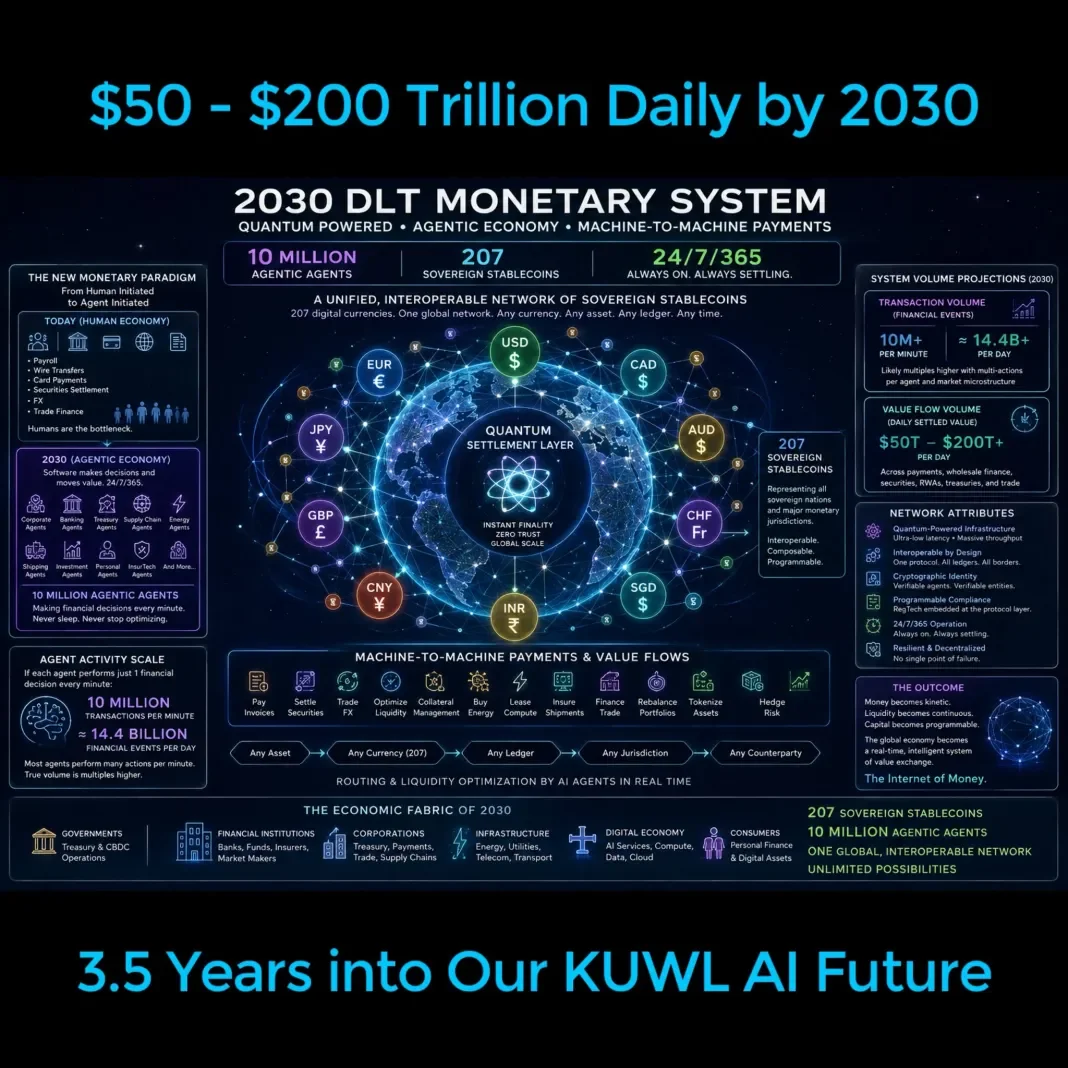
By 2030, imagine a world where:
• 10,000,000 AI agents work 24/7/365
• 207 sovereign stablecoins represent national currencies
• Every major asset can be tokenized
• Every payment network can interoperate
• Every financial decision is programmable
• 10x to 40x greater daily value settled than today
Now stop thinking about people sending payments.
Start thinking about software moving value.
Every minute…
AI treasury agents rebalance liquidity.
Supply-chain agents finance inventory.
Energy agents buy electricity.
Investment agents hedge risk.
Insurance agents settle claims.
Trade agents finance invoices.
Corporate agents optimize working capital.
Personal agents negotiate prices, pay bills, and manage investments.
None of them sleep.
None wait for banking hours.
None care what country they’re in.
Every minute, millions of autonomous financial decisions are e******d simultaneously.
Even if each AI agent performs just ONE financial action every minute…
That’s approximately:
• 10 million financial events every minute
• 14.4 billion every day
• More than 5 TRILLION every year
And that’s before considering that many industrial AI systems could e*****e numerous financial decisions each minute.
The real breakthrough isn’t faster payments.
It’s continuous capital optimization.
Money no longer waits.
Liquidity no longer sleeps.
Capital no longer sits idle.
It continuously searches for its highest-value use.
Now connect 207 sovereign digital currencies.
Not into one global currency…
But into one interoperable monetary fabric.
Every currency remains sovereign.
Every jurisdiction keeps control.
Yet every participant can exchange value with every other participant through open interoperability.
Think about what the Internet did for information.
Now imagine the same transformation for VALUE.
Instead of:
USD → EUR
You get:
Any Asset ⇄ Any Currency ⇄ Any Ledger ⇄ Any Jurisdiction ⇄ Any Counterparty
Instantly.
Continuously.
Programmatically.
This isn’t simply a faster banking system.
It’s an operating system for the global economy.
The biggest winners may not be those who move money.
They may be those who provide the liquidity, interoperability, security, identity, and trust that allow billions of autonomous financial decisions to occur every single day.
The Internet connected information.
The next decade may connect value itself.
Source(s):
• https://x.com/KuwlShow/status/2084837757436743956
Seeds of Wisdom RV and Economics Updates Wednesday Afternoon 8-5-26
Good Afternoon Dinar Recaps,
Hormuz Diplomacy Continues: Markets Bet on Lower Energy Prices While Key Risks Remain
Ongoing U.S.–Iran diplomatic efforts are easing pressure on global energy markets, but unresolved security and nuclear issues continue to leave investors watching for the next major development.
Good Afternoon Dinar Recaps,
Hormuz Diplomacy Continues: Markets Bet on Lower Energy Prices While Key Risks Remain
Ongoing U.S.–Iran diplomatic efforts are easing pressure on global energy markets, but unresolved security and nuclear issues continue to leave investors watching for the next major development.
Overview
Diplomatic discussions between the United States and Iran continue, raising cautious optimism that further progress could reduce tensions surrounding the Strait of Hormuz, one of the world's most important energy corridors. Although no final agreement has been announced, recent statements from U.S. officials have encouraged financial markets.
Investors responded by pushing oil prices lower, while global equity markets strengthened as traders priced in a reduced risk of major supply disruptions. Lower energy prices also helped reinforce expectations that inflation could continue moderating in the months ahead.
At the same time, significant issues remain unresolved, including Iran's nuclear program, regional security concerns, and the long-term framework for any future agreement. Markets are treating the negotiations as a positive development—but not yet a permanent solution.
If diplomacy continues to advance, the benefits could extend far beyond the Middle East by improving global trade, lowering transportation costs, and reducing inflationary pressures across many economies.
Key Developments
1. Diplomatic Talks Continue
Senior U.S. officials indicated that negotiations with Iran remain active, with both sides continuing discussions aimed at reducing regional tensions.
Markets are closely monitoring any announcement of a formal agreement.
Diplomatic progress has improved investor confidence, even without a finalized deal.
2. Oil Markets Respond Favorably
Crude oil prices eased as traders reduced the geopolitical risk premium that had built into energy markets during recent military tensions.
Lower oil prices help reduce fuel and transportation costs.
Energy markets remain sensitive to any setback in negotiations.
3. Strait of Hormuz Remains Critical
The Strait of Hormuz continues to serve as one of the world's most important energy chokepoints, carrying a substantial share of global crude oil exports.
Safe navigation remains essential for global energy security.
Shipping companies continue monitoring regional military activity.
4. Inflation Outlook Improves
Declining energy prices have strengthened expectations that inflation pressures may continue easing.
Lower energy costs reduce expenses throughout the economy.
Central banks may gain greater flexibility if inflation continues to moderate.
5. Financial Markets Look Beyond the Headlines
While equity markets have welcomed the diplomatic progress, investors recognize that negotiations remain ongoing.
Treasury yields have eased as inflation expectations softened.
Markets continue balancing optimism with caution until concrete agreements are finalized.
Why It Matters
Energy prices influence nearly every sector of the global economy. When oil prices fall, businesses often experience lower operating costs while consumers benefit from reduced fuel and transportation expenses.
For central banks, lower inflation pressure can reduce the need for tighter monetary policy, helping stabilize borrowing costs, government debt financing, and financial markets.
Although diplomacy has improved market sentiment, lasting stability will depend on whether negotiations produce durable agreements rather than temporary pauses in tensions.
Why It Matters to Foreign Currency Holders
Lower energy costs can strengthen confidence in global financial markets.
Reduced inflation may support greater stability in exchange rates.
Improved trade flows can enhance international capital movement.
Central bank policy decisions remain an important factor influencing currency valuations.
Implications for the Global Reset
Pillar: Energy
Progress in diplomatic negotiations could improve stability in one of the world's most important energy corridors. More reliable energy supplies help reduce inflation risks and strengthen global economic confidence.
Pillar: Trade
Safer shipping through the Strait of Hormuz supports global commerce by lowering transportation costs and reducing supply chain uncertainty. Stable trade routes remain essential for international economic growth.
Conclusion
Markets are increasingly betting that diplomacy can reduce geopolitical risk and stabilize global energy supplies, but important challenges remain unresolved.
The current market response reflects optimism that negotiations will continue moving in a constructive direction while recognizing that setbacks remain possible.
This is not simply about diplomacy—it reflects how energy security, global trade, and financial stability remain deeply interconnected as governments work to reduce geopolitical risk and strengthen the foundations of the global financial system.
Seeds of Wisdom Team
Newshounds News™ Exclusive
Sources
Reuters — "Global Markets Rise as Investors Watch U.S.–Iran Diplomacy and Energy Prices"
Reuters — "Oil Prices Ease as Markets Monitor Middle East Developments"
~~~~~~~~~~
Seeds of Wisdom Team RV Currency Facts Youtube and Rumble
Newshound's News Telegram Room Link
RV Facts with Proof Links Link
RV Updates Proof links - Facts Link
Start Here room with Most Asked Questions Link
Follow the Gold/Silver Rate COMEX
Follow Fast Facts
Seeds of Wisdom Team™Website
Thank you Dinar Recaps
What Iraq’s Liquidity Crisis means for the IQD
What Iraq’s Liquidity Crisis means for the IQD
The Dinar Den: 8-4-2026
In the complex landscape of international finance and emerging markets, few topics generate as much discussion as the Iraqi Dinar (IQD). Recently, Stephen of The Dinar Den, a seasoned entrepreneur and long-term investor in the region, shared a comprehensive update regarding the current state of Iraq’s economy.
His insights provide a necessary reality check against common rumors, focusing instead on the structural hurdles and the massive potential for reform currently unfolding within the nation.
What Iraq’s Liquidity Crisis means for the IQD
The Dinar Den: 8-4-2026
In the complex landscape of international finance and emerging markets, few topics generate as much discussion as the Iraqi Dinar (IQD). Recently, Stephen of The Dinar Den, a seasoned entrepreneur and long-term investor in the region, shared a comprehensive update regarding the current state of Iraq’s economy.
His insights provide a necessary reality check against common rumors, focusing instead on the structural hurdles and the massive potential for reform currently unfolding within the nation.
A primary point of confusion for many observers is how a nation can be “wealthy” yet struggle to pay government salaries. As Stephen points out, Iraq currently holds approximately $94 billion in foreign currency reserves, supplemented by significant gold assets. However, these reserves do not equate to immediate government liquidity.
There is a fundamental distinction between the Central Bank of Iraq (CBI) and the Iraqi government; they are separate entities with distinct mandates.
The CBI’s reserves are held to back the currency and ensure monetary stability, and these funds cannot be simply transferred to the government’s general fund to cover operational costs. This separation is a hallmark of a modernizing financial system, but it also means that when oil revenues—the government’s primary source of income—decline due to export disruptions, a liquidity crisis can occur despite the presence of high central bank reserves.
While a liquidity crisis is undoubtedly challenging for the Iraqi people, Stephen frames this period as a vital catalyst for long-overdue fiscal and administrative reforms.
For decades, Iraq has been heavily dependent on oil exports. The current shortfall in revenue is forcing the government to accelerate its “White Paper” initiatives, which aim to diversify the economy.
These reforms are not just about finding new revenue streams; they are about building a sustainable financial infrastructure. Efforts are currently underway to improve tax collection, enhance banking technology, and combat the systemic corruption that has historically hindered growth.
By modernizing the banking sector and moving toward a more transparent digital economy, Iraq is positioning itself to be more attractive to foreign direct investment, which is essential for long-term stability.
The geopolitical and financial shifts within Iraq suggest a turning point in its economic trajectory. The arrival of a new Prime Minister and a new Central Bank Governor, combined with closer cooperation with the US Treasury, signals a commitment to meeting international financial standards.
Recent oil deal signings and infrastructure projects indicate that Iraq is not just looking to survive the current crisis but is actively restructuring its foundational industries. This collaboration with international bodies is designed to integrate Iraq more fully into the global financial system, potentially paving the way for a more robust and liquid domestic economy.
For those following the Iraqi Dinar, the question of revaluation is always at the forefront. Stephen emphasizes that while the progress toward financial modernization is significant, the timing of any exchange rate change remains uncertain and subject to many moving parts. The focus for Iraq right now is stability—ensuring that the budget is passed, salaries are paid, and the banking system is secure enough to support a sovereign currency.
The current economic climate in Iraq is one of transition. By moving away from a mono-resource economy and toward a diversified, modern financial state, Iraq is laying the groundwork for a more prosperous future. While the road is filled with challenges, the shift toward transparency and reform is a positive sign for investors and the Iraqi people alike.