
News, Rumors and Opinions Sunday 5-24-2026
KTFA:
Clare: Parliamentary Oil Committee: Passing the oil and gas law is our priority
5/21/2026Economy News – Baghdad
The Oil, Gas and Natural Resources Committee affirmed that one of its priorities is to pass the Oil and Gas Law, which regulates the fair distribution of oil wealth
Committee member Mohammed Al-Fartousi told the official newspaper, as reported by "Al-Eqtisad News," that "one of the committee's priorities in this session is to pass the oil and gas law that regulates the fair distribution of oil wealth," explaining that "this law is considered one of the important laws, especially since Iraq depends on oil for 90 percent of its revenues, so it is not logical that there is no law that regulates the relationship between the federal government and the region, and regulates this wealth, as well as regulating the sale process and the connection of oil to the central government."
KTFA:
Clare: Parliamentary Oil Committee: Passing the oil and gas law is our priority
5/21/2026Economy News – Baghdad
The Oil, Gas and Natural Resources Committee affirmed that one of its priorities is to pass the Oil and Gas Law, which regulates the fair distribution of oil wealth
Committee member Mohammed Al-Fartousi told the official newspaper, as reported by "Al-Eqtisad News," that "one of the committee's priorities in this session is to pass the oil and gas law that regulates the fair distribution of oil wealth," explaining that "this law is considered one of the important laws, especially since Iraq depends on oil for 90 percent of its revenues, so it is not logical that there is no law that regulates the relationship between the federal government and the region, and regulates this wealth, as well as regulating the sale process and the connection of oil to the central government."
He added that "the committee is determined during this session to finalize the oil and gas law, and will consult with all parties as well as legal authorities to issue a draft law that ensures no party is wronged," stressing that "the committee is serious about passing this law."
Al-Fartousi pointed out that "the delay in resuming oil exports via the Ceyhan-Fishkhabur pipeline is due to technical reasons only," noting that "the next government's program must include coordination with the region regarding oil exports and its fields, and all of this is related to the oil and gas law."
He added that "the committee will not start from scratch, but will rely on the previous draft and existing understandings to move towards legislating the law during the next stage." LINK
Jackie: IMHO - Most Powerful Statement in this entire article: “he added that the committee will NOT start from scratch, but will rely on the previous draft and existing understandings to move towards legislating the law during the next stage.” Most powerful comment made! Tremendous Progress, even greater speed here! IMHO
******************
Clare: Al-Alaq: Dollar reserves are secured and transfers are under control
5/21/2026
Baghdad: Hussein Thaghab
The Governor of the Central Bank of Iraq, Ali Al-Alaq, stressed that the bank’s involvement in preparing the federal budget is an “inevitable necessity” to achieve integration between fiscal and monetary policies, noting that this coordination contributes to preventing economic gaps and enhancing financial and monetary stability in the long term.
Al-Alaq explained in an interview with Al-Sabah that the Central Bank possesses accurate indicators and readings related to cash liquidity, foreign reserves, and money supply levels, which makes it a key entity in shaping the state’s general economic policy, in addition to the fiscal policy undertaken by the government and the Ministry of Finance.
He explained that the lack of coordination between the two sides could lead to economic imbalances that affect monetary stability, the exchange rate and inflation levels, stressing that integration between the two institutions contributes to building a more realistic budget and the ability to cope with economic changes.
The Central Bank Governor pointed out the importance of the federal budget including clear economic and development goals, explaining that the bank had previously called for the adoption of a “program budget” instead of traditional formulas, in order to ensure increased spending efficiency and tangible economic results, but this proposal has not yet been implemented.
On the other hand, Al-Alaq affirmed that the Central Bank continues its efforts to support economic stability through managing foreign reserves and controlling liquidity levels, thereby enhancing the confidence of local markets and investors in the Iraqi economy. (Oil revenues)
He said that Iraqi oil revenues are deposited directly in dollars into the Ministry of Finance's account at the Federal Reserve Bank of New York, explaining that they are transferred to the Central Bank of Iraq's account within 24 hours. A balance is then maintained in the Central Bank's account to meet the country's needs, and the Central Bank manages these reserves by investing them in bonds, gold, and banks.
Other ways to generate profits.
exchange rate
Ali Al-Alaq denied the existence of any governmental or monetary intention to change the exchange rate of the Iraqi dinar against the US dollar, stressing that the current monetary policy focuses on maintaining financial and monetary stability in the country and enhancing confidence in the national economy.
Al-Alaq explained that the Central Bank continues to follow procedures aimed at supporting market stability and controlling liquidity and inflation levels, in order to ensure the stability of the exchange rate and protect the economic environment from financial fluctuations.
Regarding the issue of salaries, Al-Alaq reassured citizens that salaries are “secured for the foreseeable future,” stressing that there are no concerns about the state’s ability to meet its financial obligations, despite the economic challenges facing the country.
He pointed out that Iraq has the potential to overcome the current economic conditions, through a package of financial measures and economic reforms that are being worked on, noting that monetary stability is one of the most prominent factors supporting the national economy and maintaining the confidence of local markets and investors.
The Central Bank Governor stressed the important role that the Financial Stability Board can play in preparing the federal budget, which contributes to achieving a positive economic impact and enhancing coordination between fiscal and monetary policies to ensure the sustainability of economic stability during
The next stage.
external borrowing
Regarding external borrowing, Al-Alaq explained that the need for external borrowing arises when the state’s local resources and savings are unable to finance the requirements of economic development, or to cover the financial deficit resulting from a decrease in revenues (such as the decline in oil prices), noting that the International Monetary Fund imposes conditions and structural reforms in exchange for granting loans.
Regarding the budget deficit, Dr. Al-Alaq emphasized that it was previously a numerical deficit, with the budget ending without a real deficit. However, the situation has changed, and there is now an actual deficit. He warned that the danger of this deficit stems from the fact that it is not a temporary issue but rather reflects a structural and chronic flaw in the economic system, meaning that state revenues...
Limited to the oil sector.
He pointed out that government spending in Iraq is not flexible but fixed and governing, such as salaries, wages, and essential obligations like food and medicine, noting that flexibility comes at the expense of the investment budget, and this affects the country’s economy.
Al-Alaq pointed out that in countries with deep financial markets, there is a possibility of covering the deficit through bonds and loans. However, in Iraq, we need to possess this depth. He reiterated that internal debts are concentrated in government banks and the central bank, and this requires a financial market with effective tools, as the lending capacity of government banks has reached its limit.
To high limits.
parallel market
The Central Bank Governor stressed the importance of converting expenditures into productivity and expanding its base in the country, adding that Iraq is a rich country with great wealth in its various regions.
Al-Alaq, who denied that the Central Bank had a problem in covering the market’s need for dollars, explained that all transfer operations are monitored by the Central Bank, stressing that talk of dollar smuggling is incorrect and that the price in the parallel market is normal in comparison to what is offered in the market.
He stated that Iraq has long-term solutions and can receive major investments, urging the need to regulate the issue of tax collection in all parts of the state and make it beneficial to the federal budget. LINK
Courtesy of Dinar Guru: https://www.dinarguru.com/
Reset Intelligence Iraq is not devaluing the IQD or reducing its citizens' purchasing power. What they are building says the exact opposite.
Frank26 There is a paradigm shift that is occurring inside of Iraq because of the dynamics of the monetary reform that will lead to the explosion of the economic reform...
Stephen We are simply waiting and speculating and trying to figure out when is the revaluation of the Iraqi dinar going to happen? What is the rate going to come out at? Is it going to be 50 cents, 10 cents, a dollar, $3.70? It's sometimes fun to speculate...2026, I think there's a high probability and strong argument we could make for it happening this year...I believe the most optimal month for the dinar revaluation is going to be in August...
Militia Man The diversification that Iraq has attained over the last three years under Al-Sudani has been amazing and set the stage. They couldn't do this all overnight. They had to have things in place...
*************
Jon Dowling Weekly Wrap Up & Latest Financial Updates
5-22-2026
Excerpt: Domestically, the United States is poised for a period of legislative activity and financial transformation.
Congress is anticipating the passage of several important bills, including key legislation related to intelligence oversight, housing, and regulatory clarity, all within the coming weeks.
These legislative actions are reportedly part of a broader timeline leading up to significant public announcements later in the summer.
In parallel, the financial sector is on the cusp of major innovation, with the US Securities and Exchange Commission (SEC) expected to approve the tokenization of corporate assets, a move that could unlock substantial value within blockchain-based systems.
These developments are supported by upcoming changes to the banking system and the integration of digital currencies into mainstream finance, marking a significant evolution towards a more digitized financial future under new leadership at the Federal Reserve.
FRANK26….5-23-26….THE UGLY GIRLFRIEND
KTFA
Saturday Night Video
FRANK26….5-23-26….THE UGLY GIRLFRIEND
This video is in Frank’s and his team’s opinion only
Frank’s team is Walkingstick, Eddie and Omar in Iraq and guests
Playback Number: 605-313-5163 PIN: 156996#
KTFA
Saturday Night Video
FRANK26….5-23-26….THE UGLY GIRLFRIEND
This video is in Frank’s and his team’s opinion only
Frank’s team is Walkingstick, Eddie and Omar in Iraq and guests
Playback Number: 605-313-5163 PIN: 156996#
Seeds of Wisdom RV and Economics Updates Sunday Morning 5-24-26
Good Morning Dinar Recaps,
Iran Rejects Compromise as High-Stakes U.S. Talks Threaten Energy Stability
Tehran signals resistance as Pakistan mediation efforts continue amid rising fears over Hormuz disruptions, energy shocks, and broader geopolitical fragmentation.
Good Morning Dinar Recaps,
Iran Rejects Compromise as High-Stakes U.S. Talks Threaten Energy Stability
Tehran signals resistance as Pakistan mediation efforts continue amid rising fears over Hormuz disruptions, energy shocks, and broader geopolitical fragmentation.
Overview
Iran has hardened its negotiating position in ongoing indirect talks with the United States, with Parliament Speaker Mohammad Baqer Qalibaf declaring that Tehran will not compromise on what it considers its sovereign rights. The remarks came during meetings in Tehran with Pakistani Army Chief Asim Munir, whose government continues acting as a quiet intermediary between Washington and Tehran.
The developments arrive at a critical moment for global markets. Continued instability surrounding the Strait of Hormuz — one of the world’s most important energy corridors — is fueling concerns over oil supply disruptions, inflation pressures, and broader financial instability. The negotiations are increasingly viewed not only as a regional security issue, but as a major factor shaping the evolving global economic order.
Key Developments
1. Iran Signals Hardline Position in Negotiations
Qalibaf warned that the United States remains “untrustworthy” in negotiations and insisted Iran would continue defending its national interests through both diplomacy and military preparedness. Iranian officials reportedly shared a detailed 14-point negotiation framework during discussions with Pakistani mediators.
The comments suggest Tehran is unwilling to make rapid concessions on critical issues such as uranium enrichment, regional influence, or military capabilities despite mounting economic pressure.
2. Pakistan Expands Its Role as Regional Mediator
Pakistan continues positioning itself as one of the few countries maintaining active communication with both Washington and Tehran. General Asim Munir met not only with Qalibaf, but also with Iranian President Masoud Pezeshkian and Foreign Minister Abbas Araqchi during the diplomatic visit.
Islamabad’s growing involvement highlights the increasing role of regional middle powers in managing geopolitical crises as traditional global alliances become more fragmented.
3. Strait of Hormuz Remains Central Flashpoint
Shipping disruptions through the Strait of Hormuz continue impacting global energy markets. The narrow waterway previously handled roughly one-fifth of global oil and LNG shipments, making any instability there a direct threat to international trade and inflation control efforts.
Markets remain highly sensitive to any indication that negotiations could either stabilize or further destabilize Gulf shipping routes.
4. Global Financial Risks Continue Rising
Although U.S. Secretary of State Marco Rubio acknowledged some progress in negotiations, significant disagreements remain unresolved. Investors continue monitoring the situation closely as energy volatility contributes to inflation fears, rising shipping costs, and uncertainty across global markets.
The longer tensions persist, the greater the risk of broader economic spillover effects impacting currencies, bond markets, and international trade flows.
Why It Matters
The ongoing U.S.-Iran confrontation is becoming increasingly tied to broader discussions surrounding the future of global financial stability and geopolitical power shifts. Energy security, shipping access, sanctions policy, and strategic resource control are now directly influencing international monetary systems and global market confidence.
The crisis also reflects the growing transition toward a more fragmented multipolar environment, where regional powers and alternative diplomatic channels are playing larger roles in managing conflicts once dominated by Western-led institutions.
Why It Matters to Foreign Currency Holders
For foreign currency investors and global reset observers, prolonged instability in the Gulf could accelerate several major trends already underway:
Increased pressure on fiat currencies through inflation and energy shocks
Growing diversification away from U.S.-centric systems
Greater volatility in commodity-linked currencies
Rising interest in alternative payment systems and strategic reserves
Expanded geopolitical influence for BRICS-aligned nations and regional mediators
As energy corridors become politicized, financial systems tied heavily to global trade flows may experience increasing stress and realignment pressures.
Implications for the Global Reset
Pillar 1: Energy Security Reshapes Financial Power
Control over strategic trade routes such as the Strait of Hormuz is becoming deeply connected to currency stability, inflation management, and sovereign debt conditions. Nations that secure stable energy access may gain increasing influence over future trade and settlement systems.
Pillar 2: Multipolar Diplomacy Accelerates
Pakistan’s role in mediation reflects the rise of alternative diplomatic actors outside traditional Western power structures. This trend aligns with the broader movement toward a more decentralized geopolitical and financial order.
This is not just a regional conflict — it is a growing stress test for the future balance of global finance, energy security, and geopolitical influence.
Seeds of Wisdom Team
Newshounds News™ Exclusive
Sources
Modern Diplomacy — “Iran: Qalibaf Says It Will Not Compromise in Talks With US”
Reuters — “Pakistan continues mediation efforts between Iran and United States amid Gulf tensions”
~~~~~~~~~~
🌱A Message to Our Currency Holders🌱
If you’ve been holding foreign currency for many years, you were not foolish.
You were not wrong to believe the global financial system would change.
What failed was not your patience — it was the information you were given.
For years, dates, rumors, and personalities replaced facts, structure, and proof. “This week” predictions created cycles of hope and disappointment that were never based on how currencies actually change.
That is not your failure.
Our mission here is different: • No dates • No rates • No hype • No gurus
Instead, we focus on:
• Verifiable developments • Institutional evidence
• Global financial structure • Where countries actually sit in the process
Currency value changes only come after sovereignty, trade, banking, settlement systems, and fiscal coordination are in place. History and institutions confirm this sequence.
You will see silence. You will see denials. That is not delay — that is discipline.
Protect your identity. Organize your documents. Verify everything.
Never hand your discernment to anyone who cannot show proof.
You deserve truth — not timelines.
Seeds of Wisdom Team
Newshounds News™
~~~~~~~~~~
Seeds of Wisdom Team RV Currency Facts Youtube and Rumble
Newshound's News Telegram Room Link
RV Facts with Proof Links Link
RV Updates Proof links - Facts Link
Follow the Gold/Silver Rate COMEX
Follow Fast Facts
Seeds of Wisdom Team™Website
Thank you Dinar Recaps
Iraq Economic News and Points To Ponder Sunday Morning 5-23-26
Central Bank Governor: Banking reform is receiving direct attention from the Prime Minister
Baghdad – WAA The Governor of the Central Bank of Iraq, Ali Al-Alaq, confirmed on Tuesday that there is no intention to reduce the exchange rate of the dinar against the dollar. While denying the existence of any American embargo on Iraqi funds, he indicated that the banking reform file is receiving direct attention from Prime Minister Ali Al-Zubaidi.
Al-Alaq told a number of journalists, as reported by the Iraqi News Agency (INA), that “there is no intention to reduce the exchange rate of the dinar against the dollar, and we will help the government overcome the repercussions of any potential closure of the Strait of Hormuz by discounting treasury bonds and securing salaries,” noting that “the cash reserves are currently being invested in several countries, and there is no American embargo on Iraqi funds.”
Central Bank Governor: Banking reform is receiving direct attention from the Prime Minister
Baghdad – WAA The Governor of the Central Bank of Iraq, Ali Al-Alaq, confirmed on Tuesday that there is no intention to reduce the exchange rate of the dinar against the dollar. While denying the existence of any American embargo on Iraqi funds, he indicated that the banking reform file is receiving direct attention from Prime Minister Ali Al-Zubaidi.
Al-Alaq told a number of journalists, as reported by the Iraqi News Agency (INA), that “there is no intention to reduce the exchange rate of the dinar against the dollar, and we will help the government overcome the repercussions of any potential closure of the Strait of Hormuz by discounting treasury bonds and securing salaries,” noting that “the cash reserves are currently being invested in several countries, and there is no American embargo on Iraqi funds.”
He added that "the US Treasury and the Federal Reserve praise the role of the central bank," noting that "the central bank provides dollars to travelers and traders at the official rate."
He explained that "most banks have reached the stage of merger or liquidation, and only one or two banks remain that are unable to continue," stressing that "the banking reform file is receiving direct attention from the Prime Minister, and there is an expected meeting in the coming days with the Federal Reserve and the US Treasury Department."
He confirmed that he "directly oversees the banking reforms file, and the banks concerned and the consulting firm have made significant progress in implementing the reform requirements," noting that "a meeting is expected in the coming days that will bring together Oliver Wyman and the Central Bank of Iraq with the US Federal Reserve and the US Treasury Department."
He added: “The meeting will pave the way for the transition to dealing in other foreign currencies for banks that have completed all the required requirements and procedures,” noting that “there is no truth to what is being said about the Central Bank obstructing banking reforms, and our interest lies in the return of the deprived banks to activity as quickly as possible.”
He concluded by saying: "The media has a major role, and the international community is watching with interest what is being said by parliamentarians, analysts, and local media." https://ina.iq/ar/economie/263703-.html
Ali al-Alaq: Central Bank Participation in Budget Drafting Is Essential
The Governor of the Central Bank of Iraq (CBI) stressed the need for stronger coordination between fiscal and monetary policy, stating that the bank’s involvement in budget preparation helps prevent an economic gap.
Coordination Between Fiscal and Monetary Policy
CBI Governor Ali al-Alaq said that the participation of the Central Bank in drafting the state budget is essential to ensure complementarity between fiscal and monetary policies.
He noted that such coordination helps prevent economic disparities and strengthens long-term fiscal and monetary stability.
Role of the Central Bank in Economic Policy
Al-Alaq explained that the Central Bank has detailed indicators and data on cash flow, foreign reserves, and money supply levels. Therefore, it must play a key role in shaping the country’s overall economic policy alongside the fiscal policies implemented by the government and the Ministry of Finance.
He also emphasized that a lack of coordination directly affects prices and inflation levels.
Toward a More Balanced Budget Framework
Al-Alaq stated that coordination between the two institutions would lead to a more realistic and balanced budget capable of responding to economic changes.
These remarks come as the Iraqi government has yet to prepare the 2026 budget, with indications that a budget law for this year is unlikely.
Al-Zaidi Emphasizes Economic Reforms and Stability Initiatives
In his first official address after becoming prime minister, Ali Faleh al-Zaidi underlined that one of the “top priorities” for his government is initiating a comprehensive economic and financial reform program.
He highlighted the program aims at "building a strong, diversified, and sustainable national economy that does not rely on a single resource.”
Al-Zaidi also chaired a meeting of the Financial Stability Council earlier this week with the CBI governor and the minister of finance, during which he underscored the importance of making financial decisions that support stability in a way that positively impacts the government’s development, service, and economic plans. https://channel8.com/english/news/58421
Political Consensus Paves The Way For The Passage Of The Oil And Gas Law.
2026/05/19 Baghdad: Jinan Al-Asadi The Iraqi Parliament is preparing to introduce the draft oil and gas law in the coming period, amid indications of a political consensus among most blocs to pass it. MP Adel al-Mahalawi, from the Progress Bloc, told Al-Sabah newspaper that the law will be presented to Parliament soon after political understandings are reached.
He explained that Prime Minister Ali al-Zubaidi has expressed his willingness to cooperate in finalizing legislation with an economic dimension. He clarified that the law is considered one of the most anticipated pieces of legislation, as it regulates the relationship between the federal government and the oil-producing provinces and contributes to supporting the budget and boosting revenues.
Al-Mahalawi added that some technical and political disagreements still exist, but they are resolvable through national consensus. He also noted Parliament's intention to introduce a set of service and economic laws in the coming period in coordination with the government. https://alsabaah.iq/132587-.html
Lebanese News: US General Petraeus's Visit To Baghdad Brings Back Memories Of The "Sunni Awakening" Project
Baghdad - One News 5/23/2026 Sunni Awakening project that became associated with his name after 2007.
According to the Lebanese newspaper Al-Akhbar, the visit coincided with political changes that accompanied the formation of the new government, most notably the exclusion of factional forces from the first ministerial batch, in addition to growing talk within political circles about unannounced understandings between Baghdad and Washington regarding the Popular Mobilization Forces and the restructuring of the security landscape in Iraq.
Iraqi political sources indicate that Petraeus discussed during his meetings with government officials and security leaders American visions for reorganizing the Iraqi security establishment, within a vision that considers the continuation of the current form of the Popular Mobilization Forces to be an obstacle to the stability of Iraq and its regional relations.https://1news-iq.net/الاخبار-اللبنانية-زيارة-الجنرال-الأم/
Masrour Barzani And Ali Al-Zaidi Hold A Bilateral Meeting In Baghdad
Latest News Baghdad - One News 5/23/2026 Meanwhile, the Prime Minister of the Kurdistan Region, Masrour Barzani , and the Prime Minister of the Federal Government, Ali al-Zaidi , held a bilateral meeting at the Government Palace in the Iraqi capital, Baghdad .
The Prime Minister of the Kurdistan Region arrived in Baghdad on Saturday afternoon, leading a high-level government delegation, for a two-day visit.
During his visit, Masrour Barzani is scheduled to hold a series of meetings with the Federal Prime Minister al-Zaidi, the Speaker of Parliament, and the Head of the Supreme Judicial Council, along with a number of senior officials and leaders of political forces.
The talks will address the latest developments and updates on the Iraqi and regional scenes, as well as discuss contentious issues and outstanding files between the Kurdistan Region and the Federal Government, in accordance with the provisions of the Constitution and in a manner that guarantees the rights of all components of the country.
https://1news-iq.net/مسرور-بارزاني-وعلي-الزيدي-يعقدان-اجتم/
Iraqi And Kurdish Premiers Seek Agreement On Longstanding Disputes
026-05-23 / 05:18 Shafaq News- Baghdad/ Erbil Iraqi Prime Minister Ali Al-Zaidi and Kurdistan Region Prime Minister Masrour Barzani on Saturday launched talks in Baghdad focused on oil exports, border crossings, customs procedures, and revenue-sharing arrangements between Baghdad and Erbil.
During the discussions, which also addressed implementation of the UN-developed ASYCUDA customs platform and coordination over oil companies operating in the Kurdistan Region, Al-Zaidi stated that his government was seeking to resolve outstanding issues “according to the law and constitution,” adding that Baghdad aimed to reach an agreement serving “the interests of the country and its people.” مكتب الاعلامي لرئيس الوزراء العراقي
pdooeStrns2gfl06ch55g9g61998uc2260lt11t92g04hl0i2t1a6ugiu83m ·
Prime Minister Ali Falah Al-Zaidi Emphasizes The Government's Keenness To Cooperate With The Regional Government To Resolve Technical Issues
Today Saturday, the Prime Minister, Mr. Ali Falah Al-Zaidi, the Prime Minister of the Kurdistan Region of Iraq, Mr. Masrour Barzani, and his accompanying delegation.
During the meeting, the research of the situation in the country, discussion of technical issues related to border port files, implementation of Asikoda system and oil companies operating in the region was emphasized, the opportunity for high coordination and cooperation between the federal government and the regional government, to manage technical issues and to lower obstacles to them in accordance with law and constitution.
His majesty emphasized the diligence to solve all issues, in line with the vision of the government that aims to serve citizens with different components, demonstrating that everyone is partners in this country, and that its goal is to reach an agreement that fulfills the interests of the country and serve its people.
On his part, Mr. President of the Iraqi Kurdistan Region Government renewed his congratulations to Mr. Al-Zaidi, on the occasion of his confidence in the House of Representatives and the formation of the new government, and expressed his support of the regional government for the ministerial cabinet, he also stressed the importance of radical resolving all technical issues in accordance with the Constitution.
•••••
Media office of the Prime Minister 23- MAY-2026
Barzani, meanwhile, stressed the importance of resolving disputes under the constitution while respecting the Kurdistan Region’s federal status.
His two-day visit to the capital will also include meetings with Iraqi Parliament Speaker Haibet Al-Halbousi, Supreme Judicial Council President Faiq Ziidan, and senior political leaders, marking one of the first major engagements between Baghdad and Erbil since Al-Zaidi’s government gained confidence on May 14.
In March, Baghdad and Erbil reached an agreement to resume Kurdish crude exports through the Iraq-Turkiye pipeline following nearly two years of disruption, with exports resuming at around 170,000 barrels per day.
Despite the agreement, negotiations have continued over payment mechanisms, revenue-sharing arrangements, and guarantees demanded by foreign oil companies operating in the Region, including members of the Association of the Petroleum Industry of Kurdistan (APIKUR).
The strategic importance of northern export routes has also increased following months of disruption to maritime shipping through the Strait of Hormuz, which Iran closed and the United States blockaded during their conflict.
Read more: Iraq's oil lifeline is blocked: Here is why the crisis runs deeper than Hormuz
Baghdad And Erbil Also Remain Divided Over Federal Budget Transfers And Salary Payments To Kurdistan Region Public Employees.
Earlier this year, the Kurdistan Regional Government’s Ministry of Finance and Economy said Baghdad had transferred only about 41% of the Kurdistan Region’s financial entitlements over the previous three years despite agreements on oil and non-oil revenue sharing, while the federal Finance Ministry argued that salary transfers depend on the Kurdistan Regional Government complying with revenue-sharing obligations under Iraq’s federal budget law.
Read more: Into 2026, Baghdad and Erbil face the same disputes—with higher stakes
https://shafaq.com/en/Iraq/Iraqi-and-Kurdish-premiers-seek-agreement-on-longstanding-disputes
Ali Al-Zaidi's Incomplete Cabinet Faces Iraqi Armed Factions Test
2026-05-22 / 02:12 Shafaq News Iraq’s new Prime Minister, Ali al-Zaidi, entered office under the shadow of an incomplete parliamentary mandate after the Iraqi parliament approved only 14 cabinet ministers, leaving nine key sovereign and service portfolios unresolved, including the ministries of Interior, Defense, and Planning.
The delay has not been viewed as a routine political dispute over appointments. Instead, it reflects deeper tensions tied to the restructuring of Iraq’s post-2003 political order and the future role of armed Shiite factions within the state apparatus.
Vacant ministries encompass some of Iraq’s most critical institutions, overseeing security, administration, and economic planning. The Interior and Defense portfolios, in particular, remain highly contentious because they are directly tied to the issue of weapons control and the influence of armed factions, a file that lies at the heart of both Baghdad’s relationship with Washington and rivalries within the Shiite political camp.
Amid a highly sensitive regional and international climate, Baghdad faces increasing US pressure alongside escalating competition among factions within the Coordination Framework. At the same time, Iraqi political forces are attempting to craft a governing arrangement capable of containing external demands without upsetting the country’s fragile internal equilibrium.
Read more: Iraq’s armed factions, state authority, and the battle over disarmament
Armed Factions and the Post-2003 Order
One of the most significant transformations in Iraq since 2003 has been the evolution of armed factions from military actors into influential political stakeholders with direct leverage over state institutions. Many of these groups expanded their influence during the war against ISIS and now maintain substantial parliamentary, political, and economic power that major Iraqi parties can no longer ignore.
Political researcher Ramadan Al-Badran told Shafaq News that the issue of armed factions is simultaneously a domestic Iraqi crisis and part of a broader regional confrontation. “The factions’ relationship with Iran makes them part of the wider tension between Tehran and Washington,” Al-Badran said, arguing that the post-2003 political system, particularly during the governments of former Prime Minister Nouri Al-Maliki between 2006 and 2014, “effectively legitimized the presence of these groups by presenting them as defenders of Iraq’s political order.”
He questioned the current calls to limit factional influence, asking why parallel military formations were established outside the traditional army structure in the first place and why they are now being asked to retreat after years of participating in protecting the state.
Read more: Ali Al-Zaidi sworn in as Iraq's prime minister with a program already failed
A Consensus Prime Minister
Observers interviewed by Shafaq News said Al-Zaidi’s selection was less the result of political dominance within the Coordination Framework than a compromise among competing Shiite forces seeking a figure capable of managing internal rivalries.
Haitham Hadi Numan, Professor of Political Science at the University of Exeter, noted that Al-Zaidi emerged as a consensus candidate acceptable to the major factions inside the alliance, and the forces within the Coordination Framework now possess relatively balanced influence that prevents any single party from dominating. “Therefore, they chose a figure who can be politically managed.”
According to Numan, confrontation with armed factions “remains unlikely” in the current phase. Instead, Iraq’s ruling forces appear more inclined toward the “legal institutionalization” of these groups within state structures.
Read more: The Shiite Coordination Framework: Can govern Iraq, but cannot agree on a primeminister
Factions Push Back
Pillar One of al-Zaidi’s program commits the government to consolidating all weapons under exclusive state authority, meaning no armed group outside the formal military and security structure should operate independently. In most countries, this would be an unremarkable statement, but in Iraq, it is the central unresolved dilemma of the post-2003 political order.
Signs of resistance quickly emerged. Harakat Hezbollah al-Nujaba rejected suggestions that the government’s pledge to limit weapons to state authority applies to what it called “resistance weapons.”
The group’s Executive Council chief, Nazem Al-Saadi, stressed that the term “uncontrolled weapons” referred only to illegal arms that create “chaos,” insisting that it did not include weapons held by fighters who “defended Iraq, its holy sites, and its people during the most difficult circumstances.”
At the same time, new fractures appear to be emerging within the Coordination Framework itself.
A well-informed source revealed to Shafaq News that five influential Shiite leaders are holding advanced discussions to establish a new parliamentary alliance that could significantly reshape Iraq’s ruling coalition landscape.
The figures involved include Nouri Al-Maliki, leader of the State of Law Coalition; Hadi Al-Ameri, leader of the Badr Organization and head of the Fatah Alliance; Faleh Al-Fayyad; Humam Hamoudi; and Ahmed al-Asadi.
According to the source, the proposed bloc could include between 75 and 100 lawmakers, potentially making it one of the largest organized opposition forces in parliament despite originating from within the Shiite political establishment itself.
If formed, the alliance would signal not only dissatisfaction with Al-Zaidi’s government arrangements but also deeper competition over the future leadership of the Coordination Framework and the distribution of influence inside the Shiite camp.
Washington Pressure and Baghdad’s Balancing Act
In recent months, Washington has intensified sanctions targeting individuals linked to armed factions while repeatedly stressing that restricting weapons to state control remains a prerequisite for deeper bilateral cooperation with Baghdad.
Iraqi political sources have also spoken of an undeclared American veto against the participation of armed factions in government institutions.
The US Department of State has indicated that its relationship with the new Iraqi government will be judged “by actions, not words,” placing Baghdad in a difficult position. The Iraqi government must preserve the cohesion of its internal alliances while simultaneously avoiding confrontation with Washington, whose support remains critical for Iraq’s economic stability, security cooperation, and international relations.
Read more: Ali al-Zaidi named Iraq's prime minister: Easy nomination, harder road ahead
Iraq’s Unresolved State Dilemma
According to analysts, the troubled birth of Al-Zaidi’s government underscores a structural crisis that extends far beyond cabinet formation or ministerial quotas.
At its core, the conflict concerns the nature of the Iraqi state itself: the limits of armed faction influence, the future of the Popular Mobilization Forces (PMF), and Baghdad’s relationship with competing regional and international powers.
Caught between American pressure, Iranian calculations, and the internal balance of the Coordination Framework, the new prime minister faces a defining challenge: either engineer a new political settlement capable of reorganizing the relationship between the state and armed factions or enter another prolonged phase of political paralysis.
One notable indicator of the current compromise is the absence of any explicit commitment in the government program regarding the future of the PMF or its weapons. That omission raises a central question now dominating Iraq’s political debate: can the PMF become the foundation for a broader political settlement between the state and the factions, or has the issue already moved beyond the limits of purely Iraqi solutions?
Read more: Iraq's new political equation: Armed groups' gains put pressure on US
MilitiaMan & CREW IRAQ DINAR UPDATE-Iraq's Reform: CBI Release Major 5-Year Achievement Report-Timing-Iran?
MilitiaMan & CREW IRAQ DINAR UPDATE-Iraq's Reform: CBI Release Major 5-Year Achievement Report-Timing-Iran?
5-23-2026
The Crew: Samson, PompeyPeter, Petra, Daytrader, Sunkissed, GIGI and Militia Man
No drama. No intrigue. No songs and dances. Just straight, factual news that I read and interpret to the best of my ability after being an avid Dinar investor and insanely obsessed Dinarian for over 15 years.
Follow MM on X == https://x.com/Slashn
MilitiaMan & CREW IRAQ DINAR UPDATE-Iraq's Reform: CBI Release Major 5-Year Achievement Report-Timing-Iran?
5-23-2026
The Crew: Samson, PompeyPeter, Petra, Daytrader, Sunkissed, GIGI and Militia Man
No drama. No intrigue. No songs and dances. Just straight, factual news that I read and interpret to the best of my ability after being an avid Dinar investor and insanely obsessed Dinarian for over 15 years.
Follow MM on X == https://x.com/Slashn
Be sure to listen to full video for all the news……..
URGENT: CBI Announcement and Nuclear Drone Attack Updates
URGENT: CBI Announcement and Nuclear Drone Attack Updates
Edu Matrix: 5-22-2026
Iraq’s Central Bank Governor has issued a serious warning about Iraq’s growing financial crisis, calling the country’s budget deficit “real and chronic.”
In this important report, Sandy Ingram explains what the Central Bank of Iraq is saying about declining oil revenues, rising government debt, IMF loan concerns, and the future stability of the Iraqi dinar (IQD).
URGENT: CBI Announcement and Nuclear Drone Attack Updates
Edu Matrix: 5-22-2026
Iraq’s Central Bank Governor has issued a serious warning about Iraq’s growing financial crisis, calling the country’s budget deficit “real and chronic.”
In this important report, Sandy Ingram explains what the Central Bank of Iraq is saying about declining oil revenues, rising government debt, IMF loan concerns, and the future stability of the Iraqi dinar (IQD).
This verified report discusses Iraq’s dependence on oil income, the dangers of excessive domestic borrowing, and why Iraq may eventually need foreign financial assistance tied to IMF economic reforms.
The CBI Governor also addressed rumors surrounding the Iraqi dinar exchange rate and stated that the Central Bank remains focused on maintaining monetary stability.
This video also covers:
• Iraq’s sharp drop in oil revenues
• International concerns involving Iran-backed militants
• Missile and drone tensions impacting the Middle East
• Why the UAE incident has the region on edge
• Iraq’s remaining funds held in the U.S. Federal Reserve
• New financial cooperation involving Iraq, Germany, Switzerland, and the UK
• Growing pressure for disarmament inside Iraq
• The geopolitical risks now being discussed internationally and at the United Nations
This channel provides verified news and analysis related to Iraq, the IQD, global finance, BRICS developments, Middle East tensions, and international economics.
Watch until the end for the international reports that are making governments across the Middle East extremely nervous.
Ross: IQD RV was Never Possible Until the Strait of Hormuz was Dealt with
Ross: IQD RV was Never Possible Until the Strait of Hormuz was Dealt with
5-23-2026
Iraqi Dinar Revaluation was NEVER Possible Until the Strait of Hormuz Was Dealt With!
Imagine holding the Dinar for 23 years thinking it could revalue any day.
What if it actually did?
Ross: IQD RV was Never Possible Until the Strait of Hormuz was Dealt with
5-23-2026
Iraqi Dinar Revaluation was NEVER Possible Until the Strait of Hormuz Was Dealt With!
Imagine holding the Dinar for 23 years thinking it could revalue any day.
What if it actually did?
You’d have cashed out years ago, retired on a beach with a margarita… but what if the Strait closed after your exchange?
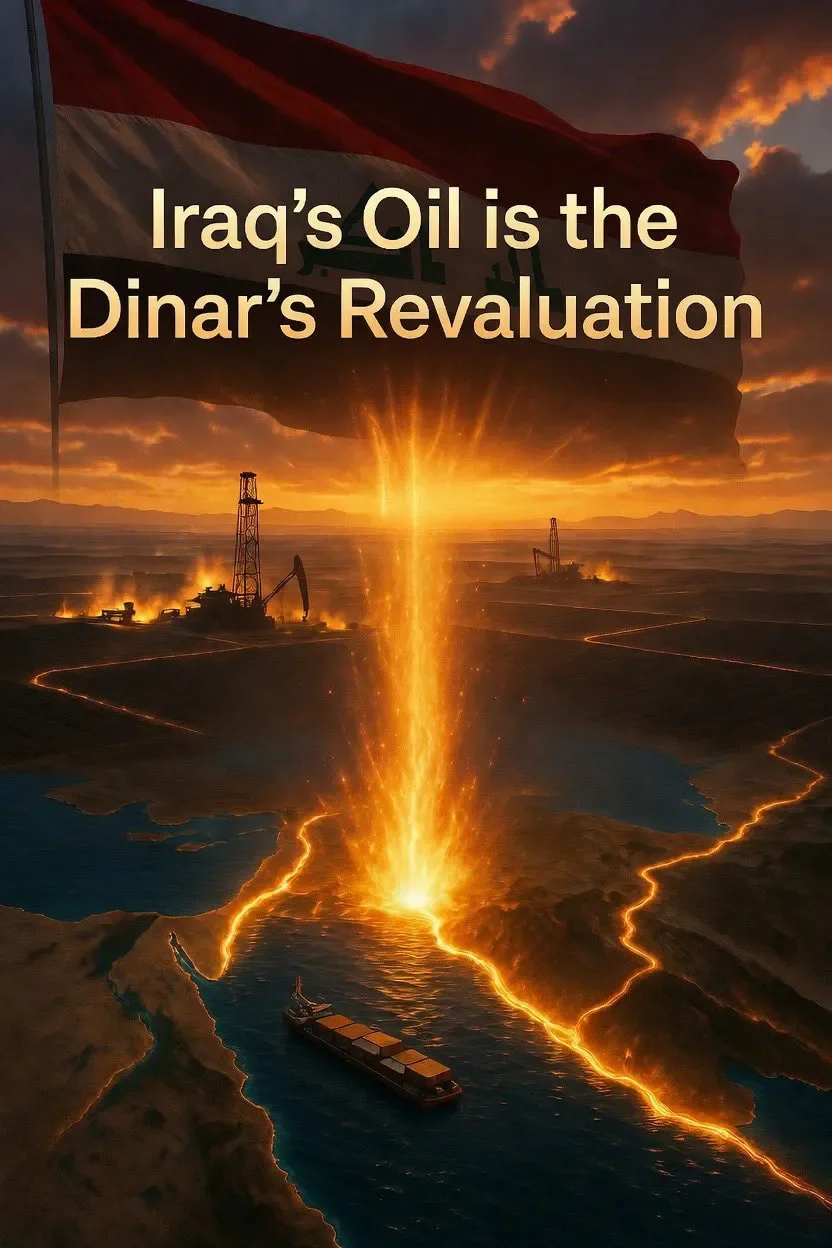
Iraq’s oil exports via Hormuz collapsed 89% in April alone — slashing 90% of government revenue.
You do the math.
What oil revenue would be backing that newly revalued Dinar?
Exactly. Nothing.
And that’s precisely why you’ve waited this long.
Nothing could have sustained the new value.
Iraq’s diversification away from oil revenues will not be solved anytime soon.
The fact that the Strait of Hormuz is closed right now should have you feeling electric about your investment — resolving this is literally the #1 prerequisite to a revaluation.
Iraq isn’t poor. It’s an oil superpower.
5th-largest proven reserves on Earth (147 billion barrels).
Lowest production costs globally.
Still HOLDing $100B in foreign reserves at the CBI.
The Iran War just exposed the old petrodollar/export trap in the most brutal way possible.
Emergency World Bank/IMF loans?
Rapid-response cash. Minimal conditions. Letter of Intent only.
A bridge to pay salaries and keep subsidies alive.
But it piles on more debt in a broken fiat loop.
Iraq can’t keep borrowing forever when its real wealth (oil in the ground + reserves) is massive (but trapped).
The key to the revaluation is unlocking the wealth.
This crisis is the justification for the clean break:
IQD revaluation to actual asset-backed levels — not the artificial low rate tied to the old model.
So how does the choke point finally get dealt with?
Military: Iran’s ability to close the strait is being neutralized
Kirkuk-Ceyhan pipeline to Turkey ramping fast (250k+ bpd)
Basra-Haditha pipeline under construction (2.25M bpd goal)
Basra-Aqaba pipeline to Jordan/Red Sea now on the fast track
Grand Faw Port + Development Road as the ultimate bypass
The foundation is already being built:
New PM + 100-day corruption cleanup governance reset
CBI/Fed & Treasury alignment institutional green light
Railways, energy diversification, HCL progress…. real economic base
“Delete the zeros” project still active …..technical runway laid
Old central-bank debt system cracks under shock sovereign oil wealth backs a new, righteous dinar.
Just like the Fed dying and the US shifting to asset-backed Victory Notes.
XRP pours gasoline on the fire unlocking the $27T trapped globally in nostro/vostro balances.
Iraq’s $100B in foreign reserves suddenly level up to $200–400B in currency strength firepower.
This provides the CBI with the monetary sovereignty to defend a stronger Dinar without the old handcuffs.
Forcing diversification of oil export routes while piling on more debt is the accelerant.
Debt digs the old fiat system even deeper — making the whole broken loop completely unsustainable and forcing the clean break.
The only logical exit from the collapsing debt trap.
I know how you feel… worn out. Beat up. Defeated.
Bills. BS. Life.
But you should really… REALLY be far more bullish than you are or think you are.
This is the Global Currency Reset unfolding right in front of us.
Don’t let ever increasing tolerance for amazing news discount the progress happening right before your eyes on a daily basis.
We are almost there.
Source(s):
• https://x.com/Ross_ptm/status/2058082087102787915
Seeds of Wisdom RV and Economics Updates Saturday Afternoon 5-23-26
Good Afternoon Dinar Recaps,
Iran Conflict Reshapes China-U.S. Rivalry as Global Power Balance Begins to Shift
The prolonged Iran-U.S. confrontation is increasingly being viewed as a geopolitical turning point that may accelerate the transition toward a more multipolar global order.
Good Afternoon Dinar Recaps,
Iran Conflict Reshapes China-U.S. Rivalry as Global Power Balance Begins to Shift
The prolonged Iran-U.S. confrontation is increasingly being viewed as a geopolitical turning point that may accelerate the transition toward a more multipolar global order.
Overview
What began as a regional confrontation between the United States and Iran is now evolving into a much larger strategic test with global implications for the balance of power between Washington and Beijing.
According to growing geopolitical analysis, the Iran conflict has exposed vulnerabilities in U.S. military deterrence, economic resilience, and alliance management while simultaneously creating strategic opportunities for China to expand its influence across global markets and diplomatic networks.
Chinese leadership is reportedly studying the crisis closely as a real-time example of how prolonged geopolitical attrition can weaken even the world’s most powerful military and financial system.
Key Developments
1. Iran’s Resistance Challenges Traditional U.S. Deterrence
The conflict has increasingly highlighted the limits of overwhelming military superiority in modern geopolitical warfare.
Rather than achieving rapid strategic surrender through sanctions and military pressure, the United States now faces a prolonged war of attrition involving shipping disruptions, energy instability, rising inflation pressures, and mounting operational costs.
Iran’s asymmetric strategy — particularly involving the Strait of Hormuz — demonstrated that smaller powers can impose significant economic and political strain without defeating a superior military force outright.
2. China Sees Strategic Overextension in Washington
Chinese analysts reportedly view the Iran crisis as evidence that the United States may be struggling to manage multiple global confrontations simultaneously.
As Washington diverts military resources and diplomatic focus toward the Middle East, Beijing gains additional room to maneuver in the Indo-Pacific region, particularly regarding Taiwan and the South China Sea.
The situation has intensified concerns inside the Pentagon regarding missile stockpiles, air defense systems, and the long-term sustainability of simultaneous geopolitical crises.
3. Economic Pressures Are Weakening Global Confidence
The ongoing conflict has contributed to energy market instability, shipping disruptions, inflation fears, and growing concerns over global supply chains.
China has continued maintaining selective economic ties with Iran despite sanctions pressure, while positioning itself as a more stable and patient economic power compared to what Beijing portrays as increasingly reactive American leadership.
Analysts note that prolonged instability could further accelerate de-dollarization efforts and deepen interest in alternative trade and financial systems.
4. The Crisis Is Reinforcing a Multipolar Global Order
One of the most significant outcomes may be the gradual erosion of confidence in America’s ability to maintain uncontested global leadership.
China increasingly presents itself as a long-term strategic actor focused on economic development, infrastructure, and stability, while portraying U.S. policy as overly dependent on military coercion.
The longer the conflict continues, the more the world may move toward a fragmented international system where power is distributed among several competing centers rather than dominated by a single superpower.
Why It Matters
The Iran conflict is no longer simply a Middle Eastern security issue. It has become part of the broader global struggle involving military power, economic influence, energy security, and financial dominance.
For the first time in decades, a prolonged regional confrontation is visibly testing the durability of U.S. global leadership while simultaneously strengthening China’s strategic position without Beijing directly engaging in military conflict.
The crisis also demonstrates how modern geopolitical competition increasingly revolves around economic endurance, supply chain resilience, and long-term attrition rather than quick battlefield victories.
Why It Matters to Foreign Currency Holders
For foreign currency holders and global reset observers, the situation reinforces growing uncertainty surrounding the future structure of the international monetary and geopolitical system.
Persistent energy instability, inflationary pressure, rising sovereign debt concerns, and declining confidence in traditional global leadership structures may continue accelerating diversification away from a purely U.S.-centered financial order.
China’s expanding economic influence, combined with broader de-dollarization initiatives among BRICS and emerging economies, points toward a future where multiple financial and geopolitical power centers coexist.
Implications for the Global Reset
Pillar 1: Wars of Attrition Are Replacing Traditional Power Projection
Modern conflicts increasingly focus on economic endurance, energy disruption, financial strain, and political exhaustion rather than direct military conquest alone.
The Iran conflict demonstrates how prolonged instability can gradually weaken larger powers over time.
Pillar 2: Multipolar Financial and Geopolitical Systems Are Accelerating
As global confidence fragments, nations are increasingly building parallel economic structures, regional alliances, and alternative payment systems outside traditional Western institutions.
China is leveraging these shifts to expand long-term influence without needing immediate military dominance.
Seeds of Wisdom Team View
The Iran-U.S. confrontation may ultimately be remembered less for the military conflict itself and more for how it exposed deeper structural weaknesses within the existing global order.
China appears to understand that the future contest for global leadership may not depend on defeating America militarily, but rather on patiently outlasting Washington economically, politically, and strategically while global confidence gradually shifts.
The conflict is increasingly becoming a geopolitical laboratory for the next phase of great-power competition — one driven by endurance, economic leverage, supply chains, and financial systems instead of purely conventional warfare.
This is no longer simply a regional war — it is a stress test for the future architecture of global power.
Seeds of Wisdom Team
Newshounds News™ Exclusive
Sources
~~~~~~~~~~
Seeds of Wisdom Team RV Currency Facts Youtube and Rumble
Newshound's News Telegram Room Link
RV Facts with Proof Links Link
RV Updates Proof links - Facts Link
Follow the Gold/Silver Rate COMEX
Follow Fast Facts
Seeds of Wisdom Team™Website
Thank you Dinar Recaps
Iraq Economic News and Points To Ponder Saturday Afternoon 5-23-26
Al-Zaidi And Masrour Barzani Discuss Border Crossings, The Implementation Of The ASYCUDA System, And Oil Companies Operating In The Region.
Money and Business Economy News – Baghdad Prime Minister Ali al-Zaidi expressed his desire on Saturday to resolve the outstanding disputes and issues between Erbil and Baghdad.
During his meeting with Kurdistan Regional Government Prime Minister Masrour Barzani in Baghdad, Al-Zaidi said, "We are all partners in this country, and our goal is to solve problems, reach an agreement, and serve all citizens and communities without discrimination."
Al-Zaidi And Masrour Barzani Discuss Border Crossings, The Implementation Of The ASYCUDA System, And Oil Companies Operating In The Region.
Money and Business Economy News – Baghdad Prime Minister Ali al-Zaidi expressed his desire on Saturday to resolve the outstanding disputes and issues between Erbil and Baghdad.
During his meeting with Kurdistan Regional Government Prime Minister Masrour Barzani in Baghdad, Al-Zaidi said, "We are all partners in this country, and our goal is to solve problems, reach an agreement, and serve all citizens and communities without discrimination."
For his part, he stressed the importance of addressing the contentious issues between the two sides in a radical manner and based on the constitution, while respecting the federal entity of the region.
A statement issued by the Prime Minister’s Media Office stated that the two sides discussed technical issues related to border crossings, the implementation of the ASYCUDA system, and oil companies operating in the region. Emphasis was placed on the availability of high-level coordination and cooperation between the federal government and the regional government to manage technical issues and overcome obstacles to address them in accordance with the law and the constitution.
This morning, the Prime Minister of the Kurdistan Region arrived in Baghdad at the head of a high-level government delegation on a visit aimed at discussing the latest developments and updates on the Iraqi and regional scenes, in addition to discussing the resolution of contentious issues and outstanding files between the Kurdistan Region and the Federal Government in accordance with the provisions of the Constitution and in a manner that guarantees the rights of all components of the country.
https://www.economy-news.net/content.php?id=69433
DeepSec ignites an AI price war: historic discounts of up to 75%
Arabic and international Chinese AI startup DeepSec announced on Saturday that it has made the 75% price reduction on its flagship V4-Pro AI model permanent, stabilizing prices at just a quarter of their original level.
The company did not disclose in its official statement whether this permanent price cut was due to an increase in the supply of Huawei's Ascend 950 chips, which DeepSec relies on to enhance the performance of its model and expand its operations.
As part of this decision, the company has reduced the cost of the V4-Pro's API to between 0.025 and 6 yuan per million tokens (approximately $0.0035 to $0.83) depending on the nature and type of use, down from the previous range of 0.1 to 24 yuan. https://www.economy-news.net/content.php?id=69456
Al-Zaydi: Salaries Must Be Paid On Time, And We Are Preparing The Iraq 2035 Plan.
Money and Business Economy News – Baghdad Prime Minister Ali Faleh al-Zaidi directed the Ministry of Finance on Saturday to release employee salaries and socialprotection payments on time.
A statement from his office, received by "Al-Eqtisad News," stated that "Al-Zidi visited the Ministry of Finance as part of his follow-up on the work of ministries and their executive, service and economic programs."
Al-Zaydi chaired a meeting of the ministry's senior staff and listened to reports concerning the ministry's work in all its departments, where he stressed that Iraq is going through a sensitive financial and economic situation imposed by regional and international developments and their repercussions on the global economy.
Al-Zaydi explained that "these changes have affected Iraq's export capacity and oil revenues, indicating that 90% of the budget depends on oil revenues, and work must be done to expand the non-oil economy and adopt alternatives that support diversification, pointing out the need to be frank with citizens about the financial challenges, without exaggeration or embellishment."
He continued: "We want the Ministry of Finance to draw up the financial policy for Iraq, and we are preparing the Iraq 2035 plan. The ministry must have a clear vision and the budget must be a roadmap for the future."
He pointed out that "the budget must maximize its resources, and it is not possible to continue to rely on oil alone," explaining that "Iraq is a meeting point for the world and we must invest in its geographical location to enhance its revenues."
He added that “employees’ salaries must be released on time, so that there is no message of concern to the people, as well as the salaries of the social protection network,” directing “the preparation of a payment of the dues of farmers, and the dues of contractors and investors, and their rights must not be delayed to ensure the continuation of work.”
He explained that "there is a concept that the state manages the economy, but we want the economy to manage the state, and if the change in concepts is achieved, we will not have to change the people," noting that "the state is not just a budget and allocations, but rather seeks to achieve a high GDP."
He explained that "there are governing and operational expenses that do not reflect positively on development, so we seek to change traditional financial concepts, and we do not want to replicate yesterday's experiences. The role of the state is regulation and monitoring, and we support the private sector, as it is the one that will advance development."
He added: “It is our duty to look after the poor, but we must not continue to operate with a socialist mindset in the economy,” directing that a report be prepared on the customs situation in terms of revenues during the last six months, especially for materials with high customs duties.
He continued: "We noticed that high-customs materials are being replaced with cheaper materials through devious means, and automation will put an end to this manipulation. We have 5,000 doctors contracted with the Ministry of Health, and we have directed that their situations be resolved."
He concluded his speech by saying: "We have circulated a directive not to place pictures of the Prime Minister and ministers in all departments and institutions. We want people to see our work, not our pictures."
https://www.economy-news.net/content.php?id=69435
From $300 To $2.3 Million: Shocking Prices For 2026 World Cup Tickets
Money and Business Economy News - Follow-up Football, the game that was born in the streets, schools and alleys, and which has always been considered the most popular sport in the world, seems today to be at a historic turning point that may change its nature forever.
The 2026 World Cup, which is supposed to be a global celebration of popular passion, has become a source of widespread controversy due to an unprecedented jump in ticket prices and a clear shift towards a business model closer to luxury markets than to mass sports.
From Reasonable Tickets To Shocking Prices
For the first time in the tournament's history, FIFA is adopting a "dynamic pricing" system, a model common in aviation and hotels, where prices change instantly according to demand.
Shocking result
Cheapest ticket in the group stage: around $300
Official final tickets: Exceeded $11,000 and could reach $30,000
In the resale market: Some tickets reached $2.3 million for a single seat
Figures like these are no longer just a price increase, but a radical shift in the philosophy of accessing the world's biggest football event.
Even US President Donald Trump, who contributed to the bid to host the tournament, commented on the prices, telling the New York Post: "Even I wouldn't pay that price."
FIFA Enters The Era Of Profit Maximization
What is happening is not just about increased demand, but a strategic shift in the tournament management model.
FIFA also launched an official platform for reselling tickets, through which it receives commissions from both the seller and the buyer, in a move that reinforced the commercial nature of the tournament.
According to market comparisons, the average ticket prices for the 2026 World Cup are about 6 times higher than the average of the last five editions of the World Cup.
This shift reflects a clear trend: the World Cup is no longer just a sporting event, but a huge entertainment industry based on maximizing revenues.
When Attendance Becomes A Privilege, Not A Right
But the real debate is not just about the numbers, but about what these numbers mean for football itself.
Historically, the stands were not just seats, but a space for the voice of the masses: chants, emotions, pressure on the players, and the spirit that creates the identity of the game.
Today, with prices rising in this way, a fundamental question arises: Will this popular presence remain possible?
Studies in the sociology of sport indicate that wealthier crowds are often less boisterous and enthusiastic inside stadiums, meaning that changing the social composition of the stands may directly affect the "spirit of the game" itself.
Football Between Market And Identity
The transformation we are witnessing today is not separate from the general trend in global sports, where major tournaments are increasingly reliant on huge broadcasting rights, global sponsorships, flexible pricing models, and resale platforms.
But the 2026 World Cup could be the moment when this transformation is most clearly manifested.
While some see these steps as reflecting a "natural economic modernization" of a huge global tournament, others see them as the beginning of football losing its original identity as a popular sport.
The Question That Arises
Are we witnessing a historic edition of the World Cup in terms of revenues, technology, and organization? Or are we witnessing the beginning of a gradual transformation that will make the tournament an elite event, accessible only to those with financial means?
Ultimately, the real question may not be just about ticket prices, but about the future of the game itself: Will football remain the people's game, or will it turn into a luxury show watched only from golden seats?
https://www.economy-news.net/content.php?id=69432
Reuters: A Memorandum Of Understanding To End The War Between Tehran And Washington Is Being Finalized.
Arabic and international Reuters reported on Saturday that a memorandum of understanding to end the war between Tehran and Washington is being finalized.
Reuters quoted a Pakistani security official as saying, "A memorandum of understanding to end the war between Tehran and Washington is being finalized." https://www.economy-news.net/content.php?id=69458
Rob Cunningham: America’s New Monetary System
Rob Cunningham: America’s New Monetary System
5-23-2026
America’s New Monetary System
Phase 1 – The Legal trigger:
CLARITY passes by July 4, 2026. Digital assets receive market-structure certainty. Stablecoin rails become institutionally safe under existing GENIUS Law. Tokenized Treasury settlement accelerates.
Rob Cunningham: America’s New Monetary System
5-23-2026
America’s New Monetary System
Phase 1 – The Legal trigger:
CLARITY passes by July 4, 2026. Digital assets receive market-structure certainty. Stablecoin rails become institutionally safe under existing GENIUS Law. Tokenized Treasury settlement accelerates.
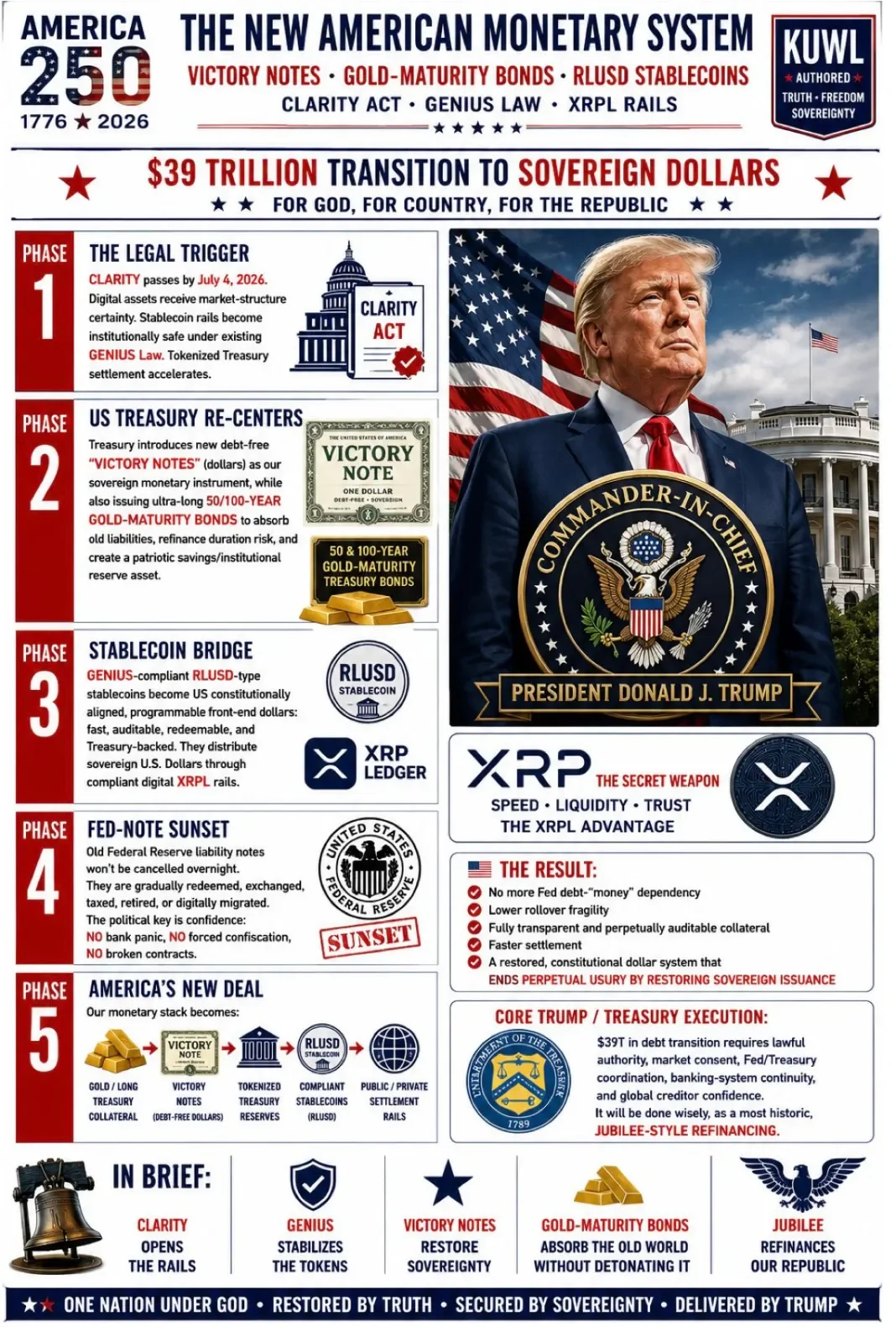
Phase 2 – US Treasury re-centers:
Treasury introduces new debt-free “Victory Notes” (dollars) as our sovereign monetary instrument, while also issuing ultra-long 50/100-year gold-maturity bonds to absorb old liabilities, refinance duration risk, and create a patriotic savings/institutional reserve asset.
Phase 3 – Stablecoin bridge:
GENIUS-compliant RLUSD-type stablecoins become US constitutionally aligned, programmable front-end dollars: fast, auditable, redeemable, and Treasury-backed. They distribute sovereign U.S. Dollars through compliant digital XRPL rails.
Phase 4 – Fed-note sunset:
Old Federal Reserve liability notes won’t be cancelled overnight. They are gradually redeemed, exchanged, taxed, retired, or digitally migrated. The political key is confidence: no bank panic, no forced confiscation, no broken contracts.
Phase 5 – America’s New Deal:
Our monetary stack becomes:
Gold / long Treasury collateral → Victory Notes → tokenized Treasury reserves → compliant stablecoins → public/private settlement rails
The Result:
No more Fed debt-“money” dependency, lower rollover fragility, fully transparent and perpetually auditable collateral, faster settlement, and a restored, constitutional dollar system that ends perpetual usury by restoring sovereign issuance.
Core Trump/Treasury Execution:
$39T in debt transition requires lawful authority, market consent, Fed/Treasury coordination, banking-system continuity, and global creditor confidence. It will be done wisely, as a most historic, Jubilee-style refinancing.
KUWL Summary
CLARITY opens the rails
GENIUS stabilizes the tokens
VICTORY Notes restore monetary sovereignty
GOLD-maturity bonds absorb the old world without detonating it
JUBILEE refinances our Republic
FREEDOM reigns the world over
(This is my conceptual idea of how things logically evolve. Please share your thoughts, alternate scenarios, and let’s ideate to elevate understanding.)
Source(s):
• https://x.com/KuwlShow/status/2056808497002525014
https://dinarchronicles.com/2026/05/23/rob-cunningham-americas-new-monetary-system/
More “Iraq News” Posted by Tishwash at TNT 5-23-2026
TNT:
Tishwash: Masrour Barzani will be in Baghdad next week to discuss the electricity and oil files.
Kurdistan Regional Government Prime Minister Masrour Barzani will head to Baghdad next week, leading a high-level delegation, for a series of talks with the federal government on the electricity and oil sectors.
Aziz Ahmed, Deputy Director of the Prime Minister's Office, stated in a post on the "X" platform that the regional government will present its successful "Ronaki - Electricity" project, which aims to provide 24-hour electricity, during the visit. He emphasized that the delegation will offer technical support to the new Iraqi government to accelerate reforms in the electricity sector across the country.
TNT:
Tishwash: Masrour Barzani will be in Baghdad next week to discuss the electricity and oil files.
Kurdistan Regional Government Prime Minister Masrour Barzani will head to Baghdad next week, leading a high-level delegation, for a series of talks with the federal government on the electricity and oil sectors.
Aziz Ahmed, Deputy Director of the Prime Minister's Office, stated in a post on the "X" platform that the regional government will present its successful "Ronaki - Electricity" project, which aims to provide 24-hour electricity, during the visit. He emphasized that the delegation will offer technical support to the new Iraqi government to accelerate reforms in the electricity sector across the country.
He added that "the Prime Minister will also address the issue of security guarantees necessary to enable oil and gas companies to resume production and export operations, noting that the ongoing drone threats make it difficult for these companies to continue their work." link
Tishwash: Government advisor: The Ministry of Finance is preparing a three-year emergency plan to boost revenues.
The Prime Minister’s financial advisor, Mazhar Muhammad Salih, revealed on Friday five options to address the shortfall in financial revenues and restructure the Iraqi economy, in light of the challenges resulting from the decline in oil exports and the closure of the Strait of Hormuz, while indicating that the Ministry of Finance is moving towards preparing a three-year emergency plan to boost revenues.
Saleh said that "Iraq is facing a financial gap estimated at about $9.5 billion per month as a result of the decline in oil exports," noting that "the Ministry of Finance is moving towards preparing a three-pronged emergency plan that includes internal and external borrowing, in addition to measures to
maximize non-oil revenues through taxes, fees and financial reforms."
He explained that “domestic borrowing is a quick solution to cover salaries and operational obligations, but it may lead to a withdrawal of liquidity from banks, an increase in the cost of local financing, and a weakening of private sector financing, while external borrowing provides liquidity in dollars and maintains relative monetary stability, but it is linked to reform conditions and an increase in debt service burdens.”
He added that “maximizing non-oil revenues is the most strategic option in the medium and long term, through controlling border crossings and customs, automating the tax system, reducing the informal economy, and improving collection without harming economic activity,” noting that “implementing the Government Financial Management Information System (IFMIS) contributes to strengthening financial oversight, reducing waste and corruption, and raising the efficiency of public spending management.”
Saleh stressed that “reforming the banking sector, especially Rafidain and Rasheed banks, is necessary to develop development finance, digital and credit services, as well as the importance of reforming private banks to achieve financial inclusion, support small and medium enterprises and attract investments.”
He explained that “activating the Public-Private Partnership Law would alleviate pressure on the general budget and create new job opportunities, provided that a stable legal environment, investment guarantees, and combating administrative corruption are provided,” stressing that “any emergency plan will not succeed without real financial reform that includes controlling operational spending, reducing waste in government contracts, and adopting spending priorities linked to production and development.”
Saleh explained that "the current crisis represents a real test for the structure of the Iraqi economy, which is dependent on oil," stressing that "accelerating financial and banking reforms and diversifying the economy will enhance the state's ability to cope with geopolitical and economic shocks." libk
************
Tishwash: The US dollar: Can Washington guarantee its continued flow into Iraq under al-Zaidi's rule?
The US dollar has returned to the forefront of political debate, with assurances that Washington will not stop the flow of currency to Iraq during Ali al-Zaidi's government, amid talk of trade and financial ties that make it difficult to impose financial restrictions that could threaten Iraqi economic stability.
Political analyst Adel Al-Manea confirmed that the United States will not prevent the flow of dollars to Iraq during Ali Al-Zaidi’s government, attributing this to the existence of commercial and financial ties with the American side that will exert pressure towards the continued flow of currency to the country.
Al-Mana’ said: “Talk of new alliances or coalitions that include more than 140 MPs does not actually exist at the moment,” considering that “they do not go beyond being political understandings and reactions to what happened during the session to grant confidence to Al-Zidi’s government.”
Al-Mana’a pointed out that “the current political reality within the coordination framework can be described as ‘a harmony of faces and a difference of hearts,’ stressing that ‘the majority of political parties and rational people are pushing towards passing what remains of Al-Zidi’s cabinet according to the convictions of the representatives, away from political pressures.’”
He explained that “one of the political leaders predicted that Hebat al-Halbousi would not continue as Speaker of Parliament after the vote of confidence session,” noting that “the Sadiqun movement will not participate in al-Zidi’s government.”
Regarding the visit of US General David Petraeus to Iraq and his meeting with al-Zaidi, al-Mana’ said, “It came in the context of emphasizing that no factions should participate in al-Zaidi’s government without exception.”
He pointed to “American proposals related to restructuring some security institutions and including the Popular Mobilization Forces within a new security ministry that includes various security agencies.”
Al-Mana’ also suggested that “Qasim Atta will be appointed Minister of Interior after the Eid al-Adha holiday,” revealing that “more than 28 MPs withdrew from the Reconstruction and Development Alliance due to the failure to adhere to some of the promises and understandings that accompanied the formation of the government.”
He stressed that “Al-Zaydi was put forward by a “heavy” figure from outside the coordination framework and was accepted by most political forces in order to end the political deadlock,” emphasizing “the rejection of any tampering with the Popular Mobilization Forces file, as it is an institution established by a law from the House of Representatives.” link
Tishwash: Among them are members of parliament: The US Treasury sanctions nine individuals for allegedly facilitating Hezbollah activities.
The US Treasury Department announced on Thursday new sanctions targeting nine individuals accused of facilitating Hezbollah's activities and undermining Lebanese sovereignty.
The sanctions package included members of the Lebanese parliament, the Iranian ambassador to Beirut, Mohammad Reza Raouf Sheibani, and Lebanese security officials, who it said "exploited their positions to support Hezbollah and obstruct efforts to disarm it."
The US Treasury, in a statement translated by Shafaq News Agency, said that the sanctioned individuals "serve Tehran's malicious agenda and impede the path to peace and recovery for the Lebanese people."
In conjunction with these measures, the US State Department’s “Rewards for Justice” program has set up a financial reward of up to $10 million for any information leading to the dismantling of Hezbollah’s financial networks and mechanisms.
Washington issued a strongly worded warning that this step is "just the beginning," vowing to hold accountable anyone who continues to provide cover for the party, cooperates with it, or undermines Lebanon's sovereignty.
A statement issued by the US State Department stressed that Lebanon’s stability, security and independence require the complete disarmament of Hezbollah and the restoration of the Lebanese government’s exclusive and absolute authority over the security file throughout the country.
The statement concluded by reaffirming the United States' commitment to supporting the Lebanese people and their legitimate institutions in building a more secure and prosperous future. link