U.S. Has Reached ‘Choose Your Poison’ Moment: Save the Dollar or Save Treasuries
U.S. Has Reached ‘Choose Your Poison’ Moment: Save the Dollar or Save Treasuries | Gromen & Makori
Miles Franklin Media: 5-18-2026
Michelle Makori, President & Editor-in-Chief of Miles Franklin Media, sits down with Luke Gromen, Founder & President of FFTT LLC, for a deep-dive into what he believes is becoming an unavoidable monetary breaking point for the United States.
Gromen warns that the U.S. may soon face a historic “choose your poison” moment: save the dollar or save the Treasury market.
As the Iran conflict, rising oil prices, inflation pressures, and sovereign debt stress converge, he argues policymakers may ultimately be forced to inject liquidity into an inflation spike – weakening the dollar to keep the financial system functioning.
U.S. Has Reached ‘Choose Your Poison’ Moment: Save the Dollar or Save Treasuries | Gromen & Makori
Miles Franklin Media: 5-18-2026
Michelle Makori, President & Editor-in-Chief of Miles Franklin Media, sits down with Luke Gromen, Founder & President of FFTT LLC, for a deep-dive into what he believes is becoming an unavoidable monetary breaking point for the United States.
Gromen warns that the U.S. may soon face a historic “choose your poison” moment: save the dollar or save the Treasury market.
As the Iran conflict, rising oil prices, inflation pressures, and sovereign debt stress converge, he argues policymakers may ultimately be forced to inject liquidity into an inflation spike – weakening the dollar to keep the financial system functioning.
In this episode of The Real Story with Michelle Makori:
Why the U.S. may have to choose between saving the dollar or Treasuries
The Iran war’s impact on inflation, oil, and sovereign debt markets
Why Luke Gromen says “the release valve becomes the dollar”
Gold’s growing role as a neutral reserve asset
Why Gromen believes gold could rise 5X-10X
The possibility of gold being revalued against oil
Why central banks continue aggressively buying gold
Trump’s China negotiations and the future of the dollar system
Bitcoin’s role in the coming monetary reset
00:00 – Coming Up
02:27 – Introduction
06:25 – The Debt Spiral
08:08 – Is the Fed Already Injecting Liquidity?
10:26 – How Governments Will “Save” the Treasury Market
14:22 – The Real Tradeoff: Weak Dollar or Inflation Spike
:35 – What This Means for Investors and Markets
24:15 – Trump’s China Trip and the Real Power Shift
31:25 – Did the U.S. Miscalculate Iran?
37:46 – “It’s a Giant Mexican Standoff”
40:22 – The Most Likely Endgame for the Iran Conflict
51:19 – Why the Dollar Still Dominates Global Payments
54:39 – Gold as the New Neutral Reserve Asset
58:08 – China’s Message to America: “Let Gold Rise”
1:05:02 – Trump & Fort Knox
1:09:27 – Is the U.S. Quietly Settling Trade Deficits in Gold?
1:12:25 – Gold Could Reach $15K-$22K This Cycle
1:14:22 – Gromen’s Base Case
1:15:33 – Gold vs. Bitcoin in the New Monetary System
1:20:23 – Why Gromen Prices Everything in Gold
1:23:41 – Portfolio Positioning
1:27:08 – Are We Already Entering a “Crack-Up Boom”?
Ross: IQD Revaluation is Tied to the Adoption of Crypto
Ross: IQD Revaluation is Tied to the Adoption of Crypto
5-18-2026
XRP IQD (Supercharges)
Iraq: $100B foreign reserves (CBI: covers 12 months of imports).
Major chunk funds bills, dollar auctions & trade buffers.
Global XRP adoption + ODL slashes that need (12mo → 3mo).
Same reserves now 2-4x more effective for IQD stability & backing.
Ross: IQD Revaluation is Tied to the Adoption of Crypto
5-18-2026
XRP IQD (Supercharges)
Iraq: $100B foreign reserves (CBI: covers 12 months of imports).
Major chunk funds bills, dollar auctions & trade buffers.
Global XRP adoption + ODL slashes that need (12mo → 3mo).
Same reserves now 2-4x more effective for IQD stability & backing.
No more idle cash for tomorrow’s imports — full power toward currency strength.
If you don’t believe me or you don’t get it, read this.
Ross: The Iran War has Iraq’s Foreign Reserves Under Heavy Pressure — a Signal for the XRP Revolution.
Oil revenues are down, yet the country still has to maintain massive dollar stockpiles just to cover imports, service debt, and stabilize the dinar peg. This pressure is exactly why efficient digital solutions like XRP and its on-demand liquidity model were built.
Instead of tying up billions in idle nostro and vostro accounts across foreign currencies, banks can instantly convert local currency to XRP—or Ripple’s RLUSD stablecoin—and then to the destination currency on the XRPL.
No delays, no correspondent banking headaches, and dramatically reduced need for massive FX reserves sitting idle. As XRP becomes the bridge asset for central banks and institutions, countries like Iraq could slash the transactional portion of their reserves.
You wouldn’t need to hoard dollars just to settle tomorrow’s oil invoices or pay for imports. Of course, nations will still hold buffers for trade imbalances, economic shocks, and currency confidence. But XRP doesn’t eliminate the need for reserves—it shrinks the reasons for holding so many of them.
XRP shifts Iraq’s reserves from constantly covering the bills to primarily backing the currency itself — providing fuel for a massive revaluation.
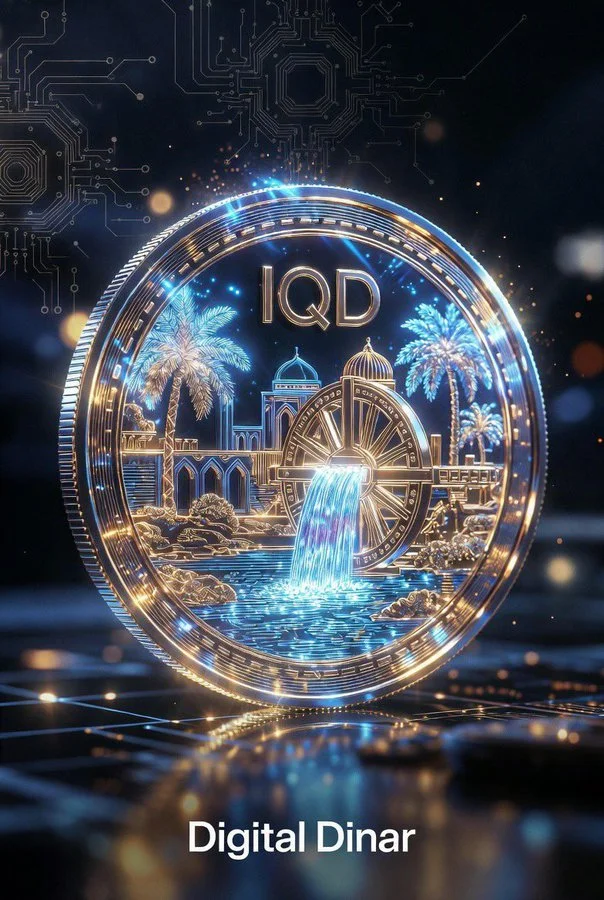
Iraq’s current reserve bleed is the perfect pressure point making these digital rails highly attractive. And Iraq is already moving in this direction with a digital dinar.
The Central Bank of Iraq is working on a CBDC—a stablecoin-like version of the dinar, backed 1:1 by the central bank itself. This digital native currency aims to reduce cash hoarding, cut printing costs, keep money in the formal system, and enable faster, cheaper payments both domestically and across borders.
The digital dinar isn’t some private token; it’s official e-cash on a ledger—programmable, trackable, and instantly settleable.
It fights dollarization and improves liquidity management. Paired with global rails like XRPL, it reduces the pressure to defend the physical currency through endless dollar sales.
A revalued, stronger dinar would make this digital version far more credible and attractive internationally. People want to hold and use a currency that feels stable and valuable.
You can’t have a sudden massive revaluation without reforms — that could wreck exports and destroy the reserves they’re trying to protect. Instead, the blueprint is clear: stabilize via the current peg, build the digital infrastructure, integrate efficient cross-border rails like XRP, diversify the economy, and then revalue to support tokenization.
The digital dinar can launch regardless of the current rate but why launch digital garbage? What it needs is stability, trust in the central bank, and interoperability with the world.
This reserve situation and Iraq’s CBDC push? It’s a major clue about what’s coming: a modernized, tokenized Iraqi dinar built for the digital age, with less reliance on bloated dollar reserves.
Tokenization is fuel for the revaluation. A tokenized dinar = improved credibility/stability/functionality. The writing is on the wall for what’s coming. This is what’s different this time around.
Ross: Why you CANNOT tokenize a hyperinflated currency like IQD in its current broken state: Tokenization is just a digital mirror. It copies the currency 1:1 onto the blockchain.
If the rate is still crushed at 1,300+ to 1 USD (a relic of sanctions & war) you’re only uploading digital garbage. Zero real value. Zero trust. Zero liquidity. No serious player will use it for settlement.
BlackRock - one of the key architects in DTCC’s tokenization launch (limited production July 2026, full Oct) - won’t touch it. They’re building the rails for trillions in real assets (Russell 1000 stocks, ETFs & Treasuries on Canton). They demand legitimate on-chain cash legs.
Sequence is everything: Revalue FIRST to reflect Iraq’s true wealth. THEN tokenize the new, strong dinar so it slots perfectly into the CLARITY + DTCC + stablecoin ecosystem.
BlackRock & major institutions will settle in multiple high-quality tokenized currencies (regulated stablecoins + tokenized deposits). A revalued, gold/oil-backed tokenized IQD at or above USD parity becomes a powerful option for diversification, Middle East oil-trade settlement, hedging, and 24/7 global liquidity. That’s the real play.
When will IQD RV?
Look no further than the Reverse Carry Trade unwinding — the catalyst for XRP mass adoption.
The Clarity Act is the signal that it’s almost time.
Everything is converging nicely right now, there’s no denying it.
Buckle up.
IQD Revaluing is Directly Tied to the Mass Adoption of Crypto.
Progress was made today.
The CBI is making serious strides on digital transformation ahead of the July 2026 government cashless deadline — fascinating how it syncs with President Trump’s July 4th Clarity Act deadline.
Governor Ali Mohsen Al-Alaq personally chaired a high-level meeting today with all licensed electronic payment companies.
They directly addressed the main technical, administrative, and regulatory challenges in the sector.
The group worked on upgrading and expanding electronic payment services across Iraq — the exact infrastructure needed to support future crypto integration.
Boosting overall efficiency in banking and finance was a central focus.
This represents important progress toward Iraq’s modern digital economy and positions the country to participate safely in the global crypto space.
The CBI continues demanding full compliance with its rules and international best practices — critical groundwork for regulated crypto adoption.
Security, reliability, and stronger digital infrastructure were key priorities that will enable secure crypto rails.
Expanding financial inclusion for the Iraqi people remains a top goal, building the user base ready for digital assets.
While this is not a rate change or RV announcement, these steps are building a solid foundation for a much stronger dinar in a crypto-enabled world.
The CBI is methodically constructing the infrastructure for a more powerful, globally respected Iraqi dinar future — perfectly timed to ride the coming wave of digital asset clarity.
Iraq’s government deadlock is finally ending, its digital economy is accelerating, the U.S. is rolling out crypto regulatory clarity, the reverse carry trade is set to unwind, and major geopolitical realignments are unfolding.
These forces are not converging by accident.
They are aligning to unlock Iraq’s economic rebirth and deliver a far stronger, globally relevant Iraqi dinar.
You are watching the foundation of one of the most significant monetary shifts in modern history take shape right now.
NCSWIC.
Source(s):
• https://x.com/Ross_ptm/status/2056036031565361468
• https://x.com/Ross_ptm/status/2056049113221767348
• https://x.com/Ross_ptm/status/2056107330199245036
https://dinarchronicles.com/2026/05/17/ross-iqd-revaluation-is-tied-to-the-adoption-of-crypto/
Seeds of Wisdom RV and Economics Updates Monday Afternoon 5-18-26
Good Afternoon Dinar Recaps,
Cuba–U.S. Tensions Escalate: Drone Claims, Energy Collapse, and Military Threats Raise Regional Stability Risks
Growing confrontation between Washington and Havana is reviving Cold War-era tensions at a time of rising geopolitical fragmentation and global financial uncertainty
Warnings of military confrontation between Cuba and the United States are intensifying concerns over regional stability, energy disruptions, and the expanding overlap between geopolitics and financial risk.
Good Afternoon Dinar Recaps,
Cuba–U.S. Tensions Escalate: Drone Claims, Energy Collapse, and Military Threats Raise Regional Stability Risks
Growing confrontation between Washington and Havana is reviving Cold War-era tensions at a time of rising geopolitical fragmentation and global financial uncertainty
Warnings of military confrontation between Cuba and the United States are intensifying concerns over regional stability, energy disruptions, and the expanding overlap between geopolitics and financial risk.
OVERVIEW (KEY POINTS)
Cuban President Miguel Díaz-Canel warned today that any United States military action against Cuba would trigger a “bloodbath” with severe consequences for regional peace and stability.
The warning follows reports alleging Cuba acquired more than 300 military drones and discussed possible strikes on U.S. targets including the naval base at Guantánamo Bay and military assets near Florida.
At the same time, Cuba is facing one of its worst economic and energy crises in decades after severe fuel shortages and electricity blackouts intensified across the island following tighter U.S. pressure and energy restrictions.
The developments are drawing international attention because they reflect a broader trend of geopolitical escalation spreading across multiple regions simultaneously — a growing factor impacting global markets, commodity flows, and financial stability.
KEY DEVELOPMENTS
1. Cuba Warns of “Bloodbath” if Military Action Occurs
Tensions sharply escalated following public warnings from Havana.
President Díaz-Canel stated Cuba poses “no threat” but would defend itself if attacked
Cuban officials accused Washington of using false pretexts to justify aggression
Foreign Minister Bruno Rodríguez cited Cuba’s right to self-defense under international law
2. Drone Allegations Intensify Security Concerns
Reports regarding military drones heightened tensions further.
Axios reported Cuba allegedly obtained 300+ military drones
Alleged targets included Guantánamo Bay and U.S. naval assets
Cuban officials strongly denied aggressive intentions and called the claims politically motivated
3. Cuba’s Energy Crisis Deepens
Economic conditions on the island continue deteriorating rapidly.
Severe fuel shortages are causing prolonged blackouts
Electricity availability reportedly dropped to only a few hours daily in some regions
Cuba blames tighter U.S. sanctions and energy restrictions for worsening conditions
4. Trump Administration Pressure Continues Expanding
Washington’s posture toward Havana has become increasingly aggressive.
Reports indicate U.S. prosecutors may seek an indictment against former leader Raúl Castro
Additional sanctions and strategic pressure are being discussed
U.S.-Cuba relations are now at some of their lowest levels in decades
5. Regional Stability Risks Are Rising
The situation carries broader geopolitical implications.
Caribbean trade and shipping routes remain strategically important
Increased military tensions near Florida and Guantánamo raise security concerns
Analysts warn that even limited escalation could impact regional markets and investor confidence
WHY IT MATTERS
The Cuba situation matters because it reflects the growing intersection between geopolitical confrontation, economic pressure, and financial instability.
The combination of sanctions, energy shortages, and military rhetoric increases uncertainty not only for the Caribbean region but also for broader global markets already dealing with elevated geopolitical risk.
It also demonstrates how economic tools such as sanctions and energy restrictions are increasingly being used alongside military and diplomatic pressure as part of modern geopolitical strategy.
At a time when markets are already sensitive to disruptions involving energy flows, trade routes, and sovereign debt, another major geopolitical flashpoint could further strain investor confidence globally.
WHY IT MATTERS TO FOREIGN CURRENCY HOLDERS
Geopolitical instability often increases demand for safe-haven assets like gold
Energy disruptions can fuel inflation and weaken fiat purchasing power
Regional instability may increase currency volatility across emerging markets
Sanctions-driven economic fragmentation continues accelerating multipolar trade systems
IMPLICATIONS FOR THE GLOBAL RESET
Pillar 1: Geopolitical Fragmentation Expands
The rise in U.S.-Cuba tensions reflects a broader pattern of increasing regional confrontation shaping global financial and trade systems.
Pillar 2: Economic Pressure Becomes a Strategic Weapon
Sanctions, energy blockades, and financial isolation are increasingly central tools in geopolitical competition, influencing global reserve and trade strategies.
CONCLUSION
The renewed confrontation between Cuba and the United States represents more than a regional dispute.
It highlights how geopolitical tensions, economic sanctions, and energy instability are becoming deeply interconnected within the evolving global financial landscape.
As nations increasingly rely on economic leverage and strategic pressure rather than traditional diplomacy alone, global markets may face higher volatility and greater fragmentation in the years ahead.
The growing overlap between geopolitics and economics is becoming one of the defining forces behind the emerging global financial reset.
Seeds of Wisdom Team
Newshounds News™ Exclusive
Sources
Reuters — "Cuba Warns U.S. Military Action Would Cause ‘Bloodbath’ After Drone Report"
Modern Diplomacy — "Cuba Warns U.S. Military Action Would Trigger ‘Bloodbath’"
~~~~~~~~~~
Seeds of Wisdom Team RV Currency Facts Youtube and Rumble
Newshound's News Telegram Room Link
RV Facts with Proof Links Link
RV Updates Proof links - Facts Link
Follow the Gold/Silver Rate COMEX
Follow Fast Facts
Seeds of Wisdom Team™Website
Thank you Dinar Recaps
Iraq Economic News and Points To Ponder Monday Afternoon 5-18-26
Calls To Expedite The Submission Of The Budget To The House Of Representatives And Warnings Against Delaying Its Approval
Economy News — Baghdad Member of Parliament Ahlam Al-Kakaei warned of the repercussions of the continued delay in approving the general budget, indicating that the absence of the budget has caused the suspension of many projects and has directly affected the service situation and development plans.
Calls To Expedite The Submission Of The Budget To The House Of Representatives And Warnings Against Delaying Its Approval
Economy News — Baghdad Member of Parliament Ahlam Al-Kakaei warned of the repercussions of the continued delay in approving the general budget, indicating that the absence of the budget has caused the suspension of many projects and has directly affected the service situation and development plans.
Al-Kaka’i added, in a statement to the official newspaper, that “Parliament extended its holiday due to the issue of forming the government cabinet, before later heading to the legislative holiday, which may lead to further delays in approving the budget if there is no political will to expedite its resolution.”
She stressed that “the continued delay in the budget will affect the launch of new projects and the completion of stalled projects, as well as disrupting the financial obligations of government institutions, stressing the need to expedite the submission of the draft budget to the House of Representatives for discussion and approval.” https://www.economy-news.net/content.php?id=69165
CBI: Iraq Posts About $25 Billion Trade Surplus In 2025
2026-05-18 / Shafaq News- Baghdad Iraq recorded a trade surplus of approximately $24.686 billion in 2025, driven by exports outpacing imports across all four quarters of the year, according to data released Monday by the Central Bank of Iraq (CBI).
Total exports reached roughly $90.43 billion against imports of $65.74 billion, based on foreign trade figures calculated on a free-on-board (FOB) basis —a methodology that values goods at the point of loading in the exporting country, excluding shipping and insurance costs.
Exports declined gradually through the first three quarters before a marginal recovery in the final months of the year. The first quarter led with $24.11 billion, followed by $23.29 billion in the second quarter and $21.41 billion in the third, before edging up to $21.62 billion in the fourth quarter.
Imports followed a broadly similar downward trajectory. The first quarter recorded $18.16 billion, with the figure falling to $15.99 billion in the second quarter and $16.10 billion in the third, before dropping to $15.49 billion in the fourth —the lowest quarterly import figure of the year.
The surplus was sustained in every quarter without exception, with exports consistently exceeding imports throughout 2025, the data showed. https://shafaq.com/en/Economy/CBI-Iraq-posts-about-25-billion-trade-surplus-in-2025
US Denies Official Petraeus Role In Baghdad Visit
2026-05-18 / 04:25 Shafaq News- Washington Former CIA Director Gen. David Petraeus does not hold any position within the US mission in Iraq, a US State Department spokesperson told Shafaq News on Monday, dismissing speculation surrounding his recent visit to Baghdad.
Petraeus visited the Iraqi capital on Friday and held meetings with senior Iraqi officials, without any official clarification regarding the purpose of the trip or the capacity in which he attended.
The visit fueled media reports suggesting that Petraeus, who previously commanded US forces during the Iraq war, had been assigned a special mission or was acting as an envoy for US President Donald Trump. Some reports linked the visit to what they described as growing US pressure on the Iraqi government over Iran-aligned armed factions operating in Iraq.
For Shafaq News, Mostafa Hashem, Washington, DC.
Read more: Iraq after the regional ceasefire: US bases and unresolved political questions
https://www.shafaq.com/en/Iraq/US-denies-official-Petraeus-role-in-Baghdad-visit
A Najafi Source: Al-Sadr's Contact With Al-Zaydi Constitutes A "Shock" Within The Coordination Framework Forces, And There Are Fears Of Support For Al-Hanana
latest news Monday, May 18, 2026 Najaf – One News A source in Najaf revealed that the phone call made by the leader of the Shiite National Movement, Muqtada al-Sadr, to Prime Minister Ali al-Zidi constituted a “shock” within the forces of the Coordination Framework, in light of what he described as growing fears about the repercussions of al-Sadr’s support for al-Zaidi on the balance of political power.
The source said that al-Sadr’s support for al-Zaydi “will put him in a stronger position against the interventions of some of the cadre leaders”, noting that al-Sadr sees in al-Zaydi “a figure who possesses the necessary determination to correct the course of the political process and save the country”, as he put it.
He added that al-Sadr supports the government's approach to combating corruption, and believes that the current stage requires giving the Prime Minister more space to implement real reforms away from political pressures and partisan rivalries.
The source indicated that the atmosphere of concern within the coordination framework escalated after the contact, amid estimates that any rapprochement between Al-Sadr and Al-Zaydi could redraw political alliances during the next stage. https://1news-iq.net/مصدر-نجفي-اتصال-الصدربالزيديشكّل-صدم/
An Economic Expert Says Iraq Needs About 7 Trillion Dinars To Cover Operational Expenses This Month.
Baghdad – One News Nabil Al-Marsoumi, an expert in economic affairs, confirmed that Iraq needs about 7 trillion dinars to cover operational spending during the current month, noting that current oil revenues do not exceed 2 trillion dinars, which is insufficient to secure salaries and the costs of electricity and imported gas.
Al-Marsoumi explained that the budget deficit is likely to worsen starting this May, due to the significant decline in oil revenues resulting from a decrease in Iraqi exports by more than 90%, which led to revenues dropping to about one billion dollars last April.
He added that the oil revenues achieved last March amounted to about two and a half trillion dinars, while salaries alone require more than 7 trillion dinars, which means there is a large financial gap that threatens to cover basic operating expenses, including the import of gas, electricity, medicine and social welfare. https://1news-iq.net/خبير-اقتصادي-العراق-بحاجة-إلى-نحو-7-تري/
A Member Of The Parliamentary Finance Committee Told NINA: "The Next Stage Will Be Very Difficult... Economically."
Saturday, May 16, 2026| Economy Baghdad / NINA / Member of the Parliamentary Finance Committee, MP Mustafa al-Karawi, affirmed that Iraq is facing a very difficult economic phase, attributing this to the widening budget deficit, low revenues, and the failure to find alternatives to oil to finance the country's economy.
Al-Karawi told the Iraqi National News Agency ( NINA 😞 "Following the economic crisis that occurred in the region due to the Iran-US war and the previous Iraqi government's inability to find solutions for oil exports, the budget deficit and low revenues have widened due to the failure to find alternatives to oil by increasing non-oil revenues."
The Finance Committee member emphasized: "The coming period will be very difficult due to the lack of non-oil funding sources, as non-oil revenues constitute only 10% of total revenues. This will significantly impact the revenue generated and its direct dependence on external regional conditions."
He explained: "The continuation of this situation will greatly affect the provision of services and the implementation of investment projects due to the lack of financial liquidity."
He expressed his hope that the new government would find real solutions to build a strong domestic economy and establish systems to effectively manage non-oil revenues, significantly reducing dependence on oil. /End 8. https://ninanews.com/Website/News/Details?key=1295740
Between An "Army Of Employees" And A Million Graduates... The Iraqi Economy Teeters On The Brink - Urgent
Baghdad Today – Baghdad At a time when concerns are rising about the future of the labor market in Iraq, attention is turning to a cumulative economic crisis that is threatening the state’s ability to continue its open government employment policy, amid warnings of a wave of unemployment that could worsen with the increasing number of university graduates in the coming years.
In this context, economist Raad Al-Masoudi warns that government departments are no longer able to absorb more employees within state institutions, stressing that the output of Iraqi universities will approach the one million graduate mark within a few years, a number that exceeds the capacity of the government sector to accommodate.
Al-Masoudi told Baghdad Today on Saturday (May 16, 2026) that the employment policy that expanded after 2003 has, over time, turned into a tool used by some political forces to gain popular support by opening the doors of appointments during election seasons, instead of adopting the criteria of the actual needs of institutions.
He added that the inflated number of employees has created a state of “disguised unemployment” within many government departments, at a time when other ministries and institutions are suffering from a real shortage of specialists, which has led to a clear imbalance in the structure of the state’s administrative apparatus.
He pointed out that the salaries file now consumes the largest part of the operational expenses of the general budget, noting that oil revenues are barely sufficient to cover salaries, given that the Iraqi economy depends almost entirely on crude oil exports.
Al-Masoudi stressed that the current stage requires “deep economic surgery”, starting with rebuilding the private sector and opening the doors to real investment, in addition to supporting the stalled sectors, especially industry and agriculture, in order to create sustainable job opportunities for young people away from temporary government appointments.
He called for the adoption of a comprehensive national strategy to address economic imbalances, warning that continuing the current approach would put the country in front of more serious challenges, especially with regional turmoil and oil market fluctuations, which could affect Iraq’s ability to secure its basic revenues in the future.
After 2003, Iraq witnessed an unprecedented expansion in government employment, as state institutions became the largest refuge for job seekers, in light of the weakness of the private sector and the decline of productive sectors.
With the increasing number of graduates annually and the country's reliance on oil as a primary source of revenue, warnings have begun to escalate about the dangers of continuing this economic model, which consumes most of the state's resources in salaries and operating expenses, while investment and real production remain limited.
Some Iraq News Posted by Tishwash at TNT 5-18-2026
TNT:
Tishwash: Parliament is moving to avoid a "paralysis" scenario and aims to finalize the oil, gas, and telecommunications laws.
MP Hussein Ali announced on Monday a serious parliamentary determination to avoid a repeat of the scenario that disrupted parliamentary sessions in the previous session. He emphasized that the House of Representatives has successfully completed the reading and passage of 16 laws so far, focusing on strategic legislation related to oil and communications.
Ali told Al-Maalouma, "The House of Representatives is working intensively to activate its legislative role and avoid the obstacles and political gridlock that led to the disruption of sessions in the past." He explained that "Parliament is moving steadily to compensate for previous delays."
TNT:
Tishwash: Parliament is moving to avoid a "paralysis" scenario and aims to finalize the oil, gas, and telecommunications laws.
MP Hussein Ali announced on Monday a serious parliamentary determination to avoid a repeat of the scenario that disrupted parliamentary sessions in the previous session. He emphasized that the House of Representatives has successfully completed the reading and passage of 16 laws so far, focusing on strategic legislation related to oil and communications.
Ali told Al-Maalouma, "The House of Representatives is working intensively to activate its legislative role and avoid the obstacles and political gridlock that led to the disruption of sessions in the past." He explained that "Parliament is moving steadily to compensate for previous delays."
He added that "the House has so far managed to complete the reading and proceed with the legal procedures for 16 diverse laws affecting various sectors," noting that "parliamentary focus is currently on resolving contentious laws that have been stalled for years."
Ali continued, "There is a concerted parliamentary effort to pass the postponed oil and gas law, the communications and information technology law, as well as a package of other laws that are of paramount importance in regulating the country's economic resources and infrastructure." link
Tishwash: Calls to expedite the submission of the budget to the House of Representatives and warnings against delaying its approval
Member of Parliament Ahlam al-Kaka'i warned of the repercussions of the continued delay in approving the general budget, explaining that its absence has halted numerous projects and directly impacted public services and development plans. In a statement to the official newspaper, al-Kaka'i added that "Parliament extended its recess due to the government formation process before subsequently entering its legislative recess, which could lead to further delays in approving the budget if there is no political will to expedite its resolution."
She emphasized that "the continued delay in the budget will affect the launch of new projects and the completion of stalled projects, in addition to disrupting the financial obligations of government institutions," stressing the need to expedite the submission of the draft budget to Parliament for discussion and approval. link
******************
Tishwash: The Governor of the Central Bank of Iraq chairs a meeting with electronic payment companies.
The Central Bank of Iraq held an expanded meeting at its headquarters in Baghdad, chaired by the Governor, Mr. Ali Mohsen Al-Alaq, and attended by directors of relevant departments within the bank, as well as the authorized managers of licensed electronic payment service providers in Iraq.
The meeting focused on discussing the most prominent challenges and observations related to the operations of these companies, and reviewing mechanisms for developing the services they provide to enhance the efficiency of the financial and banking sector and support the comprehensive digital transformation in the country.
The meeting included a comprehensive review of technical, administrative, and regulatory observations pertaining to the work of electronic payment companies.
Participants exchanged views on the companies' future plans aimed at improving financial services, with a focus on strengthening compliance and full adherence to the regulations and instructions adopted by the Central Bank. They also discussed upgrading the infrastructure and developing the technical and regulatory systems of payment companies in line with best practices and international standards.
The discussions expanded to include the development of innovative solutions and initiatives aimed at improving the electronic payment environment in Iraq. Participants focused on enhancing the security, efficiency, and reliability of digital financial services to meet citizens' aspirations and support the government's efforts to promote financial inclusion and a smooth transition to a digital economy.
This meeting is part of the Central Bank of Iraq's ongoing efforts to regulate and develop the financial technology sector and ensure the provision of secure and innovative digital services that support financial stability in the country.
Baghdad - (Media Office)
May 17, 2026 link
Tishwash: Al-Zaidi chairs the first meeting of the Financial Stability Board
Prime Minister Ali Faleh al-Zaidi chaired the first meeting of the Financial Stability Council on Saturday and issued a series of directives.
A statement from the Prime Minister's Media Office indicated that "al-Zaidi chaired the first meeting of the Financial Stability Council, which was established under the ministerial program, and which included the Minister of Finance and the Governor of the Central Bank of Iraq."
Al-Zaidi emphasized "the importance of achieving financial stability, given its developmental and economic impacts," noting "the necessity of close coordination between the Central Bank and the Ministry of Finance, and the need to make financial decisions that support stability, which will positively impact government development, service, and economic plans." link
***************
Tishwash: Financial stability is the cornerstone of the government's launch.
In a rapid and remarkable pace, the new government, led by Prime Minister Ali Faleh al-Zaidi, began outlining its executive actions from the first hours of officially assuming his duties. Only a few hours passed before the first cabinet meeting was held, and a set of directives was issued that reflected the orientations of his government program, before one of its most prominent axes was quickly translated through the establishment of the "Financial Stability Council" as a foundational step in the path of economic reform.
On Saturday, Al-Zaidi chaired the first meeting of the "Financial Stability Council," in the presence of the Minister of Finance and the Governor of the Central Bank of Iraq, as part of an initiative aimed at strengthening coordination between fiscal and monetary policies.
During the meeting, Al-Zaydi stressed the importance of achieving financial stability, emphasizing the need to raise the level of coordination between the Central Bank and the Ministry of Finance, and to make consistent decisions that support general stability, which will positively impact the government’s development, service and economic plans.
In the same context, the new government, on its first official working day after gaining the confidence of Parliament, began to outline its executive and political program, with a clear focus on economic reform, combating corruption, improving services, and activating digital transformation.
The Prime Minister stressed, according to a statement from his media office, that the Ministry of Oil should not be limited to selling crude oil, but should transform into an economic institution with added value through developing the oil industry and increasing production and exports.
In the energy sector, Al-Zaydi directed the Ministry of Electricity to prepare two plans, one urgent to address the current summer crisis, and another long-term plan to develop the electrical grid and infrastructure.
He also instructed the Ministry of Foreign Affairs to prepare working papers to reactivate Iraqi relations with the Arab and international communities, in order to strengthen Iraq’s political and diplomatic presence.
In the health sector, he stressed the need to activate the health insurance law, while calling on the Ministry of Transport to proceed with the "Development Road" project to support the national economy and link Iraq to global trade chains.
The directives included obligating ministers to disclose their financial assets within a week, and not to make structural changes within ministries at the present time.
Al-Zaydi also stressed the importance of enabling the House of Representatives to perform its oversight and legislative role, and of strengthening cooperation with parliamentary committees.
In the fight against corruption, the Prime Minister called for giving this file the highest priority, with full cooperation with the Federal Integrity Commission, and working to recover smuggled funds, stressing the need to keep official institutions away from political and factional rivalries. link
News, Rumors and Opinions Monday 5-18-2026
Majeed KSA: What Iraq has Already Achieved
5-18-2026
You must read this
Here is how the banking reform is done in Iraq.
What Iraq has already achieved.
Over the last decade, Iraq moved from an almost entirely cash-based and loosely controlled banking environment toward a more internationally supervised system.
Majeed KSA: What Iraq has Already Achieved
5-18-2026
You must read this
Here is how the banking reform is done in Iraq.
What Iraq has already achieved.
Over the last decade, Iraq moved from an almost entirely cash-based and loosely controlled banking environment toward a more internationally supervised system.
Major progress includes:
• Electronic payment expansion
• Salary localization into bank accounts
• Stronger AML/CFT (anti-money laundering) rules
• Integration with SWIFT/global payment systems
• Restrictions on c*****t dollar transfers
• Bank audits and restructuring
• Financial inclusion growth
• ATM and bank card expansion
• Preparation for digital banking and possibly a digital dinar
The biggest turning point came after the U.S. Federal Reserve and Treasury forced Iraq to tighten dollar-transfer controls beginning around 2022–2023. That pressure effectively forced Iraq to modernize its banking oversight.
In 2025–2026, the Central Bank of Iraq launched what it openly called a “comprehensive reform project” with consulting firm Oliver Wyman.
That is one of the clearest signs that Iraq has moved from talking about reform to actually restructuring the banking sector.
The key point is this:
Iraq is no longer in the “planning only” phase.
It is now in the implementation and enforcement phase of reform. That is a major difference from most of the last decade.
Today CBI article May 17, 2026
The Central Bank of Iraq met with electronic payment companies to improve digital banking, strengthen regulations, modernize financial infrastructure, and enforce international compliance standards. The meeting shows Iraq is actively pushing toward a safer digital economy, stronger financial oversight, and broader banking reform implementation.
This article tells you:
This article suggests Iraq is now focused on:
• modernizing the payment infrastructure
• formalizing money movement
• tightening oversight
• reducing cash dependence,
• digitizing the economy and integrating into the global financial system.
That is exactly what a country in the implementation phase looks like.
So this article actually reinforces the earlier conclusion:
Iraq is no longer mainly discussing reform, it is actively restructuring parts of the banking system in real time.
Source(s):
• https://x.com/majeed66224499/status/2055656744429244470
• https://x.com/majeed66224499/status/2056112808434028707
See full post here: https://dinarchronicles.com/2026/05/17/majeed-ksa-what-iraq-has-already-achieved/
************
Courtesy of Dinar Guru: https://www.dinarguru.com/
Thom Question: "Is there any information on the estimated price of IQD and VND?" I think IQD will be over $3.22 (likely over $4 imo), and VND will likely be a float (a very fast moving float when it goes). My opinions based and what I have researched.
Jeff As long as the US Treasury has removed Iraq from their OFAC sanctions list then all the banks within the United States will start exchanging the dinar. IMO when Iraq revalues the US Treasury will remove Iraq from the OFAC sanctions list at the same time.
Boot-On-The-Ground Guru Omar On the television we have our prime minister Zaidi. He said we're going to start the next phase. We will see the launch of a "comprehensive economic and financial reform program" that will strengthen our national partnership and focus on improving services and fighting corruption...He said financial reforms can lead to giving the dinar more real value. But he said only if Iraq actually executes the deeper structural monetary reform behind the scenes...The type of reforms Zaidi is talking to us about are the same one that required before any currency can strengthen.
IQD News Update: Why the KWD Reinstated But the IQD Has Not
Edu Matrix: 5-18-2026
In this video, we explain one of the biggest misunderstandings in the IQD investment community. Many investors compare the Iraqi Dinar to what happened to Kuwait after the Gulf War, but the two situations are completely different.
The Kuwaiti Dinar was already internationally recognized and openly traded on global FOREX markets before Iraq invaded Kuwait in 1990.
After liberation, Kuwait’s banking system and currency simply returned to their previous internationally recognized value.
The Iraqi Dinar is different. The modern IQD was created after the 2003 war and has remained a heavily managed domestic currency controlled by the Central Bank of Iraq. Unlike the Kuwaiti Dinar, the IQD has never freely traded on the open international FOREX market.
In this video we discuss:
• Why Kuwait’s currency recovered
• What “reinstatement” really means
• Why the IQD is considered a closed currency
• The role of the Central Bank of Iraq
• Why there is no true global market price for the IQD
• The difference between speculation and international currency trading
This video is for educational and informational purposes only.
FRANK26….5-17-26….ILLEGAL TO BORROW and Bank Story
KTFA
Sunday Night Video
FRANK26….5-17-26….ILLEGAL TO BORROW
This video is in Frank’s and his team’s opinion only
Frank’s team is Walkingstick, Eddie and Omar in Iraq and guests
Playback Number: 605-313-5163 PIN: 156996#
KTFA
Sunday Night Video
FRANK26….5-17-26….ILLEGAL TO BORROW
This video is in Frank’s and his team’s opinion only
Frank’s team is Walkingstick, Eddie and Omar in Iraq and guests
Playback Number: 605-313-5163 PIN: 156996#
KTFA
Sunday Night Video
FRANK26…5-17-26….BANK STORY
This video is in Frank’s and his team’s opinion only
Frank’s team is Walkingstick, Eddie and Omar in Iraq and guests
Playback Number: 605-313-5163 PIN: 156996#
Seeds of Wisdom RV and Economics Updates Monday Morning 5-18-26
Good Morning Dinar Recaps,
G7 Faces Financial Fragmentation as Bond Turmoil and Syria’s Reentry Signal a Changing Global Order
Rising debt pressures, geopolitical instability, and post-conflict economic reintegration are reshaping the structure of global finance
The G7’s latest financial meetings in Paris revealed growing concern over bond market instability, inflation risks, and the increasing overlap between geopolitics and economic governance.
Good Morning Dinar Recaps,
G7 Faces Financial Fragmentation as Bond Turmoil and Syria’s Reentry Signal a Changing Global Order
Rising debt pressures, geopolitical instability, and post-conflict economic reintegration are reshaping the structure of global finance
The G7’s latest financial meetings in Paris revealed growing concern over bond market instability, inflation risks, and the increasing overlap between geopolitics and economic governance.
OVERVIEW (KEY POINTS)
Finance ministers and central bank officials from the G7 gathered in Paris amid mounting concerns over global bond market volatility, inflation pressure, and widening structural economic imbalances.
At the same time, Syria’s participation in closed-door financial discussions marked a significant geopolitical development, signaling a potential shift toward economic reintegration and reconstruction diplomacy after years of isolation.
The meetings highlighted how global finance is becoming increasingly influenced by geopolitical tensions, energy security concerns, and supply chain competition rather than traditional market fundamentals alone.
Together, these developments point toward a broader transition into a more fragmented and politically managed global financial system — a major theme within the evolving global reset landscape.
KEY DEVELOPMENTS
1. G7 Finance Chiefs Address Bond Market Instability
Global sovereign debt markets remain under pressure.
Bond yields surged across major economies including the U.S., Europe, and Japan
Investors fear higher energy prices could keep interest rates elevated longer
Officials expressed concern about fiscal sustainability and debt sensitivity
2. Inflation Risks Linked to Energy Disruptions
Geopolitical instability is feeding market anxiety.
Ongoing Iran-related tensions continue pressuring global energy markets
Rising oil and shipping costs threaten to prolong inflation globally
Central banks may face difficulty easing monetary policy under current conditions
3. Syria Quietly Reenters Global Financial Discussions
A major geopolitical signal emerged in Paris.
Syria joined a closed-door session with G7 finance officials
Discussions focused on economic reconstruction and financial reintegration
The move suggests growing international interest in regional stabilization efforts
4. Critical Minerals and Supply Chains Become Strategic Priorities
Economic security is increasingly tied to industrial policy.
G7 nations discussed reducing dependence on dominant suppliers like China
Coordinated investment and procurement strategies are under consideration
Rare earths and energy-transition minerals are now viewed as strategic financial assets
5. Structural Imbalances Continue to Threaten Stability
Officials warned that deeper economic distortions are growing.
Consumption and investment patterns remain uneven globally
Trade and capital flow imbalances continue widening
Policymakers fear future market corrections if coordination fails
WHY IT MATTERS
The Paris meetings revealed that financial instability is no longer viewed as purely economic — it is increasingly tied to geopolitics, energy security, and strategic competition.
Rising bond yields, inflation fears, and debt pressures are exposing vulnerabilities within highly leveraged economies, particularly as governments continue managing elevated spending levels.
At the same time, Syria’s participation demonstrates how reconstruction and financial reintegration are becoming tools of geopolitical strategy, where access to banking systems and investment flows can shape regional power dynamics.
This reflects a broader transformation in global governance, where economic coordination is increasingly driven by security concerns and supply chain resilience rather than traditional globalization models.
WHY IT MATTERS TO FOREIGN CURRENCY HOLDERS
Bond market instability could increase global currency volatility
Persistent inflation may weaken purchasing power across major economies
Commodity-producing nations could gain strategic leverage
Reserve diversification into gold and alternative assets may continue accelerating
IMPLICATIONS FOR THE GLOBAL RESET
Pillar 1: Financial Governance Becomes More Geopolitical
Economic policy is increasingly tied to security strategy, energy access, and geopolitical alignment rather than free-market coordination alone.
Pillar 2: Reconstruction and Resource Control Reshape Global Influence
Post-conflict recovery, critical minerals, and supply chain control are becoming central pillars in the next phase of global economic competition.
CONCLUSION
The G7 meetings in Paris underscored how rapidly the financial landscape is changing.
Bond market stress, inflation risks, energy disruptions, and geopolitical realignment are converging into a more fragmented and strategically managed global system.
Meanwhile, Syria’s gradual return to international financial discussions signals that reconstruction and economic normalization are now part of broader geopolitical negotiations among major powers.
The global economy is no longer moving toward deeper integration alone — it is increasingly being reorganized around resilience, strategic influence, and controlled economic blocs.
What emerges next may not resemble the old globalized system, but a new financial order shaped by security, supply chains, and geopolitical leverage.
Seeds of Wisdom Team
Newshounds News™ Exclusive
Sources
~~~~~~~~~~
🌱A Message to Our Currency Holders🌱
If you’ve been holding foreign currency for many years, you were not foolish.
You were not wrong to believe the global financial system would change.
What failed was not your patience — it was the information you were given.
For years, dates, rumors, and personalities replaced facts, structure, and proof. “This week” predictions created cycles of hope and disappointment that were never based on how currencies actually change.
That is not your failure.
Our mission here is different: • No dates • No rates • No hype • No gurus
Instead, we focus on:
• Verifiable developments • Institutional evidence
• Global financial structure • Where countries actually sit in the process
Currency value changes only come after sovereignty, trade, banking, settlement systems, and fiscal coordination are in place. History and institutions confirm this sequence.
You will see silence. You will see denials. That is not delay — that is discipline.
Protect your identity. Organize your documents. Verify everything.
Never hand your discernment to anyone who cannot show proof.
You deserve truth — not timelines.
Seeds of Wisdom Team
Newshounds News™
~~~~~~~~~~
Seeds of Wisdom Team RV Currency Facts Youtube and Rumble
Newshound's News Telegram Room Link
RV Facts with Proof Links Link
RV Updates Proof links - Facts Link
Follow the Gold/Silver Rate COMEX
Follow Fast Facts
Seeds of Wisdom Team™Website
Thank you Dinar Recaps
Iraq Economic News and Points To Ponder Monday Morning 5-18-26
The Government Affirms Its Commitment To Restricting Weapons To The State And Keeping Iraq Out Of Regional Conflicts
latest news Sunday,Baghdad – One News 5/17/2026 The spokesman for the Commander-in-Chief of the Armed Forces, Sabah al-Nu’man, confirmed that the first strategic pillar in the ministerial program is the strengthening of national security, through a firm commitment to restricting weapons to the state and enforcing the rule of law.
The Government Affirms Its Commitment To Restricting Weapons To The State And Keeping Iraq Out Of Regional Conflicts
latest news Sunday, Baghdad – One News 5/17/2026 The spokesman for the Commander-in-Chief of the Armed Forces, Sabah al-Nu’man, confirmed that the first strategic pillar in the ministerial program is the strengthening of national security, through a firm commitment to restricting weapons to the state and enforcing the rule of law.
Al-Nu’man told the Iraqi News Agency that this approach represents a fundamental step towards ending armed manifestations outside the legal framework and securing the internal stability necessary to protect the sovereignty of the state and ensure its security.
He added that the ministerial program approved a strict regulatory procedure to address the dispersal of resources and prevent overlapping powers, by unifying the security decision and linking all resources and capabilities to the official state system, in order to ensure that all armed formations are subject to the authority of the General Command and the unified security decision.
Al-Nu’man pointed out that the curriculum adopts a modern vision to enhance operational security, through the development of border monitoring systems according to modern technologies, and linking them to an intelligence effort to combat terrorism and organized crime and dry up its sources of funding.
He stressed that the right choice for Iraq is to stay away from the axes of regional and international conflict, and not to allow Iraq to be a passage or launching pad for attacks on other countries, or an arena for interference in its internal affairs, in order to protect internal stability from the repercussions of regional crises. https://1news-iq.net/الحكومة-تؤكد-حصر-السلاح-بيد-الدولة-وإب/
Unannounced Contacts To Integrate Forces That Have Expressed Their Willingness To Lay Down Arms And Engage Politically
latest news Sunday, May 17, 2026 Baghdad – One News The newspaper “Al-Sharq Al-Awsat” indicated that unannounced contacts and talks are currently taking place between political parties close to the government and the American administration, with the aim of reaching understandings that would allow the participation of some forces that have announced their abandonment of their armed wings, while maintaining their presence within the formations of the “Popular Mobilization Forces”.
In the same context, the sources confirmed that the government intends to quickly begin practical steps to restrict weapons to the hands of the state, including the factions that still declare positions rejecting the American presence, most notably the Kataib Hezbollah and Harakat al-Nujaba, which had previously announced their refusal to disarm according to the government program proposed by al-Zaidi. https://1news-iq.net/الشرق-الأوسط-اتصالات-غير-معلنة-لدمج-قو/
Iraq Requests Financial Support From The International Monetary Fund
Alsumaria NewsAn economist revealed a source close to the International Monetary Fund Iraqi officials contacted the fund for financial assistance in the aftermath of the ongoing war in the Middle East.
And it was reported Asharq Al-Awsat newspaper The source said that "initial talks took place last month during the spring meetings of the IMF and the World Bank in Washington He noted that "discussions are ongoing regarding the amount of funding he wants."Iraq and how to structure any loan"According to Reuters
The war that erupted on February 28th sent shock waves throughout the Middle East, causing widespread damage to infrastructure and economies.
Iraq was particularly hard hit, as the majority of its oil exports, which accounted for almost all of the government's revenue, were halted due to the blockade. Strait of Hormuz Previously, about 20 percent of the world's crude oil supply passed through it. https://www.alsumaria.tv/news/economy/564072/العراق-يطلب-دعماً-مالياً-من-صندوق-النقد-الدولي
The International Monetary Fund Comments On Reports That Iraq Has Requested Financial Assistance.
Money and Business Economy News — Baghdad The International Monetary Fund said it continues to discuss the possibility of providing financial support to countries affected by rising energy and commodity prices due to the war in the Middle East, without confirming reports that Iraq had requested financial assistance.
Reuters quoted the IMF spokeswoman, Julie Kozak, as saying during a press conference that the Fund continues to discuss potential financial assistance for member countries suffering from high energy and commodity costs, but she did not provide details on specific countries, and declined to comment on a report that Iraq had requested financial support.
Kozak added that a number of countries are asking the Fund for support in the area of economic policies and advice on how to respond to economic shocks according to the circumstances of each country.
Media reports had indicated that Iraq had requested financial assistance from the Fund as a result of the repercussions of the war in the Middle East and rising energy prices, at a time when the Fund’s Managing Director, Kristalina Georgieva, had previously indicated that about 12 countries might need financial support ranging between $20 billion and $50 billion.
https://www.economy-news.net/content.php?id=69157
Iraq Is Expected To Achieve A Trade Surplus Of $24 Billion In 2025.
Money and Business Economy News – Baghdad Data released by the Central Bank of Iraq on Monday showed that Iraq achieved a trade surplus of approximately $24.686 billion during 2025, driven by a higher value of exports compared to imports.
According to foreign trade data calculated on an FOB basis, total Iraqi exports during the year amounted to approximately $90.427.7 billion, compared to imports of $65.741.7 billion.
She added that exports were distributed as follows: $24.112.3 billion in the first quarter, $23.285.6 billion in the second quarter, $21.414.3 billion in the third quarter, before rising slightly to $21.615.5 billion in the fourth quarter.
In contrast, imports totaled $18.158.6 billion in the first quarter, $15.993.1 billion in the second quarter, and $16.102.0 billion in the third quarter, before declining to $15.488.0 billion in the fourth quarter, according to the data.
The data indicated that Iraqi exports exceeded imports in all quarters of the year, which reinforced the continued recording of a trade surplus.
The data was based on Free On Board, a system that calculates the value of goods when loaded onto the means of transport in the exporting country, without including shipping and insurance costs. https://www.economy-news.net/content.php?id=69218
Gold Prices Remain Stable In Baghdad Markets
Money and Business Economy News – Baghdad On Monday, the prices of Iraqi and foreign gold remained stable in the local markets of Baghdad at less than one million dinars per mithqal.
The selling price of one mithqal of 21-karat gold from the Gulf, Turkey, and Europe reached 982,000 dinars in the wholesale markets on Al-Nahr Street in Baghdad, while the buying price reached 978,000 dinars, which are the same prices that were recorded yesterday, Sunday.
One mithqal of 21-karat Iraqi gold was recorded at 952,000 dinars, while the purchase price reached 948,000 dinars.
In goldsmith shops, the selling price of a mithqal of 21-karat Gulf gold ranged between 985,000 dinars and 995,000 dinars, while the selling price of a mithqal of Iraqi gold ranged between 955,000 dinars and 965,000 dinars.
https://www.economy-news.net/content.php?id=69214
Fars News Agency: Tehran has the right to declare its sovereignty over the internet cables in the Strait.
Arabic and international Economy News - Follow-up The Iranian news agency Fars reported, in a report titled "A $10 Trillion Treasure at the Bottom of the Strait of Hormuz," that all fiber optic cables at the bottom of the strait will be under absolute Iranian sovereignty.
The report stated that after Iran regained full control of the Strait of Hormuz in execution of its sovereign rights in its territorial waters, a new legal and technical question arises: the extent to which Iran has the legitimacy to impose its sovereignty over the fiber optic cables that pass through the bottom and under the surface of this vital passage.
According to Fars News Agency, the 1982 United Nations Convention on the Law of the Sea grants Iran full sovereignty over the seabed and subsoil within 12 nautical miles of its coast. Given that the Strait of Hormuz is only 21 nautical miles wide, its entire waters, seabed, and airspace fall within the territorial waters of Iran and Oman.
There is not a single centimeter of free water or exclusive economic zone within the Strait of Hormuz. Therefore, Iran's legal team argues that the fixed cables running along the seabed of the Strait of Hormuz do not fall under the concept of "transit passage" for ships and aircraft, but rather constitute permanent use of the seabed subject to Iranian permits and oversight.
According to this interpretation, every kilometer of international internet cables (Google, Microsoft, Amazon, Meta, and others) laid on the seabed of the Strait of Hormuz would require Iranian authorization, becoming subject to technical and security oversight and the payment of sovereign fees, similar to how other countries handle technology infrastructure crossing their territories.
Furthermore, Iranian legal approaches encourage consideration of additional fees for services such as navigational safety, marine environmental protection, and linking foreign maintenance companies with local workers under Iranian sovereignty.
In practical terms, the analysis published by the Fars News Agency in its report entitled: “A $10 Trillion Treasureat the Bottom of the Strait of Hormuz” indicates that Iran, as the coastal state that manages the Strait of Hormuz, can treat the submarine cables as it treats any property that touches its sovereignty, and turn this digital infrastructure into a strategic tool for economic and international negotiation, while emphasizing that any continuation of the operation of these cables requires the approval of the Iranian government and the signing of cooperation and maintenance agreements within the rules of its regulation.
MilitiaMan and Crew: IRAQ DINAR UPDATE-A Powerful Window we can see Through! Last 72 hours? Amazing-Convergence!
MilitiaMan and Crew: IRAQ DINAR UPDATE-A Powerful Window we can see Through! Last 72 hours? Amazing-Convergence!
5-17-2026
The Crew: Samson, PompeyPeter, Petra, Daytrader, Sunkissed, GIGI and Militia Man
No drama. No intrigue. No songs and dances. Just straight, factual news that I read and interpret to the best of my ability after being an avid Dinar investor and insanely obsessed Dinarian for over 15 years.
Follow MM on X == https://x.com/Slashn
MilitiaMan and Crew: IRAQ DINAR UPDATE-A Powerful Window we can see Through! Last 72 hours? Amazing-Convergence!
5-17-2026
The Crew: Samson, PompeyPeter, Petra, Daytrader, Sunkissed, GIGI and Militia Man
No drama. No intrigue. No songs and dances. Just straight, factual news that I read and interpret to the best of my ability after being an avid Dinar investor and insanely obsessed Dinarian for over 15 years.
Follow MM on X == https://x.com/Slashn
Be sure to listen to full video for all the news……..
Rob Cunningham: Our World will Soon See Changes
Rob Cunningham: Our World will Soon See Changes
5-17-2026
Central Bank Death 101
Our world soon changes like this:
Taxation stops feeding debt machinery.
Labor, gains, and productive energy no longer get harvested primarily to service interest on money created by middlemen.
Rob Cunningham: Our World will Soon See Changes
5-17-2026
Central Bank Death 101
Our world soon changes like this:
Taxation stops feeding debt machinery.
Labor, gains, and productive energy no longer get harvested primarily to service interest on money created by middlemen.
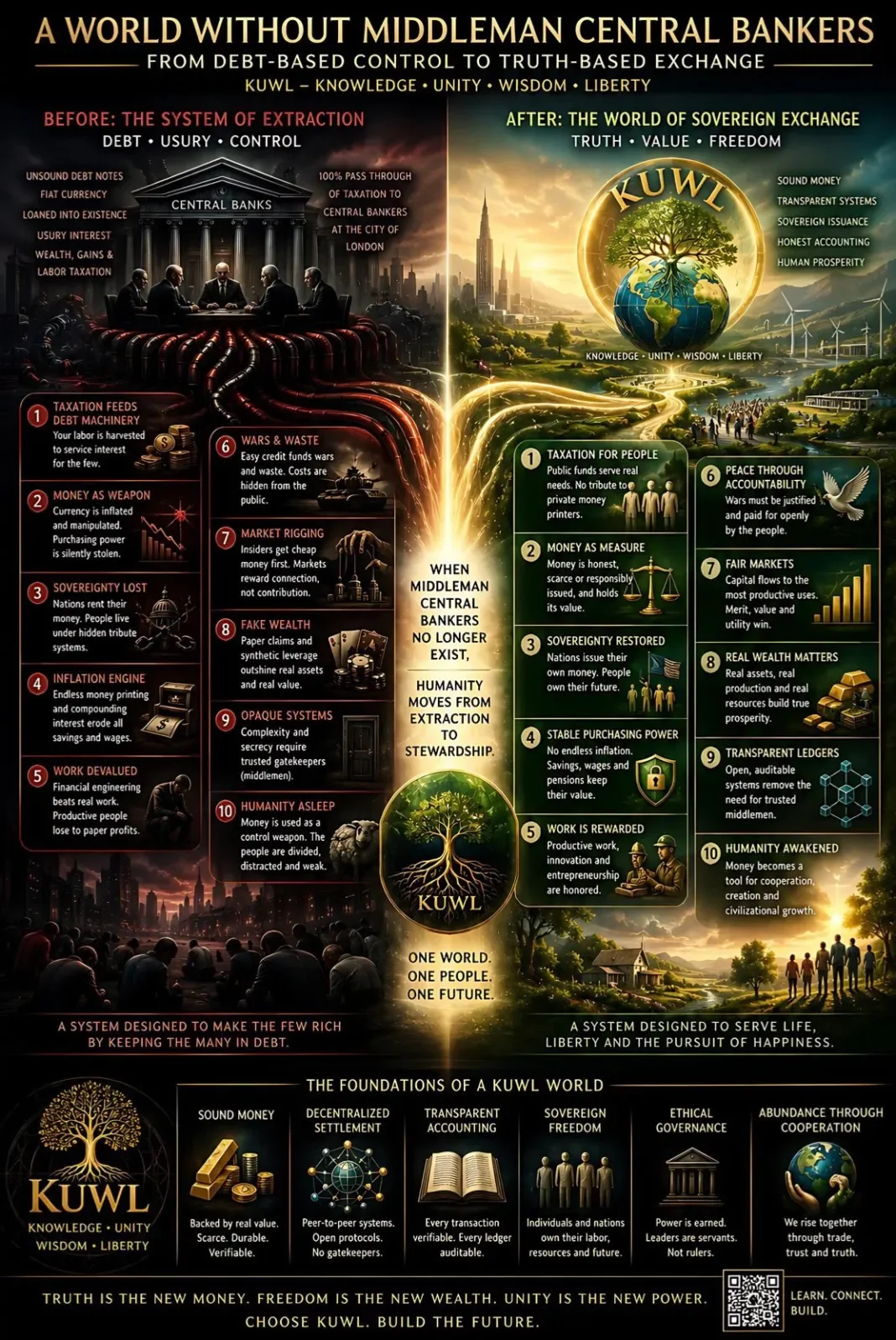
Money becomes measurement again.
Currency shifts from manipulated debt instruments toward honest weights and measures: scarce, auditable, rules-based, redeemable, or transparently issued.
Sovereignty returns to nations and people.
Governments no longer rent their monetary authority from private banking structures. Citizens no longer live under hidden tribute systems disguised as public finance.
Inflation loses its primary engine.
If money is no longer endlessly loaned into existence with compounding interest, purchasing power stops being quietly siphoned through currency debasement.
Productive work is rewarded more honestly.
Labor, savings, entrepreneurship, farming, building, invention, and risk-taking gain value relative to financial engineering.
Wars become harder to finance.
Without debt-note expansion and central-bank credit creation, governments must directly justify spending to the people instead of hiding costs through inflation and borrowing.
Markets become less rigged.
Capital allocation shifts away from privileged insiders closest to the money spigot and toward real utility, real collateral, real productivity, and real demand.
Real assets regain moral gravity.
Gold, land, energy, food, infrastructure, productive companies, and verifiable digital settlement networks become more important than paper claims and synthetic leverage.
Public ledgers matter more.
Transparent settlement systems, atomic exchange, cryptographic proof, and neutral interoperability become civilization-grade tools because they reduce the need for trusted middlemen.
Humanity exits monetary adolescence.
The spell breaks: people recognize that money is not supposed to be a control weapon. It is supposed to be a truthful coordination tool.
Bottom line:
When middleman central bankers no longer sit between human labor and human value, the world moves from debt-based control toward truth-based exchange.
From extraction to stewardship.
From hidden tribute to visible accounting.
From artificial scarcity to lawful abundance.
From financial priesthoods to sovereign participation.
Source(s):
• https://x.com/KuwlShow/status/2055824914200867161
https://dinarchronicles.com/2026/05/16/rob-cunningham-our-world-will-soon-see-changes/