
News, Rumors and Opinions Saturday 4-18-2026
KTFA:
Clare: The Iraqi parliament publishes the agendas for its four sessions next week.
4/17/2026
The Iraqi parliament published on Friday the agendas for its sessions next week, Sunday, Monday, Wednesday and Thursday, including the first reading of the proposed National Water Council Law.
The agenda for session No. (18) on Sunday, April 1, 2026, included, first: the first reading of the proposed National Service Law. (Security and Defense Committee), (Article 66)
KTFA:
Clare: The Iraqi parliament publishes the agendas for its four sessions next week.
4/17/2026
The Iraqi parliament published on Friday the agendas for its sessions next week, Sunday, Monday, Wednesday and Thursday, including the first reading of the proposed National Water Council Law.
The agenda for session No. (18) on Sunday, April 1, 2026, included, first: the first reading of the proposed National Service Law. (Security and Defense Committee), (Article 66).
Second: The first reading of the proposed fifth amendment to the Cancer Council Law in Iraq No. (63) of 1985. Health, Drug Control and Psychotropic Substances Committee) (Article 2).
As for the agenda of session No. (19) for Monday, April 20, 2026, it includes, firstly: the first reading of the proposed National Water Council Law. Committee on Agriculture, Resources, Water Resources, Marshes and Environment). (11) Articles.
Second: First reading of the proposed arbitration law. (Legal Committee). (47 articles).
The agenda for session No. (20) on Wednesday, April 22, 2026, included, firstly: the first reading of the proposed law of the Ministry of Communications (Transport, Communications and Governance Committee) 16 articles.
Second: First reading of the proposed law on municipal solid waste management. Committee on Agriculture, Water Resources, Marshes and Environment, Committee on Services and Reconstruction). (19 articles).
Finally, the agenda for session number (21) on Thursday, April 23, 2026, included: First: The first reading of the proposed Juvenile Welfare Law (Committee on Labor, Civil Society Organizations, Federal Public Service, Youth, Sports, Culture, and Tourism). (110 articles)
Second: The first reading of the proposed first amendment to the Law on the Protection of Teachers, Instructors, Supervisors and Educational Counselors No. (18) of 2018 (Education Committee). (Article). LINK
*********************
Clare: The US State Department demands that Iraq dismantle the militias and threatens "serious consequences" for their supporters.
4/17/2026
The US State Department on Friday evening called on the Iraqi government to dismantle armed factions allied with Iran, threatening their supporters with "serious consequences," following the imposition of sanctions on seven of their leaders.
The US State Department said in a statement: "We affirm our support for a stable, prosperous and sovereign Iraq, but at the same time we call on it to prevent its territory from being used to launch activities that destabilize the region."
The US State Department called on Iraqi authorities to "dismantle the groups allied with Iran," noting that these groups "threaten the lives of Americans as they have planned and attacked American individuals and interests in Iraq, and they undermine the country's sovereignty."
She noted, "We are taking decisive action to hold Iraqi groups allied with Iran accountable," and warned that "those who support militia violence in Iraq will face dire consequences."
Earlier today, the U.S. Treasury Department’s Office of Foreign Assets Control announced it had added seven Iraqi faction leaders to its sanctions list, holding them responsible for planning, directing, and carrying out attacks against U.S. personnel, facilities, and interests in Iraq.
The sanctions, according to the statement, included: leaders in Kataib Hezbollah Radwan Youssef Hamid Al-Mohammad, Hassan Dhiab and Ammar Jassim Kazem Al-Ramahi, leaders in Kataib Sayyid Al-Shuhada Khalid Jamil and Saeed Kazem, leader in Asaib Ahl Al-Haq Safaa Adnan Jabbar Suwaid, and leader in Harakat Al-Nujaba Hisham Hashem. LINK
Courtesy of Dinar Guru: https://www.dinarguru.com/
Stephen Do not ask your bank today if they're dealing with the Iraqi dinar. Because most banks are going to give you a very blanket answer saying, 'no we're not dealing with the Iraqi dinar nor do we have plans to deal with the Iraqi dinar.' A lot of people who are uneducated or uninformed, they take that to mean that the bank is never going to deal with the Iraq dinar. Then they get upset...down...frustrated because they're thinking, 'How am I going to exchange my dinar once it revalues?' I'm telling you once the Iraqi dinar has value and is no longer on a program rate and is no longer considered an exotic currency, the bank is going to deal with you.
Frank26 The lifting of the three zeros of the Iraqi dinar has officially started...This is an amazing day for the monetary reform...What they need to do now is add value to the currency in order to remove the three zero notes...In doing so it will introduce lower notes with purchasing power because they will have that power added by a different exchange rate.
Reset Intelligence The Saturday [the 26th] fuse is not about who sits in the chair. It is about what the chair activates. President to prime minister to cabinet to budget to HCL to rate. That sequence was laid out in The Constitutional Clock. It is now past the halfway mark.
************
Silver Price Rips Over $80 As New Shortage Looms...
4-17-2026
The silver price surged back over the $80 level this morning as the Strait of Hormuz reopened, and stunning news out of India has created the possibility of another shortage.
To find out more, and get caught up to speed on the latest regarding the war and how it will affect the precious metals, click to watch this video now!
Seeds of Wisdom RV and Economics Updates Saturday Morning 4-18-26
Good Morning Dinar Recaps,
Bond Market Fragility & Energy Shock Collide — Reset Pressures Rising Fast
Debt stress, geopolitical shifts, and volatile markets are converging into a systemic inflection point.
Good Morning Dinar Recaps,
Bond Market Fragility & Energy Shock Collide — Reset Pressures Rising Fast
Debt stress, geopolitical shifts, and volatile markets are converging into a systemic inflection point.
Overview
Global markets are showing conflicting signals with underlying weakness. While equities have rallied in response to easing geopolitical tension, deeper structural risks are intensifying. Sovereign debt concerns, unstable energy markets, and tightening policy flexibility are all pointing toward a system under strain. Recent warnings from financial leaders highlight that government bond markets—the backbone of global finance—may be approaching a critical breaking point.
Key Developments
1. U.S. Treasury Market Warning Signals Structural Risk
Former Treasury Secretary Henry Paulson warned that the U.S. may need an emergency “break-the-glass” plan if demand for Treasurys weakens significantly. He pointed to persistent deficits, rising yields, and declining foreign demand as key risks. A collapse in demand could force the Federal Reserve to become the primary buyer, effectively monetizing debt and undermining confidence in the system.
2. Global Debt Levels Near Critical Thresholds
Global debt continues to climb toward historic levels near 100% of GDP, limiting governments’ ability to respond to future crises. Rising interest costs are consuming larger portions of national budgets, increasing the likelihood of fiscal instability or forced restructuring if conditions worsen.
3. Energy Market Volatility Highlights Fragility
Oil prices dropped sharply after Iran signaled the Strait of Hormuz would remain open, triggering a rally in equities. However, this underscores a deeper issue: markets are now highly sensitive to geopolitical shocks, with energy acting as a key driver of inflation and liquidity conditions.
4. Central Banks Trapped Between Inflation and Debt Risk
Central banks are facing a policy dilemma. Keeping rates high risks triggering debt stress and recession, while cutting rates too soon could reignite inflation, especially with energy volatility still present. This limits their ability to stabilize markets effectively.
Why It Matters
Bond market instability threatens the core of global finance
Excessive debt reduces crisis response capability
Energy volatility amplifies inflation uncertainty
Central banks are losing policy flexibility
Together, these forces suggest the system is moving closer to a major inflection point, where traditional tools may no longer be sufficient.
Hello, World!
Why It Matters to Foreign Currency Holders
Confidence in fiat currencies could weaken if debt markets destabilize
Currency volatility may increase as capital shifts globally
Nations with strong fundamentals or commodity backing may gain relative strength
Disruption in U.S. Treasurys would impact the global reserve currency system
Implications for the Global Reset
Pillar 1: Monetary System Stress
The U.S. Treasury market is the foundation of global liquidity. Any sustained disruption could force rapid systemic changes, including increased monetization or a shift in reserve structures.Pillar 2: Global Debt Realignment
With debt levels at extremes, the likelihood of debt restructuring, currency realignment, or new financial frameworks increases as policymakers search for long-term solutions.
This is not just market volatility — it’s a stress test of the global financial system as debt, energy, and policy constraints converge.
Seeds of Wisdom Team
Newshounds News™ Exclusive
Sources
~~~~~~~~~~
A Message to Our Currency Holders
If you’ve been holding foreign currency for many years, you were not foolish.
You were not wrong to believe the global financial system would change.
What failed was not your patience — it was the information you were given.
For years, dates, rumors, and personalities replaced facts, structure, and proof. “This week” predictions created cycles of hope and disappointment that were never based on how currencies actually change.
That is not your failure.
Our mission here is different: • No dates • No rates • No hype • No gurus
Instead, we focus on:
• Verifiable developments • Institutional evidence
• Global financial structure • Where countries actually sit in the process
Currency value changes only come after sovereignty, trade, banking, settlement systems, and fiscal coordination are in place. History and institutions confirm this sequence.
You will see silence. You will see denials. That is not delay — that is discipline.
Protect your identity. Organize your documents. Verify everything.
Never hand your discernment to anyone who cannot show proof.
You deserve truth — not timelines.
Seeds of Wisdom Team
Newshounds News™
~~~~~~~~~~
Seeds of Wisdom Team RV Currency Facts Youtube and Rumble
Newshound's News Telegram Room Link
RV Facts with Proof Links Link
RV Updates Proof links - Facts Link
Follow the Gold/Silver Rate COMEX
Follow Fast Facts
Seeds of Wisdom Team™Website
Thank you Dinar Recaps
Iraq Economic News And Points To Ponder Saturday Morning 4-18-26
Strait Of Hormuz Is Open, But Lower Gas Prices Could Take Time
Traffic And Trepidation In The Persian Gulf Could Keep Gasoline Prices From Dropping Quickly
NEW YORK (AP) — After U.S. President Donald Trump and Iran’s foreign minister said the Strait of Hormuz was fully open to commercial vessels after almost seven weeks of war, oil prices plunged 10% and the stock market rallied Friday.
Motorists, hoping for relief at the pump, wondered how quickly gasoline prices might fall once oil tankers stuck in the Persian Gulf were moving again. A gallon of regular gasoline cost $4.08 on average in the U.S. Friday, which was 37% more than before U.S. and Israel attacked Iran but down a few cents from a week ago.
Strait Of Hormuz Is Open, But Lower Gas Prices Could Take Time
Traffic And Trepidation In The Persian Gulf Could Keep Gasoline Prices From Dropping Quickly
NEW YORK (AP) — After U.S. President Donald Trump and Iran’s foreign minister said the Strait of Hormuz was fully open to commercial vessels after almost seven weeks of war, oil prices plunged 10% and the stock market rallied Friday.
Motorists, hoping for relief at the pump, wondered how quickly gasoline prices might fall once oil tankers stuck in the Persian Gulf were moving again. A gallon of regular gasoline cost $4.08 on average in the U.S. Friday, which was 37% more than before U.S. and Israel attacked Iran but down a few cents from a week ago.
But when gas prices spike, they don’t typically drop as quickly as the cost of crude. Even if Iran keeps the waterway open in the face of a U.S. blockade of its vessels, it still could take months for fuel prices to return to levels resembling those enjoyed before the war began Feb. 28, energy experts said.
The slow speed at which oil tankers travel from ports to refineries, lingering security concerns, traffic in the strait and damage to energy infrastructure in the Middle East are all playing a role in the elevated price of gasoline.
“The historical observation is that gasoline prices rise quickly but fall slowly, regardless of the particular causes of the increase,” said Mark Barteau, a professor in the department of chemical engineering at Texas A&M University.
“In this case, one has to take into account the time it takes for the steps that have to happen once tankers sail through the straits – for example, sailing time to refineries on other continents, time to ramp up refinery operations, and time to transport some refined products by tanker to the continent where they will be used,” Barteau said. “There is also tendency to hedge bets because of doubts about whether and how quickly that restoration might occur, and whether further disruptions are possible along the way.”
Nevertheless, some energy analysts were optimistic that gas prices would gradually decline.
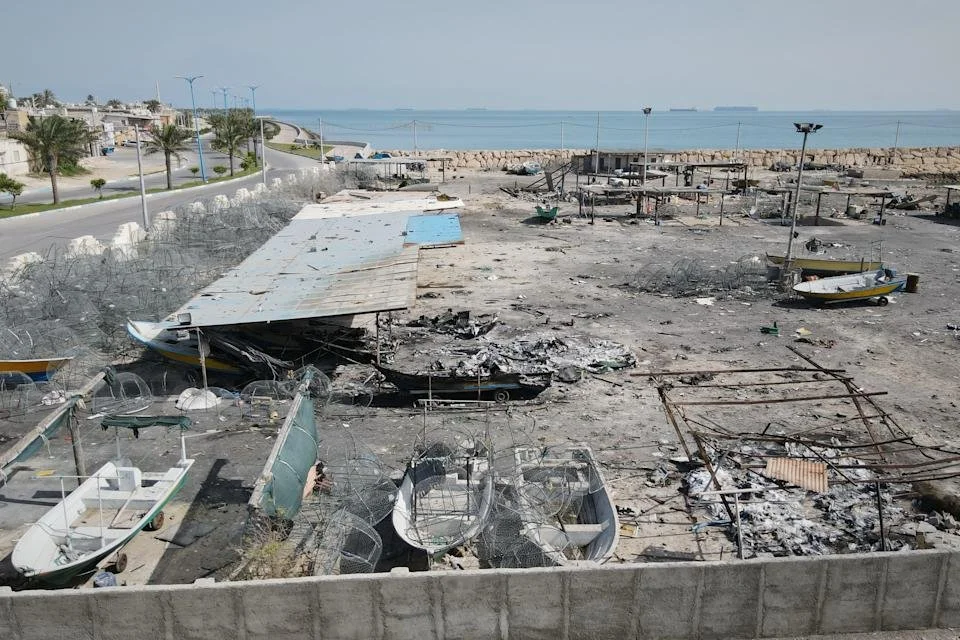
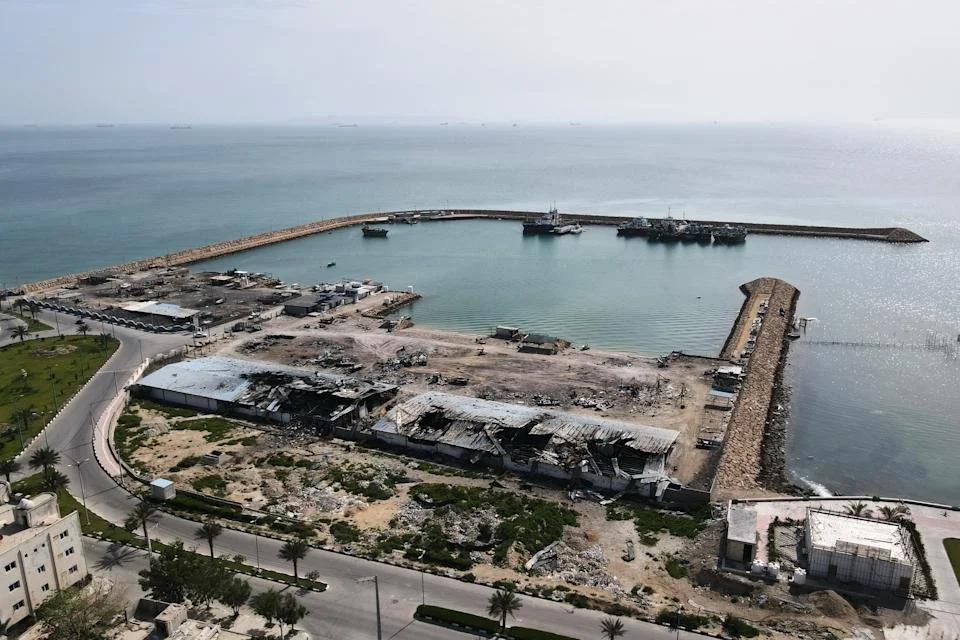
Caption Backdropped by ships in the Strait of Hormuz, damage, according to local witnesses caused by several recent airstrikes during the U.S.-Israel military campaign, is seen on a fishing pier in the port of Qeshm island, Iran, Monday, April 13, 2026. (AP Photo/Asghar Besharati)
Hope for Lower Gasoline Prices
Gasoline prices were already falling slightly after last week’s announcement of a two-week ceasefire between the U.S. and Iran, according to motor club federation AAA.
Following the Strait of Hormuz announcement, oil prices fell by $10 to $12 per barrel, which generally translates into a decrease of 25 or 30 cents per gallon of gas, said Michael Lynch, distinguished fellow at Energy Policy Research Foundation, a non-partisan research institution focused on energy and economics.
“That doesn’t happen overnight, but within a week or two, we could be down 50 cents a gallon easily, if this holds,” Lynch said. “And part of it is, there’s a lot of tankers ready to go. And if they all come out, then that balances the market very quickly.”
In the wake of Friday's news, “every state will start seeing gas price decreases accelerate at a pace of probably 1 to 3 cents a gallon for every day or two,” said Patrick De Haan, head of petroleum analysis at GasBuddy, in a webcast. “And that could continue for at least a couple of weeks.”
DeHaan estimated that the national average for a gallon of regular gas could reach $3.45 to $3.65 by Memorial Day. But he acknowledged that returning to lower prices could take a while.
“It might take until later this year or early next year to really fully normalize and for some of these surcharges and impacts to reverse and disappear," De Haan said.
Traffic and Trepidation
If an agreement to end the war is reached, it could take at least four months for shipping through the Strait of Hormuz to go back to normal, said Patrick Penfield, professor of supply chain practice at Syracuse University.
“Right now, you still have potential mines that have to be removed or detonated, you have over 150 tankers that have been anchored in and around the strait, which is causing a traffic jam, and we still have shipping rates that are still high because of lack of shipping capacity and war rate insurance,” he said.
The leaders of France and the U.K. welcomed word of the strait's reopening but said they would keep pushing for a way to permanently restore freedom of navigation for vessels that rely on the narrow passage off Iran's coast, through which about one-fifth of the world's oil typically travels.
Ship owners would have to be convinced to trust the Americans and Iranians, "and that seems like it’s a hard hill to climb,” Lynch, of the Energy Policy Research Foundation, said. “I certainly wouldn’t want to do it. I wouldn’t wanna be the first ship through or even the first five ships through, but somebody will do it. There’s a lot of money on the table and somebody’s going to grab it.”
If the Iranians are cooperating, the mines should not be a problem, because Iran has a sense of where the mines are, Lynch said.
"Now, that raises the issue, are the Iranians going to cooperate, or what do they want to cooperate?” he asked. “Are they going to demand a couple-million dollars a ship, as is talked about? Or is Trump going to say ‘that’s not acceptable,’ and then what’s the next step after that?”
If the strait remains open, and ships loaded with oil leave the Persian Gulf, it could take weeks for those heavy, slow-moving ships to reach their destinations.
“People think that once the strait opens, it’s fine. We’re done. It’ll be better really fast,” said Richard Joswick, global head of near-term oil analysis at S&P Global Energy. “If you open the strait today to get a ship and bring it around and take it to Europe and run a refinery, turn it into products, you’re talking 10 weeks of a lag time here. It will be two to three months before things can start to get back to normal after the straight re-opens.”
Damage to Energy Infrastructure in the Middle East
Many oil production facilities were damaged in the Middle East, including refineries in Saudi Arabia and Kuwait and oil tanker terminals in the United Arab Emirates and Iran. Some repairs has been made, but damage remains.
In addition, some countries slowed down or halted production during the war, because without the ability to ship crude through the Strait of Hormuz, their ships and storage tanks filled up with stranded oil.
“It’s not a light switch. Everyone’s impatient and saying, ‘Go, go go,’” De Haan said. “But it will take time to get these flows of oil through the Middle East fired back up again.”
Once an oil well is turned off, the pressure within the well could change, and it can take time to restart the flow. But that might not be a problem in some Middle East oil fields, where production can be resumed quickly, Lynch said.
“The Saudis have done that a bunch of times. They ramp up by 2 or 3 million barrels a day, almost overnight, and there’s no problem with the wells that have been shut in for months and sometimes years,” Lynch said. LINK
MilitiaMan and Crew: IRAQ DINAR UPDATE-FOCUS-REER UPDATE: Momentum is Building-Political Clean up & Economic Resilience
MilitiaMan and Crew: IRAQ DINAR UPDATE-FOCUS-REER UPDATE: Momentum is Building-Political Clean up & Economic Resilience
4-17-2026
The Crew: Samson, PompeyPeter, Petra, Daytrader, Sunkissed, GIGI and Militia Man
No drama. No intrigue. No songs and dances. Just straight, factual news that I read and interpret to the best of my ability after being an avid Dinar investor and insanely obsessed Dinarian for over 15 years.
Follow MM on X == https://x.com/Slashn
MilitiaMan and Crew: IRAQ DINAR UPDATE-FOCUS-REER UPDATE: Momentum is Building-Political Clean up & Economic Resilience
4-17-2026
The Crew: Samson, PompeyPeter, Petra, Daytrader, Sunkissed, GIGI and Militia Man
No drama. No intrigue. No songs and dances. Just straight, factual news that I read and interpret to the best of my ability after being an avid Dinar investor and insanely obsessed Dinarian for over 15 years.
Follow MM on X == https://x.com/Slashn
Be sure to listen to full video for all the news……..
FRANK26…4-17-26….ADIOS … A
KTFA
Friday Night Video
FRANK26…4-17-26….ADIOS … A
This video is in Frank’s and his team’s opinion only
Frank’s team is Walkingstick, Eddie and Omar in Iraq and guests
Playback Number: 605-313-5163 PIN: 156996#
KTFA
Friday Night Video
FRANK26…4-17-26….ADIOS … A
This video is in Frank’s and his team’s opinion only
Frank’s team is Walkingstick, Eddie and Omar in Iraq and guests
Playback Number: 605-313-5163 PIN: 156996#
The Money Printer is Firing up but it’s Different this Time
The Money Printer is Firing up but it’s Different this Time
Heresy Financial: 4-15-2026
If you’ve been keeping an eye on the headlines, the numbers are becoming impossible to ignore. The United States is currently staring down a debt-to-GDP ratio of 122%—a level of financial strain we haven’t seen since the height of World War II. For many, this raises a haunting question: How does the government get out of this hole?
The reality is that there are no “easy” buttons. When you dig into the mechanics of federal finance, you realize the government is walking a tightrope between economic collapse and the risk of runaway inflation.
The Money Printer is Firing up but it’s Different this Time
Heresy Financial: 4-15-2026
If you’ve been keeping an eye on the headlines, the numbers are becoming impossible to ignore. The United States is currently staring down a debt-to-GDP ratio of 122%—a level of financial strain we haven’t seen since the height of World War II. For many, this raises a haunting question: How does the government get out of this hole?
The reality is that there are no “easy” buttons. When you dig into the mechanics of federal finance, you realize the government is walking a tightrope between economic collapse and the risk of runaway inflation.
Printing money isn’t a neutral act. When new money enters the system, it doesn’t spread evenly. Those who receive the money first—often politically connected groups or large financial institutions—can spend it before prices rise. By the time that money filters down to the average citizen, prices have already climbed, resulting in a silent wealth transfer from the bottom to the top. This is the mechanism that has driven much of the wealth inequality we’ve seen over the last few years.
So, if the government can’t cut spending and can’t afford to let the economy stagnate, what’s the move? The brewing theory is that the Federal Reserve may push for bank deregulation, specifically targeting the supplementary leverage ratio.
The goal? To allow banks to buy unlimited U.S. Treasuries and free up their balance sheets to lend more to the private sector.
Regardless of which scenario plays out, both are inherently bullish for asset prices. While the debt crisis poses a systemic risk to the dollar, it often creates a windfall for those who own the “hard” assets that the newly created money flows into.
In a world defined by uncertainty and endless printing, the message is clear: Don’t just watch from the sidelines. Positioning yourself as an asset owner is no longer just a wealth-building strategy; it’s a form of economic self-defense.
Want to learn how to navigate these volatile waters? The current economic climate is ripe for “Black Swan” events—unpredictable market shifts that can either ruin the unprepared or reward the proactive. Find out how to position yourself advantageously in these uncertain times by checking out the full analysis from Heresy Financial.
TIMECODES
00:00 The Worst Debt Crisis in Almost a Century
00:31 Four Options. Three Are Off the Table.
01:05 Every New Dollar Creates Future Demand for More Dollars
01:56 Not All Money Printing Causes Inflation
02:25 The Thought Experiment That Explains Everything
03:56 Who Gets the New Money First Gets Rich. Everyone Else Pays.
06:05 2020 Proved Exactly How This Wealth Transfer Works
07:33 The Post-War Playbook Worked Once. Here's Why It Can't Again.
09:29 Entitlements Are the Spending Nobody Will Cut
10:01 Bank Deregulation: The Needle They're Trying to Thread
11:58 They Tested This in 2020. Banks Did Exactly What They Expected.
12:44 Scenario 1: Production Boom. Scenario 2: Wall Street Bailout.
14:09 Both Scenarios Are Bullish for Asset Prices
14:35 Your Portfolio Is the Only Lifeboat
Ask THESE Questions Before You Go To The Bank
Ask THESE Questions Before You Go To The Bank
Dinar For Dummies: 4-16-2026
For many in the investment world, the Iraqi Dinar (IQD) represents a unique, albeit polarizing, opportunity. Since 2011, Steven—entrepreneur and seasoned investor—has navigated the turbulent waters of the Dinar market. In a recent video on the Dinar For Dummies channel, Steven pulls back the curtain on what it actually takes to be ready for a potential Revaluation (RV).
His message is clear: Stop chasing “hopeium” and start focusing on logistics.
If you are a Dinar holder, it’s time to move past the rumors of “confirmed dates” and “leaked rates” and start building a professional exchange strategy. Here is the blueprint for practical preparation.
Ask THESE Questions Before You Go To The Bank
Dinar For Dummies: 4-16-2026
For many in the investment world, the Iraqi Dinar (IQD) represents a unique, albeit polarizing, opportunity. Since 2011, Steven—entrepreneur and seasoned investor—has navigated the turbulent waters of the Dinar market. In a recent video on the Dinar For Dummies channel, Steven pulls back the curtain on what it actually takes to be ready for a potential Revaluation (RV).
His message is clear: Stop chasing “hopeium” and start focusing on logistics.
If you are a Dinar holder, it’s time to move past the rumors of “confirmed dates” and “leaked rates” and start building a professional exchange strategy. Here is the blueprint for practical preparation.
The Dinar community is often flooded with unverified rumors. Steven emphasizes that the exact timing and rate of an RV remain uncertain, and very few people—if any—have credible, inside information.
Instead of refreshing forums for a “secret date,” your time is better spent preparing for the moment the window opens. Success isn’t just about holding the currency; it’s about having a plan to exit the position efficiently.
When the RV occurs, you shouldn’t be walking into your local bank blindly. Steven suggests a proactive approach by interviewing banks beforehand to understand their specific policies.
For those with significant holdings, Steven suggests looking beyond the retail teller window.
Private Banking and Wealth Management: If the RV results in a significant windfall, standard retail banking may not be the best fit. Private banking services offer more personalized care, better security for large transactions, and potential breaks on exchange fees.
The “Spread” Strategy: Rather than exchanging your entire holding in one go, Steven advises spreading out transactions. This helps mitigate the risk of sudden rate fluctuations and allows you to manage the tax implications more effectively.
Getting the money is only half the battle; keeping it is the other half. One of the most critical aspects of post-RV life is tax strategy.
Steven teased an upcoming interview with a former NATO contractor and experienced Dinar investor to dive deep into these topics. Understanding how to structure your wealth legally through trusts or specific business entities can mean the difference between long-term financial freedom and a massive tax headache.
The potential of the Iraqi Dinar is a marathon, not a sprint. Steven’s approach is a breath of fresh air in a space often dominated by emotional highs and lows. By focusing on bank relationships, fee negotiations, and legal preparedness, you transition from a “speculator” to a “professional investor.”
As Steven suggests, the goal is to maximize the benefits while minimizing the risks.
Want to dive deeper into the specifics? Watch the full video on Dinar For Dummies for a comprehensive walkthrough of the exchange process and stay tuned for Steven’s upcoming in-depth guide on tax strategies and legal structures.
Seeds of Wisdom RV and Economics Updates Friday Afternoon 4-17-26
Good Afternoon Dinar Recaps,
Strait of Hormuz Reopens: Oil Prices Plunge as Geopolitical Tensions Reshape Global Markets
Temporary de-escalation in the Middle East is driving energy price shifts and exposing deeper vulnerabilities in the global financial system
Good Afternoon Dinar Recaps,
Strait of Hormuz Reopens: Oil Prices Plunge as Geopolitical Tensions Reshape Global Markets
Temporary de-escalation in the Middle East is driving energy price shifts and exposing deeper vulnerabilities in the global financial system
Overview
A major geopolitical shift has emerged as Iran announced the full reopening of the Strait of Hormuz to commercial vessels, marking a significant reversal from earlier restrictions. The move comes amid a 10-day ceasefire tied to regional conflict dynamics, easing immediate fears of global energy supply disruption.
Donald Trump responded by welcoming the reopening, noting the strait is “open and ready for business,” while simultaneously confirming that a U.S. naval blockade on Iranian ports will remain in place until broader conditions are met. This dual approach reflects partial de-escalation without full normalization.
The Strait of Hormuz is one of the most critical energy chokepoints in the world, responsible for a significant share of global oil transit. Its reopening has already triggered a sharp drop in oil prices, signaling how sensitive global markets remain to geopolitical developments.
At a broader level, this event underscores a growing reality: energy flows, geopolitical strategy, and financial stability are now deeply interconnected, with immediate implications for the global monetary system.
Key Developments
1. Strait of Hormuz Reopens to Global Shipping
Iran’s decision marks a significant shift in regional posture.
• All commercial vessels are now allowed passage through the strait
• The move reverses earlier restrictions on U.S. and Israeli-linked shipping
• Global energy supply routes are temporarily stabilized
2. Oil Prices Enter Sharp Decline
Markets reacted quickly to reduced supply risk.
• Oil prices fell rapidly following the reopening announcement
• Lower prices signal easing short-term inflation pressures
• Energy market volatility remains elevated despite the drop
3. U.S. Maintains Strategic Pressure
Despite the reopening, tensions remain unresolved.
• The U.S. will continue its naval blockade on Iranian ports
• Policy reflects a controlled de-escalation strategy
• Full normalization is contingent on further agreements
4. Ceasefire Creates Temporary Stability Window
The reopening is tied to a broader regional pause in conflict.
• A 10-day ceasefire involving Israel and Hezbollah is now in effect
• The agreement has reduced immediate military escalation risks
• Long-term peace remains uncertain, limiting sustained market confidence
Why It Matters
This development highlights how geopolitical control over energy routes directly impacts global financial conditions. The immediate drop in oil prices demonstrates the powerful link between supply stability and inflation expectations.
Markets are increasingly reacting in real time to geopolitical signals, reinforcing the idea that financial systems are highly sensitive to external shocks rather than purely economic fundamentals.
From a policy perspective, the situation reflects a balancing act between de-escalation and continued strategic pressure, complicating efforts to stabilize global markets.
Why It Matters to Foreign Currency Holders
• Falling oil prices can weaken energy-linked currencies while supporting import-heavy economies
• Currency volatility increases during geopolitical transitions
• The U.S. dollar remains influenced by geopolitical positioning and energy control
• Shifts in global energy flows may accelerate changes in reserve currency dynamics
Implications for the Global Reset
Pillar 1: Energy Corridors as Financial Control Points
The Strait of Hormuz remains a critical lever of global economic influence, with its status directly affecting inflation, trade flows, and currency stability. Control over such routes is increasingly central to global financial power.
Pillar 2: Managed Instability as a System Feature
The coexistence of a ceasefire and continued sanctions highlights a system where stability is partial and controlled rather than absolute, reflecting deeper structural tensions within the global financial framework.
Conclusion
The reopening of the Strait of Hormuz offers short-term relief to global markets, but it does not resolve the underlying geopolitical tensions driving volatility. Instead, it reveals a system operating under managed uncertainty, where temporary stability masks deeper structural risks.
While falling oil prices may ease immediate pressures, the persistence of strategic conflict suggests that market calm could be short-lived. This reinforces the broader theme of a global system in transition.
Ultimately, this moment is not just about energy or geopolitics — it is a reflection of how fragile and interconnected the global financial system has become under pressure.
Seeds of Wisdom Team
Newshounds News™ Exclusive
Sources
RT — "Trump thanks Iran for opening Strait of Hormuz as oil prices in freefall"
Reuters — "Oil prices fall as Strait of Hormuz tensions ease"
~~~~~~~~~~
Seeds of Wisdom Team RV Currency Facts Youtube and Rumble
Newshound's News Telegram Room Link
RV Facts with Proof Links Link
RV Updates Proof links - Facts Link
Follow the Gold/Silver Rate COMEX
Follow Fast Facts
Seeds of Wisdom Team™Website
Thank you Dinar Recaps
Bruce’s Big Call Dinar Intel Thursday Night 4-16-26
Bruce’s Big Call Dinar Intel Thursday Night 4-16-26
Transcribed By WiserNow Emailed To Recaps (INTEL ONLY)
Welcome, everybody to the big call tonight - it is Thursday, April 16th and you're listening to the big call. Thanks for tuning in, everybody again, and we're loved to have you here. Looking forward, having a really good call.
Just minutes into Bruce’s intel segment the recording became defective – Bruce’s voice /words were not understandable and transcribing with any accuracy was not possible – The recorded call link is below for you to listen
Bruce’s Big Call Dinar Intel Thursday Night 4-16-26
Transcribed By WiserNow Emailed To Recaps (INTEL ONLY)
Welcome, everybody to the big call tonight - it is Thursday, April 16th and you're listening to the big call. Thanks for tuning in, everybody again, and we're loved to have you here. Looking forward, having a really good call.
Just minutes into Bruce’s intel segment the recording became defective – Bruce’s voice /words were not understandable and transcribing with any accuracy was not possible – The recorded call link is below for you to listen
Bruce’s Big Call Dinar Intel Thursday Night 4-16-26 REPLAY LINK Intel Begins 1:20:00
Bruce’s Big Call Dinar Intel Tuesday Night 4-14-26 REPLAY LINK Intel Begins 1: 01:15
Bruce’s Big Call Dinar Intel Thursday Night 4-9-26 REPLAY LINK Intel Begins 1:19:19
Bruce’s Big Call Dinar Intel Tuesday Night 4-7-26 REPLAY LINK Intel Begins 1: 17:37
Bruce’s Big Call Dinar Intel Thursday Night 4-2-26 REPLAY LINK Intel Begins 1:17:17
https://www.freeconferencecallhd.com/wall/recorded_audio?audioRecordingUrl=https%3A%2F%2Frs0002.freeconferencecall.com%2Fstorage%2FsgetHD%2FHsCgW%2FOoxT
Bruce’s Big Call Dinar Intel Tuesday Night 3-31-26 REPLAY LINK Intel Begins 1: 7:50
Bruce’s Big Call Dinar Intel Thursday Night 3-26-26 REPLAY LINK Intel Begins 54:44
Bruce’s Big Call Dinar Intel Tuesday Night 3-24-26 REPLAY LINK Intel Begins 1: 22:00
https://www.freeconferencecallhd.com/wall/recorded_audio?audioRecordingUrl=https%3A%2F%2Frs0002.freeconferencecall.com%2Fstorage%2FsgetHD%2FHsCgW%2FOoQt
Bruce’s Big Call Dinar Intel Thursday Night 3-19-26 REPLAY LINK Intel Begins 1:15:35
Bruce’s Big Call Dinar Intel Tuesday Night 3-17-26 REPLAY LINK Length 1:17: 27
Bruce’s Big Call Dinar Intel Thursday Night 3-12-26 REPLAY LINK Call Intro 19:28 Intel Begins 1:18:18
Bruce’s Big Call Dinar Intel Tuesday Night 3-10-26 REPLAY LINK Length 57: 36
Why the Government Runs Like a Bloated Chrome Tab
Why the Government Runs Like a Bloated Chrome Tab
Notes From the Field By James Hickman (Simon Black / Sovereign Man) April 17, 2026
I had a Commodore 64 “computer” when I was a kid. I know I’m dating myself with that reference... but I’m telling you— back in the 80s, a Commodore was pretty hot stuff. It was basically an antique typewriter that you plugged into a television (sort of like a Nintendo or other gaming console). And they called it a Commodore “64” because it had a whopping 64 kilobytes of RAM.
"Kilobytes" is not a typo. For context, most mobile phones today have 8 gigabytes of RAM, and a gigabyte is roughly 1 million times a kilobyte.
Why the Government Runs Like a Bloated Chrome Tab
Notes From the Field By James Hickman (Simon Black / Sovereign Man) April 17, 2026
I had a Commodore 64 “computer” when I was a kid. I know I’m dating myself with that reference... but I’m telling you— back in the 80s, a Commodore was pretty hot stuff. It was basically an antique typewriter that you plugged into a television (sort of like a Nintendo or other gaming console). And they called it a Commodore “64” because it had a whopping 64 kilobytes of RAM.
"Kilobytes" is not a typo. For context, most mobile phones today have 8 gigabytes of RAM, and a gigabyte is roughly 1 million times a kilobyte.
****************************
pic
The average email today (without attachments) is nearly 100 kilobytes, i.e. 50% more than the entire memory of my Commodore. Yet, back in the 80s, software developers were able to do miraculous things with that tiny amount of memory.
64 kilobytes was somehow enough to play games like Pitfall and Impossible Mission, bang out a school report on a dot-matrix printer, and all sorts of other things.
And it wasn’t just Commodore— Nintendo and Sega put out hundreds of titles on consoles that had comparably tiny amounts of memory.
In order to make all of this magic happen, programmers had to be absolutely ruthless about every single line of code. Every byte mattered. There was zero bloat. Zero inefficiency.
And software teams routinely fought with each other about what features would be in a game, versus what features would be thrown out— because there simply wasn’t enough memory to include what everyone wanted.
***********************************
In short, the software industry had to live within its means. Yet despite those severe memory limitations, they put out timeless classics. It was a Golden Age for software development.
But then something happened. Technological and manufacturing breakthroughs made memory abundant... and cheap. Whereas 64 kilobytes of memory was considered a luxury in the 80s, soon megabytes of RAM... and then gigabytes of RAM, became readily available.
Memory eventually became so abundant that it felt practically infinite. No one had to make any tough decisions to optimize their code for RAM limitations... because there was always more memory available.
As a result, bloat eventually crept in. Here are a few examples.
Literally right now as I write this, I have a number of tabs open in my browser (I use Brave, by the way). ProtonMail takes up 409 megabytes of RAM... for a single tab. And a web-based PowerPoint presentation in my browser takes up 957 megabytes of RAM!
And don’t get me started on Windows.
Microsoft has been rolling out a ‘feature’ to “pre-load” data in its File Explorer application that consumes 67.4 megabytes of RAM. That’s more than 1,000x the memory requirement as my Commodore 64 had... for the sole purpose of being able to look at files and folders on your computer.
The level of bloat and memory waste is absurd (and also why I use Linux).
There’s hardly anyone in the industry today who remembers the bygone days of having to make ruthless decisions over every line of code; rather, the software industry today is accustomed to being able to publish bloated code... because memory has been so abundant for so long.
Unfortunately conditions have now dramatically changed.
Thanks in large part to surging AI demand, there is now a global memory shortage. RAM supply is scarce and has skyrocketed in price.
The industry, quite predictably, is fretting over the supply side, complaining that memory manufacturers need to build new factories and produce more RAM.
Very few prominent voices in software are saying, “Gee guys, maybe we should be more efficient in our code and use less RAM. Maybe it shouldn’t take 67 megabytes to look at our system files... Or 400+ megabytes for a single browser tab.”
In other words, there’s very little push to be more efficient and live within their means.
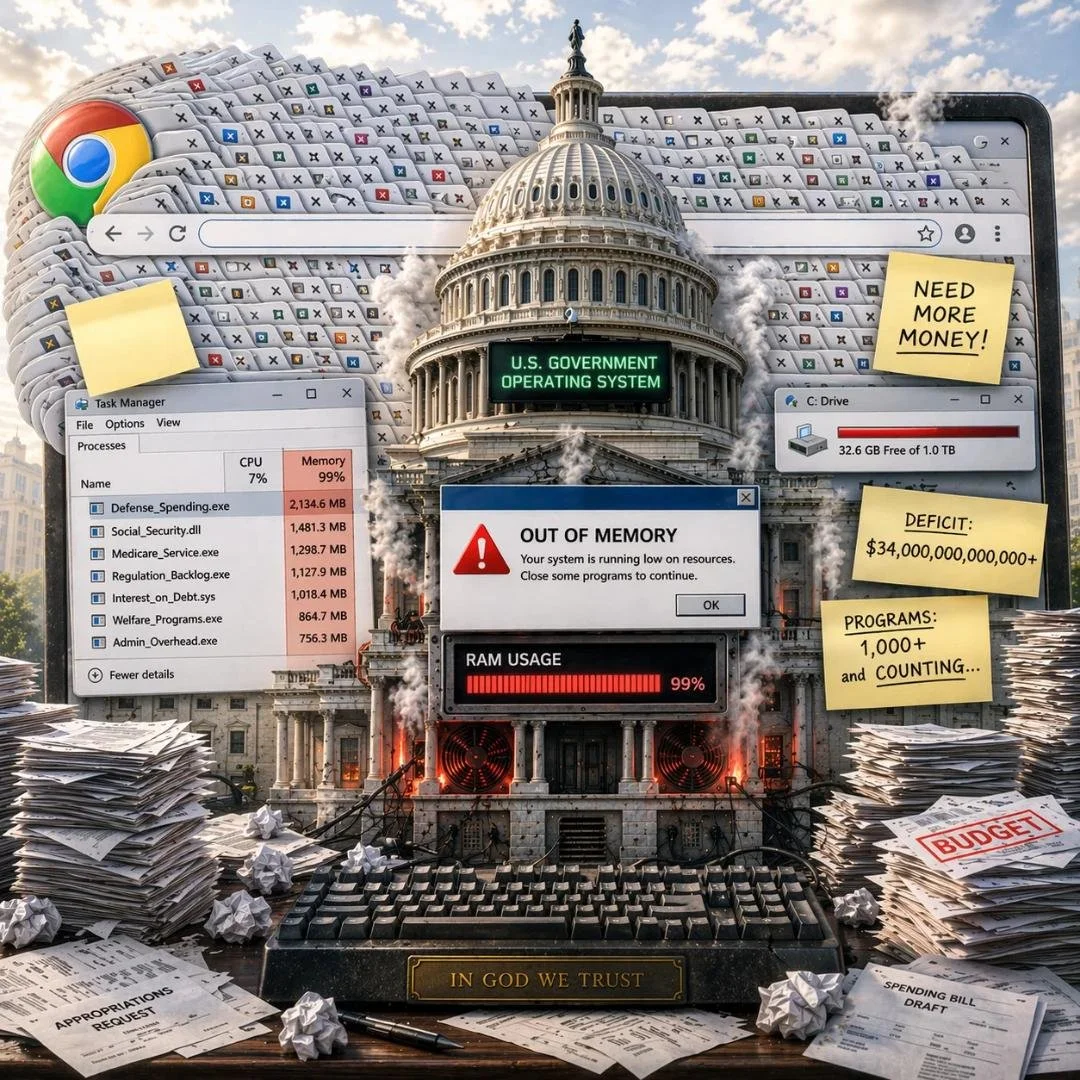
If you’re starting to see where I’m going, this story should sound familiar... because it’s very similar to how the government spends our money.
*********************************
Once upon a time in America, Congress fought passionately over every dollar. They knew they had to live within their means, and every budget item mattered. Politicians debated passionately about which programs stayed and which had to go.
But that was the past. America has been the world’s superpower, and the US dollar the world’s reserve currency, for eight decades.
Consequently, the US government has been able to run massive deficits and rack up a gargantuan national debt with impunity, leading politicians to believe that America’s financial resources are infinite.
Today there’s no one in government who remembers the days of responsible spending. That’s why there’s so much bloat and why deficits are so high.
But, just like the memory market, a sudden scarcity is emerging. Foreign creditors— who used to provide ample funds to the Treasury market— are starting to invest their capital elsewhere.
We can see this impact with interest rates, which are now hovering near multi-decade highs... as well as gold prices, which remain near all-time highs.
Faced with a sudden scarcity of financial resources— and the shocking realization that government spending cannot be infinite— Congress is choosing the predictable route.
Rather than look to themselves to become more efficient, to make objective and ruthless decisions about what programs stay and what programs go, to live within their means... they are instead demanding more resources.
Of course they always start with calls to “tax the rich”. But these taxes invariably trickle down to the middle class; just ask anyone who had to submit an AMT return this week.
But the point here isn’t to argue whether Jeff Bezos should or shouldn’t pay more tax. The point is that Congress’s approach is entirely wrong.
As we discussed yesterday, they fail to understand a very simple point: higher tax rates don’t generate higher overall tax revenue. Higher tax revenue comes from a booming economy.
So they should instead invest their energy into ensuring maximum productivity... which ultimately means fewer regulations, and in general staying out of the way.
It’s also insane that they are specifically refusing to cut spending. Despite hundreds of billions worth of documented fraud, they do nothing about it. They’ve also pledged to NOT reform Social Security and Medicare, i.e. the single biggest budget items in government.
It’s the exact opposite of what they should be doing. They still don’t have the right mentality to solve America’s #1 problem... and it’s why having a Plan B makes so much sense.
To your freedom, James Hickman Co-Founder, Schiff Sovereign LLC
Some “Iraq News” Posted by Tishwash at TNT 4-17-2026
TNT:
Tishwash: The Speaker of Parliament affirms the commitment to supporting the independence of monetary policy and monitoring the performance of the Central Bank.
Official statement…
The Speaker of Parliament, Hebat Al-Halbousi, received the Governor of the Central Bank, Ali Mohsen Al-Alaq, on Thursday.
The meeting discussed the reality of monetary policy in Iraq and prospects for enhancing its stability, in line with the requirements of macroeconomic stability, and stressed the importance of continued coordination between the House of Representatives and the Central Bank, in order to enhance the effectiveness of economic policies and achieve the desired development goals.
TNT:
Tishwash: The Speaker of Parliament affirms the commitment to supporting the independence of monetary policy and monitoring the performance of the Central Bank.
Official statement…
The Speaker of Parliament, Hebat Al-Halbousi, received the Governor of the Central Bank, Ali Mohsen Al-Alaq, on Thursday.
The meeting discussed the reality of monetary policy in Iraq and prospects for enhancing its stability, in line with the requirements of macroeconomic stability, and stressed the importance of continued coordination between the House of Representatives and the Central Bank, in order to enhance the effectiveness of economic policies and achieve the desired development goals.
During the meeting, the Speaker of the Council emphasized the House of Representatives’ interest in monitoring the performance of the Central Bank of Iraq and its commitment to supporting the independence of monetary policy, stressing the importance of strengthening effective coordination between monetary and fiscal policies in order to contribute to achieving economic balance and reducing inflationary pressures.
He pointed out that the House of Representatives, based on its oversight and legislative role, affirms its monitoring of the procedures and policies adopted by the Central Bank, in order to enhance transparency and strengthen confidence in the banking sector, stressing the House’s readiness to provide the necessary legislative cover to support financial and banking reforms.
For his part, the Governor of the Central Bank reviewed the most prominent measures taken to enhance monetary stability, regulate the exchange market, and develop the banking sector, stressing that the bank will continue to work in accordance with best international practices and in a way that supports financial stability.
Media Office of the Speaker of Parliament,
April 16, 2026 link
************
Tishwash: An Iraqi expert says approving the 2026 budget is almost impossible, and postponement until the end of the year is possible.
Economic and financial expert Haider Al-Sheikh confirmed on Thursday that the discussions circulating within the House of Representatives regarding moving to legislate the federal budget law for 2026 are “almost impossible” given the limited time and its insufficiency for the government and parliament to accomplish this obligation.
The sheikh explained to “Roj News” that “the next Iraqi government is expected to be formed in about a month, but it will need at least three months to prepare and approve the draft budget law before sending it to the House of Representatives, which means that the draft law, if prepared, may reach Parliament during October or the end of this year.”
He pointed out that “Iraq relies primarily on oil exports to maximize its revenues,” noting that “the cessation of maritime navigation in the Strait of Hormuz has directly affected oil exports, as revenues have decreased from about $7 billion to only about $2 billion.”
He explained that “the Iraqi government needs at least $120 billion to prepare and finance the federal budget in order to secure employee salaries and cover the state’s public expenses.” link
************
Tishwash: Is there an American and an Iranian “veto” on the second Sudanese term, or is it a fabricated political narrative?
Some claim there is an Iranian veto on the nomination of Mohammed Shia al-Sudani for the premiership of the new government, and that there is also an American veto on the same issue, but this is untrue. According to observers, the Iranians are too bold to conceal their position, and if they have an opinion or reservation, they do not reject it outright, but rather express their stance indirectly. This has not happened at all with al-Sudani; on the contrary, there are numerous positive signals coming from the Iranian side that are in Mohammed Shia al-Sudani's favor.
Similarly, the Americans are the most outspoken and direct in declaring their position, and no one is clearer in expressing their political stance on such an issue. Certainly, no negative statement or insinuation regarding al-Sudani's premiership came from the Washington government or its representatives. In contrast, we find a clear American statement against al-Maliki's nomination, issued personally by US President Donald Trump, in which he unequivocally expressed his rejection of Abu Israa assuming the premiership for a third time.
The Americans, especially President Trump, feel no hesitation in declaring their position against any official in the world.
For example, their stance on the government in Venezuela was clear, and Trump himself stated it publicly on numerous occasions.
The Americans undoubtedly have many ways of expressing their position, including through the American ambassador to Iraq, who speaks frankly, or the chargé d'affaires, or through Trump's envoys and representatives.
But this never happened in the matter of Al-Sudani’s nomination. Those who promote this lie are “promoting it for purely political and self-serving purposes that have no relation to reality and truth.” The head of the Reconstruction and Development Bloc, Bahaa Al-Araji, said it frankly: The American veto on Al-Sudani is a clear lie.
Yes, America has no veto, ban, or objection to al-Sudani. The rumors and propaganda spread by some forces within the Coordination Framework are a blatant lie and nothing more than a deliberate attempt to confuse the situation. When they claim there is a veto on al-Maliki and a veto on al-Sudani, they are pursuing a self-serving objective: to present a "third candidate"
—a candidate carefully tailored to their own interests and utilitarian needs.
Indeed, these rumors are being circulated by certain parties seeking to bring in a weak prime minister who can be controlled and manipulated as they please.
As for Iran, it has no reservations about al-Sudani.
Tehran certainly knows al-Sudani's nature better than anyone else, and is aware of his skill in keeping Iraq out of the conflict zone, and his ability to maintain a neutral stance, specifically on the safe path. This is a point the Iranians value and are very concerned with. Therefore, officials in Tehran have sent several positive and favorable signals to the Iraqi government and its president, al-Sudani.
Iran is also well aware of the al-Sudani government's supportive stance towards the Lebanese people, the resistance, and Hezbollah, and its prevention of any leniency or inclination by any party within the government towards any axis hostile to Iran or its allies.
Therefore, the American and Iranian veto card is a false card, and whoever promotes it as a rumor should look for another card.
Then how can this strange paradox be believed, which says that the Sudanese are facing a veto from both opposing sides together?
Logic means standing with America or standing with Iran, and this means that the veto will come from one of them and not from both of them together.. as they cannot possibly agree on one position.
Therefore, some parties within the coordination framework must look for excuses or justifications other than this narrative, which, according to many observers, has lost credibility in the eyes of a public that is now more open than ever! link
Tishwash: Minerals and “white gold” put Najaf on the investment map in Iraq
The Iraqi Geological Survey Authority confirmed that Najaf Governorate represents one of the most prominent areas for mining investment in Iraq, due to its strategic mineral wealth and high-quality silica sand (white gold).
Senior Geologist Haider Hadi Abdul Zahra, director of the Najaf office of the commission, said, “The commission is working to promote mineral investment within an integrated industrial, geological and economic environment, given the importance of this sector in supporting the national economy and diversifying sources of income.”
He added that “the Authority seeks to develop and promote mineral investment in various regions of Iraq by developing the mining industry and making use of natural resources, while opening the door to investments in accordance with the amended Mineral Investment Law No. (91) of 1988, in a manner consistent with market requirements and contributing to the development of the industrial sector.”
He explained that “the Najaf office provides facilities for the work of the Authority in the covered governorates, through monitoring the field activities of mineral investment operations, providing scientific and technical expertise related to mineral wealth and ways to invest in it, as well as supporting the field teams with experts and technicians to complete mining projects.”
He pointed out that “Najaf Governorate possesses important mineral resources, most notably high-quality limestone deposits used in the manufacture of cement, marble substitutes, and building materials, making it a key factor in supporting housing and urban development projects.”
He added that “the governorate also contains strategic reserves of pure quartz sand and sand suitable for casting used in the ceramics and industrial molds industries, as well as high-quality silica sand used in the manufacture of colored glass.”
He explained that “there are other types of sand used in filtration systems (water filters), in addition to the sand used in the manufacture of concrete bricks, clay bricks, and standard sand used in the manufacture of cement, as well as valley deposits that provide building sand, gravel, and aggregates used in construction work.”
He pointed out that “one of the most prominent indicators of the presence of strategic minerals in Najaf is the mineral strontium sulfate, which is used in advanced industries such as radar and television screens, which enhances the opportunities for advanced industrial investment in the governorate.”
He stressed that “the diversity of mineral reserves in Najaf provides promising investment opportunities in the mining sector, especially in the cement and silica sand industries, which contributes to supporting the national economy and promoting sustainable industrial development.”
Official reports and geological experts confirm that Iraq possesses huge reserves of high-purity silica sand, which is called “white gold” in economic circles, ranging between 350 million confirmed tons and expectations of up to one billion tons in the Anbar and Najaf deserts.
This resource is of paramount strategic importance as it is the primary raw material for the clean energy revolution and the manufacture of solar panels, electronic chips, and optical fibers.
With the purity of these sands reaching 99%, Iraq seeks to transform them from a raw material into advanced manufacturing industries, which could boost the general budget by billions of dollars and provide more than 10,000 job opportunities, coinciding with expectations that the global silica market will grow to reach $85.86 billion by 2033. link