
Seeds of Wisdom RV and Economics Updates Wednesday Morning 4-8-26
Good Morning Dinar Recaps,
Ceasefire Sparks Market Rally | Trump’s Iran Pause Sends Oil Down, Stocks Up
Temporary peace lifts markets but deeper risks remain beneath the surface
Good Morning Dinar Recaps,
Ceasefire Sparks Market Rally | Trump’s Iran Pause Sends Oil Down, Stocks Up
Temporary peace lifts markets but deeper risks remain beneath the surface
Overview
A two-week ceasefire between the U.S. and Iran has triggered an immediate global market rebound, easing fears of a prolonged energy disruption in the Strait of Hormuz.
Following the announcement, oil prices dropped, bond markets strengthened, and equities surged, reflecting investor optimism that Gulf energy flows may resume. However, analysts caution that the ceasefire is fragile and temporary, with long-term risks still unresolved.
Key Developments
1. Markets Rally as War Fears Ease
The ceasefire led to a sharp reversal in market sentiment, with oil prices falling, stocks rising, and bonds gaining as investors priced in reduced geopolitical risk. The move signals how sensitive global markets are to energy supply disruptions.
2. Oil Market Remains Structurally Tight
Despite the drop in prices, analysts warn that oil supply will not normalize quickly. Damage to infrastructure and lack of confidence in lasting peace could keep markets tight, even if shipping resumes.
3. Ceasefire Credibility Gains Support
Pakistan’s involvement as an intermediary has added diplomatic weight to the agreement, increasing cautious optimism that the ceasefire could extend beyond the initial two-week window.
4. Inflation Risks Still Linger
Even with easing oil prices, experts suggest energy costs are unlikely to return to pre-conflict levels, meaning inflationary pressures may persist globally, especially in energy-dependent economies.
Why It Matters
This event highlights how quickly geopolitical developments can shift financial markets, particularly when tied to critical energy chokepoints like the Strait of Hormuz.
While markets are celebrating short-term relief, the situation underscores a deeper reality: global stability remains highly dependent on fragile geopolitical balances.
Why It Matters to Foreign Currency Holders
Falling oil prices may provide temporary relief to inflation pressures
Continued uncertainty supports safe-haven demand and volatility
Energy-linked currencies may remain unstable in the near term
Long-term pricing above pre-war levels could weaken purchasing power globally
Implications for the Global Reset
Pillar 1: Market Sensitivity & Monetary Pressure
Rapid market swings tied to geopolitical events reveal a system that is increasingly reactive and fragile, putting pressure on central bank stability efforts.
Pillar 2: Energy as a Financial Lever
Control over oil flows continues to act as a powerful influence on global finance, reinforcing the shift toward resource-driven economic dominance.
Analysis
The ceasefire offers a short-term release valve for global markets, but it does not resolve the underlying tensions driving instability.
Investors are reacting with measured optimism, recognizing that while conflict may pause, the structural risks to energy supply and inflation remain intact.
If the ceasefire evolves into a lasting agreement, markets could stabilize further. However, if tensions return, volatility may intensify quickly, reinforcing the current trend of uncertainty-driven financial behavior.
This is not just a ceasefire — it’s a temporary pause in a much larger global shift.
Seeds of Wisdom Team
Newshounds News™ Exclusive
Sources
“Trump’s Two-Week Iran Ceasefire: How Investors Are Responding” — Modern Diplomacy
“Global Markets React to Iran Ceasefire and Oil Movements” — Reuters
~~~~~~~~~~
A Message to Our Currency Holders
If you’ve been holding foreign currency for many years, you were not foolish.
You were not wrong to believe the global financial system would change.
What failed was not your patience — it was the information you were given.
For years, dates, rumors, and personalities replaced facts, structure, and proof. “This week” predictions created cycles of hope and disappointment that were never based on how currencies actually change.
That is not your failure.
Our mission here is different: • No dates • No rates • No hype • No gurus
Instead, we focus on:
• Verifiable developments • Institutional evidence
• Global financial structure • Where countries actually sit in the process
Currency value changes only come after sovereignty, trade, banking, settlement systems, and fiscal coordination are in place. History and institutions confirm this sequence.
You will see silence. You will see denials. That is not delay — that is discipline.
Protect your identity. Organize your documents. Verify everything.
Never hand your discernment to anyone who cannot show proof.
You deserve truth — not timelines.
Seeds of Wisdom Team
Newshounds News™
~~~~~~~~~~
Seeds of Wisdom Team RV Currency Facts Youtube and Rumble
Newshound's News Telegram Room Link
RV Facts with Proof Links Link
RV Updates Proof links - Facts Link
Follow the Gold/Silver Rate COMEX
Follow Fast Facts
Seeds of Wisdom Team™Website
Thank you Dinar Recaps
Iraq Economic News And Points To Ponder Wednesday Morning 4-8-26
The Minister of Finance chairs a technical meeting to implement the ASYCUDA system in Kurdistan.
Money and Business Economy News – Baghdad Finance Minister Taif Sami chaired an expanded meeting on Wednesday to discuss the draft agreement for implementing the ASYCUDA customs automation system in the Kurdistan Region, in implementation of the directives of the Ministerial Council for Economy in its session held on April 6, 2026.
The meeting was attended by the Director General of the Federal Customs Authority, the Director General of the Regional Customs and his assistant, the advisor to the Regional Minister of Interior, the head of the Information Technology Department there, the Director of the Legal Department at the Federal Customs Authority, in addition to a team of experts from the UNCTAD International Organization.
The Minister of Finance chairs a technical meeting to implement the ASYCUDA system in Kurdistan.
Money and Business Economy News – Baghdad Finance Minister Taif Sami chaired an expanded meeting on Wednesday to discuss the draft agreement for implementing the ASYCUDA customs automation system in the Kurdistan Region, in implementation of the directives of the Ministerial Council for Economy in its session held on April 6, 2026.
The meeting was attended by the Director General of the Federal Customs Authority, the Director General of the Regional Customs and his assistant, the advisor to the Regional Minister of Interior, the head of the Information Technology Department there, the Director of the Legal Department at the Federal Customs Authority, in addition to a team of experts from the UNCTAD International Organization.
During the meeting, the Minister of Finance emphasized the need to adhere to the laws within the ASYCUDA system and to identify any legal conflicts between the two parties in order to harmonize them and obtain the necessary official approvals. It was also agreed to form a regional ASYCUDA team as part of the unified national team, with an emphasis on ensuring that all system requirements are met by the relevant companies in the region and that the powers and responsibilities of each party are clearly defined to guarantee smooth operation.
In order to enhance the technical aspects, Minister Sami directed that a Kurdish language interface be provided within the system and adopted for use in forms during implementation, alongside Arabic and English, to ensure ease of use.
The agreement also included launching a comprehensive training program in which the national team will train personnel operating the system in the region, thereby improving technical efficiency and standardizing customs administration procedures across all border crossings.https://www.economy-news.net/content.php?id=67658
Short-Term Treasury Bills: Immediate Liquidity At A Deferred Cost
Dr. Haitham Hamid Mutlaq Al-Mansour Economy News – Baghdad In Iraq's economy, which relies heavily on oil revenues for its GDP, and given the repercussions of the war shock, domestic debt instruments have become essential to ensure the continuity of public spending. Among these instruments, remittance discounting has emerged as a key financing mechanism in Iraq, used to provide rapid liquidity, but it also reveals deeper imbalances in the structure of the financial and monetary system.
Data from the Central Bank of Iraq and reports from the Iraqi Ministry of Finance indicate a continued reliance on short-term treasury bill auctions, with maturities ranging from 7 to 90 days and annual returns between 4% and 7%.
According to estimates based on International Monetary Fund reports for 2025–2026, Iraq's domestic debt is approaching 90 trillion dinars, of which treasury bills constitute between 25 and 40 trillion dinars—nearly a third of the total debt.
This substantial amount reflects the transformation of bill discounting from a temporary tool to a permanent operational financing method, particularly given monthly spending needs ranging from 4 to 6 trillion dinars to cover salaries and current expenditures. Instead of serving as a liquidity management tool, it has become an integral part of the regular budget financing cycle.
However, the real cost is evident in the banking sector. According to World Bank indicators, credit extended to the private sector in Iraq remains below 10% of GDP, a low percentage compared to other developing economies.
This is partly due to government debt accounting for between 50% and 65% of some banks' assets, creating a "credit crowding out" phenomenon and limiting financing for productive activities.
IMF analyses also indicate that directing up to 15% of bank liquidity towards government debt instruments, including treasury bills, weakens the efficiency of financial intermediation and restricts economic growth. In this context, banks tend to invest in low-risk instruments like bills rather than financing private sector projects.
On the monetary front, discounting remittances is not a direct issuance of money, but the intervention of the Central Bank of Iraq through rediscounting these instruments or supporting banks can lead to an indirect expansion in the money supply, ranging between 3% and 6% annually according to analytical estimates based on liquidity trends, which may create latent inflationary pressures.
Most concerning is the growing link between sovereign and banking risks. The more banks hold government debt, the more vulnerable they become to any deterioration in the financial situation.
IMF scenarios indicate that a drop in oil prices below $70 per barrel could force the government to expand its reliance on domestic financing, including discounting remittances, by more than 20%, thus deepening liquidity pressures and increasing the fragility of the financial system.
In conclusion, the discounting of remittances provides a clear example of the fiscal paradox in Iraq: a tool that provides short-term stability but does not lead to genuine structural reforms in the economy.
The sustainability of public finances cannot depend solely on short-term financing; it requires broader reforms that include diversifying revenue streams, strengthening the role of the private sector, and redirecting bank liquidity toward productive investment.
Given these challenges, the following question arises: Will remittance discounting remain a tool for managing liquidity in Iraq, or are there other alternative channels? Certainly, there are other debt instruments besides remittance discounting, but in reality, most of them entail one of three difficult paths:
First: Effectively reducing spending: This includes freezing hiring, cutting operating expenses, and reprioritizing within the budget. However, it does not significantly affect salaries, so its impact will be limited if the crisis continues.
Second: Managing the demand for dollars instead of creating new money: This means reducing imports, tightening controls on transfers, and limiting the operation of the currency auction window. This eases pressure on reserves but raises domestic prices.
Third: Relatively non-inflationary domestic financing, such as issuing real government bonds, absorbs liquidity from the market instead of creating new money. Its success in Iraq is limited due to the weakness of the financial market.
Without any of these tools, deducting remittances will become almost inevitable to finance salaries, because there is no quick alternative source of dinars in light of the halt in oil exports.
Therefore, the remittance discounting tool can postpone the crisis, but it will not lead to its cancellation, because the fundamental problem is the loss of rentier value as a source of the dollar itself in the first place, and it is possible that this tool will turn into an early indicator of a deeper financial crisis if an alternative to it is not possible or if the scarcity of oil revenues continues. https://www.economy-news.net/content.php?id=67653
US-Israeli War On Iran: What Is Happening On Day 40?
EXPLAINER News US-Israel war on Iran - The US and Iran agree to a two-week truce on Tuesday, just an hour before Trump’s deadline to escalate the conflict expired.
Iran says it has accepted a two-week ceasefire, with talks set to begin on Friday in Pakistan’s capital, Islamabad, after United States President Donald Trump agreed to suspend attacks on the condition that Tehran fully reopens the Strait of Hormuz.
Iran’s Minister of Foreign Affairs Abbas Araghchi said safe passage through the strategic waterway will be ensured for two weeks through coordination with the country’s armed forces.
Trump’s move followed a request from Pakistan’s Prime Minister Shehbaz Sharif, who urged Washington to extend its deadline for a deal and called on Iran to reopen the strait.
In Iran:
US, Iran, Israel agree to last-minute ceasefire: The US, Iran and Israel agreed to a two-week truce on Tuesday, just an hour before Trump’s deadline to escalate the conflict expired. Tehran agreed to temporarily reopen the Strait of Hormuz, while the White House confirmed Israel’s participation. The breakthrough followed talks with Pakistan’s leadership, which had pushed for a ceasefire.
Hormuz terms under ceasefire: Under the agreement, safe passage will be coordinated, with Iran and Oman allowed to charge transit fees on passing ships. Tehran plans to use the revenue for post-war reconstruction.
Ten-point peace plan: Talks are set to begin on Friday in Islamabad, mediated by Pakistan’s prime minister. Tehran’s proposal includes lifting sanctions, creating a war-loss fund, a potential US troop withdrawal from the Gulf, and recognition of Iran’s right to enrich uranium in exchange for a pledge not to build nuclear weapons. It is unclear whether the US has agreed to any of these proposals.
Tehran synagogue struck: The Israeli military accepted that an overnight strike – which it said was targeting a senior Iranian commander – caused “collateral damage” to a synagogue in Tehran, expressing regret over the incident.
Tehran leaders project strength: Al Jazeera’s Mohamed Vall reported from Tehran a “feeling of pride among the leaders”, who are telling the public that “this war is ending on Iran’s terms”.
War diplomacy:
Trump says China helped bring Iran to talks: Donald Trump told AFP he believed China played a role in pushing Iran to negotiate the two-week ceasefire. “I hear yes,” he said when asked whether Beijing was involved in bringing its ally Tehran to the table.
NATO chief to meet Trump in Washington: Mark Rutte is set to meet Trump on Wednesday, with discussions expected to focus on the Iran situation as well as Russia’s ongoing war in Ukraine, according to a NATO official.
Regional reactions: The ceasefire has triggered street celebrations in Tehran and Baghdad, with Iranian leaders declaring the conflict is ending “on Iran’s terms”. However, some citizens remain sceptical, warning the US and Israel may be using the pause to “buy time” and regroup.
Israel backs truce with limits: The office of Prime Minister Benjamin Netanyahu confirmed support for the US decision to suspend strikes on Iran, but stressed the ceasefire does not extend to Lebanon.
A fragile exit, and a narrow diplomatic window: Analyst Trita Parsi described the ceasefire as a strategic retreat by Trump, arguing the conflict had “become an absolute disaster” and forced the White House to seek a way out. “Trump needed an exit, and he took it,” he said, warning the next two weeks will be decisive, either opening a path to genuine diplomacy or allowing tensions to flare again.
Parsi noted there is “potential” for meaningful talks, but cautioned “we’re not quite there yet,” underscoring the fragility of the moment. Even if negotiations fail, he added, a return to full-scale war is unlikely in the same form. Iran still retains key leverage, particularly its ability to disrupt the Strait of Hormuz, giving it the capacity to exert sustained pressure on both Washington and the global economy.
In the Gulf
Gulf countries sound alarms: Gulf countries including Kuwait, Bahrain, Qatar, Saudi Arabia and the United Arab Emirates issued near-simultaneous alerts and activated air defences in the lead-up to the announcement of a ceasefire.
Bahrain says fire contained after attack: No injuries were reported at an unnamed facility following the incident, authorities said.
Saudi Arabia role acknowledged: The country was briefly mentioned and thanked by Australian leaders for its role as a mediator who helped facilitate the current ceasefire agreement.
Qatar: Before the ceasefire was reached, Qatar said the war was approaching a stage where it could no longer be contained. A Foreign Ministry spokesman urged urgent de-escalation, saying, “This is why we have been urging all parties to find a resolution… before it’s too late.”
In the US
US frames ceasefire as leverage for diplomacy: White House Press Secretary Karoline Leavitt said the military campaign was a success that achieved its goals, rejecting the idea of a retreat. She described the ceasefire as a calculated move, arguing it “created maximum leverage” for Trump to pursue tough negotiations, opening the door to a diplomatic solution and long-term peace.
US journalist released in Iraq: Secretary of State Marco Rubio confirmed the release of American journalist Shelly Kittleson, who had been kidnapped in Iraq days earlier. Her freedom came after the armed group Kataib Hezbollah said it would release her on the condition she leave the country immediately.
Scrutiny over ‘perfectly timed’ bets: An online prediction platform, Polymarket, is facing questions over possible insider trading after an anonymous user reportedly made $400,000 by accurately betting on the start of US military action and the timing of the ceasefire — raising concerns about leaks tied to geopolitical decisions.
In Israel
Israel backs ceasefire, but not in Lebanon: Israel said on Wednesday it supported the two-week ceasefire with Iran but maintained the deal “does not include Lebanon”, where it has been fighting Iran-backed group Hezbollah.
Reluctance over ceasefire: Al Jazeera’s Rob McBride reported that Prime Minister Netanyahu is “widely suspected of having derailed the last round of talks” brokered by Oman and remains “very wary of the word ‘ceasefire’.”
Five people injured in Israel: Israel’s emergency services said five people in northern Israel were injured following missiles from Iran and rockets from Lebanon.
Israel warns Lebanon ships: The Israeli military urged all vessels in the maritime zone off the coast of southern Lebanon to immediately head north of the city of Tyre, warning that it would operate in the area.
In Iraq and Lebanon
Strikes continue in Lebanon: Israeli operations have persisted. An air raid reportedly struck an ambulance in Qlaileh, near Tyre, while shelling was also reported in Baraachit in southern Lebanon. Lebanese health officials say medics and rescue crews are being repeatedly targeted.
Hezbollah signals defiance: The Lebanese group Hezbollah has not directly commented on the ceasefire, but shared a past statement by the late Iranian supreme leader, Ayatollah Ali Khamenei, alongside imagery of torn US and Israeli flags, warning: “We will make the enemy kneel.”
Iran-aligned groups pause operations in Iraq: The Islamic Resistance in Iraq said it will observe the truce, suspending military operations in Iraq and across the region for two weeks.
Deadly strikes in Iraq before ceasefire took hold: The truce followed a final surge in violence, with Iraqi officials reporting that strikes late on Tuesday killed at least seven people, including two children.
Global economy
Oil drops below $100:Crude prices fell on Wednesday after Trump announced a two-week ceasefire with Iran, easing fears of supply disruptions.
Caution despite ceasefire relief: Alex Holmes of the Economist Intelligence Unit said the ceasefire remains uncertain, with markets in “wait-and-see mode” as a “big gap” remains in negotiations. While oil prices fell after the announcement, he noted they are still significantly higher than in late February.
https://www.aljazeera.com/news/2026/4/8/iran-war-what-is-happening-on-day-40-of-us-israeli-attacks
FRANK26…4-7-26… BANK STORY
KTFA
Tuesday Night Video
FRANK26…4-7-26… BANK STORY
This video is in Frank’s and his team’s opinion only
Frank’s team is Walkingstick, Eddie and Omar in Iraq and guests
Playback Number: 605-313-5163 PIN: 156996#
KTFA
Tuesday Night Video
FRANK26…4-7-26… BANK STORY
This video is in Frank’s and his team’s opinion only
Frank’s team is Walkingstick, Eddie and Omar in Iraq and guests
Playback Number: 605-313-5163 PIN: 156996#
What Frank’s suit color’s mean…. FRANKS SUIT COLORS FOR CC'S..... WHITE = NEW INFO…. SILVER = INTEL FROZEN…. RED= HIGH ALERT… PURPLE=GUEST WITH US…. BLUE = AIR FORCE…. BLACK = GROUND/FF’S…. GREEN= MR OR FAB 4 ... GOLD = CHANGE… ORANGE=IMPLEMENTATION
FRANK26…4-7-26….THE LAWSUIT
KTFA
Tuesday Night Video
FRANK26…4-7-26….THE LAWSUIT
This video is in Frank’s and his team’s opinion only
Frank’s team is Walkingstick, Eddie and Omar in Iraq and guests
Playback Number: 605-313-5163 PIN: 156996#
KTFA
Tuesday Night Video
FRANK26…4-7-26….THE LAWSUIT
This video is in Frank’s and his team’s opinion only
Frank’s team is Walkingstick, Eddie and Omar in Iraq and guests
Playback Number: 605-313-5163 PIN: 156996#
What Frank’s suit color’s mean…. FRANKS SUIT COLORS FOR CC'S..... WHITE = NEW INFO…. SILVER = INTEL FROZEN…. RED= HIGH ALERT… PURPLE=GUEST WITH US…. BLUE = AIR FORCE…. BLACK = GROUND/FF’S…. GREEN= MR OR FAB 4 ... GOLD = CHANGE… ORANGE=IMPLEMENTATION
Seeds of Wisdom RV and Economics Updates Tuesday Evening 4-7-26
Good Evening Dinar Recaps,
Markets Brace for Conflict | Dollar Strength and War Risk Reshape Global Capital Flows
Currency dominance and investor behavior shift under geopolitical pressure
Good Evening Dinar Recaps,
Markets Brace for Conflict | Dollar Strength and War Risk Reshape Global Capital Flows
Currency dominance and investor behavior shift under geopolitical pressure
Overview
Global financial markets are entering a critical inflection point, as escalating tensions between the U.S. and Iran drive capital flight, currency shifts, and rising volatility.
The U.S. dollar remains near recent highs, while equities weaken and commodities surge, signaling a reallocation of global capital under stress conditions.
Key Developments
1. Dollar Holds Strong Despite Rising Risk
The U.S. dollar remains near its highest levels since mid-2025, reflecting safe-haven demand amid geopolitical uncertainty.
2. Stocks Decline as War Risk Increases
Equity markets are under pressure, with U.S. futures falling and global stocks weakening as investors brace for potential escalation in the Middle East conflict.
3. Capital Rotates Into Commodities and Energy
Oil prices continue climbing, while sectors sensitive to energy costs—such as airlines—face growing downside pressure, highlighting sector-level financial stress.
4. Mega Capital Events Signal Structural Shifts
Amid the turmoil, major developments like SpaceX preparing for a potential $2 trillion IPO reflect continued capital concentration in strategic industries, even as broader markets weaken.
Why It Matters
This environment reflects a classic risk-off cycle, where capital flows toward perceived safety (dollar, commodities) and away from growth-sensitive assets.
However, prolonged reliance on the dollar during crises may ultimately accelerate diversification efforts globally, especially among emerging markets.
Why It Matters to Foreign Currency Holders
Strong dollar can create short-term pressure on other currencies
Volatility increases risk across emerging market assets
Commodity-linked currencies may gain relative strength
Long-term trend may still favor de-dollarization strategies
Implications for the Global Reset
Pillar 1: Currency System Tension
While the dollar remains dominant in crisis, repeated geopolitical use of financial power may push nations to develop alternatives.
Pillar 2: Capital Flow Realignment
Global capital is increasingly moving based on geopolitical alignment and resource access, not just economic fundamentals.
Analysis
The current market reaction highlights a key contradiction:
The dollar strengthens in crisis
But each crisis also motivates long-term diversification away from it
This dual dynamic is central to the evolving global system.
If geopolitical tensions persist, the financial world may gradually shift toward a multi-polar currency framework, where no single system dominates completely.
This is not just market volatility — it’s capital repositioning for a new financial order.
Seeds of Wisdom Team
Newshounds News™ Exclusive
Sources
~~~~~~~~~~
Seeds of Wisdom Team RV Currency Facts Youtube and Rumble
Newshound's News Telegram Room Link
RV Facts with Proof Links Link
RV Updates Proof links - Facts Link
Follow the Gold/Silver Rate COMEX
Follow Fast Facts
Seeds of Wisdom Team™Website
Thank you Dinar Recaps
Iraq Economic News And Points To Ponder Tuesday Evening 4-7-26
Is The World Facing A Maritime Chokepoint? The Risks Of Closing The Strait Of Hormuz And The Bab El-Mandeb Strait Threaten Global Energy And Trade
Tuesday, April 7, 2026 Gulf States - One News International warnings are mounting about the potential repercussions of closing two of the world's most strategic maritime passages, the Strait of Hormuz and the Bab el-Mandeb Strait, amid rising tensions in the region.
The Strait of Hormuz is the main artery for Gulf oil exports to global markets, through which a large part of international energy supplies pass, making any disruption to it a direct threat to the global economy, as it immediately leads to higher oil prices and increased economic pressure on consuming countries.
Is The World Facing A Maritime Chokepoint? The Risks Of Closing The Strait Of Hormuz And The Bab El-Mandeb Strait Threaten Global Energy And Trade
Tuesday, April 7, 2026 Gulf States - One News International warnings are mounting about the potential repercussions of closing two of the world's most strategic maritime passages, the Strait of Hormuz and the Bab el-Mandeb Strait, amid rising tensions in the region.
The Strait of Hormuz is the main artery for Gulf oil exports to global markets, through which a large part of international energy supplies pass, making any disruption to it a direct threat to the global economy, as it immediately leads to higher oil prices and increased economic pressure on consuming countries.
In contrast, the Bab el-Mandeb Strait forms a vital link between the Red Sea and the Indian Ocean, and is a key passage for global trade towards the Suez Canal, meaning that its disruption will directly affect shipping between Asia and Europe.
According to reports, including one carried by Reuters, there are warnings of a possible escalation to include Bab al-Mandab, amid indications that the Houthi group may play a role in disrupting navigation to the south.
Some global shipping companies have already begun changing the routes of their ships to avoid risks, which threatens higher transportation costs and delays in supply chains, especially with regard to food and basic commodities.
Observers believe that closing both straits together could lead to an unprecedented maritime bottleneck, threatening global supply chains and causing a widespread wave of inflation as a result of rising energy and shipping prices.
If the situation worsens, this escalation could lead to international military intervention to protect shipping lanes, opening the door to a new phase of tensions that could extend beyond the region.
The question remains: Is the world heading towards a full-blown maritime crisis, or will international efforts succeed in containing the escalation before reaching this stage? https://1news-iq.net/هل-يواجه-العالم-اختناقاً-بحرياً؟-مخاط/
PSM’s Al-Sadr still rejects Al-Maliki comeback as Iraqi PM, aide says
2026-04-07 Shafaq News- Baghdad Patriotic Shiite Movement (PSM) leader Muqtada Al-Sadr has not signaled support for nominating State of Law Coalition head Nouri Al-Maliki as prime minister, Al-Sadr’s aide Salah Al-Obaidi told Shafaq News on Tuesday.
Al-Obaidi said statements circulating on social media claiming Al-Sadr could back Al-Maliki if Shiite factions reached consensus were fabricated and published through a “suspicious” account.
The Shiite Coordination Framework, parliament’s largest bloc, formally nominated Al-Maliki in January, but government formation has stalled amid disputes over electing a president, the constitutional step required before naming a premier. Parliament has scheduled April 11 for a session to elect a president, though similar timelines have often slipped during prolonged negotiations.
In November 2025, the PSM opposed Al-Maliki’s nomination, with a senior official telling Shafaq News on condition of anonymity that it represented “a continuation of failure and corruption,” warning the movement could take action if efforts to return him to power proceed. https://shafaq.com/en/Iraq/PSM-s-Al-Sadr-still-rejects-Al-Maliki-comeback-as-Iraqi-PM-aide-says
Read more: Iraq’s next Prime Minister held hostage by US-Iran standoff
Muzhir Muhammad Salih: The Informal Economy Hides 67% Of The Market In Iraq.
{Economic: Al-Furat News} Mazhar Muhammad Saleh confirmed today, Monday, that the informal economy in Baghdad and the rest of Iraq’s cities represents a source of livelihood for millions of citizens, but at the same time it hides 67% of the market economy, deprives the state of important resources, and leaves those working in it without legal protection.
Saleh explained in his interview with Al-Furat News Agency that "this economic, social and legal paradox cannot be addressed through imposing taxes or prosecution, but rather through simplifying the procedures adopted by the government program, such as registration, reducing fees, and providing real incentives such as loans and insurance."
He pointed out that "the adoption of electronic payment through digital payment applications, with its current resurgence, can enhance transparency and facilitate the integration of this sector into the regulated market economy."
He explained that "when the formal economy becomes more accessible and beneficial, the informal market will become a supporting force for the economy instead of remaining outside the organized market and the legal framework that protects market activity, including the social protection system and the workers' pension fund."
He added that "the entire informal economy can then be transformed into a supporting force for the economy, based on governance and transparency, instead of remaining outside the legal framework and social protection."
https://alforatnews.iq/news/مظهر-محمد-صالح-الاقتصاد-غير-الرسمي-يخفي-67-من-السوق-في-العراق
Iran war live: Trump suspends US attacks, Tehran agrees to 2-week ceasefire
Al Jazeera Live By Lyndal Rowlands, Ted Regencia, Chris Hamill-Stewart and Ali Harb
Published On 7 Apr 20267 Apr 2026
Iran says it has accepted a two-week ceasefire, with negotiations to begin on Friday in Pakistan’s Islamabad, after US President Donald Trump said he would suspend attacks subject to Tehran agreeing to fully reopen the Strait of Hormuz.
Iran’s foreign minister says safe passage through the key waterway will be possible for a period of two weeks via coordination with Iranian armed forces.
Trump’s statement came after Pakistan’s Prime Minister Shehbaz Sharif asked the US president to extend a deadline for a deal and Iran to fully open the Strait of Hormuz. https://www.aljazeera.com/news/liveblog/2026/4/7/iran-war-live-trump-warns-of-devastating-attacks-as-deal-deadline-nears
‘A Lot Of Movement’: Trump Moves From War Of Obliteration To Ceasefire With Iran
By Mike Hanna Reporting from Washington, DC, United States Let’s start with President Trump’s first message – on social media – of the day in which he said the “whole civilisation will die tonight and never to be brought back again”.
Now, we’ve got the president putting out on his social media that a two-week ceasefire has been agreed to. Not just a ceasefire but a period in which the remaining differences between the US and Iran can be ironed out, leading to a long-term and lasting resolution of the disputes between the two nations.
This is a lot of movement in one particular day.
The White House has formally declared a lid, which means there will be no more formal statements from the White House in the course of the evening. That does not obviate the possibility of more social media coming out from President Trump.
But clearly this is a deeply significant outcome given the fact that this was the time at which President Trump had vowed to obliterate Iran if they did not agree to the US proposals for negotiation.
What has in fact happened, from the president’s social media posting, is that the US has agreed to Iran’s 10-point proposal, which was communicated to the US by Pakistani mediators.
These 10 points are very significant, carrying with them that this is not a temporary ceasefire. Iran would not agree to a temporary ceasefire but it wanted negotiations leading to a lasting, longstanding end to hostilities between the US and Iran. https://www.aljazeera.com/news/liveblog/2026/4/7/iran-war-live-trump-warns-of-devastating-attacks-as-deal-deadline-nears
.Mr. Al-Hakim: The Stage Is Critical And The Blocs Must Hasten To End The Political Deadlock.
Time: 2026/04/07 22:34:18 Political: Al-Furat News} The head of the National State Forces Alliance, Mr. Ammar Al-Hakim, stressed the need to expedite the end of the political deadlock in Iraq.
A statement from his office, a copy of which was received by Al-Furat News, indicated that Mr. Hakim, during his meeting with Muthanna al-Samarrai, head of the Azm Alliance, emphasized that the current phase is critical and requires a fully empowered government to confront all challenges. He stressed that political blocs must shoulder their responsibilities in expediting the end of the political deadlock.
On the regional level, Mr. Hakim reiterated his call for an end to the war against the Islamic Republic of Iran, stating that escalation is widening the scope of the conflict and consequently increasing the damage inflicted on the region and the world. LINK
Parliamentarian: No Kurdish Agreement On A Candidate; Saturday's Session Will Be Held To Elect The President.
{Politics:Al-Furat News} The head of the Al-Asas bloc, Alaa Al-Haidari, confirmed that there is no Kurdish agreement on a candidate for the presidency, suggesting that a session will be held next Saturday amidst differing scenarios between a decision or postponement.
Al-Haidari said during his appearance on the “Point” program on Al-Furat satellite channel that: “The political deadlock has been prolonged and has entered a stage of constitutional vacuum as a result of the continued dispute between the two Kurdish parties,” indicating that “the lack of agreement may lead either to breaking the political will and proceeding with the election of the President of the Republic or to the failure to hold the session due to the lack of a quorum.”
He pointed out that "the Democratic Party expressed reservations about holding the session in light of the security situation in the region, with threats to withdraw from the political process if it proceeds."
Al-Haidari added that "regional conditions are casting a shadow on the internal scene," noting that "Iraq is directly affected by the developments of the war in the region, with losses being recorded among the security forces and the Popular Mobilization Forces."
He added that "the government has affirmed its right to self-defense, as security and economic challenges increase, particularly those related to the energy sector and the targeting of vital facilities."
Al-Haidari concluded that "the political scene is still open to multiple possibilities, given the continued disagreements within the political forces regarding the next stage and the formation of the government." LINK
Rob Cunningham: The Great Payment Reset
Rob Cunningham: The Great Payment Reset
4-7-2026
Rob Cunningham | KUWL.show
When $100 Trillion in annual global payments can be transferred, swapped and invested, and 100% of trapped nostro/vostro funds are unlocked, and transaction settlement times drop from 24 Hours to 5 seconds, costs drop from 3% to less than 1 cent per transaction, error rates drop to near zero, lost transactions drop from ~6% to near zero, and human labor costs drop by 75%, let’s ask this:
Rob Cunningham: The Great Payment Reset
4-7-2026
Rob Cunningham | KUWL.show
When $100 Trillion in annual global payments can be transferred, swapped and invested, and 100% of trapped nostro/vostro funds are unlocked, and transaction settlement times drop from 24 Hours to 5 seconds, costs drop from 3% to less than 1 cent per transaction, error rates drop to near zero, lost transactions drop from ~6% to near zero, and human labor costs drop by 75%, let’s ask this:
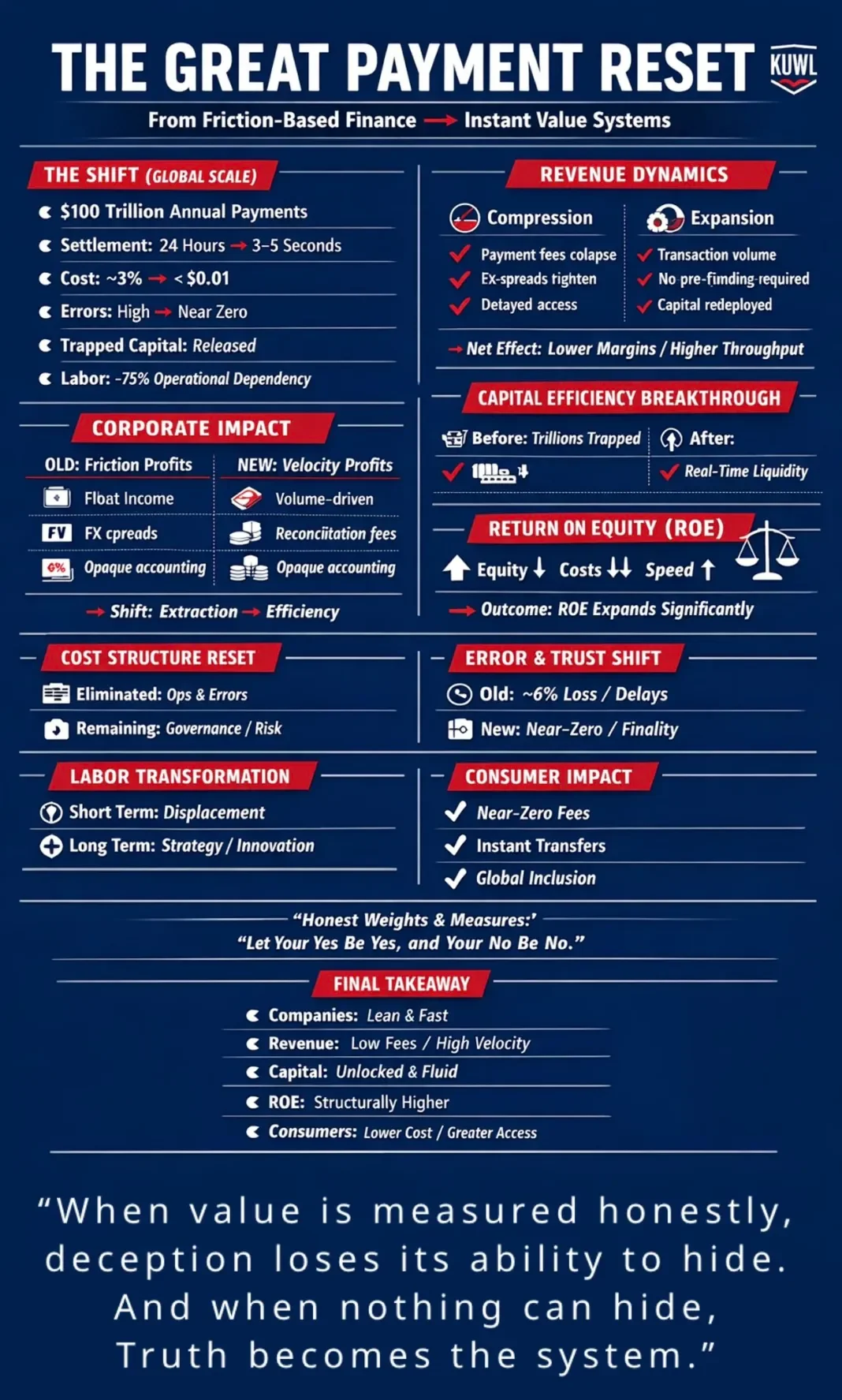
“What are the overall implications for consumers, public trust, new services, employment, corporate revenues, capital efficiencies, ROE, new payment creativity and new reach for previously underserved people everywhere?
Ask critics & skeptics to explain how moving from an OLD institutional “trust” model to a NEW transaction “verifiable truth” model, in a world where 90% of the U.S. House just voted to ban CBDCs in America, is somehow an “evil conspiracy” to further enslave us by central bankers.
The Deeper Question
This isn’t really about payments.
It’s about this:
“Do we want a system where truth is optional and delayed, or one where truth is immediate and unavoidable?”
Because once settlement becomes instantaneous and verifiable…
There’s nowhere left to hide.
When there’s nowhere left to hide
Truth Becomes The System.
CLARITY • STABLE • GENUIS
Source(s): • https://x.com/KuwlShow/status/2041135948067381745
https://dinarchronicles.com/2026/04/07/rob-cunningham-the-great-payment-reset/
Can A Little Dinar Turn Into Millions? (Real Breakdown)
Can A Little Dinar Turn Into Millions? (Real Breakdown)
Dinar For Dummies: 4-6-2026
In this video I go over how you don't need a ton of dinar to make millions.
As an investor, you’re likely always on the lookout for opportunities to grow your wealth. For those who have been following the Iraqi dinar investment scene, a revaluation (RV) of the currency has been a long-anticipated event that could potentially unlock significant financial gains.
Can A Little Dinar Turn Into Millions? (Real Breakdown)
Dinar For Dummies: 4-6-2026
In this video I go over how you don't need a ton of dinar to make millions.
As an investor, you’re likely always on the lookout for opportunities to grow your wealth. For those who have been following the Iraqi dinar investment scene, a revaluation (RV) of the currency has been a long-anticipated event that could potentially unlock significant financial gains.
In a recent YouTube video from Dinar For Dummies, entrepreneur and seasoned investor Steven shares his insights and strategies on how to capitalize on the dinar RV and navigate the potential wealth-building opportunities that follow.
One of the key takeaways from Steven’s discussion is that you don’t need to hold a massive amount of dinar to achieve substantial returns.
Using conservative hypothetical scenarios, he demonstrates how even a modest initial investment of $250 in the dinar could yield impressive gains after revaluation.
For example, if the dinar were to revalue at a rate that returns 10 times the initial investment, a $250 investment would become $2,500. Reinvesting this amount into other assets could then potentially multiply the returns even further.
Steven highlights the importance of having a strategic plan in place for reinvesting your returns. He specifically mentions the cryptocurrency XRP as a potential vehicle for multiplying wealth, citing his strong confidence in its future prospects.
With predictions suggesting that XRP could become a multi-thousand-dollar coin, investors who get in early could see significant returns. By diversifying your portfolio and investing in a mix of assets, including cryptocurrencies and precious metals, you can potentially maximize your gains and build long-term wealth.
Steven also warns that a market crash could follow the dinar RV, creating a window of opportunity to acquire undervalued assets at discounted prices. This could be a game-changer for investors who are prepared to take advantage of the situation.
By having a solid understanding of the market and a well-thought-out investment strategy, you can navigate the potential volatility and come out on top.
The dinar RV is not just a matter of currency exchange rates; it’s also influenced by geopolitical tensions in the region.
Steven references potential catalysts like a bombing in Iran that could accelerate the timeline for the dinar revaluation. As an investor, it’s essential to stay informed about global events and be prepared to adapt your strategy as circumstances unfold.
So, what can you do to prepare for the potential wealth-building opportunities that the dinar RV may bring? Steven advises viewers to take action now by opening investment accounts and planning wisely. By doing so, you can avoid losing potential gains post-RV and be well-positioned to capitalize on the opportunities that arise.
Throughout the video, Steven emphasizes the importance of discipline, diversification, and education in navigating the anticipated financial transition period.
By staying informed, being disciplined in your investment approach, and diversifying your portfolio, you can minimize risk and maximize your potential returns.
Seeds of Wisdom RV and Economics Updates Tuesday Afternoon 4-7-26
Good Afternoon Dinar Recaps,
Oil Shock Escalates | Strait of Hormuz Crisis Sends Markets Toward Stagflation Risk
Energy spike and war tensions ignite fears of a global economic shift
Good Afternoon Dinar Recaps,
Oil Shock Escalates | Strait of Hormuz Crisis Sends Markets Toward Stagflation Risk
Energy spike and war tensions ignite fears of a global economic shift
Overview
Global markets are on edge as oil prices surge above $110 per barrel, driven by escalating tensions between the U.S. and Iran over the Strait of Hormuz. The situation has triggered renewed fears of a global energy crisis, with institutions warning of inflation, slowing growth, and systemic financial stress.
The combination of geopolitical conflict and supply disruption is now pushing the global economy toward a potential stagflation scenario, a key catalyst often associated with major monetary system shifts.
Key Developments
1. Oil Prices Surge Amid War Escalation
Crude oil climbed back above $110–$114 per barrel, as the U.S. issued an ultimatum to Iran to reopen the Strait of Hormuz. Markets are reacting to the risk of prolonged supply disruption in a critical global energy corridor.
2. Global Growth and Inflation Warnings Intensify
The IMF and energy agencies warn the crisis could trigger higher inflation and weaker global growth simultaneously, raising the specter of stagflation across major economies.
3. Market Volatility Spreads Across Assets
Global equities are unstable, with stocks falling, oil rising, and investor confidence weakening. Currency markets show continued dollar strength, while safe-haven demand remains elevated.
4. Energy Crisis Compared to Historic Shocks
The International Energy Agency warned this situation could be more severe than the oil crises of 1973, 1979, and 2022 combined, highlighting the scale of systemic risk building in energy markets.
Why It Matters
This is not just a short-term oil spike—it signals a structural vulnerability in global energy dependence.
When energy prices surge alongside geopolitical instability, the result is often persistent inflation and economic slowdown, a combination that historically forces central banks into difficult policy decisions.
Why It Matters to Foreign Currency Holders
Rising oil prices increase global inflation pressure
Strengthening dollar may be temporary amid long-term instability
Energy-importing nations face currency depreciation risks
Commodities and hard assets gain renewed monetary importance
Implications for the Global Reset
Pillar 1: Inflation & Monetary Policy Stress
Sustained energy shocks could force central banks to choose between controlling inflation and supporting growth, accelerating monetary system strain.
Pillar 2: Energy-Driven Power Shift
Control over energy supply routes becomes a dominant factor in global financial influence, reinforcing a shift toward resource-backed economic power.
Analysis
The Strait of Hormuz crisis is exposing a critical reality: global finance remains deeply tied to physical energy flows.
If disruptions persist, the world could enter a period of prolonged volatility, where inflation, geopolitical risk, and market instability reinforce one another.
This environment historically leads to major structural changes in monetary systems, especially when confidence in stability begins to erode.
This is not just an oil shock — it’s a pressure point for the entire financial system.
Seeds of Wisdom Team
Newshounds News™ Exclusive
Sources
~~~~~~~~~~
Seeds of Wisdom Team RV Currency Facts Youtube and Rumble
Newshound's News Telegram Room Link
RV Facts with Proof Links Link
RV Updates Proof links - Facts Link
Follow the Gold/Silver Rate COMEX
Follow Fast Facts
Seeds of Wisdom Team™Website
Thank you Dinar Recaps
Iraq Economic News And Points To Ponder Tuesday Afternoon 4-7-26
Data: Iraq Did Not Buy Gold In 2026
Money and Business Economy News – Baghdad The latest official global gold reserves data for April 2026 shows that Iraq has not recorded any gold purchases since the beginning of 2026, while maintaining its position in the global ranking. Iraq ranked 28th globally and third in the Arab world during the first three months of this year, according to data seen by Shafaq News.
Data: Iraq Did Not Buy Gold In 2026
Money and Business Economy News – Baghdad The latest official global gold reserves data for April 2026 shows that Iraq has not recorded any gold purchases since the beginning of 2026, while maintaining its position in the global ranking. Iraq ranked 28th globally and third in the Arab world during the first three months of this year, according to data seen by Shafaq News.
According to the data, Iraq’s gold reserves amounted to 174.6 tons, which constitutes 28.1% of the country’s total foreign currency reserves.
Globally, the United States topped the list with a reserve of 8,133 tons, followed by Germany with 3,350 tons, then Italy with 2,451 tons, France came in fourth with 2,437 tons, while Russia came in fifth with a reserve of 2,311 tons.
The report continued that Iraq purchased several quantities of gold during 2025, including one ton in March, 1.6 tons in June, 3.1 tons in July, 2.5 tons in August, and 3.8 tons in October.
It is worth noting that the World Gold Council, based in the United Kingdom, is one of the leading bodies specializing in analyzing global gold market trends and the factors affecting its prices. https://www.economy-news.net/content.php?id=67609
2025 Statistics: Iraq Ranks Second In The Arab World In Terms Of Reliance On "Cash"
Money and Business Economy News – Baghdad Iraq continues to rely heavily on cash payments for daily transactions as of 2025, ranking high among Arab countries according to forex.se.
Iraq’s reliance on cash, at a rate of up to 85%, reflects the slow pace of the shift towards electronic payments compared to some countries in the region, according to the Swedish website specializing in currency exchange and travel services.
According to the website's data, Lebanon tops the list with 90%, followed by Iraq with 85%, then Egypt and Jordan with 80% each, Morocco with 65%, Tunisia with 55%, Oman with 50%, while Kuwait and Saudi Arabia have 30%, Qatar has 25%, and finally Bahrain and the UAE have 20% each.https://www.economy-news.net/content.php?id=67610
Transportation: The Submerged Tunnel At The Grand Faw Port Will Be Inaugurated Soon.
Money and Business Economy News – Baghdad The Ministry of Transport announced that it will inaugurate, in the near future, the submerged tunnel within the Grand Faw Port projects, to be the most important international trade corridor between the continents of Asia and Europe.
The director of the ministry’s media office, Maitham Al-Safi, told Al-Sabah, as reported by Al-Eqtisad News: “Work on the submerged tunnel has reached its final stages, as it is currently being furnished and prepared for cladding. He pointed out that the tunnel will form the most important passage for international trade between the continents of Asia and Europe, which enhances the position of Al-Faw port as one of the most important commercial ports in the region.”
He added that the tunnel is one of the giant engineering projects that will greatly contribute to accelerating maritime transport and increasing the port’s capacity to accommodate huge commercial ships, in addition to its contribution to stimulating trade between Iraq and the countries of the world, and enhancing its ability to interact commercially with international markets, as well as providing thousands of job opportunities in various fields of construction and logistics.
Al-Safi explained in the same context that the government has shown full support for the completion of this phase of the Grand Faw Port project, as it seeks, through the aforementioned projects, similar to the submerged tunnel, to transform Faw Port into a global trade center linking the markets of the Middle East with Europe, which will contribute to strengthening Iraq’s economic position on the international stage. https://www.economy-news.net/content.php?id=67600
Gold Prices Rise In Baghdad, Hold Steady In Erbil Markets
2026-04-07 Shafaq News- Baghdad/ Erbil On Tuesday, gold prices hovered around 1.03 million IQD per mithqal in Baghdad and Erbil markets, according to a survey by Shafaq News Agency.
Gold prices on Baghdad's Al-Nahr Street recorded a selling price of 1,025,000 IQD per mithqal (equivalent to five grams) for 21-carat gold, including Gulf, Turkish, and European varieties, with a buying price of 1,021,000 IQD. The same gold had sold for 1,020,000 IQD on Monday.
The selling price for 21-carat Iraqi gold stood at 995,000 IQD, with a buying price of 991,000 IQD.
In jewelry stores, the selling price per mithqal of 21-carat Gulf gold ranged between 1,025,000 and 1,035,000 IQD, while Iraqi gold sold for between 995,000 and 1,005,000 IQD.
In Erbil, 22-carat gold was sold at 1,069,000 IQD per mithqal, 21-carat gold at 1,021,000 IQD, and 18-carat gold at 875,000 IQD.
https://www.shafaq.com/en/Economy/Gold-prices-rise-in-Baghdad-hold-steady-in-Erbil-markets-0
Iraq Gold Reserves Hold At ~175t, No 2026 Buying
2026-04-07 Shafaq News- Baghdad Iraq’s gold reserves stood at 174.6 tons with no recorded purchases so far in 2026, according to World Gold Council data.
The figures place Iraq 28th globally and third among Arab countries, while the United States leads with 8,133 tons, followed by Germany, Italy, France, and Russia.
Iraq expanded its reserves in 2025 through multiple purchases, while World Gold Council data, based on central bank and International Monetary Fund (IMF) figures, is typically reported with a delay.
https://www.shafaq.com/en/Economy/Iraq-gold-reserves-hold-at-175t-no-2026-buying
Iraq Holds Second Place In Arab World For Cash Payments In 2025
2026-04-07 Shafaq News- Baghdad Iraq ranked second among Arab countries in reliance on cash payments in 2025, with 85% of daily transactions conducted in cash, according to data published by the Swedish platform Forex.se.
Lebanon topped the list at 90%, while Egypt and Jordan each recorded 80%, Morocco 65%, Tunisia 55%, and Oman 50%. Kuwait and Saudi Arabia each registered 30%, Qatar 25%, and Bahrain and the United Arab Emirates 20% each.
https://www.shafaq.com/en/Economy/Iraq-holds-second-place-in-Arab-world-for-cash-payments-in-2025
USD/IQD Exchange Rates Steady In Baghdad, Drop In Erbil
2026-04-07 Shafaq News- Baghdad/ Erbil The US dollar opened Tuesday’s trading mixed in Iraq, hovering around 155,000 dinars per 100 dollars. According to Shafaq News market survey, the dollar traded in Baghdad's Al-Kifah and Al-Harithiya exchanges at 154,600 dinars per 100 dollars, unchanged from Monday.
In the Iraqi capital, exchange shops sold the dollar at 155,000 dinars and bought it at 154,000 dinars, while in Erbil, selling prices stood at 154,550 dinars and buying prices at 154,450 dinars.
https://www.shafaq.com/en/Economy/USD-IQD-exchange-rates-steady-in-Baghdad-drop-in-Erbil
Basrah Crudes Hit Highest Levels Since 2022 Amid Global Rally
2026-04-07 Shafaq News- Basrah Iraq’s Basrah crude surged more than 13% on Tuesday, reaching its highest level since 2022, when prices stood near $122 per barrel.
Basrah Heavy rose $14.96, or 13.83%, to $123.11 per barrel, while Basrah Medium increased by the same margin, or 13.57%, to $125.21 per barrel.
Brent crude futures climbed $1.74, or 1.6%, to $111.51 per barrel by 0530 GMT. US West Texas Intermediate advanced $3.45, or 3.1%, to $115.86. https://www.shafaq.com/en/Economy/Basrah-crudes-hit-highest-levels-since-2022-amid-global-rally
Private Bank-Crypto Deal, XRP Bridge Asset, New Treasury Dollar (and more)
Ariel: Private Bank-Crypto Deal, XRP Bridge Asset, New Treasury Dollar
4-6-2026
The Cabal On Notice: Freedom & Liberation
Private Bank-Crypto Deal On Market Structure
Banks and crypto firms have been locked in closed-door sessions hammering out the CLARITY Act framework. The core fight is over stablecoin “yield/rewards” banks scream deposit flight will gut their lending power; crypto side pushes back that innovation gets strangled.
Ariel: Private Bank-Crypto Deal, XRP Bridge Asset, New Treasury Dollar
4-6-2026
The Cabal On Notice: Freedom & Liberation
Private Bank-Crypto Deal On Market Structure
Banks and crypto firms have been locked in closed-door sessions hammering out the CLARITY Act framework. The core fight is over stablecoin “yield/rewards” banks scream deposit flight will gut their lending power; crypto side pushes back that innovation gets strangled.
A tentative White House-brokered middle ground emerged in March, with more meetings into early April. This isn’t liberation theater. It’s regulated coexistence that lets institutions onboard digital rails while the legacy system still pretends it sets the rules.
The real play: once the bill moves (targeted Senate Banking markup in second half of April), it creates the on-ramp for trillions to flow without the old SWIFT choke points. Expect friction, delays, and last-minute carve-outs, but the direction is locked crypto gets a seat at the adult table under federal guardrails.
Ripple / XRP as the bridge asset
Brad Garlinghouse didn’t mince words recently: Ripple is actively eating SWIFT’s lunch every day by providing faster, cheaper liquidity. He projected XRP could realistically grab 14% of SWIFT volume in coming years, not by “replacing” the messaging network outright but by becoming the settlement rail it desperately needs. For Iraq, this matters. Decades of sanctions, corruption skims, and central bank black-boxing kept the dinar suppressed.
XRP’s on-demand liquidity removes the correspondent banking friction that made cross-border FX a nightmare. Holders positioning in dinar aren’t gambling on some mythical revaluation fairy tale alone they’re betting the new rails will finally let trapped value clear without the old middlemen taking 30-50% cuts in fees, delays, and “facilitation” bribes.
Same logic applies to Venezuela’s recent Forex stabilization moves and dollar sales resumption. These aren’t isolated. They’re test runs for opening markets that were deliberately kept chaotic.
New Treasury Dollar / July 4 signaling
Trump’s signature is already slated for new paper currency printing starting this year first $100s in June framed as 250th anniversary honor. That’s surface.
The deeper current: Basel III revisions (re-proposed March 19, comments due June), SOFR as the new risk-free rate benchmark, ISO 20022 migration milestones (unstructured data purge November 2026), and COMEX-related reforms are the scaffolding.
These weren’t random regulations. They were installed over years to force transparency, higher capital standards, and data-rich messaging that legacy fiat can’t hide inside anymore.
A “new US Treasury Dollar” isn’t literal new paper replacing the old overnight; it’s the transition to a hybrid system where the dollar is increasingly backed/settled via tokenized assets, real-time rails, and reduced counterparty opacity.
July 4 announcement window fits the symbolic reset narrative independence from the old central bank stranglehold.
Read Full Article: https://www.patreon.com/posts/c---l-on-notice-154942942
Ariel: Basel III and ISO 20022 Forces Financial Transparency
4-6-2026
Prolotario@Prolotario1
Basel III and ISO 20022 are the knives in the ribs forcing reserve transparency and real-time auditing that exposes fractional-reserve shell games and off-balance-sheet slush. No more moving money in the dark without a system check. We are literally removing these parasitic cults from our financial system.
ISO 20022 ends them by enforcing rich, structured, auditable data in every cross-border payment stripping the opacity that let black budgets, trafficking proceeds, and hidden skims flow undetected through legacy SWIFT MT formats.
November 2026 milestones (full unstructured address ban, mandatory structured fields, annual release cycles) plus end of MT coexistence make anonymous correspondent banking impossible, forcing real-time transparency that collapses the old cabal’s off-books leverage while enabling bridge assets like XRP for verifiable settlement.
Renee:ISO 20022 just flipped the switch on a new financial system and XRP/XLM are already built to plug into it. The OLD CABAL SYSTEM IS GOING-GONE! “That’s the real story.”
Source(s): • https://x.com/Prolotario1/status/2041314796566356408