
The $13,000 Apartments the Government Won't Let You Buy
The $13,000 Apartments the Government Won't Let You Buy
Notes From the Field By James Hickman (Simon Black/Sovereign Man) April 14, 2026
On May 20, 1862, Abraham Lincoln signed the Homestead Act into law, and it essentially said: here's 160 acres of land. It's yours. For free. All you have to do is live on it and improve it. And between 1862 and 1934, the federal government distributed 270 million acres under the program — roughly 10% of all the land in the United States.
Even as far back as the American Revolution, the Founding Fathers understood that property ownership made people more engaged, more productive citizens. Ownership meant that you had a vested financial interest in your community... and your country.
The $13,000 Apartments the Government Won't Let You Buy
Notes From the Field By James Hickman (Simon Black/Sovereign Man) April 14, 2026
On May 20, 1862, Abraham Lincoln signed the Homestead Act into law, and it essentially said: here's 160 acres of land. It's yours. For free. All you have to do is live on it and improve it. And between 1862 and 1934, the federal government distributed 270 million acres under the program — roughly 10% of all the land in the United States.
Even as far back as the American Revolution, the Founding Fathers understood that property ownership made people more engaged, more productive citizens. Ownership meant that you had a vested financial interest in your community... and your country.
Over time, that idea fused with the concept of "the American Dream". And for decades that dream was a reality for millions of people.
After World War II, for example, America underwent a massive construction boom. Between postwar prosperity, the GI Bill, and the arrival of the modern 30-year fixed mortgage, home ownership surged from about 44% in 1940 to 62% by 1960.
More importantly, housing was affordable.
In 1950, median family income was about $3,000, yet the median home cost roughly $7,350. That’s just ~2.5 times median household income. Plus, with prevailing mortgage rates back then 4.5%, the monthly payments were trivial.
Because of that, families across America could easily make ends meet on a single income.
Today the median home sells for about $412,000. Median household income is roughly $83,700. That puts housing at 5x household income— double what it was in the 1950s.
More importantly, at today's mortgage rate of roughly 6.4%, the monthly payment on a median home (assuming a 20% down payment) consumes roughly 30% of household income.
The down payment is also so high these days that buying a home is nearly impossible, especially for young people or low-income workers. Even in dual-income households, homeownership is increasingly out of reach.
As we discussed on Friday, America’s housing problems go far beyond the ‘greedy’ Wall Street investors that are getting most of the blame for rising home prices.
Construction materials cost 40% more than they did five years ago, courtesy of the Federal Reserve printing trillions during the pandemic and igniting inflation.
Plus the regulatory permitting maze adds enormous costs. In Fremont, California, development fees alone run $157,000 per home before a single nail is hammered. And that doesn’t even include additional permitting costs and utility connection fees.
The government used to give away 160 acres for free. Now local governments charge six figures for permission to build.
Go figure that California, with its endless lip service about affordable housing, is also the epicenter of American homelessness.
But it turns out there's a ready-made solution staring policymakers in the face.
The office property market is a complete bloodbath right now. Between the sluggish economy, AI reducing demand for workers, and the lingering work-from-home paradigm, the prices of office properties across the country have tanked.
More than 200 distressed office buildings changed hands across the country in 2025, with average sale prices down 37% from 2019. In Manhattan, a 920,000-square-foot tower sold for $8.5 million, down from $332.5 million. That’s a 97% decline!
Then there’s 401 South State Street in Chicago, a 485,000-square-foot office building that sold last October for $4.2 million, down from $68.1 million in 2016. That’s less than $9 per square foot.
Housing in Chicago isn’t cheap. So just imagine you’re young, fresh out of college, and staring at the prospect of paying $1,200 per month to live in a cramped apartment with three roommates.
Instead, you could pay about $13,000 for 1,500 square feet worth of space in the 401 South State Street office building that would be yours to own.
Yes, duh, it’s an office building. So it wouldn’t have the conveniences of a traditional home— like private bathrooms and kitchens. But for $13 grand?!!? Who cares. You'd have your own private space, a roof over your head, and a door that locks.
Frankly, that's not so different from military barracks and university dorms. Americans manage just fine with communal facilities when the price is right.
That's the beauty of capitalism. Such living accommodations aren’t for everyone. But at a low enough price, a LOT of people would happily trade convenience for affordability. Shower at the gym. Eat at the fast-casual spot around the corner. Live with walking distance to work downtown.
Most 20-somethings might think that’s pretty cool— especially compared to the alternative of paying out the nose for rent and never managing to save enough money to buy a house.
Same logic for a family of six crammed into a two-bedroom public housing unit in decrepit conditions; they could have a few thousand square feet to themselves.
Here’s another scenario. Let’s say a family in Topeka, Kansas locked in a 2% mortgage during the pandemic. Dad got laid off and can't find another job locally. But they don’t want to sell the house to move across country, uproot the kids, and buy a new house somewhere else at a 6% rate. So they're stuck.
Instead, Dad buys 1,000 square feet in one of these bankrupt office buildings for less than $10k. His family stays home, he commutes to his new job in a new city, and flies home on the weekends to see his kids. They make it work... which they wouldn’t be able to afford with hotels or an AirBnb.
This would be a genuine ‘starter home’— a place where someone could actually save money and build toward a proper mortgage, instead of hemorrhaging rent to Blackrock every month while still falling behind.
But the government won't allow it.
Zoning codes, building regulations, occupancy requirements— a labyrinth of rules that forbid you from such options.
Let grown adults decide for themselves. That's how capitalism is supposed to work.
Nobody would pay $400,000 for a unit with no bathroom. But $13,000? For a lot of Americans, that's not a sacrifice— it's an opportunity.
The same politicians who claim to care about the poor, the homeless, and young people priced out of the American Dream have the obvious solution sitting right in front of them.
But they won't take it, because that would mean getting out of the way.
To your freedom, James Hickman Co-Founder, Schiff Sovereign LLC
PS — Another way to opt out of America's housing affordability disaster is to look elsewhere.
There are plenty of countries where you can buy a beautiful home in a major city for a fraction of what a starter unit costs in the US, and several of those purchases also qualify you for residency or eventual citizenship. So you're not just buying a home, you're buying optionality. We cover the best programs, exact thresholds, and on-the-ground intelligence in Plan B Confidential.
Two Weeks to Stop the Spread of War
Two Weeks to Stop the Spread of War
Notes From the Field By James Hickman (Simon Black/Sovereign Man) April 8, 2026
On August 15, 1945, after two of their cities had been obliterated by the world's first nuclear weapons, the people of Japan heard the voice of their young Emperor for the first time ever.
Hirohito went on what was a relatively new communications medium at the time—the radio— and gave one of the most bizarre speeches in all of human history, in which he told his subjects that "the war situation has developed not necessarily to Japan's advantage."
Two Weeks to Stop the Spread of War
Notes From the Field By James Hickman (Simon Black/Sovereign Man) April 8, 2026
On August 15, 1945, after two of their cities had been obliterated by the world's first nuclear weapons, the people of Japan heard the voice of their young Emperor for the first time ever.
Hirohito went on what was a relatively new communications medium at the time—the radio— and gave one of the most bizarre speeches in all of human history, in which he told his subjects that "the war situation has developed not necessarily to Japan's advantage."
Talk about an understatement.
It's one of the more famous examples in a long list throughout history of speeches that have ended conflicts, where leaders paint whatever picture they want.
Perhaps even more famously, Richard Nixon promised "peace with honor" in Vietnam on the campaign trail in 1968.
It was one of the most brilliant political statements of its era, because everyone heard what they wanted to hear. Those who wanted an end to the war heard "peace." The war hawks heard "honor." Everyone got what they wanted out of it.
But ultimately there was neither peace nor honor. The war dragged on for seven more years, resulting in a humiliating withdrawal from Saigon in April 1975, complete with desperate helicopter evacuations from the US Embassy rooftop.
This is the sort of stuff that peace deals and conflict resolutions are made of— situations where you can talk out of both sides of your mouth, and both sides of the conflict can declare victory.
And if both sides can claim victory, that's actually a good thing. Because the only other way to end a war is to have the other side so utterly demolished that they have no choice but to accept defeat.
The alternative is to give both sides an out.
That's what's happening with Iran.
It's a strange situation from a military and strategic perspective given that Iran has been objectively obliterated; major infrastructure is demolished, key leadership was assassinated, the military is weakened, the government is vulnerable— and yet Iran actually thinks they are winning. Or at least they act like it.
It reminds me of when Charlie Sheen was on a three-day cocaine binge giving live interviews and talking about "winning." That's Iran right now.
The reason is because the American media is so deranged, so pro-Iran and anti-Trump, that they have managed to convince the Iranians that they are much stronger than they actually are.
But at this point the political realities have started surfacing in the US. The administration is worried about high gas prices and the midterms, and there’s a lot of pressure to end the conflict.
Now there’s an arrangement where both sides can declare victory. The US can say they accomplished their objectives — dismantled Iran's military and defense capabilities, degraded their nuclear program, eliminated key leadership, and dismantled their ability to fund and spread terror.
And the Iranians can say they stood up to the ‘evil empire’ and forced the Americans to walk away.
That is essentially what both sides are saying right now. And while the full implications remain to be seen, this is where the proverbial rubber meets the road.
We've been saying since this war started that it could end up being a very big deal for the fate of the United States... so what happens during negotiations over the next few weeks is crucial.
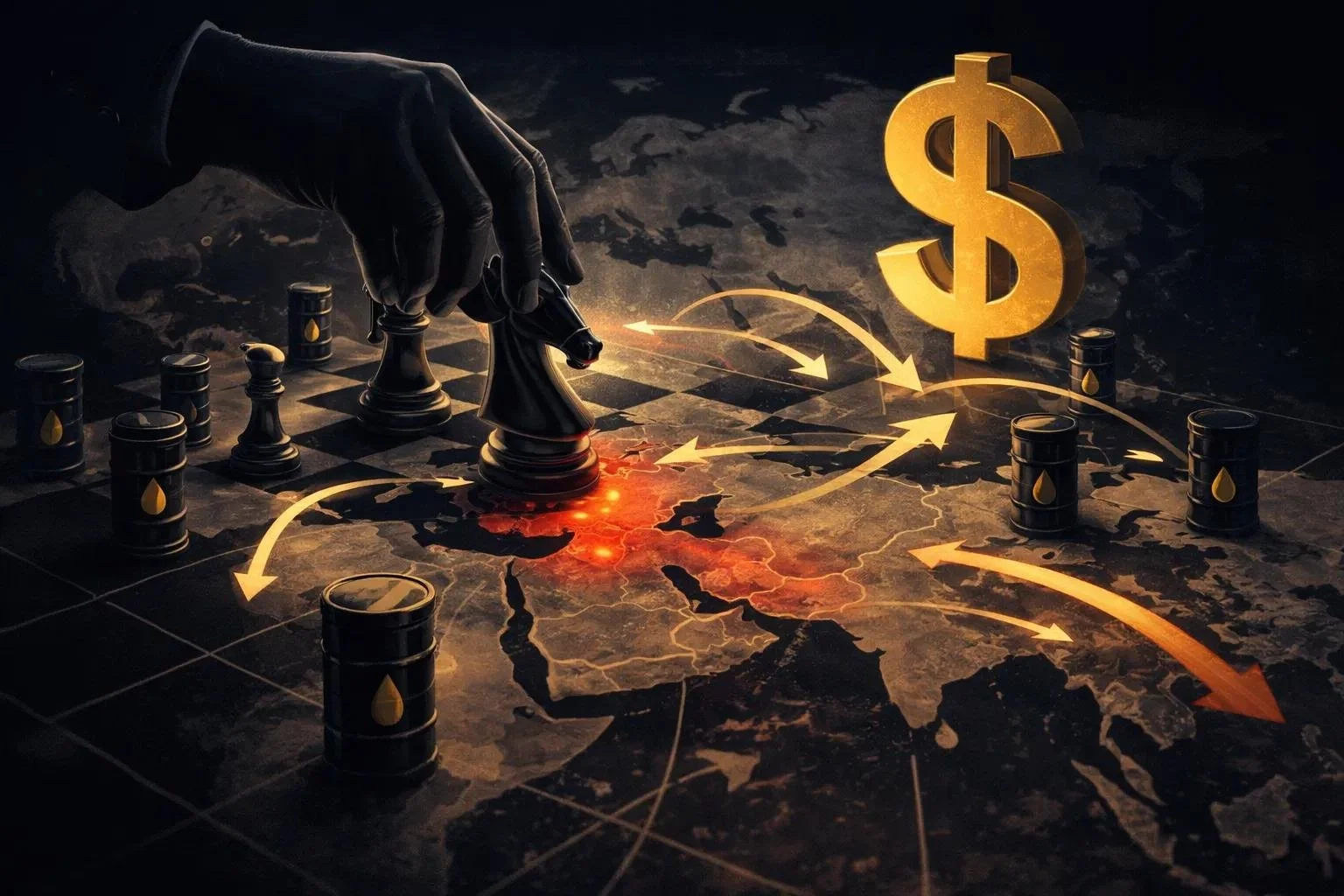
On one hand, there is a possibility they could strike a deal to lift sanctions against Iran and allow Iranian oil to be sold on the global market— as long as it's priced in US dollars.
Between Iran and Venezuela, that could create a massive financial incentive for the whole world to continue to hold US dollars, and thus to buy US government bonds.
But it could just as easily go the other way if the Iranians continue to think they are in a position of strength and that they have the advantage.
One thing we can be pretty sure about is that there probably won't be a resolution in two weeks.
I couldn't help but think of the infamous "two weeks to stop the spread" when COVID first emerged. That was an unrealistic timetable then, and two weeks is an unrealistic timetable now.
International negotiations are extremely difficult, and the tried and true tactic of rogue-nation geopolitics is to let negotiations drag on.
The Soviets perfected this approach. Their strategy was always to exhaust the negotiation partner. Westerners tend to like quick and speedy deals, but rogue nations in general tend to use that impatience to their advantage. So it's hard to believe in the two-week time frame.
But the clock has certainly started, however long it takes. And by the end we should have a very good sense for what this means for America.
The consequences could be massive— for inflation, for the dollar, for bond markets, for the trajectory of the entire US economy.
This could still be a deal that helps prop up the dollar and US government bonds for years, if not decades, to come. But if that doesn't happen, the best-case scenario is probably a stalemate where both sides walk away, flip the switch, turn off the war, almost pretend it never happened. And hopefully the world just ignores it and gives America a pass.
Time will tell. But probably not in the next two weeks.
To your freedom, James Hickman Co-Founder, Schiff Sovereign LLC
Phone Service for 94,000 Dead People, and Other Things Congress Won't Cut
Phone Service for 94,000 Dead People, and Other Things Congress Won't Cut
Notes From the Field By James Hickman (Simon Black) April 1, 2026
Earlier this year, the House DOGE Subcommittee pulled spending records from the Department of Transportation and discovered that the agency had spent $55 million on office furniture over the past few years. That’s about $1,000 per employee, which might not sound so crazy, until you realize that this was during a period when only 9% of DOT employees were actually showing up to the office.
Phone Service for 94,000 Dead People, and Other Things Congress Won't Cut
Notes From the Field By James Hickman (Simon Black) April 1, 2026
Earlier this year, the House DOGE Subcommittee pulled spending records from the Department of Transportation and discovered that the agency had spent $55 million on office furniture over the past few years. That’s about $1,000 per employee, which might not sound so crazy, until you realize that this was during a period when only 9% of DOT employees were actually showing up to the office.
But the furniture budget of the Department of Justice was even worse— $408 million on furniture in four years, with an average attendance rate of just 35%.
DARPA (Defense Advanced Research Projects Agency) dropped $250,000 on a single "refresh" of Herman Miller chairs. My only hope is this was part of developing some new revolutionary bulletproof chair cushion.
All told, federal agencies have spent $4.6 billion on furniture since 2021 — much of it for offices that have sat empty while employees work from home on Zoom.
If this were an isolated case of waste, you might write it off as bad management at a couple of agencies.
But it is not.
In February, the Government Accountability Office calculated the final cost of the Employee Retention Credit— a COVID-era program that ended in 2021. Total payout: $283 billion.
But 83% of that money ($235 billion) was paid out YEARS after the pandemic ended; the fraud mills kept filing bogus claims, and the IRS just kept writing checks.
Also in February, the FCC's inspector general discovered that Lifeline phone providers in California had been billing the government to provide phone and internet service to 94,000 dead people— $3.8 million worth of calls that were never made, to phones that were never used, for people who were no longer alive.
The examples never stop.
Senator Joni Ernst recently uncovered Pentagon-funded research projects that included studies on octopus hypnosis, monkey mind-reading, snail mucus, and elephant seal sleeping habits, all funded through a contracting loophole called "Other Transaction Agreements".
These OTAs allow agencies to spend money without competitive bidding, standard oversight, or public disclosure of costs.
How much did each project cost? That's the beauty of the system — the government doesn't have to tell you. But the GAO found that $77.5 billion flowed through these agreements between 2021 and 2025 without proper public accounting.
The National Science Foundation spent $14.6 million teaching monkeys to play a video game inspired by ThePrice Is Right. USAID spent $20 million producing Sesame Street in Iraq and $69,000 on dance classes in Wuhan, China.
And every single year, the federal government makes hundreds of billions of dollars in improper payments— money sent to the wrong person, in the wrong amount, or for the wrong reason.
Last year's total: $186 billion. That includes payments to deceased individuals, ineligible recipients, and programs that can't even verify whether the money should have gone out at all.
Since 2003, the cumulative total has reached $2.8 trillion, i.e. a full 7% of the national debt that simply would not exist if the government was minimally competent.
The Pentagon, meanwhile, has failed its own audit for eight consecutive years. Auditors could not verify more than 60% of the department's $4.65 trillion in assets.
Congress's response? Hand the Pentagon its first-ever trillion-dollar budget. They cannot account for the money they already receive, so why not give them even more?!?
Then there's the end-of-year ritual. Under "use it or lose it" rules, agencies that don't exhaust their budgets risk getting less money next year.
So in the final five days of fiscal year 2025, the War Department spent $50.1 billion in grants and contracts, including $6.9 million on lobster tail, $2 million on Alaskan king crab, $15 million on ribeye steak, $225 million on furniture, including a $98,329 Steinway grand piano for a general’s home.
Makes sense. Perhaps a stirring rendition of “Great Balls of Fire” is just what we need to defeat Iran.
For context, only nine countries on Earth spend more $50 billion on their entire annual defense budget. The Pentagon spent that in five days.
None of this is secret. DOGE found it. Inspectors General found it. The GAO found it. Senators publish it in annual reports that make headlines for about a day.
And then nothing changes. Congress doesn't cut a dime.
They act like it is simply impossible, that children would be starving in the streets, national security would be at risk, and farms would lay fallow, that we would all burst into flames if they cut the budget.
This might be one of the most effective lies ever perpetrated on a population— that we simply cannot, must not cut a dime in spending, for the consequences would be catastrophic.
The federal government spent $7 trillion in fiscal year 2025. $2 trillion of that was borrowed. $1.2 trillion was spent on interest to service the $39 trillion national debt.
And over the next decade, the CBO expects Congress to add another $23.1 trillion to the debt. It will almost certainly be much more.
This is arguably the single greatest threat to America. Not China, not hysteria over AI, not any of the foreign adversaries that dominate the headlines— but the slow, compounding, mathematically inevitable consequences of a government that cannot stop spending money it doesn't have.
And the most infuriating part is that it should be so easy to cut the most obvious, most indefensible waste. The $600 billion in outright fraud Secretary of Treasury Bessent estimates in the budget every single year. The $200+ billion in improper payments. The $100+ billion in legal graft that flows to political allies.
That alone would cut nearly half the deficit, without even touching the furniture for empty offices or octopus hypnosis experiments.
But if Congress is unwilling to even lift a finger for such obvious absurdity, what are the odds they'll tackle Social Security’s impending insolvency, just six years away? Or give foreign countries the confidence to keep investing in US government bonds? Or behave in a way to keep inflation in check?
Seems pretty low to us. Which is why it makes so much sense to have a Plan B.
To your freedom,
James Hickman
Co-Founder, Schiff Sovereign LLC
PS- If you're worried about what this all means for your savings, your retirement, and the purchasing power of the dollar — we built Plan B Confidential for exactly that.
It's our flagship research service covering second citizenships, foreign residency, international banking, tax strategies, and boots-on-the-ground intelligence from 120+ countries.
Everything you need to make sure your family's future doesn't depend on Congress suddenly discovering fiscal discipline.
What If This Is All Part Of The Plan?
What If This Is All Part Of The Plan?
Notes From the Field BY James Hickman (Simon Black) March 24 2026
You don’t have to look very hard these days to see widespread criticism of the conflict in Iran.
Obviously, there are the usual suspects like the New York Times and Washington Post who have called it “folly” and “rotten”. But plenty of voices on the right have joined in the criticism as well.
What If This Is All Part Of The Plan?
Notes From the Field BY James Hickman (Simon Black) March 24 2026
You don’t have to look very hard these days to see widespread criticism of the conflict in Iran.
Obviously, there are the usual suspects like the New York Times and Washington Post who have called it “folly” and “rotten”. But plenty of voices on the right have joined in the criticism as well.
Tucker Carlson calls it “absolutely disgusting and evil”. Thomas Massie says it is “not America First”. Joe Rogan says it’s “insane”. Joe Kent, formerly the Director of the National Counterterrorism Center, resigned his post because Iran was not “an imminent threat” and there was no “clear path to a swift victory”.
In short, there are plenty of respectable and informed views that Iran is (1) not going well, and (2) not in America’s interests. And I can certainly understand their points of view.
Personally, I see this from a lot of different angles– some positive, some negative. But at the same time I also think there’s a possibility that what’s happening right now might actually BE the plan.
Just consider: the US national debt is $39 trillion. Deficits are piling on an additional $2 trillion per year. Social Security is only six years away from running out of money. And the vast majority of United States Congressmen couldn’t possibly care less.
It doesn’t make you unpatriotic or unAmerican to understand this simple truth: US government bonds are simply not as attractive as they used to be for foreign investors.
The leadership of every foreign country on this planet recognizes that they could wake up tomorrow morning and find out that their Treasury holdings have been frozen. Or they could be sanctioned. Or there could be another tariff escalation. Or their alliance terminated. Or another military strike.
They also believe that Congress will continue to do nothing about America’s spiraling debt and budget deficit. Interest on the debt already exceeds 22% of federal tax revenue, and the problem is rapidly becoming much worse.
They also know there’s a good chance the Federal Reserve will fail to achieve price stability, and that inflation could easily go much higher from here.
All of that spells plenty of risk, especially for foreign governments and central banks. Given that US Treasury securities pay a measly 4%, it hardly seems worth their investment.
That’s why so many foreign governments and central banks around the world started moving a portion of their strategic financial reserves away from the US dollar… and into gold. This has been a trend for a few years now– central bank gold purchases surged in 2023, 2024, and 2025.
That’s a huge problem for the US government, which critically needs foreign investors to continue buying Treasury bonds. Treasury demand from foreigners helps keep interest rates down and inflation in check.
Conversely, if foreigners ditched the dollar entirely, inflation and interest rates would both skyrocket.
So, what better way to prevent this than to give foreigners an extremely compelling reason to buy US Treasurys and hold US dollars?
Oil is the most widely traded commodity in the world. Every country needs it, and despite the cries of deranged teenagers who superglue themselves to the pavement, demand for oil keeps growing.
Oil has traditionally been bought and sold in US dollars… even when neither buyer nor seller are American. So, when Australia sells oil to India, that transaction takes place in US dollars.
The sheer volume of the oil trade means that every country stockpiles US dollars in order to participate in global energy markets. And they typically hold US dollars by buying Treasury bonds.
This war might possibly have been a ploy to gain control over Iran’s oil: punch them in the face, decimate their leadership, destroy much of their military capabilities… and then offer a peace deal:
“We will lift sanctions and allow you to sell oil on the global market, and even line up investment to expand your production, as long as everything is denominated in US dollars. No oil will be sold in any other currency. Better yet, we’ll push you to peg your currency to the US dollar, just like other countries in the region.”
Obviously, they would never communicate such a strategy in public; they’d never stand on stage and tell CNN what they’re really trying to accomplish.
But in the end, maybe they don’t really care if there’s true regime change in Iran. Maybe they don’t really care about Israel’s objectives either. Perhaps the singular American goal is to boost foreign demand for the US dollar.
And it’s possible they might just pull that off.
Again, I’m just speculating. The only thing we can say for sure is that there’s a lot riding on this outcome.
If they succeed, the resurgence of the dollar could buy the US enough time to fix its problems. If they fail, it could be the proverbial nail.
That’s why this war in Iran could end up right alongside 9/11, the GFC, and Covid as one of the most consequential events of our time.
To your freedom, James Hickman Co-Founder, Schiff Sovereign LLC
Ever Wonder Where $7 TRILLION Goes? So Does the Government
Ever Wonder Where $7 TRILLION Goes? So Does the Government
Notes From the Field By James Hickman (Simon Black) March 17, 2026
On March 10, a nonpartisan Washington think tank called the Committee for a Responsible Federal Budget published a report called: "Break Glass: A Plan for the Next Economic Shock."
It points out that the United States has never entered an economic downturn as indebted as it is today— meaning there is essentially zero fiscal space to respond to the next crisis. When the financial crisis hit in 2008, national debt stood at roughly 35% of GDP. By the time it was over, debt had ballooned to about 70%.
Ever Wonder Where $7 TRILLION Goes? So Does the Government
Notes From the Field By James Hickman (Simon Black) March 17, 2026
On March 10, a nonpartisan Washington think tank called the Committee for a Responsible Federal Budget published a report called: "Break Glass: A Plan for the Next Economic Shock."
It points out that the United States has never entered an economic downturn as indebted as it is today— meaning there is essentially zero fiscal space to respond to the next crisis. When the financial crisis hit in 2008, national debt stood at roughly 35% of GDP. By the time it was over, debt had ballooned to about 70%.
Then, when COVID hit in 2020, debt was already at 80% of GDP. By the time that was over, it had surged past 100%.
Today the official national debt is almost at 130% of GDP. That's well beyond the World War II record.
Each economic crisis starts from a worse position, requires more borrowing, and leaves the country deeper in the hole.
None of this should be surprising to anyone who's been paying attention. We've been writing about this for years.
We said it in 2019 when everything was going great— record stock market, record tax revenue, healthy economy— and the government still ran a trillion dollar deficit.
We wondered out loud— if the government still runs a $1 trillion deficit when everything is great, how bad will the deficit be when there’s an actual crisis?
We didn’t have to wait long to find out; Covid hit shortly thereafter, causing the government deficit to surge to $5+ trillion.
So what happens when the next recession hits? Where does the money come from?
The CRFB's proposed emergency plan gives you the answer. First, freeze Social Security, Medicare, and all discretionary spending — no cost-of-living adjustments, no growth, nothing.
Then, freeze tax brackets too, so that inflation quietly pushes more Americans into higher brackets.
And on top of all that, phase in a brand new "deficit reduction surtax": an additional tax on income above $100,000 that ratchets up every year until deficits fall to 3% of GDP.
Of course this would all be so politically toxic that the report concedes nothing will be done until... a crisis forces it.
But that doesn’t mean Americans aren’t already feeling the consequences of higher deficits.
Last year, a Yale Budget Lab report found that federal deficit spending since 2015 has pushed interest rates up by nearly a full percentage point.
The government borrows so much money that it crowds out private lending, forcing everyone else to pay more. You’re essentially competing with the government for a loan.
For a new homebuyer, that single percentage point adds $76,014 in extra costs over a 30-year mortgage — roughly $2,534 per year, or about $211 every single month. Auto loans cost an extra $670. Small business loans cost an extra $7,723.
So when a young couple can't afford their first house, or a small business owner pays more to expand, part of that cost is a direct, measurable consequence of Washington's borrowing binge.
The national debt isn't an abstract number on a screen in Washington. It's higher interest rates on mortgages, auto loans, and credit cards.
And the government borrowing is only accelerating.
Over the past year, the debt grew by $2.7 trillion; that’s a sharp increase from the $1.8 trillion federal deficit in fiscal year 2025.
So not only is the national debt growing, but the rate at which the national debt is growing... is growing. (If you’re a math wonk, the second derivative is positive.)
At the current trajectory, the debt will cross $39 trillion by the end of this month. And $40 trillion by the summer... not long after America celebrates its 250th birthday.
What’s crazy is that the people in charge of tracking all of this spending can't figure out where the money goes.
On March 5, a government auditor reported that the Office of Management and Budget cannot even produce a complete inventory of federal programs, despite being legally required to do so.
It’s not that the OMB is lazy or incompetent; it’s that there are simply too many federal programs... and the complex web of spending makes it virtually impossible to tally up all the various offices, agencies, sub-departments, committees, special advisory boards, emergency programs, etc. that exist in the federal government.
Congress makes things much worse when they appropriate annual funding for some program— sort of ‘fire and forget’. So decades go by since a program was originally created...yet it continues to receive money each year even though nobody knows what it’s for.
Bottom line, the government now spends $7 trillion each year. And they can’t figure out where it goes.
We've spent the last 16 years helping people build a Plan B— because even back in 2010, the trajectory of fiscal spending was obvious.
Look, the world’s not coming to an end. But it would be naive and foolish to think there won’t be consequences to such a dismal financial situation. There already are.
And it’s important to think about this, because the earlier you start preparing, the more options you’ll have to mitigate the consequences.
To your freedom, James Hickman Co-Founder, Schiff Sovereign LLC
Why I have doubts about the supposed “next Global Financial Crisis”
Why I have doubts about the supposed “next Global Financial Crisis”
Notes From the Field By James Hickman (Simon Black) March 11, 2026
It was the early 2000s, and poor Monty was down on his luck.
An aging, out-of-work game hunter and security guard, Monty had been unemployed for quite some time. Fortunately, he was getting by, but living off the generosity of a family in southern California who had taken him in. Without them Monty would have almost certainly been living on the street.
But things started to change for Monty on a fateful day when his host family received a letter in the mail from a local bank-- addressed to Monty. They eagerly ripped open the letter to find that the bank had pre-approved old Monty for a substantial line of credit!
Why I have doubts about the supposed “next Global Financial Crisis”
Notes From the Field By James Hickman (Simon Black) March 11, 2026
It was the early 2000s, and poor Monty was down on his luck.
An aging, out-of-work game hunter and security guard, Monty had been unemployed for quite some time. Fortunately, he was getting by, but living off the generosity of a family in southern California who had taken him in. Without them Monty would have almost certainly been living on the street.
But things started to change for Monty on a fateful day when his host family received a letter in the mail from a local bank-- addressed to Monty. They eagerly ripped open the letter to find that the bank had pre-approved old Monty for a substantial line of credit!

They all found this extraordinary… and not just because Monty had no job, no income, no assets (i.e. a classic “NINJA loan” from the early 2000s). What was particularly unique about this case is that Monty was a dog.
We’ve talked about this a lot over the years-- but in case you’re too young to remember, the early 2000s was a decade in which anyone and everyone was able to borrow money.
The Federal Reserve had slashed interest rates to zero-- which made borrowing look cheap… even free. And government policy was prompting banks to ignore all common sense and underwrite loans to anyone with a pulse… and occasionally some people without a pulse.
The stories covered in books like Michael Lewis’s The Big Short are hilarious-- dead people, homeless people, unemployed people, prison inmates, canines and cats… they were wall approved for mortgages despite having no ability to make monthly payments.
There were so many loans being issued that the US mortgage market quickly ballooned to $11 trillion. Investment banks packaged up these dubious loans and dressed them up as special investment-grade bonds… and then the big Wall Street ratings agencies (like S&P, Fitch, etc.) slapped the highest quality “AAA” rating on them as if they were risk-free.
The whole system blew up in 2008, causing multiple financial institutions to collapse-- triggering the Global Financial Crisis.
The warning signs were there all along. But very few people paid attention.
My friend and partner Peter Schiff was one of the few voices of reason who accurately predicted this crisis years before it actually happened; Peter used to go on live television and get laughed at by CNBC’s panel of ‘experts’. But in the end, Peter was right… and the whole system blew up.
It turns out that lending money to broke, unemployed people who cannot pay is a pretty stupid lending policy.
Now, you may have heard about new trouble emerging in the financial sector. And gee what else is new. Finance guys almost invariably find ways to generate short-term profits while creating long-term risk.
And the latest brewing financial crisis of the day is the so-called ‘private credit market’.
Private credit is what it sounds like-- funds and investors (i.e. NOT banks) underwrite private loans to companies. This isn’t particularly controversial; private lending is one of the cornerstones of capitalism.
And usually these loans are asset-backed-- just like a real estate mortgage-- so the lender has collateral.
Private lending was initially brought on by the ultra-low interest rates of the pandemic era (when companies could borrow for 3%); and it also ballooned-- estimated at roughly $3 trillion. That’s a pretty chunky number, even in the $30+ trillion US economy.
But, just like the subprime market in the years before the GFC kicked off, there are starting to be warning signs that private credit is cracking.
One of those-- most notably-- is that a major private lending fund (run by Blackstone, one of the world’s largest asset managers) has capped redemptions, i.e. they have limited the amount of money that investors can withdraw.
This is a pretty clear sign of strain. Perhaps not the proverbial canary in the coalmine… but it’s a big deal that an investment firm with the size and reputation of Blackstone isn’t letting its investors out of their fund.
(In fairness, the fund documents do stipulate redemption limits. But it’s pretty unusual for an asset manager to have to exercise this clause.)
Another sign of strain is that default rates are up dramatically. Fitch (the same guys who slapped AAA ratings on NINJA loans 20 years ago) estimated that roughly 10% of US private loans are in default. That’s a big number, and it could go a lot higher.
A key reason is that interest rates are MUCH higher today than when many of these loans were originally underwritten. So, any borrower that needs to refinance (which is likely the vast majority) will see a massive spike in monthly payments.
That will be unaffordable for a lot of borrowers, resulting in even higher defaults. Plus, general economic malaise could contribute to higher default rates too.
A chief concern about private credit is that many loans were like subprime “NINJA loans”, i.e. private loans that were way too big, issued to borrowers who were not creditworthy.
I doubt anyone will shed any tears that Blackstone might lose money in a bad deal. But there could be knock-on effects-- specifically to banks.
I know the whole point of ‘private’ credit is that the loans are NOT issued by banks. But in a rather peculiar twist, banks often loan money to private credit funds, who in turn loan that same bank money to the final borrower. Strange, right?
Bottom line, banks are exposed.
A few prominent voices lately have been warning that this private credit fiasco has all the hallmarks of the early 2000s subprime bubble… and that the next GFC is upon us.
And there are definitely similarities. But a LOT of major differences too-- most notably size. The private credit market is MUCH smaller than subprime was, and it’s difficult to see how those losses would take down the US financial system again, let alone the entire global economy.
But there are also significant existing risks in the banking sector-- like rising defaults in traditional office and commercial loans, and mark-to-market losses in banks’ bond portfolios.
We’ve talked about this before-- US financial institutions are collectively sitting on hundreds of billions of dollars in unrealized losses, and most of those losses ironically come from Treasury bonds. So, another ~$100+ billion hit from private credit could definitely hurt banks.
I’ve been looking at this pretty hard, but at the moment I don’t see some epic crisis emerging from private credit.
That said, one EASY Plan B option to safeguard your capital is to hold funds at Treasury Direct.
Through Treasury Direct, any US citizen is able to set up an account and hold virtually any amount of money through ultra-short-term T-bills; it’s like keeping your money in a 4-week certificate of deposit, but without any bank counterparty risk.
As we’ve discussed many times before, the US government is in pretty dire financial straits. But even I don’t think they’re going to default in the next four weeks.
So, this is a safer alternative to hold cash--and you can quickly link your Treasury Direct account to your bank for easy back & forth transfers
To your freedom, James Hickman Co-Founder, Schiff Sovereign LLC
The Precipice
The Precipice
Notes From the Field By James Hickman (Simon Black) March 2, 2026
“OK, so now I just want a bunker,” a close friend of mine texted over the weekend. And I get it. Fear, apprehension, unease… these are completely normal feelings right now.
Google Trends shows that searches for “WW3” and “nuclear war” spiked over the weekend. Similar hashtags on social media (#WW3, etc.) also surged.
It doesn’t help that much of the legacy media has been stoking these fears, as they almost always do.
The Precipice
Notes From the Field By James Hickman (Simon Black) March 2, 2026
“OK, so now I just want a bunker,” a close friend of mine texted over the weekend. And I get it. Fear, apprehension, unease… these are completely normal feelings right now.
Google Trends shows that searches for “WW3” and “nuclear war” spiked over the weekend. Similar hashtags on social media (#WW3, etc.) also surged.
It doesn’t help that much of the legacy media has been stoking these fears, as they almost always do.
Now, I suspect most people already have very strong opinions on the conflict. I certainly do. So there’s no sense in spending time today trying to litigate whether the military action was a good idea; we’ll all find out soon enough.
Instead, I want to focus on two key points:
The first is that—regardless of how someone feels about this conflict— World War III is LESS LIKELY today than it was on Friday. And it’s not hard to understand why.
US military capabilities have been on full display this year— first in Venezuela, where special operations forces managed to extract one of the world’s most tightly protected dictators… and it was over in a matter of hours.
Only weeks later we see total dominance of Iran’s air defense systems— most of which are Russian or Chinese technology.
In other words, China and Russia saw their military technology completely embarrassed by the United States. And this unmitigated defeat makes them both less interested in taking on America’s military.
More importantly, Russia is completely depleted after four years of war in Ukraine. China’s military has almost no combat experience and has never had to project power beyond the South China Sea.
So while they’ll certainly phone in their condemnations and strongly worded tweets, these countries have neither the capacity nor the inclination for war.
It’s also noteworthy that the US rolled out a new weapon against Iran— a ‘kamikaze drone’ which was first pioneered by the Iranians themselves.
Over the past several years the Iranian military developed its low-cost Shahed-136 drone— and sold vast quantities of them to Russia for use in Ukraine.
Well, an Arizona-based defense startup reverse engineered the Shahed-136… and made major improvements with respect to range, firepower, networking, cybersecurity, and more.
It’s also dramatically more cost effective and can be manufactured in America at less than half the price as the Iranian variant.
This shows how valuable the US private economy can be in war— managing to best the Iranians at their own game in less than a year. Foreign adversaries cannot ignore this.
Look, nothing is impossible. But in terms of probabilities— at this moment, the specter of world war, nuclear war, etc. is actually lower… and adversary nations’ appetite for direct military conflict is diminishing by the day.
The second point is what’s really at stake.
Military action of this scale brings almost infinite permutations. And, yes, there are many possibilities which result in the US subduing Iran’s military and a new, America-friendly regime takes control of the country.
China has already lost access to Venezuelan oil. Now they stand to lose access to Iranian oil. This is bad news for China’s domestic economy.
More importantly, by exerting de-facto control (or at least significant influence) over most of the largest oil supplies on the planet—Iran, Venezuela, the US, most of the Gulf states— America would be able to re-establish the US dollar’s dominance.
Every country that wants to buy oil— which is pretty much everyone— would need to own and hold US dollars to pay for it. This means that foreign countries must continue buying vast quantities of Treasury bonds—helping to finance America’s deficit and keep interest rates down.
But there are other outcomes as well.
If the remaining military campaign does not go well— if the Iranian regime manages to suppress the protestors, survive the bombings, and maintain their grip on power— then the US could be in trouble.
US casualties at that point will be mounting. Munitions will be depleting rapidly. And most media attention and political opposition will pounce on the President.
Frankly I’d expect to see more well-funded protests and professional agitators making a stink across American cities, i.e. the Left will fall back on its Minneapolis/ICE playbook to force a military withdrawal.
China and Russia would likely take advantage, capitalizing on US weakness and the fact that America’s relations with Europe are heavily strained.
Between the tariff chaos, domestic social divisions, Congressional intransigence, constant government shutdown threats, etc., adding in a humiliating military defeat in Iran might just be the final straw.
Led by China, other nations could come together and say, ‘enough is enough’, then force a new Bretton Woods style convention to formally establish a new order that strips the US of its power.
Again, there are nearly infinite ways in which this could play out. But regardless of where someone stands on this weekend’s airstrikes, it’s important to acknowledge the stakes.
A successful outcome could provide major benefit to the dollar for decades to come. Defeat could trigger the end of US geopolitical dominance.
America might just be on a precipice. And we’ll find out which way it goes over the coming weeks.
To your freedom, James Hickman Co-Founder, Schiff Sovereign LLC
Any Takers For The Taliban’s New Investment Visa?
Any Takers For The Taliban’s New Investment Visa?
Notes From the Field By James Hickman (Simon Black) February 23, 2026
Just imagine how tranquil your retirement could be in... sunny Afghanistan! You could wake up in the morning to the pleasant sound of celebratory gunfire... then artfully dodge landmines left behind by not one, but two different superpower invasions on your way to witness the day’s beheading.
You could cap off the afternoon spelunking through mountain caves where you might bump into actual jihadists, then end the day with a stroll through a war-torn city’s desperate poverty.
Any Takers For The Taliban’s New Investment Visa?
Notes From the Field By James Hickman (Simon Black) February 23, 2026
Just imagine how tranquil your retirement could be in... sunny Afghanistan! You could wake up in the morning to the pleasant sound of celebratory gunfire... then artfully dodge landmines left behind by not one, but two different superpower invasions on your way to witness the day’s beheading.
You could cap off the afternoon spelunking through mountain caves where you might bump into actual jihadists, then end the day with a stroll through a war-torn city’s desperate poverty.
If this sounds ideal to you, then you're in luck! The Taliban now offers an investment visa for foreigners to obtain residency in Afghanistan.
This is a real thing; earlier this month, Afghanistan's Economic Commission approved a proposal to offer foreign investors residency permits of up to ten years. Put your money into Afghan mining, construction, or energy, and you too can call Kabul home.
Sure, the banking system is cut off from the international financial network, US sanctions make it effectively illegal for Western companies to operate there, and girls aren't allowed to attend school past sixth grade. The roads, power grid, and water systems are barely functional. And the country has been at war, in some form, for over forty years.
Any takers?
Fortunately the world is a big place, and there are plenty of other options besides Afghanistan.
And while we poke fun at the Taliban, the core concept of obtaining residency in another country is one of the smartest things you can do to give yourself a Plan B.
The logic is simple. If your home country feels like an increasingly unfamiliar place— as a lot of people in the West feel right now— then it makes sense to have a backup... a place you can go, legally, on your own terms, even if borders close or things get weird.
We saw this play out during COVID. When governments around the world slammed their borders shut in 2020. Tourists were locked out— flights canceled, entry denied.
But people who had established legal residency in a foreign country still had the right to enter and stay, just like citizens.
Families who had taken that step years earlier found that they had options— another place to leave the chaos, work remotely from their second home, and wait out the insanity on their own terms.
Those who hadn't were stuck wherever they happened to be, subject to whatever restrictions their local governments decided to impose.
That distinction— tourist versus legal resident— became the difference between freedom and lockdown. Overnight. And this might matter again.
But a second residency isn’t about crises and pandemics..
A lot of people start by simply finding a place they enjoy. They visit somewhere on vacation — Costa Rica, Portugal, Malaysia, wherever— and they love it. They go back a few times. Eventually they start looking at property. Maybe they buy a place and rent it out when they're not using it.
Over time, they realize they've built something more than a vacation spot. They've got a home in a country where life is slower, the food is better, and their money goes a lot further.
And that last part matters more than most people think.
The cost of living in much of the world is a fraction of what it is in the West. A couple living on Social Security and a modest level of savings— money that barely covers the basics in most American cities — can live extremely well in dozens of countries.
We're talking beachfront property, hired help, great healthcare, and money left over at the end of the month.
There are plenty of ways to obtain residency abroad. In some countries, you can become a legal resident by purchasing property— something that you might want to do anyhow.
In Panama, you can become a legal resident by purchasing property for roughly $300,000 — and that buys you genuinely nice real estate in a country where property prices can be $100 to $200 per square foot.
In Europe, countries like Portugal and Greece have set up formal programs specifically designed to attract foreign capital in exchange for residency rights.
There are also plenty of countries that don't even require an investment— where simply demonstrating you have a pension (like Social Security) is enough to qualify.
Other places (like Australia or New Zealand) are looking strictly at skill needs, so younger people with valuable work experience can obtain residency.
Everyone's situation is different. For some people it's a beachfront villa in Central America. For others it's a flat in Lisbon. For others it's a farm in New Zealand. The world is full of options.
The point is that none of this is radical. It's not about fleeing. It's about having the option to go somewhere you actually enjoy — somewhere you might already vacation — and having the legal right to stay there indefinitely if you ever need to.
It's the same logic as any insurance policy. You don't buy fire insurance because you want your house to burn down. You buy it because you'd rather not find out the hard way that you needed it. That’s what a Plan B is about.
To your freedom, James Hickman Co-Founder, Schiff Sovereign LLC
The 92% Tax Rate That Nobody Ever Paid
The 92% Tax Rate That Nobody Ever Paid
Notes From the Field By James Hickman (Simon Black) February 26, 2026
In 1954, Frank Sinatra was on top of the world. He'd just won the Academy Award for Best Supporting Actor in From Here to Eternity — a comeback role that rescued his career after years of decline and a voice hemorrhage that nearly ended it all.
Hollywood was paying him handsomely again. But there was a problem. The top marginal income tax rate was 92%, and Sinatra was about to watch most of his comeback earnings disappear before a single penny ever hit his bank account.
The 92% Tax Rate That Nobody Ever Paid
Notes From the Field By James Hickman (Simon Black) February 26, 2026
In 1954, Frank Sinatra was on top of the world. He'd just won the Academy Award for Best Supporting Actor in From Here to Eternity — a comeback role that rescued his career after years of decline and a voice hemorrhage that nearly ended it all.
Hollywood was paying him handsomely again. But there was a problem. The top marginal income tax rate was 92%, and Sinatra was about to watch most of his comeback earnings disappear before a single penny ever hit his bank account.
So Ol' Blue Eyes did what every major Hollywood star at the time was doing: he set up what was known as a "collapsible corporation."
The tactic was simple. Instead of collecting his fee personally — where it would be taxed at 92% — Sinatra had the studio pay his corporation, which was taxed at roughly 50%. He'd take a modest salary out of the company. Then, when the picture wrapped, he'd sell the corporation's stock and pay the 25% capital gains rate on the proceeds.
The 92% rate was the law. But in practice, it was a fiction.
Back in the 1950s, fewer than 10,000 households in the entire country — out of 57 million tax returns — earned enough to even reach the top bracket. And those who did had so many deductions and shelters available that the top 1% paid an effective federal income tax rate of just 16.9%.
I think this is important to point out because, just last week, TIME Magazine published an article titled "Tax the Rich. They're Not Going Anywhere". They argued that wealthy Americans are too "sticky" to flee, so cities and states should feel free to squeeze them.
New York's mayor Zohran Mamdani wants an additional 2% tax on incomes over $1 million. California voters are expected to vote on a "one-time" 5% wealth tax on billionaires. TIME cheers them all on.
In Britain, the Labour government already abolished the "non-dom" regime — a 110-year-old policy that let wealthy foreigners shield overseas income from UK taxes. As a result of changing this program, Britain drove over 10,000 millionaires out of the country.
But rather than eat their humble pie and admit a policy failure, the left wing of their party is pushing for a new wealth tax. On top of that, they continue gaslight people and insisting, just like TIME magazine, that wealthy people don’t leave when tax rates rise.
Across the pond in America, Bernie Sanders, AOC, and Elizabeth Warren have been beating this drum for years— demanding that the wealthy pay their "fair share."
What IS the fair share? They never say. They never commit to a number.
So let's look at the numbers they keep ignoring.
In 2022, the top 1% of American taxpayers paid 40.4% of all federal income taxes, according to the Tax Foundation. The top 10% paid 72%. The bottom 50% paid 3%.
And the top 1% doesn't just pay a large share — they pay a share wildly disproportionate to their income. They earned 22.4% of all adjusted gross income but shouldered 40.4% of the tax bill. That's nearly double their proportional share.
This isn't new. It's been the trend for decades — and it runs in exactly the opposite direction from what the "fair share" crowd implies.
In 1980 (when the top marginal tax rate was 70%), the wealthiest taxpayers (the top 1%) paid 19% of all federal income taxes. Today, again, the top 1% pay 40.4% of the taxes, even though the highest marginal tax rate is much lower.
How? Because the Tax Reform Act of 1986 — a bipartisan deal signed by Ronald Reagan — made a simple trade: dramatically lower rates in exchange for closing the loopholes. No more passive loss write-offs zeroing out taxable income. No more converting salary into capital gains through shell corporations. No more Frank Sinatra deals.
The rates were lower, but there were fewer places to hide. And these changes to the tax code resulted in the wealthy paying MORE tax, not less.
Even if you go back to the days of 92% rates (which the Left loves to bring up), the effective rate for the top 0.1% was only 21%.
But even setting all of that aside — even if you could squeeze a few more percentage points out of the top 1% — it wouldn't fix anything. The federal government is running $2 trillion annual deficits. Higher taxes are not the solution.
Cutting the deficit requires spending restraint. And economic growth.
Given Congress’s intransigence in cutting spending, growth is the easier option. But it requires a stable, predictable business environment with minimal bureaucracy.
Instead, we get an environment that changes every four years — sometimes every four weeks. One administration's regulations get undone by the next. Businesses get sued over rules that didn't exist two years ago.
Take the infamous Corporate Transparency Act.
Congress passed this law in 2021 requiring roughly 32 million small businesses to file "beneficial ownership" reports with FinCEN. The penalties for failure to do so were $500 per day in fines and up to two years in prison.
Never mind that the government already collects this information through K-1s, 1099-DIVs, and existing bank regulations. Never mind that large banks and publicly traded corporations were conveniently exempted.
The onus fell on small, family-owned businesses: the restaurant owner figuring out how to keep waitstaff from quitting, the small shop already buried in paperwork. Well, Congress gave them yet another form to fill out under threats of penalties and imprisonment.
But then the regulations changed— SEVEN TIMES in four months. A federal judge blocked the law. Three days later, an appeals court reversed him. Three days after that, a different panel reversed the reversal. Then the Supreme Court weighed in.
The Treasury Department kept issuing new deadlines to comply, and no business owner had any idea from one week to the next whether they were in compliance.
In the end, the White House simply canceled it— which was the right thing to do. But the next President might very well put it back in place.
The whole ethos was that every small business owner is a potential money launderer. Never mind the money laundering rules already on the books — rather than fix what wasn't working, Congress just piled on more. That's how you end up with a Code of Federal Regulations over 188,000 pages long.
That's the real problem. Not that the wealthy aren't paying enough. That the business environment in America is so needlessly complex, so maddeningly unstable, that it chokes the growth that would actually generate the revenue politicians claim to want.
If they spent as much energy making it easier to build a business as they do dreaming up new ways to "soak the rich," the tax base would take care of itself.
To your freedom, James Hickman Co-Founder, Schiff Sovereign LLC
The Luddites Were Wrong In 1811 The AI Doomsayers Will Be Wrong Today
The Luddites Were Wrong In 1811. The AI Doomsayers Will Be Wrong Today
Notes From the Field By James Hickman (Simon Black) Sovereign Man February 24, 2026
In 1779, in a textile workshop in the English village of Anstey, a young apprentice named Ned Ludd was put to work on a knitting machine — one of the large mechanical frames that wove thread into stockings. He was too slow. His master had him whipped for it.
So Ned grabbed a hammer and smashed the machine to pieces.
The Luddites Were Wrong In 1811. The AI Doomsayers Will Be Wrong Today
Notes From the Field By James Hickman (Simon Black) Sovereign Man February 24, 2026
In 1779, in a textile workshop in the English village of Anstey, a young apprentice named Ned Ludd was put to work on a knitting machine — one of the large mechanical frames that wove thread into stockings. He was too slow. His master had him whipped for it.
So Ned grabbed a hammer and smashed the machine to pieces.

The story spread across England’s textile country. Over the next thirty years, Ned Ludd became a folk hero for every worker who felt threatened by the new machines that were pouring into their factories.
Now, the story is probably a myth — there’s no hard evidence Ned Ludd ever actually existed. But it didn’t matter. The movement that took his name was very real.
In March 1811, textile workers across England’s industrial heartland began breaking into factories at night, smashing power looms with sledgehammers. They called themselves Luddites. Over 200 machines were destroyed in the first month alone.
It was all motivated by fear; workers were terrified that machines would take their jobs and steal their livelihoods.
But think about the world back then: in the early 1800s when the Luddites were smashing looms, roughly 90% of the world’s population lived in what today would be considered extreme poverty.
Life expectancy in England was only about 35. One in three children didn’t make it to their fifth birthday. Houses were tiny. Food was scarce. Clean drinking water was a luxury. Heating your home meant an open fire, and most of the warmth went up the chimney. Indoor plumbing didn’t exist. Neither did antibiotics, electricity, or refrigeration.
That was normal life in 1811. But fast forward just over two hundred years.
Extreme global poverty has fallen from 90% to under 10%. Life expectancy has more than doubled. The poorest American today — not the wealthy, the average person — has access to more information, nutrition, comfort, and opportunity than the richest king on earth could have imagined in 1811.
Our homes are bigger. Our food is more plentiful. Our energy supplies are more abundant… and far more efficient.
And the reason is technology.
Every major leap in human prosperity has followed the same basic mechanism: new technology makes people more productive. More productivity increases supply of goods and services. More supply means lower prices. Lower prices mean more prosperity for everyone.
At the same time, there is always some short-term pain. Entire vocations and industries disappear… and that sudden change can be both difficult and scary.
But think about it— in literally EVERY major technological advancement throughout history, overall employment went UP. Economies prospered. Workers prospered.
That’s the great fear sweeping the world right now regarding artificial intelligence, and a lot of people are worried.
Earlier this month, for example, a viral essay by an AI startup CEO tore across the Internet and was viewed more than 80 million times.
His thesis: AI will have a COVID-level impact on the world, and the industry right now is the equivalent of being back in January 2020. Everything feels normal at the moment. But he believes that life will be unrecognizable (just like during Covid) in just a few months.
But while Covid was temporary, he believes the AI impact will be permanent.
Amazingly enough, due to this one viral essay, investors began dumping their stocks, triggering a major selloff.
Cybersecurity stock CrowdStrike, for example, dropped roughly 16% in days. Travel companies like TripAdvisor are down nearly 30%.
Financial firms like Charles Schwab and Raymond James fell 7% to 9% in a single session. Software giants like Salesforce and ServiceNow have shed a quarter to a third of their value.
All told, roughly $2 trillion in market value has been wiped off software stocks alone.
The logic behind the selloff is: if AI can scan code for security vulnerabilities, why do you need CrowdStrike? If an AI agent can plan your entire trip, book flights, and find the best hotel, why do you need TripAdvisor? If a chatbot can manage a portfolio or draft a financial plan, why are you paying Raymond James?
Investors looked at these industries and decided that AI wasn’t just going to help these companies — it was going to replace them. And they sold.
It’s amazing how overblown this is.
People said the same things about the Industrial Revolution — that machines would make human labor obsolete and destroy the working class.
They said it about personal computers in the 1980s — that automation would wipe out office jobs.
They said it about the Internet in the late 1990s — that e-commerce would obliterate entire sectors of the economy.
Every single time, the prophets of technological doom were wrong.
The reality is that, of course, some industries and vocations go away. But advances in technology have never led to sustained, long-term, widespread unemployment.
New industries emerge. New skills become valuable. The economy adapts. And the overall standard of living goes up.
But all along the way, there are always the self-interested evangelists insisting that THIS time is different. THIS technology is uniquely disruptive.
Yes, AI is obviously a massive advancement. It’s going to reshape industries. And plenty of businesses that exist today won’t survive the transition. That’s the nature of progress.
But the idea that we’re all going to be starving in the streets because a chatbot can draft a legal brief or scan code for security bugs is ludicrous.
Technology always makes people more prosperous and better off. It might not be crystal clear right now exactly how that plays out with AI. Early stages of a technology boom are never clear.
But the notion that one person’s viral essay could wipe trillions from global financial markets is peak paranoia.
The Luddites were wrong in 1811. The AI doomsayers will be wrong today.
To your freedom, James Hickman Co-Founder, Schiff Sovereign LLC
P.S. Technology has never destroyed prosperity. But reckless governments have — over and over again, for thousands of years.
The US national debt is over $38 trillion. Annual deficits are running at nearly $2 trillion. And neither party has any intention of doing anything about it.
Every month in Schiff Sovereign Premium, we dig into exactly where this is heading — the debt, the dollar, the historical parallels — and how to position yourself to benefit from what comes next.
Another “Temporary” Spending Bill That Still Costs Americans 93 Years Later
Another “Temporary” Spending Bill That Still Costs Americans 93 Years Later
Notes From the Field By James Hickman (Simon Black) February 16, 2026
In January 1933, a farmer named Wallace Kramp was about to lose everything. A lender in Wood County, Ohio was foreclosing on his farm over an $800 mortgage he couldn't pay.
Kramp wasn't a bad farmer. It was actually the government’s fault: during World War I, the US government had urged farmers to plant as much as they could to feed the troops and war-torn Europe.
Another “Temporary” Spending Bill That Still Costs Americans 93 Years Later
Notes From the Field By James Hickman (Simon Black) February 16, 2026
In January 1933, a farmer named Wallace Kramp was about to lose everything. A lender in Wood County, Ohio was foreclosing on his farm over an $800 mortgage he couldn't pay.
Kramp wasn't a bad farmer. It was actually the government’s fault: during World War I, the US government had urged farmers to plant as much as they could to feed the troops and war-torn Europe.
Families like the Kramps borrowed money and used the loan proceeds to expand production. But then the war ended; European agriculture recovered, and demand for US agriculture vanished. But the American farmers’ debts didn't.
By the early 1930s, wheat that had sold for $2 a bushel during the war was going for 25 cents. Nearly 750,000 farms went bankrupt between 1930 and 1935.
These weren't giant agribusinesses. They were small, family farms.
Kramp, at least, got lucky. On January 26th 1933, his assets were up for bankruptcy auction... and Kramp's neighbors showed up to bid a combined total of $14. Then they handed everything back to him so that he could keep his property.
But most farmers weren't so lucky, and they lost everything.
That's why, a few months later, Congress passed the Agricultural Adjustment Act of 1933. The idea was to pay farmers to reduce production, prop up crop prices, and keep family farmers on their lands.
The original budget was $100 million— about $2.5 billion in today's dollars— and it was supposed to be a temporary measure.
That was 93 years ago.
But, big surprise, the "temporary" program never went away. And the Agricultural Adjustment Act of 1933 evolved into the modern farm bill— a sprawling piece of legislation that Congress renews every five years, now costing roughly $1.5 trillion per decade.
More importantly, the struggling family farmers it was meant to protect have been replaced by massive agricultural conglomerates.
For example, they receive billions to grow corn. And that subsidized corn flows into the processed food supply— much of it as high-fructose corn syrup which ends up in practically everything Americans eat and drink.
The modern farm bill then funds SNAP benefits (Supplemental Nutrition Assistance Program, aka food stamps) for more than 40 million people.
Ironically, soft drinks— full of that high fructose corn syrup— are the single largest category of SNAP purchases.
Processed foods have fueled epidemic levels of obesity, diabetes, and heart disease. The United States spends nearly $5 trillion per year on healthcare, with the government picking up roughly two-thirds of the tab through Medicare, Medicaid, and other programs.
So taxpayers subsidize Big Ag’s corn production. Then further subsidize the purchase of junk food made from that corn. Then further subsidize the medical care for Americans who become unhealthy from all of that processed food.
This is what I'd call the government spending spiral— a self-reinforcing doom loop where each dollar spent justifies even more spending.
And this isn’t even the most corrosive layer of the spending spiral... because at every step, the industries involved— agricultural conglomerates, food manufacturers, healthcare providers, insurance companies— lobby Congress to keep the money flowing.
PepsiCo alone spent $2.8 million last year lobbying to keep their highly processed junk food eligible for food stamps.
You can see the pattern— these companies benefit from ample taxpayer funded subsidies, then recycle a portion of those proceeds back into the political machine to prop up the candidates who vote in favor of those subsidies.
This is why Congress— with an approval rating under 15%— somehow maintains a 90%+ reelection rate for incumbents: their campaigns are funded by the very graft that they vote for!
The federal government now spends roughly $7 trillion per year— roughly double from ten years ago.
What exactly did Americans get for the extra trillions in government spending? Are roads smoother? Schools better? Healthcare more affordable?
None of the above. In fact, despite a 100% increase in spending, schools, healthcare, and infrastructure have all become worse.
It’s truly staggering how much all of this spending is creating a drag on the US economy.
But it works both ways: cutting spending and eliminating subsidies reverses the spiral and moves things in the right direction.
Last week we told you that RFK Jr. helped to eliminate junk food subsidies in several states. And Pepsi— suddenly devoid of a government teet to suckle— responded by slashing prices to make up that lost revenue.
In other words, they cut subsidies and prices fell. Immediately.
It’s amazing to think how a "temporary" farm program from 1933 is still costing American taxpayers 93 years later.
Just imagine what would happen if the spiral ran the other way.
To your freedom, James Hickman Co-Founder, Schiff Sovereign LLC