
“Tidbits From TNT” Friday Morning 8-15-2025
TNT:
Tishwash: Rafidain Bank signs an agreement with an American company in the field of financial consulting and oversight.
Rafidain Bank announced today, Friday, the signing of a professional partnership agreement with an American company in the field of financial consulting and oversight.
Rafidain Bank Director General Ali Karim Hussein Zahir Al-Fatlawi said in a statement published by the Iraqi Embassy in Washington, "In a new strategic step that reflects Iraq's growing financial standing on the international stage, the Iraqi Embassy in Washington witnessed the signing of a professional partnership agreement between Rafidain Bank and K2 Integrity, a global leader in financial and regulatory consulting."
TNT:
Tishwash: Rafidain Bank signs an agreement with an American company in the field of financial consulting and oversight.
Rafidain Bank announced today, Friday, the signing of a professional partnership agreement with an American company in the field of financial consulting and oversight.
Rafidain Bank Director General Ali Karim Hussein Zahir Al-Fatlawi said in a statement published by the Iraqi Embassy in Washington, "In a new strategic step that reflects Iraq's growing financial standing on the international stage, the Iraqi Embassy in Washington witnessed the signing of a professional partnership agreement between Rafidain Bank and K2 Integrity, a global leader in financial and regulatory consulting."
He added that "the agreement includes providing a comprehensive package of services, including combating money laundering and terrorist financing, implementing compliance systems in line with international standards, and strengthening the regulatory infrastructure of Iraqi banks." He noted that "this cooperation is part of the Iraqi government's strategy to build a strong and transparent financial sector capable of keeping pace with global economic transformations and consolidating Iraq's position as a promising financial center in the region."
He explained that "this partnership represents a qualitative leap forward in the path of banking reform," noting that "the agreement will contribute to strengthening confidence in Iraqi banks and opening broader horizons for cooperation with correspondent banks around the world, supporting the government's goals of building a strong, transparent financial sector that is consistent with international best practices."
This signing comes as an extension of the government's approach to launching strategic projects that enhance Iraq's position as a promising financial center in the region, and consolidate its image as a country capable of keeping pace with global economic transformations with confidence and competence. link
************
Tishwash: Development Plan 2024–2028: Iraq moves towards a productive economy with revenues exceeding 700 trillion dinars.
In one of the most significant economic transformations in recent years, the Iraqi government has begun implementing the National Development Plan for 2024–2028. The plan aims to transform the national economy by diversifying sources of income and reducing dependence on oil, while also addressing unemployment and boosting investment in vital sectors.
The plan, supported by a clear government vision and political will, includes profound structural reforms and precise performance indicators that are monitored periodically. This comes at a time when projected revenues are estimated at more than 710 trillion Iraqi dinars and investments exceeding 240 trillion dinars are required to achieve its goals.
While the Ministry of Planning emphasized the importance of capital allocation and investment in priority sectors, government agencies viewed the plan as a true economic lever, while economic experts considered it one of the most realistic and comprehensive plans for addressing Iraq's development challenges.
For his part, the Prime Minister's Advisor for Financial and Economic Affairs, Mazhar Mohammed Saleh, highlighted the importance of the five-year national development plan for the years 2024–2028.
Speaking to Al-Eqtisad News, Saleh emphasized that the five-year plan reflects a genuine national determination to achieve significant goals in economic progress and prosperity, noting that it relies on population census data to accurately and efficiently guide its implementation.
He added that the plan's fundamental objective is to implement profound structural reforms, transforming it from a mere written document into an economic lever capable of transforming the production and employment equation and transforming Iraq from a rentier economy to a productive and competitive one, provided it is managed efficiently as a comprehensive national mission.
The advisor pointed out that the success of the five-year plan requires a combination of institutional, financial, and executive components, most notably political will embodied in the government program, with direct support from senior leadership, which has worked to protect planning institutions from fluctuations.
He also stressed the importance of providing a binding legislative and regulatory framework to transform the plan into a law that defines objectives, resources, and responsible parties, in addition to ensuring sustainable and diversified funding consisting of oil revenues, private investments, and soft development loans.
Clear performance indicators and periodic monitoring
Saleh explained that the plan relies on precise governance and continuous monitoring based on key performance indicators (KPIs), which are reviewed semi-annually to ensure commitment and actual implementation of projects.
According to Al-Sudani's advisor, the most prominent targeted indicators include "annual GDP growth of no less than 5%, an unemployment rate of no more than 8% annually, an inflation rate of no more than 5%, and a petrochemical sector contribution of 5% to GDP."
He pointed to increasing oil production to 6 million barrels per day, utilizing associated gas by 90%, and increasing the contribution of non-oil sectors to more than 50% of national income. The plan also includes indicators related to the manufacturing, health, education, and infrastructure sectors.
Professional Management and Community Engagement
Saleh added that an important success factor is the formation of specialized implementation teams to manage projects according to international standards (PMI), without quotas or regional distribution. He emphasized the importance of civil society and private sector participation in formulating and implementing the plan, including chambers of commerce and industry and unions.
He concluded by stating that the five-year plan represents a fundamental pillar of sustainable development in Iraq, and requires concerted efforts and genuine national commitment to ensure its transformation into a tangible reality that is reflected in citizens' living standards and overall economic growth.
In addition, the Ministry of Planning announced that the total revenues expected to be achieved during the five-year development plan period (2024-2028) amount to approximately 710 trillion Iraqi dinars.
The ministry's official spokesperson, Abdul Zahra Al-Hindawi, told the official agency that the largest portion of these revenues will come from the oil sector, with oil revenues expected to reach approximately 631 trillion dinars, while non-oil revenues are estimated at approximately 79 trillion dinars.
Al-Hindawi added that the five-year plan estimated the volume of investments required to achieve the targeted economic growth rate of 4.24% during its implementation period at more than 241 trillion dinars.
Meanwhile, economic researcher Ali Daadoush asserted that the recently prepared five-year plan is one of the best studies to address the reality of the Iraqi economy, addressing key economic challenges and presenting future investment opportunities to advance the country's development.
In an interview with Al-Eqtisad News, Daadoush explained that the plan sets ambitious macroeconomic trends, most notably achieving a targeted growth rate of 5% to 6% on an annual average, in addition to targeting natural inflation, stabilizing the exchange rate, and reducing the general budget deficit.
He pointed out that the plan focused on productive sectors, particularly agriculture and food industries, by adopting modern irrigation systems and strategic crops with high water returns, and by establishing specialized logistics and manufacturing zones for dates, grains, poultry, and dairy products, with the aim of enhancing import substitution and increasing local added value.
According to Daadoush, the plan also addressed challenges in other sectors, such as the digital economy, payment systems, and financial sector reform, along with private sector development and increased employment opportunities. A "single window" approach was adopted to remove regulatory barriers (such as licenses, taxes, and industrial land allocation) within a period not exceeding 72 hours, in addition to linking technical education to the needs of priority sectors.
Regarding the components of the plan's success, the researcher stressed the importance of having clear governance and issuing a playbook for projects that includes the stages of selection, financing, implementation, monitoring, and evaluation, in addition to shifting from item budgets to program and performance budgets, so that each plan includes a program with performance indicators, a direct supervisor, a specific budget, and clear outputs.
Daadoush concluded his remarks by emphasizing the need to enact a law mandating the implementation of the national plan, in conjunction with the general budget and the government program. He considered this tripartite integration to be the cornerstone of sustainable development in Iraq.
The Ministry of Planning believes that the largest share of capital formation will be allocated to the oil sector, at 27.4%, followed by the housing ownership sector, at 22.5%, and then social development services, at 20.8%.
She pointed out that "the water and electricity sector will constitute 8.6% of the total planned capital formation, while the manufacturing sector's share will be approximately 7.8% link
Mot: Yeppers!! - ole ""Mot"" dids it Again!!!!

Mot: Here We Go Again !!!!!!

“Tidbits From TNT” Thursday 8-14-2025
TNT:
Tishwash: The Governor of the Central Bank of Iraq meets with the International Finance Corporation's representative in Iraq.
His Excellency the Governor of the Central Bank of Iraq, Mr. Ali Mohsen Al-Alaq, met with Mr. Bilal Al-Saghir, the Resident Representative of the International Finance Corporation (IFC) in Iraq.
During the meeting, they discussed strengthening bilateral relations between the Central Bank of Iraq and the IFC and the importance of cooperation between the two parties, particularly in the field of training banking personnel in Iraq. The two parties intend to sign a memorandum of understanding in this regard in the coming period.
TNT:
Tishwash: The Governor of the Central Bank of Iraq meets with the International Finance Corporation's representative in Iraq.
His Excellency the Governor of the Central Bank of Iraq, Mr. Ali Mohsen Al-Alaq, met with Mr. Bilal Al-Saghir, the Resident Representative of the International Finance Corporation (IFC) in Iraq.
During the meeting, they discussed strengthening bilateral relations between the Central Bank of Iraq and the IFC and the importance of cooperation between the two parties, particularly in the field of training banking personnel in Iraq. The two parties intend to sign a memorandum of understanding in this regard in the coming period.
His Excellency the Governor discussed the proposal to establish a leasing company with local and foreign participation. This is a financial system used to provide financing to projects and individuals without the need to directly purchase assets such as machinery and industrial equipment, vehicles, offices, and warehouses. This proposal supports emerging projects and small and medium-sized enterprises seeking easy and flexible financing.
The two parties discussed the importance of implementing the banking reform plan being implemented by the Central Bank of Iraq with the assistance of Oliver Wyman, within international standards that will enhance the soundness of the banking sector internationally and restore the ability of a group of Iraqi banks to conduct international transactions.
Central Bank of Iraq
Media Office
August 13, 2025 link
************
Tishwash: Iraq and Turkey agree to form a joint customs committee to enhance trade cooperation.
Iraq and Turkey agreed on Wednesday to form the Iraqi-Turkish Joint Customs Committee, as part of strengthening cooperation between the two countries' customs authorities. This will contribute to developing trade relations and facilitating the movement of goods across border crossings.
A statement issued by the Iraqi Embassy in Ankara stated that "the agreement came during a meeting held in the Turkish capital, Ankara, chaired by Sami Abdul-Hussein Radhi, Advisor to the Prime Minister of Iraq for Border Ports, Customs and Transport Affairs, and Sezai Oçarmak, Deputy Minister of Trade of Turkey. The two sides discussed mechanisms for raising the efficiency of work at border gates and developing customs cooperation."
The meeting, according to the statement, addressed "ways to facilitate trade flows, increase the capacity of ports, and support infrastructure projects related to bilateral trade and transit."
The two sides affirmed their "keenness to raise the volume of trade exchange to $30 billion, enhance joint investments, and expand areas of cooperation through the Development Road project and the establishment of new customs ports." link
************
Tishwash: Al-Sudani: Iraq's investments exceeded $100 billion in two years.
Prime Minister Mohammed Shia al-Sudani confirmed on Wednesday that Iraq's investments in two years have exceeded $100 billion.
The Prime Minister's media office said in a statement that "Prime Minister Mohammed Shia al-Sudani received, on Wednesday, representatives of the coalition of six companies that have applied to rehabilitate, develop and operate Baghdad International Airport, in the presence of representatives of the International Finance Corporation (IFC), which is advising the Ministry of Transport on the project."
The Prime Minister blessed "the holding of the conference to review the projects of the IFC, which is an important partner with Iraq in joint work and the implementation of many projects in various stations and sectors," appreciating "its efforts in completing the work in a manner befitting Baghdad International Airport, given its importance to Iraq, which is witnessing a state of recovery, stability, development and reconstruction movement in all governorates."
He stressed that "Iraq's distinguished geographical location has prompted us to invest in air transport, aircraft transit and service to passengers," noting "the existence of many government projects in this field."
He stressed that "Iraq is currently attracting significant Arab and foreign investments in various sectors, exceeding $100 billion over the two years of the government's term." He explained that "Baghdad Airport is a showcase for the capital, and must receive the necessary rehabilitation and development, as well as management that provides services and generates revenues."
He indicated that "there is a real and clear opportunity to increase the number of passengers from abroad to Baghdad," pointing to "the need to reconsider the management style of the government sector, in airports and most sectors."
He stressed that "the opportunity is available at Baghdad Airport, and at the airports of Najaf, Basra, Nasiriyah and Mosul, and we have chosen successful experiences in the region for managing and operating airports," noting that "we have contracted with the International Finance Corporation (IFC) to work as a specialized advisory body to prepare the investment portfolio for the development and operation of Baghdad Airport."
The Prime Minister welcomed "all Arab and foreign companies in Iraq, as a message that it is a safe and attractive environment for investment," noting that "the government will provide support, assistance and all facilities for the companies' work."
He explained that "the project to rehabilitate, develop and operate Baghdad Airport is based on a desire to find the best coalition, company or investor that can provide a successful model for the airport." link
Mot: Big plans today !!!!!

Mot: Don't Worry!!! -- It's a Scottish Thingy!!!

“Tidbits From TNT” Sunday 8-10-2025
TNT:
Tishwash: The Central Bank to Al-Maalouma: Our measures for banks are necessary, but not strict.
A member of the Central Bank's Board of Directors, Ahmed Brihi, confirmed today, Saturday, that the standards set by the bank to reform the banking sector are not strict or prohibitive, but rather aim to protect banks from collapse and ensure the safety of depositors' funds, in addition to preserving Iraq's international financial relations.
Brihi said in a statement to Al-Maalouma Agency, “The banking reform standards approved by the Central Bank related to private banks are not strict measures as promoted, but rather are necessary steps aimed at ensuring financial stability and preventing banks from collapsing.”
TNT:
Tishwash: The Central Bank to Al-Maalouma: Our measures for banks are necessary, but not strict.
A member of the Central Bank's Board of Directors, Ahmed Brihi, confirmed today, Saturday, that the standards set by the bank to reform the banking sector are not strict or prohibitive, but rather aim to protect banks from collapse and ensure the safety of depositors' funds, in addition to preserving Iraq's international financial relations.
Brihi said in a statement to Al-Maalouma Agency, “The banking reform standards approved by the Central Bank related to private banks are not strict measures as promoted, but rather are necessary steps aimed at ensuring financial stability and preventing banks from collapsing.”
He added, "A number of private banks faced circumstances that disrupted their financial operations, which required the Central Bank to establish regulatory standards to protect them and depositors' funds."
He pointed out that "these standards also take into account the importance of maintaining the Central Bank's international financial relations, which represent a decisive factor in Iraq's monetary and financial stability." link
Tishwash: The Central Bank of Iraq's fines on banks and financial companies exceed 66 billion.
The Central Bank of Iraq announced on Saturday that fines imposed on banks and non-banking institutions (exchange companies) amounted to more than 66 billion Iraqi dinars during the first half of 2025.
Statistics from the bank showed that “the fines imposed on banks and financial companies during the past six months, starting from January/November until the end of last June, amounted to 66 billion, 210 million, and 955 thousand dinars,” indicating that “the fines also included 77 administrative penalties for these banks and non-banking institutions, distributed between warnings, alerts, and grace periods.”
The bank stated that, "These fines decreased from the same period last year, which amounted to 181 billion, 842 million, and 854 thousand dinars, while the penalties amounted to 151, distributed between warnings, cautions, and grace periods."
The bank did not name the banks subject to the fines or administrative penalties. There are approximately 51 private banks, including 23 private commercial banks and 28 private Islamic banks. link
************
Tishwash: Al-Sudani announces decisive steps to reform Iraqi banks and restore confidence in the financial sector.
Prime Minister Mohammed Shia al-Sudani affirmed on Sunday the continuation of the comprehensive banking reform process through three basic steps, emphasizing the need for implementation to be based on a balanced vision that takes into account the specificities of Iraqi reality and ensures enhanced confidence in the banking sector.
A statement issued by his office, received by Al-Mada, said, "Al-Sudani was briefed on the latest developments related to the banking reform paper, particularly those related to private banks, appreciating the efforts made by the Central Bank of Iraq in preparing the document, which aims to enhance financial stability, achieve transparency, and raise the efficiency of the banking sector."
The statement indicated that "the Prime Minister paid special attention to the observations contained in the letter from the Iraqi Private Banks Association dated August 3, which included challenges facing local banks in implementing some provisions of the document, particularly those related to capital increase requirements, the adoption of a strategic partner, the costs of contracting with foreign companies, as well as the binding timelines. Accordingly, Al-Sudani called for adopting a participatory and consultative approach between the Central Bank and Iraqi banks by forming joint technical committees to review reform requirements and ensure their compatibility with the national financial and economic reality, in a manner that maintains a balance between reform requirements and the capabilities of local banks and protects the interests of investors and workers in this vital sector."
Al-Sudani explained that "the three approved steps begin with opening an expanded dialogue between the Central Bank and the banks to clarify the technical aspects of the document and discuss possible implementation mechanisms and their gradual progression.
This includes taking into account the specificity of the Iraqi reality when applying international standards, while committing to reform in principle and formulating standards in a manner that enhances confidence in the banking sector. This is followed by reassuring the banking community through clear messages that the goal of reform is empowerment, not exclusion, and that the doors of discussion remain open to serve the national economy."
For his part, banking expert Majid Abdul Hamid told Al-Mada that "the document represents a necessary step to raise the efficiency of the banking sector and improve the business environment in Iraq, but its success depends on gradual implementation and linking each stage to a clear support plan." He explained that the immediate implementation of some provisions, such as increasing capital or requiring a strategic partner, could place small banks under significant financial pressure, which requires granting them appropriate periods of time to adapt.
Economist Ayad Al-Rawi explained to Al-Mada that "banking reform is part of a broader economic reform, and that raising technical standards for banks will boost the confidence of depositors and investors. However, he warned that the lack of effective communication with the public could lead to unjustified fears and sudden withdrawals of deposits."
He stressed that "gradualness and transparency in announcing measures will be key to the success of reform, calling for a supportive legislative and financial environment to reduce risks to the local market."
As the government continues its path of banking reform, the stakes remain on the ability of the relevant parties to balance adherence to international standards with their adaptation to Iraqi market conditions, thus preserving the sector's stability and enhancing its role in financing development and supporting the national economy. link
Mot: . OK!!! --- Bringing OUT the ""RV Clock""
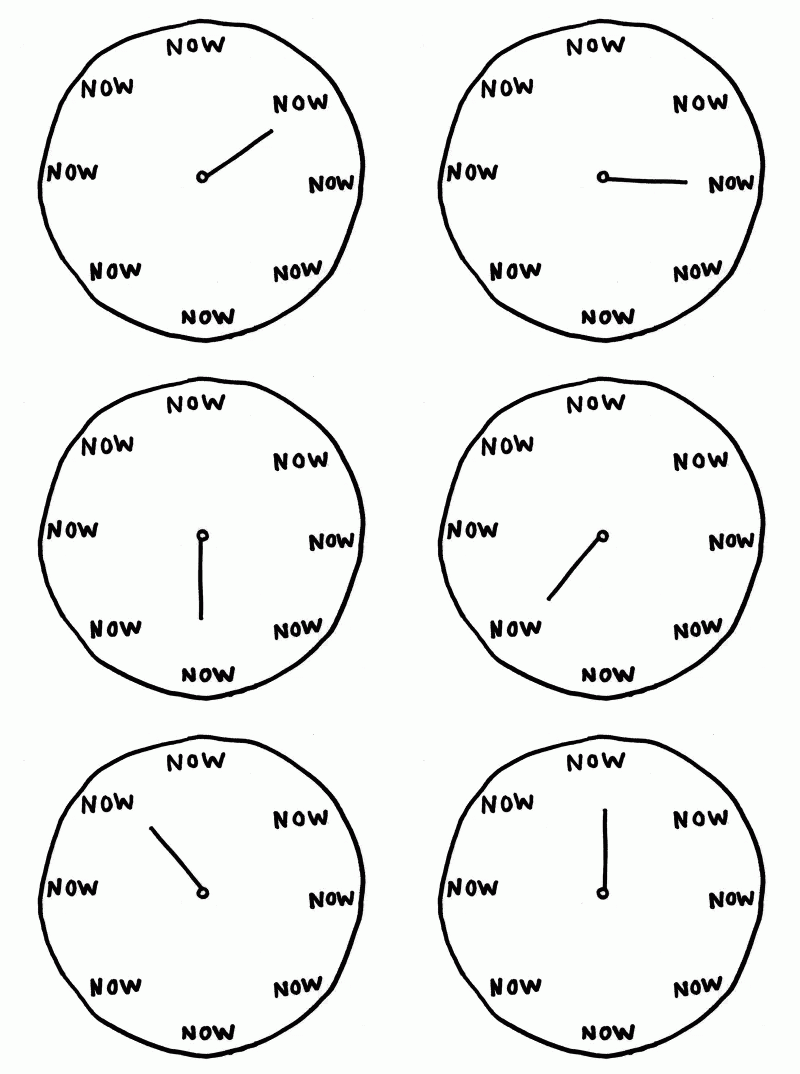
Mot: .. can ya sing um????

Shrinkflation is here and the Economy is Broken: John Rubino
Shrinkflation is here and the Economy is Broken
Liberty and Finance: 8-8-2025
A pivotal moment is unfolding in the precious metals space, according to John Rubino, as outlined in a recent video from Liberty and Finance. Rubino asserts that the long-awaited bull market for mining stocks is finally underway, driven by gold’s dramatic price surge and the strategic actions of key industry players.
Rubino explains that royalty and streaming companies, benefiting immensely from gold’s robust performance, are now flush with cash. This financial windfall is not sitting idle; these powerful entities are aggressively deploying capital into high-leverage deals across the mining sector.
Shrinkflation is here and the Economy is Broken
Liberty and Finance: 8-8-2025
A pivotal moment is unfolding in the precious metals space, according to John Rubino, as outlined in a recent video from Liberty and Finance. Rubino asserts that the long-awaited bull market for mining stocks is finally underway, driven by gold’s dramatic price surge and the strategic actions of key industry players.
Rubino explains that royalty and streaming companies, benefiting immensely from gold’s robust performance, are now flush with cash. This financial windfall is not sitting idle; these powerful entities are aggressively deploying capital into high-leverage deals across the mining sector.
This strategic capital deployment, Rubino asserts, is the definitive signal that the mining stock bull market, anticipated by many for years, has unequivocally begun.
However, Rubino’s insights extend beyond just precious metals, painting a broader picture of economic shifts and looming dangers.
He issues a stark warning about the rising political popularity of government price controls, which he describes as a dangerous form of “shrinkflation on steroids.” Such controls, Rubino argues, are not merely economic interventions but market distortions that inevitably erode quality across the economy, creating a façade of affordability while actual value diminishes.
Underlying these economic trends is a profound erosion of public trust. Rubino highlights a growing disillusionment with traditional institutions, ranging from main stream media to monetary authorities.
As faith wanes in the reliability and integrity of these pillars, individuals and investors are increasingly seeking refuge in tangible wealth.
Rubino points to a clear and accelerating shift into real assets like gold, farmland, and energy, as people fundamentally distrust fiat currencies and the systems backing them. This flight to real assets is a direct consequence of a world grappling with perceived institutional failures and economic uncertainties.
Rubino’s analysis paints a picture of a critical juncture, where a burgeoning bull market in mining stocks plays out against a backdrop of potential economic distortions and a broad flight from traditional financial assets.
For a deeper dive into these vital insights and the implications for your portfolio, viewers are encouraged to watch the full video from Liberty and Finance.
Not 1971, it was 1604, the Birth of Fiat Currency
Not 1971, it was 1604, the Birth of Fiat Currency
Miles Harris: 8-6-2025
Forget what you think you know about the most significant shifts in the history of money. Popular narratives often point to the dramatic severing of the dollar from gold by Nixon in 1971, the rise of powerful central banks, or the recent advent of digital currencies.
While these moments are undoubtedly pivotal, they may well be downstream effects of a foundational change that occurred centuries earlier, far from the bustling financial centers, in a quiet courtroom in Ireland.
Not 1971, it was 1604, the Birth of Fiat Currency
Miles Harris: 8-6-2025
Forget what you think you know about the most significant shifts in the history of money. Popular narratives often point to the dramatic severing of the dollar from gold by Nixon in 1971, the rise of powerful central banks, or the recent advent of digital currencies.
While these moments are undoubtedly pivotal, they may well be downstream effects of a foundational change that occurred centuries earlier, far from the bustling financial centers, in a quiet courtroom in Ireland.
In 1604, a little-known legal case posed a question that resonates profoundly even today: what gives money its value? The answer, delivered without fanfare or grand pronouncements, would quietly expand royal control and fundamentally alter the very structure of monetary power across the realm, laying an invisible bedrock for the financial systems we inhabit today.
This was no English common law ruling designed for immediate colonial subjugation; its setting in Ireland was crucial. It served as a potent demonstration of the Crown’s burgeoning ability to extend its legal authority and administrative reach across its diverse territories.
The case wasn’t about a new tax or a land dispute; it was about the very nature of coinage and the authority to define its worth. The verdict, though unheralded at the time, was a calculated move to centralize power, giving the sovereign an unprecedented degree of control over the economy.
The brilliance – and the subtle menace – of this 1604 decision lay in its quiet executionn. There were no headlines screaming revolution. No royal proclamations heralding a new era. Instead, it was a legal precedent, a ruling passed down in a courtroom, that began to redefine economic reality. It shifted the locus of monetary value from an intrinsic quality (like the weight of precious metal) to a declaration of authority. The Crown was asserting its right not just to mint coins, but to assign their value, even if that value diverged from their metallic content.
This subtle, yet seismic, shift had profound, long-term implications. It began to decouple money’s value from its material composition, paving the way for the eventual concept of fiat currency – money whose value is derived from government decree rather than a physical commodity.
The principle that a government’s stamp, its legal tender status, could effectively determine a currency’s worth overrode the simple equation of gold or silver content.
To truly understand how money functions today, how its value is created, controlled, and manipulated, we must look beyond the well-trodden paths of 20th and 21st-century finance. The threads of our modern monetary system stretch back an astonishing four centuries, to a seemingly obscure legal skirmish in Ireland.
It was here, in 1604, that the Crown quietly planted the seeds of a new monetary paradigm, a paradigm where legal authority, rather than market forces or metallic content alone, became the ultimate arbiter of value.
For further insights into this fascinating and overlooked chapter in monetary history, and to uncover the detailed mechanics of this pivotal legal case, explore the full video from Miles Harris. It’s a journey that rewrites our understanding of when and how one of history’s most important economic transformations truly began.
https://dinarchronicles.com/2025/08/07/miles-harris-not-1971-it-was-1604-the-birth-of-fiat-currency/
Seeds of Wisdom RV and Economic Updates Thursday Afternoon 8-7-25
Good Afternoon Dinar Recaps,
Bank of England Expected to Cut Interest Rate to 4.0% Despite Rising Inflation
BoE expected to cut rates from 4.25% to 4.0%
UK inflation accelerates, while growth continues to contract
GBP/USD at risk of falling toward August lows near 1.3140
Good Afternoon Dinar Recaps,
Bank of England Expected to Cut Interest Rate to 4.0% Despite Rising Inflation
BoE expected to cut rates from 4.25% to 4.0%
UK inflation accelerates, while growth continues to contract
GBP/USD at risk of falling toward August lows near 1.3140
The Bank of England (BoE) is poised to announce a 25-basis-point interest rate cut on Thursday, reducing the benchmark rate from 4.25% to 4.0%, according to growing market consensus. Analysts expect that seven out of nine Monetary Policy Committee (MPC) members will vote in favor of the cut, up from just three in the previous meeting.
The decision will be accompanied by the meeting Minutes and the Monetary Policy Report, offering insight into the BoE’s updated economic outlook and inflation projections. Following the announcement, Governor Andrew Bailey is scheduled to deliver a press conference outlining the rationale behind the rate cut and potentially signaling the bank’s future policy trajectory.
Economic Backdrop: A Conflicting Picture
The BoE last held rates steady in June. At that time, three MPC members cited:
Weakened labor market conditions
Subdued consumer demand
Wage growth trending toward sustainable levels
Since then, economic indicators have continued to show strain:
UK GDP contracted 0.1% MoM in May, following a 0.3% contraction in April
Production output fell 0.9%
Construction output declined 0.6%
Services output rose slightly by 0.1%
These figures paint a troubling picture of a slowing UK economy, just ahead of the Q2 GDP estimate set for release on August 14.
Inflation Rebounds—Complicating the BoE’s Dilemma
Despite declining growth, inflation rose sharply in June:
Headline CPI climbed to 3.6% YoY, up from 3.4% in May
Core CPI increased to 3.7% YoY, from 3.5%
Services inflation held steady at 4.7%, with food prices showing their biggest jump since February 2024
Meanwhile, labor market conditions continue to loosen, with the unemployment rate climbing to 4.7% in April, from 4.4% at the start of the year.
As the central bank weighs slowing growth against persistent inflationary pressures, Governor Bailey recently reiterated:
“I really do believe the path is downward”—referring to interest rates.
Revised Economic Forecasts Expected
Analysts anticipate that the BoE may:
Upgrade inflation projections due to sticky services inflation and rising food prices
Downgrade growth expectations, reflecting weak consumer demand and broad-based output declines
Market Reaction: GBP/USD Faces Downside Risk
Ahead of the announcement, GBP/USD is trading just above 1.3300, struggling to extend gains. The central bank’s split vote and cautious tone are expected to exert downward pressure on the British Pound.
According to Valeria Bednarik, Chief Analyst at FXStreet:
“The GBP/USD pair hovers around its weekly peak in the 1.3330 region, without any technical sign of additional gains ahead.”
She continues:
“The pair could turn bullish only if it breaks above 1.3400, an unlikely scenario given the expected BoE announcement. On the downside, watch the 1.3250 support—if breached, GBP/USD could target the August low at 1.3141.”
Conclusion
The Bank of England faces a complex policy crossroads: inflation is rising, but growth is faltering. While a rate cut appears imminent, the communication strategy and vote split may be the biggest market movers. The fate of the GBP/USD pair hangs in the balance, with downside risks mounting unless the BoE delivers a surprisingly hawkish outlook.
@ Newshounds News™
Source: BeInCrypto
~~~~~~~~~
Canada & Mexico to Join BRICS? The Fall of the US Dollar in 2024?
Exploring BRICS Expansion in the Western Hemisphere
Mexico formally declines BRICS membership
Canada remains silent on BRICS engagement
Is the US Dollar's global dominance at risk?
Potential Expansion of BRICS: An Analysis of Canada and Mexico’s Involvement
The BRICS bloc—originally composed of Brazil, Russia, India, China, and South Africa—has been rapidly expanding. In August 2023, the alliance extended invitations to several countries, five of which officially joined in 2024. This growth has sparked speculation about whether Western-aligned nations, including Canada and Mexico, could eventually pivot toward BRICS, potentially accelerating dedollarization efforts worldwide.
Mexico’s Stance on Joining BRICS
Speculation surrounding Mexico’s potential entry into BRICS intensified in mid-2023, ahead of the bloc’s August summit. However, Mexican President Andrés Manuel López Obrador publicly refuted such claims, affirming that Mexico would not seek membership in the alliance. The decision aligned with Mexico’s longstanding trade, economic, and geopolitical ties with the United States under frameworks such as USMCA.
Canada’s Position Regarding BRICS
In contrast to Mexico, Canada has made no official statements regarding BRICS membership. To date, there have been no public discussions, diplomatic engagements, or policy shifts that indicate Canadian interest in aligning with the BRICS bloc. Canada remains a core member of Western institutions such as the G7, NATO, and the OECD, further reinforcing its alignment with the existing US-led financial order.
Will Canada and Mexico Join BRICS?
Based on current geopolitical alignments, it appears highly unlikely that either Canada or Mexico would pursue BRICS membership in the near term—particularly with the explicit goal of weakening or replacing the US Dollar. While 2023 saw increasing concerns over the dollar’s global dominance, including inflationary pressures and internal US political division, both Canada and Mexico remain deeply integrated into the US-centric financial and security architecture.
BRICS’ Aspirations and Western Countries’ Responses
BRICS continues to push for greater economic sovereignty and a shift away from dollar dependency, aiming to promote settlement in local currencies and eventually introduce a shared digital or commodities-backed currency. These efforts have been well-received in parts of the Global South and among energy-exporting nations seeking alternatives to SWIFT and IMF dollarization structures.
Yet, the idea that NATO-aligned nations such as Canada and Mexico would join this movement remains speculative at best. Their participation in the US-led global order, access to Western capital markets, and dependence on the North American economic ecosystem make BRICS membership both politically improbable and economically costly.
Conclusion: Realignment or Rhetoric?
Despite BRICS’ expansion and continued calls for monetary multipolarity, neither Canada nor Mexico are expected to deviate from their current trajectories. While the US Dollar faces challenges, its foundational role in global trade, reserves, and institutional finance still ensures that Western partners remain tethered—for now.
As BRICS gains more influence in the Global South, 2024 will be a year to watch—but expectations of Western defection to the bloc remain premature.
@ Newshounds News™
Source: aped.ai
~~~~~~~~~
BRICS to Discuss Joint Response to Trump’s Tariffs
Lula calls out Trump’s “unilateralism” and threat to multilateral trade
BRICS members may coordinate action in response to rising tariffs
Brazil, India, and China seek a unified strategy to limit U.S. economic pressure
Lula Urges BRICS Coordination Amid Rising U.S. Tariffs
The BRICS bloc—comprising Brazil, Russia, India, China, and South Africa—is preparing to discuss a coordinated response to U.S. President Donald Trump’s escalating tariff threats. The initiative comes directly from Brazilian President Luiz Inácio Lula da Silva, who criticized Trump’s approach to international trade as a deliberate attempt to undermine multilateral institutions.
“What President Trump is doing is tacit — he wants to dismantle multilateralism, where agreements are made collectively within institutions, and replace it with unilateralism, where he negotiates one-on-one with other countries,” Lula told Reuters.
President Lula stated that he would initiate conversations with fellow BRICS leaders, beginning with Indian Prime Minister Narendra Modi on Thursday, followed by China’s President Xi Jinping and others. His goal: to understand how each nation is affected by the U.S. measures and to formulate a joint response.
“I’m going to try to discuss with them about how each one is doing in this situation, what the implications are for each country, so we can make a decision.”
Where BRICS Tariffs Currently Stand
U.S.–Brazil Tariffs: Currently at 50%
India Tariffs: Increased today by 25%, now totaling 50%
China–U.S. Tariffs: Paused for now
Russia Tariffs: Above 30%
Canada Tariffs: Recently raised to 35%
EU Goods: Settled at a new 15% tariff
Trump has recently labeled the BRICS alliance as “anti-American”, issuing public threats to impose an additional 10% blanket tariff on bloc members. Some individual BRICS nations, notably India and China, have explored bilateral deals with the U.S. to mitigate tariff effects. However, growing pressure may force a unified BRICS front to resist escalating U.S. protectionism.
Brazil’s Leadership Role in BRICS Response
President Lula emphasized that Brazil currently holds the BRICS presidency, granting it a leading role in shaping the bloc’s diplomatic and economic posture. In his interview, he expressed concern not just over tariffs, but over Trump’s broader agenda to dismantle multilateral norms:
“I want to discuss with our allies why Trump is attacking multilateralism and what his goals may be.”
Notably, Lula did not reference any intention to engage Trump directly as part of this initiative, suggesting that the response will remain within the BRICS framework for now.
The Bigger Picture: Trump’s Tariff Offensive
In recent days, President Trump has accelerated a wave of protectionist trade measures as part of his self-imposed tariff deadline. These include:
35% tariffs on Canadian imports
50% tariffs on Brazilian goods
15% settled tariffs on EU exports
All of this appears to be part of a broader realignment of U.S. trade policy aimed at strengthening leverage ahead of key diplomatic deadlines.
Conclusion: BRICS Eyes a Coordinated Strategy
The growing web of tariffs has created significant uncertainty for global markets and placed BRICS nations on alert. As Lula takes steps to convene the bloc’s leadership, the prospect of a cohesive BRICS economic strategy—and possibly retaliatory action—marks a pivotal moment in the evolving U.S.–BRICS relationship.
@ Newshounds News™
Source: Watcher.Guru
~~~~~~~~~
Seeds of Wisdom Team RV Currency Facts Youtube and Rumble
Newshound's News Telegram Room Link
Follow the Roadmap
Follow the Timeline
Seeds of Wisdom Team™ Website
Thank you Dinar Recaps
“Tidbits From TNT” Wednesday Morning 8-6-2025
TNT:
Tishwash: Oil Minister from Kirkuk: Today or tomorrow we will resume oil exports via Ceyhan, Turkey.
Oil Minister Hayan Abdul Ghani inaugurated on Wednesday a number of development and rehabilitation projects for oil stations in Kirkuk Governorate, while stressing that today or tomorrow we will resume oil exports via Ceyhan, Turkey.
The minister told the Iraqi News Agency (INA): "A number of development and rehabilitation projects for oil stations in Kirkuk Governorate have been inaugurated," noting that "today or tomorrow we will resume oil exports via Ceyhan, Turkey, as we will export 80,000 barrels per day as a first phase after the agreement with the region."
TNT:
Tishwash: Oil Minister from Kirkuk: Today or tomorrow we will resume oil exports via Ceyhan, Turkey.
Oil Minister Hayan Abdul Ghani inaugurated on Wednesday a number of development and rehabilitation projects for oil stations in Kirkuk Governorate, while stressing that today or tomorrow we will resume oil exports via Ceyhan, Turkey.
The minister told the Iraqi News Agency (INA): "A number of development and rehabilitation projects for oil stations in Kirkuk Governorate have been inaugurated," noting that "today or tomorrow we will resume oil exports via Ceyhan, Turkey, as we will export 80,000 barrels per day as a first phase after the agreement with the region."
He continued: "We were able to increase production at the wet oil station by 25,600 barrels per day," stressing that "90,000 barrels per day is the total capacity of the wet oil station north of Kirkuk."link
Tishwash: A Kurdistan Regional Government (KRG) financial delegation has arrived in Baghdad to discuss the salary issue
A technical delegation from the Kurdistan Regional Government (KRG) has arrived in Baghdad to resume talks on the salaries of employees and the work of joint committees.
"A technical delegation from the Kurdistan Regional Government (KRG) has arrived in Baghdad today to discuss the salaries of the employees and the work of the joint committees," a source in the Ministry of Finance and Economy told PUKMEDIA.
The Iraqi Council of Ministers held a regular meeting on Tuesday to discuss the issue of oil and salaries in the Kurdistan Region.
Meanwhile, Deputy Prime Minister for Energy Affairs and Oil Minister Hayan Abdul Ghani said in Kirkuk: "We are in talks with the Kurdistan Region to receive and export oil through SOMO and currently produces about 130,000 barrels of oil per day "We are ready to receive the oil from the Kurdistan Region," he said. link
***************
Tishwash: Oil: Major global energy companies confirm participation in the Baghdad International Energy Forum.
The Ministry of Oil confirmed on Tuesday that major international energy companies have confirmed their participation in the Baghdad International Energy Forum.
The ministry said in a statement received by the Iraqi News Agency (INA): "The Ministry of Oil confirms the participation of major international energy companies, including BP, TotalEnergies, Chevron, Eni, and Shell, in the Baghdad International Energy Forum, scheduled to be held in the capital, Baghdad, on September 6 and 7."
She added, "This broad participation reflects international companies' interest in the Iraqi oil sector, the investment opportunities and strategic partnerships it offers, and Iraq's pivotal position in global oil markets."
She continued, "These companies will be represented by senior delegations and executives who will participate in the forum's specialized dialogue sessions, which will focus on issues related to oil markets, energy security, sustainability, and the transition to renewable energy."
According to the ministry, the forum is being held under the auspices of the State Oil Marketing Organization (SOMO) and attended by energy ministers and international experts, making it an important international platform for enhancing cooperation and exploring the future of energy in Iraq and the region. link
************
Tishwash: Ports: Any ship that does not carry official documents will not enter Iraq.
The Director General of the General Company for Iraqi Ports, Farhan Al-Fartousi, confirmed today, Tuesday, that the security forces protecting the Khor Abdullah Canal are working continuously to secure goods.
Al-Fartousi said in a press statement, "There is continuous monitoring of all ships entering the Khor Abdullah Canal, and the Iraqi authorities are working to verify the official documents of all ships entering the canal," adding that "territorial waters are subject to the law and authority of the state."
He added, "The military and security forces are conducting a survey of Iraqi territorial waters to investigate all commercial and oil vessels present in the waiting areas." link
Mot: It is Sooo Great That Folks Help out the Seasoned Peoples!!!

Mot: . All Sources Seem to Agree --That it will Happen ~~tomorrow
https://www.youtube.com/watch?v=3IBdFVOkxR4&list=RD3IBdFVOkxR4&start_radio=1
MilitiaMan and Crew: Iraq Dinar News- Economic Developments-Impact
MilitiaMan and Crew: Iraq Dinar News- Economic Developments-Impact
8-2-2025
The Crew: Samson, PompeyPeter, Petra, Daytrader, Sunkissed, GIGI and Militia Man
In this exciting new video, we get into the latest significant developments in Iraq's economy and how they impact the Iraqi dinar. From the recent reduction of tariffs by the USA to groundbreaking infrastructure projects, we cover it all!
Topics Covered:
Iraqi Dinar Insights: An overview of the current state of the dinar and what recent changes mean for investors and the economy.
MilitiaMan and Crew: Iraq Dinar News- Economic Developments-Impact
8-2-2025
The Crew: Samson, PompeyPeter, Petra, Daytrader, Sunkissed, GIGI and Militia Man
In this exciting new video, we get into the latest significant developments in Iraq's economy and how they impact the Iraqi dinar. From the recent reduction of tariffs by the USA to groundbreaking infrastructure projects, we cover it all!
Topics Covered:
Iraqi Dinar Insights: An overview of the current state of the dinar and what recent changes mean for investors and the economy.
USA Reduces Tariffs on Iraq: Learn how this decision is poised to boost trade relations and open new avenues for economic growth.
Development Road Opens New Energy Agreement: Discover the implications of this new roadway and how it facilitates international partnerships in the energy sector.
First Oil Export Tanker Docks in Iraqi Waters: We’ll discuss the significance of this milestone for Iraq's oil exports and what it means for the Iraq heading into the global energy market.
Issuance of the Iraqi Journal of Facts-Gazette (4833): Get some insights into this important publication and how it aims to show at least two components that likely will impact the Iraqi dinar on the Legal and Central Bank side.
Join us as we explore these pivotal moments that shape Iraq's future and the potential impact on the Iraqi dinar.
Seeds of Wisdom RV and Economic Updates Sunday Morning 8-3-25
Good Morning Dinar Recaps,
Banks Launch 'Operation Chokepoint 3.0' to Restrict Crypto and Fintech Access
A new wave of financial restrictions targeting crypto and fintech firms may be underway as banks begin rolling out what critics are calling “Operation Chokepoint 3.0.” According to Andreessen Horowitz general partner Alex Rampell, this initiative could significantly undermine access to banking services and consumer data essential for crypto platforms and digital finance startups.
Good Morning Dinar Recaps,
Banks Launch 'Operation Chokepoint 3.0' to Restrict Crypto and Fintech Access
A new wave of financial restrictions targeting crypto and fintech firms may be underway as banks begin rolling out what critics are calling “Operation Chokepoint 3.0.” According to Andreessen Horowitz general partner Alex Rampell, this initiative could significantly undermine access to banking services and consumer data essential for crypto platforms and digital finance startups.
*********************************
Rampell: Banks Reviving Chokepoint Tactics with New Fees and Barriers
Rampell warns that while Operation Chokepoint 2.0—an initiative under the Biden administration that sought to deplatform crypto firms—has come to an end, banks are now pursuing a privately driven version that may be even more damaging.
“Now the banks are aiming to implement their own Chokepoint 3.0 — charging insanely high fees to access data or move money to crypto and fintech apps — and, more concerningly, blocking crypto and fintech apps they don’t like,” said Rampell.
At the center of the controversy is the growing effort by major financial institutions to charge fintech and crypto platforms premium fees for accessing customer bank account data—fees that could total hundreds of millions of dollars annually.
JPMorgan Chase Implements Tiered Data Access Fees
Among the first major banks to adopt this model is JPMorgan Chase, which has announced a tiered fee structure for third-party access to customer account data. Higher fees will reportedly apply to payment-focused platforms, which often rely on continuous API access to facilitate real-time transfers.
A Chase spokesperson acknowledged the plan:
“We’ve had productive conversations and are working with the entire ecosystem to ensure we’re all making the necessary investments in the infrastructure that keeps our customers safe.”
Rampell pushed back against this framing, stating that the data in question—such as bank account and routing numbers printed on checks—has long been freely accessible and that charging for it now raises questions about monopolistic behavior.
Fintech & Crypto Platforms Could Face User Attrition
The new fees may disrupt operations at major platforms including Coinbase, Venmo (PayPal), and Robinhood, all of which rely on access to customer banking data to enable deposits, withdrawals, and balance verification.
Rampell emphasized the potential consumer impact:
“If it suddenly costs $10 to move $100 into a Coinbase or Robinhood account, maybe fewer people will do it.”
Such friction, he argues, could lead to a sharp decline in user participation across platforms—especially those targeting younger and cost-sensitive demographics.
**********************************
Crypto Advocates Call for Policy Intervention
Rather than seeking new legislation, Rampell believes regulators should intervene to prevent banks from erecting barriers that stifle innovation and restrict consumer choice:
“We don’t need new laws. We need an administration that won’t allow banks to destroy competitive fintech and crypto industries through manipulation.”
FAQs: Understanding Operation Chokepoint 3.0
What is Operation Chokepoint 3.0?
A privately driven effort by banks to restrict crypto and fintech operations by charging excessive data access fees and selectively blocking apps.
How is it different from Operation Chokepoint 2.0?
Version 2.0 focused on government pressure to debank crypto. In contrast, 3.0 involves bank-initiated commercial practices like tiered pricing for account data.
Which companies are most affected?
Platforms like Venmo, Coinbase, and Robinhood could see major user drop-off if added fees discourage asset movement and reduce platform affordability.
@ Newshounds News™
Source: Coinpedia
~~~~~~~~~
Ripple CTO Proposes XRPL Infrastructure Upgrade as Ledger Surpasses 70M Monthly Transactions
Ripple’s Chief Technology Officer David Schwartz has unveiled plans for a new high-performance XRP Ledger (XRPL) server to enhance infrastructure resilience and analytics. The announcement comes as XRPL achieved a major milestone in July, recording over 70 million transactions—its highest monthly total to date.
CTO David Schwartz Shares Plans for Personal XRPL Server Initiative
In a recent post on X, Schwartz revealed his intent to build and operate a dedicated XRPL production server. Although not an official Ripple initiative, the server would serve the broader XRPL ecosystem by offering reserved connectivity slots for UNL validators and XRPL-linked services.
“This is something I’d be doing independently to support the network. It’s about improving performance monitoring and resiliency, not centralizing control,” Schwartz clarified.
The proposed server setup includes:
AMD 9950X CPU
256 GB RAM
High-speed NVMe storage
Unmetered 10GB connection
Data center hosting in New York City
***************************************************
Schwartz emphasized that no individual server should be relied upon within XRPL’s decentralized framework. He intends to monitor real-time data flows and network behavior, with minimal interference to existing XRPL operations.
XRPL Ecosystem Sees Record Usage and Developer Momentum
According to Dune Analytics, the XRP Ledger processed over 70 million transactions in July, pushing its all-time count to approximately 3.83 billion transactions. XRPL’s daily average now stands at 1.8 million, reflecting consistent utility across global users.
Additional milestones include:
Over 1 million new users added in 2025 so far
3,000 new wallets created daily
More than 7 million total XRPL accounts
Growth has also extended to XRPL’s automated market maker (AMM) and decentralized exchange (DEX) systems:
AMM volume increased 17%, reaching 408 million XRP
DEX volume rose 21%, totaling 465 million XRP
Cross-Chain Adoption and Stablecoin Expansion Drive Ecosystem Utility
Cross-chain activity on XRPL is accelerating, with over $165 million in assets bridged via Axelar to EVM-compatible blockchains. The launch of an EVM-compatible sidechain on June 30 has already generated significant developer traction—with more than 1,400 smart contracts deployed in the first week.
In addition, the Brazilian real-denominated stablecoin BBRL, issued by BrazaBank on XRPL, saw issuance surge past $4.2 million last month. BBRL now ranks as the second-largest BRL stablecoin, behind Transfero’s BRZ.
These developments underscore XRPL’s growing reputation as a scalable, low-cost global settlement layer—and illustrate the importance of infrastructure investments like those proposed by Schwartz.
XRPL in Numbers – July 2025
Metric Value
Monthly Transactions 70+ million
Total Transactions (All-Time) 3.83 billion
New Wallets per Day 3,000+
AMM Volume 408M XRP (↑17%)
DEX Volume 465M XRP (↑21%)
Stablecoin (BBRL) Issuance $4.2M+
Cross-Chain Asset Transfer $165M+ via Axelar
Smart Contracts (New Sidechain) 1,400+ in first week
As Ripple’s ecosystem expands and developer engagement grows, efforts like Schwartz’s independent infrastructure upgrade highlight the importance of decentralization, transparency, and performance monitoring in supporting XRPL’s next phase of global adoption.
@ Newshounds News™
Source: Coingape
~~~~~~~~~
**********************************************
Uniswap, a16z, and DeFi Allies Urge U.S. Senate to Shield Developers in Upcoming Crypto Market Bill
A coalition of major decentralized finance (DeFi) advocates—including Uniswap Labs, a16z Crypto, and the Solana Policy Institute—is calling on U.S. lawmakers to protect open-source developers and maintain tech-neutrality as Congress shapes the future of digital asset regulation.
Senate Banking Committee Reviews DeFi Protections Under RFIA Draft
The comments were submitted in response to a Request for Information (RFI) issued by the Senate Banking Committee, which is currently reviewing the draft of the Responsible Financial Innovation Act of 2025 (RFIA)—an updated legislative framework first introduced in 2022. The updated version aims to build upon the foundational CLARITY Act, which promotes innovation while preserving consumer protections and financial stability.
The response was filed by the DeFi Education Fund (DEF), a crypto policy nonprofit originally funded by Uniswap. It was co-signed by leading crypto organizations, including:
a16z Crypto
Jito Labs
Jump Crypto
Paradigm
Multicoin Capital
Uniswap Foundation
Solana Policy Institute
Variant Fund
Key Policy Recommendations from the DeFi Education Fund
In its official comment, the coalition emphasized four major policy imperatives that should guide Senate legislation:
1. DeFi Developers ≠ Centralized Intermediaries
Lawmakers should make a clear legal distinction between open-source DeFi developers and traditional custodial financial institutions. Developers of non-custodial protocols should not face the same compliance burdens as centralized intermediaries.
2. Technology-Neutral Regulation
Regulations should focus on function, not form—treating traditional and decentralized systems with parity, without favoring one architecture over another.
**************************************
3. Clarity on Registration Requirements
The law should clearly define who must register with financial regulators based on their level of control, custodial function, or ability to halt transactions—criteria that many decentralized protocols do not meet.
4. Federal Preemption to Prevent State-Level Weaponization
The DEF warns that without federal preemption, large incumbent financial institutions may exploit state laws to bring litigation or enforcement actions against DeFi protocols—not to protect consumers, but to stifle competition.
“Absent federal preemption, well-resourced traditional financial institutions may exploit the fragmented regulatory landscape by funding or encouraging state-level enforcement actions against DeFi developers — not to protect consumers, but to stifle competition,” the DEF wrote.
Call for Revised FinCEN Guidance in Light of Tornado Cash Case
The DEF also urged the Senate to clarify FinCEN’s existing guidance, which underpins the ongoing trial of Tornado Cash developer Roman Storm. The Department of Justice has charged Storm with violating federal laws by publishing open-source software used by illicit actors.
The coalition argues:
“Rulemaking should reflect that technology which solely consists of non-custodial, non-controlling software shall not be regulated as a financial institution or financial intermediary.”
Storm’s verdict is expected as early as next week, making this debate especially urgent for developers across the DeFi ecosystem.
What’s at Stake for DeFi in the RFIA Bill?
This moment marks a critical inflection point in how U.S. law distinguishes between traditional financial institutions and decentralized technology. The outcome will impact:
The future legal status of DeFi developers
The ability to publish open-source code without legal liability
The competitiveness of U.S.-based DeFi innovation in the global economy
By engaging early in the legislative process, the crypto community hopes to ensure that U.S. digital asset laws foster innovation rather than stifle it.
@ Newshounds News™
Source: The Block
~~~~~~~~~
Seeds of Wisdom Team RV Currency Facts Youtube and Rumble
Newshound's News Telegram Room Link
Follow the Roadmap
Follow the Timeline
Seeds of Wisdom Team™ Website
Thank you Dinar Recaps
Fiat Currency Corrupts Society
Fiat Currency Corrupts Society
Liberty and Finance: 7-31-2025
We often discuss the economic implications of fiat currency – inflation, debt, and market fluctuations. But what if its impact runs far deeper, eroding the very fabric of society’s moral foundation?
This is the provocative argument put forth by financial analyst David Morgan in a recent discussion with Liberty and Finance. Morgan contends that the insidious nature of manipulated money extends beyond the balance sheet, subtly corrupting our collective values and diverting us from true purpose.
Fiat Currency Corrupts Society
Liberty and Finance: 7-31-2025
We often discuss the economic implications of fiat currency – inflation, debt, and market fluctuations. But what if its impact runs far deeper, eroding the very fabric of society’s moral foundation?
This is the provocative argument put forth by financial analyst David Morgan in a recent discussion with Liberty and Finance. Morgan contends that the insidious nature of manipulated money extends beyond the balance sheet, subtly corrupting our collective values and diverting us from true purpose.
Morgan’s central thesis is chillingly simple: when individuals and societies place their faith in a currency that can be arbitrarily created and devalued, rather than in enduring principles or a higher power, a profound moral distortion takes hold.
This misplaced trust in manipulated money, he argues, overshadows our understanding of value itself. Integrity, honesty, and genuine achievement are gradually overshadowed by a pursuit of superficial gain facilitated by an ever-expanding money supply.
The consequence, according to Morgan, is a society increasingly driven by consumerism and deceit.
Fiat currency, untethered from tangible assets or intrinsic worth, fosters an illusion of prosperity that encourages insatiable consumption.
This insatiable desire, in turn, can breed dishonesty, as the pursuit of more becomes paramount, often at the expense of ethical conduct.
Trust, the bedrock of any healthy society, is replaced by a system based on control and an increasingly pervasive illusion of wealth. Authenticity gives way to a culture where appearances and perceived affluence dictate status.
As society collectively accepts this “false money as truth,” Morgan warns, broader distortions inevitably emerge. These aren’t merely economic in scope; they permeate spiritual, cultural, and political landscapes.
The spiritual void created by a focus on material accumulation can lead to a loss of meaning and purpose. Culturally, a short-term, instant-gratification mindset replaces long-term planning and intergenerational responsibility. Economically, the cycle of boom and bust becomes more pronounced, enriching a few while destabilizing the many.
David Morgan’s message is not merely a critique; it’s a poignant call to action. He advocates for a fundamental shift back to the principles of sound money – currency rooted in real value and not subject to political manipulation.
More importantly, he urges a return to inner values – principles of integrity, truth, and genuine worth that transcend mere financial metrics. Only by reclaiming these foundational elements, Morgan asserts, can society truly reclaim genuine freedom, purpose, and a robust moral compass.
His insights serve as a potent reminder that the health of our financial system is inextricably linked to the health of our collective soul.
For a deeper dive into these profound assertions and to fully grasp the nuances of David Morgan’s argument, viewers are encouraged to watch the full video from Liberty and Finance.
Seeds of Wisdom RV and Economic Updates Friday Afternoon 8-1-25
Good Afternoon Dinar Recaps,
India Lets 30 Countries Trade With Rupee in New BRICS Strategy
As tensions escalate between Washington and the BRICS alliance, India has taken a bold step to internationalize the rupee, allowing nearly 30 countries to settle cross-border transactions directly in its national currency. The move comes just as U.S. President Donald Trump imposed steep 25% tariffs on Indian goods, citing what he described as anti-American activities, including New Delhi’s ongoing energy and defense partnerships with Russia.
Good Afternoon Dinar Recaps,
India Lets 30 Countries Trade With Rupee in New BRICS Strategy
As tensions escalate between Washington and the BRICS alliance, India has taken a bold step to internationalize the rupee, allowing nearly 30 countries to settle cross-border transactions directly in its national currency. The move comes just as U.S. President Donald Trump imposed steep 25% tariffs on Indian goods, citing what he described as anti-American activities, including New Delhi’s ongoing energy and defense partnerships with Russia.
The development represents a clear advance in the BRICS bloc’s de-dollarization strategy, with India now positioning the rupee as an alternative settlement currency for international trade — a direct challenge to U.S. dollar dominance.
Rupee Push Gains Momentum Through Vostro Accounts
At the heart of India’s effort is the use of Vostro bank accounts, a mechanism enabling foreign countries to settle transactions with India in rupees rather than relying on the U.S. dollar or other reserve currencies. These accounts are maintained by Indian banks on behalf of overseas banks, allowing direct rupee remittances without conversion losses.
The Reserve Bank of India (RBI) recently removed caps on investments made via these accounts, signaling a major policy shift toward facilitating rupee-based trade.
So far, 22 of the 30 countries have already executed trades using the rupee, including both BRICS members and key economic partners:
BRICS/Partners: Russia, Belarus, Malaysia, Uganda
Others: Bangladesh, Botswana, Fiji, Germany, Guyana, Israel, Kazakhstan, Kenya, Maldives, Mauritius, Myanmar, New Zealand, Oman, Seychelles, Singapore, Sri Lanka, Tanzania, United Kingdom
Trump Responds with Tariffs and Penalties
While India moves ahead with its rupee trade initiative, President Trump has responded forcefully. In addition to the 25% tariffs on Indian imports, the U.S. has penalized India for purchasing Russian crude oil and military hardware, defying American sanctions on Moscow.
Trump’s latest actions are part of a broader strategy to confront BRICS countries that seek to undermine the dollar’s global role. India’s growing rupee diplomacy is being interpreted in Washington as a key piece of this puzzle.
Trump, in his public remarks, has warned that nations benefiting from U.S. trade ties must not simultaneously support alternative financial systems that weaken American influence. His administration appears to view India’s Vostro-driven settlement system as a strategic provocation.
India Advances, BRICS Realigns
India’s rupee trade policy is not just about currency—it is a geopolitical signal of intent. By reducing reliance on the dollar for trade settlements, New Delhi is asserting economic sovereignty, while also reinforcing BRICS goals of multipolar finance and reduced Western dependency.
According to sources familiar with the RBI’s strategy, the goal is long-term: to position the rupee as a viable medium of exchange within Asia, Africa, and the broader Global South.
In this new financial architecture, BRICS-aligned economies are working together to design non-dollar payment rails, and India is becoming a central player in that effort.
Outlook: Rupee Trade Meets Washington Resistance
While India’s Vostro framework is gaining traction globally, its future viability will depend on how the U.S. reacts in the coming months. The Trump administration’s tariffs are just one layer of pressure. Additional sanctions or financial restrictions on countries using rupee settlements could emerge, potentially complicating India's push.
Still, India’s currency diplomacy signals a deeper BRICS realignment, one where national currencies replace dollar hegemony — at least in targeted sectors of bilateral trade. What comes next may reshape global commerce and force emerging economies to choose between U.S. alignment or BRICS autonomy.
@ Newshounds News™
Source: Watcher.Guru
~~~~~~~~~
Seeds of Wisdom Team RV Currency Facts Youtube and Rumble
Newshound's News Telegram Room Link
Follow the Roadmap
Follow the Timeline
Seeds of Wisdom Team™ Website
Thank you Dinar Recaps