
“Tidbits From TNT” Friday 8-1-2025
TNT:
Tishwash: The dinar rises and trade falls... a monetary paradox that confuses markets and curbs consumption.
Amid an atmosphere of cautious anxiety, Iraqi markets are gripped by a deep recession, with economic indicators intersecting with political variables, creating a stagnation-ridden business environment characterized by stagnation and low expectations. The sharp decline in purchasing power, the chronic volatility of the dinar's exchange rate against the dollar, and the government's shrinking spending are all symptoms of a complex problem that extends beyond the market to touch upon the very structure of Iraq's rentier economy.
TNT:
Tishwash: The dinar rises and trade falls... a monetary paradox that confuses markets and curbs consumption.
Amid an atmosphere of cautious anxiety, Iraqi markets are gripped by a deep recession, with economic indicators intersecting with political variables, creating a stagnation-ridden business environment characterized by stagnation and low expectations. The sharp decline in purchasing power, the chronic volatility of the dinar's exchange rate against the dollar, and the government's shrinking spending are all symptoms of a complex problem that extends beyond the market to touch upon the very structure of Iraq's rentier economy.
The manifestations of this stagnation are manifested in a state of "passive waiting" prevalent among consumers and traders. Despite its relative recovery, the dollar has become a source of suspicion rather than a catalyst for activity. The more the price declines, the more markets freeze, and citizens withdraw from the trading scene in hopes of further declines. This turns purchasing into a financial bet. An Iraqi economist summed it up by saying, "Demand in Iraq no longer follows need, but rather monetary sentiment."
The statements of Rashid Al-Saadi, a representative of the Baghdad Chamber of Commerce, are an indication of the growing entanglement between economics and politics. He clearly pointed to the impact of the Central Bank's decisions, the budget delays, and the reduced reliance on the parallel market. These observations reinforce the conviction that the issue goes beyond market fluctuations to the declining effectiveness of fiscal and monetary policy tools, given the absence of a proactive state role that can absorb shocks.
The repercussions extend to a darker landscape as experts speak of business losses, a shrinking real estate market, a decline in investment, and a weakening confidence in the effectiveness of monetary policy. These indicators reveal a flaw in the Iraqi economy's equation, which is based on government spending that is only achieved through the approval of a budget, oil revenues that are slowly translated into projects, and a legislative structure that hinders market flexibility rather than protecting it.
It appears that the state, as the economic center of gravity, has become a bystander or a deferent, which has pushed the market toward a horizontal recession across various sectors, from real estate to automobiles, from tourism to trade, without the decline in inflation having any significant revival effect.
In contrast to this bleak landscape, some sectors, such as agriculture, the food industry, and e-commerce, appear less affected. However, they remain exceptions that do not alter the nature of the dilemma. The problem is structural, requiring urgent monetary and legislative reforms to restore investor confidence, curb market volatility, and recalibrate the relationship between the state and the private sector, moving away from improvisation and persecution rather than partnership. link
************
Tishwash: Oil is not another reason delaying the submission of budget tables to Parliament, and a warning against entering 2026 without them.
Economic expert Safwan Qusay revealed non-oil reasons behind the delay in submitting the budget schedules to parliament, warning of the repercussions of entering 2026 without actual approval, which could disrupt public spending and impact economic stability.
Qusay told Al Furat News: "The delay in sending it is not only related to fluctuating oil prices, but also to a government attempt to audit the numbers of employees, retirees, and those covered by welfare and the ration card, which may reveal exaggerations and inaccurate funding in some items over the past years."
He added, "Financial and economic stability requires sustaining spending rates at levels similar to those recorded in the 2024 budget, which amounted to approximately 360 trillion dinars," noting that "a decline in public spending could lead to an economic contraction, particularly in items related to new projects and job opportunities."
Qusay explained that "the government continues to spend on salaries, pensions, welfare, and the food basket, as these are governed by laws. However, investment agreements and development projects require financial schedules to ensure sustainable funding and reduce unemployment rates."
He pointed out that "budget tables represent an important reference for the private sector, which relies on them to plan imports and investments," noting that "the absence of these tables will lead to economic confusion, requiring urgent intervention from Parliament to avoid entering the next year without a legal basis for spending."
In a related context, Qusay noted that "oil prices during the first half of 2025 reached approximately $70 per barrel," stressing that "the future outlook for the markets indicates the possibility of prices rising due to increased demand from China and the United States and improved understandings between the European Union and the United States, which could push the price to $73."
Regarding production policy, the expert concluded by saying, "The Ministry of Oil is determined to increase production capacity to nearly 6.5 million barrels per day over the coming years, while Iraq's OPEC quota is gradually increasing by 50,000 barrels per month in preparation for returning to the production capacity approved in November 2023." link
************
Tishwash: Industry: The first locally manufactured portable thermal imaging system has been completed and security authorities have been notified.
The Ministry of Industry announced on Friday the completion of the first locally manufactured portable thermal imaging camera system, while noting that it had approached security and military agencies to discuss the use of this national system.
Ministry spokeswoman Duha al-Jubouri said in a press statement that "the ministry has completed the first portable thermal camera system, manufactured locally at the Al-Kindi factory affiliated with the General Company for Communications and Capacity in Nineveh Governorate.
" She added that "the new system is used for field surveillance and covers an area of up to 360 degrees, with a range of 6 to 30 kilometers, depending on the required specifications. It operates on solar energy and batteries to provide the necessary energy for long periods."
She confirmed that "the ministry has approached security and military agencies, such as the Ministries of Defense and Interior, to benefit from this national system," noting that "it will work to develop it later." link
Mot: Don't Knows bout U!! -- But When the RV Happens - I'm Gunna

Mot: .... I’ve never slipped on sunshine, just sayin’

Seeds of Wisdom RV and Economic Updates Friday Morning 8-1-25
Good morning Dinar Recaps,
‘Crypto, Welcome Home’: White House Report Signals Major Shift in U.S. Policy Toward Digital Assets
Industry leaders praise Trump administration’s pro-crypto stance and SEC’s move to rethink token classification.
In a landmark move that could reshape the future of digital asset policy in the United States, the White House on Wednesday released a 168-page report outlining a comprehensive regulatory framework for crypto. The report includes key proposals covering banking access, stablecoins, taxation, illicit finance, and a federal crypto stockpile.
Good morning Dinar Recaps,
‘Crypto, Welcome Home’: White House Report Signals Major Shift in U.S. Policy Toward Digital Assets
Industry leaders praise Trump administration’s pro-crypto stance and SEC’s move to rethink token classification.
In a landmark move that could reshape the future of digital asset policy in the United States, the White House on Wednesday released a 168-page report outlining a comprehensive regulatory framework for crypto. The report includes key proposals covering banking access, stablecoins, taxation, illicit finance, and a federal crypto stockpile.
Treasury Secretary Scott Bessent, in prepared remarks, took direct aim at the previous administration, calling the Biden-era approach to crypto “hostile.” In a striking departure from past rhetoric, Bessent posted on social media:
“Crypto, welcome home.”
He elaborated in his speech:
“So start your companies here. Launch your protocols here. And hire your workers here. You’ll be glad you did.”
Industry Praises New White House Approach
The report’s release was met with strong approval from across the digital asset sector. Advocates hailed the move as a long-overdue acknowledgment of crypto’s economic potential.
“We commend this Administration, the Presidential Working Group, and all the agencies involved for producing a comprehensive, forward-looking report,” said Ji Hun Kim, CEO of the Crypto Council for Innovation. “It reflects a serious commitment of U.S. leadership in the digital asset space and the continued adoption of blockchain technology.”
Several leaders highlighted how this report builds on previous congressional efforts—especially the passage of the GENIUS Act, which federally regulates stablecoins and laid groundwork for broader crypto market structure legislation.
“This moment is a reminder that groundbreaking legislation like GENIUS becomes law because of advocates who demand progress,” said Mason Lynaugh, community director at Stand With Crypto. “Now, not only do we have a voice in the national conversation, but we also have momentum on our side. Let’s keep going.”
U.S. Signaling Global Crypto Leadership
Roshan Robert, CEO of OKX US, framed the report as a pivot toward practical adoption:
“From Ethereum-based treasuries to compliant stablecoins and regulated exchanges, Washington is signaling a shift toward real-world utility over ideology.”
Robert added that the United States is finally “stepping up to lead” in the digital asset space—a sentiment echoed by others who see the report as a potential turning point.
SEC to Lead Secondary Market Regulation
The report also clarifies the roles of various agencies, naming the Securities and Exchange Commission (SEC) as the “primary federal regulator of secondary digital asset markets.” On Thursday, SEC Chair Paul Atkins acted on the recommendations by launching a new agency initiative called “Project Crypto.”
Atkins said that Commissioner Hester Peirce and her task force will begin developing proposals in line with the White House’s framework. He also committed agency staff to draft new rules around crypto distributions, custody, and trading, subject to public comment.
“The biggest headline is that most tokens are not considered securities,” said Nic Puckrin, founder of Coin Bureau. “That’s a huge shift from the SEC’s previous stance.”
Regulatory Philosophy: Support Innovation, Protect Rights
Atkins emphasized a regulatory posture that distinguishes between centralized schemes and onchain software systems, including DeFi protocols. He pledged that developers and users will not be burdened by "duplicative or unnecessary regulation."
“At DeFi Education Fund, we sincerely appreciate his acknowledgment of the American right to self-custody,” said Amanda Tuminelli, the group’s executive director. “He understands that regulating DeFi requires a nuanced approach—and that’s exactly what we need.”
A New Chapter in U.S. Crypto Policy?
This week’s announcements from both the White House and the SEC appear to mark the beginning of a major realignment in U.S. crypto regulation. Once viewed primarily through the lens of enforcement and national security, digital assets are now being positioned as strategic infrastructure—with the government encouraging builders to innovate on American soil.
While the details of future rulemaking remain to be seen, the tone has unmistakably shifted. In the words of the Treasury Secretary, crypto is finally being invited home.
@ Newshounds News™
Source: The Block
~~~~~~~~~
Powell Blames Trump: Interest Rates Frozen by His Tariff Policy
Federal Reserve Chairman Jerome Powell made headlines this week by placing responsibility for stalled rate cuts squarely on the shoulders of President Donald Trump, whose tariff policies are injecting instability into the global economy. While markets were bracing for a policy pivot in 2025, Powell made clear that any such move remains on hold — not due to inflation, but due to Trump’s economic tactics.
“I think that’s true,” Powell stated bluntly when asked whether interest rates would already be lower without Trump’s recent trade measures.
That single sentence landed like a thunderclap across Wall Street. The implication: Trump’s aggressive tariff strategy is forcing the Fed into a holding pattern. In the Fed Chair’s words and tone, a deeper confrontation is brewing — not just between economics and politics, but between institutional independence and presidential volatility.
Trump’s Tariff Gambit Blocks Fed Action
Powell’s remarks confirm what investors have suspected: the Fed is delaying rate cuts due to the uncertainty created by the White House. While inflation has eased and the broader economy shows signs of fatigue, the central bank refuses to budge, citing Trump’s aggressive trade posture with key global partners.
“They’ve made abrupt decisions,” Powell alluded, adding that these create “a climate of instability.”
The renewed economic nationalism — dubbed by some as the Return of Trumpian Tariffism — carries high costs. From Beijing to Brussels, retaliatory whispers are already echoing across trade ministries, and central banks globally are watching to see whether the U.S. Fed can maintain autonomy under executive pressure.
Powell vs. Trump: Personal History, Policy Collision
The drama isn’t just institutional — it’s personal. Trump appointed Powell in 2019, but their relationship quickly soured. Trump has since publicly criticized Powell, most recently calling him a “stubborn mule” and “a stupid person.”
Despite the attacks, Powell remains publicly composed. But make no mistake: the Fed Chair is quietly reasserting his role as guardian of monetary stability, refusing to be rushed into rate cuts that could unleash unintended consequences in a politically charged environment.
Crypto in the Crossfire: Bitcoin and Stablecoins React
The standoff has spilled into the digital asset space. Bitcoin fell 1.3% on Tuesday, as Powell’s comments — and Trump’s unpredictability — weighed on market sentiment.
“As long as rates remain high, liquidity becomes scarcer, and cryptocurrencies suffer,” analysts warn.
In a telling shift, Powell also acknowledged that the Fed is supporting stablecoin legislation, suggesting that while it holds the line on rates, it is not opposed to financial innovation. He noted a “significant change in tone” on Wall Street toward crypto, indicating the sector’s growing legitimacy in monetary policy discussions.
Balancing Act: The Fed’s Independence Under Fire
Trump’s tariff policies aren’t just economic tools — they’re electoral levers. His administration is using trade threats to rally domestic support, even at the cost of global stability. The Fed, in contrast, is forced into cautious restraint, maintaining high rates not because it wants to, but because it must wait for clarity.
“This isn’t just about rates,” one economist noted. “It’s about whether U.S. institutions can withstand politicization during an election year.”
As Powell plays for time and Trump reshapes trade policy with a campaign lens, the fate of interest rates — and by extension, the economy and digital asset markets — remains tethered to political turbulence.
Outlook: One Name, One Variable
Whether in bond markets or Bitcoin forums, one name dominates every discussion: Trump. His influence on trade, rates, and digital asset regulation has become the single most important variable in economic forecasting.
“For Trump, Bitcoin doesn’t compete with the dollar — it becomes a safety valve,” one strategist observed.
This is no longer a theoretical debate. It is a live test of how America’s monetary framework navigates the crosswinds of politics, innovation, and global realignment. The coming months will decide whether the Fed can hold its ground — or whether the Trump doctrine forces a structural shift in U.S. monetary independence.
@ Newshounds News™
Source: Cointribune
~~~~~~~~~
Seeds of Wisdom Team RV Currency Facts Youtube and Rumble
Newshound's News Telegram Room Link
Follow the Roadmap
Follow the Timeline
Seeds of Wisdom Team™ Website
Thank you Dinar Recaps
Ariel: Big Moves are Being made Today
Ariel: Big Moves are Being made Today
Big Moves Are Being Made Today:
• Sec Dropped The Ripple Case
• Kurdish Region Ready To Export Oil
• President Demands Fed To Lower Interest Rates Now
Iraq has 30% Tariffs on them.
Ariel: Big Moves are Being made Today
Big Moves Are Being Made Today:
• Sec Dropped The Ripple Case
• Kurdish Region Ready To Export Oil
• President Demands Fed To Lower Interest Rates Now
Iraq has 30% Tariffs on them.
What was one of the main things Donald Trump said must cease regarding countries with financial undercuts?
Currency Manipulation.
Do I think Iraq will come out with a hard rate change on August 1st?
Can not say emphatically. But one thing I can say with 100% certainty.
Is that by default of their fraudulent monetary practice is that they will have to start on Friday a official procedure to end the program rate and allow a market float to determine their currency value.
National Bank of Iraq and Temenos have partnered together to transition the Iraqi Banks from Legacy Systems to a Unified Core Banking and Payments Platform.
What does this mean?
Temenos digital products are adaptable and scalable that will allow them to work inside an Open Banking System. This new upgrade will allow Iraq to trade with Global Financial Institutions around the world.
Do you all understand the importance of what is being done for your financial freedom?
All the tools will be available for you all to make a stable future for yourselves and family. Take full advantage of this opportunity.
This will never happen again.
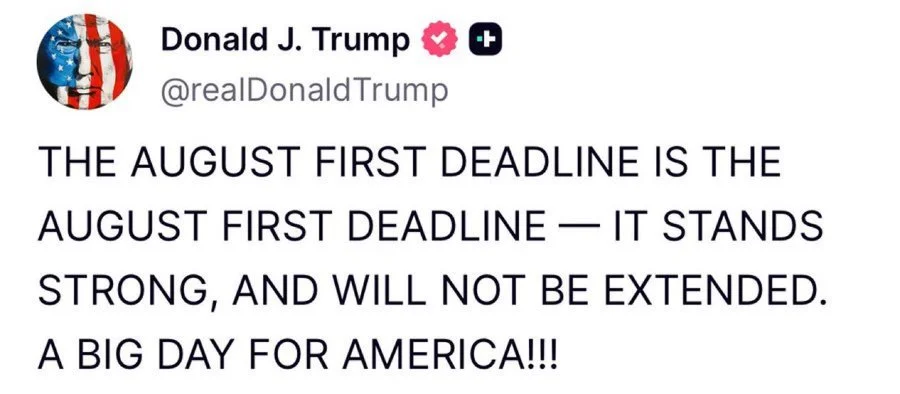
Majeed: RV before the deadline, August 1
Seeds of Wisdom RV and Economic Updates Thursday Morning 7-31-25
Good morning Dinar Recaps,
Transatlantic Turbulence: Trump-EU Turnberry Agreement Reshapes Global Trade Balance
The United States and European Union have entered a historic — and highly controversial — trade pact that risks redefining global economic alignments. The Turnberry Agreement, signed on July 28, imposes sweeping tariffs on European exports while locking in a massive $750 billion fossil fuel purchase commitment from the EU. Beneath the diplomatic optics, the deal signals a deep strategic realignment with potentially lasting consequences for global trade, energy security, and industrial policy.
Good Morning Dinar Recaps,
Transatlantic Turbulence: Trump-EU Turnberry Agreement Reshapes Global Trade Balance
The United States and European Union have entered a historic — and highly controversial — trade pact that risks redefining global economic alignments. The Turnberry Agreement, signed on July 28, imposes sweeping tariffs on European exports while locking in a massive $750 billion fossil fuel purchase commitment from the EU. Beneath the diplomatic optics, the deal signals a deep strategic realignment with potentially lasting consequences for global trade, energy security, and industrial policy.
Key Sectors Targeted by New U.S. Tariffs
The agreement, driven by President Donald Trump’s renewed protectionist agenda, slaps a 15% tariff on a broad range of high-value European exports to the United States. This follows an earlier 27.5% hike on select categories in April, disproportionately impacting European economies such as Germany and France.
Strategic sectors affected include:
Automobiles – German automakers face steep tariff headwinds.
Luxury goods – French brands like LVMH and Kering are considering U.S.-based production pivots to mitigate exposure.
Pharmaceuticals – Tariff exemptions for medicines are ending, threatening a sector that accounts for 22.5% of EU exports.
Cosmetics and wines – These industries face new uncertainty, with over €8 billion in annual trade now exposed to higher costs.
Europe’s $750 Billion Energy Commitment: Strategic Dependence or Economic Leverage?
In exchange, the EU has committed to purchasing $750 billion in U.S. fossil fuels, particularly shale gas — a move that critics say deepens Europe’s strategic energy dependence and contradicts stated climate neutrality goals.
The European Commission’s ability to enforce this commitment remains questionable, especially amid diverging member state priorities. Nevertheless, the symbolic and financial weight of the deal indicates a forced alignment with U.S. geopolitical and economic interests.
Industrial Reorientation, Climate Contradictions, and Strategic Fallout
The agreement is expected to trigger major industrial reorientations across the EU, with companies considering relocation to the U.S. to maintain market access. This not only undermines Europe’s industrial sovereignty but also threatens its climate commitments, as increased fossil fuel imports conflict with the European Green Deal.
A Global Economy Rebalanced on Unequal Terms
The Turnberry Agreement underscores a new era of asymmetric trade negotiations, where traditional Western alliances are subordinated to America First–driven policies. Europe’s attempt to avoid confrontation with the U.S. may instead result in economic subjugation, as critics argue the deal surrenders too much leverage without meaningful reciprocity.
As tariff walls rise and energy dependencies deepen, the global trade system appears increasingly fractured — reinforcing the move toward a multipolar economic order where geopolitics, energy, and trade policy are no longer separable.
@ Newshounds News™
Source: Cointribune
~~~~~~~~~
BRICS Accelerates Intra-Bloc Trade: India and Brazil Set $60B Target Amid U.S. Backlash
BRICS member states India and Brazil have jointly committed to tripling their bilateral trade flows, signaling a bold escalation of intra-BRICS economic cooperation amid rising geopolitical tensions. The move comes as U.S. President Donald Trump continues to threaten tariffs against BRICS-aligned nations that pursue “anti-American” economic strategies.
Strategic Trade Expansion Between India and Brazil
India’s Prime Minister Narendra Modi and Brazil’s President Luiz Inácio Lula da Silva signed a series of agreements this month aimed at boosting food security, energy transition, and industrial collaboration. The deals cover a broad range of sectors including cotton, chicken, and essential food commodities, as both countries seek to reduce reliance on external powers and foster deeper South-South cooperation.
Lula stated unequivocally:
“Our $12 billion trade flow is not up to par with our economies. We are determined to accelerate this goal, tripling this amount in the short term.”
India’s Modi echoed this, asserting that a $60 billion trade target within five years is “not difficult to achieve,” given the growth potential and mutual economic alignment between the two emerging markets.
A Response to U.S. Pressure on BRICS Nations
The timing of the India-Brazil trade acceleration is significant. It follows recent threats from the Trump administration, which has warned of retaliatory tariffs on BRICS countries that pursue policies counter to U.S. interests. Trump’s comments have drawn rebukes from multiple BRICS leaders, including Lula, who criticized the U.S. president’s approach:
“I don’t think it’s very responsible and serious for a president of a country the size of the U.S. to threaten the world over the internet… We don’t want an emperor.”
This political backdrop underscores how BRICS trade initiatives are increasingly intertwined with broader multipolar realignment efforts, as member states seek autonomy from Western financial and trade systems.
Toward a $60 Billion Trade Corridor
Negotiations for the expanded trade framework are expected to begin in Q1 2026, with both nations committing to fast-track the process. Analysts view this as part of a wider BRICS strategy to establish strong internal trade corridors, increase resilience against sanctions, and enhance strategic food and energy security within the bloc.
As U.S. pressure mounts, BRICS’ internal partnerships — such as the India-Brazil trade pact — are becoming the foundation of a multipolar economic architecture, designed to shift global power away from the traditional transatlantic axis.
@ Newshounds News™
Source: Watcher Guru
~~~~~~~~~
Seeds of Wisdom Team RV Currency Facts Youtube and Rumble
Newshound's News Telegram Room Link
Follow the Roadmap
Follow the Timeline
Seeds of Wisdom Team™ Website
Thank you Dinar Recaps
Iraq Economic News and Points To Ponder Wednesday Afternoon 7-30-25
The National Bank Of Iraq Signs A Strategic Agreement With The Ministry Of Finance To Activate The Sovereign Guarantees Program.
Banks Economy News – Baghdad The National Bank of Iraq signed a strategic cooperation agreement with the Ministry of Finance aimed at activating the sovereign guarantees program. This qualitative step reflects the Iraqi government's commitment to empowering the banking sector, enhancing its role in supporting the national economy, and stimulating investment in priority projects.
The National Bank Of Iraq Signs A Strategic Agreement With The Ministry Of Finance To Activate The Sovereign Guarantees Program.
Banks Economy News – Baghdad The National Bank of Iraq signed a strategic cooperation agreement with the Ministry of Finance aimed at activating the sovereign guarantees program. This qualitative step reflects the Iraqi government's commitment to empowering the banking sector, enhancing its role in supporting the national economy, and stimulating investment in priority projects.
This agreement aims to enable Iraqi banks to contribute to providing long-term credit facilities for national projects, through guarantees provided (in part) by the Iraqi government to foreign international financing institutions. This will help reduce financing risks and encourage the private sector and local and international investors to enter the Iraqi market with greater confidence.
Under the agreement, the National Bank of Iraq will play a pivotal role in facilitating financial relations for projects and assisting in obtaining financing through international financial institutions, in line with its strategic position and active role in supporting productive sectors, particularly industries that receive direct attention from the Iraqi government.
This agreement comes as part of the government's efforts to strengthen public-private partnerships and enable local banks to play a greater role in supporting the national economy, particularly in vital sectors such as industry, energy, and housing.
This agreement represents a pivotal milestone in the bank's journey and embodies its commitment to providing innovative and secure financing solutions that support economic development efforts in Iraq.
This partnership with the Ministry of Finance will open new horizons for the banking sector and enable the National Bank of Iraq to contribute more effectively to financing vital projects Iraq needs.
This step is in line with the Iraqi government's financial and administrative reform plan, which aims to diversify sources of income, boost non-oil revenues, and enable the banking sector to play a greater role in supporting sustainable development and achieving the national economic vision.
The National Bank of Iraq affirms its commitment to continuing to work with relevant government agencies to implement innovative financing programs that contribute to enabling major national projects, particularly in the fields of industry, energy, and infrastructure.
The bank also seeks to expand its regional and international partnerships to provide financing tools that align with development requirements and support the government's efforts to achieve comprehensive and sustainable economic stability. 342 views https://economy-news.net/content.php?id=58100
Currency Market: New Rise In Dollar Prices In The Local Market
Buratha News Agency1702025-07-30 The dollar exchange rate against the dinar resumed its rise after the closure of the two main stock exchanges in Al-Kifah and Al-Harithiya. The selling price reached 140,500 dinars for $100, while the buying price reached 138,500 dinars for $100. https://burathanews.com/arabic/economic/463476
Oil Prices Rise, Brent Exceeds $72 A Barrel
Energy Oil prices rose slightly on Wednesday, as investors focused on developments in US President Donald Trump's deadline to end the war in Ukraine and his threat to impose tariffs on countries that trade in Russian oil.
Brent crude futures, the most active, rose 40 cents, or about 0.6%, to $72.09 a barrel.
US West Texas Intermediate crude rose 76 cents to $69.97 a barrel, as investors shrugged off mixed US data on oil and fuel inventories. September Brent futures rise ahead of trading close.
September Brent crude, which expires Wednesday, rose 37 cents to $72.88.
Both contracts had fallen about 1% earlier in the session.
Trump said on Tuesday that he would begin imposing measures on Russia, including secondary tariffs of 100% on its trading partners, if it did not make progress in ending the war within 10 to 12 days, 50 days earlier than previously scheduled.
Trump also imposed a 25% tariff on goods imported from India starting August 1, along with unspecified sanctions related to arms and oil purchases from Russia, potentially straining relations with the world's most populous democracy.
The United States also warned China, the largest buyer of Russian oil, that it could face hefty tariffs if it continues to purchase this oil. US inventory data reveals unexpected increases.
The US Energy Information Administration announced that US crude inventories rose by 7.7 million barrels, compared to analysts' expectations in a Reuters poll for a decrease of 1.3 million barrels.
US gasoline inventories fell by 2.7 million barrels, compared to expectations for a smaller decrease of 0.6 million barrels.
Distillate inventories, which include diesel and heating oil, rose by 3.6 million barrels, exceeding expectations for a gain of only 0.3 million barrels, according to the EIA data. 56 views 2025/07/30 - https://economy-news.net/content.php?id=58141
Gold Prices Fell More Than 1 Percent After The US Interest Rates Were Held Steady.
Wednesday, July 30, 2025, 11:57 PM | Economic Number of readings: 87 Baghdad/ NINA / Gold prices fell, at settlement on Wednesday, by more than one percent, after the Federal Reserve (the US central bank) kept interest rates unchanged and refrained from providing indications about the timing of a cut, while strong US economic data weakened the appeal of the yellow metal.
Spot gold fell 1.5 percent to $3,275.92 per ounce.
US gold futures also lost 0.8 percent, recording $3,352.8.
As for other precious metals, silver fell in spot transactions by 3.2 percent to $36.97 per ounce, falling to its lowest level in three weeks, while platinum fell by 6.6 percent to $1,303.19, its lowest level since June 24, and palladium fell by 4.9 percent to $1,196.75. https://ninanews.com/Website/News/Details?key=1243853
For current and reliable Iraqi news please visit: https://www.bondladyscorner.com
Gargantuan Bubbles Everywhere you Look, 50%+ Crash to Wipe out Market
Gargantuan Bubbles Everywhere you Look, 50%+ Crash to Wipe out Market
VRIC Media: 7-30-2025
In a recent illuminating panel discussion hosted by VRIC Media, financial titans Todd Horwitz of Bubba Trading and Michael Pento of Pento Portfolio Strategies delivered a stark warning about the state of the US and global economy.
Their message was clear: despite record-high market indicators, an underlying fragility points to significant systemic risks, with dire implications for investors.
Gargantuan Bubbles Everywhere you Look, 50%+ Crash to Wipe out Market
VRIC Media: 7-30-2025
In a recent illuminating panel discussion hosted by VRIC Media, financial titans Todd Horwitz of Bubba Trading and Michael Pento of Pento Portfolio Strategies delivered a stark warning about the state of the US and global economy.
Their message was clear: despite record-high market indicators, an underlying fragility points to significant systemic risks, with dire implications for investors.
Horwitz and Pento expressed profound concern over what they identify as unsustainable bubbles inflating across equities, real estate, and credit markets.
While mainstream headlines trumpet new market highs, the experts highlighted disturbing indicators like persistently low trading volumes and valuations reaching historic extremes, including all-time high Shiller PE ratios and negative risk premiums.
These signs, they cautioned, bear an uneasy resemblance to the precursors of previous market crashes, painting a picture of an underlying fragility masked by seemingly robust figures. They foresee an eventual recession and credit crisis as the inevitable consequence of these market distortions.
Amidst this unsettling landscape, the panelists discussed a potential strategic pivot from overvalued tech stocks towards hard assets. Both experts emphatically favor precious metals – particularly gold and platinum – as essential safe havens.
They foresee these assets not only outperforming the broader market but also serving as crucial hedges against rising inflation, especially with anticipated, and in their view, aggressively dangerous, Federal Reserve interest rate cuts. Such cuts in an already inflationary environment, they argued, would likely ignite even higher inflation, further fueling precious metals rallies.
The discussion also cast a critical eye on the Federal Reserve’s role. Horwitz and Pento voiced strong calls for auditing the Fed to enhance transparency and accountability, criticizing its artificial control over interest rates, which they believe distorts free market dynamics. They advocated for a return to a true, free-market interest rate system, possibly linked to gold supply, arguing it would be a vital safeguard against reckless monetary expansion and inflationary pressures.
Shifting to broader economic and geopolitical factors, the experts expressed skepticism regarding the effectiveness of current tariff policies. They viewed such threats as more political posturing than realistic economic strategy, especially given global wage disparities and their limited ability to genuinely revive US manufacturing.
The conversation also touched upon the potential of other commodities like uranium and energy, highlighting nuclear power’s pivotal role in achieving energy independence and environmental sustainability.
In their comprehensive and cautionary concluding remarks, Horwitz and Pento urged investors to exercise extreme prudence. Their core advice centered on the importance of physical ownership of precious metals – particularly gold and platinum – as a vital protective measure against the systemic risks they perceive.
The Federal Reserve’s future policies remain a central wildcard, with calls for greater transparency and a return to market-based interest rates seen as crucial for restoring genuine economic stability.
As market highs mask underlying fragility and geopolitical tensions add complexity, the panel’s overarching message was clear: vigilance, diversification, and a deep understanding of macroeconomic imbalances are paramount for navigating the challenging economic landscape ahead.
Seeds of Wisdom RV and Economic Updates Wednesday Afternoon 7-30-25
Good Afternoon Dinar Recaps,
Crypto Policy Crossroads: Senate Pushes Digital Asset Frameworks for Markets and Mortgages
Digital regulation gains momentum as lawmakers weigh oversight frameworks and new use cases
Senate Committee Unveils Digital Asset Regulation Framework
In a pivotal move for U.S. digital asset oversight, the Senate Banking, Housing, and Urban Affairs Committee has released a Discussion Draft aimed at formally regulating the crypto ecosystem. The proposal introduces foundational definitions, seeks jurisdictional clarity between federal agencies, and proposes comprehensive guardrails for stablecoins and digital asset intermediaries
Good Afternoon Dinar Recaps,
Crypto Policy Crossroads: Senate Pushes Digital Asset Frameworks for Markets and Mortgages
Digital regulation gains momentum as lawmakers weigh oversight frameworks and new use cases
Senate Committee Unveils Digital Asset Regulation Framework
In a pivotal move for U.S. digital asset oversight, the Senate Banking, Housing, and Urban Affairs Committee has released a Discussion Draft aimed at formally regulating the crypto ecosystem. The proposal introduces foundational definitions, seeks jurisdictional clarity between federal agencies, and proposes comprehensive guardrails for stablecoins and digital asset intermediaries.
This marks a shift from fragmented enforcement to a structured legislative path, with implications for how exchanges, custodians, and token issuers will operate in the years ahead.
Key Elements of the Draft Legislation
Defined Classifications of Digital Assets:
The bill distinguishes between payment stablecoins, digital commodities, and securities, creating tailored compliance expectations for each.Clarifying SEC vs. CFTC Authority:
Digital commodities would fall under CFTC jurisdiction, while the SEC would retain authority over assets resembling investment contracts, especially those with profit expectations tied to a third party’s efforts.Stablecoin Oversight and Reserve Requirements:
Issuers would face federal registration and strict prudential standards, including full reserves in eligible assets, regular audits, and anti-money laundering (AML) protocols—drawing parallels with the Lummis-Gillibrand Payment Stablecoin Act.Consumer Disclosures:
Retail-facing platforms would be required to deliver a standardized “digital asset disclosure form,” mirroring mutual fund prospectuses to inform users about risks, fees, and legal standing.Custody and Commingling Protections:
Intermediaries would be barred from mixing customer funds with corporate assets, with enhanced custody and recordkeeping practices designed to avoid failures akin to FTX.
Reactions and Outlook
The industry has responded with cautious optimism, welcoming the move toward regulatory clarity. However, concerns remain over the breadth of federal reach, especially as it pertains to software developers and decentralized protocols.
Regulatory agencies are divided. While the CFTC supports expanded authority over digital commodity markets, the SEC continues to assert a broad view of its existing jurisdiction.
Although still in discussion phase, the draft opens the door for bipartisan negotiations, and could intersect with parallel bills such as the GENIUS Act and the CLARITY Act, both of which aim to modernize digital asset laws.
Crypto Assets in Homeownership? Lummis Targets Mortgages Next
In a surprising intersection of crypto and housing finance, Senator Cynthia Lummis (R-WY) has introduced the 21st Century Mortgage Act, a bill that would allow cryptocurrencies to be considered as assets during mortgage evaluations.
The legislation would codify a June 2025 directive from the Federal Housing Finance Agency (FHFA), which instructs government-backed mortgage purchasers like Fannie Mae and Freddie Mac to explore incorporating digital assets in loan risk assessments.
“This legislation embraces an innovative path to wealth-building, keeping in mind the growing number of young Americans who possess digital assets,” said Senator Lummis.
A Generational Wealth Tool – Or a Risk Factor?
The proposal comes amid generational shifts in asset ownership. According to U.S. Census data, homeownership among Americans under 35 sits at just 36% as of Q1 2025—well below historical averages.
The bill would allow crypto-holding borrowers to leverage their digital wealth without converting to fiat, offering a new route to homeownership. However, Senate Democrats have raised concerns, citing crypto's volatility and liquidity risks that may complicate borrower stability.
In a July 24 letter, several lawmakers urged FHFA Director William Pulte to fully examine the systemic implications of such a move.
Momentum Builds Across Chambers
The 21st Century Mortgage Act is one of several crypto bills expected to be discussed after the Senate’s August recess. Others include:
A market structure bill that defines how crypto assets are traded and regulated.
A House-passed bill barring the Federal Reserve from launching a central bank digital currency (CBDC).
A House companion bill, the American Homeowner Crypto Modernization Act, introduced by Rep. Nancy Mace (R-SC), which also mandates that mortgage lenders consider digital asset balances held on registered exchanges.
Globally, similar initiatives are taking shape. Australia-based Block Earner recently announced Bitcoin-backed mortgage offerings, following a court ruling that its crypto lending services did not qualify as financial products under Australian law.
Conclusion: Crypto Enters the Regulatory and Housing Mainstream
From stablecoin regulation to mortgage underwriting, digital assets are entering formal policy discussions across U.S. institutions. The Senate’s regulatory proposals reflect a maturing market landscape—one that increasingly demands legal clarity, consumer protection, and financial integration.
While significant hurdles remain, these legislative developments suggest that digital assets are no longer peripheral. They are becoming part of the financial system’s foundation—not just as speculative investments, but as tools for access, collateralization, and wealth-building.
@ Newshounds News™
Sources:
~~~~~~~~~
White House Readies Crypto ‘Regulatory Bible’ Amid Push for Strategic Bitcoin Reserve
New report expected to define U.S. digital asset rules for years to come
The White House is preparing to release a sweeping report this week that industry leaders have dubbed a “regulatory Bible”—a document expected to shape U.S. crypto policy and rulemaking for the foreseeable future.
The report stems from a January 2025 executive order by President Donald Trump establishing the President’s Working Group on Digital Asset Markets, tasked with delivering a detailed roadmap on how federal agencies should approach the evolving digital asset economy. The working group includes Treasury Secretary Scott Bessent, Commerce Secretary Howard Lutnick, and SEC Chair Paul Atkins, among others.
While the contents of the report have not been officially released, early insights suggest it will influence every major regulatory decision over the next three and a half years.
“This will dictate every rulemaking or guidance document that comes out,” said Cody Carbone, CEO of The Digital Chamber, in an interview with The Block. “I do think it is a big deal.”
Legislative Context: A Convergence of Bills and Executive Strategy
The timing of the report coincides with a flurry of congressional activity. In mid-July, the House passed both a stablecoin oversight bill and broader digital asset market regulation, sending them to the president’s desk or over to the Senate for reconciliation.
Senate Republicans have targeted September 30 as a date to vote on a companion digital asset bill. The White House report is expected to fill critical regulatory gaps, guiding both federal agencies and lawmakers as they refine legislative proposals like the GENIUS Act, the CLARITY Act, and emerging digital payment infrastructure bills.
Carbone noted that the report may also revisit or repeal prior agency guidance, helping to standardize how platforms, issuers, and consumers engage with digital assets.
Bitcoin Reserve Still Uncertain, But a Priority
One of the more ambitious proposals under discussion is the creation of a U.S. strategic bitcoin reserve—a concept floated by President Trump in a March 2025 executive order. That order tasked key administration officials with exploring budget-neutral strategies to acquire and manage a digital asset stockpile, including bitcoin, without adding cost to taxpayers.
However, sources indicate the upcoming report does not yet include language on the bitcoin reserve, although that could change prior to publication.
“Nothing is set in stone,” Carbone said. “But I’m hoping the report will shed light on how the administration plans to acquire bitcoin and what a stockpile would include.”
Industry Expectations: Tax Policy and Tokenized Securities in Focus
Alongside regulatory clarity, tax treatment of digital assets ranks among the industry’s top priorities.
The Digital Chamber submitted a letter to Bo Hines, Executive Director of the Presidential Council of Advisers for Digital Assets, emphasizing key industry needs:
Clear and consistent tax guidelines for digital asset transactions and holdings.
A legal framework for tokenized securities and digital commodities.
Harmonized federal oversight across agencies, avoiding duplicative compliance burdens.
“Tax clarity is number one,” Carbone said. “That needs to be one of the foundational portions of this report and where Washington leans in.”
A Pivotal Moment for U.S. Crypto Policy
Industry leaders are treating the forthcoming release as a watershed moment in U.S. digital asset policy.
“We look forward to the release tomorrow... a significant milestone following this year’s executive order on digital assets,” said Summer Mersinger, CEO of the Blockchain Association.
“While most of the actions have been agency or Congress driven, the White House’s prioritization of crypto has been evident,” added Ron Hammond, head of policy and advocacy at Wintermute.
A briefing is scheduled for 2:30 p.m. Wednesday, involving both government officials and select industry stakeholders. It remains unclear whether the full report will be released before or after the session.
If fully realized, the report could define a national crypto strategy—from regulatory harmonization to strategic asset acquisition, tax reform, and digital infrastructure development. As the federal government accelerates its crypto policymaking, the industry is now positioned at a critical juncture between legitimacy and liability, growth and governance.
@ Newshounds News™
Source: The Block
~~~~~~~~~
BlackRock Endorses Stablecoins as Key to Strengthening U.S. Dollar Dominance
GENIUS Act Seen as Dual Catalyst for U.S. Treasury Demand and Global Dollar Supremacy
BlackRock, the world’s largest asset manager with over $12.5 trillion in AUM, has added its voice to a growing chorus of analysts and policymakers suggesting that stablecoins could significantly enhance the U.S. dollar’s dominance in a rapidly digitizing global economy.
In a recent weekly commentary, BlackRock strategists praised the newly established U.S. stablecoin regulatory framework as a "step in the right direction" for the dollar. Their position reinforces the narrative that tokenized versions of the U.S. dollar, under proper regulation, could extend the reach of America’s fiat currency into new international use cases—including on-chain institutional settlement.
“Tokenized forms of the U.S. dollar will bolster its dominance, especially as institutional transactions move on-chain,” BlackRock noted.
“Stablecoins are part of the future of finance.”
GENIUS Act Ushers in First-Ever Federal Crypto Framework
The commentary follows passage of the GENIUS Stablecoin Act, the first federal crypto bill to be signed into law in the United States. The bipartisan legislation provides a regulatory blueprint for stablecoin issuers and outlines strict reserve requirements intended to strengthen market confidence and tie stablecoins directly to U.S. financial infrastructure.
BlackRock analysts highlighted that the law’s mandate for stablecoin issuers to hold reserves in U.S. Treasuries, money market funds, and repurchase agreements will generate a dual benefit:
Boost demand for short-term U.S. debt instruments, and
Enhance the credibility and attractiveness of stablecoins in both domestic and international markets.
From Under $50B to $273B: Stablecoins Enter Institutional Era
The stablecoin market has expanded from under $50 billion in 2021 to $273 billion as of July 2025, with rapid institutional integration now underway. The two largest stablecoin issuers—Tether and Circle—currently hold a combined $120 billion in U.S. Treasury bills, already representing 2% of the $6 trillion Treasury market.
As stablecoins gain traction across emerging markets, cross-border payments, and decentralized finance, BlackRock expects their share of Treasury demand to grow significantly, potentially reshaping liquidity flows in short-term government securities.
Dollar’s Digital Edge: First-Mover Advantage in Global Payments
While the U.S. dollar already dominates global trade, the rise of Bitcoin and other non-sovereign digital assets poses new challenges to fiat relevance. Stablecoins, especially those pegged to the U.S. dollar, offer a strategic counterbalance—allowing the greenback to maintain its primacy within blockchain-based financial systems.
“Stablecoins expose the dollar to entirely new digital use cases,” BlackRock stated, especially in jurisdictions where local currencies are unstable or access to U.S. dollars is restricted.
However, the firm cautioned that a prohibition on interest-bearing stablecoins—included in the GENIUS Act—could limit their appeal in certain major markets, particularly those where competitive yield is essential for adoption.
Bitcoin's Parallel Role: Risk, Return, and Digital Hedging
In the same analysis, BlackRock acknowledged that Bitcoin will also play a crucial role in the digital financial future—but as a risk asset rather than a stable store of value. While the firm has promoted BTC through its iShares Bitcoin Trust (IBTC) and other financial instruments, BlackRock continues to position Bitcoin as complementary to stablecoins, not a replacement for fiat.
The firm’s growing footprint in both tokenized assets and digital infrastructure aligns with its broader push to modernize capital markets through blockchain rails, tokenized securities, and programmable money.
Conclusion: GENIUS Act as a Catalyst for U.S. Financial Dominance
BlackRock’s analysis underscores a broader reality taking shape: stablecoins, when regulated effectively, are not threats to sovereign money—but vehicles for extending its reach. The GENIUS Act represents not only a breakthrough in digital asset policy, but also a strategic maneuver in currency diplomacy, ensuring the U.S. dollar remains embedded in the next generation of global finance.
As demand for digitally native, regulated, dollar-backed assets rises, the GENIUS framework—and the market it enables—could redefine the contours of both monetary power and international trade.
@ Newshounds News™
Source: The Crypto Basic
~~~~~~~~~
Seeds of Wisdom Team RV Currency Facts Youtube and Rumble
Newshound's News Telegram Room Link
Follow the Roadmap
Follow the Timeline
Seeds of Wisdom Team™ Website
Thank you Dinar Recaps
The $1 Quadrillion Time Bomb, Dollar Endgame, and Post-Collapse Hope
The $1 Quadrillion Time Bomb, Dollar Endgame, and Post-Collapse Hope
Liberty and Finance: 7-29-2025
In a recent interview with Liberty and Finance, financial analyst Phil Low explains that the derivatives complex, a financial instrument worth over a quadrillion dollars, sits atop the global financial system as the peak of Exter’s inverted pyramid.
This complex, often hidden from public view and off the books of financial institutions, represents a staggering amount of off-balance-sheet financial bets that threaten to bring down the entire system if they begin to unravel.
The $1 Quadrillion Time Bomb, Dollar Endgame, and Post-Collapse Hope
Liberty and Finance: 7-29-2025
In a recent interview with Liberty and Finance, financial analyst Phil Low explains that the derivatives complex, a financial instrument worth over a quadrillion dollars, sits atop the global financial system as the peak of Exter’s inverted pyramid.
This complex, often hidden from public view and off the books of financial institutions, represents a staggering amount of off-balance-sheet financial bets that threaten to bring down the entire system if they begin to unravel.
Derivatives, such as options, futures, and swaps, are financial instruments that derive their value from an underlying asset or security, such as stocks, bonds, or commodities.
While these instruments can be used to hedge risk and manage exposure, their complexity and the potential for misuse have led to concerns about their impact on the stability of the global financial system.
The derivatives market’s rapid growth is not a failure of capitalism, as some might argue, but rather a distortion caused by central banks enabling infinite credit expansion without market discipline. Central banks, particularly the U.S. Federal Reserve, have pursued policies of ultra-low interest rates and quantitative easing, which have fueled asset bubbles and encouraged excessive risk-taking by financial institutions. This has led to a massive buildup of leverage and speculative bets in the derivatives market.
If the derivatives market were to begin unraveling, through margin calls or a refusal to extend credit, it could instantly freeze the financial system. In such a scenario, the Federal Reserve would be forced to print trillions of dollars overnight just to keep the system afloat. This has led some to question the sustainability of the current system, which relies on constant intervention by central banks to prevent collapse.
In a true free market, institutions would bear the consequences of their risk-taking, but under the current system, the losses are socialized while the profits remain private.
Unless we restore sound money and allow markets to self-correct, this vast structure of speculative leverage teeters ever closer to collapse.
To prevent a potential catastrophe, it is crucial to address the root causes of the problem, including excessive leverage, moral hazard, and the distorting effects of central bank policies. This may require a fundamental rethinking of the role of central banks in the global economy and a return to sound money principles that prioritize market discipline and stability over short-term gains.
In conclusion, the derivatives complex represents a quadrillion-dollar time bomb that threatens to bring down the global financial system.
To prevent a potential collapse, we must address the underlying causes of the problem and restore sound money principles that prioritize market discipline and stability over short-term gains. Watch the full video from Liberty and Finance for further insights and information on this critical issue.
Seeds of Wisdom RV and Economic Updates Wednesday Morning 7-30-25
Good Morning Dinar Recaps,
How BRICS Is Reshaping the Emerging Multipolar World
From Expansion to Internal Division: The Global South’s Strategic Realignment Faces Tests
The BRICS alliance is no longer a concept in transition—it is an evolving geopolitical force shaping the emerging multipolar world in real time. At the July 6–7 summit in Rio de Janeiro, BRICS officially expanded to 11 full members, strengthening its claim as the largest Global South alliance and advancing its ambition to create an alternative to Western-dominated global institutions.
Good Morning Dinar Recaps,
How BRICS Is Reshaping the Emerging Multipolar World
From Expansion to Internal Division: The Global South’s Strategic Realignment Faces Tests
The BRICS alliance is no longer a concept in transition—it is an evolving geopolitical force shaping the emerging multipolar world in real time. At the July 6–7 summit in Rio de Janeiro, BRICS officially expanded to 11 full members, strengthening its claim as the largest Global South alliance and advancing its ambition to create an alternative to Western-dominated global institutions.
With this expansion, BRICS now represents a powerful cross-continental coalition—but its path to becoming a cohesive global counterweight remains uneven.
Expansion Without Cohesion: Cracks in the Multipolar Blueprint
While the summit concluded with the 126-point Rio Declaration, internal challenges became evident. Notably, Chinese President Xi Jinping was absent, Russian President Vladimir Putin attended virtually, and top leaders from Egypt and Iran—both new members—were also no-shows.
“Many of the 180 working groups launched under Brazil’s BRICS presidency reportedly failed to meet. They signalled a bloc expanding in size but eroding in cohesion.” — Felipe Porto, Brazilian Foreign Policy Observatory
Despite these gaps, the declaration underscored a shared commitment to multilateralism, condemning military strikes and trade coercion—though it notably stopped short of naming the United States.
Historical Continuity: BRICS and the Legacy of the Global South
The ideological foundation of BRICS can be traced to the 1955 Bandung Conference, where newly independent nations articulated the “Ten Principles of Peace” that would shape the Non-Aligned Movement. Today’s BRICS nations claim to be the heirs of that Global South vision.
“BRICS is the heir to the Non-Aligned Movement... the first organization to unify Global South nations.”
— Brazilian President Luiz Inácio Lula da Silva
However, the bloc’s composition reveals contradictions. Four BRICS members are former Soviet states, absent from the historical Global South coalition. This hybrid identity reflects both the bloc’s potential and the fault lines within its expanding membership.
Trump’s Threats: Western Pushback Against the BRICS Challenge
The most immediate response to BRICS’s global ambitions came from U.S. President Donald Trump, who issued a sharp warning following the Rio summit:
“Any country aligning themselves with the Anti-American policies of BRICS will be charged an ADDITIONAL 10% tariff. There will be no exceptions.”
This escalation demonstrates how BRICS’s growing global influence is now seen as a direct economic and geopolitical threat to the U.S.-led international order. The clash between Western hegemony and South-South cooperation is entering a more aggressive phase.
“BRICS is designed to suit autocracies... used by authoritarian powers like China and Russia to promote an alternative world order.” — Natalie Sabanadze, Chatham House
She also pointed to a “growing rift” within BRICS—between the China-Russia axis and other members over the bloc’s strategic direction.
Can Southeast Asia Redefine BRICS’s Future?
The future trajectory of BRICS may hinge on its democratic members, particularly the four ASEAN nations that joined: Indonesia, Malaysia, Thailand, and Vietnam. These nations could play a pivotal role in shaping a less autocratic, more development-oriented alliance.
“As Southeast Asian countries deepen their engagement, the choices they make will help determine whether BRICS can evolve into a credible counterweight to Western dominance or falter under the weight of its own diversity.”
— M.A. Hossain, geopolitical analyst
This emerging multipolar world now features a bloc that reflects both the opportunity of expanded multilateralism and the challenge of maintaining cohesion across diverse political systems and interests.
Conclusion: BRICS at a Crossroads
The Rio summit proved that BRICS is growing in reach but not yet in unity. Its ambition to serve as the institutional core of a multipolar world faces major tests—from internal fragmentation to external confrontation. Yet, the bloc continues to assert itself as a strategic platform for Global South nations seeking more equitable global governance.
The coming months—especially with tariff threats from the U.S., growing digital currency initiatives, and regional realignments—will determine whether BRICS can transition from symbolic opposition to operational alternative.
@ Newshounds News™
Source: Watcher.Guru
~~~~~~~~~
Seeds of Wisdom Team RV Currency Facts Youtube and Rumble
Newshound's News Telegram Room Link
Follow the Roadmap
Follow the Timeline
Seeds of Wisdom Team™ Website
Thank you Dinar Recaps
Iraq Economic News and Points To Ponder Tuesday Evening 7-29-25
Sudani Advisor: Iraq Is Making International Progress And Reducing Pressure On The Dollar.
July 29, 2025 Baghdad/Iraq Observer The Prime Minister's financial advisor, Mazhar Mohammed Saleh, confirmed on Tuesday that the expansion of electronic transactions has contributed to reducing speculation and unreal demand for the dollar, which has lowered its price on the parallel market. He also indicated that reliance on digital payment tools has led to a decline in the volume of cash dollar trading.
Sudani Advisor: Iraq Is Making International Progress And Reducing Pressure On The Dollar.
July 29, 2025 Baghdad/Iraq Observer The Prime Minister's financial advisor, Mazhar Mohammed Saleh, confirmed on Tuesday that the expansion of electronic transactions has contributed to reducing speculation and unreal demand for the dollar, which has lowered its price on the parallel market. He also indicated that reliance on digital payment tools has led to a decline in the volume of cash dollar trading.
“The expansion of the use of bank cards and electronic transactions has contributed to reducing the margin of speculation and the unreal demand for the dollar, especially after linking transfers and trade finance operations to digital data and pre-verification of documents, such as the advance customs declaration,”
Saleh said in a press statement monitored by the Iraq Observer. He explained that “citizens’ reliance on digital payment tools, both locally and during foreign travel, has led to a decline in the volume of cash circulation in dollars outside the official system.”
Saleh explained that “this has begun to have positive impacts at the international level, given Iraq’s membership in the Middle East and North Africa Financial Action Task Force (MENAFATF),
a regional organization established in 2004 that works to combat
money laundering,
terrorist financing, and the
proliferation of weapons in the region,
in line with the forty recommendations issued by the Financial Action Task Force (FATF) in Paris.”
He pointed out that "Iraq, through its digital advancements, has made tangible progress, particularly with enhanced compliance with the requirements of the Financial Action Task Force and international compliance practices.
This has positively impacted Iraq's current stable credit ratings and opened up broader horizons for better engagement with global correspondent banks, as we can see from the decline in the dollar exchange rate against the official rate in the parallel market in recent months."
He emphasized that "modern electronic technology can be leveraged in Iraq through three complementary paths, the most important of which, based on the government's program, is the digital transformation of public finances and economic governance, which includes several directions, including:
automating taxes and customs to maximize non-oil revenues,
digitizing government contracts, and
distributing support to eligible groups, in addition to
enhancing transparency and
combating corruption through the presence of a digital fingerprint for every transaction ."
Regarding innovation and small business technology, Saleh noted that "digital technology development paths are taking on more modern dimensions, most notably supporting digital entrepreneurship, such as
e-commerce,
delivery apps,
distance learning, and others.
This also includes funding startups in the fields of
artificial intelligence,
smart agriculture, and
solar energy, in addition to
building digital platforms for vocational training and market access." He added,
"There is a trend toward a transition to a data and knowledge economy in close conjunction,
through the establishment of national data centers,
the use of artificial intelligence in planning,
and the enhancement of internet infrastructure and the achievement of equitable access to it in accordance with global standards for digital justice, while emphasizing the importance of supporting the higher education sector towards digital and technical specializations."
He pointed out that "these trends will undoubtedly contribute to
creating sustainable jobs,
reducing operating costs, and increasing the productivity of the national economy in a promising digital era for Iraq." https://observeriraq.net/مستشار-للسوداني-العراق-يحقق-تقدماً-دو/
Gold Continues To Soar... Where Will It Reach In 2026?
Stock Exchange Analysts expect gold prices to remain above $3,000 per ounce in the coming period, supported by increased demand for safe-haven assets amid rising concerns related to global trade and worsening sovereign debt levels.
A Reuters poll of 40 analysts and traders showed that the median forecast for the gold price in 2025 is $3,220 per ounce, compared to $3,065 in the April poll, while the estimate for 2026 rose to $3,400 from $3,000 previously.
Spot gold prices have risen 27% since the beginning of this year, reaching a record high of $3,500 per ounce in April, amid escalating trade tensions between the United States and China, which prompted investors to seek safe havens.
David Russell, marketing director at Goldcore, said: “The first half of 2025 has confirmed what we have long believed; Gold is not just a hedge, it's a market signal," he said, predicting that the price could reach $4,000 by the end of 2026 if concerns about the US financial situation worsen.
Gold's appeal as a safe haven has been heightened by uncertainty over the deadlines for major US trade agreements, as well as financial concerns sparked by US President Donald Trump's passage of a massive bill dubbed the "Big, Beautiful Act," which independent analysts expect will add $3.3 trillion to the US national debt.
However, gold has failed to recapture its April peak, with Julius Baer analyst Carsten Menke saying the "short-term sideways movement is likely to continue in the absence of an immediate catalyst to push prices higher."
Most analysts believe that central banks remain the main driver of gold's rise, as part of their long-term efforts to diversify their reserves away from the dollar's dominance. China has continued to boost its gold reserves for the eighth consecutive month, while a European Central Bank survey showed that nearly 40% of central banks consider geopolitical risks a key reason for holding gold.
"The multipolar world continues, and with it, central banks' desire to reduce their reliance on the US dollar as a reserve currency and, in extreme cases, reduce their exposure to US sanctions," Minke said.
Silver prices have jumped 32% since the beginning of 2025, outperforming gold and approaching the $40 per ounce barrier for the first time in 14 years.
Analysts revised their 2025 silver price forecast to $34.52 per ounce, up from $33.10 in the previous survey, supported by concerns about US tariff policies, signs of tight supply in the spot market, and increased investor appetite for silver as an alternative to gold.
For 2026, the median forecast rose to $38 per ounce from $34.58 previously.
Suki Cooper, an analyst at Standard Chartered, said that most of these gains were the result of strong inflows into exchange-traded products, warning that a slowdown in this momentum could leave silver vulnerable to a decline despite expectations of a new market deficit this year. https://economy-news.net/content.php?id=58029
The Dollar Exchange Rate Remains Stable In Baghdad.
Economy | 07/29/2025 Mawazine News - Baghdad - The dollar exchange rate witnessed remarkable stability against the dinar in local markets on Tuesday.
The selling price reached 140,250 dinars per $100, while the buying price reached 138,250 dinars per $100. https://www.mawazin.net/Details.aspx?jimare=264356
For current and reliable Iraqi news please visit: https://www.bondladyscorner.com
“Tidbits From TNT” Tuesday 7-29-2025
TNT:
Tishwash: Bilateral meeting with China: Iraq seeks to strengthen its relationship with its neighbors, especially Kuwait.
Prime Minister and Minister of Foreign Affairs Fuad Hussein affirmed on Monday that dialogue and negotiation are the best way to resolve regional disputes, noting Iraq's efforts to strengthen its relations with neighboring countries, particularly Kuwait.
The Ministry of Foreign Affairs said in a statement received by Dijlah News that “Deputy Prime Minister and Minister of Foreign Affairs Fuad Hussein met on Monday with the Chinese government’s Special Envoy for Middle East Affairs, Zhai Jun, on the sidelines of the conference hosted by the United Nations on the Palestinian issue, at the headquarters of the Iraqi mission to the organization in New York.”
TNT:
Tishwash: Bilateral meeting with China: Iraq seeks to strengthen its relationship with its neighbors, especially Kuwait.
Prime Minister and Minister of Foreign Affairs Fuad Hussein affirmed on Monday that dialogue and negotiation are the best way to resolve regional disputes, noting Iraq's efforts to strengthen its relations with neighboring countries, particularly Kuwait.
The Ministry of Foreign Affairs said in a statement received by Dijlah News that “Deputy Prime Minister and Minister of Foreign Affairs Fuad Hussein met on Monday with the Chinese government’s Special Envoy for Middle East Affairs, Zhai Jun, on the sidelines of the conference hosted by the United Nations on the Palestinian issue, at the headquarters of the Iraqi mission to the organization in New York.”
He added, "The meeting discussed bilateral relations between Iraq and China, and exchanged views on the situation in the region, particularly developments in the Palestinian issue and the worsening humanitarian tragedy in Gaza."
The statement added that "the minister highlighted Iraq's position on the ongoing events in Gaza," while expressing his thanks to China for "its supportive stance on Palestinian rights and its standing with the Palestinian people during the difficult circumstances they are experiencing."
He pointed out that "Fuad Hussein reviewed Iraq's vision regarding the overall situation in the region," and while stressing that "dialogue and negotiation constitute the best way to resolve regional disputes," he pointed out that "Iraq seeks to strengthen its relations with neighboring countries, especially with the sisterly State of Kuwait, in a way that ensures the building of distinguished relations based on mutual respect and common interests."
The statement quoted the Chinese envoy as saying that his country "supports Iraq's positions and balanced policies on regional issues," noting that "the two sides share identical views regarding the need to enhance regional stability and intensify joint efforts to achieve security and peace." link
************
Tishwash: Payment of dues in black oil and tightening controls at ports are the main reasons for the dollar's decline.
10 interpretations from expert Manar Al-Abidi
Economic researcher Manar Al-Obaidi reviewed 10 reasons behind the decline in the dollar exchange rate against the dinar in Iraqi markets on Monday, stressing that they have collectively created an economic environment that has contributed to strengthening the dinar's value.
He pointed out that these reasons range from direct economic factors, such as deflation and a decline in spending, to procedural and regulatory factors, such as tightening border controls and traders' shift to the formal banking system, in addition to circumstantial factors related to the elections and the increasing number of expatriates.
The exchange rate of the dollar against the Iraqi dinar has witnessed a significant decline recently. This decline is due to a combination of intertwined economic and procedural factors, which vary in their impact but have collectively contributed to strengthening the dinar.
The most prominent of these factors are:
1- Economic contraction and declining consumer confidence:
The uncertainty facing the Iraqi market due to the economic slowdown has led to a decline in individual and institutional spending confidence, negatively impacting overall demand and thus reducing the need for the dollar as a catalyst for trade.
2- Stopping government investment expenditures:
The government's focus on operating spending rather than investment has slowed economic activity. Since the general budget is the primary driver of economic activity, reducing investment spending has reduced aggregate demand, including demand for the dollar.
3- Tightening control over border crossings:
Government measures to prevent smuggling and regulate relations with the Kurdistan Region have helped curb the phenomenon of overbilling, reducing the unreal demand for dollars on the parallel market.
4- Merchants’ transition to the formal banking system:
Markets have witnessed a large segment of traders entering the formal banking system and adopting the official dollar exchange rate through approved platforms, which has reduced trading volume in the parallel market and eased pressure on the dollar.
5- Decline in re-export operations:
The decline in re-export activity to neighboring countries has reduced demand for imported goods, which has directly impacted the need for dollars to finance these trade transactions.
6- Settling the dues of major companies with petroleum products instead of cash:
The government has settled part of its debts to foreign companies in black oil and naphtha instead of cash, reducing reliance on dollars sold by the central bank and increasing their supply in the market.
7- Preparations for the electoral process:
As the election season begins, campaign spending increases. This spending is often financed from dollar reserves, which necessitates converting large amounts of these reserves into dinars to cover campaign expenses, thus increasing the supply of dollars.
8- Increase in the number of foreign visitors and arrivals:
The increasing number of immigrants to Iraq has brought significant amounts of foreign currency into the local market, providing an additional source of hard currency outside of central bank sales and contributing to increased dollar availability.
9- The cessation of illegal trade as a result of the closure of the border with Syria:
The closure of border crossings with Syria has curbed smuggling and illegal trade, which was heavily reliant on dollars on the parallel market, leading to a further decline in demand for the dollar.
10- Decrease in the issued currency and withdrawal of part of it from the market:
The Central Bank of Iraq withdrew a portion of the dinar money supply from the market, creating a double demand for the Iraqi dinar against the dollar. This balance in demand for the two currencies helped strengthen the value of the dinar and raise its exchange rate against the dollar in the parallel market. link
************
Tishwash: Iraq replaces the dollar with gold: a yellow shield against economic storms.
Economic expert Nasser Al-Kanani revealed on Monday (July 28, 2025) that Iraq's position as the Arab country with the largest gold purchases represents a strategic shift in the Central Bank's approach to enhancing the country's financial stability.
Al-Kanani told Baghdad Today, "Iraq's purchase of more than 20 tons of gold in a single year, and its rise to seventh place globally in this field, reflects a calculated move by the Central Bank to protect the national economy from fluctuations in foreign currency prices, especially the dollar."
He pointed out that "gold is considered one of the safest reserve instruments, as it is not affected by fluctuations in the monetary market, unlike paper currencies. This gives Iraq a strategic advantage in confronting sudden crises and enhances confidence in its financial policies, both domestically and internationally."
Al-Kanani explained that "this trend will positively impact the value of the Iraqi dinar in the medium term. It will also contribute to the stability of the local market and reduce reliance on the dollar, giving the Central Bank greater flexibility in managing monetary policy and achieving economic stability in light of current regional and global challenges link
Mot: Sum mor ""Marriage/Family Tips"" frum ole Mot of Course!!

Mot: And then the ""Fight"" Started!!!