
Labor Day, The First Continental Congress Meets In Philadelphia
Labor Day, The First Continental Congress Meets In Philadelphia
September 5, 2022 | by NCC Staff
On September 5, 1774, the first Continental Congress in the United States met in Philadelphia to consider its reaction to the British government’s restraints on trade and representative government after the Boston Tea Party.
The group of colonial luminaries didn’t meet in Independence Hall (which, at the time, was called the Pennsylvania State House). Instead, delegates selected by colonial legislatures met next door in Carpenters’ Hall, which had just been constructed. The State House was already occupied by the Pennsylvania provincial assembly.
Labor Day, The First Continental Congress Meets In Philadelphia
September 5, 2022 | by NCC Staff
On September 5, 1774, the first Continental Congress in the United States met in Philadelphia to consider its reaction to the British government’s restraints on trade and representative government after the Boston Tea Party.
The group of colonial luminaries didn’t meet in Independence Hall (which, at the time, was called the Pennsylvania State House). Instead, delegates selected by colonial legislatures met next door in Carpenters’ Hall, which had just been constructed. The State House was already occupied by the Pennsylvania provincial assembly.
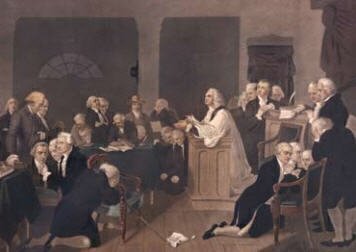
The delegates gathered on the morning of September 5 at Philadelphia’s City Tavern, near Benjamin Franklin’s home. Franklin had remained in England, and he would deliver a petition from the First Congress to King George III in late 1774. The group then walked over to Carpenters’ Hall to inspect the meeting room.
“They took a view of the room, and of the chamber where is an excellent library… The general cry was, that this was a good room, and the question was put, whether we were satisfied with this room? and it passed in the affirmative,” said John Adams.
In all, 56 delegates from 12 colonies came to Philadelphia for the meeting to address the Coercive or Intolerable Acts. The laws were meant as punishment for the activities of the Boston Tea Party, but they affected all colonies. Neither Franklin nor Thomas Jefferson attended, but in addition to Adams, the delegates included Patrick Henry, Roger Sherman, John Jay, John Dickinson, Richard Henry Lee, George Washington, and John Adams’ cousin, Samuel Adams.
Thomas Jefferson’s cousin, Peyton Randolph, was named as the first president of the Continental Congress. Randolph was another prominent Virginia leader and Washington’s close friend.
After about seven weeks of debates, the group agreed to a boycott of British goods within the colonies as a sign of protest, spelled out in the Articles of Association. In addition to the boycott, the Articles called for an end of exports to Great Britain in the following year if the Intolerable Acts weren’t repealed. The First Continental Congress also made plans to convene a second Continental Congress in May 1775 to continue the work started in Philadelphia if the Intolerable Acts remained in force.
A separate document, now called the Declaration and Resolves of the First Continental Congress, stated the group’s objections to the Intolerable Acts, listed the rights of the colonists, and itemized objections to British rule beyond the Intolerable Acts. On October 26, the delegates also crafted a formal petition to King George III. It outlined the grievances of the colonies to the King, but it also didn’t assign blame to him.
Next May, when the Second Continental Congress came back to Philadelphia, it met in the Pennsylvania State House. Violence had broken out in Boston with the battles of Lexington and Concord. Delegates from Georgia joined the Second Continental Congress, as did Franklin and John Hancock. Jefferson arrived to replace Randolph, who was called back to Virginia on political business.
The new Congress became focused on the war effort, just seven months after it had left Carpenters’ Hall hoping for a constructive response from the King and the British government.
To continue reading, please go to the original article here:
https://constitutioncenter.org/blog/the-first-congress-meets-in-philadelphia
How a Deadly Railroad Strike Led to the Labor Day Holiday
How a Deadly Railroad Strike Led to the Labor Day Holiday
By: Sarah Pruitt Updated: August 25, 2023 | Original: August 27, 2019
When the federal government was called in to suppress a railroad workers' strike, dozens were killed and politicians sought a way to show they still supported workers.
Today many Americans see Labor Day as time off from work, an opportunity to enjoy a barbecue with friends and family and a final moment of summertime relaxation before the busy fall season begins. But the history behind the Labor Day holiday is far more complex and dramatic than most might realize, starting with a heated campaign by workers in the late 19th century to win support and recognition for their contributions.
How a Deadly Railroad Strike Led to the Labor Day Holiday
By: Sarah Pruitt Updated: August 25, 2023 | Original: August 27, 2019
When the federal government was called in to suppress a railroad workers' strike, dozens were killed and politicians sought a way to show they still supported workers.
Today many Americans see Labor Day as time off from work, an opportunity to enjoy a barbecue with friends and family and a final moment of summertime relaxation before the busy fall season begins. But the history behind the Labor Day holiday is far more complex and dramatic than most might realize, starting with a heated campaign by workers in the late 19th century to win support and recognition for their contributions.
In July 1894, President Grover Cleveland finally signed into law legislation creating a national Labor Day holiday in early September—even as federal troops in Chicago brutally crushed a strike by railroad and Pullman sleeping car company workers, leaving some 30 people dead.
Early History of Labor Day Celebrations
More than a decade before the Pullman strike, some 10,000 to 20,000 people joined a parade through Lower Manhattan, organized by New York City’s Central Labor Union on September 5, 1882. "The windows and roofs and even the lamp posts and awning frames were occupied by persons anxious to get a good view of the first parade in New York of workingmen of all trades united in one organization," reported the New York Tribune of that first Labor Day celebration.
Throughout the 1880s, labor strikes became increasingly common, with workers protesting their long hours and difficult, sometimes even dangerous, working conditions. In May 1886, the growing tensions between labor and capital exploded into violence during a protest rally in Chicago’s Haymarket Square. Eight anarchists were eventually convicted on murder charges and four were executed.
After the Haymarket Riot, labor organizers and socialists in countries around the world began celebrating May 1 as Workers Day—an occasion U.S. government officials had no interest in sanctioning. Meanwhile, other cities had followed New York’s lead in holding Labor Day celebrations in early September. In 1887, Oregon became the first state to make it an official holiday; by 1894, 22 other states had passed similar legislation.
Outbreak of the Pullman Strike
In 1893, during a nationwide economic recession, George Pullman laid off hundreds of employees and cut wages for many of the remaining workers at his namesake railroad sleeping car company by some 30 percent. Meanwhile, he refused to lower rents or store prices in Pullman, Illinois, the company town south of Chicago where many of his employees lived.
Angry Pullman workers walked out in May 1894, and the following month, the American Railway Union (ARU) and its leader, Eugene V. Debs, declared a sympathy boycott of all trains using Pullman cars.
The Pullman strike effectively halted rail traffic and commerce in 27 states stretching from Chicago to the West Coast, driving the General Managers Association (GMA), a group that represented Chicago’s railroad companies, to seek help from the federal government in shutting the strike down.
Federal Injunction, Troops and Violence
To continue reading, please go to the original article here:
https://www.history.com/news/labor-day-pullman-railway-strike-origins
The Dark Side of Money
The Dark Side of Money
Jacob Schroeder Jul 24, 2023
What we can learn from the ways money brings out the worst in us
Last year, the YouTuber Mr. Beast posted a Twitter poll that revealed an evilness lurking in our relationship with money.
As you can see, almost half the respondents said “Yes.” Yes, to the death of a person – who could be a devoted parent, an innocent child, the world’s leading cancer researcher, or Tom Hanks – for $10,000, about the worth of a used Honda.
It’s proof that money has power. The power to take our lives – with diligent saving and patient investing – to great heights. But also the power to lead us to some dark places.
The Dark Side of Money
Jacob Schroeder Jul 24, 2023
What we can learn from the ways money brings out the worst in us
Last year, the YouTuber Mr. Beast posted a Twitter poll that revealed an evilness lurking in our relationship with money.
As you can see, almost half the respondents said “Yes.” Yes, to the death of a person – who could be a devoted parent, an innocent child, the world’s leading cancer researcher, or Tom Hanks – for $10,000, about the worth of a used Honda.
It’s proof that money has power. The power to take our lives – with diligent saving and patient investing – to great heights. But also the power to lead us to some dark places.

Perhaps, that’s where the best financial lessons lie.
When discussing how dark experiences acted as life’s greatest teacher, endurance athlete and former Navy SEAL David Goggins said: “There are no answers in the light… knowledge comes from the muck.”
The same rings true for money; financial knowledge often comes from unfortunate events — job loss, market crashes, bankruptcy, fraud, et al. Most finance books and articles tell us we deserve financial success. Less frequent are those that help people identify their own toxic relationships with money as a route to personal growth. Fortunately, we can learn from the experiences of others.
For instance, I’ll briefly tell you why I don’t gamble. It’s not that I think gambling is a waste of money (which I do), or that I think the “games” are boring (which I do), or that I think of casinos as pitiful dungeons soiled with the stench of stale cigarette smoke and desperation (which I also do). It’s because it reminds me of the tragic death of a family.
When I was 18, my best friend called me one day to tell me that a family had been found murdered in their home nearby. This was a quiet, upper-class neighborhood where such tragedies never happened. Out of shock, we drove by the family’s once comfortable home that now resembled the set of a cop show with telltale props and extras – yellow tape, detectives, reporters, coroners.
It turned out the killer was the father. He had been a successful businessman who started to gamble and gamble some more, and then he started to lose and lose some more, until he inevitably lost almost everything. Distraught and at rock bottom, he decided to cash in the last thing he had left, the lives of his family and his own.
The experience taught me how a potentially big financial windfall could influence our psyche, like a siren call toward the rocks and cliffs of financial ruin. And at times, much worse.
I don’t believe money is not inherently evil. But research shows that it can trigger the worst parts of our nature if we let it.
The surprising thing? Unfortunate consequences can arise through both financial strain and abundance. Go too far in either direction, and you end up in the same miserable place.
So, when does money transform from an illusory store of value to an accessory to evil? How do we keep it from ruling over us?
How does this relate to our own financial lives?
Humans may have an inherent sensitivity to fairness, which explains why inequality can feel so stressful and damaging.
Consider a video of an experiment with two capuchin monkeys, our distant relatives often used in psychological tests as human stunt doubles. The capuchins perform the task of giving the experimenter a rock in exchange for a slice of cucumber.
To continue reading, please go to the original article here:
https://rootofall.substack.com/p/the-dark-side-of-money?utm_source=substack&utm_medium=email
Inspiring Anecdotes Posted by Mot at TNT
Mot: Knowing that a small bill meant a small tip. .....
A poor, young waiter was working.
When a wealthy old man came to restaurant.
The waiter spent a lot of effort to recommend the best food and drink the restaurant had to offer, hoping this would earn him a big tip.
But in the end, the rich man ordered only a sandwich and a lemonade.
Knowing that a small bill meant a small tip. The waiter walked away somewhat disappointed.
After finishing his food, the rich man asked for the check.
Mot: Knowing that a small bill meant a small tip. .....
A poor, young waiter was working.
When a wealthy old man came to restaurant.
The waiter spent a lot of effort to recommend the best food and drink the restaurant had to offer, hoping this would earn him a big tip.
But in the end, the rich man ordered only a sandwich and a lemonade.
Knowing that a small bill meant a small tip. The waiter walked away somewhat disappointed.
After finishing his food, the rich man asked for the check.
When the young waiter came, the rich man noticed there was sadness in his eyes.
He asked, “is everything okay, son? Are you having a hard day?”
“I’m having a hard life, Sir” The waiter replied.
Then the waiter continued his job not thinking of anything. When he returned to the table of the rich man and found a tip of $10,000.
The waiter ran to catch the wealthy man. Just as he was getting into his car.
He asked, “why did you do this? ”
The old man replied, when I was your age, “I struggled in restaurants like these A wealthy man once gave me such a tip that paid for my college tuition. I hope that his money will help you as it had helped me”
The young man was speechless and in tears.
“Sir, you’ve just paid for my Mother’s cancer treatment. ”
“Only by giving are you able to receive more than you already have ”

Mot: THE OLD FARMER~ Moral Story Of The Day.
There was a successful old farmer who grew tomatoes for many years. One day, his grandson told him.
"Grandfather, I want to achieve great things in life and make all of my dreams come true. What are the things I should avoid?"
The farmer paused for a moment and said.
"First of all, you should avoid procrastination. Secondly, you should never be afraid to fall. Thirdly, don't ever fool yourself. But the most important of them all, I won't tell you yet"
The boy asked.
"Why grandfather?"
The farmer responded.
"I will tell you at the appropriate time"
One week later, the farmer took his grandson to his tomato field for the first time. He showed him a large portion of land where he grew some of his tomatoes. When the farmer saw how amazed the little boy was, he asked him.
"How do you see them?"
The boy replied.
"They look very healthy. Their stems are solid, their leaves are green and their fruits are smooth and red"
The farmer smiled. Then he took him to a separate small portion of his tomato plants, and said to him.
"How about these ones? Can you compare them to the others?"
The boy shook his head and said.
"They don't look healthy. Their stems are weak, their leaves are yellow and they haven't developed any fruit yet. What do you think is the reason?"
The farmer uttered.
"That's because they are surrounded by unwanted plants called weeds. These weeds compete with the main plants for nutrients in the soil, leading to stunted growth for the plants"
Then the farmer tapped his grandson on his shoulders, looked at him in the eye, and said.
"Now is the appropriate time to answer your question completely. The most important thing you should avoid to become successful in life are negative people. These people are like the weeds and they would stunt your development and stop you from reaching your dreams. They have nothing to offer as they wallow in their problems and fail to focus on solutions.
They are energy suckers and you will feel drained being around them. So you shouldn't surround yourself with such kind of people. Be around people who bring a smile to your face, fill your heart with joy and push you toward greatness. Choose your friends wisely and they will never put you down.
Author: Chima_****son Official
"What I Realized After My Kids Said “Mom” 159 Times in 6 Hours" Posted by Mot at TNT
TNT:
Mot: What I Realized After My Kids Said “Mom” 159 Times in 6 Hours
Let me start by saying that I love my children. More than anything in this world. More than shopping alone at Target. More than Ben & Jerry’s Truffle Kerfuffle.
BUT.
If I hear the word “Mom” just one more time today, I am going to lose my ever-lovin’ mind. In fact, I just googled “how many questions do kids ask in a day” because I know I’m not alone here.
Are you ready for this? According to a UK study, moms field nearly 300 questions a day from their offspring, making them the most quizzed people around, above even teachers, doctors, and nurses.
TNT:
Mot: What I Realized After My Kids Said “Mom” 159 Times in 6 Hours
Let me start by saying that I love my children. More than anything in this world. More than shopping alone at Target. More than Ben & Jerry’s Truffle Kerfuffle.
BUT.
If I hear the word “Mom” just one more time today, I am going to lose my ever-lovin’ mind. In fact, I just googled “how many questions do kids ask in a day” because I know I’m not alone here.
Are you ready for this? According to a UK study, moms field nearly 300 questions a day from their offspring, making them the most quizzed people around, above even teachers, doctors, and nurses.
Fun fact: Girls aged four are the most curious, averaging a question every one minute, 56 seconds of their waking day.
No wonder emails go unanswered, laundry piles up, library books expire before they are read, we scramble at the last minute for that birthday gift (please don’t ever leave me, Amazon Prime).
We are constantly interrupted during any given task.
As an experiment, I decided to make a list of all the times I heard the word “Mom” followed by a question or comment.
I grabbed a small notebook like Harriet the Spy and lasted exactly six hours before my hand cramped from all the writing.
In those six hours, I was beckoned ONE HUNDRED AND FIFTY-NINE times. While I won’t torture you with reading all 159 questions and comments posed to me, here’s a small sampling below:
9-year-old daughter
“Mom, who are you?” (Like, in an existential way?)
“Mom, has any human ever had 26 children?” (Yes. And they all have a reality TV show.)
“Mom, guess how many butt cheeks are in our house?” (Um…does the dog count?)
“Mom, this kid at school said that one middle finger equals 20 BAD WORDS. How is that possible?” (Oh, it’s possible.)
“Mom, I just found a HUMONGOUS house in California and it only costs $14 million dollars.” (Okay, I’ll get right on that purchase, sweetie.)
“Mom, can I put a ghost detector app on your phone?” (I’d kind of rather not know when there’s a ghost near me sooo…no.)
“Mom, I have a super duper secret.” (There should be no secrets from your mother. Ever.)
“Mom, do you want to play catch with me?” (Can’t, because I need a free hand to write down the 29 questions you will ask me while playing.)
“Mom, I can run down the hall and back 10 times in 37 seconds. Do you want to try?” (I’m good, thanks.)
“Mom, I need a band-aid.” (x3)
“Mom, what are we doing today?” (Apparently I am spending my day answering questions)
“Mom, can I invite a friend over?” (Will they ask me any questions?)
“Mom, can I have candy?” (If a mouthful of candy keeps you quiet for 2 minutes, then yes.)
“Mom, I changed my mind about my Halloween costume.” (AGAIN??)
“Mom, can you tell the dog to move?” (Because I speak dog and you don’t?)
“Mom, can I see heaven but not die first?” (Ok, I am officially not qualified to answer any more questions.)
“Mom (watching me write), why do you keep writing stuff down?”
15-year-old son
“Mom, we have nothing to eat.” (Staring into the overflowing refrigerator)
“Mom, have you seen my phone?” (x3)
“Mom, I can’t find my phone.”
“Mom, can I borrow your phone?”
“Mom, can you buy some posterboard?”
“Mom, what are you writing?”
“An article.”
“On what?”
“How many questions I’m asked in a day.”
“Why? Is it a lot?”
“Seriously?? I’m adding that one.”
18-year-old daughter (away at college)
“Mom…did you change the Netflix password?” (Of course I did, you haven’t called me in two days)
Mind you, I did this experiment on a Sunday, and my husband was home the whole time. He is a great, very involved, hands-on dad.
But do you know how many questions I heard them ask him during that time? ONE.
When I said no to playing catch with my daughter, she asked him to play. He immediately said yes, probably because he wasn’t exhausted from 158 prior questions.
When I sat down to write this post, I stared at the list for each of my three kids. And something hit me like a ton of bricks.
The older they get, the WAY less questions they ask. The less thoughts and feelings they share.
Those big kids have their friends and their smarter-than-a-mom phones.
My older kids would never ask me what the population of China is, they would simply Google it.
But to my little one, I’m still the go-to…the one with all the answers.
And I guess that’s a pretty great thing to be.
It’s hard to face the fact that, though my older kids still need me, it’s just not in the same way my younger child does.
Someday all too soon my 9-year-old will be an 18-year-old. And one morning, I’ll wake up and there won’t be anyone left to pepper me with questions all day long.
And as much as they drive me crazy, I’m not quite ready for that yet.
So for as long as they’re asking, I’ll be right here answering. ❤
Janene
"The Old Farmer" Posted by Mot at TNT
Mot: THE OLD FARMER~ Moral Story Of The Day.
There was a successful old farmer who grew tomatoes for many years. One day, his grandson told him.
"Grandfather, I want to achieve great things in life and make all of my dreams come true. What are the things I should avoid?"
The farmer paused for a moment and said.
"First of all, you should avoid procrastination. Secondly, you should never be afraid to fall. Thirdly, don't ever fool yourself. But the most important of them all, I won't tell you yet"
The boy asked.
"Why grandfather?"
Mot: THE OLD FARMER~ Moral Story Of The Day.
There was a successful old farmer who grew tomatoes for many years. One day, his grandson told him.
"Grandfather, I want to achieve great things in life and make all of my dreams come true. What are the things I should avoid?"
The farmer paused for a moment and said.
"First of all, you should avoid procrastination. Secondly, you should never be afraid to fall. Thirdly, don't ever fool yourself. But the most important of them all, I won't tell you yet"
The boy asked.
"Why grandfather?"

The farmer responded.
"I will tell you at the appropriate time"
One week later, the farmer took his grandson to his tomato field for the first time. He showed him a large portion of land where he grew some of his tomatoes. When the farmer saw how amazed the little boy was, he asked him.
"How do you see them?"
The boy replied.
"They look very healthy. Their stems are solid, their leaves are green and their fruits are smooth and red"
The farmer smiled. Then he took him to a separate small portion of his tomato plants, and said to him.
"How about these ones? Can you compare them to the others?"
The boy shook his head and said.
"They don't look healthy. Their stems are weak, their leaves are yellow and they haven't developed any fruit yet. What do you think is the reason?"
The farmer uttered.
"That's because they are surrounded by unwanted plants called weeds. These weeds compete with the main plants for nutrients in the soil, leading to stunted growth for the plants"
Then the farmer tapped his grandson on his shoulders, looked at him in the eye, and said.
"Now is the appropriate time to answer your question completely. The most important thing you should avoid to become successful in life are negative people. These people are like the weeds and they would stunt your development and stop you from reaching your dreams. They have nothing to offer as they wallow in their problems and fail to focus on solutions.
They are energy suckers and you will feel drained being around them. So you shouldn't surround yourself with such kind of people. Be around people who bring a smile to your face, fill your heart with joy and push you toward greatness. Choose your friends wisely and they will never put you down.
Author: Chima_****son Official
Three Presidents Die on July 4th: Just a Coincidence?
Three Presidents Die on July 4th: Just a Coincidence?
July 4, 2022 | by NCC Staff
It is a fact of American history that three of the five Founding Father Presidents died on the Independence Day anniversary. But was it just a coincidence?
It is a fact of American history that three Founding Father Presidents—John Adams, Thomas Jefferson, and James Monroe—died on July 4, the Independence Day anniversary. But was it just a coincidence?
On July 4, 1831, James Monroe, the fifth President, died at the age of 73 at his son-in-law’s home in New York City. Monroe had been ill for some time and newspapers had reported on Monroe’s illness before his passing.
Three Presidents Die on July 4th: Just a Coincidence?
July 4, 2022 | by NCC Staff
It is a fact of American history that three of the five Founding Father Presidents died on the Independence Day anniversary. But was it just a coincidence?
It is a fact of American history that three Founding Father Presidents—John Adams, Thomas Jefferson, and James Monroe—died on July 4, the Independence Day anniversary. But was it just a coincidence?
On July 4, 1831, James Monroe, the fifth President, died at the age of 73 at his son-in-law’s home in New York City. Monroe had been ill for some time and newspapers had reported on Monroe’s illness before his passing.
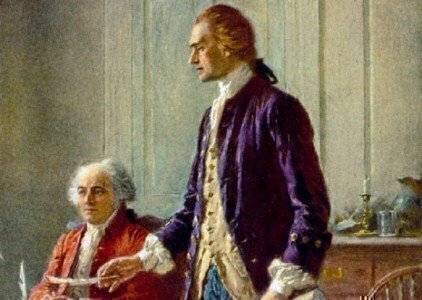
Local and national newspapers were also quick to report after Monroe’s death that they thought his July 4 passing was a “remarkable” coincidence, at the least, since Thomas Jefferson and John Adams had both also died on July 4, 1826 – the 50th anniversary of the Declaration of Independence.
The oddness of the events wasn’t lost on the New York Evening Post in 1831, when the newspaper founded by Alexander Hamilton called it a “coincidence that has no parallel”: “Three of the four presidents who have left the scene of their usefulness and glory expired on the anniversary of the national birthday, a day which of all others, had it been permitted them to choose [they] would probably had selected for the termination of their careers,” the Post reported on July 5, 1831.
The New York Commercial Advertiser wrote on July 5, 1831: “It would be difficult to find a parallel in history, three of them have been called away in a good all age, on the same proud anniversary."
And then the Boston Traveler wondered about the coincidence on July 8. “Again our national anniversary has been marked by one of those events, which it may be scarcely permitted to ascribe the chance.”
Then the Frederick, Maryland Town Herald marked Monroe’s passing on July 9, 1831 by also noting the “presidential coincidence”: “This have three of our revolutionary presidents departed this life on the anniversary of our independence; presenting the most remarkable tissue of coincidences that have marked the history of nations,” the newspaper said.
The death of these three presidents on the same day of the year was a long shot. There is an interesting blog post at the Boston University’s History Society that excerpts Margaret P. Battin’s research on the coincidental deaths of Adams and Jefferson.
“Given the insufficient historical evidence available, we can’t know the truth about why Adams and Jefferson died on the same day,” Battin said. (She didn’t include Monroe in her study.) Battin evaluated the circumstances under six different criteria, ranging from mere coincidence and divine intervention, to the men’s willingness or desire to die on the anniversary day.
To continue reading, please go to the original article here:
https://constitutioncenter.org/blog/three-presidents-die-on-july-4th-just-a-coincidence
Happy 4th of July
Happy 4th of July
The Dinar Recaps Team wishes everyone a happy and safe 4th of July.
Due to the holiday, we will NOT have a 10pm (ET) email Newsletter Monday night.
Please check our BLOG page for any new postings throughout the day and evening.
Happy 4th of July
The Dinar Recaps Team wishes everyone a happy and safe 4th of July.
Due to the holiday, we will NOT have a 10pm (ET) email Newsletter Tuesday night.
Please check our BLOG page for any new postings throughout the day and evening.
10 Fascinating Facts About The Declaration Of Independence
10 Fascinating Facts About The Declaration Of Independence
July 4, 2022 by NCC Staff
July 4th marks the annual holiday that celebrates the adoption of the Declaration of Independence. So how much do you know about this famous document?
1. Is Independence Day really July 2?
Officially, the Continental Congress declared its freedom from Britain on July 2, 1776, when it approved a resolution and delegates from New York were permitted to make it a unanimous vote. John Adams thought July 2 would be marked as a national holiday for generations to come.
10 Fascinating Facts About The Declaration Of Independence
July 4, 2022 by NCC Staff
July 4th marks the annual holiday that celebrates the adoption of the Declaration of Independence. So how much do you know about this famous document?
1. Is Independence Day really July 2?
Officially, the Continental Congress declared its freedom from Britain on July 2, 1776, when it approved a resolution and delegates from New York were permitted to make it a unanimous vote. John Adams thought July 2 would be marked as a national holiday for generations to come.
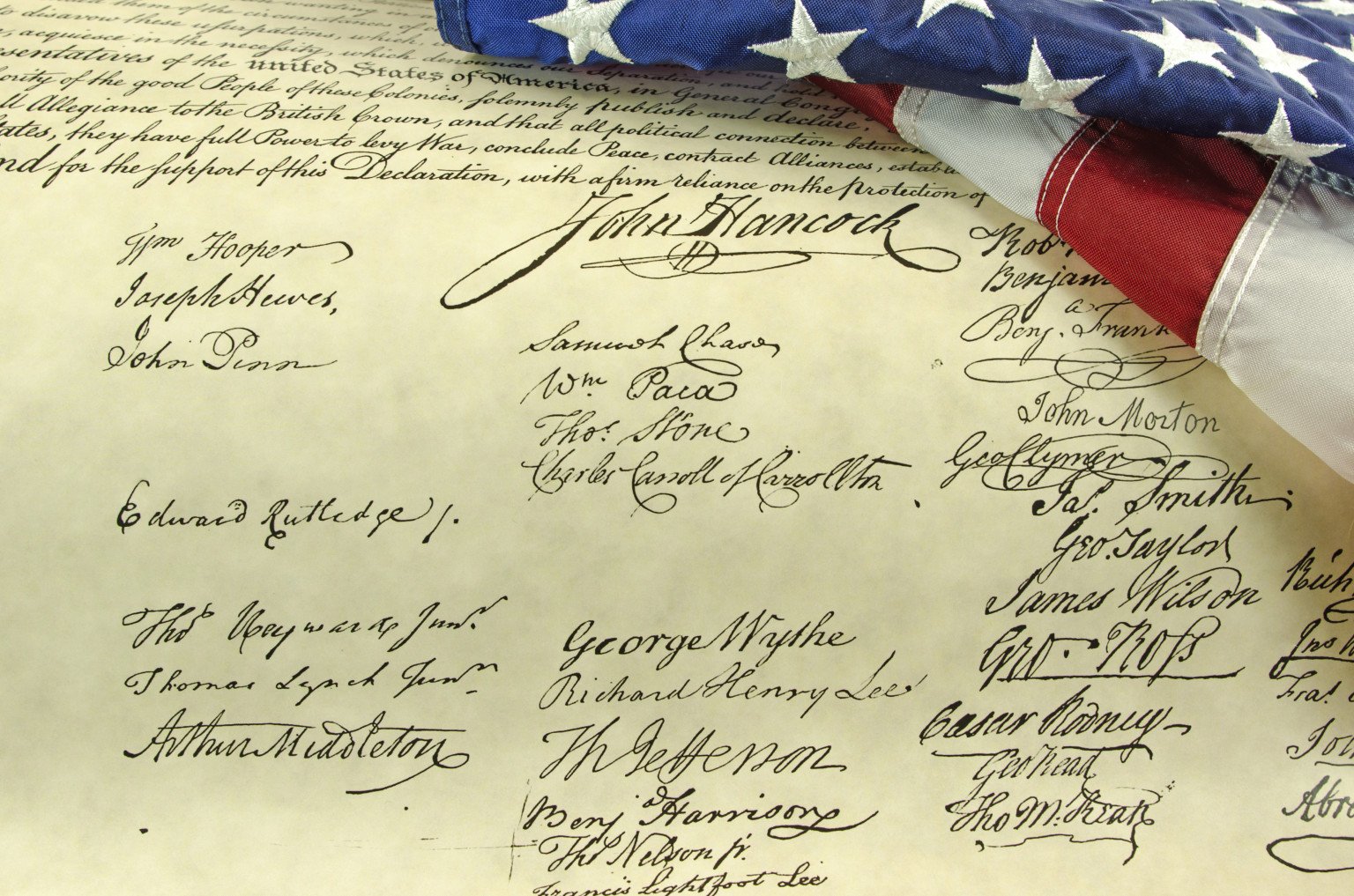
2. July 4 is when the Declaration was adopted
After voting on independence, the Continental Congress needed to finalize a document explaining the move to the public. It had been proposed in draft form by the Committee of Five (John Adams, Roger Sherman, Robert Livingston, Benjamin Franklin, and Thomas Jefferson) and it took two days for the Congress to agree on the edits.
3. Six people signed the Declaration and also the Constitution
Franklin was among a handful of people who signed both historical documents. The others were George Read, Roger Sherman, Robert Morris, George Clymer and James Wilson.
4. But they didn’t sign the Declaration on July 4th!
Once the Congress approved the actual Declaration of Independence document on July 4, it ordered that it be sent to a printer named John Dunlap. About 200 copies of the Dunlap Broadside were printed, with John Hancock’s name printed at the bottom. Today, 26 copies remain.
5. So what if I stumble upon a lost version of the Dunlap Broadside at a flea market?
That’s what happened in 1989 in Adamstown, Pa. It was tucked behind an old picture in a frame and it cost the buyer $4. That version of the Declaration was eventually acquired by TV producer Norman Lear for $8.1 million.
6. OK – when was the Declaration actually signed?
Most of the members of the Continental Congress signed a version of the Declaration in early August 1776 in Philadelphia. The names of the signers were released publicly in early 1777. So that famous painting showing the signing of the Declaration on July 4, 1776, is a bit of an exaggeration.
To continue reading, please go to the original article here:
https://constitutioncenter.org/blog/10-fascinating-facts-about-the-declaration-of-independence
The Awesome Dad Cheat Sheet
The Awesome Dad Cheat Sheet: 18 Fatherhood Tips They Should’ve Handed Out at the Delivery Room
Editor’s note: This is a guest post from Leo Babauta of Zen Habits, a father of six children.
Being a father can be a wonderful thing, once you get past all the gross stuff, all the stressful events, the loss of privacy, and the bewildering numbers of ways you can screw it up. But other than those few things, fatherhood is wonderful. Every dad has fears that he won’t be a great dad, that he’ll mess up, that he’ll be a failure. It comes with the job.
Unfortunately, what doesn’t come with the job is a simple set of instructions. As guys, we often will skip the manual, figuring we can wing it … but when things go wrong, it’s nice to have that manual to go back to. Fatherhood needs that manual.
The Awesome Dad Cheat Sheet: 18 Fatherhood Tips They Should’ve Handed Out at the Delivery Room
Editor’s note: This is a guest post from Leo Babauta of Zen Habits, a father of six children.
Being a father can be a wonderful thing, once you get past all the gross stuff, all the stressful events, the loss of privacy, and the bewildering numbers of ways you can screw it up. But other than those few things, fatherhood is wonderful. Every dad has fears that he won’t be a great dad, that he’ll mess up, that he’ll be a failure. It comes with the job.
Unfortunately, what doesn’t come with the job is a simple set of instructions. As guys, we often will skip the manual, figuring we can wing it … but when things go wrong, it’s nice to have that manual to go back to. Fatherhood needs that manual.
And while, as the father of six children, you might say that I’m qualified to write such a manual, it’s not true — I’m winging it like everyone else. However, I’ve been a father for more than 15 years, and with six kids I’ve learned a lot about what works and what doesn’t, what’s important and what you can safely ignore (unlike that odd grating sound coming from your engine).
What follows are the fatherhood tips I wish they’d passed out to me upon the delivery of my first child. It would have helped a ton. I hope they’ll help you become an even more awesome dad than you already are — feel free to refer back to them as a cheat sheet, anytime you need some help.
Cherish your time with them. One thing that will amaze you is how quickly the years will fly. My oldest daughter is 15, which means I have three short years with her before she leaves the nest.
That’s not enough time! The time you have with them is short and precious — make the most of it. Spend as much time as you can with them, and make it quality, loving time. Try to be present as much as possible while you’re with them too — don’t let your mind drift away, as they can sense that.
It gets easier. Others may have different experiences, but I’ve always found the first couple of months the most difficult, when the baby is brand new and wants to feed at all hours of the night and you often have sleepless nights and walk around all day like zombies. It gets easier, as they get a regular sleeping pattern.
The first couple of years are also a lot more demanding than later years, and as they hit middle school they become almost functioning, independent adults. It gets easier, trust me.
Don’t look at anything as “mom” duties — share responsibilities. While there are a lot of good things from our grandparents’ day that we should bring back, the traditional dad/mom split of parenting duties isn’t one of them. Some men still look at certain duties as “mom” duties, but don’t be one of those dads.
To continue reading, please go to the original article here:
https://www.artofmanliness.com/articles/18-tips-for-being-a-great-dad/
Happy National Flag Day
TNT:
Mot: ... and Today is National ""Flag Day"" ~~~~~
Flag Day, also called National Flag Day, in the United States, a day honouring the national flag, observed on June 14. The holiday commemorates the date in 1777 when the United States approved the design for its first national flag.
The idea to set aside a day to honour the national flag came from several sources. Bernard J. Cigrand, a Wisconsin schoolteacher, in 1885 urged his students to observe June 14 as “Flag Birthday.”
He later wrote an essay published in a Chicago newspaper that urged Americans to proclaim this date as the day to celebrate the flag. In 1888 William T. Kerr of Pennsylvania founded the American Flag Day Association of Western Pennsylvania, an organization to which he dedicated his life.
TNT:
Mot: ... and Today is National ""Flag Day"" ~~~~~
Flag Day, also called National Flag Day, in the United States, a day honouring the national flag, observed on June 14. The holiday commemorates the date in 1777 when the United States approved the design for its first national flag.
The idea to set aside a day to honour the national flag came from several sources. Bernard J. Cigrand, a Wisconsin schoolteacher, in 1885 urged his students to observe June 14 as “Flag Birthday.”
He later wrote an essay published in a Chicago newspaper that urged Americans to proclaim this date as the day to celebrate the flag. In 1888 William T. Kerr of Pennsylvania founded the American Flag Day Association of Western Pennsylvania, an organization to which he dedicated his life.
A lesser-known claim is that of George Morris of Connecticut, who is said to have organized the first formal celebration of the day in Hartford in 1861.
In 1916 Pres. Woodrow Wilson proclaimed June 14 as the official date for Flag Day, and in 1949 the U.S. Congress permanently established the date as National Flag Day.
Although Flag Day is not an official federal holiday, Pennsylvania celebrates the day as a state holiday. Each year the U.S. president delivers an address that proclaims the week of June 14 as National Flag Week, and all Americans are encouraged to fly U.S. flags during that week.

Home Free - God Bless the U.S.A. (featuring Lee Greenwood and The United States Air Force Band)
Gene Simmons salute to our troops