
5 Common Emergency Expenses — And How Much They Cost on Average
5 Common Emergency Expenses — And How Much They Cost on Average
Cindy Lamothe GoBankingRates Fri, June 7, 2024
One thing in life is certain: things are unpredictable unimaginable ways. While you can’t know what the future holds, you can plan for it. Because being unprepared can drain your emergency fund empty and leave you in the poor house.
“If your car breaks down, the cost to fix it can vary greatly,” said Melanie Musson, a finance expert with Clearsurance. “If you have a flat tire, you may need to replace all your tires, which will cost about $600 or more. However, you can expect to pay $2,000 or more for a replacement if your transmission goes. A new radiator will cost around $1,000. If you need a new battery, you have an easy fix for about $100.”
Justin Godur, financial expert and CEO of Capital Max, says understanding these common emergency expenses and their potential impact on your finances is essential for effective financial planning.
“By anticipating these costs and preparing accordingly, you can protect your financial well-being and avoid significant stress during emergencies.”
5 Common Emergency Expenses — And How Much They Cost on Average
Cindy Lamothe GoBankingRates Fri, June 7, 2024
One thing in life is certain: things are unpredictable unimaginable ways. While you can’t know what the future holds, you can plan for it. Because being unprepared can drain your emergency fund empty and leave you in the poor house.
“If your car breaks down, the cost to fix it can vary greatly,” said Melanie Musson, a finance expert with Clearsurance. “If you have a flat tire, you may need to replace all your tires, which will cost about $600 or more. However, you can expect to pay $2,000 or more for a replacement if your transmission goes. A new radiator will cost around $1,000. If you need a new battery, you have an easy fix for about $100.”
Justin Godur, financial expert and CEO of Capital Max, says understanding these common emergency expenses and their potential impact on your finances is essential for effective financial planning.
“By anticipating these costs and preparing accordingly, you can protect your financial well-being and avoid significant stress during emergencies.”
Below, experts outline exactly how much some of these common emergency expenses will cost you on average.
Car Breakdown
“A car breakdown is one of the most frequent and costly emergency expenses,” Godur said. “The average cost for a major car repair, such as a transmission or engine replacement, can range from $3,000 to $7,000.”
He says even minor repairs, like fixing a brake system or replacing a fuel pump, can cost between $300 to $1,000.
“Regular maintenance and an emergency savings fund can help mitigate these unexpected costs,” Godur said.
Job Loss
According to experts, losing a job is a significant financial shock.
“The average duration of unemployment in the U.S. is about 22 weeks, during which time individuals need to cover living expenses without a steady income,” Godur said.
Musson notes the same.
“If you lose your job and are eligible for unemployment, you can expect to lose half of what you were making,” Musson said. “Unemployment services are a nightmare to work through in many parts of the country, so you can expect to have a lag time of several months, during which time you’ll have no income. So, if you were making $5,000 a month, in a best-case scenario, you’d lose $2,500 a month, and in a worst-case scenario, you’d lose $5,000 a month.”
Godur says that depending on your lifestyle and location, this could mean needing between $10,000 to $20,000 to stay afloat.
“Building an emergency fund with three to six months’ worth of expenses is crucial to weather such storms.”
To Read More:
https://www.yahoo.com/finance/news/5-common-emergency-expenses-much-140111547.html
9 Times To Always Have $1 and $5 Bills on Hand While Traveling
9 Times To Always Have $1 and $5 Bills on Hand While Traveling
Dawn Allcot Thu, June 6, 2024 GoBankingRates
As we shift toward a cashless economy, there are still times you want cash on hand. For instance, when you fuel up at the gas pump, you can save as much as 10 cents per gallon — that’s more than $1 if you have a 12-gallon tank and take it down close to empty. There are other times, especially on vacation, when you’ll want a stash of $1 or $5 bills.
Before you leave for a trip, it’s wise to withdraw some $1 and $5 bills from the ATM and keep them in your pocket, a change purse, or your wallet for easy access.
9 Times To Always Have $1 and $5 Bills on Hand While Traveling
Dawn Allcot Thu, June 6, 2024 GoBankingRates
As we shift toward a cashless economy, there are still times you want cash on hand. For instance, when you fuel up at the gas pump, you can save as much as 10 cents per gallon — that’s more than $1 if you have a 12-gallon tank and take it down close to empty. There are other times, especially on vacation, when you’ll want a stash of $1 or $5 bills.
Before you leave for a trip, it’s wise to withdraw some $1 and $5 bills from the ATM and keep them in your pocket, a change purse, or your wallet for easy access.
In fact, you might find yourself reaching for your wallet more than you might imagine on vacation in the U.S. Just getting from the airport into your hotel room often requires contact with multiple service providers who all supplement their income with tips.
1. Restaurant Servers
Most restaurants allow you to leave a tip for the server on your credit card when you pay the bill. But tipping in cash, instead, puts money in the server’s pocket that evening. And for many people living paycheck to paycheck, that extra money can make a difference. That’s why it’s a good idea to carry cash for tipping.
The standard rule is to tip 20%. Restaurants often publish suggested tip amounts at the bottom of the receipt, saving you the trouble of pulling out your phone to do the math.
You may also want to carry cash to pay for your restaurant meal. According to LawPay.com, in all but a handful of states, restaurants are permitted to add credit card surcharges to your bill — and many do.
Businesses in Connecticut, Maine, Massachusetts, and New York are prohibited from adding credit card surcharges, although New York allows a “cash discount” that’s essentially the same thing as a surcharge.
If you want to save money on vacation, read your restaurant bill carefully and avoid surcharges by paying in cash.
2. Housekeeping at the Hotel
If you’re staying in a hotel that cleans rooms daily, try to leave between $1 and $5 per day, according to Southern Living. There might be a new housekeeper each day. If the hotel only provides service every few days, it’s fine to leave a tip at the end of your stay. If you’re in a large suite or a luxury hotel, you might increase that amount to $10 per night or more.
Make sure to leave the tip in a visible spot, such as on the nightstand. If the hotel has stationery and a pen in the room, it’s a nice touch to leave a quick thank you note.
3. Room Service
If you order food from the hotel restaurant, it’s easy to put the charge on your room bill. But it’s a good idea to have money to tip the person delivering the food. Just as you would in a sit-down restaurant, 15% to 20% of your bill is the norm, according to Travel + Leisure.
4. Hotel Bellhop
Justin Nels, managing director of Isla Bella Beach Resort in Marathon, Florida, told travel site AFAR.com that it’s a good idea to tip your bellhop between $2 and $5 per bag, depending on the size and weight of your luggage.
To Read More:
https://www.yahoo.com/finance/news/9-times-always-1-5-183141249.html
6 Great Money Lessons From the 1950s You Should Use Today
6 Great Money Lessons From the 1950s You Should Use Today
Angela Mae Thu, Jun 6, 2024,
America in the 1950s was a vastly different place than it is today. Unemployment rates were low, individual purchasing power was high, and mass production and new technologies were making everyday goods and services readily available and cheaper.
Many young adults in the 1950s grew up during the Great Depression — 1929 to 1941. As they went on to launch their own careers, start their own families and pursue the American dream, they did so with the financial lessons they learned along the way.
And those lessons? They were passed down to their children and their children’s children.
6 Great Money Lessons From the 1950s You Should Use Today
Angela Mae Thu, Jun 6, 2024,
America in the 1950s was a vastly different place than it is today. Unemployment rates were low, individual purchasing power was high, and mass production and new technologies were making everyday goods and services readily available and cheaper.
Many young adults in the 1950s grew up during the Great Depression — 1929 to 1941. As they went on to launch their own careers, start their own families and pursue the American dream, they did so with the financial lessons they learned along the way.
And those lessons? They were passed down to their children and their children’s children.
While the 1950s might seem ever so distant, many of the lessons that came about back then are still significant today. Living within your means, owning what you have, saving up for the future — these are just some of the great money lessons from back then that you should use today.
Wealthy people know the best money secrets. Learn how to copy them.
Live Within Your Means
Learning to live within your means is just as important now as it was 20, 50 or even 100 years ago.
“In the 1950s, most families stuck to pretty much the same budget from year to year, with people spending only what they earned and never going into debt when they [could avoid it],” said Erika Kullberg, a personal finance expert, attorney and founder of Erika.com.
It helped that the first consumer credit card didn’t come about until 1958, when Bank of America launched BankAmericard. Credit simply wasn’t as readily accessible as it is today.
“In a world where credit is easy, it’s more important now than ever to shop around, practice self-discipline and save rather than borrow,” said Kullberg.
If you must use credit or loans for something, like a house or school, do so with extreme caution so that you don’t end up taking on debt you can’t afford.
Live Like Your Money’s Going To Disappear
Living like your money will disappear doesn’t mean spending everything immediately. Quite the opposite, in fact.
“In the ’50s, many adults remembered struggling through the Great Depression,” said Todd Stearn, founder and CEO of The Money Manual. “With low inflation and unemployment and high wages, the middle class had more spending money than ever in the ’50s, but many were so impacted by the things they and their parents had been through financially that they often saved carefully despite the good fortune many had found. That caution with money is just as valuable today.”
Save as Much as You Can, But Use Your Savings as Intended
To Read More:
https://finance.yahoo.com/news/6-great-money-lessons-1950s-150010941.html
It’s Vital That You Keep These 7 Financial Documents Forever
It’s Vital That You Keep These 7 Financial Documents Forever — Here’s Why
Vawn Himmelsbach Mon, June 3, 2024
Many of us have piles of papers we’re saving "just in case,” probably gathering dust somewhere.
While some of those documents could probably head straight to the shredder, there are others that you should keep forever — and preferably not in a cardboard box in the basement.
But sometimes we just don’t know what we need to keep (and for how long), and what we can safely get rid of.
Here are seven financial documents you shouldn’t get rid of (ever) — and why.
It’s Vital That You Keep These 7 Financial Documents Forever — Here’s Why
Vawn Himmelsbach Mon, June 3, 2024
Many of us have piles of papers we’re saving "just in case,” probably gathering dust somewhere.
While some of those documents could probably head straight to the shredder, there are others that you should keep forever — and preferably not in a cardboard box in the basement.
But sometimes we just don’t know what we need to keep (and for how long), and what we can safely get rid of.
Here are seven financial documents you shouldn’t get rid of (ever) — and why.
7 Documents You Should Never Lose
1. Birth certificate. Your original birth certificate (or adoption papers) is used to prove your age at various life stages, such as obtaining a driver’s license or applying for Social Security benefits. It will also help your family obtain a death certificate when the time comes.
2. Social Security card. You need the nine-digit number on this card to get a job, rent an apartment and collect government benefits, and you may need it to open a bank account or apply for a credit card. The Social Security Administration (SSA) recommends keeping your card in a safe place and only sharing your number when required.
3. Marriage license. Your marriage license affirms that you and your spouse did, indeed, get married. This can come in handy if you want to claim a Social Security spousal benefit in retirement.
4. Divorce records. Your settlement agreement includes the division of marital property and the terms for child and/or spousal support, so you’ll want to hang onto that. Plus, if you were married for 10 years or more (and aren’t remarried), you may be able to claim Social Security benefits based on your ex’s record.
5. Loan payoff statements. This is important if you’ve negotiated a settlement that’s less than the original debt. That’s because if the debt is sold to a debt collector, the new debt collector may not have a copy of the documentation proving that you settled under those terms.
To Read More:
https://www.yahoo.com/finance/news/vital-keep-7-financial-documents-110000136.html
Gold Will Soon Displace The US Dollar, And Americans Are Missing Out
Gold Will Soon Displace The US Dollar, And Americans Are Missing Out
Notes From the Field By James Hickman (Simon Black) June 3 2024
Next month will mark 80 years since the US dollar was formally anointed as the world’s reserve currency.
It was July 1944. And with the war in Europe near its denouement, governments were already trying to plan what the postwar world would look like. Most urgently, they needed to figure out how to rebuild their devastated economies.
Just think about the mess they were in: nearly every industrialized country in Europe had been destroyed by war. Manufacturing and farming were both in the dumps, and they had very little savings to invest in economic revival.
They also had a gigantic mess when it came to international trade. Dozens of countries each had their own currencies, so commercial trade meant each government keeping 20-30 currencies in reserve.
France, for example, would have to hold Austrian schillings, British pounds, Spanish pesetas, Italian lira, Dutch guilders, Soviet rubles, etc. in reserve, just to be able to trade.
Gold Will Soon Displace The US Dollar, And Americans Are Missing Out
Notes From the Field By James Hickman (Simon Black) June 3 2024
Next month will mark 80 years since the US dollar was formally anointed as the world’s reserve currency.
It was July 1944. And with the war in Europe near its denouement, governments were already trying to plan what the postwar world would look like. Most urgently, they needed to figure out how to rebuild their devastated economies.
Just think about the mess they were in: nearly every industrialized country in Europe had been destroyed by war. Manufacturing and farming were both in the dumps, and they had very little savings to invest in economic revival.
They also had a gigantic mess when it came to international trade. Dozens of countries each had their own currencies, so commercial trade meant each government keeping 20-30 currencies in reserve.
France, for example, would have to hold Austrian schillings, British pounds, Spanish pesetas, Italian lira, Dutch guilders, Soviet rubles, etc. in reserve, just to be able to trade.
*********************************
A much, much simpler solution was for every country to use the same currency to trade with each other. And there was no question about which currency would be the right choice: the US dollar.
In 1944, the United States still had a strong and powerful economy. It had robust capital markets and a well-developed financial system. It was the only country left standing.
So, representatives from more than 40 nations gathered that summer in picturesque Bretton Woods, New Hampshire and formally agreed to use the US dollar for international trade and commerce.
More specifically, each country fixed its exchange rate to the US dollar, while the US dollar was fixed to gold.
It only lasted about thirty years. By the early 1970s, the original Bretton Woods deal had been completely undone. Currencies floated freely against each other (including the dollar), and the US dollar terminated its link with gold.
And yet (thanks in part to Saudi Arabia agreeing to sell oil in dollars), the US dollar has continued to remain the dominant reserve currency through today.
For the most part that was still a sensible bet; the US has been the world’s #1 economy for the past five decades. But the cracks are obvious.
The US federal debt is a national embarrassment. At $35 trillion, the debt is far larger than the entire US economy… and it gets worse every year.
The US government is also completely dysfunctional. The vitriol and enmity, among the parties and within the parties, is so extreme that virtually nothing productive or beneficial ever takes place. The business of government now is merely two sides screaming that the other is a threat to democracy.
The President barely knows where he is half the time, and the other half he spends shredding the Constitution to engage in some anti-capitalist, inflationary, fanatical woke climate agenda.
Sadly, this isn’t a one-time blip. America’s governance and finances have been deteriorating for most of this century-- starting with the endlessly expensive War on Terror, through the free-spending Obama years, to the pandemic… and now the very real prospect that the next four years could look very similar to the previous four years.
*****************************
America is supposed to be a reliable, stabilizing force in the world. But today’s America has lost its grip. And foreign nations have noticed.
Most people alive today don’t remember a world in which the dollar wasn’t #1 and therefore cannot fathom a world in which this is no longer the case. But it’s irrational to assume that something will continue indefinitely, forever, simply because of the status quo today.
It’s not 1944 anymore. Back then there were no other options… and no one who even came close to rivaling the military and economic superiority of the United States.
Today both of those are in decline. It’s not to say the military can no longer fight or that the economy is in complete shambles. But America no longer has the unrivaled position it enjoyed for so long.
More importantly, the trend isn’t looking good. From an economic perspective, the national debt is set to increase by another $20 trillion over the next decade… likely triggering a nasty run of stagflation like the US experienced in the 1970s.
The US military, meanwhile, continues its downward slide. Recruitment is absolutely abysmal. Key weapons systems, fighter jets, tanks, and naval vessels are borderline obsolete.
The US Navy’s fleet of ships and submarines (which would be critical in any conflict against China) is the oldest and smallest it’s been since the end of World War II. Nearly 1,000 military aircraft will be retired from service in the next five years alone, and there is no concrete plan to replace them.
Nor is there any money to do so.
Frankly it is exceedingly difficult to believe that, in light of America’s declining power and prestige, the rest of the world will continue accepting the US dollar as the global reserve currency for much longer.
We’re already seeing signs of this change; plenty of countries are starting to trade with one another in different currencies, including Chinese renminbi and Indian rupee, and this trend will likely accelerate over the next several years.
I think it’s even possible there could be an event of some sort-- perhaps the US government defaults on its debt, or there’s even a shooting war or cyberattack-- which triggers a new Bretton Woods style conference.
The key difference between now and 1944 is that there was only one option back then-- the US. And pretty much everyone had confidence in America.
That’s not the case today. Few rational people have the same level of confidence in the US government. Yet almost no one trusts the Chinese either.
**********************************
But just like 1944, there is an obvious solution… and one that everyone already trusts: gold.
Nearly every country already holds gold as a reserve asset, so there would be very little change to the way they currently do business.
I’ve written about this before-- I believe this is why so many central banks around the world have been on a gold-buying spree. In fact, this is THE reason why gold is near its all-time high: central banks have been buying it by the metric ton.
You have to understand that central banks aren’t speculators. They don’t care about price. They buy for strategic reasons… and I believe that the central bank gold purchases that have been occurring over the past few years are a key sign that the global financial regime will be changing.
Individual investors, meanwhile, have been selling gold.
North American investors have sold off more than $4 billion worth of gold ETFs in the first four months of this year, with $2 billion of that just in the month of April. And gold ETF holdings are now at their lowest level in four years.
Central banks are buying. Individual investors are selling. It seems pretty clear that people aren’t paying attention to the warning signs.
Yes, gold is near its all-time high. But that doesn’t mean it can’t go much higher… especially if there’s a catalyst. And there absolutely is.
As a final point, I would point out again that even while gold is near its all-time high, shares of high quality, profitable, dividend-paying gold miners are laughably cheap.
That’s because central banks only buy physical gold bullion (which has pushed up the price of gold). They do not buy gold stocks… hence many of these businesses are available for outrageous bargains.
To your freedom, James Hickman Co-Founder, Schiff Sovereign LLC
4 Purchases Financial Experts Regret and What They Wish They Had Spent Money On
4 Purchases Financial Experts Regret and What They Wish They Had Spent Money On
Laura Bogart Thu, May 30, 2024
Financial advisors may know a lot of things about wisely spending money, but they don’t know everything. Even the best educated, most experienced and all around savviest financial expert is still, at the end of the day, a human being trying to make the best decisions based on the information they have on hand.
Sometimes, these advisors regret their decisions in hindsight. And sometimes, looking back on the purchases they regret the most will teach the experts in a more intimate way than they’d get in their studies or on the job.
GOBankingRates talked to some financial experts about the purchases they most regret and what they now wish they’d purchased instead.
Investing In a Startup
As the co-founder and CEO of Reliant Insurance Group and Helping Hand Financial, Ben Klesinger is a seasoned financial professional. But that doesn’t mean that he didn’t have to acquire some of his expertise the hard way by making investments he would come to regret.
4 Purchases Financial Experts Regret and What They Wish They Had Spent Money On
Laura Bogart Thu, May 30, 2024
Financial advisors may know a lot of things about wisely spending money, but they don’t know everything. Even the best educated, most experienced and all around savviest financial expert is still, at the end of the day, a human being trying to make the best decisions based on the information they have on hand.
Sometimes, these advisors regret their decisions in hindsight. And sometimes, looking back on the purchases they regret the most will teach the experts in a more intimate way than they’d get in their studies or on the job.
GOBankingRates talked to some financial experts about the purchases they most regret and what they now wish they’d purchased instead.
Investing In a Startup
As the co-founder and CEO of Reliant Insurance Group and Helping Hand Financial, Ben Klesinger is a seasoned financial professional. But that doesn’t mean that he didn’t have to acquire some of his expertise the hard way by making investments he would come to regret.
Early in his career, Klesinger invested heavily in what he called “a promising but unproven fintech startup.” Citing generally high levels of enthusiasm for technology, he put in about $200,000 of his own capital. Though he expected to see quick returns, what he got was a whole lot of headaches.
“The startup struggled with regulatory issues and market competition. In the end, we lost nearly the entire investment,” he said. “I learned the hard way that even if a business idea sounds revolutionary, proper due diligence is indispensable.”
In hindsight, Klesinger wishes he’d applied a more balanced approach, like investing in a diversified portfolio of mutual funds or even tech-focused ETFs, which would have allowed him to get exposure to the tech sector without taking on such a high risk.
A Fancy Car
Like many people who have worked hard and want to show off their success, Klesinger once purchased “an extravagant car” that he also hoped would serve as a solid investment. Unfortunately, that car which cost him $150,000, ultimately proved more trouble than fun by depreciating much faster than he anticipated.
“The maintenance costs also piled up, diminishing the overall value,” he said. “I realized afterward that investing the same amount in rental properties or a mix of dividend-yielding stocks would have generated consistent income and appreciated over time.”
To Read More:
https://www.yahoo.com/finance/news/4-purchases-financial-experts-regret-180011958.html
Would You Pay €1 For This House?
Would You Pay €1 For This House?
Notes From the Field by James Hickman (Simon Black) May 29, 2024
In 2007, Giuseppe Ferrarello found himself facing a monumental challenge as the newly-elected mayor of Gangi, Italy — an incredibly picturesque yet dwindling town nestled in the mountains of Sicily.
Like many rural communities across Italy and beyond, the village of Gangi was grappling with depopulation and economic decline. Once home to 15,000 people, its population by 2007 stood at just 7,000. Young people in particular were leaving to seek job opportunities in northern Italy and elsewhere in Europe, leaving behind aging parents and empty houses.
At first glance, the situation seemed hopeless. Gangi’s inland location far from the coast rendered it unattractive to tourists.
Would You Pay €1 For This House?
Notes From the Field by James Hickman (Simon Black) May 29, 2024
In 2007, Giuseppe Ferrarello found himself facing a monumental challenge as the newly-elected mayor of Gangi, Italy — an incredibly picturesque yet dwindling town nestled in the mountains of Sicily.
Like many rural communities across Italy and beyond, the village of Gangi was grappling with depopulation and economic decline. Once home to 15,000 people, its population by 2007 stood at just 7,000. Young people in particular were leaving to seek job opportunities in northern Italy and elsewhere in Europe, leaving behind aging parents and empty houses.
At first glance, the situation seemed hopeless. Gangi’s inland location far from the coast rendered it unattractive to tourists.
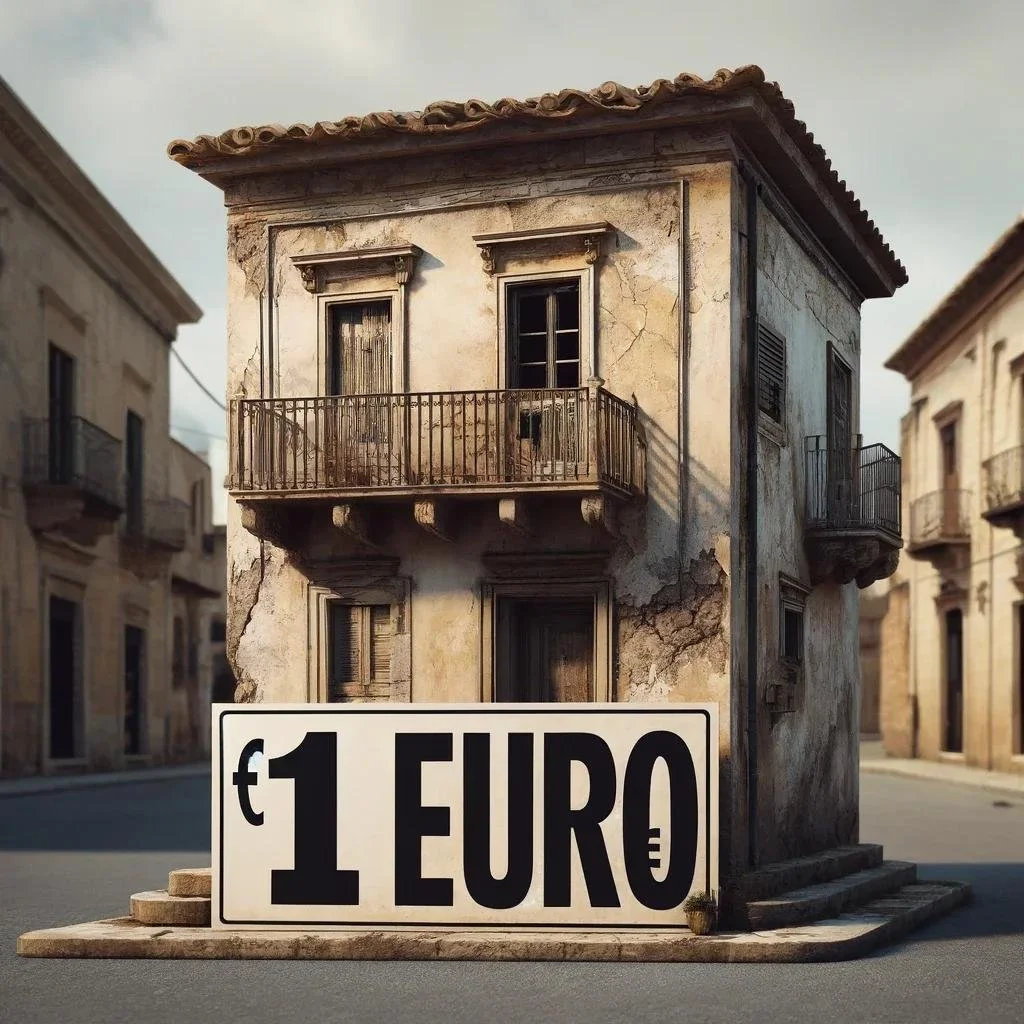
But Ferrarello refused to give up and adopted a bold strategy to revitalize his town through the “One Euro Houses program” — a pioneering initiative aimed at attracting new residents and rejuvenating abandoned properties.
Under the program, buyers could purchase local derelict houses for a symbolic price of just one euro... but with strings attached. New owners had to commit to restoring the properties within four years.
Ferrarello’s idea was successful in attracting foreign investors. And over the next few years, the little hamlet was recognized as the “Jewel of Italy,” and named one of the “The most beautiful Italian villages.”
New residents and tourists from Europe and beyond arrived, to the delight of the local businesses and artisans.
And over the following years, several towns across Italy, Spain, France, and even the UK launched their own projects offering housing at a ‘symbolic price’.
At face value it seems like a stupendous bargain to buy a house in Europe for just 1 euro. But are these offers really worth the strings attached?
Super cheap real estate deals across various EU countries exist because the properties are worthless to their current owners. These often-dilapidated homes are located in small towns far from major population centers and tourist attractions, and many have been abandoned for generations, requiring extensive renovation.
Property taxes, though modest, make these properties a burden. And buyers typically must commit to spending at least €35,000 to renovate the property within two to three years.
If you fail to meet these obligations, you risk losing a €1,000 to €5,000 insurance deposit held by the municipality, losing the property, or both.
Other costs include €1,500 in legal fees, and roughly €3,500 for mandatory civil engineering and architectural plans.
There’s also no guarantee that €35,000 will be enough to complete renovations; many of these properties are “historic,” meaning you can’t do whatever you want. Plenty of local regulations will govern what you can and cannot do.
Therefore, renovating a small, 100 square meter (1,076 sq.ft.) home can cost between €60,000 and €160,000 to bring it to a livable and rentable condition.
Engaging in such a project could certainly benefit adventurous souls with ample free time.
But there are other challenges as well. You either need to speak Italian and be prepared for the complexities of southern European bureaucracy, or you’ll have to spend even more money on project managers.
Even if you persevere through the purchase and renovation process, consider the most probable outcome — an illiquid property in a tiny village lacking appeal to both Italians and foreigners alike. Because most of these towns aren’t as successful as Gangi at reigniting their tiny economies.
But if owning a beautiful home in Italy is your goal (and part of your Plan B), it probably makes more sense to just look at the wide selection of regular cheap properties available throughout the country.
After all, owning an Italian home does offer the allure of breathtaking scenery, cultural richness, relaxation, outdoor activities, and even an investment potential… all in one picturesque package.
Even for as low as €60,000 to €160,000, you can find a nice Italian property with no strings attached — no hunting for reliable information, no applying for remodeling and construction permits, no actual renovation, and no time wasted.
Properties almost anywhere in Italy remain remarkably cheap, as the country has, so far, missed the real estate boom experienced by its European neighbors.
As of March 2024, the average Italian property price per square meter stood at €1,850, just 6.6% higher than the nationwide low recorded in February 2020.
Property prices in Spain average €2,098 per sq.m., and €2,596 in Portugal.
And 22 provinces (out of 106) across Italy have current province-wide prices below €1,000 per square meter. That’s definitely cheap.
For example, in Gangi, the original “€1 house” village, this 151 sq.m., 3-story house in the town center offers great views, is in livable condition, and is selling for just €35,000.
(Personally, I’d rather pay 35k for the finished home than have paid 1 euro and gone through all the time, money, and work to renovate it.)

And it’s not just the cheaper southern Italy that has these deals.
Genoa — a famous port city just south of Milan, and the birthplace of Christopher Columbus — is still 47% below its 2012 peak, with plenty of options below €1,000 per square meter.
Biella — less than 90 minutes from Milan and situated right at the foot of the Alps, next to lakes, mountains, and ski resorts — offers this spacious and modern 250 sq.m. apartment located right in the town’s historic area, selling for €155,000 — a very inexpensive €620 per square meter

Now, believe it or not, this article isn’t really about buying property in Italy. To some people, Italy may be their idyllic retirement dream. Others couldn’t care less. The larger issue is how to think about a “Plan B”.
Remember, the central idea behind a Plan B is to mitigate risks by taking sensible actions — actions which make sense regardless of what happens (or doesn’t happen) in the future.
For a lot of people, a big part of their Plan B is having a second property overseas. A second home abroad, combined with residency or citizenship, is sort of like an insurance policy: you might not ever need it… but in case you ever do, you’ll be damn glad you have one.
A second residence means that you’ll always have a place to go in case, for whatever reason, you need to leave your home country. This could be enormously valuable to you and your family.
But even if that day never comes (and hopefully it doesn’t), it’s hard to imagine you’ll be worse off for owning a nice property in a place where you really enjoy spending time-- which you were able to purchase on the cheap and generate modest cashflow while you’re not using it.
For some people, Italy ticks that box. For others, it doesn’t. And for others, buying a second home isn’t the right move either. Everyone has unique, individual circumstances.
The key idea is that we can apply this same logic to other elements of a Plan B, including our finances.
For example, we have long argued why inflation will grow and become a major problem for the US dollar in the coming years; it will be extremely difficult to take on $20+ trillion in new debt in the next decade without serious, serious inflation.
Real assets are a major inflation hedge. And right now, many real assets-- including key commodities and the companies which produce them — are historically cheap.
We’re talking about high quality gold or copper miners that generate fantastic profits, have virtually zero debt, and pay 8%+ dividends… yet their shares trade at laughably low valuations.
If our inflation thesis plays out as expected, these types of companies will do extremely well, and shareholders could be richly rewarded.
But even if inflation never materializes (which is highly doubtful), it still makes sense to consider owning a strong, profitable business that pays a great dividend.
James Hickman Co-Founder, Schiff Sovereign LLC
https://www.schiffsovereign.com/trends/would-you-pay-e1-for-this-house-150891/
6 Tools That Can Help You Become Debt Free
6 Tools That Can Help You Become Debt Free
J. Arky Tue, May 28, 2024
Close your eyes and just imagine it: Being debt free. For many people working today, that feels like an impossible dream to realize. Between having to take out loans for your education, getting a mortgage on a house and putting expenses on a credit card, debt can feel never ending.
Thankfully, there are some modern tools that can help you become debt free. This doesn’t mean you won’t slip into debt here and there along the way — it’s almost inevitable these days — but these methods can aid you in getting yourself out, managing any future debt and staying in the black going forward.
Here are the six tools that can help you become debt free.
6 Tools That Can Help You Become Debt Free
J. Arky Tue, May 28, 2024
Close your eyes and just imagine it: Being debt free. For many people working today, that feels like an impossible dream to realize. Between having to take out loans for your education, getting a mortgage on a house and putting expenses on a credit card, debt can feel never ending.
Thankfully, there are some modern tools that can help you become debt free. This doesn’t mean you won’t slip into debt here and there along the way — it’s almost inevitable these days — but these methods can aid you in getting yourself out, managing any future debt and staying in the black going forward.
Here are the six tools that can help you become debt free.
Budgeting Apps
Our lives are connected to our smart devices. One of the reasons they are so adept and useful is that you can download apps to help you with anything, such as budget and expense tracking.
“Apps like Mint and YNAB (You Need A Budget) are great for tracking expenses and creating budgets. They help you see where your money goes and identify areas to cut back,” said Rhett Stubbendeck, the CEO and founder of Leverage.
“YNAB teaches you to prioritize every dollar you earn, a fundamental shift that can drastically reduce debt,” added Ben Klesinger, the co-founder and CEO of Reliant Insurance Group. “Mint helps you manage your budget, keep tabs on your bills and track your investments all in one place.”
Debt Snowball vs. Debt Avalanche
Two popular strategies for debt repayment are the snowball and avalanche.
“The debt snowball method involves paying off your smallest debts first, which can provide quick wins and momentum,” Klesinger said. “The debt avalanche method, on the other hand, focuses on paying off debts with the highest interest rates first, saving you more money in the long run.”
Automated Savings Plans
“Services like Digit and Qapital automatically save small amounts of money from your checking account to a savings account based on your spending habits,” Klesinger said. “This incremental approach helps build an emergency fund, which is crucial for avoiding new debt.”
To Read More:
https://www.yahoo.com/finance/news/6-tools-help-become-debt-170028672.html
Banking Habits You Should Change in Retirement
Banking Habits You Should Change in Retirement
Jordan Rosenfeld Sat, May 25, 2024
While retirement is often a time when you finally get to stop thinking so hard about many of the little details in life, there are some you want to stay on top of, like your banking habits.
Some of your pre-retirement banking habits may not be as useful, protective or financially savvy after retirement.
Experts explain some banking habits you might still be doing that you’ll want to change in retirement.
Wealthy people know the best money secrets. Learn how to copy them.
Not Saving More Than Before
Retirees should consider having more money in a bank account than they did while they were working and earning an income, according to Chris Urban, CFP, a retirement planner and founder of Discovery Wealth Planning.
Experts: Banking Habits You Should Change in Retirement
Jordan Rosenfeld Sat, May 25, 2024
While retirement is often a time when you finally get to stop thinking so hard about many of the little details in life, there are some you want to stay on top of, like your banking habits.
Some of your pre-retirement banking habits may not be as useful, protective or financially savvy after retirement.
Experts explain some banking habits you might still be doing that you’ll want to change in retirement.
Wealthy people know the best money secrets. Learn how to copy them.
Not Saving More Than Before
Retirees should consider having more money in a bank account than they did while they were working and earning an income, according to Chris Urban, CFP, a retirement planner and founder of Discovery Wealth Planning.
“These days, high-yield savings accounts are a good place to earn a reasonable amount of interest while also having access to your cash. These accounts are a great way to insulate your household from the ups and downs of the financial markets, where your other retirement and investment accounts may be invested,” Urban said.
Learn More: 7 Bills You Never Have To Pay When You Retire
Not Keeping Cash Liquid
Consider taking your spending money from this high-yield savings account and replenishing it in a tax-efficient way from your retirement and/or investment accounts in years when they have performed well, Urban explained.
“Sure, you might have what is referred to as ‘cash drag’ by holding too much in cash; however, in my opinion, retirement is much more about optimizing your overall happiness and life than it is about optimizing for investment performance,” he said.
Holding On to High-Fee Accounts
Retirees should steer clear of accounts with high fees, including maintenance fees, overdraft fees and ATM fees, according to Taylor Kovar, CFP, founder and CEO of 11 Financial.
“These fees can eat into retirement savings over time. Instead, consider switching to fee-free or low-fee accounts to minimize expenses and maximize savings,” he said.
Do your research and shop around different banks and credit unions to find accounts with low or no fees, added Lyle D. Solomon, Esq., an attorney who specializes in personal finance issues such as debt relief, taxes and estate planning at Oak View Law Group. “Don’t hesitate to switch if you find a much better deal elsewhere,” he said.
Using Non-Bank ATMs
Retirees should also be mindful of using non-bank ATMs, which often charge hefty fees for withdrawals, Kovar said.
To Read More:
https://www.yahoo.com/finance/news/experts-banking-habits-change-retirement-120105489.html
9 Ways To Become Rich If You Were Born Poor
9 Ways To Become Rich If You Were Born Poor
Cindy Lamothe Fri, May 17, 2024,
Growing up with wealth is a privilege that lends financial stability and provides greater opportunities for future success. But what if you weren’t born with a silver spoon in your mouth? It’s hard to fathom going from poor to wealthy in a single lifetime, but according to experts, it’s not some distant fantasy. It isn’t easy either.
“Wealth building for individuals starting from a disadvantaged economic position requires a multifaceted approach, focusing on education, smart financial decisions and leveraging available opportunities creatively,” said Dennis Shirshikov, head of growth at Summer.
“Education, both formal and informal, is a cornerstone. It’s not just about earning degrees but acquiring financial literacy,” he added.
Overall, though, some experts disagree on how best to build wealth — especially when starting from a place of financial insecurity. Some say to invest in education, while others suggest skipping the fancy schools altogether.
9 Ways To Become Rich If You Were Born Poor
Cindy Lamothe Fri, May 17, 2024,
Growing up with wealth is a privilege that lends financial stability and provides greater opportunities for future success. But what if you weren’t born with a silver spoon in your mouth? It’s hard to fathom going from poor to wealthy in a single lifetime, but according to experts, it’s not some distant fantasy. It isn’t easy either.
“Wealth building for individuals starting from a disadvantaged economic position requires a multifaceted approach, focusing on education, smart financial decisions and leveraging available opportunities creatively,” said Dennis Shirshikov, head of growth at Summer.
“Education, both formal and informal, is a cornerstone. It’s not just about earning degrees but acquiring financial literacy,” he added.
Overall, though, some experts disagree on how best to build wealth — especially when starting from a place of financial insecurity. Some say to invest in education, while others suggest skipping the fancy schools altogether.
Below are some ways to become rich if you’re starting out with limited resources, according to the experts.
Capitalize on High Demand Skills or Industries
One strategy, according to Shirshikov, is to capitalize on high-demand skills or industries.
“Whether it’s learning a trade, tech skills or entering emerging markets, aligning one’s skillset with market demands can provide a substantial economic uplift.”
Start a Business
Entrepreneurship also plays a crucial role, Shirshikov continued. “It involves higher risks but offers greater control and higher rewards.
“I’ve observed several cases where individuals from modest backgrounds have started their own businesses in fields as varied as cleaning services to tech consultancies, scaling these ventures into substantial wealth over time.”
The key, he says, lies in starting small, minimizing initial costs and gradually expanding as the business generates revenue.
Focus on Getting a Good Education
“The key to building wealth for people starting from scratch is to focus on getting a good education and developing valuable skills,” said Joe Chappius, financial planning and tax expert at TaxClimate.com.
“This builds you a solid foundation that will open doors to better job opportunities and higher income for you later on.”
Melanie Musson, finance expert with Clearsurance, agrees.
“Take a class and read some books. When you don’t grow up rich, you miss out on the lifestyle learning you get just by living in a wealthy household. So, to make up for that, you have to take the initiative to educate yourself.”
To Read More:
https://finance.yahoo.com/news/9-ways-become-rich-were-120057219.html
The Fed Is Already Insolvent. Here’s How We Think This Plays Out
The Fed Is Already Insolvent. Here’s How We Think This Plays Out
Notes From The Field By James Hickman ( Simon Black ) 5-22-24
On Tuesday, September 15, 1992, the two most powerful financial officials in the British government held an urgent meeting that night to review their plan for when the markets opened the next morning.
The tone of the meeting must have felt frantic… even desperate… because the value of the British pound had been falling for weeks.
Investors and speculators were rapidly losing confidence in the UK government, mostly due to the ridiculous “Exchange Rate Mechanism” (ERM) which essentially pegged most European currencies to the German Deutschemark.
Rational investors viewed the ERM as an almost comical impossibility.
Germany’s economy was light years ahead of everyone else. Germany had vastly higher productivity, far greater savings, low inflation, high growth, and much more responsible monetary policy.
The Fed Is Already Insolvent. Here’s How We Think This Plays Out
Notes From The Field By James Hickman ( Simon Black ) 5-22-24
On Tuesday, September 15, 1992, the two most powerful financial officials in the British government held an urgent meeting that night to review their plan for when the markets opened the next morning.
The tone of the meeting must have felt frantic… even desperate… because the value of the British pound had been falling for weeks.
Investors and speculators were rapidly losing confidence in the UK government, mostly due to the ridiculous “Exchange Rate Mechanism” (ERM) which essentially pegged most European currencies to the German Deutschemark.
Rational investors viewed the ERM as an almost comical impossibility.
Germany’s economy was light years ahead of everyone else. Germany had vastly higher productivity, far greater savings, low inflation, high growth, and much more responsible monetary policy.
So, to even pretend that a country like Italy or even Britain could fix its exchange rate to the Deutschemark, i.e. to essentially mirror Germany’s economic performance-- was a total joke.
Britain joined the Exchange Rate Mechanism in October 1990. Prime Minister Margaret Thatcher had spent years trying to keep Britain out of the ERM, viewing it as giving up national sovereignty.
But Thatcher was about to retire. And the new batch of leaders insisted that pegging Britain’s economy to Germany was the way forward.
Their experiment didn’t even last two years. By the summer of 1992, inflation in Britain was more than 3x Germany’s. Plus, Britain had a major budget deficit.
Financial speculators correctly recognized, given the massive disconnect between the British and German economies, that Britain would not be able to maintain its fixed exchange rate with the Deutschemark.
So, traders began short selling the British pound, i.e. betting that the value of the pound would fall because the British government would devalue its currency.
The sell-off reached a crisis on September 15th, when the head of Germany’s central bank suggested to the Wall Street Journal that weaker countries (like Britain) would have to devalue their currencies.
That’s what led the British Chancellor of the Exchequer and head of the Bank of England-- the two most powerful policymakers in British government finance-- to meet that evening.
They knew that the German central bank’s comments would encourage even more traders to dump the British pound. So, the two men pledged to do ‘whatever it takes’ to defend the pound and defeat the speculators.
It didn’t work.
The following morning on September 16th, the Bank of England did everything it could. They raised interest rates, they bought back pounds, they bought government bonds, they made all sorts of outlandish promises.
But speculators didn’t believe any of it. They could see the numbers, and they knew that the Bank of England simply didn’t have the financial resources to maintain such an unrealistic exchange rate.
One of those speculators was George Soros, who famously bet $10 billion against the British pound… far exceeding the Bank of England’s financial resources
By the end of that day, the British central bank had exhausted its capital and was essentially bankrupt. The British government had to bail them out to the tune of 3 billion pounds, and then announce that they were formally leaving the ERM-- proving the speculators right.
This is an important story to understand, because it’s likely that something similar may happen to the Federal Reserve and US dollar over the next several years.
The Federal Reserve is already insolvent.
According to its most recent annual financial statements, the Fed has just $51 billion in equity, versus a whopping $948 billion in mark-to-market losses. This means the Fed is insolvent by roughly $900 billion.
This is a big problem. Remember that the Fed is still a bank, i.e. it has financial obligations, liabilities, and depositors that it needs to pay.
For example, commercial banks like JP Morgan and Bank of America have deposited a total of $3.4 trillion of their customers’ money, i.e. YOUR money, with the Fed. And the Treasury Department holds another $700 billion deposit at the Fed.
The Fed owes money to foreign governments. They owe trillions of dollars from repurchase agreements to banks and businesses across the global financial system.
So, yeah, the insolvency of the Federal Reserve is a pretty big deal. Yet, at least for now, no one is saying a word about it.
But just like the Bank of England in 1992, sooner or later, someone is finally going to say something… and do something… about the Fed’s insolvency.
There’s a good chance that means betting against the dollar… just like speculators bet against the pound three decades ago. And that would ultimately reduce the value of the dollar, increase inflation, and trigger a new ‘Bretton Woods’ agreement in which the US dollar is no longer the world’s reserve currency.
George Soros became known as “The Man Who Broke the Bank of England”. (Though given his malign proclivity to fund progressive activists, he is known by several other names in my household, none of them reverent).
Within the next several years there could be some Chinese or Russian financier who becomes known as “The Man Who Broke the Fed”.
This isn’t sensational. The Fed is already insolvent by $900+ billion, according to its own financial statements. Social Security is insolvent. The US government is insolvent by tens of trillions… and they further anticipate the national debt to grow by $20 trillion over the next decade.
These are facts, not fantasies.
And this is why it makes so much sense to hedge these risks by owning real assets which are scarce, valuable, and uncorrelated to the US dollar.
Gold is a great example. And as we’ve argued before, even though it’s already near its all-time high, we believe it can go much higher from here.
More on that soon.
To your freedom, James Hickman Co-Founder, Schiff Sovereign LLC