
Find Financial Freedom: 5 Simple Tips for a Stress-Free Life
Find Financial Freedom: 5 Simple Tips for a Stress-Free Life
APRIL 6, 2023 Financial Pilgrimage
Reducing financial stress in your life is easier said than done. Even if you have the best intentions, it can be challenging to make progress. Fortunately, making progress is possible and probable when you have the right tips to guide you.
There’s no one size fits all solution to reducing financial stress in your life. Instead, your approach depends mainly on your financial circumstances, such as how much money you have saved, your monthly expenses, and your short and long-term goals.
Find Financial Freedom: 5 Simple Tips for a Stress-Free Life
APRIL 6, 2023 Financial Pilgrimage
Reducing financial stress in your life is easier said than done. Even if you have the best intentions, it can be challenging to make progress. Fortunately, making progress is possible and probable when you have the right tips to guide you.
There’s no one size fits all solution to reducing financial stress in your life. Instead, your approach depends mainly on your financial circumstances, such as how much money you have saved, your monthly expenses, and your short and long-term goals.
With all this in mind, let’s examine five tips for reducing financial stress in your life:
Create a Comprehensive Budget
This is where it all starts. You can’t make critical financial decisions unless you know what you’re up against. A comprehensive budget outlines your income and expenses, which gives you the knowledge needed to make more informed and confident decisions.
You can create a budget using an app, software application, or pen and paper. The approach you take doesn’t matter. As long as it’s comprehensive and accurate, you have everything you need in this regard. You will then find it easier to follow the other tips.
Slowly Pay Down Your Debt
In a perfect world, you’d have all the money you need to pay off your debt. But in reality, you know this is not the circumstances you’ve been dealt with. So, don’t get too far ahead of yourself. Instead, take your time and get into the frame of thinking that slow and steady will win the race.
Know how much debt you have and how much you can contribute to paying it monthly. You can then create a plan for making progress in a reasonable period. Knowing where the finish line makes it easier to take one step at a time.
Shop Local and Online Sales
Why pay full price for items when you don’t have to? Both local and online sales can help you save. And best yet, you don’t have to give up anything regarding quality.
Take, for example, a situation where you’re shopping online for a new generator. Rather than buy the first one you see, search the keyword string “generators for sale” to unearth the best deal.
To continue reading, please go to the original article here:
The Gold Awakening
The Gold Awakening
April 4 2023 Simon Black Sovereign Man
Letter from the Editor:
If you do any investing, especially in commodities, then you’ve likely heard the name Marin Katusa.
Several of our subscribers, in fact, have spoken very highly of his research, having made money the last time we shared a few of his findings. That’s why I’m doing the same this week. Marin has a knack for timing. And right now, gold is at $2,020/oz. This letter came across our desk this morning, so I’m passing it along to you in case this is the kind of opportunity you’d like to consider. It’s long, but I’d encourage you to read all the way through. Caveat – as with any kind of investing, there is risk involved. But part of our job is to share opportunities we find with you.
The Gold Awakening
April 4 2023 Simon Black Sovereign Man
Letter from the Editor:
If you do any investing, especially in commodities, then you’ve likely heard the name Marin Katusa.
Several of our subscribers, in fact, have spoken very highly of his research, having made money the last time we shared a few of his findings. That’s why I’m doing the same this week. Marin has a knack for timing. And right now, gold is at $2,020/oz. This letter came across our desk this morning, so I’m passing it along to you in case this is the kind of opportunity you’d like to consider. It’s long, but I’d encourage you to read all the way through. Caveat – as with any kind of investing, there is risk involved. But part of our job is to share opportunities we find with you.
Read on and see if you agree with his assessment of where the puck is going…
In freedom, Simon Black Founder, Sovereign Man
****
Friends, I’m asking you to spend a few minutes of your time reading until the very end.
What's about to unfold in the global financial markets could be referred to as "the golden bull market of the century."
You'll likely be bombarded with headlines about how economic instability and soaring inflation are propelling the price of gold to unprecedented heights.
We predict that investors will flock to precious metals in search of a safe haven, driving the price of gold to levels never seen before.
Central banks will scramble to increase their gold reserves, while ordinary citizens will turn to the yellow metal as a hedge against the eroding value of their hard-earned money.
But you'll be ahead of the game.
As you'll discover, there is nothing surprising at all about the coming gold boom. In fact, it's been years in the making.
The stage has been set for a massive shift in global wealth, and those who recognize the signs early will stand to profit immensely.
Not the mainstream media. Not your financial advisors. And not the governments.
No one is going to tell you what you need to know to protect yourself, to grow your wealth, and to seize this once-in-a-lifetime opportunity.
That's why I urge you to take a moment and breathe before the golden bull market that's about to take the world by storm.
While the rest of the world scrambles to catch up, you'll already be reaping the rewards…
These same forces are at work across the globe, putting everyone's financial future at risk…
They point to a major shift in the way we invest, save, and provide for the safety of our families.
There's a very real chance that we'll witness a global financial revolution…
Forcing investors to rethink their strategies and flee to the safety of gold and other precious metals.
It's important for you to know what's going to happen. So first and foremost, you can prepare.
But, it's also important to remember that a massive bull market like this is going to make a lot of money for a lot of people.
Some of the world's most successful investors and financial experts have already begun positioning themselves for this historic event – and you can join them.
In the wealthiest nations in the world, markets don't experience historic bull runs by accident…
INFLATION: THE SILENT WEALTH KILLER
Let me just start with this, so you'll know how serious I am about these predictions…
As you may know, inflation has been steadily rising for years now, eroding the purchasing power of currencies across the globe. Central banks have continued to print money at unprecedented rates, leading to a dangerous devaluation of fiat currencies.
But what most people don't realize is that this is just the tip of the iceberg.
Behind the scenes, there's a much more sinister force at work – one that has the potential to trigger a worldwide financial restructuring. And when that day comes, there will be only one safe haven left standing: GOLD.
There’s also surging demand from emerging markets. And the decline of traditional currencies is just the beginning.
The world is in for an economic storm, and many investors will be caught off-guard.
The Most Important Chart Right Now
Pay attention. This is the single most important chart in the world right now:
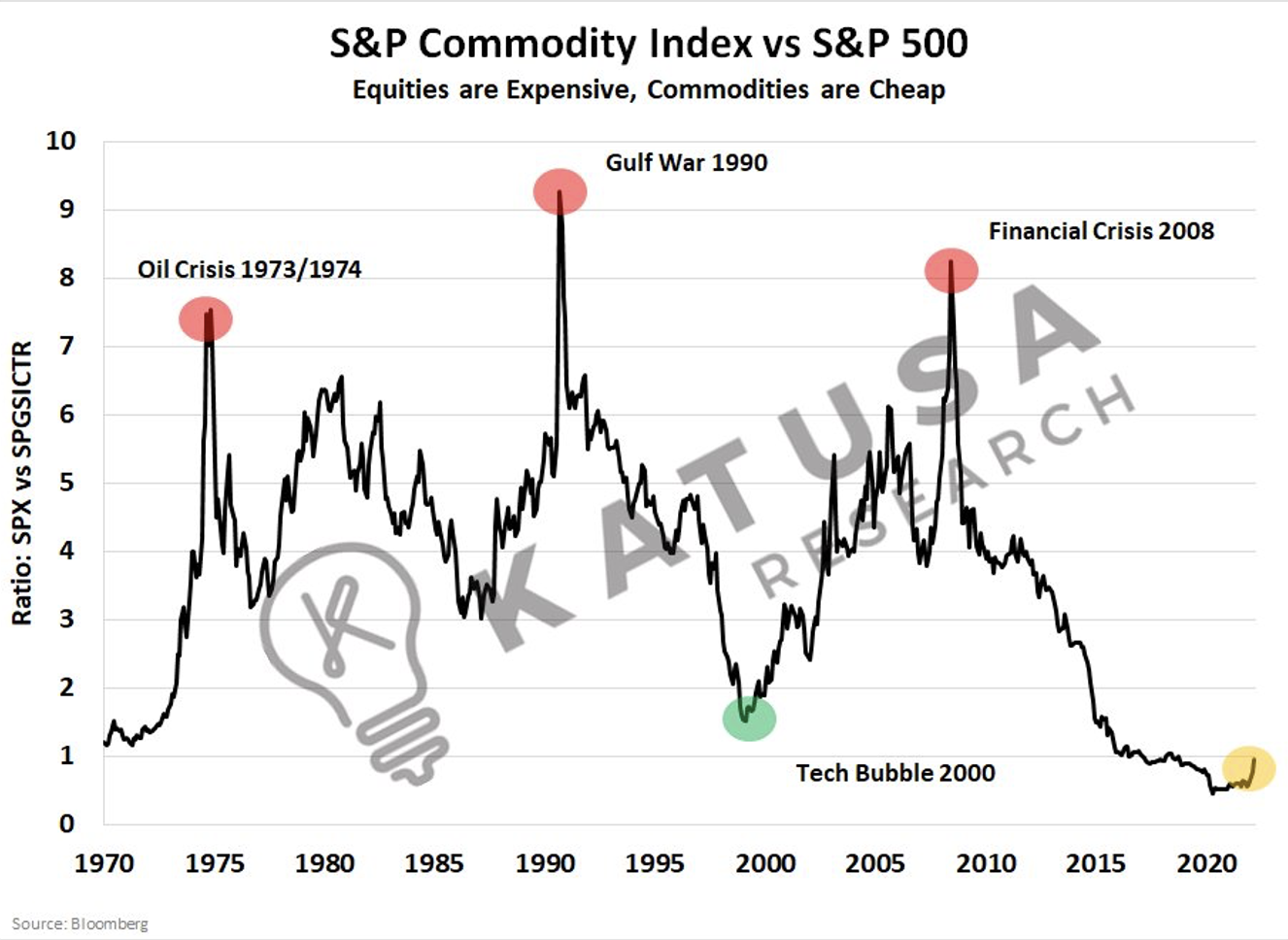
IF this is the beginning of a VIOLENT move upwards, commodities are about to get very expensive...
You’ll see that, relatively speaking, commodities are the cheapest they have ever been compared to the S&P 500. There’s nowhere to go but UP.
You might be thinking, “Yeah, but it feels like gold is already pretty high at $2020+/oz.” But by all metrics, the gold bull market remains at historic lows.
Gold Could Go Vertical, Fast
If you’ve been following precious metals for a long time, one thing’s for sure, the gold market has always moved in cycles. Going from dramatic boom to overnight bust, and eventually back again.
So far in this “boom,” gold has barely risen 20 percent from its floor. That’s not even close to the minimum required to qualify for a true “bull market” over the past century.
The smallest gold run-up in the past 90 years was 45 percent — more than twice the current gain. Every other rally was far, far bigger:
From 1972–1974, the rally yielded a 100 percent gain.
From 1978–1980, another 100 percent gain.
Then from 2007–2010, a 67 percent increase in the price of gold.
As you can see from the chart, when gold is ready to rise, it takes off.
Every single one of the years in the date ranges above saw an increase of more than 20%. That’s how you know the gold rally has barely just begun.
2023 is Inflation Versus the World
Central banks will do everything they can to fight it… and get their economies back on the growth track. And you just saw the Fed raise rates 25bps, a move that stunned the markets and sent the Dow Jones dropping 500 points.
Meanwhile…
According to MarketWatch: “Goldman Sachs says it’s the beginning of a structural bull market in commodities.”
And the Wells Fargo Investment Institute wrote, “After a decade of poor performance… commodities look poised to outperform other assets (possibly for a decade or more)… a new bull supercycle.”
My take? I rarely, if ever, agree with mainstream finance. But in this case, I called it three years ago: We are still very, very early in this gold and resource “supercycle” market, the likes of which the world has never seen before.
With gold prices spiking in short order the past 2 weeks, it has more than just regular precious metals investors paying attention.
The Crowd is Paying Attention
The number of mining companies in the S&P 500 will increase, which means an increase in the flow of capital into the sector.
At the end of the Cold War, there were 20 mining companies in the S&P 500. Today there are only 2.
Sure, you could buy gold bullion…
It’s independent of government-controlled financial systems. Your money will be relatively protected from currency wars.
Sure, you could buy gold-backed ETFs, they offer a little more leverage, and can give you some quick profit when gold starts to rise. But when gold starts going up, gold stocks tend to go up a lot.
Tomorrow, you’ll find out why I love this corner of the resource market and show you examples of the high-risk, high-reward nature of gold stocks.
Tomorrow, I’m releasing a brand-new report – called PROJECT GOLD RUSH.
Where I’ll reveal details about one of the most exciting gold projects I’ve ever seen in my life.
I’m going for the bulls-eye.
Regards, Marin Katusa Chairman, Katusa Research
P.S. (From Marin) Mark your calendars for tomorrow to see my special report on PROJECT GOLD RUSH. You don’t want to miss this.
Can a Trustee Remove a Beneficiary From a Trust?
Can a Trustee Remove a Beneficiary From a Trust?
By Rebecca Lake, CEPF® Tue, April 4, 2023
Creating a trust as part of your estate plan is something you might consider if you'd like to ensure that your assets will be managed according to your wishes after you're gone. When you establish a trust, you'll need to name a trustee to manage assets and one or more beneficiaries who can receive them. Can a trustee remove a beneficiary from a trust? Generally speaking, no, but there are other scenarios when a beneficiary can be removed. For help with your estate plan, consider talking to a financial advisor who has estate planning expertise.
Can a Trustee Remove a Beneficiary From a Trust?
By Rebecca Lake, CEPF® Tue, April 4, 2023
Creating a trust as part of your estate plan is something you might consider if you'd like to ensure that your assets will be managed according to your wishes after you're gone. When you establish a trust, you'll need to name a trustee to manage assets and one or more beneficiaries who can receive them. Can a trustee remove a beneficiary from a trust? Generally speaking, no, but there are other scenarios when a beneficiary can be removed. For help with your estate plan, consider talking to a financial advisor who has estate planning expertise.
Trustee vs. Beneficiary Rights and Responsibilities
A trust is a legal arrangement in which one person, called a grantor, transfers the management of assets to someone else. That someone else is called a trustee.
It's the trustee's job to manage the assets in the trust according to the terms and conditions set down by the grantor. They do so on behalf of one or more beneficiaries. A trust beneficiary is an individual or entity who benefits from the trust.
So, say you want to set up a trust on behalf of your three children. You could name your brother as the trustee and include specific directions about when your children would be entitled to receive assets from the trust. For instance, you might specify that they can't get their inheritance until they reach a certain age or get married.
The trustee is obligated to follow your directions to the letter because they have a fiduciary duty to do so. Fiduciary duty requires trustees to act in the best interests of beneficiaries at all times.
Technically, a trustee can also be a beneficiary but that's not common. It may not be wise either if you'd like there to be some separation of rights and responsibilities between your trustee and your beneficiaries.
Can a Trustee Remove a Beneficiary From a Trust?
To continue reading, please go to the original article here:
https://finance.yahoo.com/news/trustee-remove-beneficiary-trust-130016549.html
How Financial Literacy Changes Once You’re Retired
How Financial Literacy Changes Once You’re Retired
John Csiszar Tue, April 4, 2023
Financial literacy covers a wide range of topics, from budgeting and saving to investing and planning for retirement. Once you retire, however, financial literacy broadens to include scenarios that may not have been as relevant during your working life. For example, income typically drops in retirement, while expenses may remain the same or even rise, depending on the type of lifestyle you lead and the condition of your general health. Financial Literacy Month is a great time for both seniors and those about to retire to review their planning and make sure they're prepared for the changes encountered in retirement.
How Financial Literacy Changes Once You’re Retired
John Csiszar Tue, April 4, 2023
Financial literacy covers a wide range of topics, from budgeting and saving to investing and planning for retirement. Once you retire, however, financial literacy broadens to include scenarios that may not have been as relevant during your working life. For example, income typically drops in retirement, while expenses may remain the same or even rise, depending on the type of lifestyle you lead and the condition of your general health. Financial Literacy Month is a great time for both seniors and those about to retire to review their planning and make sure they're prepared for the changes encountered in retirement.
Here are seven topics that are important to understand if you want to avoid any financial landmines in retirement.
Social Security
From the time you start receiving your first paychecks, you've been paying into the Social Security system. But as you approach retirement, it's time to start planning your Social Security withdrawal strategy instead. Before you hit retirement, it pays to maximize your income in any way possible, as your Social Security payout is based in large part on how much you earn during your working career.
You'll also want to sit with a tax or financial advisor and determine whether you should initiate your payments early, at full retirement age or as late as age 70.
Medicare
Medicare is a health insurance program for seniors, but it's a complicated system with various parts. To use it effectively, you'll have to become literate on how it works. In a nutshell, Medicare consists of two original parts, A and B, which cover hospital and medical expenses, respectively. Part B requires a monthly premium. You can also add Part D if you require prescription drug coverage.
Medicare Advantage, also known as Medicare Part C, is an alternative to Original Medicare that is run by a private company. As the choices can get complicated, you'll likely need to speak to an expert to get financially literate when it comes to Medicare. Note that neither Original Medicare nor Medicare Advantage are likely to cover care outside of the United States.
Required Minimum Distributions
Just like you've paid Social Security taxes your whole working career, hopefully you've done the same in terms of contributions to your retirement plans. But you can't keep your money in those accounts forever. At a certain point, accounts like traditional IRAs and 401(k) plans require you to begin taking annual distributions to avoid a steep 50% penalty tax.
Congress granted a slight reprieve by extending the time at which you must begin RMDs to April 1 following the year you turn 72. Note that as Roth IRAs are funded with after-tax contributions, you're never required to take minimum distributions from them.
Stimulus 2023: Updates To Know Now
Taxes
If you work at a salaried job, your life can be pretty simple when it comes to taxes. Generally, your employer will take out the requisite taxes from your paycheck and all you'll have to do when you file your taxes is include your W-2 information.
To continue reading, please go to the original article here:
https://finance.yahoo.com/news/financial-literacy-changes-once-retired-110012547.html
New Government Report Says Social Security Will Be Broke In 10 Years
New Government Report Says Social Security Will Be Broke In 10 Years
April 3, 2023 Simon Black Sovereign Man
Paris. Such a romantic city. Sip coffee at a sidewalk bistro, while you take in the wafting smell of burning rubber from the street fires. Take a picture with the Eiffel Tower, as you dodge incoming tear-gas canisters. Enjoy the ambiance as you stroll the alleys between 5,600 metric tons of garbage currently rotting on the sidewalks.
See, the sanitation workers’ union is one of several currently on strike in Paris.
They and over a million protesters have lit fires in the streets, destroyed property, and sparred with riot police over the past weeks.
New Government Report Says Social Security Will Be Broke In 10 Years
April 3, 2023 Simon Black Sovereign Man
Paris. Such a romantic city. Sip coffee at a sidewalk bistro, while you take in the wafting smell of burning rubber from the street fires. Take a picture with the Eiffel Tower, as you dodge incoming tear-gas canisters. Enjoy the ambiance as you stroll the alleys between 5,600 metric tons of garbage currently rotting on the sidewalks.
See, the sanitation workers’ union is one of several currently on strike in Paris.
They and over a million protesters have lit fires in the streets, destroyed property, and sparred with riot police over the past weeks.
All in an effort to stop the government from raising the retirement age from 62 to 64 by 2030. (Or from 57 to 59 for professions considered dangerous, such as garbage collectors.)
Like essentially all Western countries, France’s population is aging. And the retirement system depends on more workers paying into the system than retirees collecting.
In 1950, four French workers were paying for just one retired French pensioner.
Today, the ratio is less than two workers for each retiree— and by 2040 it could be about 1:1.
Now, it’s understandable that people are angry over broken promises.
But the public refuses to understand or accept basic financial realities.
They exist in a world where all this stuff is free, and they simply shouldn’t have to worry about things like saving for retirement.
And of course, France is far from unique. It is simply a mild preview of the social chaos that is coming to the US...
Three days ago (last Friday March 31st) the Board of Trustees for Social Security released its annual report.
According to the report, Social Security has been paying out more than it takes in since 2021, and “Social Security’s total cost is projected to be higher than its total income in 2023 and all later years.”
And at that rate, “reserves become depleted in 2033, one year earlier than projected in last year’s report.”
So the situation is actually getting worse.
Keep in mind these aren’t some random fringe economists writing this. The Board of Trustees of Social Security include, for example, US Treasury Secretary Janet Yellen.
So what happens when Social Security’s trust funds run out of money?
Well, the program won’t disappear entirely; there will still be incoming payroll tax revenue to partially fund the program (FICA taxes that are paid by workers).
But just like the situation in France, there simply aren’t enough workers in the system to keep paying full benefits to the program’s 51+ million retirees
This means that, even factoring in payroll tax revenue, Social Security recipients are going to have to take an enormous cut in their monthly benefit of around 25%.
And that might be wildly optimistic; in their annual report the Social Security lists the key assumptions of their projections... and those assumptions look like they could be grossly incorrect.
For example, the agency assumes that inflation in the US will return to 2%-3%, and basically stay there forever. Fat chance.
They also assume that the US fertility rate (which is a critical indication of the number of future taxpayers) will be 2.0; this is another outrageously bad assumption, given that the US fertility rate hasn’t consistently been above 2.0 since the late 1960s!
The trustees are clearly making bad assumptions... so even when they say the trust fund will run dry in 2033, but that they’ll still be able to make roughly 3/4 of the payments, the reality is likely much, much worse.
But right now, with all these obvious problems rapidly approaching, politicians are promising voters that they WON’T touch Social Security.
Even the ones talking about balancing the budget vow not to touch Social Security...
(To balance the budget without touching the sacred cows of Social Security, Medicare, and Defense would require cutting 85% of ALL other federal spending.)
Of course, reality is reality, and places like France show us the inevitable outcome:
*The retirement age will go up
*Benefits will be cut substantially
*Payroll taxes will increase
We might also expect the same, or worse, reaction as in France— massive protests, strikes, riots, property destruction, and social chaos.
And all that will do nothing.
Because there are really two institutions which Americans could realistically expect to solve this problem:
One, the US government, currently saddled with $31.5 trillion of debt and rapidly increasing, with a total net worth (assets versus liabilities) of NEGATIVE $34 trillion.
Two, the Federal Reserve, which last year reported ‘unrealized losses’ of more than $330 billion against just $42 billion in capital, making it completely and totally insolvent.
So there are really only two plays left to make...
The US government could raise taxes to cover the gap.
The Federal Reserve could print money to cover the gap, creating massive inflation.
Without responsible leadership willing to make tough decisions, this is their default option.
There are a few takeaways here.
1. Prepare to fund a portion of your own retirement.
Between inflation and benefit cuts, you simply cannot rely on the promises the government has made to you about your retirement.
It’s probably not going away entirely, but you should consider Social Security as a supplement to your retirement, and not the primary source. You certainly won’t be any worse off if by some miracle Social Security manages to pay the full benefits.
2. Prepare for a future with higher taxes.
And take every legal step at your disposal to reduce what you owe.
3. Prepare for a future with higher inflation.
Again, the government’s inevitable solution is to go deeper into debt, and print the money to fund it. As we’ve already seen, more money printing means more inflation.
That doesn’t necessarily mean inflation will be at 10-15% levels for years to come. But it probably won’t be the 2% average we’ve gotten used to over the past two decades.
The good news is you can control your own fate by having your own retirement funds, which puts you in the driver's seat.
And at the same time, you can lower your taxable income significantly by, for example, contributing to a Traditional 401(k) retirement account.
As of 2023, you can contribute up to $22,500 per year, or $30,000 per year if you're over 50.
For those who are self employed, earn money through a side businesses, or own a business without any employes, using a Solo 401(k) is even more beneficial.
In 2023, the tax-free limit for contributions rises to $66,000 (or $73,500 for those age 50 and older) because you can make both the employer and employee contributions.
A self-directed Solo 401(k) also provides a wider range of investment options such as real estate, foreign investments, private equity, and more.
And this barely even scratches the surface of the options you have available to shore up your retirement, beat inflation, and legally reduce your tax rate.
You don’t have to protest, or vote harder. You simply have to understand the magnitude of the problem, and use the tools at your disposal to fix it.
To your freedom, Simon Black, Founder Sovereign Man
After SVB, are you worried about that your bank could be the next one to collapse suddenly?
Download our new FREE 28-page report entitled "How To Tell If YOUR Bank Is Safe". Packed with eight steps you can take to ensure your money is safe today, it's essential reading for these uncertain times.
Why is it so Essential to Learn Money Skills?
Why is it so Essential to Learn Money Skills?
August 5 2021 Financial Imaginer
Do you know how to take care of money? Did you learn about money in school? From family? From friends? Have you ever wondered how some people seem to have more money than others? Some even have more than they would ever need. This is not just because they’re lucky, it’s because they’ve learned how to take care and manage their money!
If you want to feel confident about your financial future, then there are some things you can learn about money. I can be your teacher. If you invest your time to improve your financial literacy, I promise you here and now this will be one of the best decisions of your life!
Why is it so Essential to Learn Money Skills?
August 5 2021 Financial Imaginer
Do you know how to take care of money? Did you learn about money in school? From family? From friends? Have you ever wondered how some people seem to have more money than others? Some even have more than they would ever need. This is not just because they’re lucky, it’s because they’ve learned how to take care and manage their money!
If you want to feel confident about your financial future, then there are some things you can learn about money. I can be your teacher. If you invest your time to improve your financial literacy, I promise you here and now this will be one of the best decisions of your life!
This article aims to show you how the first steps to a better life must be to improve your financial literacy. Why earning, saving, and investing more money are the key to a better life.
Are you ready to learn how it all goes together and take control of your financial future?
Get yourself a cup of coffee or tea first. Let’s get started!
Learn How to Make Money Work for You
The best time to get started learning money skills is when you’re a child, the second-best time is right now! It’s time to learn how money works and how you can make the most out of it.
Most people work very hard for their money, but why not become the person that makes its money work very hard for yourself? Work on becoming the latter!
Invest in Your Financial Literacy
Before you get started investing into capital markets, invest in your own financial literacy. There are a lot of things you can learn about money. And yes, it isn’t always easy. However, it’s also not rocket science!
What is Financial Literacy?
Financial literacy is the knowledge how money works. It’s the combination of skills and attitudes needed to make sound financial decisions and participate in the full range of money management activities throughout life.
In short: the knowledge and skill to make money work for You! Understanding how money works helps not only financially but also emotionally. Once you know how to make money work for you, the next steps will become easier: from budgeting to saving to investing.
The Most Important Investment of Your Life
To continue reading, please go to the original article here:
How to Avoid Financially Destructive Revenge Spending
How to Avoid Financially Destructive Revenge Spending
4. March 2023 Financial Imaginer
It’s no secret that revenge spending has become a [post-pandemic] phenomenon, as people try to make up for what they believe they might have missed out on during the pandemic. People are playing catch-up, trying to even the score on their deferred consumption. However, while revenge spending can be cathartic and temporarily rewarding, it can also have serious financial consequences if not managed properly.
Revenge spending can take many forms:
Such as catching up for yourself, getting even with your partner or family, or simply YOLO’ing your way through life.
How to Avoid Financially Destructive Revenge Spending
March 4 2023 Financial Imaginer
It’s no secret that revenge spending has become a [post-pandemic] phenomenon, as people try to make up for what they believe they might have missed out on during the pandemic. People are playing catch-up, trying to even the score on their deferred consumption. However, while revenge spending can be cathartic and temporarily rewarding, it can also have serious financial consequences if not managed properly.
Revenge spending can take many forms:
Such as catching up for yourself, getting even with your partner or family, or simply YOLO’ing your way through life.
Unfortunately, revenge spending doesn’t just lead to heightened inflation across the globe but it can also lead to serious financial consequences if not managed properly. It could even destroy potential generational wealth in families.
In this article, we’ll explore the implications of revenge spending and provide some tips on how to overcome it.
Are you ready to talk about revenge spending?
What Is Revenge Spending?
Revenge spending is a phenomenon characterized by impulsive and often excessive spending in an attempt to make up for what people believe they may have missed out on.
It is essentially an act of attempting to fill emotional voids with material items or experiences.
Revenge spending can take form in expensive vacations, luxury purchases, extravagant dates, etc., and it has become increasingly popular over the past year [mainly due to the uncertainty caused by the pandemic].
“This attitude can fuel a habit: “revenge spending,” which, as the name says, is shopping to get back at someone or something that wrongs us — like a job layoff, slumping economy, relationship strife, even a global trauma like the pandemic.”
Dr. Juli Fraga
Revenge spending has both short and long-term implications for not just individuals but for entire economies as well.
Inflation anyone?
Revenge spending can contribute to inflationary pressures in an economy [if it goes unchecked] especially when such expenditures are not backed by income stability or wealth.
In addition, revenge spending also has long-term implications for affected individuals.
It can turn into monetary downward spirals!
Post Pandemic Revenge Spending
In the past two years, revenge spending has become some sort of “post-pandemic phenomenon” that has been popping up around the world.
People are indulging in revenge spending on all kinds of things in an attempt to catch up on what they believe to have missed out on during the pandemic.
It’s almost like the big Marshmallow Test unwind!
To continue reading, please go to the original article here:
The Money Lessons Grief Teaches Us
The Money Lessons Grief Teaches Us
By Kara
I recently I lost my grandmother. It’s been a really hard time and it’s really sad. But today, I don’t want to talk about her. I actually want to talk about how my pursuit of financial independence and frugal living has impacted my ability to grieve.
We don’t make space for grief in the U.S.
There is no federal law that guarantees paid time off for bereavement, including funeral time. Right now it’s a sad time, nationally speaking. 1,117,054 Americans have died from COVID. And 72% of Americans either know someone who died from COVID or was hospitalized because of COVID.
The Money Lessons Grief Teaches Us
By Kara
I recently I lost my grandmother. It’s been a really hard time and it’s really sad. But today, I don’t want to talk about her. I actually want to talk about how my pursuit of financial independence and frugal living has impacted my ability to grieve.
We don’t make space for grief in the U.S.
There is no federal law that guarantees paid time off for bereavement, including funeral time. Right now it’s a sad time, nationally speaking. 1,117,054 Americans have died from COVID. And 72% of Americans either know someone who died from COVID or was hospitalized because of COVID.
Several of our peer nations, including France, Japan, and New Zealand all do have guaranteed paid time off for grieving. But here in the United States, only three states guarantee that same thing.
The Fair Labor Standards Act, the foundation of US labor policy, does not require employers to provide paid leave, including vacation time, to convalesce or time to plan or attend a funeral. In the United States, just three states have passed their own policies. Oregon requires employers to provide 12 unpaid weeks of leave, two of which can be used for bereavement after the death of a family member. Illinois offers two weeks of unpaid bereavement leave, but only after the death of a child.
Maryland recently extended its flexible leave act to require that employers who offer paid leave allow it to be used for bereavement. So even the states that do offer this don’t really offer it right. It’s under very specific circumstances that you are allowed to have mostly unpaid time off to feel sad after the loss of a family member or a loved one.
Since I work for myself, I took four days completely off work after my grandma passed. And that’s a luxury that most Americans do not have. It’s a luxury that I have only because of the fact that I do work for myself and the specific ways that I’ve structured my business.
Frugality has helped me have time to grieve
If you’re more of a visual learner or want to hear more, I talk about my upbringing and my road to FIRE in this video:
https://www.youtube.com/watch?v=313sjuPK8NA
To continue reading, please go to the original article here:
What Is a Power of Appointment For a Trust or Will?
What Is a Power of Appointment For a Trust or Will?
Ashley Kilroy Sat, April 1, 2023
Establishing a trust or will is vital to a well-designed estate plan; you might even use both. However, even the best estate plans can't anticipate changes in the future or head off new tax legislation. Fortunately, a power of appointment can help your beneficiary take control of your estate to minimize taxes and keep the property from falling into the wrong hands. Here's how it works.
Consider working with a financial advisor if you need help setting up an estate plan or managing inherited money.
What Is a Power of Appointment For a Trust or Will?
Ashley Kilroy Sat, April 1, 2023
Establishing a trust or will is vital to a well-designed estate plan; you might even use both. However, even the best estate plans can't anticipate changes in the future or head off new tax legislation. Fortunately, a power of appointment can help your beneficiary take control of your estate to minimize taxes and keep the property from falling into the wrong hands. Here's how it works.
Consider working with a financial advisor if you need help setting up an estate plan or managing inherited money.
What Is a Power of Appointment?
A power of appointment is an ability a grantee or beneficiary receives from the grantor or creator of a trust. The power of appointment allows the beneficiary to change a trust in specific ways in specific contexts. For example, a grandparent might place his or her assets in a trust and give their grandchildren the power of appointment over the trust once the grandparent passes away.
In addition, a power of appointment affects irrevocable trusts – which, as the name implies, are not easy to change. Fortunately, a power of appointment means beneficiaries can modify a trust within the boundaries the trust's creator sets.
Types of Powers of Appointment
There are two types of powers of appointment: general and limited. General power of appointment allows the appointed individual to change and direct the trust however he or she wishes. In essence, a general power of appointment gives over complete control of the trust, and the person who has that power can allocate the trust's assets how that person sees fit.
On the other hand, a limited or special power of appointment has boundaries the holders must follow.
Powers of Appointment and Ownership
Depending on appointment type and state law, powers of appointment have varying effects on ownership. For example, your state's laws may allow you to immediately own property within the trust as the holder of a general power of appointment. However, such ownership also exposes the property to your creditors.
Therefore, if you're in debt or serious financial trouble, the ownership you receive through a power of appointment could mean losing the property altogether. That said, state law may prohibit creditors from seizing the property until the power holder dies. On the other hand, a limited power of appointment typically doesn't grant property ownership.
Power of Appointment Tax Treatment
A power of appointment can affect your tax circumstances, even if you don't exercise the power. Specifically, tax law declares that a general power of appointment designated after Oct. 21, 1942, will add the related trust's value to the power holder's estate upon that person's death. As a result, a general power of appointment usually exposes a trust to federal estate taxes.
To continue reading, please go to the original article here:
https://finance.yahoo.com/news/power-appointment-trust-130014490.html
How to Organize Your Tax Documents for Your Accountant
How to Organize Your Tax Documents for Your Accountant
January 7, 2023 Last Updated on March 8, 2023 by Carolyn
Though this post is directed at US taxpayers, It still should be useful to non-US taxpayers but keep in mind that form references such as 1099’s, Schedule C and US tax rules may not apply. Investment advice published here is of a general nature only as disclosed here.
You have received all your tax slips (w-2’s, 1099’s, etc.), and you have records of your other income and expenses, but now what? How do you organize your tax documents so that your accountant can prepare your taxes with ease?
How to Organize Your Tax Documents for Your Accountant
January 7, 2023 Last Updated on March 8, 2023 by Carolyn
Though this post is directed at US taxpayers, It still should be useful to non-US taxpayers but keep in mind that form references such as 1099’s, Schedule C and US tax rules may not apply. Investment advice published here is of a general nature only as disclosed here.
You have received all your tax slips (w-2’s, 1099’s, etc.), and you have records of your other income and expenses, but now what? How do you organize your tax documents so that your accountant can prepare your taxes with ease?
Hiring a Professional Accountant
This may be a bit biased considering I am a professional accountant but hiring a professional to prepare your income taxes can be a really smart idea.
Not only can it save you a lot of time preparing your taxes in lieu of doing it yourself in Turbo Tax or Tax Act ( many people tell me it takes them 8-10 hours to prepare their own returns) but it can actually save you money and give you peace of mind that you haven’t missed something.
It’s a tax professional’s job to know what deductions you are eligible for and to provide tax planning advice to maximize deductions and minimize income tax liability.
A good accountant will get to know you, your family, and your business so they can spot potential deductions whether it be that your eldest has started university and might have tuition credits or perhaps you have undertaken home renovations and can take advantage of some energy credits. Expect to answer some questions and be perturbed if you’re not asked any!
What Your Tax Preparer Needs to Know
How to Organize Your Tax Documents for Your Accountant?
First of all, be aware that just because you’ve hired an accountant to prepare your taxes doesn’t absolve you of any tax preparation work.
Gone Are the Days of Handing over A Box Full of Receipts
Gone are the days of plunking a shoebox full of receipts on your accountant’s desk and saying “call me if you have any questions”. Do this and you will most surely be shown to the door. Continue reading to find out how to organize your tax documents for your accountant.
Most accountants don’t want to see any receipts at all. What they do want to see is a summary of income by type as well as a summary of deductions by type, followed by another page with a detailed list of those same income and deduction items, whose totals ties into the figures listed on the summary.
Income
I recommend listing out all income reported on forms in this order: W2s, 1099-int, 1099-div, 1099-r, SSA-1099, 1099-B, 1099-G and K-1s. Use 2 columns, one for taxable income, and one for federal tax withheld ( if you have state tax withheld add a 3rd column).
If you have rental income or self-employed income list the income and expenses on a separate page and then just list the property address or business name on your summary and cross-reference to the detailed schedule.
Rental Income and Expenses
You need to separately list income and expenses for each rental property you own. Income will include all rent received including last month’s rent deposits but not damage and pet deposits.
Expenses that you might have include:
To continue reading, please go to the original article here:
https://tucandream.com/how-to-organize-your-tax-documents-for-your-accountant/
How to Stop Being Broke: Change Your Money Mindset
How to Stop Being Broke: Change Your Money Mindset
March 14, 2023 Last Updated on March 23, 2023 by Carolyn
How to Stop Being Broke?
Are you tired of living paycheck to paycheck, and having nothing to show for it? You have a good-paying job but still, it’s a financial squeeze to get through the month and make ends meet. You want to stop being broke but don’t know where to start. More than likely. it’s your money mindset that’s keeping you broke. Before you can change your money mindset you need to know what exactly it is.
What is Money Mindset?
Let’s start with what money mindset is not. For many people who hear the phrase “money mindset” an image of a person like Charles Dickens “Ebenezer Scrooge” counting his coins pops into their head, a person obsessed with money. This is not what money mindset is.
How to Stop Being Broke: Change Your Money Mindset
March 14, 2023 Last Updated on March 23, 2023 by Carolyn
How to Stop Being Broke?
Are you tired of living paycheck to paycheck, and having nothing to show for it? You have a good-paying job but still, it’s a financial squeeze to get through the month and make ends meet. You want to stop being broke but don’t know where to start. More than likely. it’s your money mindset that’s keeping you broke. Before you can change your money mindset you need to know what exactly it is.
What is Money Mindset?
Let’s start with what money mindset is not. For many people who hear the phrase “money mindset” an image of a person like Charles Dickens “Ebenezer Scrooge” counting his coins pops into their head, a person obsessed with money. This is not what money mindset is.
Money mindset is your personal relationship with money; how you feel about it, your beliefs about money, and its role in the world.
Believe
Believe..positive thoughts will yield positive outcomes (image by Nini kvaratskhelia of Unsplash)
Your money mindset is somewhat akin to the law of attraction, how you feel and relate to money will dictate whether you have no money, just enough money, or an abundance of money. Being an extreme left-brain type I’d love to say the path to financial success is to simply work hard and spend less, but sadly this is not the truth, money mindset comes into play and it’s amazing how much it controls the outcome.
Different types of Money Mindsets
Scarcity Mindset VS Abundance Mindset
I’m sure you’ve noticed that some people are inherently spenders while others are savers. These spending habits aren’t related to having an abundance of money or lack thereof, they are a reflection of that person’s individual money mindset.
There are basically two basic types of money mindsets: scarcity mindsets and abundance mindsets. These can be further broken down into different sub-types. Do you identify with any of the following scarcity mindsets? Don’t worry, identifying the problem is the first step in your journey to stop being broke.
Scarcity Mindsets
Scarcity mindsets are based on the belief that there are limited resources in the world, and if someone takes more, you’ll get less. This mindset cultivates fear, jealousy, and selfishness.
I Have Enough Mindset
This is the mindset; “I’m comfortable with what I have. I can pay my bills, I have a roof over my head, why do I need more?”
This kind of mindset is dangerous, it’s a mindset of avoidance. You will never have more than enough and the loss of a job, or a sudden emergency expense, can push you over the edge where you don’t have enough.
Money more than likely causes you stress after all you believe, “ money is the root of all evil”.
Money Grows on Trees Mindset
My husband used to justify additional expenses by saying “I’ll just shoe another horse” (he was a horseshoer). The problem is did he really just shoe another horse? No, he didn’t actively go out and look for another horse to shoe. If not reined in, he had a habit of spending every dollar twice.
This is the “money grows on trees” mindset, I can always earn another dollar so it’s OK to spend it today. It can also be considered a debt mindset or a spenders mindset. You try to buy happiness, and instead, end up with debt and stress.
This mindset will most likely get you into a lot of financial trouble.
“Never spend your money before you have it.” –Thomas Jefferson
To continue reading, please go to the original article here: