
GP Q: US Dollar Upgrade or Collapse?
GP Q: US Dollar Upgrade or Collapse?
10-20-2026
“Is the dollar dying… or is it about to get a major upgrade?”
MONEY MONEY MONEY
Most people are only watching the old fiat dollar.
They’re completely missing the new system the U.S. is building right now under the GENIUS Act. Here’s the simple version:

Core Explanation:
The regular U.S. dollar you use every day is still a pure fiat currency. That means its only value comes from: “trust” in the U.S. government and the Federal Reserve — not from gold or anything else sitting in a vault.
It can go up or down based on interest rates, inflation, and how much the world wants to hold it. Right now it’s off its recent highs, but it is still historically strong and still the main reserve currency.
What’s new is the layer being built on top of it.
In July 2025 the U.S. passed the GENIUS Act.
This law created the first clear federal rules for payment stablecoins — digital dollars that are designed to always stay worth exactly $1.
Here’s the key part most people miss: these are not just “crypto.”
Under the GENIUS Act, every stablecoin issued in the U.S. must be fully backed, one-for-one, with high-quality reserves. That means cash, bank deposits, and especially short-term U.S. Treasury bills.
The issuer has to hold at least $1 of these safe assets for every $1 of stablecoins they put into the world.
So when someone buys a stablecoin, the company that issued it has to go out and buy more Treasuries. That creates real, ongoing demand for U.S. government debt.
The bigger the stablecoin market gets, the more demand there is for Treasuries.
Treasury Secretary Scott Bessent and the administration have said this is intentional. They want dollar stablecoins to grow — potentially into the trillions — so more of the world’s need for dollars turns into demand for U.S. debt.
It also gives people and businesses a fast, digital way to move dollars without relying on the old banking rails.
The rules are still being finalized and the law fully kicks in by early 2027 at the latest. But the direction is clear: the traditional fiat dollar stays the foundation, while a fully reserved digital version is being rolled out on top of it to extend its reach and support demand for Treasuries.
Why it matters / closer
This is not a replacement of the dollar. It’s an attempt to make the dollar more usable in a digital world while locking in extra demand for U.S. government debt.
A weaker traditional dollar and gradual shifts in central-bank reserves are real. At the same time, the U.S. is actively building a new asset-backed digital dollar layer. Both things are happening at once.
If you’re only watching the old fiat dollar chart, you’re missing half the story.
Source(s):
• https://x.com/argosaki/status/2112339162510844142
https://dinarchronicles.com/2026/10/20/gp-q-us-dollar-upgrade-or-collapse/
Rob Cunningham: If the World Could Choose Only One Blockchain
Rob Cunningham: If the World Could Choose Only One Blockchain
10-20-2026
On a go forward basis, “all things considered”, based on the comprehensive utility and liquidity needs of the entire world, “if” only one blockchain was allowed to exist, which should it be?
My choice: the XRP Ledger.
Under this hypothetical – one blockchain serving the world’s combined needs for payments, currencies, tokenized assets, exchange and settlement – XRPL offers the strongest fit in my judgment.

The deciding factor is its combination of financial functions:
• Move value: Fast settlement with low transaction costs.
• Represent value: Issue currencies, stablecoins and tokenized assets.
• Exchange value: A native decentralized exchange and automated market makers.
• Connect liquidity: XRP can bridge trading pairs when it provides a better execution path.
• Ripple adds institutional access through payments, custody, treasury management and prime brokerage.
• RLUSD supplies dollar-denominated liquidity within that broader offering.
• Those services strengthen the case for adoption; they remain distinct from the ledger itself.
One structural point: if only one blockchain existed, ILP would still help connect it to banks, mobile-money systems and other payment networks. Its purpose extends beyond connecting blockchains.
For the specific mission I describe – providing common financial infrastructure for a world of different assets, currencies and owners – I would select XRPL.
This is my judgment about best architectural fit in today’s world.
Source(s):
• https://x.com/KuwlShow/status/2112247733058715971
https://dinarchronicles.com/2026/10/20/rob-cunningham-if-the-world-could-choose-only-one-blockchain/
Iraq Economic News and Points To Ponder Tuesday Afternoon10-20-26
The Central Bank Of Iraq Resolves The Issue Of Merchants' Remittances And Confirms The Continuation Of Import Financing In Dollars.
October 20, 2026Last updated: October 20, 2026 The Central Bank of Iraq confirmed on Tuesday, October 20, 2026, the continuation of financing imports and providing foreign currency through official banking channels, announcing the completion of fulfilling external transfer requests that were suspended before the adjustment of the dinar exchange rate on October 7, in a step aimed at addressing outstanding issues, protecting the rights of traders and ensuring the smooth flow of foreign trade.
The Central Bank explained in an official statement that the applications covered by the procedure are those that meet the approved conditions and controls, calling on traders and companies to review the banks they deal with to ensure that their foreign transfers are carried out and the procedures related to them are completed.
The bank stressed the need to report any unjustified delays in the execution of transfers, or demands from merchants for additional amounts that violate the approved instructions, confirming its readiness to take the necessary measures against violating banks, by following up on complaints submitted through its official electronic platform.
This confirmation comes in the wake of the adjustment of the official exchange rate on October 7, 2026, from 1320 to 1520 dinars per dollar, and the accompanying questions in business circles regarding the fate of remittances that were submitted or financed before the new rate came into effect, particularly the financial obligations related to import and external supply contracts.
The Central Bank had explained in a previous statement, issued on October 10, that it had strengthened bank accounts to cover transfers due before the exchange rate adjustment, stressing the need not to charge traders financial differences for transfers that were proven to have been purchased and covered at the previous rate.
In a related development, the Parliamentary Investment and Development Committee announced on Monday, October 19, that the issue of exchange rate differences for previous remittances had been resolved, noting that banks are obligated to implement remittances covered by the old rate and not to require customers to pay differences resulting from the adjustment, in exchange for adopting the new rate for remittances accepted starting from October 7.
On the economic level, the statement carries two main messages; the first is directed to traders and importers regarding the continued provision of dollars to finance commercial operations that meet the regulations, and the second is to banks regarding the need to adhere to the instructions and not exploit the change in the exchange rate to impose additional unjustified costs.
These measures are of particular importance given the Iraqi market’s extensive reliance on imports to provide food, consumer goods, medicines, and raw materials, as the regularity of foreign transfers is a key factor in companies’ ability to meet their obligations to suppliers and maintain supply chains.
From a monetary perspective, continued financing of foreign trade through official banks could help reduce the reliance of some traders on the parallel market for dollars, which could alleviate some of the pressure on exchange rates. However, achieving this effect remains contingent on the speed of transfers, the efficiency of banks, and the capacity of official channels to absorb actual trade demand.
The Central Bank’s announcement that it will continue to provide foreign currency does not necessarily mean the end of fluctuations in the parallel market, given that exchange rates are affected by other factors including traders’ expectations, speculation, the size of cash demand, and economic and regional conditions.
The Central Bank had confirmed in a previous statement during September that it had sufficient foreign reserves to meet the demands related to financing foreign trade through the approved channels, stressing the continued provision of the market’s needs for foreign currency.
Economic analysis suggests that the real test of the recent measures will not be limited to announcing the completion of funding for delayed remittances, but will extend to the extent of banks’ commitment to actual implementation, settling traders’ complaints, and ensuring that importers are not burdened with illegal financial burdens that may later be passed on to the prices of goods and services.
In this context, banking supervision is a crucial factor in the success of the central bank's policy, especially since any delay in the arrival of foreign payments may affect the cost of imports and shipping and supply dates, thus impacting the movement of local markets.
The data indicates that the central bank is seeking to separate the repercussions of adjusting the exchange rate from the continuity of foreign trade, while preserving the rights of previous remittance holders and preventing the emergence of additional obligations as a result of changing the official rate.
In conclusion, the statement reflects a trend towards containing the effects of the exchange rate adjustment on the commercial sector and enhancing confidence in official banking transactions. However, its repercussions on market stability and dollar prices will remain linked to practical implementation, the speed of completing transfers, and the continued flow of goods to Iraqi markets.
Traders and companies can submit their complaints through the official complaints platform of the Central Bank of Iraq , in case of an unjustified delay or a demand for additional amounts that violate regulations
https://mustaqila.com/البنك-المركزي-العراقي-يحسم-ملف-حوالات/
"Raising Readiness And Immediate Response"... Interior Minister Yasser Al-Maliki Inspects The National Command Center And Directs The Development Of Security Plans And The Strengthening Of Combat Readiness Throughout Iraq
Baghdad - One News - 10/19/2026 Interior Minister Yasser al-Maliki conducted an inspection tour of the ministry's operations department and the National Command Center to review the overall security situation and the readiness level of the security services, directing them to develop plans and enhance immediate response to incidents in various Iraqi governorates.
The Interior Minister’s media office stated that during his tour, Al-Maliki followed up on the daily briefing of security incidents and developments, and inspected the Central Response and Control Directorate 911, where he was briefed on the nature of the tasks and duties assigned to it, and listened to a detailed explanation regarding its work mechanisms and its ability to deal with reports and emergency cases.
He added that the minister held a meeting with the senior staff of the ministry’s operations department and a number of department directors, during which a comprehensive review of the incidents recorded within the security command sectors and governorates was conducted, and procedures to raise performance efficiency and enhance coordination between the various security formations were discussed.
Al-Maliki stressed the need to maintain the full readiness of the security forces, and to develop communications and control systems, in order to ensure a rapid response to incidents and immediate handling of security challenges, as well as to review and update the approved plans in accordance with the requirements of the security situation.
The Minister of Interior also reviewed the force structure and combat readiness, and examined precautionary measures and readiness levels at security and border points, outposts, and fortifications, stressing the importance of enhancing constant preparedness and raising the level of field coordination among security agencies.
https://1news-iq.net/رفع-الجاهزية-والاستجابة-الفورية-وز/
The Central Bank told Nina: Removing zeros is not within our authority and requires a legal and legislative process
Baghdad/ NINA / The Central Bank of Iraq confirmed that the issue of removing zeros from the currency is not within its jurisdiction, but rather requires legislation.
The bank's media director, Haider Ghazi, told the Iraqi National News Agency ( NINA "The issue of removing zeros is not within the bank's authority; it requires legislation, as it is linked to the settlement of debts, legal obligations, and punitive fines under current Iraqi laws. All of these require legislation and codification before the bank can proceed with implementation."
Ghazi added: "If the removal of zeros is enacted, it will require clarification and public awareness campaigns to ensure a new valuation similar to that of the old currency."
Regarding the economic impact of removing zeros, he explained: "The process is simple and has no impact except in accounting; for example, instead of 'million,' it will be 'thousand,' and instead of 'trillion,' it will be 'billion,' and so on."
It should be noted that there is unofficial talk circulating among the public about a decision to remove zeros from the national currency. This has revived discussions about a project that has been proposed on several occasions in recent years, amidst questions about the details of the decision, the entity authorized to implement it, and its potential economic and financial consequences if it moves from the proposal stage to implementation. /End
https://ninanews.com/website/News/Details?key=1320862
Iraq's Rasheed Bank expands lending options
2026-10-20 06:07 Shafaq News- Baghdad Iraq's state-owned Rasheed Bank offers loans and advances of up to 125 million IQD ($82,200) for employees, pensioners, and other borrowers, according to an official bank document.
The document, dated October 19, lists advances for public-sector employees ranging from 5 million to 25 million IQD ($3,290 to $16,450), repayable over five years at an annual declining-balance interest rate of 8%, without a guarantor. Contract employees can receive up to 5 million IQD ($3,290) under the same terms, while pensioners qualify for advances of 5 million to 15 million IQD ($3,290 to $9,870), also over five years at 8% declining interest and without a guarantor.
Other services include installment financing of 5 million to 125 million IQD ($3,290 to $82,200), repayable over 12 months, and financing of 250,000 to 25 million IQD ($165 to $16,450) for employees and pensioners, with repayment periods of 12, 24, or 36 months.
The bank also offers Visa credit cards with limits of up to 5 million IQD ($3,290), marriage advances of up to 10 million IQD ($6,580) over five years, and home renovation and maintenance loans of up to 75 million IQD ($49,340). Healthcare professionals can obtain loans of up to 80 million IQD ($52,630) over five years.
The document further lists university advances of 25 million to 50 million IQD ($16,450 to $32,890) over five years, loans of up to 100 million IQD ($65,790) for special-grade officials, and loans of up to 50 million IQD ($32,890) for notaries public.
Separately, on October 19, Finance Minister Falih Al-Sari directed state-owned Rafidain Bank to resume lending to public-sector employees, simplify loan applications, and expand financing for private businesses.
Iraq's state-owned banks have faced months of lending restrictions due to liquidity shortages. Central Bank of Iraq data showed deposits falling 5.6% and cash credit contracting 5.4% in the first half of 2026.
1 US dollar = 1520 Iraqi dinars https://shafaq.com/en/Economy/Iraq-s-Rasheed-Bank-expands-lending-options
Seeds of Wisdom RV and Economics Updates Tuesday Afternoon 10-20-26
Good Afternoon Dinar Recaps,
GLOBAL ASSET RESET WATCH: DEBT, AI UNCERTAINTY AND ENERGY RISKS RESHAPE SAFE-HAVEN DEMAND
Investors are reassessing where to protect their wealth as geopolitical conflict, rising energy prices, government debt and uncertainty surrounding artificial intelligence reshape global markets.
OVERVIEW
The U.S. dollar, Swiss franc, German government bonds and gold are responding differently to today's financial and geopolitical pressures.
AI investment concerns and rising government debt are challenging confidence in some traditional safe-haven assets.
Energy-market disruption is influencing inflation expectations and investor decisions, making the global movement of capital increasingly important to watch.
KEY DEVELOPMENTS
1. The U.S. dollar remains a safe haven—but questions persist
The U.S. dollar has strengthened approximately 4% since late February, supported by relatively strong economic conditions, higher interest rates and the United States' position as a major energy exporter.
Yet concerns about the country's more than $40 trillion debt burden and policy uncertainty remain. The dollar's recent strength demonstrates that investors may still seek dollar assets during periods of stress, even while questioning the currency's longer-term outlook.
The key distinction: Short-term demand for the dollar does not eliminate longer-term concerns about government debt, fiscal sustainability or reserve diversification.
2. The Swiss franc and German bonds are attracting attention
Investors are also looking toward other established safe havens.
The Swiss franc has strengthened against the euro amid concerns about French public finances and political uncertainty in Europe. Meanwhile, German government bonds have shown relative resilience as investors seek assets viewed as more dependable during periods of market turbulence.
These developments demonstrate that safe-haven demand is not limited to a single currency or asset class. Investors compare economic stability, government finances, liquidity and perceived risk when deciding where to place their capital.
However, neither the franc's strength nor demand for German bonds establishes that the euro is collapsing or that the international monetary system is undergoing a coordinated reset.
3. Gold remains important despite market volatility
Gold has experienced substantial price swings in 2026. After reaching a reported record of approximately $5,595 per troy ounce in January, it subsequently retreated as investors reacted to geopolitical and market pressures.
Reuters reported gold trading around $4,175 per ounce in its October 20 analysis, with central-bank purchases and geopolitical uncertainty continuing to support demand.
Gold's behavior illustrates an important point: even assets considered stores of value can decline when investors sell holdings to raise cash or cover losses elsewhere.
Its longer-term appeal depends on several factors, including real interest rates, inflation expectations, central-bank purchases and confidence in government finances.
4. AI uncertainty is adding another layer of financial risk
Artificial intelligence remains a major source of investment and economic opportunity, but the scale of spending on data centers, chips and computing infrastructure has also raised questions about future returns and borrowing.
A separate Financial Times report published today describes increased use of credit-default swaps, financial contracts that can provide protection against a borrower's default, as investors hedge risks linked to heavily financed AI infrastructure.
This does not mean an AI-related financial crisis is inevitable. It does show that some investors are paying closer attention to how AI expansion is funded and whether future earnings can justify the investment.
If concerns spread, the effects could reach technology stocks, corporate borrowing, credit markets and broader investor confidence.
WHY IT MATTERS
Safe-haven demand provides a window into how investors assess risk across the global financial system.
When debt levels rise, energy prices surge or technology valuations come under pressure, investors may change the balance of their holdings. Those decisions can influence exchange rates, government bond yields, gold prices and international capital flows.
Several important developments deserve attention:
Debt: Governments with rising interest expenses may face greater pressure to demonstrate fiscal discipline.
Energy: Higher oil prices can raise inflation, increase import costs and complicate central-bank policy.
Technology: AI investment can support growth, but excessive borrowing or disappointing returns could expose credit vulnerabilities.
Assets: Investors may diversify among currencies, bonds, gold and other holdings rather than rely on one traditional safe haven.
Confidence: Financial stability depends not only on asset prices but also on trust in governments, institutions and markets.
The important message is that traditional safe havens are not equally safe under every circumstance. Their relative appeal changes with the source of the risk, the cost of holding an asset and the financial strength of the institution or government behind it.
WHY IT MATTERS TO FOREIGN CURRENCY HOLDERS
For foreign currency holders following the possibility of a global financial reset, these developments offer useful evidence of how international capital responds to uncertainty.
Changes in investor demand can affect currencies, but exchange rates are influenced by multiple forces, including interest-rate differences, inflation, trade balances, central-bank policy and economic growth.
A stronger Swiss franc does not automatically mean the euro will be revalued. Gold's price does not establish a future official gold-backed currency. And concern about U.S. debt does not prove that the dollar is about to collapse.
What should currency holders watch?
Central-bank reserve data: Are official institutions making documented changes to the composition of their reserves?
Currency performance: Are movements sustained over time, or are they short-term reactions to market stress?
Gold demand: Are central banks continuing to report purchases, and how are prices responding to interest rates?
Debt and credit conditions: Are borrowing costs and credit-risk indicators signaling growing financial pressure?
Official policy announcements: Are governments or monetary authorities actually implementing changes to settlement systems, reserves or currency arrangements?
The best approach remains hope without hype. Real financial changes deserve attention, but speculative predictions about guaranteed currency gains should never replace evidence or sound financial judgment.
THE FIVE PILLARS CONNECTION
Pillar 1: Debt
Government borrowing and rising interest expenses are influencing how investors judge sovereign bonds. Countries with stronger perceived fiscal positions may attract additional demand when confidence weakens elsewhere.
Pillar 2: Trade
Trade relationships affect capital flows and currency demand. Energy importers may face higher costs when oil prices rise, while major energy exporters can experience different economic and currency effects.
Pillar 3: Assets
This is the central pillar of the story. Investors are reassessing the relative appeal of dollars, Swiss francs, government bonds and gold as financial and geopolitical risks change.
Pillar 4: Technology
AI investment is reshaping business expectations and capital allocation. Its long-term impact will depend on productivity gains, sustainable financing and whether the returns justify the scale of investment.
Pillar 5: Energy
Energy-market disruption can influence inflation, interest rates, trade balances and investor confidence. Energy security remains a major factor in the economic outlook and the movement of global capital.
THE BOTTOM LINE
The latest market developments show that investors are reassessing traditional safe havens rather than simply abandoning them. The dollar remains influential, the Swiss franc and German bonds are attracting attention, and gold continues to draw support from central-bank demand and geopolitical uncertainty. Meanwhile, concerns about AI financing and government debt are adding complexity to investment decisions.
For global financial reset watchers, the most important signal is not that one asset has won or another has failed. It is that investors are continually reassessing where trust, liquidity and financial resilience are strongest.
As debt, technology, energy and geopolitics reshape investment decisions, the evolution of the global financial system will be defined by how capital moves—and where the world continues to place its trust.
Seeds of Wisdom Team
SOURCES
Reuters — “How safe havens stack up as tech, energy and France fears grip markets”
Financial Times — “AI debt worries spark surge in default insurance trading”
~~~~~~~~~~
RV Facts with Proof - Step 1🌱 Link
RV Intel Highlights - Step 2🔥 Link
Start Here room with over 110 RV Topics Link
Ask Your ❓Questions❓ in the Q & A Room Link
Seeds of Wisdom Team Rooms Directory Link
Follow the Gold/Silver Rate COMEX
Follow Fast Facts
Seeds of Wisdom Team™ Website
Seeds of Wisdom Team™ Rumble
Thank you Dinar Recaps
Reset Intelligence: Iraq's Oil Exports Are Back.
Reset Intelligence: Iraq's Oil Exports Are Back.
By Reset Intelligence | @EXIT_FIAT
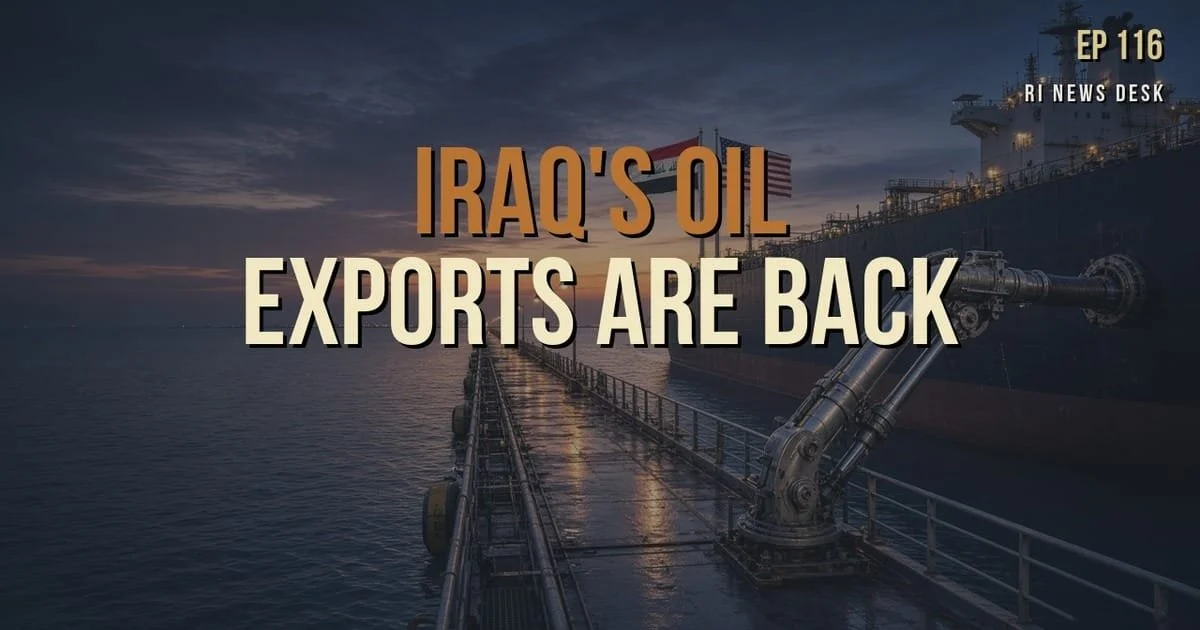
Iraq's oil exports are back above 3.4 million barrels a day, close to where they stood before the war.
The same weekend the IMF and Washington both moved toward Baghdad, and the street dollar went the other way.
Reset Intelligence: Iraq's Oil Exports Are Back.
By Reset Intelligence | @EXIT_FIAT
Iraq's oil exports are back above 3.4 million barrels a day, close to where they stood before the war.
The same weekend the IMF and Washington both moved toward Baghdad, and the street dollar went the other way.
The oil
Iraq's Oil Minister said on Monday that exports this month have averaged more than 3.4 million barrels a day, up from about 3 million in September. The oil is leaving through the Strait of Hormuz, through Turkey's port at Ceyhan, and by tanker truck across Syria. When Baghdad cut the dinar to 1,500 this month, the reason it gave was oil that could not get out.
What moved this weekend
The IMF - on Saturday the Fund's managing director said it will support Iraq "very firmly" with money and policy through the loan programme Baghdad asked for. No amount or terms yet.
Exchange companies - on Sunday Iraq's Central Bank said the US Treasury had lifted restrictions on a number of Iraqi exchange companies, so they can sell dollars to travellers again.
The street - Baghdad closed Monday at 168,350 IQD for $100, against the bank's 152,000 and the government's target of 155,000.
The court - a member of parliament has asked the Federal Supreme Court to rule on the vote that added three deputy prime ministers and three new ministries.
The question
The oil that was stuck is moving again. What does that do to the reason the dinar was cut, and which two numbers tell you whether it is working?
That is the short version. Why the Central Bank's own reason for the cut is now reversing, and what a holder should watch next - that is the daily read.
Read the full daily briefing free for 5 days. Sign up here: the daily Iraqi dinar briefing
Want it straight from the horse's mouth? The CBI Rate Alert pings you the moment the Central Bank of Iraq moves the official rate. The number itself, not a rumour about it. It comes with our free resource library and the daily breakdown of what is actually moving in Iraq. Sign up free: The CBI Rate Alert
Got a dinar question? Reset Intelligence runs an on-call research assistant: ask it anything they have published. It answers in seconds and will conduct deep research to find you the answer. Try it: the Iraqi dinar research assistant
Common questions, answered straight: When will the Iraqi dinar revalue? and Is the Iraqi dinar revaluation real?
The design behind all of it is mapped in Head of the Snake, and the free guides live in the Iraqi dinar resource library.
Follow the daily intel free: Telegram · Facebook · Spotify · Odysee
Book: resetintelligence.com/head-of-the-snake
Daily Briefings: resetintelligence.com
Follow on Socials: X · Facebook · Telegram · Rumble · Spotify
Tuesday Iraq News Posted by Tishwash at TNT 10-20-2026
TNT:
Tishwash: 45 trillion outside the banks... Parliamentary Finance Committee reveals the extent of the crisis of confidence in banks
The head of the parliamentary finance committee, Uday Awad, revealed the existence of a cash mass ranging between 40 and 45 trillion dinars outside the Iraqi banking system, attributing this to the weak confidence of citizens in banks, while stressing the work to find solutions to return these funds to the banking cycle .
Awad said during a televised interview followed by Al-Sa’a Network that “there is a cash mass estimated at about 40 to 45 trillion dinars outside the banking system,” noting that “the lack of confidence in banks has led citizens to keep their money away from them.”
He explained that "addressing the problem requires restoring the citizen's confidence in the banking system and developing its working mechanisms," noting that "automating the banking sector represents one of the main paths to moving from traditional collection methods to a more organized financial system."
The head of the Finance Committee addressed the exchange rate crisis, explaining that "the Central Bank pledged to take measures to reduce the gap in dollar prices, including raising the sales ceiling to cover citizens' needs related to travel, study and treatment."
Awad’s remarks come in conjunction with the financial pressures facing the state, as he revealed that “the budget was prepared based on an oil price of $58 per barrel, with a deficit exceeding 50 trillion dinars,” stressing that “the Finance Committee will work on making transfers and reducing unnecessary expenditures to reduce the size of the deficit without putting pressure on the Central Bank’s reserves.”
According to Awad, "Addressing financial imbalances is not only related to the budget, but also includes reforming the banking sector and bringing funds outside banks back into the financial system, allowing for the expansion of banking activity and reducing reliance on traditional cash transactions link
Tishwash: The US Treasury lifts restrictions on a number of exchange companies
The Central Bank decided yesterday, Sunday, to raise the value of the amounts allocated for the purchase of housing units to 3 trillion dinars through the Real Estate Bank.
While the bank announced the introduction of a new electronic system for replacing damaged currency,
it confirmed that the US Treasury Department lifted restrictions on a number of Iraqi exchange companies.
According to a document addressed to the Real Estate Bank, which was received by “Al-Sabah”, the bank stated that “Based on this bank’s role in supporting the housing sector, and based on the provisions of Law No. (56) of 2004 amended, it was decided to increase the allocation amount referred to in paragraph (1/A) of our letter No. (H S/4451/6/11) dated 8/22/2024, by an amount of (1) trillion dinars, in order to meet the requests of citizens wishing to purchase housing units within residential complexes, so that the total allocation amount becomes (3) trillion dinars, according to the same conditions mentioned in our letter referred to above.”
The Central Bank of Iraq also announced, in a statement received by Al-Sabah, that it “has introduced a new electronic system for replacing damaged currency, as part of its efforts to simplify procedures and make it easier for citizens to access this service in a faster and more organized manner.”
He added that "the system allows citizens to submit requests to replace damaged currency electronically through the 'Ur' platform, by entering and verifying the required data. The relevant departments at the Central Bank of Iraq will then complete the necessary procedures to finalize the replacement process." He explained that "the development of this system is part of the Central Bank of Iraq's efforts towards digital transformation and improving services provided to citizens," and added that "citizens wishing to benefit from the service can submit their requests through the Ur electronic platform."
In another statement, the bank said: "The US Treasury Department has lifted restrictions on a number of Iraqi exchange companies, after verifying that they meet the compliance standards approved by the Central Bank of Iraq, allowing them to return to participating in dollar sales to travelers."
He added that "this step comes within the framework of strengthening compliance with regulatory controls and regulating foreign currency sales operations in accordance with the approved frameworks."
In addition, the Central Bank of Iraq called on Sunday for all licensed banks to facilitate foreign transfers to streamline foreign transfer procedures for customers with completed transactions.
A statement from the Central Bank added that "the bank will boost the balances of banks' accounts abroad as needed, and exempt banks from the deposit period requirement via the RTGS system." link
*************
Tishwash: Iraqi economic reforms: International praise awaits tangible results
The financial advisor to the Prime Minister, Mazhar Muhammad Saleh, confirmed that the Iraqi economic reforms enhance confidence in the economy and improve the management of public finances, but he stressed that their success is measured by sustainable results that include spending efficiency, financial stability, and reducing the impact of oil price fluctuations.
Financial pressures on Iraq are increasing as the budget deficit widens, amid a move towards external borrowing after the International Monetary Fund announced its readiness to provide financial support to Baghdad at the official request. This development raises questions about the effectiveness of government economic measures, particularly the decision to raise the dollar exchange rate, which Prime Minister Ali Faleh al-Zaidi had previously confirmed was aimed at avoiding external borrowing and doubling debts.
While no decisive government position has been issued confirming or denying the continuation of the lending program, economic specialists warn of the consequences of the potential reform conditions, interest costs and their impact on the livelihood of citizens.
Amid talk of an imminent borrowing plan, the Prime Minister’s financial advisor, Mazhar Muhammad Salih, presented a vision that addresses international praise for economic reforms, without confirming or denying Baghdad’s actual intention to borrow from the International Monetary Fund, a matter on which, as of the writing of this report, no official statement has been issued by the Iraqi government clarifying its position.
IMF praise
Saleh said that “the praise from IMF officials for the efforts made by the Iraqi government in implementing financial and economic reforms reflects the importance of the reform path adopted by Iraq to enhance economic stability, consolidate the foundations of sound public finance management, and raise the efficiency of financial and monetary policies.”
He explained that “this praise represents a positive indicator of the importance of the measures taken to enhance confidence in the Iraqi economy and develop its relations with international financial institutions.”
He added that “the true measure of the success of these reforms depends on their ability to achieve tangible and sustainable results that reflect on the strength of the financial situation, improve the efficiency of government spending, enhance economic stability, and reduce the repercussions of oil price fluctuations on the general budget.”
Saleh added that “the reforms being worked on by the Ministry of Finance are of strategic importance, as they are a fundamental pillar for restructuring the national economy, diversifying revenue sources, and reducing excessive dependence on oil resources,” explaining that “this requires developing the tax and customs system, raising collection efficiency, expanding the base of non-oil revenues, enhancing digital transformation and transparency, in addition to rationalizing public spending and directing resources towards development priorities and economically viable projects.”
He pointed out that “the success of these reforms is linked to creating a stable and attractive investment environment based on clear legislation, simplified procedures, development of the banking sector, and expanding financing opportunities for small and medium enterprises, which enhances the contribution of the private sector to economic activity, supports productive sectors, provides real job opportunities, and paves the way for a transition towards a diversified economy that is more capable of growth and sustainability.”
Updating financial policies
The financial advisor stressed “the importance of continuing cooperation with the International Monetary Fund as a partner in providing technical advice, developing institutional capacities, supporting the modernization of financial and economic policies, and benefiting from international experiences in managing public resources and addressing economic challenges.”
He pointed out the possibility of “employing this cooperation effectively by accelerating the implementation of priority reforms, setting clear and measurable goals, enhancing governance and transparency, improving public financial management, and developing oversight and performance evaluation mechanisms, in order to ensure that recommendations are transformed into practical actions with a sustainable impact.”
Saleh added that “financial steps must be accompanied by directing investments towards the industrial, agricultural, infrastructure, energy, education and health sectors, in a way that contributes to raising productivity, stimulating growth and expanding the economic base, while maintaining social protection for low-income groups and achieving a balance between the requirements of financial reform and social justice.”
He added that “the real challenge for Iraq is not limited to passing reforms or obtaining praise from international institutions, but rather lies in establishing them as a sustainable approach to managing the economy, and turning them into tangible results that citizens feel in their daily lives, through improving public services, expanding job opportunities , enhancing purchasing power, raising income levels, and providing a more stable and confident economic environment.”
He stressed that “the more fiscal discipline is linked to diversifying income sources and revitalizing the private sector, the stronger Iraq’s ability to cope with shocks and achieve comprehensive development will be.” link
Tishwash: The Central Bank of Iraq resolves the issue of merchants' remittances and confirms the continuation of import financing in dollars.
The Central Bank of Iraq confirmed on Tuesday, October 20, 2026, the continuation of financing imports and providing foreign currency through official banking channels, announcing the completion of fulfilling external transfer requests that were suspended before the adjustment of the dinar exchange rate on October 7, in a step aimed at addressing outstanding issues, protecting the rights of traders and ensuring the smooth flow of foreign trade.
The Central Bank explained in an official statement that the applications covered by the procedure are those that meet the approved conditions and controls, calling on traders and companies to review the banks they deal with to ensure that their foreign transfers are carried out and the procedures related to them are completed.
The bank stressed the need to report any unjustified delays in the execution of transfers, or demands from merchants for additional amounts that violate the approved instructions, confirming its readiness to take the necessary measures against violating banks, by following up on complaints submitted through its official electronic platform.
This confirmation comes in the wake of the adjustment of the official exchange rate on October 7, 2026, from 1320 to 1520 dinars per dollar, and the accompanying questions in business circles regarding the fate of remittances that were submitted or financed before the new rate came into effect, particularly the financial obligations related to import and external supply contracts.
The Central Bank had explained in a previous statement, issued on October 10, that it had strengthened bank accounts to cover transfers due before the exchange rate adjustment, stressing the need not to charge traders financial differences for transfers that were proven to have been purchased and covered at the previous rate.
In a related development, the Parliamentary Investment and Development Committee announced on Monday, October 19, that the issue of exchange rate differences for previous remittances had been resolved, noting that banks are obligated to implement remittances covered by the old rate and not to require customers to pay differences resulting from the adjustment, in exchange for adopting the new rate for remittances accepted starting from October 7.
On the economic level, the statement carries two main messages; the first is directed to traders and importers regarding the continued provision of dollars to finance commercial operations that meet the regulations, and the second is to banks regarding the need to adhere to the instructions and not exploit the change in the exchange rate to impose additional unjustified costs.
These measures are of particular importance given the Iraqi market’s extensive reliance on imports to provide food, consumer goods, medicines, and raw materials, as the regularity of foreign transfers is a key factor in companies’ ability to meet their obligations to suppliers and maintain supply chains.
From a monetary perspective, continued financing of foreign trade through official banks could help reduce the reliance of some traders on the parallel market for dollars, which could alleviate some of the pressure on exchange rates. However, achieving this effect remains contingent on the speed of transfers, the efficiency of banks, and the capacity of official channels to absorb actual trade demand.
The Central Bank’s announcement that it will continue to provide foreign currency does not necessarily mean the end of fluctuations in the parallel market, given that exchange rates are affected by other factors including traders’ expectations, speculation, the size of cash demand, and economic and regional conditions.
The Central Bank had confirmed in a previous statement during September that it had sufficient foreign reserves to meet the demands related to financing foreign trade through the approved channels, stressing the continued provision of the market’s needs for foreign currency.
Economic analysis suggests that the real test of the recent measures will not be limited to announcing the completion of funding for delayed remittances, but will extend to the extent of banks’ commitment to actual implementation, settling traders’ complaints, and ensuring that importers are not burdened with illegal financial burdens that may later be passed on to the prices of goods and services.
In this context, banking supervision is a crucial factor in the success of the central bank's policy, especially since any delay in the arrival of foreign payments may affect the cost of imports and shipping and supply dates, thus impacting the movement of local markets.
The data indicates that the central bank is seeking to separate the repercussions of adjusting the exchange rate from the continuity of foreign trade, while preserving the rights of previous remittance holders and preventing the emergence of additional obligations as a result of changing the official rate.
In conclusion, the statement reflects a trend towards containing the effects of the exchange rate adjustment on the commercial sector and enhancing confidence in official banking transactions. However, its repercussions on market stability and dollar prices will remain linked to practical implementation, the speed of completing transfers, and the continued flow of goods to Iraqi markets.
Traders and companies can submit their complaints through the official complaints platform of the Central Bank of Iraq , in case of an unjustified delay or a demand for additional amounts that violate regulations link
Iraq Economic News and Points To Ponder Tuesday Morning 10-20-26
Iraq Absent From Top US Treasury Holders List
2026-10-19 17:56 Shafaq News- Washington Iraq was absent from the list of major foreign holders of US Treasury securities in August 2026, as total foreign holdings rose to $9.3317 trillion from $9.2484 trillion in July, according to US Treasury Department data released on October 16.
Saudi Arabia ranked 17th, with $141.2 billion in US Treasuries, down from $142.4 billion in July, while the UAE placed 19th with $116.1 billion, up from $110.1 billion. Japan topped the list at $1.0683 trillion, followed by the United Kingdom with $1.0095 trillion and China with $590.7 billion.
Iraq's holdings reached $42 billion in December 2025, up from $41.1 billion in November, according to US Treasury data.
Its absence from the latest ranking does not mean it has sold all its holdings. Countries outside the leading group fall under the Treasury's broader reporting categories, while securities held through foreign custodians may not always reflect their ultimate owners.
Read more: Iraq diversifies reserves beyond US treasuries
https://shafaq.com/en/Economy/Iraq-absent-from-top-US-Treasury-holders-list
Brent Tops $110 As Middle East Tensions Escalate
2026-10-20 01:22 Shafaq News Oil prices advanced on Tuesday, with Brent hovering around a five-month high as traders priced in a geopolitical risk premium from Houthi attacks on Saudi infrastructure and reports of vessel attacks in the Gulf.
Brent crude futures climbed 55 cents, or 0.50%, to $110.10 a barrel by 0319 GMT, after rising as high as $110.70 a barrel in the previous session to their highest since May 20.
The US West Texas Intermediate crude (WTI) contract for November delivery, set to expire on Tuesday, was up 0.24% to $103.91. The more-active December contract rose 39 cents, or 0.40%, to $98.93.
"Oil prices remain well-supported ... This suggests the market is pricing in a significant risk premium, given the situation's volatility," ING analysts said in a note on Tuesday.
"However, if flows continue uninhibited despite the geopolitical environment, the risk premium would likely erode slowly. Clearly, there are no signs of this yet."
At least 18 vessels were reportedly attacked over two weeks, which keeps the risk premium intact, shiptracker Kpler said in a note on Monday.
HOUTHIS CLAIM ATTACKS ON SAUDI FACILITIES
Yemen's Iran-aligned Houthis said on Monday they launched several attacks on Saudi energy, airport and military targets, such as an Aramco (2222.SE) site in Yanbu, the Shaybah oilfield, Riyadh's King Khalid International Airport and Abha airport.
Saudi authorities did not immediately confirm the claims and Reuters could not independently verify them.
Also on Monday, a Houthi attack on a training camp for government security forces in Yemen's Shabwa province killed 58 people with more than 200 injured.
The renewed attacks heightened fears about regional stability and underscored continuing risks to energy supply from the region, keeping oil prices above $100 a barrel.
In the US, crude oil stockpiles were expected to have fallen last week along with product inventories, a preliminary Reuters poll showed on Monday.
Friday's executive order by President Donald Trump waived key Russia-related US sanctions and tariffs, including goods duties and penalties for purchases of its energy.
However, Trump said on Saturday he had yet to announce a final decision on the matter, while Secretary of State Marco Rubio said officials wanted more time to evaluate the situation.
Russia's crude oil production increased by 65,000 barrels per day in September to 8.43 million bpd, but remained about 870,000 bpd below that of a year ago, the International Energy Agency said last week.
"While the prospect of additional Russian diesel supply offers some theoretical relief, traders appear far more focused on the ongoing risk of further damage to energy infrastructure across the Gulf region," said Tim Waterer, KCM Trade chief analyst. (Reuters) https://shafaq.com/en/Economy/Brent-tops-110-as-Middle-East-tensions-escalate
Basrah Crudes Fall Despite Rising Brent, WTI
2026-10-20 02:50 Shafaq News- Basrah Iraq’s Basrah crude prices fell by up to 3.4% on Tuesday despite gains in benchmark crude futures.
Basrah Heavy crude dropped $2.38, or 3.40%, to $67.70 per barrel, while Basrah Medium crude fell $1.38, or 1.89%, to $71.70 per barrel.
US West Texas Intermediate (WTI) crude rose 39 cents, or 0.40%, to $98.93 per barrel, while Brent crude gained 55 cents, or 0.50%, to $110.10 per barrel. https://shafaq.com/en/Economy/Basrah-crudes-fall-despite-rising-Brent-WTI
US Dollar Dips In Baghdad And Erbil
2026-10-20 03:40 Shafaq News- Baghdad/ Erbil The US dollar opened Tuesday’s trading lower in Iraq, hovering around 168,000 dinars per 100 dollars.
According to a Shafaq News market survey, the dollar traded in Baghdad’s Al-Kifah and Al-Harithiya exchanges at 168,250 dinars per 100 dollars, down from the previous session’s 168,600 dinars.
In the Iraqi capital, exchange shops sold the dollar at 168,750 dinars and bought it at 167,750 dinars, while in Erbil, selling prices stood at 168,050 dinars and buying prices at 167,950 dinars.
https://shafaq.com/en/Economy/US-dollar-dips-in-Baghdad-and-Erbil
Gold Drops In Baghdad And Erbil
2026-10-20 05:33 Shafaq News- Baghdad/ Erbil On Tuesday, gold prices fell in Baghdad and Erbil markets, hovering around 980,000 IQD per mithqal, according to a Shafaq News survey.
Gold prices on Baghdad’s Al-Nahr Street recorded a selling price of 974,000 IQD per mithqal (equivalent to five grams) for 21-carat gold, including Gulf, Turkish, and European varieties, with a buying price of 970,000 IQD, down from Monday’s 990,000 IQD.
The selling price for 21-carat Iraqi gold stood at 944,000 IQD, while the buying price reached 956,000 IQD.
In jewelry stores, the selling price per mithqal of 21-carat Gulf gold ranged between 975,000 and 985,000 IQD, while Iraqi gold sold for between 945,000 and 955,000 IQD.
In Erbil, 22-carat gold was sold at 1,035,000 IQD per mithqal, 21-carat gold at 990,000 IQD, and 18-carat gold at 847,000 IQD. https://shafaq.com/en/Economy/Gold-drops-in-Baghdad-and-Erbil
Iraq's Oil Exports To China Surge 248%
2026-10-20 06:58 Shafaq News- Baghdad/ Beijing China's crude oil imports from Iraq surged 248% from August to September, reaching 4.84 million tons, or about 1.18 million barrels per day (bpd), despite falling 19% year-on-year, according to Chinese customs data.
Read more: Iraqi oil exports recover after regional conflict
Russia remained China's largest crude supplier, shipping 9.94 million tons, or about 2.42 million bpd, up 20% from a year earlier but down 11% from August. Brazil supplied 5.15 million tons, or about 1.25 million bpd, an 18% annual increase, while Saudi shipments fell 62% to 2.70 million tons, or roughly 660,000 bpd.
Brazil also overtook Saudi Arabia as China's second-largest crude supplier in the first nine months of 2026, shipping 44.29 million tons compared with 43.12 million tons from the Kingdom.
Elsewhere, Chinese imports from Oman reached 1.22 million tons, or about 300,000 bpd, down 54% year-on-year but up 30% from August. Imports from Malaysia, a major transshipment hub for sanctioned Iranian oil, fell 70% year-on-year and 56% from August to 1.16 million tons, or about 280,000 bpd.
Chinese customs recorded no crude imports from the United States, Venezuela, or Iran in September, unchanged from the same month last year. https://shafaq.com/en/Economy/Iraq-s-oil-exports-to-China-surge-248
ISX Trading Value Plunges 67% Weekly
2026-10-20 08:10 Shafaq News- Baghdad The Iraq Stock Exchange (ISX) recorded trading worth more than 2 billion Iraqi dinars (about $1.68 million) last week, down 67% from the previous week.
According to market data, 1.852 billion shares were traded, an increase of 6.8% from the previous week, with total trading value reaching 2.560 billion dinars across 3,676 transactions.
The ISX60 index closed at 943.57 points, down 1.54% from the previous session.
Shares in 57 companies were traded during the week, while 36 companies recorded no activity because buy and sell orders did not match. Trading in 11 other companies remained suspended because they had not submitted required disclosures.
Non-Iraqi investors purchased 158 million shares worth 331 million dinars in 55 transactions. They also sold 5 million shares worth 10 million dinars in 38 transactions.
The Iraq Stock Exchange holds five trading sessions a week, from Sunday to Thursday, and lists 103 Iraqi joint-stock companies operating across the banking, telecommunications, industrial, agricultural, insurance, financial investment, tourism, hotel, and services sectors. https://shafaq.com/en/Economy/ISX-trading-value-plunges-67-weekly
Seeds of Wisdom RV and Economics Updates Tuesday Morning 10-20-26
Good Morning Dinar Recaps,
GLOBAL DEBT RESET WATCH: U.S. TREASURY FINANCING PLANS FACE GROWING MARKET PRESSURE
Rising borrowing costs, heavy government debt and uncertainty over future bond sales are testing the U.S. Treasury market and raising questions about the cost of financing America's deficits.
OVERVIEW
U.S. national debt reached approximately $40 trillion in August 2026, while the fiscal 2026 budget deficit was about $2 trillion.
Demand for longer-term Treasury bonds remains a concern, as investors seek sufficient returns to compensate for inflation, borrowing and market uncertainty.
The Treasury's November 4 refunding announcement is a key date to watch for guidance on future borrowing and bond auction sizes.
KEY DEVELOPMENTS
1. Heavy borrowing is increasing pressure on government finances
The U.S. government continues to borrow to cover the gap between federal spending and revenue. Reuters reported that the fiscal 2026 deficit reached approximately $2 trillion, while interest expenses climbed to a record $1.36 trillion.
These figures matter because interest payments compete with other federal priorities for available revenue. When existing debt must be refinanced at higher rates, the cost of servicing that debt can rise further.
The central challenge is not simply how much the United States owes, but how much it must pay to maintain and refinance that debt.
2. Investors are demanding attractive returns on longer-term bonds
Long-term Treasury bonds are sensitive to expectations about inflation, future interest rates and the government's borrowing requirements. When investors worry about those factors, they may demand higher yields before committing money for longer periods.
MarketWatch reported that demand for longer-dated Treasuries has been a particular concern, even as the Treasury uses buybacks to support market liquidity.
Higher yields can help attract buyers, but they also increase borrowing costs for the government and can influence interest rates across the wider economy. The market is balancing the need to finance government borrowing against the price investors are willing to accept.
3. The Treasury's next financing announcement is an important test
Investors are watching the Treasury's scheduled November 4 quarterly refunding announcement for information about future bond auction sizes and financing strategy.
One question is whether the Treasury will adjust the balance between short-term bills and longer-term bonds. Short-term borrowing can sometimes carry lower immediate interest costs, but it also creates refinancing risk because the debt must be rolled over more frequently.
Long-term bonds can provide more predictable financing, but investors may demand higher yields to commit their money for decades.
There is no single solution without trade-offs. The Treasury must balance financing needs, market demand, liquidity and the government's long-term exposure to interest costs.
WHY IT MATTERS
U.S. Treasury securities play a central role in global finance. They are held by investors, banks, pension funds, central banks and governments around the world, and their yields help establish reference rates for many other financial products.
When Treasury financing comes under pressure, the effects can extend well beyond Washington:
Borrowing costs: Higher Treasury yields can feed into mortgage rates, business loans and government financing costs elsewhere.
Global investment: Investors may compare U.S. bonds with other sovereign debt, corporate bonds, gold and alternative assets.
Financial stability: Sharp movements in bond prices can create losses and liquidity pressures for institutions holding large positions.
Fiscal flexibility: Rising interest payments can leave governments with less room to respond to recessions, emergencies or other spending needs.
However, higher yields do not automatically mean investors are abandoning U.S. debt. Investors may continue buying Treasuries while demanding greater compensation for holding them.
The issue to watch is whether the market continues to function smoothly and whether the government can finance its obligations at sustainable costs.
WHY IT MATTERS TO FOREIGN CURRENCY HOLDERS
For foreign currency holders following the possibility of a global financial reset, U.S. borrowing conditions are worth monitoring because interest rates, investor confidence and international capital flows can influence exchange rates.
But the relationship is not automatic. Higher U.S. yields can attract international investment and support demand for the dollar. Alternatively, concerns about inflation, fiscal sustainability or future policy can complicate that effect.
A debt-market challenge is not proof of a dollar collapse, a new monetary system or an imminent currency revaluation.
The most useful indicators to watch are:
Treasury auction results: Are investors buying the debt at expected yields, or demanding higher returns?
Interest expenses and deficits: Are federal borrowing needs stabilizing or continuing to grow?
Foreign and domestic demand: Are the sources of Treasury financing changing materially?
The November refunding announcement: What does the Treasury signal about future borrowing and bond supply?
For currency holders, the best approach remains hope without hype: follow documented financial changes and avoid making major decisions based on promises of guaranteed exchange-rate gains.
THE FIVE PILLARS CONNECTION
Pillar 1: Debt
Debt is the heart of this story. Growing borrowing requirements and rising interest expenses raise questions about how the United States will finance its obligations while maintaining fiscal flexibility.
Pillar 2: Trade
Trade deficits and surpluses influence cross-border financial flows. Trade patterns can affect currency demand and international investment, although trade balances alone do not determine who purchases Treasury securities.
Pillar 3: Assets
Treasury bonds are major global financial assets. Changes in yields and investor demand can affect how capital is allocated among government bonds, equities, gold and other investments.
Pillar 4: Technology
Electronic trading and modern financial infrastructure help Treasury markets process enormous volumes of transactions. Reliable market systems and adequate liquidity matter when investors respond quickly to new information.
Pillar 5: Energy
Energy prices can influence inflation, economic growth and government borrowing costs. If energy costs remain elevated, they may complicate monetary policy and add uncertainty to long-term bond yields.
THE BOTTOM LINE
The United States continues to finance its government through Treasury securities, but the cost and structure of that financing deserve close attention. Heavy borrowing, substantial interest expenses and uncertainty about long-term bond demand create challenges that policymakers cannot ignore.
The November refunding announcement will provide another opportunity to assess the Treasury's strategy, but it should be judged by its actual details—not by speculation about what it might mean for the dollar or global currencies.
As governments, investors and central banks adapt to mounting debt and changing capital flows, the evolution of the global financial system will depend on who is willing to finance the future—and on what terms.
Seeds of Wisdom Team
SOURCES
MarketWatch — “The Treasury's financing plans are sparking anxiety on Wall Street”
Reuters — “Under Trump, deficits remain high while borrowing costs escalate”
~~~~~~~~~~
🌱 A Message to Our Currency Holders🌱
If you’ve been holding foreign currency for many years, you were not foolish.
You were not wrong to believe the global financial system would change.
What failed was not your patience — it was the information you were given.
For years, dates, rumors, and personalities replaced facts, structure, and proof. “This week” predictions created cycles of hope and disappointment that were never based on how currencies actually change.
That is not your failure.
Our mission here is different: • No dates • No rates • No hype • No gurus
Instead, we focus on:
• Verifiable developments • Institutional evidence
• Global financial structure • Where countries actually sit in the process
Currency value changes only come after sovereignty, trade, banking, settlement systems, and fiscal coordination are in place. History and institutions confirm this sequence.
You will see silence. You will see denials. That is not delay — that is discipline.
Protect your identity. Organize your documents. Verify everything.
Never hand your discernment to anyone who cannot show proof.
You deserve truth — not timelines.
Seeds of Wisdom Team
~~~~~~~~~~
RV Facts with Proof - Step 1🌱 Link
RV Intel Highlights - Step 2🔥 Link
Start Here room with over 110 RV Topics Link
Ask Your ❓Questions❓ in the Q & A Room Link
Seeds of Wisdom Team Rooms Directory Link
Follow the Gold/Silver Rate COMEX
Follow Fast Facts
Seeds of Wisdom Team™ Website
Seeds of Wisdom Team™ Rumble
Thank you Dinar Recaps
Iraq Economic News and Points To Ponder Monday Afternoon 10-19-26
The Central Bank Told Nina: Removing Zeros Is Not Within Our Authority And Requires A Legal And Legislative Process
Baghdad/ NINA / The Central Bank of Iraq confirmed that the issue of removing zeros from the currency is not within its jurisdiction, but rather requires legislation. The bank's media director, Haider Ghazi, told the Iraqi National News Agency ( NINA 😞 "The issue of removing zeros is not within the bank's authority; it requires legislation, as it is linked to the settlement of debts, legal obligations, and punitive fines under current Iraqi laws.
The Central Bank Told Nina: Removing Zeros Is Not Within Our Authority And Requires A Legal And Legislative Process
Baghdad/ NINA / The Central Bank of Iraq confirmed that the issue of removing zeros from the currency is not within its jurisdiction, but rather requires legislation. The bank's media director, Haider Ghazi, told the Iraqi National News Agency ( NINA "The issue of removing zeros is not within the bank's authority; it requires legislation, as it is linked to the settlement of debts, legal obligations, and punitive fines under current Iraqi laws.
All of these require legislation and codification before the bank can proceed with implementation."
Ghazi added: "If the removal of zeros is enacted, it will require clarification and public awareness campaigns to ensure a new valuation similar to that of the old currency."
Regarding the economic impact of removing zeros, he explained: "The process is simple and has no impact except in accounting; for example, instead of 'million,' it will be 'thousand,' and instead of 'trillion,' it will be 'billion,' and so on."
It should be noted that there is unofficial talk circulating among the public about a decision to remove zeros from the national currency. This has revived discussions about a project that has been proposed on several occasions in recent years, amidst questions about the details of the decision, the entity authorized to implement it, and its potential economic and financial consequences if it moves from the proposal stage to implementation. https://ninanews.com/website/News/Details?key=1320862
Mps Urge The Government And Central Bank To Take Urgent Measures To Reduce The Exchange Rate Gap
Baghdad - One News 10/19/2026 Members of Parliament called on the Iraqi government and the Central Bank to take practical and urgent measures to reduce the growing gap between the official and parallel exchange rates of the dollar, warning of the repercussions of the continued rise in exchange rates on the livelihood of citizens and economic activity in the country.
The MPs stressed that the dollar exchange rate in the parallel market reaching 170,000 dinars per 100 dollars is unacceptable, due to the additional burdens it places on citizens and the direct repercussions it has on the national economy.
They explained that banks receive dollars from the state at the official rate of 150,000 dinars per 100 dollars, while the gap between the two rates turns into profits that these entities make at the expense of the state and citizens.
The Central Bank Of Iraq Launches An Electronic System For Replacing Damaged Currency Via The Ur Platform
October 18, 2026Last updated: October 18, 2026 The Central Bank of Iraq announced on Sunday, October 18, 2026, the introduction of a new electronic system for replacing damaged banknotes, in a step aimed at simplifying administrative procedures and facilitating citizens’ access to the service, within the bank’s directions to expand the scope of digital transformation and develop banking services.
The Central Bank stated in an official statement that the new system allows citizens to submit requests to replace damaged currency electronically through the “Our” platform, by entering the required data and installing it in the system, provided that the competent authorities in the bank undertake to complete the necessary procedures to complete the replacement process in accordance with the approved instructions and controls.
He explained that the introduction of this mechanism comes within the framework of his efforts to develop services provided to the public and reduce paperwork, which contributes to saving time and effort and improving the efficiency of dealing with citizens’ requests related to damaged banknotes.
The new system represents a shift in the mechanism for submitting requests to replace damaged currency, as it provides an electronic channel for registering requests instead of relying solely on traditional procedures, while the replacement process continues to be subject to examination and verification by the competent authorities.
This step is gaining importance in the Iraqi market, which witnesses widespread circulation of banknotes in daily transactions, where some banknote denominations are damaged as a result of repeated use or poor storage, which may lead to difficulties in their circulation in some shops.
According to the instructions published on the official website of the Central Bank of Iraq, the replacement of damaged banknotes is subject to specific criteria related to the condition of the banknote and the extent to which it retains its original features, with a distinction between banknotes that remain valid for circulation and those that require replacement or examination.
Submitting the application electronically does not mean automatic approval to replace all banknotes, as the application acceptance process remains linked to meeting the conditions and standards set by the Central Bank, to ensure the integrity of the procedures and protect cash transactions.
If implemented efficiently, the system is expected to improve the organization of citizens' requests and reduce administrative burdens, as well as enhance the use of digital government services.
The Central Bank confirmed that citizens wishing to benefit from the service can submit their applications through the electronic system dedicated to replacing damaged currency at the following link:
He also urged people to review the instructions and standards for replacing banknotes published on his official website:
This step is part of efforts to develop the digital infrastructure for banking services in Iraq, and to simplify transactions related to the national currency, thereby
enhancing the efficiency of financial institutions and facilitating citizens’ access to official services. https://mustaqila.com/البنك-المركزي-العراقي-يطلق-نظاماً-إلك/
Central Bank: Damaged Currency Exempt From Exchange Fees, Provided There Was No Negligence
About the news
The Central Bank of Iraq explains the mechanism for replacing damaged currency via the electronic system.
The Central Bank indicates that damaged currency is exempt from replacement fees, provided there is no negligence.
Bank Media Director Haider Ghazi: Requests to replace damaged currency are received directly through banks, as any citizen can visit the bank to deposit the damaged cash amounts.
The bank's media director explained that "some banks do not accept damaged currency, which has caused problems for citizens, while the central bank deals directly with banks and financial institutions, and does not deal directly with citizens."
The Central Bank decided to open an electronic platform via the OR platform, which allows citizens to access it and enter all the required data.
The necessary procedures will be completed, after which an appointment will be scheduled for him to visit the relevant authority and hand over the damaged currency, regardless of the amount.
Regarding the mechanism for replacing damaged currency, there are instructions in this regard, as some cases of damage are due to negligence, lack of caution, and lack of attention to preserving the currency.
The bank's media manager continued: "In cases where the damage is not due to negligence, the currency is replaced free of charge. However, if the damage is due to lack of caution or negligence, the bank is not obligated to bear the full replacement costs, as a specific percentage is charged according to the approved instructions."https://channel8.com/arabic/news/90198
Documented: Parliamentary Investment Committee Calls For Not Requiring Customers To Pay Any Financial Differences Resulting From The Exchange Rate Adjustment
Translation below:
In the name of God, the Most Gracious, the Most Merciful
Republic of Iraq, Council of Representatives Investment and Development Committee
Kumari Iraq House of Representatives Astronomy (Nay Nosharaf)
Legend and found in the rahinan and gah sheh
72/ Number Date: 8/10/2026
To: The Honorable First Deputy Speaker of the Council of Representatives
Subject: Request
Our committee extends its warmest greetings.
A group of business owners and representatives of institutions contracted with the Central Bank of Iraq were hosted to discuss the repercussions of the rise and fluctuation of the foreign exchange rate, and the resulting financial burdens and direct impact on their companies' activities and the market in Iraq.
According to the business owners, the changes in the exchange rate have affected import costs, commercial transactions, and local pricing, leading to difficulties in conducting business and investment activities, in addition to impacting market activity and consumers.
Given the importance of the corporate and private sectors and their role in supporting the country's economic activity, and in the committee's keenness to accurately identify the causes of the problem
We kindly request that you consider the request submitted by the business owners and grant them fairness by not applying the Central Bank's decision retroactively from the date of initial approval of the transfer request, in order to obtain final approvals and avoid imposing any unjustified additional burdens on the business owners.
We respectfully request that you contact the Central Bank to take the necessary measures and inform the committee of the actions taken, so that we may follow up on the matter properly within the committee's oversight role.
With appreciation... Naheda Zaid Manhal Al-Daini Chairperson / Investment and Development Committee
Parliamentary Affairs Department Investment and Development Committee
Outgoing Copy to: Outgoing File / For your records Comm.invest@parliament.iq
Email: Inves.iq.com@gmail.com Mobile: 07713543715
The FY 2026 Deficit Was $2 Trillion... And No One Cares
The FY 2026 Deficit Was $2 Trillion... And No One Cares
Notes From the Field By James Hickman (Simon Black / Sovereign Man) October 19, 2026
On Friday afternoon the Treasury Department released its final numbers for fiscal year 2026, which just ended on September 30, and the results are pretty much what you’d expect: horrible, appalling, inexcusable.
Treasury reported a total budget deficit of $2 trillion, $220 billion worse than the year before.
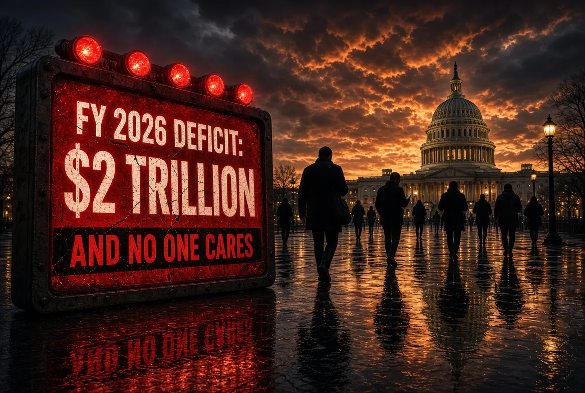
And once again, mandatory spending— things like Social Security and Medicare— plus interest on the debt, exceeded 100% of tax revenue.
In other words, they could have literally furloughed the entire US military, shut down the national parks, laid off the TSA, etc., and there still would have been a budget deficit. That’s just beyond pitiful.
The saddest part is how few people take this seriously.
Hardly anyone in Congress seems to care. No one on either side is jumping up and down and shouting from the rooftops that they have to cut this budget, and do it immediately.
Obviously there’s no interest in Congress because no one in the media is talking about it... and it rarely comes up as a key issue among voters.
And that’s the irony: voters absolutely care about this. They just don’t know that they do.
The number one issue for most voters right now is affordability. Life in the US has gotten absurdly expensive. I’ve been visiting Texas with my family for the past couple of weeks, and I’m astonished that every time we leave the house it costs $200 just to do anything.
Everyone has stories about just how mind-numbingly expensive life has become. People aren’t looking for less inflation; they’re looking for prices to fall back to the levels they remember from the good old days of 2019.
What many people don’t realize is that all this government spending, together with an insane level of regulation, is largely responsible for the high cost of living.
The media is focused on the war in Iran— and that certainly that has contributed to higher energy prices. But it’s an overly simplistic view to blame high prices on the war.
Simply put, everything the government touches and ‘invests’ in becomes more expensive. And there is perhaps no better example than the ridiculously-named Affordable Care Act.
Obamacare was a noble idea in theory: help Americans obtain health insurance, and bring down the cost of healthcare.
But in practice, insurance premiums have gone through the roof. The number of ‘uninsured’ only fell because tens of millions of people were put on Medicaid or taxpayer-subsidized plans, And overall healthcare spending is much greater (i.e. less affordable) than before.
The federal government now spends a trillion dollars a year on healthcare, and that doesn’t even include Medicare. That trillion dollars is just Medicaid and similar programs.
So basically the government passed a bill to make healthcare more affordable, and now they spend a trillion dollars a year because people can’t afford the supposedly affordable healthcare. It’s ridiculous.
Bottom line: everything the government touches becomes more expensive: healthcare, housing, education, food, energy. Everything.
So voters who care about the cost of living, which is almost everyone, absolutely should care about government spending (and about costly regulation too).
Unfortunately, most people are not aware of the clear and obvious link between irresponsible spending, excess regulation, and the cost of living. And the legacy media is far more interested in the clicks and eyeballs that come from pitting Americans against each other on social issues than they are in having a rational discussion about the budget.
None of this should not be controversial. Gross interest on the debt in fiscal year 2026 was $1.36 trillion, roughly 25% of tax revenue and significantly more than what was spent on the military.
That’s a blatant warning sign that spending is out of control.
Fortunately there is significant fat to trim. Hundreds of billions of dollars a year are lost to outright fraud. And that’s before you get into other forms of graft that are technically legal but absurdly wasteful. And that’s before an ounce of effort goes into making things more efficient.
In many ways it’s heartening that there’s so much room for improvement. But American voters tend to elect the most ignorant, incompetent, and morally bankrupt people on the planet to represent them.
The conduct of government has been so bad for so long that people’s expectations are minimal at best. Voters expect nothing and get even less in return.
Sadly, the most likely outcome is more of the same. No one in Congress will cut anything. The spending will continue and even increase.
Eventually, the Federal Reserve will have to resort to full-blown monetary expansion (‘printing money’) to help the government make ends meet. The cost of living will continue to rise, and no one will understand why.
There will be a lot of finger pointing, but absolutely no accountability or genuine solutions... and that’s why it makes so much sense to have a Plan B.
To your freedom, James Hickman Co-Founder, Schiff Sovereign LLC
P.S. A government can print dollars by the trillion, but it can’t print an ounce of gold or a barrel of oil. That’s why real assets like gold, oil, and the companies that produce them hold their value when the currency loses its own, and why it makes sense to own them now.
Real assets are the whole premise of Schiff Sovereign’s investment research newsletter, Strategic Assets: profitable, low-debt companies that produce the things a government can’t print, researched while they’re still cheap.
We locked in gains of more than 10x on a small silver producer, and a precious metals company we still follow is up nearly 400%. Right now we’re giving away a free sample issue so you can see what’s inside.
https://www.schiffsovereign.com/investing/the-fy-2026-deficit-was-2-trillion-and-no-one-cares-156136/
GP Q: Iraq Just Moved its First International Cargo on an Iraqi Truck
GP Q: Iraq Just Moved its First International Cargo on an Iraqi Truck
Iraq Just Moved Its First International Cargo on an Iraqi Truck:
Turkey to UAE
Iraq’s customs authority announced that an Iraqi truck has completed its first international transit shipment — carrying goods from Turkey to the United Arab Emirates across Iraqi territory.
What Happened
On 16 October 2026, Iraq’s General Authority of Customs said it received the first shipment under the international TIR transit system that was carried by an Iraqi truck using an Iraqi TIR document. The cargo started in Turkey and was heading to the UAE.
This was done with coordination between Iraqi federal customs, Kurdistan Region customs, Turkish authorities, and the International Road Transport Union (IRU).
The head of the Customs Authority, Thamer Qasim Dawood, called it a step forward for Iraq’s role as a trade corridor and for giving Iraqi trucking companies a chance to compete regionally.
What Is TIR?
TIR is a simple customs system used in many countries. It lets sealed trucks cross borders with one set of paperwork and fewer inspections along the way. Iraq started using it fully in April 2025 and later made it mandatory for trucks crossing its land borders.
Until now, most TIR trucks going through Iraq were foreign-owned. This shipment is notable because it was done by an Iraqi truck with an Iraqi TIR carnet.
Another Related First the Same Day
Separately, Iraq’s Transport Ministry announced that an Iraqi truck loaded goods in the Turkish city of Mardin and was taking them across Iraq toward Amman, Jordan. Officials said nearly 10,000 TIR trips had already crossed Iraq by mid-October 2026.
Why It Matters
• It shows Iraqi carriers can now operate on international routes under the TIR system.
• It supports Iraq’s push to become a land bridge between Turkey and the Gulf.
• Officials say it can help cut transit times and costs compared with longer sea routes and generate more non-oil revenue over time.
This is a logistics and customs development. The official statements focus on trade facilitation and Iraq’s corridor role — they do not mention any currency revaluation.
Sources
• English overview: The Insight International
• Detailed English version of the customs statement: Video News Agency
• Multiple Arabic news outlets quoted the Customs Authority directly on 16–17 October 2026.
In short: Iraq is starting to run its own trucks on international transit routes instead of only hosting foreign ones. Whether this grows into meaningful trade volume will depend on consistent operations and security going forward.
What’s your view — real progress, or still early days?
video-agencyia.iq/EN/Detail/6530
https://theinsightinternational.com/iraqi-truck-tir-mardin-amman-first-transit-october-16/
Source(s):
• https://x.com/argosaki/status/2111754106910167281