
Rob Cunningham: What if the Greatest Wealth System in History is Being Created
Rob Cunningham: What if the Greatest Wealth System in History is Being Created
10-14-2026
WHAT IF THE GREATEST WEALTH SYSTEM IN HUMAN HISTORY IS BEING CREATED – RIGHT BEFORE OUR VERY EYES?
What if we’ve spent 15 years arguing about the price of XRP while overlooking the extraordinary possibility of what it was engineered to DO?
What if payments were merely the beginning?
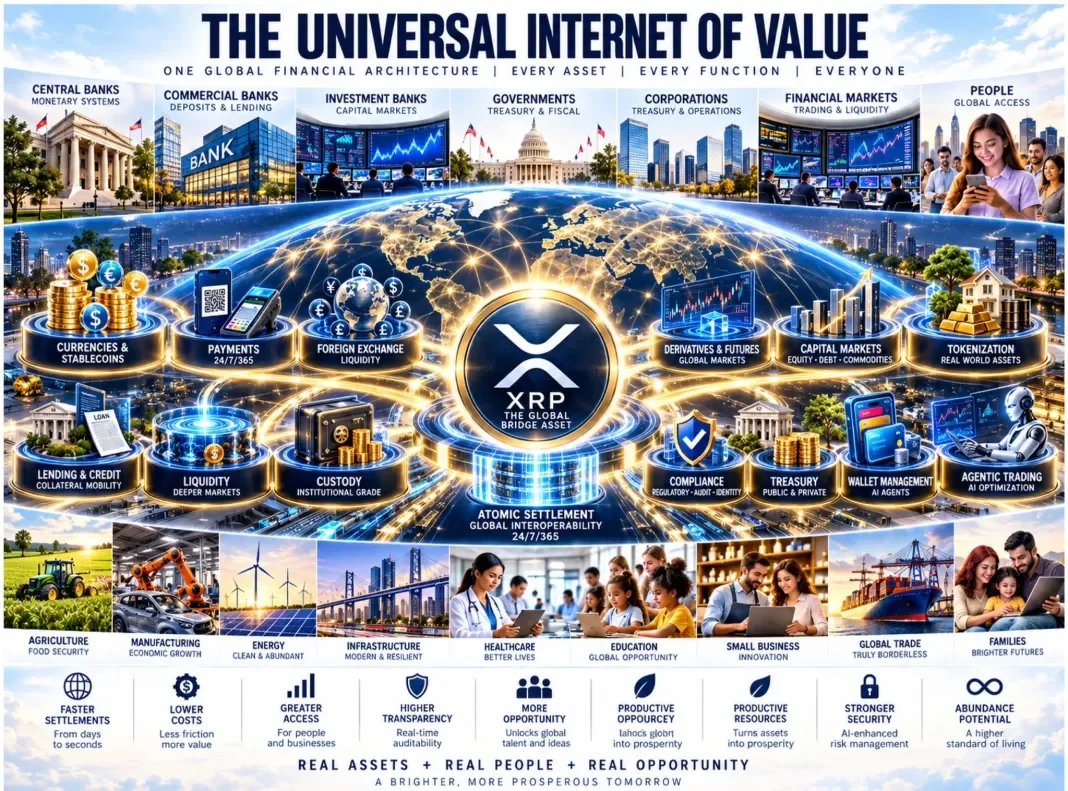
What if banking, currencies, stablecoins, stocks, bonds, commodities, derivatives, collateral, lending, custody, liquidity, tokenization and global settlement were becoming interconnected components of ONE intelligent, 24/7/365 financial architecture?
What if AI could make trillions in previously constrained capital more productive?
What if the world’s greatest problem isn’t a shortage of wealth – but the costly, fragmented, opaque systems controlling access to it?
And what if ONE non-sovereign native bridge asset could become the connective tissue of this extraordinary new Internet of Value Platform?
Now ask yourself the BIG question:
What happens to human prosperity when the world’s REAL assets, REAL people and REAL opportunities become financially connected at the speed of information?
Are we witnessing another financial technology upgrade?
Or the early emergence of an entirely new operating system for human civilization?
I explore this breathtaking possibility through a KUWL Quantum Imagination thought experiment.
It’s about what becomes possible for ALL humanity.
Read/Share My Full Article on SubStack:
[https://robcunningham.substack.com/p/quantum-imagination]
Source(s):
• https://x.com/KuwlShow/status/2110202353647305091
Scott Bessent, Gold & The Iraqi Dinar… Is Something BIG Coming?
Scott Bessent, Gold & The Iraqi Dinar… Is Something BIG Coming?
The Dinar Den: 10-13-2026
The global financial landscape is currently undergoing a period of significant transformation as policymakers and economists reconsider the foundations of modern monetary systems.
Recent discussions, such as those featured on The Dinar Den hosted by Stephen, suggest that we may be approaching a global financial reset.
This potential shift is characterized by a move toward incorporating tangible assets into monetary policy to enhance stability and credibility. Rather than a total overhaul of existing systems, these changes represent a strategic evolution intended to address the complexities of a modern, interconnected economy.
A pivotal element in this changing narrative is the recent appointment of Judy Shelton to the advisory circle of U.S. Treasury Secretary Scott Bessent.
Shelton is a well-regarded economist known for her support of gold-linked financial instruments. Her presence within the Treasury’s advisory framework signals a serious exploration of gold as a stabilizing force for the U.S. dollar.
One of her most notable proposals involves the creation of a gold-linked U.S. Treasury bond. Such a move would not necessarily represent a full return to the historical gold standard, but it would integrate hard assets into the modern fiscal framework to provide a hedge against volatility and bolster investor confidence.
This shift toward asset-backed monetary strategies has profound implications for emerging economies, particularly Iraq. As a nation with substantial oil reserves and growing monetary gold holdings, Iraq is uniquely positioned within this evolving global context.
The Iraqi government has been working diligently on internal banking modernization and fiscal reforms. These efforts are designed to align Iraq’s financial sector with international standards, making it more resilient and prepared for a global system that increasingly values sovereign resources and monetary transparency.
The discussion surrounding a potential revaluation of the Iraqi dinar is closely tied to these broader financial movements. While the prospect of a currency adjustment is a topic of great interest, it remains dependent on several critical domestic factors. Iraq’s ability to maintain low inflation, implement effective exchange rate frameworks, and foster public confidence in its banking system are essential prerequisites for any significant monetary change.
The integration of gold and other hard assets into the global consciousness only serves to highlight the importance of Iraq’s own resource-backed economic potential.
While the current developments in the financial world are undoubtedly exciting, they also require a measured and cautious approach. The transition to a system that blends modern financial governance with the stability of gold is a complex process with many variables.
Outcomes are never guaranteed, and the timing of such shifts remains uncertain. For those following these trends, it is vital to monitor policy actions and official announcements from both U.S. and Iraqi authorities to understand the true trajectory of these reforms.
As we look toward a future shaped by these evolving systems, staying informed is the most valuable tool for any observer or investor. The intertwining of sovereign resources, gold-backed initiatives, and modern banking reforms marks a new chapter in global economics.
Bruce’s Big Call Dinar Intel Tuesday Night 10-13-26
Bruce’s Big Call Dinar Intel Tuesday Night 10-13-26
Transcribed By WiserNow Emailed To Recaps (INTEL ONLY)
Welcome, everybody, to the big call tonight. It is Tuesday, October 13, and you're listening to the big call. Thanks for tuning in, everybody. Again, and we appreciate that very much.
All right. Let's dig this. Let's go into the intel segment, and I got a lot of information yesterday, primarily, and some today. And so the biggest thing we're trying to do is confirm what we're hearing from various sources of our sources.
Okay, so let's start first of all. Let's talk about Iraq first. Now, Iraq was told by President Trump. In fact, Prime Minister, let me get his name right. Zaidi, I believe it is Z A I D I, Zaidi. Prime Minister Zaidi. Met with President Trump last Thursday, and then Prime Minister Zaidi went up to the UN on Friday to New York, but he did meet with our president on Thursday.
Now I'm sure they discussed several things, but I'm sure one of which was okay. You guys redeceive your government. He told them to defeat their government in Iraq Yesterday and today, in other words, Monday or Monday Tuesday.
I don't know if we still have the parliament. I know we have a cabinet. I don't know if they still have a parliament or not. But I know they began seating, and we have heard that they seated yesterday. Now, can I confirm it from Iraq? We're trying. I'm so ready.
Our sources in Iraq have not gotten back to us about that, but we'll see how that goes. I believe they did, and if they didn't get it done yesterday, I believe they probably got it done by today.
Now, this is something President Trump asked him to do. Let's see if they did it.. The other thing we need on every new rate to show up for the Iraqi dinar, and we anticipated being published in the Gazette, their official government newspaper, and they typically print the Gazette because they have an online version too. But the printable version comes out Wednesday and Saturday
I'm thinking they could have that new rate ready to go in tomorrow's gazette, and as I've heard from some of our sources, once we have that new rate, we're into the races.
Okay. Now, what else is going on that's in conjunction with Iraq is we have heard that the International Monetary Fund, which I believe has some new people in it, the IMF has asked and given an okay for Vietnam to revalue the Vietnamese dong.
Hey, now. Why is everything we're waiting for seemingly contingent upon Iraq and Vietnam? The reason is because those two countries were the first to declare their currencies as gold backed.
Now we say asset backed, but in some cases the asset is gold itself. In our case, we have a large percentage of our U.S. N currency gold backed. It could also be backed by oil, by natural gas, by intellectual property, gems, obviously precious metals like gold, silver, platinum, radium, etc. Copper is very much more valuable than it used to be.
The reason that I bring up Vietnam is because those two countries probably need to come out at approximately the same time. Iraq theoretically would come out first, but it might be more of a simultaneous type of them.
Where Iraq and Vietnam both announce a revalued currency. And what about the rest of them too? We've got about how many currencies were we up to? 42 to 51 currencies that are going to revalue upwards for us. I mean, it's a lot.
So there are a lot that have to be on the screen now. Bondholders are something that is supposed to go right barely ahead of us getting our numbers.
When I say go, make sure that they'll have their funds in their account, and then they'll have coordinates where they can log in with the right codes and get into their accounts to see their amount that they have in their balance, and then they'll get an email around the time we either get our numbers or go to exchange. They'll get access to funds.
They want them to not have an unfair advantage over us in 4B and go ahead of us. I think everybody's going to have access to funds at approximately the same time. That was their hope to use what's called in golf a true shotgun start, where everybody lines up all throughout the golf course, holds one to 18, and when the gun goes off, everybody tees off at the same time on their respective hole.
That's what a shotgun start is. So they're used. They've used that term with us before. We've heard the term modified shotgun start, where instead of being identically starting at the same time, one gets a slight advantage to go first before the other.
All right. What about the admirals group out in Reno? Now we understand that there were multiple groups, but the terminology that they are using is different batches of the admiral's group batches, and so these batches are numbered, and people that are in the admiral's group probably already have received some information about it.
But the interesting thing to me is that some of them that I've talked to have heard that they will be asked to come in to Reno for information and one-on-one, possibly one-on-one training About banking, about probably setting up their quantum accounts. I'm sure that'll be part of it.
They want to see some of these people in person again, and to make sure that they have the right frame of mind for humanitarian projects and so on, and they also will bring them up to speed with attorneys to talk about trusts and so on.
And they may be meeting one on one with these people, or it might be in a group setting. I'm not quite sure how they'll do it, and if it is, understand there are three separate factions within the admiral's group that may go at slightly different times.
So if you're in the admiral's group and you have other ZIM or currency that you did not pony up 8 -10, 12 -15, years ago with the admiral, you should use the toll-free number that Wells gives us in an email, or that I put out with Bob's help on the website to call and set your appointment to for the Redemption Center,
Even if you have ponyed up currency to the Admiral's group already. I would say it would be wise to use the 800 number to set your appointment for your other currency exempt.
And one reason I say that is because that way you'll have your quantum account already set up, so that when you're called to go in to get the benefit of the group in in Reno, then you already have your quantum card.
You've already got your basic account set up. Everything's rolling, and this is just to finish up whatever you put in with the admiral years and years ago. A lot of people did.
So let's see where else we can go from there, guys. I have been over the process of this a lot, many times. I don't think you guys need a whole lot there. I just think it's really coming down to the point where this could go. This could go at any time now. This could go any day now.
Maybe it's not Thursday. Maybe it's the weekend. But whenever it is, we're very, very close. I don't know of anything else. I'm going to say other than Iraq putting a raid out on the forex and in their gazettes.
I think when we get those two things, and I'm sure Iraq. I'm sure that Vietnam will do similar things with their currency because if they have in fact been cleared by the IMF to do this, then they'll be right there with them, with Iraq, and I'm sure the rest of the countries that we hold their currency will do similar things.
There's a lot going on elsewise in the world, and I'm going to say this: we are three weeks away from the so-called midterm election day, which is Tuesday, November 3.
Now, I've been told from several sources we're going to have a pause in the midterms. I cannot absolutely say unequivocally that that is the case. They may have those elections. I would like everybody to think really hard about what is going to happen after those midterms, the Republicans need our vote. Wherever state you're in, I don't care where it is.
President Trump was doing a rally at the time of the big call. He started speaking at 7:25 p.m. Central Time tonight, an hour after he was theoretically going to be there and speak.
But you know how these rallies go; they have other people that bring in, and then they bring the president on, and that's what they did. And I caught a little bit of it at that time, but I think that was a really good rally that he did, probably in Alaska,
Everything that we're going to do to rebuild America and rebuild the countries internationally that need help-that is all going to be beneficial for our country, and I can't wait to get started with it, and we will. So, is there anything else? Is there anything else I forgot? I don't think so.
I think that's really about everything that I can think of right now. But what about Thursday? Two days away. Will we have numbers? Quite possibly, we will. Will we will we be exchanging? I hope so. But I'm going to say it this way:
We're going to have a call. Maybe it'll be a celebration call. But we will have a call Thursday night at the regular time. And so tune in. Let's see what happens between now and then.
And we do. We will put our 800 number if we're allowed to, which I believe we will be, on the landing page of the website, bigcalluniverse.com, and then of course we will send out an email to everybody that registered that wants the email with the 800 number, okay, we'll send that out as soon as we can, as soon as we get the number and can verify it that it's the real McCoy.
All right, so be prepared for that. I would say do what Sue said to do and get be thinking at least 15 minutes a day, and be doing some things for your projects. Be prepared for this. You know, I've been in this 21 years, invested 21 years, big call 15 years, and it's gonna.
I don't think it's gonna hit me like a ton of bricks, but I think even I will be a little bit surprised when we see this, and I'm looking forward to it, and have been for years and years, and we're about to see it.
We're about to receive it, so I'm going to leave that leave it with you in that regard, and let's go ahead and thank Sue for doing a wonderful job with the teaching and commentary, and her segment, and the pod, and everything handling prayer and praise time with us. Thank you, Bob, for handling the music, leading into the call, and your segment on nutrition and everything that we can do, and I want to thank everybody who's kind of behind the scenes, and everybody in Big Hall Universe, thank you for all of you out there, all over the world.
We had a number about a month ago, or maybe a little more, that we were reaching 22 and a half million people in God knows how many countries, quite a few. So we're going to just continue to be here for you and give you the information as I get it, unadulterated, not changed, just giving you what I'm hearing.
And let's go ahead and believe for this happening this week. So that's what we're going to pray. And I thank everybody for listening.
Well, everybody have a great night. We'll look forward to talking to you Thursday night. Let's keep an eye on emails and see if they come in. Okay. God bless you guys. Take care, and we'll see you Thursday.
Bruce’s Big Call Dinar Intel Tuesday Night 10-13-26 REPLAY LINK Intel Begins 1:17:00
Bruce’s Big Call Dinar Intel Thursday Night 10-8-26 REPLAY LINK Intel Begins 1:04:44
Bruce’s Big Call Dinar Intel Tuesday Night 10-6-26 REPLAY LINK Intel Begins 1:31:31
Bruce’s Big Call Dinar Intel Thursday Night 10-1-26 REPLAY LINK Intel Begins 1:09:19
Bruce’s Big Call Dinar Intel Tuesday Night 9-29-26 REPLAY LINK Intel Begins 59:00
Bruce’s Big Call Dinar Intel Thursday Night 9-24-26 REPLAY LINK Intel Begins 1:09:09
Bruce’s Big Call Dinar Intel Tuesday Night 9-22-26 REPLAY LINK Intel Begins 1:07:07
Bruce’s Big Call Dinar Intel Thursday Night 9-17-26 REPLAY LINK Intel Begins 1:04:00
Bruce’s Big Call Dinar Intel Tuesday Night 9-15-26 REPLAY LINK Intel Begins 1:22:40
Bruce’s Big Call Dinar Intel Thursday Night 9-10-26 REPLAY LINK Intel Begins 1:04:00
Seeds of Wisdom RV and Economics Updates Wednesday Afternoon 10-14-26
Good Afternoon Dinar Recaps,
GLOBAL FINANCIAL RESET WATCH: UK CALLS FOR FUNDAMENTAL REFORM OF THE GLOBAL FINANCIAL SYSTEM
Britain is pushing for a new approach to developing-country debt, private investment, and climate resilience as international leaders confront growing financial pressures and debate the future of global economic cooperation.
OVERVIEW
The United Kingdom has called for a fundamental reset of the global financial system, arguing that developing countries face excessive debt pressures and inadequate access to investment.
Four priorities are proposed: debt reform, greater private investment, stronger resilience to economic and climate shocks, and faster action in conflict-affected countries.
The global reset connection: The announcement adds momentum to discussions about how international finance can better support developing economies while strengthening the stability of the wider global system.
KEY DEVELOPMENTS
1. Britain Puts Global Financial Reform on the Agenda
On October 14, 2026, UK Foreign Secretary Ed Miliband called for a fundamental reset of the global financial system during the IMF and World Bank annual meetings in Bangkok, Thailand.
Miliband argued that the existing system is not adequately serving developing economies. He said high debt-servicing costs, limited investment, and vulnerability to economic and climate shocks are preventing many countries from investing sufficiently in jobs, public services, and long-term growth.
The UK plans to make these priorities central to its engagement with international financial institutions and its upcoming 2027 G20 presidency.
This is a significant policy announcement, but it is a call for reform—not confirmation that a new monetary system has already been established.
2. Debt Relief and Better Financing Terms Take Center Stage
One of Britain's main proposals is a new deal on developing-country debt.
The UK is calling for international development banks to help countries facing unsustainable debt burdens through measures such as:
Longer repayment periods.
Better refinancing terms where appropriate.
Faster restructuring when existing debts cannot be sustained.
More effective cooperation between governments, development banks, and private creditors.
The pressure is substantial. According to the UK government's announcement, debt-servicing costs in sub-Saharan Africa have reached a 25-year high, with countries collectively spending more than three and a half times as much on debt servicing as on education.
The underlying concern is that governments spending heavily to service existing debt have less money available for infrastructure, healthcare, education, energy, and economic development.
The proposed objective is to create more fiscal space so that vulnerable economies can invest in growth rather than remain trapped in cycles of expensive borrowing and limited public spending.
3. Private Investment Could Become a Bigger Part of the Solution
Britain also wants international development banks to attract substantially more private capital into emerging and developing economies.
The argument is that public funding alone cannot meet the enormous investment needs of these countries. Development banks could potentially use their resources and financial guarantees to reduce some investment risks and encourage pension funds, insurers, banks, and other investors to participate.
If implemented effectively, this approach could support infrastructure, business development, employment, and deeper domestic capital markets.
However, attracting investment is not automatic. Investors still assess political stability, legal protections, currency risks, expected returns, and the ability to move money in and out of a country.
The test will be whether these proposals produce actual investment and sustainable economic benefits—not simply new announcements or financing commitments.
4. Climate Resilience and Fragile States Become Financial Priorities
The UK's proposed reform agenda also recognizes that debt and investment cannot be separated from a country's ability to withstand shocks.
Climate disasters, energy disruptions, conflict, and economic instability can damage infrastructure, reduce government revenue, and increase borrowing needs.
Britain is advocating better preparation for disasters, more resilient infrastructure, financing that can be made available before crises escalate, and options to pause debt repayments following major shocks.
It is also calling for international institutions to coordinate more effectively in countries affected by conflict and instability.
These proposals connect financial reform with the practical ability of countries to protect essential services and maintain economic activity during crises.
WHY IT MATTERS
The international financial system is not changing through a single announcement or one dramatic event. It evolves through policy decisions, lending arrangements, regulatory changes, investment flows, and cooperation among governments and financial institutions.
Britain's announcement brings several important issues together:
Debt: How can countries manage existing obligations without sacrificing essential investment and public services?
Trade: How can developing economies build stronger productive capacity and participate more effectively in international commerce?
Assets: How can global savings and private capital be directed toward productive opportunities in emerging markets?
Technology: How can modern financial tools and digital infrastructure improve access to capital while managing security and operational risks?
Energy: How can countries strengthen energy security and withstand price shocks that place additional pressure on national budgets?
The announcement is particularly relevant because the UK's proposals arrive alongside the IMF's warnings about high public debt, rising borrowing costs, and imbalances between major economies.
Together, these discussions point toward a broader question: Can international finance be reformed to distribute opportunity more effectively while preserving financial stability?
The answer will depend on negotiations, implementation, financing, and the willingness of governments and creditors to accept changes.
WHY IT MATTERS TO FOREIGN CURRENCY HOLDERS
For foreign currency holders following developments in the possible evolution of the global monetary system, this announcement is worth watching because it concerns the financial foundations that support national economies and international trade.
Countries with more manageable debt burdens, stronger investment, and resilient infrastructure may have greater capacity to support economic growth and withstand future shocks. Those conditions can influence investor confidence and the long-term economic outlook.
However, the relationship between financial reform and currency value is complex. A debt agreement, development initiative, or investment announcement does not automatically make a country's currency appreciate.
This announcement does not establish a global currency revaluation, announce a replacement for the U.S. dollar, or provide a timetable for a monetary reset.
For currency holders, the most useful indicators to follow are concrete outcomes:
Whether debt restructuring agreements are reached and implemented.
Whether borrowing costs improve for developing economies.
Whether private investment actually increases.
Whether countries strengthen their productive capacity and financial resilience.
Whether reforms lead to more sustainable growth and improved economic conditions.
Watch the implementation, not just the announcement. Lasting changes in economic fundamentals are more meaningful than unverified predictions about sudden currency-value changes.
IMPLICATIONS FOR THE GLOBAL RESET
Pillar 1: Debt
The proposal places debt sustainability near the center of global financial reform. Longer repayment periods, better financing terms, and more effective restructuring could give some governments greater room to invest. The actual results will depend on creditor participation, financial arrangements, and the conditions attached to any relief.
Pillar 2: Trade
Countries burdened by high debt and weak infrastructure can struggle to expand production, develop new industries, and compete in international markets. Better access to financing could help strengthen trade capacity, although debt reform alone cannot correct trade imbalances.
Pillar 3: Assets
The UK wants to mobilize more private investment in developing economies. This could redirect some international capital toward infrastructure, businesses, and productive assets. Success will depend on whether investors find viable opportunities and whether the resulting projects deliver lasting benefits.
Pillar 4: Technology
Digital financial infrastructure, improved financial information, and modern payment systems can support investment and economic participation. Yet technology must be accompanied by effective regulation, security, and access to reliable financial services.
Pillar 5: Energy
Energy price shocks can increase inflation, strain government budgets, and make debt more expensive to manage. Greater resilience and investment in reliable infrastructure could help countries withstand disruptions and reduce vulnerabilities over time.
THE BOTTOM LINE
Britain's call for a fundamental reset of the global financial system is a meaningful policy development because it places developing-country debt, private investment, resilience, and international cooperation at the center of the reform debate.
The next major milestone will be whether these priorities translate into agreements and measurable changes, particularly as the UK prepares to lead the G20 in 2027. Other governments, international financial institutions, private creditors, and investors will all influence what happens next.
For foreign currency holders, this is a development to follow with informed interest, while keeping expectations grounded in evidence. It signals a push to address structural weaknesses in international finance, not a guarantee of imminent currency revaluations.
The deeper transformation will not be measured by the word “reset,” but by whether the global financial system evolves into one that can manage debt more sustainably, move capital more productively, and give more countries a viable path toward lasting prosperity..
Seeds of Wisdom Team
Newshounds News
SOURCES
1. UK Government — “UK calls for fundamental reset of global financial system for developing countries”
2. Reuters — “UK to seek fresh global focus on developing-nation debt relief”
~~~~~~~~~~
Seeds of Wisdom Team RV Currency Facts Youtube and Rumble
Newshound's News Telegram Room Link
RV Facts with Proof Links Link
RV Updates Proof links - Facts Link
Start Here room with Most Asked Questions Link
Follow the Gold/Silver Rate COMEX
Follow Fast Facts
Seeds of Wisdom Team™ Website
Thank you Dinar Recaps
Wed. Iraq News Posted by Tishwash at TNT 10-14-2026
TNT:
Tishwash: The Association of Private Banks reveals three pillars for banking reform.
The Association of Private Banks revealed on Monday three pillars of banking reform, noting that the banking reform plan is reviewed every six months.
The association’s executive director, Ali Tariq, told the Iraqi News Agency (INA): “The Central Bank has launched a central reform plan for 2025-2027, and this plan concerns private banks, which must implement it on several axes, including governance, the work plan, financial indicators, in addition to compliance and combating money laundering.”
He added that "the banks are working on this plan and reviewing it every six months, with the aim of all banks implementing it," indicating that "there are paths to reform, whether reform individually, mergers, or outside the market."
He added that "the banking reform plan is a large plan with many requirements that private banks must fulfill within the set timeframe." link
Tishwash: Al-Fariji: Raising the value of the dollar against the dinar does not represent financial reform.
Crisis expert Ali al-Fariji criticized the government's move to raise the value of the dollar against the dinar, pointing out that this decision does not constitute financial reform in itself.
Al-Fariji told Al-Maalouma, "Raising the exchange rate may provide quick liquidity, but it does not represent financial reform in itself. True reform lies in building a diversified revenue system, recovering funds and assets, reducing waste, and shifting the economy away from dependence on oil and the dollar's revaluation towards a financial management that measures results and creates real and sustainable revenues."
He added, "The 19.2 trillion dinars expected from the dollar's revaluation should be viewed as an approximate total book revenue, not a net gain for the treasury, because part of its impact may rebound on the state itself in the form of increased spending and import costs."
He explained that "maximizing revenues requires recovering Iraqi funds and assets, and establishing a specialized institutional framework to track and recover funds and assets proven to have been illegally transferred after 2003. This also necessitates reassessing files related to the funds and assets of the former Iraqi state. What is needed here is not political rhetoric, but a unified database of assets, verification of their ownership, tracing of their financial flows, and activating legal and international mechanisms to recover or freeze them through laws and agreements. link
*************
Tishwash: The IMF commends the Iraqi government's efforts in adopting a path of economic and financial reforms.
Finance Minister Faleh Sari announced on Wednesday a commitment to financial reforms and strengthening the role of the private sector in Iraq, while the International Monetary Fund praised the Iraqi government's efforts in adopting a path of economic and financial reforms.
A statement from the Ministry, received by the Iraqi News Agency (INA), stated that "the Minister of Finance, Faleh Sari, participated in the annual meetings of the International Monetary Fund and the World Bank Group, currently being held in the Thai capital, Bangkok, as part of strengthening cooperation with international financial institutions and supporting the path of economic and financial reform in Iraq."
He added that "the Minister of Finance held a series of meetings with officials of the International Monetary Fund, beginning with a meeting with the Fund's Executive Director for Iraq and the region, Mohamed Maait, and the incoming Executive Director, Ali Al-Hosni, in the presence of the Governor of the Central Bank of Iraq, Nizar Nasser Hussein, where the economic and financial conditions in Iraq were discussed, and views were exchanged on reform priorities and ways to enhance joint cooperation."
He added that "Finance Minister Faleh Sari met with the Regional Director of the Technical Assistance Department at the International Monetary Fund, Ali Abbas, to discuss areas of technical cooperation and prospects for benefiting from the Fund's expertise in developing financial and economic policies in Iraq."
During his meetings, the minister stressed "the importance of the partnership with the International Monetary Fund in supporting reform efforts and enhancing their chances of success, expressing his confidence in the possibility of completing financial reforms within the next two years."
Speaking about the current economic challenges, he pointed to the "repercussions of the Strait of Hormuz crisis and its impact on the Iraqi economy," explaining that "the government is working on preparing immediate remedies and future solutions to contain its repercussions."
The Minister of Finance revealed "a genuine trend to support the private sector and alleviate the pressures it faces, thereby strengthening its role in the market economy and contributing to expanding investment opportunities."
For their part, IMF officials praised the Iraqi government's efforts in adopting a path of economic and financial reforms, stressing the Fund's commitment to continuing to support Iraq and employing its expertise and capabilities to enhance these efforts and ensure their success. link
***************
Tishwash: Masrour Barzani and the US Consul discuss expanding investments in Kurdistan
On Tuesday, Kurdistan Regional Government Prime Minister Masrour Barzani emphasized strengthening the bonds of friendship and strategic partnership between the region and the United States, enhancing trade exchange, and expanding the prospects for American companies' investments in Kurdistan.
This came according to a statement from the Presidency of the Regional Government, received by Shafaq News Agency, during Barzani’s reception of the US Consul General to the region, Gwendolyn Wendy Green, this afternoon, in a meeting that witnessed discussions on developments in the general situation in the Kurdistan Region, Iraq and the region.
The statement noted that the two sides agreed on the importance of maintaining the security and stability of the Kurdistan Region, and stressed the need to activate the Kurdistan Parliament as a fundamental step to proceed with forming the new cabinet of the regional government.
He explained that the two sides discussed the course of relations between the Kurdistan Region and the federal government, where the importance of resolving contentious issues was emphasized based on the constitution, while stressing the need to respect the constitutional entity of the region, preserve its financial entitlements, and allocate its share of the federal general budget on fair grounds. link
Tishwash: Fuad Hussein in Rome: Official meetings and discussions on relations with the Vatican
Foreign Minister Fuad Hussein began an official visit to Rome in preparation for the opening of the new building of the Iraqi embassy. The visit includes official meetings with Vatican officials to discuss issues of common interest and strengthen relations between the two sides.
The ministry said in a statement that “Foreign Minister Fuad Hussein arrived in the Italian capital, Rome, at the start of an official visit to the Vatican City State, during which he will inaugurate the new building of the Embassy of the Republic of Iraq to the Holy See.”
The statement added, “During the visit, the minister will hold a number of official meetings with officials in the Holy See to discuss issues of common interest and ways to strengthen relations between the Republic of Iraq and the Holy See.” link
************
Tishwash: The Minister of Trade discusses prospects for joint cooperation with Chinese companies.
Minister of Trade Mustafa Nizar Al-Ani met today with a delegation of Chinese companies specializing in investment, banking and trade to discuss prospects for joint cooperation and review the opportunities available to develop economic and investment partnerships between the two sides.
A statement from the ministry, which was reviewed by (Shafaqna Iraq), stated that “the meeting witnessed the Chinese delegation presenting a set of visions, proposals and projects related to investment , developing the work environment and strengthening the partnership, which contributes to opening new horizons for cooperation and exchange of experiences, and benefiting from the capabilities available to both sides in supporting economic and commercial activity.”
The Minister of Trade pointed out that “the meeting emphasized the importance of strengthening communication with international investment companies and institutions, and creating appropriate opportunities to establish effective partnerships that contribute to supporting economic development and developing the commercial and banking sectors, in line with the Iraqi government’s directions to attract investments and enhance economic cooperation with various countries of the world.” link
BOND MARKET CRISIS: Is the U.S. Secretly Preparing for a Gold Reset? | Andy Schectman
BOND MARKET CRISIS: Is the U.S. Secretly Preparing for a Gold Reset? | Andy Schectman
Liberty and Finance: 10-13-2026
America added more than $2.3 trillion in debt in a single fiscal year, while annual interest payments have climbed to $1.1 trillion.
Andy Schectman warns that rising Treasury yields could trigger a chain reaction across stocks, banks, pensions, and real estate.
Meanwhile, central banks and major institutions continue accumulating gold as questions mount about the future of the dollar.
Schectman raises the possibility that the Treasury could be accumulating gold and silver indirectly, while Judy Shelton’s appointment adds fresh intrigue to the prospect of monetary reform.
Could the bond market crisis force Washington to consider a radical change to the monetary system?
Schectman suggests that her influence could signal a potential shift toward more traditional monetary principles, possibly involving a return to assets that provide a more stable foundation for the currency.
Given Shelton’s history of advocating for sound money and her interest in the role of gold within the financial system, her presence in high-level discussions may point toward upcoming attempts at stabilizing the dollar amidst ongoing fiscal instability.
This potential for reform highlights the urgency with which policymakers are viewing the current debt crisis.
Ultimately, the insights shared by Andy Schectman emphasize that the current economic climate is one of transition and high stakes. Between the unsustainable path of national debt and the strategic maneuvering of international powers, the importance of hard assets has rarely been more evident.
Reset Intelligence: Who Is Joining Iraq's Government?
Reset Intelligence: Who Is Joining Iraq's Government?
By Reset Intelligence | @EXIT_FIAT
On Thursday Iraq's parliament votes on the last empty seats in Prime Minister Ali al-Zaidi's government, and on four new deputy prime ministers.
One of the nominees put forward is Laith al-Khazali, a senior figure in Asaib Ahl al-Haq whom the US Treasury sanctioned in 2019.
The nominees
Parliament has published no list, so these are the names their own blocs have put forward. None is confirmed until the vote, and the chamber has turned a nominee down before. For Interior, the bloc of former prime minister Nouri al-Maliki has put forward Yasser Sakhil al-Maliki, reported to be his son-in-law. Iraqi reporting says two new ministries are meant for factions that agreed to give up their weapons.
What moved this week
Washington - Iraq's National Security Adviser said on Tuesday that the United States had decided on strikes and a blockade before Baghdad chose economic deals with it.
The banks - the US Treasury fined Bank of America more than $1.21 billion over money-laundering and sanctions failures.
The cut - Iraqi reporting says the governing parties approved the cut to 1,500 in June, months before it was announced.
The street - Tuesday closed at 166,250 IQD for $100 in Baghdad, against the bank's public price of 152,000.
The budget - the 2027 budget has still not reached parliament.
Hormuz - two senior Iranian officials say attacks on shipping have been stepped up to keep oil high through the US elections.
The question
Why would Baghdad bring men Washington sanctioned into its government, and why would Washington let it? And what does that mean for the dinar you hold?
That is the short version. Who is joining, what each side got for it, and what it means for the IQD and the RV - that is the daily read.
Read the full daily briefing free for 5 days. Sign up here: the daily Iraqi dinar briefing
Want it straight from the horse's mouth? The CBI Rate Alert pings you the moment the Central Bank of Iraq moves the official rate. The number itself, not a rumour about it. It comes with our free resource library and the daily breakdown of what is actually moving in Iraq. Sign up free: The CBI Rate Alert
Got a dinar question? Reset Intelligence runs an on-call research assistant: ask it anything they have published. It answers in seconds and will conduct deep research to find you the answer. Try it: the Iraqi dinar research assistant
Common questions, answered straight: When will the Iraqi dinar revalue? and Is the Iraqi dinar revaluation real?
The design behind all of it is mapped in Head of the Snake, and the free guides live in the Iraqi dinar resource library.
Follow the daily intel free: Telegram · Facebook · Spotify · Odysee
Iraq Economic News and Points To Ponder Wednesday Morning 10-14-26
CBI Defends Dinar Devaluation, Cites Strong Reserves
2026-10-13 / 04:06 Shafaq News- Erbil Iraq’s recent dinar devaluation was the best option to protect foreign reserves from an oil revenue shock, although the country still holds enough reserves to cover at least a year of imports, Central Bank of Iraq (CBI) Director General of Statistics and Research Samir Fakhri Nima said on Tuesday.
Speaking at the Middle East Research Institute’s MERI Forum 2026 in Erbil, Nima said disruptions around the Strait of Hormuz had sharply reduced oil revenue, with the effects emerging in May and June because of deferred payments for oil sales. He put oil’s share of government revenue at more than 93%.
Nima put monthly government spending at the equivalent of about $6 billion to $6.7 billion at the new Finance Ministry exchange rate, but said average oil exports had recently exceeded 2.5 million barrels per day, easing financing pressure on the government and the CBI. The oil revenue shock made it “necessary” to assess domestic and foreign borrowing options, while Iraq’s external debt declined in recent years.
Government operating spending generates demand for dollars at the CBI, adding pressure to foreign reserves, he said.
On October 7, Iraq raised the public dollar-selling rate from 1,320 to 1,520 dinars, while the rate applied to Finance Ministry transactions rose from 1,300 to 1,500. Iraqi analyst Mohammed Al-Saffar told Reuters the adjustment would give the government more dinars per dollar of oil revenue but raise import costs. CBI data showed foreign reserves had fallen to $80.6 billion by the end of July, from $97.4 billion at the end of 2025.
Read more: Iraqi dinar devaluation sparks backlash from blocs inside the cabinet
Read more: Why Iraq's dinar keeps sliding despite fresh US cash
https://www.shafaq.com/en/Economy/CBI-defends-dinar-devaluation-cites-strong-reserves
Latest Updates From Bahaa Al-Araji: Al-Zaydi Dissolved The "Al-Muhandis" Company, And The World Bank Wants The Dollar At 200,000 Dinars
2026-10-13 | 23:50 Baghdad - 964 Media Member of Parliament and head of the Reconstruction and Development bloc, Bahaa Al-Araji, confirms the existence of a severe financial crisis that threatens salaries by the end of this year, noting that the World Bank is asking Baghdad to price the dollar at 200,000 dinars per 100 US$. (2,000 IQD / $1)
At the same time, he reveals that Washington agreed to amend the Popular Mobilization Forces Law in exchange for abolishing the company of (Abu Mahdi) Al-Muhandis, as he put it in an interview with journalist Samer Jawad, on Iraq 24 channel, which was followed by the 964 network.
Bahaa Al-Araji:
Brother Humam Hamoudi, my teacher, but where is the state for there to be a State Leadership Council? I, Bahaa Al-Araji, cannot be in this council. The state has been exhausted, paralyzed, and weakened, so why these titles? We are the ones who brought the state to this stage, is it right for us to come up with the solutions?
We have a constitution that includes the institutions of the Prime Minister, Parliament, Republic, and Judiciary, and there is no State Leadership Council. This proposal wants to swallow up the state, like the previous regime that reduced it to a temporary constitution and a Revolutionary Command Council.
Regarding the lack of salaries for the deputy prime ministers: At the beginning of the national session, Ahmed Chalabi suggested giving an advance of $50,000 to each deputy, to sort out his situation and fill his eye with something other than theft, because when you don’t give him a salary, how will he live?
We export Iraqi oil through Hormuz, with American approval and via the Omani side, without Iran's approval. The Islamic Republic did not stand with Iraq as we stood with it.
Our imports from Iran are around $15 billion annually, and some say we have become your backyard. So when you prevent me from exporting, where will I be?
We paid a higher price for the war than Iran. If the war stops, Iran will recover in one year, while Iraq will not recover its financial situation in five years.
Iranian influence in Iraq has weakened over the last three years, and Iran has put up many indicators in Iraq, but these are things that are not in our hands, as we cannot do anything to American and Israeli aircraft.
When the previous government wanted to open outlets from Jordan and Syria, some “Shait and Mait” came out to say: I will blow up the pipeline and other things. We should hang these people now in Hormuz.
Some were “shouting” from the factions, which were outside the state institution, so how will they be now that they are inside the state in the ministerial formation, and will become influential in weapons and decision-making, and none of them will hand over their weapons, as long as the war exists in the region.
The state pays salaries with loans from the Central Bank, and salaries are secured until December of this year, after which the situation is difficult.
Raising the exchange rate will not solve the budget crisis, and the Central Bank has advised that the exchange rate should be 220,000 per 100 dollars.
The Popular Mobilization Forces (PMF) law has been transformed from the blacklist to the whitelist, due to some amendments, including the cancellation of the Engineer Company.
The Americans also have reservations about the PMF structure, especially regarding some professional positions, as well as the issue of affiliation.
For example, there is a certain party or faction present in the PMF. These people are affiliated with the party, but today their affiliation is being severed and they may be scattered and not be in one group. https://964media.com/725304/
Seeds of Wisdom RV and Economics Updates Wednesday Morning 10-14-26
Good Morning Dinar Recaps,
GLOBAL PAYMENTS RESET WATCH: IMF AND WORLD BANK LAUNCH NEW FRAMEWORK TO FIGHT DIGITAL FINANCIAL FRAUD
The new Bangkok Blueprint calls for stronger international cooperation to protect digital payments, strengthen financial security, and preserve public confidence as money moves through an increasingly connected global system.
OVERVIEW
The IMF and World Bank have introduced a new framework to help governments, regulators, banks, and other stakeholders combat cyber-enabled financial fraud.
The scale of the problem is enormous: Thailand’s finance minister estimated that digital fraud and scams cost the world economy approximately $1 trillion annually.
The global reset connection: As digital payments and financial technology expand across borders, protecting transactions and maintaining public trust are becoming essential to the future of the international financial system.
KEY DEVELOPMENTS
1. The Bangkok Blueprint Establishes a Framework for Cooperation
On October 14, 2026, the International Monetary Fund (IMF) and World Bank launched the Bangkok Blueprint for Fraud-Resilient Financial Services at their annual meetings in Bangkok, Thailand.
Developed in partnership with the Bank of Thailand, the framework is intended to help policymakers, financial institutions, regulators, and other stakeholders coordinate their responses to digital fraud.
Its central principle is that financial fraud cannot be addressed by banks alone. Scams may begin on social media, involve telecommunications networks, target bank customers, and move stolen funds across multiple countries. Effective prevention therefore requires cooperation across industries and national borders.
Important distinction: The Bangkok Blueprint is a framework for guiding discussion and action. It is not a binding IMF-World Bank policy directive or a new global financial system.
2. Digital Fraud Threatens the Expansion of Digital Finance
Thai Finance Minister Ekniti Nitithanprapas estimated that digital fraud and scams cost the global economy around $1 trillion each year, equivalent to approximately 3% of global gross domestic product.
Reuters also reported that, according to the United Nations Office on Drugs and Crime, scam gangs defrauded people in the Asia-Pacific region of at least $88 billion in 2025.
These figures illustrate the growing challenge facing financial institutions as digital transactions become more widespread. Criminal networks are adapting their methods, while online platforms and emerging technologies can make fraudulent messages, identities, and investment schemes more convincing.
IMF Managing Director Kristalina Georgieva warned that fraud could undermine the benefits of digital finance, particularly for people who have only recently gained access to formal banking and payment services.
3. Trust Becomes a Critical Part of Financial Infrastructure
The launch comes amid wider concerns about cyberattacks, artificial intelligence, and the security of interconnected financial systems.
Bank of England Governor Andrew Bailey and Georgieva warned that cyber-enabled fraud could erode confidence in technology and financial institutions. If people no longer trust digital transactions, some may withdraw from formal financial services or return to less convenient ways of holding money.
That creates a challenge beyond individual losses. A digital payment system is only useful when people believe their money can be transferred safely and reliably.
The framework points toward a broader approach in which fraud prevention, information sharing, international cooperation, and appropriate technology become central parts of financial-system resilience.
WHY IT MATTERS
The global financial system is undergoing a significant technological transition. Payments are increasingly digital, financial institutions rely on interconnected networks, and new technologies are changing how money is transferred and managed.
The Bangkok Blueprint highlights an important part of that transition: modernizing financial infrastructure also means modernizing the protections that keep it trustworthy.
Its potential importance extends across several areas:
Cross-border payments: Better coordination could help countries identify fraudulent transactions and respond to criminal networks operating across jurisdictions.
Financial inclusion: Stronger protections may help preserve access to digital banking for individuals and businesses that depend on affordable electronic services.
Financial stability: Widespread fraud or major cyber incidents can damage confidence, disrupt operations, and create broader risks for financial institutions.
Technology and regulation: Governments and financial firms face increasing pressure to keep security measures aligned with rapidly evolving digital threats.
The initiative does not establish a new international currency, announce a replacement for the U.S. dollar, or guarantee a coordinated global financial reset. Its significance lies in the practical work of strengthening the infrastructure on which an increasingly digital financial system depends.
WHY IT MATTERS TO FOREIGN CURRENCY HOLDERS
For foreign currency holders following developments in the possible evolution of the global monetary system, this story is relevant because payment security is part of the foundation required for modern financial networks to function reliably.
International currency use depends on more than exchange rates or official reserve holdings. It also relies on payment channels, banking relationships, legal safeguards, regulatory cooperation, and confidence that transactions will be completed securely.
As countries explore faster payments, digital currencies, tokenized assets, and other financial technologies, protection against fraud becomes increasingly important.
However, the Bangkok Blueprint does not confirm a currency revaluation, establish a date for a global reset, or promise that any particular currency will rise in value. Those outcomes cannot be inferred from the launch of an anti-fraud framework.
For currency holders, the useful takeaway is to watch for measurable developments: implementation by national regulators, stronger payment-security standards, cross-border cooperation, and evidence that new systems can operate safely at scale.
IMPLICATIONS FOR THE GLOBAL RESET
Pillar 1: Technology
Digital finance is expanding, but its long-term success depends on secure infrastructure. Artificial intelligence and other emerging technologies may help detect suspicious activity, while criminals can also use technology to make fraud more sophisticated. The challenge is ensuring that protection advances alongside innovation.
Pillar 2: Trade
International commerce depends on businesses being able to send and receive payments across borders. Better cooperation against financial fraud could help protect the payment channels that support trade, remittances, and business activity.
Pillar 3: Assets
As financial assets and transactions become increasingly digital, the systems used to hold, transfer, and safeguard value become more important. Stronger security can support confidence, although it does not by itself change the underlying value of currencies or assets.
Pillar 4: Global Financial Governance
The initiative illustrates how international institutions and national authorities can develop shared approaches to problems that no country can solve alone. Whether the framework produces meaningful results will depend on how governments, regulators, banks, technology platforms, and payment providers put its principles into practice.
THE BOTTOM LINE
The IMF and World Bank’s Bangkok Blueprint is a meaningful development in the effort to protect an increasingly digital global financial system. It recognizes that fraud is not simply a problem for individual consumers or individual banks; it is a cross-border challenge that can weaken financial inclusion, disrupt payments, and undermine confidence in money itself.
The next step is implementation. Watch for practical measures, stronger cooperation, and evidence that countries and financial institutions are turning the framework into effective protections.
For foreign currency holders, this is a development to follow with informed interest—not as proof of an imminent revaluation, but as evidence that the security and coordination of global financial infrastructure are receiving greater attention.
The bigger picture is clear: as the world redesigns how money moves, trust must move with it—or the next generation of global finance cannot reach its full potential.
Seeds of Wisdom Team
Newshounds News
SOURCES
1. Reuters — “IMF, World Bank launch ‘Bangkok Blueprint’ to fight cyber fraud”
2. The Guardian — “Bank of England and IMF bosses issue stark warning on cyber threat to trust”
~~~~~~~~~~
🌱 A Message to Our Currency Holders🌱
If you’ve been holding foreign currency for many years, you were not foolish.
You were not wrong to believe the global financial system would change.
What failed was not your patience — it was the information you were given.
For years, dates, rumors, and personalities replaced facts, structure, and proof. “This week” predictions created cycles of hope and disappointment that were never based on how currencies actually change.
That is not your failure.
Our mission here is different: • No dates • No rates • No hype • No gurus
Instead, we focus on:
• Verifiable developments • Institutional evidence
• Global financial structure • Where countries actually sit in the process
Currency value changes only come after sovereignty, trade, banking, settlement systems, and fiscal coordination are in place. History and institutions confirm this sequence.
You will see silence. You will see denials. That is not delay — that is discipline.
Protect your identity. Organize your documents. Verify everything.
Never hand your discernment to anyone who cannot show proof.
You deserve truth — not timelines.
Seeds of Wisdom Team
Newshounds News
~~~~~~~~~~
Seeds of Wisdom Team RV Currency Facts Youtube and Rumble
Newshound's News Telegram Room Link
RV Facts with Proof Links Link
RV Updates Proof links - Facts Link
Start Here room with Most Asked Questions Link
Follow the Gold/Silver Rate COMEX
Follow Fast Facts
Seeds of Wisdom Team™ Website
Thank you Dinar Recaps
16 Retirement Mistakes You Will Regret Forever
16 Retirement Mistakes You Will Regret Forever
From saving too little to taking withdrawals from your retirement account too early, there are plenty of ways that current and future retirees can sabotage their golden years.
By Bob Niedt Contributions by Kathryn Pomroy, Alexandra Twin Last updated October 7, 2026 In Features
As more and more baby boomers and Gen Xers anticipate a happy retirement, thoughts turn from worry over the workday slog to concerns about how to bankroll their golden years. How prepared are you? How much money do you need to retire? The 2026 Planning & Progress Study by Northwestern Mutual says that number is $1.46 million.
Do you know the ins and outs of your pension (if you're lucky enough to have one)? How about your 401(k), IRA, and other retirement accounts that make up your nest egg? Do you have a good handle on when to claim Social Security benefits? These are just some of the questions to contemplate as retirement approaches.
Long before you punch out for the last time, make sure you're making the right choices now.
To help, we've compiled a list of the 16 biggest retirement planning mistakes you'll regret forever and how to avoid making them. Take a look to see if any sound familiar.
1. Relocating On A Whim
The lure of warmer climates has long been the siren call of many approaching retirement. So, you're cooking up a plan to retire in Florida, or maybe you're considering relocating to one of the many places near the beach.
Our advice: Test the waters and visit your destination before you make a permanent move.
Too many folks have trudged off willy-nilly to what they thought was a dream destination, only to find that it's more akin to a nightmare. The pace of life is too slow, everyone is a stranger, and endless rounds of golf and walks on the beach can quickly grow tiresome.
Well before your retirement date, spend extended vacation time at your chosen destination to get a feel for the people and the lifestyle.
This is especially true if you're thinking about retiring abroad, where new languages, laws and customs can overwhelm even the hardiest retirees.
You can also check out some of our helpful articles to learn more about things you should know before retiring in Florida, retiring in Arizona, or retiring in the Carolinas. And, as these areas are getting more popular, you can also read about some of the challenges (and costs) that might hit your wallet.
Along with that, before you buy a new home, either on the coast or inland, make sure you understand if your new house will flood in a storm. Flood insurance is expensive, if it's offered at all.
Once you do make the plunge, consider renting before buying. A couple I know circled Savannah, Georgia, for their permanent retirement nest. But wisely, as it turned out, they decided to lease an apartment downtown for a year before building or buying a new home in the suburbs. Good thing, too.
It turns out the Deep South didn't suit their Philadelphia get-it-done-now temperament. They instead joined the ranks of "halfback retirees" — people who head to the Deep South, find they don't like it, and move halfway back toward their former home up north.
2. Falling For Too-Good-To-Be-True Offers
Hard work, careful planning and many decades of working and building wealth are the keys to reducing stress for a secure retirement. There are no shortcuts. Yet, Americans lose hundreds of millions of dollars a year to get-rich-quick and other scams, according to the FTC, as elder fraud runs rampant. My parents constantly receive calls from scammers trying to persuade them to hand over their hard-earned retirement savings.
Credit card fraud was the most common type of identity theft in 2025 and is expected to reach $43 billion worldwide this year, according to Merchant Cost Consultant. Add in the 150 million Americans who will be victims of credit card fraud this year and the fact that every 14 seconds a person in the US falls victim to identity theft, it's enough to make your blood curdle.
State Attorney General offices and the FTC offer tips for spotting too-good-to-be-true offers. Telltale signs include guarantees of spectacular profits in a short time frame without risk; requests to wire money or pay a fee before you can receive a prize; or unnecessary demands to provide bank account and credit card numbers, Social Security numbers, or other sensitive financial information. Oh, and those pesky phone calls for donations to the police or fire department could also be a scam.
Be wary of — in fact, run away from — anyone pressuring you to make an immediate decision or discouraging you from getting advice from an impartial third party. If they want your money, they can mail you an envelope.
What do you do if you suspect a scam? The FTC advises searching for the company or product name, along with "review," "complaint," or "scam," on Google or another search engine. You can also check with your local consumer protection office or your state attorney general to see if it has fielded any complaints. If it has, add yours to the list. Be sure to file a complaint with the FTC, too.
3. Planning To Work Indefinitely
The 2026 reports from both Transamerica Life and Money: Retirement Security in the USA (PDF) and Employers, Workers, and the New World of Work confirm that 44% of workers expect to retire after age 65 or not retire at all — with Baby Boomers remaining among the most likely to work longer.
But that plan could backfire.
Consider this: Fidelity’s 2026 State of Retirement Planning survey showed that more than six in ten Americans (61%) plan to continue working in some capacity as they transition into retirement, with many phasing into retirement via part-time work, consulting, gig work or side hustles indefinitely.
Or, you could be forced to stop working and retire early for any number of reasons. Health-related issues — either your own or those of a loved one — are a major factor. Employer-related issues such as downsizing, layoffs, and buyouts are also a factor.
Failing to keep skills up to date is another reason older workers struggle to get hired. The actionable advice regarding this: Assume the worst, and save early and often.
Per the Transamerica survey, almost four in 10 workers expect to retire at age 70-plus, while 23% do not plan to retire at all, citing financial and healthy-aging reasons for doing so.
Although working past retirement age may be necessary, it could be a mistake you regret down the road.
4. Putting Off Saving For Retirement
In Northwestern Mutual’s 2026 Planning & Progress Study, nearly one in four Americans (23%) who have retirement savings say they have one year or less of their current income saved for retirement. For Gen Xers, many of whom are approaching retirement, one-third have 3x or less of their current annual income saved.
What is even more concerning is that while significant differences exist across generations, about 1 in 5 of each believe they will never be financially independent.
The truth is, while many retirees understand they should save for retirement, many have no idea how much money they will need to retire comfortably.
"Many people do not start to aggressively save for retirement until they reach their 40s or 50s," says Ajay Kaisth, a certified financial planner with KAI Advisors in Princeton Junction, N.J. "The good news for these investors is that they may still have enough time to change their savings behavior and achieve their goals, but they will need to take action quickly and be extremely disciplined about their savings."
Here's how much you need to sock away monthly to build a $1 million nest egg by age 65, according to Dutch Point Credit Union. Assuming an annual interest rate of 8%, an annual inflation rate of 2%, and $0 in prior savings, you'd need to save $300 a month if you start at age 25; $700 a month, starting at age 35; $1,700 per month, starting at age 45; and $3,000 each month, starting at age 50.
Uncle Sam offers incentives to procrastinators. Once you turn 50, you can start making catch-up contributions to your retirement accounts. In 2026, older savers can contribute an extra $8,000 to a 401(k) (up from $7,500 last year) on top of the standard $24,500, up from $23,500 in 2025.
In addition, people aged 60 to 63 can make “super” catch-up contributions of up to $11,250 in eligible workplace retirement plans on top of the standard limit and any regular age-50+ catch-up.
For IRAs (Traditional or Roth), the catch-up amount for those age 50 and older is $1,100, on top of the standard contribution limit of $7,500 (for a total of $8,600).
5. Claiming Social Security Too Early
You're entitled to start taking Social Security benefits at 62, but you might want to wait if you can financially. Most financial planners recommend holding off at least until your full retirement age (FRA) — 67 for anyone born after 1959 — before tapping Social Security. Waiting until 70 can be even better.
Let's say your full retirement age, the point at which you would receive 100% of your benefit amount, is 67. If you claim Social Security at 62, your monthly check will be reduced by 30% for the rest of your life.
But if you hold off, you'll get an 8% boost in benefits each year between ages 67 and 70 thanks to delayed retirement credits. There are no additional retirement credits after you turn 70. Claiming strategies can differ for couples, widows and divorced spouses, so weigh your options and consult a professional if you need help.
"If you can live off your portfolio for a few years to delay claiming, do so," says Natalie Colley, a financial analyst at Francis Financial in New York City. "Where else will you get guaranteed returns of 8% from the market?" Alternatively, stay on the job longer, if feasible, or start a side gig to help bridge the financial gap. There are plenty of interesting ways to earn extra cash these days.
6. Borrowing From Your 401(K)
Taking a loan from your 401(k) retirement savings account can be tempting. After all, it's your money. As long as your plan sponsor permits borrowing, you'll usually have five years to pay it back with interest.
But short of an emergency, tapping your 401(k) is a bad idea. It's one of the eight worst 401(k) mistakes you can make that could tank your retirement.
According to Meghan Murphy, VP, Commercial Strategy at Fidelity Investments, you're likely to reduce or suspend new contributions during the period you're repaying the loan.
That means you're short-changing your retirement account for months or even years and sacrificing employer matches — free money. You're also missing out on the investment growth from the missed contributions and the cash that was borrowed.
”As you think about loans from retirement plans, the first thing we say is, is there anywhere else you might be able to borrow from?” says Murphy. “We think through the importance of having an emergency fund.
But, of course, if that’s not available, is there any other place that you’re able to draw from? Something you might want to think about is: if it’s a medical emergency, do you have a health savings account (HSA) that you might be able to take money from?”
What’s becoming more popular, says Murphy, is employees drawing money from stock plan options through their employer. “If you draw money from there, there’s not necessarily a penalty associated with it or the requirement that you have to make payment on the loan directly through your paycheck.”
Another huge downside to borrowing from your retirement plan is the payback. Usually, loans are paid back to the fund over five years. If you were to leave that employer before the loan is paid off, you’re obligated to pay it back in full within 60 to 90 days, says Murphy, or it becomes a taxable distribution. “And if you’re below the age of 59-1/2, there’s now a 10% tax penalty associated with it.”
Keep in mind, too, that you'll be paying the interest on that 401(k) loan with after-tax dollars, then paying taxes on those funds again when retirement rolls around. And if you leave your job, the loan usually must be paid back in as little as 30 days. Otherwise, it's considered a distribution and taxed as income.
Before borrowing from a 401(k), explore other loan options. College tuition, for instance, can be covered with student loans and PLUS loans for parents. Major home repairs can be financed with a home equity line of credit (HELOC), though that comes with considerable risks, too.
TO READ MORE: https://www.kiplinger.com/slideshow/retirement/t047-s001-retirement-mistakes-you-will-regret-forever/index.html
MilitiaMan & Crew: Is Iraq’s Economy Finally Turning? | Daily IQD Analysis
MilitiaMan & Crew: Is Iraq’s Economy Finally Turning? | Daily IQD Analysis
10-13-2026
The Crew: Samson, PompeyPeter, Petra, Daytrader, Sunkissed, GIGI and Militia Man
Straight reporting on Iraq’s economy. CBI policy, the budget, oil, banking reform, and the exchange rate — read clean and interpreted without the noise. This channel started as daily phone calls to Mom with the latest dinar news. After she passed in 2022, I built a team so that same standard could keep going for everyone following the story.
Follow MM on X == https://x.com/Slashn
Be sure to listen to full video for all the news……..