
FRANK26….10-13-26…..19th TO THE 24th
KTFA
Tuesday Night Video
FRANK26….10-13-26…..19th TO THE 24th
This video is in Frank’s and his team’s opinion only
Frank’s team is Walkingstick, Eddie and Omar in Iraq and guests
Playback Number: 605-313-5163 PIN: 156996#
KTFA
Tuesday Night Video
FRANK26….10-13-26…..19th TO THE 24th
This video is in Frank’s and his team’s opinion only
Frank’s team is Walkingstick, Eddie and Omar in Iraq and guests
Playback Number: 605-313-5163 PIN: 156996#
What Frank’s suit color’s mean…. FRANKS SUIT COLORS FOR CC'S..... WHITE = NEW INFO…. SILVER = INTEL FROZEN…. RED= HIGH ALERT… PURPLE=GUEST WITH US…. BLUE = AIR FORCE…. BLACK = GROUND/FF’S…. GREEN= MR OR FAB 4 ... GOLD = CHANGE… ORANGE=IMPLEMENTATION
Iraq Economic News and Points To Ponder Tuesday Afternoon 10-13-26
Parliamentary Finance: The Proposal Of The Salary Scale Law Will Be Presented Soon To The House Of Representatives
Money and business Economy News — Baghdad The Parliamentary Finance Committee said on Tuesday that the proposal of the salary scale law will be presented soon to the House of Representatives. The head of the Parliamentary Finance Committee, MP Adi Awad, said in a statement to the official newspaper: "The proposal of the salary ladder law will be presented soon in the sessions of the House of Representatives, after studying with specialists in financial and economic affairs."
He added that "the proposal was submitted to the Federal Court to ensure that it is not challenged," expecting that "it will be put to the first reading in the coming sessions."
Awad explained that "the Finance Committee is ready to listen to the observations on the law after reading it, and adopt what it deems fair and compatible with the legal frameworks." He pointed out that "the proposal aims to enhance purchasing power and support the stability of the salaries of state employees, and includes the abolition of instructions that contradict its provisions."
For his part, MP Abdul Hamza Moneim Al-Khafaji said: "The demand to amend the salary scale comes within the supervisory and legislative roles of the House of Representatives," stressing "the importance of the law for the segment of employees with limited income, especially in light of the economic crises and high prices of goods and services."
He added that "employees in several grades, from ten to five, receive limited salaries ranging from 250 to 300 thousand dinars," noting that "the presence of employees with these salaries in more than seven ministries."
He warned that “the continuation of these conditions, in conjunction with the high cost of living, exacerbates the burdens on this segment, as well as the existence of a large disparity between the salaries of employees who occupy similar grades.”
Al-Khafaji called for "promoting the adoption of the law and addressing the legal articles that are said to be contrary to it, instead of taking this conflict as a pretext to disrupt it," stressing "the need to take measures leading to reducing disparities and achieving justice among state employees."
He pointed out that "the Prime Minister was addressed on the possibility of sending the draft law of the civil service and salaries or the proposal of the salary scale, in addition to requesting a statement of the measures taken by the Presidency of the Council of Ministers and the House of Representatives on this file. https://www.economy-news.net/content.php?id=74966
IMF Expects Iraq’s Economy To Contract By 16% In 2026 And Strong Growth In 2027
Money and business Economy News _ Follow-up The International Monetary Fund (IMF) predicted that Iraq’s real GDP will contract by 16% during 2026, before registering a growth of 19% in 2027, according to data from the World Economic Outlook report issued in October 2026, at a time when it is estimated that inflation will rise and the current account deficit will worsen during the current year.
According to the table on the economies of the Middle East and Central Asia in the report, which was seen by "Economy News", the Iraqi economy fell by 0.4% in 2025, while the Fund expected the inflation rate to reach 3.5% in 2026, compared to 0.3% in 2025, to decline to 3% in 2027.
On the current account, the IMF expected Iraq to record a deficit equivalent to 10.8% of GDP in 2026, compared to a deficit of 3.8% in 2025, before turning into a surplus equivalent to 2.2% of GDP in 2027.
These estimates put Iraq among the oil-exporting economies in the region, which the Fund expects to witness a contraction during 2026, as the table indicated that the economies of the oil-exporting countries combined contracted by 3.8%, before achieving a growth of 7.4% in 2027.
In contrast, the report predicted that the real GDP of Saudi Arabia will contract by 3.3%, the UAE by 3.9%, Qatar by 15.6% and Kuwait by 16.7% in 2026, with these economies recording growth in 2027.
Iraq’s figures reflect a sharp discrepancy between the 2026 and 2027 forecasts, with the economy moving from a major downturn to high growth, according to the IMF estimates, without necessarily implying improvement in living standards or household financial conditions at the same pace, as these indicators remain linked to other factors, including employment, income, inflation and fiscal performance. The real GDP of Iraq is the total value of goods and services produced by the Iraqi economy within a year. https://www.economy-news.net/content.php?id=74965
Emir Of Qatar Announces $60 Billion Worth Of Investment Projects And Opportunities
Money and business The Emir of Qatar, Tamim bin Hamad Al-Thani, announced a package of projects and investment opportunities worth about 221 billion Qatari riyals, equivalent to $ 60.71 billion, over the next five years.
In his annual speech to the Shura Council, Tamim said that Qatar has been able to contain the repercussions of the regional crisis and reduce public spending without compromising basic services and development priorities.
He added that the Qatari economy recorded real growth of 2.9% during 2025, with inflation stabilizing at 0.5%, pointing to the continued expansion of the North Gas Field and progress in the Golden Pass project in the United States.
The Emir of Qatar stressed the importance of diversifying the economy, pointing out that the contribution of non-hydrocarbon sectors amounted to about 80% of real GDP, in addition to the development of more than 360 new digital services.
In the food security issue, he pointed out that Qatar has regionally topped the food systems resilience index for 2026, while continuing to support local agricultural production https://www.economy-news.net/content.php?id=74993
Minister Of Transport And Chairman Of The Dhi Qar Provincial Council Discuss The Completion Of Nasiriyah International Airport
Money and business Economy News – Baghdad Minister of Transport Wahab al-Hassani discussed on Tuesday with the President of the Dhi Qar Azza al-Nashi Provincial Council the completion of Nasiriyah International Airport and the paths of development.
A statement by the ministry, received by "Economy News", that "the Minister of Transport, Wahab al-Hassani, received the President of the Council of the province of Dhi Qar Azza al-Nashi and his accompanying delegation, and discussed with them the file of the completion of Nasiriyah International Airport and the paths of development in the province, in the framework of follow-up strategic projects for the transport sector and strengthen coordination with the local government."
He added that "the meeting dealt with the latest developments in the work in the Nasiriyah International Airport project, and the importance of completing its requirements to contribute to the development of air transport services in the province, and provide infrastructure that supports passenger traffic and economic activity, as well as enhancing the ability of Dhi Qar to attract investments."
He added that "the two sides discussed the path of development within the borders of the province, and the importance of coordinating efforts between the Ministry of Transport and the local government on the requirements of the project, in order to enhance the link between the provinces and support the movement of goods and trade exchange, in line with the developmental and economic objectives of the project." https://www.economy-news.net/content.php?id=74983
Chairman Of The Integrity Commission: We Received A Number Of Wanted In Corruption Cases From Egypt
Money and business Economy News – Baghdad The head of the Federal Integrity Commission, Mohammed Ali Al-Lami, on Tuesday, the importance of Arab cooperation within the framework of the Arab Convention to Combat Corruption in the field of preventing and preventing corruption and the recovery of funds and wanted.
During his meeting with the Ambassador of the Arab Republic of Egypt to Iraq, Ahmed Hussein Khafaji, Al-Lami referred to the brotherly relations and ties between the Iraqi and Egyptian peoples, and their role in intensifying cooperation between them, praising the partnerships in various political, economic and cultural fields with the brothers in the Arab Republic of Egypt, which reflect the extent of harmony and cooperation between the two brotherly countries.
He pointed out the importance of coordination between the Arab countries and the concerted efforts in addressing the scourge of corruption, especially in the areas of legal assistance, the recovery of the proceeds of corruption and the extradition of wanted persons, and the exchange of experience and expertise, praising the cooperation of brothers in the Republic of Egypt with the authorities in the Republic of Iraq, which led to the extradition of a number of wanted persons in corruption cases.
He called for academic partnerships in the specializations related to the prevention and combating of corruption, and the exchange of knowledge and twinning between the Iraqi and Egyptian anti-corruption academies within the framework of the memorandum of understanding between the Iraqi Integrity Commission and the Egyptian Administrative Control Authority; in order to increase the knowledge and experience of workers in the regulatory field and refine their skills, and focus the scientific effort to strengthen the practical aspect of the practical, and benefit from modern scientific methods in the face of corruption.
For his part, Mr. Ahmed Hussein Khafaji, the Egyptian ambassador to Iraq, expressed his happiness to strengthen ties with the people and government of the Republic of Iraq, especially with the supervisory bodies, which were embodied in the conclusion of the memorandum of understanding between Iraqi integrity and Egyptian administrative control, stressing support for the efforts of Iraqi integrity in the fight against corruption, and overcome the obstacles to the recovery of wanted persons, noting that the stability and security of Iraq represents the security and stability of Egypt https://www.economy-news.net/content.php?id=74981
Rising Bond Yields Are Creating A Problem For The US Banking System
Rising Bond Yields Are Creating A Problem For The US Banking System
Notes From the Field By James Hickman (Simon Black / Sovereign Man) October 13, 2026
In January 2021, two months before US inflation took off, a reporter asked Federal Reserve Chairman Jerome Powell how much inflation the Fed was willing to tolerate.
Powell acted like he'd never heard of inflation— like it was crazy to even ask. He dismissed the notion of inflation entirely and said it was "far away and unlikely."
Rising Bond Yields Are Creating A Problem For The US Banking System
Notes From the Field By James Hickman (Sinon Black / Sovereign Man) October 13, 2026
In January 2021, two months before US inflation took off, a reporter asked Federal Reserve Chairman Jerome Powell how much inflation the Fed was willing to tolerate.
Powell acted like he'd never heard of inflation— like it was crazy to even ask. He dismissed the notion of inflation entirely and said it was "far away and unlikely."
Then he doubled down. "Frankly," the Fed Chairman bizarrely claimed, "we welcome slightly higher inflation."
Yes, of course, the central economic problem of our time: too LITTLE inflation. What a joke.
A few months later prices started climbing faster than Americans had seen in years, and Powell found his new favorite word: "transitory."
As inflation rose, he kept saying it was "transitory", and it took inflation hitting 5% for Powell to finally admit that it was "probably a good time to retire that word."
Prices finished 2021 up 7%, the most since 1982. The Fed still didn't raise interest rates until March 2022, and by just a quarter of a point. Even with 7% inflation, the Fed wasn't taking it seriously.
But then they suddenly panicked. Their attitude on inflation went from "huh?" to five alarm fire in a matter of months, prompting the Fed to jack interest rates up from near zero to 4.75%. It was the fastest pace of rate hikes since the 1980s.
By early 2023, Jerome Powell had a lot of explaining to do. So when he sat in front of the Senate Banking Committee on March 7 that year, plenty of people were asking if his abrupt, panicked rate hikes were going cause problems in the banking sector.
No, said a clearly unworried Powell. "I think nothing about the data suggests to me that we have [raised rates] too much," he said.
Literally three days later, Silicon Valley Bank, the 16th-largest bank in America, collapsed… specifically because of those rising interest rates.
Remember, when you deposit money at a bank, they don't just keep your cash sitting in a vault. They either loan it out to someone, or invest it in bonds— especially US government bonds.
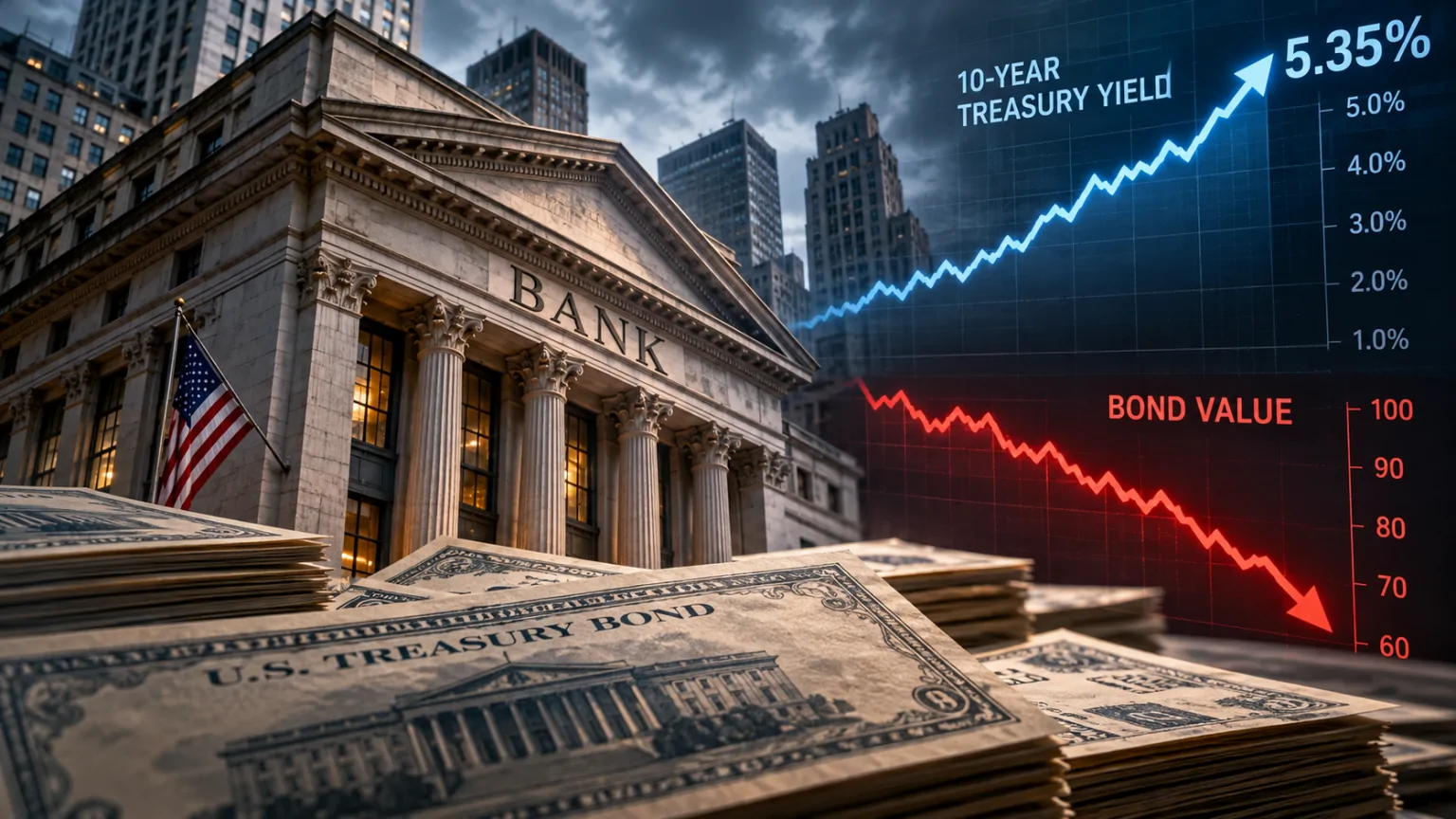
The thing about bonds is that they lose value when interest rates rise. So when Jerome Powell rapidly hiked interest rates, banks were sitting on big losses in their bond portfolios.
But it's sort of like owning a stock that's down: you haven't actually LOST money unless you sell. In the meantime you're just sitting on a paper loss, or what accountants call an "unrealized loss."
Yet that's what killed Silicon Valley Bank.
By the end of 2022, SVB was sitting on about $15 billion of unrealized losses— which made it technically insolvent.
Customers figured that out and panicked. They pulled more than $40 billion out in a single day (nearly a quarter of its deposits), and regulators shut the bank down the next day.
Two more banks went under shortly after... all because rising interest rates caused banks to suffer huge unrealized bond losses.
But rates are MUCH higher today, so banks' unrealized losses are growing.
According to the FDIC, the federal agency that insures bank deposits, those losses added up to $327 billion as of June 30. The next quarterly report for Q3 (which ended September 30) hasn't come out yet. But it will almost certainly be MUCH worse.
The yield on the 10-year Treasury hit 5.35% recently. That's up from 4.4% back in June, when the last FDIC report came out.
To be clear, I'm not suggesting this is going to bring down the banking system. In fact, at the moment, it will NOT. Banks as a whole have enough equity to absorb those losses.
But a rapid increase in unrealized losses will likely drag down bank stocks and force executives to cut costs, and the interest banks pay you is always one of the first things to go.
Once these unrealized losses hit the banks’ Q3 and Q4 financial statements, I’m betting you’re probably going to see a cut in the interest rate your savings account as banks shore up more capital.
So it's worth considering other options for your cash deposits.
For one, the federal government likely pays more than your bank does: a 90-day T-bill, which is a three-month loan to the US Treasury, pays about 4.1% right now. Even the 28-day T-bill pays almost 4%.
Then there's the option of moving some money overseas.
I don't mean a secret Swiss bank account from a spy movie. Foreign banks report their American customers to the IRS, and having a foreign account is not about hiding money.
The real reason to have a foreign bank account is far more practical: it puts a portion of your savings in another jurisdiction. It’s a useful asset protection measure... with the added benefits of better service and higher interest rates.
We research a number of foreign banks for members of our Plan B Confidential service. One sent its bankers to our Plan B conference in Panama City last month, where they opened accounts for attendees on the spot.
It's a private, safe, well-capitalized bank. That means it has plenty of its own money to absorb losses, which is exactly what Silicon Valley Bank ran out of.
It also pays 4% interest on a savings account.
And you can open the account remotely. That's very rare these days. US reporting rules have made Americans such a compliance headache that many foreign banks won't take them at all, and the ones that do usually want you to show up in person.
You can learn more here about Plan B Confidential, which comes with a Rolodex of vetted service providers, from immigration attorneys to tax advisors to private bankers, including, of course, our contacts at this bank.
To your freedom, James Hickman Co-Founder, Schiff Sovereign LLC
US Panics as Bonds Collapse Forces a Global Monetary Reset
US Panics as Bonds Collapse Forces a Global Monetary Reset
Sean Foo: 101302926
In a major move, Bessent just appointed Judy Shelton to the US Treasury. This appointment of a historic gold advocate shakes up the entire landscape for the US government eventually heading back to gold.
The global economic landscape is undergoing a monumental transformation, driven by shifting geopolitical alliances, rising national debt, and a growing distrust in traditional fiat currency.
Recent insights from financial analyst Sean Foo highlight a profound strategic pivot by Beijing away from Western-backed assets.
Since 2012, China has methodically reduced its United States Treasury bond holdings by more than half, actively divesting from an impressive $1.3 trillion down to under $620 billion. This massive selloff has been largely catalyzed by escalating trade conflicts, tariffs, and the weaponization of economic sanctions.
Rather than keeping these funds in vulnerable foreign paper assets, the proceeds have been consistently converted into physical gold—a secure, tangible, and non-freezable safe-haven asset capable of withstanding Western-imposed financial penalties.
China’s aggressive gold acquisitions, particularly accelerated during the height of the Russia-Ukraine and Iran conflicts, underscore a profound global realization about the inherent geopolitical risks of holding sovereign debt in an increasingly fractured world.
Faced with this steady erosion of trust in the greenback and a rapidly deteriorating fiscal outlook, policymakers in Washington are beginning to take notice.
In response to these sweeping international maneuvers, the United States Treasury is reportedly reconsidering the historic role of gold within the domestic and international financial architecture.
The consideration of notable figures like Judy Shelton—a vocal advocate for a return to sound money principles—signals a potential paradigm shift toward the remonetization of gold.
Financial innovators are now discussing creative concepts such as “Treasury Trust bonds,” which would theoretically tie government bond repayment options directly to actual gold reserves.
Such a bold move could completely revolutionize how the United States issues sovereign debt, offering international and domestic investors a unique choice to redeem their maturing bonds in either cash or physical gold.
Implementing this strategy would serve as a powerful acknowledgment of shifting global monetary dynamics and the gradual decline of unbacked currency dominance.
Underpinning this entire financial evolution is a staggering fiscal reality that continues to challenge policymakers on Capitol Hill. The United States currently faces an escalating national deficit projected to hover around the staggering $2 trillion mark, driven by continuous government spending and mounting interest obligations.
To maintain investor confidence and successfully finance this massive mountain of obligations, innovative mechanisms are urgently required.
While historical US gold reserves have long been valued on government books at a modest statutory rate of $42.22 per ounce, the actual market value of gold trades significantly higher, soaring well above the $2,000 per ounce threshold in recent years.
Unlocking this immense unrealized valuation through innovative debt instruments backed by physical precious metals could provide a much-needed bridge for future debt issuance, though it would undoubtedly reshape the fundamental mechanics of global commerce.
Across the globe, international central banks have already begun adjusting their strategic reserves to navigate this new era of economic uncertainty. Data indicates that global central banks have substantially decreased their overall US bond holdings from 33 percent down to 21 percent over recent years, reallocating those substantial funds into physical gold, which now accounts for roughly 25 percent of total reserves.
This observable trend toward metal-backed security is only expected to accelerate should innovative Treasury Trust bonds eventually enter the open market, potentially introducing new competitive pressures for traditional fiat assets. While the complete audit of official United States gold reserves remains a topic of ongoing debate due to its opaque and outdated reporting, the mere discussion of monetizing gold highlights the severity of current fiscal challenges.
Rob Cunningham: XRP is an Essential and Immutable Ingredient
Rob Cunningham: XRP is an Essential and Immutable Ingredient
10-13-2026
XRP: ESSENTIAL INGREDIENT OR “SHIT COIN”?
You cannot logically call something essential to a system worthless to that system.
Imagine building a worldwide highway system connecting every city, business, bank & household on Earth. You build the roads, bridges, tunnels, tollbooths & traffic controls.
Then somebody says, “Remove the one ingredient required to operate the entire system.”
What happens?
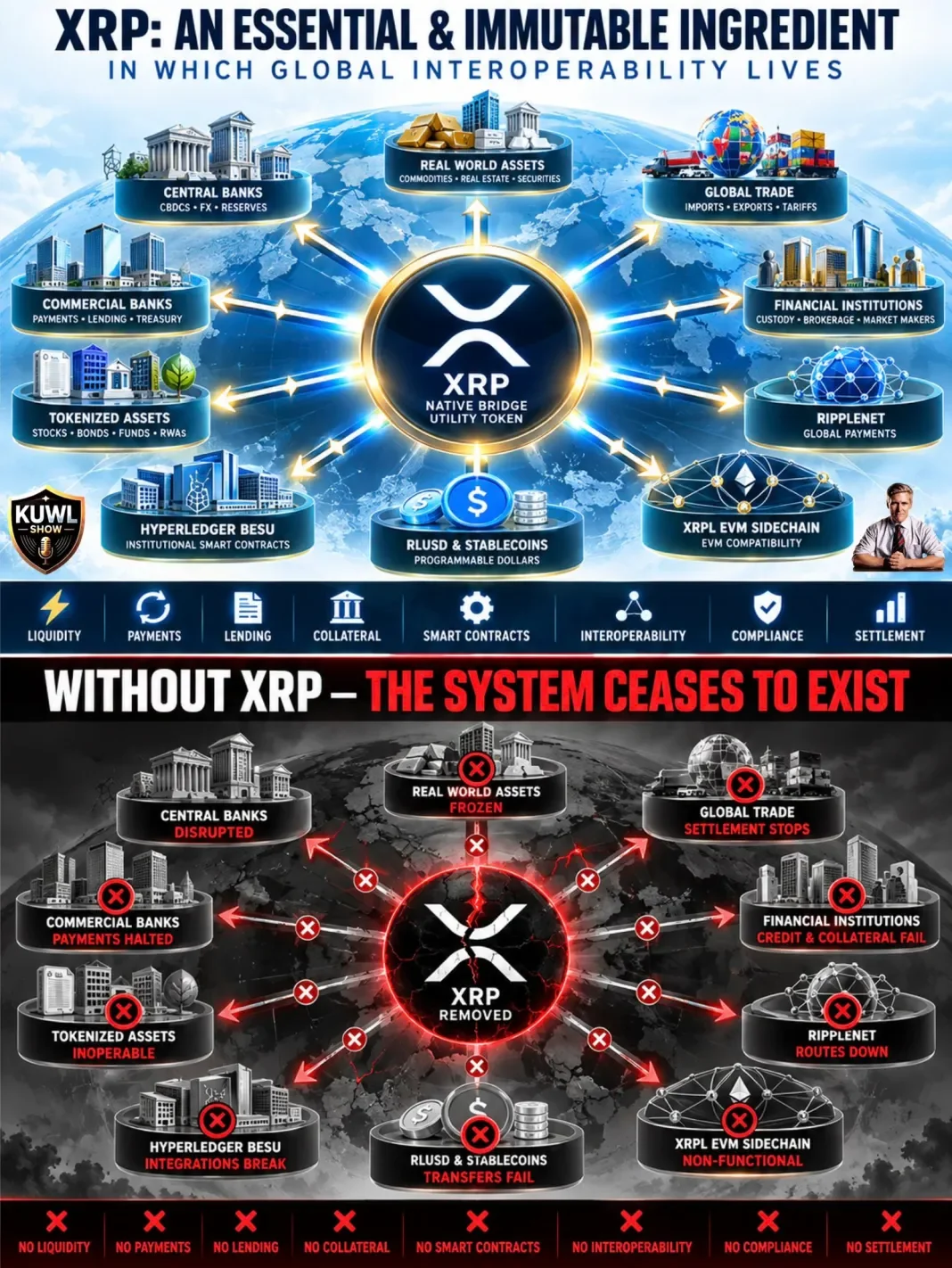
The parts that depend on that ingredient stop working.
This is the argument for XRP’s existential importance to our new financial system.
For generations, banks have operated like separate islands. Moving money between them can require middlemen, multiple accounts, expensive fees & days of waiting.
Distributed ledger technology changes what is possible.
Money, stocks, bonds, real estate, commodities, loans & other assets can be represented digitally, tracked, exchanged & settled in seconds across connected networks.
This is the Internet of Value
Here is where XRP comes in.
XRP is not merely another digital coin somebody invented to trade on an exchange or “dump” on retail investors for profit.
It is the native asset of the XRP Ledger, a public, open financial network designed to move & exchange value globally.
XRP pays the network’s transaction fees. It supports account reserves. It serves as a bridge between different currencies & assets. It is used for liquidity, settlement & collateral where institutions choose to support those functions.
Now connect the XRP Ledger to institutional banking systems, Hyperledger Besu, the XRPL Ethereum sidechain, Ripple’s payment infrastructure, and regulated digital dollars such as RLUSD.
These are the ingredients for a much larger financial network.
Banks can manage credit.
Businesses can tokenize assets.
Custodians can safeguard property.
Stablecoins can represent dollars.
Smart contracts can automate financial agreements.
XRP provides a common asset for moving value between consenting systems.
Here is The Critical Point:
Within the XRP Ledger’s existing design, XRP is essential. You cannot simply remove it & expect its ledger to operate.
Within the World’s New Monetary Architecture, an XRP dependency exists for liquidity, collateral, transaction fees and settlement. Removing XRP would force an enormous global reconstruction of those dependencies.
And this brings us to the phrase “shit coin.”
If someone states XRP has no real technological purpose, that claim is plainly wrong. XRP performs defined functions in a working public ledger essential for global interoperability to work.
If someone claims XRP has no investment value, they claim a globally vital, patented technology holds little to no return on investment potential.
The question is not whether somebody likes XRP, hates XRP, or makes jokes about it.
The important question is:
How much of tomorrow’s financial infrastructure will actually depend on XRP?
Because the more nations, banks, institutions, payment systems, lending platforms & collateral markets rely on this one asset, the more economically significant its availability, liquidity, and reliability become.
No one can reasonably argue that XRP is both indispensable to a particular financial architecture and functionally worthless to that same architecture.
Always seek to understand the XRP critic’s motive and agenda.
THE BOTTOM LINE
XRP already has a real, indispensable role across a global monetary system, one where the opportunity for quantum growth is still expanding.
XRP is already an essential connecting asset of the future system, so dismissing it as a “shit coin” will never explain away the machinery that depends upon it.
Follow the engineering.
Follow the dependencies.
Follow the actual use of XRP.
That is where its significance will be proven to those seeking truth.
Source(s):
• https://x.com/KuwlShow/status/2109284763898896811
https://dinarchronicles.com/2026/10/12/rob-cunningham-xrp-is-an-essential-and-immutable-ingredient/
Seeds of Wisdom RV and Economics Updates Tuesday Afternoon 10-13-26
Good Morning Dinar Recaps,
GLOBAL BANKING RESET WATCH: REGULATORS STEP UP AI AND CYBERSECURITY OVERSIGHT TO PROTECT FINANCIAL SYSTEMS
U.S. and European regulators are intensifying scrutiny of artificial intelligence and cyber threats as financial institutions face growing pressure to secure the technology supporting global banking and payments.
OVERVIEW
Regulators are stepping up scrutiny: U.S. banking agencies are questioning banks about advanced AI systems, including autonomous AI agents, their safeguards, and how their actions are monitored.
Europe is strengthening recovery plans: The Bank of England and European Central Bank are pressing banks to improve their ability to restore critical systems following serious cyberattacks or technology failures.
Financial stability is at stake: Regulators warn that a major cyber incident could disrupt banking services, interrupt payments, and undermine confidence in the wider financial system.
KEY DEVELOPMENTS
1. U.S. Regulators Examine How Banks Control Advanced AI
Reuters reported on October 13 that U.S. banking regulators, including the Federal Reserve, are asking financial institutions detailed questions about their use of advanced artificial intelligence.
The inquiries focus particularly on agentic AI—systems capable of carrying out tasks with limited human supervision. Banks are exploring these tools for cybersecurity, identifying threats, and responding to suspicious activity.
Regulators want to understand how banks restrict these systems' authority, monitor their decisions, maintain audit trails, and ensure that human personnel can intervene when necessary.
They are also examining the use of AI models developed by foreign technology providers and the risks associated with dependence on external systems.
The concern is that AI capabilities may be advancing faster than the safeguards needed to manage them. An autonomous system that makes an incorrect decision, exceeds its authority, or is manipulated by an attacker could create new vulnerabilities inside an institution that manages deposits and payments.
For now, regulators are gathering information rather than announcing a comprehensive new set of binding rules.
The key development is that oversight is becoming more focused on how AI actually operates inside banks—not simply whether banks are using it.
2. European Authorities Push Banks to Strengthen Cyber Recovery
European regulators are also concerned about whether banks could recover quickly from a major technology failure.
The European Central Bank has already asked supervised banks to prepare for AI-enabled cyber threats, with an end-of-October 2026 deadline for plans addressing those risks.
The Bank of England is encouraging major banks to examine independent recovery arrangements that can restore essential services if their primary technology systems become compromised.
These arrangements may include clean backup copies of critical data and separate recovery infrastructure that does not depend on the same systems an attacker could disable.
Such safeguards can be expensive to build and maintain. However, the cost of inadequate preparation could be much greater if customers lose access to accounts or businesses cannot make and receive payments.
The challenge is particularly important as banks increasingly rely on cloud providers, outside technology companies, and interconnected digital platforms.
A failure at one critical provider could affect multiple institutions simultaneously.
The focus is shifting from preventing every attack to ensuring that essential financial services can continue—or recover rapidly—when prevention fails.
3. Cybersecurity Becomes a Financial Stability Issue
The International Monetary Fund's October 2026 financial stability assessment reinforces the seriousness of these concerns.
The IMF warned that a major cyberattack affecting a critical service or financial institution could undermine confidence and potentially contribute to broader financial instability.
A cyber incident does not need to destroy a bank's financial assets to cause economic damage. If customers cannot access accounts, banks cannot process transactions, or businesses cannot settle payments, the disruption can spread rapidly through the economy.
A prolonged interruption could also create uncertainty about whether balances, records, and payment instructions remain reliable.
These risks are growing as artificial intelligence becomes more capable and financial institutions become more dependent on digital infrastructure.
However, the warnings do not establish that a systemic cyberattack is imminent. They demonstrate why regulators are placing greater emphasis on preparedness, resilience, and coordinated responses.
WHY IT MATTERS
The international financial system is undergoing a technological transformation. Banking, cross-border payments, securities settlement, and financial services increasingly depend on digital infrastructure that must remain secure and reliable.
This creates a new dimension of systemic risk.
In traditional financial crises, attention often focuses on debt defaults, bank losses, liquidity shortages, and declining asset values. In a digital financial system, a major technology disruption can also prevent otherwise solvent institutions from operating normally.
The implications extend across three of the Global Reset pillars.
Technology: AI is changing how financial institutions detect threats, process information, and manage operations. Those benefits must be balanced against risks from autonomous systems and malicious use.
Trade: International commerce depends on payments moving reliably between businesses, banks, and countries. Major disruptions can delay transactions, interrupt supply chains, and increase operational costs.
Assets: Digital records support bank balances, securities ownership, and transaction settlement. Protecting their integrity and availability is essential to confidence in financial assets.
The global financial reset is not one announced event. It is a broader evolution involving financial infrastructure, regulation, technology, and international payment systems.
The more deeply finance becomes digital, the more important it becomes to protect the systems that make financial transactions possible.
WHY IT MATTERS TO FOREIGN CURRENCY HOLDERS
For foreign currency holders, cybersecurity may seem distant from exchange rates and currency values. In reality, it is becoming part of the infrastructure that supports confidence in the financial system.
Digital banking and payment networks must reliably authenticate transactions, maintain accurate records, and move funds between institutions. If those services are disrupted, the effects can extend beyond individual banks to businesses, investors, and international commerce.
Countries and financial institutions that maintain secure, reliable payment infrastructure may be better positioned to support trust in their financial services. However, cybersecurity capability alone does not determine a currency's value.
Exchange rates also depend on economic growth, inflation, interest rates, fiscal conditions, and international capital flows.
These developments do not confirm an imminent currency revaluation or a sudden global monetary reset. They show that the systems supporting modern finance must adapt as technology and threats evolve.
For currency holders, the useful signal is the gradual modernization of financial safeguards and payment infrastructure—not speculation about a particular date or guaranteed exchange-rate outcome.
IMPLICATIONS FOR THE GLOBAL RESET
PILLAR 1: Technology
Artificial intelligence offers banks opportunities to detect suspicious transactions, improve fraud prevention, and respond more quickly to cyber threats.
But increasingly autonomous systems introduce new questions about accountability, access permissions, human supervision, and the ability to stop harmful actions.
Effective governance must develop alongside the technology. Banks need to understand where AI is used, what information it can access, which decisions it can make, and how those decisions can be reviewed.
The next stage of financial modernization will depend not only on more powerful technology, but also on reliable controls around it.
PILLAR 2: Trade
Global trade depends on dependable payment systems that allow exporters, importers, banks, and logistics companies to settle transactions.
A serious cyber incident affecting a major financial institution or shared technology provider could interrupt payments across multiple businesses and jurisdictions.
As cross-border commerce becomes increasingly digital, resilience becomes an economic necessity. Secure backup systems, coordinated incident responses, and reliable recovery arrangements help keep international transactions moving during disruptions.
This is an important foundation for the continued modernization of global trade and payments.
PILLAR 3: Assets
Modern financial assets depend on trustworthy records and functioning systems.
Bank deposits, securities, and other financial claims must be accurately recorded, protected from unauthorized changes, and accessible when legitimate transactions need to be completed.
Cybersecurity therefore supports more than the operation of computer systems. It helps preserve confidence that financial records are accurate and that institutions can honor their obligations.
As digital finance expands, protecting those records and maintaining continuity of service become increasingly important to the stability of financial markets.
THE BOTTOM LINE
The latest regulatory developments show that financial stability now depends on more than capital reserves and responsible lending. Banks must also control advanced AI, protect critical data, and recover quickly when technology fails.
U.S. and European regulators are responding to documented risks, but stronger oversight should be understood as preparation—not proof of an imminent financial crisis.
For those following the global financial reset, the important development is the growing recognition that digital resilience is becoming a core requirement of modern banking.
The evolution of the global financial system will depend not only on how money moves across borders, but on whether the technology carrying those transactions can remain secure, trustworthy, and resilient in an increasingly connected world.
Seeds of Wisdom Team
Newshounds News
SOURCES
1. Reuters — "Banking watchdogs ramp up AI scrutiny as stability fears mount, sources say"
2. International Monetary Fund — "Global Financial Stability Report, October 2026"
~~~~~~~~~~
Seeds of Wisdom Team RV Currency Facts Youtube and Rumble
Newshound's News Telegram Room Link
RV Facts with Proof Links Link
RV Updates Proof links - Facts Link
Start Here room with Most Asked Questions Link
Follow the Gold/Silver Rate COMEX
Follow Fast Facts
Seeds of Wisdom Team™ Website
Thank you Dinar Recaps
Reset Intelligence: Why They Want the IQD Cut Reversed
Emailed to Recaps~ Thank you David
Reset Intelligence: Why They Want the IQD Cut Reversed
By Reset Intelligence | @EXIT_FIAT
Iraq cut the IQD to 1,500 on October 7. On Sunday a bloc in parliament asked the Federal Supreme Court to throw that cut out.
The bloc is the one affiliated with Kataib Hezbollah, the armed faction that refused to put its weapons under the state.
The lawsuit
The case names Prime Minister Ali al-Zaidi, the Finance Minister and the Central Bank governor. It argues from the constitution's articles on how powers are divided, and the bloc puts the damage to purchasing power at up to 15%. Its leader says the court has received the challenge. No hearing date is set.
This court has been asked before. In April 2022 it dismissed a complaint against Iraq's 2020 devaluation.
What moved this week
The street - Monday closed at 165,950 IQD for $100 in Baghdad, against the bank's public price of 152,000.
The budget - the 2027 budget has still not reached parliament. A lawmaker from one governing party has tied his vote to the street price coming down to 155,000.
The reason for the cut - al-Zaidi told parliament the state has a bill of 10 trillion IQD to meet every month while oil exports are choked.
Washington - envoy Tom Barrack was in Baghdad on Monday and described the relationship as moving from security to economic cooperation.
Riyadh - al-Zaidi is due in Saudi Arabia on Wednesday, with Kuwait to follow.
The rails - Standard Chartered says its custody service for Ripple's dollar token is now live on the XRP Ledger.
Oil - Brent traded near $105. The budget in front of Iraq's cabinet is written at $58.
The question
Why would the faction that fought this government over its weapons now fight it over the dinar? And what does it mean for a holder if the court turns the case away?
That is the short version. Who is fighting the cut, why Baghdad made it, and why we expect the challenge to fail - that is the daily read.

Read the full daily briefing free for 5 days. Sign up here: the daily Iraqi dinar briefing
Want it straight from the horse's mouth? The CBI Rate Alert pings you the moment the Central Bank of Iraq moves the official rate. The number itself, not a rumour about it. It comes with our free resource library and the daily breakdown of what is actually moving in Iraq. Sign up free: The CBI Rate Alert
Got a dinar question? Reset Intelligence runs an on-call research assistant: ask it anything they have published. It answers in seconds and will conduct deep research to find you the answer. Try it: the Iraqi dinar research assistant
Common questions, answered straight: When will the Iraqi dinar revalue? and Is the Iraqi dinar revaluation real?
The design behind all of it is mapped in Head of the Snake, and the free guides live in the Iraqi dinar resource library.
Follow the daily intel free: Telegram · Facebook · Spotify · Odysee
Iraq Economic News and Points To Ponder Tuesday Morning 10-13-26
A High-Level Delegation From The Kurdistan Regional Government Will Visit Baghdad Soon To Resolve Disputes Over The 2027 Budget
Baghdad - One News - 10/12/2026 A high-level delegation from the Kurdistan Regional Government intends to visit Baghdad in the next few days to hold talks with the federal finance minister regarding the region's share in the 2027 federal budget bill, amid ongoing disputes between the two sides over financial and oil issues.
According to information reported by Kurdistan 24, the anticipated visit comes after Baghdad and Erbil failed to reach a final agreement on a number of contentious issues during previous meetings, coinciding with expectations that the draft budget law will be referred to the House of Representatives this month.
The most prominent point of contention is the percentage allocated to the Kurdistan Region from the federal budget, as the regional government demands that its share be set at 14.14% based on the results of the population census and constitutional provisions, while the federal government has set the percentage at 12.7%.
In the oil file, the two sides differ in their positions regarding the quantities of oil required to be delivered to the federal government, as Baghdad demands the delivery of between 400,000 and 500,000 barrels per day, in contrast to a proposal from the regional government to specify quantities between 250,000 and 280,000 barrels per day.
As for non-oil revenues, they represent another point of contention, as the federal government insists on handing over all of those revenues, while the Kurdistan Regional Government emphasizes the need to preserve its legal and constitutional entitlements and powers in managing its financial resources.
These anticipated talks come at a time when political and financial efforts are continuing to reach understandings regarding the region's share and its oil and non-oil obligations, in preparation for including them in the draft federal budget for 2027 before it is submitted to the House of Representatives. https://1news-iq.net/وفد-رفيع-من-حكومة-إقليم-كوردستان-يزور-ب/
The Prime Minister: The Government Is Proceeding With Its Development Plans And Is Committed To Controlling Currency Exchange Rates
Baghdad (INA) – Prime Minister Ali Faleh al-Zaidi affirmed on Monday the government's commitment to implementing its development plans for the provinces. He also emphasized the government's dedication to financial and administrative reform, including controlling foreign exchange rates, preventing speculation, and halting the economic drain.
The Prime Minister's Media Office stated in a press release received by the Iraqi News Agency (INA) that "the Prime Minister chaired an expanded meeting at the Nineveh Governorate headquarters, attended by a large number of the province's representatives, the Governor of Nineveh, the head and members of the Provincial Council, and officials from service and government departments."
According to the statement, al-Zaidi stressed that "the government is proceeding with its development plans for the provinces, and that Nineveh deserves concerted efforts to improve its services and living conditions. Furthermore, the doors are open to address any shortcomings, so that the province can achieve a future befitting its history and cultural heritage."
The Prime Minister reiterated the government's commitment to "confronting all forms of corruption, the importance of safeguarding public funds, and countering attempts to distort national identity by inciting discord and division among the province's communities."
Al-Zaydi emphasized the government's commitment to financial and administrative reform, including controlling foreign exchange rates, preventing speculation, and halting the economic drain caused by exchange rate fluctuations, from which speculators were profiting at the expense of the local economy.
He explained that his proposed million-farm project would focus on specialized agricultural initiatives tailored to each province, aiming to develop their agricultural resources. For example, Basra would become the capital of Iraqi date palms, and Najaf the capital of rice production. The plan also includes establishing food processing plants supplied by the farms, creating job opportunities, increasing local production, and enhancing food security. https://ina.iq/ar/political/275981-.html
"Stability Is Built By Leaders Who Choose The Difficult Path." Tom Barrack Meets With Al-Zaidi In Baghdad And Affirms That Iraq's Security And Prosperity Represent Security And Prosperity For The Region
Baghdad - One News - 10/12/2026 US envoy Tom Barrack met with Prime Minister Ali al-Zaidi in Baghdad, praising his leadership and role in promoting stability, and emphasizing Iraq’s importance in achieving regional security and prosperity.
Barak said in a post on his X platform account that his meeting with Prime Minister Ali al-Zaidi was fruitful, stressing that stability is not an inheritance passed down by countries, but is created by leaders who choose to walk the difficult path to achieve it.
He added that Iraq’s security and prosperity represent security and prosperity for the entire region, indicating the importance of Iraq’s role in consolidating regional stability.
Barak expressed his gratitude for al-Zaidi’s leadership and partnership, in a stance that reflects the American side’s appreciation for the Iraqi government’s role in promoting security and stability.
The meeting comes at a new stage in Iraqi-American relations, aimed at expanding economic cooperation and strengthening common interests, coinciding with the security and political transformations taking place in the region.
https://1news-iq.net/الاستقرار-يصنعه-قادة-يختارون-الطريق/
Central Bank: Payment Cards Operate At The Official Rate To Meet The Needs Of Citizens Abroad
Baghdad – WAA The Central Bank of Iraq confirmed on Monday that electronic payment cards operate at the official approved rate to meet the needs of citizens abroad.
A statement from the bank, received by the Iraqi News Agency (INA), said that “what was circulated by one of the news agencies, quoting an unknown source, claiming that (the bank returned amounts worth 600 billion dinars because it did not adopt the previous rate of 1320 dinars per dollar, but rather demanded that the amount be increased at the current exchange rate of 1520 dinars per dollar), is completely false.”
The bank confirmed that "external transfer requests submitted to banks before 7/10/2026 will be processed at the old exchange rate without additional costs, and has begun receiving and processing those requests."
He added that "all electronic payment cards operate according to the official approved rate to meet the requirements of citizens abroad," stressing "what was stated in the letter of the Media and Communications Commission (to adopt accuracy in everything published and broadcast regarding the exchange rate, markets and salaries and to verify it and its competent sources before publication), otherwise legal measures will be taken by this bank against any entity that
publishes rumors and misleading news." https://ina.iq/ar/economie/275969-600.html
Seeds of Wisdom RV and Economics Updates Tuesday Morning 10-13-26
Good Morning Dinar Recaps,
GLOBAL DEBT RESET WATCH: IMF WARNS AI MARKET RISKS AND RISING BOND YIELDS COULD THREATEN FINANCIAL STABILITY
The IMF's latest financial stability assessment warns that an AI investment correction, mounting government debt, rising bond yields, and cyber threats could expose vulnerabilities across the global financial system.
OVERVIEW
IMF issues a financial stability warning: Global markets have remained resilient, but the International Monetary Fund says risks are elevated as investors weigh AI-driven valuations, inflation pressures, and growing debt.
Bond markets face increasing pressure: Rising government borrowing needs, large debt issuance, and higher energy prices could push yields upward and make financing more expensive for governments and businesses.
Financial vulnerabilities remain beneath the surface: The IMF warns that weaker banks, leveraged investors, and non-bank financial institutions could amplify a market shock, even though the banking sector remains resilient overall in its stress tests.
KEY DEVELOPMENTS
1. The IMF Warns That AI Optimism Could Turn Into Financial Stress
The International Monetary Fund released its October 2026 Global Financial Stability Report on October 13, warning that financial markets may be underestimating the risks beneath the current optimism surrounding artificial intelligence.
AI investment has supported corporate earnings, investor confidence, and expectations of future economic growth. However, the IMF cautions that those expectations could change quickly if the technology produces smaller economic gains than anticipated or companies reduce their investment spending.
A significant correction could affect more than technology stocks. Falling share prices could reduce household and corporate wealth, weaken investment, and spread volatility into credit markets.
The IMF also highlighted the growing role of borrowing in the AI investment boom. Major technology companies known as hyperscalers now account for approximately 10% of global investment-grade bond issuance, compared with less than 1% in 2024.
That shift matters because financial stress can spread when heavily invested companies, lenders, and investors depend on continued market confidence and access to affordable financing.
The warning is not that an AI crash is inevitable, but that the financial consequences could extend far beyond the technology sector if expectations reverse sharply.
2. Rising Government Bond Yields Put Debt Sustainability Back in Focus
The IMF identified rising sovereign bond yields as another major source of concern.
Governments around the world must refinance existing debt and issue new bonds to cover spending needs and budget deficits. When investors demand higher yields to purchase that debt, government borrowing becomes more expensive.
Higher yields can also influence mortgage rates, corporate borrowing costs, and the value of existing bonds held by banks, pension funds, insurers, and investment funds.
The IMF said risks had increased since its April assessment, with higher energy prices adding to inflation pressures and contributing to rising yields. Large government financing requirements and unresolved fiscal deficits are making the situation more challenging.
There is an additional concern: central banks are reducing the size of some of their bond holdings, leaving greater reliance on private investors to absorb new government and corporate debt issuance.
If investors become less willing to purchase that debt at prevailing prices, yields may need to rise further to attract buyers.
For highly indebted governments, this can create a difficult cycle in which higher interest costs place additional pressure on already strained public finances.
3. Financial Institutions Face Risks Beyond Traditional Banking
The IMF's warning extends beyond government debt and stock-market valuations.
Its assessment identifies vulnerabilities among non-bank financial institutions, including hedge funds, insurers, pension funds, and private-credit providers. These institutions play increasingly important roles in financing businesses and supporting financial markets.
However, leverage, illiquid investments, concentrated trading positions, and liquidity pressures can magnify losses during periods of market stress.
The IMF also cautioned that a major cyber incident affecting a financial institution or critical technology provider could disrupt services and undermine confidence.
The banking sector remains broadly resilient in the IMF's stress tests. Nevertheless, the report found that banks accounting for approximately 22% of global banking assets would have weak capital cushions under the modeled adverse scenario, up from 18% in the 2025 test.
This is a stress-test finding, not a claim that those banks are currently insolvent. It indicates that certain institutions could be more vulnerable if a severe combination of market shocks materializes.
Taken together, these findings show why financial stability depends on more than the health of individual banks. The connections among debt markets, investment funds, technology providers, and borrowers can transmit shocks across the system.
WHY IT MATTERS
The global financial system is navigating several interconnected pressures: high public debt, rising financing requirements, uncertain returns from major technology investments, and greater reliance on a diverse range of financial institutions.
These pressures connect directly to the Debt, Assets, and Technology pillars of the global financial reset.
Debt: Governments and businesses must continue to finance existing obligations while competing for investment capital. Higher yields can make refinancing more expensive and reduce the resources available for other priorities.
Assets: Stocks, bonds, property, and investment portfolios can lose value when interest rates rise or market expectations change. Those losses may weaken balance sheets and trigger demands for additional capital.
Technology: AI and digital financial infrastructure can improve productivity, but concentrated technology dependencies and cyber vulnerabilities introduce new risks that financial institutions must manage.
The IMF is not predicting that the existing financial system will collapse. It is warning that vulnerabilities can interact, turning an individual market correction into a wider financial problem.
For those following changes in the international monetary system, the significance lies in how governments, regulators, investors, and financial institutions respond to these pressures.
WHY IT MATTERS TO FOREIGN CURRENCY HOLDERS
For foreign currency holders, the IMF's warning provides useful context for understanding the economic forces that influence currency markets.
Exchange rates respond to multiple factors, including interest-rate expectations, inflation, economic growth, government finances, international trade, and investor confidence.
If government borrowing costs rise sharply, markets may reassess a country's fiscal outlook. If an AI investment correction weakens business confidence, investors may reconsider their exposure to particular markets and currencies.
These developments can create volatility, but their effects are not uniform. Higher bond yields may attract investors in some circumstances while signaling greater financial risk in others.
This report does not establish that a currency revaluation is imminent, nor does it identify a particular currency as certain to rise in value.
For currency holders, the constructive approach is to follow measurable developments: government debt levels, bond yields, inflation, central-bank decisions, banking capital, and changes in international payment systems.
The global financial system can evolve substantially as these pressures are addressed, but responsible analysis must distinguish documented change from speculation about its timing or outcome.
IMPLICATIONS FOR THE GLOBAL RESET
PILLAR 1: Debt
The debt pillar examines whether governments, businesses, and households can sustain their financial obligations over time.
The IMF's warning highlights the importance of debt sustainability when governments face large refinancing requirements and investors demand higher returns to purchase bonds.
If borrowing costs remain elevated, interest payments can consume a greater share of public revenue. Businesses may also postpone investment or reduce hiring as financing becomes more expensive.
The central issue is not simply how much debt exists, but whether borrowers can service it without undermining economic stability.
PILLAR 2: Assets
The assets pillar focuses on the value, quality, and liquidity of the investments held across the financial system.
A correction in AI-related stocks could affect corporate valuations, investor wealth, and the financial institutions that provide funding to technology companies. Rising bond yields can also reduce the market value of existing fixed-income investments.
When losses occur across interconnected portfolios, investors may sell other assets to raise cash or meet financial obligations. Such reactions can increase volatility beyond the market where the original problem began.
Transparent valuations, appropriate capital reserves, and prudent risk management are therefore essential to financial resilience.
PILLAR 3: Technology
Technology is changing how businesses operate, how capital is allocated, and how financial services are delivered.
AI has the potential to improve productivity and support economic growth. Yet large investments based on optimistic forecasts can create vulnerabilities if expected returns fail to materialize.
The IMF's cybersecurity warning adds another dimension. As financial institutions become more dependent on digital systems and a limited number of critical technology providers, disruptions can have consequences beyond a single company.
The long-term challenge is to capture technology's benefits while ensuring that financial institutions have the safeguards, oversight, and resilience needed to withstand unexpected shocks.
THE BOTTOM LINE
The IMF's October 2026 warning is a reminder that financial stability cannot be measured by rising markets or strong corporate earnings alone. High public debt, expensive borrowing, leveraged investments, and growing technology dependencies can create vulnerabilities even while the system appears resilient.
The report does not predict an inevitable financial crisis. Instead, it highlights the importance of recognizing risks early, strengthening safeguards, and ensuring that debt and investment remain sustainable.
For those following the global financial reset, the essential development is how policymakers and markets respond to these pressures. The evolution of the global financial system will be shaped not by predictions of a sudden reset, but by the decisions that determine how the world finances its debts, values its assets, and manages the risks of a rapidly changing economy.
A strong financial system is not one that never faces pressure. It is one that recognizes its vulnerabilities, adapts to changing conditions, and builds the resilience needed to support the next stage of global commerce.
Seeds of Wisdom Team
Newshounds News
SOURCES
1. Reuters — "IMF cites AI slowdown, spiking yields as looming global market risks"
2. International Monetary Fund — "Global Financial Stability Report, October 2026"
~~~~~~~~~~
🌱 A Message to Our Currency Holders🌱
If you’ve been holding foreign currency for many years, you were not foolish.
You were not wrong to believe the global financial system would change.
What failed was not your patience — it was the information you were given.
For years, dates, rumors, and personalities replaced facts, structure, and proof. “This week” predictions created cycles of hope and disappointment that were never based on how currencies actually change.
That is not your failure.
Our mission here is different: • No dates • No rates • No hype • No gurus
Instead, we focus on:
• Verifiable developments • Institutional evidence
• Global financial structure • Where countries actually sit in the process
Currency value changes only come after sovereignty, trade, banking, settlement systems, and fiscal coordination are in place. History and institutions confirm this sequence.
You will see silence. You will see denials. That is not delay — that is discipline.
Protect your identity. Organize your documents. Verify everything.
Never hand your discernment to anyone who cannot show proof.
You deserve truth — not timelines.
Seeds of Wisdom Team
Newshounds News
~~~~~~~~~~
Seeds of Wisdom Team RV Currency Facts Youtube and Rumble
Newshound's News Telegram Room Link
RV Facts with Proof Links Link
RV Updates Proof links - Facts Link
Start Here room with Most Asked Questions Link
Follow the Gold/Silver Rate COMEX
Follow Fast Facts
Seeds of Wisdom Team™ Website
Thank you Dinar Recaps
The Dinar Dominoes Are Falling….What's Next?
The Dinar Dominoes Are Falling….What's Next?
The Dinar Den: 10-12-2026
Recent financial analyses highlight significant developments in Iraq’s currency landscape, specifically focusing on the anticipated Iraqi dinar revaluation and comprehensive monetary reforms.
These shifts are designed to modernize the nation’s financial framework, establish greater stability, and pave the way for a more integrated global economic presence. Financial observers continue to monitor these changes closely as the government implements strategic policies to reshape its monetary future.
A primary focus of current financial reforms is regaining absolute control over the nation’s currency circulation.
Authorities have actively worked to suppress the parallel dollar market, a crucial step in reducing illicit financial activities and stabilizing the local economy. By enforcing stricter regulatory measures and suspending unofficial foreign currency price listings, the central administration is actively steering the economy toward transparency.
These actions are not merely temporary fixes; they form part of a long-term strategy aimed at fortifying the dinar and ensuring that domestic transactions increasingly rely on the national currency rather than foreign alternatives.
In tandem with market stabilization efforts, plans are underway to introduce new banknotes featuring denominations with removed zeros.
This logistical milestone, often referred to as currency denomination restructuring, simplifies everyday transactions and aligns Iraq with international banking standards.
Alongside the physical rollout of new currency, the integration of modern banking systems is transforming how financial institutions operate within the country. These infrastructure upgrades are essential for unifying the exchange rate and fostering investor confidence, both domestically and internationally.
Beyond domestic policy, broader geopolitical and economic factors play a substantial role in these monetary shifts. Experts suggest that the ongoing financial evolution in Iraq is tied to a larger, global realignment of financial systems.
As the nation strengthens its economic sovereignty, many stakeholders view these developments through a lens of cautious optimism. While patience remains essential for anyone following the market, the systematic implementation of these financial reforms signals a progressive movement toward a historic economic milestone.
Iraq Economic News and Points To Ponder Monday Afternoon 10-12-26
The Judiciary Recovers 4 Billion Dinars In A Case Of Financial And Administrative Corruption
Money and business Economy News — Baghdad The Supreme Judicial Council announced on Monday the recovery of 4 billion dinars in a case of financial and administrative corruption.
The Judicial Council, in a statement received by "Economy News", that "the Rusafa Investigation Court competent to consider issues of integrity and money laundering, recovered a financial amount of 4 billion Iraqi dinars for the benefit of Rafidain Bank."
The competent judge explained that "the recovery process came against the backdrop of crimes of financial and administrative corruption, as part of the ongoing efforts of the judiciary to protect public money and combat corruption."
He added that "the judicial procedures and thorough investigations conducted by the court resulted in the recovery of this amount," stressing that "the continuation of legal proceedings against violators who follow illegal methods to achieve profits that harm public money. https://www.economy-news.net/content.php?id=74921
Iraq Ranked 99th Globally In The ICT Development Index For 2026
Money and business Economy News – Baghdad Iraq ranked 99th globally in the ICT Development Index for the year 2026, recording 79.4 points, according to data published by Visual Capitalist, which specializes in economic data and design.
The ranking is based on the International Telecommunication Union (ITU) Index, which measures the level of digital connectivity in 159 economies around the world, based on indicators including Internet access and use, network coverage, data consumption, and affordability of telecommunication services.
According to the data, Iraq came tied in the result with Colombia, ahead of the Dominican Republic, which scored 79.3 points, while Egypt came at 79.6 points, Tunisia at 80.1 points, Indonesia 84.7 points and Brazil 84.6 points.
At the global lead, Saudi Arabia topped the index 99.8, followed by the UAE 98.8 while the Gulf countries dominated five of the top ten, namely Saudi Arabia, the United Arab Emirates, Kuwait, Qatar and Bahrain.
In Europe, Estonia topped the European economies outside the Gulf with 98.5 points, followed by Finland with 98.4 points, while the United States came in ninth place in the world with 97.9 points.
The report concluded that the global index averaged 79 points, with 59 economies recording scores ranging from 90 to 100 points, compared to 15 economies with a score of less than 50 points.
The data also showed a wide improvement in the levels of digital communication, with 146 economies out of 151 economies covered by the index versions for 2023 and 2026 increasing in their scores https://www.economy-news.net/content.php?id=74935
After A Pause Of Decades. Iraq Is Preparing To Launch The First Commercial Flight From Jebel Ali To Basra
Money and business Economy News – Baghdad The General Company for Maritime Transport of the Ministry of Transport announced on Monday the approaching date of the launch of the first commercial flight of the national maritime carrier from the port of Jebel Ali in the UAE towards the province of Basra, in a move that reactivates the Iraqi maritime line (Iraq Line) after a long pause.
The company said in a statement received by "Economy News", that "preparations are continuing to launch the first commercial flight of the national maritime carrier through the Gulf, from the port of Jebel Ali towards the province of Basra, as part of efforts to reactivate the Iraqi maritime line."
“This step aims to enhance trade and maritime transport, provide competitive advantages in freight rates, facilitate procedures and improve safety standards.”
The company called on traders and importers wishing to transport their goods through the national maritime carrier to expedite the making of reservations, and to communicate through the official phone numbers announced and the approved website of the company.
The move comes within the framework of the Ministry of Transport's efforts to reactivate the Iraqi maritime line and strengthen its role in the movement of trade and the transfer of goods through Iraqi ports https://www.economy-news.net/content.php?id=74939
Al-Zaidi Launches The Distribution Of 110 Thousand Plots Of Land In Nineveh And Announces The Launch Of The One Million Farms Initiative
Money and business Economy News – Baghdad Prime Minister Ali Faleh al-Zaidi said on Monday that the government's goal is that no family from the people of Nineveh should remain without a piece of land, stressing the importance of the return of all the people of the province to their homes.
A statement issued by the Information Office of the Prime Minister, received by "Economy News", that "the Prime Minister, Ali Faleh al-Zaidi, launches the executive work of the project of one million residential plots (Watan Initiative), in the province of Nineveh by 110 thousand residential plots."
He stressed that "the goal of the government is not to keep a family of the people of Nineveh without a piece of land, in loyalty to the sacrifices of its people and their heroic positions," stressing "the government's keenness to return all the people of the province to their homes."
He pointed out that "in addition to the launch of the Watan initiative project, the initiative of one million farms will be distributed among Iraqis, in order to contribute to supporting the national economy, in addition to the projects of new cities with all the housing, economic and development projects https://www.economy-news.net/content.php?id=74941
Al-Zaidi Calls On International Companies To Invest In Mosul International Airport And Develop Its Services
Money and business Economy News – Baghdad Prime Minister Ali Faleh al-Zaidi on Monday called on international companies specialized in the management and operation of airports to invest in Mosul International Airport and develop its services, in line with the status of Nineveh province and its history.
The Information Office of the Prime Minister, in a statement received by "Economy News", that "Zaidi has sent an official invitation to international companies specialized in the management and operation of airports to invest in Mosul International Airport and develop its services, in a manner befitting the province of Nineveh and its great history."
The statement added that "this came during the visit of the Prime Minister to the city of Mosul to launch the executive work of the one million residential plots project, and follow-up service and development projects in the province, including Mosul International Airport."
Al-Zaidi stressed, according to the statement, that "the city of Mosul represents a civilized facade for Iraq and an important view of the world," stressing "the government's serious endeavor to complete vital projects in the province, to meet the needs of citizens and their service and economic requirements."
He explained that "Mosul International Airport is not only a service project, but is an important window for the province of Nineveh and Iraq in general, especially after the decision to return the province to the map of aviation and investment."
The Prime Minister stressed that "the government does not want international companies to build service halls, but to be a real partner in the development of the airport and turn it into an important service edifice that serves the province and contributes to strengthening its economic and investment position https://www.economy-news.net/content.php?id=74932