
America Turns 250 At 125, It Looked Like the End
America Turns 250 At 125, It Looked Like the End
Notes From the Field By James Hickman (Simon Black / Sovereign Man) July 3, 2026
On the afternoon of September 6, 1901, President William McKinley stood in a receiving line at the Pan-American Exposition in Buffalo, New York, shaking hands with a crowd of well-wishers.
One of the people in the crowd was a young man named Leon Czolgosz... who was patiently waiting with a revolver wrapped in a handkerchief. When he reached the front, he fired twice into the president's abdomen.
America Turns 250 At 125, It Looked Like the End
Notes From the Field By James Hickman (Simon Black / Sovereign Man) July 3, 2026
On the afternoon of September 6, 1901, President William McKinley stood in a receiving line at the Pan-American Exposition in Buffalo, New York, shaking hands with a crowd of well-wishers.
One of the people in the crowd was a young man named Leon Czolgosz... who was patiently waiting with a revolver wrapped in a handkerchief. When he reached the front, he fired twice into the president's abdomen.
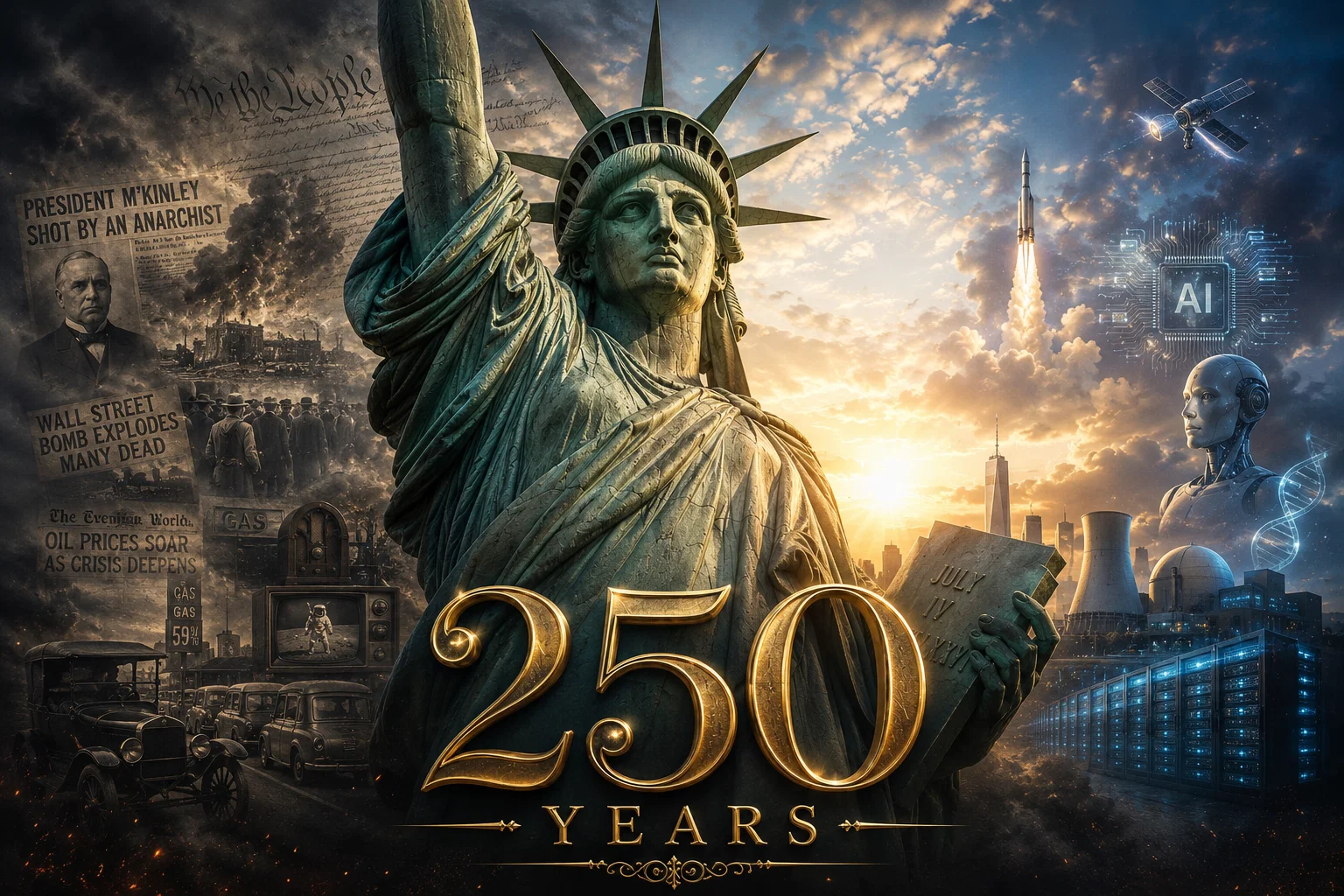
McKinley died eight days later, and, Czolgosz, an unemployed factory worker, went to the electric chair without a trace of remorse. He insisted it was his duty to strike down a symbol of oppression.
Czolgosz wasn’t a crazed madman, but rather a product of his time. The America of 1901 was 125 years into its history— the exact midpoint between the Declaration of Independence and today.
And despite the US economy already being the largest in the world at that point, the year 1901 did not feel like a nation striding confidently into the American Century.
The US financial system lurched from panic to panic, and to a great many observers, the young republic looked less like a rising power and more like a country unraveling.
The rich versus poor divide was growing, and violent socialist movements spread. Political assassinations, terrorism, and bombings became a recurring feature of public life.
The political violence did not end with McKinley’s assassination, either. Followers of the Italian anarchist Luigi Galleani waged a years-long bombing campaign against judges, politicians, and businessmen.
It peaked at noon on September 16, 1920, when a horse-drawn wagon packed with explosives detonated in front of the headquarters of J.P. Morgan on Wall Street, killing thirty people and wounding hundreds more. The case was never solved.
Many of these anarcho-socialists were immigrants, which poured gasoline on the raging blaze of backlash against widespread immigration.
In 1907 alone, more than a million people passed through Ellis Island. Immigrants were arriving faster than anyone knew how to absorb them, and people were getting tired of it.
Congress passed legislation that imposed a literacy test on immigrants, then banned entire countries. At first, people from Asia and the Middle East were shut out. Subsequent legislation set strict quotas, slamming the door on the southern and eastern Europeans who were considered undesirable.
Yet the instability continued... as did the government’s push to consolidate power.
After the Panic of 1907 nearly brought down the financial system, Congress used the scare to establish the Federal Reserve in 1913. This was the first step toward money that could be printed at will.
Also in 1913, the Constitution was amended, giving Congress the power to tax income.
The income tax (16th Amendment) was sold to the American people as a tax on the very rich that would only affect the top 2% of US households. Idiotic socialists at the time believed the lie and supported the amendment; after all, the rich should pay their fair share.
Within decades, three quarters of Americans were paying income tax.
With a new central bank and tax power in place, Washington then raced to join World War I (despite being an ocean away), and borrowed on an unimaginable scale to do it.
Frankly it all looked pretty bleak.
And yet, while all the bad news and turmoil was ongoing, America was simultaneously producing miracles.
Henry Ford put the country on wheels with the Model T and the moving assembly line. Motion pictures went from novelty to industry. Radio turned from a tinkerer's hobby into a machine that could broadcast to every home in the nation.
These were American breakthroughs that rewired the entire global economy and powered better times ahead.
Seventy-five years later, America's 200th birthday looked little better. In 1976, the economy was mired in stagflation that “experts” had previously sworn was impossible.
Oil shocks had humiliated the country at the gas pump. American dominance looked spent in the wreckage of Vietnam, and the nation had watched President Richard Nixon resign in disgrace.
Terrorism was back. Plane hijackings were somewhat commonplace. Crime rampaged across the cities.
And yet what followed was the personal computer, the Internet, the longest peacetime expansion in the country's history, and a comeback almost nobody standing in a gas line in 1976 would have believed.
Which brings us to the 250th birthday, today.
Political violence is back in American life. Immigration is once again a major issue. Fraud and corruption are rampant (and hardly anyone pays the price). And Washington's finances are in worse shape than at any point in the country's history, with the national debt larger than the entire economy.
Yet at the same time, American companies are building artificial intelligence, next-generation nuclear power, robotics, and biotech breakthroughs that could rewire the global economy even more than the assembly line and the Internet did. Chaos and invention have always lived side by side in the US, and they still do.
America was born out of revolution, and it has endured a civil war, two world wars, a depression, a decade of stagflation, and repeated financial panics.
Every one of those episodes brought years of real pain, but every time, the country that looked terminally ill came back stronger than ever.
There is an old saying in politics (usually credited to Winston Churchill, though apparently first quipped by an Israeli diplomat): Americans will always do the right thing... after exhausting all the alternatives.
Apocryphal or not, that is the pattern: the right thing comes eventually, but the pain comes first.
America is not just a country; it is an idea, and it may be the most extraordinary idea human beings have ever assembled. It stands on the shoulders of giants— Greek thought, Roman law, Judeo-Christian values, and free-market capitalism, fused with a conviction about individual liberty balanced by personal responsibility.
Betting against that idea has been the worst trade of the past 250 years.
To be clear, having a Plan B is not a bet against America either. The concept is not to hide in a bunker with canned food and guns because the end is near.
The point of a Plan B is to be honest about the road between here and the recovery: more inflation, higher taxes, and a stretch of instability, and to make sure you have the options available to come at it from a position of strength.
At 250 years, I truly believe the best days are still ahead. But there will be some rough ones in between.
To your freedom, James Hickman Co-Founder, Schiff Sovereign LLC
Seeds of Wisdom RV and Economics Updates Friday Afternoon 7-3-26
Good Afternoon Dinar Recaps,
CLARITY Act Advances as U.S. Senate Prepares Final Bill Text, Boosting Momentum for Crypto Regulation
Senate leaders are expected to release the final CLARITY Act text this week as bipartisan negotiations continue, strengthening expectations that the United States is moving closer to establishing a comprehensive regulatory framework for digital assets.
Good Afternoon Dinar Recaps,
CLARITY Act Advances as U.S. Senate Prepares Final Bill Text, Boosting Momentum for Crypto Regulation
Senate leaders are expected to release the final CLARITY Act text this week as bipartisan negotiations continue, strengthening expectations that the United States is moving closer to establishing a comprehensive regulatory framework for digital assets.
Overview
The U.S. Senate is expected to release the final CLARITY Act legislative text this week, marking another major step toward crypto regulatory clarity.
Growing bipartisan support, along with endorsements from industry and law enforcement organizations, has improved confidence that the legislation could advance later this summer.
If enacted, the CLARITY Act would establish clearer rules for digital assets, helping reduce regulatory uncertainty while encouraging innovation and investor protection.
Key Developments
1. Senate Finalizing Legislative Text
The U.S. Senate is reportedly preparing to release the final version of the CLARITY Act, giving lawmakers, industry participants, and investors their clearest view yet of the proposed digital asset regulatory framework before a Senate vote.
2. Bipartisan Support Continues to Build
Although the legislation still requires 60 Senate votes to advance, recent committee support from several Democratic senators has improved prospects for bipartisan cooperation when Congress returns from its July recess.
3. Law Enforcement Backs the Bill
The National Organization of Black Law Enforcement Executives (NOBLE) has become the first major law enforcement organization to endorse portions of the legislation, arguing that regulatory clarity can strengthen compliance, consumer protection, and public safety.
4. Market Optimism Increases
Analysts report that expectations for passage have improved, with investors viewing the legislation as one of the most significant crypto regulatory proposals ever considered by Congress. Markets are closely watching the release of the final bill for additional details.
Why It Matters
The CLARITY Act represents one of the most significant efforts to establish a comprehensive federal regulatory framework for digital assets in the United States. Clear legislation could reduce years of uncertainty surrounding cryptocurrencies while encouraging institutional investment, innovation, and responsible market growth.
Why It Matters to Foreign Currency Holders
Greater regulatory certainty for digital assets could accelerate institutional adoption of blockchain technology, tokenized assets, and digital payment infrastructure. While the legislation does not directly affect foreign currencies, it reflects the continued modernization of global financial systems that many currency holders are closely monitoring.
Implications for the Global Reset
Pillar 4 – Technology
The CLARITY Act could accelerate the integration of blockchain technology into regulated financial markets by providing clearer legal standards for digital assets, tokenization, and emerging financial infrastructure.
Future Outlook
The Senate is expected to publish the final legislative text shortly before lawmakers return from recess. Debate and amendments are likely to follow before a Senate floor vote, with bipartisan support remaining the key factor determining whether the bill becomes law. If approved, the CLARITY Act could reshape the U.S. digital asset industry by providing long-awaited regulatory certainty for businesses, investors, and financial institutions.
This is not just about cryptocurrency—it reflects the United States' broader effort to modernize financial regulation, support technological innovation, and position itself as a global leader in the rapidly evolving digital economy.
Seeds of Wisdom Team
Newshounds News™ Exclusive
Sources
CoinGape – CLARITY Act Advances as US Senate Eyes Final Text Release This Week
Galaxy Research – CLARITY Act: Lowering Our Odds to 60% as the Senate Calendar Tightens
~~~~~~~~~~
Seeds of Wisdom Team RV Currency Facts Youtube and Rumble
Newshound's News Telegram Room Link
RV Facts with Proof Links Link
RV Updates Proof links - Facts Link
Start Here room with Most Asked Questions Link
Follow the Gold/Silver Rate COMEX
Follow Fast Facts
Seeds of Wisdom Team™Website
Thank you Dinar Recaps
The Death of the Dollar Just Died
The Death of the Dollar Just Died
Heresy Financial: 7-2-2026
TIMECODES
0:00 The dollar's "death" was greatly exaggerated
0:52 What a stronger dollar means for your portfolio
1:28 Bretton Woods: how the dollar took over (1944)
Seeds of Wisdom RV and Economics Updates Friday Morning 7-3-26
Good Morning Dinar Recaps,
ECB Unveils Three-Pillar Digital Euro Roadmap, First Issuance Possible by 2029
The European Central Bank (ECB) has outlined a comprehensive three-pillar strategy to modernize Europe's financial system through a digital euro, tokenized settlement infrastructure, and faster cross-border payments. If approved, the initiative could pave the way for the first issuance of a digital euro by 2029, marking one of the world's most significant central bank digital currency (CBDC) projects.
Good Morning Dinar Recaps,
ECB Unveils Three-Pillar Digital Euro Roadmap, First Issuance Possible by 2029
The European Central Bank (ECB) has outlined a comprehensive three-pillar strategy to modernize Europe's financial system through a digital euro, tokenized settlement infrastructure, and faster cross-border payments. If approved, the initiative could pave the way for the first issuance of a digital euro by 2029, marking one of the world's most significant central bank digital currency (CBDC) projects.
Overview
The ECB has released a three-pillar roadmap for launching the digital euro and modernizing Europe's payment infrastructure.
Regulatory approval is targeted for 2026, with pilot transactions expected in 2027 and a potential public rollout by 2029.
The initiative aims to strengthen European payment sovereignty while supporting tokenized financial markets and reducing dependence on private stablecoins.
Key Developments
1. ECB Sets Timeline for the Digital Euro
ECB Executive Board member Piero Cipollone outlined a roadmap that targets regulatory approval in 2026, institutional pilot programs beginning in 2027, and the potential issuance of the digital euro by 2029. The retail digital euro is intended to complement physical cash while providing consumers with a secure, central bank-backed digital payment option.
2. Three-Pillar Strategy Modernizes Financial Infrastructure
The ECB's strategy focuses on three key initiatives:
A retail digital euro for consumers with legal tender status.
Wholesale settlement using tokenized central bank money for institutional transactions beginning in 2026.
Interconnected fast-payment systems to improve cross-border payment efficiency throughout Europe.
Together, these initiatives are designed to create a modern payment ecosystem capable of supporting both traditional finance and tokenized assets.
3. Tokenized Settlement Gains Institutional Support
Beginning in September 2026, the ECB plans to allow institutions using distributed ledger technology (DLT) to settle transactions with tokenized central bank money rather than relying on private stablecoins. This move further integrates blockchain technology into regulated financial markets.
4. Europe Seeks Greater Payment Sovereignty
The ECB emphasized reducing Europe's dependence on foreign payment providers and privately issued stablecoins. Standardization agreements have already been signed with major European payment organizations to help ensure broad acceptance of the digital euro across retail payment networks.
Why It Matters
The ECB's roadmap represents one of the most advanced central bank digital currency initiatives among major global economies. Beyond introducing a digital euro, the strategy seeks to modernize payment infrastructure, strengthen financial sovereignty, and integrate tokenized finance into Europe's regulated financial system.
Why It Matters to Foreign Currency Holders
The continued development of the digital euro demonstrates that major central banks are actively modernizing payment systems through tokenization and digital currencies. Investors following global monetary reform may view these developments as another significant milestone in the evolution of next-generation financial infrastructure.
Implications for the Global Reset
Pillar 2 – Trade
A digital euro and faster cross-border payment systems could improve international settlement efficiency, lower transaction costs, and strengthen Europe's role in global commerce.
Pillar 4 – Technology
The ECB's roadmap accelerates the adoption of tokenized finance, distributed ledger technology, and central bank digital currency infrastructure, helping modernize Europe's financial architecture.
Future Outlook
The next major milestone will be the European Union's regulatory approval process in 2026. If approved on schedule, pilot programs will begin in 2027 before a possible public launch in 2029, positioning Europe among the first major economies to deploy a large-scale central bank digital currency integrated with tokenized financial markets.
This is not just about launching a digital euro—it reflects Europe's broader strategy to modernize financial infrastructure, strengthen payment sovereignty, and prepare its economy for the next generation of digital finance.
Seeds of Wisdom Team
Newshounds News™ Exclusive
Sources
~~~~~~~~~~
🌱 A Message to Our Currency Holders🌱
If you’ve been holding foreign currency for many years, you were not foolish.
You were not wrong to believe the global financial system would change.
What failed was not your patience — it was the information you were given.
For years, dates, rumors, and personalities replaced facts, structure, and proof. “This week” predictions created cycles of hope and disappointment that were never based on how currencies actually change.
That is not your failure.
Our mission here is different: • No dates • No rates • No hype • No gurus
Instead, we focus on:
• Verifiable developments • Institutional evidence
• Global financial structure • Where countries actually sit in the process
Currency value changes only come after sovereignty, trade, banking, settlement systems, and fiscal coordination are in place. History and institutions confirm this sequence.
You will see silence. You will see denials. That is not delay — that is discipline.
Protect your identity. Organize your documents. Verify everything.
Never hand your discernment to anyone who cannot show proof.
You deserve truth — not timelines.
Seeds of Wisdom Team
Newshounds News
~~~~~~~~~~
Seeds of Wisdom Team RV Currency Facts Youtube and Rumble
Newshound's News Telegram Room Link
RV Facts with Proof Links Link
RV Updates Proof links - Facts Link
Start Here room with Most Asked Questions Link
Follow the Gold/Silver Rate COMEX
Follow Fast Facts
Seeds of Wisdom Team™Website
Thank you Dinar Recaps
Friday Iraq News Posted by Tishwash at TNT 7-3-2026
TNT:
Tishwash: The US Treasury is tracking $300 billion outside the Iraqi banking system.
Informed sources revealed to Al-Mustaqilla information described as serious, indicating that the US Treasury informed the government of Ali al-Zaidi of the existence of sums of money estimated at about $300,000,000,000 believed to have left the official banking system.
According to the source, these funds are suspected to still be outside banking channels, specifically with certain political figures, away from direct financial oversight.
TNT:
Tishwash: The US Treasury is tracking $300 billion outside the Iraqi banking system.
Informed sources revealed to Al-Mustaqilla information described as serious, indicating that the US Treasury informed the government of Ali al-Zaidi of the existence of sums of money estimated at about $300,000,000,000 believed to have left the official banking system.
According to the source, these funds are suspected to still be outside banking channels, specifically with certain political figures, away from direct financial oversight.
The source also pointed to what he described as “precise sequences of dollar movement allocated to Iraq,” where the path of funds is tracked and transfer and distribution operations are analyzed, in an attempt to uncover the whereabouts of large sums believed to be inside the country or outside the official financial system.
The information added that ongoing tracking operations reveal – according to the source – a complex financial network linked to dollar flows inside and outside Iraq, which raises questions about the size of undeclared funds and their true paths. link
Tishwash: The European Union hands over to the Ministry of Finance the assets of a project to develop public financial management in Iraq.
The European Union handed over, on Wednesday (July 1, 2026), the assets resulting from the "Strengthening Public Finances and Financial Markets" project to the Iraqi Ministry of Finance, in a move aimed at supporting public financial management and enhancing joint cooperation in the fields of macroeconomics and investment.
The EU said in a statement received by Baghdad Today that “today, EU-funded assets were officially handed over to the Iraqi Ministry of Finance, in an important step that reflects our shared commitment to strengthening public financial management.”
He added, “During the handover ceremony, both the Director General of the Administration Department at the Ministry of Finance, Sadiq Huwaidi Abbas, and the Head of the New Cooperation Section at the European Union Mission, Wim Rippma, spoke about the depth of the partnership and its outstanding results between the European Union and Iraq in the fields of economy and investment.”
The statement indicated that “the transfer of assets resulting from the ‘Strengthening Public Finances and Financial Markets’ project, funded by Germany and implemented by GIZ, reflects the sustainable impact of this cooperation and paves the way for continued joint work to establish transparent, effective and sustainable public financial management in Iraq,” adding that “together we look forward to a new chapter in our partnership.” link
**************
Tishwash: Enhancing the investment environment tops the agenda of Al-Zaidy's meeting with businessmen, along with broader support for the private sector.
Prime Minister Ali Faleh al-Zaidi discussed with a group of Iraqi businessmen ways to develop the investment environment and expand the contribution of the private sector to the economic development process.
The Prime Minister’s Media Office stated in a statement that “Prime Minister Ali Faleh Al-Zaidi received a group of Iraqi businessmen in various commercial, industrial and financial sectors.”
According to the statement, the Prime Minister affirmed “the government’s commitment to providing a safe investment environment and supporting all legislation and laws that contribute to achieving the requirements for investment, commercial and industrial success.”
He pointed out that “the private sector is an important partner in development and service projects in Iraq.”
He pointed out that “the government will support his active presence within the framework of its plan included in the ministerial program, which focuses on freeing the economy from the single-system model and employing all capabilities to diversify sources of income and maximize resources. link
*************
Tishwash: The Central Bank and the Integrity Commission are taking action to close "money laundering channels" – statement
The Governor of the Central Bank of Iraq, Nizar Nasser Hussein, and the Head of the Federal Integrity Commission, Mohammed Ali Al-Lami, agreed today, Thursday (July 2, 2026), to put in place rapid coordination mechanisms to dry up the avenues for smuggling money by activating proactive monitoring and exchanging immediate data.
The meeting, which took place at the bank's headquarters and was attended by both sides on the occasion of the new governor assuming his position, witnessed an in-depth discussion of the files of protecting public funds, where it was decided to form a joint coordination working group to close the legal and procedural gaps, and to pursue illegal proceeds to recover them in accordance with the legal frameworks.
The Governor of the Central Bank of Iraq, Mr. Nizar Nasser Hussein, received at the bank’s headquarters the Head of the Federal Integrity Commission, Dr. Muhammad Ali Al-Lami, who offered his congratulations and blessings to His Excellency on the occasion of his assuming his new position, wishing him success in managing the country’s monetary policy.
The meeting witnessed an in-depth discussion of a number of vital files of common interest, where both sides stressed the importance of institutional integration between the Central Bank and regulatory bodies to protect public funds and enhance the environment of integrity and transparency in all state institutions.
In a strategic move to enhance financial security, the head of the Integrity Commission and the governor of the Central Bank agreed to strengthen joint coordination mechanisms with the aim of drying up avenues for money smuggling and combating the challenges facing the financial system, through activating proactive oversight and exchanging real-time data, which represents a fundamental pillar in pursuing corruption crimes, and tracking smuggled funds and illicit proceeds to recover them in accordance with legal frameworks.
At the conclusion of the meeting, both parties emphasized the need for the swift implementation of the joint agreements and the formation of a coordinating working group to ensure that any legal and procedural loopholes that could be exploited in financial transactions are addressed. link
Tishwash: Diversifying the Iraqi economy: A historic opportunity or a project that clashes with old obstacles?
Economic reform is one of the most prominent challenges facing Iraq, given the continued heavy reliance on oil revenues and the direct impact of fluctuations in global energy prices.
Conversely, there are increasing calls to adopt economic policies based on diversifying income sources, encouraging investment, and strengthening the role of the private sector, which would contribute to building a more stable economy capable of facing crises.
With the current government adopting a package of economic plans and reforms, a question arises about its ability to translate this vision into tangible results that reflect on the lives of citizens and the national economy.
Economic expert Abbas Al-Shatri confirmed today, Thursday (July 2, 2026), that the current government adopts an economic vision different from the previous government, based on diversifying income sources and reducing dependence on oil revenues, in addition to stimulating investment and developing the economic infrastructure.
Al-Shatri told Baghdad Today that “Iraq is working genuinely to save the Iraqi economy from the accumulated challenges, based on an economic vision that focuses on structural reforms rather than temporary solutions, which distinguishes its approach from many previous governments.”
He explained that "the success of this vision remains contingent on the continued implementation of reforms, the provision of a supportive legislative and administrative environment, as well as combating corruption and strengthening partnership with the private sector, which will positively impact growth rates and job opportunities."
He added that "Iraq possesses great economic potential that qualifies it to achieve a qualitative leap in the coming years if reform policies continue and development projects are implemented according to clear timetables, and the current stage represents an opportunity to lay the foundations for a more diversified and sustainable economy."
For many years, the Iraqi economy has relied mainly on oil revenues, which represent the largest share of the general budget revenues, making it vulnerable to the fluctuations of global markets.
Over the past years, many government programs have been proposed for economic reform and diversification of income sources, but challenges such as corruption, bureaucracy, a weak investment environment, and delays in project implementation have limited the achievement of broad results. link
Iraq Economic News and Points To Ponder Thursday Evening 7-02-26
The Dollar Records A New Decline Against The Iraqi Dinar In The Local Markets
Last Updated: July 1, 2026 The exchange rates of the US dollar, on Wednesday, a new decline against the Iraqi dinar in the local markets, amid slight changes in the movement of supply and demand within the market.
According to market data, the selling price of the dollar recorded 155,500 dinars per 100 dollars, while the purchase price reached 154,500 dinars per 100 dollars, in an indication of the continued volatility in exchange rates during the recent period.
The Dollar Records A New Decline Against The Iraqi Dinar In The Local Markets
Last Updated: July 1, 2026 The exchange rates of the US dollar, on Wednesday, a new decline against the Iraqi dinar in the local markets, amid slight changes in the movement of supply and demand within the market.
According to market data, the selling price of the dollar recorded 155,500 dinars per 100 dollars, while the purchase price reached 154,500 dinars per 100 dollars, in an indication of the continued volatility in exchange rates during the recent period.
This new decline comes at a time when local markets are following the developments of monetary policy and regulatory measures related to the exchange market, which aim to achieve greater stability in the price of the currency.
Traders in the market are waiting for more indicators in the coming days, to see if this decline will be the beginning of a continuous downtrend or just a temporary correction within the usual fluctuation range.
Exchange rates in Iraq remain subject to multiple factors, including the movement of demand for the dollar, control procedures, and internal and external economic developments. LINK
US Treasury Tracks $300 Billion Out Of Iraq’s Banking System
Last Updated: July 1, 2026 Independent sources revealed to the «independent» information described as dangerous, indicating that the US Treasury informed the government of Ali al-Zaidi of the existence of amounts estimated at $ 300,000,000,000 believed to have left the official banking system.
According to the source, these funds are suspected of being still outside banking channels, specifically by some political figures, away from direct financial supervision.
The source also pointed to the existence of what he described as "accurate sequences of the movement of the dollar allocated to Iraq," where the trajectory of funds is tracked and analysis of transfers and distribution, in an attempt to reveal the whereabouts of large sums believed to be inside the country or outside the official financial system.
According to the source, the ongoing tracking operations reveal a complex financial network linked to dollar flows inside and outside Iraq, opening the door to questions about the size of undeclared funds and their real trajectories. LINK
Public Funds Stolen In Iraq Surpass $2 Trillion Since 2003
Iraq Amr Salem July 2, 2026 Baghdad (IraqiNews.com) – The Iraqi Prime Minister’s legal advisor, Munir Haddad, revealed that more than $2 trillion have been stolen from Iraq since 2003.
According to the Iraqi News Agency, Haddad stated that the number of suspects continues to increase as investigations with the arrested ones are ongoing.
The Iraqi government launched a countrywide anti-corruption campaign on Sunday known as “Operation Dawn.” Prime Minister Ali al-Zaidi ordered the crackdown, which has resulted in the arrests of several lawmakers and senior officials, as well as the recovery of millions of dollars, gold, luxurious cars, and real estate.
Iraqi security forces began the massive campaign following judicial orders, targeting dozens of current and former government officials.
The step, which included lifting parliamentary immunity and overnight raids in Baghdad’s Green Zone, is based on confessions and investigations into the major arrest of Adnan al-Jumaili, a deputy oil minister accused of corruption.
Primary suspects have delivered extensive confessions, prompting security and judicial officials to arrest more individuals, according to Haddad.
The Iraqi official clarified that some of the suspects attempted to leave the country or seek a safe haven in Iraqi Kurdistan, but Kurdish authorities have shown cooperation and handed over eight suspects so far.
The offenses being investigated include both typical embezzlement and money laundering.
According to Haddad, the sums seized by the authorities are incredible. For example, the wife of one of the defendants purchased a home worth $5 million. Furthermore, some of the accused hold over 50 properties registered in their own or family members’ names.
The campaign will cover several Iraqi provinces. “The investigations and arrests are ongoing and will not adhere to a specific timeline,” Haddad said. They are being conducted in complete secrecy to prevent any individuals who are wanted from fleeing.
https://www.iraqinews.com/iraq/public-funds-stolen-in-iraq-surpass-2-trillion-since-2003/
Iraq Seeks To Raise Oil Output Ahead Of Global Energy Transition
Iraq Amr Salem July 2, 2026 Baghdad (IraqiNews.com) – Iraq seeks to boost oil production and optimize its reserves for revenue generation before a global energy transition potentially reduces oil demand.
Iraq is adopting an approach that delaying the development of oil reserves may be less cost-effective than increasing output at the present time, according to Reuters.
Oil constitutes approximately 90 percent of the revenue for the Iraqi government. The recent conflict and the resulting turmoil forced Baghdad to cut its daily output from over 4.2 million barrels to under 1.5 million barrels in May. This situation underscores the urgent need to increase production to recover the lost revenue.
New investments worth billions of dollars from businesses such as British Petroleum (BP), TotalEnergies, and ExxonMobil have raised hopes that Iraq would be able to transform its massive oil reserves into long-term financial benefits. However, this approach raises concerns about a potential significant decline in global oil consumption in the years ahead.
The main concern involves the potential for increased supplies from various producing countries, which could lead to a supply glut and a decline in oil prices. This is particularly relevant as global output is projected to rise by nearly eight million barrels per day by 2027, while the growth in demand is expected to be slower.
The Iraqi strategy is based on the timing factor due to the uncertainties over when global oil demand will decline and whether producers can profit from their reserves prior to that time.
https://www.iraqinews.com/iraq/iraq-seeks-to-raise-oil-output-ahead-of-global-energy-transition/
8 Million Barrels Of Iraqi Crude Oil Still trapped On Tankers
Iraq Amr Salem July 2, 2026 Baghdad (IraqiNews.com) – Over eight million barrels of Iraqi crude oil are still trapped aboard ships, but over 100 million barrels of crude oil and petroleum products that had accumulated in the Gulf have begun to slowly flow back to international markets, offering a temporary relief from supply constraints, Shafaq News said on Thursday, citing a report issued by S&P Global Commodity Insights.
Iraq, along with Oman, has been identified as one of the Middle East’s top countries to reactivate oil output, while key refineries in Saudi Arabia, Bahrain, and Kuwait would take months to restore operations, according to the report.
The total amount of crude oil in the Arabian Gulf reached around 90.5 million barrels, with the remainder divided among other petroleum products. More than 90 million barrels of crude oil were aboard vessels ready to be transported.
According to estimates, Iraq has around 8.3 million barrels of oil stuck on tankers, following only Iran with 31.7 million barrels, Saudi Arabia with 18.7 million barrels, and the UAE with 17 million barrels. Kuwait recorded 8.1 million barrels, Qatar had 4 million, and Oman had 2.2 million barrels.
Most Gulf oil exports are bound for East Asian markets. This demonstrates that the resumption of these supplies may have an impact on the global supply-demand balance, affecting oil prices and producing nations’ income.
International banks anticipate that exports will return to pre-war levels in July, but there is still concern that the effects of such quantities will be temporary until actual production in the region improves.
https://www.iraqinews.com/iraq/8-million-barrels-of-iraqi-crude-oil-still-trapped-on-tankers/
Seeds of Wisdom RV and Economics Updates Thursday Evening 7-2-26
Good Evening Dinar Recaps,
SEC Launches ‘Project Crypto’ to Bring Traditional Finance On-Chain
The U.S. Securities and Exchange Commission has unveiled Project Crypto, a sweeping initiative designed to modernize securities regulations for blockchain-based financial markets. The proposal aims to create clearer rules for tokenized assets, digital securities, and cryptocurrency markets while supporting innovation under a regulated framework.
Good Evening Dinar Recaps,
SEC Launches ‘Project Crypto’ to Bring Traditional Finance On-Chain
The U.S. Securities and Exchange Commission has unveiled Project Crypto, a sweeping initiative designed to modernize securities regulations for blockchain-based financial markets. The proposal aims to create clearer rules for tokenized assets, digital securities, and cryptocurrency markets while supporting innovation under a regulated framework.
Overview
The SEC has launched Project Crypto to modernize U.S. securities regulations for blockchain-based financial markets.
Most digital assets may no longer be classified as securities, potentially reducing legal uncertainty for much of the crypto industry.
The initiative supports tokenized financial markets while coordinating regulatory oversight with the CFTC.
Key Developments
1. SEC Introduces Project Crypto
SEC Chairman Paul Atkins announced Project Crypto, a comprehensive initiative designed to update securities regulations so traditional financial assets—including stocks, bonds, and other securities—can operate efficiently on blockchain infrastructure. The effort aligns with recommendations from the President's Working Group on Digital Assets and supports the broader adoption of tokenized finance.
2. Most Digital Assets Could Avoid Securities Classification
One of the proposal's most significant changes is the SEC's position that the majority of digital assets should not automatically be treated as securities. If adopted, many blockchain projects could operate under clearer regulatory guidelines rather than facing ongoing uncertainty over securities laws.
3. SEC and CFTC Plan Joint Regulatory Framework
The SEC and the Commodity Futures Trading Commission (CFTC) are expected to establish a Memorandum of Understanding to better define regulatory responsibilities for digital assets that fall outside traditional securities laws. This coordinated approach aims to reduce overlapping oversight and improve regulatory clarity.
4. New Rules Planned for Tokenized Markets
The SEC's Crypto Task Force, led by Commissioner Hester Peirce, will develop proposals covering:
Digital asset custody
Tokenized securities trading
Market structure modernization
Decentralized finance (DeFi) integration
Distribution standards for digital assets
The agency expects updated market structure rules to be introduced during 2026.
Why It Matters
Project Crypto represents one of the strongest indications yet that U.S. regulators are preparing for a financial system where traditional assets and blockchain technology operate together. Clearer regulations could encourage greater institutional participation, accelerate tokenization, and reduce legal uncertainty that has slowed innovation across the digital asset industry.
Why It Matters to Foreign Currency Holders
A more defined regulatory framework for tokenized financial assets could accelerate the development of tokenized currencies, stablecoins, and blockchain-based payment systems. As global financial infrastructure continues to modernize, investors following currency reform and digital asset adoption may view these regulatory developments as an important step toward faster and more efficient financial markets.
Implications for the Global Reset
Pillar 2 – Trade
Clearer rules for blockchain-based financial markets could support faster cross-border payments, tokenized settlements, and more efficient global financial transactions, reducing friction in international commerce.
Pillar 4 – Technology
Project Crypto advances the modernization of U.S. financial infrastructure by creating a regulatory framework that supports tokenization, blockchain networks, and digital asset innovation within regulated markets.
Future Outlook
The SEC plans to continue developing Project Crypto through 2026 alongside the CFTC and industry participants. If implemented successfully, the initiative could position the United States as a leading jurisdiction for regulated digital assets while encouraging broader adoption of tokenized securities and blockchain-based financial services.
This is not just about cryptocurrency—it reflects a broader transformation of financial markets as regulators build the legal framework for tokenized assets, digital infrastructure, and the next generation of global finance.
Seeds of Wisdom Team
Newshounds News™ Exclusive
Sources
Crypto Briefing – SEC launches ‘Project Crypto’ to bring traditional finance on-chain
U.S. Securities and Exchange Commission – SEC Crypto Task Force
~~~~~~~~~~
Seeds of Wisdom Team RV Currency Facts Youtube and Rumble
Newshound's News Telegram Room Link
RV Facts with Proof Links Link
RV Updates Proof links - Facts Link
Start Here room with Most Asked Questions Link
Follow the Gold/Silver Rate COMEX
Follow Fast Facts
Seeds of Wisdom Team™Website
Thank you Dinar Recaps
Seeds of Wisdom RV and Economics Updates Thursday Afternoon 7-2-26
Good Afternoon Dinar Recaps,
IMF Says Tokenization Could Transform Settlement and Financial Stability
The International Monetary Fund (IMF) says tokenization could fundamentally reshape global financial markets by enabling near-instant settlement, improving efficiency, and modernizing financial infrastructure. While the IMF sees enormous potential, it also warns that common standards and coordinated regulation will be essential to prevent new systemic risks as tokenized finance expands.
Good Afternoon Dinar Recaps,
IMF Says Tokenization Could Transform Settlement and Financial Stability
The International Monetary Fund (IMF) says tokenization could fundamentally reshape global financial markets by enabling near-instant settlement, improving efficiency, and modernizing financial infrastructure. While the IMF sees enormous potential, it also warns that common standards and coordinated regulation will be essential to prevent new systemic risks as tokenized finance expands.
Overview
The IMF says tokenization could significantly improve global financial market efficiency by accelerating settlement and modernizing asset ownership.
The organization warns that without global interoperability standards and coordinated regulation, tokenized markets could become fragmented and introduce new financial risks.
Major banks, regulators, and financial institutions are rapidly advancing tokenized finance initiatives, signaling that blockchain infrastructure is moving into the financial mainstream.
Key Developments
1. IMF Endorses Tokenization as a Major Financial Innovation
The IMF stated that tokenization is no longer simply a cryptocurrency concept but a technology capable of transforming traditional finance. By placing assets, settlement, and recordkeeping onto shared distributed ledgers, transactions that currently require several days could potentially settle within minutes or seconds.
2. Faster Settlement Could Improve Global Liquidity
Near-instant settlement may reduce counterparty risk, lower operating costs, free up capital, and improve liquidity across financial markets. The IMF believes these efficiencies could modernize payments, securities settlement, and asset transfers worldwide.
3. Regulators Face Critical Policy Decisions
The IMF stressed that governments and regulators have a limited window to establish global standards. Decisions involving interoperability, governance, settlement assets, smart contracts, and the future role of central banks will determine whether tokenization strengthens or fragments the global financial system.
4. Traditional Financial Institutions Continue Moving Toward Tokenization
Large financial institutions continue expanding tokenization initiatives. The Clearing House, whose owners include major U.S. banks, is preparing a tokenized deposit network, while additional research from PwC and Moody's indicates banks are actively preparing for broader blockchain integration.
5. SEC Continues Developing U.S. Regulatory Framework
The U.S. Securities and Exchange Commission continues refining how existing securities laws apply to tokenized assets. The agency is also evaluating an innovation exemption that could allow firms to test blockchain-based trading platforms while permanent regulatory frameworks are developed.
Why It Matters
The IMF's endorsement represents another major signal that tokenization is becoming part of the future financial system rather than remaining a niche blockchain application. As regulators and major financial institutions increasingly embrace tokenized assets, the technology could significantly improve settlement speed, transparency, liquidity, and operational efficiency across global markets.
Why It Matters to Foreign Currency Holders
Tokenization supports the modernization of financial infrastructure that many analysts believe will eventually improve cross-border payments, settlement efficiency, and digital asset integration. While it does not directly affect currency revaluations, it represents another foundational step toward faster, more transparent international financial systems.
Implications for the Global Reset
Pillar 3 – Assets
The IMF's recognition of tokenization reinforces the transition toward digitally represented financial assets, real-world asset tokenization, and more efficient capital markets supported by blockchain technology.
Pillar 4 – Technology
Tokenization advances the modernization of global financial infrastructure by enabling faster settlement, programmable assets, interoperable ledgers, and next-generation payment systems that could reshape international finance.
Looking Ahead
The next several years will likely determine how quickly tokenized finance moves from pilot programs into everyday financial markets. Success will depend on international cooperation, regulatory clarity, common technical standards, and secure blockchain infrastructure. If these elements come together, tokenization could become one of the most significant upgrades to the global financial system in decades.
This is not just about blockchain—it reflects the accelerating modernization of the global financial system as governments, regulators, and major financial institutions work to build faster, more efficient, and interoperable market infrastructure.
Seeds of Wisdom Team
Newshounds News™ Exclusive
Sources
Cointelegraph — IMF says tokenization could transform settlement and financial stability
International Monetary Fund (IMF) — Tokenization Can Change the World's Financial Architecture
~~~~~~~~~~
Seeds of Wisdom Team RV Currency Facts Youtube and Rumble
Newshound's News Telegram Room Link
RV Facts with Proof Links Link
RV Updates Proof links - Facts Link
Start Here room with Most Asked Questions Link
Follow the Gold/Silver Rate COMEX
Follow Fast Facts
Seeds of Wisdom Team™Website
Thank you Dinar Recaps
Iraq Economic News and Points To Ponder Thursday Afternoon 7-02-26
The New York Times: The US Administration Has Resumed The Transfer Of Oil Revenues To Iraq
Economy News _ Baghdad The New York Times revealed that the White House administration has resumed sending Iraqi oil revenues to Baghdad, against the backdrop of Prime Minister Ali al-Zaidi’s campaign against those involved in financial corruption cases. The newspaper quoted the spokesman for the Iraqi government, Haider al-Aboudi, as saying: "The shipments of the dollar to Iraq have resumed, and the problem has been solved."
The New York Times: The US Administration Has Resumed The Transfer Of Oil Revenues To Iraq
Economy News _ Baghdad The New York Times revealed that the White House administration has resumed sending Iraqi oil revenues to Baghdad, against the backdrop of Prime Minister Ali al-Zaidi’s campaign against those involved in financial corruption cases. The newspaper quoted the spokesman for the Iraqi government, Haider al-Aboudi, as saying: "The shipments of the dollar to Iraq have resumed, and the problem has been solved."
The financial adviser to the prime minister, Mazhar Mohammed Saleh, also confirmed the resumption of transfers.
The U.S. State Department or Treasury did not comment on the matter, according to the New York Times.
The resumption of dollar shipments coincides with the launch of an anti-corruption campaign, which included the arrest of dozens of current and former officials, including members of the House of Representatives, on corruption-related charges.
The administration of U.S. President Donald Trump halted the flow of dollars from oil sales to Iraq’s largely cash-banking economy in April.
Iraqi officials said at the time that Washington had also suspended cooperation and funding for Iraqi security services.
An official from the Kurdistan region at the time pointed out that one of the motives for suspending dollar shipments was to limit the smuggling of the US currency by Iranian-backed militias, at a time when the country was in the process of choosing a new prime minister, amid US efforts to prevent the arrival of candidates seen as close to Tehran.
Washington has also been demanding that the Iraqi government rein in a number of militias linked to Tehran that operate largely outside state control and have occasionally carried out attacks against U.S. targets inside Iraq.
It is noteworthy that new international banking rules were imposed years ago on Baghdad according to greater requirements for transparency on financial transfers in dollars held as foreign reserves of Iraq in an account with the Federal Reserve Bank in New York.
The Central Bank of Iraq has facilitated these financial transfers from its account with the Federal Reserve in New York for the benefit of Iraqi companies and individuals to pay for goods imported from outside the country.
These transfers are vital because few Iraqi companies have international bank accounts.
Iraq Wins A Lawsuit In Jordan And Obliges A Company To Pay Financial Compensation
Money and business Economy News – Baghdad The Ministry of Justice announced on Thursday that it has won a lawsuit pending before the Amman Court of Appeal in the Hashemite Kingdom of Jordan, and obtained a final ruling that requires a Jordanian company to pay financial compensation in favor of the General Company for Southern Refineries of the Ministry of Oil.
The ministry said that the ruling came against the backdrop of the defendant’s violation of the implementation of its contractual obligations arising from the contract concluded between the two parties in 2011, after the legal department in the Ministry of Justice followed the proceedings before the Jordanian judiciary until the issuance of the final judicial decision.
This achievement comes within the framework of the Iraqi government's keenness to protect public money and preserve the rights of the Iraqi state outside the country, and embodies the continuous legal efforts exerted by the Ministry of Justice, in coordination with the concerned government agencies, to follow up on foreign lawsuits and restore rights in accordance with legal and judicial frameworks, thus enhancing Iraq's position in protecting its legal interests at the regional and international levels https://www.economy-news.net/content.php?id=70907
A Parliamentary Committee Is Heading To Review All Oil Contracts And Licensing Rounds
Money and business Economy News – Baghdad The Parliamentary Oil and Gas Committee said it has a tendency to re-review all oil contracts and licensing rounds
A member of the Parliamentary Oil and Gas Committee, Jassim Al-Moussawi, said that the committee has a tendency to review all oil contracts and licensing rounds, noting that this file is one of the important and sensitive files that need comprehensive scrutiny to identify the flaws and address the problems that have emerged during the implementation stages.
Al-Moussawi explained that the committee is continuing to follow up this file by reviewing the details of the contracts and the contracting mechanisms adopted in the oil sector, pointing out that some contracts need to be re-evaluated to ensure their harmony with the national interest, maximize the revenues achieved by the state, and reduce any aspects that may lead to the waste of financial resources.
He added that the oil sector, despite its great importance to the Iraqi economy, has faced a number of challenges during the past years as a result of errors that accompanied the implementation of some projects, pointing out that some refineries established with government funding did not achieve the required goals because of the assignment of their implementation to companies that were not at the required level of efficiency, causing the failure of those projects and the opening of investigation files linked to them.
He stressed that the review process will not be limited to licensing rounds only, but will include various projects related to the production, refining and oil investment sectors, in order to diagnose weaknesses and develop practical solutions that ensure improved performance and maximum utilization of oil resources.
Moussawi pointed out that the reform of the oil sector is a key priority in view of its pivotal role in supporting the national economy and financing the general budget, stressing that addressing the gaps in contracts and projects can contribute to reducing financial waste, raising the level of administration, and increasing the economic returns achieved by the state
https://www.economy-news.net/content.php?id=70911
Samsung And SK Pump $252 Billion To Expand Artificial Intelligence Chip Industry
Money and business Economy News - Follow-up The Ministry of Industry announced on Thursday that Samsung Electronics, SK Hynx and others have been investing 392 trillion won ($252.5 billion) in the Chongcheong region, including in facilities for manufacturing and packaging high-bandwidth memory, as part of the government’s efforts to expand growth based on artificial intelligence.
It comes as a follow-up plan for the tripartite mega-projects unveiled by the government earlier this week, which aims to develop technologies across the country and turn South Korea into an industrial powerhouse in the emerging age of artificial intelligence, South Korea’s Yonhap news agency reported.
The Ministry of Commerce, Industry and Resources said Samsung Group has pledged to invest a total of 140 trillion won in the Chongcheung region to build the Samsung Electronics facility for the manufacture and packaging of high-bandwidth memory, as well as a line for the production of the light-emitting organic diode and a next-generation screen by Samsung Display.
Samsung Electricity and Mechanics will build facilities for high-performance packaging substrates for artificial intelligence servers, and Samsung SDI will build an advanced battery manufacturing plant https://www.economy-news.net/content.php?id=70915
Al-Zaidi Discusses With A Jordanian Delegation The Implementation Of The Oil Pipeline Project (Basra-Aqaba)
Money and business Economy News – Baghdad Prime Minister Ali Faleh al-Zaidi on Thursday discussed with a Jordanian ministerial delegation the implementation of the oil pipeline project (Basra-Aqaba).
The media office said in a statement received by "Economy News" that "Zaidi received, on Thursday, a ministerial delegation from the Hashemite Kingdom of Jordan, headed by the Minister of Industry, Trade and Supply, Falah Al-Qadhaf, and included ministers; energy and mineral wealth, transport, and investment, in the presence of the Minister of Industry and Minerals, the head of the Arab Department in the Ministry of Foreign Affairs, and the Jordanian ambassador to Iraq."
He added that "the meeting witnessed the discussion of a number of files and topics of common interest, foremost of which is the implementation of the oil pipeline project (Basra - Aqaba), and facilitate the procedures for granting entry visas to businessmen in both countries, in addition to enhancing cooperation in the fields of industry, energy, transport, investment and other sectors of common interest."
Al-Zaidi stressed that "the two countries have historical and distinguished relations, and the Hashemite Kingdom of Jordan represents an important strategic depth for Iraq," pointing to "the government's aspiration to raise bilateral relations to wider levels during the next phase, by increasing the volume of trade exchange, and expanding investment opportunities and economic cooperation in various sectors."
For their part, the members of the Jordanian delegation conveyed to Al-Zaidi the greetings and congratulations of King Abdullah II of Jordan and Jordanian Prime Minister Jafar Hassan on the occasion of the formation of the government, and handed him an official invitation to visit the Kingdom.
The judges expressed the Kingdom's full support for Iraq, praising Iraq's progress in the areas of combating corruption, economic reforms, and improving the investment environment, thus contributing to strengthening the partnership between the two brotherly countries https://www.economy-news.net/content.php?id=70923
Thursday Iraq News Posted by Tishwash at TNT 7-2-2026
TNT:
Tishwash: The central bank governor is in parliament to discuss "major reforms" in the banking sector.
Al-Mustaqilla - In his first prominent political and economic move since assuming his duties, the Governor of the Central Bank of Iraq, Nizar Nasser Hussein, held a meeting with the Speaker of Parliament, Hebat al-Halbousi, to discuss the future of the Iraqi banking sector and financial reform plans, amid escalating economic challenges facing the country.
According to an official statement, the meeting witnessed extensive discussions on the reality of the Iraqi banking system and mechanisms for modernizing it, as well as the development of strategic programs and plans to restructure the financial sector and enhance the efficiency of Iraqi banks.
TNT:
Tishwash: The central bank governor is in parliament to discuss "major reforms" in the banking sector.
Al-Mustaqilla - In his first prominent political and economic move since assuming his duties, the Governor of the Central Bank of Iraq, Nizar Nasser Hussein, held a meeting with the Speaker of Parliament, Hebat al-Halbousi, to discuss the future of the Iraqi banking sector and financial reform plans, amid escalating economic challenges facing the country.
According to an official statement, the meeting witnessed extensive discussions on the reality of the Iraqi banking system and mechanisms for modernizing it, as well as the development of strategic programs and plans to restructure the financial sector and enhance the efficiency of Iraqi banks.
The Central Bank Governor stressed that the next phase requires proceeding with a comprehensive banking reform plan, which includes developing the infrastructure of the banking sector and raising the level of institutional performance, while strengthening coordination between monetary policy and the legislative authority to ensure financial stability.
For his part, the Speaker of Parliament announced the parliament’s support for measures and policies aimed at protecting the national currency and enhancing banking stability, stressing the importance of providing a more stable economic and investment environment in Iraq.
This meeting comes at a time when the Iraqi banking sector is facing increasing challenges and pressures related to financial and regulatory reforms, which puts the Central Bank’s new plans under political and economic scrutiny in the coming period.
At the conclusion of the meeting, both sides affirmed their commitment to continuing coordination and joint work to overcome legislative and executive obstacles, in order to contribute to building a stronger and more effective financial and banking system link
************
Tishwash: The New York Times: The United States resumes dollar transfers to Iraq after suspending them for months.
The New York Times: The United States has resumed dollar transfers to Iraq after suspending them for months.
The administration of US President Donald Trump had suspended dollar shipments to Iraq and frozen funding for security cooperation programs with the government to pressure Baghdad to dismantle armed factions, according to The Wall Street Journal.
According to officials cited by the newspaper, the US Treasury Department recently blocked the transfer of an air shipment of approximately $500 million in cash—revenue from Iraqi oil sales—from accounts at the Federal Reserve Bank of New York to Iraq, due to US concerns about Iraqi factions.
The US State Department told the newspaper that the Iraqi government's "failure" to prevent attacks by these factions "negatively impacts" Washington's relationship with Baghdad, noting that the Trump administration expects the authorities to take immediate action to dismantle these factions.
State Department spokesman Tommy Pigott emphasized that the US will not tolerate attacks on US interests, adding that "entities linked to the Baghdad government continue to provide political, financial, and operational cover for the factions."
US and Iraqi officials revealed to the newspaper that the suspension of dollar shipments to Iraq is a temporary measure, and that Washington informed Baghdad of its intention to suspend funding for some counterterrorism programs and armed forces training until attacks by armed factions cease. link
************
Tishwash: Abu Kalal: Iraq is close to launching Starlink services within a comprehensive regulatory framework.
The head of the executive body of the Media and Communications Commission, Baligh Abu Kalal, confirmed today, Wednesday, (July 1, 2026), that Iraq is proceeding with completing the procedures for licensing the Starlink service in its final stages, which will allow the introduction of one of the most prominent modern satellite communication technologies to the Iraqi market within a clear regulatory framework that preserves national interests and keeps pace with global developments.
During his speech at the opening of the third edition of the Iraqi Communications Summit, Abu Kalal explained that: “The communications sector is no longer a traditional service sector, but has become part of the modern sovereign structure of countries, and a fundamental pillar of the digital economy, e-government and smart services,” stressing that “the Authority views this sector as one of the engines of economic and social development in Iraq.”
He pointed out that the next phase will witness a greater focus on service quality, in addition to expanding coverage, through the development of technical monitoring tools and measuring performance indicators of operating companies, in order to ensure an improved user experience in various governorates.
The head of the executive body affirmed that the authority is proceeding with establishing a stable regulatory environment based on fair competition and the rule of law, indicating that Iraq supports investment, respects competition, and is working to build a stable communications market capable of keeping pace with the requirements of the future.
Abu Kalal also stressed the importance of fiber optic projects as the backbone of digital transformation, along with satellite communications and the fifth generation, as an integrated system that contributes to expanding users’ options and opening the way for more advanced industrial and service applications.
Mr. Abu Kalal pointed out that the Authority is working, in cooperation with the relevant authorities and companies operating in the sector, to prepare the regulatory and technical requirements for the transition to fifth-generation technologies, and to benefit from artificial intelligence applications in network management, improving the quality of services and raising performance efficiency.
He concluded his speech by emphasizing that the future of communications in Iraq is built through a partnership between the Authority, the Ministry of Communications, operating companies, investors, academic institutions and experts, in order to build a modern and sustainable communications sector that keeps pace with Iraq’s aspirations and the challenges of the times.link
************
Tishwash: Gulf States Are Watching Closely The Anti-Corruption Campaign In Iraq: "Investment In Exchange For Controlling Weapons."
Former Kuwaiti Information Minister Sami Al-Nisf believes that the future of Gulf investments in Iraq depends on the government's ability to impose state control over weapons and confront corruption, warning that the continued presence of armed groups outside the official system will keep Iraq from attracting capital. Al-Nisf explained, during a television interview published by local media, that “any Gulf economic openness to Iraq requires the existence of a state capable of extending its full authority, indicating that the international community holds governments respo
any attacks launched from their territories, regardless of who carries them out.” He noted that “the Gulf states are following with interest the efforts of Prime Minister Ali al-Zaidi’s government to restrict weapons to the state, in addition to the measures to pursue corruption cases, considering that the success of these two paths will give investors greater confidence in the Iraqi environment.”
He pointed out that “attacks carried out by drones cannot go unpunished,” explaining that international legal options remain on the table if such attacks continue, because international laws do not differentiate between non-state actors and the responsibility of the state on whose territory the incidents occur.
Al-Nisf explained that “achieving economic development requires security stability and the state’s monopoly on the use of force, stressing that the investor, whether from the Gulf or Iraq, first looks for a safe and stable environment before investing his money in any project.”
He added that “Iraq has great economic opportunities, but their investment remains contingent on consolidating state sovereignty, ending the manifestations of uncontrolled weapons, and strengthening the path of administrative and financial reform, in order to restore confidence in the Iraqi economy and encourage the flow of foreign investments.” link
Tishwash: From the top of the US Treasury Department to the Kurdistan Regional Bank: A new roadmap to boost banking confidence and attract investment
The Kurdistan Regional Commercial Bank (RTB) is holding its first meeting of its new board of directors. With this move, the bank will become the first local bank in Iraq and the Kurdistan Region of Iraq to implement an international governance system, a step that is expected to boost banking confidence in the region.
The council is chaired by Mr. Marshall Billingslea, former Assistant Secretary of the Treasury and former President of the Financial Action Task Force (FATF).
The Financial Action Task Force (FATF) is a global body that sets standards for combating money laundering and terrorist financing. The team also includes a number of prominent figures, such as Mr. Gregory Gatianis, former Deputy Director of the Office of Foreign Assets Control (OFAC);
Ilze Zanutina, former head of the Latvian Financial Intelligence Unit and advisor to the International Monetary Fund and the European Commission, and Dr. Jorge Jimenez, an expert on the US Federal Payments System, are among the board members. Other members include Hashim Hamandi, Basil Kivan, Adnan Kafait, and Colonel Hijazi. Yilmaz Ugur Ay, who has over twenty years of experience in the Iraqi and Turkish financial markets, will handle day-to-day operations as CEO.
The presence of this strong team of experts from the US Treasury Department and international institutions will open new horizons for the Iraqi banking sector, freeing it from the financial isolation it has suffered for years.
This radical change in three key dimensions could fundamentally transform Iraq's economic equation. First, it strengthens the bank itself. RTB Bank is upgrading its internal control system, risk management, and financial infrastructure to international standards, ensuring its protection against money laundering risks and its compliance with global standards.
Second, openness to the global financial system. Achieving this level of trust paves the way for correspondent banking with major American and European banks, a step that reduces import and export costs for local companies and facilitates the movement of funds.
Third, attracting foreign investment. When international companies see a local bank managed according to the highest international standards, they are more inclined to invest in Iraq and the Kurdistan Region.
The Regional Commercial Bank has been providing banking services since July 2001, and established its headquarters in Erbil in September 2003. It is licensed and registered with the Central Bank of Iraq, and has not been subject to any banking sanctions since its establishment to date. link
************
Tishwash: In the presence of the US Chargé d'Affaires, the Governor of Basra signs a memorandum of understanding with the American energy company KBR.
Basra Governor Asaad Al-Eidani signed a memorandum of understanding onTuesday with the American company KBR, which specializes in the fields of energy, space and technology, with the aim of strengthening cooperation in the energy sector.
The US Embassy in Iraq stated in a statement that Chargé d'Affaires Harris, accompanied by a delegation from the US company KBR, received the Governor of Basra, stressing his country's desire to deepen the economic partnership with Iraq, particularly in Basra Governorate, in a way that achieves tangible results that benefit both countries.
The statement added that Al-Eidani signed the memorandum of understanding with the American company, which is one of the world’s leading companies operating in the fields of engineering and energy, and is headquartered in Houston, Texas.
The move comes as part of efforts to strengthen economic cooperation and attract foreign investment to Iraq's energy sector link