Iraq Economic News and Points To Ponder Late Tuesday Evening 6-3-26
Iraqi PM Declares War On Corruption, Orders Ministers To Disclose Assets Within One Week
Iraqi prime minister ali al-zaidi has declared an all-out war against systemic corruption, marking his administration's first major policy move by mandating all cabinet ministers to publicly disclose their financial assets within one week.
Iraqi PM Declares War On Corruption, Orders Ministers To Disclose Assets Within One Week
Iraqi prime minister ali al-zaidi has declared an all-out war against systemic corruption, marking his administration's first major policy move by mandating all cabinet ministers to publicly disclose their financial assets within one week.
Ministerial Accountability and Contract Audits
During his inaugural cabinet session, Prime Minister al-Zaidi designated the eradication of administrative and financial corruption as his administration's absolute highest priority. al-Zaidi issued a strict directive requiring every government minister to submit exhaustive documentation regarding their personal wealth and assets to the Federal Commission of Integrity within seven days.
In tandem with the asset mandates, the Prime Minister ordered an immediate, comprehensive audit of all active contracts signed by ministries and public institutions. Any identified irregularities or legal infractions are to be fast-tracked to the judiciary to ensure negligent officials face criminal prosecution.
Creation of the Supreme Sovereignty Council for Integrity
To solidify institutional oversight, the Prime Minister signed an executive decree on May 30, 2026, establishing the "Supreme Sovereignty Council for Integrity, Oversight, and Public Asset Recovery." The council’s primary mandate focuses on tracking, monitoring, and auditing large-scale government projects and procurement contracts.
The ultimate goal of the new body is twofold: preventing the ongoing embezzlement of state funds and orchestrating the repatriation of billions in capital stolen during previous administrations.
High-Profile Arrests and Multi-Trillion Dinar Heist Thwarted
The anti-graft crackdown yielded immediate results just 24 hours after the new measures were codified. Adnan Hamad Hamoud, the former director of the North Refineries Company and a former deputy minister of oil, widely referred to in domestic circles as the "Oil Whale" was arrested on sweeping corruption charges.
Simultaneously, investigators from the Commission of Integrity successfully foiled a major financial plot aimed at siphoning 1.5 trillion Iraqi dinars (IQD) from two state-owned banks in Baghdad. Law enforcement officials confirmed that two suspects have already been detained in connection with the multi-trillion-dinar banking conspiracy.
A Technocratic Strategy to Protect Public Wealth
In his maiden address to the nation after assuming office, Prime Minister al-Zaidi characterized financial and administrative corruption as the single greatest bottleneck stymieing Iraq’s economic development. al-Zaidi, who possesses a robust background in economics and commerce, stressed that his government will deploy its full legal power to safeguard public wealth.
These domestic measures come at a critical time, as international watchdogs consistently rank Iraq among the most non-transparent and corrupt nations globally.
The Looming Shadow of the "Heist of the Century"
Despite the swift momentum of the new administration, the monumental challenge of recovering vast sums of capital smuggled out of the country in recent years remains unresolved.
The greatest test of al-Zaidi's anti-corruption campaign is the ongoing fallout from the infamous "Heist of the Century," a scandal that saw trillions of dinars systematically looted from state coffers. To date, many of the primary suspects continue to evade justice, moving freely both inside Iraq and abroad due to entrenched patron-client networks linked to highly influential political actors.
Iraqi PM Declares War on Corruption, Orders Ministers to Disclose Assets Within One Week
https://channel8.com/english/news/59131
Eram News: Barak's Appointment Means Transferring The Iraqi File From Diplomacy To A Direct Administration Linked To The White House
Baghdad - One News 6/02/2026 A report published by Eram News revealed that Washington is currently viewing Iraq through three main files. The first is the file of armed factions and their weapons, the second is reducing Iranian influence within political and economic institutions, and the third is related to reactivating the economic and investment relationship, especially in the energy, gas, electricity and banking sectors.
The report indicated that the appointment of Tom Barrack as a special presidential envoy to Iraq cannot be separated from the desire of US President Donald Trump’s administration to move the Iraqi file from traditional diplomatic management to direct political management linked to the White House.
The report added that Barak is coming to Baghdad as a dealmaker and regional relations man, reflecting Washington’s desire to deal with Iraq from a broader perspective, indicating that the main task is to test the Iraqi government’s ability to produce a new balance that does not clash directly with Tehran, while at the same time not allowing Iraq to remain an open arena for armed factions. https://1news-iq.net/إرم-نيوز-تعيين-باراك-يعني-نقل-الملف-ال/
Rejecting Its Dissolution...The Coordination Framework, In The Presence Of Al-Zaydi: The Popular Mobilization Forces Are An Official Security Institution Committed To The Orders Of The Commander-In-Chief
Baghdad - One News 6/02/2026 The Coordination Framework held its periodic meeting at the office of the head of the Victory Coalition, Haider al-Abadi, in the presence of Prime Minister Ali al-Zubaidi, to discuss a number of priority national and security issues.
The Coordination Framework stressed that the choice of the political system and its representatives is an exclusive right of the Iraqi people, who have made great sacrifices in defense of their state and democratic system, and that the decision of war and peace is a sovereign national decision that belongs to the Iraqi people through their constitutional institutions, represented exclusively by the House of Representatives and the elected government, and that any action outside this framework is considered a violation of the law and the principles of the constitutional state.
The coordination framework also affirmed that the Popular Mobilization Forces is an official security institution committed to the constitution, applicable laws, and the orders of the Commander-in-Chief of the Armed Forces, and carries out its duties in accordance with the approved legal frameworks.
Security Source: 13 Million Weapons Remain Outside State Control Despite Ongoing Purchase And Registration Campaigns
Baghdad - One News 6/02/2026 A security source confirmed that the issue of weapons spread outside official frameworks still represents one of the most prominent challenges facing the Iraqi state, despite the fact that more than two years have passed since the launch of the project to purchase citizens’ weapons and register them within the plan to restrict weapons to the state.
The source explained that the government has taken a series of measures in the past period aimed at regulating the possession of weapons and reducing their spread, by opening registration centers and launching programs to purchase unlicensed weapons, but the volume of weapons circulating in Iraqi society is still large and requires long-term efforts to address it.
He explained that the success of the project to restrict weapons to the state is not related to security measures alone, but requires broad community cooperation and the provision of a stable environment that enhances citizens’ confidence in official security institutions, in addition to the continuation of government programs related to regulating and collecting weapons.
https://1news-iq.net/مصدر-أمني-13-مليون-قطعة-سلاح-ما-تزال-خارج/
US Hails Iraqi Coordination Framework’s Move To Restrict Weapons To State
2026-06-02 / 04:06 Shafaq News- Baghdad The United States on Tuesday welcomed Iraq's push to place all weapons under state control, after armed faction Asaib Ahl Al-Haq (AAH) announced practical steps toward transferring its arms, personnel, and equipment to state authority following a landmark decision by the ruling Coordination Framework (CF).
During a meeting between US Chargé d'Affaires Joshua Harris and Iraqi National Security Adviser Qasim Al-Araji, both sides praised the CF's support system" rel="">support for restricting weapons to the state and separating the Popular Mobilization Forces (PMF) from political, partisan, and social structures.
اسم الاعرجي
potosednSr1fau495f850g471h1c0fml42i7u1h887a0c2m3ah62glfaia9h ·
National Security Adviser Mr. Qasim Al-Arji receives the list of the American Embassy in Baghdad
Today, Tuesday, received the National Security Adviser, Mr. Qasim Al-Arji, today, who is in charge of the American Embassy in Baghdad,
Mr. Joshua Harris. Mr. Al-Arji and Mr. Harris reviewed the situation at the regional and international levels and the latest developments in the region, as well as the decision of the coordinating framework to support system" rel="">support the government's measures to confiscate arms by the state, emphasizing that the statement of the coordinating frame is a road map to stabilize the country and to get away from everything that is harmful to the security and stability of Iraq.
As witnessed by the meeting, the research on the continuation of cooperation and partnership between Iraq and the United States, and the development of bilateral relations, in accordance with the common interests of the two countries.
Mr. Al-Arji to the head of the American embassy, renewed Iraq's firm position due to the conflict in the region and its stand to the peaceful path as drawn by the international customs and diplomacy.
On his side the staff of the American Embassy confirmed the support system" rel="">support of the American government and President Trump for the Iraqi government, signaling that the United States supports independent Iraq with full sovereignty, and that economy and development are the driving force for Iraq and its people, again supporting the state's curfew, describing the coordinating framework statement as a quality move in The way to consolidating independence and sovereignty for the promising future of Iraq.
Media Office of the National Security Adviser 2- June-2026
Harris described the CF position as a "qualitative shift" toward strengthening Iraq's independence and sovereignty, while reaffirming the support system" rel="">support of the United States and President Donald Trump for the Iraqi government.
The Shiite alliance, which dominates Iraq's parliament with more than 160 of 329 seats, authorized Prime Minister Ali Al-Zaidi on June 1 to take the decisions and measures necessary to protect the country's interests while endorsing efforts to place all weapons under state control and detach the PMF from political and partisan frameworks.
It also stressed that decisions on war and peace are the exclusive responsibility of Iraq's constitutional institutions and that any action outside that framework violates the law and the principles of the state.
Restricting weapons to state control is a central pillar of Al-Zaidi's government program. Since taking office, he has repeatedly argued that the authority to bear arms and enforce the law belongs exclusively to the state and has called on armed groups to integrate into official institutions through legal channels.
Read more: A guide to Ali Al-Zaidi's ministerial program
AAH, the first faction within the CF to take concrete steps, explained that the move was made in response to the coalition’s position and in line with calls by Iraq's top Shiite cleric, Grand Ayatollah Ali Al-Sistani, for weapons to remain under state control. The Iran-backed group currently operates Brigades 41, 42, and 43 within the PMF and maintains a parliamentary political wing through the Sadiqoon bloc. No timeline was provided for completing the transfer process.
Read more: Iraq’s armed factions and the disarmament debate
https://shafaq.com/en/Iraq/US-hails-Iraqi-Coordination-Framework-s-move-to-restrict-weapons-to-state
Wed. Iraq News Posted by Tishwash at TNT 6-3-2026
TNT:
Tishwash: Kurdistan Delegation in Baghdad to Discuss Oil Exports and Output Increase
Talks expected with Iraqi officials and SOMO aimed at raising Kurdistan Region oil exports to 500,000 barrels per day amid ongoing production constraints
A delegation from the Kurdistan Regional Government (KRG) arrived in Baghdad on Wednesday to hold a series of meetings with senior Iraqi officials focused on oil exports and mechanisms to increase production and shipments, according to Kurdistan24 correspondent in Baghdad, Dilan Barzan.
The delegation is scheduled to begin its first meeting at 12:00 noon on Wednesday with Iraq’s Prime Minister Ali Faleh al-Zaidi, marking the start of a broader round of talks with federal authorities.
TNT:
Tishwash: Kurdistan Delegation in Baghdad to Discuss Oil Exports and Output Increase
Talks expected with Iraqi officials and SOMO aimed at raising Kurdistan Region oil exports to 500,000 barrels per day amid ongoing production constraints
A delegation from the Kurdistan Regional Government (KRG) arrived in Baghdad on Wednesday to hold a series of meetings with senior Iraqi officials focused on oil exports and mechanisms to increase production and shipments, according to Kurdistan24 correspondent in Baghdad, Dilan Barzan.
The delegation is scheduled to begin its first meeting at 12:00 noon on Wednesday with Iraq’s Prime Minister Ali Faleh al-Zaidi, marking the start of a broader round of talks with federal authorities.
A well-informed source told Kurdistan24 that the KRG delegation is on an official visit to Baghdad, with the main objective of increasing Kurdistan Region oil exports through the Turkish port of Ceyhan.
The delegation is expected to meet with Prime Minister al-Zaidi, Oil Minister Bassim Mohammed Khudair Al-Abadi, and representatives of the State Organization for Marketing of Oil (SOMO) to discuss export arrangements.
According to Kurdistan24 sources, the delegation includes Acting Minister of Natural Resources Kamal Muhammad, Head of the Council of Ministers Diwan Omed Sabah, and Cabinet Secretary Amanj Rahim.
A source within Iraq’s Oil Ministry told Kurdistan24 that crude exports from the Kurdistan Region have declined over recent months due to security conditions affecting oil fields, impacting both export volumes and overall regional revenues.
The talks in Baghdad are expected to focus on increasing oil exports to 500,000 barrels per day, alongside stabilizing production and ensuring secure transport routes.
Exports from the Kurdistan Region to the Turkish port of Ceyhan were suspended in 2023 following a ruling by an international arbitration court, before partially resuming at the end of 2025. However, recent months have seen another decline in output and exports due to renewed regional security tensions and concerns over the safety of oil infrastructure.
Officials from both sides are now seeking to stabilize export flows and address operational challenges that have affected production levels across key oil fields in the Kurdistan Region. link
************
Tishwash: "It's no longer a separate issue": Washington is reshaping its priorities in Iraq.
"It's no longer a separate issue": Washington is reshaping its priorities in Iraq.
Diler Khalaf Osman, a researcher in international relations and Middle Eastern affairs at the University of Tennessee, affirmed that Washington's decision to merge the Iraq and Syria files under a single envoy reflects a fundamental shift in US strategy toward the region.
Osman stated that this move confirms the United States no longer treats Iraq as a separate or isolated issue with its own internal particularities, but rather as part of a broader regional security and geopolitical framework.
He added that this approach represents a shift from the US approach that has prevailed since 2003, which focused on democracy and development, to a regional approach that views Iraq through the lens of regional power balances, aiming to reduce Iranian influence and redirect the geopolitical trajectory of both countries in a way that serves US interests.
The researcher pointed out that the background of the new envoy, Tom Barrack, and his ideology related to the idea of “America First” reveal the features of his mission, as he does not seem concerned with the files of democracy, federalism and political pluralism as much as he is concerned with strengthening the central state and its security capabilities, to ensure that it does not pose any threat to American interests, and to enable it to manage its security itself in the long term, which reduces the need for a direct American military presence. link
************
Tishwash: A huge financial surplus... and a service reality that has not changed: What happened?
The era of Mustafa Al-Kadhimi has sparked widespread controversy that continues to resurface whenever the issue of managing public funds and oil surpluses is raised, especially in light of talk about huge sums that entered the state treasury during the period of high oil prices, compared to a clear limitation in the size of service and development projects completed on the ground.
While supporters of that phase promote the idea of “financial stability” and crisis management in a difficult economic situation, critics argue that the surpluses that were subsequently achieved did not translate into a real reconstruction boom, and their effects remained limited to covering operational expenses and salaries, without a tangible impact on infrastructure or basic services.
At the heart of this debate stands the most prominent economic decision at the end of 2020, when the exchange rate of the dinar against the dollar was adjusted. The government at the time considered this decision a necessary step to address the financial deficit, while opponents saw it as an influential shift that directly affected the prices of basic commodities and the standard of living, and left a long-term impact on the purchasing power of citizens.
As oil revenues increased in subsequent years, questions grew about the absence of strategic projects commensurate with those revenues, as observers believe that the period did not witness a construction momentum that matched the size of the available resources, with the exception of continued operational spending and covering the state’s financial obligations.
The issue of investment projects also remained controversial, given the failure or absence of a number of announced initiatives, and the increasing voices that spoke of a gap between the amount of money flowing into the country and what was actually achieved in terms of development and services.
On the other hand, supporters of that era still maintain that the government faced complex political, economic and security challenges, and that performance evaluation should take into account the nature of the circumstances in which the country was run.
Between these two narratives, the Al-Kadhimi era remains one of the most controversial economic periods in Iraq, between those who describe it as managing a difficult crisis, and those who consider it a huge financial opportunity that was not invested in the way that could have changed the reality of services and reconstruction. link
Tishwash: Iraqi PM proposes US-backed investment plan linked to weapons control
Iraqi Prime Minister Ali al-Zaidi has proposed a plan to the United States that would link the expansion of US-led service and investment projects in Iraq to efforts to restrict weapons to state control and facilitate the disarmament of armed factions, a political source told Shafaq News on Tuesday.
The proposal aims to shift the weapons issue from a direct security challenge into a broader political and economic settlement by providing practical alternatives for faction members, particularly through employment opportunities and productive development projects.
"Al-Zaidi believes that the involvement of American companies in service and investment sectors could provide the government with economic and political support for implementing a gradual disarmament plan," the source said, adding that It would also seek to create jobs for young Iraqis, integrate some faction members into the labor market, and reduce their reliance on armed formations operating outside state institutions.
Earlier in the day, Asaib Ahl al-Haq (AAH), one of Iraq's most powerful Iran-aligned armed factions, announced the formation of an internal central committee tasked with implementing the group's disengagement from Popular Mobilization Forces structures and transferring its weapons, personnel, and equipment to state authority.
Ashab al-Kahf, also one of Iraq's prominent clandestine armed groups, rejected outright any political calls for factions to surrender their weapons, dismissing arguments invoking the supreme Shia religious authority in support of disarmament as false. Kataib Hezbollah welcomed efforts to centralize arms under government oversight while signaling it would not disarm.
Al-Zaidi has made weapons restriction a central plank of his government program, welcoming al-Sadr's earlier disarmament initiative as a step that would strengthen Iraq's security institutions in performing their constitutional duties, and calling on other armed factions to follow through official state channels, on the principle that “the authority to bear arms and enforce the law belongs exclusively to the state.” link
Iraq Economic News and Points To Ponder Tuesday Evening 6-2-26
Iraq Seizes $10 Million, Dozens Of Properties In Oil Corruption Case
2026-06-02 Shafaq News- Baghdad Iraqi authorities seized on Tuesday nearly 40 properties, $10 million in cash, three billion Iraqi dinars (≈ $2.29 million), and large quantities of weapons in an expanding corruption case involving former Deputy Oil Minister for Refining Affairs Adnan Mohammed Mahmoud.
Iraq Seizes $10 Million, Dozens Of Properties In Oil Corruption Case
2026-06-02 Shafaq News- Baghdad Iraqi authorities seized on Tuesday nearly 40 properties, $10 million in cash, three billion Iraqi dinars (≈ $2.29 million), and large quantities of weapons in an expanding corruption case involving former Deputy Oil Minister for Refining Affairs Adnan Mohammed Mahmoud.
According to a statement from the Supreme Judicial Council, preliminary investigations led to the seizure of properties in Baghdad, Saladin, and Erbil, along with around 1.5 kilograms of gold. The investigating judge said authorities also confiscated large quantities of light and medium weapons, adding that inquiries remain ongoing to identify all individuals and entities linked to the case.
Mahmoud, who previously served as deputy oil minister for refining affairs, was arrested last week on corruption-related charges.
Earlier this week, security forces arrested the financial director of the North Refineries Company in Baiji, though authorities have not publicly disclosed the reasons for the detention or any charges against him.
Arrest Of Oil Official Linked To Fuel Shortages Across Iraq
2026-06-02 Shafaq News- Baghdad The arrest of Deputy Oil Minister for Refining Affairs Adnan al-Jumaili has contributed to fuel supply disruptions and long queues at filling stations across Baghdad and several Iraqi provinces since the Eid al-Adha holiday.
Sources familiar with the matter told Shafaq News that some northern refineries have slowed or halted fuel shipments in protest against the detention of al-Jumaili, who previously headed the North Refineries Company, creating additional pressure on gasoline supplies reaching the capital.
Al-Jumaili was arrested on May 30 as part of a corruption investigation linked to government contract reviews and anti-corruption measures.
The disruptions have coincided with a worsening fuel crunch on the ground, where motorists reported spending hours searching for gasoline and moving between multiple stations in an attempt to refuel. The government has denied any fuel shortage, attributing the pressure on stations to increased consumption driven by high temperatures and greater use of cooling systems.
However, the continuing queues have fueled public frustration, with many residents questioning why fuel remains difficult to obtain despite official assurances that supplies are sufficient to meet daily demand.
No unified explanation has yet emerged from the authorities responsible for fuel distribution, leaving uncertainty over when conditions at filling stations will return to normal.
https://www.shafaq.com/en/society/Arrest-of-oil-official-linked-to-fuel-shortages-across-Iraq
Fire Losses In Duhok Hit $1,6M+ In 2026
2026-06-02 Shafaq News- Duhok Civil Defense teams in Duhok province recorded 357 incidents since the beginning of 2026, including 204 fires that caused material losses estimated at 2.5 billion Iraqi dinars (about $1.62M), with an increase of about 35 million dinars compared with last month, a Civil Defense official told Shafaq News on Tuesday.
Biwar Abdulaziz, the Directorate’s spokesperson, stated that the province also recorded 19 drowning incidents, along with five other fatalities, including one suicide by drowning in a dam and four deaths caused by blazes. He added that Civil Defense teams rescued 41 people during the same period from drowning, traffic accidents, and structural collapses before transferring them to hospitals for treatment.
The directorate carried out 3,035 field inspections of buildings, residential complexes, and other sites in and around Duhok to verify the availability of firefighting systems, automatic fire-control equipment, and compliance with safety regulations.
During the harvest season, he explained that abundant rainfall this year contributed to significant growth in vegetation and crops, prompting the directorate to implement a preventive plan to protect wheat fields and farms from fires. “The plan includes deploying 30 firefighting teams across agricultural areas to reduce response times and contain any outbreaks quickly.”
As for the summer swimming season, Abdulaziz pointed out that diving teams have been stationed at dams, rivers, and other water sites to respond to drowning incidents. He noted that heavy rainfall has altered the conditions of many water bodies and raised water levels compared with last year.https://www.shafaq.com/en/Kurdistan/Fire-losses-in-Duhok-hit-1-6M-in-2026
Iraq Cancels Settlement Deal With Korek Telecom
2026-06-02 Shafaq News- Baghdad Iraq's Communications and Media Commission (CMC) on Tuesday canceled its settlement agreement with Korek Telecom, citing the company's failure to comply with contractual obligations despite being granted multiple opportunities to resolve outstanding issues.
The regulator said it would begin implementing the legal and regulatory measures stipulated under the agreement, including actions related to the company's operations and assets per Iraqi law.
It also directed its Consumer Voice Department to receive and process complaints from Korek subscribers and address any issues resulting from the decision, urging government institutions, private entities, and the public not to enter into new agreements or commitments with the company. “Korek would bear responsibility for any legal or financial consequences arising from the cancellation.”
In 2025, CMC ordered the suspension of internet services provided by Korek Telecom, a move that sparked criticism from residents and activists in the Kurdistan Region over its impact on consumers and businesses.
Read more: Internet in Iraq: Snail-speed service, high costs, and digital divide
https://www.shafaq.com/en/society/Iraq-cancels-settlement-deal-with-Korek-Telecom
US Rubio Reports Progress In Nuclear Negotiations With Iran
2026-06-02 Shafaq News- Washington The US Secretary of State Marco Rubio on Tuesday shared optimism about the potential for a resumption in nuclear talks with Iran, adding that Iranians have agreed to negotiate on nuclear points that they had not been willing to address in the past.
In his first public testimony sincethe Iran warbegan, he said there is no guarantee that ultimately the negotiations will lead to an “acceptable deal”, explaining that these negotiations have been made difficult “by the instability of Iran’s leadership.”
Earlier, Tasnim News Agency reported that Iran's negotiating team will suspend indirect message exchanges with the United States through intermediaries, a decision Tehran linked directly to Israeli strikes on Lebanon.
https://www.shafaq.com/en/World/US-Rubio-reports-progress-in-nuclear-negotiations-with-Iran
Summer Heat Boosts Nightlife On Erbil's Iskan Street
2026-06-02 Shafaq News- Erbil Climbing summer temperatures in Erbil, the capital of the Kurdistan Region, are driving growing crowds to Iskan Street, which has become a major nighttime destination for families and tourists.
Kamran Ahmed, a visitor, told Shafaq News on Tuesday that Iskan Street offers a welcome escape from the high temperatures. “Staying at home during this weather is unbearable,” he remarked. “We come here because it is our outlet in the city center. The open-air atmosphere, ice cream, and meeting friends are what make summer nights enjoyable.”
The street's appeal extends beyond Erbil residents. Large numbers of visitors from Iraq's central and southern provinces have continued to arrive since the Eid Al-Adha holiday, during which, the city welcomed 112,657 visitors, according to the Erbil Tourism Directorate.
Read more: Discover Kurdistan: The Middle East's best-kept travel secret
https://www.shafaq.com/en/Kurdistan/Summer-heat-boosts-nightlife-on-Erbil-s-Iskan-Street
Iran Prepares For Ali Khamenei's Funeral In Tehran, Qom, And Mashhad
2026-06-02 Shafaq News- Tehran The funeral of Iran's former Supreme Leader Ali Khamenei will be held in three Iranian cities before his burial at the Imam Reza Shrine in Mashhad, an Iranian official revealed on Tuesday.
Deputy Mayor for Social and Cultural Affairs Amin Tavakolizadeh told local media that funeral ceremonies will take place in Tehran, Qom, and Mashhad, adding that authorities are preparing to receive between 15 and 20 million mourners in the capital.
Khamenei was killed on February 28, 2026, in a joint US-Israeli air operation that targeted his presidential compound in Tehran. Preparations for large-scale mourning and funeral ceremonies for Khamenei and members of his family killed in the attack were delayed for months due to security concerns and ongoing military hostilities, according to Iranian media.
https://www.shafaq.com/en/World/Iran-prepares-for-Ali-Khamenei-s-funeral-in-Tehran-Qom-and-Mashhad
US Chargé D'affaires Presses Iraq On Regional Threats
2026-06-02 Shafaq News- Washington US Chargé d'Affaires to Iraq Joshua Harris said Tuesday that ending threats emanating from Iraqi territory is essential to regional peace, following a meeting with Iraqi President Nizar Amedi.
In a post on X, Harris also valued a productive discussion with Amedi “on shared priorities for a strong and mutually beneficial U.S.-Iraq partnership.”
U.S. Embassy Baghda
#CDA Harris valued a productive discussion with President Amidi on shared priorities for a strong and mutually beneficial U.S.-Iraq partnership. They discussed the imperative of decisive Iraqi action to safeguard Iraq’s sovereignty, build trust, and end the threat to regional peace emanating from Iraqi territory. LINK
Earlier Tuesday, Harris met with National Security Adviser Qasim al-Araji, where he praised the Coordination Framework's stated support for consolidating the weapons of Iraqi factions under state authority and severing any operational ties between the Popular Mobilization Forces (PMF)— an umbrella of predominantly Shiite armed factions operating under nominal Iraqi state authority— and structures outside Iraq's official defense establishment. https://www.shafaq.com/en/Iraq/US-charg-d-affaires-presses-Iraq-on-regional-threats
The Funky Math Behind How The US Economy Could Double In Size. Overnight
The Funky Math Behind How The US Economy Could Double In Size. Overnight
Notes From the Field B James Hickman (Simon Black / Sovereign Man) June 2, 2026
It was September 2006— roughly two years before the 2008 financial crisis annihilated much of the global economy. But Greece was already in deep trouble. Unemployment was hovering around 9%. Youth unemployment was a staggering 25%. And government finances were in the toilet, with official debt-to-GDP at 100% and annual budget deficits at nearly 8% of GDP.
The deficit issue was especially troubling; as part of the Eurozone, Greece was legally obliged to keep its annual budget deficit below 3% of GDP. But the government was simply incapable of doing so.
The Funky Math Behind How The US Economy Could Double In Size. Overnight
Notes From the Field B James Hickman (Simon Black / Sovereign Man) June 2, 2026
It was September 2006— roughly two years before the 2008 financial crisis annihilated much of the global economy. But Greece was already in deep trouble. Unemployment was hovering around 9%. Youth unemployment was a staggering 25%. And government finances were in the toilet, with official debt-to-GDP at 100% and annual budget deficits at nearly 8% of GDP.
The deficit issue was especially troubling; as part of the Eurozone, Greece was legally obliged to keep its annual budget deficit below 3% of GDP. But the government was simply incapable of doing so.
Yet if they didn’t significantly reduce their deficit-to-GDP ratio, Greek politicians faced the prospect of EU bureaucrats from Brussels taking charge of the government and imposing austerity.
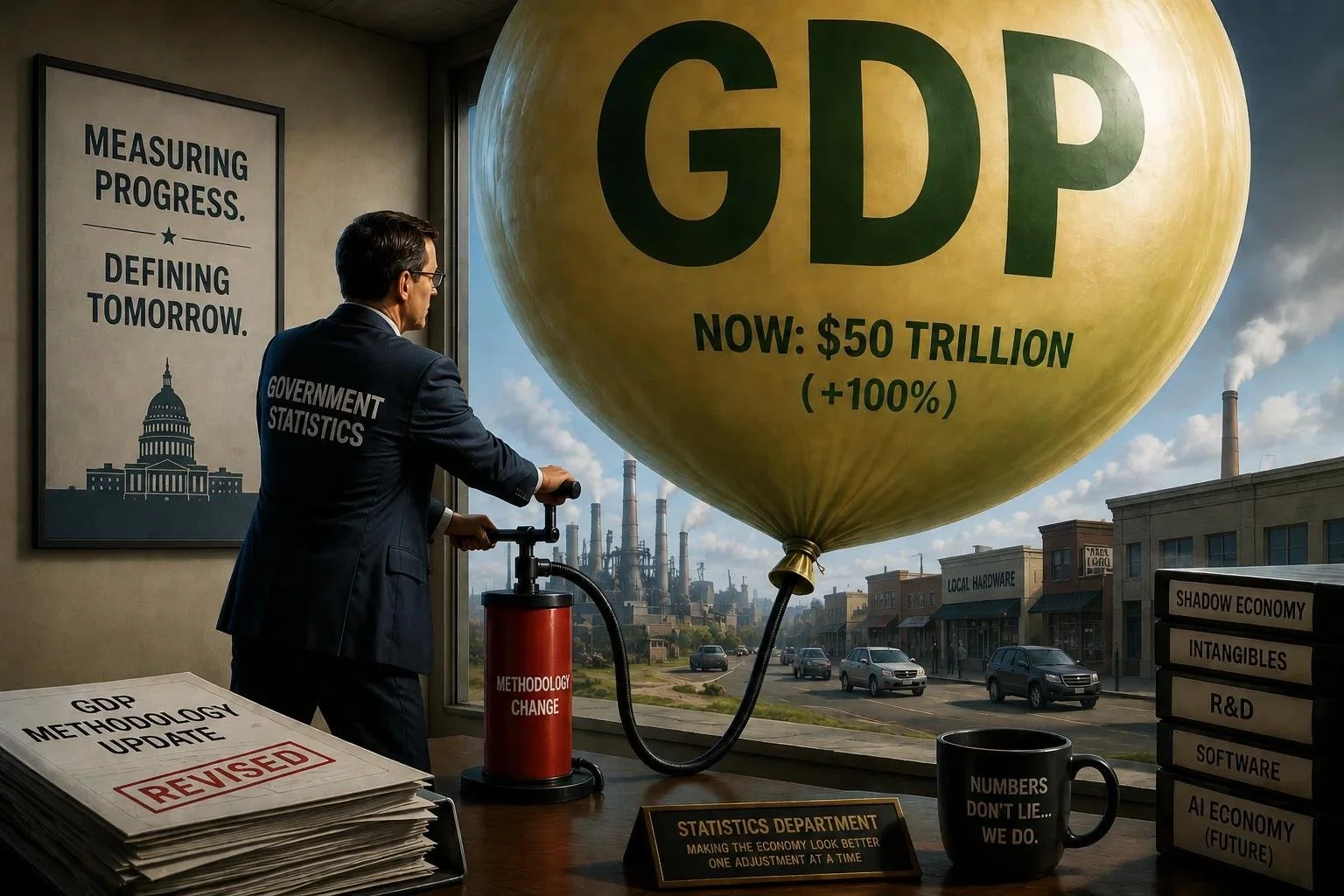
So, rather than cut spending and reduce the deficit, the Greeks cooked up a creative way to magically increase their GDP—overnight.
And on September 26, 2006, the Greek National Statistical Service announced they were changing the way they were calculating GDP; among other things, the Greek government would include “illegal activities like drug trafficking and prostitution” in their GDP estimates.
Laughter and facepalming ensued immediately around the world as global economists collectively groaned at the Greek government’s desperation.
And yet, they still went through with it: poof. Overnight, Greece’s GDP magically grew by 25% because of the change in their calculation.
Frankly this idea is not uncommon in economics; plenty of countries have seen overnight surges in their GDP simply by changing the way they count economic activity.
Italy famously increased its GDP by nearly 20% overnight back in 1987 when they started including estimates of their shadow economy in the GDP numbers.
Nigeria ‘rebased’ its economy in 2014, nearly DOUBLING its GDP. One day it was a $270 billion economy, and literally the next day it was a $510 billion economy.
Ghana did the same in 2010, increasing its GDP by 60%.
But the world record goes to west Africa’s Guinea-Bissau, which, in 2005, increased GDP by a whopping 142%. Overnight.
Now, sometimes these updates aren’t completely ludicrous. Econometrics is an imprecise field that often relies on outdated modes of information gathering.
More importantly, statistical agencies over-concentrate their efforts collecting data on has-been industries while ignoring ‘new economy’ sectors. And this can seriously distort the picture.
That’s why, even in the United States, government agencies occasionally make changes to their econometric methods. Measuring an economy as dynamic as America’s absolutely has to change from time to time. And they have.
In 1999, for example, the Bureau of Economic Analysis began classifying software as a long-term asset (rather than an expense), immediately adding about 0.4% to the prior year’s GDP growth.
In 2013 the same agency went even further and began counting R&D expenses, artistic content, and more in GDP calculations. This change added $560 billion to the US economy.
To be fair, these were not political mandates or desperation moves. Instead, they were necessary adjustments to reflect changes that had taken place in the US economy; it makes sense to include R&D in GDP calculations when so much of the economy is R&D.
Typically, these adjustments to US methodologies take place every few years. And, as of yet, the US government has NOT yet updated its measurements to include AI.
And this is what may ultimately lead to a Greek, Ghana, or even Guinea-Bissau boost to GDP.
Economic activity from AI is extremely difficult to measure. Sure, there are sales of Nvidia GPUs and data center spending.
But think about all of the things that people are doing with AI—things which have economic value, but the government has no credible way to count.
Here’s an easy example: every time I’m at the grocery store, I browse the meager selection of children’s books for my kids. I almost never buy anything, though, because most of them are garbage… so the resulting economic activity is very low.
Lately I’ve been using AI to create my own books for the kids—which they seem to be enjoying very much. But since no dollars actually changed hands (i.e. I make the books myself), there is no economic activity recorded in this case either.
This is a critical point to understand, so I’ll say it again: in both situations, i.e. me NOT buying a book at the store, versus me creating one with AI, no recorded economic activity took place.
And yet, when I make my own books, something of economic value IS being created. I value them. My kids value them. The books have some value, hence value is being created.
I’m just one guy. Hundreds of millions of people are doing the same thing. And none of that value is being recorded, i.e. none of it is showing up in the GDP numbers.
It turns out the US government’s Bureau of Economic Analysis is already considering ways to incorporate AI into the GDP numbers.
And frankly that impact could be dramatic… for a couple of reasons.
First, because the impact of AI really IS dramatic. And growing. But second—because the US government REALLY needs to cut its deficit-to-GDP and debt-to-GDP ratios.
And since, like Greece, they seem to have no interest in actually cutting spending and reducing the debt, they’ll use AI as a way to suddenly boost GDP.
So don’t be surprised if we wake up one day and are told that the US economy is now $50 trillion because of AI… and hence America’s debt-to-GDP level immediately falls to 80%.
I suppose counting the economic value of cat memes and unicorn stories is better than drug traffickers and prostitutes. And it would be an interesting way for the US government to dramatically improve its fiscal condition overnight.
To your freedom, James Hickman Co-Founder, Schiff Sovereign LLC
The Real Reason the Market is Ripping Higher
The Real Reason the Market is Ripping Higher
Heresy Financial: June 1, 2026
In the current financial climate, the word “bubble” is frequently tossed around by analysts and headlines alike. With stock indices reaching new heights, many investors are bracing for an imminent crash. however, a recent analysis from Heresy Financial challenges this common perception, suggesting that the underlying data might tell a much more optimistic—and complex—story than the popular narrative suggests.
The Real Reason the Market is Ripping Higher
Heresy Financial: June 1, 2026
In the current financial climate, the word “bubble” is frequently tossed around by analysts and headlines alike. With stock indices reaching new heights, many investors are bracing for an imminent crash. however, a recent analysis from Heresy Financial challenges this common perception, suggesting that the underlying data might tell a much more optimistic—and complex—story than the popular narrative suggests.
One of the most striking points discussed is the current level of short interest in the S&P 500. While high levels of “shorting” (betting that the market will fall) might seem like a warning sign, history often views it as a contrarian indicator. When bearish bets reach near-record levels, it suggests that a significant portion of the market has already positioned itself for a decline. Paradoxically, these excessive short positions have historically marked market bottoms rather than tops, as there are fewer sellers left to drive prices down and more “forced buyers” if the market starts to rise.
The video also addresses the concerns surrounding leverage. While margin debt—money borrowed to buy stocks—has increased recently, it remains well below the extreme levels seen before previous major market corrections. This is a crucial distinction, as it suggests that the risk of a “domino effect” caused by forced margin calls is significantly lower than it was during past bubbles. Without that excessive leverage, the foundation of the current market appears more stable than many realize.
To truly understand current valuations, the analysis suggests looking beyond nominal prices. When we measure the stock market against a stable baseline like gold, the “record highs” look a bit different. In many ways, rising stock prices may simply reflect a depreciating dollar rather than an overvalued market. Furthermore, fundamental metrics like the Price/Earnings-to-Growth (PEG) ratio indicate that stocks may still be priced reasonably relative to their expected earnings. Historically, when the PEG ratio dips below one, it has signaled a local market bottom and the start of a significant bull run—a pattern we are seeing glimpses of today.
The macroeconomic environment also plays a pivotal role in this outlook. We are currently witnessing a shift in monetary policy from a period of tightening to a period of easing. With expectations of interest rate cuts and potential deregulation in the banking sector, liquidity is expected to increase. This creates a favorable “tailwind” for equities, a sharp contrast to the restrictive environment of 2022 that triggered a bear market.
Ultimately, while the video advises investors to remain disciplined and well-hedged, it warns against being overly defensive. Holding excessive amounts of cash out of fear can lead to missing out on substantial gains as the market climbs a “wall of worry.” The key takeaway is that the bull market may have more longevity than the bears expect, at least until sentiment shifts from skepticism to universal euphoria.
TIMECODES
00:00 The Crash Everyone Is Waiting For Might Not Come
00:19 Short Interest Is Near a 30-Year High
00:54 The Last Time Shorts Were This Heavy, Stocks Bottomed
01:30 Why Crowded Shorts Are Fuel for Bull Markets
02:09 How the 2026 Rally Was Built on Hedge Fund Pain
02:30 Margin Debt Is Nowhere Near 2008 Levels
03:15 If You're Sitting in Cash, This Is Hard to Hear
03:46 Stocks Priced in Gold Aren't Overvalued
04:30 Valuation Is Just "How Much for a Money Printer"
05:22 The PEG Ratio Just Dropped Below 1 Again
06:53 The Only Time This Signal Failed
07:23 The Monetary Regime Just Flipped Back to Easy
08:27 "It's a Bubble" Is Now a Crowded Opinion
09:00 The Real Risk Is Sitting in Too Much Cash
Iraq Economic News and Points To Ponder Tuesday Afternoon 6-2-26
Oil Prices Retrench After Mixed US-Iran Diplomatic Signals
2026-06-02 Shafaq News Oil prices trended lower on Tuesday following the previous session's sharp gains as the market remained cautious about progress in U.S.-Iran peace talks.
U.S. President Donald Trump said on Monday talks with Iran were ongoing, while Tasnim news agency reported earlier that Tehran had suspended indirect negotiations with Washington.
Oil Prices Retrench After Mixed US-Iran Diplomatic Signals
2026-06-02 Shafaq News Oil prices trended lower on Tuesday following the previous session's sharp gains as the market remained cautious about progress in U.S.-Iran peace talks.
U.S. President Donald Trump said on Monday talks with Iran were ongoing, while Tasnim news agency reported earlier that Tehran had suspended indirect negotiations with Washington.
Brent crude futures lost 75 cents, or 0.79%, to $94.23 a barrel at 0434 GMT, while U.S. West Texas Intermediate fell 85 cents, or 0.92%, to $91.31 a barrel.
Both benchmarks rose more than 5% in the previous session, having posted a monthly loss of more than 16% in May on hopes of a peace deal.
"While markets had hoped to move past the uncertainty amid prospects of a potential deal, nothing appears to have changed for oil as of this morning," said Priyanka Sachdeva, senior market analyst at Phillip Nova.
In an interview with CNBC on Monday, Trump said he did not mind if the talks were over. But shortly after, he issued a social media post saying talks with Iran were continuing and told ABC News that he expected a deal to extend the ceasefire and reopen the Strait of Hormuz “over the next week”.
"The market is currently focused on whether there's any concrete progress or setbacks in U.S.-Iran negotiations, the tone and substance of statements from both sides (particularly Iran's threats regarding the Strait of Hormuz), and actual physical tanker movements through the waterway," said Tim Waterer, chief market analyst at KCM Trade.
The status of the U.S.-Iran negotiations at any given point will ultimately determine whether the current risk premium stays embedded in oil prices or starts to unwind, Waterer added.
Lebanon on Monday announced a partial ceasefire between Hezbollah and Israel, in what would amount to a limited de-escalation of a conflict that has inflamed the broader war with Iran.
Iran has effectively halted nearly all non-Iranian shipping into and out of the Gulf since the war began, choking off about a fifth of global oil and liquefied natural gas flows and driving prices up by 50% or more.
U.S. crude exports climbed to a record 5.6 million barrels per day in May as the Middle East crisis pushed up demand for the country's oil from Asian and European refiners, ship tracking estimates showed on Monday.
According to a preliminary Reuters poll released on Monday, U.S. crude stockpiles are expected to have fallen by about 3.6 million barrels in the week ended May 29, extending the prior week's draw, while distillates and gasoline inventories also are likely to have declined.
Shipping executives meeting in Athens on Monday said that any peace deal worked out between the U.S. and Iran would need to offer clear rules allowing vessels to resume normal business via the Strait of Hormuz.
(REUTERS) https://www.shafaq.com/en/Economy/Oil-prices-retrench-after-mixed-US-Iran-diplomatic-signals
Basrah Crudes Surge Despite Global Losses
2026-06-02 Shafaq News- Basrah Iraq’s Basrah crude rose more than 3.6% on Tuesday, bucking declines in global oil markets driven by volatility linked to geopolitical tensions and shifting energy demand expectations.
Basrah Heavy crude climbed $2.48, or 3.75%, to $68.55 per barrel, while Basrah Medium crude climbed to $70.65 per barrel, gaining 3.64%.
The gains, however, did little to narrow the gap with other OPEC crudes, many of which continued to command substantially higher prices. Saudi Arabia’s Arab Light was priced at $103.62 per barrel, while Arab Super Light reached $104.12. Kuwait’s Export Crude stood at $117.51 per barrel.
Iranian grades also traded well above Iraqi levels, with Iranian Light at $90.04 per barrel and Iranian Heavy at $88.14. The United Arab Emirates’ Murban crude settled at $94.43 per barrel.
Globally, Brent crude fell 75 cents, or 0.79%, to $94.23 per barrel. US West Texas Intermediate (WTI) declined 85 cents, or 0.92%, to $91.31. https://www.shafaq.com/en/Economy/Basrah-crudes-surge-despite-global-losses-0
Dollar Rises In Baghdad, Erbil Markets
2026-06-02 Shafaq News- Baghdad/ Erbil The US dollar opened Tuesday’s trading higher in Iraq, hovering around 154,000 dinars per 100 dollars.
According to Shafaq News market survey, the dollar traded in Baghdad's Al-Kifah and Al-Harithiya exchanges at 153,750 dinars per 100 dollars, up from the previous session’s 153,500 dinars.
In the Iraqi capital, exchange shops sold the dollar at 154,250 dinars and bought it at 153,250 dinars, while in Erbil, selling prices stood at 153,750 dinars and buying prices at 153,650 dinars.
https://www.shafaq.com/en/Economy/Dollar-rises-in-Baghdad-Erbil-markets-0-3
Gold Rises In Baghdad And Erbil
2026-06-02 Shafaq News- Baghdad/ Erbil Gold prices rose on Tuesday in Baghdad and Erbil, hovering around 990,000 IQD per mithqal, according to a Shafaq News market survey.
At Al-Nahr Street wholesale markets in Baghdad, the selling price for a mithqal of 21-carat Gulf, Turkish, and European gold reached 982,000 dinars, with the buy price at 978,000 dinars, up from a sell price of 972,000 dinars the previous session.
Iraqi 21-carat gold was priced at 952,000 dinars to sell and 948,000 dinars to buy.
At Baghdad jewelry stores, Gulf 21-carat gold ranged between 985,000 and 995,000 dinars per mithqal, while Iraqi 21-carat gold ranged between 955,000 and 965,000 dinars.
In Erbil, 22-carat gold was priced at 1,024,000 dinars per mithqal, 21-carat at 978,000 dinars, and 18-carat at 838,000 dinars. https://www.shafaq.com/en/Economy/Gold-rises-in-Baghdad-and-Erbil
Dollar Steady In Baghdad, Lower In Erbil
2026-06-02 Shafaq News- Baghdad/ Erbil The US dollar closed Tuesday's trading steady in Baghdad and lower in Erbil, hovering around 154,000 dinars per 100 dollars.
According to Shafaq News market survey, the dollar traded in Baghdad's Al-Kifah and Al-Harithiya exchanges at 153,750 dinars per 100 dollars, unchanged from the morning session.
In the Iraqi capital, exchange shops sold the dollar at 154,250 dinars and bought it at 153,250 dinars, while in Erbil, selling prices stood at 153,650 dinars and buying prices at 153,600 dinars.
https://www.shafaq.com/en/Economy/Dollar-steady-in-Baghdad-lower-in-Erbil-1
UN General Assembly Elects Iraq Vice President
2026-06-02 Shafaq News- Baghdad Iraq secured the vice presidency of the 81st session of the United Nations General Assembly on Tuesday, the Iraqi Foreign Ministry announced on Tuesday.
Iraq's election reflects the confidence it enjoys within the United Nations and the broader international community, the Foreign Ministry stated, citing the country's role in promoting South-South and trilateral cooperation and facilitating consensus among developing nations on key priorities within the organization.
The ministry indicated that Iraq intends to use the position to contribute to UN efforts aimed at achieving the 2030 Sustainable Development Goals, support initiatives to improve the efficiency of the General Assembly, and strengthen the country's role on the international stage.https://www.shafaq.com/en/Iraq/UN-General-Assembly-elects-Iraq-Vice-President
Seeds of Wisdom RV and Economics Updates Tuesday Afternoon 6-2-26
Good Afternoon Dinar Recaps,
CLARITY Act Nears Senate Vote as America Moves Closer to Comprehensive Crypto Regulation
The advancement of the CLARITY Act could establish the regulatory foundation for digital assets in the United States and strengthen America's position in the evolving digital financial system.
Good Afternoon Dinar Recaps,
CLARITY Act Nears Senate Vote as America Moves Closer to Comprehensive Crypto Regulation
The advancement of the CLARITY Act could establish the regulatory foundation for digital assets in the United States and strengthen America's position in the evolving digital financial system.
Overview
The Digital Asset Market Clarity Act (CLARITY Act) has reached a major milestone after being officially added to the U.S. Senate Legislative Calendar. The legislation is now positioned for a potential Senate floor vote as lawmakers return to Washington, bringing the United States one step closer to establishing a comprehensive regulatory framework for cryptocurrencies and digital assets.
The bill's advancement comes amid growing competition among nations to lead the future of digital finance, blockchain innovation, and tokenized markets. Supporters view the legislation as a critical step toward providing regulatory certainty while encouraging investment and innovation within the United States.
Key Developments
1. CLARITY Act Advances to Senate Calendar
The CLARITY Act was officially placed on the Senate Legislative Calendar under General Orders as Calendar No. 423. This advancement follows the bill's successful passage through the Senate Banking, Housing and Urban Affairs Committee and positions it for consideration by the full Senate.
The move represents one of the most significant developments in U.S. digital asset legislation to date.
2. Bill Seeks to Define Regulatory Authority
One of the primary goals of the CLARITY Act is to provide clear definitions for digital assets and establish regulatory responsibilities among federal agencies, including the Securities and Exchange Commission (SEC) and the Commodity Futures Trading Commission (CFTC).
Supporters argue that regulatory uncertainty has slowed innovation and investment in the digital asset sector.
3. Senate Leadership Pushes for Action
Senate Banking Committee Chairman Tim Scott has publicly championed the legislation, describing it as a framework for ensuring that the future of finance is developed within the United States under American laws and standards.
Senator Cynthia Lummis has also urged lawmakers to move quickly, emphasizing that Congress is closer than ever to creating a workable digital asset market structure.
4. Crypto Market Structure Reform Gains Momentum
The CLARITY Act is part of a broader effort to modernize financial regulations for blockchain technology, tokenized assets, and cryptocurrency markets. Lawmakers are facing increasing pressure from industry participants who seek greater legal clarity before additional innovation moves offshore.
5. Prediction Markets Show Mixed Expectations
Despite the bill's advancement, prediction markets remain cautious. Recent forecasts indicate that traders remain divided regarding the likelihood of final passage, reflecting uncertainty surrounding congressional priorities and legislative timing.
Why It Matters
The CLARITY Act represents one of the most important digital asset regulatory proposals currently under consideration in the United States. Clear regulatory standards could unlock significant investment, encourage innovation, and provide institutional participants with greater confidence to engage in digital asset markets.
Why It Matters to Foreign Currency Holders
Increased adoption of digital assets may accelerate the modernization of global financial infrastructure.
Regulatory clarity could strengthen confidence in blockchain-based financial products.
Expanded digital asset markets may influence future cross-border payment systems and settlement mechanisms.
Implications for the Global Reset
Pillar 1: Regulatory Foundation for Digital Finance
The CLARITY Act demonstrates how governments are increasingly moving from observation to regulation of digital assets. Establishing legal frameworks is considered a necessary step before broader adoption of tokenized financial systems can occur.
Pillar 2: Evolution of Financial Markets
As digital assets become integrated into traditional financial systems, regulatory frameworks like the CLARITY Act could help bridge the gap between conventional banking, capital markets, and emerging blockchain technologies.
Closing Insight
The advancement of the CLARITY Act signals that digital assets are becoming an increasingly important component of future financial systems. Whether the legislation ultimately passes or not, the debate itself highlights the growing recognition that blockchain technology and digital finance are moving into the mainstream of global economic policy.
This is not just a crypto bill—it is a step toward defining the rules of the next generation of financial markets.
Seeds of Wisdom Team
Newshounds News™ Exclusive
Sources
CoinGape — "BREAKING: CLARITY Act Advances To Senate Calendar As Floor Vote Nears"
H.R.3633 - 119th Congress (2025-2026): Digital Asset Market Clarity Act of 2025
~~~~~~~~~~
Seeds of Wisdom Team RV Currency Facts Youtube and Rumble
Newshound's News Telegram Room Link
RV Facts with Proof Links Link
RV Updates Proof links - Facts Link
Follow the Gold/Silver Rate COMEX
Follow Fast Facts
Seeds of Wisdom Team™Website
Thank you Dinar Recaps
Ultimate Restructuring of the Monetary System
Ultimate Restructuring of the Monetary System
Liberty and Finance: 6-1-2026
Simon Hunt outlines a multi-year transition toward a new global monetary system centered on gold backed settlement mechanisms. He argues that China and Russia are gradually building parallel financial infrastructure that reduces dependence on the US dollar.
In his view, BRICS aligned economies may eventually introduce a gold linked currency or unit that facilitates international trade outside the Western system.
Ultimate Restructuring of the Monetary System
Liberty and Finance: 6-1-2026
Simon Hunt outlines a multi-year transition toward a new global monetary system centered on gold backed settlement mechanisms. He argues that China and Russia are gradually building parallel financial infrastructure that reduces dependence on the US dollar.
In his view, BRICS aligned economies may eventually introduce a gold linked currency or unit that facilitates international trade outside the Western system.
He connects ongoing geopolitical tensions in the Middle East and Eurasia to this broader restructuring of global finance and energy flows. He suggests the period from 2026 to 2032 could mark the decisive phase of this shift, characterized by inflation cycles, currency realignment, and long term changes in asset markets
Hunt’s analysis suggests that we are moving away from a unipolar world dominated by the West and toward a complex, multipolar reality led by the BRICS nations.
A central theme of Hunt’s discussion is the ongoing tension between the United States and Iran. According to Hunt, this conflict is less about regional grievances and more about a strategic effort to maintain global influence.
Iran holds a pivotal position in the emerging BRICS-aligned world, and its control over the Strait of Hormuz remains a critical leverage point. Hunt predicts that this friction is not a short-term volatility but a conflict that could persist for years.
A significant shift is already occurring in how energy is traded, with Iran increasingly requiring transactions to be settled in non-U.S. currencies, specifically the Chinese yuan, signaling a direct challenge to the “petrodollar” system.
As the influence of traditional Western economic powers, particularly in Europe, faces internal and external pressures, the BRICS coalition (Brazil, Russia, India, China, and South Africa, among others) is preparing for a systemic financial realignment.
Hunt highlights the development of a new gold-backed currency known as the “Unit.” This move, orchestrated by nations with massive gold reserves like Russia and China, is intended to create a stable alternative to the U.S. dollar.
While this transition will take several years to fully materialize, it represents a fundamental shift in how global trade and finance will be conducted in the coming decade.
Turning his attention to the markets, Hunt offers a sobering outlook. He anticipates a period defined by short, volatile cycles rather than the steady growth seen in previous decades.
He specifically warns of an impending inflationary crisis around 2028, drawing parallels to the high-inflation era of the late 1970s and early 1980s. Because of the high levels of leverage within the modern financial system, Hunt believes the resulting recessions could be significantly more severe than typical market downturns. This could mark the definitive end of a century-long bull market for traditional stocks and bonds, forcing investors to seek shelter in defensive assets.
In this era of currency depreciation and economic uncertainty, Hunt asserts that gold will reclaim its role as a vital monetary hedge.
He forecasts that gold prices could at least double by 2032 when adjusted for the falling value of fiat currencies. Conversely, his outlook on industrial metals like copper is more cautious. Despite the current hype surrounding AI and infrastructure, Hunt believes that technological shifts and decreased demand during deep recessions could lead to a bear market for copper.
For the individual, Hunt suggests that preparation should extend beyond the portfolio; he recommends focusing on food security, including storing supplies and even growing one’s own food to mitigate the impact of soaring prices.
More “Iraq News” Posted by Tishwash at TNT 6-2-2026
TNT:
Tishwash: Mohsen Al-Humaid: ICC continues its efforts to open channels of cooperation and investment with international institutions and companies.
The President of the International Chamber of Commerce - Iraq (ICC), Engineer Mohsen Al-Humaid, affirmed that investment represents the true gateway to achieving sustainable economic development, pointing to the importance of working to attract the largest global investments to the Iraqi market in a way that contributes to supporting the reconstruction movement and revitalizing various productive and service sectors.
TNT:
Tishwash: Mohsen Al-Humaid: ICC continues its efforts to open channels of cooperation and investment with international institutions and companies.
The President of the International Chamber of Commerce - Iraq (ICC), Engineer Mohsen Al-Humaid, affirmed that investment represents the true gateway to achieving sustainable economic development, pointing to the importance of working to attract the largest global investments to the Iraqi market in a way that contributes to supporting the reconstruction movement and revitalizing various productive and service sectors.
Al-Humaid said that Iraq has promising investment opportunities and an economic environment capable of attracting global companies, indicating that the current stage requires strengthening the partnership between the public and private sectors and providing the necessary facilities for investors in a way that will positively affect the national economy and provide new job opportunities for young people.
He added that the International Chamber of Commerce – Iraq (ICC) continues its efforts to open channels of cooperation with international institutions and companies, and to work on presenting a positive image of the economic reality in Iraq.
He stated that attracting foreign investments contributes to the transfer of expertise and modern technology and supports the comprehensive development process in the country. link
Tishwash: The Ministry of Electricity is discussing with representatives of the American company GE ways to accelerate the completion of maintenance and development projects in the production and transmission sectors.
The Ministry of Electricity discussed on Tuesday with representatives of GE Vernova in Iraq mechanisms to accelerate the completion of maintenance and development projects in the production and transmission sectors.
The Ministry of Electricity’s media office stated in a statement seen by “Al-Eqtisad News” that “Minister of Electricity Ali Saadi Wahib met today with representatives of GE Vernova in Iraq to discuss the progress of projects implemented by the company in the electricity sector and prospects for strengthening joint cooperation.”
She added that “the meeting reviewed the most prominent projects led by the company in the field of electricity production, and discussed mechanisms to accelerate maintenance and rehabilitation work for power generation stations, in order to increase their readiness and bring them into service as quickly as possible, as well as discussing future plans aimed at developing the performance of the electrical system.” link
**************
"America First" in Baghdad: What is Tom Barrack planning for Iraq's "interconnected crises"?
Tom Barrack, 79, is described as more than just a traditional American diplomat. The man of Lebanese descent, who speaks Arabic, combines a background as a businessman and investor with close ties to US President Donald Trump, and in recent months has become one of the most prominent architects of American policy in the Middle East.
Observers believe that his appointment as a special presidential envoy to Iraq and Syria places him at the heart of the most sensitive issues for Washington, from Iranian influence and armed factions to energy, investments, and the future of regional arrangements.
On Sunday, US President Donald Trump announced the appointment of US Ambassador to Turkey Tom Barrack as Special Presidential Envoy to Iraq and Syria, while retaining his position as ambassador in Ankara, stressing that the new mission comes within the framework of strengthening strategic cooperation with the governments of Baghdad and Damascus.
The decision came just one day after US Secretary of State Marco Rubio announced the end of Barak's mission as special envoy to Syria, before it later became clear that the US administration was moving to expand his powers rather than end them.
According to researchers and observers who spoke to Shafaq News Agency, the decision represents an indication of a broader shift in Washington’s approach to Iraq, from an independent file managed through traditional diplomatic channels, to part of an interconnected regional system that includes Syria, Turkey, Iran and the Gulf.
Regional engineering
In this context, Dalir Khalaf Osman, a researcher in international relations and Middle Eastern affairs at the University of Tennessee, believes that merging the Iraqi and Syrian files under the supervision of a single envoy reflects a fundamental shift in American strategy.
Osman tells Shafaq News that the United States no longer deals with Iraq as a separate file with its own internal particularities, but rather as part of a broader security and geopolitical engineering aimed at reshaping the region’s balances and reducing Iranian influence.
This trend is believed to represent a shift from the American approach that has prevailed since 2003, which focused on democracy, development and institution building, to an approach that puts regional security and balances of power at the forefront of priorities.
He adds that Barack’s background, his direct relationship with Trump, and the “America First” doctrine adopted by the US president reveal that his focus will be on strengthening the central state and its security capabilities rather than being preoccupied with issues of democracy, federalism, and political pluralism.
Savaya's mission is complete
In Washington, Patrick Clawson, a senior fellow at the Washington Institute for Near East Policy, reveals that Barak's appointment does not represent a sudden shift as much as it enshrines an existing reality.
Clawson told Shafaq News that Barak's joint appointments in Iraq, Syria and Turkey "are a continuation of an existing policy that he has been leading for some time," noting that he has become a pivotal figure in managing the region's files, including Lebanon as well.
The American researcher reveals that the former envoy to Iraq, Mark Savaya, was effectively dismissed from his post without an official announcement, considering that the decision "was widely arranged and welcomed within the US State Department and within Iraq."
He adds that Savaya, a businessman from Michigan of Iraqi Chaldean descent (from the Nineveh Plain), did not have the diplomatic background to manage a complex file the size of Iraq, and that his experience practically ended before it began.
unconventional approach
From Baghdad, writer and political analyst Ali Al-Baydar believes that Barak’s appointment does not appear to be a mere protocol step, but rather an indication that Washington wants to manage its relationship with Baghdad through political channels directly linked to the White House.
Al-Bader told Shafaq News Agency that the new mission comes within the framework of strengthening strategic cooperation with Iraq, but at the same time it reflects the desire of the American administration to rearrange the files of the region as an interconnected unit that includes Iraq, Syria, Turkey, Iran and Lebanon as well.
He adds that combining the position of ambassador to Turkey with the mission of special envoy to Iraq and Syria reveals an American interest in energy issues, regional balances and border security, as well as taking advantage of Barak’s personal relationships and his ability to combine economics, politics and diplomacy.
Al-Bader believes that Washington is also seeking to manage the files of the American military presence, the international coalition and the relationship with armed factions more directly, with a focus on preventing any escalation that may threaten American interests.
Controlling the factions
While the new envoy has many issues to address, Clawson places the issue of armed factions at the forefront of American priorities. He says that Washington’s most urgent and significant goal is to limit the influence of the Popular Mobilization Forces and ensure that they do not affect the formation of the next Iraqi government, in addition to pressuring Baghdad to impose its full control over the armed factions and prevent any targeting of American forces or interests.
He points out that Barak’s agenda is not limited to security issues, but extends to economic relations, Iraqi oil exports, and investment cooperation.
This assessment coincides with what a number of observers believe, who consider that Washington currently views Iraq through three main files: the weapons of the factions, reducing Iranian influence, and revitalizing economic and investment relations, especially in the energy, gas, electricity, and banking sectors.
"Trump's man"
For his part, Haitham al-Hiti, a professor of political science at the University of Exeter in Britain, says that Barak’s reappointment has closed the door on the speculation that surrounded his future during the past weeks.
Al-Hiti adds to Shafaq News Agency that the man played a pivotal role in the transformations that Syria witnessed during the past period, and that his statements in Damascus, Beirut and Baghdad showed a different approach from the traditional American discourse related to democracy and elections.
Al-Hiti describes Barak as a realistic and straightforward figure who views the region from the perspective of its social, tribal, and historical formations, rather than through traditional Western democratic frameworks.
He points out that his background as a businessman, his Lebanese origins, and his specialization in history and law all give him a deep understanding of the Middle East's structure and complexities.
Al-Hiti believes that Barak tends to support strong central states instead of models based on power-sharing and sectarian divisions, considering him to be one of the most prominent figures of the Trumpian movement seeking to reshape American policy in the region.
Countering Iranian influence
Despite the confidence that the US administration places in Barak, his mission in Iraq appears more difficult than the Syrian file, as Osman says that the biggest challenges he will face are the deep Iranian influence inside Iraq, which extends to politics, the economy and security, unlike the Syrian scene in which the Turkish role was more clear and influential.
He adds that Iraq has multiple and interconnected centers of power, from the government, parties and armed factions to Kurdish forces and regional actors, making any attempt to reshape the balances a highly complex task.
Opportunity or threat?
On the other hand, not everyone agrees with the optimistic view regarding Barak's appointment. Prominent Iraqi politician Mithal Al-Alusi believes that Iraq and the region need "institutional America" more than they need an envoy close to the American president.
Al-Alousi told Shafaq News Agency that some of Barak’s positions and statements raise questions about his understanding of democracy and political pluralism, warning that dealing with Iraq in the same way as the Syrian issue was dealt with may not serve the development of the strategic partnership between Baghdad and Washington.
He adds that Barak’s appointment may be interpreted by some as a retreat from the traditional American institutional approach, or a gray message regarding Iranian and Turkish expansion in the region.
Political analyst Ziad Al-Arar believes that Barak’s appointment reflects a growing American interest in Iraq in the coming period.
Al-Arar told Shafaq News Agency that Iraq will be an essential part of the regional and international scenes, given the complex issues related to weapons, the economy, foreign relations, and the nature of the political system.
He continues that Washington seems willing to build on what it started during the past months, and to work more intensively with the Iraqi government, which explains the choice of a figure of Barak’s stature for this sensitive task. link
Tishwash: Integrated banking solutions for localization employees... International Development Bank enhances financing, savings, and investment.
The International Development Bank affirmed its continued commitment to providing advanced banking and financing solutions that meet the needs of public and private sector employees with salaries deposited directly into their bank accounts. This aligns with its strategy to offer flexible banking services and solutions that align with customer aspirations and support their financial stability and various investments.
In a press release issued Monday, the bank's management stated, "The bank offers a comprehensive suite of banking services and products specifically designed for its clients with deposited salaries. These include loans, credit cards, savings and investment accounts, in addition to digital services and a network of branches and ATMs located throughout the country."
The statement added, "The International Development Bank provides credit cards to public and private sector employees, enabling public sector employees to obtain financing of up to six times their salary, while private sector employees can obtain financing of up to three times their salary, with flexible repayment options to meet their financial needs."
The bank also offers a special loan for local employees, providing financing of up to 60 million Iraqi dinars. This enables clients to implement and grow their personal projects, aligning with the bank's strategy to support the business sector and small and medium-sized enterprises (SMEs).
Regarding savings and investment solutions, the bank offers a profit account with a 6.5% return paid upfront, an investment deposit account with annual returns of up to 10% distributed monthly, and a savings account with a 5% annual return. This reflects the bank's commitment to providing diverse financial options to suit various customer segments.
The bank's services also include a solar energy loan designed to support the transition to clean energy, with financing of up to 18 million dinars for individuals and 1 billion dinars for companies. This initiative demonstrates the bank's commitment to supporting sustainability and promoting modern environmental solutions.
The International Development Bank continues to enhance the customer experience through advanced localization services and a comprehensive debt collection service. This is built upon its growing expertise in providing financial solutions for individuals and businesses, and its extensive network of branches and ATMs, ensuring easy access to banking services at all times.
The bank confirmed that these services fall within its vision of providing a comprehensive banking experience that combines innovation, flexibility, and ease of access, while also supporting investment projects and the national economy, thus reinforcing its position as a leading bank in providing modern financial solutions in Iraq. link
Iraq Economic News and Points To Ponder Late Monday Evening 6-1-26
A Leader Within It: The Coordination Framework Will Hold A Crucial Meeting Tomorrow, Tuesday, To Finalize The Ministries Of Al-Zidi's Cabinet
latest news Monday, June 1, 2026 Baghdad - One News A prominent leader in the coordination framework revealed that the coalition leaders will hold a meeting tomorrow, Tuesday, to discuss the issue of vacant ministries and to decide on the mechanism for completing the government formation.
A Leader Within It: The Coordination Framework Will Hold A Crucial Meeting Tomorrow, Tuesday, To Finalize The Ministries Of Al-Zidi's Cabinet
latest news Monday, June 1, 2026 Baghdad - One News A prominent leader in the coordination framework revealed that the coalition leaders will hold a meeting tomorrow, Tuesday, to discuss the issue of vacant ministries and to decide on the mechanism for completing the government formation.
The leader explained that the meeting will discuss setting a date for a parliamentary session to vote on the remaining ministers, given the continued political disagreements regarding a number of ministerial portfolios.
He added that there is a general trend among political forces to expedite the completion of government entitlements within a period not exceeding one or two weeks, given the current security and regional conditions and the pressures facing the political process.
He noted that the consultations also include exploring the possibility of replacing some of the candidates for the vacant ministries in order to achieve broader consensus and ensure the passage of the remaining cabinet within the House of Representatives. https://1news-iq.net/قيادي-فيه-الإطار-التنسيقي-يعقد-يوم-غد-ا/
Mps: Al-Zidi's Steps In Combating Corruption Are An Important Start On The Path To Administrative And Financial Reform
latest news Monday, June 1, 2026 Baghdad - One News 6/01/2026 Members of Parliament believe that the steps taken by Prime Minister Ali al-Zaidi in the fight against corruption represent an important start on the path to administrative and financial reform, stressing the need to turn these measures into practical results that lead to holding those involved accountable and recovering public funds.
They pointed out that the decision to form the Supreme Sovereign Council for Integrity, Oversight and Recovery of Public Funds, along with reviewing government contracts and opening files that are suspected of corruption, reflects a clear governmental direction to deal seriously with this issue and to prosecute violations that have harmed public funds.
They added that the House of Representatives supports any legal and constitutional measures aimed at protecting state funds and holding those involved in corruption cases accountable, stressing the importance of providing the necessary legislative and oversight framework to ensure the success of these efforts. https://1news-iq.net/نواب-الخطوات-التي-اتخذها-الزيدي-في-مكا/
Coordination Framework Authorizes PM On Arms Issue
2026-06-01 Shafaq News- Baghdad Iraq’s Coordination Framework (CF), Iraq’s main Shiite political alliance, expressed support for efforts to place all weapons under state control and to separate the Popular Mobilization Forces (PMF) from political, partisan, and social structures.
In a statement issued after a meeting held at the office of former Prime Minister Haider al-Abadi and attended by Prime Minister Alial-Zaidi, the coalition stressed that decisions on war and peace are a sovereign national matter that belongs exclusively to the Iraqi people through their constitutional institutions, namely parliament and the elected government. “Any action taken outside this framework constitutes a violation of the law and the principles of the constitutional state.”
Regarding the PMF, the coalition affirmed that the force is an official security institution committed to the constitution, applicable laws, and the directives of the commander-in-chief of the armed forces, carrying out its duties within established legal frameworks.
The coalition also emphasized the importance of maintaining cooperation between the Iraqi government and the international community, while continuing the process of ending the mission of the international coalition in Iraq.
https://shafaq.com/en/Iraq/Coordination-Framework-authorizes-PM-on-arms-issue
Al-Mada News: 5 Factions Have Begun Handing Over Their Weapons In Preparation For Their Integration Into The Political Process According To The American Vision
latest news Monday, June 1, 2026 Baghdad - One News 6/01/2026 A report published by Al-Mada newspaper stated that the Iraqi government has practically begun implementing a plan to restrict weapons to the state, noting that the “Peace Brigades” affiliated with the Sadr movement have begun procedures to hand over their weapons.
According to the report, five other factions are expected to begin similar steps during the next phase, including: Ahl al-Haq, Badr, Sayyid al-Shuhada, Thaar Allah, and Imam Ali.
The report linked these developments to what it described as American pressure on Baghdad to address the issue of weapons outside the framework of the state, noting that Washington stipulated the exclusion of parties that have armed wings from government participation, and that the ministerial formation should not be completed before taking measures in this regard.
The report added that some factions showed greater flexibility towards these steps, hoping to maintain their political presence and obtain representation within the government and ministerial positions.
https://1news-iq.net/المدى-5-فصائل-بدأت-إجراءات-تسليم-أسلحته/
Iraqi Forces Review Integrating Armed Groups Under State Authority
2026-06-01 / 01:51 Shafaq News- Baghdad A high-level Iraqi committee will meet leaders of the Shiite Coordination Framework (CF) on Monday evening to discuss mechanisms for regulating armed factions, integrating their members into state institutions, and advancing plans to place all weapons under government authority, a source told Shafaq News.
The source, who requested anonymity due to the sensitivity of the discussions, revealed that the three-member committee is headed by Prime Minister and Commander-in-Chief of the Armed Forces Ali Al-Zaidi and includes former Prime Minister Mohammed Shia Al-Sudani and Badr Organization Secretary-General Hadi Al-Amiri.
The meeting is expected to focus on implementing the government's plan, including proposals to redistribute eligible members among ministries and security agencies after reviewing their records. Participants will also consider creating a dedicated security institution to accommodate participating groups, either through a ministry linked to the Popular Mobilization Forces (PMF) –a predominantly Shiite umbrella force incorporated into the Iraqi state in 2016– or an independent body operating under a defined legal and administrative framework.
Discussions will cover personnel audits, a timetable for implementation, and the issue of “ghost employees,” the source added, noting that funding mechanisms are also expected to feature prominently, including domestic borrowing and potential financing arrangements involving Gulf-based banks. Broader political and economic issues are on the agenda as well, including efforts to fill the remaining vacancies in Al-Zaidi’s cabinet.
Read more: US vetoes armed faction participation in Iraq’s new government
International scrutiny of Iraq’s armed factions has intensified in recent weeks. Reports indicate that Washington opposes their participation in government unless they relinquish their weapons and has called for ending state funding for some groups.
Speaking to Shafaq News, Patrick Clawson, research director at The Washington Institute for Near East Policy, said the main US concern is ensuring that the PMF does not wield “major influence in the new Iraqi government” and that Iraqi authorities retain full oversight while preventing attacks on US personnel and facilities.
Read more: What does Iraq's new government promise? A guide to Ali Al-Zaidi's ministerial program
https://shafaq.com/en/Iraq/Iraqi-forces-review-integrating-armed-groups-under-state-authority
The Tripartite Committee for Weapons Control will hold its meeting tomorrow to present its results to the Coordination Framework, in the presence of “Ali Al-Zaidi”
latest news Monday, June 1, 2026 Baghdad - One News The tripartite committee concerned with restricting weapons to the state is holding an expanded meeting with the forces of the coordination framework to discuss mechanisms for implementing the project to disarm the armed factions and the plan to integrate their members into state institutions.
An informed source said that the tripartite committee consists of the Commander-in-Chief of the Armed Forces, Ali al-Zaidi, as chairman, and includes former Prime Minister Mohammed Shia al-Sudani and Badr Organization leader Hadi al-Amiri as members.
He added that the meeting will discuss mechanisms for restricting weapons to the state, in addition to discussing the distribution of faction members to ministries and security agencies after verifying their data and ensuring that their records are free of criminal restrictions, as well as taking stock of their actual numbers and setting a time limit for receiving weapons.
According to the source, the attendees will also discuss ways to provide the necessary financial allocations for the implementation of the project, whether through internal borrowing or through some Gulf banks, with the aim of concluding this matter almost definitively. https://1news-iq.net/اللجنة-الثلاثية-لحصر-السلاح-تعقد-اجتم/
Seeds of Wisdom RV and Economics Updates Tuesday Morning 6-2-26
Good Morning Dinar Recaps,
Globalization Transforms as Trade Wars and Geopolitical Conflicts Reshape the World Economy
The global economy is not abandoning globalization but evolving toward a new model built on resilience, security, and strategic partnerships.
Good Morning Dinar Recaps,
Globalization Transforms as Trade Wars and Geopolitical Conflicts Reshape the World Economy
The global economy is not abandoning globalization but evolving toward a new model built on resilience, security, and strategic partnerships.
June 2, 2026
Overview
For decades, globalization was driven by a simple principle: manufacture goods where costs were lowest and sell them wherever demand existed. That strategy helped expand global trade from roughly 16% of world GDP in the early 1990s to approximately 45% today.
However, ongoing geopolitical conflicts, trade disputes, sanctions, and supply chain disruptions are forcing governments and multinational corporations to rethink how they source materials, manufacture products, and manage strategic dependencies. Rather than marking the end of globalization, experts increasingly view the current shift as the emergence of a new phase of globalization centered on resilience and security.
Key Developments
1. Global Trade Continues Growing Despite Geopolitical Tensions
Contrary to predictions of widespread deglobalization, global trade remains strong. According to World Trade Organization data, total trade in goods and services reached approximately $34.65 trillion in 2025, representing a 7% increase from the previous year.
Trade growth demonstrates that countries remain deeply interconnected economically, even as political relationships become more complicated.
2. U.S.-China Competition Is Reshaping Supply Chains
The strategic rivalry between the United States and China continues to alter global commerce. Since the beginning of the U.S.-China trade conflict in 2018, tariffs, export controls, semiconductor restrictions, and investment screening measures have become permanent features of international trade.
Many multinational corporations are adopting a "China Plus One" strategy by expanding production into countries such as India, Vietnam, Indonesia, Thailand, and Mexico while maintaining a presence in China.
3. Governments Embrace 'Friendshoring' and Economic Security
A major trend emerging from current geopolitical tensions is "friendshoring"—the practice of locating production in politically aligned countries rather than simply choosing the lowest-cost destination.
Governments increasingly view economic security as equally important as efficiency, encouraging businesses to build supply chains with trusted partners to reduce geopolitical risk.
4. Russia-Ukraine War Exposed Supply Chain Vulnerabilities
Europe's heavy dependence on Russian energy prior to the war highlighted the risks associated with concentrated supply chains. The conflict forced European nations to rapidly diversify energy suppliers, expand LNG infrastructure, and reevaluate long-term economic dependencies.
The lesson learned was clear: maximum efficiency does not always equal maximum security.
5. Economic Nationalism Continues Expanding Worldwide
Governments are increasingly using industrial policies and subsidies to strengthen domestic industries. Programs such as the U.S. CHIPS and Science Act, the European Union's industrial strategy initiatives, and India's Production Linked Incentive programs reflect a growing focus on strategic self-sufficiency.
Meanwhile, trade restrictions continue to increase globally, with thousands of new tariff and regulatory measures implemented since 2020.
Why It Matters
The transformation of globalization represents one of the most significant economic shifts since the end of the Cold War. Supply chains are becoming more diversified, regionalized, and politically influenced as governments seek to balance economic growth with national security priorities.
Why It Matters to Foreign Currency Holders
Increased regionalization could strengthen the role of local and regional currencies in trade.
Trade fragmentation may accelerate efforts to reduce dependence on any single reserve currency.
Countries with strong manufacturing and resource sectors could gain strategic importance in future trade networks.
Implications for the Global Reset
Pillar 1: Realignment of Global Trade Networks
The restructuring of supply chains is creating new economic hubs and altering traditional trade routes. These shifts could influence future capital flows, currency demand, and international investment patterns.
Pillar 2: Strategic Economic Independence
Nations are increasingly prioritizing economic security, domestic production, and supply chain resilience. This trend may reshape the balance of economic power and accelerate the development of alternative trade and settlement systems.
Closing Insight
Globalization is not disappearing—it is adapting to a world increasingly shaped by geopolitical competition, national security concerns, and economic resilience. As supply chains become more diversified and politically aligned, the structure of global commerce is undergoing a profound transformation that could influence international finance for years to come.
This is not the end of globalization—it is the emergence of a new economic order where resilience matters as much as efficiency.
Seeds of Wisdom Team
Newshounds News™ Exclusive
Sources
~~~~~~~~~~
🌱A Message to Our Currency Holders🌱
If you’ve been holding foreign currency for many years, you were not foolish.
You were not wrong to believe the global financial system would change.
What failed was not your patience — it was the information you were given.
For years, dates, rumors, and personalities replaced facts, structure, and proof. “This week” predictions created cycles of hope and disappointment that were never based on how currencies actually change.
That is not your failure.
Our mission here is different: • No dates • No rates • No hype • No gurus
Instead, we focus on:
• Verifiable developments • Institutional evidence
• Global financial structure • Where countries actually sit in the process
Currency value changes only come after sovereignty, trade, banking, settlement systems, and fiscal coordination are in place. History and institutions confirm this sequence.
You will see silence. You will see denials. That is not delay — that is discipline.
Protect your identity. Organize your documents. Verify everything.
Never hand your discernment to anyone who cannot show proof.
You deserve truth — not timelines.
Seeds of Wisdom Team
Newshounds News™
~~~~~~~~~~
Seeds of Wisdom Team RV Currency Facts Youtube and Rumble
Newshound's News Telegram Room Link
RV Facts with Proof Links Link
RV Updates Proof links - Facts Link
Follow the Gold/Silver Rate COMEX
Follow Fast Facts
Seeds of Wisdom Team™Website
Thank you Dinar Recaps