Who Really Owns the Federal Reserve
From Recaps Archives
Who Really Owns the Federal Reserve
Heresy Financial: 3 years ago
In the year 1910, a secret meeting between some of the world's most powerful private men took place on the secluded island of Jekyll Island.
This is where the idea and the plan to form the Federal Reserve were hatched. This meeting was so secretive that they did not even admit this meeting happened until the 1930s.
From Recaps Archives
Who Really Owns the Federal Reserve
Heresy Financial: 3 years ago
In the year 1910, a secret meeting between some of the world's most powerful private men took place on the secluded island of Jekyll Island.
This is where the idea and the plan to form the Federal Reserve were hatched. This meeting was so secretive that they did not even admit this meeting happened until the 1930s.
Now, given the fact that today the Federal Reserve is number one, the most powerful economic decision maker in the world, number two is not a company. Number three is not a federal agency either. And number four is not accountable to either shareholders or to voters.
It leaves the inner workings of the Federal Reserve shrouded in mystery and suspicion. So, let us find the underlying cause of this. What is the Federal Reserve and who really owns it?
Timecodes
0:00 Introduction
0:55 The Opposition to Central Banking
5:33 The Creation of the Federal Reserve
6:30 The Control and Accountability of the Federal Reserve
7:32 The Federal Reserve's Monetary Policy and the FOMC
12:33 Organizational Structure
14:06 The Federal Reserve's Balance Sheet and Interest Rates
15:48 Can Congress End the Federal Reserve?
Iraq Economic News and Points To Ponder Tuesday Afternoon 5-26-26
Pezeshkian And Al-Zaidi Stress The Importance Of Prioritizing Dialogue And De-Escalation For The Stability Of The Region And The World.
Money and Business Economy News – Baghdad Prime Minister Ali al-Zaidi received a phone call on Tuesday from Iranian President Masoud Pezeshkian.
According to a statement received by "Al-Eqtisad News", the two sides exchanged congratulations on the occasion of the approaching Eid al-Adha, and their wishes that God would bring it back to the Iraqi and Iranian peoples and the entire Islamic nation with abundant goodness and stability.
Pezeshkian And Al-Zaidi Stress The Importance Of Prioritizing Dialogue And De-Escalation For The Stability Of The Region And The World.
Money and Business Economy News – Baghdad Prime Minister Ali al-Zaidi received a phone call on Tuesday from Iranian President Masoud Pezeshkian.
According to a statement received by "Al-Eqtisad News", the two sides exchanged congratulations on the occasion of the approaching Eid al-Adha, and their wishes that God would bring it back to the Iraqi and Iranian peoples and the entire Islamic nation with abundant goodness and stability.
The call also included discussions on bilateral relations and the importance of strengthening bilateral cooperation between the two countries in a way that enhances mutual benefit for the two neighboring peoples.
The two sides also discussed the situation in the region and the need to continue regional and international coordination and cooperation in order to reduce tension and promote dialogue and de-escalation, which contributes to strengthening stability in the region and the world. https://www.economy-news.net/content.php?id=69557
Government Advisor: The Dollar Is The Basis Of Iraq's Cash Reserves.
Money and Business Economy News – Baghdad The Prime Minister's financial advisor, Mazhar Muhammad Salih, said on Tuesday that diversifying Iraq's foreign reserves within a balanced investment portfolio represents a strategic monetary policy aimed at enhancing financial stability and reducing the risks associated with relying on a single asset or currency.
Saleh said that the management of foreign reserves at the Central Bank of Iraq is based on the criteria of liquidity, security and return, explaining that the philosophy of managing reserves is based on achieving a balance between protecting the value of the national currency and ensuring the ability to intervene in the exchange market and finance foreign trade, in addition to reducing sovereign and financial risks resulting from the fluctuations of global markets and geopolitical tensions.
He explained that Iraq, as an economy heavily dependent on oil revenues and foreign imports, keeps the US dollar as a key component of its foreign reserves due to its direct link to foreign trade, noting that the diversification policy also includes other currencies and assets such as the euro, yuan, and gold to enhance flexibility and reduce the risks of monetary concentration.
He added that the distribution of reserves is not limited to foreign currencies, but includes multiple investment instruments such as treasury bonds and sovereign deposits, explaining that the goal is not to achieve high profits as much as it focuses on maintaining security and liquidity while achieving an acceptable return.
He explained that gold is an important component of reserves within global diversification standards, as it provides a safe cover in times of turmoil, but it is not a complete substitute for the rest of the foreign assets because it does not generate a direct return and the costs of storing and securing it are high.
He stressed that the sound management of foreign reserves aims to achieve a balance between exchange rate stability, protecting the national economy, and reducing exposure to international market fluctuations, through building a balanced investment portfolio that provides liquidity, security, and an appropriate return.
https://www.economy-news.net/content.php?id=69548
Tehran Is Negotiating Over Its Frozen Assets; Qatari Mediation Aims To Resolve The Final Obstacle With Washington.
Money and Business Economy News - Follow-up Iran’s Tasnim news agency quoted a source close to the Iranian negotiating team on Tuesday as saying that the release of about $24 billion of frozen Iranian funds is one of the most prominent items on the agenda of the memorandum of understanding being negotiated between Tehran and Washington.
According to the source, Iranian Parliament Speaker Mohammad Baqer Qalibaf traveled to the Qatari capital, Doha, as part of efforts to reach an agreement on the mechanism for releasing these funds, amid intensive Qatari mediation between the two sides.
Tasnim News Agency confirmed that Qalibaf’s visit to Qatar made progress in indirect talks with the United States.
For its part, the Iranian news agency Fars indicated that Qatari mediation is currently working to resolve the issue of frozen Iranian funds, which is considered the "last sticking point" in the negotiations.
Fars reported that understandings between Washington and Tehran are nearing their final stages, after addressing most of the contentious issues, while the discussion is currently focused on the mechanisms for releasing Iranian funds and the conditions for implementing this within the framework of the proposed agreement.
Iran’s frozen funds abroad are estimated at $100 to $120 billion, representing oil sales revenues and Iranian assets held in international banks due to sanctions. These assets are currently at the heart of complex negotiations between Washington and Tehran, with Iran insisting on their release as a prerequisite for any agreements.
Estimates indicate that the most prominent countries holding Iranian financial revenues are China, which holds about $20 billion in oil revenues, in addition to $7 billion in India, $6 billion in Iraq related to electricity and gas revenues, as well as $6 billion transferred by South Korea to Qatar under previous understandings, in addition to other assets distributed in Japan, Luxembourg and the United States.
The roots of the Iranian funds seizure crisis go back to 1979 following the American hostage crisis in Tehran, when the first large batch of Iranian assets was frozen, and the issue later turned into an accumulated and complex file that the past decades have failed to resolve. https://www.economy-news.net/content.php?id=69559
Al-Zaydi Directs Baghdad Municipality To Rationalize Spending And Maximize Revenues
Localities Economy News – Baghdad Prime Minister Ali al-Zaidi directed Baghdad Mayor Ammar Musa Kazim on Tuesday to "rationalize expenditures and maximize revenues."
Al-Zaydi’s office said in a statement received by “Al-Eqtisad News” that the latter received, today, the Mayor of Baghdad and was briefed on the reality of services in the capital, the projects implemented and those under implementation, in addition to the most prominent obstacles facing the progress of work and the proposed solutions to address them.
Al-Zay di listened to a detailed briefing presented by the Mayor of Baghdad regarding the service and infrastructure projects being implemented by the municipality, stressing the importance of completing these projects and raising the level of performance and quality of work in order to improve the services provided to citizens.
The Prime Minister stressed the need for the Baghdad Municipality to adopt a policy of reducing and rationalizing expenditures and maximizing revenues, in order to contribute to strengthening resources and achieving sustainable development.
Energy Police: Seized Approximately 7 Million Liters Of Petroleum Products And Arrested 278 Suspects During 2026
Energy The Director General of the Energy Police, Lieutenant General Dhafer al-Husseini, announced on Tuesday the seizure of approximately 7 million liters of petroleum products and the arrest of 278 suspects during 2026.
Al-Husseini stated that "the General Directorate of Energy Police continues its intensive efforts to combat the smuggling of petroleum products and protect national wealth," explaining that "the Directorate's detachments were able—during this month—to achieve significant security results in various governorates across the country."
He added that "the Energy Police detachments were able—during this month—to arrest (43) suspects and violators in cases of petroleum product smuggling, following meticulous intelligence monitoring and intensive field efforts," noting that "the operations also resulted in the seizure of (47) tankers and vehicles of various sizes that were prepared for smuggling petroleum products in a number of governorates, excluding the Kurdistan Region, where the necessary legal measures were taken against those involved and the seized items were referred to the competent authorities."
He noted that "the Energy Police carried out targeted operations in the Basra and Salah al-Din governorates, resulting in the raiding of five locations used for illegal purposes related to smuggling and storing petroleum products. The contents of these locations were seized according to official procedures."
Al-Husseini explained that "ongoing security efforts resulted in the seizure of approximately 1,327,000 liters of petroleum products this month, reflecting the Directorate's commitment to protecting the national economy and deterring anyone attempting to tamper with the country's resources."
He indicated that "the rate of oil pipeline breaches reached 0%, while the Directorate's measures contributed to reducing smuggling operations by 98%. Four non-compliant gas stations were also recorded during the same period."
He added that "the total number of defendants reached 278, while the quantity of confiscated petroleum products amounted to 6,963,000 liters. In addition, 28 locations and 249 vehicles of various types and sizes were seized during 2026."
Al-Husseini affirmed that "the General Directorate of Energy Police continues to carry out its security duties to protect oil wealth and enhance economic stability in the country." https://www.economy-news.net/content.php?id=69582
Head Of Ports Authority: We Are Ready To Implement The Government Program By Following Governance And Automation In Order To Maximize Revenues.
Localities The head of the Border Ports Authority, Lieutenant General Omar Adnan Al-Waili, affirmed the Authority’s full readiness to implement the contents of the government program related to electronic governance and the automation of procedures within land, sea and air ports, stressing that these steps come in line with the direct directives of the Prime Minister, which represent a fundamental pillar for maximizing non-oil revenues and supporting the budget.
Al-Waeli said: “In response to what the Prime Minister’s government program emphasized regarding following governance and automation in order to maximize non-oil revenues and diversify the Iraqi economy, we will be ready to implement these government programs and programs with a high degree of responsibility.”
He added that "the main goal of these digital transformations is to maximize the state's non-oil revenues, diversify the country's economic resources and not rely entirely on oil," noting that "achieving stable revenue rates by following governance and automation will directly contribute to supporting the Iraqi citizen and bolstering the general federal budget."
Treasury Yields Are At 20-Year Highs. And Almost Nobody Wants Them
Treasury Yields Are At 20-Year Highs. And Almost Nobody Wants Them
Notes From the Field By James Hickman (Simon Black / Sovereign Man) May 26, 2026
There are pools of capital in the world so large that they cannot be parked just anywhere. Pension funds, foreign governments and central banks, giant commercial banks— they are collectively sitting on tens of trillions of dollars worth of capital that they have to invest in a safe, stable asset.
The stock market doesn’t really work— it’s far too volatile. Real estate doesn’t really work either— it’s not liquid.
Treasury Yields Are At 20-Year Highs. And Almost Nobody Wants Them
Notes From the Field By James Hickman (Simon Black / Sovereign Man) May 26, 2026
There are pools of capital in the world so large that they cannot be parked just anywhere. Pension funds, foreign governments and central banks, giant commercial banks— they are collectively sitting on tens of trillions of dollars worth of capital that they have to invest in a safe, stable asset.
The stock market doesn’t really work— it’s far too volatile. Real estate doesn’t really work either— it’s not liquid.
That is where the bond market comes in: it’s both massive (far larger than the stock market), so it can absorb enormous flows of capital. And it’s highly liquid. This allows large investors to quickly move huge sums of money in/out of the bond market.
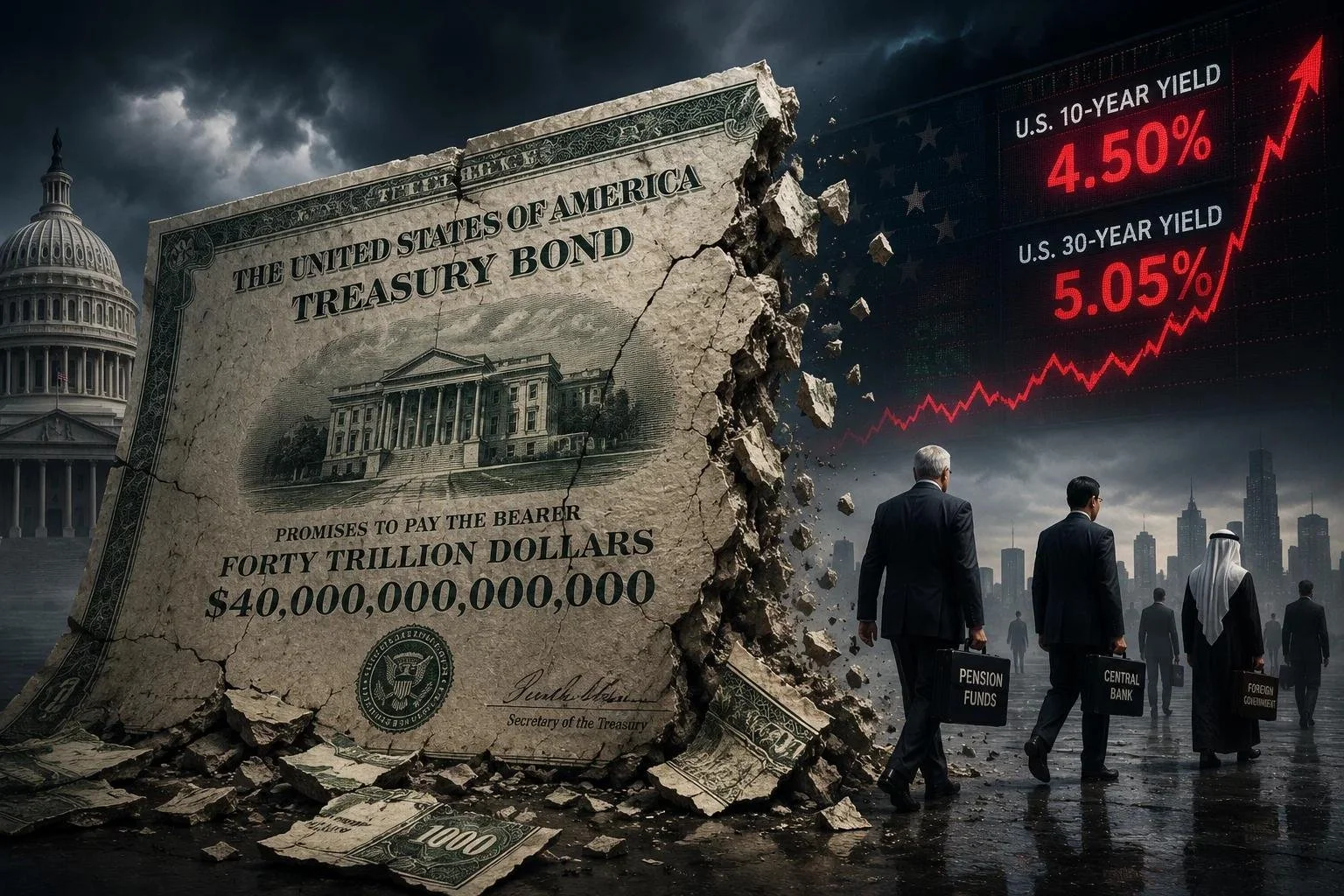
That’s why, for the better part of a century, the single deepest and most trusted piece of that market has been US government bonds. With the US national debt of nearly $40 trillion, this makes America’s bond market REALLY big. And Congress keeps adding to it.
The federal government runs roughly $2 trillion annual deficits— which you could think of as the new ‘supply’ of Treasury securities added to the bond market each year.
In other words, when the government spends more, they have to borrow more money by issuing more Treasury bonds. So the supply of US Treasury securities in the bond market increases.
‘Demand’ for US government bonds, on the other hand, comes from everyone on the planet who buys them. Pension funds, foreign governments and central banks, big corporations, banks, money market funds, etc.
And as any high school economics student can tell you, the ‘price’ is where supply meets demand. In the bond market, we usually think of price as the bond yield, e.g. right now the US 10-year yield is 4.5%, and the 30-year Treasury is over 5%.
To put those yields in a historical context, they haven’t been this high in decades— and it’s a direct result of rising supply and waning demand.
On the supply side, the US government keeps borrowing money at an insane pace, i.e. the Treasury Department keeps flooding the market with more and more bonds, notes, and yields.
But on the demand side, investors are backing off— especially foreigners. Foreign ownership of US government bonds (as a percentage of total public debt) has fallen by roughly HALF since the early 2010s... with a significant drop recorded just over the past twelve months according to the Treasury Department’s own data.
Few people in Congress seem to mind; there is no serious discussion in Washington about slowing the growth of the deficit, i.e. the bond supply, let alone actually shrinking supply by paying off debt.
Ultimately this supply and demand imbalance means that bond yields will continue to rise— which affects just about everything else from auto loans to the 30-year mortgage rate.
And just take a look around the rest of the developed world:
Bond yields in Germany are far lower (by about 1.5%) than US yields. So are yields in Japan, France, Italy, Canada, Singapore, New Zealand, South Korea, and China.
Even GREECE, with its 3.6% 10-year government bond yield, has lower yields than the United States.
You’d think that such attractive yields in the United States compared to the rest of the world would entice a lot more capital into the US bond market. After all, investors generally chase the highest returns.
But buyers are signaling that they don’t think the return is worth the risk— that even a 4.5% yield on a 10-year Treasury note is not worth the risk of holding a US government IOU for an entire decade.
Think about how much has changed over the past decade... and how much more can change over the next decade. Inflation, government shutdowns, debt ceiling showdowns, political theater, war, Social Security’s looming insolvency, etc.
Foreign governments and central banks aren’t willing to lock themselves in for ten years, let alone thirty years, with so much chaos on the horizon.
And with less demand from foreigners in the bond market, it’s likely that bond yields will continue to rise, until the Treasury Department is paying 5, 6, and 7% to borrow money.
With a ~$40 trillion national debt, that’s almost $3 trillion per year just to pay interest— roughly 60% of last year’s tax revenue.
This is why it makes so much sense to have a Plan B... because the most likely ‘solution’ to this problem will be for the Federal Reserve to ‘print’ trillions of dollars of capital.
This approach may succeed in lowering yields. But it will lead to substantially higher inflation, for a lot longer.
To your freedom, James Hickman Co-Founder, Schiff Sovereign LLC
P.S. If the Fed ultimately prints trillions to keep yields down, inflation is the bill— and the best protection is owning the companies that produce the real assets central banks are already loading up on.
Gold is the obvious example, but the same logic applies to every essential input the real economy runs on: energy, fertilizer, industrial metals, uranium, agriculture, shipping.
People still need to eat, drive, heat their homes, build, and farm.
That's why we built Schiff Sovereign's Strategic Assets, our monthly investment research service focused on profitable, well-managed real asset companies.
Iraq News Posted by Tishwash at TNT 5-26-2026
TNT:
Tishwash: Parliamentary committee: The 2026 budget will be based on a "hedging" oil price of around $60.
The Oil, Gas and Natural Resources Committee of the House of Representatives identified 4 features of this year’s budget.
According to the official newspaper, committee member Hawraa Aziz Al-Moussawi said, "This year's budget will probably be based on adopting a lower (hedging) oil price in the 2026 budget, reaching about $60 per barrel, rationalizing spending, increasing non-oil revenues, and reducing complete dependence on oil."
TNT:
Tishwash: Parliamentary committee: The 2026 budget will be based on a "hedging" oil price of around $60.
The Oil, Gas and Natural Resources Committee of the House of Representatives identified 4 features of this year’s budget.
According to the official newspaper, committee member Hawraa Aziz Al-Moussawi said, "This year's budget will probably be based on adopting a lower (hedging) oil price in the 2026 budget, reaching about $60 per barrel, rationalizing spending, increasing non-oil revenues, and reducing complete dependence on oil."
She explained, "There are discussions related to trying to reduce the financial deficit with the decline in global oil price expectations, because any increase in the price of oil supplied to local refineries may gradually affect the citizen." link
Tishwash: 4 pillars for the 2026 budget
The country's fiscal policy faces a critical test in maintaining economic stability, as the parliamentary committee on oil, gas, and natural resources has outlined four key pillars aimed at protecting the 2026 budget from external shocks. This legislative initiative comes amidst a complex regional and international environment, buffeted by oil market volatility and escalating geopolitical tensions in vital waterways, placing Iraq's financial security under exceptional challenges.
Member of the Oil Committee, MP Hawraa Aziz Al-Moussawi, said that the (2026) budget will be based on four main pillars, foremost among them setting a hedge oil price of about (60) dollars per barrel, in addition to rationalizing public spending, increasing non-oil revenues, and reducing dependence on oil as a main source of budget financing.
In her interview with Al-Sabah, she indicated that there are discussions within the committee regarding ways to reduce the financial deficit in light of declining global expectations for oil prices, warning that any change in the prices of oil derivatives may gradually affect the living conditions of citizens.
In the same vein, Dr. Ali Al-Azirjawi, a member of the State of Law Coalition, called for the adoption of an emergency plan similar to the Food Security Law should the 2026 budget not be approved within the constitutional timeframe. He explained that the current circumstances necessitate exceptional measures to ensure the continued and organized functioning of state institutions. He added that Iraq faces economic challenges related to the size of its internal and external debt, in addition to regional tensions that further complicate the overall financial situation.
For his part, economic researcher Bassam Raad considered setting a hedging oil price of (60) dollars per barrel a proactive step aimed at controlling public spending and avoiding the exacerbation of internal debt, but he pointed out that these data may not be sufficient to bridge the gap between revenues and actual expenditures, in light of the continued pressures on the general budget.
For his part, economist Nabil Al-Marsoumi suggested the possibility of postponing the (2026) budget to the year (2027), attributing this to the lack of time, the turmoil in the oil markets, and the fluctuation in export quantities, especially in light of the repercussions of the Strait of Hormuz crisis. link
************
Tishwash: Government advisor: The dollar is the basis of Iraq's cash reserves.
On Tuesday, Mazhar Mohammed Saleh, the financial advisor to the Iraqi Prime Minister, stated that diversifying Iraq's foreign reserves within a balanced investment portfolio represents a strategic monetary policy aimed at enhancing financial stability and reducing the risks associated with relying on a single asset or currency.
Saleh told Shafaq News Agency that the management of foreign reserves at the Central Bank of Iraq is based on liquidity, security and return standards, explaining that the philosophy of managing reserves is based on achieving a balance between protecting the value of the national currency and ensuring the ability to intervene in the exchange market and finance foreign trade, in addition to reducing sovereign and financial risks resulting from global market fluctuations and geopolitical tensions.
He explained that Iraq, as an economy heavily dependent on oil revenues and foreign imports, keeps the US dollar as a key component of its foreign reserves due to its direct link to foreign trade, noting that the diversification policy also includes other currencies and assets such as the euro, yuan, and gold to enhance flexibility and reduce the risks of monetary concentration.
He added that the distribution of reserves is not limited to foreign currencies, but includes multiple investment instruments such as treasury bonds and sovereign deposits, explaining that the goal is not to achieve high profits as much as it focuses on maintaining security and liquidity while achieving an acceptable return.
He explained that gold is an important component of reserves within global diversification standards, as it provides a safe cover in times of turmoil, but it is not a complete substitute for the rest of the foreign assets because it does not generate a direct return and the costs of storing and securing it are high.
He stressed that the sound management of foreign reserves aims to achieve a balance between exchange rate stability, protecting the national economy, and reducing exposure to international market fluctuations, through building a balanced investment portfolio that provides liquidity, security, and an appropriate return. link
************
Tishwash: Ports: An integrated strategy to facilitate trade and protect the national economy
he head of the Border Ports Authority, Omar Al-Waeli, confirmed on Sunday that there has been a noticeable decline in smuggling operations through the ports as a result of tightening control procedures and strengthening field control, noting that these measures have contributed to achieving a clear increase in revenues, while pointing to the implementation of an integrated strategy to facilitate trade and protect the national economy.
Al-Waeli said, “The border crossings are subject to smuggling attempts in various forms, but the volume of these operations has witnessed a noticeable decline in recent years as a result of tightening control procedures and strengthening field control.”
He added that "the Ports Authority has adopted a number of mechanisms to reduce smuggling, most notably automating procedures, activating monitoring systems and cameras, intensifying auditing and detection work, as well as continuous coordination with security and regulatory bodies and activating the principle of the single window, which contributes to reducing cases of manipulation and corruption."
He pointed out that "the Authority adopts an integrated strategy aimed at achieving a balance between facilitating trade, enhancing oversight, and protecting the national economy, through digital transformation, standardization of procedures, raising the efficiency of employees, combating administrative and financial corruption, as well as developing infrastructure and using modern technologies in inspection and detection," explaining that "these measures have resulted in a clear increase in revenues, a reduction in waste and smuggling rates, and faster completion of transactions within the ports."
He pointed out that "there is ongoing coordination between the federal government and the Kurdistan Regional Government regarding the management of border crossings, information exchange, control procedures, and the activation of the ASYCUDA system, given that the border crossings represent a part of the state's economic sovereignty."
He noted that "the last phase witnessed progress in the levels of joint cooperation through the coordination committees, while efforts continue to reach a complete unification of customs and control procedures in all Iraqi ports."
Al-Waeli continued, “Smugglers are subject to penalties based on applicable laws, including financial fines, confiscation of goods and means of transport in some cases, as well as referral to the judiciary and taking the necessary penal measures against violators.” He pointed out that “tightening penalties and activating judicial follow-up has contributed to strengthening deterrence, reducing many smuggling attempts, and raising the level of compliance with laws within border crossings.”
He explained that “the smuggling of drugs, weapons and prohibited materials, as well as organized commercial smuggling that harms the national economy, are among the most dangerous types of smuggling that the state faces,” noting that “the Authority deals with these files as they directly affect national and economic security by strengthening intelligence work, using modern inspection devices, intensifying detection and auditing procedures, and carrying out joint operations with the competent security agencies to reduce these phenomena and prosecute those involved in them.” ink
Tishwash: Iraq is moving towards a post-oil economy as part of its "2035 Plan".
The directives issued by the Prime Minister, Ali Faleh Al-Zaidi, during his recent visit to the Ministry of Finance, have garnered widespread attention in economic and specialized circles, after they included clear indications of the need to reformulate Iraq’s financial policy, reduce dependence on oil, and expand the role of the private sector, in conjunction with the preparation of “Iraq Plan 2035,” which aims to establish a new economic contract that does not patch up the old one but builds a completely different model.
Experts believe that the Prime Minister’s speech revealed a new governmental direction based on moving from the traditional management of the economy to a model that relies on development, production and investment, with a focus on reforming the financial and customs system and stimulating non-oil sectors as a fundamental pillar of economic stability in the next stage .
New economy
Financial expert Dr. Nabil Al-Abadi said: The proposal presented by the Prime Minister reflects a fundamental shift in the state’s financial philosophy from a rentier, distributive mentality to a productive and sustainable economic mentality, explaining that the talk about Iraq’s 2035 plan confirms that we are facing an attempt to establish a new economic contract that does not patch up the old one but builds a completely different model.
economic model
Al-Abadi added to Al-Sabah: “The diagnosis of the budget’s 90 percent dependence on oil is not merely a description of an economic reality, but a clear declaration of the fragility of the existing economic model. The danger lies in the governing and operational expenses that consume the budget without producing a high GDP. The paradox pointed out by the Prime Minister is that the state has a huge budget but does not create a robust economy. The shift towards making the economy manage the state instead of the state managing the economy represents a redefinition of the government’s role to be an organizer and stimulator of the business and investment environment .”
Energies towards production
He pointed out that relying on the private sector is no longer an intellectual option but an economic necessity to stop the inflation of government employment and to redirect energies towards production, noting that the move towards automation and reforming the customs system reflects a deep understanding of the importance of closing the loopholes of financial waste and maximizing non-oil revenues, while he described linking the dues of farmers and contractors to the continuation of the economic cycle as an “advanced awareness” of the importance of liquidity in stimulating the productive sectors .
Formulating fiscal policy
For his part, Jassim Al-Aradi, a member of the Baghdad Economic Forum, believes that the contents of the Prime Minister’s speech reflect a serious governmental direction to reformulate fiscal policy in line with current economic challenges and the requirements of sustainable development in Iraq .
Al-Aradi said that the diagnosis of the budget’s almost total dependence on oil revenues represents a realistic reading of the nature of the Iraqi economy, noting that the next stage requires accelerating the procedures for diversifying national income sources by revitalizing the industrial, agricultural, commercial and service sectors and not being satisfied with traditional solutions related to oil prices .
Modern economies
The spokesperson added that transforming the role of the state from manager of the economy to regulator and supporter of economic activity is one of the most prominent positive indicators, because it gives the private sector a greater opportunity to participate in creating job opportunities and driving investment, stressing that modern economies are based on partnership between the state and the private sector to achieve growth and stability .
Al-Aradi explained that the Prime Minister’s directives regarding automation and control of customs ports represent an important step to address financial waste and reduce cases of revenue manipulation, as well as enhance financial transparency and raise the efficiency of government collection .
Financial challenges
For his part, economist Dr. Murtadha Al-Khafaji described the Prime Minister’s speech as representing an economic roadmap that reflects a clear understanding of the magnitude of the financial challenges facing Iraq in light of regional and international changes and their direct impact on oil prices and public revenues .
Al-Khafaji explained that the Prime Minister’s emphasis on diversifying the economy and reducing dependence on oil represents an important strategic direction, especially since the Iraqi economy still depends heavily on oil revenues, which makes public finances vulnerable to global fluctuations .
Stimulating the productive sectors
He added that the call to make the budget a roadmap for the future reflects a new understanding of the role of fiscal policy in stimulating development and driving productive sectors, noting that supporting the private sector and changing traditional economic concepts are a necessary step to build a more resilient and sustainable economy .
Al-Khafaji stated that investing in Iraq’s geographical location and developing the transport and trade sectors could provide important financial resources outside the oil framework, stressing the importance of automation in customs ports to eliminate manipulation and increase non-oil revenues link
Iraq Economic News and Points To Ponder Tuesday Morning 5-26-26
Iraq In 2026: Will US Pressure Lead To Genuine Reform Or Wider Economic Paralysis?
May 24, 2026 Al-Mustaqilla - Iraq enters 2026 under unprecedented financial and banking pressure, with escalating US restrictions on dollar movement, expanding sanctions related to financial and commercial networks, and growing concern within the market about the impact of this on banks, transfers, the exchange rate, and citizens' confidence in the financial system.
Iraq In 2026: Will US Pressure Lead To Genuine Reform Or Wider Economic Paralysis?
May 24, 2026 Al-Mustaqilla - Iraq enters 2026 under unprecedented financial and banking pressure, with escalating US restrictions on dollar movement, expanding sanctions related to financial and commercial networks, and growing concern within the market about the impact of this on banks, transfers, the exchange rate, and citizens' confidence in the financial system.
The crisis is no longer confined to the price of the dollar in the parallel market, but has turned into a broader question concerning the future of the entire Iraqi economy:
Will American pressure push Baghdad towards genuine reform in the financial and banking sector, or will it lead to a wider economic paralysis in a country that depends on oil, imports, the dollar, and currency?
The sensitivity of this stage stems from the fact that Iraq possesses large oil revenues and significant financial reserves, but it still suffers from a fragile banking system, weak public confidence in banks, widespread reliance on cash transactions, as well as a private sector with limited capacity for production and export.
The Dollar: From A Monetary Instrument To A Pressure Tactic
Recent developments have shown that the dollar is no longer merely a monetary issue within Iraq, but has become a tool of political and financial pressure in the relationship between Baghdad and Washington.
In April 2026, Iraqi sources told Reuters that the United States had intercepted a shipment of between $450 million and $500 million destined for Iraq, in a move aimed at pressuring the Iraqi government over the activities of Iranian-backed armed groups.
The sources explained that the action targeted paper currency used to meet the demand for dollars for travel, medical treatment, and education, while electronic transfers for trade and imports remained unaffected, according to an economic advisor to the Iraqi government.
This development reveals the deep interdependence between politics and finance in Iraq. The dollar, which enters the country through a complex system linked to oil revenues and accounts at the Federal Reserve in New York, is no longer guaranteed to flow in the traditional way if political or security disputes escalate between Baghdad and Washington.
Hence, the question becomes more serious:
What happens to a market that depends on the dollar for cash, trade, and transfers if currency shipments and transfers become a tool conditioned on the political and security behavior of the Iraqi government?
Banks Between Compliance And Isolation
In recent years, several Iraqi banks have faced restrictions on dollar transactions as part of declared US and Iraqi efforts to combat money laundering and currency smuggling. Reuters reported in February 2025 that the Central Bank of Iraq was moving to bar five more banks from dealing in dollars after meetings with officials from the US Treasury Department and the Federal Reserve, following a ban on eight banks in 2024.
This path has practically led to a sorting out within the Iraqi banking sector: banks that are able to comply with the requirements of foreign transfers and deal with the international financial system, and other banks that have become restricted or isolated from the dollar, which weakens their ability to serve traders and importers and reduces market confidence in them.
The result is that the banking sector is no longer a monolith. Some banks are attempting to transition to compliance, governance, and digitalization, while others face the risk of marginalization, mergers, or gradual market exit.
This sorting-out may be the beginning of a necessary reform, but it also carries the risk of market disruption if not managed transparently and gradually.
Washington Expands The Circle Of Pressure
American pressure did not stop at banks and transfers. In May 2026, the US Treasury Department announced sanctions as part of a campaign it called Economic Fury, targeting an Iraqi oil official and leaders linked to Iranian-backed factions. It said that Washington was prepared to take economic measures against entities supporting illicit Iranian trade, including imposing secondary sanctions on foreign financial institutions that facilitate Iran's activities.
This American message adds a new dimension to the crisis; It concerns not only banks, but also networks of finance, oil, trade, and politics.
This means that any Iraqi financial institution, company, or commercial intermediary could find itself under scrutiny if its dealings are linked to entities that Washington considers part of networks circumventing sanctions.
Thus, Iraq moves from the stage of monitoring transfers to a more complex stage, the title of which is:
Who has control over the movement of funds? And who can prove that his trade and transfers do not pass through suspicious channels?
The Central Bank Is Trying To Restructure The Sector.
In contrast, the Central Bank of Iraq is attempting to demonstrate a more rigorous reform path. It has launched reform pathways for banks based on options of survival, merger, or exit from the market, within a program that includes requirements related to capital, liquidity, ownership disclosure, governance, and compliance.
Central Bank documents on reform pathways show that banks that choose to remain are required to reach a paid-up capital of 400 billion dinars, comply with liquidity ratios, and provide full disclosure of shareholders and related parties, with the interim evaluation processes to begin in the first half of 2026 and extend over several cycles the end of 2028.
Another path allows banks to merge into stronger entities, while a third path involves an ordered exit or liquidation for those unable to meet reform requirements. The documents confirm that the central bank can redirect banks failing to meet the requirements toward alternative paths, including mergers or exits.
On paper, this plan appears to be an attempt to reform a banking sector that is bloated in terms of numbers and functional weaknesses.
However, it raises a crucial question:
Do Iraqi banks possess the financial, administrative, and technical capacity to meet these standards? Or will the reform lead to the collapse of weaker banks, creating further market instability?
A Cash Economy Resists Reform
The deeper problem is that Iraq suffers not only from weak banks, but also from a widespread cash economy. Citizens and merchants still keep a large portion of their money outside the banking system, preferring to deal in cash, especially dollars, due to a lack of trust and fear of sudden restrictions or complicated procedures.
This makes any banking reform run into a harsh reality:
it is not enough to impose standards on banks if the citizen does not trust them, the trader does not find them an easy and quick channel, and the parallel market is still more flexible than the official system.
Therefore, true reform does not simply mean closing down non-compliant banks, raising capital requirements, or tightening controls on transfers. Reform means building renewed trust between citizens and banks, between merchants and the financial system, and between Iraq and international institutions.
The Broader Economic Risk
If American pressure succeeds in pushing Iraq to reform its financial system, the medium-term outcome could be positive: fewer and stronger banks, more transparent transfers, a decline in the use of fictitious invoices, and a gradual improvement in investor confidence.
But the other scenario is equally plausible. If the pressures escalate into increasing restrictions without effective domestic alternatives, Iraq could face broader economic paralysis. Disruptions to remittances, traders' fear of banks, a widening gap between the official and parallel exchange rates, and the continuation of sanctions are all factors that could put pressure on imports, prices, and investment.
The most serious issue is that Iraq is a country that relies on imports to meet most of its consumer and production needs. Any disruption in financing foreign trade could quickly translate into price pressures, and then into social unrest, especially given that millions of citizens depend on government salaries and fixed incomes.
The Government Faces A Difficult Equation
The Iraqi government finds itself facing a delicate equation:
it must reassure Washington about combating money laundering and adhering to sanctions, reassure the domestic market that the dollar will not turn into an open crisis, convince the banks of the feasibility of reform, and convince citizens that their money is safer inside the banking system than outside of it.
This is not just a technical matter, but also a political one.
American pressure on the dollar and banks is linked to issues of Iranian influence, armed factions, and regional politics, while the crisis internally is linked to banking and commercial interests and financial networks that emerged during years of weak oversight.
Therefore, 2026 could be a pivotal year: either Iraq will use external pressure as an opportunity to rebuild its financial system, or the pressure itself will become a paralyzing factor if reform remains partial and the government lacks a clear plan to protect the market and affected classes.
Iraq in 2026 faces more than just a dollar crisis.
It faces a test of the state's ability to transition from a fragile cash economy to a modern financial system, and from banks seeking quick profits in the currency market to banks that finance the economy and adhere to international compliance standards.
American pressure could be an opportunity for genuine reform if accompanied by a clear Iraqi will, transparency in managing the banking sector, protection of legitimate trade, and a plan to restore public confidence.
However, it could turn into broader economic paralysis if measures remain limited to bans, sanctions, and restrictions, without deep internal reform.
The question that will determine the course of the next phase remains:
Can Iraq transform American pressure into genuine banking and economic reform, or will weak confidence, monetary dominance, and the entanglement of politics and money push it towards a wider crisis?
Seeds of Wisdom RV and Economics Updates Tuesday Morning 5-26-26
Good Morning Dinar Recaps,
Rubio Says Iran Deal Could Take Days as Fresh Strikes Keep Energy Markets on Edge
Ongoing U.S.-Iran negotiations, renewed military operations, and uncertainty surrounding the Strait of Hormuz are intensifying fears of prolonged energy instability and accelerating global discussions about geopolitical realignment and financial restructuring.
Good Morning Dinar Recaps,
Rubio Says Iran Deal Could Take Days as Fresh Strikes Keep Energy Markets on Edge
Ongoing U.S.-Iran negotiations, renewed military operations, and uncertainty surrounding the Strait of Hormuz are intensifying fears of prolonged energy instability and accelerating global discussions about geopolitical realignment and financial restructuring.
Overview
The United States and Iran remain engaged in fragile negotiations aimed at ending months of conflict that have disrupted global energy markets and threatened maritime trade through the Strait of Hormuz. While U.S. Secretary of State Marco Rubio stated that progress is being made, fresh U.S. military strikes in southern Iran highlight how unstable the situation remains.
At the center of negotiations are several critical issues, including reopening the Strait of Hormuz, managing Iran’s enriched uranium stockpile, releasing frozen Iranian assets, and preventing broader regional escalation involving Israel and Hezbollah.
The outcome of these talks could have major consequences for global oil prices, inflation, supply chains, currency markets, and the evolving multipolar financial system.
Key Developments
1. Rubio Signals Progress but Warns Talks Could Still Take Days
Secretary of State Marco Rubio said negotiations with Iran are advancing but cautioned that no immediate breakthrough should be expected. He stressed that the Strait of Hormuz “must remain open,” signaling Washington’s determination to restore maritime stability regardless of negotiation delays.
The comments suggest the White House is balancing diplomacy with continued military pressure while attempting to calm increasingly volatile energy markets.
2. Fresh U.S. Strikes Increase Pressure During Negotiations
Despite ongoing talks, U.S. forces launched new strikes targeting alleged Iranian military positions and naval mine operations in southern Iran.
Iran later claimed its air defense systems intercepted a hostile stealth drone, further escalating tensions and demonstrating how quickly diplomacy could unravel if either side miscalculates.
The simultaneous use of military force and negotiations reflects the increasingly fragile balance between deterrence and diplomacy.
3. Strait of Hormuz Remains the Core Global Economic Risk
The Strait of Hormuz continues to be the single most important issue in negotiations.
Under normal conditions, the waterway handles roughly 20% of global oil and LNG shipments, making it one of the most strategically important trade corridors in the world.
Shipping activity through the strait has sharply declined since the conflict intensified earlier this year, contributing to higher oil prices, rising transportation costs, and renewed global inflation concerns.
Any long-term disruption could significantly impact global trade flows and economic stability.
4. Iran’s Nuclear Program and Frozen Assets Remain Major Obstacles
Negotiators in Doha reportedly focused on Iran’s enriched uranium stockpile, sanctions relief, and the possible release of frozen Iranian financial assets.
Iran continues insisting its nuclear program is peaceful while resisting demands that could weaken its long-term strategic leverage.
Washington, meanwhile, maintains that preventing Iran from developing nuclear weapons remains a non-negotiable objective.
The unresolved nuclear dispute remains one of the largest barriers to any lasting agreement.
5. Israel-Hezbollah Tensions Threaten Wider Regional Escalation
Israeli Prime Minister Benjamin Netanyahu announced expanded operations against Hezbollah in Lebanon, adding another layer of instability to the region.
Even with ceasefires technically in place, military operations continue across multiple fronts, raising fears that any collapse in U.S.-Iran negotiations could trigger a broader Middle East conflict.
Global markets remain highly sensitive to any sign of escalation.
Why It Matters
The negotiations are no longer just about Iran and the United States. They now directly affect global energy security, inflation trends, trade stability, and confidence in the international financial system.
The Strait of Hormuz serves as a critical artery for global commerce. Continued disruption threatens oil-importing economies across Europe and Asia while placing additional pressure on already fragile supply chains.
The crisis also reflects the growing transition toward a more fragmented and multipolar global order where energy corridors, sanctions, currency systems, and geopolitical alliances are becoming increasingly interconnected.
Why It Matters to Foreign Currency Holders
For foreign currency holders, prolonged instability in the Middle East could accelerate pressure on the traditional dollar-based global financial system.
Rising oil prices and inflation fears often strengthen short-term demand for the U.S. dollar, but long-term geopolitical fragmentation may encourage countries to expand alternative trade settlement systems outside traditional Western financial networks.
Nations involved in BRICS expansion and regional trade alliances continue exploring local currency settlement mechanisms, commodity-backed agreements, and alternative payment systems designed to reduce exposure to geopolitical sanctions and energy disruptions.
If Hormuz instability continues, global efforts toward financial diversification, de-dollarization discussions, and multipolar trade restructuring could intensify further.
Implications for the Global Reset
Pillar 1: Energy Security Is Becoming Central to Global Financial Stability
Control over shipping routes, energy supply chains, and commodity pricing is increasingly shaping geopolitical and financial power structures worldwide.
Pillar 2: Multipolar Financial Systems Continue Expanding
As global conflicts expose vulnerabilities in traditional trade systems, more nations are accelerating efforts to build alternative financial and payment networks independent of Western control.
Pillar 3: Geopolitical Risk Is Reshaping Currency and Commodity Markets
Persistent instability in the Middle East is increasing volatility across oil, currencies, shipping, and global bond markets, reinforcing broader concerns about long-term financial restructuring.
This is not just a regional conflict — it is becoming a major test of global energy security, geopolitical power, and the future direction of the international financial system.
Seeds of Wisdom Team
Newshounds News™ Exclusive
Sources
Reuters — "Rubio says Iran deal could take days as U.S. launches fresh strikes"
Modern Diplomacy — "Rubio Says Iran Deal Could Take Days as US Launches Fresh Strikes"
~~~~~~~~~~
🌱A Message to Our Currency Holders🌱
If you’ve been holding foreign currency for many years, you were not foolish.
You were not wrong to believe the global financial system would change.
What failed was not your patience — it was the information you were given.
For years, dates, rumors, and personalities replaced facts, structure, and proof. “This week” predictions created cycles of hope and disappointment that were never based on how currencies actually change.
That is not your failure.
Our mission here is different: • No dates • No rates • No hype • No gurus
Instead, we focus on:
• Verifiable developments • Institutional evidence
• Global financial structure • Where countries actually sit in the process
Currency value changes only come after sovereignty, trade, banking, settlement systems, and fiscal coordination are in place. History and institutions confirm this sequence.
You will see silence. You will see denials. That is not delay — that is discipline.
Protect your identity. Organize your documents. Verify everything.
Never hand your discernment to anyone who cannot show proof.
You deserve truth — not timelines.
Seeds of Wisdom Team
Newshounds News™
~~~~~~~~~~
Seeds of Wisdom Team RV Currency Facts Youtube and Rumble
Newshound's News Telegram Room Link
RV Facts with Proof Links Link
RV Updates Proof links - Facts Link
Follow the Gold/Silver Rate COMEX
Follow Fast Facts
Seeds of Wisdom Team™Website
Thank you Dinar Recaps
Seeds of Wisdom RV and Economics Updates Monday Evening 5-25-26
Good Evening Dinar Recaps,
High-Stakes Iran Negotiations Focus on Hormuz, Sanctions, and Nuclear Disputes
Fragile diplomatic progress between the United States and Iran is raising hopes for a limited de-escalation agreement that could ease pressure on global energy markets and reduce the risk of a wider regional conflict.
Good Evening Dinar Recaps,
High-Stakes Iran Negotiations Focus on Hormuz, Sanctions, and Nuclear Disputes
Fragile diplomatic progress between the United States and Iran is raising hopes for a limited de-escalation agreement that could ease pressure on global energy markets and reduce the risk of a wider regional conflict.
Overview
Iranian officials confirmed that preliminary conclusions have been reached regarding a proposed 14-point memorandum of understanding designed to create a framework for ending the ongoing Middle East conflict and reopening critical global shipping routes.
While negotiators from both sides acknowledge progress, major disagreements remain over Iran’s nuclear program, sanctions relief, military capabilities, and long-term security arrangements in the Strait of Hormuz.
The negotiations are being closely watched by global markets because the conflict has already contributed to:
Rising oil prices
Shipping disruptions
Inflation concerns
Currency volatility
Increased geopolitical instability
Key Developments
1. Strait of Hormuz Remains the Core Negotiation Issue
The central focus of the discussions is the future of the Strait of Hormuz, one of the world’s most important energy chokepoints.
According to reports, Iran has agreed in principle to ensure safe transit through the strait in exchange for:
The lifting of the U.S. naval blockade
Easing of sanctions
Release of frozen Iranian assets
Expanded access to oil exports
Because roughly a fifth of global oil and LNG shipments traditionally pass through Hormuz, any agreement affecting the strait could significantly impact global energy markets.
2. Nuclear Program Still a Major Obstacle
Despite reported progress, Iran’s nuclear activities remain one of the largest unresolved issues.
Current discussions reportedly do not yet contain a final commitment regarding:
Uranium enrichment limits
Inspection mechanisms
Nuclear transparency requirements
Long-term verification agreements
U.S. Secretary of State Marco Rubio stated that any temporary agreement would likely create a 60-day negotiation window for resolving the nuclear dispute.
3. Iran Seeks Economic Relief and Security Guarantees
Iranian officials continue demanding:
Broad sanctions relief
Access to frozen financial assets
Freedom to export oil internationally
Reduced military pressure from the United States and its allies
Iran has also insisted that any agreement must preserve what Tehran describes as its “national rights” and strategic deterrence capabilities.
The proposed framework would still require approval from Iran’s Supreme National Security Council and final authorization from Supreme Leader Ali Khamenei.
4. Global Markets Remain Sensitive to Negotiation Outcomes
Financial and energy markets remain cautious despite reports of progress.
Oil prices, shipping insurance costs, and global inflation expectations continue reacting to developments surrounding:
Gulf shipping security
Possible sanctions relief
Energy supply disruptions
Regional military escalation risks
Analysts warn that even if a ceasefire framework is reached, restoring full commercial confidence and shipping stability could take years.
Why It Matters
The Iran negotiations are no longer simply a regional diplomatic issue. They now directly influence:
Global energy markets
Inflation trends
Central bank policy
International trade routes
Currency stability
Global financial confidence
The Strait of Hormuz remains one of the most strategically important waterways in the world, making any disruption capable of affecting nearly every major economy.
At the same time, the negotiations reflect a broader transition toward a more fragmented geopolitical and financial environment where military conflict, energy security, and economic policy are increasingly interconnected.
Why It Matters to Foreign Currency Holders
For foreign currency holders, the outcome of these negotiations could significantly impact global monetary and financial stability.
Energy disruptions tied to Hormuz directly influence:
Inflation rates
Interest rate policy
Currency valuations
Commodity prices
Sovereign debt markets
A prolonged crisis could accelerate efforts by major powers and BRICS-aligned nations to reduce dependence on Western-controlled financial systems and energy settlement mechanisms tied to the U.S. dollar.
Meanwhile, any successful agreement that stabilizes Gulf shipping could temporarily calm markets, strengthen confidence in global trade flows, and reduce pressure on energy-importing economies.
The larger issue is that global financial systems are becoming increasingly vulnerable to geopolitical disruptions, especially around energy infrastructure and strategic trade corridors.
Implications for the Global Reset
Pillar 1: Energy Security Is Reshaping Global Finance
The negotiations highlight how energy supply routes are becoming central to global financial stability and geopolitical leverage.
Control over strategic waterways increasingly affects:
Currency strength
Inflation management
Trade balances
Global capital flows
Pillar 2: Multipolar Negotiation Structures Are Emerging
The diplomacy surrounding Iran now involves multiple regional powers including Pakistan, Qatar, China, and Gulf states rather than solely Western-led negotiations.
This reflects the broader emergence of a more multipolar global order where regional powers are playing larger roles in conflict resolution and economic coordination.
Closing Perspective
The Iran negotiations are rapidly evolving into more than a ceasefire discussion — they are becoming a test of how global energy security, geopolitical power, and financial stability will interact in the emerging multipolar era.
Whether the talks succeed or collapse, the crisis has already demonstrated how deeply connected modern financial systems are to strategic trade corridors and geopolitical tensions.
This is not just diplomacy — it is the intersection of energy, currency stability, and the future structure of global power.
Sources
Reuters — "U.S. and Iran Continue Discussions on Hormuz and Nuclear Issues"
Modern Diplomacy — "What Must Be Agreed to End the Iran War?"
~~~~~~~~~~
Seeds of Wisdom Team RV Currency Facts Youtube and Rumble
Newshound's News Telegram Room Link
RV Facts with Proof Links Link
RV Updates Proof links - Facts Link
Follow the Gold/Silver Rate COMEX
Follow Fast Facts
Seeds of Wisdom Team™Website
Thank you Dinar Recaps
Iraq Economic News and Points To Ponder Monday Evening 5-25-26
Government Advisor: New Financial Strategy To Raise Non-Oil Revenues To 45%
{Economic: Al-Furat News} The financial advisor to the Prime Minister, Mazhar Muhammad Saleh, revealed that the government is moving towards adopting a new financial strategy aimed at raising the contribution of non-oil revenues in the general budget to 45% by diversifying the economy and reducing dependence on crude oil.
Saleh told Al-Furat News that “Prime Minister Ali Al-Zaidi, during the historic meeting with the Iraqi financial authority held on May 23, 2026, outlined a firm vision for building the future of public finance in the country,” explaining that “the new beginning came from a fundamental pillar represented by announcing the alternative path for public finance and Iraqi financial policy.”
Government Advisor: New Financial Strategy To Raise Non-Oil Revenues To 45%
{Economic: Al-Furat News} The financial advisor to the Prime Minister, Mazhar Muhammad Saleh, revealed that the government is moving towards adopting a new financial strategy aimed at raising the contribution of non-oil revenues in the general budget to 45% by diversifying the economy and reducing dependence on crude oil.
Saleh told Al-Furat News that “Prime Minister Ali Al-Zaidi, during the historic meeting with the Iraqi financial authority held on May 23, 2026, outlined a firm vision for building the future of public finance in the country,” explaining that “the new beginning came from a fundamental pillar represented by announcing the alternative path for public finance and Iraqi financial policy.”
He added that “diversifying public revenues and breaking dependence on the single resource of crude oil, and ending the Iraqi economy’s connection to the geopolitical risks of the energy market, has become a necessity that must be achieved,” noting that “the Strait of Hormuz shock has reaffirmed the importance of redrawing future maps by adopting economic and financial diversification.”
Saleh explained that “redesigning Iraq’s vision for the period 2020-2025 should be based on the principle of economic diversification based on a genuine partnership between the state and the productive private sector, while launching a suitable environment for a productive social market economy,” noting that “the plan aims to raise the contribution of non-oil revenues from less than 10% currently to about 45% as a first stage.”
He added that "achieving this percentage requires a fundamental shift in the philosophy of public finance, from merely distributing resources to operating and producing them, through establishing a strong relationship with the market economy based on institutions, efficiency and production."
Saleh pointed out that "the future Iraq must be based on the efficient diversification of budget resources and sources of GDP, in line with the national strategy for developing market forces and the private sector."
Saleh stressed that “transforming the general budget into a development action plan represents an important reform step in managing the national economy, because it moves it from a tool for distributing expenditures to a tool for directing development and achieving the state’s strategic goals.”
He added that "previous budgets were linked to operational spending, especially salaries and subsidies, which made the margin for developmental investment limited, while the new approach means moving to a model that relies on advance planning, setting priorities and measuring results."
Saleh continued, "This transformation requires a change in the philosophy of the state's management of public resources, so that the budget is based on programs and objectives and not just on traditional items, and that every dinar spent must have a tangible economic and social impact."
He pointed out that “involving the private sector in implementing development projects is a key element for the success of this approach, because it reduces the burden on the state, enhances implementation efficiency, and increases the dynamism of the economy,” stressing that “enhancing transparency and activating oversight and accountability are essential conditions to ensure the success of the plan.”
Saleh concluded by saying that “the success of this approach remains dependent on the ability of institutions to implement it effectively and not just to plan or announce it, because international experiences have proven that the real difference between successful plans and those that remain just ink on paper lies in the efficiency of management, the stability of decision-making, and the commitment to continuous reform.
” He explained that “linking the budget to a clear strategic vision and managing it with a results-based methodology can transform it into an effective development tool for building a more sustainable and diversified economy.”
https://alforatnews.iq/news/مستشار-حكومي-استراتيجية-مالية-جديدة-لرفع-الإيرادات-غير-النفطية-إلى-45
Al-Mada News: Iraq Is Facing A “Purge Storm” Targeting 3,000 High-Ranking Employees Affiliated With “Factions” By Order Of Washington
Baghdad - One News 5/25/2026 Al-Mada newspaper reported that Iraq is bracing for a storm of changes that could affect some 3,000 high-ranking employees affiliated with armed groups, if Washington rejects Iraqi mediation aimed at freezing what is known as the de-Baathification process.
The newspaper added that the Shiite forces have gradually begun to contain the media exchanges between the parties of the coordination framework, but this calm seems temporary, amid political assessments that suggest a return of tension as soon as the American response regarding the Iraqi proposals arrives.
According to Al-Mada, Baghdad submitted a proposal to Washington that included monitoring the movement of the factions for three months, before making any decision regarding dissolving those groups or dismantling their influence within the country.
The newspaper confirmed that Baghdad is still waiting for the American response after the Eid holiday, to find out the future of the factions and their influence within state institutions. https://1news-iq.net/المدى-العراق-مُقبل-على-عاصفة-اجتثاثات/
The Central Bank Imposes A "Harsh Sorting" Of Banks... And The National Bank Of Iraq Raises Its Capital To 650 Billion!
May 24, 2026 The Independent/- The National Bank of Iraq announced in an official statement the approval of increasing its capital to 650 billion Iraqi dinars, in a move that reflects accelerating trends within the Iraqi banking sector towards strengthening financial solvency and raising levels of compliance with regulatory standards.
According to the statement, this increase comes as part of a plan aimed at supporting the bank's ability to expand its operations, enhance customer confidence, and keep pace with changes in the financial environment within Iraq.
In the same context, banking sources revealed to Al-Mustaqilla that the Central Bank of Iraq continues to impose increasing regulatory pressure on banks operating in the country, by setting high capital ceilings as a basic condition for the continuation of activity within the market.
The sources explained that the next phase may witness a real “reshuffling” of the banking sector, where only banks that raise their capital and adhere to strict compliance standards will be allowed to remain in the market, as part of a policy aimed at reducing risks and enhancing financial stability.
Observers believe that these moves reflect a new phase in the Iraqi banking system, the most prominent feature of which is restructuring and raising the requirements for continuity, which may push a number of banks to merge or reduce their activity if they are unable to keep up with these conditions.
Experts: The Financial Stability Board Contributes To Supporting Fiscal And Monetary Policies.
Economic 2026/05/24 Baghdad: Hussein Faleh Financial and economic experts and specialists considered the formation of the Financial Stability Council by the government an important step towards supporting fiscal and monetary policies by maximizing revenues and protecting the national currency, while they stressed the importance of adopting comprehensive economic and structural reforms to achieve financial sustainability and diversify the national economy and revenues.
Unifying Financial And Monetary Decisions
Economic expert Ahmed Al-Majidi told Al-Sabah: “The step of forming a Supreme Council for Financial Stability is one of the important steps at this time, because it reflects a trend towards unifying financial and monetary decisions within an institutional framework capable of facing current economic challenges, especially in light of fluctuations in oil prices and global and regional financial pressures.”
He added, “The presence of the Minister of Finance and the Governor of the Central Bank within the membership of the Council gives this formation great importance, because coordination between fiscal policy and monetary policy is essential for maintaining economic stability, protecting the value of the national currency, and enhancing confidence in the Iraqi economy.
” He explained that “the Council can contribute to managing liquidity, controlling spending, maximizing non-oil revenues, in addition to supporting the banking and financial reforms needed in the next stage.”
Supporting The Investment Environment
He continued: "If the council is given clear powers and operates according to an integrated economic vision, it can form a real platform for making quick and effective decisions to confront crises, enhance financial stability, support the investment environment, and reduce the impact of economic shocks on the citizen and the local market."
For his part, economic researcher and academic Dr. Salem Al-Bayati told Al-Sabah: “One of the priorities of any country is to secure economic security in all its details, especially in formulating monetary and fiscal policy,” explaining that “the internal and external challenges facing the country require the state to set clear priorities for managing the current stage.”
Cash Management And State Funds
He added that "the government sought to provide the basic requirements for the citizen through managing the money and state funds, and despite the difficulties, it was able to secure a level of monetary stability and economic activity and maintain the citizen's purchasing power," noting that "these efforts are important solutions, but they still need integrated economic policies."
Al-Bayati pointed to “the need for the new government to adopt a comprehensive economic policy that includes fiscal and monetary policy, while supporting the independence of financial institutions and strengthening them with specialized personnel, especially since the government headed by Al-Zidi has taken an important step, which is the formation of a Supreme Council for Financial Stability, which will work to achieve a balance between the money coming into the state and what is being pumped into the markets in hard currencies, and this will lead to strengthening revenues and protecting the national currency.”
Developing Productive Sectors
He called for "developing various productive sectors to ensure food security, preserve the country's currency reserves, and control both local and foreign currencies." Al-Bayati emphasized the importance of "imposing oversight on border crossings and customs and preventing corrupt individuals from controlling public funds," stressing "the necessity of establishing and effectively implementing strict regulations and laws.
" He also called for "improving the financial situation by increasing production, providing diverse job opportunities, supporting the private sector, and utilizing the potential of young people in the agricultural, industrial, and service sectors, while adopting integrated policies that prevent conflicting projects and avoid creating new crises."
Geopolitical Challenges
For his part, Dr. Ahmed Hadhhal, a professor of economics and financial expert, told Al-Sabah newspaper: “Iraq’s financial situation is facing exceptional and complex pressures as a result of geopolitical challenges, fluctuations in energy markets, and disruptions to international trade, in addition to chronic structural imbalances linked to near-total dependence on oil revenues.”
He explained that “the government, the Ministry of Finance, and the Central Bank have managed over the past two months to manage the situation with a degree of financial and monetary containment by maintaining the stability of salaries and sovereign spending, securing the market’s needs for foreign currency and basic commodities, and preventing rumors from escalating into widespread monetary instability.”
Regular Government Funding
He added that "the Central Bank continued to manage monetary stability, the exchange rate, and control liquidity and inflation levels, while the Ministry of Finance succeeded in maintaining regular government financing despite increasing pressures on the general budget."
Hathal explained that "the current stage requires moving from traditional budget management to comprehensive economic crisis management based on sustainability and fiscal discipline," calling for "restructuring public spending and activating electronic systems for financial management, taxes, customs and collection to reduce waste and corruption and maximize non-oil revenues."
Controlling Operating Expenses
He pointed to the importance of "controlling unproductive operating expenses and directing resources towards productive and strategic sectors, while adopting conservative oil prices and expanding organized domestic financing tools such as treasury bills and investment bonds."
He stressed that "improving Iraq's financial situation in the medium and long term requires a comprehensive structural reform to diversify the economy and increase the contribution of agriculture, industry, energy and logistics to the gross domestic product, in addition to developing the investment environment and partnership with the private sector."
He concluded by saying, "The real challenge is not limited to financing the current budget, but rather lies in building a state capable of achieving financial and economic sustainability and protecting the social and economic security of future generations." Prime Minister Ali Faleh al-Zaidi had chaired the first meeting of the Financial Stability Council.
The Prime Minister's Media Office stated in a press release that "Prime Minister Ali Faleh al-Zaidi chaired the first meeting of the Financial Stability Council, which was included in the ministerial program, and which included the Minister of Finance and the Governor of the Central Bank of Iraq.
" Al-Zaidi emphasized "the importance of achieving financial stability due to its developmental and economic impacts," noting "the necessity of close coordination between the Central Bank and the Ministry of Finance, and the need to make financial decisions that support stability, which will positively impact the government's development, service, and economic plans." https://alsabaah.iq/132798-.html
MilitiaMan & CREW IRAQ DINAR UPDATE-IRAQ'S REFORMS: Deep Integration Momentum-More to it!
MilitiaMan & CREW IRAQ DINAR UPDATE-IRAQ'S REFORMS: Deep Integration Momentum-More to it!
5-25-2026
The Crew: Samson, PompeyPeter, Petra, Daytrader, Sunkissed, GIGI and Militia Man
No drama. No intrigue. No songs and dances. Just straight, factual news that I read and interpret to the best of my ability after being an avid Dinar investor and insanely obsessed Dinarian for over 15 years.
Follow MM on X == https://x.com/Slashn
MilitiaMan & CREW IRAQ DINAR UPDATE-IRAQ'S REFORMS: Deep Integration Momentum-More to it!
5-25-2026
The Crew: Samson, PompeyPeter, Petra, Daytrader, Sunkissed, GIGI and Militia Man
No drama. No intrigue. No songs and dances. Just straight, factual news that I read and interpret to the best of my ability after being an avid Dinar investor and insanely obsessed Dinarian for over 15 years.
Follow MM on X == https://x.com/Slashn
Be sure to listen to full video for all the news……..
Seeds of Wisdom RV and Economics Updates Monday Afternoon 5-25-26
Good Afternoon Dinar Recaps
Huawei’s AI Chip Breakthrough Signals China’s Push Toward Tech Independence
China’s semiconductor ambitions are accelerating as Huawei unveils a new chip design strategy that could reshape the global AI and technology race while weakening the long-term impact of U.S. sanctions.
Good Afternoon Dinar Recaps
Huawei’s AI Chip Breakthrough Signals China’s Push Toward Tech Independence
China’s semiconductor ambitions are accelerating as Huawei unveils a new chip design strategy that could reshape the global AI and technology race while weakening the long-term impact of U.S. sanctions.
Overview
Chinese technology giant Huawei Technologies has announced a major semiconductor design breakthrough centered around a new concept called the “Tau Scaling Law,” signaling Beijing’s growing determination to build a fully self-sufficient chip ecosystem despite years of U.S. export restrictions.
The announcement comes as the global competition for AI dominance, semiconductor leadership, and technological sovereignty intensifies between China and the United States. Huawei claims its future chip architecture could eventually achieve transistor density comparable to advanced 1.4 nanometre processes by 2031 — potentially redefining how computing performance is achieved in the post-Moore’s Law era.
Key Developments
1. Huawei Introduces Alternative Path Beyond Traditional Chip Scaling
Huawei revealed a new semiconductor strategy focused less on shrinking transistor sizes and more on improving data movement, system efficiency, and chip architecture integration.
The company’s proposed “LogicFolding” architecture aims to:
Reduce internal signal delays
Improve data transmission speeds
Lower latency
Enhance advanced chip packaging
Increase AI processing efficiency
This reflects a broader shift across the industry as traditional transistor miniaturization approaches physical limitations.
2. China Accelerates Semiconductor Self-Sufficiency
The announcement highlights how China is adapting to years of American technology sanctions designed to restrict access to:
Advanced lithography systems
High-end semiconductor tools
AI processors
Chip design software
Rather than waiting to fully replicate Western manufacturing capabilities, China is increasingly pursuing alternative technological pathways to remain competitive.
Huawei’s earlier success launching the Mate 60 smartphone with domestically produced 7nm chips already demonstrated China’s growing resilience under sanctions pressure.
3. AI Competition Is Becoming the Core Battleground
Huawei’s semiconductor strategy is heavily tied to the exploding global demand for artificial intelligence infrastructure.
Its Ascend AI processors are emerging as China’s primary domestic alternative to chips produced by NVIDIA, whose advanced products remain heavily restricted from Chinese markets under U.S. export controls.
As AI increasingly becomes tied to:
Economic productivity
Military modernization
Cybersecurity
Financial systems
National competitiveness
semiconductor control is now viewed as a cornerstone of geopolitical power.
4. Global Supply Chains Could Become More Fragmented
The broader implication of Huawei’s announcement is that the world may be moving toward parallel technology ecosystems.
The United States and its allies continue tightening restrictions on advanced semiconductor exports, while China accelerates domestic alternatives through state-backed investment and industrial policy.
This growing divide may eventually reshape:
Global trade flows
AI development standards
Digital infrastructure
Currency systems tied to technological leadership
Strategic alliances
Why It Matters
The semiconductor race is no longer simply about consumer electronics. It is increasingly tied to the future structure of the global economy, financial systems, and geopolitical power.
Advanced chips now underpin:
Artificial intelligence
Banking infrastructure
Military systems
Quantum computing
Energy grids
Financial trading systems
Digital currencies and CBDCs
China’s ability to develop independent chip ecosystems reduces vulnerability to Western sanctions and strengthens Beijing’s long-term push for a more multipolar economic order.
At the same time, the United States is attempting to preserve its technological dominance through export controls, AI financing initiatives, and semiconductor alliances with partners such as Taiwan, Japan, and South Korea.
Why It Matters to Foreign Currency Holders
For foreign currency holders, the growing U.S.-China technology divide could have major long-term implications for the future global monetary system.
As nations increasingly compete for control over:
AI infrastructure
Semiconductor supply chains
Digital payment systems
CBDCs
Cross-border financial networks
the world may gradually shift away from a single dominant financial framework toward a more fragmented and multipolar system.
China’s push for technological self-sufficiency supports broader efforts by BRICS and Global South nations to reduce dependence on Western-controlled financial systems and the U.S. dollar.
If technological blocs continue forming, future trade settlements, reserve currency diversification, and digital payment infrastructure could increasingly align with competing geopolitical spheres.
For currency investors, these developments are important because technological leadership is becoming deeply connected to:
Economic strength
Currency stability
Global trade influence
Capital flows
The future structure of international finance
The semiconductor and AI race is no longer just about technology — it is increasingly becoming part of the larger global financial realignment now unfolding.
Implications for the Global Reset
Pillar 1: Technological Sovereignty
The world is increasingly fragmenting into competing technology blocs where nations seek control over their own:
Chips
AI infrastructure
Data systems
Payment rails
Digital currencies
Huawei’s breakthrough reflects China’s determination to avoid dependence on Western-controlled technologies.
Pillar 2: Economic and Financial Realignment
Semiconductor dominance increasingly influences:
Currency strength
Capital flows
Industrial competitiveness
Global investment patterns
AI-driven economic productivity
Countries leading the AI and semiconductor race may ultimately shape the next generation of global financial power structures.
Closing Perspective
The Huawei announcement may represent more than a semiconductor breakthrough — it could mark another step toward a divided global technology and financial system where innovation, AI infrastructure, and geopolitical power become inseparable.
As the U.S.-China rivalry deepens, the battle over advanced chips is rapidly becoming one of the defining forces shaping the future global order.
This is not just technology competition — it is the restructuring of economic power in real time.
Seeds of Wisdom Team
Newshounds News™ Exclusive
Sources
Reuters — "Huawei Unveils New Chip Design Strategy Amid U.S.-China Tech Competition"
Modern Diplomacy — "Huawei Unveils Major Chip Design Breakthrough as China Pushes Past US Sanctions"
~~~~~~~~~~
Seeds of Wisdom Team RV Currency Facts Youtube and Rumble
Newshound's News Telegram Room Link
RV Facts with Proof Links Link
RV Updates Proof links - Facts Link
Follow the Gold/Silver Rate COMEX
Follow Fast Facts
Seeds of Wisdom Team™Website
Thank you Dinar Recaps
Iraq Economic News and Points To Ponder Monday Afternoon 5-25-26
Oil Prices Plunge 6% On US-Iran Deal Progress
2026-05-25 Shafaq News Oil prices fell 6% to two-week lows on Monday, as optimism grew that the United States and Iran were moving closer to a peace deal, even though they remain at odds over key issues, such as blockades on the Strait of Hormuz.
Brent crude futures fell $5.85, or 5.7%, to $97.69 a barrel by 0343 GMT, while U.S. West Texas Intermediate were at $90.85 a barrel, down $5.75, or 6%. Both contracts touched their lowest since May 7 earlier in the session.
Oil Prices Plunge 6% On US-Iran Deal Progress
2026-05-25 Shafaq News Oil prices fell 6% to two-week lows on Monday, as optimism grew that the United States and Iran were moving closer to a peace deal, even though they remain at odds over key issues, such as blockades on the Strait of Hormuz.
Brent crude futures fell $5.85, or 5.7%, to $97.69 a barrel by 0343 GMT, while U.S. West Texas Intermediate were at $90.85 a barrel, down $5.75, or 6%. Both contracts touched their lowest since May 7 earlier in the session.
On Saturday, U.S. President Donald Trump said Washington and Iran had "largely negotiated" an understanding on a peace deal that would reopen the Strait of Hormuz, which had carried a fifth of global shipments of oil and liquefied natural gas before the conflict.
"Not withstanding all the caveats and risks that remain to the peace deal and Strait of Hormuz, there is now some light at the end of the tunnel, which will bring some near-term oil price relief," said MST Marquee analyst Saul Kavonic.
However, the two sides remain at odds on several difficult issues, with Trump saying on Sunday he had told his representatives not to rush into any deal with Iran.
"We've been at this stage before, only for talks to break down. Therefore, the market will likely be more cautious about overreacting," said Warren Patterson, head of commodities strategy at ING.
Analysts expect a return to normal oil flows through the strait will take months, while damaged oil and gas facilities are repaired.
"The longer the crisis stretches, the more debatable it becomes whether world leaders genuinely want a quick end to disruptions," said Phillip Nova analyst Priyanka Sachdeva.
U.S. energy firms responded to higher local energy prices by adding oil and natural gas rigs for the fifth week in a row, for the first time since February 2025.
The rig count, an early indicator of future output, rose by seven to 558 in the week to May 22, its highest since June 2025. Even so, Baker Hughes said the total count was still down eight rigs, or 1% below this time last year.
"Momentum indicators suggest markets are attempting to stabilise after last week’s aggressive selloff, but conviction remains weak," Sachdeva said.
(Reuters) https://www.shafaq.com/en/Economy/Oil-prices-plunge-6-On-US-Iran-deal-progress
Tanker With Iraqi Crude Clears Blocked Hormuz
2026-05-25Shafaq News- Strait of Hormuz Two tankers stranded for three months have transited the Strait of Hormuz using a route designated by Iran, Reuters reported on Monday, amid signs of progress in negotiations between Washington and Tehran.
The liquefied natural gas (LNG) carrier Fure Vyl and the oil tanker Eagle Verona were among the few large vessels to leave the Gulf through the “control zone” extending from the western edge of Iran’s Qeshm Island to a point east of Umm Al Quwain in the United Arab Emirates.
Owned by Japanese shipping company Mitsui O.S.K. Lines and carrying Qatari LNG, the Fure Vyl, is expected to unload its cargo in Pakistan on Tuesday. The Eagle Verona, chartered by a subsidiary of Chinese energy company Sinopec and loaded with Iraqi crude oil, is scheduled to arrive at China’s Ningbo port on June 12.
The strategic waterway has remained largely restricted since February 28 following the US–Israel war on Iran, disrupting energy flows and prompting Gulf producers, including Iraq —which routes roughly 95% of its oil exports through the corridor— to scale back shipments.
Baghdad had previously secured access to the passage after Iran granted “brotherly Iraq” an exemption from “any restrictions imposed on the Strait of Hormuz,” setting it apart from states Tehran considers hostile.
Read more: Iraq's oil lifeline blocked: Why the crisis runs deeper than Hormuz
https://www.shafaq.com/en/Economy/Tanker-with-Iraqi-crude-clears-blocked-Hormuz
Dollar Trades Higher In Baghdad, Lower In Erbil
2026-05-25Shafaq News- Baghdad/ Erbil The US dollar opened Monday’s trading mixed in Iraq, hovering around 153,000 dinars per 100 dollars.
According to Shafaq News market survey, the dollar traded in Baghdad's Al-Kifah and Al-Harithiya exchanges at 153,300 dinars per 100 dollars, up from the previous session’s 153,250 dinars.
In the Iraqi capital, exchange shops sold the dollar at 153,750 dinars and bought it at 152,750 dinars, while in Erbil, selling prices stood at 152,850 dinars and buying prices at 152,700 dinars.
https://www.shafaq.com/en/Economy/Dollar-trades-higher-in-Baghdad-lower-in-Erbil
Gold Prices Climb In Baghdad And Erbil Markets
2026-05-25Shafaq News- Baghdad/ Erbil On Monday, gold prices hovered around 990,000 IQD per mithqal in Baghdad and Erbil markets, continuing their upward trend, according to Shafaq News Agency survey.
Gold prices on Baghdad's Al-Nahr Street recorded a selling price of 985,000 IQD per mithqal (equivalent to five grams) for 21-carat gold, including Gulf, Turkish, and European varieties, with a buying price of 981,000 IQD. The same gold had sold for 970,000 IQD on Sunday.
The selling price for 21-carat Iraqi gold stood at 955,000 IQD, with a buying price of 951,000 IQD.
In jewelry stores, the selling price per mithqal of 21-carat Gulf gold ranged between 985,000 and 995,000 IQD, while Iraqi gold sold for between 955,000 and 965,000 IQD.
In Erbil, 22-carat gold was sold at 1,025,000 IQD per mithqal, 21-carat gold at 980,000 IQD, and 18-carat gold at 840,000 IQD. https://www.shafaq.com/en/Economy/Gold-prices-climb-in-Baghdad-and-Erbil-markets-4-6-8
ISX Trading Value Jumps 958% In One Week
2026-05-25 Shafaq News- Baghdad The Iraq Stock Exchange (ISX) recorded more than 86 billion Iraqi dinars (roughly $56M) in trading value last week, marking a 958% increase compared with the previous week.
According to market data, 83.652 billion shares were traded worth 86.729 billion dinars, up 1.206% in volume from last week, through 5,718 transactions.
The ISX60 index closed at 944.57 points, reflecting a 0.46% increase from the previous session.
Investors traded shares of 67 companies, while 29 others saw no activity due to unmatched buy and sell orders. Eight companies remained suspended for failing to submit required disclosures.
Non-Iraqi investors purchased 54 million shares worth 143 million dinars through 53 transactions, while selling 748 million shares valued at 1 billion dinars through 138 transactions.
The Iraq Stock Exchange holds five trading sessions per week, from Sunday to Thursday, and includes 104 listed Iraqi joint-stock companies representing the banking, telecommunications, industry, agriculture, insurance, financial investment, tourism, hotel, and service sectors. https://www.shafaq.com/en/Economy/ISX-trading-value-jumps-958-in-one-week