
The Money Printer is Firing up but it’s Different this Time
The Money Printer is Firing up but it’s Different this Time
Heresy Financial: 4-15-2026
If you’ve been keeping an eye on the headlines, the numbers are becoming impossible to ignore. The United States is currently staring down a debt-to-GDP ratio of 122%—a level of financial strain we haven’t seen since the height of World War II. For many, this raises a haunting question: How does the government get out of this hole?
The reality is that there are no “easy” buttons. When you dig into the mechanics of federal finance, you realize the government is walking a tightrope between economic collapse and the risk of runaway inflation.
The Money Printer is Firing up but it’s Different this Time
Heresy Financial: 4-15-2026
If you’ve been keeping an eye on the headlines, the numbers are becoming impossible to ignore. The United States is currently staring down a debt-to-GDP ratio of 122%—a level of financial strain we haven’t seen since the height of World War II. For many, this raises a haunting question: How does the government get out of this hole?
The reality is that there are no “easy” buttons. When you dig into the mechanics of federal finance, you realize the government is walking a tightrope between economic collapse and the risk of runaway inflation.
Printing money isn’t a neutral act. When new money enters the system, it doesn’t spread evenly. Those who receive the money first—often politically connected groups or large financial institutions—can spend it before prices rise. By the time that money filters down to the average citizen, prices have already climbed, resulting in a silent wealth transfer from the bottom to the top. This is the mechanism that has driven much of the wealth inequality we’ve seen over the last few years.
So, if the government can’t cut spending and can’t afford to let the economy stagnate, what’s the move? The brewing theory is that the Federal Reserve may push for bank deregulation, specifically targeting the supplementary leverage ratio.
The goal? To allow banks to buy unlimited U.S. Treasuries and free up their balance sheets to lend more to the private sector.
Regardless of which scenario plays out, both are inherently bullish for asset prices. While the debt crisis poses a systemic risk to the dollar, it often creates a windfall for those who own the “hard” assets that the newly created money flows into.
In a world defined by uncertainty and endless printing, the message is clear: Don’t just watch from the sidelines. Positioning yourself as an asset owner is no longer just a wealth-building strategy; it’s a form of economic self-defense.
Want to learn how to navigate these volatile waters? The current economic climate is ripe for “Black Swan” events—unpredictable market shifts that can either ruin the unprepared or reward the proactive. Find out how to position yourself advantageously in these uncertain times by checking out the full analysis from Heresy Financial.
TIMECODES
00:00 The Worst Debt Crisis in Almost a Century
00:31 Four Options. Three Are Off the Table.
01:05 Every New Dollar Creates Future Demand for More Dollars
01:56 Not All Money Printing Causes Inflation
02:25 The Thought Experiment That Explains Everything
03:56 Who Gets the New Money First Gets Rich. Everyone Else Pays.
06:05 2020 Proved Exactly How This Wealth Transfer Works
07:33 The Post-War Playbook Worked Once. Here's Why It Can't Again.
09:29 Entitlements Are the Spending Nobody Will Cut
10:01 Bank Deregulation: The Needle They're Trying to Thread
11:58 They Tested This in 2020. Banks Did Exactly What They Expected.
12:44 Scenario 1: Production Boom. Scenario 2: Wall Street Bailout.
14:09 Both Scenarios Are Bullish for Asset Prices
14:35 Your Portfolio Is the Only Lifeboat
Seeds of Wisdom RV and Economics Updates Friday Afternoon 4-17-26
Good Afternoon Dinar Recaps,
Strait of Hormuz Reopens: Oil Prices Plunge as Geopolitical Tensions Reshape Global Markets
Temporary de-escalation in the Middle East is driving energy price shifts and exposing deeper vulnerabilities in the global financial system
Good Afternoon Dinar Recaps,
Strait of Hormuz Reopens: Oil Prices Plunge as Geopolitical Tensions Reshape Global Markets
Temporary de-escalation in the Middle East is driving energy price shifts and exposing deeper vulnerabilities in the global financial system
Overview
A major geopolitical shift has emerged as Iran announced the full reopening of the Strait of Hormuz to commercial vessels, marking a significant reversal from earlier restrictions. The move comes amid a 10-day ceasefire tied to regional conflict dynamics, easing immediate fears of global energy supply disruption.
Donald Trump responded by welcoming the reopening, noting the strait is “open and ready for business,” while simultaneously confirming that a U.S. naval blockade on Iranian ports will remain in place until broader conditions are met. This dual approach reflects partial de-escalation without full normalization.
The Strait of Hormuz is one of the most critical energy chokepoints in the world, responsible for a significant share of global oil transit. Its reopening has already triggered a sharp drop in oil prices, signaling how sensitive global markets remain to geopolitical developments.
At a broader level, this event underscores a growing reality: energy flows, geopolitical strategy, and financial stability are now deeply interconnected, with immediate implications for the global monetary system.
Key Developments
1. Strait of Hormuz Reopens to Global Shipping
Iran’s decision marks a significant shift in regional posture.
• All commercial vessels are now allowed passage through the strait
• The move reverses earlier restrictions on U.S. and Israeli-linked shipping
• Global energy supply routes are temporarily stabilized
2. Oil Prices Enter Sharp Decline
Markets reacted quickly to reduced supply risk.
• Oil prices fell rapidly following the reopening announcement
• Lower prices signal easing short-term inflation pressures
• Energy market volatility remains elevated despite the drop
3. U.S. Maintains Strategic Pressure
Despite the reopening, tensions remain unresolved.
• The U.S. will continue its naval blockade on Iranian ports
• Policy reflects a controlled de-escalation strategy
• Full normalization is contingent on further agreements
4. Ceasefire Creates Temporary Stability Window
The reopening is tied to a broader regional pause in conflict.
• A 10-day ceasefire involving Israel and Hezbollah is now in effect
• The agreement has reduced immediate military escalation risks
• Long-term peace remains uncertain, limiting sustained market confidence
Why It Matters
This development highlights how geopolitical control over energy routes directly impacts global financial conditions. The immediate drop in oil prices demonstrates the powerful link between supply stability and inflation expectations.
Markets are increasingly reacting in real time to geopolitical signals, reinforcing the idea that financial systems are highly sensitive to external shocks rather than purely economic fundamentals.
From a policy perspective, the situation reflects a balancing act between de-escalation and continued strategic pressure, complicating efforts to stabilize global markets.
Why It Matters to Foreign Currency Holders
• Falling oil prices can weaken energy-linked currencies while supporting import-heavy economies
• Currency volatility increases during geopolitical transitions
• The U.S. dollar remains influenced by geopolitical positioning and energy control
• Shifts in global energy flows may accelerate changes in reserve currency dynamics
Implications for the Global Reset
Pillar 1: Energy Corridors as Financial Control Points
The Strait of Hormuz remains a critical lever of global economic influence, with its status directly affecting inflation, trade flows, and currency stability. Control over such routes is increasingly central to global financial power.
Pillar 2: Managed Instability as a System Feature
The coexistence of a ceasefire and continued sanctions highlights a system where stability is partial and controlled rather than absolute, reflecting deeper structural tensions within the global financial framework.
Conclusion
The reopening of the Strait of Hormuz offers short-term relief to global markets, but it does not resolve the underlying geopolitical tensions driving volatility. Instead, it reveals a system operating under managed uncertainty, where temporary stability masks deeper structural risks.
While falling oil prices may ease immediate pressures, the persistence of strategic conflict suggests that market calm could be short-lived. This reinforces the broader theme of a global system in transition.
Ultimately, this moment is not just about energy or geopolitics — it is a reflection of how fragile and interconnected the global financial system has become under pressure.
Seeds of Wisdom Team
Newshounds News™ Exclusive
Sources
RT — "Trump thanks Iran for opening Strait of Hormuz as oil prices in freefall"
Reuters — "Oil prices fall as Strait of Hormuz tensions ease"
~~~~~~~~~~
Seeds of Wisdom Team RV Currency Facts Youtube and Rumble
Newshound's News Telegram Room Link
RV Facts with Proof Links Link
RV Updates Proof links - Facts Link
Follow the Gold/Silver Rate COMEX
Follow Fast Facts
Seeds of Wisdom Team™Website
Thank you Dinar Recaps
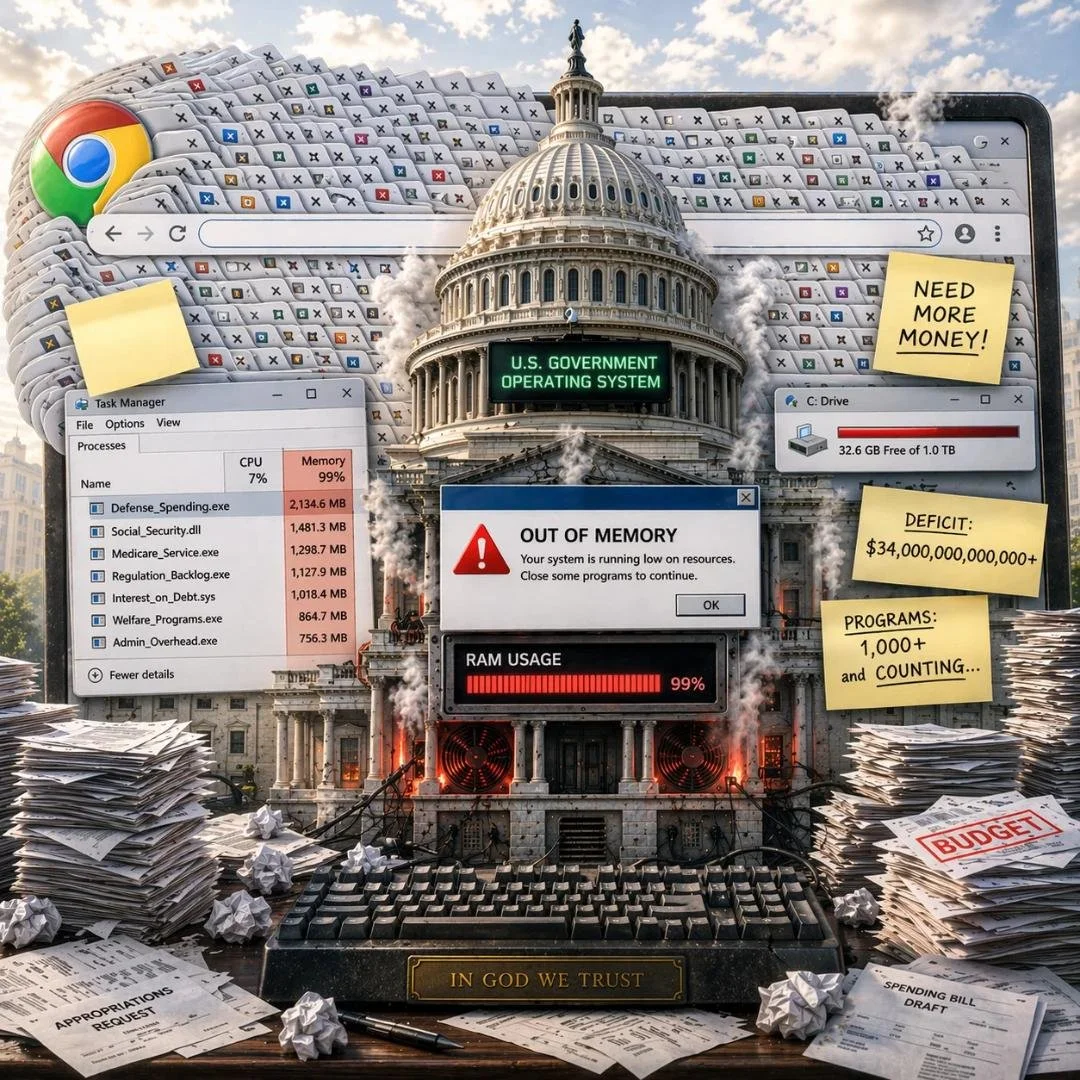
Why the Government Runs Like a Bloated Chrome Tab
Why the Government Runs Like a Bloated Chrome Tab
Notes From the Field By James Hickman (Simon Black / Sovereign Man) April 17, 2026
I had a Commodore 64 “computer” when I was a kid. I know I’m dating myself with that reference... but I’m telling you— back in the 80s, a Commodore was pretty hot stuff. It was basically an antique typewriter that you plugged into a television (sort of like a Nintendo or other gaming console). And they called it a Commodore “64” because it had a whopping 64 kilobytes of RAM.
"Kilobytes" is not a typo. For context, most mobile phones today have 8 gigabytes of RAM, and a gigabyte is roughly 1 million times a kilobyte.
Why the Government Runs Like a Bloated Chrome Tab
Notes From the Field By James Hickman (Simon Black / Sovereign Man) April 17, 2026
I had a Commodore 64 “computer” when I was a kid. I know I’m dating myself with that reference... but I’m telling you— back in the 80s, a Commodore was pretty hot stuff. It was basically an antique typewriter that you plugged into a television (sort of like a Nintendo or other gaming console). And they called it a Commodore “64” because it had a whopping 64 kilobytes of RAM.
"Kilobytes" is not a typo. For context, most mobile phones today have 8 gigabytes of RAM, and a gigabyte is roughly 1 million times a kilobyte.
****************************
pic
The average email today (without attachments) is nearly 100 kilobytes, i.e. 50% more than the entire memory of my Commodore. Yet, back in the 80s, software developers were able to do miraculous things with that tiny amount of memory.
64 kilobytes was somehow enough to play games like Pitfall and Impossible Mission, bang out a school report on a dot-matrix printer, and all sorts of other things.
And it wasn’t just Commodore— Nintendo and Sega put out hundreds of titles on consoles that had comparably tiny amounts of memory.
In order to make all of this magic happen, programmers had to be absolutely ruthless about every single line of code. Every byte mattered. There was zero bloat. Zero inefficiency.
And software teams routinely fought with each other about what features would be in a game, versus what features would be thrown out— because there simply wasn’t enough memory to include what everyone wanted.
***********************************
In short, the software industry had to live within its means. Yet despite those severe memory limitations, they put out timeless classics. It was a Golden Age for software development.
But then something happened. Technological and manufacturing breakthroughs made memory abundant... and cheap. Whereas 64 kilobytes of memory was considered a luxury in the 80s, soon megabytes of RAM... and then gigabytes of RAM, became readily available.
Memory eventually became so abundant that it felt practically infinite. No one had to make any tough decisions to optimize their code for RAM limitations... because there was always more memory available.
As a result, bloat eventually crept in. Here are a few examples.
Literally right now as I write this, I have a number of tabs open in my browser (I use Brave, by the way). ProtonMail takes up 409 megabytes of RAM... for a single tab. And a web-based PowerPoint presentation in my browser takes up 957 megabytes of RAM!
And don’t get me started on Windows.
Microsoft has been rolling out a ‘feature’ to “pre-load” data in its File Explorer application that consumes 67.4 megabytes of RAM. That’s more than 1,000x the memory requirement as my Commodore 64 had... for the sole purpose of being able to look at files and folders on your computer.
The level of bloat and memory waste is absurd (and also why I use Linux).
There’s hardly anyone in the industry today who remembers the bygone days of having to make ruthless decisions over every line of code; rather, the software industry today is accustomed to being able to publish bloated code... because memory has been so abundant for so long.
Unfortunately conditions have now dramatically changed.
Thanks in large part to surging AI demand, there is now a global memory shortage. RAM supply is scarce and has skyrocketed in price.
The industry, quite predictably, is fretting over the supply side, complaining that memory manufacturers need to build new factories and produce more RAM.
Very few prominent voices in software are saying, “Gee guys, maybe we should be more efficient in our code and use less RAM. Maybe it shouldn’t take 67 megabytes to look at our system files... Or 400+ megabytes for a single browser tab.”
In other words, there’s very little push to be more efficient and live within their means.
If you’re starting to see where I’m going, this story should sound familiar... because it’s very similar to how the government spends our money.
*********************************
Once upon a time in America, Congress fought passionately over every dollar. They knew they had to live within their means, and every budget item mattered. Politicians debated passionately about which programs stayed and which had to go.
But that was the past. America has been the world’s superpower, and the US dollar the world’s reserve currency, for eight decades.
Consequently, the US government has been able to run massive deficits and rack up a gargantuan national debt with impunity, leading politicians to believe that America’s financial resources are infinite.
Today there’s no one in government who remembers the days of responsible spending. That’s why there’s so much bloat and why deficits are so high.
But, just like the memory market, a sudden scarcity is emerging. Foreign creditors— who used to provide ample funds to the Treasury market— are starting to invest their capital elsewhere.
We can see this impact with interest rates, which are now hovering near multi-decade highs... as well as gold prices, which remain near all-time highs.
Faced with a sudden scarcity of financial resources— and the shocking realization that government spending cannot be infinite— Congress is choosing the predictable route.
Rather than look to themselves to become more efficient, to make objective and ruthless decisions about what programs stay and what programs go, to live within their means... they are instead demanding more resources.
Of course they always start with calls to “tax the rich”. But these taxes invariably trickle down to the middle class; just ask anyone who had to submit an AMT return this week.
But the point here isn’t to argue whether Jeff Bezos should or shouldn’t pay more tax. The point is that Congress’s approach is entirely wrong.
As we discussed yesterday, they fail to understand a very simple point: higher tax rates don’t generate higher overall tax revenue. Higher tax revenue comes from a booming economy.
So they should instead invest their energy into ensuring maximum productivity... which ultimately means fewer regulations, and in general staying out of the way.
It’s also insane that they are specifically refusing to cut spending. Despite hundreds of billions worth of documented fraud, they do nothing about it. They’ve also pledged to NOT reform Social Security and Medicare, i.e. the single biggest budget items in government.
It’s the exact opposite of what they should be doing. They still don’t have the right mentality to solve America’s #1 problem... and it’s why having a Plan B makes so much sense.
To your freedom, James Hickman Co-Founder, Schiff Sovereign LLC
Some “Iraq News” Posted by Tishwash at TNT 4-17-2026
TNT:
Tishwash: The Speaker of Parliament affirms the commitment to supporting the independence of monetary policy and monitoring the performance of the Central Bank.
Official statement…
The Speaker of Parliament, Hebat Al-Halbousi, received the Governor of the Central Bank, Ali Mohsen Al-Alaq, on Thursday.
The meeting discussed the reality of monetary policy in Iraq and prospects for enhancing its stability, in line with the requirements of macroeconomic stability, and stressed the importance of continued coordination between the House of Representatives and the Central Bank, in order to enhance the effectiveness of economic policies and achieve the desired development goals.
TNT:
Tishwash: The Speaker of Parliament affirms the commitment to supporting the independence of monetary policy and monitoring the performance of the Central Bank.
Official statement…
The Speaker of Parliament, Hebat Al-Halbousi, received the Governor of the Central Bank, Ali Mohsen Al-Alaq, on Thursday.
The meeting discussed the reality of monetary policy in Iraq and prospects for enhancing its stability, in line with the requirements of macroeconomic stability, and stressed the importance of continued coordination between the House of Representatives and the Central Bank, in order to enhance the effectiveness of economic policies and achieve the desired development goals.
During the meeting, the Speaker of the Council emphasized the House of Representatives’ interest in monitoring the performance of the Central Bank of Iraq and its commitment to supporting the independence of monetary policy, stressing the importance of strengthening effective coordination between monetary and fiscal policies in order to contribute to achieving economic balance and reducing inflationary pressures.
He pointed out that the House of Representatives, based on its oversight and legislative role, affirms its monitoring of the procedures and policies adopted by the Central Bank, in order to enhance transparency and strengthen confidence in the banking sector, stressing the House’s readiness to provide the necessary legislative cover to support financial and banking reforms.
For his part, the Governor of the Central Bank reviewed the most prominent measures taken to enhance monetary stability, regulate the exchange market, and develop the banking sector, stressing that the bank will continue to work in accordance with best international practices and in a way that supports financial stability.
Media Office of the Speaker of Parliament,
April 16, 2026 link
************
Tishwash: An Iraqi expert says approving the 2026 budget is almost impossible, and postponement until the end of the year is possible.
Economic and financial expert Haider Al-Sheikh confirmed on Thursday that the discussions circulating within the House of Representatives regarding moving to legislate the federal budget law for 2026 are “almost impossible” given the limited time and its insufficiency for the government and parliament to accomplish this obligation.
The sheikh explained to “Roj News” that “the next Iraqi government is expected to be formed in about a month, but it will need at least three months to prepare and approve the draft budget law before sending it to the House of Representatives, which means that the draft law, if prepared, may reach Parliament during October or the end of this year.”
He pointed out that “Iraq relies primarily on oil exports to maximize its revenues,” noting that “the cessation of maritime navigation in the Strait of Hormuz has directly affected oil exports, as revenues have decreased from about $7 billion to only about $2 billion.”
He explained that “the Iraqi government needs at least $120 billion to prepare and finance the federal budget in order to secure employee salaries and cover the state’s public expenses.” link
************
Tishwash: Is there an American and an Iranian “veto” on the second Sudanese term, or is it a fabricated political narrative?
Some claim there is an Iranian veto on the nomination of Mohammed Shia al-Sudani for the premiership of the new government, and that there is also an American veto on the same issue, but this is untrue. According to observers, the Iranians are too bold to conceal their position, and if they have an opinion or reservation, they do not reject it outright, but rather express their stance indirectly. This has not happened at all with al-Sudani; on the contrary, there are numerous positive signals coming from the Iranian side that are in Mohammed Shia al-Sudani's favor.
Similarly, the Americans are the most outspoken and direct in declaring their position, and no one is clearer in expressing their political stance on such an issue. Certainly, no negative statement or insinuation regarding al-Sudani's premiership came from the Washington government or its representatives. In contrast, we find a clear American statement against al-Maliki's nomination, issued personally by US President Donald Trump, in which he unequivocally expressed his rejection of Abu Israa assuming the premiership for a third time.
The Americans, especially President Trump, feel no hesitation in declaring their position against any official in the world.
For example, their stance on the government in Venezuela was clear, and Trump himself stated it publicly on numerous occasions.
The Americans undoubtedly have many ways of expressing their position, including through the American ambassador to Iraq, who speaks frankly, or the chargé d'affaires, or through Trump's envoys and representatives.
But this never happened in the matter of Al-Sudani’s nomination. Those who promote this lie are “promoting it for purely political and self-serving purposes that have no relation to reality and truth.” The head of the Reconstruction and Development Bloc, Bahaa Al-Araji, said it frankly: The American veto on Al-Sudani is a clear lie.
Yes, America has no veto, ban, or objection to al-Sudani. The rumors and propaganda spread by some forces within the Coordination Framework are a blatant lie and nothing more than a deliberate attempt to confuse the situation. When they claim there is a veto on al-Maliki and a veto on al-Sudani, they are pursuing a self-serving objective: to present a "third candidate"
—a candidate carefully tailored to their own interests and utilitarian needs.
Indeed, these rumors are being circulated by certain parties seeking to bring in a weak prime minister who can be controlled and manipulated as they please.
As for Iran, it has no reservations about al-Sudani.
Tehran certainly knows al-Sudani's nature better than anyone else, and is aware of his skill in keeping Iraq out of the conflict zone, and his ability to maintain a neutral stance, specifically on the safe path. This is a point the Iranians value and are very concerned with. Therefore, officials in Tehran have sent several positive and favorable signals to the Iraqi government and its president, al-Sudani.
Iran is also well aware of the al-Sudani government's supportive stance towards the Lebanese people, the resistance, and Hezbollah, and its prevention of any leniency or inclination by any party within the government towards any axis hostile to Iran or its allies.
Therefore, the American and Iranian veto card is a false card, and whoever promotes it as a rumor should look for another card.
Then how can this strange paradox be believed, which says that the Sudanese are facing a veto from both opposing sides together?
Logic means standing with America or standing with Iran, and this means that the veto will come from one of them and not from both of them together.. as they cannot possibly agree on one position.
Therefore, some parties within the coordination framework must look for excuses or justifications other than this narrative, which, according to many observers, has lost credibility in the eyes of a public that is now more open than ever! link
Tishwash: Minerals and “white gold” put Najaf on the investment map in Iraq
The Iraqi Geological Survey Authority confirmed that Najaf Governorate represents one of the most prominent areas for mining investment in Iraq, due to its strategic mineral wealth and high-quality silica sand (white gold).
Senior Geologist Haider Hadi Abdul Zahra, director of the Najaf office of the commission, said, “The commission is working to promote mineral investment within an integrated industrial, geological and economic environment, given the importance of this sector in supporting the national economy and diversifying sources of income.”
He added that “the Authority seeks to develop and promote mineral investment in various regions of Iraq by developing the mining industry and making use of natural resources, while opening the door to investments in accordance with the amended Mineral Investment Law No. (91) of 1988, in a manner consistent with market requirements and contributing to the development of the industrial sector.”
He explained that “the Najaf office provides facilities for the work of the Authority in the covered governorates, through monitoring the field activities of mineral investment operations, providing scientific and technical expertise related to mineral wealth and ways to invest in it, as well as supporting the field teams with experts and technicians to complete mining projects.”
He pointed out that “Najaf Governorate possesses important mineral resources, most notably high-quality limestone deposits used in the manufacture of cement, marble substitutes, and building materials, making it a key factor in supporting housing and urban development projects.”
He added that “the governorate also contains strategic reserves of pure quartz sand and sand suitable for casting used in the ceramics and industrial molds industries, as well as high-quality silica sand used in the manufacture of colored glass.”
He explained that “there are other types of sand used in filtration systems (water filters), in addition to the sand used in the manufacture of concrete bricks, clay bricks, and standard sand used in the manufacture of cement, as well as valley deposits that provide building sand, gravel, and aggregates used in construction work.”
He pointed out that “one of the most prominent indicators of the presence of strategic minerals in Najaf is the mineral strontium sulfate, which is used in advanced industries such as radar and television screens, which enhances the opportunities for advanced industrial investment in the governorate.”
He stressed that “the diversity of mineral reserves in Najaf provides promising investment opportunities in the mining sector, especially in the cement and silica sand industries, which contributes to supporting the national economy and promoting sustainable industrial development.”
Official reports and geological experts confirm that Iraq possesses huge reserves of high-purity silica sand, which is called “white gold” in economic circles, ranging between 350 million confirmed tons and expectations of up to one billion tons in the Anbar and Najaf deserts.
This resource is of paramount strategic importance as it is the primary raw material for the clean energy revolution and the manufacture of solar panels, electronic chips, and optical fibers.
With the purity of these sands reaching 99%, Iraq seeks to transform them from a raw material into advanced manufacturing industries, which could boost the general budget by billions of dollars and provide more than 10,000 job opportunities, coinciding with expectations that the global silica market will grow to reach $85.86 billion by 2033. link
Seeds of Wisdom RV and Economics Updates Friday Morning 4-17-26
Good Morning Dinar Recaps,
Trump’s Iran Ceasefire: Temporary Peace Sparks Global Market Repricing
Short-term de-escalation is shifting energy markets, investor sentiment, and financial system stability signals
Good Morning Dinar Recaps,
Trump’s Iran Ceasefire: Temporary Peace Sparks Global Market Repricing
Short-term de-escalation is shifting energy markets, investor sentiment, and financial system stability signals
Overview
A two-week ceasefire between the United States and Iran, announced by Donald Trump, has triggered an immediate global market reaction, particularly across energy, equities, and bond markets. The announcement came just ahead of a critical deadline tied to the reopening of the Strait of Hormuz, a vital global oil transit route.
The timing reflects heightened geopolitical pressure, with ongoing tensions threatening global energy supply chains and driving volatility in oil prices. Markets had been pricing in escalation risk, making the ceasefire a significant short-term relief event.
Key global players, including the U.S., Iran, and regional intermediaries such as Pakistan, are now central to whether this pause evolves into something more durable. However, deep geopolitical divisions remain unresolved, limiting long-term certainty.
At a broader level, this development highlights how geopolitical risk is increasingly dictating financial market behavior, reinforcing concerns about systemic fragility in the global economic structure.
Key Developments
1. Ceasefire Sparks Immediate Market Repricing
The announcement triggered a rapid shift in global markets as risk expectations eased.
• Oil prices declined sharply as supply disruption fears subsided
• Equity markets rallied globally on improved sentiment
• Bond markets strengthened, reflecting reduced immediate risk
2. Energy Supply Remains Constrained
Despite the ceasefire, structural issues continue to limit supply recovery.
• Infrastructure damage will delay production normalization
• Oil flows may resume, but output levels could remain below pre-conflict levels
• Tighter supply conditions may sustain elevated energy prices
3. Strait of Hormuz Stability Remains Critical
The ceasefire reduces immediate threats to one of the world’s most important energy corridors.
• The Strait of Hormuz handles a significant share of global oil shipments
• Any disruption has instant global inflation and trade implications
• Stability here is essential for restoring market confidence
4. Investor Confidence Improves — With Caution
Markets have responded positively, but uncertainty remains elevated.
• The ceasefire is seen as a potential short-term de-escalation path
• Volatility risks remain tied to future geopolitical developments
• Investors are not fully pricing in long-term peace or stability
Why It Matters
This event demonstrates how geopolitical decisions now directly influence global financial markets, particularly through energy pricing, inflation expectations, and capital flows.
The rapid market reaction underscores the fragility of the current financial system, where even temporary developments can trigger significant shifts in valuation and sentiment.
From a policy standpoint, it highlights the growing challenge for governments and central banks trying to balance economic stability with external geopolitical shocks.
At the global level, it reinforces a broader shift toward a system where political risk is becoming a primary driver of financial outcomes.
Why It Matters to Foreign Currency Holders
• Energy price volatility directly impacts currency strength across major economies
• Oil-exporting nations may experience short-term currency support
• U.S. dollar positioning remains tied to geopolitical influence and stability
• Continued uncertainty could accelerate diversification away from traditional reserve currencies
Implications for the Global Reset
Pillar 1: Energy Control as a Financial Power Lever
Control over key energy routes like the Strait of Hormuz continues to shape global economic influence, trade balances, and currency stability. This reinforces the role of energy in any evolving financial system structure.
Pillar 2: Increasing Visibility of System Fragility
The speed and scale of market reactions highlight a financial system highly sensitive to external shocks, suggesting underlying structural weaknesses that align with broader global reset narratives.
Conclusion
The two-week ceasefire represents more than a temporary geopolitical pause — it is a clear signal of how tightly interconnected global markets and political developments have become.
While the immediate response has been positive, the underlying risks remain unresolved, leaving markets exposed to renewed volatility. The situation underscores the difficulty of maintaining stability in an increasingly complex and reactive global system.
Ultimately, this moment reinforces a critical reality: short-term events are now capable of triggering long-term financial consequences, particularly in a system already under pressure.
The system isn’t just under pressure—it’s being forced toward a decision point where debt, energy, and monetary policy can no longer coexist without consequence.
Seeds of Wisdom Team
Newshounds News™ Exclusive
Sources
Modern Diplomacy — "Trump’s Two-Week Iran Ceasefire: How Investors Are Responding"
Reuters — "Global Markets React to Iran Ceasefire and Oil Price Movements"
~~~~~~~~~~
A Message to Our Currency Holders
If you’ve been holding foreign currency for many years, you were not foolish.
You were not wrong to believe the global financial system would change.
What failed was not your patience — it was the information you were given.
For years, dates, rumors, and personalities replaced facts, structure, and proof. “This week” predictions created cycles of hope and disappointment that were never based on how currencies actually change.
That is not your failure.
Our mission here is different: • No dates • No rates • No hype • No gurus
Instead, we focus on:
• Verifiable developments • Institutional evidence
• Global financial structure • Where countries actually sit in the process
Currency value changes only come after sovereignty, trade, banking, settlement systems, and fiscal coordination are in place. History and institutions confirm this sequence.
You will see silence. You will see denials. That is not delay — that is discipline.
Protect your identity. Organize your documents. Verify everything.
Never hand your discernment to anyone who cannot show proof.
You deserve truth — not timelines.
Seeds of Wisdom Team
Newshounds News™
~~~~~~~~~~
Seeds of Wisdom Team RV Currency Facts Youtube and Rumble
Newshound's News Telegram Room Link
RV Facts with Proof Links Link
RV Updates Proof links - Facts Link
Follow the Gold/Silver Rate COMEX
Follow Fast Facts
Seeds of Wisdom Team™Website
Thank you Dinar Recaps
Iraq Economic News And Points To Ponder Friday Morning 4-17-26
Gold is heading for its fourth weekly gain amid anticipation of a deal on Iran
Money and Business Economy News — Follow-up Gold is on track for its fourth weekly gain after US President Donald Trump expressed optimism that the United States and Iran could reach a permanent ceasefire to end the war that has shaken markets and increased inflation fears.
The precious metal settled near $4,795 an ounce in early trading on Friday, after rising about 1% this week, according to Bloomberg.
Gold is heading for its fourth weekly gain amid anticipation of a deal on Iran
Money and Business Economy News — Follow-up Gold is on track for its fourth weekly gain after US President Donald Trump expressed optimism that the United States and Iran could reach a permanent ceasefire to end the war that has shaken markets and increased inflation fears.
The precious metal settled near $4,795 an ounce in early trading on Friday, after rising about 1% this week, according to Bloomberg. https://www.economy-news.net/content.php?id=67984
The Closure Of The Strait Of Hormuz: A Double Stranglehold On The Stability Of The Iraqi Economy
Dr. Haitham Hamid Mutlaq Al-Mansour Economy News — Baghdad
With the continued closure of the Strait of Hormuz, the repercussions on the structure of the Iraqi economy are becoming increasingly apparent. The stability of the national economy is now almost entirely dependent on a single route for vital revenue flows: oil exports through the southern ports and then via the Strait of Hormuz.
This situation represents a dual dependence on both a single commodity and a single transport route simultaneously, creating a double bottleneck that exacerbates economic fragility.
In normal economies, risks are distributed across multiple sources of income and diverse export channels. However, in Iraq, over 90% of the general budget revenues come from oil, and more than 85% of these exports pass through a single maritime outlet.
With no alternative routes to the Strait of Hormuz, this structure places the economy in a vicious cycle, where production, revenue, and financial stability are tied to the security of a single geographical point outside the state's complete control, effectively making it an external variable that dictates the revenue side of the budget. The danger of this point lies not only in its potential to cause a partial decline in economic activity but also a comprehensive shock.
If the closure of Hormuz continues, Iraq's oil export capacity will plummet, potentially resulting in losses exceeding 2.5 to 3 million barrels per day. Assuming an average price of $90 per barrel, this translates to a direct loss of approximately $245 million daily, or roughly $7 to $9 billion monthly.
This loss is not confined to the oil sector but is immediately transferred to the general budget, which relies on these revenues for nearly 90% of its funding.
The deeper impact of the double bottleneck manifests in what is known in macroeconomics as shock transmission. Following a halt or decline in dollar inflows from oil, a cascade of contractions will occur, beginning with the public budget, then government spending, then the labor market, and finally aggregate demand.
Due to the weakness of the private sector, there is no natural shock-absorbing mechanism, which will amplify the impact of the crisis rather than mitigate it. For this reason, the transmission shock can transform into an economic contraction exceeding 35% of total economic activity.
This bottleneck will not only affect current flows but also investment prospects. Increased risk in one direction raises what is known as the geopolitical risk premium, leading to higher insurance and transportation costs, exchange rate volatility in the absence or scarcity of foreign currency, and consequently, decreased investor confidence.
This means that the mere existence of a single source of revenue imposes a continuous economic cost on the Iraqi economy, further diminishing the contribution of non-oil sectors, which, at best, do not exceed 30% of GDP.
The most serious problem with this model is that it operates in a vicious cycle. The meager oil revenues are not expected to lead to significant diversification of economic activity; rather, they will undoubtedly reinforce reliance on government spending for resource allocation and redistribution, thus exacerbating the weakness of the productive sector and making it even more difficult to break free from this cycle.
Consequently, the bottleneck is no longer a geographical problem (the Strait of Hormuz), but a structural one within the economy itself, which has become stuck at a point where its stability is contingent on external factors.
One of the repercussions of this economic crisis on the monetary sector is its direct impact on the implementation of inflation targeting policies in Iraq, making them more of a theoretical objective than a practical and achievable framework.
Inflation targeting presupposes a central bank capable of controlling the money supply and interest rates within a relatively stable environment in terms of foreign currency inflows. However, in the Iraqi case, monetary stability is primarily determined by oil dollar inflows, not by traditional monetary policy tools.
Following the disruption of oil exports, the central bank faces a double shock: a contraction in the foreign exchange supply coupled with upward pressure on the general price level.
The decline in dollar inflows—which normally range between $8 and $9 billion per month—leads to an immediate imbalance in the exchange market, making the defense of the dinar's value more costly and forcing the central bank to draw on its reserves, estimated at $100 to $110 billion.
As the shock persists, the exchange rate transforms from a stabilizing tool into a source of imported inflation, especially since more than 70% of Iraq's consumption basket is directly or indirectly dependent on imports.
In this context, inflation targeting loses its fundamental requirement: the ability to guide expectations. Inflation in Iraq does not primarily stem from excess domestic demand, which can be curbed by raising interest rates, but rather from external supply shocks linked to the exchange rate and import costs.
When prices rise due to currency depreciation, raising interest rates does not address the underlying cause; instead, it exacerbates the recession, as the economy relies more on government spending than on private credit.
Since government spending itself is shrinking due to declining oil revenues, the economy enters a state of stagflation that is difficult to address with traditional monetary policy tools. This leads to a slowdown in economic growth, which can, in turn, fuel economic recession, higher unemployment rates, and a decline in real GDP.
Even more concerning is the inherently weak transmission channel of monetary policy via interest rates. Bank credit to the private sector barely exceeds 15% of GDP, meaning that interest rate changes do not effectively impact investment or consumption.
Given this limitation, the exchange rate has become the only viable tool, but this tool itself depends on dollar inflows from oil revenues, effectively tying monetary policy back to the cycle of external geopolitical constraints. In other words, the central bank's primary objective is not inflation control, but rather maintaining exchange rate stability, which is itself dependent on an external variable.
Thus, economic and monetary stability in Iraq are no longer separate entities, but rather a single, interconnected system dependent on a crucial external factor: the uninterrupted flow of oil through the Strait of Hormuz.
Any disruption to this flow leads to a rapid economic contraction, while the monetary system loses its ability to simultaneously stabilize prices and the exchange rate, revealing a structural fragility at the very foundation of stability.
Thus, inflation targeting in Iraq transforms from a policy based on internal tools into a variable dependent on the stability of external conditions, thereby losing its independence and undermining its effectiveness.
The problem lies not in the design of the monetary framework, but in the economic structure that makes inflation control contingent on the flow of a single resource through a single channel. Under this structure, sustainable price stability can only be achieved by addressing the root cause of the bottleneck: decoupling monetary stability from the oil export trajectory, diversifying sources of foreign currency, and expanding the productive base.
Otherwise, inflation targeting will remain a fragile objective, vulnerable to collapse with every external shock.
Here, the performance of monetary policy tools in Iraq is organically linked to the Strait of Hormuz, making monetary policy essentially a reflection of the stability of this external geopolitical trajectory rather than a product of independent domestic instruments.
The interest rate, which is supposed to be the primary tool for controlling aggregate demand, loses its effectiveness in an environment where bank credit to the private sector does not exceed 15% of GDP.
Even with an interest rate increase of 2 to 3 percentage points, the impact remains limited because inflation in this case does not stem from excess demand, but rather from the depreciation of the exchange rate and the increased cost of imports. Conversely, this increase leads to higher financing costs in an economy largely dependent on government spending, thus deepening the deflationary effect instead of containing it.
Consequently, the exchange rate becomes the central tool, but simultaneously the most vulnerable. Stabilizing the dinar requires injecting between $200 and $300 million daily into the market, a sum previously covered by current oil revenues.
With these revenues declining, the central bank is forced to finance this injection of funds from its foreign reserves, which range between $100 billion and $110 billion. If withdrawals continue at a rate of $5 billion to $8 billion per month, the reserves could be depleted by up to 30% within six months and by about 50% within a year.
This weakens the ability to defend the exchange rate and opens the door to a depreciation of the currency that could exceed 20% to 30% in a prolonged scenario.
On the other hand, open market operations become less effective in an environment where domestic liquidity is directly linked to oil revenues. Following a decline in these revenues, the central bank no longer faces a cash surplus to withdraw, but rather a shortage of resources, thus diminishing its ability to manage the money supply.
With the economy heavily reliant on government spending, which constitutes more than 45% of GDP, any 30% contraction in this spending translates into an economic contraction that could reach 35%, fundamentally undermining any attempt to use traditional monetary policy tools.
The repercussions of the Strait of Hormuz closure are also evident in Iraq's declining foreign currency reserves, reflecting their transformation from a stabilizing force into a means of financing the deficit amidst a widening gap between revenues and expenditures. Reserves fell by approximately 4.5 trillion dinars ($3.4 billion) in the first two months of 2026, and by 14.2 trillion dinars over four years, indicating a continuous decline.
As a result of the ongoing war, the closure of the Strait of Hormuz, and the lack of an alternative outlet for oil exports, revenues now cover only 25% of the minimum monthly expenditure and less than 13% of the maximum, forcing reliance on reserves to cover a deficit that could reach 8 trillion dinars per month.
Thus, the trajectory of reserves is now determined more by external geographical factors than by price fluctuations, making them vulnerable to rapid depletion and revealing a structural fragility in the economy, which depends on a single resource and a single channel for its flow.
Given these circumstances, the shock quickly translates into price levels, as over 70% of domestic consumption relies on imports, meaning any currency devaluation directly impacts inflation. Without effective monetary policy tools, inflation rates could rise rapidly, not due to monetary expansion, but rather to disruptions in foreign currency flows.
In this sense, monetary policy tools in Iraq not only lose their effectiveness but also become dependent on a single external variable: the continued flow of oil through a limited geographical route.
When this route is disrupted, the ability of monetary policy to perform its traditional functions is also disrupted, transforming it from a tool for regulation and stability into a tool for crisis management.
This occurs in an economy that relies heavily on a single resource for its revenues and on a single outlet for over 85% of its exports, making its monetary stability hostage to a geopolitical equation rather than a product of economic policy. Therefore, policymakers must work to develop flexible oil export policies at the short, medium, and long-term levels, each according to its specific timeline, to diversify oil export routes and reduce dependence on the Strait of Hormuz.
MilitiaMan and Crew: IRAQ DINAR UPDATE-Non-Oil Revenues-LPG-CBI Capital Adequacy-Regulatory Control-REER when Prudent
MilitiaMan and Crew: IRAQ DINAR UPDATE-Non-Oil Revenues-LPG-CBI Capital Adequacy-Regulatory Control-REER when Prudent
4-16-2026
The Crew: Samson, PompeyPeter, Petra, Daytrader, Sunkissed, GIGI and Militia Man
No drama. No intrigue. No songs and dances. Just straight, factual news that I read and interpret to the best of my ability after being an avid Dinar investor and insanely obsessed Dinarian for over 15 years.
Follow MM on X == https://x.com/Slashn
MilitiaMan and Crew: IRAQ DINAR UPDATE-Non-Oil Revenues-LPG-CBI Capital Adequacy-Regulatory Control-REER when Prudent
4-16-2026
The Crew: Samson, PompeyPeter, Petra, Daytrader, Sunkissed, GIGI and Militia Man
No drama. No intrigue. No songs and dances. Just straight, factual news that I read and interpret to the best of my ability after being an avid Dinar investor and insanely obsessed Dinarian for over 15 years.
Follow MM on X == https://x.com/Slashn
Be sure to listen to full video for all the news……..
Seeds of Wisdom RV and Economics Updates Thursday Evening 4-16-26
Good Evening Dinar Recaps,
Global Financial Stress Builds as War, Inflation, and IMF Warnings Converge
Energy shocks, rising inflation, and mounting debt pressures signal increasing strain on the global financial system.
Good Evening Dinar Recaps,
Global Financial Stress Builds as War, Inflation, and IMF Warnings Converge
Energy shocks, rising inflation, and mounting debt pressures signal increasing strain on the global financial system.
Overview
Developments in the last 24 hours show intensifying pressure across global markets, driven by war-related energy disruptions, rising inflation, and increasing reliance on financial support systems. These signals point toward a fragile global environment where structural financial shifts become more likely.
Key Developments
1. IMF Warns of Energy Shock Impact on Global Growth
The International Monetary Fund cautioned that the ongoing conflict is creating a major energy shock, particularly impacting Asia due to its dependence on imported fuel. Growth projections are being revised downward while inflation is rising, highlighting a tightening economic environment.
2. Federal Reserve Signals Inflation Pressures from War
U.S. Federal Reserve officials confirmed that the conflict is already pushing inflation higher, with rising energy costs feeding into food, travel, and industrial prices. This adds pressure to maintain tighter monetary policy, increasing the risk of prolonged high interest rates.
3. Oil Market Disruptions Create Pricing Instability
Global oil markets are experiencing severe dislocations, with physical prices surging while futures markets remain disconnected. This pricing gap reflects uncertainty and instability in supply expectations, a condition that can disrupt global trade and financial planning.
4. Rising Demand for IMF Support Signals Debt Stress
More countries, particularly in Africa, are turning to the IMF for assistance as fuel costs rise, aid declines, and fiscal pressures increase. The growing reliance on external funding suggests widening sovereign debt vulnerabilities across developing economies.
Why It Matters
The combination of energy disruption, inflation persistence, and rising debt dependence reflects a system under strain. Historically, these factors often lead to policy intervention, currency volatility, and shifts in financial structure.
Why It Matters to Foreign Currency Holders
Increased likelihood of currency fluctuations across global markets
Potential acceleration toward alternative settlement systems and regional trade blocs
Rising importance of diversification across currencies and asset classes
Implications for the Global Reset
Pillar 1: Monetary System Pressure
Persistent inflation and economic uncertainty may force central banks into difficult policy decisions, balancing growth risks against inflation control, potentially leading to new monetary strategies.
Pillar 2: Sovereign Debt and Global Dependence Shift
As more nations seek IMF support, the global system may move toward restructured debt frameworks and conditional financial alliances, reshaping global economic influence.
Closing Insight
The current environment reflects layered financial stress rather than isolated shocks. War-driven inflation, energy instability, and rising debt burdens are aligning in ways that often precede system-wide financial transitions.
War-driven energy shocks and rising inflation are tightening global liquidity, pushing the financial system closer to a breaking point.
Seeds of Wisdom Team
Newshounds News™ Exclusive
Sources
Reuters — "IMF warns Asia vulnerable to war-induced energy shock"
Reuters — "Fed's Williams warns war is driving up inflation pressures"
~~~~~~~~~~
Seeds of Wisdom Team RV Currency Facts Youtube and Rumble
Newshound's News Telegram Room Link
RV Facts with Proof Links Link
RV Updates Proof links - Facts Link
Follow the Gold/Silver Rate COMEX
Follow Fast Facts
Seeds of Wisdom Team™Website
Thank you Dinar Recaps
Seeds of Wisdom RV and Economics Updates Thursday Afternoon 4-16-26
Good Afternoon Dinar Recaps,
BRICS Accelerates Dollar Shift as Russia Settles 60% of Trade in Local Currency
Rising local currency settlements signal a strategic move away from dollar dominance and toward a multipolar financial system
Good Afternoon Dinar Recaps,
BRICS Accelerates Dollar Shift as Russia Settles 60% of Trade in Local Currency
Rising local currency settlements signal a strategic move away from dollar dominance and toward a multipolar financial system
Overview
New data indicates that Russia has settled approximately 60% of its foreign trade in local currency, marking a significant shift away from the U.S. dollar. This trend reflects a broader BRICS-led push toward de-dollarization, with growing implications for global trade flows, currency stability, and financial system structure.
Key Developments
1. Russia Reaches 60% Local Currency Trade Settlement
Russia confirmed that 60% of its foreign trade transactions are now settled in rubles or partner currencies, a notable increase from 54.2% in 2025. This marks a record level of non-dollar trade activity, driven largely by sanctions and strategic realignment.
2. Regional Trade Partners Drive Currency Shift
A significant portion of this transition is tied to BRICS partners China and India, where bilateral trade increasingly bypasses the dollar. Additionally, currency usage diversification, including the UAE dirham, highlights a broadening settlement network outside traditional systems.
3. Import Data Shows Rapid Expansion of Ruble Usage
Recent figures show:
54% of imports from Asia settled in rubles (up from 49.9%)
70% from the Americas, 82% from Africa, and 69.3% from Europe
These numbers indicate a rapid scaling of local currency adoption across multiple regions, not just within BRICS.
4. Sanctions Continue to Reshape Global Trade Behavior
Western sanctions have accelerated alternative financial infrastructure, pushing Russia and its partners to develop parallel systems for trade settlement. This shift is contributing to a fragmentation of the global financial order.
Why It Matters
The move toward local currency settlements represents a structural challenge to dollar dominance. As more trade bypasses the dollar, global demand for USD could gradually decline, impacting U.S. borrowing power and financial influence.
Why It Matters to Foreign Currency Holders
Potential for currency realignment and shifting valuations
Increased importance of emerging market currencies in trade settlement
Growing role of regional financial systems over centralized global ones
Implications for the Global Reset
Pillar 1: Monetary System Transition
The rise in local currency settlements suggests a gradual evolution toward a multi-currency global system, reducing reliance on a single reserve currency.
Pillar 2: Geoeconomic Realignment
Trade relationships are increasingly shaped by political alliances and regional blocs, signaling a shift toward fragmented but interconnected financial ecosystems.
Closing Insight
Russia’s move is not an isolated event but part of a broader strategic trend among BRICS nations. While not yet replacing the dollar, these developments indicate a steady rebalancing of global financial power.
As Russia pushes 60% of its trade into local currencies, the global financial system inches closer to a multipolar currency reality.
Seeds of Wisdom Team
Newshounds News™ Exclusive
Sources
Watcher.Guru — "BRICS Country Settled 60% of Trade in Local Currency"
Reuters — "Russia increases use of ruble in foreign trade settlements"
~~~~~~~~~~
Seeds of Wisdom Team RV Currency Facts Youtube and Rumble
Newshound's News Telegram Room Link
RV Facts with Proof Links Link
RV Updates Proof links - Facts Link
Follow the Gold/Silver Rate COMEX
Follow Fast Facts
Seeds of Wisdom Team™Website
Thank you Dinar Recaps
Iraq Economic News And Points To Ponder Thursday Afternoon 4-16-26
The Conflict Between Maliki And Sudani Continues, And The Option Of A Third Candidate Resurfaces, Awaiting A Deal To Balance Interests
Special Report – One News 4/16/2026 The crisis surrounding the selection of a prime minister within the Coordination Committee is heading toward a more complex negotiation process, following initial understandings that link the decision to a two-thirds majority within the Shia political bloc.
This means that any candidate needs the support of eight out of twelve leaders to secure their appointment, a condition that opens the door to further rounds of negotiations before a final agreement can be reached.
The Conflict Between Maliki And Sudani Continues, And The Option Of A Third Candidate Resurfaces, Awaiting A Deal To Balance Interests
Special Report – One News 4/16/2026 The crisis surrounding the selection of a prime minister within the Coordination Committee is heading toward a more complex negotiation process, following initial understandings that link the decision to a two-thirds majority within the Shia political bloc.
This means that any candidate needs the support of eight out of twelve leaders to secure their appointment, a condition that opens the door to further rounds of negotiations before a final agreement can be reached.
These understandings emerged against the backdrop of the postponement of the Committee's meeting until next Saturday, amidst the ongoing division between the camps of Nouri al-Maliki and Mohammed Shia al-Sudani, with each side attempting to strengthen its position within the power-sharing equation.
According to available information, the understandings reached between the two leading candidates, Maliki and al-Sudani, stipulate that if either of them obtains the two-thirds majority, the other parties will automatically join them, thus granting them a consensus within the Committee.
However, finalizing this agreement still requires additional time to ensure the distribution of responsibilities among the various political forces.
In contrast, several political forces have adopted a neutral stance, including the Design Alliance, the Victory Coalition, and the Virtue Party. It is estimated that these parties will support the candidate who can offer political guarantees regarding gains and representation within the next government.
The coordination framework remains limited to three main options for resolving the crisis: maintaining al-Maliki's candidacy, renewing al-Sudani's term, or pursuing a third candidate, likely close to one of the two main parties, in an attempt to defuse the current polarization. https://1news-iq.net/صراع-المالكي-والسوداني-مستمر-وخيار-ا/
EXCLUSIVE: CF Adopts Two-Thirds Rule For Iraq’s Premiership Race
2026-04-16 Shafaq News- Baghdad Iraqi Shiite leaders have agreed on a mechanism to select the country’s next prime minister, centering on a two-thirds majority rule, a source within the Coordination Framework (CF) told Shafaq News on Thursday.
Under the emerging formula, any candidate securing the backing of eight out of 12 senior Shiite leaders would effectively achieve consensus, paving the way for the remaining factions to align and complete the required two-thirds support.
The proposal comes as negotiations within the CF, Iraq’s largest parliamentary bloc, continue to shape the government formation process. A CF meeting initially scheduled for Wednesday was postponed after several Framework leaders boycotted the session.
Earlier this week, Iraq’s State of Law Coalition rejected reports that its leader, former Prime Minister Nouri al-Maliki, might withdraw his candidacy for the premiership. Coalition member Zuhair al-Jalabi conveyed to Shafaq News that al-Maliki “has not and will not step aside for any of the names circulating in the media,” describing such claims as inaccurate.
The remarks came after Qusay Mahbuba of the Reconstruction and Development Coalition (Al-Imaar wal-Tanmiya), led by caretaker Prime Minister Mohammed Shia al-Sudani, suggested that al-Maliki could step aside in favor of Basim al-Badri, raising questions over whether such a move would signal a political exit or risk fracturing the CF.
Under Iraq’s post-2003 power-sharing system, the presidency is held by a Kurd, the premiership by a Shiite, and the speakership by a Sunni Arab. Parliament elected Nizar Amedi as president on April 11, triggering the constitutional process to name a prime minister. According to Article 76 of the constitution, the CF has 15 days from that date to nominate its candidate, after which the designated prime minister has 30 days to form a government and secure parliamentary confidence.
Read more: Al-Maliki sounds different this time — the world is not convinced yet
https://www.shafaq.com/en/Iraq/EXCLUSIVE-CF-adopts-two-thirds-rule-for-Iraq-s-premiership-race
An American Magazine Reports That The Dominance Of Shiite Leaders Over The Iraqi State Is "Fragile" And Based On Sectarianism And Armed Groups Like The Popular Mobilization Forces
Baghdad – One News 4/16/2026 Foreign Affairs magazine reported that the dominance of Shiite leaders over the Iraqi state is “fragile” and based on sectarian power-sharing and armed groups such as the Popular Mobilization Forces.
She noted that Iraqi Shiite leaders are deeply concerned about the collapse of the country's fragile political system, given the escalating challenges.
She added that the Iraqi government refused to rein in the factions during the war between the United States and Iran, representing a shift from its previous efforts to contain these groups.
She noted that more groups in Iraq may show a willingness to exert military and political pressure on the United States to reduce or end its presence in the country, while sectarian and political tensions will deepen between Shiites on one side, and Sunnis and Kurds on the other. https://1news-iq.net/مجلة-أميركية-هيمنة-قادة-الشيعة-على-الد/
The Reconstruction And Development Coalition Calls For A Strong Government And Emphasizes Meeting The Aspirations Of The Iraqi People
Baghdad – One News 4/15/2026 The leadership body of the Reconstruction and Development Coalition held its periodic meeting today, Wednesday, chaired by Secretary-General Mohammed Shia Al-Sudani, to discuss the latest developments in the political scene in the country.
During the meeting, the coalition stressed the importance of completing the constitutional steps to move towards forming a strong national government with full powers, capable of continuing strategic service and economic programs, and confronting the challenges facing the Iraqi state.
The participants stressed that the priority of the next government should be to meet the aspirations of citizens in the areas of construction and development, with the need to secure the support of political forces, foremost among them the coordination framework, in order to ensure unity of decision and to prioritize the higher interests of Iraq.
The coalition also stressed the need to respect the will of the voters, which was manifested in the broad participation in the elections, stressing that the process of forming the government must reflect the aspirations of the Iraqis, contribute to strengthening Iraq’s international standing, developing its foreign relations, extending state authority, and enabling the armed forces to enforce the law and monopolize weapons, while giving priority to national sovereignty.
https://1news-iq.net/ائتلاف-الإعمار-والتنمية-يدعو-لحكومة-ق/
Some “Iraq News” Posted by Tishwash at TNT 4-16-2026
TNT:
Tishwash: After a partial suspension, Iraq resumes flights to Dubai, Istanbul, and new destinations.
The Independent - Air traffic in Iraq is gradually returning to normal, with the Ministry of Transport announcing the resumption of a number of international flights, in a step that reflects a noticeable improvement in the pace of operation and the restoration of navigational activity in the coming days.
The spokesman for the Ministry of Transport, Maitham Al-Safi, said that Iraqi airspace has already begun to receive flights in an increasing manner, stressing that work is continuing to raise the level of operation gradually until it reaches normal rates, according to what was reported by the Iraqi News Agency.
TNT:
Tishwash: After a partial suspension, Iraq resumes flights to Dubai, Istanbul, and new destinations.
The Independent - Air traffic in Iraq is gradually returning to normal, with the Ministry of Transport announcing the resumption of a number of international flights, in a step that reflects a noticeable improvement in the pace of operation and the restoration of navigational activity in the coming days.
The spokesman for the Ministry of Transport, Maitham Al-Safi, said that Iraqi airspace has already begun to receive flights in an increasing manner, stressing that work is continuing to raise the level of operation gradually until it reaches normal rates, according to what was reported by the Iraqi News Agency.
Al-Safi explained that Iraqi Airways resumed its international flights to a number of destinations on April 10, including Istanbul, Amman and Cairo, before later extending to flights to India, as part of a gradual operational plan aimed at reconnecting Iraq to the regional and international air transport network.
He added that the flight schedule will see further expansion, with flights to Guangzhou planned, and flights to Dubai resuming from Thursday, reflecting growing demand for travel and a return of confidence in the aviation sector.
In a related context, he pointed to the resumption of domestic flights between a number of major airports, including Baghdad, Erbil, Sulaymaniyah and Basra, with plans to gradually increase the number of flights in the coming period to meet the growing demand.
He also noted the return of a number of regional and international airlines to operations in Iraq, including Royal Jordanian and Flydubai, along with other companies, in an indication of the recovery of the aviation sector and the resumption of air traffic activity.
In a separate statement, the Ministry of Transport confirmed that flights between Baghdad and Sabiha Airport will resume starting next Saturday, as part of a government plan to expand the network of international destinations and facilitate the movement of passengers, which will enhance Iraq’s position as a regional transport hub in the coming phase. link
************
Tishwash: The reason for postponing the coordination framework meeting has been revealed... and these are the latest developments from the Prime Minister's office.
Salam Al-Zubaidi, a member of the Victory Alliance, revealed the reason for postponing the coordination framework meeting, pointing to urgent developments that prompted the leaders to request the postponement while consultations continue to resolve the issue of the premiership.
Al-Zubaidi said during his appearance on the “On the Ruler” program broadcast by Al-Furat satellite channel: “It was hoped that this meeting of the Coordination Framework would be decisive today; however, emergency developments occurred that prompted the leaders to request a postponement,” stressing that “the Framework seeks to reach a full agreement on the Prime Minister candidate, away from division.”
He pointed out that "the competition is currently limited to three names, while other names are being put forward for the purposes of political maneuvering."
Al-Zubaidi added that "the head of the State of Law Coalition, Nouri al-Maliki, is still holding on to his nomination; however, he may concede if the framework decides on an alternative candidate," indicating that "the framework has no option but to put forward an alternative figure at the current stage."
He indicated that “next Saturday’s meeting may largely decide on the candidate’s name, with the possibility of announcing the name 24 hours before the constitutional deadlines expire,” stressing “the framework’s commitment to adhering to the constitutional deadlines in order to restore confidence in the political process.” link
************
Tishwash: Financial expert: There is no problem with salaries in the coming months, and current oil export alternatives are stopgap measures.
Financial and banking expert, Mustafa Hantoush, said that Iraq does not face a direct problem in securing some basic food items during the coming months, noting that the abundance of strategic food reserves covers the needs of two months, in addition to the continuation of supply chains from Türkiye.
During his appearance on the program “On the Ruler” broadcast by Al-Furat satellite channel, Hantoush explained that “tomato prices have witnessed relative stability in the past period as a result of achieving self-sufficiency,” expecting “prices to decrease after the Ministry of Agriculture announces the opening of the door to imports soon.”
Regarding the financial aspect, he pointed out that "there is a need to address some challenges related to securing salaries next month if borrowing is not resorted to," noting that "the proposal includes covering the salary deficit and completing projects, given that the Central Bank has foreign currency reserves exceeding $20 billion."
Hantoush confirmed that "salaries for the coming months are secured, and the state has the ability to borrow to overcome financial pressures until oil export revenues stabilize," explaining that "tensions or war will not directly affect the continuity of salary payments."
Regarding the oil sector, Hantoush pointed to "a decline in exports of about 3 million barrels during 45 days," indicating that "the current solutions that rely on exporting through the port of Ceyhan or transporting by tankers through Syria remain 'patchwork,' as he put it, and do not eliminate the need to adopt stable routes such as the Strait of Hormuz.
He added that "Iraq does not have an oil transport fleet through the strait, which makes relying on it essential within the economic equation," noting that "any future developments in the strait will directly affect global trade."
Hantoush concluded by saying that "Iraq possesses great investment potential and competencies, but the weakness of the infrastructure and the lack of support for the private sector constitute an obstacle to development," calling for "greater flexibility in dealing with investors and reducing the restrictions and fines, which he described as excessive." link
Tishwash: US Treasury Secretary: I expect the war in Iran to end and prices to fall.
US Treasury Secretary Scott Bisent predicted on Tuesday that the war in Iran would end and that prices would fall.
He stated, "I expect the war in Iran to end and prices to decrease."
Earlier on Tuesday, Bloomberg reported that the United States and Iran were considering negotiations to extend the ceasefire before it expires next week. link
************
Tishwash: America decides to send an additional 6,000 troops to the Middle East
The Washington Post, citing US officials, reported that the Pentagon will send thousands of additional troops to the Middle East in the coming days.
Officials said the Trump administration's deployment of thousands of troops to the region was intended to pressure Iran into reaching an agreement.
The newspaper added that the forces heading to the region include about 6,000 soldiers aboard an aircraft carrier and escort ships.
It also indicated that the forces heading are estimated at about 6,000 soldiers on board an aircraft carrier and escort ships.
She noted that approximately 4,200 soldiers from the Boxer Amphibious Group and Marines are expected to arrive by the end of the month. link