
“Iraq News” Posted by Tishwash at TNT 4-10-2026
TNT:
Tishwash: 4 reasons behind the stability of exchange rates in Iraq
The Prime Minister’s financial advisor, Mazhar Muhammad Salih, confirmed on Thursday that the stability of exchange rates and the decline in inflationary pressures in Iraq are due to four interconnected factors that supported the local market despite the disruption of global supply chains, particularly through the Gulf and the Strait of Hormuz .
Saleh said, in a statement followed by Al-Sa’a Network, that “the first factor is the availability of high stocks of durable goods, while the second is related to the state’s ability to secure a strategic reserve of food basket items and enhance food security.”
TNT:
Tishwash: 4 reasons behind the stability of exchange rates in Iraq
The Prime Minister’s financial advisor, Mazhar Muhammad Salih, confirmed on Thursday that the stability of exchange rates and the decline in inflationary pressures in Iraq are due to four interconnected factors that supported the local market despite the disruption of global supply chains, particularly through the Gulf and the Strait of Hormuz .
Saleh said, in a statement followed by Al-Sa’a Network, that “the first factor is the availability of high stocks of durable goods, while the second is related to the state’s ability to secure a strategic reserve of food basket items and enhance food security.”
He added that "the third factor is the high level of government support, which includes fuel, food baskets and public services, in addition to the role of cooperative stores in absorbing price pressures."
He pointed out that "the fourth factor lies in the efficiency of foreign reserves in financing private sector trade, with the exchange rate stabilizing at around 1,320 dinars to the dollar, and the high level of banking and commercial compliance, which helped to accelerate foreign transfers and ensure the smooth flow of imports."
He explained that "the combination of these factors contributed to consolidating economic stability and reducing fluctuations in prices and the exchange market, within integrated financial, monetary and trade policies led by the government." link
************
Tishwash: Financial advisor warns: Lack of budget hinders economic reforms
The Prime Minister’s financial advisor, Mazhar Muhammad Saleh, announced on Thursday that a proposal had been submitted to avoid delaying the approval of the budget, noting that delaying the approval of the budget would lead to a number of negative effects.
Saleh said in a statement to the official agency, which was followed by "Video News Agency" that "the failure to approve the general budget, whether it is related to the financial schedules for 2025 within the three-year budget law, or the budget for 2026, leaves a number of negative effects."
He explained that "among the most prominent of these effects is the disruption of new investment projects and the slowdown in the implementation of existing projects, as a result of the lack of necessary financial allocations, in addition to the government resorting to the temporary spending rule (1/12 of a previous budget) based on the amended Financial Management Law No. (6) of 2019, which restricts the ability to expand spending or launch new programs."
He added that “this negatively impacts economic growth rates and raises unemployment rates, in addition to weakening investor confidence due to the lack of clarity in financial policies, as well as the delay in implementing economic and administrative reforms,” noting that “to avoid a recurrence of this situation in the future, there is a proposal to adopt multi-year budgets with greater legislative flexibility, which reduces reliance on annual approval, with the need to strengthen the legal framework for financial management to ensure adherence to budget approval timelines, as well as to neutralize political disputes from the budget approval process.”
He explained that "diversifying revenue sources and strengthening the role of regulatory institutions contribute to supporting financial stability and accelerating the process of approving the general budget."
Regarding how to absorb the burdens of the past two years, Saleh stated that "this requires preparing a flexible budget based on rearranging priorities, including previous commitments within the new allocations, improving spending efficiency, as well as the possibility of resorting to well-considered borrowing and strengthening the partnership with the private sector." link
Tishwash: Iraq needs deeper economic reforms; unemployment is expected to rise to over 15% by 2025.
Statistics compiled by Statista, a German company specializing in global market and consumer data, showed that the unemployment rate in Iraq recorded a slight increase during the year 2025.
The company stated in its report that the unemployment rate in Iraq rose in 2025 to 15.49%, compared to 15.28% in 2024, reflecting continued pressures in the labor market despite limited improvement.
According to the data, the country's unemployment rate rose by 6.85 percentage points during the period from 1991 to 2025, but this rise was not constant, but rather characterized by clear fluctuations up and down over the years.
She noted that 2016 saw the highest levels of unemployment, with the rate reaching 16.17%, amid economic and security challenges that directly affected job opportunities and economic activity.
She added that these figures show that the labor market in Iraq still faces structural challenges, requiring deeper economic reforms to boost employment and create sustainable job opportunities. link
************
Tishwash: Kurdistan Finance Ministry transfers more than 43 billion dinars of non-oil revenues to the federal treasury
The Ministry of Finance and Economy of the Kurdistan Regional Government announced on Wednesday, April 8, 2026, that it had transferred the non-oil revenue amounts for the month of March to the federal government in Baghdad.
The ministry stated in an official statement that it had deposited an amount of (43,094,141,000) forty-three billion, ninety-four million, one hundred and forty-one thousand Iraqi dinars into the bank account of the Federal Ministry of Finance.
The statement explained that these sums, which represent the region’s share of non-oil revenues, were delivered “in cash” through the Central Bank of Iraq branch in Erbil.
This step comes as a continuation of the implementation of the provisions of the joint agreements and legal obligations between Erbil and Baghdad, related to the mechanism for delivering local revenues and financial entitlements to strengthen the state’s general treasury. link
Seeds of Wisdom RV and Economics Updates Thursday Evening 4-9-26
Good Evening Dinar Recaps,
IMF Shock Warning | “No Easy Exit” as Energy Crisis Reshapes Global Economy
Supply shock, rising debt, and slowing growth signal deeper systemic strain
Good Evening Dinar Recaps,
IMF Shock Warning | “No Easy Exit” as Energy Crisis Reshapes Global Economy
Supply shock, rising debt, and slowing growth signal deeper systemic strain
Overview
In the last 24 hours, the International Monetary Fund (IMF) delivered one of its strongest warnings yet: the global economy faces “no painless exit” from the current energy shock triggered by the Iran conflict.
Despite a temporary ceasefire, the IMF emphasizes that supply disruptions, inflation, and economic damage are already embedded, with long-term consequences likely to reshape global financial dynamics.
Key Developments
1. IMF Warns of Prolonged Global Supply Shock
The IMF confirmed the crisis has caused a 13% drop in global oil flows and a 20% decline in LNG supply, creating a major energy shock across markets.
This type of disruption is classified as a “negative supply shock”, meaning it cannot be easily fixed through traditional economic stimulus.
2. “No Painless Exit” from the Crisis
IMF leadership warned there is no easy policy solution, as efforts to stimulate growth could worsen inflation, while tightening policy could slow economies further.
This creates a policy trap for central banks worldwide.
3. Global Growth Downgrades Accelerate
The IMF is now preparing to downgrade global growth forecasts, citing lasting damage to infrastructure, supply chains, and investor confidence.
Even in a best-case scenario, officials say there will be no return to pre-crisis conditions.
4. $20–$50 Billion in Crisis Support Expected
Demand for IMF assistance is projected to surge, with up to $50 billion needed for vulnerable economies, highlighting growing systemic stress across nations.
Why It Matters
This is a clear signal that the global economy is not just facing volatility—it is entering a structural stress phase.
When supply shocks, inflation, and debt converge, the result is often long-term transformation in how financial systems operate.
Why It Matters to Foreign Currency Holders
Persistent energy shocks increase inflation across all currencies
Slowing growth raises risk of currency devaluation and instability
IMF intervention signals rising sovereign financial stress
Hard assets and commodities gain renewed strategic importance
Implications for the Global Reset
Pillar 1: Breakdown of Traditional Policy Tools
The inability to balance inflation and growth highlights limits of current monetary systems, increasing the likelihood of policy innovation or restructuring.
Pillar 2: Global Financial Dependence Expands
Rising reliance on IMF support signals a shift toward centralized financial backstops, reducing national economic independence.
Analysis
The IMF’s message is clear: this is not a temporary disruption—it is a systemic turning point.
The combination of energy shortages, inflation pressure, and weakening growth creates conditions where traditional economic models begin to lose effectiveness.
Even if geopolitical tensions ease, the economic aftershocks will persist, potentially accelerating trends such as de-dollarization, commodity-backed strategies, and global financial realignment.
This is not just an energy crisis — it’s a structural shift in the global financial system.
Seeds of Wisdom Team
Newshounds News™ Exclusive
Sources
~~~~~~~~~~
Seeds of Wisdom Team RV Currency Facts Youtube and Rumble
Newshound's News Telegram Room Link
RV Facts with Proof Links Link
RV Updates Proof links - Facts Link
Follow the Gold/Silver Rate COMEX
Follow Fast Facts
Seeds of Wisdom Team™Website
Thank you Dinar Recaps
Two Weeks to Stop the Spread of War
Two Weeks to Stop the Spread of War
Notes From the Field By James Hickman (Simon Black/Sovereign Man) April 8, 2026
On August 15, 1945, after two of their cities had been obliterated by the world's first nuclear weapons, the people of Japan heard the voice of their young Emperor for the first time ever.
Hirohito went on what was a relatively new communications medium at the time—the radio— and gave one of the most bizarre speeches in all of human history, in which he told his subjects that "the war situation has developed not necessarily to Japan's advantage."
Two Weeks to Stop the Spread of War
Notes From the Field By James Hickman (Simon Black/Sovereign Man) April 8, 2026
On August 15, 1945, after two of their cities had been obliterated by the world's first nuclear weapons, the people of Japan heard the voice of their young Emperor for the first time ever.
Hirohito went on what was a relatively new communications medium at the time—the radio— and gave one of the most bizarre speeches in all of human history, in which he told his subjects that "the war situation has developed not necessarily to Japan's advantage."
Talk about an understatement.
It's one of the more famous examples in a long list throughout history of speeches that have ended conflicts, where leaders paint whatever picture they want.
Perhaps even more famously, Richard Nixon promised "peace with honor" in Vietnam on the campaign trail in 1968.
It was one of the most brilliant political statements of its era, because everyone heard what they wanted to hear. Those who wanted an end to the war heard "peace." The war hawks heard "honor." Everyone got what they wanted out of it.
But ultimately there was neither peace nor honor. The war dragged on for seven more years, resulting in a humiliating withdrawal from Saigon in April 1975, complete with desperate helicopter evacuations from the US Embassy rooftop.
This is the sort of stuff that peace deals and conflict resolutions are made of— situations where you can talk out of both sides of your mouth, and both sides of the conflict can declare victory.
And if both sides can claim victory, that's actually a good thing. Because the only other way to end a war is to have the other side so utterly demolished that they have no choice but to accept defeat.
The alternative is to give both sides an out.
That's what's happening with Iran.
It's a strange situation from a military and strategic perspective given that Iran has been objectively obliterated; major infrastructure is demolished, key leadership was assassinated, the military is weakened, the government is vulnerable— and yet Iran actually thinks they are winning. Or at least they act like it.
It reminds me of when Charlie Sheen was on a three-day cocaine binge giving live interviews and talking about "winning." That's Iran right now.
The reason is because the American media is so deranged, so pro-Iran and anti-Trump, that they have managed to convince the Iranians that they are much stronger than they actually are.
But at this point the political realities have started surfacing in the US. The administration is worried about high gas prices and the midterms, and there’s a lot of pressure to end the conflict.
Now there’s an arrangement where both sides can declare victory. The US can say they accomplished their objectives — dismantled Iran's military and defense capabilities, degraded their nuclear program, eliminated key leadership, and dismantled their ability to fund and spread terror.
And the Iranians can say they stood up to the ‘evil empire’ and forced the Americans to walk away.
That is essentially what both sides are saying right now. And while the full implications remain to be seen, this is where the proverbial rubber meets the road.
We've been saying since this war started that it could end up being a very big deal for the fate of the United States... so what happens during negotiations over the next few weeks is crucial.
On one hand, there is a possibility they could strike a deal to lift sanctions against Iran and allow Iranian oil to be sold on the global market— as long as it's priced in US dollars.
Between Iran and Venezuela, that could create a massive financial incentive for the whole world to continue to hold US dollars, and thus to buy US government bonds.
But it could just as easily go the other way if the Iranians continue to think they are in a position of strength and that they have the advantage.
One thing we can be pretty sure about is that there probably won't be a resolution in two weeks.
I couldn't help but think of the infamous "two weeks to stop the spread" when COVID first emerged. That was an unrealistic timetable then, and two weeks is an unrealistic timetable now.
International negotiations are extremely difficult, and the tried and true tactic of rogue-nation geopolitics is to let negotiations drag on.
The Soviets perfected this approach. Their strategy was always to exhaust the negotiation partner. Westerners tend to like quick and speedy deals, but rogue nations in general tend to use that impatience to their advantage. So it's hard to believe in the two-week time frame.
But the clock has certainly started, however long it takes. And by the end we should have a very good sense for what this means for America.
The consequences could be massive— for inflation, for the dollar, for bond markets, for the trajectory of the entire US economy.
This could still be a deal that helps prop up the dollar and US government bonds for years, if not decades, to come. But if that doesn't happen, the best-case scenario is probably a stalemate where both sides walk away, flip the switch, turn off the war, almost pretend it never happened. And hopefully the world just ignores it and gives America a pass.
Time will tell. But probably not in the next two weeks.
To your freedom, James Hickman Co-Founder, Schiff Sovereign LLC
Seeds of Wisdom RV and Economics Updates Thursday Afternoon 4-9-26
Apr 9
Good Afternoon Dinar Recaps,
IMF Alarm | War-Driven Inflation Threatens Global Financial Stability
Rising energy shocks and debt strain push the system toward breaking points
Good Afternoon Dinar Recaps,
IMF Alarm | War-Driven Inflation Threatens Global Financial Stability
Rising energy shocks and debt strain push the system toward breaking points
Overview
The International Monetary Fund has issued a fresh warning within the last 24 hours that the ongoing Middle East conflict is triggering a global inflation surge and economic slowdown, with long-term consequences even if peace is achieved.
Officials warn the world is facing a major supply shock, driven by disrupted energy flows, rising costs, and weakening growth—conditions that historically precede major monetary system shifts.
Key Developments
1. IMF Warns of Persistent Global Inflation Surge
The IMF cautioned that the war is driving up oil, gas, and commodity prices, creating broad inflationary pressure across global markets.
2. Global Growth Forecasts Being Downgraded
Economic projections are being revised lower, with the IMF warning that growth will slow even if peace holds, due to lasting damage to infrastructure and supply chains.
3. $20–$50 Billion in Emergency Support Expected
The IMF anticipates surging demand for financial assistance, estimating up to $50 billion in support for vulnerable economies impacted by energy shocks and food insecurity.
4. Central Banks Face Policy Dilemma
Officials warn central banks must balance rising inflation with weakening demand, creating a difficult environment where tightening too much could stall growth, while easing could fuel inflation further.
Why It Matters
This is a clear signal that the global economy is entering a high-risk phase, where inflation, debt, and slowing growth converge.
Such conditions historically force structural changes in monetary policy and financial systems, especially when traditional tools become less effective.
Why It Matters to Foreign Currency Holders
Persistent inflation reduces global purchasing power
Weak growth increases risk of currency instability
Rising debt burdens may trigger devaluation pressures
Hard assets like commodities gain renewed monetary relevance
Implications for the Global Reset
Pillar 1: Inflation & Debt Convergence
The combination of high inflation and rising sovereign debt places unprecedented stress on the fiat-based system, increasing the likelihood of restructuring.
Pillar 2: Multilateral Financial Dependence
Rising demand for IMF support highlights growing reliance on global financial backstops, signaling strain in national economic resilience.
Analysis
The IMF’s warnings point to a system under pressure from multiple directions—energy shocks, supply disruptions, and fiscal strain.
Even if conflict subsides, the economic aftershocks will persist, suggesting that the current system may struggle to return to pre-crisis stability.
This environment increases the probability of policy shifts, currency realignments, and structural reforms in the global financial architecture.
This is not just inflation — it’s systemic stress building beneath the surface.
Seeds of Wisdom Team
Newshounds News™ Exclusive
Sources
~~~~~~~~~~
Seeds of Wisdom Team RV Currency Facts Youtube and Rumble
Newshound's News Telegram Room Link
RV Facts with Proof Links Link
RV Updates Proof links - Facts Link
Follow the Gold/Silver Rate COMEX
Follow Fast Facts
Seeds of Wisdom Team™Website
Thank you Dinar Recaps
Iraq Economic News And Points To Ponder Thursday Afternoon 4-9-26
ISX trades $17M+ in monthly activity
2026-04-09 Shafaq News- Baghdad The Iraq Stock Exchange (ISX) recorded more than 26.9 billion Iraqi dinars in trading value over March —roughly $17.6 million. According to market data, more than 12.8 billion shares were traded during the month across 17 regular trading sessions.
ISX trades $17M+ in monthly activity
2026-04-09 Shafaq News- Baghdad The Iraq Stock Exchange (ISX) recorded more than 26.9 billion Iraqi dinars in trading value over March —roughly $17.6 million. According to market data, more than 12.8 billion shares were traded during the month across 17 regular trading sessions.
The ISX60 index closed the month at 964.57 points, marking a 0.12% increase compared with the previous session.
Throughout the month, the exchange executed around 16,775 sale and purchase contracts across listed companies. During the period, 81 companies out of 118 listed firms recorded actual trading activity.
https://www.shafaq.com/en/Economy/ISX-trades-17M-in-monthly-activity
IMF Flags Global Growth Downgrade As War Hits Energy Supply
2026-04-09 Shafaq News- Washington War-linked supply shock has cut global oil flows by about 13% and LNG by 20%, pushing energy prices higher and forcing a downgrade in global growth forecasts, the International Monetary Fund (IMF) warned on Thursday.
In a speech during the 2026 IMF Spring Meetings, IMF Managing Director Kristalina Georgieva said oil prices rose from $72 per barrel before the conflict to a peak of $120, before easing slightly. She pointed to multiple ripple effects, including shortages of refined fuels such as diesel and jet fuel, disruptions to transport and trade, and worsening food insecurity, with an additional 45 million people at risk of hunger due to higher transport and fertilizer costs.
@KGeorgieva As in past shocks, alertness and agility are key. Central banks should stress commitment to price stability. Fiscal support should be targeted and temporary. And all countries must reject go-it-alone actions that can further upset global conditions. https://imf.org/en/news/articles/2026/04/09/sp040926-spring-meetings-2026-curtain-raiser…
She outlined three main transmission channels for the shock: higher prices and shortages driving inflation, rising inflation expectations that could destabilize markets, and tightening financial conditions marked by widening bond spreads and a stronger US dollar.
Georgieva also warned that global public debt remains elevated, limiting fiscal space, and stressed the need for responsible policy management as borrowing costs rise.
She estimated that demand for IMF financial support could increase by $20 billion to $50 billion in the near term, depending on how the conflict evolves, adding that it stands ready to assist its 191 member countries.
https://www.shafaq.com/en/Economy/IMF-flags-global-growth-downgrade-as-war-hits-energy-supply
Read more: Opinion: US moves to control oil and collapse Iran
Oil Prices Climb As Strait Of Hormuz Traffic Remains Disrupted
2026-04-09 Shafaq News Oil prices pared gains to rise about 1% on Thursday after Israel said it would start direct negotiations with Lebanon as soon as possible.
Doubts over the durability of a two-week Middle East ceasefire raised concerns about continued restrictions on energy flows through the Strait of Hormuz, sending prices up more than 5% earlier in the session. Those gains were later erased after Israeli Prime Minister Benjamin Netanyahu said he had given instructions for Israel to begin peace talks with Lebanon that would also include the disarming of Hezbollah.
Brent crude futures were up 90 cents, or 1% at $95.65 a barrel at 12:58 p.m. ET (1658 GMT), easing from a high of $99.50 earlier in thesession. U.S. West Texas Intermediate (WTI) crude also pared gains, rising $3 or 3.2% at $97.39, after hitting a session high of $102.70.
Both benchmarks fell below $100 per barrel in the previous trading session, with WTI recording its biggest decline since April 2020, on optimism that the ceasefire would result in a reopening of the strait.
Israel, however, bombed more targets in Lebanon on Thursday, putting the ceasefire in jeopardy after its biggest attacks of the war on its neighbor killed more than 250 people and threatened to torpedo Donald Trump's truce from the outset.
Questions also lingered over the effectiveness of the ceasefire as ship traffic through the Strait of Hormuz fell to well below 10% of normal volumes on Thursday after Iran asserted control by warning vessels to remain within its territorial waters and prices for some physical oil grades hit fresh.
The Hormuz waterway connects supply from Gulf producers such as Iraq, Saudi Arabia, Kuwait and Qatar to global markets, and typically carries about 20% of global oil and gas supply.
"Crude futures are taking back some of (Wednesday's) losses as the Strait of Hormuz remains with just a small fraction of traffic, much less than the market anticipated (Wednesday)," said Dennis Kissler, senior vice president of trading at BOK Financial.
"The ceasefire agreements are in question as Israel had continued to strike Lebanon and Vice President Vance is en route to the Middle East to continue the talks," Kissler added.
RISKS WON'T DISAPPEAR OVERNIGHT
"Even if shipments resume, the risks won't disappear overnight," said Susannah Streeter, chief investment strategist at Wealth Club. "Tankers may be forced to navigate mined waters and a heightened military presence, all of which will keep insurance premiums high and freight costs elevated."
Shippers on Wednesday said they needed clarity on terms of the ceasefire before resuming transit through the Strait of Hormuz. Iran has issued maps to guide ships around mines and showing safe paths for passage, Iranian media reported.
Regional oil facilities remain under threat, with Iran striking sites in nearby countries after the ceasefire, including a pipeline in Saudi Arabia that has been used to bypass the blockaded waterway, according to an oil industry source.
Crude loadings at Saudi Arabia's Red Sea port of Yanbu have continued despite an Iranian on Wednesday on the country's East-West Pipeline, sources at two buyers from the port and a third trading source told Reuters on Thursday.
Kuwait, Bahrain and the UAE also reported missile and drone attacks by Iran.
The ceasefire led Goldman Sachs to trim its second‑quarter 2026 forecasts for Brent and U.S. crude to $90 and $87 a barrel, respectively, from previous forecasts that Brent and West Texas Intermediate (WTI) oil prices would average $99 and $91 a barrel, respectively. (Reuters)https://www.shafaq.com/en/Economy/Russia-expects-9-billion-oil-tax-surge
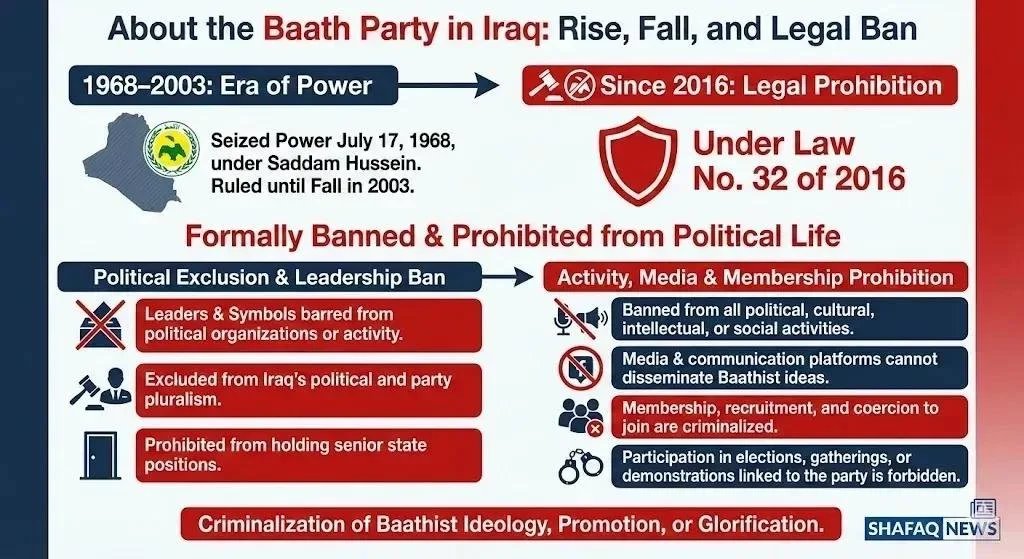
Iraq Cracks Baath Cell Hid Behind Civilian Cover In Baghdad
2026-04-09 Shafaq News- Baghdad Iraq's National Security Service (INSS) announced Thursday it had dismantled an organized cell linked to the banned Baath Party operating in western Baghdad, following a months-long intelligence operation.
The agency's spokesman said in a statement that the operation exposed the cell's organizational structure, which began its activity under civilian cover before shifting to a military character. Security forces seized photographs of security personnel and sensitive locations from the cell's members, and detected attempts to recruit new members. Eight people have been arrested so far.
The agency also sent warning text messages to individuals who had been lured into the so-called "Iraqi National Assembly for Change and Liberation" -a front linked to Saddam Hussein’s Baath Party- urging them to withdraw. Many of those contacted responded by shutting down platforms that had been used for recruitment and promotion.
https://www.shafaq.com/en/Security/Iraq-cracks-Baath-cell-hid-behind-civilian-cover-in-Baghdad
US Embassy Seeks Public Help To Identify Attackers In Iraq
2026-04-09 Shafaq News- Baghdad On Thursday, the US Embassy in Iraq called for information about people targeting its facilities in Iraq.
The embassy urged for information on Iran-aligned armed factions or individuals responsible for the attacks.
Since the outbreak of hostilities between Iran, the United States, and Israel on February 28, the US Embassy in Baghdad, the US Consulate in the Kurdistan Region, and other American interests in Iraq have faced dozens of drone and rocket attacks. https://www.shafaq.com/en/society/US-Embassy-seeks-public-help-to-identify-attackers-in-Iraq
Read more: Multiple actors, one battlefield: Iraq since the US-Israel-Iran war began
Italian Journalists Face Harassment In Baghdad
2026-04-09 Shafaq News- Baghdad Members of the Popular Mobilization Forces (PMF) harassed two Italian journalists following a dispute over filming in Firdos Square in Baghdad, a police source told Shafaq News on Thursday.
The source said a PMF unit ordered them to stop, leading to a verbal altercation. The confrontation escalated as members of the force grabbed the journalists’ clothing and used abusive language before the situation was brought under control. Italian journalists face harassment in Baghdad - Shafaq News
“Iraq News” Posted by Tishwash at TNT 4-9-2026
TNT:
Tishwash: Swiss Ambassador: We will follow up on the frozen Iraqi funds in preparation for their return.
The Federal Integrity Commission discussed on Wednesday with the Swiss Ambassador in Baghdad the strengthening of bilateral cooperation in the field of recovering frozen Iraqi funds and combating corruption, while stressing the importance of bilateral partnerships to overcome obstacles to recovering funds and prosecuting the accused.
The Commission’s media office stated in a statement received by Al-Furat News that “the head of the Federal Integrity Commission, Muhammad Ali Al-Lami, during his meeting with the Swiss Ambassador, Daniel Hon, at the Commission’s headquarters, stressed the importance of expanding bilateral partnerships and concluding memoranda of understanding that contribute to overcoming the challenges that hinder the recovery of smuggled funds and accused individuals, and enhance international cooperation in this field.”
TNT:
Tishwash: Swiss Ambassador: We will follow up on the frozen Iraqi funds in preparation for their return.
The Federal Integrity Commission discussed on Wednesday with the Swiss Ambassador in Baghdad the strengthening of bilateral cooperation in the field of recovering frozen Iraqi funds and combating corruption, while stressing the importance of bilateral partnerships to overcome obstacles to recovering funds and prosecuting the accused.
The Commission’s media office stated in a statement received by Al-Furat News that “the head of the Federal Integrity Commission, Muhammad Ali Al-Lami, during his meeting with the Swiss Ambassador, Daniel Hon, at the Commission’s headquarters, stressed the importance of expanding bilateral partnerships and concluding memoranda of understanding that contribute to overcoming the challenges that hinder the recovery of smuggled funds and accused individuals, and enhance international cooperation in this field.”
The statement added that "during the meeting, discussions were held on concluding a memorandum of understanding between the two sides, particularly in the areas of information exchange, tracking corruption crimes and reducing their spread, as well as developing technical cooperation and updating policies and strategies related to combating it, and addressing obstacles to recovering funds, especially those that were seized during the era of the previous regime."
Al-Lami pointed to the "file of Iraqi assets dating back to the time of the previous regime, explaining that their loss is due to several reasons, including the international sanctions imposed in 1990 and the Oil-for-Food Program, which requires effective international cooperation to recover them."
For his part, the Swiss ambassador expressed his pleasure at strengthening bilateral relations, especially in the field of preventing and combating corruption, stressing his endeavor to coordinate with the competent authorities in his country to study the file of frozen Iraqi funds, in preparation for taking the necessary measures to return them in a way that contributes to supporting reconstruction and development projects in Iraq. link
************
Tishwash: The House of Representatives votes on the members of the Finance Committee
The Iraqi Parliament voted today, Wednesday, on the members of the Finance Committee.
Republic of Iraq – Council of Representatives
First Legislative Term
**Agenda for Session No. (16) – May 2024**
* Recitation of verses from the Holy Quran.
**Department of Legislative Affairs**
**First:** Completion of the vote on the members of the Permanent Parliamentary Committees.
**Second:** First Reading of the Proposed Law on the Fifth Amendment to the Civil Aviation Law No. (198) of 1974 (Submitted by the Committee on Transport, Communications, and Governance) – (58 Articles).
**Third:** First Reading of the Proposed Law on Governorates Not Incorporated into a Region (Submitted by the Committee on Regions and Governorates Not Incorporated into a Region, Planning, Government Program, and Endowments) – (71 Articles).
link
Tishwash: Industry: 234 partnership agreements to support the private sector in Iraq
The Ministry of Industry and Minerals announced on Wednesday a plan to rehabilitate and operate stalled factories, confirming the existence of 234 partnership contracts to support the industrial sector in Iraq.
The ministry's spokesperson, Duha al-Jubouri, told the official news agency that "the ministry intends to take concrete steps to support national industry in the coming period, including operating the closed factories."
Al-Jubouri explained that "the public companies affiliated with the ministry number 31 companies, including 28 production and service companies, in addition to three public bodies, namely the Industrial Research and Development Authority, the Geological Survey Authority, and the Million Industrial Authority."
She continued: “The number of factories affiliated with the ministry is 312, of which 225 are operational, while 87 are out of operation,” stressing that “work is underway by the administrations of the out of operation factories, under the guidance and supervision of the Minister of Industry, to rehabilitate and operate the factories.”
She added that "the number of partnership contracts with the private sector is 144 contracts that are still being implemented, while 90 new contracts are being evaluated, bringing the total number of partnership contracts with the private sector to 234 contracts."
She noted that "the ministry has partnership contracts related to strategic industries such as sulfur and phosphate, which may take time to be completed," expecting that "citizens will see the real results of some of these projects during this year link
************
Tishwash: He moved to approve an emergency budget of $40 billion.
In light of the economic and financial challenges and the significant decline in oil revenues as a result of the war and regional conflicts, the Prime Minister’s financial advisor, Dr. Mazhar Muhammad Salih, announced that the government is adopting a series of measures to ensure the continuity of the work of state institutions and the provision of basic services in the event of a delay in approving the general budget.
In an interview with Al-Sabah, Saleh confirmed that one of the most prominent of these measures is the application of the temporary spending rule (1/12) of the previous year's budget, based on the amended Federal Financial Management Law No. (6 of 2019). He explained that this procedure allows for the coverage of essential expenditures such as salaries, wages, pensions, and social welfare allocations, which amount to approximately (8) trillion dinars monthly, while funding continues for basic operational costs. New investment projects are suspended or postponed, and only urgent projects are implemented.
Saleh indicated that the government is working on rearranging spending priorities, focusing on vital sectors, and making limited financial transfers between spending categories within the available legal frameworks. In some cases, it may resort to short-term domestic borrowing to cover the temporary deficit and ensure liquidity stability.
In Parliament, MP Ali Salman al-Moussawi revealed a plan to allocate approximately $40 billion as an emergency budget to expedite and complete projects. He explained to Al-Sabah newspaper that some parties within the coordination framework had requested a budget ranging between $30 and $40 billion to achieve this objective.
For his part, Professor of Financial Economics Dr. Ahmed Al-Hathal affirmed Iraq’s ability to secure operational expenses, but pointed out the need to take exceptional measures to cover investment expenses and strategic projects, in light of the sharp decline in oil revenues, disruption of global supplies and increased geopolitical risks.
Al-Hathal explained to Al-Sabah that the move towards an emergency budget aims to stimulate the economic cycle and prevent the cessation of vital projects related to energy, water, food and infrastructure, explaining that any delay in making the decision will lead to an expansion of the recession, an increase in unemployment and a rise in the bill for stalled projects, which will negatively affect citizens and the local market link
Seeds of Wisdom RV and Economics Updates Thursday Morning 4-9-26
Good Morning Dinar Recaps,
BRICS Commodity Dominance Reshapes Global Power Balance
Control of resources—not currencies—may define the next phase of global finance
Good Morning Dinar Recaps,
BRICS Commodity Dominance Reshapes Global Power Balance
Control of resources—not currencies—may define the next phase of global finance
Overview (Key Points)
BRICS nations control a significant share of critical global commodities
The bloc’s strength spans energy, food, metals, and natural resources
This dominance is fueling a potential global decoupling from Western systems
Resource control is emerging as a core pillar of financial and geopolitical power
Key Developments
1. BRICS Leads in Critical Minerals and Industrial Metals
Controls ~90% of global rare earth processing
Produces ~79% of global aluminum and 77% of palladium
These materials are essential for:
Electric vehicles
Defense systems
Renewable energy infrastructure
👉 This positions BRICS at the center of future industrial and military supply chains
2. Strong Position in Energy Resources
Holds ~45% of global oil reserves
Major producers include countries like Russia, Iran, and Saudi Arabia
👉 Energy dominance gives BRICS pricing influence and geopolitical leverage
3. Expanding Control Over Global Food Supply
Accounts for:
~42% of global food production
~40% of grain and meat supply
Controls ~30% of the world’s arable land
👉 Food security becomes a strategic advantage in times of crisis
4. Command Over Water and Natural Resources
Holds ~40% of global freshwater reserves
👉 Water is increasingly viewed as a future strategic asset, not just a utility
5. Significant Share of Precious Metals and Wealth Anchors
Produces ~50% of global gold output
👉 Gold remains a key hedge against currency instability and inflation
6. Industrial Production Powerhouse
Generates ~40% of global industrial output
👉 Strengthens BRICS’ ability to control supply chains and manufacturing
7. Population Advantage Fuels Workforce Growth
BRICS nations represent ~4.4 billion people (55% of global population)
In contrast, G7 nations account for less than 10%
👉 Provides a massive labor force and consumer base
Why It Matters
The global system has long been dominated by financial power (West) versus resource power (emerging markets).
That balance is shifting.
BRICS controls the “real assets”: energy, food, minerals, water
Western economies largely dominate financial systems and capital markets
If resource control tightens, global dependence may shift toward commodity-rich nations
Why It Matters to Foreign Currency Holders
Commodities often back or influence currency strength over time
Nations rich in resources may gain:
Stronger trade leverage
More stable long-term currency positioning
Investors should monitor:
Commodity flows and pricing power
Gold accumulation trends
Energy trade settlement currencies
This suggests a gradual move toward asset-backed influence rather than purely debt-based systems
Implications for the Global Reset
Pillar 1: Resource-Based Power Shift
Control of commodities may outweigh traditional financial dominance
BRICS nations are positioned to anchor value through real assets
Pillar 2: Supply Chain Realignment
Western nations may become increasingly dependent on BRICS-controlled resources
This could accelerate trade realignment and geopolitical shifts
The reset may not begin with currency—but with who controls the inputs of the global economy
Closing Insight
The West may control money systems, but BRICS controls what the world needs to function.
When resources dictate terms, power follows the supply.
Seeds of Wisdom Team
Newshounds News™ Exclusive
Sources
~~~~~~~~~~
A Message to Our Currency Holders
If you’ve been holding foreign currency for many years, you were not foolish.
You were not wrong to believe the global financial system would change.
What failed was not your patience — it was the information you were given.
For years, dates, rumors, and personalities replaced facts, structure, and proof. “This week” predictions created cycles of hope and disappointment that were never based on how currencies actually change.
That is not your failure.
Our mission here is different: • No dates • No rates • No hype • No gurus
Instead, we focus on:
• Verifiable developments • Institutional evidence
• Global financial structure • Where countries actually sit in the process
Currency value changes only come after sovereignty, trade, banking, settlement systems, and fiscal coordination are in place. History and institutions confirm this sequence.
You will see silence. You will see denials. That is not delay — that is discipline.
Protect your identity. Organize your documents. Verify everything.
Never hand your discernment to anyone who cannot show proof.
You deserve truth — not timelines.
Seeds of Wisdom Team
Newshounds News™
~~~~~~~~~~
Seeds of Wisdom Team RV Currency Facts Youtube and Rumble
Newshound's News Telegram Room Link
RV Facts with Proof Links Link
RV Updates Proof links - Facts Link
Follow the Gold/Silver Rate COMEX
Follow Fast Facts
Seeds of Wisdom Team™Website
Thank you Dinar Recaps
Iraq Economic News And Points To Ponder Thursday Morning 4-9-26
Oil Gains 2% Following Doubts Over Hormuz Reopening
2026-04-09 Shafaq News Oil prices rose on Thursday as doubts over a fragile two-week Middle East ceasefire raised concerns that energy flows through the crucial Strait of Hormuz will remain restricted.
Brent crude futures were up $1.96, or 2.07%, at $96.71 a barrel at 0325 GMT, while U.S. West Texas Intermediate (WTI) crude rose $2.60, or 2.75%, to $97.01 a barrel.
Oil Gains 2% Following Doubts Over Hormuz Reopening
2026-04-09 Shafaq News Oil prices rose on Thursday as doubts over a fragile two-week Middle East ceasefire raised concerns that energy flows through the crucial Strait of Hormuz will remain restricted.
Brent crude futures were up $1.96, or 2.07%, at $96.71 a barrel at 0325 GMT, while U.S. West Texas Intermediate (WTI) crude rose $2.60, or 2.75%, to $97.01 a barrel.
Both benchmark prices fell below $100 per barrel in the previous trading session, with WTI recording its biggest decline since April 2020, on initial expectations for the ceasefire to result in a reopening of the strait.
However, analysts said market participants are hesitant to fully unwind pricing for geopolitical risk, and there is no clarity on what negotiations between the U.S. and Iran would mean for oil flows.
"The chances of a meaningful reopening (of the Strait of Hormuz) any time soon look dim," said Vandana Hari, founder of oil market analysis provider Vanda Insights, predicting continued volatility in oil prices.
"The futures market looks a bit broken," she said. Otherwise, "prices should have snapped right back to pre-ceasefire levels by now."
The vital waterway connects supply from Gulf producers such as Iraq, Saudi Arabia, Kuwait and Qatar to global markets, and typically carries about 20% of global oil and gas supply.
The viability of the ceasefire is in question with Israel continuing to attack Lebanon on Wednesday, causing Iran to suggest it would be "unreasonable" to proceed with talks to forge a permanent peace deal.
Shippers on Wednesday also said they needed more clarity on the terms of the ceasefire before resuming transit through the Strait of Hormuz. Iran has issued maps to guide ships around mines in the waterway and designated safe paths for passage in coordination with the country's Revolutionary Guards, Iranian media reported.
"Logistic disconnects, security fears, elevated insurance premiums and operational constraints mean that very little additional energy is likely to be supplied via the Strait of Hormuz in the next two weeks," analysts at Standard Chartered said in a note.
Regional oil facilities also remain under threat, with Iran striking sites in nearby countries after the ceasefire, including a pipeline in Saudi Arabia that has been used to bypass the blockaded Strait of Hormuz, according to an oil industry source.
Kuwait, Bahrain and the UAE also reported missile and drone attacks.
Meanwhile, Goldman Sachs kept its third- and fourth-quarter oil price forecasts unchanged at, respectively, $82 and $80 for Brent, and $77 and $75 for WTI.
The investment bank lowered its second-quarter forecasts for Brent to $90 and WTI to $87 "given the reduction in risk premium at the front of the curve", with oil flows through the Strait of Hormuz "already edging up". (Reuters)
https://www.shafaq.com/en/Economy/Oil-gains-2-following-doubts-over-Hormuz-reopening
Basrah Crude Drops Over 8% Despite Global Oil Rise
2026-04-09 Shafaq News– Basrah Basrah crude fell more than 8% on Thursday, diverging from rising global oil prices.
Basrah Heavy crude fell $10.96, or 8.88% to $112.44 per barrel, and Basrah Medium crude declined $10.96, or 8.73%, reaching $114.54 per barrel.
Brent crude futures were up $1.96, or 2.07%, at $96.71 a barrel. US West Texas Intermediate (WTI) crude rose $2.60, or 2.75%, to $97.01 a barrel. https://www.shafaq.com/en/Economy/Basrah-crude-drops-over-8-despite-global-oil-rise-2
Gold Prices Stabilize Before US Inflation Data Release
2026-04-09 Shafaq News Gold prices were largely steady on Thursday as investors remained cautious about the fragile U.S.-Iran ceasefire, with a key U.S. inflation report due later in the day also in focus for interest rate clues.
Spot gold inched 0.1% higher to $4,721.51 per ounce, as of 0523 GMT. U.S. gold futures for June delivery fell 0.7% to $4,744.90.
"It doesn't seem like gold is looking to do much at this moment. I think there's still a lot of speculation on what's going to happen after the ceasefire," said GoldSilver Central Managing Director Brian Lan.
Lan said he expected gold to consolidate between $4,607 and $4,860 in the near term.
On Wednesday, Israel pounded Lebanon with its heaviest strikes yet, killing hundreds of people and drawing a threat of retaliation from Iran.
Oil prices rose on Thursday on concerns that supply from the key Middle East producing region may not fully resume amid doubts that the two-week ceasefire will hold.
Spot gold has declined more than 10% since the war began on February 28, as higher energy prices fuelled inflation concerns and prompted markets to reassess interest rate expectations, reducing non-yielding bullion's appeal.
Minutes from the Federal Reserve's March 17 to 18 meeting showed that more policymakers felt rate hikes could be needed to counter inflation that continued to exceed the central bank's 2% target.
U.S. Personal Consumption Expenditures data for February is due at 1230 GMT, and March consumer price data on Friday could give further clues on the Fed's policy path.
"Beyond near-term liquidity needs, we expect gold to continue to rebuild its gains in the coming months amid heightened geopolitical risk," Standard Chartered said in a note on Wednesday.
Among other metals, spot silver fell 0.1% to $74.07 per ounce, platinum lost 0.4% to $2,020.60 and palladium edged up 0.3% to $1,559. (Reuters) https://www.shafaq.com/en/Economy/Gold-prices-stabilize-before-US-inflation-data-release
Gold Prices Fall In Baghdad And Erbil
2026-04-09 Shafaq News- Baghdad/ Erbil On Thursday, gold prices hovered around 1 million IQD per mithqal in Baghdad and Erbil markets, according to a survey by Shafaq News Agency.
Gold prices on Baghdad's Al-Nahr Street recorded a selling price of 1,014,000 IQD per mithqal (equivalent to five grams) for 21-carat gold, including Gulf, Turkish, and European varieties, with a buying price of 1,010,000 IQD. The same gold had sold for 1,036,000 IQD on Wednesday.
The selling price for 21-carat Iraqi gold stood at 984,000 IQD, while the buying price reached 980,000 IQD.
In jewelry stores, the selling price per mithqal of 21-carat Gulf gold ranged between 1,015,000 and 1,025,000 IQD, while Iraqi gold sold for between 980,000 and 990,000 IQD.
In Erbil, 22-carat gold was sold at 1,071,000 IQD per mithqal, 21-carat gold at 1,023,000 IQD, and 18-carat gold at 876,000 IQD. Gold prices fall in Baghdad and Erbil - Shafaq News
MilitiaMan and Crew: IRAQ DINAR UPDATE - Border Ports - ASYCUDA - KRG - Unity - Baghdad - History as Precedent - Kuwait
MilitiaMan and Crew: IRAQ DINAR UPDATE - Border Ports - ASYCUDA - KRG - Unity - Baghdad - History as Precedent - Kuwait
4-8-2026
The Crew: Samson, PompeyPeter, Petra, Daytrader, Sunkissed, GIGI and Militia Man
No drama. No intrigue. No songs and dances. Just straight, factual news that I read and interpret to the best of my ability after being an avid Dinar investor and insanely obsessed Dinarian for over 15 years.
Follow MM on X == https://x.com/Slashn
MilitiaMan and Crew: IRAQ DINAR UPDATE - Border Ports - ASYCUDA - KRG - Unity - Baghdad - History as Precedent - Kuwait
4-8-2026
The Crew: Samson, PompeyPeter, Petra, Daytrader, Sunkissed, GIGI and Militia Man
No drama. No intrigue. No songs and dances. Just straight, factual news that I read and interpret to the best of my ability after being an avid Dinar investor and insanely obsessed Dinarian for over 15 years.
Follow MM on X == https://x.com/Slashn
Be sure to listen to full video for all the news……..
Seeds of Wisdom RV and Economics Updates Wednesday Evening 4-8-26
Good Evening Dinar Recaps,
War’s Economic Toll | IMF Warns of Long-Term Damage and Rising Global Instability
Conflict-driven inflation, debt, and food insecurity signal deeper systemic stress
Good Evening Dinar Recaps,
War’s Economic Toll | IMF Warns of Long-Term Damage and Rising Global Instability
Conflict-driven inflation, debt, and food insecurity signal deeper systemic stress
Overview
New warnings from the International Monetary Fund (IMF) and global institutions highlight the lasting economic damage caused by war, as rising energy costs, inflation, and supply disruptions ripple across the global economy.
Even with a temporary ceasefire, the broader conflict is already contributing to higher food prices, increased debt burdens, and long-term economic scarring, particularly in vulnerable nations.
Key Developments
1. War Driving Global Food and Energy Inflation
The IMF, World Bank, and UN agencies warn that conflict is pushing up oil, gas, and fertilizer prices, which in turn are driving global food inflation and insecurity.
2. Long-Term Economic Output Losses Expected
IMF research shows that countries involved in war typically suffer a 7% drop in economic output over five years, with effects lasting over a decade.
3. Rising Debt and Fiscal Pressure Across Nations
War-related spending is contributing to higher deficits, increased borrowing, and reduced social investment, worsening fiscal conditions globally.
4. Conflict Impact Spreads Beyond War Zones
Economic shocks are not limited to combat zones—trade partners and neighboring economies are also experiencing spillover effects, amplifying global instability.
Why It Matters
This is a clear signal that geopolitical conflict is not just a regional issue—it is a global economic disruptor.
Rising food and energy costs combined with debt pressures create a feedback loop of instability, particularly in emerging markets.
Why It Matters to Foreign Currency Holders
Inflation driven by food and energy reduces currency purchasing power
High debt levels increase risk of currency devaluation
Vulnerable economies may face capital flight and instability
Hard assets and commodities may gain relative importance
Implications for the Global Reset
Pillar 1: Debt & Inflation Crisis Expansion
War-driven inflation and borrowing accelerate pressure on the global debt-based monetary system, increasing the likelihood of restructuring.
Pillar 2: Resource-Based Financial Realignment
Food, energy, and fertilizer are emerging as critical economic levers, shifting power toward nations that control essential commodities.
Analysis
The IMF’s findings reinforce a critical reality: wars reshape economies long after the fighting stops.
While markets may react positively to short-term ceasefires, the underlying economic damage continues to build, particularly through inflation, debt accumulation, and supply disruptions.
This creates conditions where financial systems face prolonged stress, increasing the probability of structural change in how global finance operates.
This is not just conflict — it’s a long-term economic transformation already underway.
Seeds of Wisdom Team
Newshounds News™ Exclusive
Sources
~~~~~~~~~~
Seeds of Wisdom Team RV Currency Facts Youtube and Rumble
Newshound's News Telegram Room Link
RV Facts with Proof Links Link
RV Updates Proof links - Facts Link
Follow the Gold/Silver Rate COMEX
Follow Fast Facts
Seeds of Wisdom Team™Website
Thank you Dinar Recaps
Iraq Economic News And Points To Ponder Wednesday Evening 4-8-26
Iraqi Banks Under US Scrutiny: Who Controls The Transfers And Who Pays The Price?
April 7, 2026 Last updated: April 7, 2026
The Iraqi banking system has found itself under increasing regulatory pressure since late 2022, related to dollar transfers and import financing, as part of a broader tightening of international compliance and anti-money laundering regulations.
Bankers and economists say this tightening, practically linked to access to the US financial system through correspondent banks, has reshaped the remittance market in Iraq, reduced the operating margins of several private banks, and increased the cost of trade, with the effects quickly being felt by the market and consumers.
Iraqi Banks Under US Scrutiny: Who Controls The Transfers And Who Pays The Price?
April 7, 2026 Last updated: April 7, 2026
The Iraqi banking system has found itself under increasing regulatory pressure since late 2022, related to dollar transfers and import financing, as part of a broader tightening of international compliance and anti-money laundering regulations.
Bankers and economists say this tightening, practically linked to access to the US financial system through correspondent banks, has reshaped the remittance market in Iraq, reduced the operating margins of several private banks, and increased the cost of trade, with the effects quickly being felt by the market and consumers.
According to banking estimates, more than 70 banks operate in Iraq, both public and private, in addition to branches of foreign banks. However, the real activity is concentrated in a limited number of institutions.
Public banks hold the largest share of deposits and handle most official transactions and government salaries, while many private banks rely more on financing trade and remittances than on lending and investment, making them more sensitive to any restrictions related to the dollar or scrutiny of commercial documents.
Bankers describe the “transfers” mechanism as the heart of the crisis. A bank submits a request to transfer funds against import documents, and the transaction is then executed through foreign correspondents according to strict auditing procedures.
However, industry sources say that in previous years, loopholes were widely exploited through inflated invoices, fictitious import transactions, or inaccurate data, raising the risk rating and leading to escalating external pressures that impacted banks and the market.
Banking officials add that the restrictions are not being applied equally to everyone. Banks with stronger compliance systems and more stable correspondent relationships have been better able to process transfers, while a number of banks have suffered from restrictions, slowdowns, or rejections of transactions, leading to a concentration of some trade demand in specific channels.
According to observers, this concentration answers the question, “Who controls the transfers?” Control effectively shifts to banks that can meet auditing standards and to intermediaries who know how to manage official channels at a higher cost, or resort to informal channels when procedures become complicated.
As for “who pays the price?” the market answers this question quickly, according to economists, through three channels. The first is the increased cost of imports due to slower remittances, higher commissions, and increased documentation requirements, which is reflected in the prices of goods in a country heavily reliant on imports.
The second is the expansion of the informal market whenever a gap appears between the official and market exchange rates, thus putting pressure on purchasing power and increasing inflation.
The third is the decline in confidence in banks, as a large portion of the money supply remains outside the banking system, limiting banks' ability to lend and finance the real economy.
Bankers warn that the problem is no longer simply a matter of dollar liquidity, but rather a fundamental business model for a banking sector that relies more on remittances than on financing production.
The lack of effective lending and the limited scope of banking services are pushing banks to seek profit through dollar transactions and trade finance, which increases risks and makes the sector vulnerable to any external tightening.
Meanwhile, state-owned banks, despite their control over deposits, remain less agile in modernizing technology and developing services, creating a gap between their size and their role.
Experts believe that the true test of reform begins with measurable measures, including stricter auditing of import invoices and preventing inflation and forgery, developing compliance systems within banks, and restructuring weak banks through mergers or liquidations according to clear criteria. They also emphasize the need to enhance transparency in trade finance and reduce reliance on cash.
Furthermore, they stress that reducing the cost of transfers and protecting the market requires minimizing opportunities for manipulation, not merely managing the exchange rate.
Ultimately, the oversight of remittances has become a factor reshaping the banking landscape in Iraq: few institutions are able to operate within the required standards, others are declining or besieged by restrictions, and the market bears the brunt of this in prices and the cost of living.
While bankers speak of the necessity for swift internal reform to restore confidence and reduce risks, the open question remains: can Iraq transform the "dollar audit" into an opportunity to rebuild a banking sector that finances the economy, or will remittances remain an arena controlled by limited channels, with the markets and citizens paying the price?https://mustaqila.com/مصارف-العراق/
A Government Advisor Predicts Per Capita Income Growth Of $1,320 Per Month Over The Next Four Years
Baghdad – WAA – Amna Al-Salami The Prime Minister’s financial advisor, Mazhar Muhammad Salih, confirmed on Tuesday that regional competition requires a stable investment environment and major strategic projects, while he indicated that growth expectations until 2030 amount to 3.6% and per capita share is about $15,850 annually, while he clarified that the level of monthly per capita income will be $1,320 per month.
Saleh told the Iraqi News Agency (INA): “The latest IMF report reveals promising growth for Iraq amid ongoing challenges, and this development deserves great attention, as Iraq has achieved a distinguished position among the region’s economies, ranking fifth in the Arab world with a GDP of nearly $739 billion according to purchasing power parity.”
He explained that "this classification is not just a number, but an indicator of the recovery of the economy and the development of its own material and human engines, and its organizational capabilities that flourish over time, in addition to the state's ability to support development and improve the quality of life of citizens with high flexibility."
He continued: "As for growth indicators and prospects up to 2030, forecasts indicate real growth of about 3.6%, with low and stable inflation, and per capita output of about $15,850 annually."
He added, "These data reveal clear future opportunities, most notably: diversifying the economy away from oil and a single rentier economy, promoting local and foreign investment, developing infrastructure, and supporting modern technology and digital education, as these steps are essential for building a strong and sustainable economy."
He noted that “the ability to compete regionally remains an important criterion for assessing progress and building growth opportunities, as Iraq has the potential to enter the regional competition arena, but it needs a stable investment environment and constant protection for investors, the development of ports and roads and linking the economy to the region, including important regional strategic projects such as (the Development Road Project), while adhering to the project’s phased objectives and coordinating with the neighbor and the world at all times, and focusing on education, digital education, innovation and entrepreneurship without interruption, as well as ensuring the correlation between long-term political and financial stability, which are crucial factors for attracting investment and achieving sustainable development.”
He pointed out that "the current growth in development indicators reflects the strength of the Iraqi economy, but it requires transforming this level of capabilities into qualitative strength and sustainable momentum in the modernization and technological progress movement."
He concluded by saying: “The Iraqi economy must become an influential regional engine, as long as the state invests resources wisely and focuses on production and knowledge, to reach a stage where economic peace and sustainable development are fundamental pillars for the country.”
The International Monetary Fund announced on Monday that Iraq will be the fifth largest Arab economy in 2026, and predicted that the Iraqi economy will continue to grow by 2030.
The fund said in its report: “The data showed that Iraq ranked fifth as the largest Arab economy for 2026, in terms of GDP based on purchasing power parity (PPP), achieving a value of $739.13 billion, thus ranking 44th globally.”
According to the report, the ranking of the five major economic powers in the Arab world was as follows: Saudi Arabia topped the Arab world (16th globally), followed by Egypt in second place (18th globally), then the United Arab Emirates in third place, Algeria in fourth place, and Iraq in fifth place.
The report stated that "globally, three superpowers maintained their top rankings; China came in first with $43.5 trillion, followed by the United States in second place with $31.8 trillion, and then India in third place with $19.1 trillion."
According to detailed official indicators for Iraq, nominal GDP at current prices reached $273.91 billion, with a real growth rate of 3.6%.
The annual per capita GDP (PPP) reached $15,850, coinciding with the population reaching 46.64 million.
Regarding financial and monetary stability, the report noted that "the annual inflation rate remained stable at 2.5%, while net public lending/borrowing recorded a rate of -7.1%, and the current account deficit reached 1.1%."
The fund concluded its data with projections indicating that "the Iraqi economy will continue to grow by 2030."