
Seeds of Wisdom RV and Economic Updates Wednesday Morning 7-16-25
House Republicans Block Epstein Files Amendment to Landmark Crypto Bill
As “Crypto Week” begins in Washington, House Republicans have voted to block a controversial amendment to one of the most important crypto bills under consideration—one that would have compelled the Department of Justice (DOJ) to release the highly scrutinized Epstein files.
Democrats Propose Epstein Amendment to GENIUS Act
On Monday, the House Rules Committee rejected an amendment to the Guiding and Establishing National Innovation for US Stablecoins (GENIUS) Act, introduced by Representative Ro Khanna. The amendment sought to mandate that Attorney General Pam Bondi release and publish records related to investigations, prosecutions, or the incarceration of Jeffrey Epstein within 30 days of the bill becoming law.
House Republicans Block Epstein Files Amendment to Landmark Crypto Bill
As “Crypto Week” begins in Washington, House Republicans have voted to block a controversial amendment to one of the most important crypto bills under consideration—one that would have compelled the Department of Justice (DOJ) to release the highly scrutinized Epstein files.
Democrats Propose Epstein Amendment to GENIUS Act
On Monday, the House Rules Committee rejected an amendment to the Guiding and Establishing National Innovation for US Stablecoins (GENIUS) Act, introduced by Representative Ro Khanna. The amendment sought to mandate that Attorney General Pam Bondi release and publish records related to investigations, prosecutions, or the incarceration of Jeffrey Epstein within 30 days of the bill becoming law.
This effort came amid renewed Democratic pressure following criticism of how the Trump administration's DOJ handled the Epstein case, including its conclusion that Epstein’s death was a suicide and that no client list existed.
Democrats viewed the amendment as a way to leverage internal GOP tensions and force a vote that could place Republicans in a politically vulnerable position. Representative Marc Veasey also announced a resolution pushing for the full release of all Epstein-related DOJ files.
Rules Committee Prioritizes Crypto, Not Epstein Files
On July 14, the House Rules Committee voted 6-5 against including Khanna’s amendment. Republicans argued that the proposal was not relevant to the GENIUS Act, which is focused on stablecoin regulation, not criminal investigations.
The GENIUS Act—originally introduced by Senator Bill Hagerty—seeks to create a clear regulatory framework for stablecoins like USDT and USDC, placing them under Federal Reserve oversight. Supporters say it will “unleash innovation” and support President Trump’s vision of making the U.S. a global crypto leader.
Interestingly, Republican Representative Ralph Norman broke ranks to vote with Democrats in favor of the amendment, stating that “the public’s been asking for it.” However, Norman later opposed Representative Veasey’s separate resolution on procedural grounds, saying, “We’re talking about crypto, Jim. We’re talking about regulations.”
GENIUS and CLARITY Acts May Merge Ahead of August Deadline
The GENIUS Act already passed a full Senate vote in mid-June and is currently moving through the House of Representatives. Lawmakers have since discussed combining the bill with the CLARITY Act, another cornerstone crypto regulation proposal, to improve their chances of passing before the August recess.
However, Senate Banking Committee Chair Tim Scott has since signaled a new timeline, suggesting that GENIUS and CLARITY could advance independently to avoid procedural delays.
While the Epstein-related efforts were blocked, the broader legislative push around crypto regulation remains on track, with lawmakers aiming to finalize a framework that could reshape U.S. digital asset policy.
@ Newshounds News™
Source: Bitcoinist
~~~~~~~~~
Trump Cuts Deal to End Republican Revolt on Crypto Bills
President Donald Trump has intervened to restore Republican support for a suite of major cryptocurrency bills after a GOP revolt temporarily derailed progress over concerns about central bank digital currencies (CBDCs).
On Tuesday evening, Trump announced on his Truth Social platform that he had met with 11 of the 12 Republican holdouts in the Oval Office and secured their commitment to vote in favor of the bills when the House reconvenes.
“I am in the Oval Office with 11 of the 12 Congressmen/women necessary to pass the GENIUS Act and, after a short discussion, they have all agreed to vote tomorrow morning in favor of the Rule,” Trump wrote.
Crypto Bills Delayed Over CBDC Concerns
The Republican standoff halted Tuesday’s expected vote on three key crypto bills:
The GENIUS Act, which sets rules for stablecoin issuance
The Anti-CBDC Surveillance Act, which bans a Federal Reserve–issued CBDC
The CLARITY Act, a broader crypto market structure framework
Thirteen Republican lawmakers, including high-profile names like Marjorie Taylor Greene, Andy Biggs, and Anna Paulina Luna, opposed moving forward without an explicit ban on CBDCs included in the GENIUS Act.
Some wanted the three bills to be bundled into a single legislative package, while others sought amendments to further guarantee self-custody rights and block any indirect pathways to a government-backed digital currency.
“I just voted NO on the Rule for the GENIUS Act because it does not include a ban on central bank digital currency,” said Rep. Greene.
“The bill doesn’t guarantee self-custody,” added Rep. Biggs, calling for an open amendment process.
Trump's Executive Order Already Opposes CBDCs
Trump's re-engagement with crypto comes after he issued an executive order in January barring the Federal Reserve from developing a retail CBDC, a move that aligned him with the industry’s call for decentralized digital finance.
House Speaker Mike Johnson credited Trump’s influence for restoring momentum:
“I’m thankful for President Trump getting involved tonight to ensure that we can pass the GENIUS Act tomorrow,” Johnson posted on X.
Still, the bill’s language already prohibits the Fed from offering public-facing digital accounts, according to Eleanor Terrett, host of the Crypto in America podcast.
“The bill shall not be construed as expanding the Fed’s authority to offer services directly to the public—meaning it cannot authorize digital wallets, personal accounts, or anything CBDC-related,” she explained.
Procedural Challenges and Strategy Shifts
Tensions also arose over how the bills should be passed. Some Republicans wanted them voted on as a single package, while Speaker Johnson argued they should advance in succession to avoid procedural issues in the Senate.
“It’s a priority of the White House, the Senate, and the House to do all of these crypto bills,” Johnson told Politico, but added, “We have to do them in succession.”
Despite the delay, industry insiders remain optimistic. Caitlin Long, CEO of Custodia Bank, urged calm, pointing out that the GENIUS Act initially failed in the Senate before passing 11 days later.
House Reconvenes Wednesday
The House is scheduled to meet again on Wednesday to resume debate and move the crypto bills forward. If successful, it could mark a turning point in the legislative effort to establish clear U.S. digital asset regulation before the August recess.
The GENIUS Act passed the Senate in June with bipartisan support, but Democratic opposition to Trump’s rising alignment with the crypto industry remains a factor heading into final negotiations.
@ Newshounds News™
Source: Cointelegraph
~~~~~~~~~
Seeds of Wisdom Team RV Currency Facts Youtube and Rumble
Newshound's News Telegram Room Link
Follow the Roadmap
Follow the Timeline
Seeds of Wisdom Team™ Website
Thank you Dinar Recaps
“Tidbits From TNT” Wednesday Morning 7-16-2025
TNT:
Tishwash: The Minister of Finance reveals the reason for the delay in approving the budget.
Finance Minister Taif Sami revealed the reason for the federal government's failure to approve the budget and the delay in submitting it to parliament, according to a statement by MP Rashid Al-Maliki on Wednesday.
Al-Maliki said in a statement today, "Finance Minister Taif Sami informed us today during her meeting at the ministry's headquarters that a committee in the Council of Ministers is working to complete the budget schedules."
Sami was also quoted as saying: "The reason for the delay is due to efforts to maximize non-oil revenues and find financial sources to cover the budget deficit from fees, taxes, service charges, etc., and that the government is committed to submitting the budget schedules."
TNT:
Tishwash: The Minister of Finance reveals the reason for the delay in approving the budget.
Finance Minister Taif Sami revealed the reason for the federal government's failure to approve the budget and the delay in submitting it to parliament, according to a statement by MP Rashid Al-Maliki on Wednesday.
Al-Maliki said in a statement today, "Finance Minister Taif Sami informed us today during her meeting at the ministry's headquarters that a committee in the Council of Ministers is working to complete the budget schedules."
Sami was also quoted as saying: "The reason for the delay is due to efforts to maximize non-oil revenues and find financial sources to cover the budget deficit from fees, taxes, service charges, etc., and that the government is committed to submitting the budget schedules." link
Tishwash: News reveals details of the new agreement between Baghdad and Kurdistan.
An informed source revealed details on Wednesday of a new financial agreement concluded between the federal government in Baghdad and the Kurdistan Regional Government (KRG), aimed at settling salaries, oil exports, and unifying revenues.
The source told Shafaq News Agency that the agreement stipulates that the Kurdistan Regional Government will receive 240 billion dinars in revenues for May and June, at a rate of 120 billion dinars per month, in addition to delivering 230,000 barrels of oil per day to Baghdad, in exchange for the latter sending the salaries of the region's employees for those two months.
He indicated that the regional government will begin the process of disbursing local revenues from border crossings, along with the agreed-upon amount of crude oil, as part of the implementation of the terms of the new agreement.
The source added that the next phase will witness meetings between joint technical committees to review and audit figures and statistics related to oil exports and imports, as well as to discuss the region's share of the federal budget.
For his part, an Iraqi government source said that the federal cabinet is awaiting the implementation of the Kurdistan Regional Government's pledges to resolve the current crisis.
He explained that the federal government is awaiting an official letter from the Kurdistan Regional Government to begin implementing the agreement by the relevant committees.
The Kurdistan Regional Government's Council of Ministers approved the new understandings with Baghdad during its session held this morning.
The roots of the recent salary crisis between the federal government in Baghdad and the Kurdistan Regional Government (KRG) lie in ongoing disagreements over oil export mechanisms and the unification of public revenues. This is a long-standing crisis that resurfaces from time to time, but it has significantly worsened since May 2025, when the federal government refused to send salaries to KRG employees.
Baghdad justified the delay in disbursement by Erbil's failure to deliver the agreed-upon quantities of crude oil (230,000 barrels per day) and its failure to transfer non-oil revenues from internal ports to the state treasury, which the federal government considered a violation of previous agreements included in the three-year federal budget law (2023-2025).
For its part, the regional government confirmed that it is facing technical and political difficulties in delivering the full amount of oil, especially given the ongoing suspension of oil exports via the Turkish Ceyhan pipeline since March 2023. This suspension stems from an international arbitration ruling against Turkey in the oil export dispute with Iraq. This has forced Erbil to rely on domestic exports to meet its financial needs. link
***********
Tishwash: Financial Sovereignty": Why Has Iraq Not Emancipated Financially from the Grip of the US Federal Reserve?
that is witnessing Iraq Increasing American pressure regarding a set of demands that it considers Washington Essential, foremost among them the issue of armed factions.
These pressures have become more prominent recently when salaries were paid to members of the Popular Mobilization Forces, with Iraqi MPs asserting that the reason is due to American pressure exerted on Iraqi government There are also reports that Washington intends to restrict the flow of dollars into Iraq to limit their smuggling.
While negotiations are taking place betweenBaghdadAnd Washington, regarding these files, observers believe thatUSStill holding one of the strongest cards on the table.IraqControlling its financial revenues from oil exports by keeping them in US Federal Reserve accounts since 2003.
So why is Baghdad still subject to this financial arrangement two decades after the invasion? Why can't it receive its oil revenues directly, as other oil-producing countries do? And why have successive governments failed to free themselves from American financial hegemony?
Historical Background to Financial Hegemony
In May 2003,Security CouncilResolution No. 1483, which stipulated that revenues from Iraq’s oil and gas exports be deposited in a special account at the US Federal Reserve under the name “fundIraq's development.
A portion of these revenues - 5% of total oil and gas exports - was allocated to compensateKuwaitRegarding the damages resulting from the 1990 invasion, which continued until 2022 when Iraq completed paying its compensation, which amounted to approximately $52.4 billion.
According to MazharMohammed Saleh, the economic advisor to the Iraqi Prime Minister, the rest of the money was transferred to the accountCentral Bank of Iraq, which is responsible for financing the government and the Ministry of Finance with liquidity, given that the Iraqi dinar is priced in dollars.
Saleh adds thatUnited NationsLegal protection for these assets was provided under Resolution 1483, until it expired in 2011, following the implementation of Security Council Resolution 1956. In parallel, the US president issued Executive Order 13303 to protect Iraqi assets, a decision that remains in effect today despite some amendments.
According to Saleh, the goals of US protection of Iraqi assets are to ensure Iraq's reconstruction, protect its assets from compensation claims from companies and individuals, and avoid judicial seizure of Iraqi assets in cases filed since the 1990s.
Current US pressure
: Experts believe that Iraq, despite the expiration of many of the legal reasons that imposed this financial arrangement, remains subject to strict financial oversight by theWashington, differs from the usual procedures in the international banking system.
Dr.Abdulrahman Al-MashhadaniA professor of economics at the University of Iraq in Baghdad, Al-Mashhadani said that Iraq is facing unprecedented tightening of financial audits due to US concerns about money laundering, terrorist financing, and dollar smuggling, especially since Baghdad has not adhered to financial oversight controls in recent years.
Al-Mashhadani asserts that this audit has led to a significant decline in money laundering operations in recent months, citing the incident of "theftcentury"In 2022, more than $2.5 billion was smuggled, 70% of which was through Iraqi banks.
For his part, a member of theFinance CommitteeMP Jamal Kocher points out that most oil-producing countries deposit their money in the US Federal Reserve because oil is sold in dollars, but Iraq suffers from complete dependence on oil revenues without any significant alternative resources.
Kocher stresses that US pressure is not always exerted directly, but rather focuses on two issues:
- The use of US weapons outside the authority of the state.
- The smuggling of dollars to parties hostile to the United States.
In the same context, Al-Mashhadani explains that Iraq does not enjoy the same ease as other countries in disposing of its revenues, and suffers from a deficit inLibraCommercial interests, in addition to restrictions on the use of other currencies or an equal exchange system with other countries, weaken its ability to be financially independent.
Al-Mashhadani warns that the imposition of US economic sanctions on Iraq is not unlikely, noting that 32 Iraqi banks are currently subject to US sanctions, and Baghdad has not been able to lift any of them despite the passage of years.
Iraqi Voices
Economic researcher AnmarAl-ObaidiThe problem is not with depositing funds at the US Federal Reserve, but rather with the restrictions imposed on their free use, unlike other countries.
Al-Obaidi says that Iraq's political fragility and continued instability have prevented successive governments from settling the outstanding compensation issue, emphasizing that addressing this issue will enable Iraq to gradually achieve financial liberalization.
Al-Obaidi notes that the government's measures to combat money laundering and currency smuggling have achieved significant improvement over the past two years, but the country still needs banking reforms and comprehensive automation of its systems to bolster international confidence.
For his part, economic advisor Mazhar Muhammad Salih believes that getting rid of US oversight is possible in the future, but it requires gradual political and economic measures, beginning with restoring international confidence.
Economic analyst Saman Shali agrees, believing that ending US tutelage requires a courageous political decision from various blocs, in addition to working to rationalize spending and settle debts related to compensation from international companies.
Shali suggests using international law firms to negotiate with these companies, similar to what happened in the Kuwait compensation case, stressing that the process, despite its difficulty, will pave the way for Iraq to regain its financial sovereignty.
Options for Liberation and Financial Independence
Economists believe that liberating Iraq from the grip of the US Federal Reserve requires a comprehensive plan that includes:
- Completely reforming the Iraqi banking system
- Automating financial and accounting procedures
- Reducing corruption in financial institutions
- Settling compensation claims through international legal tools
- Diversifying sources of income away from oil.
Analysts believe that continued reliance on the US financial system without radical reforms will keep Iraq hostage to external agendas that restrict its ability to move.
Towards financial independence is conditional on political will,
despite the end of most of the legal restrictions imposed byinternational communityDespite Iraq's post-2003 financial situation, the country remains under tight financial control by the United States, reflecting the fragility of Iraq's economic and political structure.
Experts believe that the opportunity to liberate itself from this hegemony remains, but the matter depends on a unified political will and a strict economic vision that rebuilds international confidence in the Iraqi financial system.
The question remains: Does it have the capacity?Iraqi governmentWill the country have the will and ability to wrest its financial sovereignty, or will American influence continue to control the country's economic lifeline for decades to come? link
Mot: Yeppers!!! --- Easy - Peasey!!!

Mot: . Splain Dis Un

The Coming Melt-up Before the Global Bust
The Coming Melt-up Before the Global Bust
Palisades Gold Radio: 7-15-2025
In this detailed discussion on Palisades Gold Radio, host Tom Bodrovics interviews David Hunter, a seasoned contrarian macro strategist with over five decades of market experience.
The conversation centers around the current state of the financial markets, the anticipated final leg of a 43-year secular bull market, and an impending global economic bust.
Hunter argues that despite recent market volatility, the stock market is entering a parabolic phase likely to peak within the year, driven primarily by a cautious but gradually confident institutional investor base and falling interest rates. He highlights the divergence in sentiment between retail and institutional investors, noting retail’s surprising bullishness amid institutional skepticism.
The Coming Melt-up Before the Global Bust
Palisades Gold Radio: 7-15-2025
In this detailed discussion on Palisades Gold Radio, host Tom Bodrovics interviews David Hunter, a seasoned contrarian macro strategist with over five decades of market experience.
The conversation centers around the current state of the financial markets, the anticipated final leg of a 43-year secular bull market, and an impending global economic bust.
Hunter argues that despite recent market volatility, the stock market is entering a parabolic phase likely to peak within the year, driven primarily by a cautious but gradually confident institutional investor base and falling interest rates. He highlights the divergence in sentiment between retail and institutional investors, noting retail’s surprising bullishness amid institutional skepticism.
Hunter foresees a soft landing narrative supported by easing inflation, lower interest rates, and positive corporate earnings, which will further fuel market gains. However, he emphasizes that the Federal Reserve (Fed) is not the primary driver of this final rally; instead, institutional money flows and a shift in market sentiment toward pro-growth policies, particularly those associated with the Trump Administration, will be more influential.
Looking beyond the immediate market cycle, Hunter predicts a severe global bust reminiscent of but larger than the 2008 financial crisis, driven by excessive debt and derivatives leverage worldwide.
This bust, expected around 2026, will force central banks to engage in unprecedented monetary easing, potentially printing up to $20 trillion or more to stabilize the financial system.
The aftermath will likely usher in a prolonged inflationary period by the early 2030s, with inflation possibly reaching 20-25%, causing a dramatic revaluation of asset prices and a shift away from growth sectors toward commodities and industrials. Hunter projects gold reaching $20,000, silver $500, and oil $500 per barrel in this new cycle.
Hunter also discusses geopolitical risks, particularly the potential for conflict involving China and Europe, but views these as more relevant to the next cycle rather than the impending bust.
He expresses cautious optimism about supply-side reforms and reshoring efforts under the Trump policies but doubts these will fully offset the structural imbalances and monetary dynamics driving the looming bust.
The conversation closes with Hunter emphasizing the predictable nature of monetary responses to crises, the challenges of timing market tops, and his active engagement on social media and through his macro letter to share ongoing insights.
Timestamps:
0:00:00 - Introduction
00:00:48 - Melt-Up Phase Outlook
00:05:35 - Secular Top, Drivers?
00:07:20 - Mkt. Confidence & Big Money
00:09:44 - Earnings, Housing & Jobs
00:12:28 - Rates & Foreign Buyers
00:15:30 - The Top, Timeframes
00:18:13 - Market Behavior & Debt
00:28:59 - Final Top - Gold & BTC
00:32:30 - Mining Sector Targets
00:36:00 - Global Bust Structure
00:40:12 - Supply Side Economics
00:49:48 - Conflict & Hard Times
00:52:40 - NATO Vs. Putin, Europe
00:55:03 - Fiscal Stimulus Scenario?
00:58:10 - Money Printer is Coming
01:04:32 - Concluding Thoughts
BRICS Made a Crushing Blow to the US Economy
BRICS Made a Crushing Blow to the US Economy
Tech Revolution: 7-15-2025
For over a century, American banks have been the undisputed architects and arbiters of global finance. They’ve sat at the center, clearing trades, processing capital flows, and – crucially – writing the rules.
But a seismic shift is underway, one that threatens to fundamentally redraw the global economic map and deliver what many are calling a “crushing blow” to US financial hegemony.
On July 3rd, the BRICS alliance (Brazil, Russia, India, China, and South Africa) officially unveiled a new international finance platform designed to decouple developing economies from their reliance on the US dollar and Western financial institutions.
BRICS Made a Crushing Blow to the US Economy
Tech Revolution: 7-15-2025
For over a century, American banks have been the undisputed architects and arbiters of global finance. They’ve sat at the center, clearing trades, processing capital flows, and – crucially – writing the rules.
But a seismic shift is underway, one that threatens to fundamentally redraw the global economic map and deliver what many are calling a “crushing blow” to US financial hegemony.
On July 3rd, the BRICS alliance (Brazil, Russia, India, China, and South Africa) officially unveiled a new international finance platform designed to decouple developing economies from their reliance on the US dollar and Western financial institutions.
At its core are two groundbreaking initiatives: a global guarantee mechanism administered by the New Development Bank (NDB) and a real-time, multi-currency payment system dubbed BRICS Pay.
The New Development Bank’s new global guarantee mechanism is a direct challenge to the established order. Designed to underwrite loans and investment projects, this mechanism allows deals to proceed without relying on U.S. dollars, U.S. ratings agencies, or U.S.-based institutions like the IMF or World Bank.
In practical terms, this means that major infrastructure, energy, and logistics projects between BRICS countries and their partners can now be executed without ever touching the Western banking system.
The system utilizes local currencies, is backed by multilateral reserves, and has already been successfully applied to at least five cross-border projects in transport and raw materials, according to senior NDB officials.
Traditionally, large international deals involving developing nations required some level of approval or financial support from U.S.-aligned institutions or private insurers clearing deals through financial hubs like New York or London.
The BRICS model eradicates this dependency. For instance, if a Brazilian company seeks to finance a port construction in Egypt, the deal can now be denominated in Brazilian reais and Egyptian pounds, backed by the NDB, with absolutely no role for U.S. banks or intermediaries.
This initiative directly weakens a core pillar of American financial leverage: the indispensable role of U.S. banks as default channels for global capital movement.
In parallel with the Guarantee Fund, BRICS states are actively testing BRICS Pay, a revolutionary real-time, multi-currency payment system built on blockchain infrastructure
. This system is designed to facilitate direct payments between the national banks of China, Russia, India, Brazil, and South Africa, with Egypt and the UAE expected to join later this year.
Unlike SWIFT, which routes messages and transactions through Western-controlled nodes, BRICS Pay is entirely independent of U.S. or European infrastructure.
This independence is not theoretical; the system has already facilitated small-scale tests in bilateral trade between Russia and China.
In 2024 alone, Russia and China processed over $100 billion in non-dollar trade using local currency accounts, demonstrating the viability of this model. BRICS Pay scales that success, offering countries a new way to settle trade in non-dollar currencies without relying on U.S. clearinghouses or correspondent banks.
For U.S. financial institutions that profit immensely from transaction fees, dollar clearing, and settlement services, BRICS Pay represents a clear and present threat to their long-term global exposure and influence.
Together, these initiatives form a formidable two-pronged assault on the existing financial world order.
The BRICS alliance is not merely making a symbolic statement; they are building a parallel financial architecture designed to fundamentally reshape global capital flows. This shift isn’t about minor adjustments; it’s a structural reorientation of the global economy away from its longstanding dependence on the US dollar and Western financial institutions.
The implications for the U.S. economy are profound. As more nations adopt these alternative systems, the demand for dollar liquidity could diminish, impacting everything from interest rates to the financing of US debt.
The era of undisputed American financial hegemony, even under the watch of administrations past and present, is being openly challenged.
“Tidbits From TNT” Tuesday Morning 7-15-2025
TNT:
Tishwash: Oil Companies Signal Readiness to Resume Exports via Iraq-Türkiye Pipeline Pending Binding Agreements
7/14/2025 ERBIL —
The Association of the Petroleum Industry of Kurdistan (APIKUR) announced Monday that its member companies are prepared to immediately resume oil exports through the Iraq-Türkiye Pipeline (ITP), pending the conclusion of binding agreements with the Kurdistan Regional Government (KRG) and the Government of Iraq (GoI).
In a statement, APIKUR welcomed the intensified negotiations between the KRG and Baghdad aimed at resolving the long-standing suspension of oil exports from the Kurdistan Region. The talks seek to secure a framework that would guarantee payment certainty and recognize the existing contractual rights of international oil companies (IOCs) operating in the Region.
TNT:
Tishwash: Oil Companies Signal Readiness to Resume Exports via Iraq-Türkiye Pipeline Pending Binding Agreements
7/14/2025 ERBIL —
The Association of the Petroleum Industry of Kurdistan (APIKUR) announced Monday that its member companies are prepared to immediately resume oil exports through the Iraq-Türkiye Pipeline (ITP), pending the conclusion of binding agreements with the Kurdistan Regional Government (KRG) and the Government of Iraq (GoI).
In a statement, APIKUR welcomed the intensified negotiations between the KRG and Baghdad aimed at resolving the long-standing suspension of oil exports from the Kurdistan Region. The talks seek to secure a framework that would guarantee payment certainty and recognize the existing contractual rights of international oil companies (IOCs) operating in the Region.
On July 12, representatives from APIKUR member companies, along with other IOCs active in the Kurdistan Region, participated in a high-level meeting with KRG and GoI officials. During the meeting, the companies expressed readiness to restart exports as soon as agreements are finalized that reflect each company’s legally binding production sharing contracts and address outstanding payment arrears.
“All payments must be made promptly and transparently,” APIKUR stated, “either in cash or through the transfer of each company’s entitlement share of oil ‘in kind,’” emphasizing that terms must be acceptable to both the IOCs and the KRG.
“APIKUR member companies stand ready to resume exports as soon as written agreements are executed that honor our existing contracts which are governed by international law,” said APIKUR spokesperson Myles B. Caggins III. “APIKUR has always firmly held that our members’ production sharing contracts must be honored in every respect and members have never participated in any meetings with any governmental body suggesting otherwise.”
The announcement comes as pressure mounts on Baghdad to find a sustainable resolution to the oil export impasse that has significantly impacted the Kurdistan Region’s economy and broader energy markets. While no exact timeline was provided, both Baghdad and Erbil are currently engaged in intensive talks to reach a near-term agreement.
Oil exports through the ITP have been suspended since March 2023 following a ruling by the International Chamber of Commerce (ICC) that halted independent Kurdish oil sales. The ongoing negotiations aim to restore flows under a framework that satisfies both legal and commercial concerns. LINK
**
Tishwash: Iraq signs an agreement with the American company HKN to increase oil production in the Hamrin field.
The Iraqi Ministry of Oil announced on Tuesday the signing of an agreement in principle between the North Oil Company and the American company HKN to develop the Hamrin oil field.
Deputy Prime Minister for Energy Affairs and Minister of Oil Hayan Abdul-Ghani affirmed the ministry's commitment to cooperating with reputable American, Western, and other international companies to develop oil fields, optimize gas investment, and maximize production capacity in support of the national economy.
This came during his patronage and attendance of the signing ceremony of the agreement to invest and develop the Hamrin field.
Abdul Ghani said that the ministry seeks to raise the field’s production rates to 60 thousand barrels per day, in addition to investing (45-50) cubic meters of associated gas to supply power generation stations with fuel, noting that the Hamrin field is one of the producing fields and the current production rates are (20-25) thousand barrels per day, despite the economic and security challenges.
He pointed out Iraq's aspirations for joint cooperation with reputable American companies, explaining that there are numerous negotiations for investment in the oil, gas and energy sectors.
The signing ceremony was attended by the Ministry's Undersecretaries, the Chargé d'Affaires of the US Embassy, the Prime Minister's Advisor, and a number of Directors General at the Ministry's headquarters.
US Chargé d'Affaires Stephen Fagin said, "We are pleased to be attending the signing ceremony today at the Iraqi Ministry of Oil. We are also pleased that an American company is investing in Iraq, and we would like to see more business with Iraq."
For his part, the Director General of the North Oil Company, Amer Khalil, said that the agreement signed would serve as a basis for signing a development contract later, noting that the contract aims to develop all oil wells in the field and qualify personnel, and contributes to securing gas fuel to operate power plants and employ Iraqi workers.
In turn, HKN Vice President Matthew Zeiss said: "We are very proud to be working and cooperating with the Ministry of Oil. Our goal is to develop the Hamrin field to its full potential, utilize Iraqi capabilities to operate and operate at 80% capacity, and develop the local community in the operating area." link
*************
Tishwash: Between IMF recommendations and Baghdad's ambitions... Iraq plans a new economy
Prime Minister's advisor, Mazhar Mohammed Saleh, confirmed on Monday that the government's reform policy has not deviated from the recommendations of the International Monetary Fund, while explaining that the government seeks to transform the rentier economy into a diversified, productive economy.
“Despite the significant financial exposure to oil revenues, which has made the financing of public spending, especially investment, dependent on oil price fluctuations and the oil asset cycle, as well as the pressure of employment in the government sector, which has absorbed the state’s resources without creating parallel productivity in the real economy, these are facts that put pressure on the growth paths of the rentier economy.
However, it can be said that Iraq possesses promising economic components if they are employed within a realistic and gradual development vision,” Saleh said in a statement to the official media, followed by “Al-Mutalaa”.
He added, "Strengthening the non-oil sector requires a real shift from a rentier economy to a diversified productive economy, something the current government is seeking to achieve within the framework of its government program.
The reform policy currently being adopted by the government has not departed from the recommendations of the International Monetary Fund, which are repeated in most of its meetings, official gatherings, and reports."
He pointed out that the government program approved by the Council of Representatives in October 2022 serves as a guide and vision that has been implemented in the work of the Iraqi reform government.
This has been embodied in the transformations in the country's economic policy, despite the heavy social and economic legacy accumulated over the past years, such as stalled projects, thousands of employment contracts with the government that lead to permanent employment, and the poverty alleviation program, which required reaching two million families in the social welfare budget. He explained that:
“The government has paved its way with the non-oil economy in an exceptional way since it announced that it is a government of services, as it began implementing dozens of service infrastructure projects that were suspended, including starting to build one million housing units and hundreds of school buildings, hospitals, bridges, roads, electricity and water networks, and announcing a partnership program, especially in the industrial and energy fields, with the private sector, by granting the private sector sovereign guarantees to interact in technologically advanced industrial investment, without neglecting the agricultural support policy that provided sufficient security from the production of grain crops.
This is what indicated the decline in unemployment to 13 percent after it was 17 percent, in addition to the high stability in the general price level, which did not exceed 3 percent.”
He continued, "The government is proceeding with banking structural reforms without interruption, in addition to its successes in bringing Iraq into the digital age by improving digital payment systems, and the progress achieved in the gas sector and its exploitation within the development of the energy sector and natural resources, all of which constitute key factors for sustainable economic growth, which reflects the stability of Iraq's credit rating, with the adoption of the Development Path Strategy as a program to achieve the goals of generating a leading economic sector in development outside the oil sector, to shape the coming economic future in sustainable development in our country without interruption." link
Mot: .. Siiggghhhhhhh

Mot: . Raising the ""Male Muchkins""
MilitiaMan & Crew: Iraq Dinar News-Salaries-Oil Export-Bank Mergers-resolution-Reforms
MilitiaMan & Crew: Iraq Dinar News-Salaries-Oil Export-Bank Mergers-resolution-Reforms
7-14-2025
The Crew: Samson, PompeyPeter, Petra, Daytrader, Sunkissed, GIGI and Militia Man
In today's video, we dive deep into the latest developments surrounding the Iraqi dinar and its impact on the economy.
Join us as we explore the recent federal court postponements that could influence financial stability and investment opportunities in Iraq.
MilitiaMan & Crew: Iraq Dinar News-Salaries-Oil Export-Bank Mergers-resolution-Reforms
7-14-2025
The Crew: Samson, PompeyPeter, Petra, Daytrader, Sunkissed, GIGI and Militia Man
In today's video, we dive deep into the latest developments surrounding the Iraqi dinar and its impact on the economy.
Join us as we explore the recent federal court postponements that could influence financial stability and investment opportunities in Iraq.
Iraqi Dinar Updates:
What do the latest court decisions mean for the currency's value?
Optimism Around Salary Resolutions: How recent government actions are raising hopes for improved salary payments and economic relief for citizens.
Companies Ready to Resume Exports: Discover how major oil companies are gearing up to restart oil exports, and what this means for Iraq's economy and the dinar's strength.
Bank Mergers and Reforms: We'll discuss the ongoing bank mergers and the structural reforms aimed at modernizing Iraq's banking system.
Banking Structural Reforms: Understanding how these reforms are crucial for stabilizing the economy and fostering investor confidence.
What is ISO® 20022 and why does it matter?
KTFA:
Clare: What is ISO® 20022 and why does it matter?
Looking for information on how to prepare for the Fedwire® Funds Service ISO® 20022 single-day implementation on July 14, 2025? Visit the Fedwire Funds Service ISO 20022 Implementation Center.
What is ISO® 20022 and why does it matter?
Standards are so integrated into our world, it’s easy to forget they exist. Yet it’s standards that allow you to call or text anyone even if they have a different type of phone or carrier than you, or withdraw cash from an ATM not owned by the financial institution that issued your card. In the financial services industry, messaging standards are what make it possible for systems and networks around the world to communicate with each other.
KTFA:
Clare: What is ISO® 20022 and why does it matter?
Looking for information on how to prepare for the Fedwire® Funds Service ISO® 20022 single-day implementation on July 14, 2025? Visit the Fedwire Funds Service ISO 20022 Implementation Center.
What is ISO® 20022 and why does it matter?
Standards are so integrated into our world, it’s easy to forget they exist. Yet it’s standards that allow you to call or text anyone even if they have a different type of phone or carrier than you, or withdraw cash from an ATM not owned by the financial institution that issued your card. In the financial services industry, messaging standards are what make it possible for systems and networks around the world to communicate with each other.
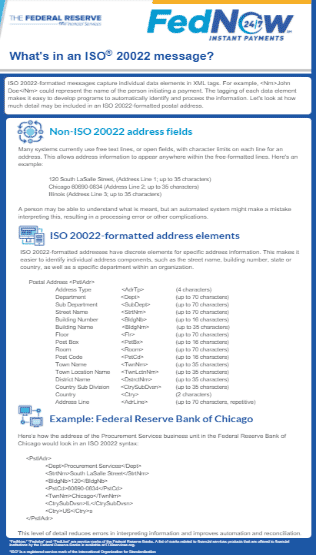
Click on the image to download an example of what's in an ISO 20022 message
The financial services industry’s need for a common “language” is what led the Geneva-based International Organization for Standardization to launch its ISO 20022 (pronounced EYE-SO-TWENTY-OH-TWENTY-TWO) messaging standard in 2004. Within the industry, the ISO 20022 messaging standard is used for business areas such as:
Payments
Securities
Trade services
Cards
Foreign exchange
Financial services organizations in more than 70 countries currently use the ISO 20022 standard, including The Clearing House’s RTP® 1 network, which has used the standard since the payment platform launched in 2017. Additionally, the Federal Reserve’s Fedwire® Funds Service and The Clearing House Interbank Payments System (CHIPS®) are planning to roll out the ISO 20022 standard across their systems.
The benefits of ISO 20022
ISO 20022 messages are vital to instant payments and play an important role in the overall modernization of payment processes. Specifically, they provide a structured and data-rich common language that is readily exchanged among corporates and banking systems. This capability is foundational for innovations like moving from end-of-day batch file processing to real-time payment processing. Additionally, ISO 20022 messages provide the opportunity for enhanced analytics, which can lead to offering valuable new levels of payment services to financial institutions’ customers.
For corporates and financial institutions alike, broad adoption of the ISO format will lead to operational efficiencies, including the ability to exchange detailed remittance information along with a customer payment; support for straight-through processing; and a reduction in errors and the need for manual processing steps.
ISO 20022 and the FedNow® Service
Broad industry adoption of the ISO 20022 messaging standard and the benefits of its highly structured data made it the logical choice for the FedNow Service, the Federal Reserve’s instant payments infrastructure. And because ISO designed the standard to meet the needs of future innovation, it can support the FedNow Service as it evolves and adds capabilities.
The FedNow Service uses a variety of ISO message types, including for customer credit transfers, requests for payment and interbank liquidity transfers, as well as FedNow system and account reporting messages.
Accessing the FedNow ISO 20022 message specifications
Whether you are responsible for your organization’s FedNow Service integration, preparing to build instant payment products leveraging the FedNow Service, or are a payments processor that will help your clients connect to the FedNow platform, now is the time to familiarize yourself with the FedNow ISO 20022 message specifications.
The Federal Reserve is using the MyStandards® 2 platform to provide access to the FedNow ISO 20022 message specifications and accompanying implementation guide. You can access these on the Federal Reserve Financial Services portal (Off-site) under the FedNow Service. Users will need a MyStandards account, which you can create on the SWIFT website (Off-site). View our step-by-step guide for tips on accessing the specifications.
Test your messages on the FedNow ISO 20022 Readiness Portal
Check compliance of your messages with the FedNow Service ISO 20022 implementation guidelines and access test use cases and sample messages on the FedNow ISO 20022 Readiness Portal, hosted on the MyStandards platform (Off-site).
Learn more
For more information about ISO 20022 and what it may mean for you, read this article (Off-site) from the Federal Reserve Bank of Minneapolis.
Stay in the know
Learn more about instant payments and the FedNow Service (Off-site), and sign up to receive regular emails with FedNow news and resources.
Footnotes
1"RTP" is a registered service marks of The Clearing House Payments Company LLC.
2“MyStandards” is a registered trademark of SWIFT.
https://www.frbservices.org/financial-services/fednow/what-is-iso-20022-why-does-it-matter
Seeds of Wisdom RV and Economic Updates Monday Morning 7-14-25
Crypto Week Is Here — What Does It Mean for Stablecoin Regulation?
July 14–18: A Legislative Turning Point for U.S. Digital Assets
The U.S. House will vote from July 14 to 18 on three major crypto bills
The GENIUS stablecoin bill is expected to reach President Trump’s desk by July 18 with bipartisan support
New regulations promise clarity for crypto—but Moody’s questions widespread adoption
The U.S. House of Representatives is preparing to vote on three major pieces of legislation next week that could define the future of digital asset regulation in the United States.
While it may be early to declare victory, all indications suggest that a stablecoin measure could be signed into law by August—a long-standing goal of the Trump administration since February.
Crypto companies have long sought clear regulatory guidance that supports innovation. After years of opposing unfavorable proposals and investing millions into pro-crypto lobbying efforts, the industry may finally see those investments pay off.
Crypto Week: July 14–18
Lawmakers have designated the week of July 14 as “Crypto Week,” with a focus on three high-profile bills:
Crypto Week Is Here — What Does It Mean for Stablecoin Regulation?
July 14–18: A Legislative Turning Point for U.S. Digital Assets
The U.S. House will vote from July 14 to 18 on three major crypto bills
The GENIUS stablecoin bill is expected to reach President Trump’s desk by July 18 with bipartisan support
New regulations promise clarity for crypto—but Moody’s questions widespread adoption
The U.S. House of Representatives is preparing to vote on three major pieces of legislation next week that could define the future of digital asset regulation in the United States.
While it may be early to declare victory, all indications suggest that a stablecoin measure could be signed into law by August—a long-standing goal of the Trump administration since February.
Crypto companies have long sought clear regulatory guidance that supports innovation. After years of opposing unfavorable proposals and investing millions into pro-crypto lobbying efforts, the industry may finally see those investments pay off.
Crypto Week: July 14–18
Lawmakers have designated the week of July 14 as “Crypto Week,” with a focus on three high-profile bills:
The Digital Asset Market Clarity Act of 2025 (Clarity Act)
The GENIUS Act (Guiding and Establishing National Innovation for U.S. Stablecoins)
The Anti-CBDC Surveillance Act
Initially expected to be bundled together, the GENIUS and Clarity Acts will now receive separate votes. The House Rules Committee is scheduled to review each bill on Monday at 4:00 p.m. ET, with strong bipartisan passage likely.
The Clarity Act outlines regulatory responsibilities for the SEC and CFTC. It passed the House Agriculture Committee by a 47–6 vote and the Financial Services Committee by 32–19, indicating strong momentum.
The GENIUS Act would establish the first comprehensive federal framework for stablecoins. Already approved by the Senate, its passage in the House would send it directly to President Trump, likely by Friday, July 18, or the following Monday.
The Anti-CBDC Act seeks to ban the issuance of a U.S. central bank digital currency. A similar version cleared the House in 2024.
Implications for Stablecoins
If these bills become law, it would mark a significant shift in how stablecoins are treated under U.S. financial law. However, regulatory implementation could take time, as detailed rules would need to be developed and adopted by both agencies and businesses.
A recent Moody’s Ratings report noted that while the GENIUS Act could impact the banking system, stablecoins must offer real advantages over current payment systems to achieve widespread use. The report also cautioned that, without strong issuer incentives, adoption may remain limited.
Democratic Concerns: Conflicts of Interest
Not all lawmakers are aligned. Representatives Maxine Waters and Stephen Lynch have raised concerns over potential conflicts of interest tied to President Trump’s personal involvement in crypto.
Waters stated:
“These bills serve as a brazen stamp of approval for the blatant abuse of power we’re witnessing in real time.”
As Crypto Week approaches, ***the next phase of U.S. crypto regulation may be decided in just days—***with stablecoins at the center of it all.
@ Newshounds News™
Source: Cryptopolitan
~~~~~~~~~
ISO 20022 Crypto List: XRP, ADA, and Stellar Ready for Fedwire Shift
Fedwire Adopts ISO 20022 Standard as Blockchain-Based Finance Enters the Mainstream
Fedwire adopts ISO 20022 on July 14, 2025
XRP, Cardano, and Stellar positioned to benefit
Could this be a trigger for a new wave of crypto adoption and price surges?
The U.S. Federal Reserve’s Fedwire system—responsible for trillions in real-time interbank settlements—will go live with the ISO 20022 messaging standard on July 14, 2025. This landmark upgrade sets the stage for a major transformation in global finance, with compliant cryptocurrencies like XRP, Cardano (ADA), and Stellar (XLM) poised to take center stage.
What Is ISO 20022—and Why Does It Matter for Crypto?
ISO 20022 is a new global standard for financial messaging that enables richer data, faster settlement, enhanced security, and better regulatory compliance. Already being adopted by major central banks and institutions worldwide, ISO 20022 forms the backbone of the next-gen financial infrastructure.
For crypto, this means that networks already aligned with the ISO standard may gain a first-mover advantage—especially as traditional financial players seek programmable and compliant blockchain settlement rails.
ISO 20022-Compliant Crypto Projects
CryptoPrimary Use CaseISO 20022 Ready?XRPCross-border banking, liquidity YesStellar (XLM)Stablecoin & fintech infrastructure YesCardano (ADA)Decentralized apps, scalability YesAlgorand (ALGO)Enterprise adoption, low fees YesQuant (QNT)Blockchain interoperability YesHedera (HBAR)Enterprise-grade DLT, speed Yes
XRP and Fedwire: A Natural Fit?
XRP has long been recognized for enabling near-instant cross-border payments. With Fedwire now ISO 20022 compliant, Ripple’s On-Demand Liquidity (ODL) platform becomes even more relevant.
Recent data suggests growing institutional interest:
Spike in XRP wallet creation
Increasing on-chain transaction volume
Large financial institutions prepping for blockchain settlement trials
Should U.S. banks eventually explore XRP for Fedwire-compatible settlement, the impact on adoption and price could be dramatic.
Cardano (ADA) in the ISO 20022 Spotlight
Crypto analyst Dan Gambardello has flagged ADA as one of the few fully compliant blockchains under ISO 20022. With Hydra and Mithril scalability upgrades underway, and a new ADA/USD1 stable trading pair launching on Bitrue, liquidity and demand are rising.
According to market analysts:
Ali Martinez forecasts a rally toward $0.90–$1.20
Price action suggests a bullish breakout supported by increasing volume
Stellar, Algorand, Quant, and Hedera: Gaining Momentum
Stellar (XLM): Low-fee payments and stablecoin issuance on a fintech-friendly chain
Algorand (ALGO): Institutional-grade performance and CBDC trials with multiple central banks
Quant (QNT): Bridges legacy banking systems with blockchain interoperability
Hedera (HBAR): High-speed, secure enterprise network backed by Fortune 500 firms
What’s Next? Blockchain Meets Fedwire
With ISO 20022 officially live on Fedwire, the door is open for compliant crypto platforms to begin integrating into the heart of the global financial system.
Analysts predict:
Accelerated institutional adoption of ISO-aligned cryptos
Bank trials exploring blockchain settlement layers
A new era of crypto-powered payments
Conclusion
The adoption of ISO 20022 by Fedwire is more than a messaging upgrade—it’s a structural shift toward a blockchain-integrated financial future. Projects like XRP, Cardano, and Stellar are not only compliant, they’re strategically positioned to benefit from this transformation.
If XRP or similar assets find their way into actual Fedwire settlement flows, the result could be explosive—both in usage and in price.
@ Newshounds News™
Source: Coinpedia
~~~~~~~~~
Asia’s Tokenization Boom Is Shifting Capital Away from the West
Japan, Hong Kong, and Dubai are driving real-world asset innovation with regulatory clarity and global investor appeal
Asia leads the tokenization race with proactive regulation
Japan, Hong Kong, and Dubai are drawing institutional capital
Tokenized bonds, ETFs, and real estate offerings are gaining momentum
Asia’s leadership in real-world asset (RWA) tokenization is redrawing the global financial map, as regulatory clarity across Japan, Hong Kong, and Dubai pulls capital away from the West, according to Maarten Henskens, Head of Protocol Growth at Startale Group.
“We’re seeing Western institutions set up Asia-Pacific operations not just to follow capital, but to participate in innovation,” Henskens told Cointelegraph. He highlighted that the region’s diverse yet complementary regulatory approaches are creating fertile ground for global investment and experimentation.
Japan: Regulatory Depth Builds Institutional Trust
Japan’s tokenization strategy is marked by careful and deliberate development, prioritizing institutional stability. Henskens pointed to MUFG’s security token infrastructure as a clear sign of how the ecosystem is maturing.
Under Japan’s Payment Services Act (PSA), stablecoins can hold up to 50% of reserves in low-risk government bonds and term deposits, balancing innovation with investor protection.
Hong Kong: Regulatory Agility Enables Fast Innovation
While Japan builds deep infrastructure, Hong Kong has launched the Ensemble Sandbox, a regulatory innovation hub designed to accelerate experimentation in digital assets.
“Japan is building long-term depth, while Hong Kong is showing how agility can bring experimentation to life,” said Henskens, suggesting the region offers both stability and speed—key ingredients for global investor confidence.
Tokenized Bonds and ETFs Fuel RWA Growth
Across Asia, the surge in tokenized bonds and exchange-traded funds (ETFs) is helping traditional investors access crypto-linked opportunities. In Japan, real estate security tokens are opening up previously exclusive markets to retail buyers, outperforming even traditional J-REITs in accessibility.
Tokenization is also simplifying fund administration and improving transparency. “This efficiency, paired with improved transparency, could make these products compelling to traditional investors who might not otherwise enter the crypto space,” Henskens noted.
He emphasized that cross-border interoperability will be the next major leap forward. “Seamless and compliant movement of tokenized assets across jurisdictions is essential for scaling adoption,” he said.
Dubai: A New Epicenter for Tokenized Real Estate
Dubai is fast emerging as another key Asian player in the tokenization landscape. The Virtual Asset Regulatory Authority (VARA) recently updated its frameworks to specifically support RWA tokenization.
According to attorney Irina Heaver, these updates provide a clear regulatory path for launching and trading tokenized real estate. In collaboration with VARA and major developers, the Dubai Land Department recently sold two tokenized apartments, with the offering selling out in minutes. Buyers hailed from over 35 countries, and 70% were first-time real estate investors in Dubai.
A Regional Network Effect Is Underway
“We’re already seeing a network effect,” Henskens said. “Innovation in one jurisdiction sparks progress in another. Different regions may optimize for different outcomes—and that’s a strength, not a liability.”
By building legal and technological bridges across borders, Asia’s tokenization leaders are not only transforming regional finance, but also reshaping global capital flows.
@ Newshounds News™
Source: Cointelegraph
~~~~~~~~~
Russia Begins Mega De-Dollarization Drive for BRICS
Russia has officially launched a mega de-dollarization drive aimed at helping the BRICS alliance move away from reliance on the Western financial system. In an interview with RT, Russian Finance Minister Anton Siluanov stated that the Kremlin could suspend transactions in the U.S. dollar at any moment.
Siluanov emphasized that Russia is actively working to make de-dollarization a central tenet of BRICS policy. He described the U.S. dollar as a “third-party currency” that should be avoided in cross-border trade and financial transactions.
Russia Pushes BRICS to Embrace National Currencies
Siluanov urged BRICS nations to conduct trade using their own national currencies, including the Russian ruble, Chinese yuan, Indian rupee, and South African rand. He argued that these currencies provide a viable alternative to the Western-dominated monetary system.
“Our BRICS de-dollarization drive would not involve Western financial infrastructure or settlement in currencies of those countries that imposed sanctions on Russia and would secure the New Development Bank from possible risks,” Siluanov stated.
The Minister added that Russia is prepared to suspend U.S. dollar trading as part of this initiative. He said Russian systems “have proven their reliability and independence from Western lending institutions that at any moment, as it turned out, can suspend payments.” Even if U.S. sanctions are lifted, Siluanov emphasized that the dollar would not return as the central reserve currency in Russia’s central bank.
Trade Deals Tied to De-Dollarization Commitment
Russia also plans to link new trade agreements within BRICS to the acceleration of de-dollarization. While China and Iran are expected to support the initiative, India, South Africa, and the UAE may hesitate due to their interest in maintaining U.S. dollar-denominated assets that bolster their GDPs and economic growth strategies.
This move underscores Russia’s ambition to solidify an independent financial architecture for BRICS and reduce systemic exposure to Western monetary influence.
@ Newshounds News™
Source: Watcher.Guru
~~~~~~~~~
Seeds of Wisdom Team RV Currency Facts Youtube and Rumble
Newshound's News Telegram Room Link
Follow the Roadmap
Follow the Timeline
Seeds of Wisdom Team™ Website
Thank you Dinar Recaps
“Tidbits From TNT” Monday Morning 7-14-2025
TNT:
Tishwash: An important meeting... Baghdad to resolve the salaries issue tonight
Kurdish media reported on Sunday that the capital, Baghdad, will host an important meeting tonight, attended by Kurdish ministers in the federal government and heads of parliamentary blocs, to discuss and resolve the issue of salaries in the Kurdistan Region.
These outlets quoted their sources as saying, "The meeting will be attended by Justice Minister Khaled Shawani, Foreign Minister Fuad Hussein, Reconstruction Minister Benkin Rikani, Deputy Speaker of the Iraqi Parliament Shakhwan Abdullah, and the head of the Kurdish blocs in parliament."
She added that "the anticipated meeting is being held to take urgent measures to resolve the region's employee salary crisis," stressing that "the Federal Court will hold a special session tomorrow for the same purpose."
TNT:
Tishwash: An important meeting... Baghdad to resolve the salaries issue tonight
Kurdish media reported on Sunday that the capital, Baghdad, will host an important meeting tonight, attended by Kurdish ministers in the federal government and heads of parliamentary blocs, to discuss and resolve the issue of salaries in the Kurdistan Region.
These outlets quoted their sources as saying, "The meeting will be attended by Justice Minister Khaled Shawani, Foreign Minister Fuad Hussein, Reconstruction Minister Benkin Rikani, Deputy Speaker of the Iraqi Parliament Shakhwan Abdullah, and the head of the Kurdish blocs in parliament."
She added that "the anticipated meeting is being held to take urgent measures to resolve the region's employee salary crisis," stressing that "the Federal Court will hold a special session tomorrow for the same purpose." link
Tishwash: Customs discusses with ASYCUDA procedures for unifying the customs system between the central and regional authorities.
The General Authority of Customs discussed, on Sunday, with the ASYCUDA national team and a delegation from the Kurdistan Region of Iraq, the mechanisms for implementing Resolution 270, the application of the 2017 Harmonized System Code, the steps for institutional integration, and the unification of customs procedures between the center and the region.
The Authority indicated that the next phase will witness a direct link and immediate exchange of customs information between the two parties.
The authority said in a statement received by the Iraqi News Agency (INA): "The Director General of the General Authority of Customs, Thamer Qasim Daoud, chaired a joint meeting in Baghdad that included a delegation from the Kurdistan Region Customs, a representative of the Ministry of Interior in the region, and the national team of the ASYCUDA project, to discuss steps for institutional integration and unification of customs procedures between the center and the region."
The statement added, "The meeting discussed the mechanisms for implementing Cabinet Resolution No. (270) of 2024, which is a pivotal station in unifying customs policies, regulating the movement of trade exchange in a manner consistent with applicable laws and enhancing control over customs centers throughout the country."
He continued, "The attendees also discussed the implementation of the 2017 Harmonized System for Data Security (HS Code) at all customs centers, including the region's customs, to facilitate the unification and integration of data between the federally approved ASYCUDA system and the systems operating in the region."
The Director General of the General Authority of Customs confirmed, according to the statement, that "the next phase will witness a direct link and immediate exchange of customs information between the two parties, via a unified technical platform that will contribute to accelerating procedures, raising the level of transparency, and achieving fairness in the evaluation and valuation of goods."
He added, "This move comes as part of the government's program to address economic reform, combat corruption, and reduce the waste of public funds, by building an integrated digital system that ensures standardization, controls the movement of goods, and increases revenues across all customs centers."
He concluded, "During the meeting, it was agreed to form specialized technical teams from both sides to undertake technical coordination and work to overcome challenges, leading to the launch of a unified system across Iraq that supports economic sovereignty and enhances institutional confidence." link
************
Tishwash: 130 laws stalled in Parliament, including conscription, the Federal Court, and the salary scale
On Sunday, July 13, 2025, the Parliamentary Legal Committee revealed the number of laws stalled in the Iraqi Parliament. It indicated that the failure to pass these laws, which include the law on compulsory military service, the Federal Court, and the salary scale, is due to political disagreements.
Committee Chairman Mohammed Anouz told Al-Jabal Platform, "There are more than 130 suspended laws in the Iraqi parliament, some of which have been suspended since previous parliamentary sessions due to political disagreements. These disagreements have deepened during the current session, leading to the continued suspension of these laws, along with the significant and dangerous disruption of sessions and the parliament's oversight role."
Anouz explained that "among the most prominent of these suspended laws are: the Oil and Gas Law, the Popular Mobilization Law, the Military Service Law, the National Oil Company Law, the Federal Civil Service Law, the Slums Law, the Federal Court Law, the Retirement Law, the amendment to the Salary Scale Law, and many others."
Anouz ruled out "passing these laws during the current parliamentary session," citing "ongoing political disagreements over them."
Yesterday, Saturday, the Iraqi Council of Representatives held its first parliamentary session of the final legislative term of the parliament, following the end of the two-month legislative recess.
Today, the Iraqi Parliament announced its intention to hold a new session tomorrow, Monday, to discuss several draft laws, including a report and a proposal to amend the House of Representatives Law.
The session is scheduled to be held at 1:00 PM tomorrow, Monday, according to a statement from the House of Representatives' media department.
The department announced the agenda for the upcoming session, which it indicated will include: "Voting on the Chairman and members of the Federal Service Council, voting on the Chairman of the Council of State, voting on the proposed law amending the first law of the foundations of equivalence of Arab and foreign certificates and degrees No. 20 of 2020, Article 18, and voting on the draft law ratifying the agreement on the encouragement and mutual protection of investment between the government of the Republic of Iraq and the government of the Kingdom of Saudi Arabia, Article 2."
The session will also include, according to the department: “Report and discussion of the second reading of the proposed law amending the first amendment to the Ministry of Education Law No. 22 of 2011, Article 5. Report and discussion (second reading) of the proposed law on environmental protection and improvement.
Report and discussion (second reading) of the draft law on the accession of the Republic of Iraq to the agreement signed on July 28, 1994 regarding the implementation of Part XI of the United Nations Convention on the Law of the Sea. In addition to the report and discussion (second reading) of the proposed amendment to the Law of the Council of Representatives and its formations No. 13 of 2018.”link
************
Mot: . They Always Say -- Get Ur Ducks in a Row – but

Mot: Shopping With Wife

MilitiaMan and Crew: Iraq Dinar News-Understanding the Iraq Dinar & Economic
MilitiaMan and Crew: Iraq Dinar News-Understanding the Iraq Dinar & Economic
8-13-2025
The Crew: Samson, PompeyPeter, Petra, Daytrader, Sunkissed, GIGI and Militia Man
The data tonight that is being put out about Iraq is about understanding the events that have taken place for many years.
The focus has been most relevant over the last few years under Al-Sundani and his Ministerial Committee of Economics.
Current events show this is not like 20 years ago we are talking about, though Iraq has been in the making for more than that. It is about current events. Take a view and enjoy. ~ MM&C
MilitiaMan and Crew: Iraq Dinar News-Understanding the Iraq Dinar & Economic
8-13-2025
The Crew: Samson, PompeyPeter, Petra, Daytrader, Sunkissed, GIGI and Militia Man
The data tonight that is being put out about Iraq is about understanding the events that have taken place for many years.
The focus has been most relevant over the last few years under Al-Sundani and his Ministerial Committee of Economics.
Current events show this is not like 20 years ago we are talking about, though Iraq has been in the making for more than that. It is about current events. Take a view and enjoy. ~ MM&C
Iraq Economic News And Points To Ponder Sunday Evening 7-13-25
Tax Bowl Restoration
Economic 2025/07/14 Abdul Zahra Muhammad Al-Hindawi Ironically, globally, the nations that pay the highest taxes are the ones that enjoy the most luxury living, and the economies of those countries are the most resilient and least affected by the economic shocks that strike the world. Among those countries, for example, are (Finland - Japan - Denmark - Netherlands - Sweden - Austria - Belgium...etc.), as those countries impose high taxes on their citizens, approaching the barrier of (60 percent).
Tax Bowl Restoration
Economic 2025/07/14 Abdul Zahra Muhammad Al-Hindawi Ironically, globally, the nations that pay the highest taxes are the ones that enjoy the most luxury living, and the economies of those countries are the most resilient and least affected by the economic shocks that strike the world. Among those countries, for example, are (Finland - Japan - Denmark - Netherlands - Sweden - Austria - Belgium...etc.), as those countries impose high taxes on their citizens, approaching the barrier of (60 percent).
What is striking is that you do not find any grumbling or discontent with the process of paying taxes.
Everyone is subject to the tax system, and there are no exceptions, because they are ultimately reassured that what they take out of their pockets (taxes) returns to them as services in the field of health, education, social security, and other things.
This reduces the burden of the tax on people’s shoulders! And whoever evades paying taxes quickly finds himself behind bars.
This was almost the fate of Real Madrid coach Ancelotti, who faced a prison sentence of (4) years, due to hiding part of his income from the Spanish tax authorities.
In contrast, countries that do not impose taxes (zero) or impose them at low rates, with the exception of the State of Qatar, have a fragile economy, and their people often suffer from a low level of services.
Iraq is among the countries that impose a low tax rate, with an income tax rate of 15 percent.
Our tax system faces many challenges and problems, which have resulted in its ineffectiveness.
Despite the existence of Income Tax Law No. (113) of 1982 and its amendments,
which is considered one of the best laws,
Iraq is considered one of the countries that suffers from tax evasion, or rather, fraud against the tax authorities. Some of this fraud may be with the knowledge of some of those authorities.
Therefore, we find that the amount of tax revenues achieved is still low,compared to the size of the huge monetary mass circulating in market and commercial transactions, as well as with the expansion of the size of economic activities and the growth of investment companies in all fields, in addition to recording a clear improvement in the level of per capita income, in light of what the street is witnessing of the large number of cars, buildings and investments.
This is in contrast to the fact that the state is still spending huge sums of money on
consumer services, such as electricity, health, education and infrastructure,
in light of the great difficulties facing the general budget, as a result of the limited revenues,
which oil still leads by a far margin over other economic activities.
Therefore, it is necessary to restore the tax base by reconsidering the mechanisms of this system.
We must promote a culture of paying taxes as a duty that must be fulfilled.
Otherwise, penalties await those who evade or refuse to pay, and their fate will be similar to that of Ancelotti. https://alsabaah.iq/117356-.html
The Value Of Gold In Iraq's Precious Metal Reserves Has Increased.
Economy | 07/13/2025 Mawazine News - Baghdad - The Central Bank of Iraq revealed on Sunday an increase in the value of gold in Iraq's foreign currency reserves.
The bank said in an official statistic that the value of gold in Iraq's foreign currency reserves amounted to 22.492 trillion dinars by April, a 5.62% increase compared to March, when the value of gold amounted to 21.228 trillion dinars.
It added that the value of gold also increased by 17.72% compared to December 2024, which amounted to 17.834 trillion dinars, an increase compared to December 2023, when the value of gold amounted to 12.293 trillion dinars.
It is noteworthy that the Central Bank had previously revealed that Iraq's foreign currency reserves at the end of April amounted to 98.089 billion dollars, equivalent to 127.516 trillion dinars. https://www.mawazin.net/Details.aspx?jimare=263754
Dollar Prices Remain Stable In Baghdad
Economy | 05:59 - 07/13/2025 Mawazine News - Baghdad - The dollar exchange rate against the dinar witnessed a noticeable continuation this evening, Sunday, with the closure of the two main stock exchanges.
Selling was 142,000 dinars for every $100. Buying was 140,000 dinars for every $100.
https://www.mawazin.net/Details.aspx?jimare=263766
Governmental move to develop electronic payment systems and financial inclusion
July 12, 2025 Iraq intends to enhance its readiness in the field of digital economy technologies.
Baghdad - Al-Zaman The government is moving towards developing electronic payment systems and financial inclusion in Iraq, through the implementation of several decisions to promote electronic payments.
A government source said in a statement yesterday that, “Since the government assumed its duties more than two and a half years ago, the importance of establishing a strong and effective banking system and increasing financial inclusion has become clear to it.”
Pointing out that "this goal is among its main priorities, as it is one of the main goals in the strategies of countries around the world, given its close connection to the stability and growth of the economy," he said.
Digital Transformation
The source explained that "the government has taken a package of decisions and measures through the Council of Ministers and the Ministerial Council for the Economy, in addition to the committees emanating from them, which include representatives from the government, the Central Bank, and the private sector, to follow up on this matter."
He added that these committees included monitoring the performance of electronic payment, stimulating electronic payment and financial inclusion, digital transformation, and evaluating digital transformation and electronic payment processes in ministries and government institutions.
The digital transformation rate for ministries and local institutions rose to approximately 32 percent, up from less than 18 percent in 2022, representing a growth rate of 78 percent.
A specialized source stated in a statement followed by (Al-Zaman) that (the number of bank accounts reached about 20 million accounts, compared to 8 million accounts in 2022, with a growth rate exceeding 150 percent, and the number of bank cards also rose to 21-22 million cards of all types, credit, debit and prepaid, after it was 16 million cards in the same year, giving a growth rate of 38 percent).
Indicating that the number of point-of-sale devices reached about 62,000 devices, after it was less than 10,000 devices in 2022, with a growth of up to 520 percent.
The number of ATMs reached approximately 7,531, up from 2,223 in the same year, with a growth rate of 239 percent.
The source continued, "Total electronic payments reached approximately 1.37 trillion dinars per month during the current year, while they were less than 90 billion at the end of 2022, with a growth rate of 1,400 percent."
Data indicates that "the financial inclusion rate in Iraq has reached approximately 40 percent, up from less than 10 percent in 2019." Prime Minister Mohammed Shia al-Sudani recently issued a package of future decisions related to a number of important projects in the field of electronic payments, stressing the need to complete them as soon as possible.
The source stated yesterday that (the projects include activating the local card, which is expected to be completed by the end of this year, activating rapid payment, operating the unified electronic collection application, localizing private sector salaries, and establishing a unified center for complaints related to electronic payment transactions at the National Data Center).
The source explained that (the implementation of these projects contributes to moving Iraq to a new stage among the developed countries in this field).
In a related context, Iraq achieved a new digital achievement by advancing in the Information and Communications Technology Development Index (ICT) for the current year, recording 78.4 points compared to 73.9 points last year, according to the annual report of the International Telecommunication Union.
This remarkable progress reflects the efforts of the Ministry of Communications in developing the digital infrastructure and improving the quality of internet services provided to citizens, as part of Iraq's efforts to enhance its digital readiness and keep pace with the global digital transformation path.
Noticeable Improvement
A statement received by Al-Zaman yesterday stated, “This achievement confirms Iraq’s determination to keep pace with the global digital transformation path, which constitutes a pioneering model towards strengthening its position in digital economy technologies, in a way that serves to support innovation and sustainable development.”
It pointed out that “the ministry is proceeding at a rapid pace, which reflects the noticeable improvement in its digital readiness.
” The statement added, “This advancement is the result of the ongoing efforts under the supervision of the Minister of Communications, Hiyam Al-Yasiri, which focused on the importance of developing the digital infrastructure, expanding access to internet services, and improving the quality of services in the field of communications and technology.”
The IDDI index is one of the most prominent international indicators globally adopted to measure the extent of development of the communications and information technology sector, as it relies on indicators of the level of digital use and skills. LINK
For current and reliable Iraqi news please visit: https://www.bondladyscorner.com