
MilitiaMan & Crew: Iraq Dinar News-Salaries-Oil Export-Bank Mergers-resolution-Reforms
MilitiaMan & Crew: Iraq Dinar News-Salaries-Oil Export-Bank Mergers-resolution-Reforms
7-14-2025
The Crew: Samson, PompeyPeter, Petra, Daytrader, Sunkissed, GIGI and Militia Man
In today's video, we dive deep into the latest developments surrounding the Iraqi dinar and its impact on the economy.
Join us as we explore the recent federal court postponements that could influence financial stability and investment opportunities in Iraq.
MilitiaMan & Crew: Iraq Dinar News-Salaries-Oil Export-Bank Mergers-resolution-Reforms
7-14-2025
The Crew: Samson, PompeyPeter, Petra, Daytrader, Sunkissed, GIGI and Militia Man
In today's video, we dive deep into the latest developments surrounding the Iraqi dinar and its impact on the economy.
Join us as we explore the recent federal court postponements that could influence financial stability and investment opportunities in Iraq.
Iraqi Dinar Updates:
What do the latest court decisions mean for the currency's value?
Optimism Around Salary Resolutions: How recent government actions are raising hopes for improved salary payments and economic relief for citizens.
Companies Ready to Resume Exports: Discover how major oil companies are gearing up to restart oil exports, and what this means for Iraq's economy and the dinar's strength.
Bank Mergers and Reforms: We'll discuss the ongoing bank mergers and the structural reforms aimed at modernizing Iraq's banking system.
Banking Structural Reforms: Understanding how these reforms are crucial for stabilizing the economy and fostering investor confidence.
What is ISO® 20022 and why does it matter?
KTFA:
Clare: What is ISO® 20022 and why does it matter?
Looking for information on how to prepare for the Fedwire® Funds Service ISO® 20022 single-day implementation on July 14, 2025? Visit the Fedwire Funds Service ISO 20022 Implementation Center.
What is ISO® 20022 and why does it matter?
Standards are so integrated into our world, it’s easy to forget they exist. Yet it’s standards that allow you to call or text anyone even if they have a different type of phone or carrier than you, or withdraw cash from an ATM not owned by the financial institution that issued your card. In the financial services industry, messaging standards are what make it possible for systems and networks around the world to communicate with each other.
KTFA:
Clare: What is ISO® 20022 and why does it matter?
Looking for information on how to prepare for the Fedwire® Funds Service ISO® 20022 single-day implementation on July 14, 2025? Visit the Fedwire Funds Service ISO 20022 Implementation Center.
What is ISO® 20022 and why does it matter?
Standards are so integrated into our world, it’s easy to forget they exist. Yet it’s standards that allow you to call or text anyone even if they have a different type of phone or carrier than you, or withdraw cash from an ATM not owned by the financial institution that issued your card. In the financial services industry, messaging standards are what make it possible for systems and networks around the world to communicate with each other.
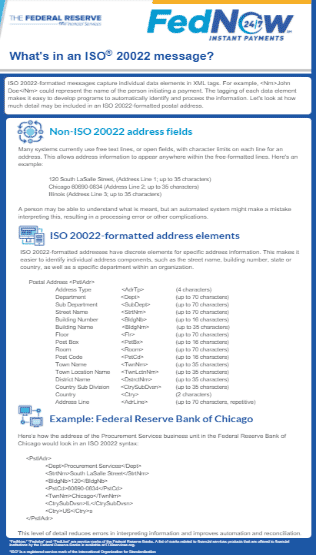
Click on the image to download an example of what's in an ISO 20022 message
The financial services industry’s need for a common “language” is what led the Geneva-based International Organization for Standardization to launch its ISO 20022 (pronounced EYE-SO-TWENTY-OH-TWENTY-TWO) messaging standard in 2004. Within the industry, the ISO 20022 messaging standard is used for business areas such as:
Payments
Securities
Trade services
Cards
Foreign exchange
Financial services organizations in more than 70 countries currently use the ISO 20022 standard, including The Clearing House’s RTP® 1 network, which has used the standard since the payment platform launched in 2017. Additionally, the Federal Reserve’s Fedwire® Funds Service and The Clearing House Interbank Payments System (CHIPS®) are planning to roll out the ISO 20022 standard across their systems.
The benefits of ISO 20022
ISO 20022 messages are vital to instant payments and play an important role in the overall modernization of payment processes. Specifically, they provide a structured and data-rich common language that is readily exchanged among corporates and banking systems. This capability is foundational for innovations like moving from end-of-day batch file processing to real-time payment processing. Additionally, ISO 20022 messages provide the opportunity for enhanced analytics, which can lead to offering valuable new levels of payment services to financial institutions’ customers.
For corporates and financial institutions alike, broad adoption of the ISO format will lead to operational efficiencies, including the ability to exchange detailed remittance information along with a customer payment; support for straight-through processing; and a reduction in errors and the need for manual processing steps.
ISO 20022 and the FedNow® Service
Broad industry adoption of the ISO 20022 messaging standard and the benefits of its highly structured data made it the logical choice for the FedNow Service, the Federal Reserve’s instant payments infrastructure. And because ISO designed the standard to meet the needs of future innovation, it can support the FedNow Service as it evolves and adds capabilities.
The FedNow Service uses a variety of ISO message types, including for customer credit transfers, requests for payment and interbank liquidity transfers, as well as FedNow system and account reporting messages.
Accessing the FedNow ISO 20022 message specifications
Whether you are responsible for your organization’s FedNow Service integration, preparing to build instant payment products leveraging the FedNow Service, or are a payments processor that will help your clients connect to the FedNow platform, now is the time to familiarize yourself with the FedNow ISO 20022 message specifications.
The Federal Reserve is using the MyStandards® 2 platform to provide access to the FedNow ISO 20022 message specifications and accompanying implementation guide. You can access these on the Federal Reserve Financial Services portal (Off-site) under the FedNow Service. Users will need a MyStandards account, which you can create on the SWIFT website (Off-site). View our step-by-step guide for tips on accessing the specifications.
Test your messages on the FedNow ISO 20022 Readiness Portal
Check compliance of your messages with the FedNow Service ISO 20022 implementation guidelines and access test use cases and sample messages on the FedNow ISO 20022 Readiness Portal, hosted on the MyStandards platform (Off-site).
Learn more
For more information about ISO 20022 and what it may mean for you, read this article (Off-site) from the Federal Reserve Bank of Minneapolis.
Stay in the know
Learn more about instant payments and the FedNow Service (Off-site), and sign up to receive regular emails with FedNow news and resources.
Footnotes
1"RTP" is a registered service marks of The Clearing House Payments Company LLC.
2“MyStandards” is a registered trademark of SWIFT.
https://www.frbservices.org/financial-services/fednow/what-is-iso-20022-why-does-it-matter
Seeds of Wisdom RV and Economic Updates Monday Morning 7-14-25
Crypto Week Is Here — What Does It Mean for Stablecoin Regulation?
July 14–18: A Legislative Turning Point for U.S. Digital Assets
The U.S. House will vote from July 14 to 18 on three major crypto bills
The GENIUS stablecoin bill is expected to reach President Trump’s desk by July 18 with bipartisan support
New regulations promise clarity for crypto—but Moody’s questions widespread adoption
The U.S. House of Representatives is preparing to vote on three major pieces of legislation next week that could define the future of digital asset regulation in the United States.
While it may be early to declare victory, all indications suggest that a stablecoin measure could be signed into law by August—a long-standing goal of the Trump administration since February.
Crypto companies have long sought clear regulatory guidance that supports innovation. After years of opposing unfavorable proposals and investing millions into pro-crypto lobbying efforts, the industry may finally see those investments pay off.
Crypto Week: July 14–18
Lawmakers have designated the week of July 14 as “Crypto Week,” with a focus on three high-profile bills:
Crypto Week Is Here — What Does It Mean for Stablecoin Regulation?
July 14–18: A Legislative Turning Point for U.S. Digital Assets
The U.S. House will vote from July 14 to 18 on three major crypto bills
The GENIUS stablecoin bill is expected to reach President Trump’s desk by July 18 with bipartisan support
New regulations promise clarity for crypto—but Moody’s questions widespread adoption
The U.S. House of Representatives is preparing to vote on three major pieces of legislation next week that could define the future of digital asset regulation in the United States.
While it may be early to declare victory, all indications suggest that a stablecoin measure could be signed into law by August—a long-standing goal of the Trump administration since February.
Crypto companies have long sought clear regulatory guidance that supports innovation. After years of opposing unfavorable proposals and investing millions into pro-crypto lobbying efforts, the industry may finally see those investments pay off.
Crypto Week: July 14–18
Lawmakers have designated the week of July 14 as “Crypto Week,” with a focus on three high-profile bills:
The Digital Asset Market Clarity Act of 2025 (Clarity Act)
The GENIUS Act (Guiding and Establishing National Innovation for U.S. Stablecoins)
The Anti-CBDC Surveillance Act
Initially expected to be bundled together, the GENIUS and Clarity Acts will now receive separate votes. The House Rules Committee is scheduled to review each bill on Monday at 4:00 p.m. ET, with strong bipartisan passage likely.
The Clarity Act outlines regulatory responsibilities for the SEC and CFTC. It passed the House Agriculture Committee by a 47–6 vote and the Financial Services Committee by 32–19, indicating strong momentum.
The GENIUS Act would establish the first comprehensive federal framework for stablecoins. Already approved by the Senate, its passage in the House would send it directly to President Trump, likely by Friday, July 18, or the following Monday.
The Anti-CBDC Act seeks to ban the issuance of a U.S. central bank digital currency. A similar version cleared the House in 2024.
Implications for Stablecoins
If these bills become law, it would mark a significant shift in how stablecoins are treated under U.S. financial law. However, regulatory implementation could take time, as detailed rules would need to be developed and adopted by both agencies and businesses.
A recent Moody’s Ratings report noted that while the GENIUS Act could impact the banking system, stablecoins must offer real advantages over current payment systems to achieve widespread use. The report also cautioned that, without strong issuer incentives, adoption may remain limited.
Democratic Concerns: Conflicts of Interest
Not all lawmakers are aligned. Representatives Maxine Waters and Stephen Lynch have raised concerns over potential conflicts of interest tied to President Trump’s personal involvement in crypto.
Waters stated:
“These bills serve as a brazen stamp of approval for the blatant abuse of power we’re witnessing in real time.”
As Crypto Week approaches, ***the next phase of U.S. crypto regulation may be decided in just days—***with stablecoins at the center of it all.
@ Newshounds News™
Source: Cryptopolitan
~~~~~~~~~
ISO 20022 Crypto List: XRP, ADA, and Stellar Ready for Fedwire Shift
Fedwire Adopts ISO 20022 Standard as Blockchain-Based Finance Enters the Mainstream
Fedwire adopts ISO 20022 on July 14, 2025
XRP, Cardano, and Stellar positioned to benefit
Could this be a trigger for a new wave of crypto adoption and price surges?
The U.S. Federal Reserve’s Fedwire system—responsible for trillions in real-time interbank settlements—will go live with the ISO 20022 messaging standard on July 14, 2025. This landmark upgrade sets the stage for a major transformation in global finance, with compliant cryptocurrencies like XRP, Cardano (ADA), and Stellar (XLM) poised to take center stage.
What Is ISO 20022—and Why Does It Matter for Crypto?
ISO 20022 is a new global standard for financial messaging that enables richer data, faster settlement, enhanced security, and better regulatory compliance. Already being adopted by major central banks and institutions worldwide, ISO 20022 forms the backbone of the next-gen financial infrastructure.
For crypto, this means that networks already aligned with the ISO standard may gain a first-mover advantage—especially as traditional financial players seek programmable and compliant blockchain settlement rails.
ISO 20022-Compliant Crypto Projects
CryptoPrimary Use CaseISO 20022 Ready?XRPCross-border banking, liquidity YesStellar (XLM)Stablecoin & fintech infrastructure YesCardano (ADA)Decentralized apps, scalability YesAlgorand (ALGO)Enterprise adoption, low fees YesQuant (QNT)Blockchain interoperability YesHedera (HBAR)Enterprise-grade DLT, speed Yes
XRP and Fedwire: A Natural Fit?
XRP has long been recognized for enabling near-instant cross-border payments. With Fedwire now ISO 20022 compliant, Ripple’s On-Demand Liquidity (ODL) platform becomes even more relevant.
Recent data suggests growing institutional interest:
Spike in XRP wallet creation
Increasing on-chain transaction volume
Large financial institutions prepping for blockchain settlement trials
Should U.S. banks eventually explore XRP for Fedwire-compatible settlement, the impact on adoption and price could be dramatic.
Cardano (ADA) in the ISO 20022 Spotlight
Crypto analyst Dan Gambardello has flagged ADA as one of the few fully compliant blockchains under ISO 20022. With Hydra and Mithril scalability upgrades underway, and a new ADA/USD1 stable trading pair launching on Bitrue, liquidity and demand are rising.
According to market analysts:
Ali Martinez forecasts a rally toward $0.90–$1.20
Price action suggests a bullish breakout supported by increasing volume
Stellar, Algorand, Quant, and Hedera: Gaining Momentum
Stellar (XLM): Low-fee payments and stablecoin issuance on a fintech-friendly chain
Algorand (ALGO): Institutional-grade performance and CBDC trials with multiple central banks
Quant (QNT): Bridges legacy banking systems with blockchain interoperability
Hedera (HBAR): High-speed, secure enterprise network backed by Fortune 500 firms
What’s Next? Blockchain Meets Fedwire
With ISO 20022 officially live on Fedwire, the door is open for compliant crypto platforms to begin integrating into the heart of the global financial system.
Analysts predict:
Accelerated institutional adoption of ISO-aligned cryptos
Bank trials exploring blockchain settlement layers
A new era of crypto-powered payments
Conclusion
The adoption of ISO 20022 by Fedwire is more than a messaging upgrade—it’s a structural shift toward a blockchain-integrated financial future. Projects like XRP, Cardano, and Stellar are not only compliant, they’re strategically positioned to benefit from this transformation.
If XRP or similar assets find their way into actual Fedwire settlement flows, the result could be explosive—both in usage and in price.
@ Newshounds News™
Source: Coinpedia
~~~~~~~~~
Asia’s Tokenization Boom Is Shifting Capital Away from the West
Japan, Hong Kong, and Dubai are driving real-world asset innovation with regulatory clarity and global investor appeal
Asia leads the tokenization race with proactive regulation
Japan, Hong Kong, and Dubai are drawing institutional capital
Tokenized bonds, ETFs, and real estate offerings are gaining momentum
Asia’s leadership in real-world asset (RWA) tokenization is redrawing the global financial map, as regulatory clarity across Japan, Hong Kong, and Dubai pulls capital away from the West, according to Maarten Henskens, Head of Protocol Growth at Startale Group.
“We’re seeing Western institutions set up Asia-Pacific operations not just to follow capital, but to participate in innovation,” Henskens told Cointelegraph. He highlighted that the region’s diverse yet complementary regulatory approaches are creating fertile ground for global investment and experimentation.
Japan: Regulatory Depth Builds Institutional Trust
Japan’s tokenization strategy is marked by careful and deliberate development, prioritizing institutional stability. Henskens pointed to MUFG’s security token infrastructure as a clear sign of how the ecosystem is maturing.
Under Japan’s Payment Services Act (PSA), stablecoins can hold up to 50% of reserves in low-risk government bonds and term deposits, balancing innovation with investor protection.
Hong Kong: Regulatory Agility Enables Fast Innovation
While Japan builds deep infrastructure, Hong Kong has launched the Ensemble Sandbox, a regulatory innovation hub designed to accelerate experimentation in digital assets.
“Japan is building long-term depth, while Hong Kong is showing how agility can bring experimentation to life,” said Henskens, suggesting the region offers both stability and speed—key ingredients for global investor confidence.
Tokenized Bonds and ETFs Fuel RWA Growth
Across Asia, the surge in tokenized bonds and exchange-traded funds (ETFs) is helping traditional investors access crypto-linked opportunities. In Japan, real estate security tokens are opening up previously exclusive markets to retail buyers, outperforming even traditional J-REITs in accessibility.
Tokenization is also simplifying fund administration and improving transparency. “This efficiency, paired with improved transparency, could make these products compelling to traditional investors who might not otherwise enter the crypto space,” Henskens noted.
He emphasized that cross-border interoperability will be the next major leap forward. “Seamless and compliant movement of tokenized assets across jurisdictions is essential for scaling adoption,” he said.
Dubai: A New Epicenter for Tokenized Real Estate
Dubai is fast emerging as another key Asian player in the tokenization landscape. The Virtual Asset Regulatory Authority (VARA) recently updated its frameworks to specifically support RWA tokenization.
According to attorney Irina Heaver, these updates provide a clear regulatory path for launching and trading tokenized real estate. In collaboration with VARA and major developers, the Dubai Land Department recently sold two tokenized apartments, with the offering selling out in minutes. Buyers hailed from over 35 countries, and 70% were first-time real estate investors in Dubai.
A Regional Network Effect Is Underway
“We’re already seeing a network effect,” Henskens said. “Innovation in one jurisdiction sparks progress in another. Different regions may optimize for different outcomes—and that’s a strength, not a liability.”
By building legal and technological bridges across borders, Asia’s tokenization leaders are not only transforming regional finance, but also reshaping global capital flows.
@ Newshounds News™
Source: Cointelegraph
~~~~~~~~~
Russia Begins Mega De-Dollarization Drive for BRICS
Russia has officially launched a mega de-dollarization drive aimed at helping the BRICS alliance move away from reliance on the Western financial system. In an interview with RT, Russian Finance Minister Anton Siluanov stated that the Kremlin could suspend transactions in the U.S. dollar at any moment.
Siluanov emphasized that Russia is actively working to make de-dollarization a central tenet of BRICS policy. He described the U.S. dollar as a “third-party currency” that should be avoided in cross-border trade and financial transactions.
Russia Pushes BRICS to Embrace National Currencies
Siluanov urged BRICS nations to conduct trade using their own national currencies, including the Russian ruble, Chinese yuan, Indian rupee, and South African rand. He argued that these currencies provide a viable alternative to the Western-dominated monetary system.
“Our BRICS de-dollarization drive would not involve Western financial infrastructure or settlement in currencies of those countries that imposed sanctions on Russia and would secure the New Development Bank from possible risks,” Siluanov stated.
The Minister added that Russia is prepared to suspend U.S. dollar trading as part of this initiative. He said Russian systems “have proven their reliability and independence from Western lending institutions that at any moment, as it turned out, can suspend payments.” Even if U.S. sanctions are lifted, Siluanov emphasized that the dollar would not return as the central reserve currency in Russia’s central bank.
Trade Deals Tied to De-Dollarization Commitment
Russia also plans to link new trade agreements within BRICS to the acceleration of de-dollarization. While China and Iran are expected to support the initiative, India, South Africa, and the UAE may hesitate due to their interest in maintaining U.S. dollar-denominated assets that bolster their GDPs and economic growth strategies.
This move underscores Russia’s ambition to solidify an independent financial architecture for BRICS and reduce systemic exposure to Western monetary influence.
@ Newshounds News™
Source: Watcher.Guru
~~~~~~~~~
Seeds of Wisdom Team RV Currency Facts Youtube and Rumble
Newshound's News Telegram Room Link
Follow the Roadmap
Follow the Timeline
Seeds of Wisdom Team™ Website
Thank you Dinar Recaps
“Tidbits From TNT” Monday Morning 7-14-2025
TNT:
Tishwash: An important meeting... Baghdad to resolve the salaries issue tonight
Kurdish media reported on Sunday that the capital, Baghdad, will host an important meeting tonight, attended by Kurdish ministers in the federal government and heads of parliamentary blocs, to discuss and resolve the issue of salaries in the Kurdistan Region.
These outlets quoted their sources as saying, "The meeting will be attended by Justice Minister Khaled Shawani, Foreign Minister Fuad Hussein, Reconstruction Minister Benkin Rikani, Deputy Speaker of the Iraqi Parliament Shakhwan Abdullah, and the head of the Kurdish blocs in parliament."
She added that "the anticipated meeting is being held to take urgent measures to resolve the region's employee salary crisis," stressing that "the Federal Court will hold a special session tomorrow for the same purpose."
TNT:
Tishwash: An important meeting... Baghdad to resolve the salaries issue tonight
Kurdish media reported on Sunday that the capital, Baghdad, will host an important meeting tonight, attended by Kurdish ministers in the federal government and heads of parliamentary blocs, to discuss and resolve the issue of salaries in the Kurdistan Region.
These outlets quoted their sources as saying, "The meeting will be attended by Justice Minister Khaled Shawani, Foreign Minister Fuad Hussein, Reconstruction Minister Benkin Rikani, Deputy Speaker of the Iraqi Parliament Shakhwan Abdullah, and the head of the Kurdish blocs in parliament."
She added that "the anticipated meeting is being held to take urgent measures to resolve the region's employee salary crisis," stressing that "the Federal Court will hold a special session tomorrow for the same purpose." link
Tishwash: Customs discusses with ASYCUDA procedures for unifying the customs system between the central and regional authorities.
The General Authority of Customs discussed, on Sunday, with the ASYCUDA national team and a delegation from the Kurdistan Region of Iraq, the mechanisms for implementing Resolution 270, the application of the 2017 Harmonized System Code, the steps for institutional integration, and the unification of customs procedures between the center and the region.
The Authority indicated that the next phase will witness a direct link and immediate exchange of customs information between the two parties.
The authority said in a statement received by the Iraqi News Agency (INA): "The Director General of the General Authority of Customs, Thamer Qasim Daoud, chaired a joint meeting in Baghdad that included a delegation from the Kurdistan Region Customs, a representative of the Ministry of Interior in the region, and the national team of the ASYCUDA project, to discuss steps for institutional integration and unification of customs procedures between the center and the region."
The statement added, "The meeting discussed the mechanisms for implementing Cabinet Resolution No. (270) of 2024, which is a pivotal station in unifying customs policies, regulating the movement of trade exchange in a manner consistent with applicable laws and enhancing control over customs centers throughout the country."
He continued, "The attendees also discussed the implementation of the 2017 Harmonized System for Data Security (HS Code) at all customs centers, including the region's customs, to facilitate the unification and integration of data between the federally approved ASYCUDA system and the systems operating in the region."
The Director General of the General Authority of Customs confirmed, according to the statement, that "the next phase will witness a direct link and immediate exchange of customs information between the two parties, via a unified technical platform that will contribute to accelerating procedures, raising the level of transparency, and achieving fairness in the evaluation and valuation of goods."
He added, "This move comes as part of the government's program to address economic reform, combat corruption, and reduce the waste of public funds, by building an integrated digital system that ensures standardization, controls the movement of goods, and increases revenues across all customs centers."
He concluded, "During the meeting, it was agreed to form specialized technical teams from both sides to undertake technical coordination and work to overcome challenges, leading to the launch of a unified system across Iraq that supports economic sovereignty and enhances institutional confidence." link
************
Tishwash: 130 laws stalled in Parliament, including conscription, the Federal Court, and the salary scale
On Sunday, July 13, 2025, the Parliamentary Legal Committee revealed the number of laws stalled in the Iraqi Parliament. It indicated that the failure to pass these laws, which include the law on compulsory military service, the Federal Court, and the salary scale, is due to political disagreements.
Committee Chairman Mohammed Anouz told Al-Jabal Platform, "There are more than 130 suspended laws in the Iraqi parliament, some of which have been suspended since previous parliamentary sessions due to political disagreements. These disagreements have deepened during the current session, leading to the continued suspension of these laws, along with the significant and dangerous disruption of sessions and the parliament's oversight role."
Anouz explained that "among the most prominent of these suspended laws are: the Oil and Gas Law, the Popular Mobilization Law, the Military Service Law, the National Oil Company Law, the Federal Civil Service Law, the Slums Law, the Federal Court Law, the Retirement Law, the amendment to the Salary Scale Law, and many others."
Anouz ruled out "passing these laws during the current parliamentary session," citing "ongoing political disagreements over them."
Yesterday, Saturday, the Iraqi Council of Representatives held its first parliamentary session of the final legislative term of the parliament, following the end of the two-month legislative recess.
Today, the Iraqi Parliament announced its intention to hold a new session tomorrow, Monday, to discuss several draft laws, including a report and a proposal to amend the House of Representatives Law.
The session is scheduled to be held at 1:00 PM tomorrow, Monday, according to a statement from the House of Representatives' media department.
The department announced the agenda for the upcoming session, which it indicated will include: "Voting on the Chairman and members of the Federal Service Council, voting on the Chairman of the Council of State, voting on the proposed law amending the first law of the foundations of equivalence of Arab and foreign certificates and degrees No. 20 of 2020, Article 18, and voting on the draft law ratifying the agreement on the encouragement and mutual protection of investment between the government of the Republic of Iraq and the government of the Kingdom of Saudi Arabia, Article 2."
The session will also include, according to the department: “Report and discussion of the second reading of the proposed law amending the first amendment to the Ministry of Education Law No. 22 of 2011, Article 5. Report and discussion (second reading) of the proposed law on environmental protection and improvement.
Report and discussion (second reading) of the draft law on the accession of the Republic of Iraq to the agreement signed on July 28, 1994 regarding the implementation of Part XI of the United Nations Convention on the Law of the Sea. In addition to the report and discussion (second reading) of the proposed amendment to the Law of the Council of Representatives and its formations No. 13 of 2018.”link
************
Mot: . They Always Say -- Get Ur Ducks in a Row – but

Mot: Shopping With Wife

MilitiaMan and Crew: Iraq Dinar News-Understanding the Iraq Dinar & Economic
MilitiaMan and Crew: Iraq Dinar News-Understanding the Iraq Dinar & Economic
8-13-2025
The Crew: Samson, PompeyPeter, Petra, Daytrader, Sunkissed, GIGI and Militia Man
The data tonight that is being put out about Iraq is about understanding the events that have taken place for many years.
The focus has been most relevant over the last few years under Al-Sundani and his Ministerial Committee of Economics.
Current events show this is not like 20 years ago we are talking about, though Iraq has been in the making for more than that. It is about current events. Take a view and enjoy. ~ MM&C
MilitiaMan and Crew: Iraq Dinar News-Understanding the Iraq Dinar & Economic
8-13-2025
The Crew: Samson, PompeyPeter, Petra, Daytrader, Sunkissed, GIGI and Militia Man
The data tonight that is being put out about Iraq is about understanding the events that have taken place for many years.
The focus has been most relevant over the last few years under Al-Sundani and his Ministerial Committee of Economics.
Current events show this is not like 20 years ago we are talking about, though Iraq has been in the making for more than that. It is about current events. Take a view and enjoy. ~ MM&C
Iraq Economic News And Points To Ponder Sunday Evening 7-13-25
Tax Bowl Restoration
Economic 2025/07/14 Abdul Zahra Muhammad Al-Hindawi Ironically, globally, the nations that pay the highest taxes are the ones that enjoy the most luxury living, and the economies of those countries are the most resilient and least affected by the economic shocks that strike the world. Among those countries, for example, are (Finland - Japan - Denmark - Netherlands - Sweden - Austria - Belgium...etc.), as those countries impose high taxes on their citizens, approaching the barrier of (60 percent).
Tax Bowl Restoration
Economic 2025/07/14 Abdul Zahra Muhammad Al-Hindawi Ironically, globally, the nations that pay the highest taxes are the ones that enjoy the most luxury living, and the economies of those countries are the most resilient and least affected by the economic shocks that strike the world. Among those countries, for example, are (Finland - Japan - Denmark - Netherlands - Sweden - Austria - Belgium...etc.), as those countries impose high taxes on their citizens, approaching the barrier of (60 percent).
What is striking is that you do not find any grumbling or discontent with the process of paying taxes.
Everyone is subject to the tax system, and there are no exceptions, because they are ultimately reassured that what they take out of their pockets (taxes) returns to them as services in the field of health, education, social security, and other things.
This reduces the burden of the tax on people’s shoulders! And whoever evades paying taxes quickly finds himself behind bars.
This was almost the fate of Real Madrid coach Ancelotti, who faced a prison sentence of (4) years, due to hiding part of his income from the Spanish tax authorities.
In contrast, countries that do not impose taxes (zero) or impose them at low rates, with the exception of the State of Qatar, have a fragile economy, and their people often suffer from a low level of services.
Iraq is among the countries that impose a low tax rate, with an income tax rate of 15 percent.
Our tax system faces many challenges and problems, which have resulted in its ineffectiveness.
Despite the existence of Income Tax Law No. (113) of 1982 and its amendments,
which is considered one of the best laws,
Iraq is considered one of the countries that suffers from tax evasion, or rather, fraud against the tax authorities. Some of this fraud may be with the knowledge of some of those authorities.
Therefore, we find that the amount of tax revenues achieved is still low,compared to the size of the huge monetary mass circulating in market and commercial transactions, as well as with the expansion of the size of economic activities and the growth of investment companies in all fields, in addition to recording a clear improvement in the level of per capita income, in light of what the street is witnessing of the large number of cars, buildings and investments.
This is in contrast to the fact that the state is still spending huge sums of money on
consumer services, such as electricity, health, education and infrastructure,
in light of the great difficulties facing the general budget, as a result of the limited revenues,
which oil still leads by a far margin over other economic activities.
Therefore, it is necessary to restore the tax base by reconsidering the mechanisms of this system.
We must promote a culture of paying taxes as a duty that must be fulfilled.
Otherwise, penalties await those who evade or refuse to pay, and their fate will be similar to that of Ancelotti. https://alsabaah.iq/117356-.html
The Value Of Gold In Iraq's Precious Metal Reserves Has Increased.
Economy | 07/13/2025 Mawazine News - Baghdad - The Central Bank of Iraq revealed on Sunday an increase in the value of gold in Iraq's foreign currency reserves.
The bank said in an official statistic that the value of gold in Iraq's foreign currency reserves amounted to 22.492 trillion dinars by April, a 5.62% increase compared to March, when the value of gold amounted to 21.228 trillion dinars.
It added that the value of gold also increased by 17.72% compared to December 2024, which amounted to 17.834 trillion dinars, an increase compared to December 2023, when the value of gold amounted to 12.293 trillion dinars.
It is noteworthy that the Central Bank had previously revealed that Iraq's foreign currency reserves at the end of April amounted to 98.089 billion dollars, equivalent to 127.516 trillion dinars. https://www.mawazin.net/Details.aspx?jimare=263754
Dollar Prices Remain Stable In Baghdad
Economy | 05:59 - 07/13/2025 Mawazine News - Baghdad - The dollar exchange rate against the dinar witnessed a noticeable continuation this evening, Sunday, with the closure of the two main stock exchanges.
Selling was 142,000 dinars for every $100. Buying was 140,000 dinars for every $100.
https://www.mawazin.net/Details.aspx?jimare=263766
Governmental move to develop electronic payment systems and financial inclusion
July 12, 2025 Iraq intends to enhance its readiness in the field of digital economy technologies.
Baghdad - Al-Zaman The government is moving towards developing electronic payment systems and financial inclusion in Iraq, through the implementation of several decisions to promote electronic payments.
A government source said in a statement yesterday that, “Since the government assumed its duties more than two and a half years ago, the importance of establishing a strong and effective banking system and increasing financial inclusion has become clear to it.”
Pointing out that "this goal is among its main priorities, as it is one of the main goals in the strategies of countries around the world, given its close connection to the stability and growth of the economy," he said.
Digital Transformation
The source explained that "the government has taken a package of decisions and measures through the Council of Ministers and the Ministerial Council for the Economy, in addition to the committees emanating from them, which include representatives from the government, the Central Bank, and the private sector, to follow up on this matter."
He added that these committees included monitoring the performance of electronic payment, stimulating electronic payment and financial inclusion, digital transformation, and evaluating digital transformation and electronic payment processes in ministries and government institutions.
The digital transformation rate for ministries and local institutions rose to approximately 32 percent, up from less than 18 percent in 2022, representing a growth rate of 78 percent.
A specialized source stated in a statement followed by (Al-Zaman) that (the number of bank accounts reached about 20 million accounts, compared to 8 million accounts in 2022, with a growth rate exceeding 150 percent, and the number of bank cards also rose to 21-22 million cards of all types, credit, debit and prepaid, after it was 16 million cards in the same year, giving a growth rate of 38 percent).
Indicating that the number of point-of-sale devices reached about 62,000 devices, after it was less than 10,000 devices in 2022, with a growth of up to 520 percent.
The number of ATMs reached approximately 7,531, up from 2,223 in the same year, with a growth rate of 239 percent.
The source continued, "Total electronic payments reached approximately 1.37 trillion dinars per month during the current year, while they were less than 90 billion at the end of 2022, with a growth rate of 1,400 percent."
Data indicates that "the financial inclusion rate in Iraq has reached approximately 40 percent, up from less than 10 percent in 2019." Prime Minister Mohammed Shia al-Sudani recently issued a package of future decisions related to a number of important projects in the field of electronic payments, stressing the need to complete them as soon as possible.
The source stated yesterday that (the projects include activating the local card, which is expected to be completed by the end of this year, activating rapid payment, operating the unified electronic collection application, localizing private sector salaries, and establishing a unified center for complaints related to electronic payment transactions at the National Data Center).
The source explained that (the implementation of these projects contributes to moving Iraq to a new stage among the developed countries in this field).
In a related context, Iraq achieved a new digital achievement by advancing in the Information and Communications Technology Development Index (ICT) for the current year, recording 78.4 points compared to 73.9 points last year, according to the annual report of the International Telecommunication Union.
This remarkable progress reflects the efforts of the Ministry of Communications in developing the digital infrastructure and improving the quality of internet services provided to citizens, as part of Iraq's efforts to enhance its digital readiness and keep pace with the global digital transformation path.
Noticeable Improvement
A statement received by Al-Zaman yesterday stated, “This achievement confirms Iraq’s determination to keep pace with the global digital transformation path, which constitutes a pioneering model towards strengthening its position in digital economy technologies, in a way that serves to support innovation and sustainable development.”
It pointed out that “the ministry is proceeding at a rapid pace, which reflects the noticeable improvement in its digital readiness.
” The statement added, “This advancement is the result of the ongoing efforts under the supervision of the Minister of Communications, Hiyam Al-Yasiri, which focused on the importance of developing the digital infrastructure, expanding access to internet services, and improving the quality of services in the field of communications and technology.”
The IDDI index is one of the most prominent international indicators globally adopted to measure the extent of development of the communications and information technology sector, as it relies on indicators of the level of digital use and skills. LINK
For current and reliable Iraqi news please visit: https://www.bondladyscorner.com
Iraq Economic News And Points To Ponder Sunday Afternoon 7-13-25
Financial Expert: The Dollar's Stability Depends On Calm Abroad And The US Federal Reserve
Time: 2025/07/13 Reading: 315 times {Economic: Al Furat News} Financial expert Salah Nouri confirmed that the stability of the dollar exchange rate in the local market depends largely on the policies of the Central Bank of Iraq. Nouri told Furat News that "the internal economic situation is moving in a direction that provides a kind of balance in the exchange market, thanks to the measures of the Central Bank."
Financial Expert: The Dollar's Stability Depends On Calm Abroad And The US Federal Reserve
Time: 2025/07/13 Reading: 315 times {Economic: Al Furat News} Financial expert Salah Nouri confirmed that the stability of the dollar exchange rate in the local market depends largely on the policies of the Central Bank of Iraq. Nouri told Furat News that "the internal economic situation is moving in a direction that provides a kind of balance in the exchange market, thanks to the measures of the Central Bank."
However, he pointed out that "external factors such as developments in the security situation in the region and the policies of the US Federal Reserve (the US central bank) still cast a shadow over market activity and could lead to potential changes towards an increase in the exchange rate in the future."
Nouri explained that "any external escalation or sudden change in global monetary policies could quickly be reflected in the financial markets in Iraq."
The selling price in exchange shops in the local markets in Baghdad reached 142,000 dinars for $100, while the buying price reached 140,000 dinars for $100.
In Erbil, the selling price reached 140,850 dinars for $100, and the buying price was 140,750 dinars for $100. LINK
The Iraqi Chamber Of Commerce Wins The Best Committees Award In The World
July 13, 2025 Baghdad - Ibtihal Al-Arabi The International Chamber of Commerce (ICC) has awarded the Iraqi Chamber of Commerce the award for the best performing national committees worldwide.
The Federation of Iraqi Chambers of Commerce (FICC) stated in a statement yesterday that, "In a qualitative achievement, the ICC has honored the Iraqi Chamber of Commerce with an award given to the best performing national committees worldwide," noting that "this honor comes as a result of the efficient and effective implementation of the annual plan for 2024-2025, reflecting Iraq's commitment to strengthening its international position on the global trade map."
International Trade
He added, "On the sidelines of the annual week, the first anniversary of Iraq's official accession to the International Chamber of Commerce was celebrated, an important step towards building strategic partnerships and enhancing the business environment in Iraq."
The International Chamber of Commerce (ICC) was founded in 1919 in Paris, and Iraq obtained full membership in 2024.
It is noteworthy that Iraq - the Iraqi National Committee of the International Chamber of Commerce - participated in the annual week of the International Chamber of Commerce in Paris, from June 17 to 20, which was attended by more than 60 countries from various national committees from around the world.
The annual week included several activities, including the World Trade Policy Conference, the World National Committees Strategies Day, specialized workshops on arbitration and the Agri-Food Initiative, the annual meeting of the World Council of the International Chamber of Commerce, a workshop on the Center for International Entrepreneurship, and the regional meeting for the West Asia and North Africa region.
The Ministry of Foreign Affairs, represented by the Iraqi Embassy in Paris and the Ministry of Trade - Department of Foreign Economic Relations, supported Iraq's accession to the International Chamber of Commerce and continues to monitor the activities of the Iraqi National Committee's program for the International Chamber of Commerce. LINK
Integrity Commission Arrests Former Government Bank Manager In Maysan For Embezzling Nearly A Quarter Of A Trillion Dinars]
Buratha News Agency 17920 25-07-13 Today, Sunday (July 13, 2025), the Federal Integrity Commission was able to arrest a former official at a government bank in Maysan, on charges of embezzlement, damage, and squandering public funds amounting to nearly a quarter of a trillion dinars.
In a statement, the Authority said that its efforts to track the movements of the fugitive convict (Ebtisam Kamel Nasser), the former director of the Agricultural Bank, supported by the information it received, resulted in locating her place of residence after extensive searches and investigations.
The Commission noted that "the team, composed of the Maysan Investigation Office, was able, after moving to the convict's residence in the Al-Zubair district in Basra, to arrest her and execute the arrest warrant issued against her, with the support of the technical efforts of the Falcons Intelligence Cell," noting that "a formal report was prepared regarding the operation and presented, along with the accused, to the competent courts in Maysan Governorate."
She continued, referring to “the cases in which the convict was convicted, as the competent court - after reviewing the evidence and proof in the cases it considered and found them sufficient and convincing to convict her - had previously sentenced her in absentia to imprisonment in accordance with the requirements of Article (316) of the Penal Code.”
The Commission added that "the total sentences issued against the convict amounted to (37) years in prison, while the total amounts that the court of subject matter ruled to return in those cases amounted to (211,737,649,265) two hundred and eleven billion dinars," noting that "there are (10) other cases under investigation against her." https://burathanews.com/arabic/news/462672
Government Advisor: US Tariffs Are An Opportunity To Activate The Joint Agreement
Money and Business Economy News – Baghdad The Prime Minister's Advisor for Investment Affairs, Mohammed al-Najjar, affirmed on Sunday that the recent US tariffs imposed on Iraqi products represent an opportunity to activate the joint economic agreement between the two countries, while noting that they do not affect the volume of trade exchange.
Al-Najjar said, "The customs duties imposed by the United States on Iraqi products can be transformed from a challenge into a real opportunity to support the national economy and enhance joint cooperation."
He explained that "the new customs duties do not currently have a direct impact on the volume of trade between Iraq and the United States, given that Iraqi exports to the United States primarily rely on oil, which is not subject to such duties."
He noted that "if Iraq diversifies its exports in the future, the impact will be significant, which calls for investing in this step to strengthen economic dialogue between the two countries."
He added, "These developments represent an opportunity to activate the provisions of the Iraq-US Framework Agreement, the economic aspects of which have not yet been implemented due to US producers' lack of familiarity with the Iraqi market compared to markets in Asia, Latin America, and Europe, in addition to the challenges facing Iraqi importers, such as high transportation costs, difficulty obtaining visas, and weak direct transportation routes."
Al-Najjar explained that "the Iraq Development Fund, whose idea was proposed about seven months ago in cooperation with the American side, is considered one of the important tools for encouraging trade exchange and joint investment," noting that "there is a response from American authorities to this approach."
He stressed that "work is underway to reach advanced stages in establishing this fund, which will provide a direct channel linking Iraqi importers with American products and, in turn, enable American investors to enter the Iraqi market."
He stated, "We view these developments as an important opportunity to strengthen the national economy and open broader horizons for cooperation and partnership between Iraq and the United States, in a way that serves the interests of both parties." https://economy-news.net/content.php?id=57308
Iraq Surpasses Saudi Arabia In Oil Exports To The US
Economy | 07/13/2025 Mawazine News - Follow-up The US Energy Information Administration announced, on Sunday, a decline in Iraqi oil exports to the United States during the past week.
The administration said in a statistic reviewed by Mawazine News, that "the average US imports of crude oil during the past week from 10 major countries amounted to 5.416 million barrels per day, a decrease of 772 thousand barrels per day compared to the previous week, which averaged 6.188 million barrels per day."
It added that "Iraq's oil exports to the United States amounted to an average of 164 thousand barrels per day, a decrease of 48 thousand barrels per day compared to the previous week, which averaged 212 thousand barrels per day. "
The administration also indicated that "the largest oil revenues to the United States during the past week came from Canada, at an average of 3.766 million barrels per day, followed by Ecuador at an average of 441 thousand barrels per day, followed by Mexico at an average of 414 thousand barrels, from Brazil at an average of 231 thousand barrels per day, and from Saudi Arabia at an average of 148 thousand barrels per day."
According to the table, "US crude oil imports from Colombia averaged 124,000 barrels per day, from Libya 90,000 barrels per day, from Nigeria 38,000 barrels, and from Venezuela 25,000 barrels per day." https://www.mawazin.net/Details.aspx?jimare=263746
For current and reliable Iraqi news please visit: https://www.bondladyscorner.com
Seeds of Wisdom RV and Economic Updates Sunday Afternoon 7-13-25
Good Afternoon Dinar Recaps,
BRICS Moves to Local Currency Trading: Is the BRICS Currency Dead?
In a notable shift from earlier ambitions, BRICS member states have opted to expand trade settlements in local currencies, shelving plans for a unified BRICS currency—at least for now. The topic was not on the agenda at the 17th BRICS summit held on July 6–7, and Brazil’s Ambassador to India, Kenneth Felix Haczynski da Nobrega, has since confirmed that no BRICS currency is being planned to challenge the U.S. dollar.
Good Afternoon Dinar Recaps,
BRICS Moves to Local Currency Trading: Is the BRICS Currency Dead?
In a notable shift from earlier ambitions, BRICS member states have opted to expand trade settlements in local currencies, shelving plans for a unified BRICS currency—at least for now. The topic was not on the agenda at the 17th BRICS summit held on July 6–7, and Brazil’s Ambassador to India, Kenneth Felix Haczynski da Nobrega, has since confirmed that no BRICS currency is being planned to challenge the U.S. dollar.
Local Currencies Rise, While BRICS Currency Stalls
According to Egyptian Prime Minister Mostafa Madbouly, local currency usage among BRICS countries is steadily growing, with bilateral settlements already in motion. This de-dollarization strategy is aimed at easing foreign exchange pressures and fostering more balanced trade relationships within the bloc.
“The BRICS group is moving toward wider implementation of local currency trade, starting bilaterally and potentially expanding to multilateral use,” said Madbouly.
Despite earlier rhetoric—particularly from Russia, one of the strongest proponents of a new BRICS currency—the bloc appears to be postponing plans for a common tender. The reason? A lack of regulatory and legal infrastructure to support such an ambitious initiative, along with doubts about whether a new currency could gain the international trust needed to thrive in global forex markets.
De-Dollarization Quietly Advances Without New Currency
While de-dollarization remains a major theme for the alliance, the 2025 summit largely avoided direct discussions about launching a BRICS currency. Analysts believe this cautious approach reflects both internal political dynamics—including Russia’s evolving relationship with U.S. President Donald Trump—and the complexities involved in forming a transnational currency system.
Although the BRICS currency proposal continues to resurface in policy circles and media narratives, member states appear more interested in the pragmatic benefits of local currency settlements than in the speculative risks of launching a new monetary instrument.
Conclusion: Strategic Pause, Not Permanent Retreat
For now, BRICS is prioritizing incremental financial integration through national currencies rather than leaping into the unknown with a new unified currency. However, the door remains open. As Ambassador da Nobrega suggested, the idea isn’t dead—just deferred.
The path forward may involve strengthening bilateral arrangements, building regulatory consensus, and gradually laying the groundwork for a unified financial alternative to the dollar-dominated system—should geopolitical conditions and internal cohesion align in the future.
@ Newshounds News™
Source: Watcher.Guru
~~~~~~~~~
Seeds of Wisdom Team RV Currency Facts Youtube and Rumble
Newshound's News Telegram Room Link
Follow the Roadmap
Follow the Timeline
Seeds of Wisdom Team™ Website
Thank you Dinar Recaps
“Tidbits From TNT” Sunday 7-13-2025
TNT:
Tishwash: Al-Sudani receives the US Chargé d'Affaires to discuss bilateral relations and the regional situation.
Prime Minister Mohammed Shia Al-Sudani received, today, Sunday (July 13, 2025), the US Chargé d'Affaires to Iraq to discuss bilateral relations and the regional situation.
Al-Sudani's media office stated in a statement received by Baghdad Today that "the latter received the Chargé d'Affaires of the United States Embassy in Iraq, Stephen Fagin, where they discussed bilateral relations between the two countries and reviewed the most prominent files of joint cooperation in various fields."
TNT:
Tishwash: Al-Sudani receives the US Chargé d'Affaires to discuss bilateral relations and the regional situation.
Prime Minister Mohammed Shia Al-Sudani received, today, Sunday (July 13, 2025), the US Chargé d'Affaires to Iraq to discuss bilateral relations and the regional situation.
Al-Sudani's media office stated in a statement received by Baghdad Today that "the latter received the Chargé d'Affaires of the United States Embassy in Iraq, Stephen Fagin, where they discussed bilateral relations between the two countries and reviewed the most prominent files of joint cooperation in various fields."
The statement added that "the meeting discussed the overall situation in the region and the need for the international community to take immediate steps to prevent the region from sliding into a cycle of war." link
Tishwash: Al-Sudani: There is no Iranian management of Iraqi affairs.
Prime Minister Mohammed Shia al-Sudani confirmed on Saturday that there is no Iranian control over Iraqi affairs, while pointing to the possibility of an agreement between Iran and the United States.
Al-Sudani said in a television interview, "There is no Iranian control over Iraqi affairs, not even a part of them."
Regarding the possibility of a deal between Iran and the United States, Al-Sudani said, "Our impression from meetings with the Iranians is that they are eager to make an agreement."
He pointed to his government's "success in reducing corruption link
************
Tishwash: Erbil is delaying the process and giving Baghdad a few days to resolve the salary crisis – Barzani's headquarters
"Last chance" to find a way out
Barzani's office announced on Saturday that the Kurdistan Democratic Party's (KDP) political bureau had decided to give Baghdad a final opportunity of several days to resolve the salary and financial dues crisis.
This came after Foreign Minister Fuad Hussein returned from a round of talks with federal parties in the capital, Baghdad, bearing promises of a settlement soon.
In the name of God, the most gracious, the most merciful
Regarding the disagreements between the Kurdistan Region and the federal Iraqi government regarding the settlement of salaries, budget, and financial dues to the Kurdistan Region, the Politburo of the Kurdistan Democratic Party (KDP) held a meeting today to take the necessary stance.
However, Dr. Fuad Hussein also returned to Kurdistan today after holding a series of talks with Iraqi political parties. He informed the KDP Politburo that the political parties, figures, and the federal Iraqi government have pledged to resolve this issue and address the issue of sending salaries and financial dues to the Kurdistan Region within the next few days.
Based on their requests and promises, and in order to continue the dialogue in a calm atmosphere and with due consideration for the situation and the public interest, we decided to grant the federal Iraqi government in Baghdad a final opportunity to find a solution that would ensure a settlement to this problem.
This is based on our firm belief in preferring to resolve differences through mutual understanding, as long as the path to dialogue remains open. link
Mot: Getting HOT out there it is!!!

.. This Was Meeeeee Last Night!!!!

Iraq Economic News and Points To Ponder Sunday Morning 7-13-25
A Semi-Final Agreement With The Region To Begin Exporting Oil
July 12, 2025 Baghdad - Qusay Munther Oil Minister Hayan Abdul Ghani revealed that a near-final agreement has been reached with the Kurdistan Region to resume oil exports via the Turkish port of Ceyhan. He noted that negotiations have reached their final stages after resolving most of the contentious issues between the two parties, with the exception of the issue of domestic consumption, which remains under discussion.
A Semi-Final Agreement With The Region To Begin Exporting Oil
July 12, 2025 Baghdad - Qusay Munther Oil Minister Hayan Abdul Ghani revealed that a near-final agreement has been reached with the Kurdistan Region to resume oil exports via the Turkish port of Ceyhan. He noted that negotiations have reached their final stages after resolving most of the contentious issues between the two parties, with the exception of the issue of domestic consumption, which remains under discussion.
Abdul Ghani said in a statement yesterday that “the budget specified quantities of crude oil that must be delivered from the Kurdistan Regional Government to the federal government for export. It stipulated the delivery of 400,000 barrels per day to the federal government, specifically to the State Oil Marketing Organization (SOMO), for export via the Iraqi-Turkish pipeline.” ]
He stressed that “during this period, intensive talks and negotiations took place to implement this initial agreement or what was stipulated in the budget law.
Based on these negotiations, the budget law was amended to expedite the implementation of the agreement and deliver the quantities according to the amendments. $16 was set for each barrel produced by the region as an advance payment, with the appointment of a consulting company within a clear scope of work to price the production of a barrel of oil in each field separately.”
He pointed out that “this agreement and amendment were presented to the regional government and received real approval from all parties,” indicating that “there are some issues that have hindered the implementation of this agreement, including the issue of the budget law and within the audit agreements between the Financial Supervision Bureaus in the federal and regional governments, where it was agreed to set the amount of refining or internal consumption at 46 thousand barrels per day, but the region is currently demanding that this amount be 65 thousand, which constitutes a violation of the budget law.”
Stressing that (almost all paragraphs were agreed upon except for this paragraph, and we hope that in the final stages the region will agree to the amount that was agreed upon within the Financial Supervision Bureau in the federal government and the region with the aim of implementing this agreement),
Abdul Ghani explained that (from our side as the federal government, the Turkish side and the Kurdish side were informed of our readiness to receive and export this amount, and I was in a meeting with the Turkish Minister of Energy, who confirmed that Ankara is ready to resume the process of exporting oil through the Iraqi-Turkish pipeline towards Ceyhan, but we are waiting for the brothers in the region to deliver this amount of oil so that it can be exported).
He continued, saying, "The federal government is now losing approximately 300,000 barrels per day, because the amount produced by the region is counted as part of Iraq's OPEC quota, even though the federal government does not benefit from this amount." On a related note, Iraq ranked 12th globally in proven natural gas reserves for 2025, according to the American magazine.
The magazine said in a report that (Russia, Iran and Qatar combined possess 51 percent of the world's proven natural gas reserves, totaling about 3.7 quadrillion cubic feet out of 7.3 quadrillion cubic feet available worldwide), and pointed out that (Iraq ranked 12th globally in proven natural gas reserves this year, amounting to 111 billion and 522 million cubic feet, which is equal to 1.61 percent of the world's reserves), adding that (Russia ranked first globally in proven natural gas reserves, amounting to 1 trillion and 688 billion and 228 million cubic feet, followed by Iran in second place with 1 trillion and 183 billion and 19 million cubic feet, and Qatar came in third with 850 billion and 98 million cubic feet).
The report continued, "The United States of America came in fourth place with the largest proven natural gas reserves, 322 billion and 234 million cubic feet, and Saudi Arabia came in fifth place with 303 billion and 284 million cubic feet of natural gas." LINK
Iraq Opens Up To Shell To Implement Major Energy Projects.
July 12, 2025 Baghdad - Qusay Munther Prime Minister Mohammed Shia al-Sudani affirmed that the Iraqi government is opening its doors to major international companies, most notably Shell, to implement strategic projects in the energy sector.
He emphasized that the government's vision and development plans align with the company's proposals for gas investment and modernizing the oil sector's infrastructure, serving Iraq's interests and enhancing self-sufficiency.
Investment Opportunities
A statement received by Al-Zaman yesterday said that "Al-Sudani received the Deputy CEO of Shell Oil Company, Richard Howe, and during the meeting, they discussed aspects of cooperation in the field of developing the energy sector and investment opportunities to contribute to achieving the common interest of both parties."
Al-Sudani affirmed that "the government is harnessing all capabilities and efforts to implement major projects in light of contracts concluded with international companies, especially those related to gas investment and achieving self-sufficiency in its production.
" He stressed that "Shell's proposals in the field of developing and reforming the oil sector are convergent with the government's vision and plans.
" Al-Sudani pointed out that "the government is open to cooperating with all companies that possess the technology, experience and competence, in order to implement important projects to develop the energy sector and modernize its infrastructure.
" For his part, the Deputy CEO of Shell Company affirmed that "Iraq is a mature environment for investment," reiterating "his company's keenness to develop gas investment from Basra, as well as projects to develop exploration blocks in Dhi Qar and the western region, in a way that enhances and raises the level of energy production in Iraq."
Meanwhile, the Ministry of Electricity revealed that all administrative, technical, and logistical requirements related to the import of Turkmen gas have been completed, following the Cabinet's approval to activate the import contract.
Ministry spokesman Ahmed Moussa said in a statement yesterday that "the ministry has completed all administrative, technical, and logistical requirements related to the import of Turkmen gas to compensate for the shortage in Iranian gas."
He continued, "The agreement was submitted to the Prime Minister's Office and received Cabinet approval at its last session."
He stressed that "the ministry is awaiting the completion of the procedures of the Commercial Bank of Iraq related to opening credit and transferring the necessary funds to purchase the gas, which will cover part of the current deficit, estimated at 14 to 15 million cubic meters, contributing to the operation of stations with a capacity exceeding 2,000 megawatts.
" He continued by saying that "the power generation stations are currently operating in a stable condition, after completing maintenance on the generating units and increasing their production capacity to the maximum."
He pointed out that "the long-term agreements concluded by the ministry have achieved their goals in ensuring the sustainability of the stations' operations.
However, the full release of gas remains the most important factor for continuing operations at optimal efficiency, as operating on alternative fuels reduces production efficiency." The Cabinet, in its last session, approved the activation of the gas supply contract from Turkmenistan to supply 14 to 15 million cubic meters per day, achieving an additional energy capacity of 2,000 megawatts.
A Comprehensive Approach
Meanwhile, OPEC Secretary General Haitham Al-Ghais predicted that the world's need for more energy will increase over the next decade. Al-Ghais stressed, on the sidelines of his participation in the OPEC International Symposium, which is being held at its headquarters in the Austrian capital, that "there is a great need to pump huge investments into the energy mix, with an emphasis on a comprehensive approach that includes the use of modern technology, reducing harmful emissions, and taking into account the needs of the oil market, especially those of non-energy-exporting countries."
He revealed that "the organization is issuing its forecast report for the first time during the organization's international symposium, as it provides forecasts on the interconnected and interrelated issues related to the development of the oil market, and provides important information that benefits policymakers, decision-makers, experts, and companies. LINK
Iraq Ranks 12th In The World In Gas Reserves.
Energy Economy News - Follow-up Iraq ranked 12th globally in proven natural gas reserves by 2025, according to the American magazine CEOWorld.
The magazine stated in a report that Russia, Iran, and Qatar combined hold 51% of the world's proven natural gas reserves, totaling approximately 3.7 quadrillion cubic feet out of the 7.3 quadrillion cubic feet available worldwide.
According to the report, Iraq ranked 12th globally in proven natural gas reserves in 2025, amounting to 111 billion and 522 million cubic feet, representing 1.61% of the world's reserves.
The magazine added in its report that Russia ranked first globally in proven natural gas reserves, amounting to 1,688 billion, 228 million cubic feet, followed by Iran with 1,183 billion, 19 million cubic feet, and Qatar with 850 billion, 98 million cubic feet.
The report continued, stating that the United States of America came in fourth with the largest proven natural gas reserves, at 322 billion and 234 million cubic feet, while Saudi Arabia came in fifth with 303 billion and 284 million cubic feet of natural gas.
A quadrillion is equal to one million billion. https://economy-news.net/content.php?id=57270
Basra crude achieves weekly gains despite lower closing prices.
energy Economy News – Baghdad Basra crude oil posted weekly gains as global oil prices rose, despite a decline in the final closing session on Friday.
Basra Heavy crude closed down $1.29 to $67.29 a barrel, but posted weekly gains of $1.18, or 1.78%.
Basra Medium crude also fell by $1.29 in its last session, closing at $69.11 per barrel, but recorded weekly gains of $1.28, or 1.85%.
Globally, Brent crude rose 2.5% over the week, while West Texas Intermediate crude is on track to gain about 1.6% compared to last week's close. https://economy-news.net/content.php?id=57261
Parliament Calls On The Ministry Of Finance To Expedite The Submission Of Budget Schedules
Buratha News Agency 11920 25-07-12 The Parliamentary Finance Committee called on the Minister of Finance, Taif Sami, on Saturday to expedite sending the budget tables for the year 2025 to the House of Representatives for approval, as stated in an official document issued by the committee, “Based on the provisions of Article (77/Second) of the Federal General Budget Law of the Republic of Iraq for the fiscal years (2023 - 2024 - 2025) No. (13) of the year 2023, which obligated the government to send the budget tables for the current fiscal year before the end of last year, and since the federal general budget is for three years, Article (13) of the Federal Financial Management Law No. (1) of 2019 does not address current government spending, as well as not benefiting from the emergency reserve allocations account to spend it on emergency situations that the country is likely to be exposed to until the budget tables are approved in the year / 2025.”
She added, "Therefore, we urge you to expedite the submission of the 2025 budget schedules to the Iraqi Parliament for approval, signaling the start of legal government spending and disbursement, and enabling state institutions to fulfill their obligations." https://burathanews.com/arabic/news/462645
For current and reliable Iraqi news please visit: https://www.bondladyscorner.com
Seeds of Wisdom RV and Economic Updates Sunday Morning 7-13-25
Good Morning Dinar Recaps,
Ripple National Trust Bank Targets Fed Access—Is RLUSD About to Go Full Scale?
Ripple has taken a decisive step toward cementing its role in the U.S. financial system with a formal application to create Ripple National Trust Bank, a federally regulated institution aimed at strengthening the foundation for its stablecoin initiative, Ripple USD (RLUSD).
Good Morning Dinar Recaps,
Ripple National Trust Bank Targets Fed Access—Is RLUSD About to Go Full Scale?
Ripple has taken a decisive step toward cementing its role in the U.S. financial system with a formal application to create Ripple National Trust Bank, a federally regulated institution aimed at strengthening the foundation for its stablecoin initiative, Ripple USD (RLUSD).
Federal Trust Charter Signals Institutional Maturity
Filed with the U.S. Office of the Comptroller of the Currency (OCC) earlier this month under control number 2025-Charter-342347, Ripple’s application seeks a national trust bank charter. If approved, Ripple National Trust Bank would be headquartered in New York City at 111-119 W. 19th Street, 6th Floor, operating under charter number 25364.
Ripple is requesting trust powers, enabling the bank to offer federally supervised digital asset custody and fiduciary services. Brian Spahn, based at Ripple’s San Francisco office, is listed as the company’s point of contact for the application. The public comment period for the application runs through August 1.
Dual Licensing: RLUSD Under State and Federal Oversight
This move reinforces Ripple’s intention to implement a dual licensing model for its stablecoin RLUSD—combining state oversight by the New York Department of Financial Services (NYDFS) with potential federal regulation via the OCC.
Ripple CEO Brad Garlinghouse emphasized the strategy on X:
“True to our long-standing compliance roots, Ripple is applying for a national bank charter from the OCC. If approved, we would have both state (via NYDFS) and federal oversight, a new (and unique!) benchmark for trust in the stablecoin market.”
Positioning for GENIUS Act Compliance
Ripple’s filing comes at a pivotal time as stablecoin regulation gains momentum in the United States. The GENIUS Act, recently passed by the Senate and awaiting House approval, would require stablecoins to be fully dollar-backed, subject to AML/KYC compliance, and operated under clear federal standards. Ripple’s strategic application aligns it with the upcoming regulatory framework, giving RLUSD a potential first-mover advantage under new law.
Targeting a Federal Reserve Master Account
In addition to the OCC application, Ripple’s subsidiary, Standard Custody & Trust Company, has applied for a Federal Reserve master account—a critical infrastructure move that would allow RLUSD reserves to be held directly with the Federal Reserve. This would significantly enhance the security and transparency of RLUSD’s backing and distinguish it from private-market competitors.
Garlinghouse added:
“This access would allow us to hold RLUSD reserves directly with the Fed and provide an additional layer of security to future-proof trust in RLUSD.”
Conclusion
Ripple’s application for a national trust bank charter and pursuit of Fed access represent a watershed moment in the evolution of compliant digital assets. If approved, Ripple National Trust Bank could set a new industry benchmark for regulated stablecoins, reinforcing both investor trust and systemic credibility at a time when U.S. crypto policy is undergoing rapid transformation.
@ Newshounds News™
Source: Bitcoin.com
~~~~~~~~~
Trump Slaps 30% Tariffs on All Goods from EU and Mexico
In a dramatic escalation of trade tensions, President Donald Trump has announced sweeping 30% tariffs on all goods imported from Mexico and the European Union, set to take effect on August 1. The move, which follows failed negotiations with both trading blocs, has prompted immediate diplomatic backlash and threats of retaliation.
Trump’s Tariff Orders Target Migration, Drug Flow, and Trade Imbalances
The tariff announcements were made via two official letters posted on Trump’s Truth Social account. In the case of Mexico, the president cited the country's role in facilitating undocumented migration and the flow of illicit drugs into the United States as justification. For the EU, he pointed to what he called a persistent trade imbalance with the United States.
These new measures supersede earlier tariff rates, including:
A previous 25% tariff on Mexican goods announced earlier this year.
A 20% tariff on EU imports implemented in April.
Goods imported under the US-Mexico-Canada Agreement (USMCA) are exempted from the new tariffs.
Wider Global Tariff Wave Hits 20+ Countries
This latest move is part of a broader tariff campaign initiated by the Trump administration. Earlier this week, the White House also announced:
New tariffs on goods from Japan, South Korea, Canada, Brazil, and others.
A 50% tariff on copper, targeting strategic raw materials.
These actions signal a return to Trump’s aggressive “America First” trade doctrine, focusing on repatriating supply chains, combating perceived trade inequities, and targeting nations seen as non-cooperative on U.S. economic or geopolitical interests.
International Response: EU and Mexico Push Back
The reaction from both trading partners has been swift and firm.
European Commission President Ursula von der Leyen condemned the measure and signaled the EU’s readiness to respond:
“The European Union will take the necessary steps to safeguard its interests, including the adoption of proportionate countermeasures if required,” von der Leyen stated.
Despite the threat of tariffs, she also left the door open for diplomacy, saying the bloc remains willing to “continue working towards an agreement by August 1.”
Mexico, for its part, described the tariffs as “unfair,” but has yet to announce whether retaliatory actions are forthcoming.
Geopolitical and Market Implications
These tariffs may ripple across global markets already grappling with monetary tightening, currency volatility, and geopolitical realignments.
The timing is critical—coming as the U.S. Federal Reserve faces pressure over its interest rate stance, and as emerging economies like BRICS continue their push for de-dollarization and alternative trade alliances. With inflationary pressures still a concern and commodity prices rising, the global supply chain could face renewed disruption.
Conclusion
President Trump’s latest tariff strategy represents a significant realignment of U.S. trade priorities, setting the stage for a turbulent second half of 2025. Whether these moves will achieve the administration’s goals—or spark retaliatory economic conflict—remains to be seen.
@ Newshounds News™
Source: Al Jazeera
~~~~~~~~~
US Democrats Declare “Anti-Crypto Corruption Week,” Slam Trump’s Deceptive Crypto Bills
In a sharp political escalation, Democrats in the U.S. House of Representatives have declared next week “Anti-Crypto Corruption Week,” introducing legislation aimed at blocking what they describe as corrupt, pro-Trump crypto initiatives. The announcement comes as a direct rebuke to the Republican-led "Crypto Week" agenda, which includes the GENIUS Act, the CLARITY Act, and the Anti-CBDC bill.
Waters and Lynch Take Aim at Trump’s “Crypto Grift”
On Friday, Congresswoman Maxine Waters, ranking Democrat on the House Financial Services Committee, along with Congressman Stephen Lynch, unveiled the Anti-Crypto Corruption Week resolution. They accused former President Donald Trump of using crypto legislation as a vehicle for personal enrichment and political favoritism.
“These bills would make Congress complicit in Trump’s unprecedented crypto scam – one that has personally enriched himself […] all while defrauding investors,” Waters stated in an official release.
The Democratic lawmakers argue that Trump and his family have exploited crypto opportunities to extract over $1.2 billion in personal gains, all while undermining consumer protection and investor safeguards.
A Direct Rebuttal to Republican-Led Crypto Agenda
The declaration of Anti-Crypto Corruption Week is timed to coincide with Crypto Week, scheduled for the week of July 14, when several major crypto bills are expected to be debated, including:
GENIUS Act – aimed at stablecoin regulation.
CLARITY Act – a market structure framework for digital assets.
Anti-CBDC Bill – designed to prohibit the Federal Reserve from issuing a digital dollar.
Democrats labeled these proposals as “dangerous,” claiming they serve the interests of crypto insiders and Trump’s inner circle, rather than average American consumers.
Democratic Amendments Seek to Block Crypto Bills
To counter what they see as predatory legislation, Democrats have proposed:
Nearly 30 amendments to the CLARITY Act to mitigate consumer harm.
Direct challenges to stablecoin frameworks in the GENIUS Act.
Objections to the Anti-CBDC Bill, citing fears it will “devastate Americans’ financial lives.”
Democrats warn that the Republican push to block a U.S. central bank digital currency (CBDC) could weaken federal oversight and empower bad actors in the crypto space.
Congressman Lynch: Republicans Are “Doing the Bidding of the Crypto Industry”
In an unusually combative tone, Congressman Stephen Lynch criticized GOP leaders for backing pro-crypto policies without addressing the risks.
“My Republican colleagues are eager to continue doing the bidding for the crypto industry while conveniently ignoring the vulnerabilities and opportunities for abuse that exist in crypto,” Lynch said.
Conclusion
The Anti-Crypto Corruption Week campaign marks a new phase in the partisan battle over crypto regulation. Democrats are attempting to cast a spotlight on what they allege is Trump-era profiteering, while Republicans continue to advocate for regulatory clarity and crypto innovation.
With the GENIUS, CLARITY, and Anti-CBDC bills poised for House consideration, the coming weeks could prove decisive for the future of digital asset policy in the United States.
@ Newshounds News™
Source: Coinpedia
~~~~~~~~~
Seeds of Wisdom Team RV Currency Facts Youtube and Rumble
Newshound's News Telegram Room Link
Follow the Roadmap
Follow the Timeline
Seeds of Wisdom Team™ Websitetext
Thank you Dinar Recaps