
The Eternal Allure of Wearable Wealth
The Eternal Allure of Wearable Wealth
Words by Saba Imtiaz Illustrated by Yulia Nidbalskaya
Throughout human history, money hasn’t just been used to buy clothing—it’s been incorporated into the very fabric of fashion itself.
On a Thursday evening in September 2018, the reality TV star Kim Kardashian West attended a party in L.A. wearing the following items of clothing: a vintage Jeremy Scott trench coat, Balenciaga boots, and a glittering bag by Judith Leiber. The thing that bound her look together: money. Everything screamed money; the trench and boots were covered in a dollar-bill print, and the bag featured a large, sparkly dollar sign. West was dressing for success: the party was in celebration of makeup mogul Anastasia Soare, whose company, Anastasia Beverly Hills, reportedly had sold a minority stake in a deal that could value the business at up to $3 billion, according to CNBC.
The Eternal Allure of Wearable Wealth
Words by Saba Imtiaz Illustrated by Yulia Nidbalskaya
Throughout human history, money hasn’t just been used to buy clothing—it’s been incorporated into the very fabric of fashion itself.
On a Thursday evening in September 2018, the reality TV star Kim Kardashian West attended a party in L.A. wearing the following items of clothing: a vintage Jeremy Scott trench coat, Balenciaga boots, and a glittering bag by Judith Leiber. The thing that bound her look together: money. Everything screamed money; the trench and boots were covered in a dollar-bill print, and the bag featured a large, sparkly dollar sign. West was dressing for success: the party was in celebration of makeup mogul Anastasia Soare, whose company, Anastasia Beverly Hills, reportedly had sold a minority stake in a deal that could value the business at up to $3 billion, according to CNBC.
“What do you do when your friend sells her company for a couple billion?” Kardashian West said. “You wear a full money fit and throw her a party. Okcurrr!”
West might have lit the fire of the clickbait headline machine—“Kim Kardashian Looks Like a Billion Bucks in Money Dress and Matching Boots,” via Entertainment Tonight—but her outfit was rooted in a long, global history of people wearing money, literally and symbolically, to celebrate things.
In parts of India and Pakistan, garlands made of local rupees adorn the necks of grooms at weddings. Polynesian leis include American dollar bills folded into floral shapes.
Wearing and rolling around in and showing off money has been immortalized in Western popular culture, from depictions of Scrooge McDuck diving into gold coins in his vault to First Lady Melania Trump, who was photographed with a bowl of jewelry for the cover of Vanity Fair’s Mexico edition in 2017.
When West was robbed at gunpoint in her Paris hotel in 2016, the Chanel designer Karl Lagerfeld blamed the reality-show star and her public flaunting of her profligacy. “You cannot display your wealth and then be surprised that some people want to share it with you,” he told reporters.
Yet the practice of wearing money is a part of everyday language: the word “sequin,” as author and professor Jack Weatherford points out in the 1998 book The History of Money, derives from the practice of stitching gold and silver coins onto cloth, or using them as jewelry.
To continue reading, please go to the original article here:
The Quiet Disappearance Of The Safe Deposit Box
The Quiet Disappearance Of The Safe Deposit Box
Michael Waters December 2, 2022 — Very Informative & Interesting
Once revered as the safest way to store physical valuables, safe deposit boxes are now being phased out by major banks. The move is already starting to backfire.
https://thehustle.co/wp-content/uploads/2022/12/ezgif.com-gif-maker.gif
In the opening sequence of The Bourne Identity, a young Matt Damon wakes up with no idea who he is. All he has is a code — the account number for a safe deposit box in Switzerland.
At the bank, an attendant leads him into an elaborate steel vault, where he’s presented with a safe deposit box. Inside are the first clues to his identity: a gun, a watch, stacks of cash, and a series of passports under different nationalities, including one bearing the name “Jason Bourne.”
The Quiet Disappearance Of The Safe Deposit Box
Michael Waters December 2, 2022 Very Informative & Interesting
Once revered as the safest way to store physical valuables, safe deposit boxes are now being phased out by major banks. The move is already starting to backfire.
In the opening sequence of The Bourne Identity, a young Matt Damon wakes up with no idea who he is. All he has is a code — the account number for a safe deposit box in Switzerland.
At the bank, an attendant leads him into an elaborate steel vault, where he’s presented with a safe deposit box. Inside are the first clues to his identity: a gun, a watch, stacks of cash, and a series of passports under different nationalities, including one bearing the name “Jason Bourne.”
Over the years, safe deposit boxes have become iconic — a staple not only of the banking industry but also of heist movies and spy flicks. Inside Man, The Dark Knight, Casino, and The Da Vinci Code all feature pivotal safe deposit box scenes.
In Hollywood, safe deposit boxes are so prominent, in fact, that it’s easy to miss the seismic changes racking the industry: In the wake of the 2008 financial crisis, big banks have quietly abandoned the safe-deposit business.
Both HSBC and Barclays have shuttered their safe-deposit services in many countries, and Capital One joined them in 2016. Most recently, this past September, JPMorgan Chase announced it was phasing out its safe deposit boxes, too. In the coming decade, other major banks seem likely to join them.
What went so wrong?
The Rise Of The Safe Deposit Box
The Civil War was just days away when a New York businessman named Francis Jenks stumbled on an idea that would change the face of the banking industry.
In March 1861, while on a trip to England, Jenks — the moneyed son of a Harvard professor — began to wonder what he was supposed to do with his valuables while he was out of town.
He decided to create a company that would store items for New York’s “fashionable inhabitants,” who wanted to, say, decamp to Europe for the summer.
Rather than worry about burglaries, Jenks suggested that the urban elite store their books, wills, jewelry, tea sets, and silver with him.
He opened a massive, marble building in lower Manhattan, complete with a thick steel vault. Inside, he offered 500 safe deposit boxes to customers.
To ensure the safety of the boxes, Jenks required two keys to unlock a box: one key for the customer and one key for his employees. Guards armed with muskets stood in front of the building at 146 Broadway through the night.
He called it the Safe Deposit Company of New York.
It was the first company of its kind — and as the Civil War broke out, demand soared. Bold-faced names like the Vanderbilts, the Guggenheims, the Roosevelts, and more began storing their valuables with Jenks. Hetty Green, the millionaire businesswoman, maintained a private vault so big that it could fit a desk inside of it.
It was such a success that copycat safe deposit box companies began proliferating across the US, with names like the Mercantile Safe Deposit Company and the Lincoln Safe Deposit Company.
While the first safe-deposit companies were stand-alone organizations, dedicated solely to safekeeping, major banks soon got involved. By the early 20th century, nearly every bank in America had a safe-deposit arm.
The Tricky Economics Of Safe Deposit Boxes
To continue reading, please go to the original article here:
https://thehustle.co/the-quiet-disappearance-of-the-safe-deposit-box/
Santa Claus Images History
Santa Claus Images History
Lorraine Boissoneault December 19, 2018
A Civil War Cartoonist Created the Modern Image of Santa Claus as Union Propaganda
Thomas Nast is legendary for his political cartoons, but he’s also responsible for the jolly St. Nick we know today
You could call it the face that launched a thousand Christmas letters. Appearing on January 3, 1863, in the illustrated magazine Harper’s Weekly, two images cemented the nation’s obsession with a jolly old elf. The first drawing shows Santa distributing presents in a Union Army camp.
Santa Claus Images History
Lorraine Boissoneault December 19, 2018
A Civil War Cartoonist Created the Modern Image of Santa Claus as Union Propaganda
Thomas Nast is legendary for his political cartoons, but he’s also responsible for the jolly St. Nick we know today
You could call it the face that launched a thousand Christmas letters. Appearing on January 3, 1863, in the illustrated magazine Harper’s Weekly, two images cemented the nation’s obsession with a jolly old elf. The first drawing shows Santa distributing presents in a Union Army camp.
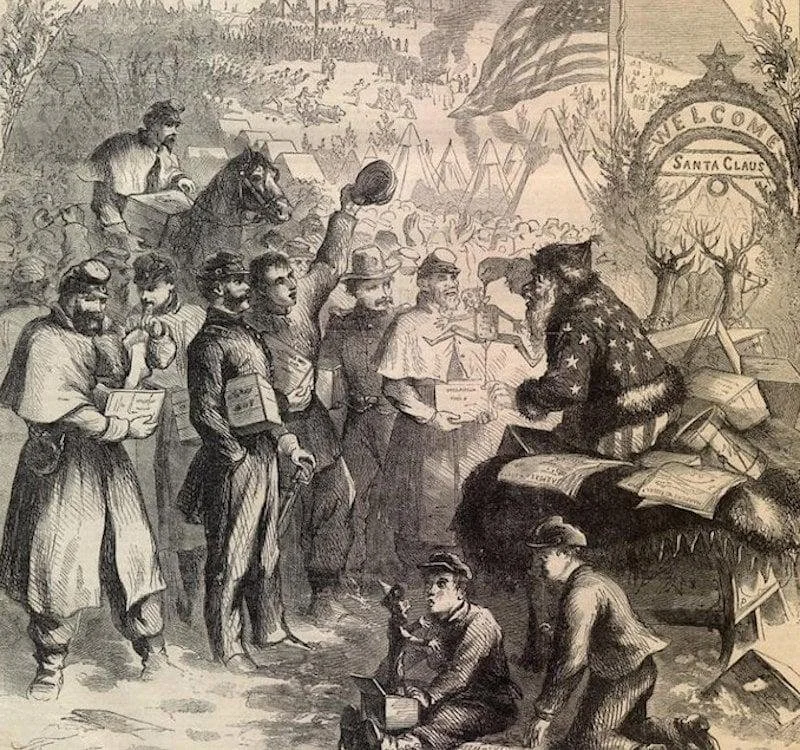
Lest any reader question Santa’s allegiance in the Civil War, he wears a jacket patterned with stars and pants colored in stripes. In his hands, he holds a puppet toy with a rope around its neck, its features like those of Confederate president Jefferson Davis.
A second illustration features Santa in his sleigh, then going down a chimney, all in the periphery. At the center, divided into separate circles, are a woman praying on her knees and a soldier leaning against a tree. “
In these two drawings, Christmas became a Union holiday and Santa a Union local deity,” writes Adam Gopnik in a 1997 issue of the New Yorker. “It gave Christmas to the North—gave to the Union cause an aura of domestic sentiment, and even sentimentality.”
The artist responsible for this coup? A Bavarian immigrant named Thomas Nast, political cartoonist extraordinaire and the person who “did as much as any one man to preserve the Union and bring the war to an end,” according to General Ulysses Grant. But like so many inventors, Nast benefitted from the work of his fellow visionaries in creating the rotund, resplendent figure of Santa Claus. He was a man with the right talents in the right place at the perfect time.
Prior to the early 1800s, Christmas was a religious holiday, plain and simple. Several forces in conjunction transformed it into the commercial fête that we celebrate today. The wealth generated by the Industrial Revolution created a middle class that could afford to buy presents, and factories meant mass-produced goods.
Examples of the holiday began to appear in popular literature, from Clement Clarke Moore’s 1823 poem “A Visit from St. Nicholas” (more commonly known by its first verse, “Twas the night before Christmas”) to Charles Dickens’ book A Christmas Carol, published in 1843. By the mid-1800s, Christmas began to look much more as it does today.
To continue reading, please go to the original article here:
At a Gas Station on a Cold Christmas Eve...............
A NEW CHRISTMAS STORY . . .This story is better than any greeting card.
The old man sat in his gas station on a cold Christmas Eve. He hadn't been
anywhere in years since his wife had passed away. It was just another day to
him. He didn't hate Christmas, just couldn't find a reason to celebrate.
He was sitting there looking at the snow that had been falling for the last
hour and wondering what it was all about when the door opened and a homeless
man stepped through.
Instead of throwing the man out, Old George as he was known by his
customers, told the man to come and sit by the heater and warm up. "Thank
you, but I don't mean to intrude," said the stranger. "I see you're busy,
I'll just go."
"Not without something hot in your belly." George said.
A NEW CHRISTMAS STORY . . .This story is better than any greeting card.
The old man sat in his gas station on a cold Christmas Eve. He hadn't been
anywhere in years since his wife had passed away. It was just another day to
him. He didn't hate Christmas, just couldn't find a reason to celebrate.
He was sitting there looking at the snow that had been falling for the last
hour and wondering what it was all about when the door opened and a homeless
man stepped through.
Instead of throwing the man out, Old George as he was known by his
customers, told the man to come and sit by the heater and warm up. "Thank
you, but I don't mean to intrude," said the stranger. "I see you're busy,
I'll just go."
"Not without something hot in your belly." George said.
He turned and opened a wide mouth Thermos and handed it to the stranger.
"It ain't much, but it's hot and tasty. Stew ... Made it myself. When you're
done, there's coffee and it's fresh."
Just at that moment he heard the "ding" of the driveway bell. "Excuse me,
be right back," George said. There in the driveway was an old '53 Chevy.
Steam was rolling out of the front. The driver was panicked. "Mister can you
help me!" said the driver, with a deep Spanish accent. "My wife is with
child and my car is broken." George opened the hood. It was bad. The block
looked cracked from the cold, the car was dead.
"You ain't going in this thing," George said as he turned away.
"But Mister, please help ..." The door of the office closed behind George
as he went inside. He went to the office wall and got the keys to his old
truck, and went back outside. He walked around the building, opened the
garage, started the truck and drove it around to where the couple was
waiting. "Here, take my truck," he said. "She ain't the best thing you ever
looked at, but she runs real good."
George helped put the woman in the truck and watched as it sped off into
the night. He turned and walked back inside the office. "Glad I gave 'em the
truck, their tires were shot too. That 'ol truck has brand new ." George
thought he was talking to the stranger, but the man had gone. The Thermos
was on the desk, empty, with a used coffee cup beside it. "Well, at least he
got something in his belly," George thought.
George went back outside to see if the old Chevy would start. It
cranked slowly, but it started. He pulled it into the garage where the
truck had been. He thought he would tinker with it for something to do.
Christmas Eve meant no customers. He discovered the the block hadn't
cracked, it was just the bottom hose on the radiator. "Well, shoot, I can
fix this," he said to himself. So he put a new one on.
"Those tires ain't gonna get 'em through the winter either." He took the
snow treads off of his wife's old Lincoln. They were like new and he wasn't
going to drive the car anyway.
As he was working, he heard shots being fired. He ran outside and beside a
police car an officer lay on the cold ground. Bleeding from the left
shoulder, the officer moaned, "Please help me."
George helped the officer inside as he remembered the training he had
received in the Army as a medic. He knew the wound needed attention.
"Pressure to stop the bleeding," he thought. The uniform company had been
there that morning and had left clean shop towels. He used those and duct
tape to bind the wound. "Hey, they say duct tape can fix anythin'," he said,
trying to make the policeman feel at ease.
"Something for pain," George thought. All he had was the pills he used for
his back. "These ought to work." He put some water in a cup and gave the
policeman the pills. "You hang in there, I'm going to get you an ambulance."
The phone was dead. "Maybe I can get one of your buddies on that there
talk box out in your car." He went out only to find that a bullet had gone
into the dashboard destroying the two way radio.
He went back in to find the policeman sitting up. "Thanks," said the
officer. "You could have left me there. The guy that shot me is still in the
area."
George sat down beside him, "I would never leave an injured man in the
Army and I ain't gonna leave you." George pulled back the bandage to check
for bleeding. "Looks worse than what it is. Bullet passed right through 'ya.
Good thing it missed the important stuff though. I think with time your
gonna be right as rain."
George got up and poured a cup of coffee. "How do you take it?" he asked.
"None for me," said the officer.
"Oh, yer gonna drink this. Best in the city. Too bad I ain't got no
donuts." The officer laughed and winced at the same time.
The front door of the office flew open. In burst a young man with a gun.
"Give me all your cash! Do it now!" the young man yelled. His hand was
shaking and George could tell that he had never done anything like this
before.
"That's the guy that shot me!" exclaimed the officer.
"Son, why are you doing this?" asked George, "You need to put the cannon
away. Somebody else might get hurt."
The young man was confused. "Shut up old man, or I'll shoot you, too. Now
give me the cash!"
The cop was reaching for his gun. "Put that thing away," George said to
the cop, "we got one too many in here now."
He turned his attention to the young man. "Son, it's Christmas Eve. If you
need money, well then, here. It ain't much but it's all I got. Now put that
pea shooter away."
George pulled $150 out of his pocket and handed it to the young man,
reaching for the barrel of the gun at the same time. The young man released
his grip on the gun, fell to his knees and began to cry. "I'm not very good
at this am I? All I wanted was to buy something for my wife and son," he
went on. "I've lost my job, my rent is due, my car got repossessed last
week."
George handed the gun to the cop. "Son, we all get in a bit of squeeze now
and then. The road gets hard sometimes, but we make it through the best we
can."
He got the young man to his feet, and sat him down on a chair across from
the cop. "Sometimes we do stupid things." George handed the young man a cup
of coffee. "Bein' stupid is one of the things that makes us human. Comin' in
here with a gun ain't the answer. Now sit there and get warm and we'll sort
this thing out."
The young man had stopped crying. He looked over to the cop. "Sorry I shot
you. It just went off. I'm sorry officer."
"Shut up and drink your coffee " the cop said.
George could hear the sounds of sirens outside. A police car and an
ambulance skidded to a halt. Two cops came through the door, guns drawn.
"Chuck! You ok?" one of the cops asked the wounded officer.
"Not bad for a guy who took a bullet. How did you find me?"
"GPS locator in the car. Best thing since sliced bread. Who did this?" the
other cop asked as he approached the young man.
Chuck answered him, "I don't know. The guy ran off into the dark. Just
dropped his gun and ran."
George and the young man both looked puzzled at each other.
"That guy work here?" the wounded cop continued.
"Yep," George said, "just hired him this morning. Boy lost his job."
The paramedics came in and loaded Chuck onto the stretcher. The young man
leaned over the wounded cop and whispered, "Why?"
Chuck just said, "Merry Christmas boy ... and you too, George, and thanks
for everything."
"Well, looks like you got one doozy of a break there. That ought to solve
some of your problems."
George went into the back room and came out with a box. He pulled out a
ring box. "Here you go, something for the little woman. I don't think Martha
would mind. She said it would come in handy some day."
The young man looked inside to see the biggest diamond ring he ever saw.
"I can't take this," said the young man. "It means something to you."
"And now it means something to you," replied George. "I got my memories.
That's all I need."
George reached into the box again. An airplane, a car and a truck appeared
next. They were toys that the oil company had left for him to sell. "Here's
something for that little man of yours."
The young man began to cry again as he handed back the $150 that the old
man had handed him earlier.
"And what are you supposed to buy Christmas dinner with? You keep that
too," George said. "Now git home to your family."
The young man turned with tears streaming down his face. "I'll be here in
the morning for work, if that job offer is still good."
"Nope. I'm closed Christmas day," George said. "See ya the day after."
George turned around to find that the stranger had returned. "Where'd you
come from? I thought you left?"
"I have been here. I have always been here," said the stranger. "You say
you don't celebrate Christmas. Why?"
"Well, after my wife passed away, I just couldn't see what all the bother
was. Puttin' up a tree and all seemed a waste of a good pine tree. Bakin'
cookies like I used to with Martha just wasn't the same by myself and
besides I was gettin' a little chubby."
The stranger put his hand on George's shoulder. "But you do celebrate the
holiday, George. You gave me food and drink and warmed me when I was cold
and hungry. The woman with child will bear a son and he will become a great
doctor.
The policeman you helped will go on to save 19 people from being killed by
terrorists. The young man who tried to rob you will make you a rich man and
not take any for himself. "That is the spirit of the season and you keep it
as good as any man."
George was taken aback by all this stranger had said. "And how do you know
all this?" asked the old man.
"Trust me, George. I have the inside track on this sort of thing. And when
your days are done you will be with Martha again."
The stranger moved toward the door. "If you will excuse me, George, I have
to go now. I have to go home where there is a big celebration planned."
George watched as the old leather jacket and the torn pants that the
stranger was wearing turned into a white robe. A golden light began to fill
the room.
"You see, George ... it's My birthday. Merry Christmas."
George fell to his knees and replied, "Happy Birthday, Lord Jesus"
MERRY CHRISTMAS AND GOD BLESS!

Christmas "Bits and Pieces" Posted by Mot at TNT
Mot: This Special Event Happened on 'Christmas 1915'........
Christmas 1915 World War One.
Legend has it that on Christmas Day 1915, soldiers from both sides of the trenches in World War One met up in No-Man's-Land for a game of football. ...
Bertie Felstead recalled that the Germans probably were already out of their trench before the British got out.
Mot: This Special Event Happened on 'Christmas 1915'........
Christmas 1915 World War One.
Legend has it that on Christmas Day 1915, soldiers from both sides of the trenches in World War One met up in No-Man's-Land for a game of football. ...
Bertie Felstead recalled that the Germans probably were already out of their trench before the British got out.
Christmas Truce of World War I -- Joyeux Noel
Mot: .. LOL - the Things Folks Come Up With!! ~~~

Mot: ....... oooh Nooooo - Not again! ~~~~~

Mot: ......... Special Moments Caught Forever!! ~~~

Mot .. WHITE CHRISTMAS ~~~~~ https://www.youtube.com/watch?v=2QW65Amj0vM
Mot: ~~~ Home Free - O' Holy Night ~~~ https://www.youtube.com/watch?v=CO6OZIY-lYw
The Biggest Banks in the United States
The Biggest Banks in the United States
A Breakdown of America's Banking Giants
By Erin ONeil Updated on March 4, 2021
The term "big four" within the banking industry refers to the four largest banks in the United States: JPMorgan Chase & Co., Bank of America, Wells Fargo, and Citibank (Citigroup Inc.). These institutions serve the majority of personal and business account holders in the U.S. The four banks collectively hold $4.6 trillion in customer deposits, or about 45 percent of deposits in the United States.1
The Biggest Banks in the United States
A Breakdown of America's Banking Giants
By Erin ONeil Updated on March 4, 2021
The term "big four" within the banking industry refers to the four largest banks in the United States: JPMorgan Chase & Co., Bank of America, Wells Fargo, and Citibank (Citigroup Inc.). These institutions serve the majority of personal and business account holders in the U.S. The four banks collectively hold $4.6 trillion in customer deposits, or about 45 percent of deposits in the United States.1
However, the nation has many other very large banks, all with total assets in the billions. These banks easily fall under the definition of “big banks,” and would presumably be considered by some as too big to fail. Become familiar with these banks so you can make better choices for your banking needs. After all, if you haven't already, you'll probably be doing business with one (or several) of the top 15 biggest banks in the future.
01 of 15 JPMorgan Chase & Co. Total customer deposits: $1.56 trillion
Total assets: $2.68 trillion Headquarters: New York, NY
02 of 15 Bank of America Corp. Total customer deposits: $1.43 trillion
Total assets: $2.43 trillion Headquarters: New York, NY
03 of 15 Wells Fargo & Co. Total customer deposits: $1.32 trillion
Total assets: $1.92 trillion Headquarters: San Francisco, CA
04 of 15 Citigroup Inc. Total customer deposits: $1.07 trillion
Total assets: $1.95 trillion Headquarters: New York, NY
To continue reading, please go to the original article here:
What Is a Decamillionaire?
What Is a Decamillionaire?
By Cassidy Horton Updated on December 29, 2021
Anyone with a net worth of at least $10 million is considered a decamillionaire. Because the word “millionaire” is such a broad term, people often use “decamillionaire” instead to describe exactly how much wealth someone has.
Someone with a net worth of $10 million to $99.99 million is considered a decamillionaire. Because the word “millionaire” is such a broad term, people often use “decamillionaire” instead to describe exactly how much wealth someone has.
What Is a Decamillionaire?
By Cassidy Horton Updated on December 29, 2021
Anyone with a net worth of at least $10 million is considered a decamillionaire. Because the word “millionaire” is such a broad term, people often use “decamillionaire” instead to describe exactly how much wealth someone has.
Someone with a net worth of $10 million to $99.99 million is considered a decamillionaire. Because the word “millionaire” is such a broad term, people often use “decamillionaire” instead to describe exactly how much wealth someone has.
Here’s a closer look at what it means to be a decamillionaire and how it works.
Definition and Examples of a Decamillionaire
A decamillionaire is someone with $10 million to $99.99 million in net worth. The word is a combination of “deca” or “deka,” meaning “10” in Greek, and “millionaire,” meaning anyone with at least $1 million in net worth. Therefore, a decamillionaire is anyone with a net worth of at least $10 million.12
The term doesn’t just apply to those with $10 million in U.S. dollars, either. It refers to anyone who has a net worth of at least 10 million in any currency. So, if you have 10 million in British pounds or 10 million in euros, you’re also a decamillionaire.
How a Being a Decamillionaire Works
Oftentimes, using the word “millionaire” alone doesn’t paint an accurate picture of someone’s wealth. Do they have $1 million? $10 million? $100 million? There’s a sizable difference between those amounts. Therefore, people use terms like “decamillionaire” to further classify how much wealth someone has.
But decamillionaire isn’t the only subclassification used to describe the size of someone’s wealth. This chart breaks down other common categories people use:
Classification Net Worth
Millionaire At least $1 million
Pentamillionaire At least $5 million
Decamillionaire At least $10 million
Hectomillionaire At least $100 million
Billionaire At least $1 billion
To continue reading, please go to the original article here:
https://www.thebalancemoney.com/what-is-a-decamillionaire-5208325
What Is a Millionaire?
What Is a Millionaire?
Millionaires Explained By Paula Pant
Definition: In the U.S., a millionaire is someone whose wealth (or net worth) is valued at $1 million or more.
Definition and Examples of Millionaires
Today, the most common definition of a millionaire is a person or a married couple whose net worth is greater than $1 million. Under this classification, the number of millionaires around the world has multiplied over the past century.
Note: Despite inflation and subsequently weaker buying power, the U.S. dollar is the international measure for qualifying millionaires.
What Is a Millionaire?
Millionaires Explained By Paula Pant
Definition: In the U.S., a millionaire is someone whose wealth (or net worth) is valued at $1 million or more.
Definition and Examples of Millionaires
Today, the most common definition of a millionaire is a person or a married couple whose net worth is greater than $1 million. Under this classification, the number of millionaires around the world has multiplied over the past century.
Note: Despite inflation and subsequently weaker buying power, the U.S. dollar is the international measure for qualifying millionaires.
For example, suppose you have assets totaling $1,400,000 ($1.4 million) and liabilities totaling $200,000. In that case, your net worth would be $1.2 million, meaning that you fit the definition of a millionaire.
How Being a Millionaire Works
When considering whether someone is a millionaire, in most cases, you consider their net worth. According to a Spectrem Group Market Insights Report, there were 11.8 million Americans with a net worth of at least $1 million in 2019.1
A person's net worth is like a summary of the total financial value of their balance sheet. This concept represents a person's financial assets minus their liabilities. In other words, net worth is what they own minus what they owe.
However, net worth includes the appraised value of all non-liquid assets, which are harder to liquidate (or sell) if needed. For this reason, there is some debate about whether the term "millionaire" should apply to people with total assets over $1 million or only to those with liquid assets in excess of $1 million.
Note: Categorizing millionaires is not straightforward when factoring in non-liquid assets. The price of consumer goods rises and falls; in an economic slump, it's unrealistic for assets like real estate and antiques to fetch full price on the market.
Where the Term "Millionaire" Originates
The term "millionaire" comes from French and was first used in 1786. It was used to describe the men who became rich off of speculative investments in North America. By the standards of the 18th century, a millionaire was someone who had amassed an unimaginable amount of wealth.2
In the wake of more than a century of inflation, $1 million hasn't retained the exceptional buying power it had in 1900. In 2022 dollars, it would be equivalent to about $34.8 million.3
A Millionaire's Profile
By looking at a person's balance sheet and considering their assets and debts, we can figure out whether they have a net worth of at least $1 million. Suppose that John Doe has the following assets:
To continue reading, please go to the original article here:
https://www.thebalancemoney.com/what-is-a-millionaire-453762
How Many Gifts Should a Child Get for Christmas?
How Many Gifts Should a Child Get for Christmas?
By One Frugal Girl
How many gifts should you give your kids for Christmas? Is there a magic number of presents? The perfect amount that makes kids feel happy, satisfied, and grateful?
In most instances, I think four is enough. After choosing something they want, something they need, something to wear, and something to read, you’ve got your kids covered.
But not everyone agrees with this approach. After reading about my four-gift rule for Christmas, a long-time reader told me she didn’t like my gift-giving advice.
How Many Gifts Should a Child Get for Christmas?
By One Frugal Girl
How many gifts should you give your kids for Christmas? Is there a magic number of presents? The perfect amount that makes kids feel happy, satisfied, and grateful?
In most instances, I think four is enough. After choosing something they want, something they need, something to wear, and something to read, you’ve got your kids covered.
But not everyone agrees with this approach. After reading about my four-gift rule for Christmas, a long-time reader told me she didn’t like my gift-giving advice.
“Limiting the number of gifts takes the fun out of Christmas,” she said. “Christmas should be filled with stacks of presents and happy children ripping into wrapping paper.”
Will Limiting Gifts Ruin Christmas?
I love when readers voice their opinions, so I dove into the insightful list of thoughts and questions.
Can Christmas be Christmas without lots of presents?
Can the holidays feel magical with fewer gifts?
And most importantly:
Won’t limiting gifts ruin Christmas?
Christmas Magic Doesn’t Exist in Boxes
I understand her misgivings because I once felt them myself.
For years, I convinced myself that Christmas lived in big boxes; the bigger the box, the better! But, in truth, it’s not the quantity or size of gifts that makes Christmas magical.
Thank back on your childhood. How many unique gifts do you remember? I bet most years are a blur. But do you remember decorating the house, searching for Christmas lights, eating Christmas dinner, or the warm feeling of sitting around the tree with your family?
Growing up, Christmas was the one day of the year when we woke up early and gathered together. My dad cooked pancakes while we watched from the kitchen table. We slathered those pancakes with butter and syrup and giggled at his Swedish Chef impersonation.
Magic didn’t come from the mountain of gifts I can no longer remember. It came from a stress-free morning, sitting in our pajamas and enjoying each other’s company. When I think back to the cozy holidays of my youth, it’s not the gifts I remember. It’s the sound of my dad’s laughter.
How Many Christmas Gifts Per Child?
How many gifts should a child get for Christmas? There are all sorts of rules for gift-giving. The three-gift rule, the four-gift rule, the seven-gift rule, and even the ten-gift rule, but for me, the ideal amount is the number of presents my children will use and appreciate.
To continue reading, please go to the original article here:
https://www.onefrugalgirl.com/how-many-christmas-gifts-per-child/
"Christmas 1881" Posted by Mot at TNT
TNT:
Mot: Christmas 1881
Pa never had much compassion for the lazy or those who squandered their
means and then never had enough for the necessities. But for those who were
genuinely in need, his heart was as big as all outdoors. It was from him
that I learned the greatest joy in life comes from giving, not from receiving.
It was Christmas Eve, 1881. I was fifteen years old and feeling like the
world had caved in on me because there just hadn't been enough money to buy
me the rifle that I'd wanted for Christmas. We did the chores early that
night for some reason. I just figured Pa wanted a little extra time so we
could read in the Bible.
TNT:
Mot: Christmas 1881
Pa never had much compassion for the lazy or those who squandered their
means and then never had enough for the necessities. But for those who were
genuinely in need, his heart was as big as all outdoors. It was from him
that I learned the greatest joy in life comes from giving, not from receiving.
It was Christmas Eve, 1881. I was fifteen years old and feeling like the
world had caved in on me because there just hadn't been enough money to buy
me the rifle that I'd wanted for Christmas. We did the chores early that
night for some reason. I just figured Pa wanted a little extra time so we
could read in the Bible.
After supper was over I took my boots off and stretched out in front of the
fireplace and waited for Pa to get down the old Bible. I was still feeling
sorry for myself and, to be honest, I wasn't in much of a mood to read
Scriptures. But Pa didn't get the Bible, instead he bundled up again and
went outside.
I couldn't figure it out because we had already done all the
chores. I didn't worry about it long though, I was too busy wallowing in
self-pity.
Soon Pa came back in. It was a cold clear night out and there was ice in
his beard. "Come on, Matt," he said. "Bundle up good, it's cold out
tonight." I was really upset then. Not only wasn't I getting the rifle for
Christmas, now Pa was dragging me out in the cold, and for no earthly reason
that I could see.
We'd already done all the chores, and I couldn't think of
anything else that needed doing, especially not on a night like this. But I
knew Pa was not very patient at one dragging one's feet when he'd told them
to do something, so I got up and put my boots back on and got my cap, coat,
and mittens. Ma gave me a mysterious smile as I opened the door to leave
the house. Something was up, but I didn't know what.
Outside, I became even more dismayed. There in front of the house was the
work team, already hitched to the big sled. Whatever it was we were going
to do wasn't going to be a short, quick, little job. I could tell. We
never hitched up this sled unless we were going to haul a big load. Pa was
already up on the seat, reins in hand. I reluctantly climbed up beside him.
The cold was already biting at me. I wasn't happy.
When I was on, Pa pulled the sled around the house and stopped in front of
the woodshed. He got off and I followed. "I think we'll put on the high
sideboards," he said. "Here, help me." The high sideboards! It had been a
bigger job than I wanted to do with just the low sideboards on, but whatever
it was we were going to do would be a lot bigger with the high side boards on.
After we had exchanged the sideboards, Pa went into the woodshed and came
out with an armload of wood - the wood I'd spent all summer hauling down
from the mountain, and then all fall sawing into blocks and splitting. What
was he doing?
Finally I said something. "Pa," I asked, "what are you
doing?" "You been by the Widow Jensen's lately?" he asked. The Widow
Jensen lived about two miles down the road. Her husband had died a year or
so before and left her with three children, the oldest being eight. Sure,
I'd been by, but so what?
Yeah," I said, "Why?"
"I rode by just today," Pa said. "Little Jakey was out digging around in
the woodpile trying to find a few chips. They're out of wood, Matt." That
was all he said and then he turned and went back into the woodshed for
another armload of wood. I followed him. We loaded the sled so high that I
began to wonder if the horses would be able to pull it.
Finally, Pa called a halt to our loading, then we went to the smoke house
and Pa took down a big ham and a side of bacon. He handed them to me and
told me to put them in the sled and wait. When he returned he was carrying
a sack of flour over his right shoulder and a smaller sack of something in
his left hand. "What's in the little sack?" I asked. Shoes, they're out of shoes.
Little Jakey just had gunny sacks wrapped around his feet when he
was out in the woodpile this morning. I got the children a little candy
too. It just wouldn't be Christmas without a little candy."
We rode the two miles to Widow Jensen's pretty much in silence. I tried to
think through what Pa was doing. We didn't have much by worldly standards.
Of course, we did have a big woodpile, though most of what was left now was
still in the form of logs that I would have to saw into blocks and split
before we could use it.
We also had meat and flour, so we could spare that,
but I knew we didn't have any money, so why was Pa buying them shoes and
candy? Really, why was he doing any of this? Widow Jensen had closer
neighbors than us; it shouldn't have been our concern.
We came in from the blind side of the Jensen house and unloaded the wood as
quietly as possible, then we took the meat and flour and shoes to the door.
We knocked. The door opened a crack and a timid voice said, "Who is it?"
"Lucas Miles, Ma'am, and my son, Matt... could we come in for a bit?"
Widow Jensen opened the door and let us in. She had a blanket wrapped
around her shoulders. The children were wrapped in another and were sitting
in front of the fireplace by a very small fire that hardly gave off any heat
at all. Widow Jensen fumbled with a match and finally lit the lamp.
"We brought you a few things, Ma'am," Pa said and set down the sack of
flour. I put the meat on the table. Then Pa handed her the sack that had
the shoes in it. She opened it hesitantly and took the shoes out, one pair
at a time.
There was a pair for her and one for each of the children -
sturdy shoes, the best... shoes that would last. I watched her carefully.
She bit her lower lip to keep it from trembling and then tears filled her
eyes and started running down her cheeks. She looked up at Pa like she
wanted to say something, but it wouldn't come out.
"We brought a load of wood too, Ma'am," Pa said. He turned to me and said,
"Matt, go bring in enough to last awhile. Let's get that fire up to size
and heat this place up."
I wasn't the same person when I went back out to bring in the wood. I had
a big lump in my throat and as much as I hate to admit it, there were tears
in my eyes too. In my mind I kept seeing those three kids huddled around
the fireplace and their mother standing there with tears running down her
cheeks with so much gratitude in her heart that she couldn't speak.
My heart swelled within me and a joy that I'd never known before, filled my
soul. I had given at Christmas many times before, but never when it had
made so much difference. I could see we were literally saving the lives of
these people.
I soon had the fire blazing and everyone's spirits soared. The kids
started giggling when Pa handed them each a piece of candy and Widow Jensen
looked on with a smile that probably hadn't crossed her face for a long
time. She finally turned to us. "God bless you," she said. "I know the
Lord has sent you. The children and I have been praying that he would send
one of his angels to spare us."
In spite of myself, the lump returned to my throat and the tears welled up
in my eyes again. I'd never thought of Pa in those exact terms before, but
after Widow Jensen mentioned it, I could see that it was probably true. I
was sure that a better man than Pa had never walked the earth. I started
remembering all the times he had gone out of his way for Ma and me, and many
others. The list seemed endless as I thought on it.
Pa insisted that everyone try on the shoes before we left. I was amazed
when they all fit, and I wondered how he had known what sizes to get. Then
I guessed that if he was on an errand for the Lord, that the Lord would make
sure he got the right sizes.
Tears were running down Widow Jensen's face again when we stood up to
leave. Pa took each of the kids in his big arms and gave them a hug. ... They
clung to him and didn't want us to go. I could see that they missed their
Pa, and I was glad that I still had mine.
At the door Pa turned to Widow Jensen and said, "The Mrs. wanted me to
invite you and the children over for Christmas dinner tomorrow. The turkey
will be more than the three of us can eat, and a man can get cantankerous if
he has to eat turkey for too many meals. We'll be by to get you about
eleven. It'll be nice to have some little ones around again. Matt, here,
hasn't been little for quite a spell." I was the youngest... my two
brothers and two sisters had all married and had moved away.
Widow Jensen nodded and said, "Thank you, Brother Miles. I don't have to
say, may the Lord bless you, I know for certain that He will."
Out on the sled I felt a warmth that came from deep within and I didn't
even notice the cold. When we had gone a ways, Pa turned to me and said,
"Matt, I want you to know something. Your Ma and me have been tucking a
little money away here and there all year so we could buy that rifle for
you, but we didn't have quite enough.
Then yesterday a man who owed me a little money from years back came by to make things square. Your Ma and me were real excited, thinking that now we could get you that rifle, and I started into town this morning to do just that, but on the way I saw little Jakey out scratching in the woodpile with his feet wrapped in those gunny sacks and I knew what I had to do. Son, I spent the money for shoes and a
little candy for those children. I hope you understand."
I understood alright... and my eyes became wet with tears again. I
understood very well, and I was so glad Pa had done it. Now the rifle
seemed very low on my list of priorities. Pa had given me a lot more. He
had given me the look on Widow Jensen's face and the radiant smiles of her
three children.
For the rest of my life, whenever I saw any of the Jensens, or split a
block of wood, I remembered, and remembering brought back that same joy I
felt riding home beside Pa that night. Pa had given me much more than a
rifle that night, he had given me the best Christmas of my life.
Don't be too busy today... share this inspiring message. Merry Christmas
and God bless you!

"Adventure With Grandma" Posted by Mot at TNT
Mot: If we all could only teach our grandchildren this gift...
I remember my first Christmas adventure with Grandma. I was just a kid.
I remember tearing across town on my bike to visit her on the day my big sister dropped the bomb: "There is no Santa Claus," she jeered. "Even dummies know that!" My Grandma was not the gushy kind, never had been. I fled to her that day because I knew she would be straight with me. I knew Grandma always told the truth, and I knew that the truth always went down a whole lot easier when swallowed with one of her "world-famous" cinnamon buns.
I knew they were world-famous, because Grandma said so. It had to be true. Grandma was home, and the buns were still warm. Between bites, I told her everything. She was ready for me. "No Santa Claus?" she snorted...."Ridiculous! Don't believe it. That rumor has been going around for years, and it makes me mad, plain mad!! Now, put on your coat, and let's go."
Mot: If we all could only teach our grandchildren this gift...
I remember my first Christmas adventure with Grandma. I was just a kid.
I remember tearing across town on my bike to visit her on the day my big sister dropped the bomb: "There is no Santa Claus," she jeered. "Even dummies know that!" My Grandma was not the gushy kind, never had been. I fled to her that day because I knew she would be straight with me. I knew Grandma always told the truth, and I knew that the truth always went down a whole lot easier when swallowed with one of her "world-famous" cinnamon buns.
I knew they were world-famous, because Grandma said so. It had to be true. Grandma was home, and the buns were still warm. Between bites, I told her everything. She was ready for me. "No Santa Claus?" she snorted...."Ridiculous! Don't believe it. That rumor has been going around for years, and it makes me mad, plain mad!! Now, put on your coat, and let's go."
"Go? Go where, Grandma?" I asked. I hadn't even finished my second world-famous cinnamon bun.
"Where" turned out to be Kerby's General Store, the one store in town that had a little bit of just about everything. As we walked through its doors, Grandma handed me ten dollars. That was a bundle in those days. "Take this money," she said, "and buy something for someone who needs it. I'll wait for you in the car."
Then she turned and walked out of Kerby's. I was only eight years old. I'd often gone shopping with my mother, but never had I shopped for anything all by myself. The store seemed big and crowded, full of people scrambling to finish their Christmas shopping. For a few moments I just stood there, confused, clutching that ten-dollar bill, wondering what to buy, and who on earth to buy it for.
I thought of everybody I knew: my family, my friends, my neighbors, the kids at school, the people who went to my church. I was just about thought out, when I suddenly thought of Bobby Decker. He was a kid with bad breath and messy hair, and he sat right behind me in Mrs. Pollock's grade-two class. Bobby Decker didn't have a coat. I knew that because he never went out to recess during the winter. His mother always wrote a note, telling the teacher that he had a cough, but all we kids knew that Bobby Decker didn't have a cough; he didn't have a good coat.
I fingered the ten-dollar bill with growing excitement. I would buy Bobby Decker a coat! I settled on a red corduroy one that had a hood to it. It looked real warm, and he would like that. "Is this a Christmas present for someone?" the lady behind the counter asked kindly, as I laid my ten dollars down. "Yes, ma'am," I replied shyly. "It's for Bobby." The nice lady smiled at me, as I told her about how Bobby really needed a good winter coat. I didn't get any change, but she put the coat in a bag, smiled again, and wished me a Merry Christmas.
That evening, Grandma helped me wrap the coat (a little tag fell out of the coat, and Grandma tucked it in her Bible) in Christmas paper and ribbons and wrote, "To Bobby, "From Santa Claus" on it.
Grandma said that Santa always insisted on secrecy. Then she drove me over to Bobby Decker's house, explaining as we went that I was now and forever officially, one of Santa's helpers.
Grandma parked down the street from Bobby's house, and she and I crept noiselessly and hid in the bushes by his front walk. Then Grandma gave me a nudge. "All right, Santa Claus," she whispered, "get going."
I took a deep breath, dashed for his front door, threw the present down on his step, pounded his door and flew back to the safety of the bushes and Grandma. Together we waited breathlessly in the darkness for the front door to open. Finally it did, and there stood Bobby.
Fifty years haven't dimmed the thrill of those moments spent shivering, beside my Grandma, in Bobby Decker's bushes. That night, I realized that those awful rumors about Santa Claus were just what Grandma said they were -- ridiculous. Santa was alive and well, and we were on his team.
I still have the Bible, with the coat tag tucked inside: $19.95.
May you always have LOVE to share, HEALTH to spare and FRIENDS that care... And may you always believe in the magic of Santa Claus!
Mot: ~~~ Home Free - O' Holy Night ~~~ https://www.youtube.com/watch?v=CO6OZIY-lYw