
GP Q: Same Week, Three Separate Stories
GP Q: Same Week, Three Separate Stories
10-6-2026
Same week, three separate stories.
An overview: Easy to mash them into a “reset.” They are not one.
Seoul, 3 October. XRP Asia launched at the Grand Hyatt during Korea Blockchain Week.
GP Q: Same Week, Three Separate Stories
10-6-2026
Same week, three separate stories.
An overview: Easy to mash them into a “reset.” They are not one.
Seoul, 3 October. XRP Asia launched at the Grand Hyatt during Korea Blockchain Week.
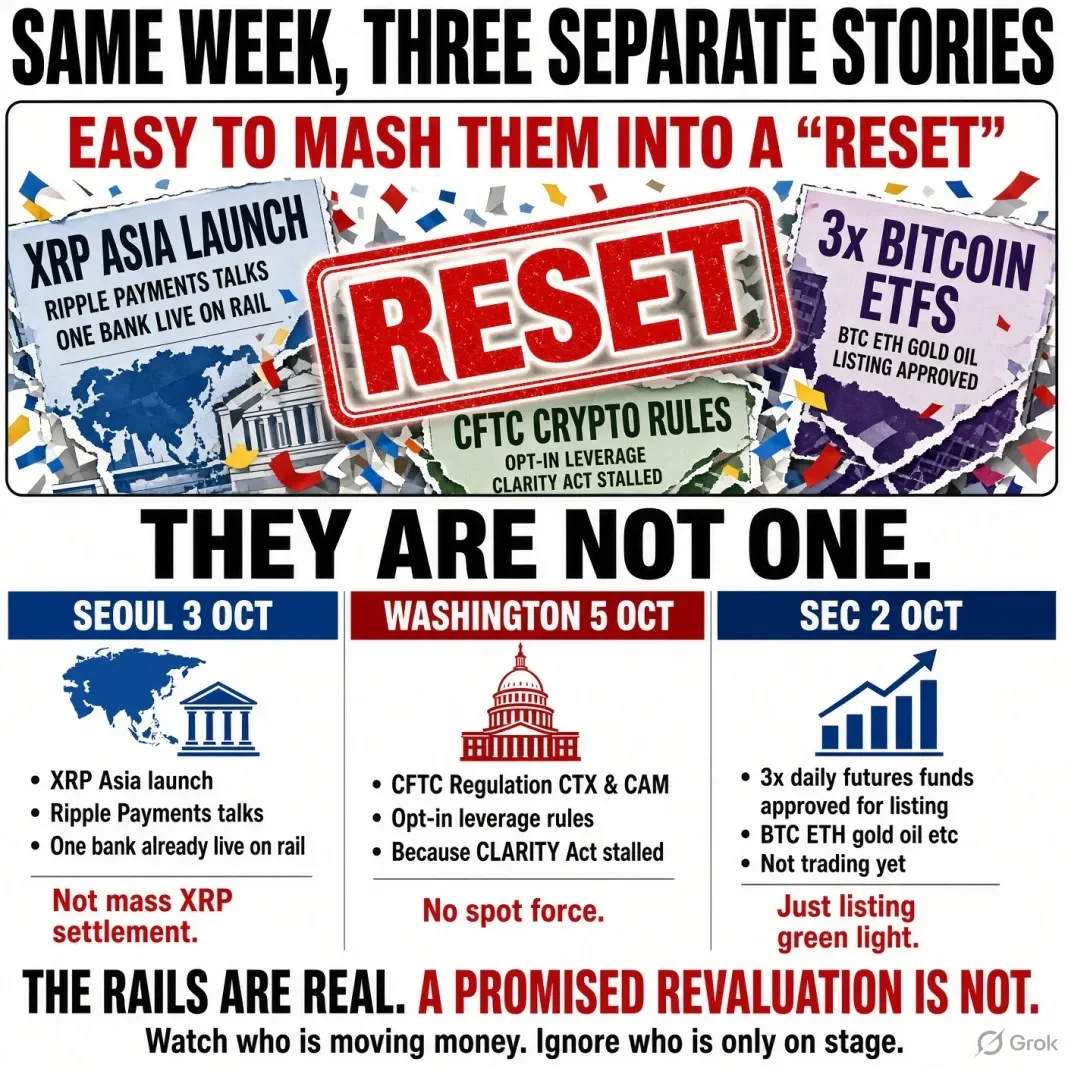
XRP Seoul, hosted by XRPL Korea with Ripple as title sponsor, pulled more than 5,000 people.
The new body is backed by Ripple and the XRP Ledger Foundation, based in Singapore, and run by Sabrina Tachdjian, who used to handle fintech and payments at the Hedera Foundation.
The brief is practical: developer education, hackathons, startup grants, and backing the existing Korea and Japan communities while building others across Asia-Pacific. Woori, KakaoBank, K Bank, Kyobo Securities, Meritz and Jeonbuk were in the room on cross-border payments and tokenized deposits. Jeonbuk already uses Ripple Payments for corporate remittances, REPLACING multi-day SWIFT windows.
That is a live rail. It is not the same as the panel signing up to settle in XRP, and neither Woori nor KakaoBank announced they had joined XRP Asia or deployed the ledger.
Washington moved because Congress didn’t.
The CLARITY Act stalled in the Senate last month, so on 5 October CFTC Chair Mike Selig put Regulation CTX and Regulation CAM out at Fordham Law.
CTX covers crypto transactions done with margin, leverage or financing. CAM is a new venue category for exchanges that want to offer that to retail under one federal setup instead of a stack of state money-transmitter licenses.
Reuters noted proof-of-reserves and anti-manipulation requirements.
No fixed leverage cap, but a leveraged product would still need CFTC staff clearance.
Selig was plain about the hole: the agency cannot force ordinary spot trading onto its platforms.
That part of CLARITY needed a law. This is an opt-in lane, written because the bill failed, and he said they would keep going with or without Congress.
The products are narrower than the headlines.
On 2 October the SEC approved Cboe BZX rule SR-CboeBZX-2026-065, Release 34-106577, so Volatility Shares can list six 3x daily funds:
Bitcoin, Ether, gold, silver, crude oil and natural gas.
Cboe filed on 10 August.
No public comments.
US crypto funds had been stuck at 2x — Volatility Shares already runs BITX and ETHU — after staff pushed back in December 2025 on anything above that, and waved off 5x filings in March.
These new ones target three times the daily move of first- and second-month futures, with cash as collateral, not coins in a vault.
Tickers floated for the crypto pair include BITH and ETHK.
They are not trading.
The registration statement still has to go effective, and the order sets no date.
Bloomberg’s Eric Balchunas called the listing a win for the issuer and a trading tool, not an investment.
Payments talks in Asia, with one bank already off SWIFT.
Rules written because the Senate bill died.
Triple-leverage futures funds one filing away from a US listing. That’s the week.
No switch flipped.
The rails are real.
A promised revaluation is not.
Watch who is moving money. Ignore who is only on stage.
Source(s):
• https://x.com/argosaki/status/2107332804086534559
https://dinarchronicles.com/2026/10/06/gp-q-same-week-three-separate-stories/
Iraq Economic News and Points To Ponder Tuesday Evening 10-6-26
Iraq Considers Raising Official Dollar Rate To 1,500 IQD And Dropping Currency Zeros
Iraq Jawad Al-Samarraie October 6, 2026
Baghdad (IraqiNews.com) – Safaa Al-Jabri, member of parliament for the Al-Sadiqoun bloc and member of the Parliamentary Economic Committee, revealed that the federal government is reviewing a proposal to adjust Iraq’s official exchange rate from 1,310 dinars to 1,500 dinars per U.S. dollar, while advancing high-level deliberations to redenominate the national currency and potentially remove zeros.
Iraq Considers Raising Official Dollar Rate To 1,500 IQD And Dropping Currency Zeros
Iraq Jawad Al-Samarraie October 6, 2026
Baghdad (IraqiNews.com) – Safaa Al-Jabri, member of parliament for the Al-Sadiqoun bloc and member of the Parliamentary Economic Committee, revealed that the federal government is reviewing a proposal to adjust Iraq’s official exchange rate from 1,310 dinars to 1,500 dinars per U.S. dollar, while advancing high-level deliberations to redenominate the national currency and potentially remove zeros.
Speaking in a televised interview, Al-Jabri projected that sovereign state revenues for the 2027 federal budget will surpass $110 billion, declaring that Iraq has successfully weathered the acute economic fallout triggered by past disruptions at the Strait of Hormuz and Basra export halts.
According to Al-Jabri, fiscal parameters for the upcoming national budget are being restructured on the back of rising non-oil customs and tax receipts, an unprecedented $8 billion to $10 billion generated from domestic petroleum sales, and projected crude oil export earnings exceeding $85 billion.
He noted that Iraqi crude sales currently benchmark around $80 to $82 per barrel, generating approximately $5 billion in monthly export revenues, providing budgetary headroom as trade bottlenecks and logistics gradually normalize.
Regarding currency and fiscal policy, Al-Jabri highlighted key government plans:
Official Exchange Rate Revision: Leaked preliminary drafts of the federal budget proposal—which carries a planned deficit between 25 and 30 trillion dinars—contain a formal submission from the Minister of Finance proposing to adjust the official statutory exchange rate to 150,000 dinars per $100 (1,500 IQD per USD). Al-Jabri noted that no binding cabinet decision has been finalized to date.
Currency Redenomination: Serious technical discussions are underway between the Prime Minister’s Office and the Central Bank of Iraq regarding currency redesign and the removal of three zeros. The measure is currently stalled only by legal jurisdictional reviews to identify the specific governing authority legally empowered to greenlight and execute the structural transition.
Critique of Past Budget Frameworks: Al-Jabri criticized previous administrations for populist fiscal practices, claiming that state budgets were prepared through rote copy-paste mechanisms for nearly twenty years under former Finance Minister Taif Sami, who had risen through the ministry ranks from director general of budget to minister.
Public Liabilities & Contract Terminations: The lawmaker highlighted structural financial arrears inherited by the treasury, including outstanding wheat procurement payouts owed to local farmers, unpaid rationing supply dues claimed by Al-Owais Company across 2025 and 2026, and 33 billion dinars in overdue liabilities tied to road and bridge construction. In response, Prime Minister Ali Faleh Al-Zaidi has canceled legacy public work contracts where execution progress remained below 20 percent.
The potential devaluation of the official dinar to 1,500 IQD per dollar represents an effort to narrow the spread with the parallel currency market—which recently traded above 160,000 dinars per $100—while curbing the planned fiscal deficit for the 2027 fiscal cycle.
Why Iraq's Dinar Keeps Sliding Despite Fresh US Cash
2026-10-06 Shafaq News- Baghdad (Updated at 16:58) The US dollar has climbed above 1,630 Iraqi dinars on Iraq's parallel market, about 21% above the official retail rate of 1,320, even as new shipments of US cash arrive to ease liquidity. Bankers and economists told Shafaq News the extra dollars alone are unlikely to close the gap while speculation, policy confusion and demand outside the banking system persist.
Iraq runs two exchange rates: an official one, at which the Central Bank of Iraq (CBI) sells dollars through banks for trade, travel and other approved needs, and a parallel street rate set by supply and demand. Traders on the parallel market quote prices per $100, and the rate passed 160,000 dinars on Monday.
Demand for dollars far exceeds supply, according to economist Ali Daadoush. He pointed to speculation and uncertainty, delays in official bank transfers, and rising demand to pay for imports from Iran. Much of the cash circulating on the parallel market, he said, starts as dollars sold at the official rate to Iraqis for travel, study and medical treatment, which are then resold locally, pushing the rate higher and making it more volatile.
Demand is also coming from travelers and from traders who prefer not to import through ASYCUDA, the electronic customs system Iraq uses to track imports, said economist Abdul Rahman al-Mashhadani, keeping steady pressure on the parallel rate.
New shipments can improve liquidity, but their effect on the parallel market depends on how quickly the dollars reach people with legitimate needs, said Nabil al-Abadi, managing director of the Union Bank of Iraq. “Narrowing the gap requires a stronger banking sector and easier access to foreign currency through official channels, so that fewer people turn to the street.”
The CBI's foreign reserves fell to $80.6 billion at the end of July 2026 from $97.4 billion at the end of 2025, a drop of about $16.8 billion, or 17.2%, in seven months, according to central bank data.
On September 19, the CBI said its reserves remained sufficient to finance foreign trade, settle bank-card payments and supply cash dollars to travelers at the official rate. It blamed the parallel market rise on speculation, market expectations and the exploitation of regional tensions.
Al-Mashhadani said that conflicting statements from members of parliament are adding to the uncertainty. “One member of parliament's finance committee has said the rate is fixed at 1,500 dinars per dollar, another has spoken of changing the currency, and a third of removing zeros from it,” he said, adding that none of these matters falls within lawmakers' powers, and with the market reacting quickly to any such talk, it was no surprise to see the dollar break 1,600.
In the Kurdistan Region, Jabar Goran, spokesman for Al-Sulaymaniyah's currency exchange market, likewise said decisions on the rate rest solely with the CBI. He warned of a backlash if the government set the rate at 1,500 dinars per dollar in the federal budget, though he did not expect it to do so. "The reaction of citizens and the market would be very negative," he told a press conference.
Expectations have become a force of their own. Fears of a stronger dollar push traders and individuals to buy in anticipation of further gains, adding to demand and widening the gap. Additional cash may ease pressure in the short term, bankers and economists say, but it is unlikely to hold the rate.
Read more: Experts: Iraq dollar gap reflects limited dollar access
https://www.shafaq.com/en/Economy/Why-Iraq-s-dinar-keeps-sliding-despite-fresh-US-cash
The Dollar Exchange Rate Set At 150,000 Dinars Per 100 Dollars For The 2027 Budget "Is Subject To Change."
Channel8 English @Channel8English Following the conclusion of the meeting between the Iraqi Finance Committee and the Minister of Finance, lawmaker and committee member Rebwar Karim told reporters that the dollar exchange rate set at 150,000 Dinars per 100 Dollars for the 2027 budget "is subject to change."
https://x.com/Channel8English/status/2107414834333811063
Economic Warning Regarding Mps' Statements: They Will Increase Market And Dollar Instability In Iraq
Shafaq News - Baghdad Economic expert Abdul Rahman Al-Mashhadani predicted on Tuesday that the exchange rate of the dollar in the parallel market may exceed the 160,000 dinar mark per 100 dollars, given the continued high demand for foreign currency and conflicting statements regarding monetary policy and the exchange rate.
Al-Mashhadani explained in an interview with Shafaq News Agency that it is not surprising that the dollar exceeded the 160,000 mark, at a time when a member of the Finance Committee is stating that the exchange rate is fixed at 150,000 dinars, while another member is talking about changing the currency, and another about removing zeros, which are files that are not within the jurisdiction of the members of parliament.
He added that continuing such statements does not serve market stability, but rather increases uncertainty among citizens and those dealing in dollars, noting that the market is quickly affected by any talk related to the exchange rate or currency.
Al-Mashhadani continued, saying that the demand for the dollar remains high, especially from travelers and traders who do not want to import through the ASYCUDA system, which keeps the demand for foreign currency in place and puts additional pressure on the exchange rate in the parallel market.
Leaks Are Confusing The Market... Al-Khafaji Warns Against The Chaos Of Talk About Changing The Exchange Rate: Where Is The Dollar Headed?
October 6, 2026Last updated: October 6, 2026 The Independent/- The escalating controversy over the possibility of changing the dollar exchange rate has reopened one of the most sensitive economic files in Iraq, amid warnings that continued leaks and unofficial statements could push markets into further turmoil, even before any governmental or monetary decision is issued on the matter.
MP Mohammed Al-Khafaji warned of the repercussions of the repeated talk about changing the dollar exchange rate, stressing that presenting figures and predictions in the media and social media platforms, without an official decision, directly affects the movement of the market and impacts the expectations of traders, citizens and those dealing in foreign currency.
Al-Khafaji said in a post that the file of determining the exchange rate falls primarily within the powers of the Central Bank of Iraq and its Board of Directors, according to the Central Bank Law No. 56 of 2004, as amended.
He pointed out that Article 16 of the law grants the Central Bank’s Board of Directors the authority to formulate the policies necessary to achieve the objectives of monetary policy, including exchange rate policy, while Article 4 defines the bank’s responsibility for formulating and implementing monetary policy and managing foreign exchange policy in Iraq.
He explained that the Central Bank’s legal authority does not mean that a decision as significant as changing the exchange rate is taken in isolation from the government, given its broad impact on the general budget, prices, citizens’ purchasing power, and commercial activity.
According to Al-Khafaji, previous experiences have shown that there is coordination between the Central Bank and the government when making major decisions related to the exchange rate, while the financial impact of the decision is also linked to the general budget accounts, which need to be approved by the Cabinet and then legislated by the House of Representatives.
This controversy comes amid growing talk about the 2027 budget, and the circulation of different figures regarding the potential exchange rate that the government may rely on in calculating revenues and expenditures, without a final and official decision being announced yet.
Observers believe that the sensitivity of the issue lies in the fact that merely talking about reducing the value of the dinar or adjusting the official price could lead to an increase in demand for the dollar in the parallel market, especially if traders believe that an imminent change will occur in monetary policy, which may lead to speculation and a preemptive increase in prices.
Al-Khafaji criticized what he described as “the chaos of leaks, statements, and media scoops,” questioning the usefulness of circulating information related to the exchange rate before a clear official position is issued by the competent authorities.
The concerns are even more pronounced given that the price of the dollar in Iraq is linked to the prices of imported goods and the costs of trade and transportation, making any disruption in the parallel market likely to spread quickly to the prices of a large number of products and services.
Given the numerous statements and assessments regarding the future of the exchange rate, attention remains focused on the Central Bank and the government as the two entities capable of ending the uncertainty by announcing an official and clear position on monetary policy and the exchange rate in the next stage.
Al-Khafaji concluded his post with a striking question: “What is the dollar exchange rate now?”—a reference to the direct impact that leaks and political and media controversy can have on the market. The main question facing citizens and traders remains: Where is the dollar headed if talk of changing the exchange rate continues without an official decision
What A High-Trust Society Looks Like Up Close
What A High-Trust Society Looks Like Up Close
Notes From the Field (Schiff/Sovereign Man) October 6, 2026
[Editor’s note: This letter was written by Schiff Sovereign’s CEO, Viktorija, who is originally from Lithuania but splits her time between Mexico and Panama.]
The first thing I noticed at Seoul’s Iuncheon airport was the luggage. People had just left their suitcases sitting there— against pillars, next to benches, by the exits— and wandered off to the bathroom or to grab a coffee. Nobody looked back.
What A High-Trust Society Looks Like Up Close
Notes From the Field (Schiff/Sovereign Man) October 6, 2026
[Editor’s note: This letter was written by Schiff Sovereign’s CEO, Viktorija, who is originally from Lithuania but splits her time between Mexico and Panama.]
The first thing I noticed at Seoul’s Iuncheon airport was the luggage. People had just left their suitcases sitting there— against pillars, next to benches, by the exits— and wandered off to the bathroom or to grab a coffee. Nobody looked back.

Forget about thieves for a minute; just try leaving an unattended bag in a US airport, and watch the place go into lockdown while the bomb squad swarms in.
A few days later I was in a small local café when the woman next to me stood up, left her phone face-up on the table, and walked off. She was gone for several minutes.
When she came back, she picked up her phone like it was nothing.
South Korea is a high-trust society. When you’re on the ground, you feel it before you can explain it. People here just assume that everyone else is going to follow the rules, and they’re almost always right.
It’s not just the obvious stuff, like Korea’s ultra-low murder rate. It’s little things too.
Last year, for example, passengers on Seoul’s metro left around $300,000 on the trains— lost wallets, money that fell out of people’s pockets, etc. About three-quarters of that cash was returned to the rightful owners. Crazy.
The Seoul subway, by the way, is the best I’ve ever been on— and I’ve been to more than 100 countries. It’s spotless, the trains show up when the sign says they will, and a ride costs a little over a dollar.
I’ve been to Seoul before, but this time I was blown away by how much had changed. The whole city feels like living in the future.
At one café, my espresso was made by a robot. At my hotel, room service arrived on a robot that drove itself down the hallway, stopped at my door, and handed over the tray.
And nobody else seemed to find any of this remarkable.
The factories are even farther along. South Korea has more robots per factory worker than ANY country in the world— about four times as many as the US.
Korea needs them. It has the same problem as America and nearly every other rich country, only worse: people aren’t having enough kids. Korea’s birth rate is one of the lowest in the world, and its working-age population is already shrinking.
But instead of waiting around for the worker shortage to solve itself, the Koreans are building machines to do the work.
I think about economic growth a lot; it’s a big part of my job at Schiff Sovereign. And South Korea’s is remarkable, if you know the backstory.
In 1960, South Korea was poorer than Ghana. Today it’s about fifteen times richer.
And the Koreans haven’t let up. South Korea puts more than 5% of its ENTIRE economy into research and development every year; only Israel spends more.
Most of that money comes from private companies. But the government keeps raising the bar too: this year’s research budget is the biggest in the country’s history.
It’s not just robotics— it’s everything from semiconductors to medical research.
In fact medical treatment is a booming industry; about two million foreigners came to Korea for medical treatment last year, which is a record. Most of them, admittedly, came for skin treatments and cosmetic work.
But Korea is also world class in regenerative medicine— stem cell treatments that repair damaged tissue, anti-aging therapies, etc. This is serious medicine, not spa tourism.
Korean regulators approved a stem cell treatment for worn-out knee cartilage back in 2012… and more than 35,000 patients have received it since.
Since last year, Korean law has also allowed patients with severe or rare diseases to receive new cell-based treatments that haven’t finished the full approval process.
It’s amazing what can happen when a country allows science and medicine to advance instead of stifling them.
To me, it all sounds a lot like America in the 1950s.
America back then was an exciting, high-functioning, high-trust society. People had a strong work ethic and shared values, and they made intelligent decisions for the future.
When America had just become the world’s dominant superpower, the Eisenhower administration built the federal highway system, and Congress paid for it with a tax on gasoline instead of borrowing the money.
Around that time, roughly 75% of Americans said they trusted the federal government to do the right thing. Today it’s less than 20%.
Frankly I think that if you’re thinking about cutting-edge medical care, Korea ought to be be on your radar.
But ultimately, Seoul is a reflection of what a high-trust society with shared values looks like… and of what a country can become when it does rational, sensible things to focus on a better future.
Viktorija CEO, Schiff Sovereign LLC
P.S. Finding places that work is a big part of what we do. Schiff Sovereign’s flagship research service, Plan B Confidential, covers second residencies and citizenships, foreign banking, and legal tax strategies, with boots-on-the-ground reports from all over the world.
https://www.schiffsovereign.com/trends/what-a-high-trust-society-looks-like-up-close-156061/?inf_contact_key=0e6f6066152f04de606fdf0f17e5425f75ed3b9f1880b1bad6530b4fabbb2716
Rob Cunningham: The FIMA Engine and America’s $40 Trillion Elephant
Rob Cunningham: The FIMA Engine and America’s $40 Trillion Elephant
10-6-2026
THE FIMA ENGINE & AMERICA’s $40 TRILLION ELEPHANT
America owes roughly $40 trillion.
Most folks hear that and figure there are only three choices:
Raise taxes. Print money. Go broke.
But let’s hold our horses.
Rob Cunningham: The FIMA Engine and America’s $40 Trillion Elephant
10-6-2026
THE FIMA ENGINE & AMERICA’s $40 TRILLION ELEPHANT
America owes roughly $40 trillion.
Most folks hear that and figure there are only three choices:
Raise taxes. Print money. Go broke.
But let’s hold our horses.
Maybe there’s another way to think about it.
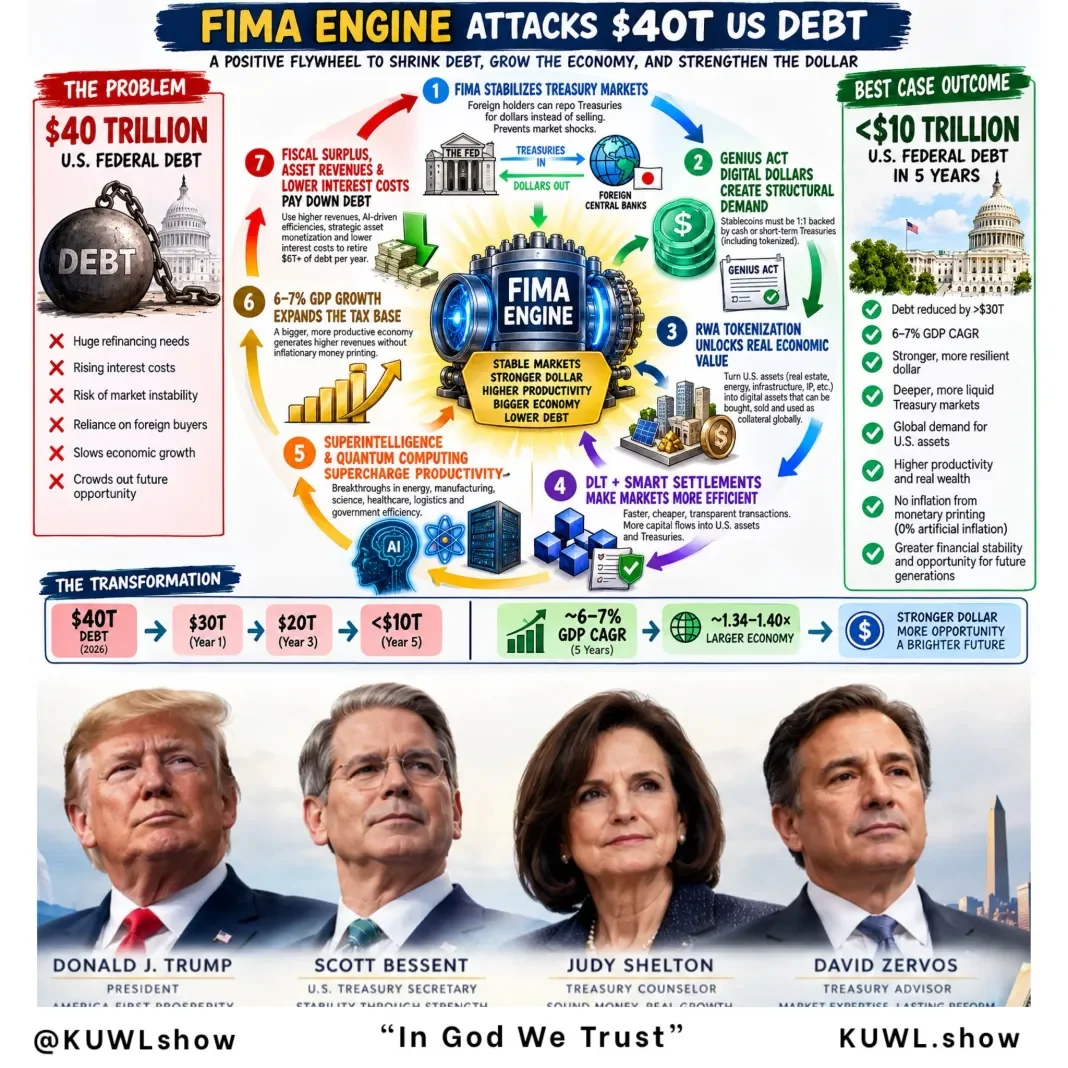
Imagine America owns a ranch worth a fortune, has extraordinary resources and the greatest new technology arriving at the front gate – yet keeps worrying about the mortgage without asking how to make the ranch vastly more productive.
OUR FIRST CLUE: FIMA
If Japan suddenly needs dollars, it doesn’t necessarily have to dump its U.S. Treasuries.
It can temporarily pledge Treasuries → receive dollars.
Treasuries stay put.
Liquidity moves.
Potential market shock is reduced.
Well now…
If changing the mechanics can help prevent one financial chain reaction, what else could better mechanics accomplish?
ENTER THE $40T QUESTION
What if America stopped treating its debt like one gigantic bill due Tuesday morning?
Instead:
Stabilize it.
Refinance intelligently over time.
Make Treasury collateral more useful.
Grow the economy underneath it.
Create real surpluses.
Then retire the debt.
Now add some horsepower.
Super Intelligence attacks waste and boosts productivity.
Quantum computing accelerates discovery and optimization.
DLT (Distributed Ledger Technology) makes ownership and transactions faster, clearer and more inspectable.
RWA tokenization puts productive assets onto modern digital rails.
GENIUS-style stablecoins require 1:1 reserves, creating additional demand for real collateral such as short-term Treasuries.
Notice what’s NOT happening:
We’re not pretending printing money creates wealth.
We’re creating more actual productivity, goods, services, knowledge and economic value.
There’s a HUGE difference.
NOW A BIG GROWTH THESIS
Imagine America achieves 6 – 7% annual GDP growth for five years.
That’s roughly a 34 – 40% larger economy.
More production.
More businesses.
More investment.
More employment.
More tariffs.
More revenue.
Meanwhile SI exposes & eliminates massive government fraud & waste, productive assets generate revenue, financing costs decline wherever possible and genuine fiscal surpluses emerge.
And then:
We DON’T spend all the surplus.
WE RETIRE THE DEBT.
Now Our Flywheel Starts Turning:
Stable Treasury markets:
→ stronger confidence
→ digital-dollar collateral demand
→ tokenized capital formation
→ more efficient markets
→ SI + quantum productivity
→ higher GDP
→ greater revenues
→ fiscal surpluses
→ debt retirement
→ lower interest expense
→ BIGGER surpluses
→ MORE debt retirement.
Round and round she goes.
Now, with my best Detective Columbo voice;
“There’s just one thing bothering me…
…To move from $40T to under $10T in five years, America would need to extinguish more than Trillion.
That’s more than $6T per year.
Could you tell me how?”
Growth?
Surpluses?
Asset revenues?
Government savings?
Interest savings?
New productive wealth?
Because tokenizing a $1B asset doesn’t magically create another $1B of wealth.
And refinancing debt isn’t retiring debt.
Real debt reduction requires real value.
That’s the beauty of this thesis.
Not:
PRINT our way out
INFLATE our way out
DEFAULT our way out
But:
GROW our way out
INNOVATE our way out
PRODUCE our way out
SAVE our way out
PAY our way out
No financial hocus-pocus.
Just better technology, better plumbing, higher productivity, sound collateral, fiscal discipline – and one absolutely enormous American economic boom.
$40T → < $10T in 5 years?
This is an optimistic thesis – not a hard prediction.
But asking HOW a FIMA ENGINE would have to work is a mighty worthwhile question.
Because sometimes the scariest bomb in the room isn’t defused by running from it.
We figure out which wire actually matters. And then take action.
Source(s):
• https://x.com/KuwlShow/status/2107127195764187546
Iraq Economic News And Points To Ponder Tuesday Afternoon 10-6-26
U.S. Sends Strong Warning To Financial Institutions Dealing With Iran
Money and business Economy News - Follow-up The U.S. Treasury Department has warned foreign financial institutions that they will face sanctions without prior notice if they continue to engage with Iran or its financial sector.
According to a notice issued by the Office of Foreign Assets Control (OFAC) of the Treasury Department on Monday, October 5, 2026, financial institutions that deal with sanctioned Iranian entities may be targeted at any time, and must cease these activities and relations immediately.
U.S. Sends Strong Warning To Financial Institutions Dealing With Iran
Money and business Economy News - Follow-up The U.S. Treasury Department has warned foreign financial institutions that they will face sanctions without prior notice if they continue to engage with Iran or its financial sector.
According to a notice issued by the Office of Foreign Assets Control (OFAC) of the Treasury Department on Monday, October 5, 2026, financial institutions that deal with sanctioned Iranian entities may be targeted at any time, and must cease these activities and relations immediately.
The notice indicates that this step comes within the framework of the economic process announced by US Treasury Secretary Scott Bissent (August 24, 2026). In this process, the Treasury Department expanded the scope of sanctions risk under Executive Order (13902) to include individuals and entities that support the digital asset, technology, gold, aviation, and shipping sectors in Iran.
During the past period, the United States has imposed sanctions on several banks in this regard, including:
On August 28, he imposed sanctions on Banque Misr in the UAE, which was an important point for Iran’s access to the US dollar.
On September 4, he imposed sanctions on the branches of the Turkish-based Golden Global Bank for facilitating the transfer of tens of millions of dollars to the Revolutionary Guards’ Quds Force.
On September 14, he imposed sanctions on VTB for his involvement in activities to circumvent sanctions imposed on Iranian banks.
The Treasury Department has warned that institutions that facilitate Iran’s access to the global financial system (including the provision of services to Iranian banks or their affiliates in third countries) will face tough sanctions. It could also face civil and criminal sanctions if its dealings lead to sanctions violations by U.S. institutions or individuals.
The prohibition of opening or maintaining bank accounts in the United States is one of the most severe measures that may be imposed on it.
In recent weeks, the United States has warned other countries to cut trade ties with Tehran, otherwise it risks being deprived of the dollar-based financial system https://www.economy-news.net/content.php?id=74695
More Than $ 51 Billion Volume Of Trade Exchange Between China And Iraq During 2025
Money and business Economy News – Baghdad The Chinese ambassador to Iraq, Chiangpuh, said on Tuesday that the volume of trade exchange between Iraq and China exceeded 51 billion dollars during the past year, pointing to the development of relations between the two countries and the strengthening of cooperation in various fields.
"Sino-Iraqi relations are witnessing in-depth and continuous developments and have achieved practical cooperation between the two countries," he said, noting that "Iraq is an important partner for China in building the Belt and Road, which has achieved fruitful results."
He added that "large Chinese companies are involved in the construction and development of several sectors in Iraq, including oil, electricity, infrastructure and other fields," pointing out that "the volume of trade exchange between the two countries exceeded during the past year 51 billion dollars."
He explained that "cooperation between the two countries is based on mutual interests and is witnessing continuous developments," expressing his hope that "cooperation will continue and expand to other areas, thus contributing to building a comprehensive relationship between the two countries."
"Cooperation will continue in new areas in the future," the Chinese ambassador said, adding that "the two sides enjoy strong economic integration, which provides a guarantee for a promising future and enormous potential for cooperation between the two countries." https://www.economy-news.net/content.php?id=74709
Industry Follows Up On The Latest Developments Of Iron And Steel Factories In Basra
Money and business Economy News – Baghdad The Technical Undersecretary of the Ministry of Industry and Minerals, Eng. Juma Diwan Al-Bahadli, held a meeting that included the general managers of the investment and technical departments at the ministry's headquarters, the General Iron and Steel Company, and Ibn Majid General Company to follow up the reality of iron and steel factories in the province of Basra.
The meeting discussed extensive discussions on the current situation of the factories of the General Company for Iron and Steel, and the latest developments in the measures taken on them, and discussed the most prominent existing problems and ways to address and overcome them in order to contribute to the activation of work and production in these factories.
The meeting stressed the importance of continuing follow-up and enhancing joint coordination between the relevant authorities to address the problems and resolve the outstanding files in accordance with the frameworks, laws and instructions in force, in order to support the ministry's directions in the development of the iron and steel sector and enhance its role in supporting the national industry https://www.economy-news.net/content.php?id=74702
Iraq Third In The Arab World And 28 Globally With Cash Reserves Of $ 85 Billion
Money and business Economy News – Baghdad Iraq ranked 28th in the world among the countries with the largest foreign exchange reserves out of 30 countries listed in the table, with a total of about $ 85 billion, according to a classification published by the Canadian site "Vigoal Capital East" based on the latest data of the International Monetary Fund.
According to the classification, Iraq came after France, which ranked 27th with reserves of $ 86 billion, and Romania ranked 29th with $ 78.2 billion, while Turkey came in 30th and last place with $ 76.6 billion.
China topped the list with reserves of $3.41 trillion, followed by Japan with $1.259 trillion, Switzerland with $932.3 billion, Taiwan with $602.5 billion and India with $543 billion.
In the Arab world, Saudi Arabia ranked sixth in the world with reserves of 458.6 billion dollars, and the UAE ranked 12th with 251.4 billion dollars, while Iraq ranked third in the Arab world among the 30 largest countries.
The classification, based on the International Monetary Fund’s International Monetary Fund (IMF) database data, noted that foreign exchange reserves are an essential tool to cope with economic shocks, support currency stability, financing imports and servicing foreign debt.
The rating excludes gold from foreign exchange reserves and is based on the latest reporting periods available between mid-2025 and the second quarter of 2026 https://www.economy-news.net/content.php?id=74701
The Supreme Commission for Governorates discusses the obstacles of the Basra-Shalamjah railway project and ways to accelerate its implementation
Money and business Economy News – Baghdad The Supreme Commission for Coordination between the provinces, on Tuesday, discussed the challenges of the Basra-Shalamjah railway project.
The authority said in a statement received by "Economy News" that it "held a consultative meeting under the chairmanship of the General Coordinator for Provincial Affairs Ahmed Abdul Zahra Al-Fatlawi, in the presence of the Governor of Basra As'ad Al-Eidani, and representatives of the ministries of transport and finance, to discuss the project of establishing the Basra-Shalamjah railway."
She added that "during the meeting, they discussed the reality of the project, and discussed the most prominent financial and technical conflicts and obstacles facing the stages of its implementation, in addition to reviewing the procedures required to address the challenges and accelerate the pace of work on the project."
She added that "the meeting stressed the importance of coordination and integration between the concerned government agencies, which contributes to overcoming obstacles to the implementation of the project and achieve its objectives in supporting the transport sector and strengthening the railway link between Iraq and neighboring countries."
Seeds of Wisdom RV and Economics Updates Tuesday Afternoon 10-6-26
Good Afternoon Dinar Recaps,
GLOBAL TRADE RESET WATCH: BATTLE FOR BAB AL-MANDEB STRAIT THREATENS WORLD SHIPPING AND ENERGY SECURITY
Saudi-backed Yemeni forces are fighting to regain territory near a critical Red Sea shipping corridor as Houthi retaliation raises new risks for global trade and energy markets.
Good Afternoon Dinar Recaps,
GLOBAL TRADE RESET WATCH: BATTLE FOR BAB AL-MANDEB STRAIT THREATENS WORLD SHIPPING AND ENERGY SECURITY
Saudi-backed Yemeni forces are fighting to regain territory near a critical Red Sea shipping corridor as Houthi retaliation raises new risks for global trade and energy markets.
OVERVIEW
Military advances: Saudi-backed Yemeni government forces report recapturing several key areas near the Bab al-Mandeb Strait from Iran-backed Houthi rebels.
Shipping risks rise: Renewed fighting threatens a strategic maritime corridor linking the Red Sea and Gulf of Aden, through which a significant share of international trade travels.
Energy security under pressure: Houthi missile and drone attacks against Saudi targets add to uncertainty surrounding oil supplies, shipping costs and regional stability.
KEY DEVELOPMENTS
1. Saudi-Backed Forces Retake Key Areas Near the Strait
On October 5, Saudi-backed Yemeni government forces launched a major offensive against Houthi rebels who had recently captured territory along Yemen's western coast.
Yemeni officials told the Associated Press that government-aligned forces retook the towns of Dhubab, Bab and Hadeid, near the strategically important Bab al-Mandeb Strait. The campaign has received Saudi military support, including air cover, intelligence sharing and operational planning.
The Houthis had made earlier advances along the coast, including capturing the port city of Mokha and nearby islands. Those gains strengthened their position near the narrow maritime passage.
The latest counteroffensive represents a significant change in the immediate military situation. However, recapturing towns near the strait is not the same as establishing uncontested control over the entire waterway. Fighting continued on October 6 as government forces sought to consolidate their gains.
2. Houthi Retaliation Raises Regional Security Concerns
The Houthis have responded to the Saudi-backed campaign with claims of missile and drone attacks against Saudi oil facilities, airports and military installations.
These claims come amid escalating regional tensions involving Iran, the United States and Gulf countries. Saudi Arabia's renewed involvement in Yemen also raises the risk that the conflict could expand beyond the immediate battle for coastal territory.
Reuters reported on October 6 that fighting continued near Bab al-Mandeb as government forces pushed to consolidate their positions. Reuters also verified video footage showing government fighters driving armored vehicles over opposing fighters, prompting Houthi accusations of war crimes.
The footage underscores the severity of the fighting and the potential for further escalation. The immediate concern is whether military operations will stabilize the area or create additional threats to commercial shipping and nearby energy infrastructure.
3. A Critical Chokepoint for Global Commerce
Bab al-Mandeb connects the Red Sea with the Gulf of Aden and provides access to the Suez Canal route between Europe and Asia.
The passage is important for container ships, oil shipments and other commercial traffic. When vessels cannot safely use this corridor, shipping companies may divert around the Cape of Good Hope, adding time, fuel consumption, insurance costs and transportation expenses.
The disruption risk is especially significant because shipping through the Strait of Hormuz has also faced severe pressure during the wider regional conflict.
If both routes remain unstable, the consequences could extend beyond the Middle East. Longer journeys and higher freight costs can affect manufacturers, retailers, energy buyers and consumers worldwide.
WHY IT MATTERS
The battle around Bab al-Mandeb demonstrates how a conflict concentrated in one region can affect the broader global economy.
Shipping security is also financial security. When a major maritime corridor becomes dangerous, insurance premiums and freight rates can rise, delivery schedules become less reliable, and businesses may pass additional costs on to customers.
Energy markets are particularly sensitive to threats involving strategic waterways. If oil shipments face delays or disruptions, prices can rise as traders account for the possibility of tighter supply. Higher energy costs can then contribute to inflation and complicate central-bank decisions.
The actual economic impact will depend on whether the latest military gains lead to safer passage or whether further attacks and territorial reversals prolong the disruption.
WHY IT MATTERS TO FOREIGN CURRENCY HOLDERS
For foreign currency holders following the Global Financial Reset, this development highlights the connection between geopolitical stability and currency strength.
A prolonged shipping crisis can increase import costs, weaken trade balances for energy-importing countries, add inflationary pressure and influence expectations for interest rates. Investors may also move funds toward assets they consider safer during periods of uncertainty.
However, currency movements are not automatic. The effects differ by country and depend on energy dependence, trade exposure, monetary policy and investor confidence.
The key lesson is that currency values depend partly on the real-world systems that support economic activity: secure shipping routes, dependable energy supplies and functioning international trade networks.
This is a meaningful global financial development, but it is not proof of an imminent currency revaluation or a coordinated monetary reset.
IMPLICATIONS FOR THE GLOBAL RESET
Pillar 1: Trade
The security of Bab al-Mandeb influences the movement of goods between Asia, Europe and other major markets. Continued disruption could encourage companies to diversify routes, suppliers and logistics arrangements, gradually reshaping international trade.
Pillar 2: Energy
Oil shipments depend on safe passage through strategic maritime corridors. Additional threats to shipping or Saudi energy infrastructure could increase price volatility and place pressure on countries that rely heavily on imported fuel.
Pillar 3: Debt
Higher fuel and transportation costs can feed inflation. If inflation persists, central banks may have less room to reduce interest rates, potentially keeping borrowing costs elevated for governments, businesses and households.
Pillar 4: Financial stability
The crisis illustrates how geopolitical events can influence commodity markets, insurance costs, investment decisions and exchange rates. A more resilient global financial system must account for physical vulnerabilities in the trade and energy networks on which it depends.
THE BOTTOM LINE
Saudi-backed forces have made reported gains near Bab al-Mandeb, but the battle for lasting control and secure maritime passage remains unresolved.
The next indicators to watch are whether government forces can hold the territory they have retaken, whether Houthi attacks continue, and whether commercial shipping can move through the Red Sea corridor with greater confidence.
The evolution of the global financial system will depend not only on new currencies and digital payment networks, but also on protecting the shipping routes and energy lifelines that keep the world economy moving.
Seeds of Wisdom Team
Newshounds News
SOURCES
~~~~~~~~~~
Seeds of Wisdom Team RV Currency Facts Youtube and Rumble
Newshound's News Telegram Room Link
RV Facts with Proof Links Link
RV Updates Proof links - Facts Link
Start Here room with Most Asked Questions Link
Follow the Gold/Silver Rate COMEX
Follow Fast Facts
Seeds of Wisdom Team™ Website
Thank you Dinar Recaps
Ariel: The Zero-Deletion Window and the October 15th Convergence
Ariel: The Zero-Deletion Window and the October 15th Convergence
10-6-2026
Opening The Books To The World: October 15th Looming
Iraq Cabinet Completion, Zero-Deletion Execution Window, and the October 15th Convergence
The Iraqi Parliament’s announcement that the full Cabinet will be confirmed as a single package this Thursday is not a procedural footnote it is the legal key that unlocks the deletion of the three zeros from the dinar.
Ariel: The Zero-Deletion Window and the October 15th Convergence
10-6-2026
Opening The Books To The World: October 15th Looming
Iraq Cabinet Completion, Zero-Deletion Execution Window, and the October 15th Convergence
The Iraqi Parliament’s announcement that the full Cabinet will be confirmed as a single package this Thursday is not a procedural footnote it is the legal key that unlocks the deletion of the three zeros from the dinar.
A partial Cabinet cannot authorize a sovereign currency restructuring under Iraqi constitutional law; the Minister of Finance, the Minister of Oil, and the Governor of the Central Bank of Iraq must all hold confirmed seats before any binding resolution on the exchange rate can be signed.
By packaging all ministerial appointments into a single confirmation vote, the PM eliminates the filibustering and factional delay that has stalled every prior cabinet formation since 2005.
Once those signatures land on the desk, the CBI has the domestic legal authority to execute the redenomination ordinance deleting three zeros from the nominal exchange rate, which mechanically means 1,000 IQD becomes 1 IQD at a new valuation reflecting Iraq’s true asset-backed parity.
This is not a lop; it is a revaluation embedded in a redenomination, where the purchasing power of the new dinar is pegged to the oil reserves, gold holdings, and natural gas contracts Iraq has quietly accumulated over the past three years.
The Thursday vote is the domestic trigger; what follows is the execution window between October 9th and October 15th, the date by which the 2027 budget must be submitted to Parliament with an operational exchange rate baked into every line item.
The budget cannot be submitted with a placeholder rate the IMF, the World Bank, and the Paris Club creditors require a live, tradable, internationally recognized exchange rate for the budget to pass technical review. That means the rate must be live before the ink dries on the submission.
The new PM’s public declaration that the 2027 budget will eliminate the need for external borrowing is the loudest signal Baghdad has ever sent to the financial world, and almost nobody outside the currency community heard it.
Iraq has run deficit budgets for over a decade, papered over by IMF loans, World Bank development credits, and short-term bilateral borrowing from regional lenders a cycle that kept Iraq in a state of fiscal dependency that directly benefited the Cabal’s control architecture.
Eliminating borrowing in the 2027 budget means Iraq’s projected revenue under the revalued dinar exceeds its expenditure envelope by a sufficient margin to retire existing debt service obligations without rolling forward new liabilities.
That is only mathematically possible if the currency revalues by an order of magnitude sufficient to multiply oil export revenue denominated in dinars while simultaneously reducing the real cost of imported goods and domestic debt denominated in the old dinar.
The PM is telling you the math without telling you the math: A revalued dinar at a meaningful parity turns Iraq’s $100+ billion in annual oil revenue from a trickle in dinar terms into a fiscal torrent.
The borrowing line item disappears because the currency itself becomes the sovereign wealth generator. Every Baghdad insider who has touched this process knows the 2027 budget is the receipt for the RV it is the document where the new math becomes public law, and the old era of C***l-controlled Iraqi fiscal dependency dies on the page.
The tokenization infrastructure going live this week is the settlement layer that makes the global rollout of the new dinar rate technically executable without the legacy SWIFT system acting as gatekeeper.
Real-world asset tokenization converting oil reserves, gold tonnage, sovereign bonds, and trade receivables into blockchain-native instruments creates the rails on which a revalued dinar can be settled internationally in near real-time, bypassing the correspondent banking network that the City of London has controlled since the Bretton Woods era.
When Iraq’s oil exports are tokenized, each barrel carries a cryptographic provenance and a settlement instrument that can be redeemed in dinar, gold-backed stablecoin, or any bilateral trade currency without touching a London clearinghouse.
The significance of tokenization launching this week specifically is that it provides the plumbing the CBI needs to release the new rate globally on a synchronized timeline every central bank, every sovereign wealth fund, every commercial bank with a node on the tokenization network receives the rate update simultaneously via smart contract execution.
There is no 48-hour lag where a City of London intermediary can front-run the revaluation, arbitrage the spread, or suppress the rate through fractional reserve manipulation.
The tokenization layer is the technological answer to the financial warfare the Cabal has waged against sovereign currency resets for decades, and its activation this week is not coincidental it is the final infrastructure piece placed before the trigger is pulled.
Read Full Article:
https://www.patreon.com/Prolotario1/posts/opening-books-to-171543674
Reset Intelligence: Iraq Refuses a Weaker Dinar
Emailed to Recaps~ Thank you David
Reset Intelligence: Iraq Refuses a Weaker Dinar
By Reset Intelligence | @EXIT_FIAT
On Sunday night a headline said Iraq's 2027 budget values $100 at 150,000 IQD. On Monday evening the same outlet carried a currency market spokesman saying the decision will not be implemented.
In between, Iraq's ruling coalition and its parliament both called the Finance Minister in. Nobody with the power to set the IQD's rate has put a name to 150,000
Emailed to Recaps~ Thank you David
Reset Intelligence: Iraq Refuses a Weaker Dinar
By Reset Intelligence | @EXIT_FIAT
On Sunday night a headline said Iraq's 2027 budget values $100 at 150,000 IQD. On Monday evening the same outlet carried a currency market spokesman saying the decision will not be implemented.
In between, Iraq's ruling coalition and its parliament both called the Finance Minister in. Nobody with the power to set the IQD's rate has put a name to 150,000
19 hours
The devaluation headline went up late on Sunday, built on one lawmaker repeating a figure from a draft. 19 hours later the same outlet quoted the spokesperson for the Slemani Currency Exchange Market, the trading floor in Sulaymaniyah. "In my personal opinion, this decision will not be implemented," he said. A policy of this scale is "never made haphazardly", he added, and would need deep study by the Central Bank of Iraq's own experts. The first headline went round the dinar community by Monday morning. The second travelled a lot less.
Everything else that moved
The coalition - the Coordination Framework, the alliance that holds the largest share of parliament, hosted Finance Minister Faleh al-Sari on Monday. Its statement stressed policies that support economic stability and raise the standard of living for Iraqi citizens. It did not mention 150,000.
Parliament - the Finance Committee has decided to host al-Sari this week. On the list of questions: revenue, spending, hiring and "the value of the dollar". A second lawmaker said there is "no clear government decision pushing for an increase in the exchange rate."
The World Bank - a World Bank delegation told the same committee that the Iraqi government has a clear vision for its financial reforms.
The street - the dollar closed Monday at 160,300 IQD per $100 in Baghdad, up from 158,050 on Sunday, against the official 131,000. The headline moved the street. It did not move the bank.
The chairs - 14 of 23 cabinet seats are filled and 9 are open. One source says the vote has been pushed to next week, a lawmaker says October 8. Either way it now lands within days of the 2027 budget, due in parliament by October 15.
Tehran - Trump said the war with Iran is almost over. Iran's president called talks with Washington "meaningless." American forces have turned back 130 ships under the blockade.
The question
Our stance is that Iraq is not devaluing the IQD. The Central Bank of Iraq sets the rate by law, and it spent Tuesday running the same auctions it runs every week.
That is the short version. Who lives off the gap between the bank's price and the street's, and how Baghdad is closing it from the other end - that is the daily read.
Read the full daily briefing free for 5 days. Sign up here: the daily Iraqi dinar briefing
Want it straight from the horse's mouth? The CBI Rate Alert pings you the moment the Central Bank of Iraq moves the official rate. The number itself, not a rumour about it. It comes with our free resource library and the daily breakdown of what is actually moving in Iraq. Sign up free: The CBI Rate Alert
Got a dinar question? Reset Intelligence runs an on-call research assistant: ask it anything they have published. It answers in seconds and will conduct deep research to find you the answer. Try it: the Iraqi dinar research assistant
Common questions, answered straight: When will the Iraqi dinar revalue? and Is the Iraqi dinar revaluation real?
The design behind all of it is mapped in Head of the Snake, and the free guides live in the Iraqi dinar resource library.
Follow the daily intel free: Telegram · Facebook · Spotify · Odysee
Tuesday Iraq News Posted by Tishwash at TNT 10-6-2026
TNT:
Tishwash: Parliament discusses with the Minister of Finance the exchange rate and the price of a barrel of oil in the 2027 budget
Member of Parliament Ahmed Salem Al-Saadi announced on Tuesday that he will host Finance Minister Faleh Al-Sari to discuss the dollar exchange rate and the price of a barrel of oil adopted in the 2027 budget.
Al-Saadi told Al-Mada that “today we will host Finance Minister Falih Al-Sari, and the issue of the price of a barrel and the exchange rate of the dollar in the 2027 budget will be discussed within the Finance Committee and in the House of Representatives.”
TNT:
Tishwash: Parliament discusses with the Minister of Finance the exchange rate and the price of a barrel of oil in the 2027 budget
Member of Parliament Ahmed Salem Al-Saadi announced on Tuesday that he will host Finance Minister Faleh Al-Sari to discuss the dollar exchange rate and the price of a barrel of oil adopted in the 2027 budget.
Al-Saadi told Al-Mada that “today we will host Finance Minister Falih Al-Sari, and the issue of the price of a barrel and the exchange rate of the dollar in the 2027 budget will be discussed within the Finance Committee and in the House of Representatives.”
He added that the discussion will include an agreement on the exchange rate and the price of a barrel of oil adopted in the budget, indicating that information and details regarding the results of the discussions will be announced later. link
**
Tishwash: Parliament begins discussing budget items early
The Iraqi Parliament is intensifying its efforts to review the draft federal budget law before its official approval by the Cabinet. These efforts are spearheaded by an extensive parliamentary session today, Tuesday, with the Minister of Finance and senior ministry officials to discuss the details and key provisions of the draft, particularly allocations for contracts and salaries, the regularization of contract workers, and borrowing projects.
The session will also address ways to mitigate the fluctuating exchange rate and protect citizens' purchasing power.
In this context, Riyadh al-Tamimi, a member of the parliamentary finance committee, confirmed that today's meeting aims to develop a clear and early parliamentary understanding of the draft before its official submission to Parliament. He explained that the discussions will include legal questions and the mechanisms used in preparing the allocations. Meanwhile, committee member Ahmed al-Masari indicated that this session coincides with expectations that the draft will soon be presented to the Cabinet for a vote in its regular session today.
Article (11) of the Financial Management Law in force states: “The Council of Ministers shall discuss, approve and submit the draft federal general budget law to the House of Representatives before the middle of October of each year.”
In a related development, Faleh al-Khazali, head of the "Victorious" parliamentary bloc, presented a package of proposals aimed at maximizing state revenues by approximately ten trillion dinars per month and reducing financial waste. The proposals included selling government scrap and decommissioned assets, based on the law governing the sale and lease of state property, particularly the large quantities held by the Ministry of Defense, as well as imposing fees on foreign workers and directing the proceeds to the Industrial and Agricultural Banks.
The parliamentary vision also called for auditing and reviewing the partnership and operation contracts in the Ministries of Industry and Transport, turning the instructions for implementing government contracts into a binding law, and establishing a Supreme Council for Armament to keep armament deals away from partisan quotas.
In the course of reform, the Finance Committee discussed with a World Bank delegation on Monday the strengthening of non-oil revenues and the automation of the tax system, with a focus on reducing dependence on the Strait of Hormuz for exporting goods. link
************
Tishwash: From line-item budgeting to performance-based budgeting: Parliamentary Finance Committee discusses reform with the World Bank
The parliamentary finance committee discussed on Monday with a World Bank delegation the financial situation and mechanisms for developing the budget and enhancing non-oil revenues .
A statement from the House of Representatives' media office, received by "Mail," stated that "the Parliamentary Finance Committee, headed by MP Uday Awad and with the attendance of a number of its members, hosted today, Monday, October 5, 2026, a delegation from the World Bank headed by Mr. Sandeep Mahajan, Regional Director of the Prosperity Sector in the Middle East, North Africa, Afghanistan and Pakistan, to discuss the financial situation, in addition to discussing mechanisms for the transition from an itemized budget to a program and performance budget ."
At the start of the meeting, the committee chairman welcomed the World Bank delegation, noting "the importance of finding opportunities to export goods through more than one outlet and not relying on the Strait of Hormuz, as well as moving towards maximizing non-oil revenues and working to achieve real automation in the tax system ."
The Finance Committee praised "the role played by the World Bank in supporting the committee and the Iraqi government in general, expressing its hope that this support will continue and that procedures related to financial and economic matters will be facilitated, in a way that contributes to shaping the country's financial policy ."
For his part, the head of the World Bank delegation affirmed that the Iraqi government has a clear vision for implementing financial reforms, explaining that the budget is a very important tool for the government, in addition to the need to work on improving the financial situation in general and supplying the budget with revenues, pointing to the bank's role in providing support and expertise, and the importance of building institutions capable of establishing advanced financial systems .
The committee discussed with the World Bank delegation "the mechanisms for transitioning from line-item budgeting to performance budgeting, and the mechanism for auditing data to ensure better performance through reliance on programs and performance, as well as dealing with spending units and financial allocations ."
The possibility of implementing a partial budget transition in stages, through its trial in a number of governorates and institutions, was also discussed, with emphasis on the need to increase non-oil revenues in a way that contributes to supporting the budget and achieving positive results .
Both sides affirmed their readiness to exchange experiences and follow developments in the financial sector, in order to support the move towards the right path, in addition to the importance of providing the necessary support to the Iraqi government and participating in establishing specialized training courses in program and performance budgeting link
************
Tishwash: No session on Thursday... "Vacant Ministries" meeting today and "State Administration" meeting tomorrow
The Iraqi parliament has postponed a session scheduled for next Thursday to complete the cabinet formation until next week.
According to an informed source who spoke to Shafaq News Agency, the postponement came as a result of ongoing disagreements over the candidates for the ministries of Labor and Social Affairs, Youth and Sports, and Planning, Reconstruction and Housing.
The source explained that "the Kurdistan Democratic Party is insisting on nominating Rebaz Hamlan for the Ministry of Reconstruction and Housing, as He will put forward his party's candidate for the position of fourth deputy prime minister."
According to the source, the coordination framework will hold a meeting today to discuss the issue of completing the government, while the State Administration Coalition will also hold a meeting tomorrow to discuss the same issue.
In this context, MP Badr Al-Fahhal stated that the political blocs have nominated names to fill the vacant ministerial portfolios, and that the ball is now in Prime Minister Ali Al-Zidi’s court to choose the candidates and send their names to the House of Representatives for a vote and to grant them confidence.
According to Al-Fahl, who spoke to Shafaq News Agency, there is no specific date yet for holding a session of the House of Representatives to grant confidence to the candidates.
An informed source revealed to Shafaq News Agency yesterday, Sunday, that the State of Law Coalition, led by Nouri al-Maliki, officially nominated Yasser Sakheel for the Ministry of Interior portfolio, and Haider Bahaa, who currently serves as Dean of the College of Pharmacy at Al-Nahrain University, for the Ministry of Higher Education portfolio.
The leaders of the coordination framework will meet this evening, in the presence of the Prime Minister and the Minister of Finance, to discuss the vote on completing the government cabinet and next year's budget. link
Tishwash: Currency spokesperson Denies Dinar Devaluation Rumors Amid Market Panic
At a glance
Market Spokesperson Jabar Goran clarified that changing the exchange rate is an exclusive constitutional power of the Central Bank of Iraq, not the Ministry of Finance.
Contacts within the Parliamentary Finance Committee confirmed that the proposal is entirely speculative and has not been drafted into any formal bill.
Goran labeled a devaluation as "suicidal," warning it would devastate living standards.
Unverified reports originating from an Iraqi MP claiming a proposed devaluation from 132,000 to 150,000 IQD per $100 triggered a massive parallel market panic.
The Slemani Currency Exchange Market spokesperson warned that recent unverified rumors of an official dinar devaluation to 150,000 IQD per $100 are triggering severe parallel market panic and volatility, labeling any such policy move as a "suicidal decision" for the economy.
Key Statements and Focus Area
Currency Market spokesperson Jabar Goran stated that the instability in local exchange markets “was triggered by statements from an Iraqi Member of Parliament claiming that the Minister of Finance discussed adjusting the exchange rate—devaluing it from 132,000 dinars to 150,000 dinars [per $100].”
“This inherently created a highly negative reflection on the market and caused a massive panic. However, this proposal has neither become a draft bill nor has it been presented to the members of the Parliamentary Finance Committee,” Goran affirmed.
A currency trader told Channel8 that “any rumor circulated in the market—whether accurate or inaccurate, and whether it drives up demand or supply—directly impacts individuals and traders alike.”
Briefing reporters in Slemani on Monday, including Channel8, spokesperson Goran stated that according to the constitution and the regulations of the Central Bank of Iraq, "these powers reside exclusively with the Central Bank."
He noted that decisions of this nature require comprehensive analysis by Central Bank experts, adding, "a decision like this is never made haphazardly."
"This would be a suicidal decision,” he stressed, adding that it would create a severe negative impact on the market and drastically lower the citizens' standard of living.
"In my personal opinion, this decision will not be implemented,” he reaffirmed.
The spokesperson highlighted that "at a time when customs tariffs have already been increased on the public due to the ASYCUDA system, coming along and devaluing the currency on top of that would ultimately have a devastating impact on people's lives."
Goran confirmed that according to sources within the Parliamentary Finance Committee and the Central Bank, the exchange rate adjustment remains entirely speculative and has not been drafted into a formal legislative proposal.
Answering questions regarding the motives behind the circulated reports, he said that "the intention of the parliamentarians who circulated this news is either to gauge the public's reaction first or, in one way or another, to manipulate the market."
He called on media outlets not to broadcast this news until the source has been officially verified.
Meanwhile, a currency trader noted that the market witnessed intense volatility as the dollar rate surged past 160,000 IQD before retracing to 159,000 IQD, warning that the instability will persist until the Central Bank officially refutes the devaluation rumors.
He further said that the ASYCUDA system fails to adequately facilitate trade by significantly delaying dollar allocations for merchants importing essential goods, forcing them to purchase dollars directly from the parallel market and thereby driving up demand.
FYI
The instability in the parallel market across the Kurdistan Region comes as Iraqi Parliamentary Finance Committee member Dilan Ghafoor revealed that the draft 2027 budget proposes setting the exchange rate at 150,000 IQD per $100.
Lawmaker Ghafoor explained that this fiscal measure, developed by the Ministry of Finance, aims to completely eliminate the gap between official and parallel trading figures by aligning both rates at the 150,000 dinar threshold.
She added that while a principal agreement has been included in the initial budget draft to inject an additional 20 trillion dinars into state revenues, the adjustment is not yet final as it still requires formal approval and votes from both the Council of Ministers and Parliament.
The Central Bank of Iraq (CBI) has not issued any official statement regarding the matter so far.
However, the apex bank has previously and repeatedly reaffirmed its steadfast commitment to maintaining the official exchange rate at 1,320 IQD per dollar without any alterations. link
News, Rumors and Opinions Tuesday 10-6-2026
GP Q: The US Fed’s Genius Act
10-6-2026
The US Fed’s GENIUS Act:
Stablecoin rules leave the statute
5 October 2026
On 24 September the Federal Reserve signed off on two proposed rules under the GENIUS Act, the July 2025 law for payment stablecoins.
GP Q: The US Fed’s Genius Act
10-6-2026
The US Fed’s GENIUS Act:
Stablecoin rules leave the statute
5 October 2026
On 24 September the Federal Reserve signed off on two proposed rules under the GENIUS Act, the July 2025 law for payment stablecoins.
One sets the application path for an insured state member bank that wants a subsidiary to issue them.
The other covers Fed-supervised permitted issuers: full backing by allowed reserve assets, capital, oversight, and a ban on tying.
Both landed in the Federal Register on 29 September. Comments close on 30 November 2026.
The statute’s own clock is the earlier of 18 January 2027 or 120 days after primary regulators issue final rules.
These texts are proposals, not the final regime.
What they describe is a banking pipe for a token that must be redeemable at a fixed value.
They do not set a new foreign-exchange rate, order the public into bank branches, or confirm a currency reset.
Proof: Fed, proposed rules — https://federalreserve.gov/newsevents/pressreleases/files/bcreg20260924a1.pdf Federal Register, 29 Sept — https://govinfo.gov/content/pkg/FR-2026-09-29/html/2026-19860.htm
What does the 18 January 2027 deadline mean?
18 January 2027 is the outside date for the GENIUS Act to take effect. It is not a revaluation date, a payout date, or a switch-on for a new dollar.
The law was signed on 18 July 2025. It says the framework starts on the earlier of two dates:
• 18 months after enactment, which is 18 January 2027
• 120 days after the main federal stablecoin regulators publish final rules
Whichever comes first is the effective date.
The Federal Reserve’s September texts are proposed rules, with comments open until 30 November 2026. They do not start that 120-day clock.
Only final rules do.
If those finals are late, or never land, the Act still switches on by 18 January 2027.
From that day, issuing a payment stablecoin in the United States without being a permitted issuer is outside the law.
Permitted issuers are the ones that meet the reserve, redemption, capital and supervision rules.
A token already designed to be redeemed for a fixed dollar amount has to sit inside that regime.
It does not change the Iraqi dinar rate, the euro, or any other currency peg.
It regulates who may issue a dollar-linked payment token and under what reserve rules.
Source(s):
• https://x.com/argosaki/status/2107314688635871513
https://dinarchronicles.com/2026/10/06/gp-q-the-us-feds-genius-act/
************
Courtesy of Dinar Guru: https://www.dinarguru.com/
Mnt Goat ...getting the dinar back to FOREX is key to our investment and is when we can exchange, if the rate is what we want to exchange from dinars to dollars or the currency of our own country. There is no guarantee what the rate will be.
Stephen Financially Iraq is still closely connected to Washington. Oil revenue continues to flow through an account controlled by the Central Bank of Iraq at the Federal Bank of New York...America is still going to control a lot of what Iraq can or can't do...'He who has the gold makes the rules.' We hold their money. If we hold their money they have to comply with us and what we say...
Kenny When I started this process, I wanted to know who makes the exchange rate change. Is it a single person? Is it a group of people? Do they vote on it? How long does it take if they vote on it? What is the process to get to that exchange rate? That's where I started my first rabbit hole I tried to go down. In 2004 there was a law created that allows the CBI to formulate exchange rate policy. So the exchange rate itself is created and discussed between the CBI board of directors. They are the one that implement the policy...Next comes Prime Minister Zaidi...and I think parliament...
This Is the End of the System” | Lynette Zang
Soar Financially: 10-6-2026
Lynette Zang warns about rising Treasury yields, instability in the bond market, and what she sees changing beneath the global financial system. She also breaks down the U.S. dollar, stablecoins, gold, silver, and why investors may be looking in the wrong direction.
TimeStamps
00:00 Market Chaos
01:28 Bond Warning
02:03 Bond Market
04:24 End of the System
05:04 What Breaks?
06:36 Hedge Funds
09:00 Treasury Risk
11:20 Sound Money
12:40 Central Bank Gold
15:05 Changing the Rules
16:35 History Repeats
17:31 System Shift
19:43 U.S. Dollar
22:38 2007 Warning
24:55 Stablecoins
27:48 Tether & Gold
29:50 Gold Price
31:03 Gold Drops $140
32:40 Physical vs. Paper
35:56 Gold & Silver
37:07 Final Thoughts
Iraq Economic News and Points To Ponder Tuesday Morning 10-6-26
Delete Zeros From The Iraqi Dinar... Change Of Currency Or Redrawing Of The Money Map?
The controversy over removing zeros from the Iraqi dinar is not limited to changing the shape of the currency or simplifying financial transactions, but extends to one of the most sensitive issues in the Iraqi economy, namely the size of the cash mass circulating outside banks and the money that citizens keep in their homes away from the banking system.
Delete Zeros From The Iraqi Dinar... Change Of Currency Or Redrawing Of The Money Map?
The controversy over removing zeros from the Iraqi dinar is not limited to changing the shape of the currency or simplifying financial transactions, but extends to one of the most sensitive issues in the Iraqi economy, namely the size of the cash mass circulating outside banks and the money that citizens keep in their homes away from the banking system.
Observers believe that the proposal is returning to the forefront as a step that may go beyond the limits of monetary reform, and is linked to the extent of the ability of financial and banking policy to restore citizens' confidence and enhance economic stability.
Iraqi Minister of Communications Mustafa Sanad returned the issue of changing the currency and deleting zeros to the forefront of discussion, after he announced, a few weeks ago, a government decision in this regard, attributing the move to addressing the issue of money looted from state institutions, the value of which was estimated at about 8 trillion dinars, by making it out of circulation and unusable after the issuance of the new currency.
Deleting Zeros From The Iraqi Dinar Is Not A New Decision
Economic expert Youssef Al-Azzawi confirmed in an interview with Sputnik that "the proposal to remove zeros from the Iraqi currency is not new, as it was proposed more than once during previous government and parliamentary sessions, but it did not go ahead with its implementation, due to the economic repercussions resulting from it."
Al-Azzawi added: "The decision to delete the zeros depends primarily on the policies and decisions of the Central Bank of Iraq, as it is the body with the authority to make such a decision, or adopt alternative procedures to address files related to the monetary currency."
He continued: "The issue is not as easy as some people imagine, as it has a number of economic repercussions, and deleting zeros may be a measure to restructure the banking sector, or a regulatory step to manage and map the flow of cash in the markets".
Al-Azzawi pointed out that "making such a decision cannot be done overnight, but rather requires economic studies and integrated procedures set by the Central Bank," noting that "deleting zeros may be among the last options that can be resorted to."
The proposal to remove zeros is not new in Iraq. The Central Bank began researching and studying the possibility of its implementation in 2007, and it has been on the table for years. Meanwhile, the former governor of the Central Bank, Ali Al-Alaq, confirmed in 2024 that the project is still ongoing, without announcing a timetable for its implementation.
Warnings of the repercussions of deleting zeros from the dinar
On the other hand, economic journalist Wissam Al-Mulla warned of the potential repercussions of the decision to delete zeros from the Iraqi dinar, considering that "addressing imbalances in the market and the banking sector requires other measures before resorting to changing the currency".
Al-Mulla added in an interview with Sputnik: "Citizens keeping their money at home is not only linked to the availability of cash, but is also due to their weak confidence in the banking sector and their lack of conviction in dealing with Iraqi banks."
He pointed out that "the government and the Central Bank's resort to deleting zeros under these circumstances may constitute a new blow to the Iraqi economy", warning that "the measure will not address the basic problems associated with confidence in the banking sector"
Al-Mulla pointed out that "there are a set of measures that the government can take to address market imbalances and the mass of money in circulation," considering that "addressing these problems away from the option of deleting zeros may be more appropriate for the current economic conditions."
Currency Spokesperson Denies Dinar Devaluation Rumors Amid Market Panic
At a glance
Market Spokesperson Jabar Goran clarified that changing the exchange rate is an exclusive constitutional power of the Central Bank of Iraq, not the Ministry of Finance.
Contacts within the Parliamentary Finance Committee confirmed that the proposal is entirely speculative and has not been drafted into any formal bill.
Goran labeled a devaluation as "suicidal," warning it would devastate living standards.
Unverified reports originating from an Iraqi MP claiming a proposed devaluation from 132,000 to 150,000 IQD per $100 triggered a massive parallel market panic.
The Slemani Currency Exchange Market spokesperson warned that recent unverified rumors of an official dinar devaluation to 150,000 IQD per $100 are triggering severe parallel market panic and volatility, labeling any such policy move as a "suicidal decision" for the economy.
Key Statements and Focus Area
Currency Market spokesperson Jabar Goran stated that the instability in local exchange markets “was triggered by statements from an Iraqi Member of Parliament claiming that the Minister of Finance discussed adjusting the exchange rate—devaluing it from 132,000 dinars to 150,000 dinars [per $100].”
“This inherently created a highly negative reflection on the market and caused a massive panic. However, this proposal has neither become a draft bill nor has it been presented to the members of the Parliamentary Finance Committee,” Goran affirmed.
A currency trader told Channel8 that “any rumor circulated in the market—whether accurate or inaccurate, and whether it drives up demand or supply—directly impacts individuals and traders alike.”
Briefing reporters in Slemani on Monday, including Channel8, spokesperson Goran stated that according to the constitution and the regulations of the Central Bank of Iraq, "these powers reside exclusively with the Central Bank."
He noted that decisions of this nature require comprehensive analysis by Central Bank experts, adding, "a decision like this is never made haphazardly."
"This would be a suicidal decision,” he stressed, adding that it would create a severe negative impact on the market and drastically lower the citizens' standard of living.
"In my personal opinion, this decision will not be implemented,” he reaffirmed.
The spokesperson highlighted that "at a time when customs tariffs have already been increased on the public due to the ASYCUDA system, coming along and devaluing the currency on top of that would ultimately have a devastating impact on people's lives."
Goran confirmed that according to sources within the Parliamentary Finance Committee and the Central Bank, the exchange rate adjustment remains entirely speculative and has not been drafted into a formal legislative proposal.
Answering questions regarding the motives behind the circulated reports, he said that "the intention of the parliamentarians who circulated this news is either to gauge the public's reaction first or, in one way or another, to manipulate the market."
He called on media outlets not to broadcast this news until the source has been officially verified.
Meanwhile, a currency trader noted that the market witnessed intense volatility as the dollar rate surged past 160,000 IQD before retracing to 159,000 IQD, warning that the instability will persist until the Central Bank officially refutes the devaluation rumors.
He further said that the ASYCUDA system fails to adequately facilitate trade by significantly delaying dollar allocations for merchants importing essential goods, forcing them to purchase dollars directly from the parallel market and thereby driving up demand.
FYI
The instability in the parallel market across the Kurdistan Region comes as Iraqi Parliamentary Finance Committee member Dilan Ghafoor revealed that the draft 2027 budget proposes setting the exchange rate at 150,000 IQD per $100.
Lawmaker Ghafoor explained that this fiscal measure, developed by the Ministry of Finance, aims to completely eliminate the gap between official and parallel trading figures by aligning both rates at the 150,000 dinar threshold.
She added that while a principal agreement has been included in the initial budget draft to inject an additional 20 trillion dinars into state revenues, the adjustment is not yet final as it still requires formal approval and votes from both the Council of Ministers and Parliament.
The Central Bank of Iraq (CBI) has not issued any official statement regarding the matter so far.
However, the apex bank has previously and repeatedly reaffirmed its steadfast commitment to maintaining the official exchange rate at 1,320 IQD per dollar without any alterations. https://channel8.com/english/news/67202