
The 10-year Treasury yield hit a 19-year high in September – Why is it so important?
The 10-year Treasury yield hit a 19-year high in September – Why is it so important?
Sep 25, 2026| Seth Carlson J.P. Morgan Wealth Management Investing Essentials
If it feels like the 10-year Treasury yield has become a fixture in financial headlines, there’s a reason for that. As investors navigate lingering inflation concerns, shifting market expectations around Federal Reserve policy and questions about economic growth, moves in the 10-year Treasury yield are closely watched, as it can impact mortgage rates, stock prices and broader financial conditions.
The 10-year Treasury yield hit a 19-year high in September – Why is it so important?
Sep 25, 2026| Seth Carlson J.P. Morgan Wealth Management Investing Essentials
If it feels like the 10-year Treasury yield has become a fixture in financial headlines, there’s a reason for that. As investors navigate lingering inflation concerns, shifting market expectations around Federal Reserve policy and questions about economic growth, moves in the 10-year Treasury yield are closely watched, as it can impact mortgage rates, stock prices and broader financial conditions.
At its core, the 10-year Treasury yield reflects the annualized return an investor earns by holding a 10-year U.S. Treasury note to maturity, based on its current market price. The yield helps shape long-term borrowing costs across the economy, offers insight into how investors view inflation and growth, and even serves as a reference point for market risk.
The 10-year Treasury yield can act as a window into a broader economic outlook. Here’s what you need to know about the yield, what it signals about the economy, how it affects financial markets and why it can be a useful tool for investors trying to make sense of an uncertain economic environment.
What is the 10-year Treasury yield?
Very simply, the 10-year Treasury yield is the annualized return an investor earns by holding a 10-year U.S. Treasury note to maturity, based on its current market price. These notes, which are issued by the U.S. Department of the Treasury, are widely viewed as one of the safest instruments in which to invest money because they are backed by the “full faith and credit of the U.S. government." Footnote 1 Opens overlay
Also important for investors to understand is how the 10-year Treasury yield typically behaves. Treasury prices and yields move in opposite directions. When investors rush to purchase Treasuries, prices rise and yields fall. When investors move money elsewhere, Treasury prices drop and yields rise.
The 10-year yield reflects how investors feel about inflation, economic growth and where interest rates may be headed over the long term. That’s why it’s often treated as a barometer for broader economic expectations, not just a return on government debt.
The influence of the 10-year Treasury yield shows up in very real ways. For example, long-term borrowing costs across the economy – especially mortgage rates – tend to follow the 10-year yield. When the yield rises, 30-year fixed mortgage rates also typically climb, making the cost to borrow money to buy a home more expensive. When the yield falls, borrowing may become more affordable, which can help boost the housing market and consumer spending.
That’s why the yield on the 10-year Treasury note can be important to people who may never buy a bond – they may still feel the impact when they take out a loan or refinance their mortgage. Footnote 2
*********************
10-year Treasury yield, January 1, 2000-September 23, 2026
CHART: LINK
When you look at the period of January 2000 to September 23, 2026, it’s easy to see how the 10-year yield reacted to major economic disruptions. After the dot-com bubble burst in the early 2000s and during the 2008 financial crisis, one reason yields fell could be that investors sought out safer assets over those that are seen as riskier, such as equities.
The same pattern reappeared in 2020. As the COVID-19 pandemic disrupted the global economy, investors sought safety, pushing the 10-year Treasury yield to historic lows.
In contrast, persistent inflation and correspondingly aggressive rate hikes by the Federal Reserve in 2022 and 2023 caused existing bonds to lose market value as investors tried to sell their old bonds with lower yields for newer bonds paying higher yields. And then in 2025, when the Fed began cutting rates, 10-year Treasury yields increased – and that was unusual since history suggests that the yield typically falls after a Fed rate cut.
In 2026, after the Fed hiked rates in September to combat stubborn inflation, the 10-year Treasury yield continued to climb, hitting a high of 5.116% on September 23, a rate not seen since 2007. Footnote 3 Opens overlay
What does the 10-year Treasury yield tell investors about the economy?
TO READ MORE: https://www.chase.com/personal/investments/learning-and-insights/article/10-year-treasury-yield-why-is-it-so-important
Fed Insider Reveals the Global Dollar Reset
Fed Insider Reveals the Global Dollar Reset
Miles Harris: 9-30-2026
For years, mainstream financial headlines have warned of the imminent decline of the US dollar as the world’s undisputed reserve currency. Narrative-driven commentary often points to aggressive foreign central bank purchases and changing trade alliances as definitive proof that the greenback is losing its crown.
However, an analysis of key insights from the Federal Reserve’s annual Jackson Hole Symposium presents a far more intricate and nuanced reality. Rather than witnessing an outright abandonment of the currency, the global economy is experiencing a structural transformation in how dollar exposure is accessed, managed, and held worldwide.
Fed Insider Reveals the Global Dollar Reset
Miles Harris: 9-30-2026
For years, mainstream financial headlines have warned of the imminent decline of the US dollar as the world’s undisputed reserve currency. Narrative-driven commentary often points to aggressive foreign central bank purchases and changing trade alliances as definitive proof that the greenback is losing its crown.
However, an analysis of key insights from the Federal Reserve’s annual Jackson Hole Symposium presents a far more intricate and nuanced reality. Rather than witnessing an outright abandonment of the currency, the global economy is experiencing a structural transformation in how dollar exposure is accessed, managed, and held worldwide.
The foundational argument for the de-dollarization thesis rests heavily on foreign exchange data. Headline figures reveal that the dollar’s share of global foreign exchange reserves held by foreign central banks has dropped significantly, falling from 72% in the year 2000 to approximately 57% today. Over the same period, sovereign monetary authorities have visibly increased their gold purchases to diversify their official reserves.
While these statistics appear to signal a retreat from the dollar on the surface, focusing exclusively on central bank balance sheets presents an incomplete picture of the global monetary architecture.
Despite the reduced holdings in official central bank reserves, dollar dominance persists in every major functional category of the international financial ecosystem. In cross-border trade finance, international payment messaging systems, and daily foreign exchange market turnover, the dollar continues to execute the vast majority of global commerce.
The unmatched depth, transparency, and liquidity of American financial markets mean that international counterparties still rely on the dollar as their primary unit of account and medium of exchange, ensuring its operational necessity worldwide.
While public sector holdings may be declining, private sector demand for dollar-denominated assets is expanding rapidly across the globe. Institutional investors, multinational corporations, and private capital funds are acquiring dollar assets at unprecedented levels.
This surge in private market appetite effectively balances the shift seen in central bank portfolios. Rather than money leaving the dollar system entirely, capital is simply transitioning from public balance sheets into private hands, reflecting a rebalancing of global asset allocation rather than a systemic exit.
Emerging financial technology is playing a pivotal role in this structural shift, most notably through the rise of stablecoins. Digital assets pegged to the US dollar provide borderless, friction-free access to stable liquidity for individuals and commercial entities in developing economies.
This digital dollarization extends the reach of the currency into previously underserved markets, enabling emerging market firms to borrow, trade, and hold dollar-backed instruments with greater ease. Consequently, private digital access is becoming a key pillar reinforcing global dollar demand.
At the same time, global debt markets are undergoing a fundamental recalibration. There is a noticeable structural transition happening within sovereign debt management, marked by a shift away from long-duration US Treasury bonds in favor of short-term Treasury bills.
This pivot toward shorter-dated paper reflects a broader systemic debt reset, where market participants prioritize maximum liquidity and flexibility in a changing macroeconomic environment. Short-term Treasuries have increasingly become the definitive collateral asset for modern global banking and liquidity management.
The insights emerging from the Jackson Hole analysis demonstrate that the narrative of a collapsing reserve currency oversimplifies a complex reality. The world is not turning its back on the dollar; instead, the mechanisms of dollar exposure are being modernized through private holdings, short-term debt instruments, and digital innovations.
Ariel: The Exchange Rate is the Foundation
Ariel: The Exchange Rate is the Foundation
9-29-2026
Swisher1776: IQD RV: The Council of Ministers announced that it has officially received the draft of the 2027 Federal General Budget Law.
The pieces have locked into place. The Council of Ministers receiving the 2027 Federal General Budget Law draft is not routine bureaucracy it is the mechanism. Under Iraqi budget law, the exchange rate MUST be codified inside the budget before passage.
October 15 is not a suggestion. It is the statutory choke point.
Ariel: The Exchange Rate is the Foundation
9-29-2026
Swisher1776: IQD RV: The Council of Ministers announced that it has officially received the draft of the 2027 Federal General Budget Law.
The pieces have locked into place. The Council of Ministers receiving the 2027 Federal General Budget Law draft is not routine bureaucracy it is the mechanism. Under Iraqi budget law, the exchange rate MUST be codified inside the budget before passage.
October 15 is not a suggestion. It is the statutory choke point. The rate goes in the budget or Iraq runs a parallel-budget year on the old program rate which they cannot do, because the entire financial architecture behind the scenes (SEC/CFTC rule changes, tokenized asset frameworks, pipeline) is already calibrated for the new rate.
The rate adjustment intention was already signaled publicly yesterday. You don’t “announce intent to adjust” a rate unless the decision is made. That announcement was the soft disclosure before the hard number drops.
Every dependency has been cleared in sequence. This is not coincidence. This is coordinated rollout, with each party completing their assigned prerequisite before the window opens. Iraq’s budget cannot legally move forward without the rate. The rate cannot move forward without the regulatory environment abroad being ready. The regulatory environment is now ready.
People have no idea how many are about to eat crow. This event is much bigger than any vain reason why people got into this investment. I look at this as a war time scenario. A declaration of independence against the Cabal. I fully understand why this transition is necessary.
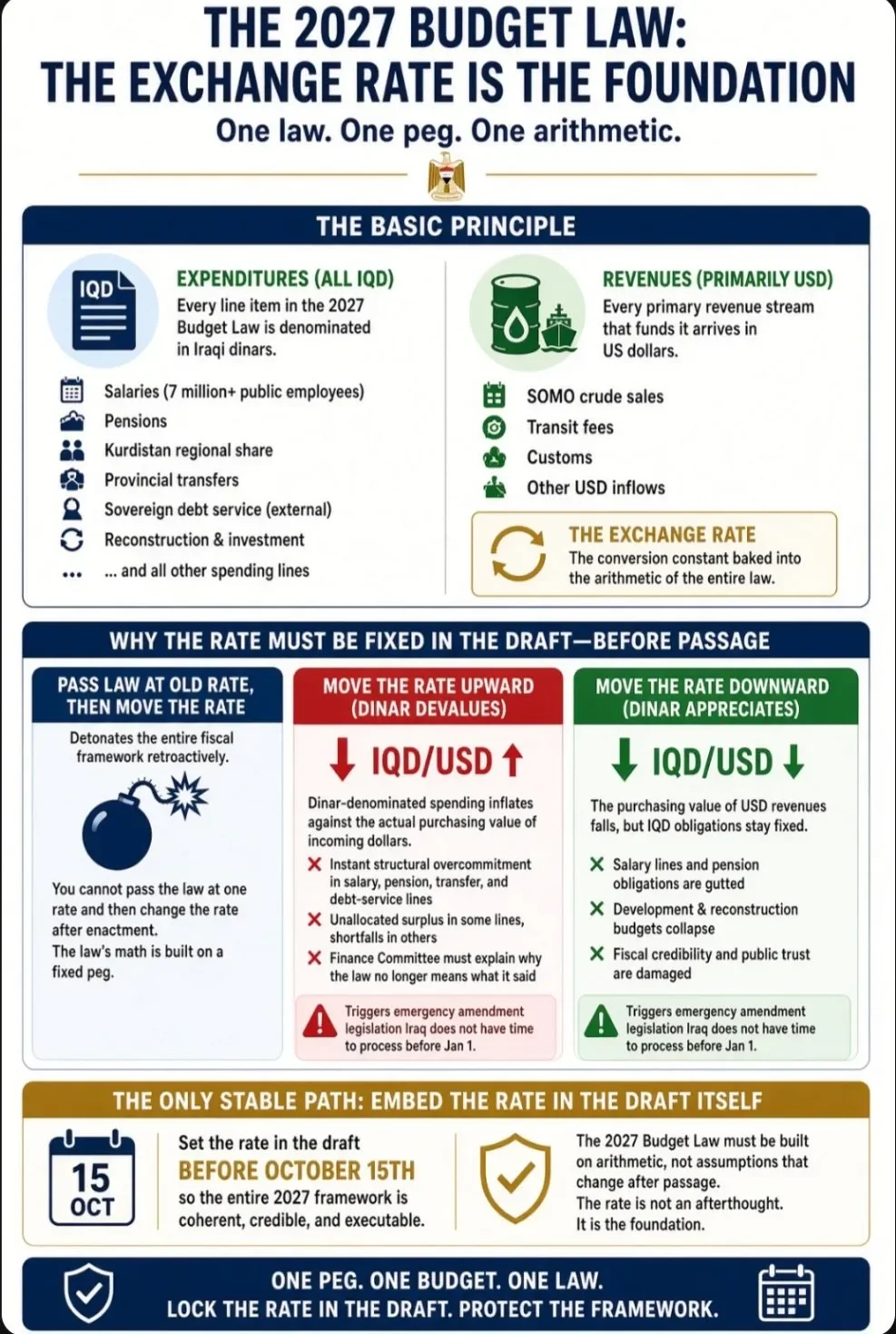
Please Understand This One Basic Principle:
Every line item in the 2027 Budget Law is denominated in Iraqi dinars. Every primary revenue stream that funds it SOMO crude sales, transit fees, customs arrives in US dollars.
The exchange rate is the conversion constant baked into the arithmetic of the entire law. Salaries for seven million-plus public employees, pension obligations, the Kurdistan regional share, provincial transfer formulas, sovereign debt service on the external obligations, reconstruction tranches all of it is IQD math running on a USD intake assumption at a fixed peg.
You cannot pass that law at the old rate and then move the rate after passage. You would detonate the entire fiscal framework retroactively.
Move the rate upward post-enactment and the dinar-denominated expenditure side inflates against the actual purchasing value of the incoming dollars instant structural overcommitment in some lines, unallocated surplus in others, and the Finance Committee gets to explain why a law they voted on no longer means what it said.
Move it downward post-enactment and you gut the salary lines and the development budget overnight. Either direction, you trigger emergency amendment legislation, which Iraq does not have the calendar time to process before January 1.
So the rate must embed in the draft itself, before October 15th, or the 2027 framework is built on sand.
Seeds of Wisdom RV and Economics Updates Wednesday Afternoon 9-30-26
Good Afternoon Dinar Recaps,
DIGITAL PAYMENTS RESET WATCH: APPLE PAY ENTERS INDIA AS GLOBAL PAYMENT SYSTEMS EVOLVE
Apple Pay’s launch in India adds another major global payment network to one of the world’s most advanced real-time digital payment ecosystems, highlighting the continuing evolution of how money moves across borders and platforms.
Good Afternoon Dinar Recaps,
DIGITAL PAYMENTS RESET WATCH: APPLE PAY ENTERS INDIA AS GLOBAL PAYMENT SYSTEMS EVOLVE
Apple Pay’s launch in India adds another major global payment network to one of the world’s most advanced real-time digital payment ecosystems, highlighting the continuing evolution of how money moves across borders and platforms.
OVERVIEW
Apple Pay has officially launched in India through a partnership with Axis Bank, initially supporting eligible Visa and Mastercard credit cards.
India’s Unified Payments Interface (UPI) already dominates the country’s digital-payment landscape and is recognized by the IMF as the world’s largest retail fast-payment system by transaction volume.
The development illustrates how global payment networks, domestic instant-payment systems, banks and digital wallets are increasingly operating within the same financial ecosystem.
KEY DEVELOPMENTS
1. Apple Pay Enters One Of The World’s Largest Digital Payment Markets
Apple Pay launched in India on September 30 through a partnership with Axis Bank, giving Apple’s payment service its first foothold in one of the world’s largest digital-payment markets.
The initial rollout is available to Axis Bank customers with eligible Visa and Mastercard credit cards. Cards issued through India’s domestic RuPay network are not currently supported.
Axis Bank had approximately 16.3 million credit cards outstanding in August, compared with roughly 124 million credit cards nationwide, according to central-bank data reported by Reuters.
Customers can add eligible cards through the Axis Bank mobile application or Apple Wallet and use Apple Pay for purchases in stores, applications and online transactions.
2. Apple Pay Is Entering An Already Highly Developed Payment Ecosystem
India is not beginning its digital-payment transformation with Apple Pay.
The country's Unified Payments Interface, or UPI, has already become a major part of everyday financial activity. Reuters, citing a 2025 IMF report, reported that UPI accounts for approximately 84% of India's digital-payment volumes.
The IMF describes UPI as the world's largest retail fast-payment system by volume and has studied India's experience as an example of how interoperability between banks and payment providers can accelerate digital-payment adoption.
This makes Apple's entry particularly significant.
Rather than replacing India's existing payment infrastructure, Apple Pay is entering an ecosystem in which multiple payment technologies can coexist.
*****************
3. The Bigger Story Is Interoperability
The IMF's research on India's payment system highlights the importance of interoperability—the ability of different banks, applications and payment providers to connect and transact across a common infrastructure.
UPI allows participating banks and payment providers to exchange payment information while the underlying funds remain within users' bank accounts.
That architecture has helped India expand digital payments while allowing different applications and financial institutions to participate.
Apple Pay adds another consumer-facing layer to that ecosystem.
The significance is therefore broader than the arrival of one technology company. It demonstrates how payment systems are increasingly being built around connections between different networks rather than isolated financial platforms.
WHY IT MATTERS
The global financial system is gradually moving toward faster, more connected forms of payment.
Traditional international payments can involve multiple banks, intermediaries, currencies and settlement systems. Newer payment infrastructure is increasingly designed to make transactions faster, more interoperable and more digitally integrated.
India's UPI provides one example of how a national payment rail can become a large-scale digital infrastructure platform.
Apple Pay's entry demonstrates another part of the evolution: global technology and payment companies are seeking access to established domestic payment ecosystems rather than building completely separate systems.
That distinction matters because the future of digital finance may depend less on one single replacement system and more on how effectively different systems connect with one another.
WHY IT MATTERS TO FOREIGN CURRENCY HOLDERS
For foreign currency holders watching the evolution of the global financial system, digital payments are an important part of the foundation being built underneath future international finance.
The development does not mean that currencies are being revalued, that a global currency reset has occurred, or that Apple Pay is replacing the dollar or India's rupee.
What it does show is that the infrastructure through which currencies are transferred and used is changing.
As countries develop faster-payment networks, banks modernize settlement systems and technology companies connect consumers to financial infrastructure, the way money moves can change even before the currencies themselves change in value.
IMPLICATIONS FOR THE GLOBAL RESET
Pillar 1: Technology
Digital wallets, instant-payment systems and interoperable banking networks are becoming increasingly important components of modern financial infrastructure.
Pillar 2: Currencies
More efficient payment systems can make domestic and international currency transactions faster and potentially reduce friction between different financial networks.
Pillar 3: Trade
Faster and more connected payment infrastructure can support international commerce by improving how businesses and consumers pay across increasingly digital economies.
Pillar 4: Assets
As financial transactions become increasingly digital, the infrastructure supporting bank deposits, cards, digital money and eventually tokenized financial assets becomes increasingly important to the broader financial system.
WHAT TO WATCH NEXT
The next important question is whether Apple Pay expands its Indian banking partnerships.
Reuters reported that Apple has also held discussions with HDFC Bank and ICICI Bank, although commercial agreements had not yet been finalized.
The larger issue is whether global payment providers increasingly connect with national instant-payment systems and whether those connections eventually extend beyond consumer payments into cross-border settlement, banking and digital financial infrastructure.
India's experience with UPI will be particularly important because the IMF has identified its interoperability model as a significant factor in the growth of digital payments.
THE BOTTOM LINE
Apple Pay's arrival in India is not a currency reset, but it is another visible piece of the infrastructure transformation taking place underneath the global financial system.
India already demonstrates that digital payments can scale nationally through interoperable networks, while Apple Pay illustrates how global financial technology companies are increasingly connecting to those established systems.
For those watching the Global Reset, the important lesson is to watch the infrastructure before the headlines.
The bigger story is not simply which payment app consumers use—it is how banks, technology companies and national payment networks are increasingly connecting the world's money into a more integrated financial system.
Seeds of Wisdom Team
Newshounds News™ Exclusive
Sources
Reuters — "Apple Pay launches in India with Axis Bank partnership"
International Monetary Fund — "Growing Retail Digital Payments: The Value of Interoperability"
~~~~~~~~~~
Seeds of Wisdom Team RV Currency Facts Youtube and Rumble
Newshound's News Telegram Room Link
RV Facts with Proof Links Link
RV Updates Proof links - Facts Link
Start Here room with Most Asked Questions Link
Follow the Gold/Silver Rate COMEX
Follow Fast Facts
Seeds of Wisdom Team™ Website
Thank you Dinar Recaps
Wed. Iraq News Posted by Tishwash at TNT 9-30-2026
TNT:
Tishwash: The Iraq Stock Exchange officially joins the "Tabadul" platform.
The Abu Dhabi Securities Exchange announced the official start of trading for the Iraq Stock Exchange via the “Tabadul” platform, making it the eighth market to join the platform.
The move allows investors in Iraq to trade securities listed on the Abu Dhabi market directly, thus enhancing trading and investment opportunities between the two markets.
The “Tabadul” platform provides the ability to trade between participating markets and settle transactions in local currencies, without the need for dual listing or custodian services.
TNT:
Tishwash: The Iraq Stock Exchange officially joins the "Tabadul" platform.
The Abu Dhabi Securities Exchange announced the official start of trading for the Iraq Stock Exchange via the “Tabadul” platform, making it the eighth market to join the platform.
The move allows investors in Iraq to trade securities listed on the Abu Dhabi market directly, thus enhancing trading and investment opportunities between the two markets.
The “Tabadul” platform provides the ability to trade between participating markets and settle transactions in local currencies, without the need for dual listing or custodian services.
With the addition of the Iraqi market, the platform now includes markets with a total market value exceeding one trillion dollars, and includes approximately 700 listed companies and more than 11 million registered investors. link
Tishwash: Iraq declares "Sovereignty Day" holiday from Wednesday to Sunday
On Saturday, the Cabinet issued a decision to suspend official working hours on the occasion of "Sovereignty Day".
An official statement from the media office of Prime Minister Ali al-Zaidi stated: It has been decided to suspend official working hours in state institutions starting from Wednesday, September 30, until Saturday, October 3, in celebration of the (Sovereignty Days) of the Republic of Iraq.
The complete withdrawal of foreign forces from Iraq is expected to be announced on September 30, after all their bases and camps have been handed over to the Iraqi side.
Al-Zaydi had previously directed all ministries, non-ministerial entities, and governorates to take the necessary measures in accordance with the law, in coordination with the government media cell, regarding the celebration of "Iraqi Sovereignty Day".
Iraq and the United States had agreed in September 2024 to end the military mission of the international coalition led by Washington against the "Islamic State" organization in Iraq, as part of a phased plan to move the security relationship between the two countries from the framework of the coalition to a bilateral partnership.
The first phase of the mission ended in September 2025, while forces remained in the Kurdistan Region to support operations against the organization in Syria, with the final phase to be completed by the end of September 2026.
The international coalition was formed in 2014 to assist Iraqi forces in confronting ISIS, which at the time controlled large areas of Iraq and Syria. The mission of the coalition forces later shifted primarily to training, advising, and intelligence support, while Baghdad asserts that its forces are now capable of assuming responsibility for security and pursuing the organization's cells link
************
Tishwash: Iraq strengthens its presence in Arab and international forums... Nizar Nasser, Governor of the Central Bank of Iraq, elected Vice-Chairman of the Council of Governors of Arab Central Banks and Monetary Institutions
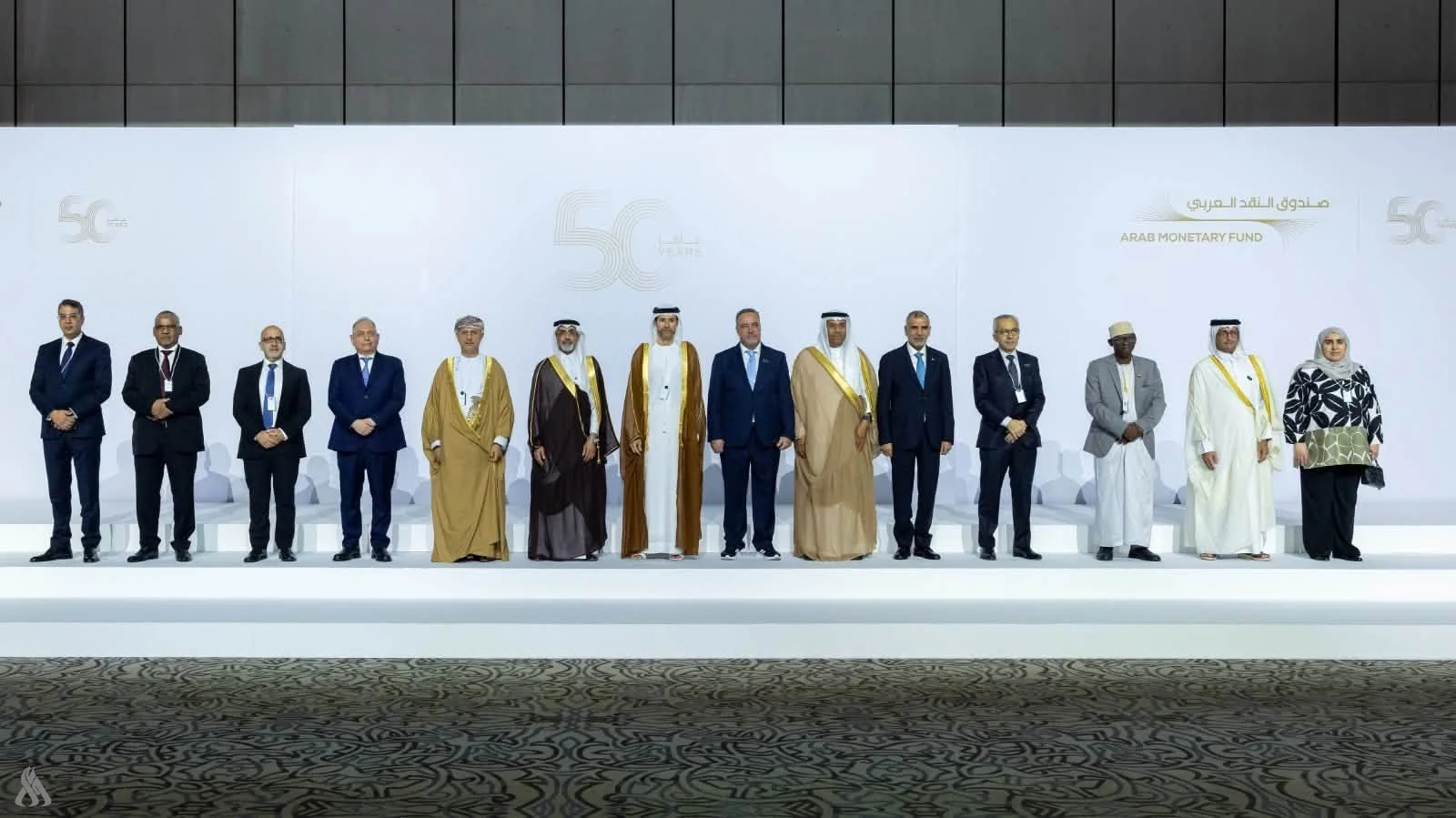
The Governor of the Central Bank of Iraq, Nizar Nasser, was elected Vice-Chairman of the Council of Governors of Arab Central Banks and Monetary Authorities during the 50th session of the Council, held in Abu Dhabi, the capital of the United Arab Emirates. The meeting, organized and sponsored by the Arab Monetary Fund, brought together governors of central banks and monetary authorities from across the Arab world.
Discussions focused on key regional and international economic and financial developments, the challenges facing Arab economies amidst current geopolitical shifts, and ways to enhance monetary and financial stability, develop the banking sector, support digital transformation and financial inclusion, and improve the efficiency of Arab payment systems and financial markets.
The meeting also addressed strengthening cooperation and coordination among Arab central banks and monetary authorities, and developing joint efforts with international financial institutions, particularly the International Monetary Fund and the World Bank, to bolster the resilience of Arab economies to shocks and achieve stability and sustainable growth.
The governors discussed priority issues proposed for inclusion in the unified Arab statement for 2026 before the International Monetary Fund and the World Bank. These issues include strengthening financial and technical support for Arab countries, developing local capital markets, supporting digital transformation, sustainable finance, capacity building, and enhancing the representation of Arab countries and expertise in international financial institutions.
The 50th session of the Council coincided with the 50th anniversary of the establishment of the Arab Monetary Fund, reflecting a long history of Arab monetary and financial cooperation and the Fund's role in supporting efforts to achieve stability and economic development in Arab countries.
Iraq's participation in this important Arab financial forum confirms its return to a leading position regionally and internationally, and reaffirms the distinguished status of the Central Bank of Iraq, one of the oldest Arab central banks.
It also underscores the prominent presence of the Governor of the Central Bank of Iraq, Nizar Nasser, among his counterparts from other Arab central banks. link
************
Tishwash: The Minister of Finance participates in the 17th session of the Council of Arab Finance Ministers in Abu Dhabi
Finance Minister Faleh Sari participated on Tuesday in the 17th regular session of the Council of Arab Finance Ministers, hosted by the UAE capital, Abu Dhabi.
A statement from the Ministry of Finance, received by the Iraqi News Agency (INA), indicated that "Finance Minister Faleh Sari participated in the 17th regular session of the Council of Arab Finance Ministers, hosted by the UAE capital, Abu Dhabi, with the participation of Arab finance ministers and representatives of regional and international financial institutions."
The statement added that "the session is discussing a number of priority issues in the field of financial and economic policies, foremost among them strengthening financial stability and enhancing the resilience of Arab economies, in addition to developments in public finance policies."
It also noted that "the session coincides with the celebration of the golden jubilee of the Arab Monetary Fund, marking 50 years since its establishment." link
Tishwash: The meeting of the presidencies sets timetables for the inventory of weapons and ties the decision of peace and war to the state.
The meeting of the presidencies on Monday affirmed that the decision of peace and war is the sole prerogative of the state and its constitutional and legal institutions, announcing an agreement to set governmental timetables to address the issue of loose weapons and control them in accordance with legislative frameworks, in a way that guarantees the country’s sovereignty and the unity of national decision-making.
The statement issued by the Prime Minister’s Media Office, which was received by (Al-Mada), stated that Prime Minister Ali Faleh Al-Zaidi met with President Nizar Amidi, Speaker of Parliament Hebat Al-Halbousi, and Head of the Supreme Judicial Council Faiq Zaidan to discuss security and economic developments.
The participants stressed their support for the Iraqi request to exempt Najaf Airport from US Treasury measures, emphasizing the need to expedite the completion of the cabinet and to mobilize judicial and executive efforts to combat corruption, in addition to taking precautionary measures to spare the national economy the consequences of regional tensions and to establish a new phase that transcends international withdrawal towards expanded economic partnerships. link
News, Rumors and Opinions Wednesday 9-30-2026
Ariel: The Wizard of Oz as a Monetary Allegory
9-30-2029
The Wizard of Oz As Monetary Allegory: For Those Pressed For Time
The Emerald City reading isn’t random. Since economist Hugh Rockoff’s 1990 paper “The ‘Wizard of Oz’ as a Monetary Allegory,” scholars have mapped L. Frank Baum’s 1900 book onto the 1890s Populist movement the fight over gold vs. silver coinage.
The Emerald City itself = paper greenbacks.
Ariel: The Wizard of Oz as a Monetary Allegory
9-30-2029
The Wizard of Oz As Monetary Allegory: For Those Pressed For Time
The Emerald City reading isn’t random. Since economist Hugh Rockoff’s 1990 paper “The ‘Wizard of Oz’ as a Monetary Allegory,” scholars have mapped L. Frank Baum’s 1900 book onto the 1890s Populist movement the fight over gold vs. silver coinage.
The Emerald City itself = paper greenbacks. Everyone entering the city must wear green-tinted glasses locked on by the gatekeeper so everything appears green/gold. The “wealth” is an optical illusion enforced by the gatekeeper. Remove the glasses and the city isn’t emerald at all. It’s an ordinary town.
That last part is the deepest cut: the citizens can’t see straight because the state mandates the lens. The green glasses are the monetary system itself debt-based currency that everyone is forced to perceive as wealth.
Note: Applied to money, the claim is that the U.S. Treasury has always had the Constitutional power (Article I, Section 8) to issue debt-free currency directly as Lincoln did with Greenbacks in 1861–62, and as the Treasury briefly did with U.S. Notes before the Federal Reserve Act of 1913 routed issuance through a private banking cartel that charges the public interest on its own money.
Think About It
• The Wizard’s curtain = the Fed’s money-creation process, where the Treasury “borrows” what it could issue outright.
• Dorothy going home = returning to direct Treasury issuance debt-free, interest-free money.
• “Yes, I found it” = the assertion that the mechanism still exists on the books, dormant, ready to be reactivated.
Get it now?
The greenback precedent is genuine. Lincoln issued ~$450 million in U.S. Notes without Fed or bank intermediation to fund the Civil War. Kennedy’s 1963 Executive Order 11110 authorized Series 1963 U.S.
Notes a small run of Treasury-issued, debt-free currency and conspiracy circles have tied that to everything from the “secret society” speech to his assassination ever since.
US Debt Clock.org usdebtclock.org

Courtesy of Dinar Guru: https://www.dinarguru.com/
Terrance Question: "Do you think the CBI and the government of Iraq needs the approval from the US Treasury before they move forward because the Treasury is so involved with the Iraqi banking system and the CBI?" Terrance: I would lean to believe the United States Treasury is overseeing it. Donald Trump made an announcement of who he did not want to be the prime minister and I'm sure they had a lot of influence in Al-Zaidi becoming Prime Minister. He's a banker. He's someone who understands business. He's a lot like Donald Trump.
Man Preparation for new notes and preparation for a coordinated rate step can run at the same time. One does not cancel the other...What do we watch for next? Watch for the sovereignty days for any central bank or finance language...Watch whether the interior and defense get names because the exit protocol needs those signatures... Watch the oil number that goes into the 2027 draft budget. Watch the dollar crate [from the US Treasury] land...
Walkingstick [Iraqi bank friend Aki update] Aki's bank owner boss says to his employees...there came a time when Iraqis held on to their dinars. Those people are going to profit very soon. Your employees, Aki, who have bought dinars from our banks are going to profit. (He didn't say anything about Americans)...Last week I was in Washington DC with the CBI, IMF World Bank and the United States Treasury. These 4 know our note count that is outside of our borders and more importantly the numerical value of our three zero notes here in the United States and worldwide...They also approved our monetary reform steps...The banking system of Iraq is going to be a mirror image of the banking system of the United States of America. Also while I was in Washington DC they reviewed the exchange procedure... There will be hundreds of places for you to exchange your dinar. It's our job to train the Iraqi citizens and prepare them in this area...Aki is teaching how to use [exchange] ATM machines.
*************
The Final Steps Before The Dinar Revalues
The Dinar Den: 9-29-2026
Reset Intelligence: Pensions for Weapons.
Emailed to Recaps~ Thank you David
Reset Intelligence: Pensions for Weapons.
By Reset Intelligence | @EXIT_FIAT
On Tuesday, the day before the coalition's mission in Iraq closed, the cabinet voted through the PMF Service and Retirement Law and sent it to parliament: ranks, salaries and pensions inside the state for the fighters who bring their weapons in.
The blocs handed al-Zaidi the authority to fill the 9 empty cabinet chairs as one package after Sovereignty Day. Kataib Hezbollah answered with a threat to police Iraqi airspace and bring the government down.
Emailed to Recaps~ Thank you David
Reset Intelligence: Pensions for Weapons.
By Reset Intelligence | @EXIT_FIAT
On Tuesday, the day before the coalition's mission in Iraq closed, the cabinet voted through the PMF Service and Retirement Law and sent it to parliament: ranks, salaries and pensions inside the state for the fighters who bring their weapons in.
The blocs handed al-Zaidi the authority to fill the 9 empty cabinet chairs as one package after Sovereignty Day. Kataib Hezbollah answered with a threat to police Iraqi airspace and bring the government down.
The law
Per the Prime Minister's office, the Council of Ministers "voted in favor of the Popular Mobilization Forces bill" and "approved referring the bill to parliament for a vote, in accordance with constitutional provisions." The package includes the PMF Service and Retirement Law, built to organize the Popular Mobilization Commission the way the state organizes its other security agencies: a structure, a ladder of ranks, pensions, and compensation for the families of fighters killed in service. The bill was first sent to parliament in early 2025 and shelved. It came back in August without the provisions Washington had objected to, and regional press reports Washington still opposes it.
Everything else that moved
The cabinet - per Iraqi press citing political sources, most blocs have authorized al-Zaidi to pick the remaining ministers himself, Interior and Defense included, as a single package. Completion is expected after the Sovereignty Day ceremonies, with a televised address by the Prime Minister. No date has been printed.
The holdout - Kataib Hezbollah says it will monitor Iraqi airspace from October 1, "warn at first, and then shoot them down," and bring the government down "by all means" if the ban on Iranian flights continues.
The air force - the same day, Air Force commander Lieutenant General Khalid al-Tamimi said every mission inside Iraq is flown "with complete independence from the International Coalition," which has flown none in Iraq this year, and that Baghdad is in advanced talks with Paris for 14 Rafale fighters.
The exit - the coalition formed in 2014 ends its Iraq mission today. Italy completed its withdrawal after 12 years on Tuesday. No statement from the Pentagon, Central Command or the White House has marked the day.
The street - $100 closed Tuesday near 157,500 dinars in Baghdad, up from 156,500 on Monday and 155,250 on Sunday, against the official 131,000. The cash shipment promised on Saturday had not arrived by Tuesday night.
The budget - the 2027 draft is still with the Council of Ministers, which voted the PMF law this week and not the budget. Parliament's date is October 15. From tomorrow, importers pay customs duties before their dollars leave the bank.
Tehran - the rial hit a record 2.54 million to the dollar on Tuesday. Trump denied offering sanctions relief: "I offered them NOTHING." Bessent said Iran will have nothing left to trade within 2 weeks, and Tether confirmed over $550 million in Iran-linked stablecoins frozen this year, including wallets the Treasury tied to the Central Bank of Iran.
The trade
For 2 years the case for a militia's weapons ran on a foreign presence to point at and a payroll from Tehran underneath. The presence is gone as of today. Iran's own central bank governor has said the oil money is dry. What the cabinet put on the table on Tuesday is a state payroll instead, with the price al-Zaidi named at the United Nations: the state decides war and peace, and weapons stay in constitutional hands.
That is the short version. How that trade works, the one time in modern history a state ran it and what it moved, and the one gate that still belongs to the Central Bank of Iraq - that is the daily read.
Read the full daily briefing free for 5 days. Sign up here: the daily Iraqi dinar briefing
Want it straight from the horse's mouth? The CBI Rate Alert pings you the moment the Central Bank of Iraq moves the official rate. The number itself, not a rumour about it. It comes with our free resource library and the daily breakdown of what is actually moving in Iraq. Sign up free: The CBI Rate Alert
Got a dinar question? Reset Intelligence runs an on-call research assistant: ask it anything they have published. It answers in seconds and will conduct deep research to find you the answer. Try it: the Iraqi dinar research assistant
Common questions, answered straight: When will the Iraqi dinar revalue? and Is the Iraqi dinar revaluation real?
The design behind all of it is mapped in Head of the Snake, and the free guides live in the Iraqi dinar resource library.
Follow the daily intel free: Telegram · Facebook · Spotify · Odysee
Seeds of Wisdom RV and Economics Updates Wednesday Morning 9-30-26
Good Morning Dinar Recaps,
GLOBAL BOND RESET WATCH: GLOBAL BONDS FACE WORST MONTH IN YEARS AS GOVERNMENT DEBT AND YIELDS SURGE
Global bond markets are ending September under pressure as rising government borrowing, persistent inflation and higher energy costs push long-term yields to multi-year highs.
Good Morning Dinar Recaps,
GLOBAL BOND RESET WATCH: GLOBAL BONDS FACE WORST MONTH IN YEARS AS GOVERNMENT DEBT AND YIELDS SURGE
Global bond markets are ending September under pressure as rising government borrowing, persistent inflation and higher energy costs push long-term yields to multi-year highs.
OVERVIEW
Global bonds are on track for their worst monthly performance in years, pressured by deteriorating government finances, increased debt issuance and persistent inflation.
The U.S. 10-year Treasury yield remains near its highest level since June 2007, while German, French and Japanese government bond yields have also reached multi-year or multi-decade highs.
Higher U.S. yields have helped lift the dollar roughly 2% for September, demonstrating how changes in bond markets can quickly affect currencies and global capital flows.
KEY DEVELOPMENTS
1. Global Bond Markets Face A Difficult September
Global bonds have come under sustained pressure as investors reassess the cost of financing government debt.
Reuters reports that global bonds are headed toward their worst month in years, with deteriorating government finances, a heavy supply of new debt and persistent inflation all contributing to the selloff.
The U.S. 10-year Treasury yield was around 5.21% on September 30, while the yield was still on track for a monthly increase of more than 45 basis points. Bond yields move inversely to prices, meaning higher yields correspond with lower bond prices.
The move matters because government bonds are a foundation for pricing many other forms of borrowing.
2. U.S. Treasury Yields Remain At Historically Important Levels
The U.S. Treasury market remains at the center of the global repricing.
The 10-year yield is near its highest level since June 2007, while the 30-year Treasury yield recently reached approximately 5.61%, its highest level since 2002.
Long-term Treasury yields influence the cost of mortgages, corporate borrowing and other financial assets.
As investors demand higher returns to hold longer-term government debt, the cost of capital throughout the economy can rise.
3. Europe And Japan Are Experiencing Similar Pressure
The bond-market pressure is not limited to the United States.
Reuters reports that 10-year German and French government bond yields reached 17-year and 18-year highs, respectively, during the week.
Japan's 10-year government bond yield has also remained near multi-decade highs.
The simultaneous movement across several major bond markets is important because global investors compare yields, currencies and risk across countries when deciding where to allocate capital.
WHY IT MATTERS
Government bonds have traditionally served as one of the primary foundations of the international financial system.
When yields rise significantly, the change can spread through mortgages, corporate debt, government refinancing, equity valuations and currency markets.
The current environment is especially significant because governments around the world are issuing substantial amounts of debt while investors are demanding higher compensation for holding longer-term bonds.
That creates a difficult balancing act: governments need financing, but higher borrowing costs can increase the amount governments must spend servicing existing debt.
WHY IT MATTERS TO FOREIGN CURRENCY HOLDERS
For foreign currency holders, the bond-market story matters because interest rates and government bond yields influence where international capital flows.
The U.S. dollar has gained roughly 2% during September, helped in part by higher U.S. Treasury yields.
At the same time, the euro and British pound have declined during the month, while the yen has been influenced by concerns about possible currency intervention.
These movements demonstrate an important connection:
Bond yields → capital flows → currency demand → exchange rates.
This does not mean that higher bond yields automatically produce a currency revaluation or a global financial reset. Instead, they show how changes in the underlying debt markets can influence the relative value of currencies and the movement of international capital.
IMPLICATIONS FOR THE GLOBAL RESET
Pillar 1: Debt
The central issue is the rising cost of financing government debt.
As yields increase, governments refinancing existing obligations or issuing new debt may face higher interest expenses. The longer elevated yields persist, the more important debt-management strategies become.
Pillar 2: Assets
Government bonds influence the valuation of many other assets because their yields serve as reference points for the broader cost of capital.
Higher risk-free yields can change how investors evaluate stocks, corporate bonds, real estate and other long-duration assets.
Pillar 3: Currencies
Currency markets are closely connected to interest-rate differentials.
When U.S. yields rise relative to other major economies, international investors may find dollar-denominated assets more attractive, increasing demand for the dollar and potentially putting pressure on other currencies.
Pillar 4: Trade
Higher borrowing costs can affect businesses that finance inventories, equipment, transportation and international expansion.
If elevated interest rates persist, the cost of financing global trade can become another factor influencing international commerce and investment.
WHAT TO WATCH NEXT
The next major indicators will include inflation data, employment reports, central-bank decisions, government borrowing requirements and energy prices.
Markets will also be watching whether long-term Treasury yields remain around the 5% range or move materially higher or lower.
The direction of energy prices is particularly important because sustained increases in oil prices can reinforce inflation pressures and complicate central-bank decisions.
THE BOTTOM LINE
The September bond-market selloff is about more than falling bond prices. It reflects a broader repricing of government debt, inflation, interest rates and the cost of capital across major economies.
For the global financial system, the important question is how governments, investors and central banks adapt if higher long-term borrowing costs become a more permanent feature of international finance.
The bigger story is not simply where bond yields go next—it is how the repricing of global debt is forcing governments, investors and markets to rethink the architecture through which money and capital move, becoming another step in the evolution of the global financial system.
Seeds of Wisdom Team
Newshounds News™ Exclusive
SOURCES
~~~~~~~~~~
🌱 A Message to Our Currency Holders🌱
If you’ve been holding foreign currency for many years, you were not foolish.
You were not wrong to believe the global financial system would change.
What failed was not your patience — it was the information you were given.
For years, dates, rumors, and personalities replaced facts, structure, and proof. “This week” predictions created cycles of hope and disappointment that were never based on how currencies actually change.
That is not your failure.
Our mission here is different: • No dates • No rates • No hype • No gurus
Instead, we focus on:
• Verifiable developments • Institutional evidence
• Global financial structure • Where countries actually sit in the process
Currency value changes only come after sovereignty, trade, banking, settlement systems, and fiscal coordination are in place. History and institutions confirm this sequence.
You will see silence. You will see denials. That is not delay — that is discipline.
Protect your identity. Organize your documents. Verify everything.
Never hand your discernment to anyone who cannot show proof.
You deserve truth — not timelines.
Seeds of Wisdom Team
Newshounds News
~~~~~~~~~~
Seeds of Wisdom Team RV Currency Facts Youtube and Rumble
Newshound's News Telegram Room Link
RV Facts with Proof Links Link
RV Updates Proof links - Facts Link
Start Here room with Most Asked Questions Link
Follow the Gold/Silver Rate COMEX
Follow Fast Facts
Seeds of Wisdom Team™ Website
Thank you Dinar Recaps
Iraq Economic News and Points To Ponder Late Tuesday Evening 9-29-26
The Iraq Stock Exchange Officially Joins The "Tabadul" Platform 9 29 2026
The Abu Dhabi Securities Exchange announced the official start of trading for the Iraq Stock
Exchange via the “Tabadul” platform, making it the eighth market to join the platform.
The move allows investors in Iraq to trade securities listed on the Abu Dhabi market directly, thus enhancing trading and investment opportunities between the two markets.
The Iraq Stock Exchange Officially Joins The "Tabadul" Platform 9 29 2026
The Abu Dhabi Securities Exchange announced the official start of trading for the Iraq Stock
Exchange via the “Tabadul” platform, making it the eighth market to join the platform.
The move allows investors in Iraq to trade securities listed on the Abu Dhabi market directly, thus enhancing trading and investment opportunities between the two markets.
The “Tabadul” platform provides the ability to trade between participating markets and settle
transactions in local currencies, without the need for dual listing or custodian services.
With the addition of the Iraqi market, the platform now includes markets with a total market value exceeding one trillion dollars, and includes approximately 700 listed companies and more than 11 million registered investors.
https://www.economy-news.net/content.php?id=74498
Iraqi Government Votes On PMF Law - 9/29/2026
2026-09-29 / Shafaq News- Baghdad Iraq’s Council of Ministers voted Tuesday during its 21st regular session to approve a draft law governing the Popular Mobilization Forces (PMF), referring it to parliament for a vote in accordance with the Constitution.
Earlier, Informed sources told Shafaq News that the two amended drafts on the structure of the PMF Commission and its service and retirement system are nearing referral to Iraq’s parliament after several contentious provisions, including those facing what the sources described as a “US veto,” were removed. The sources said some provisions of the two PMF bills still face US objections. The final versions will therefore be referred to parliament to begin the formal legislative process.
Read more:Iraq's PMF Service and Retirement Law: Is political exploitation inevitable?
Regarding the anti-corruption campaign and recovering illicitly obtained funds, the Council also voted to form a committee to coordinate with the Jordanian side on establishing a joint team tasked with developing a shared framework for recovering Iraqi funds held in Jordan and settling outstanding debts under the terms of the Paris Club agreement, while safeguarding Iraq’s legal rights. https://www.shafaq.com/en/Iraq/Iraq-government-votes-on-Popular-Mobilization-Forces-law
The Government Votes On The Draft Law On Mobilization And Refers It To Parliament For A Vote
Baghdad - One News - 9/29/2026 The Cabinet, headed by Ali al-Zidi, voted on the draft law for the Popular Mobilization Forces and referred it to the House of Representatives for a vote in accordance with the provisions of the Constitution, within what the government described as regulating the administrative framework of security institutions.
In the area of combating corruption, the Council decided to form a committee headed by the Ministry of Finance to coordinate with Jordan on recovering Iraqi funds and settling debts in accordance with the terms of the Paris Club.
He also abolished the special royal decree committee for following up on listing and sanctions files, and tasked the Ministry of Foreign Affairs with coordinating directly with the US Treasury Department to obtain information related to suspicious individuals and companies on a case-by-case basis.
The council also approved a ban on the export of copper, aluminum, lead, iron alloys and their waste, restricting their circulation within Iraq to support local industry.
https://1news-iq.net/الحكومة-تصوت-على-مشروع-قانون-الحشد-وتح/
Saif Raad: Abu Mujahid Al-Assaf's Statement Is Dragging Iraq Into Ruin, And Iraqis' Fears Of The Factions' Rhetoric Are Escalating
Baghdad - One News - 9/29/2026 Security and political analyst Saif Raad said there is a clear difference and discrepancy between the statements of Abu Mujahid al-Assaf and Abu Hussein al-Hamidawi, considering that the recent speech of the factions has raised concerns among Iraqis in conjunction with the withdrawal of American forces from the country.
Raad explained that Abu Mujahid al-Assaf’s statement and its threat to the government prompted Iraqis to worry about the nature of the next stage, noting that the incidents in al-Dora and al-Bu Aitha reveal one aspect of the reasons for these fears regarding the factions’ rhetoric.
Raad considered that Ali al-Zaidi’s threat, in his capacity as Prime Minister and Commander-in-Chief of the Armed Forces, represents a threat to the people, warning that Abu Mujahid al-Assaf’s statement may drag Iraq into “ruin,” as he put it.
He pointed out that the American talk about the dangers of “Balkanizing Iraq” is a clear indication of the magnitude of the challenges that the country may face in the next stage, especially with the continued presence of weapons outside the framework of the state.
On the economic front, Raad believes that one of the biggest challenges facing the government is that the dollar file remains in the hands of the Americans, considering that this makes Iraq vulnerable to broad economic pressures.
Raad warned of the possibility of Iraq being subjected to harsh economic sanctions and international isolation that would affect the internal situation, noting that the failure to restrict weapons to the state could, in his estimation, lead to the division of Iraq and a scenario of “Balkanization of Iraq.” https://1news-iq.net/سيف-رعد-بيان-أبو-مجاهد-العساف-يجر-العرا
The US Treasury Grants Iraqi Airways A Conditional License For Flights To Iran Via Najaf Airport.
Last updated: September 29, 2026 The Independent - The US Treasury Department, through the Office of Foreign Assets Control (OFAC), issued a special and limited-term license allowing Iraqi Airways to conduct transactions related to operating passenger flights between Iraq and Iran via Najaf International Airport, under a set of strict conditions and restrictions.
The authorization comes as Iraqi Airways has resumed flights between Najaf Airport and several Iranian airports, following a suspension of air traffic due to US restrictions and sanctions related to the Iranian aviation sector.
International reports on September 28, 2026, indicated that Washington was moving towards granting a limited waiver allowing flights for pilgrims between Iran and Najaf for approximately one month.
According to the license number IA-2026-1516078-1, Iraqi Airways and its associated service providers, as well as American persons acting on its behalf, are permitted to conduct the transactions necessary to operate the authorized flights.
The license clearly defined the scope of the flights, stipulating that the flights in question must depart from and return to Najaf International Airport, and that they must be limited to transporting Iranian passengers arriving for religious pilgrimage purposes.
This means that the American measure does not represent a comprehensive lifting of restrictions on dealings related to Iran, but rather a specific exception for a particular purpose and time frame.
The license will remain in effect until the completion of the transactions it covers or until October 28, 2026, whichever comes first, with the U.S. Office of Foreign Assets Control retaining the authority to amend or revoke the license at any time.
The license imposes restrictions on the nature of the people and goods that can be transported. According to its text, it prohibits the transfer of cash in bulk or shipments intended for Iranian intelligence agencies, military forces, or law enforcement agencies, as well as prohibiting the provision of transportation services to people and entities subject to US sanctions within the categories covered by the ban.
The license also limits the goods that can be transported to passengers' personal belongings, equipment, and items necessary for the security, safety, and operation of aircraft, while restrictions remain in place on the export or re-export of goods, technology, or software to Iran unless expressly covered by the U.S. authorization.
One of the most prominent clauses of the license is that its continuation is linked to the Iraqi side’s commitment to restrictions related to Iranian air traffic in Iraqi airspace.
It stipulates the possibility of amending or canceling it in the event of non-compliance with the conditions related to the entry or passage of Iranian flights through Iraqi airspace, except for the cases covered by the authorization.
Iraqi Airways had announced the resumption of flights between Najaf and Iranian airports on Monday, September 28, while reports indicated that restrictions remained in place on the Iranian airlines themselves, reflecting the specific nature of the US exemption granted to the Iraqi national carrier.
On the financial and security oversight side, the license obliges Iraqi Airways to keep records of the transactions covered by it for 10 years, as well as to submit a report to OFAC within ten working days of the license expiring.
The report is expected to include details of the number of passengers transported on authorized flights, their names and passport numbers, as well as the money spent by Iraqi Airways within Iran on fuel, maintenance, airport services and other expenses related to operating the flights.
These conditions indicate that Washington dealt with the issue of flights between Iraq and Iran as a temporary and monitored exception, allowing a portion of religious pilgrimage traffic to continue via the Iraqi carrier, without this implying the termination or suspension of the broader system of US sanctions and restrictions related to Iran and its aviation sector.
Iraq Economic News and Points To Ponder Tuesday Evening 9-29-26
MP: Fixing Contracts And Wages Is Mandatory For The Government Within The 2027 Budget
Information/Baghdad... MP Mahmoud Al-Shammari affirmed on Tuesday that the issue of regularizing the employment of contract and daily wage workers in various ministries and state institutions has become a legal and moral obligation incumbent upon the government. He stressed the financial necessity of including sufficient allocations to definitively resolve this entitlement within the 2027 general budget.
MP: Fixing Contracts And Wages Is Mandatory For The Government Within The 2027 Budget
Information/Baghdad... MP Mahmoud Al-Shammari affirmed on Tuesday that the issue of regularizing the employment of contract and daily wage workers in various ministries and state institutions has become a legal and moral obligation incumbent upon the government. He stressed the financial necessity of including sufficient allocations to definitively resolve this entitlement within the 2027 general budget.
Al-Shammari told the Information Agency, “Contract and daily wage workers have provided invaluable and continuous services for many years in running service and production departments and addressing the severe shortage of human resources.
Their continued suffering or the delay in settling their employment status is unacceptable.” He added, “Fairness and a stable livelihood for these employees represent a legislative priority that cannot be compromised within the Parliament.”
He added that "Parliament will exercise its oversight and legislative role to pressure the Ministry of Finance and the executive branch to include the necessary job positions (both newly created and eliminated) and the required financial coverage for their permanent employment in the 2027 budget without exception." He pointed out that "the country possesses ample resources to address this vital issue if there is a genuine will to end the policies of procrastination and favoritism."
He emphasized that "the House of Representatives will not pass the upcoming budget unless it includes clear and explicit provisions that resolve the entitlements related to contracts and salaries and grant them job security."
He warned the government against "ignoring the legitimate demands of this large segment of the population, given the negative repercussions this will have on the efficiency of government performance and social stability." End/25h
"The Brigades Threaten To Topple The Government" Security Official Abu Mujahid Al-Assaf Warns Al-Zaydi And His Allies: "A Government That Does Not Work For The Benefit Of The People Will Be Brought Down By Any Means Necessary"
Baghdad - One News - 9/28/2026 The security official of the brigades, Abu Mujahid al-Assaf, threatened to overthrow the government, directing a warning to Prime Minister Ali Faleh al-Zaidi and his allies, coinciding with an escalation of his position on the restrictions imposed on Iranian aviation and a threat to take steps if they continue after October 1st. A blatant threat...
Al-Assaf said in a statement that the government was formed from three allied parties, but he considered that the differences between them could lay the foundation for what he described as “strife and war between brothers in religion and homeland,” calling on its parties to learn from history.
The security official of the brigades addressed a message to al-Zaydi and those behind him, saying that “any government that does not work for the benefit of the people will be brought down by all means,” according to the text of the statement.
Regarding the Iran file, Al-Assaf announced that if what he described as the “air blockade” on the Islamic Republic continues after October 1st, the brigades will adopt a position that may lead to closing the ports of the countries participating in the blockade of Iran. A blatant threat that must be dealt with.
He also announced the monitoring of Iraqi airspace to ensure it was not violated by what he described as "hostile aircraft," threatening to shoot them down, and warning the Prime Minister's office against becoming, according to the statement, "a cashier for American violations" after October 1st. An IRI faction leader telling the GOI what to do...
Al-Assaf considered the withdrawal of coalition forces from Iraqi territory as the beginning of achieving full sovereignty over land, water, and airspace, and independence in political and economic decision-making. https://1news-iq.net/الكتائب-تلوّح-بإسقاط-الحكومة-المسؤ/
Kataib Hezbollah Warns To Topple PM Al-Zaidi's Government
2026-09-28 / Shafaq News- Baghdad A senior security official with Kataib Hezbollah, an Iran-aligned Iraqi armed faction, on Monday threatened to bring down Prime Minister Ali Al-Zaidi’s government if it failed to serve Iraqis and warned of escalation over restrictions on Iranian aviation.
“The government that does not work in the interests of the people will be brought down by all means,” Abu Mujahid Al-Asafi said in a statement.
Kataib Hezbollah has been designated by the United States as a Foreign Terrorist Organization since 2009. Washington says the group receives financial and military support from Iran and has carried out attacks against US, Iraqi and Coalition targets.
Read more: Iraq's disarmament deadline pits Baghdad against Iran-aligned factions
Al-Asafi also warned that if the “air blockade” on Iran continues beyond October 1, escalation could include moves to close border crossings with countries participating in the restrictions.
He said the “Islamic Resistance” would monitor Iraqi airspace for “hostile aircraft,” warning that they would first be cautioned and then shot down if they violated Iraqi airspace.
His remarks come as Baghdad faces US sanctions warnings over services provided to sanctioned Iranian airlines. Iranian airlines remain barred from operating through Iraqi airports, although Iraqi Airways resumed flights to Iran via Najaf on Monday as Baghdad continues seeking exemptions from US measures affecting Iranian carriers.
Al-Asafi also said Iraqis would celebrate September 30 as the “expulsion” of US and NATO forces.
September 30 is Baghdad’s deadline for ending the US-led Global Coalition’s military mission in Iraq, although separate US security arrangements are expected to continue.
Read more: Tension meets dialogue as Iraq approaches September 30 2
https://www.shafaq.com/en/Iraq/Kataib-Hezbollah-threatens-to-topple-Al-Zaidi-government
US Dollar Climbs In Baghdad, Erbil
2026-09-29 Shafaq News- Baghdad/ Erbil The US dollar closed Tuesday's trading higher in Iraq, hovering around 157,500 dinars per 100 dollars.
According to a Shafaq News market survey, the dollar traded in Baghdad's Al-Kifah and Al-Harithiya exchange markets at 157,500 dinars per 100 dollars, up from the morning session's 157,000 dinars.
In the Iraqi capital, exchange shops sold the dollar at 158,000 dinars and bought it at 157,000 dinars, while in Erbil, selling prices stood at 157,550 dinars and buying prices at 157,500 dinars.
https://shafaq.com/en/Economy/US-dollar-climbs-in-Baghdad-Erbil-3
Seeds of Wisdom RV and Economics Updates Tuesday Afternoon 9-29-26
Good Afternoon Dinar Recaps,
AI DEBT RESET WATCH: RISING BOND COSTS COLLIDE WITH MASSIVE AI INFRASTRUCTURE SPENDING
The global AI buildout is creating enormous demand for capital at the same time that rising government and corporate bond yields are making that capital increasingly expensive.
Good Afternoon Dinar Recaps,
AI DEBT RESET WATCH: RISING BOND COSTS COLLIDE WITH MASSIVE AI INFRASTRUCTURE SPENDING
The global AI buildout is creating enormous demand for capital at the same time that rising government and corporate bond yields are making that capital increasingly expensive.
OVERVIEW
AI infrastructure companies and major technology firms are turning increasingly to debt markets to finance data centers, computing capacity and other infrastructure.
Major technology companies known as hyperscalers have issued roughly $220 billion in bonds this year, with issuance potentially doubling next year as their infrastructure spending continues.
At the same time, the 30-year U.S. Treasury yield reached 5.61%, its highest level since June 2002, raising borrowing costs across global capital markets.
KEY DEVELOPMENTS
1. AI Infrastructure Is Becoming A Major Borrower
The rapid expansion of artificial intelligence requires enormous amounts of capital for data centers, advanced computing equipment, electricity infrastructure and technology networks.
Reuters reports that hyperscalers have already issued approximately $220 billion of bonds in 2026, with the possibility that borrowing could roughly double next year. The additional borrowing is occurring as investors demand higher yields from companies seeking large amounts of financing.
This creates an important connection between the technology boom and the global debt market: the cost of building the AI economy is increasingly being determined by the cost of capital.
2. Bond Yields Are Rising At The Same Time
The timing is significant.
The 30-year U.S. Treasury yield reached 5.6114% on September 29, its highest level since June 2002. The 10-year Treasury yield also moved above 5.28%. Treasury yields serve as important benchmarks for corporate borrowing, mortgages and other financial assets.
Higher Treasury yields can therefore raise the financing cost for companies building large infrastructure projects—even when those companies have strong access to capital markets.
3. Hyperscalers Are Competing For Global Capital
The Financial Times reports that major technology companies including Meta, Amazon, Alphabet, Microsoft and Oracle are increasingly turning to bond markets to finance AI expansion.
The scale of the borrowing is significant enough to affect where and when companies and governments can raise money. The Financial Times reported that AI-related financing by hyperscalers had reached roughly $500 billion during 2026, while noting that the resulting supply of corporate debt is putting pressure on investors and borrowing costs.
The issue is not simply whether investors have enough money. It is also how that money is allocated among governments, corporations, technology infrastructure and other investments.
WHY IT MATTERS
The AI investment cycle is increasingly becoming a financial-market story as well as a technology story.
When companies issue hundreds of billions of dollars in new debt, they compete for the same pools of global investment capital that finance governments, businesses and infrastructure projects.
At the same time, higher interest rates mean that financing a major data-center project or technology expansion can become substantially more expensive.
This creates a feedback loop:
AI infrastructure requires capital → companies issue debt → investors demand returns → borrowing costs rise → the cost of building AI infrastructure increases.
That does not mean the AI expansion will stop. It does mean that the financial structure supporting the AI economy is becoming an increasingly important part of the story.
WHY IT MATTERS TO FOREIGN CURRENCY HOLDERS
For foreign currency holders watching the evolution of the global financial system, this development is important because capital is increasingly moving between technology, government debt, corporate bonds and currencies on a global scale.
When U.S. Treasury yields rise, global investors reassess the relative attractiveness of dollar-denominated assets.
At the same time, large technology companies are seeking financing across multiple markets and currencies. The Financial Times reports that hyperscalers are increasingly looking beyond the U.S. bond market for funding, expanding the geographic reach of the AI financing cycle.
This does not represent an immediate currency revaluation or guaranteed “reset.” Instead, it is another example of how the world's financial infrastructure is adapting to major changes in technology, capital requirements and global investment flows.
IMPLICATIONS FOR THE GLOBAL RESET
Pillar 1: Debt
The AI buildout is adding another major source of corporate borrowing to a global economy already dealing with elevated government debt and higher interest costs.
The larger the financing requirement becomes, the more important interest rates, bond-market liquidity and investor demand become to the future expansion of AI infrastructure.
Pillar 2: Technology
Artificial intelligence is no longer simply a software story.
The next phase requires physical infrastructure—data centers, semiconductor capacity, electricity generation, cooling systems, fiber networks and computing equipment. Financing that infrastructure is becoming a major component of the technology economy.
Pillar 3: Assets
As more capital flows into AI-related bonds, equities and infrastructure, the distinction between technology assets and traditional financial assets continues to narrow.
Investors are increasingly evaluating technology companies not only on innovation and revenue growth, but also on their ability to finance enormous long-term infrastructure commitments.
Pillar 4: Trade
The AI infrastructure buildout requires global supply chains involving semiconductors, energy, advanced manufacturing, equipment and critical infrastructure.
That means changes in trade policy, energy costs and access to international capital can directly affect the cost of expanding AI capacity.
WHAT TO WATCH NEXT
The next phase of the AI investment cycle will depend on several factors:
Whether Treasury yields remain elevated
How much additional debt hyperscalers issue
Whether investors continue absorbing record technology-related bond supply
The cost and availability of electricity for new data centers
Whether AI-generated productivity gains eventually justify the enormous infrastructure investment
The key question is increasingly becoming not whether AI will require massive investment, but how the global financial system will finance that investment while borrowing costs remain elevated.
THE BOTTOM LINE
The AI boom is moving beyond technology companies and into the heart of the global debt and capital markets.
Hundreds of billions of dollars in new financing are being raised while governments and corporations face a higher-cost borrowing environment, making the relationship between technology spending, bond markets and global capital flows increasingly important.
The bigger story is not simply how much the world will spend on AI—it is how financing that transformation is helping reshape the movement of global capital and, in turn, becoming part of the evolution of the global financial system.
Seeds of Wisdom Team
Newshounds News™ Exclusive
SOURCES
~~~~~~~~~~
Seeds of Wisdom Team RV Currency Facts Youtube and Rumble
Newshound's News Telegram Room Link
RV Facts with Proof Links Link
RV Updates Proof links - Facts Link
Start Here room with Most Asked Questions Link
Follow the Gold/Silver Rate COMEX
Follow Fast Facts
Seeds of Wisdom Team™ Website
Thank you Dinar Recaps