
Seeds of Wisdom RV and Economics Updates Sunday Afternoon 9-27-26
Good Afternoon Dinar Recaps,
HORMUZ RESET WATCH: OIL FLOWS CONTINUE THROUGH STRAIT AS IRAN PRESSES DIPLOMACY AFTER U.S. REJECTS PLAN
Oil continues to move through the Strait of Hormuz despite severely reduced traffic, while renewed diplomatic activity keeps open the possibility of a negotiated path toward reopening the critical energy corridor.
Good Afternoon Dinar Recaps,
HORMUZ RESET WATCH: OIL FLOWS CONTINUE THROUGH STRAIT AS IRAN PRESSES DIPLOMACY AFTER U.S. REJECTS PLAN
Oil continues to move through the Strait of Hormuz despite severely reduced traffic, while renewed diplomatic activity keeps open the possibility of a negotiated path toward reopening the critical energy corridor.
OVERVIEW
Oil continues moving: Preliminary Kpler data showed 33.7 million barrels of crude moved out through the Strait of Hormuz during the week beginning September 20, roughly in line with the previous week's level.
Diplomacy remains active: Iran continues to press for a negotiated solution after President Donald Trump said he had rejected Tehran's proposal for reopening the Strait, while Trump has said he expects additional talks with Iran this week.
Global energy remains vulnerable: Hormuz traffic remains dramatically below pre-war levels, making the continued flow of oil dependent on a combination of limited shipping, alternative logistics and security measures.
KEY DEVELOPMENTS
1. Oil Flows Continue Despite Severe Shipping Constraints
Preliminary ship-tracking data from Kpler showed that 33.7 million barrels of crude moved out through the Strait of Hormuz during the week beginning September 20.
The traffic included 19 tankers, 17 of them very large crude carriers, with most of the tracked crude coming from Saudi Arabia followed by Iraq. The previous full week recorded approximately 49.2 million barrels of crude exports through the waterway.
The numbers demonstrate that the Strait has not completely stopped functioning as an energy corridor. However, the volume and vessel traffic remain well below normal.
Before the current war began, approximately 125 large commercial vessels per day typically passed through Hormuz, carrying roughly 20% of global oil and liquefied natural gas supplies.
2. Iran Continues to Push for a Diplomatic Solution
Iranian Foreign Minister Abbas Araghchi said Sunday that only diplomacy can resolve the conflict and that any reopening of the Strait of Hormuz remains conditional on Iran's stated requirements.
This followed Trump's statement that he had rejected Iran's proposal to reopen the Strait and end the fighting. Araghchi also said Iran was still waiting for mediators to communicate Washington's definitive position, indicating that the diplomatic channel has not necessarily closed.
The proposal reportedly included a seven-day pathway toward reopening Hormuz and restarting broader negotiations, potentially including discussions involving Iran's nuclear program.
3. Additional U.S.-Iran Talks Could Take Place This Week
A significant new development today is that Trump said he expects more talks with Iran this week, despite rejecting Tehran's latest proposal.
Regional sources told Axios that another round of indirect discussions could occur as early as Monday, with Qatari mediators continuing to carry messages between the two sides.
That does not mean an agreement has been reached. But it does indicate that diplomatic contacts remain active even after the latest proposal was rejected publicly.
WHY IT MATTERS
The Strait of Hormuz remains one of the world's most important energy corridors. Any sustained disruption can affect oil prices, shipping costs, inflation, industrial production and global trade.
At the same time, the continued movement of crude demonstrates how energy markets are adapting to geopolitical disruption. Producers and shipping companies are using limited tanker capacity, alternative logistics and security arrangements to keep some oil moving.
The combination of reduced traffic and continued exports is important. It shows that the global energy system can adapt to severe disruption, but often at a significantly higher cost.
WHY IT MATTERS TO FOREIGN CURRENCY HOLDERS
Energy prices can influence inflation, interest rates, trade balances, capital flows and currency values.
If diplomatic progress eventually leads to more reliable shipping through Hormuz, lower geopolitical risk could reduce some of the energy and transportation pressures affecting the global economy.
If disruption continues, however, elevated energy and shipping costs could continue influencing inflation and monetary policy across major economies.
For foreign currency holders watching the Global Financial Reset, the important point is not that Hormuz activity guarantees a currency revaluation. It is that energy flows, geopolitical relationships and the cost of international trade are all part of the financial environment in which currencies are valued.
IMPLICATIONS FOR THE GLOBAL RESET
Pillar 1: Trade
The continued movement of oil through Hormuz demonstrates the importance of secure international trade corridors. Any improvement in shipping conditions could help normalize energy trade and reduce some of the additional costs created by rerouting and security requirements.
Pillar 2: Energy
Hormuz remains central to the global energy system. Continued restrictions are forcing producers and shipping companies to develop alternative logistics and risk-management strategies, potentially changing how energy is transported in the future.
Pillar 3: Debt
Persistent energy and transportation costs can contribute to inflation, which can influence interest-rate decisions and government borrowing costs. Changes in those conditions can therefore feed into the broader global debt environment.
THE BIGGER PICTURE
Today's development presents a complicated picture: oil is still moving, shipping remains severely constrained, and diplomacy remains active despite the rejection of Iran's latest proposal.
That combination makes Hormuz an important RESET WATCH story because the outcome could influence several parts of the global economy simultaneously.
A sustained reopening could improve energy security and reduce some trade pressures. Continued disruption could keep transportation, energy and inflation risks elevated.
The next developments in the diplomatic channel—and whether they produce measurable changes in shipping through Hormuz—will be more important than any prediction about a specific outcome.
THE BOTTOM LINE
The Strait of Hormuz has not stopped functioning, but its reduced traffic shows how vulnerable the global energy system remains to geopolitical disruption.
At the same time, the continuation of diplomatic contacts means the situation remains fluid, with potential consequences for energy markets, inflation, trade and currencies.
The bigger story is that the global financial system is evolving in real time as energy routes, trade networks and geopolitical relationships are being forced to adapt to a world where financial stability increasingly depends on the resilience of the infrastructure connecting the global economy.
Seeds of Wisdom Team
Newshounds News™ Exclusive
SOURCES
~~~~~~~~~~
Seeds of Wisdom Team RV Currency Facts Youtube and Rumble
Newshound's News Telegram Room Link
RV Facts with Proof Links Link
RV Updates Proof links - Facts Link
Start Here room with Most Asked Questions Link
Follow the Gold/Silver Rate COMEX
Follow Fast Facts
Seeds of Wisdom Team™ Website
Thank you Dinar Recaps
~~~~~~~~~~
Seeds of Wisdom Team RV Currency Facts Youtube and Rumble
Newshound's News Telegram Room Link
RV Facts with Proof Links Link
RV Updates Proof links - Facts Link
Start Here room with Most Asked Questions Link
Follow the Gold/Silver Rate COMEX
Follow Fast Facts
Seeds of Wisdom Team™ Website
Thank you Dinar Recaps
GP Q: Currency Watch as of 26th September 2026
GP Q: Currency Watch as of 26th September 2026
9-27-2026
CURRENCY WATCH — 26 SEPTEMBER 2026
Facts only.
No rumour cycle.
GP Q: Currency Watch as of 26th September 2026
9-27-2026
CURRENCY WATCH — 26 SEPTEMBER 2026
Facts only.
No rumour cycle.
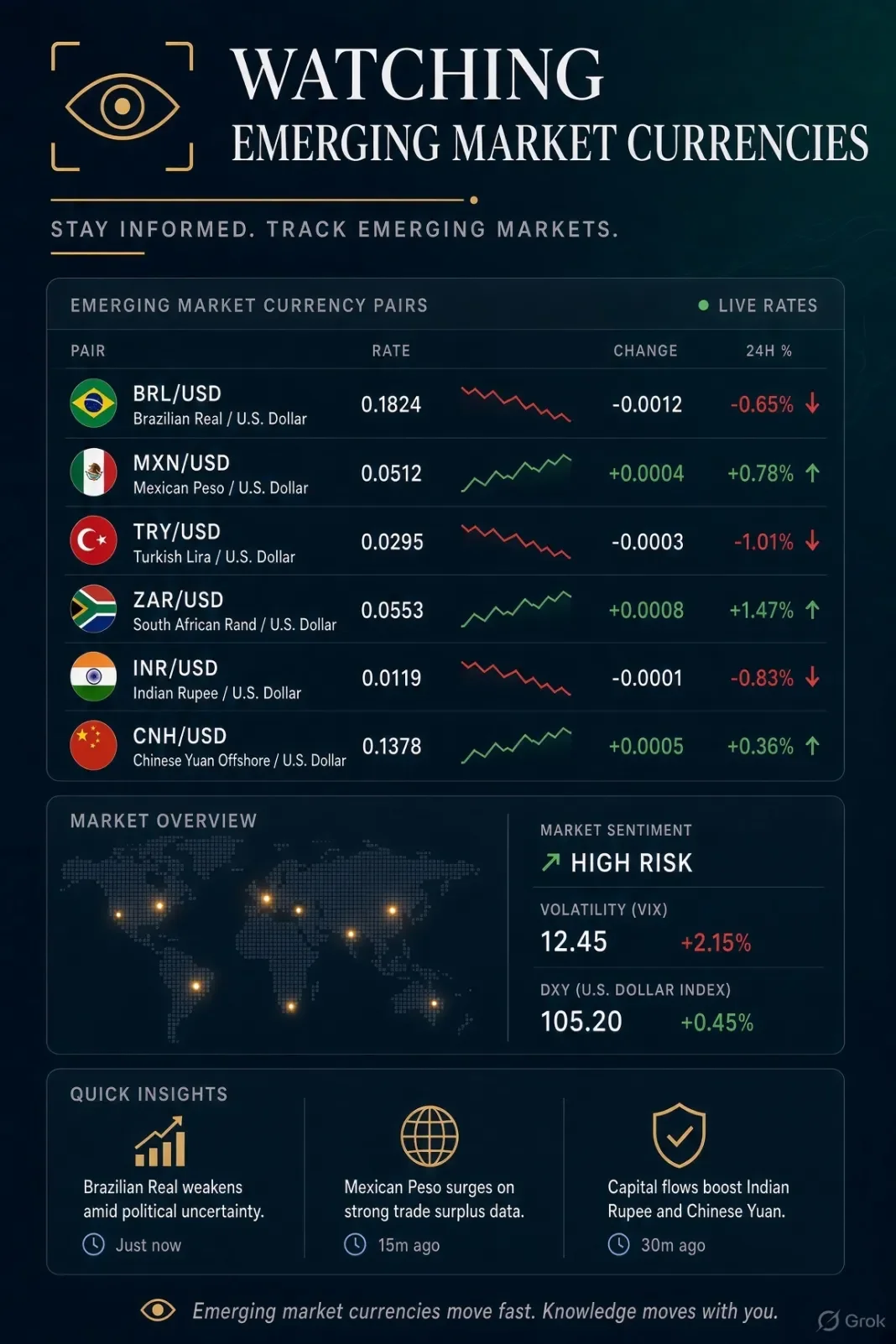
CROSS-BORDER SETTLEMENT
Saudi Arabia is no longer a public participant in mBridge, the multi-CBDC platform built for real-time, direct settlement between central banks.
SAMA told the Financial Times the kingdom completed its planned proof-of-concept on 13 May 2025 and then stepped off the participant list.
The BIS still marks the project as concluded. China, Hong Kong, Thailand and the UAE remain the core operators; Macao has since joined and begun live bank transactions.
IQD
Iraq is still pushing banking and compliance reform.
CBI notices this week cover auctions, reserves and dollar-sale operations — not a revaluation and not a redenomination.
The official budget rate remains 1,300 IQD per USD.
Treat parallel-market moves as market noise until the CBI publishes a new official rate.
VND
No redenomination.
No confirmed currency-reset decree.
Policy work is on FX accounts, accounting rules and cashless payments — not a new face value.
ZWG (ZiG)
RBZ posted an official average of 26.6294 ZWG per USD on 25 September.
That is a published interbank rate update.
It is not a revaluation.
IRR
Published official-track quotes around 26 September sit near 1.706 million IRR per USD on some feeds.
No central-bank announcement of a redenomination.
Parallel-market prints remain a separate story.
VES
BCV continues daily reference-rate publication.
No new reconversion or redenomination has been confirmed.
UNVERIFIED
No independently confirmed “sudden RV” across these currencies.
A posted rate, an auction, or a reform circular is not a revaluation.
Watch official notices.
Separate operations from narratives.
Sources to check
• FT — Saudi Arabia / mBridge
https://ft.com/content/ac104987-f43d-4e7d-97b6-057d98f7e422?utm_source=chatgpt.com
• BIS — Project mBridge (status: concluded)
https://bis.org/project/mbridge?utm_source=chatgpt.com
• Central Bank of Iraq — http://cbi.iq
https://cbi.iq/news?utm_source=chatgpt.com
• Reserve Bank of Zimbabwe — exchange rates
https://rbz.co.zw/index.php/13-daily-exchange-rates/16-rates.?utm_source=http://chatgpt.com
• BCV / official IRR rate pages
https://trend.az/iran/4228171.html?utm_source=chatgpt.com
Check the primary rate boards before sharing screenshots.
Source(s):
• https://x.com/argosaki/status/2103856549202632899
https://dinarchronicles.com/2026/09/26/gp-q-currency-watch-as-of-26th-september-2026/
Sunday Iraq News Posted by Tishwash at TNT 9-27-2026
TNT:
Tishwash: Iraq declares "Sovereignty Day" holiday from Wednesday to Sunday
On Saturday, the Cabinet issued a decision to suspend official working hours on the occasion of "Sovereignty Day".
An official statement from the media office of Prime Minister Ali al-Zaidi stated: It has been decided to suspend official working hours in state institutions starting from Wednesday, September 30, until Saturday, October 3, in celebration of the (Sovereignty Days) of the Republic of Iraq.
The complete withdrawal of foreign forces from Iraq is expected to be announced on September 30, after all their bases and camps have been handed over to the Iraqi side.
TNT:
Tishwash: Iraq declares "Sovereignty Day" holiday from Wednesday to Sunday
On Saturday, the Cabinet issued a decision to suspend official working hours on the occasion of "Sovereignty Day".
An official statement from the media office of Prime Minister Ali al-Zaidi stated: It has been decided to suspend official working hours in state institutions starting from Wednesday, September 30, until Saturday, October 3, in celebration of the (Sovereignty Days) of the Republic of Iraq.
The complete withdrawal of foreign forces from Iraq is expected to be announced on September 30, after all their bases and camps have been handed over to the Iraqi side.
Al-Zaydi had previously directed all ministries, non-ministerial entities, and governorates to take the necessary measures in accordance with the law, in coordination with the government media cell, regarding the celebration of "Iraqi Sovereignty Day".
Iraq and the United States had agreed in September 2024 to end the military mission of the international coalition led by Washington against the "Islamic State" organization in Iraq, as part of a phased plan to move the security relationship between the two countries from the framework of the coalition to a bilateral partnership.
The first phase of the mission ended in September 2025, while forces remained in the Kurdistan Region to support operations against the organization in Syria, with the final phase to be completed by the end of September 2026.
The international coalition was formed in 2014 to assist Iraqi forces in confronting ISIS, which at the time controlled large areas of Iraq and Syria. The mission of the coalition forces later shifted primarily to training, advising, and intelligence support, while Baghdad asserts that its forces are now capable of assuming responsibility for security and pursuing the organization's cells link
***********
Trump on al-Zaidi: A great man and a friend of mine... I supported him
US President Donald Trump said his meeting with Iraqi Prime Minister Ali Faleh al-Zaidi "went very well."
When a reporter asked Trump about the nature of the meeting with al-Zaidi, the US president replied, "It went very well. He's a great guy and a friend of mine, and I've supported him."
Three days earlier, Prime Minister Ali Faleh al-Zaidi met with US President Donald Trump in New York.
During the meeting, the two sides discussed bilateral relations and ways to strengthen cooperation and partnership between the two countries in the political, economic, and investment fields. They also reviewed the latest developments in the region and the joint efforts undertaken by Iraq and the United States to promote regional and international security and stability. link
************
Tishwash: The Minister of Finance directs that procedures related to budget items be completed according to the specified timelines.
Finance Minister Faleh Sari directed on Saturday that work continue at an accelerated pace and that reviews and procedures related to budget items be completed according to the established timelines.
The ministry stated in a press release received by the Iraqi News Agency (INA) that "upon his return from New York, Finance Minister Faleh Sari convened a meeting of the Budget Preparation Committee to review the draft federal budget for 2027 and finalize its requirements, in preparation for its submission to the Council of Ministers soon."
The minister directed "the continuation of work at an accelerated pace and the completion of reviews and procedures related to budget items according to the established timelines." likn
Tishwash: MP Amer Abdul-Jabbar calls for amending economic policies to stop the "bleeding of wealth" in the dollar market.
MP Amer Abdul Jabbar revealed on Saturday (September 26, 2026) statistics with figures relating to the size of the losses resulting from the price gap between the official exchange rate of the dollar and its price in the parallel market.
Abdul-Jabbar said in a statement received by “Baghdad Today” that “the losses of the Iraqi people as a result of the price gap during the period of the previous government amounted to more than 27 billion and 312 million dollars,” indicating that “the average daily losses during that period amounted to about 21 million dollars every 24 hours.”
Abdul-Jabbar added that "the losses continued to record more than $2 billion and 155 million during the current government's term until the end of last July," noting that "the price difference rose in the current month of September to 290 dinars per dollar, which is the highest since 2003."
Abdul Jabbar called on the Prime Minister to "urgently review economic, monetary, financial and trade policies to stop the bleeding of national wealth and transform it into sources that enhance the economic capabilities of the state and the people instead of depleting it." link
************
Tishwash: 40 American companies are waiting... Intensive Iraqi negotiations to resolve the issue of factions' weapons.
An informed source revealed on Saturday that private meetings are continuing between the Quartet Committee and the leaders of the armed resistance factions, with the aim of reaching final agreements on the management, storage and organization of weapons, stressing that resolving this issue paves the way for more than 40 American companies to enter Iraq to start their projects.
The source told Shafaq News Agency that “Iraqi Prime Minister Ali al-Zubaidi asked the political leaders within the coordination framework, specifically the four-party committee concerned with negotiating with the factions, to intensify dialogues and meetings to reach understandings that end the controversy over the management and organization of weapons, in a manner consistent with the interest of Iraq and the region.”
He added that "Washington demanded from al-Zaidi guarantees that American companies, which number more than 40 investment companies in various fields, would not be targeted by resistance factions."
According to the source, an important meeting will be held under the auspices of the Prime Minister after his return from Washington, between the Quartet Committee emanating from the Coordination Framework and the leaders of the factions that are hesitant to hand over weapons, in the presence of the Iranian ambassador or his representative, to discuss limiting and regulating the management of weapons officially, and to ensure that American companies that will arrive in Iraq after the official withdrawal of American forces from the country are not targeted.
He pointed out that "the meeting will also discuss the issue of integrating elements of those factions into the Popular Mobilization Forces within three months," noting that "the faction leaders reject this, but their position may change after the meeting, and everyone is counting on that."
For his part, Abdul Rahman al-Jazaeri, a leader in the National Oath Movement, which is part of the State of Law Coalition, confirmed to Shafaq News Agency that “the leaders of the four factions with whom negotiations are being conducted by the Quadripartite Committee have demanded the enactment of a special law to restrict, manage and regulate weapons by the House of Representatives, so that it acquires legal and official status, and preserves the rights of those factions under one name in the Popular Mobilization Forces.”
Al-Jazairi explained that "the issue of restricting weapons has become directly linked to the Iraqi-American relationship, as it is no longer an internal matter."
He continued, saying that "the Prime Minister will work upon his return to expedite the procedures for completing the cabinet, especially the Ministries of Interior and Defense, given that the withdrawal process, according to the approved protocol, requires that the handover and American withdrawal be carried out through the signing of an official protocol with the ministers concerned with the security file, and therefore it is necessary to choose the Ministers of Interior and Defense."
In a speech to the United Nations General Assembly on Friday, Iraqi Prime Minister Ali al-Zubaidi stressed that one of his government's priorities is for the state to be the decision-maker in peace and war, emphasizing that weapons and instruments of power must remain in the hands of the constitutional state institutions, and that the law should be the arbiter and the national interest the compass.
The issue of armed factions is one of the most sensitive issues facing the Iraqi government, with the approach of September 30, which the main political forces have set as the deadline for restricting weapons to official institutions.
The State Administration Coalition, which includes the most prominent Shiite, Sunni and Kurdish political forces, stressed during its meeting on August 5 the need to restrict weapons to the state, and considered the parties that carry out activities that threaten the security of the country outside the framework of official institutions as “outlaws and must be fought.”
The coalition warned that any armed activity outside the framework of the state after September 30 would be dealt with according to the anti-terrorism law.
Last month, Baghdad witnessed security tensions coinciding with threats by armed factions to retaliate against Saudi Arabia, following strikes targeting Popular Mobilization Forces sites. The tensions ended with contacts and a dawn meeting between Prime Minister Ali Faleh al-Zubaidi and Badr Organization leader Hadi al-Amiri, which led to a mutual calming of tensions and opened the way for diplomatic action to address the crisis.
Al-Amiri later called on the "Islamic Resistance" factions to postpone any military response against Saudi Arabia and to prioritize "Iraq's higher interest," but he returned and stressed during a meeting with a number of Popular Mobilization Forces leaders the importance of maintaining a high level of readiness.
The plan to restrict weapons does not have a unified position among the armed factions, as some forces have expressed a willingness to reorganize their military and security relationship with the state. Other factions, including Kataib Hezbollah, Harakat al-Nujaba and Kataib Sayyid al-Shuhada, have announced their refusal to give up their military capabilities, and have linked any discussion about their weapons to the end of the presence of foreign forces and ensuring the protection of Iraq from external attacks.
The September 30th date also coincides with the deadlines related to ending the military presence of the international coalition in Iraq, which some factions use as a basis for linking the future of their weapons to the withdrawal of foreign forces. link
The Economic Transition Begins, Fed Complies & Informs The Banks To Follow The Procedures
The Economic Transition Begins, Fed Complies & Informs The Banks To Follow The Procedures
X22 Report: 9-27-2026
The [CB] is now complying the Genius act and instructing the banks to back the stable coin with assets. The transition has begun
Some excerpts:
Trump and his team are already beginning the transition.
I believe Warsh has been put in place to restructure the entire Fed and follow the Genius Act and the Clarity Act to get the Federal Reserve in line so it could be brought into the Treasury.
The Economic Transition Begins, Fed Complies & Informs The Banks To Follow The Procedures
X22 Report: 9-27-2026
The [CB] is now complying the Genius act and instructing the banks to back the stable coin with assets. The transition has begun
Some excerpts:
Trump and his team are already beginning the transition.
I believe Warsh has been put in place to restructure the entire Fed and follow the Genius Act and the Clarity Act to get the Federal Reserve in line so it could be brought into the Treasury.
It looks like that is already happening. I do believe it is being prepared to change the Federal Reserve and the debt system into an income system.
To do this we will need something to back up the US dollar. Right now we use the Federal Reserve Note….but eventually it will be a US dollar. We are moving away from the “Federal Reserve Note.
Just like long ago we moved away from a US dollar and into the Federal Reserve note. Just like when they transitioned us in 1971……from the gold standard and into the petro dollar system…..Trump and his team will transitioning us from a debt backed system into a income based system.
I believe that what they are doing with the Genius Act , and when the Clarity Act passes we will have stablecoins , bitcoin and the blockchain to back the US dollar as we make this transition. Everything needs to be put in place and done right.
The deep state and CB bankers are fighting back with everything they have …but I believe they are losing that fight.
Trump is restructuring the system from debt based to an actual supply/demand income system which will take the US economy into a completely different direction. The foundation is growing by leaps and bounds.
The Central banks are now abiding by the Genius Act …they were told they had to follow this and back the stablecoins with Treasuries and other assets.
Federal Reserve unveils Stablecoin rules on Reserves and Capital: The Central Bank opened two proposals for comment under the GENIUS ACT, requiring issuers it supervises to back tokens fully with safe assets and creating an application process for banks seeking to issue stablecoins.
The transition has begun. We are on our way. They are ending the endless that started in 1913.
Please listen to the entire video. There is much more on the new financial system, revaluing gold, The end of income taxes and the end of the Federal Reserve and fiat worldwide. …….
Iraq Economic News and Points To Ponder Late Saturday Evening 9-26-26
Iraq Declares Four-Day Holiday For Sovereignty Days
2026-09-26 Shafaq News- Baghdad Iraq’s Cabinet on Saturday declared a four-day holiday in state institutions from September 30 through October 3 to mark the country’s “Sovereignty Days,” Prime Minister Ali Al-Zaidi’s media office said.
Iraq Declares Four-Day Holiday For Sovereignty Days
2026-09-26 Shafaq News- Baghdad Iraq’s Cabinet on Saturday declared a four-day holiday in state institutions from September 30 through October 3 to mark the country’s “Sovereignty Days,” Prime Minister Ali Al-Zaidi’s media office said.

Al-Zaidi had previously instructed ministries, government bodies and provincial authorities to coordinate with the Government Media Cell on events marking Iraqi Sovereignty Day.
The Council of Ministers Declares an Official Holiday Across State Institutions from Wednesday, September 30, through Saturday, October 3, in Celebration of the Republic of Iraq’s Sovereignty Days
Media Office of the Prime Minister September 26, 2026
Iraq is expected to mark the completion of the US-led Coalition’s military withdrawal on September 30, following the handover of its remaining bases and facilities to Iraqi authorities.
Iraq and the United States agreed in September 2024 to end the US-led Coalition’s military mission against ISIS in Iraq through a phased plan shifting bilateral security relations from the Coalition framework to a direct partnership.
The first phase ended in September 2025, while Coalition forces remained in the Kurdistan Region to support operations against ISIS in Syria, with the final phase scheduled for completion by the end of September 2026.
The Global Coalition was formed in 2014 to support Iraqi forces against ISIS after the group seized large areas of Iraq and Syria. Its role later shifted largely to training, advising and intelligence support.
Read more: Iraqi Army after US-led Coalition withdrawal
https://shafaq.com/en/society/Iraq-declares-four-day-holiday-for-Sovereignty-Days
US Hands Over Diplomatic Center At Baghdad Airport To Iraqi Government
The center was previously part of the US’ Victory Base military installation, before being repurposed as a diplomatic support hub during the US troops’ withdrawal from Iraq in 2011.
ERBIL, Kurdistan Region of Iraq – Iraq and the US on Thursday signed an agreement to hand over the US Embassy’s Diplomatic support Center at Baghdad International Airport to the Iraqi government, as part of procedures paving the way for the US-led global coalition’s withdrawal by the end of September.
The agreement was signed by the Iraqi foreign ministry’s Undersecretary for Bilateral Relations Mohammed Hussein Bahr al-Uloom and the US Charge d’Affaires in Iraq Steven Fagin.
“This step is part of the Iraqi government’s efforts to finalize procedures regarding the conclusion of the International Coalition’s mission and the foreign military presence in Iraq,” the statement stressed.
The US-led coalition was brought to Iraq in 2014 at Baghdad’s invitation to help repel the Islamic State (ISIS) advance across the country. Under an agreement between Washington and Baghdad, the coalition is set to complete its withdrawal from all Iraqi territory by September 30.
The two sides affirmed that the agreement represents “a key step” in regulating relations between the two countries and establishing framework for a “new phase” of bilateral ties built on “expanding areas of convergence and joint action to serve the mutual interests.”
The Diplomatic support Center was a diplomatic and logistics facility run by the US State Department and situated on the west side of Baghdad International Airport. It was previously part of the US’ Victory Base military installation, before being repurposed as a diplomatic support hub during the US troops’ withdrawal from Iraq in 2011.
The center, alongside other US interests in Iraq, was subject to drone attacks from Iran-aligned armed factions during the regional conflict that began in late February.
The new Iraqi government under Prime Minister Ali al-Zaidi has sought to disram non-state armed actors and restrict weapons to the state; a campaign heavily supported by Washington, as US interests and facilities in Iraq and the Kurdistan Region have been repeatedly struck by these groups over the years. https://thenewregion.com/posts/6620
Barak: There Is No Justification For The Factions To Remain After The American Withdrawal And Their Integration Into State Institutions
Baghdad - One News - 9/25/2026 US Special Envoy to Syria and Iraq Tom Barrack affirmed that Iraqi Prime Minister Ali al-Zaidi’s approach to dealing with the militias is a smart move, based on ending their existence as independent entities and integrating their members into Iraqi state institutions.
Barak said that what the Prime Minister is doing in Iraq is “very smart,” explaining that when the militias begin to disband, their members can be integrated into the Iraqi government and receive the same salaries, provided that the integration process is carried out on an individual basis.
He added that the goal of this path is to reach a single state, by unifying individuals within its institutions instead of the continued existence of separate armed formations.
Barak pointed out that there was no reason for the militias to continue to exist, given the departure of the Coalition forces and United States. https://1news-iq.net/باراك-لا-مبرر-لبقاء-الفصائل-بعد-الانسح/
Iraq inflation rises 0.7% in August
2026-09-26 Shafaq News- Baghdad Iraq’s consumer price index rose 0.7% in August from July and increased 3.3% year on year, according to data from the country’s Statistics and GIS Authority.
The general consumer price index reached 110.9 in August, up from 110.1 in July.
Compared with August 2025, when the index stood at 107.4, consumer prices rose 3.3% year on year. https://shafaq.com/en/Economy/Iraq-inflation-rises-0-7-in-August
US Dollar Falls In Baghdad And Erbil
2026-09-26 Shafaq News- Baghdad/ Erbil The US dollar closed Saturday’s trading lower in Iraq, hovering around 156,300 dinars per 100 dollars.
According to a Shafaq News market survey, the dollar traded in Baghdad's Al-Kifah and Al-Harithiya exchange markets at 156,300 dinars per 100 dollars, down from the morning session’s 156,800 dinars.
In the Iraqi capital, exchange shops sold the dollar at 156,750 dinars and bought it at 155,750 dinars, while in Erbil, selling prices stood at 156,400 dinars and buying prices at 156,350 dinars.
https://shafaq.com/en/Economy/US-dollar-falls-in-Baghdad-and-Erbil
Seeds of Wisdom RV and Economics Updates Sunday Morning 9-27-26
Good Morning Dinar Recaps,
U.S.-CHINA RESET WATCH: TRUMP-XI SUMMIT PRODUCES TARIFF CUTS, TRADE COUNCIL AND AI DIALOGUE
The latest U.S.-China agreement reduces some trade barriers while creating new channels for economic and artificial-intelligence cooperation between the world’s two largest economies.
Good Morning Dinar Recaps,
U.S.-CHINA RESET WATCH: TRUMP-XI SUMMIT PRODUCES TARIFF CUTS, TRADE COUNCIL AND AI DIALOGUE
The latest U.S.-China agreement reduces some trade barriers while creating new channels for economic and artificial-intelligence cooperation between the world’s two largest economies.
OVERVIEW
Tariff reductions: The United States and China agreed on recommendations for more favorable tariff treatment covering approximately $30 billion of non-sensitive goods in each direction.
New cooperation mechanisms: The two countries agreed to establish a trade council while extending the results of earlier economic and trade consultations.
AI dialogue: Washington and Beijing agreed to establish a formal China-U.S. AI Dialogue, with the next discussions scheduled for November and a separate communication channel for AI-related incidents.
KEY DEVELOPMENTS
1. $30 Billion Tariff Arrangement Creates New Trade Opening
The three-day Trump-Xi summit produced an agreement for $30 billion in reciprocal tariff reductions on non-sensitive goods. The reported categories include U.S. agricultural products, wood and cosmetics, along with Chinese exports such as small appliances, toys and decorations.
The agreement does not eliminate the broader U.S.-China trade relationship's remaining disagreements, but it establishes a concrete reduction in some tariff barriers. The two countries also agreed to extend the outcomes of previous economic and trade consultations.
2. New Trade Council Creates a Permanent Cooperation Channel
The United States and China agreed to establish a Board of Trade and related mechanisms to continue addressing selected bilateral economic issues.
This is significant because the relationship between the world's two largest economies involves far more than tariffs. Supply chains, critical materials, technology, agriculture, manufacturing, investment and financial flows are all connected to the broader trade relationship.
A continuing trade mechanism gives both governments a structured channel for addressing economic disputes rather than relying solely on high-level meetings when tensions escalate.
***************
3. AI Dialogue Expands the Reset Beyond Traditional Trade
The summit also established a China-U.S. AI Dialogue focused on the risks and benefits of artificial intelligence. The next round is scheduled for November 2026, and the two countries agreed to establish a communication channel for AI-related incidents.
This adds a technology dimension to the economic relationship. Artificial intelligence is increasingly connected to productivity, investment, semiconductor demand, energy consumption, financial technology and national economic competitiveness.
The development shows that the next phase of global economic cooperation is increasingly extending beyond physical goods into digital and technological infrastructure.
WHY IT MATTERS
The U.S.-China relationship is one of the most important forces shaping global trade, investment and supply chains. Even partial reductions in trade barriers can affect shipping volumes, manufacturing decisions, commodity demand, corporate investment and international capital flows.
The new trade council and AI dialogue are also important because they create continuing mechanisms for cooperation in areas that increasingly influence the global economy.
For the evolving global financial system, the important development is the combination of trade normalization, institutional cooperation and technology dialogue between two economic powers whose decisions have worldwide consequences.
WHY IT MATTERS TO FOREIGN CURRENCY HOLDERS
Currency values are influenced by international trade, capital flows, economic growth, interest-rate expectations and investor confidence.
A reduction in trade friction between the United States and China could alter trade flows, commodity demand and investment patterns, while greater cooperation in technology could influence future economic growth and capital allocation.
This does not establish a currency revaluation or a specific Global Reset date. The more measurable development is that the economic relationships underlying global currency markets are continuing to evolve.
For currency holders watching the Global Financial Reset, this is another example of why the foundation of the system matters before any discussion of future currency values.
***************
IMPLICATIONS FOR THE GLOBAL RESET
Pillar 1: Trade
The tariff reductions and new trade council indicate movement toward more structured management of U.S.-China economic relations. If implemented, lower barriers could support greater trade flows and reduce some friction within global supply chains.
Pillar 2: Technology
The new AI Dialogue places artificial intelligence directly into the framework of bilateral economic cooperation. AI is becoming increasingly important to financial services, productivity, manufacturing, investment and digital infrastructure.
Pillar 3: Assets
Changes in trade relationships can influence commodity markets, corporate investment and international capital allocation. As major economies adjust their trade and technology relationships, the distribution of global investment can also evolve.
THE BIGGER PICTURE
The significance of the Trump-Xi summit extends beyond the immediate tariff agreement. The United States and China are establishing multiple channels for continued economic and technology discussions, including trade and AI.
That matters because the global financial system is not being transformed through one single event. It is evolving through many interconnected changes involving trade agreements, payment systems, technology, capital markets, energy and international economic relationships.
The U.S.-China developments therefore provide another piece of the larger picture: major economies are building new mechanisms for managing an increasingly interconnected global economy.
THE BOTTOM LINE
The Trump-Xi summit produced concrete steps involving tariffs, trade cooperation and artificial intelligence, while leaving broader economic issues for continued negotiations.
For those following the Global Financial Reset, the key takeaway is not a prediction about currencies but the continued restructuring of the economic relationships that influence them.
The bigger story is that the global financial system is evolving from a network built primarily around traditional trade and banking relationships into a more interconnected system shaped by trade corridors, technology, digital infrastructure and new forms of international cooperation.
Seeds of Wisdom Team
Newshounds News™ Exclusive
SOURCES
Reuters — "China, US agree to AI dialogue, tariff cuts on $30 billion in goods during Xi visit"
China.gov.cn / Xinhua — "China and the United States reach eight deliverables and understandings"
~~~~~~~~~~
🌱 A Message to Our Currency Holders🌱
If you’ve been holding foreign currency for many years, you were not foolish.
You were not wrong to believe the global financial system would change.
What failed was not your patience — it was the information you were given.
For years, dates, rumors, and personalities replaced facts, structure, and proof. “This week” predictions created cycles of hope and disappointment that were never based on how currencies actually change.
That is not your failure.
Our mission here is different: • No dates • No rates • No hype • No gurus
Instead, we focus on:
• Verifiable developments • Institutional evidence
• Global financial structure • Where countries actually sit in the process
Currency value changes only come after sovereignty, trade, banking, settlement systems, and fiscal coordination are in place. History and institutions confirm this sequence.
You will see silence. You will see denials. That is not delay — that is discipline.
Protect your identity. Organize your documents. Verify everything.
Never hand your discernment to anyone who cannot show proof.
You deserve truth — not timelines.
Seeds of Wisdom Team
Newshounds News
~~~~~~~~~~
Seeds of Wisdom Team RV Currency Facts Youtube and Rumble
Newshound's News Telegram Room Link
RV Facts with Proof Links Link
RV Updates Proof links - Facts Link
Start Here room with Most Asked Questions Link
Follow the Gold/Silver Rate COMEX
Follow Fast Facts
Seeds of Wisdom Team™ Website
Thank you Dinar Recaps
Xi Xinping Said America Is Finished. Congress, Take The Hint!
Xi Xinping Said America Is Finished. Congress, Take The Hint!
Notes From the Field By James Hickman (Simon Black / Sovereign Man) September 25, 2026
Chinese President Xi Jinping landed at Joint Base Andrews Wednesday for a three-day state visit, and Donald Trump was waiting for him at the foot of the red carpet. That’s highly unusual. US presidents typically receive foreign leaders at the White House.
In fact, with the exception of popes, no president had met a foreign leader on the tarmac since 1962, when JFK went out to greet British Prime Minister Harold Macmillan.
Xi Xinping Said America Is Finished. Congress, Take The Hint!
Notes From the Field By James Hickman (Simon Black / Sovereign Man) September 25, 2026
Chinese President Xi Jinping landed at Joint Base Andrews Wednesday for a three-day state visit, and Donald Trump was waiting for him at the foot of the red carpet. That’s highly unusual. US presidents typically receive foreign leaders at the White House.
In fact, with the exception of popes, no president had met a foreign leader on the tarmac since 1962, when JFK went out to greet British Prime Minister Harold Macmillan.
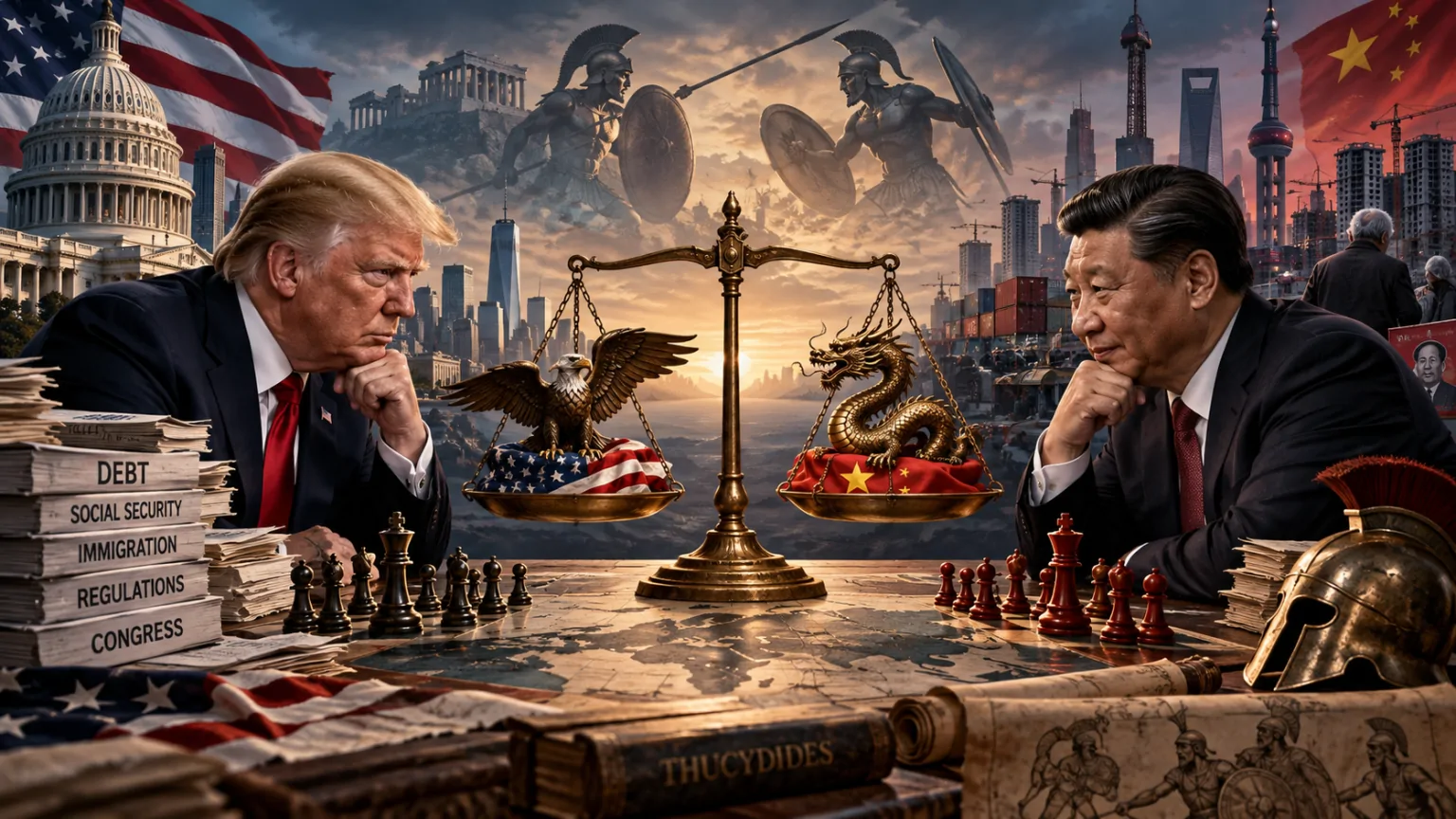
Judging by the media’s reaction, however, you would think Trump bent the knee and swore fealty to his communist overlords.
There was a short clip of US troops on their hands and knees, smoothing the carpet before Xi stepped out of the plane. It went viral. Chinese were gleeful, and Americans were disgusted, at what appeared to be a humiliation ritual... even though smoothing out the red carpet is pretty standard.
The over-analysis continued. When B-1 bombers passed overhead— Trump flinched and Xi didn't move a muscle— the Twitterverse exploded with commentary about what that means for American primacy.
Then there were hot takes on Xi’s every smile, every Trump fidget. Commentators claimed that Xi speaking Mandarin through his translator was ‘asserting language dominance’ over Trump.
It’s all ridiculous. I honestly don’t remember an event where so much irrelevant minutia was over-analyzed for hidden meaning.
The larger point is that the US is clearly treating China like an equal— something that America does not do for anyone else. When the President of France, or Ukraine, or anywhere else comes to town, the President receives them at the White House.
China, on the other hand, is now a peer... not a superior. But definitely not a junior partner.
The biggest takeaway, though, seems to be lost on everyone... but hit me right between the eyes.
At a formal White House ceremony the next morning, Xi declared that "the Thucydides Trap can be overcome. . ."
The Thucydides Trap, of course refers to the famous ancient Greek historian who wrote of the Peloponnesian Wars between Athens and Sparta. Athens was a declining power and Sparta was the rising power; and the theory asserts that rising and declining powers often go to war against one another.
World War I was an obvious example of the Thucydides Trap. Britain was in decline. Germany was rising fast. War became inevitable.
When Xi made this assertion, most of the media coverage treated his remarks as a wonderful message of peace and reassurance.
BUT NO ONE BOTHERED TO QUESTION HIS PREMISE, i.e. that America is permanently in decline and will be surpassed by China.
Xi obviously likes this analogy because he views China as the rising power... eventually the world’s superpower... and the US as the declining power.
What he essentially said was: America is finished, we're going to pass you... and while that historically has led to war, I’m going to be super magnanimous and claim that I prefer peace.
Talk about being presumptuous. This guy comes to America’s house and tells everyone that he’s going to dominate?!?
Obviously he believes this— he's the one who has been steering China for 14 years.
And yes, America is in decline. Between the $40 trillion in debt, Social Security running dry in a few years, foreign central banks dumping dollars for gold, and a Congress too dysfunctional to fix any of it, that much is indisputable.
But America is not in PERMANENT decline.
The problems that the US faces can be fixed with some rational thinking and a few hundred signatures: cutting fraud and waste. Immigration reform. Social Security reform. Regulatory reform to boost productivity growth.
None of this is difficult. But Congress can't seem to muster the will to make it happen, and voters keep sending the same corrupt idiots to office.
But if you think America has a debt problem, China has even worse debt challenges. Plus their entire economy is run by communist bureaucrats and businesses who ‘innovate’ by stealing other people’s intellectual property.
And that doesn’t even scratch the surface of their biggest challenges.
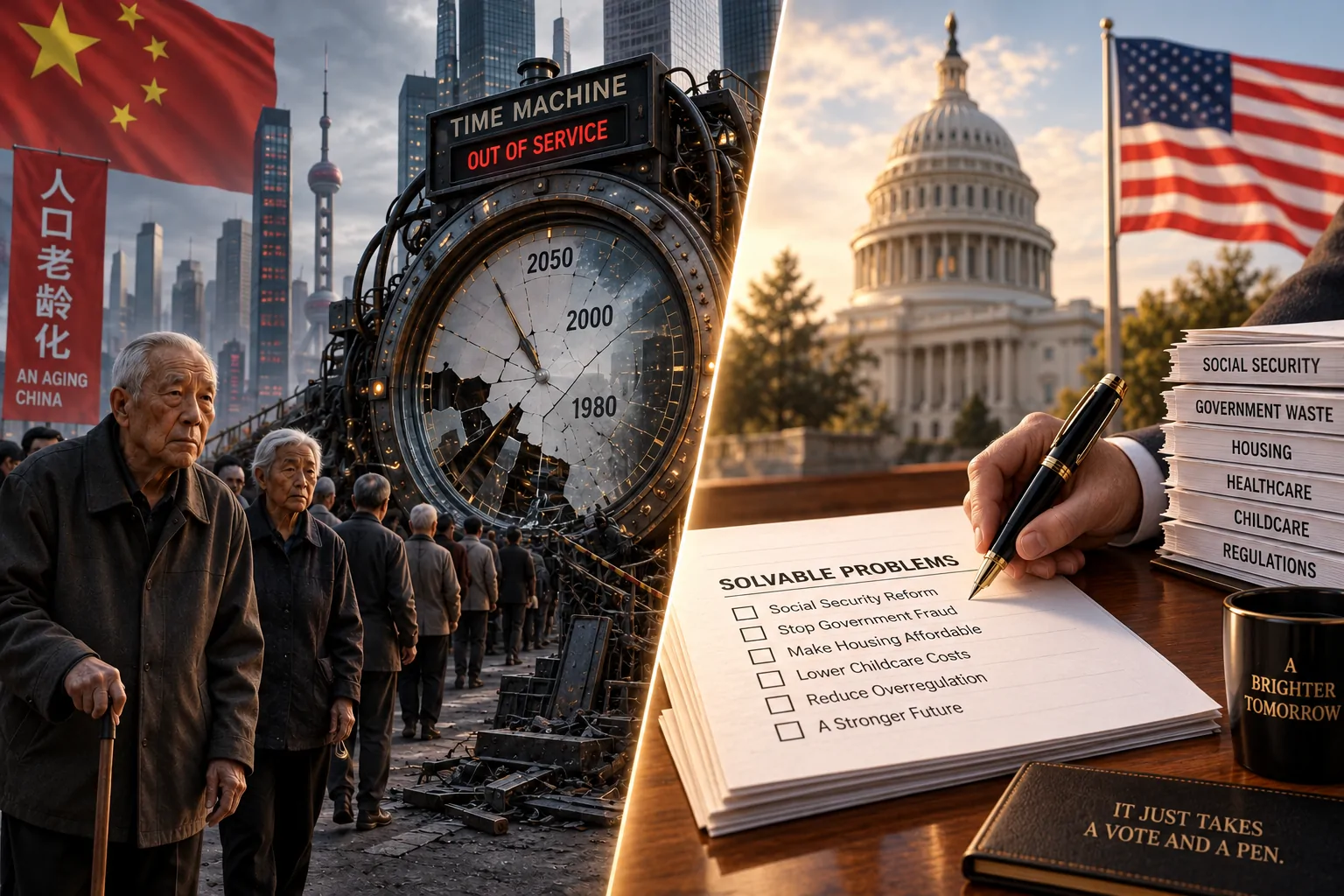
America needs some sensible politicians to fix its problems. China needs a time machine.
They’d have to go back in time to reverse their one-child policy... or undo decades of communism that created a business culture where screwing up means getting shipped off to a ‘reeducation’ facility.
Say the wrong thing and you get disappeared like Jack Ma, who was the richest man in China until he criticized the regulators in 2020, then vanished for three months, and now gets rolled out for the occasional proof of life.
There's a reason why wealthy Chinese people leave the country. People who have the means hit the exits.
And, seriously, eight decades later, these guys are still whining about Taiwanese independence. Get over it already!
Undoing all of that requires a complete cultural reset.
So when he boasts about becoming the next dominant superpower, Xi is way over his skis.
America has a regulatory problem. China is literally communist. Nothing happens there without the Party's permission, and it has to steal every idea it can't come up with itself.
Yes, China has had a good run for the past ~20 years. America’s has been miserable. But past performance is no indication of future returns.
If anything, Xi’s remarks should shame Congress into finally lifting a finger to do the right thing and pass sensible reform.
And you'd think more of the pathetic press would have the dignity to call that out as well.
Unfortunately, Congress and the media tend to attract the worst people on earth, so don't hold your breath waiting for either one to find a spine.
Time will tell if America can reverse course... and if China can live up to Xi’s fantasy. But that's why it makes sense to have a Plan B.
To your freedom, James Hickman Co-Founder, Schiff Sovereign LLC
China Needs a Time Machine. America Just Needs a Pen
China Needs a Time Machine. America Just Needs a Pen
Notes From the Field By James Hickman (Simon Black / Sovereign Man) September 22, 2026
Song Jian was very good at math. He was one of China's top missile scientists, and his specialty was the equations that steer a rocket to its target.
In 1978 Song traveled to Helsinki for an engineering conference, where he came across researchers applying the same kind of math to human beings. Their idea was that a country's population could be steered toward a target number, just like a missile.
China Needs a Time Machine. America Just Needs a Pen
Notes From the Field By James Hickman (Simon Black / Sovereign Man) September 22, 2026
Song Jian was very good at math. He was one of China's top missile scientists, and his specialty was the equations that steer a rocket to its target.
In 1978 Song traveled to Helsinki for an engineering conference, where he came across researchers applying the same kind of math to human beings. Their idea was that a country's population could be steered toward a target number, just like a missile.
Back home, Song ran China’s population through the model. It took about five minutes on his missile ministry's computers, and the answer came back: if Chinese women kept having three children apiece, China would top 4 billion people by 2080.
China’s population was about 1 billion at the time.
In 1980 Song's projection landed on the desks of the Communist Party's leaders, and by September they had their solution: one child per family, enforced with fines, forced abortions, and sterilizations.
The policy stayed in place until 2016, and China is still living with the results.
Just 7.9 million babies were born in China last year, down from 9.5 million the year before and the fewest in modern China's history. Deaths outnumbered births by more than 3 million, and the population shrank for the fourth year in a row.
A shrinking population is horrible for an economy. Economic growth comes from greater productivity (like technological breakthroughs). But it can also come from higher population, i.e. MORE people producing more goods and services.
China has fewer workers every year; its working-age population peaked in 2011 and fell by another 6.6 million last year, to about 850 million.
Worse, China's population pyramid is upside down: four grandparents and two parents lean on one grown child. Already 323 million Chinese are over 60, nearly a quarter of the country.
Sure, there's AI and robotics. In 2024 China installed more industrial robots than the rest of the world combined. But that might be a partial fix at some point in the future. The shortage of young workers is a huge problem today.
I wrote a few weeks ago that China needs a time machine, because no government can go back and conjure up a bunch of 25-year-olds.
China is trying to raise the birth rate anyway, paying parents about $540 a year for every child under three. But even if that works, a baby born today won't show up for work until the 2040s.
That leaves immigration as the only way to raise the population and increase the number of young workers in the labor pool.
China has never been a country of immigrants, but they’re desperate enough to try.
Last October they launched the “K visa” for young science and technology graduates. Unlike America's H-1B work visa, it doesn't require a job offer.
Before the pandemic China had also become the second most popular destination for African students, behind only France. And last year China promised thousands of scholarships across Latin America and the Caribbean.
No one really wants to live in a totalitarian surveillance state, but the one advantage that China has is value for the money: it offers a high standard of living, while the cost of living is fairly low.
The average production worker at a mid-size or large Chinese company makes about $1,000 a month. In an inland city like Chengdu, a one-bedroom apartment outside the center rents for about $260— about a quarter of the paycheck.
Obviously an American manufacturing worker makes a lot more money, but the typical American rental goes for almost $2,000 a month, almost 8x as much. So there’s a lot more value for the money, i.e. value for the salary, in China.
And for young workers from Africa or the Caribbean, that's an attractive enough deal that they’re willing to overlook the totalitarianism.
So far the results are modest. The last census counted about 850,000 foreigners living in China, a country of 1.4 billion. It won't necessarily always be this way, but for now the arrivals don't come close to filling the hole.
And here's the flip side: the Chinese who have the means to leave the country are moving abroad.
For a decade China has ranked first or second in the world for millionaires lost to emigration— an estimated 15,000 of them in 2024 alone.
All told, the UN estimates that China loses about 300,000 more people than it gains every year. That's small for a country of 1.4 billion. But the people leaving are the ones with money and options.
So China has two problems stacked on top of each other: too few births, and more people leaving than arriving. As I said, China still needs a time machine to fix its problems.
America's problems are nothing like that. Problems that the US faces can be fixed with some rational thinking and a few hundred signatures.
It shouldn’t be hard. But they can’t seem to muster the will to make it happen.
Social Security's main trust fund runs dry in 2032, which triggers an automatic 22% cut to every retirement check. Every single year, the program's own actuaries publish a menu of fixes. Congress hasn't picked one.
The Government Accountability Office, Congress's own auditor, estimates the federal government loses between $233 billion and $521 billion a year to fraud. Congress hasn't stopped that either.
None of this takes a miracle. It takes a vote and a pen. And the politicians refuse, which is exasperating.
America's own population problem is the same kind of unforced error.
China had a one-child policy. America, informally, has a no-child policy. It isn't written down anywhere. It's made of prices.
The average age of a first-time homebuyer is now 40 years old— the oldest ever. And with median home prices selling at record levels, those same homebuyers have to scratch together six-figures in savings just for a down payment.
They’re contending with 7% mortgages too, meaning that housing has become completely unaffordable for the young.
The government deserves much of the credit— the National Association of Home Builders calculates that federal, state, and local regulation now adds about $132,000 to the price of a new home, more than a quarter of the total. Each of those rules was signed into law by some level of government, and each can be signed back out.
Then comes the kid. Just having the baby runs about $20,000 in medical bills, and even parents with good insurance pay about $2,700 of that themselves. After that come the diapers, child care, and more.
What a surprise: the US fertility rate is down to about 1.6 children per woman, the lowest ever recorded, and well short of the 2.1 it takes to hold a population steady.
That's a real problem. But unlike China's, it's fixable. Nobody has to invent a time machine. The politicians just have to stop making so many unforced errors.
To your freedom, James Hickman Co-Founder, Schiff Sovereign LLC
P.S. Fixable isn't the same as fixed. Congress has had the answers on its desk for years and does nothing. Hoping the politicians come to their senses is not a plan, and that's exactly why it makes sense to have a Plan B.
That's what Schiff Sovereign's flagship research service, Plan B Confidential, is for— actionable research on second residencies, foreign banking, and legal tax strategies, with boots-on-the-ground reports from more than 120 countries.
Holly Celiano: Latest RV Updates, XRP News, Trump-Xi Financial Developments as of 25th September 2026
Holly Celiano: Latest RV Updates, XRP News, Trump-Xi Financial Developments as of 25th September 2026
6-25-2026
Navigating the intersections of international diplomacy, blockchain innovation, and evolving monetary policy requires a close look at how current events are reshaping our global landscape.
A recent comprehensive video briefing hosted by Holly Celiano offers a fascinating deep dive into these exact themes, breaking down everything from high-level geopolitical summits to the technical upgrades modernizing decentralized finance. Whether you are tracking macroeconomic trends or keeping an eye on the latest software developments in the digital asset space, this analysis provides valuable context for the shifting financial paradigms ahead.
Holly Celiano: Latest RV Updates, XRP News, Trump-Xi Financial Developments as of 25th September 2026
6-25-2026
Navigating the intersections of international diplomacy, blockchain innovation, and evolving monetary policy requires a close look at how current events are reshaping our global landscape.
A recent comprehensive video briefing hosted by Holly Celiano offers a fascinating deep dive into these exact themes, breaking down everything from high-level geopolitical summits to the technical upgrades modernizing decentralized finance. Whether you are tracking macroeconomic trends or keeping an eye on the latest software developments in the digital asset space, this analysis provides valuable context for the shifting financial paradigms ahead.
The video begins by examining the recent summit between US President Donald Trump and Chinese President Xi Jinping. Rather than producing major structural breakthroughs, the summit was characterized more as a diplomatic gesture focused on optics.
Discussions spanned key geopolitical issues, including Taiwan and Iran, alongside a temporary trade truce extension and a nod to renewed panda diplomacy. This trade truce extension acts as a tactical pause, pushing the deadline out to January 10, 2027.
By granting both nations additional time to negotiate complex challenges such as tariffs and technology restrictions, the delay suggests that neither side is currently ready for full confrontation or immediate resolution, prioritizing stability and image management instead.
Transitioning from international relations to technology, the discussion shifts toward major updates within the cryptocurrency sphere, specifically focusing on the XRP Ledger (XRPL).
Ongoing software improvements are actively aiming to enhance banking functionalities and transactional batch processing, reflecting broader advancements that are preparing digital infrastructure for a new financial system. These XRPL upgrades signal significant financial innovation in decentralized networks. By enabling private banking networks and decentralized exchanges (DEXs) to implement lending facilities analogous to traditional systems like LIBOR and SOFR, these tools successfully bridge the gap between traditional finance and blockchain technology, potentially accelerating institutional adoption.
Furthermore, the integration of batch transaction processing serves as a vital catalyst for boosting efficiency and scalability. The upgrade allows thousands of automated, AI-approved Know Your Customer (KYC) transactions to run in batches every second.
This directly addresses historical limitations in blockchain transaction throughput and compliance, both of which are essential for scaling decentralized finance (DeFi) to meet enterprise demands. Compounding these technical leaps is a wave of regulatory clarity.
The impending full implementation of the stablecoin-governing “Genius Act” on January 1, 2027, follows earlier congressional actions and swift rule-making by bodies like the SEC, CFTC, and DTCC. This momentum underscores rapid government efforts to legitimize crypto markets, reducing uncertainty for institutional participants.
Finally, the video addresses the current status of Tier 1 and Tier 2 funding related to currency revaluation (RV). While the briefing highlights that these funds are successfully in place, it issues an important reminder that the funds are not yet liquid or accessible. This crucial distinction between funding status and actual liquidity urges stakeholders to exercise patience, helping temper expectations and avoid premature speculation about immediate financial impacts.
Rob Cunningham: In the Past 5 Days
Rob Cunningham: In the Past 5 Days
9-26-2026
In The Past 5 Days
SAUDI & China split on Payments
GREENLAND unites w America
SEC launches PROJECT CRYPTO
CFTC releases CLARITY FAQs
Rob Cunningham: In the Past 5 Days
9-26-2026
In The Past 5 Days
SAUDI & China split on Payments
GREENLAND unites w America
SEC launches PROJECT CRYPTO
CFTC releases CLARITY FAQs
TREASURY heralds GENIUS
CHINA President Xi visits DC
TRUMP signals IRAN Agreement
IRAQ moves to full sovereignty
SUPREME Court supports TRUMP on SS/Voter Role eligibility authentication.

What does this imply for XRP?
A: Taken together, these developments strengthen the case for XRP’s potential role as neutral, global bridge liquidity. They point toward a world with more regulated digital dollars, clearer rules for digital asset markets, and continued demand to move value between sovereign payment systems.
That is the setting in which XRP’s ability to bridge currencies and networks becomes more economically relevant.
The strong implications are:
More viable payment corridors. Saudi Arabia’s reported departure from mBridge leaves open how it will approach future cross-border digital payments. It increases the strategic importance of interoperable options without prescribing one.
Less friction for institutional use. The SEC–CFTC Project Crypto effort and Treasury’s GENIUS Act implementation address the rules institutions need before building and scaling digital asset services. That can expand the market for XRPL infrastructure, RLUSD, and XRP liquidity.
Greater value in a neutral bridge. If sovereign nations retain different currencies, laws, and preferred networks, they still need a way to exchange value across those boundaries. XRP’s opportunity grows with the number and volume of those exchanges.
A clear shift from speculation to utility. The meaningful demand driver will be repeat payment and settlement flow that uses XRP for global liquidity. More flow, more corridors, and more capital committed to serving the entire world should change how the market values XRP.
So the plain spoken answer is: these pieces together make XRP’s use case more relevant and potentially much larger.
They do not lead to a higher price from headlines alone; it’s the economic forces that come when changing rules and relationships turn into sustained cross-border volume.
Source(s):
• https://x.com/KuwlShow/status/2103681066334572982
https://dinarchronicles.com/2026/09/26/rob-cunningham-in-the-past-5-days/
Iraq Economic News and Points To Ponder Saturday Afternoon 9-26-26
Saudi Arabia: Threats To International Navigation Could Affect Global Economy
Arab and International Saudi Foreign Minister Faisal bin Farhan said on Saturday evening that the Kingdom supports the Iraqi government in the file of limiting arms to the state and enhancing the country's sovereignty and security, pointing out the importance of Iraqi territory not to be a starting point for aggression against neighboring countries.
Saudi Arabia: Threats To International Navigation Could Affect Global Economy
Arab and International Saudi Foreign Minister Faisal bin Farhan said on Saturday evening that the Kingdom supports the Iraqi government in the file of limiting arms to the state and enhancing the country's sovereignty and security, pointing out the importance of Iraqi territory not to be a starting point for aggression against neighboring countries.
In his speech to the United Nations General Assembly in New York, bin Farhan said that Saudi Arabia and the countries of the region have been subjected to "brute Iranian attacks," stressing that the security of the Gulf region is an integral part of the security of the region and the world.
Efforts to restore security in the region cannot be based on hegemony and the imposition of influence, he said, stressing that any arrangements related to the security of the region should be comprehensive and sustainable.
He warned that the dangers that threaten international navigation may affect the global economy, stressing the importance of ensuring freedom of navigation in all international waterways, calling for the importance of the return of the Strait of Hormuz to work before the war without imposing fees, pointing out that the restoration of global supply chains is a joint responsibility.
The Saudi minister also stressed the need for the region to be free of weapons of destruction and the subjection of peaceful nuclear facilities to international control.
https://www.economy-news.net/content.php?id=74373i
Finance Reviews The 2027 Budget In Preparation For Sending It To The Council Of Ministers
Money and business Economy News - Baghdad Finance Minister Faleh Sari chaired a meeting of the budget preparation committee on Saturday to review the draft federal budget for 2027 and complete its requirements, in preparation for sending it to the Council of Ministers during the coming period.
The Ministry of Finance said in a statement that "Sari chaired the meeting immediately after his return from New York, to follow up the stages of preparing the draft budget and review its paragraphs and complete the procedures and requirements associated with them."
The statement added that the Minister of Finance directed to "continue to work at an accelerated pace and complete the reviews and procedures related to the budget paragraphs according to the specified times."
He pointed out that the meeting comes within the efforts of the ministry to complete the draft federal budget for 2027 and prepare it for presentation to the Council of Ministers in preparation for the completion of constitutional and legislative procedures
https://www.economy-news.net/content.php?id=74356
Iraq Imports First Gasoline Batch Through Syria
2026-09-25 03:07 Shafaq News- Baghdad Iraq has begun importing its first batch of gasoline through Syria, an Iraqi oil source told Shafaq News on Friday, with the first shipments arriving at the Syrian port of Baniyas for onward transport by tanker truck.
Loading onto the trucks has begun ahead of their departure for Iraq, the source said, adding that the quantities, the supplier, and the route into the country would become clear once the transport is complete.
Baghdad and several Iraqi provinces have faced a gasoline shortage for weeks, after a brief easing last month, with long queues at filling stations and dozens of outlets closing. Earlier this month, Oil Minister Basim Mohammed Khudair said the ministry was working to fix the shortfall and that new shipments would arrive soon.
Read more: Iraqi panel proposes Kurdistan fuel overhaul amid shortages
https://shafaq.com/en/Economy/Iraq-imports-first-gasoline-batch-through-Syria
Syria Begins First Gasoline Shipments To Iraq
2026-09-25 Shafaq News- Damascus Syria Petroleum Company said Friday it had begun sending the first gasoline shipments through Syrian ports toward border crossings into Iraq.
Three tankers loaded with fuel have arrived at Syrian ports, and the first, carrying about 32,000 tons of gasoline, has been unloaded, while the other two await their turn, the company's institutional communication director, Safwan Sheikh Ahmed, said in a statement.
Loading onto trucks began on September 22, with two convoys dispatched so far: the first of 10 tankers and the second of 55, and the ports and technical crews are ready to raise capacity to 150 tanker trucks a day once more become available to complete the transport across the border into Iraq.
https://shafaq.com/en/Economy/Syria-begins-first-gasoline-shipments-to-Iraq
SOMO tenders 2M crude barrels for October
2026-09-25 Shafaq News- Baghdad Iraq’s state oil marketer SOMO has launched a tender to sell two million barrels of Basrah Heavy crude for loading between October 1 and 7, according to a document seen by Reuters on Friday.
Bids are due by noon Baghdad time on September 28, the document showed.
The offer follows another SOMO tender announced on September 23 for two million barrels of Basrah Heavy to be loaded between September 27 and 30 through a ship-to-ship transfer off Oman, outside the Strait of Hormuz.
Iraq, OPEC’s second-largest producer, has used alternative crude-loading arrangements as shipping through the Strait of Hormuz has been disrupted by regional conflict.
Read more: No exit but Hormuz: Iraq's economic vulnerability exposed
https://shafaq.com/en/Economy/SOMO-tenders-2M-crude-barrels-for-October
Basrah Heavy, Medium Fall ~10%
2026-09-Shafaq News- Basra Iraq’s Basrah Heavy and Basrah Medium crude grades ended the week down about 10%, after both fell $8.57 per barrel in the latest trading session.
Basrah Heavy dropped 9.56% in the latest session to $81.07 per barrel, ending the week $9.20 lower, or 10.19%, from $90.27 at the start of the week.
Basrah Medium also fell $8.57, or 9.22%, to $84.37 per barrel, posting a weekly loss of $9.20, or 9.83%, from $93.57.
In global markets, Brent crude settled at $104.32 per barrel on Friday, down $2.28, or 2.1%, while US West Texas Intermediate fell $2.20, or 2.3%, to $92.41, according to Reuters. Oil prices declined as markets weighed prospects for a US-Iran truce against continuing concerns over attacks on Saudi Arabia and regional supply disruptions.
https://shafaq.com/en/Economy/Basrah-Heavy-Medium-fall-10
Gold Prices Hold Steady In Baghdad, Erbil
2026-09-Shafaq News- Baghdad/ Erbil On Saturday, Gold Prices Hovered Around 950,000 IQD Per Mithqal In Baghdad And Erbil Markets, Holding Steady, According To A Shafaq News Market Survey.
Gold Prices On Baghdad's Al-Nahr Street Recorded A Selling Price Of 945,000 IQD Per Mithqal (Equivalent To Five Grams) For 21-Carat Gold, Including Gulf, Turkish, And European Varieties, With A Buying Price Of 941,000 IQD. The Same Gold Had Sold For 945,000 IQD On Thursday.
The Selling Price For 21-Carat Iraqi Gold Stood At 915,000 IQD, With A Buying Price Of 911,000 IQD.
In Jewelry Stores, The Selling Price Per Mithqal Of 21-Carat Gulf Gold Ranged Between 945,000 And 955,000 IQD, While Iraqi Gold Sold For Between 915,000 And 925,000 IQD.
In Erbil, 22-Carat Gold Was Sold At 990,000 IQD Per Mithqal, 21-Carat Gold At 945,000 IQD, And 18-Carat Gold At 809,000 IQD. https://shafaq.com/en/Economy/Gold-prices-hold-steady-in-Baghdad-Erbil-6