
Seeds of Wisdom RV and Economics Updates Sunday Morning 9-6-26
Good Morning Dinar Recaps,
OPEC+ HOLDS THE LINE AS IRAN WAR DISRUPTS OIL FLOWS: SUPPLY SHOCK COULD KEEP INFLATION AND GLOBAL BORROWING COSTS ELEVATED
OPEC+ is expected to keep October oil production policy unchanged as the Iran conflict disrupts shipping through the Strait of Hormuz, leaving global markets exposed to a prolonged energy-driven inflation shock.
Good Morning Dinar Recaps,
OPEC+ HOLDS THE LINE AS IRAN WAR DISRUPTS OIL FLOWS: SUPPLY SHOCK COULD KEEP INFLATION AND GLOBAL BORROWING COSTS ELEVATED
OPEC+ is expected to keep October oil production policy unchanged as the Iran conflict disrupts shipping through the Strait of Hormuz, leaving global markets exposed to a prolonged energy-driven inflation shock.
OVERVIEW
OPEC+ is expected to halt further production increases for the fourth quarter, as the Iran war continues to disrupt oil exports through the Strait of Hormuz.
Oil prices have already risen sharply, with Brent gaining 7.6% and U.S. crude nearly 10% during the latest week as Middle East supply routes remain impaired.
The bigger financial risk is the chain reaction: higher energy costs can keep inflation elevated, pressure interest rates and push global borrowing costs higher.
KEY DEVELOPMENTS
1. OPEC+ Is Expected to Hold October Production Policy Unchanged
OPEC+ is expected to maintain its current oil-output policy when the group meets Sunday, rather than approve another increase for October.
The decision comes after the coalition approved an incremental production increase for September, completing the gradual rollback of a 1.65 million-barrel-per-day supply cut originally introduced in 2023.
The group is now expected to pause further increases during the fourth quarter as the war makes the global supply picture increasingly uncertain.
2. The Strait of Hormuz Is Limiting the Effectiveness of Additional Production
The problem is no longer simply how much oil OPEC+ produces.
The physical movement of oil has become the critical constraint.
Shipping through the Strait of Hormuz has fallen sharply as military tensions and restrictions disrupt commercial traffic. Reuters reported that only four commodity vessels crossed the waterway on Thursday, compared with a recent 10-day average of 15.
That matters because Hormuz is one of the world's most important energy corridors. Even if additional crude exists in producing countries, moving that oil to refiners and consumers becomes much more difficult when shipping routes are impaired.
3. Oil Is Already Feeding Into a Broader Inflation Problem
The market is beginning to price the consequences.
Brent crude ended the latest week at $96.28 a barrel, while U.S. West Texas Intermediate settled at $91.48. Brent gained 7.6% for the week, while U.S. crude rose nearly 10%.
The impact is spreading beyond gasoline.
Diesel prices have reached record levels in the United States, while higher transportation and energy costs threaten to filter through the broader economy.
That creates a particularly difficult environment for central banks because an energy shock can push inflation higher even while economic growth weakens.
4. Higher Oil Can Become a Bond-Market Problem
The financial significance of the OPEC+ decision goes far beyond the energy market.
If oil remains elevated, inflation may prove more persistent than policymakers expect. That can reduce the ability of central banks to lower interest rates and can force markets to maintain higher rate expectations for longer.
At the same time, governments must continue borrowing at increasingly expensive rates.
Reuters reported that the recent combination of rising fuel prices and oil prices has already pushed inflation and government borrowing costs higher around the world.
This creates a potentially dangerous feedback loop:
Higher oil → higher inflation → higher rates → higher bond yields → higher government debt costs.
5. OPEC+'s Dilemma Shows How Geopolitics Is Changing the Energy Market
OPEC+ traditionally has one of the world's most powerful tools for responding to an oil-price shock: adjust production.
But the current crisis exposes the limits of that tool.
When the major disruption occurs along the transportation route rather than entirely at the production field, additional barrels cannot immediately solve the problem.
That means the Iran conflict is increasingly turning the global oil market into a question of physical security, shipping access and geopolitical risk, rather than simply supply-and-demand balances.
WHY IT MATTERS
Economy: Persistent energy costs can raise transportation, manufacturing and consumer prices while simultaneously weakening economic growth.
Markets: Higher oil increases the risk of continued bond-market pressure because investors demand compensation for greater inflation uncertainty.
Policy: Central banks face a difficult choice between supporting growth and preventing an energy-driven inflation resurgence.
Global System: The episode demonstrates how geopolitical disruptions to a major energy corridor can quickly become a global financial issue.
WHY IT MATTERS TO FOREIGN CURRENCY HOLDERS
For foreign currency holders, the key issue is purchasing power.
A prolonged oil shock can create different effects across currencies depending on whether a country is a major energy exporter or importer.
Oil-exporting currencies can receive support from higher energy revenues, while oil-importing countries may face larger trade deficits, higher inflation and pressure on their currencies.
At the same time, prolonged global inflation and higher U.S. interest-rate expectations can support the dollar and pull capital toward dollar-denominated assets.
This means currency values may increasingly reflect energy exposure, interest-rate differentials and capital flows rather than traditional economic measures alone.
IMPLICATIONS FOR THE GLOBAL RESET
Pillar 1: Energy
The global financial system is becoming increasingly sensitive to the physical movement of energy. Control over supply routes, shipping corridors and energy infrastructure can translate directly into financial influence.
Pillar 2: Debt
An extended oil shock can keep inflation and interest rates elevated, increasing the cost of servicing government debt. Energy disruption therefore has the potential to accelerate pressure already building in global bond markets.
CONCLUSION
The significance of Sunday's OPEC+ decision is not simply whether the group adds or removes another few hundred thousand barrels of oil.
The bigger story is that OPEC+'s traditional supply-management tools are becoming less effective when geopolitical conflict disrupts the transportation system itself.
If the Strait of Hormuz remains impaired, the world could face a prolonged period in which energy prices remain elevated even as governments and central banks are already dealing with high debt, rising yields and persistent inflation.
The result is a financial chain reaction that begins with oil but can ultimately reach bonds, interest rates, government finances and currencies around the world.
The energy shock is no longer isolated to the oil market — it is becoming a test of the global financial system's ability to absorb higher inflation and higher borrowing costs simultaneously.
Seeds of Wisdom Team
Newshounds News™ Exclusive
SOURCES
Reuters — OPEC+ set to keep oil output policy unchanged on Sunday, sources say
Reuters — Oil ends week higher on renewed US-Iran strikes, diesel hits record
~~~~~~~~~~
🌱 A Message to Our Currency Holders🌱
If you’ve been holding foreign currency for many years, you were not foolish.
You were not wrong to believe the global financial system would change.
What failed was not your patience — it was the information you were given.
For years, dates, rumors, and personalities replaced facts, structure, and proof. “This week” predictions created cycles of hope and disappointment that were never based on how currencies actually change.
That is not your failure.
Our mission here is different: • No dates • No rates • No hype • No gurus
Instead, we focus on:
• Verifiable developments • Institutional evidence
• Global financial structure • Where countries actually sit in the process
Currency value changes only come after sovereignty, trade, banking, settlement systems, and fiscal coordination are in place. History and institutions confirm this sequence.
You will see silence. You will see denials. That is not delay — that is discipline.
Protect your identity. Organize your documents. Verify everything.
Never hand your discernment to anyone who cannot show proof.
You deserve truth — not timelines.
Seeds of Wisdom Team
Newshounds News
~~~~~~~~~~
Seeds of Wisdom Team RV Currency Facts Youtube and Rumble
Newshound's News Telegram Room Link
RV Facts with Proof Links Link
RV Updates Proof links - Facts Link
Start Here room with Most Asked Questions Link
Follow the Gold/Silver Rate COMEX
Follow Fast Facts
Seeds of Wisdom Team™Website
Thank you Dinar Recaps
Bill Holter - The Great Economic Transformation Is In Progress, Gold Is About To Make Moves
Bill Holter - The Great Economic Transformation Is In Progress, Gold Is About To Make Moves
X22 Report: 9-4-2026
Bill Holter is a Financial writer and gold expert,
The great economic transition is happening. The economy is about to change.
Bill believes that there will be a crash of the economy, but when you look at the action of Trump it seems that he is building a parallel economic system.
Bill Holter - The Great Economic Transformation Is In Progress, Gold Is About To Make Moves
X22 Report: 9-4-2026
Bill Holter is a Financial writer and gold expert,
The great economic transition is happening. The economy is about to change.
Bill believes that there will be a crash of the economy, but when you look at the action of Trump it seems that he is building a parallel economic system.
Bill says gold is going to go much higher.
Ariel: The Actual Order of Operations for Iraq (and more)
Ariel: The Actual Order of Operations for Iraq
9-5-2026
IQD Update: Someone Asked does Iraq have to change the exchange rate before the Council of Ministers (COM) approve the 2027 budget.
No!
The Council of Ministers approves the budget. Then the exchange rate change happens.
Ariel: The Actual Order of Operations for Iraq
9-5-2026
IQD Update: Someone Asked does Iraq have to change the exchange rate before the Council of Ministers (COM) approve the 2027 budget.
No!
The Council of Ministers approves the budget. Then the exchange rate change happens.
Here’s The Sequence
The Actual Order of Operations:
1. Council of Ministers approves the 2027 budget with redenomination language.
2. Parliament ratifies it.
3. CBI executes the rate change (deleting three zeros, setting the new peg — likely to USD or gold per the Tier 1 asset framework).
4. IMF confirms Article VIII compliance.
5. IQD goes live on international Forex platforms.
6. Banks begin exchanging at the new rate.
The budget is the trigger. Everything else follows from it. The rate change is a consequence of budget authorization, not a precondition for it.
Reports: Iraq’s Finance Ministry will begin drafting the 2027 federal budget on Saturday before submitting it to the Council of Ministers on September 15, where it will remain for about a month to undergo amendments and secure approval before being referred to parliament for a vote, Kurdish lawmaker Ghalib Mohammed says. End Quote
Here Is The Contradiction
If the 2027 budget gets drafted Saturday, submitted to Council of Ministers September 15, sits there for a month, then goes to parliament… but the PM wants full sovereignty before September 30, and POTUS wants repayment before US troop withdrawal… how does a month-long budget process reconcile with a pre-September 30 RV window?
Wouldn’t this mean that the budget process and the RV aren’t sequential? Under that assumption the RV has to happen BEFORE or DURING the budget’s Council of Ministers phase right?
Because the budget cannot be denominated in pre-redenomination currency. The budget IS the redenomination vehicle. Because last time I checked the PM Ali al-Zaidi did not want to go through parliament probably for the exact reason laid out. He may use an Executive/Central Bank authority to bypass them.
Based off of that I would say the rate change happens first, gets baked into the budget draft, and the budget ratifies what’s already in motion. That’s how you reconcile a month-long budget timeline with a September 30 hard deadline.
Source(s):
• https://x.com/Prolotario1/status/2095928830833676667
https://dinarchronicles.com/2026/09/04/prolotario-the-actual-order-of-operations-for-iraq/
Ariel: The 18-Month Delay Fallacy
9-5-2026
The “18-Month Delay” Fallacy — Bank Preparation vs. Statutory Implementation Lag (And Other News)
We Will Demystify The Confusion & Mysteries Of An Assumed Course Of Action
THE ARGUMENT BEING MADE
Someone is pushing the idea that the Clarity Act contains an 18-month implementation window that regulatory scaffolding must be built out for a year and a half before any revaluation mechanism activates. They are using that assumption to project 2029 or 2030 as the earliest possible RV timeline. Their logic: bill passes → 18 months of rulemaking → then and only then does the legal framework permit currency revaluation.
WHAT THE BUDGET TIMELINE ACTUALLY SHOWS
Iraq’s Finance Ministry begins drafting the 2027 federal budget on September 6, 2026 two days from now. The budget is submitted to the Council of Ministers by September 15. The Council of Ministers amends and approves it by late September. Parliament votes in mid-October.
The Critical Detail: The budget drafting process embeds RV assumptions early. The budget is being built with revaluation projections baked into revenue forecasts and expenditure planning. That means the redenomination is expected to be operative before or during the budget e*******n period — not deferred to 2029.
If the RV were truly a 2029-2030 event, the 2027 budget would not contain revaluation-adjusted revenue projections. You do not build a budget around currency values that will not exist for two more years. You build a budget around currency values you expect to be live during that budget cycle.
The budget sequencing draft September 6, Council of Ministers approval by late September, parliamentary vote mid-October creates a natural window for the CBI to execute the redenomination via decree between Council approval and parliamentary vote.
The Council of Ministers decree authorizes the zero deletion. Parliament does not need to vote on the redenomination itself it is a monetary policy action, not a legislative one. Parliament votes on the budget, which by that point already reflects the post-RV currency values.
Read Full Article:
https://www.patreon.com/Prolotario1/posts/18-month-delay-168639145
https://dinarchronicles.com/2026/09/04/prolotario-the-18-month-delay-fallacy/
Iraq Economic News and Points To Ponder Saturday Afternoon 9-5-26
CBI: No US Dollar Rate Change
2026-09-05 Shafaq News- Baghdad The Central Bank of Iraq (CBI) on Saturday denied changing the official US dollar exchange rate, following social media claims that deposits would be priced at 1,460 dinars per dollar starting September 6.
CBI: No US Dollar Rate Change
2026-09-05 Shafaq News- Baghdad The Central Bank of Iraq (CBI) on Saturday denied changing the official US dollar exchange rate, following social media claims that deposits would be priced at 1,460 dinars per dollar starting September 6.
CBI media director Haider Ghazi told Shafaq News that the reports were intended to destabilize the economy and the exchange rate. The bank’s latest published data, dated September 3, list the US dollar at 1,310 dinars.
In June, the CBI also rejected a forged document claiming the government had requested a rate of 1,600 dinars per dollar.
https://www.shafaq.com/en/Economy/CBI-No-US-dollar-rate-change
CBI Reassures Depositors Their Funds Are Safe
2026-09-05 Shafaq News- Baghdad The Central Bank of Iraq (CBI) reassured depositors on Saturday that their funds are protected and the country’s banking system has sufficient liquidity, with liquid assets exceeding 60% of short-term liabilities.
In a statement, the CBI stressed that placing a licensed bank under direct supervision or guardianship does not mean it is bankrupt, rejecting claims circulated on social media. It described such measures as legal, precautionary steps aimed at safeguarding banks and maintaining stable operations.
The clarification follows the CBI’s decision on Wednesday to place Al-Taif Islamic Bank for Investment and Finance under guardianship over violations that affected its financial position and depositors’ funds.
The CBI affirmed that depositors' funds are protected under existing laws, regulations, and instructions, adding that it monitors banks to ensure customers can access their money without delay. All licensed banks also participate in Iraq’s deposit insurance company, which compensates depositors if a bank is unable to meet its obligations in accordance with applicable laws.The assurances coincide with increased regulatory scrutiny of Iraq’s banking sector. Informed sources told Shafaq News on Saturday that the Federal Integrity Commission and other regulatory bodies are investigating declining liquidity, loans, investment financing and exceptional approvals at state-owned banks, particularly Rafidain and Rasheed.
A broader review disclosed in August also examined alleged misuse of public funds, declining liquidity and misleading reports submitted by some bank managers to senior officials.
Prime Ministerial economic adviser Mudher Mohammed Saleh previously told Shafaq News that weaknesses in management and oversight, along with declining public confidence, had constrained banks’ ability to attract savings and finance investment. He highlighted stronger governance, supervision and compliance, as well as restructuring troubled banks, as key elements of banking reform.
CBI data showed that total bank deposits fell 5.6% in the first half of 2026, from 111.065 trillion dinars (about $84.41B) at the end of 2025 to 104.875 trillion dinars (about $79.71B) by the end of June. Cash credit declined 5.4% to 71.511 trillion dinars (about $54.35B) over the same period.
https://www.shafaq.com/en/Economy/CBI-assures-depositors-of-fund-safety
US Escorts 7M Barrels Through Hormuz
2026-09-05 Shafaq News- Hormuz Oil and gas tankers carrying approximately 7 million barrels are preparing to transit the Strait of Hormuz under US military protection, amid a surge in shipping activity in the Gulf of Oman, maritime tracking service TankerTrackers.com reported on Saturday.
The service tracked 17 ship-to-ship oil and gas transfers in the Gulf of Oman on Friday, involving an estimated 24 million barrels.
US Central Command (CENTCOM) detailed that more than 200 mine-like objects had been cleared from the strategic gateway, including 11 confirmed mines. CENTCOM commander Adm. Brad Cooper said internationally recognized shipping lanes were now “free” of Iranian sea mines and that traffic was increasing. Yet shipping through Hormuz remains below recent levels.
Preliminary Kpler data showed four commodity vessels crossing on Sept. 1, down from a 10-day average of about 13.
The United States and Iran this week exchanged their most intense military strikes since July, with US forces hitting Iranian military sites and Tehran responding with missile and drone attacks on US bases in Bahrain, Jordan, Kuwait and Iraq.
https://www.shafaq.com/en/Economy/US-escorts-7M-barrels-through-Hormuz
Basrah Crude Gains Over 10% On Week
2026-09-05 Shafaq News- Basrah Basrah Heavy and Medium crude posted weekly gains of $8.14 and $8.16 a barrel, or 10.93% and 10.49%, respectively, despite falling in the final trading session, while global oil prices moved higher.
Basrah Heavy fell 80 cents a barrel, or 0.96%, in the final session to settle at $82.66. Basrah Medium also declined 80 cents a barrel, or 0.92%, to close at $85.98.
On global markets, West Texas Intermediate (WTI) fell $0.66, or 0.72%, to $90.64 a barrel, while Brent crude declined $0.14, or 0.1%, to $95.38 a barrel. https://www.shafaq.com/en/Economy/Basrah-crude-gains-over-10-on-week
Dollar Stabilizes In Baghdad, Rises In Erbil
2026-09-05 Shafaq News- Baghdad/ Erbil The US dollar opened Saturday’s trading mixed in Iraq, hovering around 155,000 dinars per 100 dollars.
According to a Shafaq News market survey, the dollar traded in Baghdad's Al-Kifah and Al-Harithiya exchanges at 154,650 dinars per 100 dollars, unchanged from the previous session.
In the Iraqi capital, exchange shops sold the dollar at 155,000 dinars and bought it at 154,000 dinars, while in Erbil, selling prices stood at 154,650 dinars and buying prices at 154,550 dinars.
https://www.shafaq.com/en/Economy/Dollar-stabilizes-in-Baghdad-rises-in-Erbil-0
EXCLUSIVE: Iraq Probes State Banks Over Liquidity Depletion
2026-09-05 Shafaq News- Baghdad Iraq’s Federal Integrity Commission, the country’s anti-corruption watchdog, and other regulatory bodies are investigating declining liquidity at state-owned banks, exceptional lending and financing approvals, and the funding of investment projects, informed sources told Shafaq News on Saturday.
The inquiry covers loans and credit facilities starting at one billion dinars (≈ $760,000), particularly at state-owned Rafidain and Rasheed banks, to determine whether they complied with banking regulations. Investigators are also examining the companies and individuals that benefited, how the funds were used and the procedures behind exceptional approvals.
Preliminary data currently under audit indicate a “significant depletion” of liquidity and financial resources at state-owned banks in recent years, including funds available to Rafidain and Rasheed, according to the sources.
Some of the files date to the previous government and involve financial and banking policies and procedures adopted at the time. The investigation and audit findings will determine the extent of any responsibility and whether violations occurred.
The regulatory measures, the sources said, come amid financial challenges facing the state and efforts to strengthen liquidity management, safeguard the financial resources of government institutions and ensure their use within established legal and economic frameworks.
The latest inquiry follows a separate Federal Integrity Commission investigation disclosed earlier this week into contracts signed by state-owned banks in recent years, along with loans and advances granted to companies and investors.
In August, a source informed Shafaq News that authorities began a broader review of several state-owned banks and financial institutions amid a cash crunch and delays in public-sector salaries, examining alleged misuse of public funds, declining liquidity and misleading reports submitted by some bank managers to senior officials.
Prime Minister Ali Al-Zaidi had also ordered a specialized Federal Board of Supreme Audit team that month to review designated government contracts before signing, describing inflated project costs as a major source of corruption.
Read more: Iraq’s Dawn Crackdown spreads through state institutions
https://www.shafaq.com/en/Economy/EXCLUSIVE-Iraq-probes-state-banks-over-liquidity-depletion
Gold Prices Hold Steady In Baghdad, Erbil
2026-09-05 Shafaq News- Baghdad/ Erbil Gold prices remained near 960,000 IQD per mithqal in Baghdad and Erbil markets on Saturday, according to a Shafaq News survey.
Baghdad's Al-Nahr Street recorded a selling price of 970,000 IQD per mithqal (equivalent to five grams) for 21-carat gold, including Gulf, Turkish, and European varieties, with a buying price of 966,000 IQD. The same gold had sold for 970,000 IQD on Thursday.
The selling price for 21-carat Iraqi gold stood at 940,000 IQD, with a buying price of 936,000 IQD.
In jewelry stores, the selling price per mithqal of 21-carat Gulf gold ranged between 970,000 and 980,000 IQD, while Iraqi gold sold for between 940,000 and 950,000 IQD.
In Erbil, 22-carat gold was sold at 1,004,000 IQD per mithqal, 21-carat gold at 960,000 IQD, and 18-carat gold at 822,000 IQD. https://www.shafaq.com/en/Economy/Gold-prices-hold-steady-in-Baghdad-Erbil-0
Seeds of Wisdom RV and Economics Updates Saturday Afternoon 9-5-26
Good Afternoon Dinar Recaps,
GLOBAL CAPITAL FLOWS SHIFT: NORWAY QUESTIONS TREASURY HOLDINGS AS CHINESE BANKS BUY U.S. DEBT
The world's major pools of capital are taking increasingly different positions in U.S. government debt, revealing a deeper change in how investors balance safety, yield, currency exposure and diversification.
Good Afternoon Dinar Recaps,
GLOBAL CAPITAL FLOWS SHIFT: NORWAY QUESTIONS TREASURY HOLDINGS AS CHINESE BANKS BUY U.S. DEBT
The world's major pools of capital are taking increasingly different positions in U.S. government debt, revealing a deeper change in how investors balance safety, yield, currency exposure and diversification.
OVERVIEW
Norway Reassesses Treasuries: Norway's $2.3 trillion sovereign wealth fund is proposing to reduce its U.S. Treasury holdings by nearly $80 billion, while shifting toward other U.S. dollar assets.
China Moves the Other Way: Chinese commercial banks have been buying U.S. Treasuries after raising interest rates on dollar deposits, seeking higher returns while helping limit upward pressure on the yuan.
Capital Allocation Is Changing: These opposing moves suggest the important question is no longer simply whether global investors want dollars—but which dollar assets they want to own and at what return.
KEY DEVELOPMENTS
1. Norway Is Reducing Direct Exposure to U.S. Government Debt
Norges Bank Investment Management, which manages Norway's $2.3 trillion sovereign wealth fund, has proposed reducing the government-bond weighting in its benchmark from 70% to 50%.
U.S. Treasuries would experience the largest reduction.
Reuters estimates that the change could eventually reduce the fund's Treasury holdings by approximately $80 billion, from about $215 billion currently.
This is significant because Norway's fund is one of the world's largest institutional investors and its portfolio decisions can influence global capital flows.
However, the move should not be interpreted as Norway abandoning the U.S. dollar.
2. Norway Is Changing the Mix—Not Walking Away From the Dollar
The proposed strategy would shift part of the fund's exposure from U.S. government bonds toward U.S. mortgage-backed securities and other government-related debt.
The fund's overall dollar exposure would decline only slightly, from approximately 52.9% to 52.5%.
That distinction matters.
The development is less about a wholesale move away from the dollar and more about investors asking whether Treasuries provide enough return for the risks and opportunity costs involved.
In other words, the global capital question is becoming more sophisticated:
Will investors continue holding U.S. assets—but demand different forms of exposure and higher compensation?
3. Chinese Banks Are Increasing Treasury Purchases
At almost the same time, Chinese commercial banks have been moving in the opposite direction.
Reuters reports that Chinese banks have been buying U.S. Treasuries after increasing the interest rates they offer on dollar deposits.
Some banks have offered dollar-deposit rates above 3%, with certain smaller banks and foreign lenders offering rates approaching 4%.
The banks can then invest those dollars in higher-yielding U.S. Treasury securities.
This represents a notable shift because Chinese government bond yields have remained comparatively low, making Treasuries more attractive from a return perspective.
4. China's Dollar Liquidity Is Growing
China's foreign-exchange deposits reached approximately $1.18 trillion at the end of July, up 17.9% from a year earlier, according to data cited by Reuters.
That provides Chinese banks with a larger pool of dollar liquidity that can potentially be deployed into U.S. assets.
At the same time, the purchases may help moderate the yuan's appreciation by encouraging Chinese depositors to retain dollars rather than convert them into yuan.
This creates an unusual dynamic:
Chinese banks can simultaneously increase Treasury demand while China's overall reported Treasury holdings continue to decline.
Reuters notes that China's Treasury holdings through U.S. custodians fell to $633.4 billion in June, the lowest level since 2008, although custody arrangements can make the true ultimate ownership difficult to measure.
5. The Real Story Is the Repricing of Capital
Taken together, Norway and China demonstrate that the Treasury story is not simply foreign investors buying or selling U.S. debt.
The deeper issue is how global investors are allocating capital among competing assets.
Norway is seeking greater diversification and exposure to different risk premiums.
Chinese banks are seeking higher returns for dollar liquidity.
Meanwhile, U.S. Treasury yields have risen substantially as investors demand greater compensation amid concerns about inflation, government borrowing and the broader supply of debt.
The result could be a gradual restructuring of global capital flows—even while the dollar remains deeply embedded in the international financial system.
WHY IT MATTERS
Economy
The United States relies heavily on domestic and foreign investors to finance its enormous government debt.
Changes in investor preferences can influence the yields Washington must offer to attract capital.
Markets
Treasury yields are a foundation for pricing other financial assets.
If major investors increasingly differentiate between U.S. government debt, mortgage-backed securities, corporate debt and other dollar assets, capital could be redistributed throughout the financial system.
Policy
The Treasury and Federal Reserve face a difficult environment in which government borrowing needs, inflation, interest rates and investor demand increasingly interact.
A lower Treasury demand from one major investor does not automatically create a crisis—but repeated shifts by large institutions could become increasingly important.
Global System
The dollar's future is not determined solely by whether foreign investors hold dollars.
It also depends on what they hold, why they hold it and what return they require.
That is a much more important distinction when evaluating changes in the global financial architecture.
WHY IT MATTERS TO FOREIGN CURRENCY HOLDERS
Dollar demand: Chinese banks increasing Treasury purchases can support demand for dollar assets, while Norway's proposed shift shows that some investors are becoming more selective about U.S. government debt.
Exchange rates: Changes in international capital allocation can influence the dollar and other currencies, particularly when large institutions rebalance portfolios.
Currency diversification: The important signal is not necessarily a move away from the dollar, but a potential move toward greater diversification among currencies and asset types.
Purchasing power: Currency movements influence the cost of imported energy, commodities and other internationally traded goods.
Watch the capital flows: Foreign currency holders should watch Treasury yields, the dollar, foreign Treasury holdings and central-bank/institutional portfolio changes for evidence of longer-term shifts.
IMPLICATIONS FOR THE GLOBAL RESET
Pillar 1: Assets
The global financial system may be entering a period in which investors increasingly distinguish between safe assets, high-yielding assets and politically or structurally exposed assets.
Norway's proposed move illustrates this perfectly: the fund is not leaving U.S. assets—it is considering moving from direct Treasury exposure toward other dollar-denominated securities offering different risk and return characteristics.
Pillar 2: Debt
The U.S. Treasury market remains the world's largest government-debt market, but its financing cost depends on continuous investor demand.
If major investors become more selective about holding government debt, the United States may need to offer higher yields to attract capital.
That could increase the cost of servicing America's already enormous debt burden and transmit higher borrowing costs throughout global markets.
CONCLUSION
The most important development is not that Norway is selling Treasuries or that Chinese banks are buying them.
It is that two enormous pools of capital are responding differently to the same financial environment.
Norway is seeking greater diversification and better risk-adjusted returns. Chinese banks are seeking higher returns on growing dollar liquidity.
That suggests the global capital system is becoming more selective—not necessarily less dollar-based.
For foreign currency holders, the distinction is critical. A changing global financial system does not have to begin with the dollar disappearing. It can begin with investors changing what they are willing to own, what they demand in return and where they believe capital is best protected.
The next phase of global financial restructuring may therefore be less about abandoning the dollar—and more about repricing the assets built around it.
Seeds of Wisdom Team
Newshounds News™ Exclusive
SOURCES
~~~~~~~~~~
Seeds of Wisdom Team RV Currency Facts Youtube and Rumble
Newshound's News Telegram Room Link
RV Facts with Proof Links Link
RV Updates Proof links - Facts Link
Start Here room with Most Asked Questions Link
Follow the Gold/Silver Rate COMEX
Follow Fast Facts
Seeds of Wisdom Team™Website
Thank you Dinar Recaps
News, Rumors and Opinions Saturday 9-5-2026
Reset Intelligence: Iraq’s 2027 Budget Enters Production
9-4-2026
Iraq’s 2027 Budget Enters Production
By Reset Intelligence | @EXIT_FIAT
Tomorrow morning, in a committee room at the Federal Ministry of Finance, Iraq starts writing its 2027 federal budget – the law that carries the dinar’s exchange rate.
Reset Intelligence: Iraq’s 2027 Budget Enters Production
9-4-2026
Iraq’s 2027 Budget Enters Production
By Reset Intelligence | @EXIT_FIAT
Tomorrow morning, in a committee room at the Federal Ministry of Finance, Iraq starts writing its 2027 federal budget – the law that carries the dinar’s exchange rate.
The Kurdistan Region flew a senior financial delegation to Baghdad to sit at the drafting table the day before the first line gets written.
The schedule is on the record
Drafting begins Saturday. The finished draft reaches the Council of Ministers on September 15. The cabinet votes the budget this month with the deficit capped at 3 percent, and then parliament receives it. It is the first complete budget the state has produced since 2023, near 200 trillion dinars, one of the largest in Iraq’s history. In Iraq the exchange rate is written into the budget law, and the 1,300 every holder knows has sat in the same law since June 2023 because no government finished a replacement. The replacement is now in production.
The central bank cleaned house the same week
• Al-Taif Islamic Bank – placed under an 18-month guardianship on the CBI’s own wire, a named custodian holding the keys
• Shams Maysan brokerage – license struck off the register
• The political class – every bank in Iraq ordered to file politicians and their relatives, to the third degree, into a database
• The 9 cabinet chairs – parliament’s vote on the unfilled posts, interior and defense among them, set for next week
• 1,320 – the number the community is circulating for the draft. The February 2023 record says the draft is not where Iraq’s rate decisions get made
That is the short version. What the drafting table means for the rate question, why Erbil took its seat a day early, what the bank seizure is preparing the system for, and where the February 2023 precedent says to actually look – that is the daily connection work, and it is in today’s full briefing.
Read the full daily briefing free for 5 days. Sign up here: resetintelligence.com
https://dinarchronicles.com/2026/09/04/reset-intelligence-iraqs-2027-budget-enters-production/
************
Courtesy of Dinar Guru: https://www.dinarguru.com/
Frank26 Question: "Once they release the smaller notes in the country will the older notes with the three zeros be so obsolete that they will not be taking them back anymore?" Frank26: The moment they raise the value, the moment they show them lower notes, those three zero notes, 'Get this out of my face. Give me that [smaller denomination notes]. These three zero notes have the power of one penny. Those LD, 5, 10, 20 have the power of one dollar.' And I think it's going to be more than a dollar in country.
David This is a very real investment. It's not a scam. It's not a hoax. It's not a bunch of smoke and mirrors, because you're holding a currency that is the national currency of a sovereign nation. Period. It's not Monopoly money. It is the real thing...
Reset Intelligence The exchange rate in Baghdad is not only a market number. It is written into law through the budget. The 1,300 every holder knows by heart has sat there since June 2023, because no government finished a successor document. Its replacement now has a start date, a submission date, and a committee working weekends...Tomorrow morning, in a committee room at the Federal Ministry of Finance, Iraq starts writing its 2027 federal budget.
Gold Is Money Again — Even the Financial Establishment Now Admits It.
Maneco64: 9-4-2026
In this video, I look at a remarkable shift in the mainstream financial narrative on gold.
More than 20 years after the Financial Times argued that holding bullion was increasingly pointless, a UBS chief strategist now argues that gold is money again and that its bull market has further to run.
We examine why the freezing of Russia’s foreign reserves in 2022 fundamentally changed the way central banks view reserve assets, the accelerating move toward gold, growing concerns about U.S. fiscal dominance, and the Dutch central bank’s decision to bring more of its gold closer to home.
We also look at why gold is increasingly challenging government bonds as the ultimate safe-haven asset.
Sat. Iraq News Posted by Tishwash at TNT 9-5-2026
TNT:
Tishwash: The Central Bank reassures depositors and confirms the protection of their funds.
The Central Bank of Iraq affirmed on Saturday that all depositors' funds in licensed banks are protected, while also stating that the Iraqi banking system possesses sufficient liquidity to efficiently manage its operations.
In a statement received by the Iraqi News Agency (INA), the bank clarified that "the Central Bank of Iraq's exercise of its powers to directly appoint supervisory or trusteeship committees to a licensed bank does not signify the bank's bankruptcy, as has been circulated on some social media platforms. Rather, these are precautionary and legal supervisory measures to ensure the bank's safety and the overall stability of its operations, and to protect depositors' rights in particular."
TNT:
Tishwash: The Central Bank reassures depositors and confirms the protection of their funds.
The Central Bank of Iraq affirmed on Saturday that all depositors' funds in licensed banks are protected, while also stating that the Iraqi banking system possesses sufficient liquidity to efficiently manage its operations.
In a statement received by the Iraqi News Agency (INA), the bank clarified that "the Central Bank of Iraq's exercise of its powers to directly appoint supervisory or trusteeship committees to a licensed bank does not signify the bank's bankruptcy, as has been circulated on some social media platforms. Rather, these are precautionary and legal supervisory measures to ensure the bank's safety and the overall stability of its operations, and to protect depositors' rights in particular."
The statement added that "the Central Bank of Iraq applies the best international banking standards to the banking sector to guarantee its safety, compliance, and the provision of optimal financial services without compromising the rights of its depositors."
It further explained that "all licensed banks participate in the Deposit Guarantee Corporation, which is a cornerstone of banking stability, through its role in compensating depositors should a bank fail to meet its obligations in accordance with applicable laws."
The bank noted that "depositors' funds are protected under applicable laws, regulations, and instructions, and the Central Bank of Iraq is closely monitoring banking procedures, particularly those related to ensuring depositors' access to their funds at any time without delay."
The bank also affirmed that "the Iraqi banking system possesses sufficient liquidity to manage its operations efficiently and under any potential pressures; the ratio of liquid assets to short-term liabilities exceeds 60%." link
************
Tishwash: The Central Bank reassures bank depositors
Affirming its pivotal role in protecting the financial system and ensuring a sound banking sector based on competitiveness and the provision of the best traditional and digital financial services, the Central Bank of Iraq wishes to inform and reassure the public of the following facts:
1. The Central Bank of Iraq's exercise of its powers to appoint supervisory or trusteeship committees to banks licensed directly by the Central Bank does not imply the bank's bankruptcy, as has been circulated in some media outlets. Rather, it is a legal and precautionary supervisory measure to ensure the bank's overall soundness and operational stability, and to protect depositors' rights in particular.
2. The Central Bank of Iraq applies the best international banking standards to the banking sector to ensure its safety, compliance, and the provision of optimal financial services without compromising the rights of its depositors.
3. All licensed banks participate in the Deposit Guarantee Corporation, which is a cornerstone of banking stability, through its function of compensating depositors in the event of a bank's inability to meet its obligations in accordance with applicable laws.
4. Depositors' funds are protected under applicable laws, regulations, and instructions. The Central Bank of Iraq pays close attention to monitoring banks' procedures, particularly those related to ensuring depositors' access to their funds at any time without delay.
5- The Iraqi banking system has sufficient liquidity to manage its operations efficiently and under any potential pressures; the ratio of liquid assets to short-term liabilities is more than (60%).
Baghdad - Media Office,
September 5, 2026 link
************
Tishwash: Removing zeros from the dinar: Parliamentary Finance Committee sets conditions for proceeding with this matter.
Member of the Parliamentary Finance Committee, Amer Rahim, confirmed on Saturday that voting on a bill to remove zeros from the local currency requires extensive discussions and the enactment of a package of laws within the Parliament. He indicated that raising this issue at the present time is premature.
Rahim told Al-Maalouma, "The step of removing zeros from the currency cannot be decided hastily; rather, it requires a series of lengthy and in-depth discussions within Parliament." He explained that "the process is closely linked to the economic reality and requires amending and enacting several supporting financial laws and regulations to ensure market stability."
He added, "Raising the discussion about this topic at this stage is premature, given the financial challenges that require first providing a comprehensive economic and banking environment before embarking on any structural change to the currency." He pointed out that "any measure of this kind without careful and prior study may negatively impact the purchasing power of citizens."
Rahim stressed "the need to focus currently on supporting the stability of the national currency and implementing banking reforms, while leaving the issue of removing zeros until economic conditions are more favorable and full legislative support is available within the House of Representatives." link
Tishwash: Washington's messages reach Baghdad... American reservations haunt the draft law on the Popular Mobilization Forces.
Revealed by the newspaper "An-Nahar"LebaneseThe American side reported Baghdad Over the past few days, there have been clear reservations about re-tendering bill Popular Mobilization ForcesIn its previous form, while it requested Washington Explicit guarantees that all Popular Mobilization Forces formations will be subject to the authority of the Commander-in-Chief of the Armed Forces, and that no parallel structures or authorities will be allowed to exist alongside the security institutions.
And the law entered Popular Mobilization Forces A new political round in Iraq More than a year after its passage was thwarted in House of RepresentativesThis comes at a time when the attempt to regulate the situation of the Popular Mobilization Forces intersects with a broader governmental approach to restricting weapons to the state and readjusting the relationship between armed formations and official security institutions.
The House of Representatives had completed the first and second readings of the bill during 2025, before the process stalled at the voting stage due to political disagreements, American objections, and reservations from Sunni and Kurdish forces. The American objection at the time focused on articles that it considered...Washington This could grant armed factions greater space within the formal system, and affect the nature of the security partnership with Baghdad
The issue was revived in 2026 after the Speaker of Parliament addressed the government regarding the submission of the draft law, while confirming prime minister Ali Al-Zaidi His government is proceeding with submitting the Popular Mobilization Forces (PMF) law to parliament, based on the premise that the PMF is part of the armed forces.
This coincides with the drafting of a law restricting weapons to the state, placing the government in a complex dilemma. Legally reorganizing the PMF must proceed in parallel with reducing any space for weapons and security decisions outside the official command, especially since the PMF already enjoys legal cover since the enactment of the PMF Law.Popular Mobilization ForcesLaw No. 40 of 2016 links the Popular Mobilization Forces (PMF) to the Commander-in-Chief of the Armed Forces, according to the newspaper.
The newspaper adds that for this reason, the dispute is not so much about the legitimacy of the PMF's existence as it is about its internal structure, its chain of command, its funding and command mechanisms, and the boundaries of the relationship between the official institution and the factions that maintain their own political, ideological, and organizational identities.
Washington is setting its conditions.
In this context, an Iraqi government source revealed to the newspaper that the American side had informed Baghdad in recent days of clear reservations about reintroducing the draft law in its previous form, considering that any legislation granting the factions additional influence could directly conflict with the process of disarming the militias.
According to the source, Washington requested explicit guarantees that all PMF formations would be subject to the authority of the Commander-in-Chief of the Armed Forces and that no parallel structures or powers would be allowed to exist alongside the security institutions. American concerns also focus on the articles that might grant some leaders greater independence in decision-making, funding, or command structure, thus reinforcing the separation between the official form of the PMF and the actual reality of some factions within it.
Washington is also sensitive to the timing of the reintroduction of the law, given Baghdad's ongoing efforts to restrict weapons and end all armed activity outside official institutions. According to the same source, the American message warned that passing a version of the law that contradicts security sector reform could have repercussions on security, military, economic, and financial cooperation between the two countries.
Meanwhile, [the text abruptly ends here ].Iraqi governmentThe review of several articles of the draft law aims to preserve the legal framework of the Popular Mobilization Forces (PMF) and the rights of its members, without granting factions additional space outside the official command structure. The source believes that the coming days will determine whether Baghdad can reach a formula that combines establishing the PMF as an official institution with fulfilling its obligations regarding weapons.
The institution is one thing, and the factions are another.
The newspaper indicated that the main obstacle lies in the fact that legalizing the PMF has not practically led to the complete unification of its constituent formations. Since 2016, most factions have retained their names, structures, bases, and political and ideological affiliations, in addition to their presence in different areas of influence.
This reality, according to the newspaper, has left the transition from a multi-factional structure to a unified military institution incomplete, and has transformed issues of leadership, funding, and the chain of command into the core of the debate surrounding any new legislation.
The expert in strategic affairs, Major General Ahmed Al-Dulaimi The essence of the American observations lies precisely in this point: the necessity of subjecting all formations to the decision of the Commander-in-Chief of the Armed Forces and to a single military chain of command.
The problem, according to...Al-Dulaimi This becomes apparent when certain factions retain the ability to make unilateral decisions or exert their own influence, placing the state in confrontation with armed power centers that do not always operate within the same official framework.
Hence, the value of the law becomes tied to its ability to regulate powers, leadership, funding, and command mechanisms, and to prevent duplication of decision-making, while clearly distinguishing between the Popular Mobilization Forces (PMF) as an official institution and the factions that may adopt independent positions or decisions.
If legislation fails to address this gap, it may transform from a tool for regulating the institution into a legal cover that legitimizes the existing reality rather than changing it.
Weapons determine the fate of the law, and this equation becomes increasingly weighty as we approach 30 September The date related to the weapons inventory and the completion of the mission International coalition This makes the Popular Mobilization Forces (PMF) law part of a broader debate about the shape of Iraq's security state and the future of its relationship with Washington.
The newspaper explained that the law's success will depend not so much on its passage through parliament, but rather on its ability to effectively unify security decision-making within the institution and prevent the continued existence of independent power centers operating under an official umbrella.
Ultimately, the issue remains tied to the broader question facing Baghdad today: Will the new legislation lead to a more tightly integrated PMF into state institutions, or will it solidify the existing fragmentation within the organization under a more robust legal framework? link
Iraq Economic News and Points To Ponder Saturday Morning 9-5-26
The Central Bank reassures depositors: No bank failures... and liquidity exceeds 60%
Baghdad Today - Baghdad The Central Bank of Iraq reassured depositors on Saturday (September 5, 2026) about the safety of the banking sector, stressing that “imposing supervisory or guardianship committees on a licensed bank does not mean its bankruptcy, but rather comes within the framework of precautionary and legal supervisory measures aimed at protecting the rights of depositors and ensuring the stability of banking operations.”
The Central Bank reassures depositors: No bank failures... and liquidity exceeds 60%
Baghdad Today - Baghdad The Central Bank of Iraq reassured depositors on Saturday (September 5, 2026) about the safety of the banking sector, stressing that “imposing supervisory or guardianship committees on a licensed bank does not mean its bankruptcy, but rather comes within the framework of precautionary and legal supervisory measures aimed at protecting the rights of depositors and ensuring the stability of banking operations.”
The bank stated in a statement received by "Baghdad Today" that "all licensed banks participate in the Deposit Guarantee Company, which is responsible for compensating depositors in the event that the bank fails to meet its obligations, in accordance with applicable laws."
He added that "depositors' funds are protected under laws, regulations and instructions," stressing the need to follow up on bank procedures, particularly those related to ensuring depositors' access to their funds without delay.
He pointed out that "the Iraqi banking system has sufficient liquidity to enable it to manage its operations efficiently in the face of potential pressures," indicating that "the ratio of liquid assets to short-term liabilities exceeds 60%."
It also emphasized the application of the best international banking standards to the banking sector, ensuring its safety and compliance and providing competitive traditional and digital financial services, without compromising the rights of depositors.
https://baghdadtoday.news/305588-60.html
The Government Faces Two Tests: Autonomy And The Economy. Will It Succeed In Overcoming The Political And Administrative Turmoil?
Today 15:34 Information / Special.. Political analyst Majashaa Al-Tamimi confirmed on Saturday that the ambiguous scene in Iraq reflects a structural and chronic governance crisis, which is mainly due to the sectarian and partisan quota system that prioritizes narrow interests over the national interest.
Al-Tamimi told Al-Maalouma that "the absence of sovereign decision-making in Iraq has led to weak administrations that lack strategic vision and rely heavily on a rentier economy based on oil."
Al-Tamimi added that “talking about restricting weapons cannot take place in light of Iraq’s lack of full autonomy and the absence of a serious political will capable of putting an end to foreign interference in all its forms,” stressing that “establishing the authority of the state requires first and foremost an independent sovereign decision and a clear political will.”
He pointed out that "combating corruption and economic reform require moving from patchwork solutions to comprehensive institutional reforms, through automating administration, diversifying sources of income, and strengthening the independence of the judiciary and activating its role in combating corruption."
He continued, "Iraq's future remains suspended between the continuation of the political and administrative chaos and the emergence of a genuine reformist will be capable of transcending the conflicts of power-sharing and spoils and placing the national interest at the forefront of priorities." (End of page 25)
Employee Salaries: Between The Embers Of Economic Skepticism And The Cool Reassurances
Today 13:42 Information/Report... The issue of employee and retiree salaries has returned to the forefront of the Iraqi economic scene, amidst a clear discrepancy between official and parliamentary assurances regarding the availability of the necessary liquidity to secure monthly payments, and warnings against the state's continued reliance on short-term solutions without a comprehensive economic vision to address chronic financial imbalances.
The salary issue holds exceptional importance in Iraq, given its direct impact on millions of employees, retirees, and their families, as well as its repercussions on market activity, consumption, and economic activity in general. This makes any discussion of potential difficulties in funding salaries a matter of widespread concern among the Iraqi public.
Despite the recurring concerns about the state's ability to continue paying salaries, the Parliamentary Finance Committee asserts that the current financial situation does not warrant alarm, and that the relevant government agencies are committed to providing the necessary funds for timely disbursement.
In this context, Jamal Kojar, a member of the Parliamentary Finance Committee, emphasized that the Prime Minister's office and the Ministry of Finance bear direct responsibility for managing the salary file, indicating that official bodies have confirmed their commitment to securing the necessary funds and that there are no obstacles preventing their disbursement.
Kujer told Al-Maalomah News Agency that "the relevant official bodies, foremost among them the Prime Minister's office and the Ministry of Finance, have affirmed their commitment to securing the funds for salaries without any obstacles."
He added that "the country's financial resources have begun to recover significantly, particularly oil revenues, which have recorded better levels compared to previous months," indicating, according to the available data, the government's financial capacity to continue meeting its monthly obligations.
Despite these assurances, concerns about the future of financial stability persist, especially given the Iraqi economy's continued heavy reliance on oil revenues, making it more vulnerable to fluctuations in crude oil prices and global market movements.
Critics of economic policies argue that the continued focus on securing salaries and operational spending does not constitute a genuine solution to the financial problem, but rather postpones crises to later stages, unless this is accompanied by reforms capable of diversifying income sources and increasing the contribution of productive sectors to the national economy.
In this context, MP Abdul Hamza al-Khafaji asserted that the government lacks clear economic solutions to address the financial crises, indicating that its primary focus is on securing employee salaries.
Al-Khafaji told the Al-Maalomah news agency, “The government has no economic solutions beyond securing employee salaries,” explaining that “the Iraqi economy needs a comprehensive vision that goes beyond addressing monthly obligations.”
He pointed out that "relying on oil as the main source of revenue makes the economy vulnerable to fluctuations and crises," calling for the development of concrete plans to diversify income sources and strengthen productive sectors.
Salaries: Between Social Entitlement and Financial Management
Ensuring salaries is a fundamental obligation for the state, but its continued prominence on the list of financial priorities raises questions about the economy's ability to transition from managing monthly obligations to building a more sustainable financial base.
An economy dependent on a single primary resource remains vulnerable to external influences not entirely under government control, most notably fluctuations in oil prices, export volumes, and revenues. This makes financial stability highly dependent on the performance of the oil sector.
Therefore, ensuring regular salary payments does not necessarily guarantee overcoming the economic crisis, but rather reflects the state's ability to meet its basic obligations in the short term. A genuine solution lies in broader reforms encompassing revenues, expenditures, public administration, and productive sectors.
Given these circumstances, calls are growing from both parliamentary and economic circles to reduce dependence on oil by revitalizing the industrial, agricultural, and investment sectors, supporting the private sector, and increasing non-oil revenues.
Al-Khafaji emphasized that addressing the financial crisis requires “economic and administrative reforms, reducing waste and corruption, and improving the management of public resources.” He stressed that "securing salaries should be part of a comprehensive economic plan, not the sole solution to the financial problems."
He also emphasized the need to adopt economic policies capable of creating job opportunities, stimulating the private sector, and increasing non-oil revenues, calling on the government to provide sustainable solutions that guarantee the country's financial and economic stability.
Immediate stability or a sustainable solution?
While assurances regarding the availability of liquidity seem capable of calming concerns about salaries in the short term, the broader debate extends beyond the issue of disbursing monthly payments to the future of public finances and their ability to withstand any potential revenue shocks.
This debate presents the government with a dual dilemma: maintaining the regularity of salaries as a social and economic priority, while simultaneously transitioning to long-term policies that reduce the fragility of public finances and provide the Iraqi economy with more diversified and stable sources of income.
Thus, the salary file remains secure according to current parliamentary and official assurances. However, ensuring its long-term sustainability depends on the state's ability to address the root causes of economic imbalances and transition from managing the financial crisis month by month to building an economy capable of with outstanding oil price fluctuations and achieving sustainable financial stability. End/25
Seeds of Wisdom RV and Economics Updates Saturday Morning 9-5-26
Good Morning Dinar Recaps,
KHARG ISLAND ATTACK RAISES NEW OIL-SHOCK RISK: MIDDLE EAST ENERGY DISRUPTION COULD REPRICE GLOBAL DEBT AND CURRENCIES
An oil tanker was reportedly struck near Iran’s critical Kharg Island export hub, adding a new layer of energy-supply risk to a global economy already dealing with elevated oil prices, inflation pressure and higher borrowing costs.
Good Morning Dinar Recaps,
KHARG ISLAND ATTACK RAISES NEW OIL-SHOCK RISK: MIDDLE EAST ENERGY DISRUPTION COULD REPRICE GLOBAL DEBT AND CURRENCIES
An oil tanker was reportedly struck near Iran’s critical Kharg Island export hub, adding a new layer of energy-supply risk to a global economy already dealing with elevated oil prices, inflation pressure and higher borrowing costs.
OVERVIEW
Energy Risk: An Iranian oil tanker was reportedly hit by four U.S. missiles near Kharg Island, according to Iranian media, with the crew evacuated and no casualties reported. The incident had not been officially confirmed by Iranian authorities or U.S. Central Command when Reuters reported it.
Critical Export Hub: Kharg Island has historically handled about 90% of Iran’s crude exports, making any disruption there potentially significant for an already-constrained regional oil market.
Financial Transmission: A prolonged energy disruption can move beyond oil markets into inflation, interest rates, bond yields, currencies and global borrowing costs.
KEY DEVELOPMENTS
1. A New Threat Emerges Near Iran’s Main Oil Export Hub
An Iranian tanker near Kharg Island was reportedly struck by four U.S. missiles on September 5, according to Iran’s semi-official Tasnim news agency and reporting cited by Reuters.
The tanker reportedly suffered no casualties, while its crew was evacuated. The reported strike had not received immediate official confirmation from either Tehran or U.S. Central Command, making verification important as the situation develops.
The significance lies not only in the vessel itself, but in where the incident occurred.
2. Kharg Island Is a Critical Point in Iran’s Oil System
Kharg Island is Iran’s principal crude-oil export terminal and has historically handled approximately 90% of the country's crude exports.
Operations have already been severely disrupted by the U.S. oil-export blockade and the continuing conflict surrounding the Strait of Hormuz.
That means another disruption could further restrict Iran's ability to move crude into international markets.
For global markets, the question is therefore not simply how much Iranian oil is lost—but how much additional uncertainty is introduced into an already disrupted regional supply chain.
3. Oil Is Already Creating an Inflation Problem
The latest Kharg Island development comes as Middle East tensions have already pushed crude prices above $90 a barrel.
Reuters reported that the ongoing conflict has also driven U.S. gasoline prices to a record-high Labor Day weekend average of approximately $4.03 per gallon. Higher crude prices, limited refinery capacity and reduced inventories are contributing to the pressure on consumers.
That creates a difficult policy environment.
Higher energy prices can push inflation higher just as central banks are trying to determine whether economic conditions justify lower interest rates.
4. The Energy Shock Can Become a Bond-Market Shock
Oil does not operate independently from the financial system.
A sustained increase in energy prices can raise inflation expectations. Higher inflation expectations can make central banks more cautious about cutting rates and can encourage bond investors to demand greater yields.
That creates a potential chain reaction:
Energy disruption → higher oil prices → inflation pressure → higher-for-longer rates → higher bond yields → higher government borrowing costs.
That transmission mechanism is particularly important now because global debt levels are already elevated and long-term Treasury yields have been under pressure.
5. Currency Markets Could Feel the Next Wave
Energy shocks can also produce major changes in international capital flows.
Oil-importing countries may face larger trade deficits and increased demand for dollars to purchase energy. Countries with weaker currencies can experience additional pressure if energy imports become substantially more expensive.
At the same time, investors may move toward currencies and assets perceived as safer during periods of geopolitical stress.
For foreign currency holders, this means the consequences of the Kharg Island development could eventually appear far beyond the Middle East.
WHY IT MATTERS
Economy
Higher energy costs act like a tax on households and businesses.
Consumers have less money available for discretionary spending, while transportation, manufacturing and other energy-intensive industries face higher costs.
Markets
Oil, bonds, equities and currencies can become increasingly interconnected when geopolitical risk threatens energy supplies.
The longer the disruption persists, the greater the possibility that markets begin pricing persistent inflation rather than a temporary oil spike.
Policy
Central banks face a difficult tradeoff.
If energy prices push inflation higher, policymakers may have less room to cut interest rates—even if higher borrowing costs are already weighing on economic activity.
Global System
The Strait of Hormuz and Kharg Island demonstrate how a relatively concentrated energy infrastructure can have consequences across the global financial system.
The issue is no longer simply how much oil is available.
It is increasingly about whether that oil can move reliably through the global trading system.
WHY IT MATTERS TO FOREIGN CURRENCY HOLDERS
Oil-importing currencies: Countries dependent on imported energy can face additional pressure on their trade balances and currencies.
Dollar demand: Energy-market disruptions can increase demand for dollars because much international oil trade is dollar-denominated.
Purchasing power: Higher fuel and transportation costs can reduce the purchasing power of currencies when inflation rises.
Capital flows: Geopolitical uncertainty can redirect international capital toward perceived safe-haven assets and away from vulnerable emerging markets.
Currency volatility: If oil remains elevated, differences between energy exporters and importers could become increasingly important to exchange-rate performance.
IMPLICATIONS FOR THE GLOBAL RESET
Pillar 1: Energy
The Kharg Island development reinforces how energy infrastructure has become a strategic financial asset.
Control over oil exports, shipping routes and energy supply chains can influence inflation, trade balances, currencies and national fiscal conditions.
The global financial system cannot be separated from the physical energy system that supports it.
Pillar 2: Debt
An energy shock becomes a debt problem when higher inflation prevents interest rates from falling as quickly as markets expect.
If governments must refinance large debt loads at higher yields, energy-driven inflation can increase the cost of maintaining already elevated debt burdens.
That creates another pressure point in the global financial system.
CONCLUSION
The reported strike near Kharg Island is significant because it places one of Iran’s most important oil-export locations back at the center of the global energy-risk equation.
The immediate question is whether the incident remains isolated or becomes part of a broader escalation affecting Iran's ability to export crude and the region's ability to move energy safely.
The larger financial question is what happens if elevated oil prices persist while governments are already carrying historically large debt loads.
Energy disruption can become inflation. Inflation can become higher interest rates. Higher rates can become higher debt costs. And higher debt costs can ultimately reshape global capital and currency flows.
This is why the Kharg Island development matters beyond the battlefield: the next financial repricing may come not from a central-bank announcement, but from the interaction between energy supply, inflation, debt and global capital.
Seeds of Wisdom Team
Newshounds News™ Exclusive
SOURCES
Reuters — “Iranian tanker hit by US attack near Iran's Kharg Island, Tasnim says”
Reuters — “Americans hit with record-high Labor Day Weekend gasoline prices”
~~~~~~~~~~
🌱 A Message to Our Currency Holders🌱
If you’ve been holding foreign currency for many years, you were not foolish.
You were not wrong to believe the global financial system would change.
What failed was not your patience — it was the information you were given.
For years, dates, rumors, and personalities replaced facts, structure, and proof. “This week” predictions created cycles of hope and disappointment that were never based on how currencies actually change.
That is not your failure.
Our mission here is different: • No dates • No rates • No hype • No gurus
Instead, we focus on:
• Verifiable developments • Institutional evidence
• Global financial structure • Where countries actually sit in the process
Currency value changes only come after sovereignty, trade, banking, settlement systems, and fiscal coordination are in place. History and institutions confirm this sequence.
You will see silence. You will see denials. That is not delay — that is discipline.
Protect your identity. Organize your documents. Verify everything.
Never hand your discernment to anyone who cannot show proof.
You deserve truth — not timelines.
Seeds of Wisdom Team
Newshounds News
~~~~~~~~~~
Seeds of Wisdom Team RV Currency Facts Youtube and Rumble
Newshound's News Telegram Room Link
RV Facts with Proof Links Link
RV Updates Proof links - Facts Link
Start Here room with Most Asked Questions Link
Follow the Gold/Silver Rate COMEX
Follow Fast Facts
Seeds of Wisdom Team™Website
Thank you Dinar Recaps
Rob Cunningham: A New Monetary Era is here
Rob Cunningham: A New Monetary Era is here
9-4-2026
RIPPLE: THE CONNECTIVE INFRASTRUCTURE OF PROGRAMMABLE GLOBAL FINANCE
A new monetary era has taken form.
The G20 is advancing financial modernization, digital assets, ISO 20022 harmonization, longer payment-system operating hours and better cross-border payments.
Rob Cunningham: A New Monetary Era is here
9-4-2026
RIPPLE: THE CONNECTIVE INFRASTRUCTURE OF PROGRAMMABLE GLOBAL FINANCE
A new monetary era has taken form.
The G20 is advancing financial modernization, digital assets, ISO 20022 harmonization, longer payment-system operating hours and better cross-border payments.
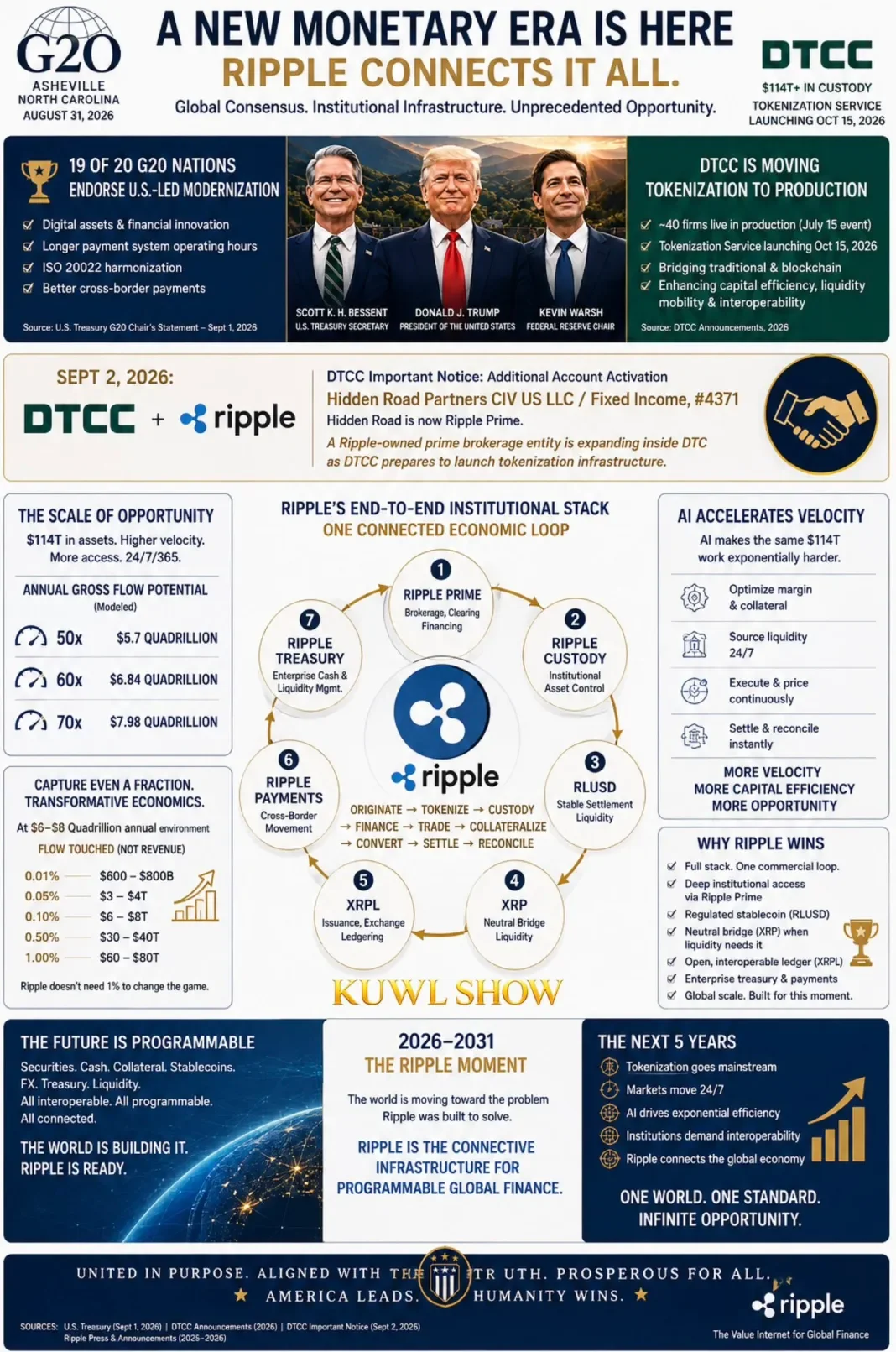
DTCC is bringing tokenization into production across an infrastructure responsible for more than $114 trillion in assets.
Ripple Prime now extends Ripple directly into institutional brokerage, clearing, financing and fixed-income markets.
These forces converge around one requirement:
Capital must become programmable, interoperable, liquid and globally mobile.
Ripple built for this moment.
ONE COMPANY. SEVEN INSTITUTIONAL CAPABILITIES.
1 Ripple Prime — Brokerage • Clearing • Financing
2 Ripple Custody — Institutional Asset Control
3 RLUSD — Stable Settlement Liquidity
4 XRP — Neutral Bridge Liquidity
5 XRPL — Issuance • Exchange • Ledgering
6 Ripple Payments — Global Value Movement
7 Ripple Treasury — Enterprise Cash & Liquidity Management
Together they create one connected economic loop:
ORIGINATE → TOKENIZE → CUSTODY → FINANCE → TRADE → COLLATERALIZE → CONVERT → SETTLE → RECONCILE
That integration is Ripple’s competitive advantage.
Ripple does not merely provide another payment rail, stablecoin, blockchain, custody platform or prime broker.
Ripple connects the entire institutional value chain.
$114 TRILLION BECOMES MORE PRODUCTIVE
Tokenization changes what assets can do.
AI changes how frequently they can do it.
As markets move toward continuous trading, collateral optimization, liquidity sourcing and settlement, the same capital can work harder:
50× turnover → $5.7 quadrillion annually
60× turnover → $6.84 quadrillion annually
70× turnover → $7.98 quadrillion annually
The transformation is not simply more money.
It is more utility from every dollar of existing value.
More velocity.
More liquidity.
More collateral mobility.
More transactions.
More settlement.
More interoperability.
RIPPLE NEEDS A FRACTION TO BUILD AN EMPIRE
At $6–$8 quadrillion of modeled annual institutional flow:
0.01% connected → $600–$800 billion
0.10% → $6–$8 trillion
0.50% → $30–$40 trillion
1.00% → $60–$80 trillion
Every additional institutional connection can strengthen the utility of Ripple Prime, Custody, RLUSD, XRP, XRPL, Payments and Treasury.
Each product strengthens the others.
Each new customer expands the network.
Each new asset creates another potential liquidity relationship.
Each new market creates another pathway through the stack.
2026–2031: THE RIPPLE MOMENT
The financial system is becoming programmable.
• Securities become programmable.
• Cash becomes programmable.
• Collateral becomes programmable.
• Treasury becomes programmable.
• Liquidity becomes programmable.
• Markets become continuous.
Ripple sits at their intersection.
The opportunity is no longer simply moving money across borders.
It is connecting assets, institutions, currencies, liquidity and ledgers across borders and markets.
That is the 5-year Ripple future:
ONE CONNECTED STACK.
ONE GLOBAL VALUE NETWORK.
INSTITUTIONAL FINANCE, MADE PROGRAMMABLE.
The world is building the new financial system.
@Ripple is built to connect it all.
Source(s):
• https://x.com/KuwlShow/status/2095579424884400399
https://dinarchronicles.com/2026/09/03/rob-cunningham-a-new-monetary-era-is-here/
History Makes a STRONG Case For A Dinar Revaluation
History Makes a STRONG Case For A Dinar Revaluation
The Dinar Den: 9-3-2026
Global monetary systems are rarely static, continuously evolving through cycles of restructuring, technological innovation, and geopolitical readjustments.
Among the most discussed topics in modern currency analysis is the long-term trajectory of the Iraqi dinar and the broader economic framework supporting its potential revaluation. Rather than viewing currency shifts as isolated financial events, expert analyses suggest that significant monetary adjustments are part of a larger historical continuum.
History Makes a STRONG Case For A Dinar Revaluation
The Dinar Den: 9-3-2026
Global monetary systems are rarely static, continuously evolving through cycles of restructuring, technological innovation, and geopolitical readjustments.
Among the most discussed topics in modern currency analysis is the long-term trajectory of the Iraqi dinar and the broader economic framework supporting its potential revaluation. Rather than viewing currency shifts as isolated financial events, expert analyses suggest that significant monetary adjustments are part of a larger historical continuum.
By examining historical precedents, modern banking standards, and digital infrastructure rollouts, macroeconomists and currency observers gain a clearer perspective on how post-conflict nations rebuild their fiscal sovereignty and integrate into the international financial ecosystem.
Looking back at twentieth-century economic history provides essential context for understanding modern monetary resets. Countries like post-war Germany, Japan, and South Korea underwent extensive financial and structural overhauls following severe geopolitical disruptions.
In each instance, international stabilization programs, backed by major economic powers and multilateral institutions, helped transition shattered local currencies into stable mediums of exchange. These historical precedents demonstrate that rebuilding national balance sheets often involves severe currency devaluations followed by multi-phase stabilization strategies, institutional reforms, reserve accumulation, and eventual revaluation to reflect real economic value.
In the case of Iraq, the post-2003 financial architecture was heavily shaped by direct international and United States institutional involvement. The initial focus centered on stabilizing the domestic market, establishing a new sovereign currency framework, and controlling hyperinflation through regular currency auctions. Over the past two decades, this relationship has evolved from immediate post-conflict stabilization toward long-term modernization.
Integrating Iraq’s banking system into the global swift network and standardizing international correspondent banking relations have established a foundation where the foreign exchange environment can gradually shift away from strict capital controls toward broader market-oriented flexibility.
A notable aspect of Iraq’s contemporary economic strategy is its aggressive push toward monetary digitization and electronic banking solutions. While many developed nations are still deliberating the domestic deployment of Central Bank Digital Currencies, developing markets often serve as efficient testing environments for rapid digital transformation.
Iraq’s central bank has prioritized financial inclusion, point-of-sale terminal adoption, and core banking technology modernization. This accelerated push toward a cashless framework reduces the reliance on paper physical currency, minimizes informal market leakages, and establishes the precise tracking mechanisms necessary for a controlled currency adjustment.
Behind these domestic reforms lies a strict adherence to global regulatory standards, specifically those governed by the International Monetary Fund and international banking guidelines like Basel III.
Under the Basel III capital adequacy framework, sovereign central banks have renewed their focus on physical gold reserves, reclassifying unencumbered gold as a primary reserve asset.
Iraq’s deliberate accumulation of sovereign gold reserves serves a dual purpose: it fortifies the nation’s balance sheet against inflationary pressures and aligns its banking sector with top-tier international settlement standards, signaling to global markets that its currency is increasingly backed by verifiable wealth.
Despite optimistic analyses regarding monetary adjustments, economic restructurings of this scale are inherently gradual processes. Complex monetary coordination involves balancing exchange rate mechanisms, managed floats, cash turn-in periods, and regional political dynamics, meaning timeline estimates must be met with analytical patience. Sovereign nations prioritize systemic stability over rapid market shifts, ensuring that domestic industries and fiscal policy can sustain new currency values.
https://www.youtube.com/watch?v=6lcst2EJ5Nw