
News, Rumors and Opinions Tuesday 9-1-2026
Note: All intel should be considered as "Rumors" until we receive official announcements ...and “Rates and Dates” could change anytime until we get to the banks/redemption centers.
RV Excerpts from the Restored Republic via a GCR Update as of Tues. 1 Sept. 2026
Compiled Tues. 1 Sept. 2026 12:01 am EST by Judy Byington
The Ultimate Interoperability Grid Is Going Live – And the Legacy Rails Are Being Bypassed Forever. …US Treasury Center on Telegram Mon. 31 Aug. 2026
While the legacy financial media is still arguing over inflation data and interest rate cuts, a seismic infrastructure shift is (allegedly) quietly locking into place. The old correspondent banking network—built on fragmented ledgers, multi-day delays, and archaic messaging—has officially hit a structural wall. Cross-border payments are taking longer, friction is mounting, and traditional institutions are scrambling to plug the leaks.
Note: All intel should be considered as "Rumors" until we receive official announcements ...and “Rates and Dates” could change anytime until we get to the banks/redemption centers.
RV Excerpts from the Restored Republic via a GCR Update as of Tues. 1 Sept. 2026
Compiled Tues. 1 Sept. 2026 12:01 am EST by Judy Byington
The Ultimate Interoperability Grid Is Going Live – And the Legacy Rails Are Being Bypassed Forever. …US Treasury Center on Telegram Mon. 31 Aug. 2026
While the legacy financial media is still arguing over inflation data and interest rate cuts, a seismic infrastructure shift is (allegedly) quietly locking into place. The old correspondent banking network—built on fragmented ledgers, multi-day delays, and archaic messaging—has officially hit a structural wall. Cross-border payments are taking longer, friction is mounting, and traditional institutions are scrambling to plug the leaks.
Then came the real structural shift:
• Legacy nostro-vostro accounts are draining faster than banks can rebalance them.
• Correspondent banking fees are squeezing global trade margins to the bone.
• Settlement finality under the old T+1/T+2 rules is proving too slow for a 24/7 global economy.
• Central banks are realizing that patching legacy plumbing is no longer an option—migration is mandatory.
• And the integration window between sovereign ledgers and commercial rails is narrowing by the day.
The old system isn’t just updating; it’s being (allegedly) entirely superseded.This is not a temporary network upgrade. This is the complete migration of global value onto cryptographic, interoperable rails. And if a global settlement network requires manual intervention and days of clearing, it is no longer a financial system. It’s a bottleneck.
The New Infrastructure Is Already Online. While legacy institutions grapple with structural obsolescence, the architecture of the new financial internet is (allegedly) fully operational across five critical pillars:
1. Cross-Border Interoperability & Multi-Ledger Bridges We have moved past isolated blockchain silos. Advanced atomic swaps and decentralized bridge protocols now (allegedly) allow frictionless value transfer between public enterprise ledgers and permissioned central bank networks—settling globally in seconds, not business days.
2. The Universal Compliance & Audit Layer (ISO 20022 Integration) With the messaging standard fully enforced worldwide, every single transaction carries rich, structured data. This completely eliminates:
• hidden intermediary fees
• fragmented transaction trails
• delayed compliance checks
• manual reconciliation bottlenecks; and
• systemic blind spots that allowed illicit flows to hide for decades.
For the first time in modern history, global finance is(allegedly) fully transparent, verifiable, and instantaneous.
3. Regulatory Clarity & Asset Classification Clear legal frameworks for digital commodities have drawn a permanent line between speculative assets and true infrastructure rails. Utility-driven tokens like XRP, XLM, ALGO, and HBAR are now (allegedly) legally recognized as foundational settlement layers, giving institutional capital the green light to deploy at scale.
4. Institutional Tokenization of Real-World Assets (RWA) Trillions of dollars in physical assets—commercial real estate, sovereign debt, private equity, and commodities—are (allegedly) actively migrating onto distributed ledgers. This unlocks:
• instant fractional liquidity
• eliminated counterparty risks
• automated smart-contract compliance; and
• 24/7 global market access.
Money is moving to ledgers because physics and math are simply superior to bureaucracy.
5. Decentralized Trade and Sovereign Independence Nations are(allegedly) bypassing legacy gatekeepers (like the IMF, World Bank, and centralized clearinghouses) to trade directly using multi-currency digital ledgers. Power is (allegedly) shifting away from unelected cartels and back toward sovereign states, transparent markets, and empowered individuals.
THE TRANSITION IS ACCELERATING! The old world is clinging to manual controls, but the structural momentum of the new financial era is unstoppable.
Read full post here: https://dinarchronicles.com/2026/09/01/restored-republic-via-a-gcr-update-as-of-september-1-2026/
Courtesy of Dinar Guru: https://www.dinarguru.com/
Jeff They can't work on any of the old long-awaited stuff because they're done. They've gone as far as they can go right now...HCL, Article 140, pseudo '26 budget, the '27 budget, everything in Iraq is clearly waiting for the rate to change before they can move forward.
Militia Man The two pocket picture. Think of Iraq's money as two pockets. Pocket one is dollars from oil. Pocket two is dinar used to pay salaries. The exchange rate is the door between those two pockets. The CBI sets what $1.00 is worth in dinar. If they print more dinars, [dinar] pocket two get bigger on paper [but each dinar is worth less dollars]. The door does not change...A rate adjustment changes the door. If the dinar is reset stronger, each oil dollar that comes in and creates more dinars [maintaining the value]...A new rate only works if both pockets are being fixed at the same time...
Frank26 Every day since the 11th of last month it's just been amazing...The GOI made an announcement. Article quote: "Removing the zeros from the currency may begin early next year." ...In my very strong opinion this is not a leak. My teams are telling me this is being done on purpose...The next 4 months is going to reveal everything about January 1st...They can give you the lower notes and lift the 3-zeros before January 1st...This is preparing you for what is about to happen.
************
IQD Update: The Real Reason Iraq Wants to Delete the Zeros
Edu Matrix: 9-1-2026
Iraq Economic News and Points To Ponder Tuesday Morning 9-1-26
Cabinet to vote on Iraq’s 2027 budget in September
2026-08-31 Shafaq News- Baghdad Iraq’s cabinet will vote on the draft 2027 federal budget in September, with the projected deficit capped at 3%, government spokesperson Haider Al-Aboudi announced on Monday.
At a press conference, Al-Aboudi said the Finance Ministry is finalizing the bill in line with the Federal Financial Management Law. The program-based budget will include electricity initiatives and development projects in Saladin and Al-Diwaniyah provinces, as well as provisions concerning contract employees.
Cabinet to vote on Iraq’s 2027 budget in September
2026-08-31 Shafaq News- Baghdad Iraq’s cabinet will vote on the draft 2027 federal budget in September, with the projected deficit capped at 3%, government spokesperson Haider Al-Aboudi announced on Monday.
At a press conference, Al-Aboudi said the Finance Ministry is finalizing the bill in line with the Federal Financial Management Law. The program-based budget will include electricity initiatives and development projects in Saladin and Al-Diwaniyah provinces, as well as provisions concerning contract employees.
The previous government, led by Mohammed Shia Al-Sudani, enacted a three-year budget covering 2023–2025, but the final-year spending plan was not implemented after parliament failed to approve amended expenditure schedules before the law expired. The Finance Ministry instead relied on the one-twelfth (1/12) mechanism to cover salaries and mandatory spending.
Iraq also entered 2026 without a budget amid delays in forming a new government, the economic fallout from the regional war, and volatile energy markets, prolonging reliance on temporary spending arrangements.
Read more: 2026 budget: Iraq confronts unprecedented fiscal strain
https://www.shafaq.com/en/Iraq/Cabinet-to-vote-on-Iraq-s-2027-budget-in-September
The Government May Begin Issuing A New Currency Early Next Year
A video.. news report https://hathalyoum.net/articles/4222841
translation of video: Sources' decisions will settle the matter in the near future.
While the currency exchange may continue.
Sources said that the government may begin issuing a new Iraqi currency in early 2027 after removing three zeros from the dinar.
Indicating that the proposal is still under discussion within the Council of Ministers.
The sources expected a decision to be made in the near future.
While the currency exchange and the issuance of new banknotes may continue throughout 2027.
And it indicated that the project to remove the zeros aims to remove the stolen and stored money outside the banking system.
Confirming that the Central Bank of Iraq has not yet received an official government decision regarding the removal of zeros
AI summary:
The video reports on a proposal discussed by the Iraqi government regarding the potential issuance of a new currency at the beginning of the next year (0:00-0:03). This initiative involves deleting three zeros from the current Iraqi dinar (0:08).
Key points mentioned in the report:
Status of the proposal: The plan is currently under discussion within the Council of Ministers (0:12-0:15).
Timeline: The decision is expected to be finalized soon, and if approved, the process of replacing the currency and issuing new banknotes could continue throughout 2027 (0:15-0:25).
Purpose: The project aims to bring money that is currently looted or stored outside the banking system back into circulation (0:30-0:36).
Central Bank involvement: As of now, the Central Bank of Iraq has not received an official government decision regarding the removal of the zeros (0:36-0:43).
After Their Numbers Dwindled By More Than A Million People, Catholic Weekly Reports That Al-Zaidi Wants To Bring Christians Back To Iraq And Is Placing Land And Investment At The Heart Of The Return Project
Baghdad - One News - 8/31/2026 The Australian Catholic Weekly highlighted a government initiative to return Christian families who had emigrated to Iraq, noting that Prime Minister Ali al-Zaidi had placed the return of Christians among the national and governmental priorities, offering incentives that included residential land and encouraging businessmen in exile to return and invest.
The newspaper reported that Al-Zaidi confirmed, during his meeting with the Chaldean Patriarch Paul III Nona in Baghdad, the government’s readiness to provide the necessary facilities and support for the return of Christian families who left the country during the past decades, and to ensure that returnees are included in the project to distribute one million residential plots of land.
According to the report, Al-Zaydi stressed that Christians represent an active component and an essential part of Iraqi society and a key partner in building the state and shaping Iraq’s history and future, considering that the country’s strength lies in its national, religious and cultural diversity, and in the unity of its people and their social cohesion.
The report noted that the Prime Minister also called on Christian businessmen living abroad to return and invest in Iraq, as part of an effort to enhance the contribution of Christians to economic and service life, particularly in the health and education sectors.
The newspaper quoted the Chaldean Archbishop of Erbil, Bishop Bashar Warda, as saying that the church welcomed this invitation, noting that al-Zaidi expressed his confidence in the role that Christians can play in the education and health care sectors, and affirmed his government’s readiness to provide them with the necessary facilities and support.
According to the report, Christian denominations in Iraq run 18 schools, including prominent educational institutions, in addition to a Catholic university in Erbil.
Catholic Weekly noted that the number of Christians in Iraq has decreased from about 1.5 million in 2000 to less than 300,000 currently, according to estimates by the Aid to the Church in Need organization, after successive waves of emigration that worsened after the events of 2003, and the targeting of Christians by extremist groups, especially after ISIS invaded Mosul and the Nineveh Plain in 2014.
In contrast to the government's approach, the report noted the continued concerns within the church about the emigration of Christian youth, quoting Patriarch Nona's warning that a segment of young people are losing hope in their future in the country and that many of them want to emigrate, in addition to a noticeable decline in the number of marriages, warning of the repercussions of this on the future of the Christian presence and the role of youth in building Iraq.
Nona also considered corruption to be "Iraq's greatest enemy," linking the protection of human rights to combating financial corruption and reducing the influence of money and political power in the decision-making process.
https://1news-iq.net/بعدما-تقلّص-عددهم-بأكثر-من-مليون-شخص
Finance Ministry: Intensifying Efforts To Finalize The 2027 General Budget Project
Finance Minister Faleh Sari directed on Monday that the necessary technical requirements for preparing the draft general budget for 2027 be completed, stressing the need to intensify efforts during the next stage.
The Ministry of Finance stated in a statement that "the Minister inspected the departments of the Budget Department, reviewed the progress of work in preparing the draft program and performance budget, and met with the work teams tasked with preparing the project and listened to a presentation on the stages of completion and the remaining technical requirements."
Sari stressed "the importance of integrating efforts and continuing to work at an intensive pace, along with strengthening coordination and communication with ministries and government institutions to organize and audit financial data and provide the information required to prepare the draft budget accurately and efficiently."
He pointed out that "the shift towards program and performance budgeting requires continuous cooperation and coordination among the concerned parties, in order to ensure that the allocation of resources is linked to programs, objectives and results, and to achieve the most efficient use of public funds."
https://alssaa.com/post/show/59977-المالية-تكثيف-العمل-لاستكمال-مشروع-الموازنة-العامة-لعام-2027
Banking Sector Faces Turning Point In Iraq’s Reform Drive
2026-08-30 Shafaq News- Baghdad Iraq’s banking sector faces a “critical crossroads” after years of weak management, oversight failures and declining public confidence have limited its ability to attract savings and finance investment and development, the prime minister’s economic adviser told Shafaq News on Saturday.
Mudher Mohammed Saleh said building an efficient banking system could no longer be delayed, particularly in an economy heavily dependent on oil for foreign currency.
“Restoring confidence requires stronger governance, supervision and compliance, strict anti-money laundering and counter-terrorist financing standards, restructuring troubled banks, addressing weaknesses in their financial positions and raising capital in line with risk levels and modern banking requirements.”
Technology is another key part of the overhaul, Saleh said, calling for improved digital systems, cybersecurity and risk management, along with secure and reliable electronic payment services. Such measures would reduce reliance on cash, expand financial inclusion and bring more people into the formal banking system.
However, technology and oversight alone would not restore confidence. Banks also need greater transparency, stronger depositor protections, clear deposit safeguards, faster complaint handling and the ability to protect customers’ money, according to the advisor.
He called for banks to shift from traditional services and liquidity management toward financing the real economy, particularly small and medium-sized enterprises and productive agricultural, industrial and service sectors.
“A bank that does not finance productive economic activity remains a financial intermediary with limited impact,” he said, adding that institutions capable of mobilizing savings, managing risks and financing production and investment can become partners in development.
From Cash to Credit
International economics professor Nawar Al-Saadi told Shafaq News that banking reform had become essential for moving Iraq from a cash-based economy toward one driven by financing. He said the Central Bank of Iraq’s (CBI) program offers banks several paths, including remaining in business, merging or leaving the market, alongside tougher governance, compliance and risk-management requirements.
Rebuilding confidence requires sound governance, solvency and transparency rather than campaigns to attract deposits, Al-Saadi said. He called for resolving the status of banks unable to continue operating, strengthening the capital of viable institutions, improving disclosure and independent auditing, and holding boards and executives accountable for violations.
Depositors should find banks “safer and easier to use” than keeping cash, he added. This would also require greater lending to small and medium-sized businesses and productive sectors, as well as effective credit-scoring systems instead of excessive reliance on traditional collateral.
Protecting Deposits
Economic expert Ahmed Al-Janabi said reform required a comprehensive package beginning with restoring confidence and protecting depositors’ money, noting that many Iraqis remain reluctant to place their savings in banks.
He noted that the reform program involving global consultancy Oliver Wyman was developed against the backdrop of restrictions on several Iraqi banks. Seven institutions subsequently entered an initial phase allowing them to resume transactions and transfers in foreign currencies other than the dollar, while further reforms remain underway.
Al-Janabi estimated that currency issued by the CBI totals around 103 trillion dinars, while about 20 trillion dinars remain outside the banking system, much of it “hoarded in homes.”
Economic expert Ahmed Abdul Rabbo said the reforms undertaken with Oliver Wyman were important for rebuilding the banking sector, improving its efficiency and strengthening its links to the global financial system, calling for faster implementation.
He welcomed the decision allowing seven banks to conduct foreign transfers in currencies other than the dollar but said the priority should be enabling them to gradually resume broader operations. Reform should also extend beyond those institutions, he said, with other banks assessed and allowed to conduct foreign transfers once they meet the required standards.
The Central Bank has been working with international firms to overhaul the banking sector and address compliance problems that had cut several Iraqi banks off from dollar transactions.
On July 18, the CBI reached an agreement with the US Treasury Department allowing seven eligible banks to resume foreign correspondent banking in currencies other than the dollar. Access to dollar transactions remains subject to further compliance, governance and relicensing requirements.
https://shafaq.com/en/Economy/Banking-sector-faces-turning-point-in-Iraq-s-reform-drive
Seeds of Wisdom RV and Economics Updates Tuesday Morning 9-1-26
Good Morning Dinar Recaps,
Global Bond Rout Deepens: Oil Shock Forces Investors to Reprice Debt, Rates and Risk
Rising energy prices and renewed inflation concerns are pushing global bond yields higher, challenging governments, central banks and investors already facing elevated debt costs.
Good Morning Dinar Recaps,
Global Bond Rout Deepens: Oil Shock Forces Investors to Reprice Debt, Rates and Risk
Rising energy prices and renewed inflation concerns are pushing global bond yields higher, challenging governments, central banks and investors already facing elevated debt costs.
OVERVIEW
Global bonds: A broad selloff is pushing government borrowing costs higher as investors reassess inflation, fiscal conditions and interest-rate expectations.
Japan: Japan’s 10-year government bond yield reached 3% for the first time since 1996, signaling a major shift in one of the world's most important low-yield markets.
Oil and inflation: Renewed Middle East tensions are pushing energy prices higher, creating additional inflation pressure just as investors prepare for potentially tighter monetary policy.
KEY DEVELOPMENTS
1. Global Bond Rout Intensifies
Bond markets across the United States, Japan, Germany and the United Kingdom are experiencing renewed selling pressure.
The move reflects growing concern that higher inflation, rising government borrowing and elevated energy prices could keep interest rates higher for longer.
2. Japan's 10-Year Yield Reaches a Historic Milestone
Japan's benchmark 10-year government bond yield reached 3%, its highest level since September 1996.
Japan has historically been an important source of relatively inexpensive global capital. Higher domestic yields could therefore influence Japanese investment flows into foreign bonds and other assets, adding another dimension to the global repricing.
3. Oil Shock Adds to Inflation Pressure
Renewed Middle East conflict has pushed energy prices higher, increasing concerns that inflation could remain elevated.
That creates a difficult environment for central banks: higher oil prices can discourage rate cuts or increase pressure for tighter policy, even when economic growth is facing uncertainty.
4. Government Debt Is Becoming More Expensive
Higher bond yields translate into higher borrowing costs for governments.
With U.S. federal debt already exceeding $40 trillion, a prolonged period of elevated long-term yields could increase interest expenses and reduce fiscal flexibility. Japan, the UK and other heavily indebted economies face similar pressures.
5. A New Global Capital Regime May Be Emerging
The significance of today's bond move extends beyond individual countries.
If investors become less willing to accept historically low yields, governments may have to compete more aggressively for capital. At the same time, changing Japanese yields could influence cross-border capital flows, potentially affecting currencies, equities and bond markets worldwide.
WHY IT MATTERS
The global bond market is effectively repricing the cost of money and the cost of government borrowing.
For years, investors operated in an environment where major central banks helped keep borrowing costs relatively low. Today's moves suggest that inflation, fiscal deficits and geopolitical energy risks are increasingly challenging that framework.
The danger is not necessarily an immediate financial crisis. The larger concern is whether higher yields become structural rather than temporary, forcing governments and markets to adapt to a permanently higher cost of capital.
WHY IT MATTERS TO FOREIGN CURRENCY HOLDERS
Currency value: Changing interest-rate expectations can redirect capital toward currencies offering higher relative returns.
Purchasing power: Higher energy prices can raise transportation, production and household costs, putting additional pressure on purchasing power.
Capital flows: Higher Japanese yields could encourage some investors to shift capital back toward domestic Japanese assets rather than seeking returns overseas.
Exchange rates: Diverging monetary policies and changing bond yields can create significant movements in major currency pairs.
IMPLICATIONS FOR THE GLOBAL RESET
Pillar 1: Debt
The global bond selloff highlights a fundamental issue for the financial system: the cost of servicing government debt is rising.
If yields remain elevated, governments may have less fiscal flexibility and face increasing pressure to manage deficits, refinancing requirements and interest expenses.
Pillar 2: Assets
Higher bond yields can change valuations across the financial system because the risk-free rate influences the pricing of stocks, real estate, corporate debt and other assets.
A sustained repricing of government bonds can therefore become a broader repricing of global assets and investment strategies.
Pillar 3: Energy
The oil shock demonstrates how energy security and financial stability are increasingly connected.
A prolonged disruption in global energy supplies can raise inflation, influence central-bank policy and ultimately affect bond yields, currencies and asset valuations.
CONCLUSION
Today's bond-market selloff is becoming more than a temporary market reaction. Higher energy prices, rising yields, fiscal pressure and changing monetary expectations are reinforcing one another.
Japan's move to a 3% 10-year yield is particularly significant because it signals that even one of the world's historically lowest-yield markets is entering a different financial environment.
The central question for investors is whether today's repricing fades as geopolitical tensions ease or becomes part of a longer-term adjustment in the global cost of capital.
The global financial system is being tested not by one market, but by the simultaneous repricing of energy, money and debt.
Seeds of Wisdom Team
Newshounds News™ Exclusive
SOURCES
~~~~~~~~~~
🌱 A Message to Our Currency Holders🌱
If you’ve been holding foreign currency for many years, you were not foolish.
You were not wrong to believe the global financial system would change.
What failed was not your patience — it was the information you were given.
For years, dates, rumors, and personalities replaced facts, structure, and proof. “This week” predictions created cycles of hope and disappointment that were never based on how currencies actually change.
That is not your failure.
Our mission here is different: • No dates • No rates • No hype • No gurus
Instead, we focus on:
• Verifiable developments • Institutional evidence
• Global financial structure • Where countries actually sit in the process
Currency value changes only come after sovereignty, trade, banking, settlement systems, and fiscal coordination are in place. History and institutions confirm this sequence.
You will see silence. You will see denials. That is not delay — that is discipline.
Protect your identity. Organize your documents. Verify everything.
Never hand your discernment to anyone who cannot show proof.
You deserve truth — not timelines.
Seeds of Wisdom Team
Newshounds News
~~~~~~~~~~
Seeds of Wisdom Team RV Currency Facts Youtube and Rumble
Newshound's News Telegram Room Link
RV Facts with Proof Links Link
RV Updates Proof links - Facts Link
Start Here room with Most Asked Questions Link
Follow the Gold/Silver Rate COMEX
Follow Fast Facts
Seeds of Wisdom Team™Website
Thank you Dinar Recaps
Is Trump Signalling a Gold Revaluation? Bill Holter
Is Trump Signalling a Gold Revaluation? Bill Holter
Kinesis Money: 8-31-2026
In this week’s Live from the Vault, Andrew Maguire is joined by Bill Holter to examine whether Trump's repost of Jim Rickards' $10,000 gold call signals something far bigger than a market comment, and what it means for gold and the dollar system.
The two precious metals experts examine why credit markets are beginning to crack, and why Bill believes any gold price target being discussed today will ultimately prove laughably low — including the ones that sound outrageous right now.
Is Trump Signalling a Gold Revaluation? Bill Holter
Kinesis Money: 8-31-2026
In this week’s Live from the Vault, Andrew Maguire is joined by Bill Holter to examine whether Trump's repost of Jim Rickards' $10,000 gold call signals something far bigger than a market comment, and what it means for gold and the dollar system.
The two precious metals experts examine why credit markets are beginning to crack, and why Bill believes any gold price target being discussed today will ultimately prove laughably low — including the ones that sound outrageous right now.
Timestamps:
00:00 Start
01:29 Is Bessant's yield push a policy error - or a gold revaluation trigger?
05:12 Why Trump reposting Jim Rickards' $10,000 gold call is no coincidence
09:07 How a weekend gold revaluation would wipe out rehypothecation overnight
14:08 AI cannot be built without silver - and the silver simply does not exist
19:24 How Hong Kong's exchange made the yuan directly convertible to gold
24:01 Enbridge: the escape hatch from the dollar system explained
30:14 Credit is cracking - and the only exit is physical gold and silver
38:44 Why any gold price target you hear today will prove laughably low
43:02 Could gold miners be nationalised? Bill makes the case
49:28 Get out of the system, and make your plan while you still can
Iraq Economic News and Points To Ponder Monday Evening 8-31-26
When Will The Removal Of Zeros Begin? A Member Of Parliament Sets A Date For The Project's Implementation.
Information/Baghdad... MP Murtadha Afween confirmed on Monday that the project to remove zeros from the Iraqi currency has not yet moved to the implementation phase, indicating that the project does not represent a direct solution to the crises plaguing the Iraqi economy.
Afween told the Information Agency that “the issue of removing zeros from the currency has not yet reached the implementation phase,” explaining that “the project has not contributed to addressing the crises facing the Iraqi economy.”
When Will The Removal Of Zeros Begin? A Member Of Parliament Sets A Date For The Project's Implementation.
Information/Baghdad... MP Murtadha Afween confirmed on Monday that the project to remove zeros from the Iraqi currency has not yet moved to the implementation phase, indicating that the project does not represent a direct solution to the crises plaguing the Iraqi economy.
Afween told the Information Agency that “the issue of removing zeros from the currency has not yet reached the implementation phase,” explaining that “the project has not contributed to addressing the crises facing the Iraqi economy.”
He added that "removing zeros from the currency, if it proceeds, should not be considered a sufficient measure to address the economic challenges," noting "the importance of focusing on issues directly related to the country's economic and financial reality."
Afween pointed out that "addressing the economic crises requires concrete steps and measures targeting the root causes of the problems, in addition to developing solutions for issues affecting financial and economic stability," emphasizing that "monetary measures alone are insufficient to address the accumulated economic problems."
Earlier, The Media Line network revealed in a report that the Iraqi government will begin issuing a new currency with zeros removed at the beginning of 2027. End/25z
Sources Told Al-Mustaqilla That The Plan To Remove Zeros From The Iraqi Currency Is Entering Advanced Stages, With A Plan To Replace The Currency In Early 2027.
Last updated: August 31, 2026 Al-Mustaqilla/- Baghdad/ Informed sources revealed to Al-Mustaqilla that the file of removing zeros from the Iraqi dinar and reissuing the currency has entered advanced stages of study and discussion within government departments, noting that a plan currently circulating aims to begin the process of replacing the old currency with a new currency starting from 2027, in the event that the required governmental, legislative and technical approvals are completed.
The sources said that the currency restructuring file is no longer limited to economic and technical discussions within the Central Bank of Iraq, but has become subject to study at the level of the Prime Minister’s office, within a plan related to the mechanism for moving from the current currency to a new monetary issuance after removing the zeros.
According to information obtained by Al-Mustaqila, the discussions are currently focused on developing a clear implementation plan for the replacement process, the transitional period during which the two currencies will be traded, the mechanisms for banks and government institutions to deal with the new currency, as well as the procedures related to bringing the largest possible amount of cash outside the banking sector into the formal financial system.
The sources confirmed that 2027 is among the current proposals as a possible start date for the process of replacing the old currency with the new one, but stressed that the date will not become officially effective before the completion of the governmental and legislative process and obtaining the required approvals.
The sources expected that the file would witness developments at the Cabinet level in the coming period, followed – if the project is approved – by moving to the required legislative path before reaching the implementation stage.
Mustafa Sand's statements bring the issue back to the forefront.
The new information coincides with previous statements by Iraqi Communications Minister Mustafa Sanad, who said during August that a decision regarding the removal of zeros and the change of currency had been decided at the political level, and linked the move to bringing out hoarded funds and returning them to the economic cycle and the banking system.
Sand said that the currency change process could encourage holders of large amounts of cash to reveal their money when exchanging old banknotes, allowing some of the liquidity outside banks to be brought back into the financial system, as well as dealing with money whose owners cannot prove its sources or bring it legally into the exchange process.
Sand’s statements had sparked widespread controversy, especially after the government said on August 17 that the Cabinet had not made a final decision at that time to remove the zeros, and that implementing such a step required a legislative process that went through the House of Representatives.
The Central Bank denies printing... but outlines the course of any future project
On August 26, 2026, the Central Bank of Iraq issued a statement explicitly denying reports that it had printed quantities of new Iraqi currency with zeros removed in preparation for its release into the markets.
However, the bank’s statement did not close the door to a future currency restructuring project, as it confirmed that any such project, if an official decision is made regarding it, will be subject to multiple legal, regulatory and technical stages, and that it will be officially announced and a transition period will be determined that allows citizens, banks and institutions to exchange the currency in an organized and safe manner.
This means that the official denial issued by the Central Bank so far relates to the existence of a new currency that has been printed and is ready for circulation, and not to the cancellation of the project idea or the exclusion of discussing it in the future.
Al-Mustaqilla has been following the case since its inception.
Al-Mustaqilla had published a series of reports in recent days on the issue of removing zeros and restructuring the currency, in which it quoted sources close to decision-making circles as saying that the matter was under serious study, despite the fact that no final government announcement had been issued yet.
Information obtained by “Al-Mustaqila” today confirms that the file is still in existence and under study within the relevant institutions, and that the discussions have moved to more advanced details regarding how to implement the replacement process and not just the idea in principle.
However, the sources confirmed at the same time that the project’s transition to the actual implementation phase will remain linked to the final decision of the Council of Ministers, the legislative procedures required by the file, and the position of the Central Bank, as it is the entity responsible for managing and issuing currency and monetary policy in Iraq.
Why does the government want to change the currency?
The proposed plans suggest that the project’s objectives are not limited to reducing the number of zeros and facilitating accounting and monetary operations, but could also include reorganizing the large amount of cash that exists outside the banking system.
Iraq is one of the economies that relies heavily on cash transactions, and a large percentage of the currency in circulation is outside of banks.
The latest data circulating on monetary indicators indicates that the volume of currency circulating outside the banking sector has reached more than 100 trillion dinars, which reflects the extent of the hoarding phenomenon and reliance on direct cash.
Currency replacement – if the government adopts clear control mechanisms – would encourage hoarders to deposit their money through banks or exchange centers within a specific time period, giving financial authorities greater ability to know the movement of money and the sources of some large cash blocks.
The process can also support anti-money laundering and anti-financing measures if it is accompanied by the application of clear rules regarding deposits, large sums, and sources of funds.
Replacement, not cancellation, of the value of citizens' money
From an economic standpoint, removing zeros does not mean that citizens' money will lose its value or that the dinar will automatically become more expensive.
If it is decided – for example – to remove three zeros, then renaming the monetary unit could make every thousand dinars of the old currency equivalent to one dinar of the new currency, in parallel with repricing salaries, prices, debts, contracts and balances at the same rate.
The main objective of the process is to simplify monetary categories, accounts and transactions, not to achieve an automatic increase in the purchasing power of the dinar.
Expected transitional phase
If the project is approved, the authorities will likely adopt a transitional phase during which the old and new currencies will circulate simultaneously before the old version is gradually withdrawn.
The central bank had already confirmed that any future decision of this kind would include a transition period to ensure that citizens, banks and institutions could exchange currency in an orderly manner while preserving all financial rights and obligations.
The process will require resetting banking systems, ATMs, accounting software, pricing, contracts and government records, as well as a broad awareness campaign to prevent the transition from being exploited for fraud or speculation.
The coming days could be decisive.
According to sources from “Al-Mustaqilla”, the next stage will be important in determining the final course of the project, while the governmental, legal and technical aspects of the currency replacement plan continue to be studied.
The sources confirmed that there is a trend to push the file towards completing the necessary procedures, with the picture to become clearer after the Cabinet's position and the legislative process are decided.
Accordingly, the information available so far indicates that the project to change the currency and remove zeros is moving within Iraqi institutions, and that 2027 is being considered as a possible start date for the replacement process according to the ideas being discussed. However, this has not yet turned into an official, announced, and binding date from the Central Bank or the Council of Ministers as of the date of this report.
The Iraqi public is waiting for any official announcement in the coming days that could move one of the most sensitive financial issues in the country from the stage of studies and discussions to the stage of decision and implementation
Breaking Down $15 billion Spent on California's Train to Nowhere
Breaking Down $15 billion Spent on California's Train to Nowhere
Notes From the Field By James Hickman (Simon Black / Sovereign Man) August 28, 2026
In November 2008, California voters approved a ballot measure to build a bullet train from San Francisco to Los Angeles. It was supposed to be fast enough to make the journey in under three hours. And passengers could hop on by 2020, for a total cost of $33 billion.
Eighteen years later, there is nothing to ride.
Breaking Down $15 billion Spent on California's Train to Nowhere
Notes From the Field By James Hickman (Simon Black / Sovereign Man) August 28, 2026
In November 2008, California voters approved a ballot measure to build a bullet train from San Francisco to Los Angeles. It was supposed to be fast enough to make the journey in under three hours. And passengers could hop on by 2020, for a total cost of $33 billion.
Eighteen years later, there is nothing to ride.
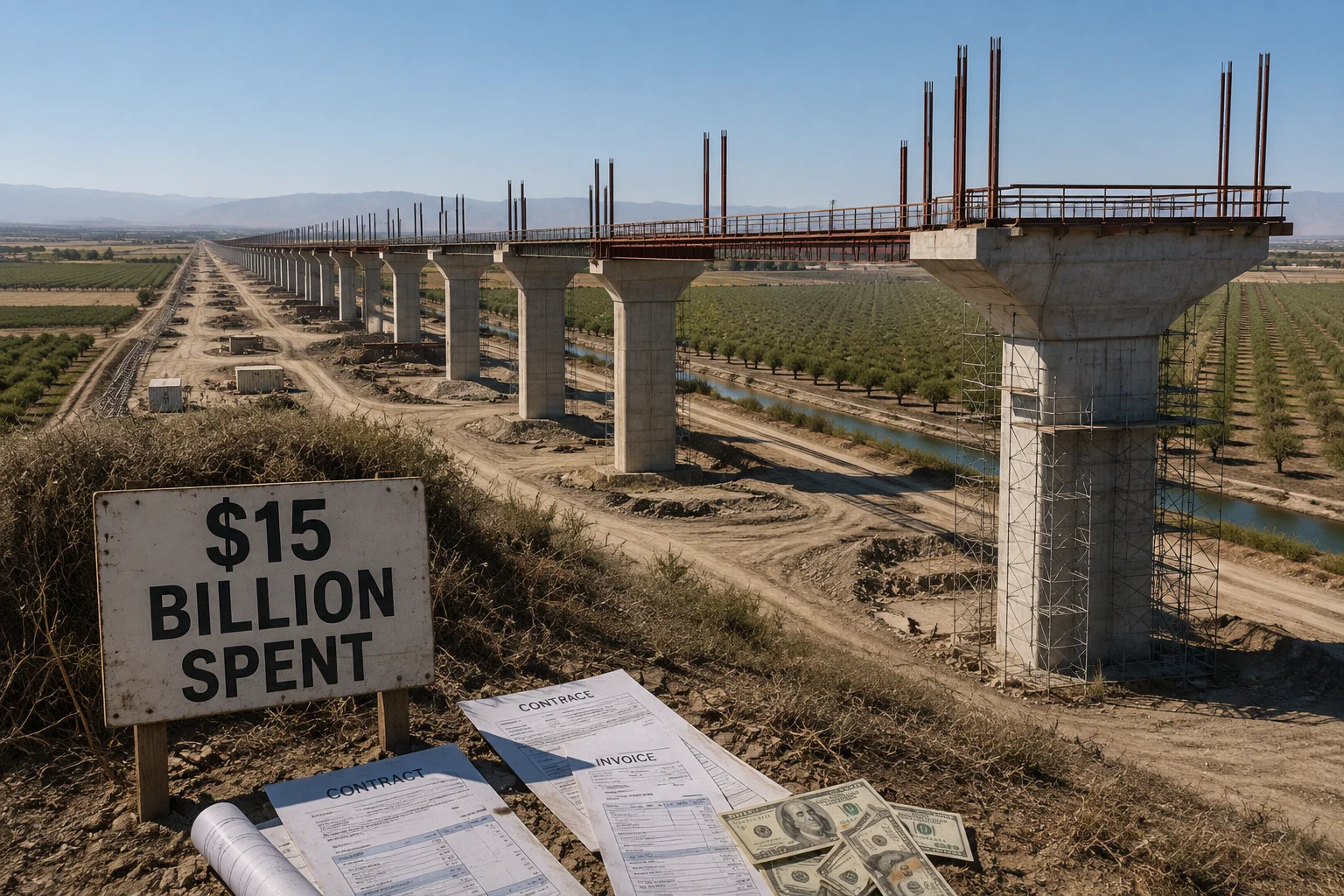
Emblematic of the progress so far is a field outside Fresno, where lonely viaducts poke into the sky with no rail connecting them. The locals call it their own Stonehenge.
And the state’s 2026 revised business plan now says it will cost $126 billion to complete... by 2040. Eighteen years into a 12-year project, they’re now saying they need another $93 billion and 14 more years.
Why is the price nearly four times higher than the original estimate?
Well, let’s try to answer that by tracking where the $15 billion already spent has gone.
The California High-Speed Rail Authority's own business plan shows that about $9.1 billion went to three construction contracts covering 119 miles of the project. Those contracts are for the civil work only, meaning dirt, pipes, power lines, and concrete.
For that, California got about 80 miles of finished roadbed, i.e. the raised, graded earth that the track will eventually sit on, plus various bridges and overpasses.
In case you’re not keeping score, that works out to $77 million per mile... but that doesn’t include the actual train tracks.
No, California plans on building the rail, the electric wire, and the signals with an additional $3.5 billion contract— which was just awarded in June (i.e. 18 years in to a 14-year project).
And $3.5 billion of rail only encompasses a very small portion of the total distance they need to build.
For a rough comparison, Brightline— a private company in Florida— finished a Miami to Orlando line in 2023, with 235 miles of track, stations, and trains, for about $6 billion, or $25 million a mile.
So California’s is three times what Florida’s cost WITHOUT including the cost of the rail, the trains, and the stations.
Extraordinary. Where did all this money go?
They claim that $1.57 billion went to buying property— the narrow strip of land under the 119 miles (i.e. less than a third of the project).
But if you look at real estate prices in the area (Central Valley farmland went for about $12,000 an acre when the buying started), the actual land value was worth maybe $35 million at the time.
In other words, the state OVERPAID what the land was worth by 30x. I’m sure absolutely zero politicians or their families profited from that overpayment.
The next $3.6 billion went to studies, i.e. environmental reviews, and something the state calls “program-wide support”. That's the second-biggest item on the bill.
The Authority started in 2008 with ten employees and hired a consulting firm to run the project. By 2018 the state had grown its own staff to about 190, with the consulting firm employing 485 people on the job.
This outside firm is generating hundreds of millions of dollars per year to do nothing.
When the state auditor went looking for what all those people had produced, 145 of the 184 deliverables were missing.
Not deliverables like rails and bridges. We’re talking about reports. The consultants couldn’t even manage that.
Governor Gavin Newsom's reaction was to promise a purge. Yet the same firm still runs the project. And every slip in the schedule means the firm gets paid more. In fact this year's plan added another $145 million for consultants.
In July the project's own Inspector General wrote that the Authority "has obscured basic facts about the project" and made oversight harder for the legislature.
For example, in January, the Authority agreed to pay one of its contractors $537 million to settle nearly 600 claims for extra costs.
What claims? Were the claims real? Nobody knows, because nobody has audited it. The Inspector General, whose job that is, says his office is half-staffed. Maybe he should hire an outside consulting firm.
How could anyone look at all this and not see the same kind of fraud the Somalis are running in Minneapolis?
You take tax dollars and funnel them through layers of government employees, consultants, contractors, and unions, all of them tied to the political establishment. In return, those people spend a slice of their ill-gotten gains keeping the politicians who make it possible in office.
California's version may be ‘legal’ graft. But that hardly makes it different. It might be worse, since at least in Minneapolis the people on the take can be prosecuted.
Who's to say the contractor didn't earn an extra $537 million? Who's to say the consultants' reports weren't worth every dollar of the $3.6 billion?
And when someone tries to get to the bottom of it, they make asking questions illegal.
Nick Shirley, the YouTuber whose video of empty tax-funded Minneapolis day cares went viral last Christmas, walked into a Los Angeles immigrant-services nonprofit this summer and asked where the $80 million in government money it has taken over the last four years went.
But they were ready to silence him, because two months after the Minneapolis video, that same nonprofit had co-sponsored a bill letting its staff sue anyone who posts videos of them online. Newsom signed it into law on Saturday.
Starting in October 2027, anyone who works at, volunteers at, or gets help from an immigration nonprofit can sue whoever posts their picture online, for at least $4,000 plus attorney's fees.
And these are the same people who mock anyone who suggests an election might not be secure.
Why wouldn't you trust them to count the mail-in ballots at 3 a.m.?
Nobody should bet a family's future on these people getting better. The tax-funded gravy train isn't slowing down if they have anything to do with it.
And that's exactly why it makes sense to have a Plan B.
To your freedom, James Hickman Co-Founder, Schiff Sovereign LLC
PS: Schiff Sovereign Premium is our guide to building that Plan B: legally cutting your tax bill, gold and precious metals strategies, research on undervalued real asset businesses, and diversification moves that keep your money and your freedom of movement out of any one government's reach.
Breaking Down $15 billion Spent on California’s Train to Nowhere | Schiff Sovereign
How Close Is The Dinar Revaluation ?
How Close Is The Dinar Revaluation ?
The Dinar Den: 8-30-2026
The journey of following the Iraqi dinar (IQD) has tested the patience of investors worldwide for nearly two decades. Recently, a compelling discussion between two seasoned market participants with over 16 years of individual experience shed light on the latest developments surrounding the currency’s potential revaluation and redenomination.
This in-depth conversation offers a much-needed analytical breakdown of the conflicting reports circulating in the financial community, providing a clearer picture of where the process currently stands.
How Close Is The Dinar Revaluation ?
The Dinar Den: 8-30-2026
The journey of following the Iraqi dinar (IQD) has tested the patience of investors worldwide for nearly two decades. Recently, a compelling discussion between two seasoned market participants with over 16 years of individual experience shed light on the latest developments surrounding the currency’s potential revaluation and redenomination.
This in-depth conversation offers a much-needed analytical breakdown of the conflicting reports circulating in the financial community, providing a clearer picture of where the process currently stands.
At the heart of the dialogue is the complex puzzle of deleting zeros from the local currency, alongside concurrent political stability efforts and vital domestic financial reforms. The speakers carefully dissect how these moving parts must align to achieve meaningful economic transformation.
A major focal point of the conversation is the heavy oversight provided by global financial institutions and international partners, which play an indispensable role in ensuring that Iraq successfully meets the stringent criteria required for a successful monetary shift.
Furthermore, the discussion highlights the strategic influence of key financial figures, specifically pointing to U.S. Treasury Secretary and currency specialist Scott Bessent.
His expertise and involvement are viewed as critical components in guiding Iraq’s currency policy, ultimately aiming for the nation’s seamless reintegration into the global financial architecture. Understanding these high-level diplomatic and economic maneuvers helps demystify why the process has taken so long and what milestones still need to be achieved.
Beyond macroeconomics, the conversation addresses the practical and psychological aspects that every long-term participant faces. The speakers touch upon projected exchange rate ranges, the identification of funding sources necessary to back the redenomination, and the undeniable emotional toll of waiting through years of delays and false starts.
Despite the opacity and complexity that often shroud these financial updates, both investors express a grounded, cautious optimism. They suggest that the conclusion of this lengthy journey may finally be approaching within the coming months, while encouraging patience and steadfast confidence among those who have followed the story for years.
To dive deeper into this comprehensive analysis and hear the full breakdown, you can watch the complete video from The Dinar Den on YouTube for further insights and information.
Iraq Economic News and Points To Ponder Monday Afternoon 8-31-26
Iraq’s Domestic Debt Climbs To $81bn In June
2026-08-31 Shafaq News- Baghdad Iraq’s domestic public debt rose to 106.072 trillion IQD (about $81 billion) at the end of June 2026, up 2.893 trillion IQD (about $2.21 billion), or 2.8%, from May, according to Central Bank of Iraq (CBI) data.
The debt has increased by 15.557 trillion IQD (about $11.9 billion), or about 17.2%, since the end of 2025, when it stood at 90.515 trillion IQD (about $69.1 billion).
Iraq’s Domestic Debt Climbs To $81bn In June
2026-08-31 Shafaq News- Baghdad Iraq’s domestic public debt rose to 106.072 trillion IQD (about $81 billion) at the end of June 2026, up 2.893 trillion IQD (about $2.21 billion), or 2.8%, from May, according to Central Bank of Iraq (CBI) data.
The debt has increased by 15.557 trillion IQD (about $11.9 billion), or about 17.2%, since the end of 2025, when it stood at 90.515 trillion IQD (about $69.1 billion).
Finance Ministry liabilities to the CBI accounted for the largest share, rising to 67.499 trillion IQD (about $51.5 billion) in June from 63.199 trillion IQD (about $48.2 billion) in May.
Treasury bills stood at 8.742 trillion IQD (about $6.67 billion), loans at 18.964 trillion IQD (about $14.5 billion) and bonds at 10.867 trillion IQD (about $8.30 billion).
The increase comes as government spending continues to outpace revenue. Public expenditure reached 46.697 trillion IQD (about $35.6 billion) through May, compared with revenue of 33.747 trillion IQD (about $25.8 billion), leaving a gap of about 12.95 trillion IQD ($9.9 billion). https://www.shafaq.com/en/Economy/Iraq-s-domestic-debt-climbs-to-81bn-in-June
Dollar Gains Traction As Fed Outlook Strengthens
2026-08-31 Shafaq News The dollar held steady near a two-week high on Monday as markets ramped up bets on a rate hike after hawkish remarks by Federal Reserve Chair Kevin Warsh, while the yen slipped back through the closely watched 160-per-dollar level.
The U.S. central bank will "have work to do" if policymakers don't get the confidence they need that inflation is heading down to 2%, Federal Reserve Chairman Kevin Warsh said on Friday, in his clearest indication yet that further tightening may be needed to curb price pressure.
The comments fuelled bets on a September rate hike. Markets raised the implied probability of a move next month to 57%, while yields on interest-rate-sensitive two-year U.S. Treasury notes rose to a more than one-month high of 4.33%.
"Warsh's defense of the inflation target has reduced a major drag on the U.S. dollar and shifted the focus back to economic fundamentals," said OCBC's FX strategist Sim Moh Siong, adding that it helped rebuild the Fed's credibility and eased concerns about currency debasement.
Investors are now turning their focus to incoming U.S. data, particularly Friday's nonfarm payrolls report and next week's consumer inflation figures, both of which could shape expectations ahead of the September Fed meeting.
The euro edged up 0.1% to $1.1591, while sterling was little changed at $1.3539. Both currencies remained on track for their second monthly gains.
The dollar index , which measures the U.S. currency against six major peers, ticked down slightly to 99.6 after jumping 0.6% on Friday to its strongest level since August 17.
Even so, the index was still on track for a second consecutive monthly decline, as U.S. Treasury bond-buyback plans earlier in the month revived debasement trades.
Dollar demand was also supported by higher oil prices on Monday. Brent oil rose nearly 2% after U.S. forces struck Iran's Larak Island on Sunday, a U.S. official said, which marks the first known American strikes on Iran since late July.
YEN WEAKNESS, G20 MEETING IN FOCUS
Focus will turn to a U.S.-hosted meeting of G20 finance ministers and central bank governors on Monday and Tuesday. Markets will watch for signs of coordinated efforts to sever ties with Iran, as well as measures aimed at easing concerns over rising U.S. debt and bond yields.
A persistently weak yen is also in focus, with the dollar's renewed strength adding to pressure on the Japanese currency after it surrendered much of the gains made following July's intervention.
The yen was slightly weaker at 160.01 per dollar, after sliding beyond the 160-per-dollar level on Friday, a level widely viewed as increasing the risk of official intervention and putting the spotlight back on whether Tokyo and Washington may step in again to support the currency.
U.S. Treasury Secretary Scott Bessent said on Sunday that recent yen moves had been "pretty well contained" and that he expected Bank of Japan Governor Kazuo Ueda to "do the right thing" on monetary policy.
"Historically, interventions have only held when fundamentals moved in the same direction," said Carlos Casanova, UBP's senior economist for Asia.
"The yen remains under pressure from a still-wide rate gap, negative real rates, and the Bank of Japan's cautious pace."
Elsewhere, the New Zealand dollar was little changed at $0.5916, and the Australian dollar edged up 0.1% to $0.7163. (REUTERS) https://www.shafaq.com/en/Economy/Dollar-gains-traction-as-Fed-outlook-strengthens
Gold Prices Fall In Baghdad, Erbil
2026-08-31 Shafaq News- Baghdad/ Erbil On Monday, gold prices declined in Baghdad and Erbil markets, according to a Shafaq News market survey.
Gold prices on Baghdad's Al-Nahr Street recorded a selling price of 965,000 IQD per mithqal (equivalent to five grams) for 21-carat gold, including Gulf, Turkish, and European varieties, with a buying price of 961,000 IQD. The same gold had sold for 970,000 IQD on Sunday.
The selling price for 21-carat Iraqi gold stood at 935,000 IQD, with a buying price of 931,000 IQD.
In jewelry stores, the selling price per mithqal of 21-carat Gulf gold ranged between 965,000 and 975,000 IQD, while Iraqi gold sold for between 935,000 and 945,000 IQD.
In Erbil, 22-carat gold was sold at 998,000 IQD per mithqal, 21-carat gold at 953,000 IQD, and 18-carat gold at 817,000 IQD.
https://www.shafaq.com/en/Economy/Gold-prices-fall-in-Baghdad-Erbil-9
USD/IQD Exchange Rates Stabilize Around 154,000 IQD In Baghdad, Erbil
2026-08-31 Shafaq News- Baghdad/ Erbil On Monday, the US dollar held steady against the Iraqi dinar for a second consecutive day, hovering around 154,000 IQD per $100 in Baghdad and Erbil markets.
According to a Shafaq News market survey, the dollar traded at 154,000 IQD per $100 at Baghdad’s Al-Kifah and Al-Harithiya central exchanges, unchanged from Sunday.
At exchange shops in Baghdad, the selling rate stood at 154,500 IQD per $100, while the buying rate was 153,500 IQD.
In Erbil, the dollar sold at 153,950 IQD per $100 and was bought at 153,850 IQD.
Basra Movement: Kuwait Gas Project Could Affect Maritime Claims
2026-08-31 Shafaq News- Basra Kuwait’s reported $3.3 billion gas-processing project near the Al-Zour refinery could advance development of Tuwaynah gas field before regional maritime claims are resolved, Basra’s Popular Movement against the Khor Abdullah Agreement said on Monday.
At a press conference, Movement members pointed to a Kuwaiti tender for a facility capable of processing about 632 million cubic feet of gas per day, warning that development could create an economic reality around the field while legal and geopolitical disputes remain unsettled.
The Movement urged Baghdad to safeguard Iraq’s maritime claims and natural resources through diplomatic and legal channels, criticizing “a fragmented response to disputes with neighboring states.” It also sought clarification from the Oil and Foreign ministries on projects that could overlap with areas claimed by Iraq.
Read more: Khor Abdullah: A waterway entangled in sovereignty disputes
It proposed forming a national team of diplomatic, maritime, legal, and technical experts to examine boundaries and resources, document Iraq’s claims, and engage international bodies where necessary, while avoiding “uncalculated escalation.”
The concerns also extend to Baghdad’s submission of maritime coordinates and a map to the United Nations, which drew objections from Gulf states. Iraqi authorities maintain that the filing is grounded in domestic legislation, international law, and the 1982 UN Convention on the Law of the Sea.
Khor Abdullah and Tuwaynah Disputes
Iraq and Kuwait signed the Khor Abdullah agreement in 2012 to regulate navigation and security in the shared waterway, Iraq’s only maritime access to the Gulf and a route linking key ports including Umm Qasr and Grand Al-Faw, with international shipping lanes.
Based on United Nations Security Council Resolution 833 (1993), which defined post-Gulf War borders, the agreement remains controversial in Iraq, particularly after the Federal Supreme Court ruled in 2023 that its ratification was unconstitutional, reigniting debate over sovereignty, economic interests, and maritime rights.
The offshore Dorra gas field, known in Iraq as Tuwaynah, is subject to competing regional claims. Kuwait and Saudi Arabia agreed in 2022 to jointly develop it, while Iran claims rights to part of the field. Iraqi lawmakers have also questioned the country’s maritime boundaries and potential rights in the area.
Read more: Iraq’s UN maritime move reopens Arab fault lines over Khor Abdullah
https://www.shafaq.com/en/Iraq/Basra-movement-Kuwait-gas-project-could-affect-maritime-claims
Seeds of Wisdom RV and Economics Updates Monday Afternoon 8-31-26
Good Afternoon Dinar Recaps,
Oil Shock Meets Bond-Market Stress: Iran Escalation Forces a Repricing of Debt, Inflation and Fed Policy
Renewed U.S.–Iran military action is pushing oil higher, lifting bond yields and forcing markets to reassess inflation, interest rates and the cost of government debt.
Good Afternoon Dinar Recaps,
Oil Shock Meets Bond-Market Stress: Iran Escalation Forces a Repricing of Debt, Inflation and Fed Policy
Renewed U.S.–Iran military action is pushing oil higher, lifting bond yields and forcing markets to reassess inflation, interest rates and the cost of government debt.
OVERVIEW
Oil: Renewed U.S.–Iran fighting has pushed Brent crude above $90 a barrel, reviving concerns about energy supplies and the inflationary consequences of prolonged disruption.
Bonds: The energy shock is spreading into global bond markets, with the U.S. 10-year Treasury yield reaching 4.764% while Japanese and European yields also move higher.
Federal Reserve: Markets are increasingly pricing a September rate hike, showing how quickly a geopolitical shock can change expectations for monetary policy and borrowing costs.
KEY DEVELOPMENTS
1. Iran Escalation Reignites the Energy Shock
Renewed military exchanges between the United States and Iran have pushed oil prices higher as investors reassess the risk of further disruption around the Strait of Hormuz.
Brent crude rose to approximately $90.34 a barrel, while U.S. crude reached about $85.51, adding a new inflation concern just as markets enter September.
2. Oil Is Feeding Directly Into the Bond Market
Higher energy prices can increase inflation expectations, making it more difficult for central banks to reduce interest rates.
The U.S. 10-year Treasury yield climbed to 4.764%, its highest level since January 2025. Japanese and European government bond yields also moved higher, demonstrating that the repricing is becoming a global bond-market story.
3. Fed Rate-Hike Expectations Are Rising
Following Federal Reserve Chair Kevin Warsh's recent hawkish comments, markets are now pricing approximately a 64% probability of a September rate increase, compared with roughly 35% before his Jackson Hole remarks.
The combination of higher oil prices and persistent inflation pressure could make it more difficult for the Federal Reserve to pursue easier monetary policy.
4. Higher Yields Increase the Cost of Debt
Rising Treasury yields matter beyond financial markets because they influence the cost of borrowing throughout the economy.
For governments carrying large debt loads, persistently higher yields mean higher interest expenses and less fiscal flexibility. Businesses and consumers can also face higher financing costs as market rates adjust.
5. The Repricing Is Spreading Across Assets
Stocks declined as investors reacted to the combination of higher oil, higher yields and greater rate uncertainty.
The significance is not simply that markets are falling. It is that investors are reassessing the relative value of bonds, equities, currencies and commodities as the cost of money changes.
WHY IT MATTERS
The immediate issue is the connection betweengeopolitics and financial conditions.
A disruption in a major energy corridor can raise oil prices. Higher oil can increase inflation. Persistent inflation can delay rate cuts or encourage higher rates. Higher rates then increase borrowing costs and pressure asset valuations.
That creates a chain reaction extending from the Strait of Hormuz to the Federal Reserve and the Treasury market.
For governments already carrying substantial debt, this matters even more. A sustained period of higher yields could make debt servicing increasingly expensive and force difficult fiscal choices.
WHY IT MATTERS TO FOREIGN CURRENCY HOLDERS
Currency values: Changing interest-rate expectations can rapidly alter demand for major currencies as investors move capital toward markets offering higher returns.
Purchasing power: Higher energy prices can increase transportation, food and production costs, putting pressure on the purchasing power of currencies.
Capital flows: Rising U.S. yields can attract capital toward dollar-denominated assets, while changing monetary policies in Japan and Europe can produce additional exchange-rate volatility.
Exchange rates: If the Federal Reserve remains more restrictive while other central banks pursue different paths, interest-rate differentials could become an important driver of currency movements.
IMPLICATIONS FOR THE GLOBAL RESET
Pillar 1: Debt
The renewed energy shock highlights how quickly geopolitical events can affect the cost of sovereign borrowing.
If higher inflation and higher yields persist, governments may face increasing interest expenses and reduced room for additional borrowing. The issue is not an immediate collapse of the debt system, but whether markets are beginning to demand a higher long-term price for carrying government debt.
Pillar 2: Energy
The Strait of Hormuz remains a critical connection between geopolitical stability and global financial stability.
When energy transportation becomes uncertain, the consequences move beyond oil markets into inflation, monetary policy, currencies and government debt. Energy security is therefore becoming an increasingly important component of the global financial architecture.
CONCLUSION
Today's Iran escalation demonstrates how quickly a geopolitical event can move through the financial system.
The transmission mechanism is clear: higher energy prices can produce higher inflation expectations, which can produce higher interest rates, which can increase the cost of debt and pressure financial assets.
For the global economy, the important question is no longer simply where oil prices settle. It is whether the current shock becomes temporary or contributes to a longer-lasting repricing of money and sovereign debt.
The financial system is being forced to reassess the cost of energy, the cost of money and the cost of debt—all at the same time.
Seeds of Wisdom Team
Newshounds News™ Exclusive
SOURCES
Reuters — "Yields rise, stocks ease, with oil gaining as US and Iran resume military attacks"
Reuters — "Stocks cautious on US-Iran escalation, bond yields hit multi-year highs"
~~~~~~~~~~
Seeds of Wisdom Team RV Currency Facts Youtube and Rumble
Newshound's News Telegram Room Link
RV Facts with Proof Links Link
RV Updates Proof links - Facts Link
Start Here room with Most Asked Questions Link
Follow the Gold/Silver Rate COMEX
Follow Fast Facts
Seeds of Wisdom Team™Website
Thank you Dinar Recaps
Ariel: Venezuela Lopped 14 Zeroes off its Currency
Ariel: Venezuela Lopped 14 Zeroes off its Currency
8-31-2026
Hypothetically Speaking:
Venezuela has lopped 14 zeroes off its currency since 2008. The “Soberano” series itself was redenominated into the “Digital” Bolivar in 2021 at a 1:1,000,000 ratio.
Venezuela pegs VES to XRP/XLM/ADA infrastructure and backs it with oil+gold reserves at a fixed rate. Ex-Reval- triggers globally — $300 (VES-Digitales Soberano) million on 1B notes at 30 cents is your number.
Ariel: Venezuela Lopped 14 Zeroes off its Currency
8-31-2026
Hypothetically Speaking:
Venezuela has lopped 14 zeroes off its currency since 2008. The “Soberano” series itself was redenominated into the “Digital” Bolivar in 2021 at a 1:1,000,000 ratio.
Venezuela pegs VES to XRP/XLM/ADA infrastructure and backs it with oil+gold reserves at a fixed rate. Ex-Reval- triggers globally — $300 (VES-Digitales Soberano) million on 1B notes at 30 cents is your number.
Gold Is A Tier 1 Assets
So I would personally be shocked if that doesn’t end up being the case.
Right now VES trades around 0.00126 USD — roughly 1/238th of a cent. A jump to 30 cents is a ~23,716x increase from current rates.
That’s not a revaluation — that’s a peg reset, the kind of move that only happens when a nation backs its currency with hard assets (gold, oil reserves, tokenized commodities on ledger). Sounds like what Iraq is doing.
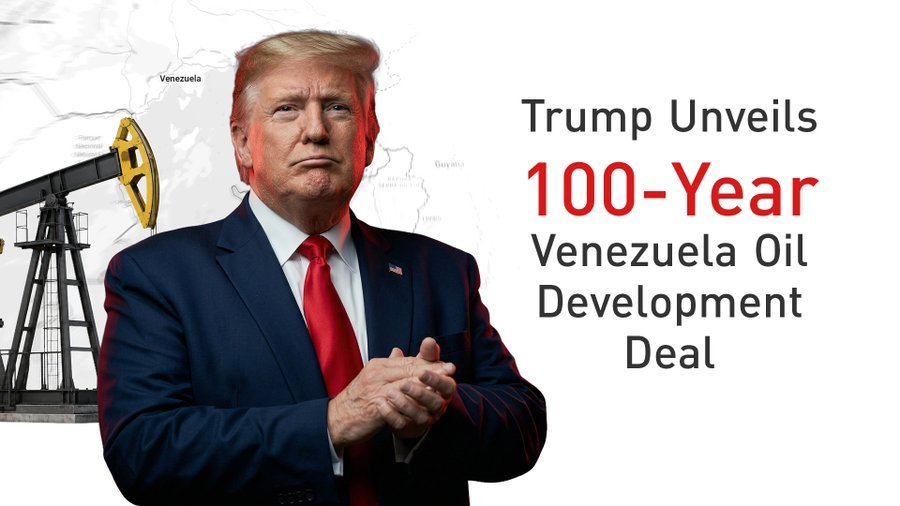
Kurdistan 24 English: U.S. President Donald Trump says Washington has reached what he calls the "biggest oil deal in world history" with Venezuela, covering more than 65 billion barrels of proven reserves. President Trump says the agreement gives the U.S. majority control through a private-sector partnership and could eventually lower American gasoline prices. Venezuela says the projects could attract about $100 billion in investment. Read more:
Trump Calls Venezuela Agreement 'Biggest Oil Deal in World History' https://www.kurdistan24.net/en/story/935720/trump-calls-venezuela-agreement-biggest-oil-deal-in-world-history
News, Rumors and Opinions Monday 8-31-2026
Note: All intel should be considered as "Rumors" until we receive official announcements ...and “Rates and Dates” could change anytime until we get to the banks/redemption centers.
RV Excerpts from the Restored Republic via a GCR Update as of Mon. 31 Aug. 2026
Compiled Mon. 31 Aug. 2026 12:01 am EST by Judy Byington
Judy Note:As of Mon. 31 Aug. 2026 the new gold/asset-backed Quantum Financial System Global Currency Reset (GCR) was set to activate.
Note: All intel should be considered as "Rumors" until we receive official announcements ...and “Rates and Dates” could change anytime until we get to the banks/redemption centers.
RV Excerpts from the Restored Republic via a GCR Update as of Mon. 31 Aug. 2026
Compiled Mon. 31 Aug. 2026 12:01 am EST by Judy Byington
Judy Note:As of Mon. 31 Aug. 2026 the new gold/asset-backed Quantum Financial System Global Currency Reset (GCR) was set to activate.
In the past the model of World economics had been defined byCentral Bank dominance,financial speculation and managed decline — which was now being systematically dismantled with the GCR.
The Quantum Financial System (QFS) was a gold-backed, transparent system that ended financial slavery.
The fall of the Cabal’s fiat US Dollar was abruptly made known onTuesday 25 Aug. 2026 when gold hit $4,589 per ounce. In the last quarter Central banks had bought 288 tonnes of gold – the fastest accumulation since 1967. The banks were positioning for a crash of their fiat US Dollar – which then happened on Sat. 29 Aug. 2026 when the national debt crossed $40 trillion.
Rolling Blackouts all across the World were (allegedly) happening now as the old Global financial fiat matrix disconnected. The World Banks had already moved to the gold-backed rails with Codes updated, Systems realigned. The Cabal’s debt chains had been successfully severed. It was the end of the corrupt fiat money system.
The GCR had been well prepared for this Mon. 30 Aug. 2026 transition. Gold and Peace Treaties had been (allegedly) signed by multiple nations. (Your nation could not be at war if you wanted to participate in the Global Currency Reset). Debts were wiped clean in test zones. Transactions had been recorded with biometric encryption. Certain individuals saw “disappearances” in their balances — in a good way. Global prosperity programs were on their way. Suppressed technologies were nearing release and the future held healing and restoration.
~~~~~~~~~~~~~~~
GLOBAL CURRENCY RECALIBRATION AND COMMODITY BACKED MONETARY TRANSITION ACTIVATED AMID MASSIVE DEBT SYSTEM COLLAPSE …Mr. Pool on Telegram Sun. 30 Aug. 2026
THE NEW ECONOMIC FRAMEWORK IS ANCHORED BY HARD COMMODITY BACKING, ENSURING EVERY UNIT OF VALUE CORRESPONDS TO REAL TANGIBLE ASSETS RATHER THAN INFINITE DEBT CREATION. COMMERCIAL BANKS FAILING TO COMPLY WITH THE NEW TRANSPARENCY MANDATES ARE FACING IMMEDIATE LIQUIDITY FREEZES AND COMPLIANCE TAKEOVERS.
THIS IS THE FINAL STAGE OF THE OLD PARADIGM COLLAPSE. THE ERA OF UNBACKED PAPER DEBT IS OFFICIALLY OVER. STAY STEADY, SECURE YOUR POSITION, AND WATCH THE CHANNELS FOR THE NEXT WAVE OF VERIFIED DROPS.
ATTENTION: THE FINAL COUNTDOWN HAS BEGUN! …Christian B. Wallace Tier4b ISO20022 on Telegram Sun. 30 Aug. 2026
If you thought the last few days were intense, what is happening right this moment is exceeding all expectations! SECRET PROCESSES HAVE ENTERED THE FINAL STAGE!
The final verification for Tier 4B are officially completed behind closed doors. There is no more room for delays – the system is fully locked down and ready for launch.
Banking servers are operating in “silent transition” mode. Key institutions are in constant coordination to prevent any attempt at sabotage by the old, corrupt lobby.
WHAT IS HAPPENING AWAY FROM THE PUBLIC EYE? The main stream media continues to distract the public with empty noise, trying to pull attention away from what truly matters. But those who know the truth are looking beneath the surface:
1. The code is green – Instructions have been dispatched to all relevant checkpoints.
2. Liquidity is prepped – Transfers are awaiting only the final green light for distribution to end users.
STAY CALM AND FOCUSED! This is the moment we have been preparing for over the years. Do not let panic, rumors, and daily noise distract you from the goal.
The transition isn’t just on the horizon — IT IS HAPPENING NOW. Stand ready. The new era is at your doorstep.
Read full post here: https://dinarchronicles.com/2026/08/31/restored-republic-via-a-gcr-update-as-of-august-31-2026/
Courtesy of Dinar Guru: https://www.dinarguru.com/
Militia Man The United States just made an announcement about 65 billion barrels of oil the United States is going to control from Venezuela...I think we all should be paying attention to certain things like that and especially at the timing...There is a connection between Venezuela and Iraq.
Frank26 September 30th is the deadline Trump has given them for everything...What do you think Trump wants?Everything. Lift the three zeros from your exchange rate. Introduce the lower notes. Bring out the HCL. Set your government. Get rid of the [Iranian] weapons. Do you think he's getting everything right now?I sincerely do...
Reset IntelligenceA country [Iraq] that just ordered 7.5 billion new notes has stopped dispensing the old ones...Here's how an exchange actually works... An exchange works by making the old paper unusable and the new paper worth walking in for. The state controls the first half with deadlines and rationing. You're watching that half run now - [atm] machines capped, [payment] trucks stopped, salaries rerouted [to electronic rails]. The second half arrives as a single announcement. Between the two halves sits nothing but silence from the [central] bank. That silence is what this week sounds like.
************
IQD Update: US Secret 100 Year Oil Deal Revealed!
Edu Matrix: 8-31-2026
Iraqi Dinar News Updates, IQD Exchange Rates, Iraq Economy News, IQD currency adjustment aka IQD RV.