
Even America's Enemies Trusted It With Their Money. That's Over
Even America's Enemies Trusted It With Their Money. That's Over
Notes From the Field By James Hickman (Simon Black / Sovereign Man) August 12, 2026
At 4:15 in the morning on November 4, 1956, Soviet artillery opened fire on the city of Budapest. And the subsequent firestorm was nothing short of devastating.
Two weeks earlier, students and factory workers had risen up against the Soviet-installed puppet government in Hungary. They pulled down Stalin's statue, rampaged across the city, and even managed to push Soviet forces out of Budapest.
Even America's Enemies Trusted It With Their Money. That's Over
Notes From the Field By James Hickman (Simon Black / Sovereign Man) August 12, 2026
At 4:15 in the morning on November 4, 1956, Soviet artillery opened fire on the city of Budapest. And the subsequent firestorm was nothing short of devastating.
Two weeks earlier, students and factory workers had risen up against the Soviet-installed puppet government in Hungary. They pulled down Stalin's statue, rampaged across the city, and even managed to push Soviet forces out of Budapest.
Moscow initially signaled that it was ready to negotiate and consider a full withdrawal. The bells of freedom started ringing. But it turned out to be a ruse— and Soviet leader Nikita Khrushchev swiftly sent in the tanks.
The Soviets brutally crushed the uprising in days, killing around 2,500 Hungarians and displacing 200,000 who fled the country.
In the reprisals that followed, tens of thousands more were arrested, and hundreds were hanged— including Hungary's prime minister, who was tricked into surrendering with a promise of safe passage.
President Dwight Eisenhower condemned the invasion and opened America’s doors to roughly 30,000 Hungarian refugees. He then made his case to the United Nations, where the UN General Assembly demanded a full Soviet withdrawal from Hungary. Kruschev ignored them.
Eisenhower was clearly opposed to Soviet aggression. But America did exercise restraint— the President did not touch Soviet money that was held in the US.
It’s crazy to think that, even during the height of the Cold War, the Soviets held a stockpile of US dollars within the US financial system. They had no choice. Global commerce (including oil sales) took place in dollars, so even America’s mortal enemy needed to hold US currency.
Eisenhower could have easily confiscated Soviet assets. Yet not one Soviet account was frozen. Not one asset blocked… even as Soviet tanks shelled a defenseless European capital.
Similarly, twenty-three years later when the Soviets invaded Afghanistan, President Jimmy Carter reacted harshly. He cut off certain trade with the USSR, including grain and technology. And most famously he led a 65-country boycott of the 1980 Moscow Olympics.
But even Jimmy Carter did not freeze Soviet assets.
Decades later, in August 2008, Russia invaded the Republic of Georgia. President George W. Bush condemned the invasion, sent humanitarian aid to Georgia, and ended support for Russia's World Trade Organization bid.
Yet he did not touch any Russian money held in the US.
Three presidents from both parties, across five decades, watched America's biggest adversary invade other countries... but they still chose to keep the money out of it.
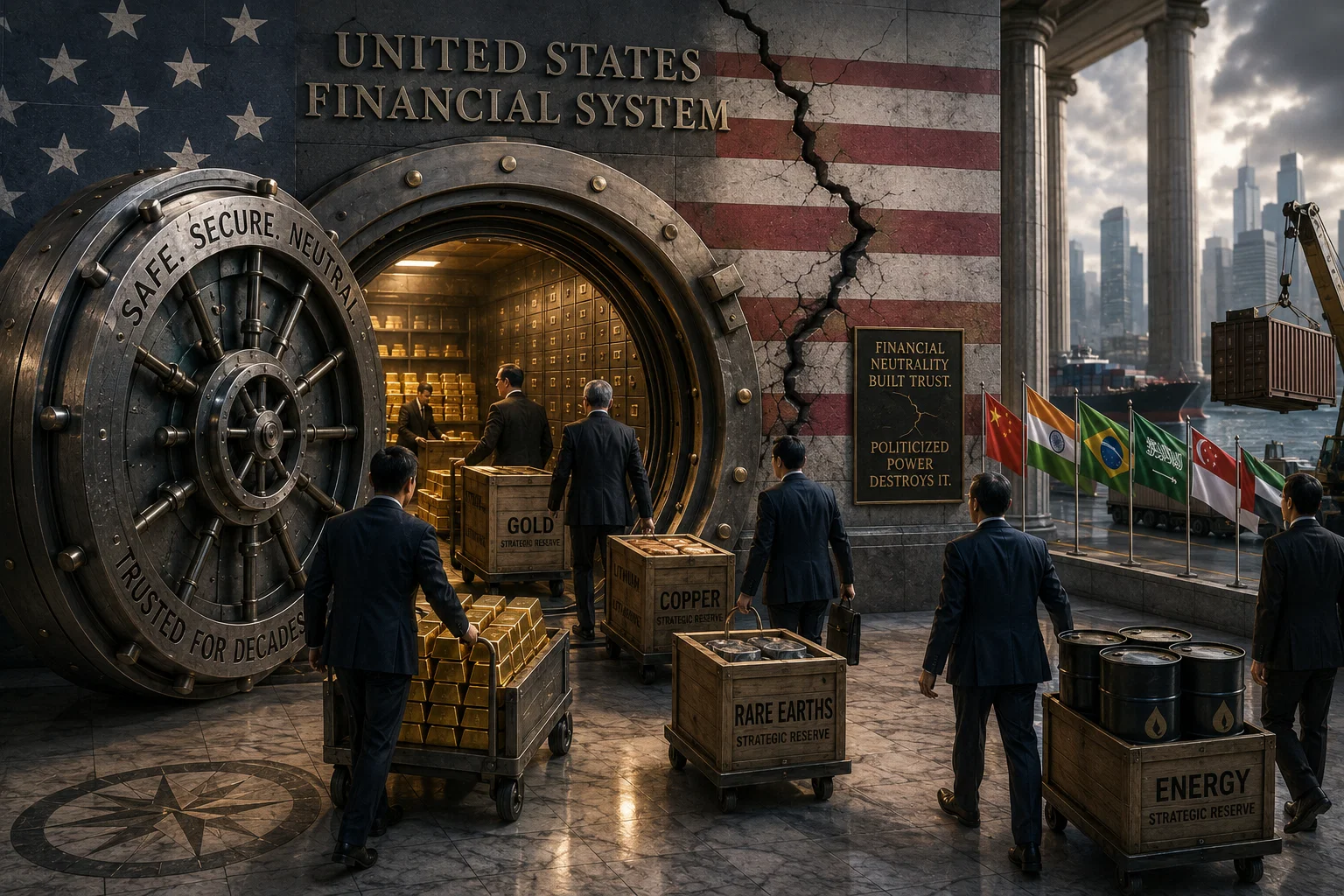
America had become Switzerland: a neutral custodian that fiercely protected anyone's savings, regardless of politics. The trust ran so deep that through every proxy war and nuclear standoff, even the Soviet Union held their enemy’s currency inside their enemy’s financial system. That’s how confident the Soviets were in America’s financial neutrality.
That wasn’t about keeping Moscow happy. It showed the world that assets in America were safe... and that was traditionally a huge reason why foreign governments parked trillions of dollars in US government bonds... and why the Treasury Dpeartment could borrow endlessly to fund its deficits.
But this policy of financial neutrality changed in February 2022, after Russia invaded Ukraine. The US pushed its allies to freeze roughly $300 billion of Russian assets.
To be clear, this is not a moral discussion. I’m not arguing whether it was right or wrong; rather, this is about setting precedent. Russia did not attack or invade the United States; they attacked Ukraine— a country with which the US did not have a mutual defense treaty.
For years leading up to the Ukraine invasion, the US government had started politicizing its financial system, weaponizing the dollar, and levying occasional sanctions when foreign countries or banks stepped out of line.
But freezing the reserves of a major power was a massive acceleration.
Consequently, America’s reputation as a financial safe haven vanished on the spot.
Foreign governments were already worried about the gigantic US national debt, political dysfunction in Washington, and deep social divisions. The Russian asset freeze was the proverbial straw that broke the camel’s back.
The first lesson that foreign nations concluded was the importance of holding gold as a strategic financial reserve.
Rather than deposit US dollars in a big Wall Street bank, or hold US government bonds, foreign governments concluded that it was much safer to have physical gold sitting in their own country— no one could confiscate it, freeze it, or inflate it away.
That’s why central banks around the world began diversifying out the US dollar and into gold: roughly 2% of strategic reserves (above normalized annual net purchases) between 2022 and 2025 was invested in gold.
And that modest shift— just 2%— caused the gold price to more than double. As we covered earlier this week, central banks plan on investing a whole lot more into gold.
Gold was the key lesson of Ukraine. Then came the lesson of Iran.
Until this year, few governments worried much about the availability of critical assets like energy, food, fertilizer, microprocessors, etc.
But then US and Israeli forces struck Iran in late February, and Iran responded by closing the Strait of Hormuz. More than five months later, the strait is still too dangerous for most commercial traffic, and many countries are running short on those same critical resources that transit the Gulf.
The lesson of Iran is that the world runs on strategic assets, and access to them can vanish overnight.
Their conclusion is that, again, rather than stockpile US dollars via government bonds and bank deposits, it makes a lot more sense to stockpile strategic assets— like fertilizer, energy, etc.
At a minimum, whenever the situation in Iran comes to its conclusion, countries will have to buy oceans of oil just to top off their strategic petroleum reserves. Our guess is they'll go far beyond that and build the capacity to store even more.
And not just oil. Anything critical and strategic is now a candidate for the stockpile, because the old days of global cooperation and easy trade are gone, replaced by mistrust, conflict, and resource nationalism.
That means base metals, rare earths, and technology itself, from memory chips to sovereign compute capacity.
This trend is still in its early stages, and the companies that own and produce these critical assets stand to do very well.
We've featured many of them, from energy to metals, in Schiff Sovereign's investment research newsletter, Strategic Assets.
And this environment has been very good to them: several are trading at all-time highs right now; the crude tanker company we covered just reported the best quarter in its history, and a zinc producer is up almost 3x in under nine months.
In the most recent issue, we told readers about a small oil producer which is becoming a wildly successful profit machine; it has no debt, excellent management, yet trades at just three times its current free cash flow.
To your freedom, James Hickman Co-Founder, Schiff Sovereign LLC
Rob Cunningham: Remember When Using a Cell Phone Required a Financial Advisor?
Rob Cunningham: Remember When Using a Cell Phone Required a Financial Advisor?
8-13-2026
REMEMBER WHEN USING A CELL PHONE REQUIRED A FINANCIAL ADVISOR?
$1.25 a minute at peak.
$0.75 off-peak.
Long distance? Hold onto your wallet.
Rob Cunningham: Remember When Using a Cell Phone Required a Financial Advisor?
8-13-2026
REMEMBER WHEN USING A CELL PHONE REQUIRED A FINANCIAL ADVISOR?
$1.25 a minute at peak.
$0.75 off-peak.
Long distance? Hold onto your wallet.
And the phone itself came in a bag approximately the size of carry-on luggage.
We thought this was advanced technology.
Then something extraordinary happened.
Networks improved. Capacity exploded. Costs collapsed. Phones became supercomputers. Metered minutes became unlimited talk, text and data.
And humanity didn’t respond to cheaper communications by communicating less.
WE WENT ABSOLUTELY BONKERS.
Billions connected.
Entire industries appeared.
Human productivity exploded.
Businesses were created that couldn’t possibly have existed under the Bag-Phone Economy.
Which raises one wonderfully uncomfortable question:
What if MONEY is standing exactly where the bag phone once stood?
Think about it.
Banking hours.
Settlement delays.
Correspondent banks.
Prefunding.
Intermediaries.
FX spreads.
Reconciliation.
Capital sitting around waiting for other capital to finish moving.
We can livestream a rocket launch from another continent while standing in a grocery-store checkout line…
… but moving our own money around Earth can still involve business days.
Seriously?
Now imagine the monetary equivalent of going from:
$1.25 PER MINUTE → UNLIMITED EVERYTHING.
24/7/365 settlement.
Interoperable DLT networks.
Sovereign digital currencies.
Real-time global liquidity.
Tokenized real-world assets.
Verifiable reserves.
Real ownership.
Sound-money principles.
Capital moving at something approaching the speed of information.
And potentially billions of humans, businesses and machines connected to the same emerging Internet of Value.
That’s the rabbit hole I went down.
And the deeper I went, the more fascinating the comparison became.
Because the biggest consequence of cellular technology wasn’t cheaper phone calls.
It was everything humanity invented after communication became abundant.
So perhaps the biggest consequence of next-generation monetary infrastructure won’t be cheaper payments either.
Perhaps it will be everything humanity creates when VALUE becomes radically easier to own, exchange, settle and put productively to work.
That is the distinction between what I call:
THE BAG-PHONE ECONOMY
and
THE REAL-MONEY ECONOMY
One rationed communications by the minute.
The other asks whether we’re about to stop rationing the movement and productive usefulness of value through yesterday’s financial plumbing.
And if the cellular transformation produced extraordinary increases in adoption, entrepreneurship, productivity and global commerce…
what happens when the infrastructure being transformed isn’t merely the telephone network – but MONEY itself?
Now that is worth thinking about.
Grab a coffee. Bring your curiosity. Leave a little room for your assumptions to get uncomfortable.
Read my full comparison of the “Bag-Phone Economy” and our emerging “Real-Money Economy” unfolding before the world’s eyes.
You don’t have to agree with the thesis.
Just answer one question when you’re finished:
If the smartphone made the bag phone look prehistoric…what will tomorrow’s monetary network make today’s banking system look like?
Source(s):
• https://x.com/KuwlShow/status/2087628706722332894
Ariel: The Zimbabwe Conundrum, Addressing Core Concerns (and more)
Ariel: The Zimbabwe Conundrum, Addressing Core Concerns
8-13-2026
The Zimbabwe Conundrum : Addressing Core Concerns That Have Worn Down Interest
Task Schema At Hand
What We Will Address
1. We will open with the core tension demonetization as “permanent” vs. the historical record of political settlements overriding legal extinguishment
Ariel: The Zimbabwe Conundrum, Addressing Core Concerns
8-13-2026
The Zimbabwe Conundrum : Addressing Core Concerns That Have Worn Down Interest
Task Schema At Hand
What We Will Address
1. We will open with the core tension demonetization as “permanent” vs. the historical record of political settlements overriding legal extinguishment
2. Deepen the ZIM gray zone analysis what RBZ actually said vs. what they didn’t file, bearer clause implications
3. Expand historical precedent beyond what we already covered add we will add cases we didn’t mention to show the pattern is even broader.
4. Address the skeptics claim about IMF/World Bank/BIS not maintaining registries flip it: that’s precisely WHY the gray zone exists
5. Connect to the GCR framework 20 currencies, regime change conditions, why ZIM notes occupy unique structural position
6. Close with forward-looking analysis on what conditions would trigger a political settlement override for ZIM specifically
The Global Currency Framework
Within the context of a systemic monetary restructuring a Global Currency Reset involving 20 currencies, a gold revaluation, new SEC cryptocurrency rules, and the Clarity Act the ZIM note question takes on a different character.
Under regime change conditions, the political settlement mechanism activates. The notes that exist in the gray zone become candidates for resolution precisely because the system itself is being restructured.
The 20 currencies positioned for transformation IQD, VND, IRR, ZIM notes, Indonesian rupiah, Venezuelan bolivar, and others share common structural features: undervaluation driven by political instability, hyperinflation history, demonetization events, and connection to regimes that have undergone or are undergoing fundamental change.
Each note represents a claim against a monetary system that the current global financial architecture is preparing to reprice.
The Iraqi dinar revaluation operates on similar logic. The old Saddam dinar was demonetized in 2003. The new dinar was issued. But the revaluation question is not about the old notes it is about the new notes being repriced under a restructured global monetary regime.
The political settlement there involves Iraq’s sovereignty being recognized through a currency value that reflects actual resource backing rather than sanctions-era suppression.
Read Full Article:
https://www.patreon.com/Prolotario1/posts/zimbabwe-core-166519059
https://dinarchronicles.com/2026/08/13/prolotario-the-zimbabwe-conundrum-addressing-core-concerns/
Ariel: Confusion around Zim Notes, Big Things are Happening
8-13-2026
We Are Going To Demystify The Confusion Around The Zim-Notes Today
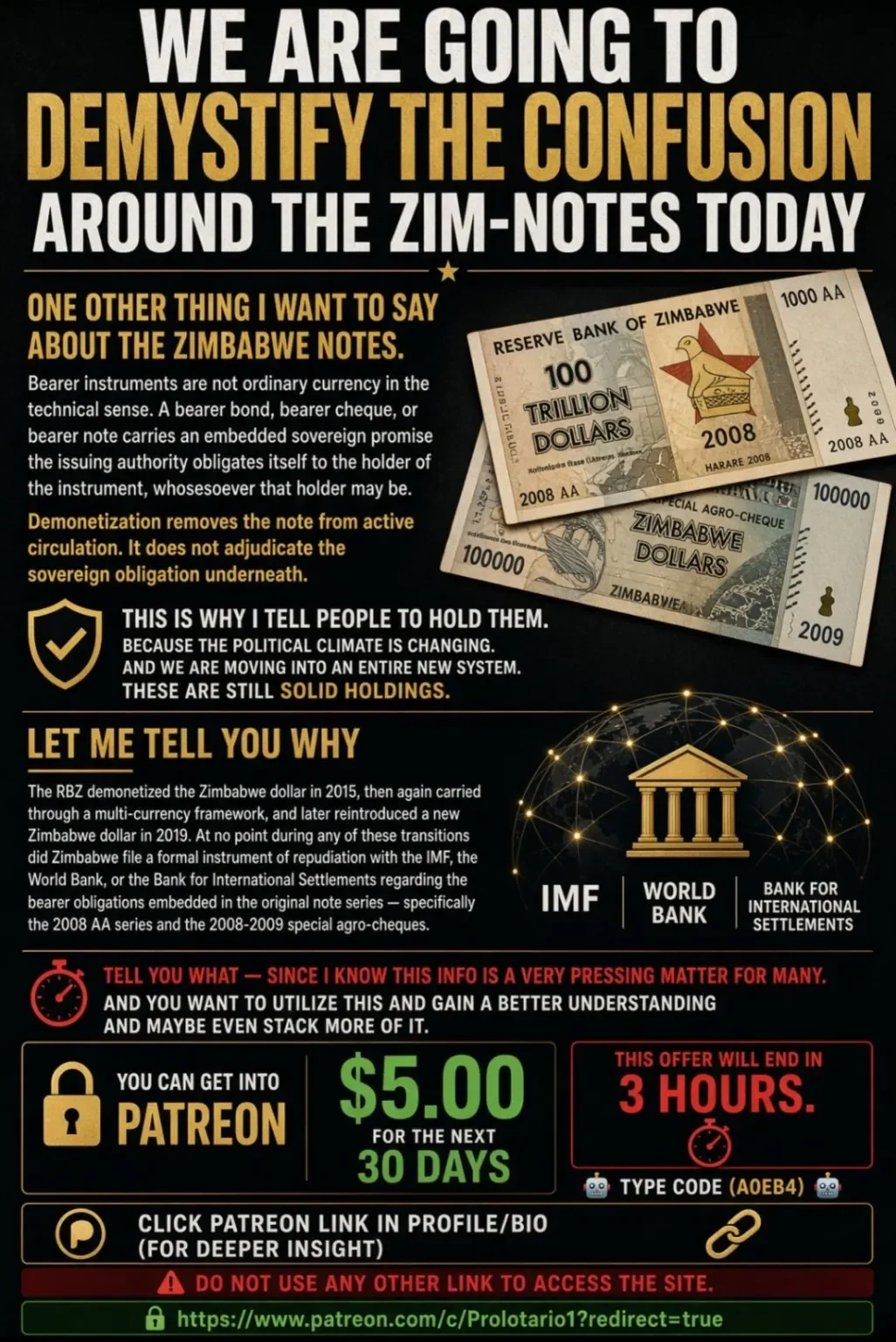
One other thing I want to say about the Zimbabwe notes. Bearer instruments are not ordinary currency in the technical sense. A bearer bond, bearer cheque, or bearer note carries an embedded sovereign promise the issuing authority obligates itself to the holder of the instrument, whosoever that holder may be.
Demonetization removes the note from active circulation. It does not adjudicate the sovereign obligation underneath.
This is why I tell people to hold them. Because the political climate is changing. And we are moving into a entire new system. These are still solid holdings.
Let Me Tell You Why
The RBZ demonetized the Zimbabwe dollar in 2015, then again carried through a multi-currency framework, and later reintroduced a new Zimbabwe dollar in 2019. At no point during any of these transitions did Zimbabwe file a formal instrument of repudiation with the IMF, the World Bank, or the Bank for International Settlements regarding the bearer obligations embedded in the original note series specifically the 2008 AA series and the 2008-2009 special agro-cheques.
If no international body maintains a registry, then no international body has formally extinguished the obligation either. The note exists in a jurisdictional void not circulating, not adjudicated, not repudiated through any formal multilateral process.
Iraq is moving
SEC is moving.
Money is moving.
Do you all understand what is about to occur?
We have waited years to get to this point.
We have lost many people along the way.
Now you stand at the threshold of an entire new life.
There is no denying what is now directly in your face.
People are on edge more than they have ever been.
You have been granted this opportunity to change history.
Now you have everything working in your favor.
Are you ready to step into the future and reclaim your life?
What better time is there right now than to reassess how we view ourselves or the world in general from this point?
Most of you never thought you would even get this far due to many reasons seen & unseen. You still stand.
Your health. Your strength. Your skills. Your patience have all been tested to its limits. Will that change? No.
We are in crunch mode.
We are in a pressure cooker.
We are in a battle for our survival.
Follow through with your goals.
Follow through with your promise to others.
Follow through with your faith with God.
Everything will fall in favor with your path forward to discover what has been hidden.
~We Have So Much To Look Forward To
Big Things Are Happening:
Note – The cascade mechanism IQD RVs, which forces the settlement framework activation for VND, ZIM, etc. because the legal infrastructure (Clarity Act, SEC crypto rules, gold revaluation) has to be in place first for the cascade to execute without market chaos.
Why now?
The Clarity Act framework, SEC crypto reclassification, and gold revaluation have to be positioned first. You can’t RV one currency in isolation without the settlement infrastructure in place for the cascade. IQD is the trigger the other currencies are the charges wired to the same circuit.
When IQD redenominates then revalues, it doesn’t just move on a screen. It activates pre-positioned settlement frameworks.
Do not be surprised that the VND could possibly go within 72 hrs. Because I will be honest with you. Vietnam has been ready since 2015.
Watcher.Guru:JUST IN: SEC prepares "innovation exemption" to allow 24/7 blockchain trading of tokenized stocks.
Source(s):
• https://x.com/Prolotario1/status/2087530542539440333
• https://x.com/Prolotario1/status/2087536737115419015
• https://x.com/Prolotario1/status/2087584720204836920
Seeds of Wisdom RV and Economics Updates Thursday Afternoon 8-13-26
Good Afternoon Dinar Recaps,
CLARITY Act Hits a New Roadblock: Rural Republicans Join Banks in Stablecoin Yield Fight
The battle over stablecoin rewards is exposing a deeper conflict between traditional banking and the emerging digital financial system—putting the CLARITY Act's September Senate vote on increasingly uncertain ground.
Good Afternoon Dinar Recaps,
CLARITY Act Hits a New Roadblock: Rural Republicans Join Banks in Stablecoin Yield Fight
The battle over stablecoin rewards is exposing a deeper conflict between traditional banking and the emerging digital financial system—putting the CLARITY Act's September Senate vote on increasingly uncertain ground.
Overview
Rural Republican senators are raising concerns about stablecoin rewards, particularly the possibility that community banks could lose deposits used to finance farms and small businesses.
The stablecoin-yield provision has become a key obstacle to securing the 60 votes needed to advance the CLARITY Act when the Senate returns in September.
The fight goes beyond crypto regulation: it represents a broader struggle over whether stablecoins will complement the existing banking system or compete directly with bank deposits.
Key Developments
1. Community-bank deposit concerns are becoming a Republican problem
The latest opposition is significant because some Republican senators representing rural states are increasingly receptive to the banking industry's argument that stablecoin rewards could encourage customers to move money away from community banks.
The concern is particularly important in rural economies, where community-bank deposits help fund agricultural loans, mortgages and small-business credit.
Reuters reports that protections for community-bank deposits and limitations on crypto rewards remain among the major unresolved issues surrounding the legislation.
2. The battle centers on what qualifies as “yield”
The disagreement is not simply over whether stablecoins should pay interest.
The Senate's current market-structure language would prohibit digital-asset service providers from paying passive, deposit-like interest or yield on payment stablecoin balances while allowing certain bona fide activity-based rewards.
Those permitted activities can include rewards associated with transactions, payments, transfers, wallet or platform use, loyalty programs and other qualifying activities.
That distinction has become one of the most important negotiating points between banks and the crypto industry.
3. Banks want the loophole closed
Banking groups argue that exchanges and other crypto platforms could effectively recreate deposit interest through rewards programs even if stablecoin issuers themselves are prohibited from paying interest.
Their concern is that a sufficiently attractive rewards structure could cause consumers and businesses to move cash from traditional bank accounts into stablecoin-based products.
That could potentially reduce the deposit funding available to community banks—particularly important institutions in agricultural and small-business communities.
4. Crypto advocates argue activity-based rewards are different
Supporters of the current approach argue that a reward tied to actual economic activity is not the same thing as interest paid simply for holding a balance.
Senator Cynthia Lummis has pushed back against efforts to treat all stablecoin rewards as equivalent to bank deposit interest.
This distinction is becoming central to the negotiations because an overly broad prohibition could limit the ability of digital-asset companies to develop payment, loyalty and transaction-based business models.
5. September 15 becomes the critical date
Senate Majority Leader John Thune filed a cloture motion for the CLARITY Act before the August recess, setting up a September 15 procedural vote.
The bill needs 60 votes to clear the cloture hurdle.
Reuters reports that the legislation faces a difficult path because of opposition from some Democrats as well as unresolved concerns among Republicans, including issues involving stablecoin rewards and community-bank deposits.
That makes the September vote much more than a routine procedural step. It will reveal whether the bipartisan coalition assembled around crypto market-structure legislation can survive the final negotiations.
What a Weakened or Failed CLARITY Act Could Mean
The CLARITY Act is intended to establish a comprehensive federal framework for digital assets, including clearer boundaries between the SEC and CFTC, registration requirements for market participants and rules governing digital commodities.
The Senate Banking Committee advanced the legislation in a bipartisan 15–9 vote in May after months of negotiations.
A major revision to the stablecoin provisions could make the bill more acceptable to banks but potentially reduce the range of rewards and financial products available through crypto platforms.
A failure to advance, meanwhile, would prolong the regulatory uncertainty that has surrounded digital assets in the United States.
That uncertainty matters because tokenization, stablecoins, institutional digital-asset adoption and blockchain-based financial infrastructure are continuing to develop even while Congress debates the rules governing them.
Why It Matters
This fight is bigger than the question of whether someone can earn a reward on a stablecoin.
At its core is a much larger question:
Will digital dollars become another product operating inside the traditional banking system—or will stablecoins become a competing financial rail capable of pulling deposits and payment activity away from banks?
That distinction could have significant implications for bank funding, credit creation, payments, financial markets and the future architecture of money.
Why It Matters to Foreign Currency Holders
For foreign-currency holders watching the evolution of the global financial system, the CLARITY Act matters because stablecoins are increasingly becoming part of the conversation about digital dollars and cross-border payments.
If U.S. lawmakers establish a clear regulatory framework, dollar-backed stablecoins could potentially expand the reach of the dollar into new digital payment networks.
That could actually reinforce dollar demand, even as other countries pursue alternatives through CBDCs, local-currency settlement and regional payment systems.
Importantly, the CLARITY Act developments do not provide evidence of a currency revaluation or RV event. The more significant signal is the potential restructuring of how dollars themselves move through the global financial system.
Implications for the Global Reset
Pillar 1 — Technology
Stablecoins and tokenized financial assets are creating a new digital layer for moving and settling value.
Pillar 2 — Trade
The regulatory treatment of digital dollars could influence future cross-border payment architecture and the dollar's role in international commerce.
Closing Perspective
The next major shift may not come from a new currency—it may come from who controls the rails through which digital dollars move, earn rewards and compete with traditional bank deposits.
Seeds of Wisdom Team
Newshounds News™ Exclusive
Sources
Reuters — Crypto bill faces long odds after Senate punts vote to September
U.S. Senate Banking Committee — Section-by-Section: Market Structure Bill
~~~~~~~~~~
Seeds of Wisdom Team RV Currency Facts Youtube and Rumble
Newshound's News Telegram Room Link
RV Facts with Proof Links Link
RV Updates Proof links - Facts Link
Start Here room with Most Asked Questions Link
Follow the Gold/Silver Rate COMEX
Follow Fast Facts
Seeds of Wisdom Team™Website
Thank you Dinar Recaps
Iraq Economic News and Points To Ponder Thursday Afternoon 8-13-26
CBI Reserves Fall Sharply To $77.8B
2026-08-13 Shafaq News- Baghdad The Central Bank of Iraq (CBI) has recorded notable shifts and a marked decline in its financial indicators, with the bank's net claims on the government rising even as official reserves shrink, economist Manar al-Obaidi, head of the Future Iraq Foundation for Economic Studies and Consultancy, revealed on Thursday.
CBI Reserves Fall Sharply To $77.8B
2026-08-13 Shafaq News- Baghdad The Central Bank of Iraq (CBI) has recorded notable shifts and a marked decline in its financial indicators, with the bank's net claims on the government rising even as official reserves shrink, economist Manar al-Obaidi, head of the Future Iraq Foundation for Economic Studies and Consultancy, revealed on Thursday.
CBI net claims on the government registered a sharp increase, reaching 66.6 trillion dinars (approximately $50.8B), compared to 35 trillion dinars (approximately $26.7B) at the start of 2025, al-Obaidi said, based on an economic reading drawing on the latest operational and banking data.
Net official reseres held by the central bank fell to 102 trillion dinars (approximately $77.8B), down from 130 trillion dinars (approximately $99.2B) at the start of 2026, al-Obaidi added, noting that July alone saw the central bank lose approximately 10.3 trillion dinars (approximately $7.9B) from its foreign currency and banking reserves.
https://www.shafaq.com/en/Economy/CBI-reserves-fall-sharply-to-77-8B
Oil Prices Retreat On Gloomy Demand Outlook
2026-08-13 Shafaq News Oil prices eased on Thursday after gains in previous sessions, as attention turned to expectations of weaker global oil demand this year, while there was no progress on opening the vital Strait of Hormuz.
Brent futures slipped 42 cents, or 0.47%, to $88.56 a barrel by 0405 GMT. U.S., trimming gains made over the previous six sessions.
West Texas Intermediate (WTI) crude fell 55 cents, or 0.66%, to $82.72, after advancing over the past five sessions.
A senior Iranian source said on Wednesday there had been no progress in talks to revive an interim deal agreed in June and define a timeframe to implement it.
"There was little in the way of fresh developments between the U.S. and Iran, with both sides remaining in a deadlock," said ING analysts in a note on Thursday.
"Meanwhile, the latest large drone attack on Russia's Novorossiysk port appears to have spared oil infrastructure, with no reports of damage to oil terminals as of now."
With no change in the prospect of reopening the Strait of Hormuz, the key factor that had driven prices higher over the past week, attention turned to the demand outlook following a surprise build in U.S. crude stocks and lower consumption forecasts from OPEC and the International Energy Agency.
U.S. commercial crude oil inventories posted their largest weekly gain since January 2023 as exports slumped, data from the Energy Information Administration showed on Wednesday.
Crude inventories rose by 17.4 million barrels to 424.4 million barrels in the week ended August 7, their highest since June 5, the EIA said, compared with analysts' expectations in a Reuters poll for a 1.4 million-barrel draw.
On the same day, the Organization of the Petroleum Exporting Countries lowered its world oil demand growth forecast for 2026 to 580,000 barrels per day in its monthly oil market report.
At the same time, the International Energy Agency said it expects a 1.6 million bpd contraction in consumption this year, down from a forecast of 1 million bpd last month, with demand curtailed by higher prices and restricted supply due to the U.S.-Israeli war with Iran.
Still, the deadlocked talks between Iran and the U.S. to end the war in the Gulf have kept a floor under prices.
"The safety situation for navigation in these waters has further deteriorated, forcing vessels to turn off their signals, which reduces transparency in shipping and makes it more difficult for the market to track and assess actual supply levels," analysts at Haitong Futures said in a note.
(REUTERS) https://www.shafaq.com/en/Economy/Oil-prices-retreat-on-gloomy-demand-outlook
Basrah Crudes Rise Despite Benchmark Losses
2026-08-13 Shafaq News- Basrah Iraq’s Basrah crude prices advanced about 15% on Thursday, despite losses in benchmark crude futures.
Basrah Heavy crude increased by $7.72, or 14.01%, to $62.81 per barrel, while Basrah Medium crude added $8.72, or 15.20%, to $66.11 per barrel.
Brent crude futures fell by 42 cents, or about 0.47%, to $88.56 a barrel. US West Texas Intermediate (WTI) lost 55 cents, or 0.66%, to $82.72 a barrel.
OPEC’s basket rose to $86.60 a barrel, gaining $5.98, or 7.42%. Marban crude moved up to $90.08 a barrel, up 1.10%, while Dubai crude stood at $84.56 a barrel, 0.59% higher.
https://www.shafaq.com/en/Economy/Basrah-crudes-rise-despite-benchmark-losses-0
US Dollar Edges Lower In Baghdad And Erbil
2026-08-13 Shafaq News- Baghdad/ Erbil The US dollar opened Thursday's trading lower in Iraq, hovering around 152,500 dinars per 100 dollars in Baghdad and Erbil.
According to Shafaq News market survey, the dollar traded in Baghdad's Al-Kifah and Al-Harithiya exchanges at 152,750 dinars per 100 dollars, down from Wednesday’s 153,300 dinars.
In the Iraqi capital, exchange shops sold the dollar at 153,250 dinars and bought it at 152,250 dinars.
In Erbil, selling prices stood at 152,950 dinars and buying prices at 152,850 dinars.
https://www.shafaq.com/en/Economy/US-Dollar-edges-lower-in-Baghdad-and-Erbil-7
Gold Prices Dip Across Baghdad And Erbil
2026-08-13 Shafaq News- Baghdad/ Erbil On Thursday, gold prices fell across Baghdad and Erbil, hovering around 940,000 IQD per mithqal, according to Shafaq News market survey.
Gold prices on Baghdad's Al-Nahr Street recorded a selling price of 946,000 IQD per mithqal (equivalent to five grams) for 21-carat gold, including Gulf, Turkish, and European varieties, with a buying price of 942,000 IQD. The same gold had sold for 957,000 IQD on Wednesday.
The selling price for 21-carat Iraqi gold stood at 916,000 IQD, with a buying price of 912,000 IQD.
In jewelry stores, 21-carat Gulf gold ranged between 950,000 and 960,000 IQD per mithqal, while Iraqi gold sold for between 920,000 and 930,000 IQD.
In Erbil, 22-carat gold was sold at 982,000 IQD per mithqal, 21-carat gold at 937,000 IQD, and 18-carat gold at 804,000 IQD.
https://www.shafaq.com/en/Economy/Gold-prices-dip-across-Baghdad-and-Erbil-2
Car Sales In Iraq Plunge 28%+ In H1 2026
2026-08-13 Shafaq News- Baghdad Iraq’s car market contracted sharply in the first half of 2026, with sales falling 28.6% year-on-year to 59,264 vehicles, according to automotive market research platform Focus2move.
Kia remained the country’s largest-selling brand with a 28% market share, despite a 27.8% drop in sales. Toyota ranked second with 22% of the market as its sales fell 24%, while Nissan placed third after a 13.3% decline.
MG ranked fourth with an 8.9% share despite sales falling 31.6%, while Jetour climbed to fifth with 8.4% after recording 29.2% growth.
Among other leading brands, Hyundai recorded the steepest decline, with sales down 69.7%, while Great Wall grew 6.9%.
The electric vehicle segment suffered an even steeper contraction, with sales dropping 72%. BYD led the segment with a 48.3% share, followed by Toyota at 43.4%.
Sales grew strongly between 2021 and 2024, reaching 158,076 vehicles in 2024, before the market reversed course.
https://www.shafaq.com/en/Economy/Car-sales-in-Iraq-plunge-28-in-H1-2026
Businessman Breaks Down the Dinar RV Timeline
Businessman Breaks Down the Dinar RV Timeline
The Dinar Den: 8-12-2026
For over a decade, the Iraqi dinar has remained a subject of intense interest for global market observers, history buffs, and private currency enthusiasts alike. The concept of monetary reform in a nation transitioning from decades of conflict to global economic integration is a fascinating study of international relations, macroeconomics, and fiscal policy.
In a recent, highly detailed conversation, veteran market observers Stephen and David shared their personal journeys, deep research, and nuanced perspectives on the Iraqi dinar’s potential path toward international revaluation.
Businessman Breaks Down the Dinar RV Timeline
The Dinar Den: 8-12-2026
For over a decade, the Iraqi dinar has remained a subject of intense interest for global market observers, history buffs, and private currency enthusiasts alike. The concept of monetary reform in a nation transitioning from decades of conflict to global economic integration is a fascinating study of international relations, macroeconomics, and fiscal policy.
In a recent, highly detailed conversation, veteran market observers Stephen and David shared their personal journeys, deep research, and nuanced perspectives on the Iraqi dinar’s potential path toward international revaluation.
Having tracked these developments since roughly 2010, both commentators stress that their insights represent informed opinions based on years of analysis, rather than formal financial advice. Their discussion provides a valuable roadmap for understanding the complex web of geopolitical and economic factors shaping Iraq’s monetary future.
Every observer’s interest in the Iraqi dinar begins with a unique spark. For David, his journey started through a faith-based introduction during a Bible study group in 2010. What began as an intriguing conversation quickly evolved into a dedicated pursuit of knowledge. Over the years, this curiosity drove him to dive deep into historical monetary precedents, international law, and political developments.
This evolution from a casual listener to a rigorous researcher is common among long-term observers of Iraq’s economy. Understanding the Iraqi dinar requires looking far beyond basic currency charts; it demands an appreciation of how history, sovereign governance, and international banking systems intersect.
Both Stephen and David emphasize that successful observation relies on separating emotional speculation from verifiable, structural milestones.
A significant portion of the discussion centers on the heavy involvement of international entities in Iraq’s financial restructuring. Since the early 2000s, the United States, the International Monetary Fund (IMF), and the U.S. Treasury have played pivotal roles in guiding Iraq’s monetary policy and governance framework.
This global supervision is designed to transition Iraq’s financial sector into alignment with international standards. The Central Bank of Iraq (CBI) has worked closely with these foreign agencies to reform political appointments, combat illicit capital flight, and build a transparent financial infrastructure.
For investors tracking potential currency shifts, the progress of these institutional reforms serves as a crucial barometer, showing that Iraq’s monetary destiny is deeply tied to its relationships with global financial institutions.
While international guidance is vital, Iraq’s internal legislative and structural reforms are equally critical. A major focal point of Stephen and David’s analysis is the stalled Hydrocarbon Law (HCL).
This proposed legislation aims to establish a transparent, unified system for distributing Iraq’s vast oil revenues among its various regions, including Baghdad and the Kurdistan Regional Government (KRG). The passage of the HCL is widely regarded as a foundational economic step that could stabilize the domestic economy and provide the fiscal backing necessary for broader currency reforms.
Simultaneously, Iraq is undergoing a massive push toward modernizing its domestic financial infrastructure. Historically a cash-dominated economy, the country is rapidly adopting electronic payment systems, digital banking platforms, and stricter auditing processes. This modernization reduces reliance on physical banknotes, improves tax collection, and aligns domestic banking practices with the global SWIFT network—all essential steps for any currency seeking international trade status.
No discussion of Iraq is complete without addressing its complex regional dynamics. Stephen and David touch upon the intricate relationship between Iraq and its neighbors, particularly Iran, and how regional conflicts influence economic stability. Crucially, they point out that regional tensions and geopolitical friction do not necessarily block a country’s economic or monetary progress. Historically, nations have successfully restructured their currencies amidst complex regional environments when backed by major global powers.
Furthermore, the conversation connects Iraq’s local reforms to broader global shifts. The rise of digital currencies, central bank digital currencies (CBDCs), and macroeconomic trends—such as the recent instability of the Japanese yen—highlight the fluid nature of today’s global financial system. Iraq’s efforts to stabilize and strengthen its currency are unfolding against a backdrop of worldwide monetary evolution.
The overarching takeaway from Stephen and David’s discussion is a call for patience, emotional discipline, and grounded analysis. The path of monetary reform is rarely linear, and the timing of a potential currency adjustment remains highly uncertain.
Navigating this space requires filtering out sensationalized rumors and focusing on tangible economic indicators, official central bank announcements, and verified geopolitical developments.
By understanding the historical context and the complex global forces at play, observers can maintain a balanced, informed perspective on Iraq’s ongoing economic transformation.
News, Rumors and Opinions Thursday 8-13-2026
Stephanie Starr: September 30th to October 1st, Watch the Timing
8-12-2026
SEPTEMBER 30 → OCTOBER 1. WATCH THE TIMING.
Iraq is reaffirming September 30 as the end of the U.S.-led Coalition’s military mission, with October 1 beginning what Iraqi leadership calls a “new phase” focused on sovereignty, security, economic development and prosperity.
October 1 is ALSO:
• Day 1 of the U.S. government’s Fiscal Year 2027
Stephanie Starr: September 30th to October 1st, Watch the Timing
8-12-2026
SEPTEMBER 30 → OCTOBER 1. WATCH THE TIMING.
Iraq is reaffirming September 30 as the end of the U.S.-led Coalition’s military mission, with October 1 beginning what Iraqi leadership calls a “new phase” focused on sovereignty, security, economic development and prosperity.
October 1 is ALSO:
• Day 1 of the U.S. government’s Fiscal Year 2027
• The beginning of the final, intense stretch toward the November 3 U.S. midterm elections
• Marks the 3 yr anniversary of the USDEBTCLOCK’S “Secret Window” graphics that have been eluding to a new monetary system.
And this is happening while Iraq continues banking and financial reforms and pushes toward greater international economic integration.
For those following the Global Currency Reset, October has long been a period of speculation. Could Iraq’s transition toward full sovereignty and deeper integration into the global financial system eventually include a change in the IQD’s exchange-rate regime or value?
Still, the timing is fascinating:
• Sept. 30: one chapter closes.
• Oct. 1: a new fiscal year and a “new phase” for Iraq begin.
Sovereignty …Stability …Investment …Economic integration …Currency reform
October is looking VERY interesting.
Source(s):
• https://x.com/StephanieStarrC/status/2087591142632067374
************
Courtesy of Dinar Guru: https://www.dinarguru.com/
Thom Late yesterday afternoon, I got a call from a friend of mine who is a banker in Texas. And he is high up at his bank. He shared with me that he got a call telling him to expect the new REER tomorrow, Thursday or Friday. That call was from a retired banker and not from an official source. Now I trust him. And I am hearing this same thing from other people. But... I am reading September for a lot of things. I hope I am wrong and it is this week. The CBI has a history of changing the rate when the gap between the street rate and the official rate are far apart and that is how it looks to me.
Frank26 [Iraq boots-on-the-ground report] OMAR: The televisions says the United States of American, Mr. Donald Trump is very furious at the new Prime Minister because he promised the reforms and the cabinet to be completed by the 1st of July. FRANK: Trump is not pulling any punches. Didn't I tell you Trump wants the same thing that you want?
Stephen I've been getting a lot of messages this past weekend from people that are very concerned saying, 'Oh my gosh, if the dinar goes digital, does that means that our paper currency is worthless?" Having the dinar go digital is going to help a lot when it comes to the tracking and making sure every single dollar is tracked...While we are waiting for the Iraqi dinar revaluation...going digital is a critical piece of that happening.
Japan Exposes US Debt Crisis, the Mask is off
Liberty and Finance: 8-11-2026
Gold and silver have experienced a significant pullback, but Andy Schectman says the correction may have shaken out much of the speculation and selling pressure that had built up earlier in the year.
He points to continued gold accumulation by central banks, China, and Tether, arguing that major buyers are using the weakness in prices to add to their holdings.
Schectman says gold and silver have “sniffed out” the direction of real yields and believes sophisticated investors increasingly understand that policymakers may have limited ability to withdraw liquidity without disrupting financial markets.
Despite the recent volatility, he says gold and silver are showing renewed strength after speculation and open interest were flushed from the market.
Schectman believes the metals could be at the beginning of another leg higher, while acknowledging that additional short-term volatility remains possible.
INTERVIEW TIMELINE:
0:00 Intro
1:30 Crisis in private credit
22:10 Metals rally
Iraq Economic News and Points To Ponder Late Wednesday Evening 8-12-26
"My Account" project: Countdown begins for the complete abolition of "cash salaries" in Kurdistan by the end of this month
Erbil (Kurdistan24) - The Kurdistan Regional Government's "My Account" (Hizami Man) financial project team has issued a decisive notice to public sector employees and retirees, announcing that they have only 20 days left to receive their bank cards before cash payments are completely and finally stopped as of August 31, 2026.
"My Account" project: Countdown begins for the complete abolition of "cash salaries" in Kurdistan by the end of this month
Erbil (Kurdistan24) - The Kurdistan Regional Government's "My Account" (Hizami Man) financial project team has issued a decisive notice to public sector employees and retirees, announcing that they have only 20 days left to receive their bank cards before cash payments are completely and finally stopped as of August 31, 2026.
The project management statement urged all employees and beneficiaries to expedite the receipt of their cards to avoid delays in the disbursement of their upcoming entitlements, noting that it is possible to verify the card's readiness via text messages (SMS), or applications (Viber and WhatsApp), or by direct inquiry at bank outlets during the current payment period.
Financial inclusion achievement in numbers
Official project data revealed that financial inclusion is nearing completion of all its phases, with the overall rate of employee registration with accredited banks reaching 96% across the region, distributed as follows:
Erbil and Duhok governorates: achieved a record registration rate of 99%.
Sulaymaniyah Governorate: 92% of the total number of employees and beneficiaries were registered.
Expanding the ATM network
As part of strengthening the infrastructure and facilitating cash withdrawals around the clock, the project team confirmed the deployment and equipping of approximately 700 automated teller machines (ATMs) distributed across all cities, districts and sub-districts in the Kurdistan Region.
https://www.kurdistan24.net/ar/story/931812/مشروع-حسابي-بدء-العد-التنازلي-لإلغاء-الرواتب-النقدية-نهائيا-في-كوردستان-نهاية-الشهر-الجاري
Kurdistan Region To Halt Cash Salaries By August 31 Deadline
Daban Mohammed
At a Glance
Cash-based payroll distribution in the Kurdistan Region concludes this month.
The MyAccount project urges 25,000 unregistered employees to expedite their enrollment.
The federal government and the KRG have agreed to terminate cash-based payrolls.
Cash salary distribution for public sector employees will be completely halted in the Kurdistan Region after August 31; approximately 150,000 public sector bank cards have not yet been collected by beneficiaries.
Key Statements and Focus Area
In an official statement, the MyAccount project warned public sector employees that cash salary distribution will no longer be available after August 31 of this year.
Any employee without a bank card will face difficulties receiving their financial dues.
In terms of logistical preparations and distribution status, the MyAccount project management stated that 80,000 finalized bank cards are currently stationed at state-run banks, calling on account holders to collect their respective cards before the end-of-month deadline.
Distribution updates and mandatory pickup schedules specifying the designated holding branch will be communicated exclusively to public sector employees through direct SMS notifications.
For beneficiaries who have not yet received this correspondence, project officials confirmed that automated text alerts will be dispatched incrementally over the next three weeks.
Furthermore, the specialized hotline 1991 has been fully activated as a dedicated customer support center tasked with handling inbound inquiries and resolving individual card issuance issues.
FYI
MyAccount, a digital payroll initiative, was launched by the Kurdistan Regional Government in September 2023 to transition public sector workers from cash payments to electronic bank deposits.
According to the agreement between Erbil and Baghdad, the salary distribution system is shifting, and cash will no longer be disbursed for payroll.
This marks the final deadline for approximately 25,000 employees who have not yet registered in the project.
The project emphasizes that collecting bank cards before August 31 is the only way to protect employees' salaries from being suspended by the federal government. https://channel8.com/english/news/63577
By October 1st, Iraq Will Be Free Of Foreign Military, No Weapons Outside The State Control, Says PM Al-Zaidi
BAGHDAD - INA - 8/12/2026 PM Ali Faleh al-Zaidi and Commander of U.S. Central Command Admiral Charles Brad Cooper confirmed on Wednesday a full and final agreement to end the international coalition's military mission, while stressing that Iraqi-US relations will move towards cooperation and partnership in the economic, development, and security fields.
During the meeting, PM Al-Zaidi reaffirmed the commitment to the agreed timelines, under which September 30 will be the fixed and final date for ending the military mission of the Global Coalition to Defeat Daesh in Iraq and completing the departure of its forces, according to a statement from the PM Media Office, received by the Iraqi News Agency - INA.
“October 1st will mark a new day in the path of the Iraqi state, as Iraq will be free of any foreign military presence, will exercise full national sovereignty over its territory, and will continue building its security and military capabilities, enabling it to protect its security and stability on its own,” he stated.
The Prime Minister called “for adherence to the principles of the Constitution and the fundamental principles upon which the state is founded, safeguarding its supreme interests, and directing the energies of the Iraqi people toward construction, reconstruction, and development. “
“Iraq today needs the efforts of all its people to build a strong economy, a stable state, and a better future for generations to come,” he affirmed.
Al-Zaidi stressed that “confining arms exclusively to state authority, in accordance with the law, protects everyone, strengthens the authority and sovereignty of the state, ensures security and stability, and represents an essential prerequisite for moving Iraq into a new phase of development and prosperity.”
Both sides affirmed their full and final agreement on ending the military mission of the Global Coalition to Defeat Daesh in Iraq, in accordance with what was agreed upon during the Prime Minister’s visit to Washington in mid-July.
They stressed that “Iraqi-U.S. relations will transition toward cooperation and partnership in the economic, development, and security fields, based on mutual respect for sovereignty and the mutual interests of both countries.”
Seeds of Wisdom RV and Economics Updates Thursday Morning 8-13-26
Good Morning Dinar Recaps,
BRICS Moves From Talk to Financial Infrastructure: Iran Eyes Development Bank as Members Explore Linked Payment Systems
August 13, 2026 — Two developments this week point to a potentially important evolution inside BRICS: Iran says it will soon join the New Development Bank, while members are discussing ways to connect their fast-payment systems and central bank digital currencies.
Good Morning Dinar Recaps,
BRICS Moves From Talk to Financial Infrastructure: Iran Eyes Development Bank as Members Explore Linked Payment Systems
August 13, 2026 — Two developments this week point to a potentially important evolution inside BRICS: Iran says it will soon join the New Development Bank, while members are discussing ways to connect their fast-payment systems and central bank digital currencies.
Overview
Iran says it will soon join the New Development Bank (NDB), strengthening its access to a BRICS-backed development-finance institution while remaining under extensive U.S. and international sanctions.
BRICS central banks are discussing payment-system connectivity, including possible links between fast-payment networks and central bank digital currencies (CBDCs).
The developments are still in the implementation stage, but together they show BRICS working on financial infrastructure that could make cross-border trade less dependent on traditional dollar-based channels.
Key Developments
1. Iran moves closer to the BRICS New Development Bank
Iranian Central Bank Governor Abdolnaser Hemmati said Iran will “soon” become a member of the New Development Bank, which was established by Brazil, Russia, India, China and South Africa.
Iran joined BRICS in 2024 and has since sought NDB membership. Reuters reports that the NDB itself has not yet confirmed Iran's membership, so this should be viewed as a stated intention rather than a completed accession.
For Tehran, the significance goes beyond another development-finance relationship. Iran remains under extensive sanctions and is looking for alternative financial channels outside the dollar system.
2. BRICS is exploring connected payment infrastructure
India's central bank governor said BRICS members are discussing possible connections between their fast-payment systems and CBDCs.
The discussions are intended in part to reduce the cost of cross-border payments. The proposals remain at the discussion stage, but they represent a move toward interoperability between national payment systems rather than relying exclusively on existing international payment networks.
3. Local currencies remain part of the strategy
BRICS members have been promoting greater use of national currencies for trade and financial transactions.
India is also continuing efforts to internationalize the rupee and expand local-currency settlement for cross-border trade. Iran, meanwhile, has advocated bilateral and trilateral monetary cooperation with other BRICS members.
4. Development finance and payments are beginning to converge
The important development is not simply that BRICS is discussing an alternative currency.
Instead, the bloc is working on several pieces of financial infrastructure at the same time:
Development finance → local-currency settlement → fast-payment connectivity → CBDCs
If these systems eventually become interoperable, they could provide participating countries with additional ways to conduct trade and finance without every transaction requiring the traditional dollar-centered pathway.
5. This is infrastructure—not an overnight monetary reset
It is important to separate what is actually happening from what is often claimed online.
There is currently evidence of discussions surrounding payment-system connectivity and local currencies, and Iran has announced its intention to join the NDB. There is not evidence that BRICS has launched a common currency or replaced the U.S. dollar as the world's reserve currency.
The significance is therefore in the gradual construction of alternatives, not a sudden replacement of the existing system.
Why It Matters
The global financial architecture is increasingly being shaped by the development of multiple payment and settlement channels.
BRICS is attempting to make cross-border transactions cheaper and less dependent on a single financial pathway. The NDB provides a financing mechanism, while payment-system interoperability could eventually provide the infrastructure for faster settlement between participating economies.
The real question is no longer simply whether countries want to reduce dollar dependence. It is whether they can build systems capable of doing so at a meaningful scale.
Why It Matters to Foreign Currency Holders
For foreign-currency holders watching the evolution of the global monetary system, these developments are worth monitoring because currency value ultimately depends not only on the currency itself, but also on the financial infrastructure supporting its use in international trade.
The development of local-currency settlement, regional payment systems and CBDC interoperability could gradually change how currencies move across borders.
However, none of these developments constitutes evidence of a specific currency revaluation or RV event. The more meaningful signals to watch are actual changes in settlement volumes, reserve policies, central-bank holdings, NDB lending and the adoption of interconnected payment infrastructure.
Implications for the Global Reset
Pillar 1 — Trade
BRICS is working toward payment infrastructure that could make cross-border trade less dependent on traditional dollar-based settlement.
Pillar 2 — Technology
Linking fast-payment systems and CBDCs could create a new layer of digital financial infrastructure connecting national currencies.
Closing Perspective
The next major shift may not come from the launch of a new currency—it may come from the infrastructure that allows existing currencies to move, settle and trade outside the traditional financial channels.
Seeds of Wisdom Team
Newshounds News™ Exclusive
Sources
Reuters — "Iran to join BRICS development bank soon, central bank governor says"
Reuters — "BRICS nations discuss linking payment systems and CBDCs, RBI chief says"
~~~~~~~~~~
🌱 A Message to Our Currency Holders🌱
If you’ve been holding foreign currency for many years, you were not foolish.
You were not wrong to believe the global financial system would change.
What failed was not your patience — it was the information you were given.
For years, dates, rumors, and personalities replaced facts, structure, and proof. “This week” predictions created cycles of hope and disappointment that were never based on how currencies actually change.
That is not your failure.
Our mission here is different: • No dates • No rates • No hype • No gurus
Instead, we focus on:
• Verifiable developments • Institutional evidence
• Global financial structure • Where countries actually sit in the process
Currency value changes only come after sovereignty, trade, banking, settlement systems, and fiscal coordination are in place. History and institutions confirm this sequence.
You will see silence. You will see denials. That is not delay — that is discipline.
Protect your identity. Organize your documents. Verify everything.
Never hand your discernment to anyone who cannot show proof.
You deserve truth — not timelines.
Seeds of Wisdom Team
Newshounds News
~~~~~~~~~~
Seeds of Wisdom Team RV Currency Facts Youtube and Rumble
Newshound's News Telegram Room Link
RV Facts with Proof Links Link
RV Updates Proof links - Facts Link
Start Here room with Most Asked Questions Link
Follow the Gold/Silver Rate COMEX
Follow Fast Facts
Seeds of Wisdom Team™Website
Thank you Dinar Recaps
The Tax Collector Now Gets a Cut of What He Finds
The Tax Collector Now Gets a Cut of What He Finds
Notes From the Field By James Hickman (Simon Black / Sovereign Man) August 11, 2026
Arguably the most famous man on the planet throughout the 1700s was the famed writer Francois-Marie Arouet, known to history as Voltaire. He wasn't just a celebrity writer and philosopher, however; Voltaire was also a wealthy capitalist and nobleman who almost single-handedly turned the impoverished region of Ferney into a highly productive watchmaking hub.
The Tax Collector Now Gets a Cut of What He Finds
Notes From the Field By James Hickman (Simon Black / Sovereign Man) August 11, 2026
Arguably the most famous man on the planet throughout the 1700s was the famed writer Francois-Marie Arouet, known to history as Voltaire. He wasn't just a celebrity writer and philosopher, however; Voltaire was also a wealthy capitalist and nobleman who almost single-handedly turned the impoverished region of Ferney into a highly productive watchmaking hub.

Through his fame and creativity, Voltaire managed to attract a small army of Swiss watchmakers to relocate across the border into France and set up shop in Ferney. As part of the deal, he personally negotiated special tax incentives for his watchmakers, exempting them from some of the most onerous French national taxes.
Voltaire's tax incentives were personally signed off by France's comptroller general, Jacques Turgot... and all of Ferney celebrated their success.
Unfortunately, even a formal deal with the French government didn't stop the local "tax farmers" from coming to collect.
For most of the 1700s, the royal court in France had delegated the collection of its complex system of taxes and duties to private citizens who were known as tax farmers.
Tax farmers would essentially bid against each other to pay the government a fixed sum of money up front each year, which the treasury would then claim as tax revenue.
Tax farmers would then have the full authority of the state to go all over the cities and the countryside to collect.
As they were obviously running a business, their primary motivation was to generate the highest possible return on investment by any means necessary. And it didn't take long for tax farmers to turn into mafia-like organizations that would send roaming gangs across the country to threaten and extort every last penny they could get from French citizens.
Even though Voltaire had negotiated directly with the French government for his region's tax exemptions, the tax farmers still came to Ferney and brutalized the local population.
Voltaire wrote to a friend in late 1775 that the tax farmers "marched about in groups of fifty, stopped all the vehicles, searched all the pockets, forced their way into all the houses and made every kind of damage," to collect money from the citizens of Ferney.
This was not an aberration; stories of widespread abuse by tax farmers were legendary in pre-revolutionary France. In the year 1783 alone, tax farmers carried out more than 4,000 house searches and arrested roughly 20,000 people. Confiscation of property, homes, clothes, and horses was routine. And the financial incentives were perverse, with the person who ratted out a suspected tax delinquent earning one-third of the confiscated property.
Unsurprisingly, most of these tax farmers would be put to the guillotine after 1789.
Sadly, this concept is starting to make a comeback in the land of the free, where governments are outsourcing tax collection to private businesses, which have a financial incentive to be excessive and overly suspicious.
A large part of this is because roughly half of the states are in financial distress. This is a consequence of the federal government pulling the plug on certain slush fund programs that have fattened state coffers since the COVID days.
As a result, states are having to find ways to make ends meet. And that starts with keeping their tax codes deliberately complex and outdated. Doing so means that almost everybody is going to be guilty of some violation, because it's nearly impossible to remain in compliance with a tax code that often contradicts itself.
States then empower private companies to go out and collect, to find infractions wherever they may be, and extort money from productive citizens. This is a much easier approach for them than doing the hard work to balance their budgets and live within their means.
Here's an easy example: it's completely normal now for a business to have remote workers. And often those workers might be in another city, another state, or even another country.
Tax rules in many states have never caught up to this new paradigm. Hence, many state governments still want their pound of flesh, even though workers don't set foot anywhere near their jurisdictions.
Rules in New York state, for example, are completely incomprehensible. A nonresident employee who works remotely from another state can still be considered a New York worker whenever staying home is for the employee's convenience rather than the employer's necessity.
There is, of course, no guidance on how necessity versus convenience is determined. It's a gray area and leaves a lot of room for interpretation by a tax collector who has a financial incentive to extort businesses with out-of-state remote workers.
The fact is, it's impossible for businesses with several employees in several states to get all of this right.
Every multi-state business is in violation of something, somewhere, and the only question is who finds it first.
And this is only one small example. There are literally hundreds, if not thousands, of outdated tax regulations at the state and local levels for which compliance is simply not feasible.
Private companies receive anywhere from 12% to 20% of the amount they collect, and they engage in any number of creative ways to find delinquents.
They'll license proprietary location data, including cell phone tower logs, toll records, and even credit card statements, and when all else fails, sometimes they'll just make stuff up to intimidate taxpayers into writing a big check.
You will absolutely hear more about this, if not experience it for yourself. Readers of this letter know without a doubt that the US federal government is in deep financial turmoil, with a national debt of nearly $40 trillion and roughly $2 trillion in annual deficits.
But many states are in far worse shape. And they don't have the luxury of being able to print the world's reserve currency to make ends meet. Rather than make the difficult choices to balance their budgets, they will turn to milking their citizens like dairy cows and outsourcing the collection to a new generation of tax farmers.
To your freedom, James Hickman Co-Founder, Schiff Sovereign LLC
P.S. Working out where your business, your assets, and your family legally belong is exactly what our flagship research service, Schiff Sovereign's Plan B Confidential, was built for.
Every month it covers second residencies and citizenships, foreign banking, legal tax reduction, and real assets, reported from more than 120 countries so the options come with real costs attached.
Thursday Iraq News Posted by Tishwash at TNT 8-13-2026
TNT:
Tishwash: Al-Zaidi to CENTCOM commander: By October, Iraq will be free of any foreign military presence.
Prime Minister Ali al-Zaidi confirmed on Wednesday evening to US Central Command chief Charles Brad Cooper that Iraq will be free of any foreign military presence on October 1st.
Al-Zaydi’s media office stated in a statement received by Shafaq News Agency that during his meeting with the CENTCOM commander, he emphasized the commitment to the agreed-upon timelines, which stipulate that September 30th will be a fixed and final date for ending the international coalition’s military mission in Iraq and completing the departure of its forces.
TNT:
Tishwash: Al-Zaidi to CENTCOM commander: By October, Iraq will be free of any foreign military presence.
Prime Minister Ali al-Zaidi confirmed on Wednesday evening to US Central Command chief Charles Brad Cooper that Iraq will be free of any foreign military presence on October 1st.
Al-Zaydi’s media office stated in a statement received by Shafaq News Agency that during his meeting with the CENTCOM commander, he emphasized the commitment to the agreed-upon timelines, which stipulate that September 30th will be a fixed and final date for ending the international coalition’s military mission in Iraq and completing the departure of its forces.
He explained that the first of next October will be "a new day in the course of the Iraqi state, as Iraq will be free of any foreign military presence, and will have completed its national sovereignty over its lands, and continued to build its security and military capabilities, enabling it to protect its security and stability on its own."
In this context, the Prime Minister called for adherence to the principles of the constitution and the constants upon which the state is based, preserving its supreme interests, and directing the energies of the people towards construction, reconstruction and development, stressing that Iraq today needs the efforts of all its people to build a strong economy, a stable state, and a better future for future generations.
He stressed that restricting weapons to the state, in accordance with the law, protects everyone, strengthens the state’s authority and sovereignty, ensures security and stability, and represents a fundamental condition for moving Iraq to a new stage of development and prosperity.
Both sides confirmed the full and final agreement to end the military mission of the international coalition, in accordance with what was agreed upon during the Prime Minister's visit to Washington in mid-July.
They stressed that Iraqi-American relations will move towards cooperation and partnership in the economic, developmental and security fields, based on mutual respect for sovereignty and the common interests of the two countries.
Earlier today, during his chairmanship of a meeting of the National Security Council, Al-Zaydi confirmed that the decision to end the mission of the international coalition in Iraq on September 30 is a final and irreversible date, and stressed the implementation of the highest level of security plans, support for internal stability, and guaranteeing national sovereignty. link
Tishwash: Baghdad and Erbil resolve the "ASYCUDA" dispute... Border crossings enter a new customs phase
The Interior Minister of the Kurdistan Regional Government, Reber Ahmed, announced that Erbil and Baghdad have reached a final agreement on the implementation of the ASYCUDA global system and the sharing of customs revenues, while criticizing the federal government's "hesitation" in compensating the victims of the attacks that targeted the region, stressing that the resumption of oil production is linked to providing air defense systems and security guarantees for foreign companies.
In a press statement, Reber Ahmed explained that the implementation of the ASYCUDA customs system came under the direct supervision of the Prime Minister of the region, Masrour Barzani, and after a series of intensive meetings.
He noted that the last point of contention regarding the distribution of border crossing revenues has been resolved, as it was agreed, in accordance with the constitution, to distribute them at a rate of 50% to Erbil and 50% to Baghdad.
In this context, Iraqi parliament member Ghalib Muhammad, from the Al-Mawqif bloc, believes that there are several benefits to implementing the ASYCUDA system at the region's border crossings.
He explained to Al-Mada that "the first expected benefit is reducing the time and costs associated with the entry of goods. Instead of relying on paper transactions and multiple procedures, customs data becomes electronic, and a large part of the transactions can be completed through the system."
He added that "the second benefit relates to transparency and the electronic recording of data, which reduces the scope of human intervention in determining fees and procedures, and allows for clearer tracking of customs transactions, which can limit manipulation and customs evasion, enhance the fight against corruption, and end the state of chaos in the management of Kurdistan's ports."
He stressed that "the most important benefit is the increase in public revenues. When the movement of goods and the fees due on them become clearer, the state can collect revenues better, especially since the region has more than 20 border crossings." link
************
Tishwash: With Apple's entry, Iraq joins the global digital economy.
The world is experiencing a phase of rapid transformations towards digitalization, and the entry of major technology companies into emerging markets stands out as one of the most important indicators of economic attractiveness and regulatory stability.
The entry of the global company (Apple) into the Iraqi market comes as an event that goes beyond the traditional commercial dimension, to reflect a new phase of Iraq’s openness to the global digital economy, and a serious attempt to reposition itself within the map of modern technology and services.
The financial advisor to the Prime Minister, Dr. Saleh Mahoud, said: “The entry of Apple into the Iraqi market and the official adoption of its services represents an important step in the path of digital transformation, and at the same time reflects an improvement in the regulatory and technical environment that Iraq is working to establish in order to attract global companies.”
Digital companies
Mahoud added that this step did not come as a surprise, but rather is the result of a cumulative effort that began more than two years ago, through continuous cooperation and coordination between the Prime Minister’s Office, the Media and Communications Commission, the Central Bank of Iraq and a number of other government agencies, with the aim of preparing the necessary requirements and procedures for the entry of global digital companies into the Iraqi market in an official and organized manner.
Electronic payments
He pointed out that Apple’s entry “is of importance beyond simply providing new digital services and products to the Iraqi user, as it represents an indication of the growing confidence of global companies in the Iraqi market and its ability to absorb modern digital services within clear legal and regulatory frameworks. It can also contribute to the development of the electronic payments system and the enhancement of digital transactions, in line with the directions of banking and financial reform and the shift towards a more technology-dependent economy.”
From an economic perspective, the presence of a global company the size of Apple in the Iraqi market can send a positive message to other international companies, indicating that Iraq is working to build a more open environment for the digital economy and investment in technology. The presence of global companies is not only linked to market size, but also to the clarity of regulatory frameworks, ease of doing business, efficiency of payment and settlement systems, and security measures.
For the consumer and the data.
Joint efforts
Mahoud stressed that what has been achieved is the result of joint efforts involving multiple government agencies and teams, which makes the current step part of a broader path and not a single goal. The most important thing during the next stage is to build on this experience and complete the rest of the procedures and services.
This will allow more international companies and platforms to officially enter Iraq, and will enhance the integration of the Iraqi economy into the global economic system.
Global digital. Attracting companies
Economic expert Dr. Nabil Al-Abadi pointed out that Apple's entry should not be understood as a mere business deal, but rather as a true test of the environment's readiness.
The Iraqi economy believes that priority should be given to building an integrated ecosystem that precedes any attraction of global companies, based on three basic pillars: automating the customs system to unify fees and reduce smuggling, launching a unified electronic payment gateway linked to the Central Bank to facilitate subscriptions and digital services, as well as developing clear legislation to protect the consumer that guarantees the rights of users, device maintenance, and the availability of official spare parts.
Attractive environment
Al-Abadi pointed out in an interview with Al-Sabah that Iraq should not wait for decisions from international companies to enter, but rather should take the initiative to build an attractive and stable environment that makes the Iraqi market a viable option.
Naturally for these companies.
According to him, global institutions do not enter fragile markets, but rather seek clear and stable regulatory environments. Once this legislative and service infrastructure is complete, the entry of major companies will be a natural consequence of market attractiveness, not a result of external factors.
Direct negotiations.
He pointed out that if this vision is seriously adopted, it could put Iraq on a completely different path, transforming it from a consumer market into a regional digital hub capable of attracting technological investments, which would positively impact the national economy and the level of services provided to citizens. link
Tishwash: Upgrading the Iraqi banking sector: A new phase begins with mergers and reducing the number of banks.
The Independent - The Iraqi banking sector is entering a new phase of restructuring and modernization, after the Cabinet approved a plan to develop the banking sector, in a move that is expected to open the door to broad changes in the map of banks operating in the country during the next phase.
An informed source confirmed to Al-Mustaqilla that the current trend is not limited to developing banking systems and financial services, but also aims to merge a number of banks and reduce the total number of banks operating in Iraq, with the goal of building a sector more capable of complying with international banking and regulatory standards.
According to the source, the Iraqi banking sector has been facing a number of challenges for years, most notably the weakness of some banks, compliance and governance problems, in addition to sanctions and restrictions imposed on a number of Iraqi banks, which has made the issue of reorganizing the sector one of the most sensitive economic issues.
The data circulating indicates that the number of Iraqi banks subject to international banking sanctions or restrictions has reached about 39 out of 81 banks, which reflects the size of the challenges facing the sector reform process, and pushes towards a comprehensive review of the banks’ conditions and their ability to continue.
Merger of state-owned banks
In a notable development, the source revealed that the next phase may also witness the merging of a number of government banks with each other, as part of a move to restructure the government banking sector and reduce the fragmentation and multiplicity of banking institutions.
According to the source, the discussion revolves around the possibility of mergers between government banks in the coming period, with these steps being part of a broader plan to restructure the sector, raise the efficiency of banks, and enhance their financial and administrative capabilities.
If officially approved, mergers are expected to be linked to studies concerning the financial positions of banks, the size of deposits and loans, staff, branches, assets and liabilities, in addition to the ability of the bank resulting from the merger to compete and comply with international standards.
Will the number of banks in Iraq change?
The most prominent question in the next phase will be about the final number of banks that will remain in the Iraqi market.
The new plan may mean a shift from a policy of increasing the number of banks to a policy of focusing on the quality of the bank, its financial strength, and its ability to comply with regulatory standards.
This means that some banks may face the option of merging, while others may have to reorganize, and institutions unable to meet regulatory requirements may face stricter measures.
Observers believe that the success of this step will not be measured solely by the number of banks that will be merged or downsized, but rather by the extent to which the reforms can address the fundamental problems that the sector suffers from, most notably trust, compliance, governance, liquidity, digital transformation, and integration with the global financial system.
pivotal stage
According to informed sources, the Cabinet's approval of the modernization of the banking sector represents the beginning of a process that may be one of the largest restructurings of the Iraqi banking sector in recent years.
The next phase may involve merging banks, reducing their number, restructuring government banks, and tightening work and oversight standards.
However, the final details remain linked to the decisions and procedures that will be issued by the relevant governmental and regulatory bodies, and the extent to which they are implemented on the ground.
If the plan is implemented according to a clear schedule, the Iraqi banking sector may witness in the coming period a transition from a stage of multiple banks to a stage of fewer banks that are stronger, more organized, and more capable of dealing with the international financial system. link