
Iraq Economic News and Points To Ponder Wednesday Evening 8-12-26
Saladin Gas Field Targets 300M Cubic Feet Daily
2026-08-11 Shafaq News- Baghdad Iraq plans to raise gas production from the Ajeel field in Saladin province to around 300 million standard cubic feet per day, the Oil Ministry stated on Tuesday.
Deputy Oil Minister for Gas Affairs Izzat Saber Ismail said the projected output would strengthen the national gas system and could also support production of liquefied petroleum gas and condensates.
Saladin Gas Field Targets 300M Cubic Feet Daily
2026-08-11 Shafaq News- Baghdad Iraq plans to raise gas production from the Ajeel field in Saladin province to around 300 million standard cubic feet per day, the Oil Ministry stated on Tuesday.
Deputy Oil Minister for Gas Affairs Izzat Saber Ismail said the projected output would strengthen the national gas system and could also support production of liquefied petroleum gas and condensates.
The ministry is assessing whether existing North Gas Company facilities can process the additional volumes or whether new infrastructure will be required at Ajeel, taking into account rehabilitation and development work under Iraq’s contract with BP.
Te field’s development should pair higher crude output with greater use of associated gas to reduce flaring and improve utilization of Iraq’s hydrocarbon resources, according to Deputy Oil Minister for Extraction Affairs Naseer Aziz.
Ajeel is one of Saladin province’s active oil and gas fields. North Gas Company was producing about 410 million standard cubic feet per day of associated gas in 2025, while Kirkuk gas output currently stands at about 255 million standard cubic feet per day, with BP-linked development targeting 400 million.
Read more: Four Iraqi Kirkuk fields target 450K bpd under BP
https://www.shafaq.com/en/Economy/Saladin-gas-field-targets-300M-cubic-feet-daily
Heavy Fees Drive Iraqi Delivery Firms Toward Collapse
2026-08-11 Shafaq News- Baghdad Iraq's delivery companies are warning that rising licensing costs, new fees and overlapping government regulations are putting increasing pressure on a sector that has become a key link between small businesses and their customers.
More than 25 delivery companies are closing each day because of the cost of renewing licenses and rising charges, Rami Ali, manager of Al-Sultan Road Delivery Company, stated on Tuesday.
Speaking at a forum in Baghdad that brought together representatives of delivery companies, lawmakers and government officials to discuss the challenges facing the sector, Ali noted that renewing licenses costs companies 8 million Iraqi dinars ($6,100) a year for services that are not actually provided.
“Half of the delivery fee goes to the courier and the other half to the company,” he added, cautioning that the financial pressure is particularly heavy for companies operating on relatively narrow margins, with profits accounting for no more than 13% of delivery fees.
The financial strain comes alongside a dispute over which government body should regulate delivery companies, with the Transport Ministry and Communications Ministry both involved in the sector.
Read more: Iraq's e-commerce boom fuels growth, fraud, and consumer mistrust
Legal expert Ayoub Rashid argued that the laws underpinning the regulatory framework are inconsistent with those currently in force, leaving the two ministries with overlapping authority.
“Transport falls under the jurisdiction of the relevant ministry, and no other ministry is authorized to regulate it,” he maintained, contending that the Communications Ministry cannot impose fees on delivery companies without a clear legal basis.
The dispute extends beyond the companies themselves, with potential implications for the growing number of small businesses and households that rely on delivery services to reach customers.
Economic expert Khaled al-Jabri described delivery companies as a key link in Iraq's e-commerce sector, particularly for people who produce goods from their homes and depend on delivery services to sell them.
“Delivery companies provide the link between producers and consumers, particularly for businesses that can be operated from home and do not require extensive administrative or legal procedures,” Jabri told Shafaq News.
Many of these small activities generate revenues below the threshold for tax exemptions and have limited dealings with company registration offices or other government departments, he added, stressing that disruptions to the sector could therefore affect the livelihoods of hundreds of thousands of families, particularly as Iraq faces significant financial pressures.
Read more: 2026 budget: Iraq confronts unprecedented fiscal strain
https://www.shafaq.com/en/Economy/Heavy-fees-drive-Iraqi-delivery-firms-toward-collapse
Oil, Gold Rise As Geopolitical Risks Persist
2026-08-12 Shafaq News Oil and gold prices climbed while regional shares edged nervously higher on Wednesday as geopolitical tensions ratcheted up ahead of key U.S. inflation data.
The yen was mostly flat against the dollar, having unwound much of its gains following rare intervention in currency markets by Japan and the United States.
The U.S. and Yemen's Iran-aligned Houthis reported separate attacks on shipping, while Asia was rattled by an early morning missile launch by North Korea.
Markets remained focused on U.S. consumer price index data later in the session for signals of timing for a potential Federal Reserve rate hike.
"Market sentiment is lukewarm amidst lingering geopolitical risk and as market participants head into U.S. CPI data," Kyle Rodda, a senior financial market analyst at Capital.com, wrote in a note.
"The lack of substantial news or progress in talks, with Iran doubling down on its commitment to govern the Strait of Hormuz, is keeping the risk for oil prices skewed to the upside and U.S. indices on hold," he added.
U.S. crude rose 0.89% to $83.94 a barrel, and Brent advanced to $89.60 per barrel, up 0.78% on the day. Both benchmarks settled more than $1 higher on Tuesday, marking their highest closes since July 31 and extending gains after jumping about 5% on Monday.
Spot gold gained 0.46% to $4,387.03 an ounce. MSCI's broadest index of Asia-Pacific shares outside Japan (.MIAPJ0000PUS), opens new tab was up 0.5%, while Japan's benchmark Nikkei share gauge (.N225), opens new tab traded flat as the market reopened after a holiday.
Four crew members of an Egyptian-owned ship were killed in an attack by Houthis on Tuesday, Yemen's transport ministry said, while the U.S. military said it struck a container ship attempting to sail toward an Iranian port. The fatalities would mark the first from a Houthi strike on shipping since the Iran war began on February 28.
The war shows no signs of ending despite repeated claims from U.S. President Donald Trump of an imminent deal.
A North Korean ballistic missile fired off the Korean Peninsula's east coast came days ahead of major joint military exercises by Seoul and Washington long denounced by Pyongyang. Meanwhile, Taiwan condemned planned naval drills between China and an Indonesian warship off the island's east coast.
Wednesday's CPI data will not capture the most recent rise in energy costs, but it could still prove instrumental in setting expectations for the Fed's meeting next month, with money markets showing an even chance of a hike .
Consumer prices are expected to edge up 0.1% in July after falling 0.4% in June, according to a Reuters poll. Annual CPI inflation is forecast to slow to 3.4% from 3.5% a month earlier.
"Everyone's got their eyes on the CPI report," Skye Masters, head of markets research at National Australia Bank, said on a podcast. "If you do see the print coming in at zero, I think you'll obviously see a reasonable rally in Treasuries as the market unwinds expectations for the Fed tightening."
Markets are also increasingly pricing in an early rate hike in Japan, putting pressure on the nation's shorter-dated bonds. The yield on the 5-year Japanese government bonds rose to 2.1%, a record high, while the 2-year yield reached a 31-year peak of 1.63%.
The dollar index , which measures the greenback against a basket of currencies, rose 0.04% to 99.85. The euro was down 0.02% at $1.1538.
The Japanese yen weakened 0.03% against the greenback to 159.31 per dollar, remaining off last week's high of 155.20 after several suspected rounds of intervention. Sterling weakened 0.01% to $1.3501.
In early European trades, the pan-region Euro Stoxx 50 futures were down 0.15% at 6,563, German DAX futures fell 0.12% at 26,444, and FTSE futures lost 0.25% to stand at 10,825.
U.S. stock futures, the S&P 500 e-minis , were up 0.03% at 7,750.
https://www.shafaq.com/en/Economy/Oil-gold-rise-as-geopolitical-risks-persist
BP Weighs New Oil Exploration Across Southwest Kirkuk
2026-08-12 Shafaq News- Kirkuk British energy giant BP could extend oil and gas exploration into new areas of Kirkuk, including the Hawija district and the al-Riyadh and al-Rashad sub-districts, a member of the Iraqi parliament's Oil and Gas Committee, Mohammed Ali al-Nuaimi, told Shafaq News on Wednesday.
He set out those areas as promising untapped ground during talks with the General Manager of BP in Iraq, Zaid al-Yasiri. The two sides examined technical and investment plans to develop Kirkuk's oil and gas fields, raise production efficiency, and upgrade refineries.
BP maintains a long-standing partnership with Iraq's energy sector and operates under an agreement with the Iraqi government to develop and rehabilitate several Kirkuk fields, including the Kirkuk, Bai Hassan, Jambur, and Khabbaz fields, along with gas and power projects.
Iraq activated that contract in October 2025, with initial output set at about 328,000 barrels per day, according to Iraq's Oil Ministry.
According to Oil Ministry spokesman Salim al-Rikabi, BP's work will include rehabilitating and developing Kirkuk oilfields, expanding Northern Gas Company facilities, constructing a 400-megawatt power station, absorbing local labor, implementing social welfare projects, and developing the technical capacity of the North Oil and Northern Gas companies.
The projects will also eliminate continuous gas flaring by utilizing produced gas as fuel for power stations, contributing to both economic and environmental benefits.
https://www.shafaq.com/en/Economy/BP-weighs-new-oil-exploration-across-southwest-Kirkuk
Totalenergies, CPP To Build Basra Gas Pipelines For Iraq
2026-08-12 Shafaq News- Basra Iraq will start laying the pipeline network for a major gas-capture project in the Basra oilfields this month, the state-owned Company for Oil Projects (SCOP) said Wednesday, adding that it had completed technical and operational preparations to begin work at the Artawi field on a scheme designed to cut the gas routinely flared, or burned off, at southern oilfields.
The director of the company's South Projects Authority, Abdul Hakim Qadouri, said a joint meeting with TotalEnergies of France and China Petroleum Pipeline (CPP) of China, attended by representatives of Basra Gas Company, settled the final requirements for launching the work, including pipeline routes and supporting facilities.
The project involves laying pipelines of 10, 12, and 24 inches to carry sweet gas, which is low in sulfur, and building launching and receiving stations. It also includes a 20-inch line for sour gas, which is higher in sulfur and more corrosive, within the WQ2 block of the West Qurna 2 oilfield.
According to Qaddouri, behind the engineering is a persistent Iraqi problem: the country flares much of the gas produced alongside its crude for lack of infrastructure to capture it, then imports gas and fuel to run its power stations.
The project falls under Oil Ministry efforts to make use of this associated gas and process the volumes coming off producing fields, reducing flaring and drawing more value from the resource.
The Artawi Gas Midstream Project (GMP) forms part of TotalEnergies' Gas Growth Integrated Project, a multi-billion-dollar program in Basra that also covers oilfield redevelopment, a seawater supply plant, and solar power, according to the French company.
The Company for Oil Projects said the pipeline work is scheduled to begin this August.
Read more: TotalEnergies pushes alternative Iraqi pipelines to west
https://www.shafaq.com/en/Economy/TotalEnergies-CPP-to-build-Basra-gas-pipelines-for-Iraq
Seeds of Wisdom RV and Economics Updates Wednesday Evening 8-12-26
Good Evening Dinar Recaps,
U.S.–Iran Conflict Update: Ceasefire Talks Stall as Strait of Hormuz Remains at the Center of the Crisis
August 12, 2026 — The latest developments suggest the U.S.–Iran conflict remains unresolved, with diplomacy stalled and control of the Strait of Hormuz continuing to drive the confrontation.
Good Evening Dinar Recaps,
U.S.–Iran Conflict Update: Ceasefire Talks Stall as Strait of Hormuz Remains at the Center of the Crisis
August 12, 2026 — The latest developments suggest the U.S.–Iran conflict remains unresolved, with diplomacy stalled and control of the Strait of Hormuz continuing to drive the confrontation.
Overview
U.S.–Iran negotiations have stalled, with an Iranian official saying there are currently no talks to extend the interim ceasefire agreement.
The Strait of Hormuz remains the critical flashpoint, with Iran maintaining that it will not fully reopen the waterway until the United States changes its policies and meets Tehran's demands.
Washington is increasing economic pressure, while the continued disruption of shipping is keeping energy markets and global trade under pressure.
Key Developments
1. Ceasefire negotiations have stalled
Iran says there has been no progress toward reviving the interim peace arrangement negotiated earlier this year. The agreement was intended to stop military operations and create a 60-day period for negotiating a longer-term settlement addressing Iran's nuclear program and U.S. sanctions.
However, the arrangement deteriorated after both sides accused the other of violating its terms. President Trump subsequently declared the agreement over, while Iran suspended implementation.
2. Strait of Hormuz remains the major obstacle
The Strait of Hormuz has become the central bargaining point between Washington and Tehran.
Iran says the waterway will remain restricted until the United States ends sanctions, addresses what Tehran describes as war-related compensation, and changes its military posture. President Trump, meanwhile, has claimed that the United States has “total control” of the strait and has rejected Iranian demands for control or fees associated with international shipping.
The disagreement is particularly significant because Hormuz is one of the world's most important energy corridors. AP reports that roughly 20% of global oil supplies normally move through the waterway.
3. Washington shifts toward economic pressure
With diplomatic efforts struggling to produce a settlement, the Trump administration has turned increasingly toward sanctions and economic pressure.
AP reports that the administration has launched what it calls “Operation Economic Fury,” seeking to weaken Iran's financial ability to sustain the conflict and pressure Tehran into concessions on its nuclear program and the Strait of Hormuz.
4. Shipping and energy markets remain vulnerable
The unresolved confrontation continues to affect commercial shipping and energy markets.
The United States has also extended a 90-day Jones Act waiver, allowing foreign vessels to transport certain energy and agricultural commodities between U.S. ports. The move is intended to help maintain domestic supplies while the conflict continues to disrupt international shipping.
5. A diplomatic opening still exists — but the gap is wide
Despite the current impasse, diplomacy has not completely disappeared. Pakistan and other regional governments continue to push for renewed negotiations, while discussions surrounding a possible arrangement for the Strait of Hormuz remain possible.
The fundamental disagreement is that Washington wants unrestricted international shipping without granting Iran a formal role in controlling or charging for passage, while Tehran is seeking major U.S. concessions before agreeing to reopen the waterway.
Why It Matters
The U.S.–Iran confrontation has moved beyond a traditional military conflict and into a broader struggle involving energy, shipping, sanctions, international trade and financial pressure.
The longer Hormuz remains disrupted, the greater the potential consequences for oil prices, transportation costs, inflation and global supply chains. At the same time, continued military pressure increases the risk that another incident could derail diplomatic efforts entirely.
Why It Matters to Foreign Currency Holders
For foreign-currency holders watching the possibility of a broader global monetary and financial restructuring, the U.S.–Iran confrontation is important because it demonstrates how quickly geopolitical conflict can affect energy flows, trade routes, currency stability and international payment relationships.
However, the current developments do not provide evidence of a specific currency revaluation or RV event. The more concrete financial signals to watch are changes in reserve assets, central-bank policies, sanctions infrastructure, international payment systems and settlement arrangements.
Implications for the Global Reset
Pillar 1 — Energy
Continued disruption around Hormuz reinforces the strategic importance of energy security and alternative supply routes.
Pillar 2 — Trade & Assets
Prolonged geopolitical fragmentation encourages countries to diversify trade relationships, reserves and payment mechanisms.
Bottom Line
The U.S.–Iran situation remains unresolved rather than settled. The immediate diplomatic problem is the lack of progress toward reviving the ceasefire framework, while the Strait of Hormuz remains the biggest bargaining chip and economic pressure point.
For now, the most important developments to watch are whether negotiations restart, whether Hormuz shipping can be restored, whether Washington expands sanctions, and whether either side makes a meaningful concession.
The next major move may not come from the battlefield—it may come from the Strait of Hormuz, global energy markets and the financial pressure building between Washington and Tehran.
Seeds of Wisdom Team
Newshounds News™ Exclusive
Sources
Reuters — “Iran says no progress on reviving interim peace deal with US”
Associated Press — Trump pivots back to sanctions for Iran as other strategies to end his war fizzle
~~~~~~~~~~
Seeds of Wisdom Team RV Currency Facts Youtube and Rumble
Newshound's News Telegram Room Link
RV Facts with Proof Links Link
RV Updates Proof links - Facts Link
Start Here room with Most Asked Questions Link
Follow the Gold/Silver Rate COMEX
Follow Fast Facts
Seeds of Wisdom Team™Website
Thank you Dinar Recaps
Rob Cunningham: A Commission-wide Digital-Asset Safe Harbor
Rob Cunningham: A Commission-wide Digital-Asset Safe Harbor
8-11-2026
The SEC’s Nuclear Option: A Commission-wide Digital-Asset Safe Harbor on August 14, 2026?
Section 36 of the Securities Exchange Act gives the SEC remarkably broad exemptive authority.
The SEC itself describes it this way:
“…the Commission may, by rule, regulation, or order, conditionally or unconditionally exempt persons, transactions, securities – or entire classes of them – from provisions of the Exchange Act or its rules, provided the exemption is in the public interest and consistent with investor protection.”
Rob Cunningham: A Commission-wide Digital-Asset Safe Harbor
8-11-2026
The SEC’s Nuclear Option: A Commission-wide Digital-Asset Safe Harbor on August 14, 2026?
Section 36 of the Securities Exchange Act gives the SEC remarkably broad exemptive authority.
The SEC itself describes it this way:
“…the Commission may, by rule, regulation, or order, conditionally or unconditionally exempt persons, transactions, securities – or entire classes of them – from provisions of the Exchange Act or its rules, provided the exemption is in the public interest and consistent with investor protection.”
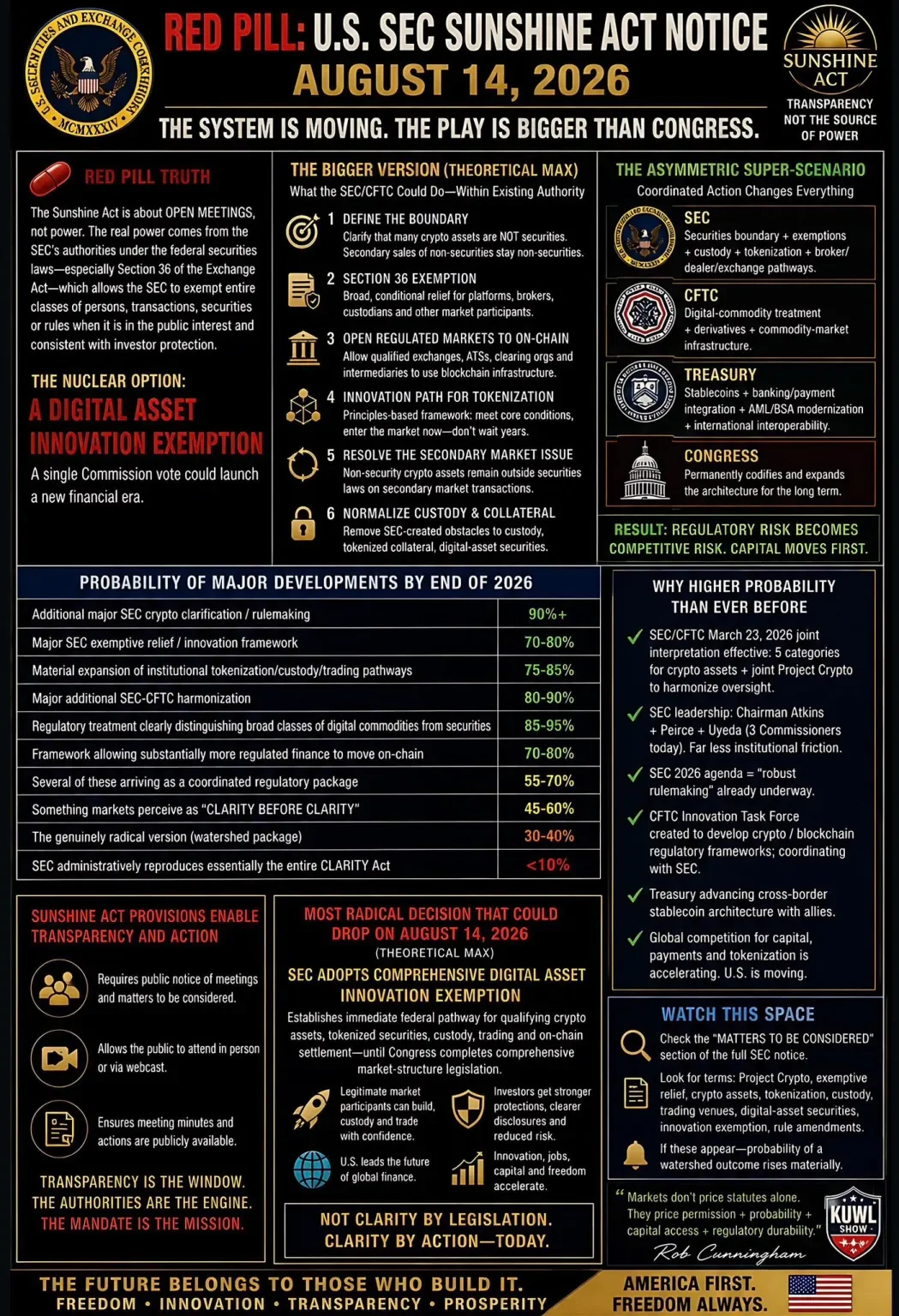
Imagine the Commission voting August 14 for a sweeping Digital Asset Market Transition / Innovation Exemption establishing something like:
Until Congress completes comprehensive market-structure legislation, qualifying decentralized digital assets and qualifying transactions involving them may operate under a defined federal safe harbor and tailored securities-market framework, rather than being forced through securities rules designed for conventional issuers and intermediaries.
That would not literally enact the CLARITY Act. The SEC cannot legislate the CFTC into possessing powers Congress has not granted it, rewrite statutes, or enact CLARITY by administrative vote.
But within the SEC’s own statutory jurisdiction, it could potentially accomplish something economically similar in important areas.
And there is precedent for thinking in exactly this direction. The SEC has already been actively exercising Section 36 authority in 2026, including conditional exemptions from Exchange Act requirements.
Now take that concept to its theoretical maximum.
The Commission could combine several actions into one enormous regulatory package:
1 Define the securities boundary much more sharply.
2 Establish that numerous crypto assets are not themselves securities merely because they previously were sold in an investment-contract transaction. The SEC has already issued a March 2026 Commission interpretation specifically addressing how federal securities laws apply to different types of crypto assets and crypto transactions.
3 Create a broad Section 36 transitional exemption.
Exchanges, broker-dealers, ATSs, custodians and other regulated entities could receive conditional relief allowing them to interact with qualifying digital assets and blockchain infrastructure without every legacy securities-market requirement mechanically applying.
4 Open regulated securities markets to on-chain infrastructure.
The really radical version would permit qualifying broker-dealers, exchanges, clearing organizations and other intermediaries to integrate tokenized securities, blockchain settlement and digital assets under specified conditions.
5 Create an innovation exemption for tokenization.
Instead of requiring every novel DLT architecture to wait years for bespoke regulatory accommodation, establish a principles-based pathway: meet custody, disclosure, anti-fraud, capital, cybersecurity and investor-protection conditions and enter the regulated marketplace now.
6 Resolve the secondary-market problem.
The Commission could make unmistakably clear that secondary transactions in qualifying non-security crypto assets don’t somehow become securities transactions merely because an asset once figured in somebody else’s securities offering.
7 Normalize regulated custody and collateral treatment.
A coordinated package could remove major SEC-created obstacles to broker-dealer custody, tokenized collateral, digital-asset securities and institutional participation.
Source(s):
• https://x.com/KuwlShow/status/2087238412801638882
https://dinarchronicles.com/2026/08/12/rob-cunningham-a-commission-wide-digital-asset-safe-harbor/
Japan Just Forced the US into an Impossible Choice
Japan Just Forced the US into an Impossible Choice
Taylor Kenny: 8-11-2026
Japan’s currency crisis may be exposing a much bigger problem for the U.S. The largest foreign holder of U.S. Treasuries—faces mounting pressure at the same time America is approaching $40 trillion in debt. So what happens if Japan needs cash and starts selling Treasuries?
The global financial system is currently experiencing subtle yet profound shifts that could redefine wealth preservation for years to come.
Japan Just Forced the US into an Impossible Choice
Taylor Kenny: 8-11-2026
Japan’s currency crisis may be exposing a much bigger problem for the U.S. The largest foreign holder of U.S. Treasuries—faces mounting pressure at the same time America is approaching $40 trillion in debt. So what happens if Japan needs cash and starts selling Treasuries?
The global financial system is currently experiencing subtle yet profound shifts that could redefine wealth preservation for years to come.
Recent movements in foreign exchange markets—specifically an unprecedented intervention by the United States to support the Japanese yen—have signaled deeper structural vulnerabilities within the international monetary framework. What initially appeared to be a routine diplomatic or financial courtesy is, upon closer inspection, a strategic move driven by mutual economic survival.
Understanding these macroeconomic developments requires looking beyond daily headlines to examine the interconnected mechanisms of sovereign debt, foreign reserves, and global currency stability.
In a rare move not seen on this scale in over three decades, monetary authorities in the United States recently intervened in currency markets to help stabilize the Japanese yen. By liquidating a portion of its euro reserves, the U.S. actively supported Japan’s currency, which has been under severe downward pressure due to widening interest rate differentials.
This intervention was not merely an act of international goodwill. Japan is currently the largest foreign holder of U.S. sovereign debt. However, with a domestic debt load roughly double the size of its economy, Japan faces immense pressure to defend its currency. Without external support, Japan would likely be forced to liquidate significant holdings of U.S. Treasuries to raise the capital necessary to back the yen.
The prospect of Japan selling off massive tranches of U.S. government debt presents a serious challenge for Washington. The U.S. bond market relies heavily on consistent demand from foreign central banks to absorb its ongoing debt issuance. If major buyers like Japan pause their purchases—or actively flood the secondary market with existing Treasuries—it creates a supply-and-demand imbalance.
When demand for sovereign debt falls, bond yields (and consequently, interest rates) must rise to attract new buyers. Higher interest rates increase borrowing costs across the entire economy, from mortgage rates to corporate debt, while simultaneously making it far more expensive for the U.S. government to service its own national debt, which is fast approaching the $40 trillion threshold.
To prevent rates from spiking uncontrolled, the Federal Reserve could ultimately be forced to intervene as the buyer of last resort, expanding its balance sheet and potentially accelerating inflationary pressures.
For decades, the U.S. dollar has enjoyed the distinct advantage of being the world’s primary reserve currency. This global demand for dollars has effectively exported domestic inflation, allowing the U.S. to carry high levels of public debt without immediate, runaway price increases at home.
However, as global trade patterns evolve and geopolitical dynamics shift, trust in the long-term stability of fiat-based debt systems is being tested. Central banks around the world are increasingly scrutinizing the risks associated with holding large reserves of foreign sovereign debt. When national debts balloon without a clear path toward fiscal balance, global confidence in the purchasing power of paper currencies naturally wanes.
As international confidence in traditional fiat models faces headwinds, central banks and institutional investors are quietly reallocating capital. Rather than relying solely on paper assets and sovereign debt, there is a growing pivot toward tangible, non-counterparty assets—most notably physical gold.
Physical precious metals have historically served as a foundational hedge during periods of monetary transition and currency debasement. Unlike sovereign bonds, physical gold carries no credit risk and cannot be diluted through monetary expansion. The systemic shifts currently taking place highlight the importance of risk management and portfolio diversification outside of purely dollar-denominated financial instruments.
The recent currency interventions and bond market tensions serve as an early warning signal of broader structural adjustments within global finance. As debt levels rise and traditional currency relationships face stress, proactive financial planning becomes essential for safeguarding capital. Diversifying into physical assets and reducing over-reliance on a single currency system remain prudent strategies for navigating an uncertain economic landscape.
CHAPTERS:
00:00 Japan Just Forced the U.S. Into an Impossible Choice
00:55 Japan Is the Largest Foreign Holder of U.S. Debt
01:55 Why the Dollar’s Reserve Status Matters
02:24 The Debt Doom Loop Is Accelerating
03:52 What Happens If Japan Starts Selling U.S. Treasuries?
04:50 Why the U.S. Currency Intervention Was So Unusual
05:49 The Bigger Threat: Other Countries Could Follow
07:17 The U.S. Is Running Out of Good Options
08:42 Why Physical Gold and Silver Matter
Seeds of Wisdom RV and Economics Updates Wednesday Afternoon 8-12-26
Good Afternoon Dinar Recaps,
Cooling Inflation, Rising Debt Costs: The Fed Faces a New Policy Dilemma
U.S. inflation is easing toward the Federal Reserve’s target while record government interest costs increasingly complicate the path for monetary and fiscal policy.
Good Afternoon Dinar Recaps,
Cooling Inflation, Rising Debt Costs: The Fed Faces a New Policy Dilemma
U.S. inflation is easing toward the Federal Reserve’s target while record government interest costs increasingly complicate the path for monetary and fiscal policy.
OVERVIEW
U.S. inflation is cooling: July CPI eased to 3.4%, while core CPIfell to 2.5%, strengthening the case for the Federal Reserve to avoid additional tightening.
The debt burden is moving in the opposite direction: Interest payments on U.S. public debt have reached approximately $1.37 trillion over the past year, creating increasing pressure on the federal budget.
The emerging dilemma is becoming more important: Lower inflation could give the Fed room to hold or eventually reduce rates, but high borrowing costs and record debt-service expenses make the cost of maintaining restrictive rates increasingly significant.
KEY DEVELOPMENTS
1. July Inflation Shows Further Cooling
The latest CPI data provide evidence that underlying inflation pressures are moderating. Headline CPI rose 3.4% year-over-year, down from 3.5% in June, while the monthly increase was just 0.1%.
Core CPI, which excludes food and energy, declined to 2.5%, its lowest level since February 2026. That remains above the Fed’s 2% target, but the direction is favorable for policymakers.
2. The Fed May Have More Room to Hold Rates Steady
The softer inflation reading has reduced expectations for another immediate rate increase. Market expectations are increasingly shifting toward the possibility that the Federal Reserve holds rates steady rather than tightening further.
If additional inflation reports confirm the trend, policymakers could eventually have greater flexibility to consider lower rates. However, the Fed must balance that possibility against the risk that inflation could remain above target.
3. U.S. Debt-Interest Costs Hit Another Record
While inflation is moving lower, the government's cost of servicing its debt is moving higher.
U.S. public-debt interest expenses have reached approximately $1.37 trillion over the past year, with interest payments reportedly increasing 10.5% year-over-year.
The average interest rate on marketable U.S. debt was approximately 3.411% as of June 2026, illustrating why even modest changes in borrowing costs can have enormous fiscal consequences.
4. Debt Service Could Become a Larger Budget Constraint
If current trends continue, annual federal interest expenses could eventually surpass Social Security as the largest individual component of federal spending.
That does not mean such an outcome is inevitable, but it highlights the structural problem: as older, lower-rate Treasury debt matures and is refinanced at higher rates, the government's interest burden can continue rising even without a dramatic increase in total debt.
5. Markets Must Reconcile Two Opposing Signals
The financial system is therefore receiving two very different signals.
Inflation is providing the Fed with greater policy flexibility, while the enormous stock of outstanding government debt makes higher interest rates increasingly expensive for the Treasury.
That tension could become increasingly important as investors assess the future direction of Treasury yields, federal borrowing, monetary policy and the dollar.
WHY IT MATTERS
The significance extends beyond the latest CPI report.
For the economy, cooling inflation improves household purchasing power and reduces pressure on businesses and consumers. But elevated government interest costs divert increasing amounts of federal revenue toward servicing existing obligations rather than funding other priorities.
For financial markets, the combination creates a difficult pricing environment. Investors must determine whether declining inflation will eventually produce lower interest rates or whether the scale of government borrowing will keep pressure on Treasury yields.
For Federal Reserve policy, the situation is particularly complicated. The Fed wants inflation to return sustainably to 2%, but maintaining restrictive rates for too long also increases the government's financing costs and can tighten financial conditions across the economy.
For the global financial system, the issue is even larger because U.S. Treasury securities remain a core component of global reserves, collateral markets and international investment portfolios.
WHY IT MATTERS TO FOREIGN CURRENCY HOLDERS
Dollar value: Changes in U.S. interest-rate expectations can influence global demand for dollars and affect exchange rates.
Purchasing power: Lower inflation could support U.S. purchasing power, while continued fiscal deficits and rising debt-service costs create longer-term concerns about monetary and fiscal stability.
Capital flows: Investors may continue moving capital toward U.S. assets if Treasury yields remain attractive, but persistent fiscal pressures could eventually influence how global investors allocate reserves.
Exchange rates: A shift from expectations of higher U.S. rates toward eventual rate reductions could change relative currency valuations and alter capital flows between the dollar and other major currencies.
IMPLICATIONS FOR THE GLOBAL RESET
Pillar 1: Debt
The clearest structural signal is the growing cost of servicing U.S. government debt. $1.37 trillion in annual interest expense demonstrates how the level of outstanding debt interacts with interest rates to create a rapidly expanding fiscal obligation.
This is important to the broader financial system because the U.S. Treasury market serves as a foundation for global borrowing, collateral and reserve management. Rising debt-service costs therefore represent more than a domestic budget issue.
Pillar 2: Assets
The relationship between inflation, interest rates and Treasury yields directly affects the valuation of bonds, equities, currencies, gold and other major assets.
If inflation continues falling, markets may increasingly anticipate lower rates, potentially supporting bonds and rate-sensitive assets. But if investors become more concerned about the sustainability of U.S. borrowing, Treasury yields could remain elevated even as inflation declines.
That tension is an important structural signal for global asset allocation.
CONCLUSION
The latest economic data present a striking contrast: inflation is moving in the direction the Federal Reserve wants, while the cost of America's debt is moving in the opposite direction.
That creates a growing policy dilemma. Lower inflation gives the Fed greater flexibility, but the enormous size of the federal debt means that prolonged high interest rates carry increasingly significant fiscal consequences.
The important question is no longer simply whether inflation is falling. Markets must also determine how the United States manages its debt burden while maintaining confidence in the Treasury market and the dollar.
The financial system is entering a period where the cost of money and the cost of debt can no longer be viewed separately.
Seeds of Wisdom Team
Newshounds News™ Exclusive
SOURCES
~~~~~~~~~~
Seeds of Wisdom Team RV Currency Facts Youtube and Rumble
Newshound's News Telegram Room Link
RV Facts with Proof Links Link
RV Updates Proof links - Facts Link
Start Here room with Most Asked Questions Link
Follow the Gold/Silver Rate COMEX
Follow Fast Facts
Seeds of Wisdom Team™Website
Thank you Dinar Recaps
Ariel: The Crash of Fiat and the Iraqi Dinar RV
Ariel: The Crash of Fiat and the Iraqi Dinar RV
8-11-2026
The Crash Of Fiat: Locking Up Liquidity & Transferring The Wealth Of The Ages (End Of Cabal)
We Are Going To Dive Right Into It Folks
Iraqi Dinar RV & The $80 Oil Peg:
Iraq is the keystone. Deleting the three zeros was said to require the Clarity Act to codify the asset-backed status into US law, preventing the Cabal from legally challenging the revaluation through their once captured SEC and judiciary. But we know that not the case.
Ariel: The Crash of Fiat and the Iraqi Dinar RV
8-11-2026
The Crash Of Fiat: Locking Up Liquidity & Transferring The Wealth Of The Ages (End Of Cabal)
We Are Going To Dive Right Into It Folks
Iraqi Dinar RV & The $80 Oil Peg:
Iraq is the keystone. Deleting the three zeros was said to require the Clarity Act to codify the asset-backed status into US law, preventing the Cabal from legally challenging the revaluation through their once captured SEC and judiciary. But we know that not the case.
As I explained in my X account. $80 oil ensures Iraq’s state revenue balances against the newly revalued dinar, allowing them to float a hard asset currency without hyperinflating their domestic economy.
The RV cuts the Iranian Rial off from its primary black-market dollar exchange (the Dinar), starving the Deepstate’s proxy funding. Remember, the Cabal wanted this at 200 a barrel.
So now you all know that we are about to get Crypto/Digital Rules from The SEC. Before congress comes back I presume.
THE FLIP: XRP, GOLD, & THE EXTENT OF THE CRASH:
The extent of the crash is Total Systemic Illiquidity. The fiat system does not correct; it freezes. SWIFT goes dark. CBDCs backed by nothing fail. The Cabal’s banks JPM, Citi, BofA find their ledgers empty because the underlying assets (mortgages, derivatives) are recognized as null and void under the new legal framework (Clarity Act + EOs).
The XRP Mechanism: XRP is not a cryptocurrency; it is the bridge liquidity vehicle for the ISO 20022 standard. When the switch flips, XRP is pegged to a physical gold reserve (likely the hoard audited and repatriated under military oversight).
The price is set algorithmically to absorb the total volume of global cross-border trade. The math requires a high price thousands per token to function as the institutional bridge without liquidity friction.
The Intended Sequence Of Events:
1. Crash: SWIFT failure, market closure, Cabal banks locked out of Fed window.
2. Isolate: Cabal capital trapped in old ledger, inaccessible, rendered valueless.
3. Flip: New ledger (XRP/XLM) goes live. Gold peg established.
4. RV: Dinar revalues simultaneously, syncing to the new asset-backed standard.
Read Full Article:
https://www.patreon.com/Prolotario1/posts/crash-of-fiat-up-166415050
https://dinarchronicles.com/2026/08/11/prolotario-the-crash-of-fiat-and-the-iraqi-dinar-rv/
News, Rumors and Opinions Wednesday 8-12-2026
Reset Intelligence: A Budget for What Rate?
8-11-2026
A Budget for What Rate?
By Reset Intelligence | @EXIT_FIAT
Iraq has started writing the next law that must name the dinar’s exchange rate – and the central bank is sitting at the drafting table.
Reset Intelligence: A Budget for What Rate?
8-11-2026
A Budget for What Rate?
By Reset Intelligence | @EXIT_FIAT
Iraq has started writing the next law that must name the dinar’s exchange rate – and the central bank is sitting at the drafting table.
The same week, a US senator walked out of Fort Knox and confirmed every ounce of gold is there. Then he said the dollar lost 85% of its value anyway.
The Budget File Reaches the Top Table
On Monday, Prime Minister al-Zaidi personally chaired a session with parliament’s finance committee, Finance Minister al-Sari, and Central Bank Governor Nizar Nasser Hussein. The subject: Iraq’s 2027 federal budget, the first in the country’s history built program-and-performance based. In Iraq, the exchange rate is written into the budget law. The 1,300 sits in the 2023 law, and no law since has replaced it. Iraq never passed a 2026 budget at all.
• The calendar – drafted and sent to parliament in September, endorsed and released in October, per the PM’s own financial adviser
• The door closed on camera – the government spokesman confirmed Iraq has not resorted to external borrowing, leaving the two options state TV repeats nightly: borrow from Iraqi banks, or take the three zeros off the notes
• The old books – former Finance Minister Taif Sami, who kept Iraq’s ledger for the entire life of the 2023 law, was placed on a judicial wanted list 2 days before the meeting
• The gold – central banks bought a record 289 tonnes last quarter; Iraq’s own bank holds roughly 175 tonnes, a quarter of its total reserves
• Fort Knox – Senator Rand Paul confirmed the full 147 million ounce stockpile, then pointed at the 85% the dollar lost since it was cut loose from that metal
Here is the question that matters, and it is the one everyone gets wrong: does the rate have to wait for the budget to pass in January? Iraq’s own record answers it, and the answer changes how you watch the next 6 weeks. The last time the number moved, the paperwork came 4 months later. The full breakdown of that sequence, and what the CBI can do any morning between now and September, is in today’s briefing.
Read the full daily briefing free for 5 days. Sign up here: resetintelligence.com
Want it straight from the horse’s mouth? The CBI Rate Alert pings you the moment the Central Bank of Iraq moves the official rate. The number itself, not a rumour about it. It comes with our free resource library and the daily breakdown of what is actually moving in Iraq. Sign up free: resetintelligence.com/rate-alert
The longer story is in the book: Head of the Snake. The free reference layer is here: The Library.
Follow the daily intel free: Telegram · Facebook · Spotify · Odysee
The budget that names the rate is being written now. The only question history will ask is who saw it while it was actually happening.
https://dinarchronicles.com/2026/08/11/reset-intelligence-a-budget-for-what-rate/
************
Courtesy of Dinar Guru: https://www.dinarguru.com/
Reset Intelligence This week a United States senator Rand Paul walked into the most famous vault on earth [Fort Knox] and settled a half century argument "the gold is there." All 147 million ounces... The metal never moved. And the dollar lost 85% of its value anyway. That is what happens to money with no backing. Nixon's moment and the endless printing did the damage...Now the gold is being counted again. The world is heading back to the gold standard, and the US is leading the way. Baghdad is already positioned, 175 tonnes deep, writing the budget law that names the dinar's next rate.
Frank26 Iraqi citizens repeat after me - We are lifting the value of your currency. We are lifting the three zeros from your exchange rate. The 25K note will become a 25 dinar note. $100 is about 150,000 dinar. We are going through a currency redenomination. It's to simplify transactions and to strengthen the confidence in Iraqi citizens on your currency.
Walkingstick [Iraqi bank friend Aki update] WALKINGSCICK: Aki, do you have any LDs? AKI: No, I don't have any lower denominations. I have no needs for lower denominations. WALKINGSTICK: When I come to your bank, you're going to take my dinars and give me American dollars in my account right? AKI: Yes, I will take care of you in conversion electronically. I will convert your IQDs into the USDs.
The Fed has Lost Control of Interest Rates
VRIC Media: 8-11-2026
Christopher Whalen of Whalen Global Advisors, LLC and publisher of The Institutional Risk Analyst argues that investors may be overlooking one of gold’s most important signals: credit default swaps on U.S. government debt. He explains why rising concern over America’s creditworthiness can strengthen the case for gold, why long-term interest rates may remain elevated even if short-term rates fall, and why inflation is likely to remain a persistent problem.
Whalen also discusses the dollar’s changing role in global reserves, the risk of inflating away U.S. debt, and why he expects a significant reset in housing and parts of the stock market.
0:00 The overlooked indicator driving gold
1:02 Why the Fed may keep rates unchanged
3:22 Short-term rates down, long-term rates higher
5:37 Why mortgage rates could stay elevated
8:38 Whalen’s outlook for gold and silver
11:03 What credit default swaps reveal about U.S. debt
14:14 Why U.S. credit risk can lead gold
16:06 How the dollar’s global role is changing
18:21 Why countries still need U.S. Treasuries
20:30 Diversifying into foreign currencies
23:13 Will America inflate away its debt?
26:05 Why the fiscal problem keeps getting pushed forward
27:31 A potential housing reset in 2028
30:04 Tech valuations and the AI bubble
Iraq Economic News and Points To Ponder Late Tuesday Evening 8-11-26
Five Years With Half Pay, And Six Months Without Pay... Parliament Paves The Way For Granting Iraqi Employees A "Long Leave"
latest news Tuesday, August 11, 2026 Baghdad - One News - 8/11/2026 The Iraqi parliament is paving the way for the approval of a new option for state employees, allowing them to obtain a long leave of five years or more in exchange for receiving half of the nominal salary, in addition to a six-month leave without pay.
Five Years With Half Pay, And Six Months Without Pay... Parliament Paves The Way For Granting Iraqi Employees A "Long Leave"
latest news Tuesday, August 11, 2026 Baghdad - One News - 8/11/2026 The Iraqi parliament is paving the way for the approval of a new option for state employees, allowing them to obtain a long leave of five years or more in exchange for receiving half of the nominal salary, in addition to a six-month leave without pay.
The House of Representatives concluded on Tuesday the first reading of a draft law granting employees a long regular leave, in a step that paves the way for moving to the second reading and discussing its articles, before putting it to a final vote.
According to the proposed law, an employee is entitled, upon his request, to take leave for a period of five years or more, while receiving 50% of his nominal salary for the duration of the leave.
The proposal also grants the employee the right to cut short the leave and return to his job after half of its duration has passed, without having to wait until the specified period has completely ended.
The proposal includes another option that allows the employee to take a six-month leave without pay, at his request, with the possibility of interrupting it and returning to work after half of its duration has passed.
These provisions are still within the framework of a proposed law and have not yet entered into force, as their approval requires the completion of the legislative stages within the House of Representatives and a final vote on them.
https://1news-iq.net/5-سنوات-بنصف-الراتب-و6-أشهر-بلا-راتب-البر/
Iraq's Coordination Framework Is Weakening, But No Rival Is Ready To Replace It
2026-08-11 / Shafaq News- Baghdad Iraq's Coordination Framework, the alliance of Shiite parties that has run the country since 2022, is weaker today than at any point since it was assembled. It is also, for now, the only game in Baghdad, and that pairing —a governing bloc losing its grip while facing no one able to take its place— explains more about where Iraqi politics is heading than any single quarrel inside it.
The Framework was not designed to be a party, or even a permanent coalition. It formed in 2021 for one purpose: to prevent Muqtada al-Sadr, the populist Shiite cleric whose list had won the most seats, from building a majority government that would have pushed the Iran-aligned parties out of power. Isam al-Faili, a professor of political science at Baghdad's Mustansiriyah University, describes an alliance that carried an unclear label from the day it was born and has only ever been a gathering of forces that agree on very little.
Read more: Explainer: Iraq’s Coordination Framework and Its Rise to Power
Hostility to al-Sadr supplied the glue. When he walked away, the glue began to dry. How this alliance holds, or frays, is not a domestic curiosity: it governs a major oil producer, sets the terms of Baghdad's dealings with both Washington and Tehran, and now holds the fate of the armed groups through which Iran projects power across the region.
Al-Sadr's exit is also the reason the Framework looks so commanding today. He boycotted the November 2025 election outright, and in his absence the Framework's constituent parties returned to the field and claimed roughly 175 of parliament's 329 seats, well above the 130 or so they controlled after the Sadrists quit parliament in 2022.
They reached that total by running apart rather than together —Nouri al-Maliki's State of Law, Qais al-Khazali's Sadiqoon, Ammar al-Hakim's National State Forces, and Mohammed Shia al-Sudani's Reconstruction and Development each contested separately and allied with others.
Analysts have labeled the tactic-controlled fragmentation: split to harvest the maximum number of seats under an election law the Framework itself redrew to reward large lists, then regroup afterward to name the prime minister and parcel out the ministries.
It worked cleanly, and in working it exposed the trait that now defines the alliance. The Framework can coordinate with precision when the prize is seats, and hardly at all once the question becomes what to do with them.
Read more: Exclusive: Coordination Framework split into three factions over armed groups
What holds it together has narrowed to a single shared interest: keeping hold of the state and everything attached to it —the offices, budgets, and patronage that have organized Iraqi government since the US invasion in 2003.
The discipline this generates is real and easy to underrate. Framework leaders do not turn on one another in public, and when the bloc issues a collective position, none of them steps out to disown it.
That the parties ran as separate lists and then reassembled without a public rupture is itself evidence of coordination, not decay. The unity is genuine at the level of the statement, even when it dissolves the moment anyone tries to act on it.
Nowhere is the discipline clearer than in how the Framework picks prime ministers, and nowhere is its dysfunction clearer either. Installing al-Sudani in 2022 took just over a year, the longest government-formation deadlock since 2003.
Once in office, he tried to grow a base of his own, and by November 2025 his list had finished first, yet the Framework still refused him a second term, with corruption files trailing him as he was eased aside.
Read more: The Shiite Coordination Framework: Can govern Iraq, but cannot agree on a prime minister
Haitham Numan, a professor of political science at Britain's University of Exeter, reads that arc as a lesson the bloc teaches its own premiers: reach for independence and you become a target.
The search for al-Sudani's successor then stalled for five months. It broke only when US President Donald Trump moved against al-Maliki's bid to return, threatening to cut security cooperation and freezing dollar transfers to Baghdad until the Framework dropped him.
The compromise that emerged was Ali al-Zaidi, a businessman with no party, no faction, and no political record, chosen because he alarmed no one.
Al-Zaidi was sworn in on May 14 with only 14 of 23 ministers approved; the interior and defense portfolios, the core of the security establishment, sat empty amid disputes the bloc could not settle.
Al-Faili notes that even al-Zaidi was not a settled choice until the final moment. The relationship between the government and its makers is one of mutual dependence rather than separation; the Framework keeps producing weak premiers because a weak premier is the only kind all of its members will tolerate.
There is one dispute this method cannot swallow, and it is the one now pressing hardest on the alliance. Several Framework members are not only political parties; they also command weapons.
Al-Amiri's Badr Organization is among the largest factions inside the Popular Mobilization Forces, the state-funded umbrella of mostly Iran-aligned armed groups; al-Khazali's Asaib Ahl al-Haq fields both lawmakers and fighters; the Hoqooq movement is widely understood as the political face of Kataib Hezbollah.
So when the Framework authorized al-Zaidi in early June to bring all weapons under state control, presenting the step as a sovereign national decision, some of the figures signing off were being asked to take apart the very source of their leverage.
Al-Faili observes that arms are handled case by case rather than by any collective ruling of the bloc, and events bore him out within days.
Asaib Ahl al-Haq and Kataib al-Imam Ali announced they would place their brigades under state authority; Kataib Hezbollah and Harakat al-Nujaba refused, with Kataib Hezbollah professing support while insisting on keeping its drones and missiles. The same fault line runs through the half-empty cabinet, where the security ministries remain contested precisely because they decide who commands the men with guns.
Driving all of it is outside pressure, Washington's envoy Tom Barrack, the frozen dollar transfers, and a September 30 deadline after which unlicensed weapons are to face legal action.
The word both camps reach for is sovereignty, though they mean opposite things by it: for the state-first parties it describes a government monopoly on force, and for the resistance factions it describes defiance of American power.
The timing sharpens everything. A year after the war that left Iran badly weakened and stripped of its allies in Syria and Lebanon, Tehran now leans on Iraq as its most dependable partner, exactly as Baghdad is being pushed to disarm the groups that anchor that relationship.
Abbas Ghadir al-Jubouri, a researcher on Iraqi political affairs, argues that what looks like erosion is political repositioning rather than retreat, and that the Framework remains the government's sponsor with al-Zaidi its chosen product.
On the matter of form, he is right; nothing on the horizon is poised to unseat the alliance. Numan's reading runs deeper and darker: the Framework stands at its weakest and still rules, held up less by its own strength than by the absence of any figure able to unify the Shiite house, offering what he calls protocol cover in place of real political cover. Both descriptions hold at once.
The Framework is not going to dissolve, and it is not going to be replaced. What is draining out of it is substance.
The September 30 deadline puts to the alliance the question its whole design was meant to avoid. A coalition assembled to share power can absorb almost any disagreement that money and offices are able to settle.
Whether it can survive being asked to surrender the weapons that make some of its members powerful in the first place is the test it has spent four years avoiding, and the one it can no longer postpone.
Written and edited by Shafaq News staff.
https://www.shafaq.com/en/Report/Iraq-s-Coordination-Framework-is-weakening-but-no-rival-is-ready-to-replace-it
Chief Justice Faiq Zaidan: There Is No Legal Basis For Any Settlement With Corrupt Individuals, And The Judiciary Deals With Corruption Cases According To The Law
latest news Tuesday, August 11, 2026 Baghdad - One News - 8/11/2026 The head of the Supreme Judicial Council, Judge Faiq Zaidan, confirmed that there is no legal basis for settlement agreements with those accused in corruption cases, stressing that the judiciary deals with corruption files in accordance with the law, and there is no decision or intention to adopt settlements with corrupt individuals.
This came during a meeting between Zaidan and the Secretary of the Iraqi Communist Party, Raed Fahmi, who said in a post on his account on the “X” website that the meeting addressed a number of issues of public concern, most notably combating corruption, restricting weapons to the state, and protecting rights and freedoms.
Fahmy explained that during the meeting he expressed his full support for the national campaign to combat corruption, and the need for it to be comprehensive, while Zidan confirmed, according to what was reported, that the judiciary is proceeding with dealing with corruption files in accordance with the approved legal frameworks.
The meeting also addressed the issue of public freedoms, as Fahmy quoted the head of the Supreme Judicial Council as confirming that freedoms are a constitutionally guaranteed right, and that the judiciary distinguishes between exercising the right to expression and cases of insult, slander and transgression, noting that the exercise of freedoms is regulated by laws.
Regarding the application of the Jaafari law and the problems and complications that accompany it related to the situation of women, Fahmi pointed out that Zaidan spoke about the existence of many observations with the Supreme Judicial Council in this regard, stressing that the task of the judiciary is to apply the law, not to legislate it, considering that legislation is the prerogative of the House of Representatives.
The Secretary of the Iraqi Communist Party described the meeting as important and frank, noting that it addressed a number of issues related to state-building, establishing the rule of law, and protecting rights and freedoms.
https://1news-iq.net/رئيس-مجلس-القضاء-الأعلى-القاضي-فائق-زي-4
Seeds of Wisdom RV and Economics Updates Wednesday Morning 8-12-26
Good Morning Dinar Recaps,
U.S. Treasury Market Pressure: Rising Bond Yields Test the Foundation of Global Finance
Higher U.S. borrowing costs are putting renewed pressure on the world’s benchmark bond market, raising questions about debt sustainability, monetary policy and the future structure of global capital flows.
Good Morning Dinar Recaps,
U.S. Treasury Market Pressure: Rising Bond Yields Test the Foundation of Global Finance
Higher U.S. borrowing costs are putting renewed pressure on the world’s benchmark bond market, raising questions about debt sustainability, monetary policy and the future structure of global capital flows.
OVERVIEW
U.S. Treasury yields remain elevated, keeping borrowing costs high for the federal government, businesses and households while investors reassess the outlook for inflation and Federal Reserve policy.
The pressure is significant because Treasury securities sit at the center of the global financial system, serving as a benchmark for pricing debt and as a major reserve asset for institutions and central banks worldwide.
At the same time, foreign investors and global institutions are increasingly watching diversification, currency exposure and alternative reserve assets, adding another layer to the long-term evolution of the international financial architecture.
KEY DEVELOPMENTS
1. Elevated Treasury Yields Keep Debt Costs in Focus
Higher yields mean the U.S. government must pay more to finance newly issued debt and refinance maturing obligations.
The immediate issue is not a sudden crisis, but the long-term compounding effect of higher interest costs as federal borrowing remains substantial.
2. The Treasury Market Remains the Global Benchmark
Treasury securities influence borrowing costs far beyond Washington.
Mortgage rates, corporate bonds, bank financing and sovereign borrowing are all affected by movements in U.S. government bond yields. Stress in the Treasury market can therefore transmit through multiple layers of the global financial system.
3. The Federal Reserve Faces a Difficult Policy Balance
Persistent inflation can limit the Federal Reserve's ability to reduce interest rates, while maintaining restrictive policy for longer can increase pressure on economic growth and financial markets.
Investors are therefore watching inflation data, employment conditions and Fed communications for clues about the future direction of monetary policy.
4. Global Investors Are Watching U.S. Debt Exposure
The Treasury market remains extraordinarily important to global investors, but the combination of high U.S. debt levels, elevated yields and currency considerations has encouraged institutions to examine portfolio diversification and alternative stores of value.
That does not mean the dollar or Treasury market is being replaced. It does mean that the structure of global reserves and capital allocation is receiving greater scrutiny.
5. The Longer-Term Question Is Financial-System Resilience
The most important issue is whether the global financial system can continue absorbing large amounts of government debt while maintaining relatively stable borrowing costs.
If elevated yields persist, governments may face greater pressure to control deficits, manage debt issuance and reconsider the cost of maintaining increasingly large debt burdens.
WHY IT MATTERS
The Treasury market is not simply another financial market. It is one of the foundations upon which modern global finance is built.
Higher yields increase the cost of capital throughout the economy and can affect government budgets, corporate investment, mortgages, currencies and asset valuations.
For policymakers, the challenge is balancing debt financing, economic growth and inflation control without creating additional instability in the world's most important bond market.
For the global system, sustained pressure could accelerate discussions about reserve diversification, alternative payment networks and changes in the way international capital is allocated.
WHY IT MATTERS TO FOREIGN CURRENCY HOLDERS
Currency value: Changes in Treasury yields can influence international capital flows and the relative attractiveness of dollar-denominated assets.
Purchasing power: Persistent inflation and higher interest costs can affect the purchasing power of currencies and the economic policies used to defend them.
Capital flows: Investors may move capital between dollars, foreign currencies, bonds, commodities and other assets as interest-rate expectations change.
Exchange-rate impact: A stronger or weaker dollar can materially change the value of foreign currencies when measured against the U.S. dollar.
IMPLICATIONS FOR THE GLOBAL RESET
Pillar 1: Debt
The most direct impact is on global debt sustainability. Higher U.S. Treasury yields raise the cost of financing the world's largest sovereign debt market and can increase borrowing costs elsewhere.
If elevated rates persist, governments may face growing pressure to restructure spending, manage deficits and reconsider how debt is financed.
Pillar 2: Assets
Treasury-market pressure also affects the global allocation of capital. Investors and central banks continuously evaluate the balance between dollar assets, government bonds, gold and other reserves.
This does not establish that a replacement for the dollar is imminent. However, continued diversification can contribute to a more multipolar global financial architecture over time.
CONCLUSION
The significance of today's Treasury-market pressure extends beyond the daily movement of bond yields. The cost of U.S. government debt increasingly intersects with inflation, monetary policy and the decisions of investors and central banks around the world.
The Treasury market remains the core benchmark of global finance, but its growing debt burden is forcing markets to pay closer attention to the long-term cost of maintaining that position.
For the broader financial system, the important question is not whether the Treasury market suddenly fails. It is whether persistent high borrowing costs gradually encourage governments, investors and central banks to rethink how global capital is structured.
The financial system does not have to break to change — sustained pressure can be enough to reshape it.
Seeds of Wisdom Team
Newshounds News™ Exclusive
SOURCES
~~~~~~~~~~
🌱 A Message to Our Currency Holders🌱
If you’ve been holding foreign currency for many years, you were not foolish.
You were not wrong to believe the global financial system would change.
What failed was not your patience — it was the information you were given.
For years, dates, rumors, and personalities replaced facts, structure, and proof. “This week” predictions created cycles of hope and disappointment that were never based on how currencies actually change.
That is not your failure.
Our mission here is different: • No dates • No rates • No hype • No gurus
Instead, we focus on:
• Verifiable developments • Institutional evidence
• Global financial structure • Where countries actually sit in the process
Currency value changes only come after sovereignty, trade, banking, settlement systems, and fiscal coordination are in place. History and institutions confirm this sequence.
You will see silence. You will see denials. That is not delay — that is discipline.
Protect your identity. Organize your documents. Verify everything.
Never hand your discernment to anyone who cannot show proof.
You deserve truth — not timelines.
Seeds of Wisdom Team
Newshounds News
~~~~~~~~~~
Seeds of Wisdom Team RV Currency Facts Youtube and Rumble
Newshound's News Telegram Room Link
RV Facts with Proof Links Link
RV Updates Proof links - Facts Link
Start Here room with Most Asked Questions Link
Follow the Gold/Silver Rate COMEX
Follow Fast Facts
Seeds of Wisdom Team™Website
Thank you Dinar Recaps
Rob Cunningham: XRP Price Before Law v 2.0
Rob Cunningham: XRP Price Before Law v 2.0
8-11-2026
• XRP Price Before Law v 2.0 •
Last Friday’s major institutional question was:
“Why should we expose ourselves to digital assets before Congress tells us exactly what everything is?”
Also the “John Thune would suck in the WNBA, too” week in DC.
Rob Cunningham: XRP Price Before Law v 2.0
8-11-2026
• XRP Price Before Law v 2.0 •
Last Friday’s major institutional question was:
“Why should we expose ourselves to digital assets before Congress tells us exactly what everything is?”
Also the “John Thune would suck in the WNBA, too” week in DC.
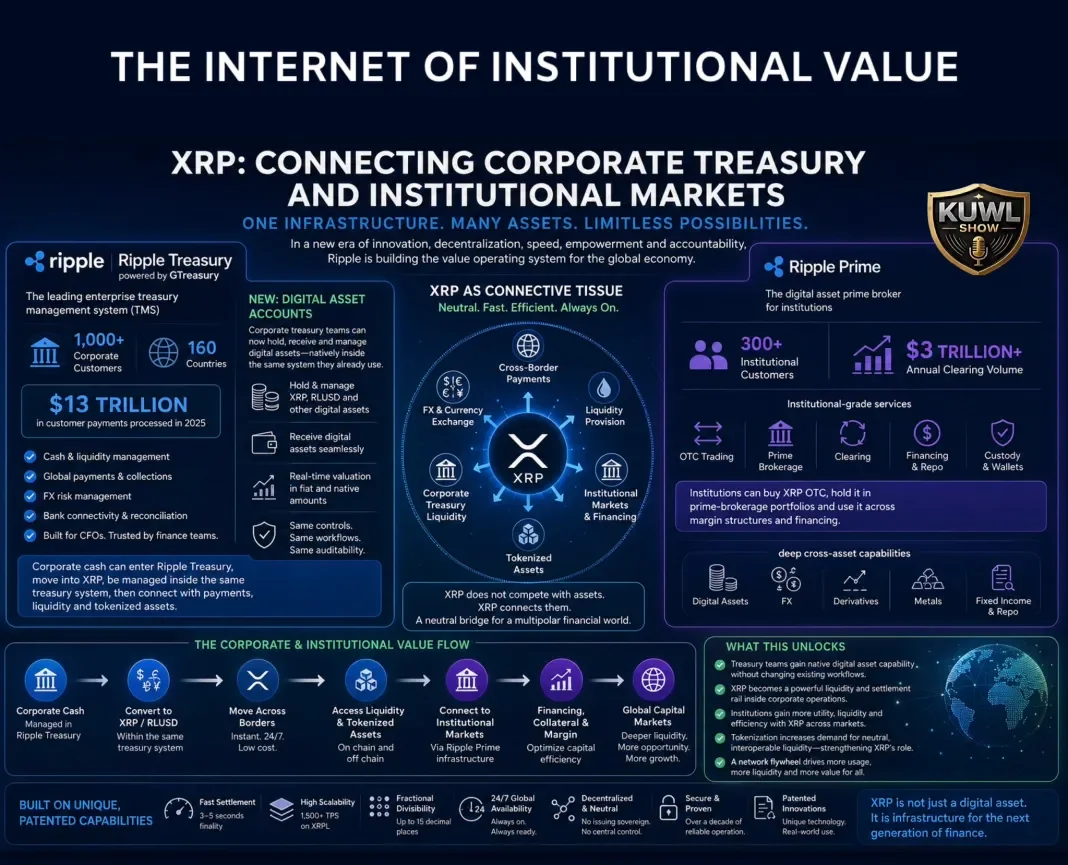
Today, the increasingly defensible boardroom question has become:
“Why are we refusing even to prepare for an asset class and financial architecture that the Executive Branch has expressly directed federal regulators to integrate into the traditional financial system?”
EO 14405 & EO 14406 signed on May 19, 2026, now offer a profound inversion of institutional risk, thanks to Lady Thune.
And then comes the Federal Reserve provision, too.
This may ultimately be the most strategically important part of EO 14405.
President Trump specifically requested that the Federal Reserve conduct a comprehensive review of whether uninsured depositories and non-bank financial firms – explicitly including firms (like @Ripple) engaged in digital assets and novel financial activities – can obtain direct access to Federal Reserve payment accounts and services. His EO asks the Fed to analyze legal authority, barriers, risk-management structures and options for expanding access. Where existing law permits access, it asks for transparent application procedures and decisions on complete applications within 90 days.
The institutional message is much bigger than “Trump supports crypto”
EO 14405 does something unusually important for bank boards, investment committees and general counsels: it establishes as formal policy of the United States that federal regulation should permit the integration of digital assets and innovative technology into traditional financial services and payment systems, while removing unnecessary barriers that favor incumbents.
It expressly sweeps in 11 areas:
payments
derivatives
investment management
brokerage
underwriting
capital markets
custody
fiduciary services
securities
commodities and
blockchain-based services
Think about the architectural implication.
For most of crypto’s history, the industry sat outside the monetary fortress, accessing traditional payment infrastructure through banking intermediaries.
EO 14405 asks whether portions of that wall can legally become a door.
It doesn’t grant every crypto company a master account. It does something institutionally significant nonetheless: it moves direct access by digital-financial businesses from something regulators might resist philosophically to something the Federal Reserve has been formally asked by the President to evaluate and justify structurally.
And EO 14406 provides the other half of the institutional equation
This is where the two orders operate almost like a matched pair.
EO 14405 says:
Integrate innovation. Reduce artificial barriers. Examine payment-system access.
EO 14406 says:
Do it while strengthening financial integrity, BSA compliance, customer identification and defenses against illicit finance.
The second order directs Treasury and banking regulators toward stronger risk-based customer due-diligence and customer-identification requirements, while identifying money laundering, trafficking, fraudulent identity structures and unlawful cross-border activity as priorities.
That matters enormously to boards.
Because the strongest institutional argument against digital assets was never merely “crypto is volatile.”
It was:
Regulatory risk + AML risk + reputational risk + counterparty risk + uncertain classification = don’t touch it.
The Administration’s emerging framework is effectively separating those issues:
Innovation is legitimate. Digital assets belong inside regulated finance. Access should be evaluated. Bad actors should be policed aggressively.
That is a much easier proposition for a compliance committee to defend.
Source(s):
• https://x.com/KuwlShow/status/2086963843087904930
https://dinarchronicles.com/2026/08/11/rob-cunningham-xrp-price-before-law-v-2-0/
Seeds of Wisdom RV and Economics Updates Tuesday Evening 8-11-26
Good Evening Dinar Recaps,
BRICS Payment Networks: A New Cross-Border Financial Architecture Takes Shape
BRICS nations are moving toward greater payment-system connectivity while China expands the international role of the yuan, signaling a gradual shift toward a more multipolar financial infrastructure.
Good Evening Dinar Recaps,
BRICS Payment Networks: A New Cross-Border Financial Architecture Takes Shape
BRICS nations are moving toward greater payment-system connectivity while China expands the international role of the yuan, signaling a gradual shift toward a more multipolar financial infrastructure.
OVERVIEW
BRICS nations are discussing ways to connect their fast-payment systems and central bank digital currencies (CBDCs) to make cross-border transactions faster and potentially less expensive.
China is simultaneously advancing the international use of the yuan in trade and investment, adding another layer to the development of alternative financial channels.
The developments do not establish a replacement for the U.S. dollar, but they do show major emerging economies building greater flexibility into the infrastructure used for international payments and trade.
KEY DEVELOPMENTS
1. BRICS Discusses Connecting National Payment Systems
Reserve Bank of India Governor Sanjay Malhotra said BRICS nations are discussing linking their fast-payment systems and CBDCs as part of efforts to improve cross-border payments.
The discussions are still in an early stage, but the fact that CBDC connectivity is being considered at the BRICS level represents a significant step toward greater interoperability between national financial systems.
2. Lower-Cost Cross-Border Payments Are a Central Objective
The goal is not simply to create another payment network. BRICS officials are examining whether existing national systems can be connected to reduce transaction costs and improve the efficiency of international payments.
For businesses engaged in cross-border trade, faster settlement and lower transaction costs could eventually make local-currency transactions more practical.
3. China Pushes for Greater International Use of the Yuan
China's central bank has separately committed to broadening the international use of the yuan in trade and investment as part of its five-year financial strategy.
The policy reinforces China's effort to increase the currency's role in international commerce while maintaining a stable yuan exchange rate and continuing to open parts of its financial system.
4. The Evidence Points to Infrastructure Diversification
The developments should not be interpreted as proof that BRICS is creating a new currency to replace the dollar.
The more measurable shift is occurring underneath the currency question: countries are developing additional payment rails, digital currencies and settlement mechanisms that could allow international transactions to move through a wider range of systems.
5. A More Multipolar Payment System Is Emerging
The BRICS discussions are part of a broader global movement toward interoperable digital financial infrastructure.
If these systems eventually move from discussions and pilots into large-scale operation, the global financial system could become more diversified, with multiple interconnected payment networks operating alongside the established dollar-based infrastructure.
WHY IT MATTERS
For the global economy, cheaper and faster cross-border payments could reduce friction in international trade and make transactions between emerging-market economies more efficient.
For financial markets, greater use of local currencies and alternative settlement channels could gradually influence currency demand and capital flows.
For central banks and policymakers, the development raises an increasingly important question: who will establish the standards and infrastructure through which international money moves in the next generation of global finance?
The significance is therefore larger than any single BRICS payment initiative. The underlying competition is increasingly about financial infrastructure, interoperability and settlement technology.
WHY IT MATTERS TO FOREIGN CURRENCY HOLDERS
Currency value: Greater international use of BRICS currencies could eventually create additional sources of demand for currencies used in cross-border trade.
Purchasing power: More efficient settlement could reduce some costs associated with international transactions and currency conversion.
Capital flows: If more international trade is settled directly in local currencies, capital flows could gradually become more diversified across currencies.
Exchange rates: Increased international use of currencies such as the yuan and rupee could influence long-term currency demand, although the ultimate impact remains uncertain.
IMPLICATIONS FOR THE GLOBAL RESET
Pillar 1: Trade
The most immediate structural effect is on international trade settlement. Connecting fast-payment systems could make cross-border transactions more efficient and provide businesses with additional settlement options.
Over time, greater interoperability could reduce some of the friction associated with traditional correspondent-banking channels and make local-currency trade more practical between participating economies.
Pillar 2: Technology
The deeper structural shift is the development of digital financial infrastructure connecting national payment systems and CBDCs.
If these systems become interoperable at scale, the technology supporting international finance could become more decentralized across multiple national and regional networks rather than relying predominantly on established financial infrastructure.
CONCLUSION
BRICS is not demonstrating that the U.S. dollar is being replaced. What the evidence does show is more gradual and potentially more important: major emerging economies are building additional ways for money to move across borders.
The combination of BRICS payment-system discussions, potential CBDC connectivity and China's effort to expand the international use of the yuan points toward greater diversification of global financial infrastructure.
This transition will not happen overnight, and significant technical, regulatory and political obstacles remain. But the direction is becoming increasingly visible.
The global financial system may not be replacing the existing architecture—it is building additional rails alongside it, and those rails could reshape how international money moves.
Seeds of Wisdom Team
Newshounds News™ Exclusive
SOURCES
Reuters — "BRICS nations discuss linking payment systems and CBDCs, RBI chief says"
Reuters — "China's central bank vows to expand yuan's international use in five-year plan"
~~~~~~~~~~
Seeds of Wisdom Team RV Currency Facts Youtube and Rumble
Newshound's News Telegram Room Link
RV Facts with Proof Links Link
RV Updates Proof links - Facts Link
Start Here room with Most Asked Questions Link
Follow the Gold/Silver Rate COMEX
Follow Fast Facts
Seeds of Wisdom Team™Website
Thank you Dinar Recaps