
Sunday Iraq News Posted by Tishwash at TNT 7-12-2026
TNT:
Tishwash: Al-Zaidi Heads to U.S. to Transition Ties into Long-Term Economic Partnership
Government spokesperson Haider al-Aboudi announced that Iraqi Prime Minister Ali Faeh al-Zaidi will lead a high-level delegation to the United States on Monday to sign key memorandums of understanding in the oil and gas sectors.
Al-Zaidi will be accompanied by several cabinet ministers, the Central Bank Governor, and private investors from the energy and banking sectors.
Channel8 earlier reported that the delegation will discuss key security, economic, and banking issues with U.S. officials, with a central focus on drawing American investments into Iraq's oil, electricity, and natural gas sectors.
TNT:
Tishwash: Al-Zaidi Heads to U.S. to Transition Ties into Long-Term Economic Partnership
Government spokesperson Haider al-Aboudi announced that Iraqi Prime Minister Ali Faeh al-Zaidi will lead a high-level delegation to the United States on Monday to sign key memorandums of understanding in the oil and gas sectors.
Al-Zaidi will be accompanied by several cabinet ministers, the Central Bank Governor, and private investors from the energy and banking sectors.
Channel8 earlier reported that the delegation will discuss key security, economic, and banking issues with U.S. officials, with a central focus on drawing American investments into Iraq's oil, electricity, and natural gas sectors.
Al-Zaidi previously stated that his trip to Washington is "not just a routine protocol visit" and that Iraq "prioritizes American companies" as it actively pivots from military to economic ties.
Al-Aboudi: Al-Zaidi's US Visit to Prioritize Balanced Ties
Al-Aboudi told a press conference on Sunday that the visit aims to build balanced foreign relations based on mutual interests, noting that al-Zaidi will hold crucial meetings with President Trump and financial institutions to turn these dialogues into real progress.
He stressed that the visit aims to strengthen ties with Washington, with discussions focusing primarily on developing economic and investment relations.
Al-Aboudi highlighted that the visit aims to boost Iraq's regional presence by prioritizing talks with the U.S. on economic cooperation, development, and investment in the energy, trade, and technology sectors.
Economic Partnership and Focus on Energy and Framework Integrity
The spokesperson noted that unlike previous visits, "its primary theme is the economy," emphasizing that all new agreements will remain fully based on the existing Strategic Framework Agreement.
He emphasized that upcoming Iraq-U.S. energy agreements will bring in specialized American firms to boost oil and gas production and build alternative export routes to avoid the Strait of Hormuz crisis.
Haider al-Aboudi further emphasized that the bilateral dynamic will transition from "crisis management to a long-term economic partnership." link
*************
Tishwash: Al-Zaidi heads to Washington carrying files on the economy and weapons in a pivotal visit to the White House
All eyes are on the upcoming visit of Iraqi Prime Minister Ali al-Zaidi to the White House next week, in one of the most significant milestones in Iraqi-American relations in recent years .
This visit comes amid increasing pressure on Baghdad to address the issue of armed factions, coinciding with the Iraqi government's efforts to expand economic and investment cooperation with the United States .
A report by Middle East Eye stated that “US President Donald Trump views Iraq from the perspective of economic and investment opportunities, while al-Zaidi seeks to capitalize on this trend to strengthen relations with Washington and gain the support of the US administration, which gives him more room to implement his government program, and at the forefront of his priorities is restricting weapons to the state and reorganizing Iraq’s regional relations .”
According to the report, "During his visit, Al-Zaidi will carry a package of economic agreements, including expanding the initial agreement with Chevron to develop one of the oil fields in Basra Governorate, in addition to increasing the investments of another American company in the Akaz gas field in Anbar Governorate ."
He added: "The visit's agenda also includes the signing of an agreement to rehabilitate the Kirkuk-Banias pipeline, which connects Iraq to the Syrian coast, in a project that Washington sees as part of its plan to ensure the continued flow of energy supplies and reduce the impact of any disruptions in the Strait of Hormuz ."
He noted that "the US envoy to Syria and Iraq, Tom Barrack, is working to prepare initial understandings before al-Zaidi arrives in Washington, as part of a strategy aimed at expanding the presence of American companies and reducing Iranian economic influence within Iraq ."
The report noted that "the resumption by the United States of transferring Iraqi oil revenues deposited with the Federal Reserve in New York, days before the visit, has political dimensions that go beyond the financial aspect, and reflects Washington's desire to open a new chapter of cooperation with Baghdad ."
He explained that "in contrast, the issue of armed factions will occupy a key position in the White House talks, as the US administration seeks to obtain clear Iraqi commitments regarding ending the influence of armed groups linked to Iran, and stopping attacks targeting US interests and the Gulf states ."
Al-Zaydi had given those factions until September 30 to hand over their weapons to the state, coinciding with the end of the international coalition’s mission in Iraq, but some of the main factions, including Kataib Hezbollah and Harakat al-Nujaba, still refuse to give up their weapons .
The report also addressed the anti-corruption campaign launched by the Iraqi government, considering that it "strengthened al-Zaidi's position before the American administration, after it included prominent figures and officials, including those close to the previous government and figures associated with the Popular Mobilization Forces ."
The report concluded that "the success of the visit will not be measured by the number of economic agreements that will be signed, but rather by the ability of the Iraqi Prime Minister to convince Washington that his government is capable of implementing real reforms and making progress in the issue of restricting weapons to the state, while at the same time maintaining balance in Iraq's regional relations link
***************
Tishwash: Parliamentary Finance Committee reveals details of the 2027 budget
The head of the parliamentary finance committee, Uday Awad ,
revealed on Saturday the most prominent aspects of the 2027 budget proposal, explaining that it will adopt a program and performance budget in a number of government institutions and agencies.
Awad told Al-Maalomah News Agency, "The 2027 budget will be a program and performance budget, while the remaining sections will be structured according to the program and performance guidelines." He explained that "this approach comes within the framework of developing budget preparation mechanisms and enhancing the efficiency of government spending."
He added that "the application of the program and performance budget will include the Ministry of Electricity, in addition to the governorates of Salah al-Din and Diwaniyah, as the first phase of the project," emphasizing that "adopting this method contributes to raising the level of oversight of spending and achieving better results in the implementation of projects and services." lin
Tishwash: Economists: Iraq's international acceptance has broadened following Operation Dawn.
Iraq is betting that its ongoing anti-corruption campaign will be a starting point for restoring international confidence, as experts believe that establishing the rule of law and holding corrupt individuals accountable sends a positive message to financial institutions and investors, and may be reflected in improved economic indicators and governance.
Turning point
The academic, Dr. Kazem Eidan, described the current moves as a “real turning point” if the state continues to fight corruption without exceptions or selectivity, indicating that the international community does not build its confidence on statements, but on results, the rule of law, and the independence of the judiciary.
Eidan explained in an interview with Al-Sabah that holding corrupt individuals accountable under the law has enhanced Iraq’s image and will contribute to bringing it closer to political and economic stability, and will open the door to international investments and partnerships, stressing that true success will only be achieved when the citizen, before the world, feels that the law is applied to everyone without discrimination or exceptions.
The spokesman added that if the government succeeds in turning these measures into a permanent and continuous approach, Iraq may regain the international standing it deserves after many years of challenges. He considered the recent measures, including opening corruption files, as a message that the state is ready to take serious and bolder steps, which is being followed with great interest by countries and international financial institutions.
Eidan pointed out that this trend improves the investment environment, explaining that investors view combating corruption as an indicator of the stability of the business environment and a decrease in the risks of bribery and illegal interventions, which is reflected in an increase in foreign investments.
International ranking improved
Eidan promised that strengthening economic and financial relations would be a gateway to the success of reforms and economic and financial stability, which would facilitate cooperation with international institutions and increase opportunities to obtain financing and investments on better terms, as well as raise Iraq’s international ranking and achieve sustainable improvement in governance and transparency indicators, thus improving the country’s international image, provided that these reforms continue and show their results.
Economic stability
On the same note, financial and economic researcher Imad Al-Muhammadawi considered combating corruption to be the gateway to economic stability in Iraq, explaining that corruption is an economic burden before it is a moral one.
Al-Muhammadi told Al-Sabah that corruption in Iraq is not measured by numbers alone, but by the burdens it places on the investment environment. He pointed out that when contracts and licenses are granted outside the framework of competence through incompetent intermediaries, they create a burden and a state of uncertainty, the price of which is paid by both the investor and the citizen.
Al-Muhammadi added that most specialized reports indicate that the cost of doing business in Iraq is higher than in other countries due to bribery and favoritism, stressing that this makes the investment environment an attractive arena for uncalculated risks.
Recovering stolen funds
The researcher pointed out that the international community views the stability of Iraq from a different angle than security, but rather through the state's ability to enforce the law equally, by recovering the looted funds from those who steal public money. This is a message of great impact to international companies that seek to enter the Iraqi market, as the former feel their way to the market by predicting the state's judicial decisions and thus whether or not to enter the market.
Al-Muhammadi promised that recovering the funds would be an opportunity to introduce the world to the image of the new Iraq, whose name has been associated for many years and in international reports with a decline in governance indicators. He stressed the need to work on changing and reformulating that stereotypical image by issuing judgments against all corrupt individuals without exception and recovering those funds, in order to alleviate the crisis of international confidence and change the country’s reputation.
He believed that continuing to work by increasing reform initiatives and finding a new building block that deserves international confidence in the file of opening investments, not just opening internal corruption files, but through international relations in a stage in which Iraq is regaining its regional role and diversifying its incomes, which were limited to selling oil and the files that accompany it.
Account for depositing stolen goods
It is worth noting that the government spokesman, Haider al-Aboudi, said earlier that the “Dawn Charge” anti-corruption campaign is ongoing, revealing an account into which the funds will be deposited.
Al-Aboudi said that the fight against corruption is ongoing and is based on a procedural methodology in which the federal authorities cooperate and integrate, adding that the government continues to implement its constitutional obligations in protecting public funds and enabling state institutions to perform their duties in enforcing the law.
He explained that the anti-corruption narrative is unlike its predecessors, noting that the Prime Minister, Ali al-Zaidi, directed the Ministry of Finance to create an account to deposit the recovered funds. link
************
Tishwash: Iraqi oil is attracting Chinese refineries as demand for Iranian crude declines and floating storage rises.
Iraq has benefited from the shift of independent refineries in China towards purchasing crude oil not subject to sanctions, after they resorted in recent weeks to increasing their purchases of crude oil from Iraq, the UAE and Qatar, at a time when Iranian oil sales have slowed and the volume of floating stockpiles at sea has increased with the return of US sanctions.
Traders said that independent Chinese refineries in Shandong province purchased between 16 and 20.5 million barrels of Iraqi, Emirati, and Qatari crude oil, marking the largest purchase of non-sanctioned Middle Eastern oil since the start of the conflict. Shenghong Petrochemical also bought approximately 12 million barrels of Iraqi, Saudi, and Abu Dhabi crude.
Reuters added, based on data from Kpler, Vortexa and UANI, that increased supplies from Iraq and the Gulf states contributed to displacing demand for Iranian crude, especially after the resumption of exports through the Strait of Hormuz, as competing crudes were sold at discounts ranging between $5 and $8 per barrel compared to Brent crude, while discounts for Iranian oil remained at only $2 to $3, making it less attractive to buyers.
Conversely, the volume of Iranian oil stranded at sea increased after exports surged during the temporary truce, but sales slowed as buyers held back. Kpler data showed that approximately 34.5 million barrels of Iranian crude oil transited the Strait of Hormuz between June 14 and July 10, while Vortexa estimated loadings of around 30 million barrels between June 15 and July 6.
Kpler data also indicated that China’s imports of Iranian oil so far in July have reached about 556,000 barrels per day, the lowest level since January 2023, while traders expect Iranian sales to rebound next week if discounts on August and September shipments increase. link
News, Rumors and Opinions Sunday 7-12-2026
KTFA:
Clare: Officials at Rafidain Bank arrested on charges of stealing 1.6 billion dinars
7/9/2026
On Thursday evening, a joint force from the Federal Integrity Commission and the SWAT force in Diwaniyah Governorate carried out a qualitative operation that resulted in the arrest of a number of officials in Al-Rafidain Bank, on the grounds of a currency manipulation and embezzlement case.
An informed source told Shafaq News Agency that investigations revealed the changing of banknote denominations from 50,000 dinars to 1,000 dinars, in a manipulation operation that led to the theft of an estimated 1.6 billion dinars.
KTFA:
Clare: Officials at Rafidain Bank arrested on charges of stealing 1.6 billion dinars
7/9/2026
On Thursday evening, a joint force from the Federal Integrity Commission and the SWAT force in Diwaniyah Governorate carried out a qualitative operation that resulted in the arrest of a number of officials in Al-Rafidain Bank, on the grounds of a currency manipulation and embezzlement case.
An informed source told Shafaq News Agency that investigations revealed the changing of banknote denominations from 50,000 dinars to 1,000 dinars, in a manipulation operation that led to the theft of an estimated 1.6 billion dinars.
The source added that the operation came after intensive monitoring and investigations, during which the accused were arrested and legal measures were taken against them, while investigations are still ongoing to uncover all those involved and recover the stolen funds. LINK
Clare: Federal Integrity Commission Uncovers 2 Billion Dinar Electricity Material Theft; 4 Arrested in Diyala
Mohammed Jangadost
Iraq's Federal Integrity Commission announced on Thursday the discovery of an electrical materials theft valued at over two billion Iraqi dinars (IQD) and the subsequent arrest of four public employees in Diyala Governorate. The anti-corruption operation followed an internal audit into fraudulent warehouse transfer documents within the region's public utility sector.
Fraud Audit and Warehouse Verification
The operation was executed by a specialized investigative team deployed from the Diyala Investigation Office to the regional branch of the General Company for Electricity Distribution. Investigators uncovered systemic discrepancies after cross-referencing multi-year records:
Document Discrepancies: The investigative team audited warehouse transfer documents spanning the years 2022 to 2025.
Inventory Exclusion: Cross-referencing records with the digital warehouse inventory system revealed that materials listed on two major shipping documents were never logged into physical storage.
Unauthorized Diversion: Investigators determined the high-value electrical materials were diverted despite being officially signed for and received by an authorized logistics officer.
Legal Actions and Judicial Processing
The accounting audit, which was conducted alongside official representatives from the state-owned distribution utility, confirmed the total value of the missing infrastructure assets at 2,001,494,000 IQD.
Following the field verification, commission investigators apprehended four utility employees directly linked to the management and processing of the falsified transfer manifests.
A formal judicial seizure report was compiled alongside the cataloging of criminal evidence recovered during the raid. The four suspects and accompanying documentation have been transferred to the Baqubah Investigation Court, where a presiding judge will oversee the initiation of formal legal proceedings. LINK
************
Courtesy of Dinar Guru: https://www.dinarguru.com/
Reset Intelligence A currency cannot climb while a foreign power is quietly bleeding it. The Iraqi dinar could not price at its real value for 20 years because too much of its money flowed to Iran. This week, for the first time, both hands [ASYCUDA, a customs system] closed on the wound at once.
Jeff IMO I think Z's going to DC the week of July 19th, not next week. I think he's going there after the rate has changed...I think they will complete his cabinet by the end of next week...
Stephen A stronger currency usually belongs to countries that have accurate trade records, modernized banking, lower corruption, reliable tax collection and investors who actually trust the country. The ASYCUDA system helps to improve several of those areas...Before a country wants a stronger currency it usually wants good customs... banking... accounting ...trade data...compliance. The ASCUDA system is one of those foundational pieces.
Frank26 Every day from now on it looks like there will be a slight improving to the value of [the Iraqi dinar market rate] as the black market is slowly winding down. The two parallel lines will eventually intersect, the official rate and the black market...
BREAKING: Japan's 200% Debt Bomb Just Triggered a Historic Bond Market Warning
Finance Mind: 7-11-2026
BREAKING: Japan's 200% Debt Bomb Just Triggered a Historic Bond Market Warning Japan's debt just hit 203% of GDP, nearly double America's own debt level, and economists are calling it a historic warning sign.
In this breakdown, we cover why a failed Japanese bond auction sent 40-year yields above 4% for the first time ever, how this connects directly to a 2022-style bond market crisis in the UK, and why Japan's finance minister couldn't calm markets even after publicly pleading for stability.
We explain the carry trade unwind pulling Japanese money out of US Treasuries, why American mortgage rates are already reacting, and the realistic scenarios economists are watching, from Bank of Japan intervention to a slow-burn global bond selloff.
If you care about interest rates, government debt, or where the global economy is heading next, this is the fact-based breakdown you need to watch until the end.
Iraq Economic News and Points To Ponder Sunday Morning 7-12-26
Small Denominations Of The Iraqi Dinar Reveal A Negative Indicator Of The Money Supply... An Expert Explains With Figures.
Baghdad Today - Baghdad An economic expert revealed on Friday (July 10, 2026) that there was a significant increase in the money supply during the period from April 2022 to April 2026, according to data from the Central Bank of Iraq.
Manar Al-Obaidi said in a post on his Facebook page, which was followed by “Baghdad Today”, that the monetary mass for the aforementioned period “recorded an increase of more than 38 percent, bringing the total from 81.5 trillion dinars to 113 trillion dinars.”
Small Denominations Of The Iraqi Dinar Reveal A Negative Indicator Of The Money Supply... An Expert Explains With Figures.
Baghdad Today - Baghdad An economic expert revealed on Friday (July 10, 2026) that there was a significant increase in the money supply during the period from April 2022 to April 2026, according to data from the Central Bank of Iraq.
Manar Al-Obaidi said in a post on his Facebook page, which was followed by “Baghdad Today”, that the monetary mass for the aforementioned period “recorded an increase of more than 38 percent, bringing the total from 81.5 trillion dinars to 113 trillion dinars.”
He explained that “the total number of banknotes issued increased from about 5.8 trillion banknotes in 2022 to 6.3 trillion banknotes in 2026, which led to an increase in the per capita share of banknotes from 120 banknotes to 141 banknotes, raising their total value per person from 1.8 million dinars to 2.51 million dinars.”
According to Al-Obaidi, the analyses showed “the distribution of the cash increase according to categories, as the 50,000 dinar category acquired the largest share, as the number of issued notes jumped from 319 million notes in 2022 to more than 941 million notes in 2026, so that the citizen’s share of it increased from 7.1 notes to 21 notes, while the 25,000 dinar category recorded a slight growth from 2 billion notes to 2.1 billion notes.”
He pointed out that “the middle denominations witnessed a decline in issuance, as the number of 10,000 dinar notes decreased from 935 million notes to 878 million notes, and the 5,000 dinar note recorded the largest decrease, declining from 954 million notes in 2022 to 691 million notes in 2026.”
As for the smaller denominations, Al-Obaidi pointed out that “the 1000 dinar denomination increased from 718 million notes to 775 million notes, and the 250 dinar denomination grew from 795 million notes to 818 million notes, while the 500 dinar denomination decreased slightly from 147 million notes to 145.4 million notes.”
He noted that this “uneven growth and the prominence of large groups is an economic indicator that most of this money is going towards hoarding outside the banking system instead of circulating in the economy,” stressing that “the failure of small groups to grow in proportion to the size of the total money supply reflects a slowdown in real economic activity and daily trade, which necessitates a comprehensive review of monetary policy and currency issuance mechanisms that take into account the real market need and encourage the integration of cash into the economic and banking system.” https://baghdadtoday.news/303086-.html
The Central Bank Governor Under The Dome Of Parliament: Crucial Questions Awaiting Answers
July 10, 2026Last updated: July 10, 2026 The Independent - All eyes will be on the Iraqi Parliament in the coming days, after the Parliamentary Finance Committee announced its intention to host the Governor of the Central Bank to discuss a number of financial and monetary issues, most notably the mechanism for distributing dollars to travelers, and the repercussions of the recent measures related to the cash dollar quota.
The head of the parliamentary finance committee, Uday Awad, said that the committee will ask questions during the meeting about the reasons for reducing the traveler's share of dollars from $3,000 to $2,000, stressing that there are observations on the mechanism for distributing dollars to travelers, which he described as having problems related to complexity, corruption, extortion and favoritism.
This hosting comes at a time when the monetary file in Iraq is witnessing widespread discussion, especially with the continued debate about the mechanisms for selling dollars, the Central Bank’s procedures for regulating the market, and the impact of this on exchange rates, trade and import activity.
Well-informed political sources indicated that the hosting session may witness the raising of sensitive issues related to the performance of the Central Bank during the past period, the mechanism for managing monetary policy, in addition to evaluating the measures taken to address the dollar market disturbances.
According to the sources, some parties within Parliament are considering the possibility of taking political steps if they are not convinced by the answers provided, amid talk of the possibility of raising the issue of changing the management of the Central Bank, but this remains linked to the results of the hosting and the political positions during the coming period.
Observers believe that the dollar issue has become one of the most prominent economic issues facing the government and parliament, as it is directly linked to prices, market activity, and citizens' confidence in the banking sector.
The next stage may reveal whether hosting the Central Bank Governor will be just an oversight session, or the beginning of larger moves that may affect the management of the monetary file in Iraq LINK
Calls To End Oil's Dominance Of The Iraqi Economy... E-Governance Among The Solutions
Baghdad Today - Baghdad: The heavy reliance on oil continues to pose challenges to the Iraqi economy, amid continued fluctuations in crude oil prices in global markets, which raises concerns about direct repercussions on the general budget and government spending.
At a time when calls for economic reforms are escalating, experts and politicians stress that diversifying sources of income has become a necessity to ensure financial stability and reduce the fragility of the economy in the face of external crises. MP Mohammed Al-Bayati, on Friday (July 10, 2026), identified the extent of the impact of oil on the general budget, while calling for a change in the direction of the Iraqi economy and a move towards a diversified economy to reduce financial risks.
Al-Bayati told Baghdad Today, “Oil sales contribute nearly 90% of Iraq’s treasury revenues, which demonstrates the extent of its direct impact on the national economy. Therefore, any decrease in its prices directly affects revenues, especially hard currency, which puts pressure on the state’s ability to cover expenses.”
He added that "Iraq is greatly affected by any decline in oil prices, because the general budget is based on an estimated price per barrel of oil, and in light of that, plans and projects are developed and annual spending categories are determined."
He pointed out that "the sharp decline in oil prices witnessed in global markets during the past years has had a significant impact on project management, and has led to the disruption of many of them, at a time when salaries remain a priority and a red line that cannot be crossed, which makes any decline in oil revenues a direct challenge to public finances."
Al-Bayati stressed that "the current stage requires the adoption of a clear strategy to diversify the Iraqi economy, by giving non-oil revenues a greater contribution to financing the budget, especially taxes, customs duties and other resources."
He explained that "these revenues can achieve significant leaps if they are dealt with according to a plan that adopts e-governance and combats corruption, which leads to raising state revenues and reducing dependence on oil."
Al-Bayati stressed in his speech the importance of emphasizing that “Iraq’s continued reliance on oil as the main source of revenue carries significant economic risks, and requires accelerating the implementation of real economic reforms that ensure the diversification of income sources and enhance financial stability in the long term.”
For decades, Iraq has relied on oil exports as its main source of funding for the general budget, with oil revenues constituting the largest share of the state's resources, making the economy highly vulnerable to fluctuations in crude oil prices in global markets.
Over the past years, sharp declines in oil prices have caused a decrease in government revenues, delayed the implementation of many investment and service projects, and put pressure on fiscal policy. https://baghdadtoday.news/303021-.html
Ziad Al-Hashemi: The Iraqi Government Has Not Found An Alternative To Hormuz, And Any Escalation Will Lead To A Severe Economic And Financial Crisis.
Baghdad - One News Economic expert Ziad al-Hashemi warned of the repercussions of Iraq’s continued reliance on the Strait of Hormuz for oil exports, criticizing what he described as the government’s slowness in finding alternative routes, at a time when Gulf states continue to strengthen their options to overcome any potential disruptions in the strait.
Al-Hashemi said in a post on his Facebook page that the UAE is proceeding with a plan to reduce dependence on the Strait of Hormuz by launching a new pipeline with a capacity of 1.8 million barrels per day outside the strait, while Saudi Arabia is working on operating a new pipeline towards the Red Sea with a capacity of two million barrels per day.
He explained that the Emirati project will raise the country’s export capacity to about 3.6 million barrels per day away from the Strait of Hormuz, while the capacity of the Saudi pipelines heading to the Red Sea will increase to about 7 million barrels per day. https://1news-iq.net/زياد-الهاشمي-الحكومة-العراقية-لم-تجد-ب/
Seeds of Wisdom RV and Economics Updates Sunday Morning 7-12-26
Good Morning Dinar Recaps,
Global Economy Faces Higher Inflation and Slower Growth: Financial Risks Continue to Mount
Global economic growth is slowing as persistent inflation, trade uncertainty, and rising debt create new challenges for policymakers, investors, and financial markets.
Good Morning Dinar Recaps,
Global Economy Faces Higher Inflation and Slower Growth: Financial Risks Continue to Mount
Global economic growth is slowing as persistent inflation, trade uncertainty, and rising debt create new challenges for policymakers, investors, and financial markets.
Overview
Global growth is expected to remain subdued as higher inflation, elevated interest rates, and geopolitical uncertainty continue weighing on economic activity.
Central banks are balancing inflation control with slowing growth, increasing the risk of policy mistakes that could affect global financial stability.
Rising sovereign debt and shifting trade patterns continue reshaping the international financial system and long-term investment landscape.
Key Developments
1. Stronger Inflation Proves More Persistent
Inflation has moderated from its recent peaks but remains above many central bank targets, particularly in services and labor-intensive sectors.
Higher wages and supply-side pressures continue to slow the return to stable inflation.
Policymakers remain cautious about easing monetary policy too quickly.
2. Economic Growth Continues to Slow
Global growth is projected to remain below historical averages as businesses and consumers adjust to higher borrowing costs.
Slower investment and weaker manufacturing activity continue weighing on economic expansion.
Uneven regional growth highlights increasing divergence between advanced and developing economies.
3. Financial Stability Risks Are Increasing
High levels of government borrowing, elevated interest rates, and tighter financial conditions continue placing pressure on financial institutions and sovereign balance sheets.
Debt-servicing costs have risen significantly over the past two years.
Highly leveraged sectors remain vulnerable to unexpected economic shocks.
4. Trade and Geopolitical Tensions Continue Reshaping Markets
Governments are increasingly restructuring supply chains and expanding domestic production to reduce geopolitical risks.
Strategic industries continue receiving increased public investment.
Global trade flows are gradually shifting toward regional partnerships and diversified sourcing.
5. Policymakers Face Difficult Choices
Central banks and governments must balance inflation control, economic growth, and financial stability simultaneously.
Premature rate cuts could reignite inflation.
Keeping interest rates elevated for too long could further slow economic activity and increase debt pressures.
Why It Matters
The global economy is entering a more complex phase where inflation, debt, and slower growth are occurring simultaneously. This environment makes policy decisions more difficult and increases the potential for market volatility.
Financial markets continue watching central banks closely, as interest rate decisions will influence borrowing costs, investment activity, and overall economic confidence. At the same time, governments are adapting to changing trade relationships and higher fiscal pressures that could reshape long-term global growth.
Why It Matters to Foreign Currency Holders
Foreign currency holders should continue monitoring interest rate policies, inflation trends, and sovereign debt levels, as these factors directly influence currency values and purchasing power.
Changes in capital flows, reserve diversification, and monetary policy could contribute to greater exchange-rate volatility while influencing the long-term outlook for major global currencies.
Implications for the Global Reset
Pillar – Debt
Persistently high government borrowing and rising debt-servicing costs continue increasing pressure on public finances, encouraging policymakers to explore more sustainable fiscal strategies.
Pillar – Trade
Global supply chains continue evolving as nations diversify trading relationships and reduce dependence on traditional economic partners, contributing to a more multipolar financial system.
Conclusion
The global economy remains resilient but continues facing significant headwinds from inflation, elevated debt, and slowing growth. Policymakers must carefully balance price stability with economic expansion while preserving financial stability.
Although the immediate outlook remains challenging, the structural changes underway in trade, debt management, and monetary policy are likely to shape the next phase of the global financial system for years to come.
The transition now unfolding is not simply another economic cycle—it reflects a broader transformation in how nations manage growth, finance, and global economic cooperation.
Seeds of Wisdom Team
Newshounds News™ Exclusive
Sources
Reuters — "Global Economy Faces Slower Growth and Persistent Inflation"
International Monetary Fund — "World Economic Outlook Update"
~~~~~~~~~~
🌱 A Message to Our Currency Holders🌱
If you’ve been holding foreign currency for many years, you were not foolish.
You were not wrong to believe the global financial system would change.
What failed was not your patience — it was the information you were given.
For years, dates, rumors, and personalities replaced facts, structure, and proof. “This week” predictions created cycles of hope and disappointment that were never based on how currencies actually change.
That is not your failure.
Our mission here is different: • No dates • No rates • No hype • No gurus
Instead, we focus on:
• Verifiable developments • Institutional evidence
• Global financial structure • Where countries actually sit in the process
Currency value changes only come after sovereignty, trade, banking, settlement systems, and fiscal coordination are in place. History and institutions confirm this sequence.
You will see silence. You will see denials. That is not delay — that is discipline.
Protect your identity. Organize your documents. Verify everything.
Never hand your discernment to anyone who cannot show proof.
You deserve truth — not timelines.
Seeds of Wisdom Team
Newshounds News
~~~~~~~~~~
Seeds of Wisdom Team RV Currency Facts Youtube and Rumble
Newshound's News Telegram Room Link
RV Facts with Proof Links Link
RV Updates Proof links - Facts Link
Start Here room with Most Asked Questions Link
Follow the Gold/Silver Rate COMEX
Follow Fast Facts
Seeds of Wisdom Team™Website
Thank you Dinar Recaps
The Next Subprime Crisis Was Just Triggered...And It's Bigger Than 2008
The Next Subprime Crisis Was Just Triggered...And It's Bigger Than 2008
George Gammon: 7-10-2026
When most people reflect on the Global Financial Crisis (GFC) of 2008, they immediately think of the housing market collapse. However, a growing body of financial analysis suggests that the United States may be approaching a new kind of crossroads.
Rather than a crisis contained within a single sector like residential real estate, current data points toward a “subprime everything” scenario. This brewing situation encompasses auto loans, credit card debt, and student loans, creating a complex web of financial pressure that warrants a closer look.
The Next Subprime Crisis Was Just Triggered...And It's Bigger Than 2008
George Gammon: 7-10-2026
When most people reflect on the Global Financial Crisis (GFC) of 2008, they immediately think of the housing market collapse. However, a growing body of financial analysis suggests that the United States may be approaching a new kind of crossroads.
Rather than a crisis contained within a single sector like residential real estate, current data points toward a “subprime everything” scenario. This brewing situation encompasses auto loans, credit card debt, and student loans, creating a complex web of financial pressure that warrants a closer look.
The first sign of distress in any credit-based economy is a spike in delinquency rates, and recent data suggests we are seeing record-highs across several categories. Perhaps most striking is the state of the auto loan market. Auto loan delinquencies have now surpassed previous peaks, driven by monthly payments that, in many cases, resemble mortgage costs.
With longer loan terms and higher average debt amounts, the “car bubble” is becoming a significant weight on the American consumer. Similarly, credit card and student loan delinquencies are approaching all-time highs, signaling a pervasive credit crunch that affects everyone from recent graduates to established households.
To understand why this is happening now, we have to look at the underlying economic drivers. While topline employment numbers may look stable, the reality for many consumers is an environment where inflation is consistently outpacing wage growth.
Furthermore, official inflation measurements often exclude the rising costs of debt servicing. As the Federal Reserve has pushed interest rates higher to combat inflation, the cost of carrying a balance on a credit card or financing a vehicle has skyrocketed. This “hidden” cost of living has intensified the debt servicing burden, leading to a surge in defaults as stagnant wages fail to keep up with the compounding cost of borrowed money.
Perhaps the most concerning aspect of the current landscape is how this debt is structured within the global financial system.
Much like the mortgage-backed securities of 2008, today’s “bad debts”—including auto and student loans—are bundled into complex financial products known as Asset-Backed Securities (ABS). These are sold in tranches to a wide variety of investors, ranging from conservative pension funds to aggressive hedge funds.
The risk becomes systemic because of the involvement of private credit funds. These funds often use high leverage to invest in riskier tranches of debt. If default rates continue to climb, losses can cascade through these tranches.
This could potentially trigger a chain reaction of margin calls and “fire sales,” where assets are sold off rapidly to cover losses, leading to widespread financial instability that mirrors the mechanics of the 2008 crisis.
In conclusion, the current credit environment shares dangerous parallels with the pre-2008 period, yet it is arguably broader and more complex. The health of the modern economy depends heavily on the continuous circulation of money and credit.
If the “subprime everything” bubble reaches a breaking point, that circulation could sharply contract, precipitating a significant financial event. Staying informed about these credit cycles is essential for understanding the broader trajectory of the U.S. economy.
Iraq’s Biggest Update yet, July 13th Trip to Trigger the Reset: Jon Dowling
Iraq’s Biggest Update yet, July 13th Trip to Trigger the Reset: Jon Dowling
7-10-2026
Iraq is stepping onto the international stage with renewed vigor, signaling a proactive approach to both its foreign relations and domestic economic landscape.
Recent developments highlight a strategic push to solidify its position globally while simultaneously tackling internal challenges through ambitious reform efforts.
A key indicator of Iraq’s renewed international focus is the expedited visit of Prime Minister Al Zaidi to Washington D.C., now set for July 13th.
Iraq’s Biggest Update yet, July 13th Trip to Trigger the Reset: Jon Dowling
7-10-2026
Iraq is stepping onto the international stage with renewed vigor, signaling a proactive approach to both its foreign relations and domestic economic landscape.
Recent developments highlight a strategic push to solidify its position globally while simultaneously tackling internal challenges through ambitious reform efforts.
A key indicator of Iraq’s renewed international focus is the expedited visit of Prime Minister Al Zaidi to Washington D.C., now set for July 13th.
This earlier-than-planned engagement underscores a deliberate strategy to re-establish Iraq as a significant player and strengthen its bilateral ties with the United States. The discussions are anticipated to cover a broad spectrum of critical areas, including enhanced cooperation on economic growth, bolstering security measures, and addressing vital energy issues.
Beyond its relationship with the U.S., Iraq is actively fostering stronger connections within its own region. The strategic discussions are expected to involve key regional players such as Saudi Arabia, the UAE, Syria, and Turkey, reflecting a comprehensive approach to regional stability and collective prosperity. This collaborative spirit aims to create a more integrated and secure environment for all involved nations.
Domestically, Iraq has launched a massive anti-corruption campaign that is yielding remarkable results. Reports indicate unprecedented recoveries exceeding $141 billion, comprising substantial sums of cash and gold that were illicitly accumulated by corrupt officials. This robust campaign is not merely about justice; it’s a strategic move designed to significantly stabilize Iraq’s national currency and invigorate its economy. The successful retrieval of these vast sums is poised to inject much-needed capital and confidence into the Iraqi financial system.
Alongside these recovery efforts, there are ongoing discussions concerning the potential implementation of a modern digital currency system.
These discussions reportedly explore innovative models for digital assets, potentially backed by tangible resources, as part of a broader push towards financial modernization. Such initiatives could represent a significant step in enhancing financial transparency and efficiency within the country.
The interplay of these profound changes in Iraq has resonated within global financial markets, contributing to a period of notable volatility. Observers have noted fluctuations in various asset classes, with precious metals prices, for instance, experiencing shifts amidst broader economic adjustments and evolving investment strategies worldwide.
Reports also suggest a climate of anticipation regarding significant transitions within global banking frameworks. Some sources indicate discussions surrounding potential structural changes in the financial system, with a public launch of certain new methodologies anticipated in the mid to late July timeframe. These broader discussions reflect a global landscape where financial infrastructure is continually evolving in response to technological advancements and economic pressures.
Iraq’s proactive engagement on both the international diplomatic front and its ambitious domestic economic reform agenda marks a pivotal moment for the nation. With significant recoveries from corruption and forward-looking discussions on financial modernization, Iraq is charting a course towards greater stability and influence.
Iraq Economic News and Points To Ponder Saturday Afternoon 7-11-26
Iraq’s Finance Ministry Insists On Full Recovery Of Corruption Funds
2026-07-11 03:29 Shafaq News- Baghdad Iraq’s Finance Ministry Said On Saturday That Any Mechanism For Repaying Funds Owed By Convicted Corruption Offenders Must Guarantee The Full Recovery Of State Money, Stressing That Judicial Matters Remain Outside Its Mandate.
The Ministry Explained That Its Role In Corruption-Related Cases Is Limited To Financial Matters And Safeguarding The Treasury's Rights, While Any Repayment Arrangement Must Be Binding And Enforceable To Protect Public Funds. It Also Confirmed That Requests For Amnesty And Other Judicial Procedures Remain Solely Within The Judiciary's Authority Under The Applicable Legal Framework.
Iraq’s Finance Ministry Insists On Full Recovery Of Corruption Funds
2026-07-11 03:29 Shafaq News- Baghdad Iraq’s Finance Ministry Said On Saturday That Any Mechanism For Repaying Funds Owed By Convicted Corruption Offenders Must Guarantee The Full Recovery Of State Money, Stressing That Judicial Matters Remain Outside Its Mandate.
The Ministry Explained That Its Role In Corruption-Related Cases Is Limited To Financial Matters And Safeguarding The Treasury's Rights, While Any Repayment Arrangement Must Be Binding And Enforceable To Protect Public Funds. It Also Confirmed That Requests For Amnesty And Other Judicial Procedures Remain Solely Within The Judiciary's Authority Under The Applicable Legal Framework.
On Friday, The Supreme Judicial Council Said It Was Coordinating With Prime Minister Ali Al-Zaidi's Government On A Legal Framework That Would Ease Judicial Measures Against Corruption Suspects Who Voluntarily Return Stolen Public Funds. Najaf's Friday Prayer Leader, Sadr Al-Din Al-Qubanji, Rejected The Proposal, Warning It Would Encourage Further Corruption And Urging The Judiciary To Handle Corruption Cases "With Complete Justice And Firmness."
Read More: Iraq Detains Top Officials In Anti-Corruption Sweep
Dollar Falls In Baghdad, Erbil Markets
2026-07-11 04:00 Shafaq News- Baghdad/ Erbil The Us Dollar Opened Saturday’s Trading Lower In Iraq, Hovering Around 154,000 Dinars Per 100 Dollars.
According To Shafaq News Market Survey, The Dollar Traded In Baghdad's Al-Kifah And Al-Harithiya Exchanges At 153,750 Dinars Per 100 Dollars, Down From The Previous Session’s 154,500 Dinars.
In The Iraqi Capital, Exchange Shops Sold The Dollar At 154,250 Dinars And Bought It At 153,250 Dinars, While In Erbil, Selling Prices Stood At 153,900 Dinars And Buying Prices At 153,850 Dinars.
Https://Www.Shafaq.Com/En/Economy/Dollar-Falls-In-Baghdad-Erbil-Markets-9
Rafidain Bank Reshuffles Department Leadership
2026-07-11 05:02 Shafaq News- Baghdad Iraq's state-owned Rafidain Bank has introduced a series of leadership changes across key departments as part of an internal restructuring, a source told Shafaq News on Saturday.
According to an administrative order dated July 9, 2026, Sanaa Sabeeh Mousa was reassigned from head of the Compliance Department to lead the Bank Restructuring Division, while Mohammed Karim Hussein was appointed acting head of the Compliance Department.
In the Risk Management Department, Zainab Hussein Ghaib was relieved of her duties as first assistant to the department's director, Ahmed Bashar Abdul Aziz was named acting director, and Lubna Mahmoud Tawfiq was appointed as an auditor.
The order stipulates that the performance of Hussein and Tawfiq will be evaluated three months after they assume their new positions.
The changes take effect upon the officials' formal handover of their previous duties, with all transfer procedures to be completed in accordance with the bank's administrative regulations.
https://www.shafaq.com/en/Economy/Rafidain-Bank-reshuffles-department-leadership
Basrah Crudes Post Weekly Losses Amid Global Declines
2026-07-11 02:39 Shafaq News- Basrah Iraq’s Basrah crude lost more than 24% over the past week, as major global benchmarks weakened.
Basrah Heavy crude dropped by $1.65 in its last trading session to $48.27 per barrel, down 3.31% on the day and recording a weekly loss of $11.82, or 24.49%. Basrah Medium crude slipped by $1.65 to settle at $50.37 per barrel, falling 3.17% in its final session and posting a weekly loss of $6.82, or 13.54%.
Brent futures settled at $76.30 a barrel, down $1.72, or 2.2%, while US West Texas Intermediate (WTI) crude closed at $72.08 a barrel, down $1.44, or 2.0%.
https://www.shafaq.com/en/Economy/Basrah-crudes-post-weekly-losses-amid-global-declines-5
Iraq’s Banking Sector Grows To 81 Institutions
2026-07-11 05:31 Shafaq News- Baghdad Iraq’s banking sector has expanded to 81 financial institutions, making it one of the largest banking markets in the Middle East by the number of banks, the Eco Iraq Observatory reported on Saturday.
Describing Iraq’s banking sector as one of the most active in the region, the Observatory listed eight state-owned banks, 24 local commercial banks, 31 local Islamic banks, 16 foreign banks, and two representative offices of foreign banks. It also pointed to the rapid growth of electronic payment services, noting that the country has 20 electronic payment companies and 25 million active bank cards in circulation.
Despite the increase in the number of banks and financial institutions, the Observatory said that the sector’s economic and service role remains limited, with many institutions yet to fully adopt the technological advances that have reshaped global banking.
“Iraq still does not have a fully integrated electronic bank capable of providing comprehensive online financial services,” it stated, hailing the country’s recent efforts to modernize the financial sector, expand electronic payments, and reduce reliance on cash-based transactions.
Read more: Debt without contracts: Iraq's shadow credit market
https://www.shafaq.com/en/Economy/Iraq-s-banking-sector-grows-to-81-institutions
Dollar Declines In Baghdad, Erbil Markets
2026-07-11 09:52 Shafaq News- Baghdad/ Erbil The US dollar closed Saturday’s trading lower in Iraq, hovering around 153,000 dinars per 100 dollars.
According to Shafaq News market survey, the dollar traded in Baghdad's Al-Kifah and Al-Harithiya exchanges at 153,250 dinars per 100 dollars, down from the morning session’s 153,750 dinars.
In the Iraqi capital, exchange shops sold the dollar at 153,750 dinars and bought it at 152,750 dinars, while in Erbil, selling prices stood at 153,250 dinars and buying prices at 153,250 dinars.
https://www.shafaq.com/en/Economy/Dollar-declines-in-Baghdad-Erbil-markets-2
Gold Prices Decline In Baghdad, Erbil Markets
2026-07-11 05:14 Shafaq News- Baghdad/ Erbil On Saturday, Gold Prices Hovered Around 890,000 IQD Per Mithqal In Baghdad And Erbil Markets, According To Shafaq News Market Survey.
Gold Prices On Baghdad's Al-Nahr Street Recorded A Selling Price Of 884,000 IQD Per Mithqal (Equivalent To Five Grams) For 21-Carat Gold, Including Gulf, Turkish, And European Varieties, With A Buying Price Of 881,000 IQD. The Same Gold Had Sold For 887,000 IQD On Thursday.
The Selling Price For 21-Carat Iraqi Gold Stood At 854,000 IQD, With A Buying Price Of 851,000 IQD.
In Jewelry Stores, The Selling Price Per Mithqal Of 21-Carat Gulf Gold Ranged Between 885,000 And 895,000 IQD, While Iraqi Gold Sold For Between 855,000 And 865,000 IQD.
In Erbil, 22-Carat Gold Was Sold At 940,000 IQD Per Mithqal, 21-Carat Gold At 897,000 IQD, And 18-Carat Gold At 770,000 IQD. https://www.shafaq.com/en/Economy/Gold-prices-decline-in-Baghdad-Erbil-markets-0-1
Seeds of Wisdom RV and Economics Updates Saturday Afternoon 7-11-26
Good Afternoon Dinar Recaps,
CLARITY Act Gains Momentum as Senate Finalizes Crypto Framework and Trump Administration Rejects CBDC
The U.S. Senate is moving closer to releasing the final version of the CLARITY Act as lawmakers merge competing drafts, while the Trump administration reinforces its opposition to a U.S. central bank digital currency. Together, these developments could establish the most significant regulatory framework for digital assets in U.S. history.
Good Afternoon Dinar Recaps,
CLARITY Act Gains Momentum as Senate Finalizes Crypto Framework and Trump Administration Rejects CBDC
The U.S. Senate is moving closer to releasing the final version of the CLARITY Act as lawmakers merge competing drafts, while the Trump administration reinforces its opposition to a U.S. central bank digital currency. Together, these developments could establish the most significant regulatory framework for digital assets in U.S. history.
Overview
The Senate Banking and Agriculture Committees are finalizing a unified version of the CLARITY Act, with the updated legislative text expected shortly.
Treasury Secretary Scott Bessent reaffirmed that the Trump administration opposes a U.S. Central Bank Digital Currency, instead supporting private-sector innovation through stablecoins and tokenized assets.
Democratic lawmakers are seeking additional hearings regarding President Trump's cryptocurrency holdings, introducing new political debate even as bipartisan momentum for crypto legislation continues.
Key Developments
1. Senate Nears Release of Final CLARITY Act
Senate Banking and Agriculture Committee leaders are combining their respective versions of the CLARITY Act into a single legislative package. The unified bill is expected to provide clear regulatory authority for digital assets, helping define oversight responsibilities between federal agencies while establishing long-awaited rules for the cryptocurrency industry.
2. Treasury Secretary Bessent Rejects a U.S. CBDC
Treasury Secretary Scott Bessent reiterated that the Trump administration will not pursue a Central Bank Digital Currency, stating that government-issued digital money could create concerns regarding financial surveillance and individual privacy. Instead, the administration continues to support private stablecoins, tokenized assets, and blockchain innovation within the existing financial system.
3. Senate Faces Critical Legislative Window
With Congress returning to session, lawmakers have only a limited period before the August recess to advance the CLARITY Act. Supporters believe the coming weeks represent the best opportunity in 2026 for Senate approval, although the legislation must still secure sufficient bipartisan support to overcome procedural hurdles.
4. Political Debate Continues Alongside Regulatory Progress
Several Democratic senators have requested additional hearings concerning President Trump's cryptocurrency holdings before the final CLARITY Act text is released. While the request adds political scrutiny to the legislative process, it has not halted committee work toward completing the bill.
5. Regulatory Certainty Could Accelerate Institutional Adoption
If enacted, the CLARITY Act would establish clearer legal standards for digital asset exchanges, stablecoin issuers, custodians, tokenized securities, and blockchain developers. Greater regulatory certainty could encourage additional institutional investment while providing businesses with a more predictable operating environment.
Why It Matters
The CLARITY Act represents one of the most significant cryptocurrency regulatory efforts ever considered by the United States. Combined with the administration's rejection of a CBDC, the legislation signals a policy direction that favors private-sector blockchain innovation over government-issued digital currency.
Why It Matters to Foreign Currency Holders
Foreign currency and digital asset investors are closely watching U.S. regulatory developments because they influence the future of tokenized finance, stablecoins, cross-border payments, and digital asset adoption. Greater regulatory clarity could accelerate broader institutional participation in blockchain-based financial markets.
Implications for the Global Reset
Pillar 3 – Assets
Greater regulatory clarity could encourage wider institutional adoption of digital assets, tokenized securities, and regulated stablecoins, expanding the role of blockchain-based financial instruments.
Pillar 4 – Technology
The legislation supports continued development of blockchain infrastructure, tokenization, and digital payment systems, while rejecting a government-issued CBDC in favor of private-sector innovation.
This is not simply about cryptocurrency regulation—it reflects the broader modernization of financial markets as governments establish rules for integrating blockchain technology into the global financial system.
Seeds of Wisdom Team
Newshounds News™ Exclusive
Sources
~~~~~~~~~~
Seeds of Wisdom Team RV Currency Facts Youtube and Rumble
Newshound's News Telegram Room Link
RV Facts with Proof Links Link
RV Updates Proof links - Facts Link
Start Here room with Most Asked Questions Link
Follow the Gold/Silver Rate COMEX
Follow Fast Facts
Seeds of Wisdom Team™Website
Thank you Dinar Recaps
Ariel: What a Time this Must be for Many of you
Ariel: What a Time this Must be for Many of you
7-11-2026
Are you all even reading what is coming out of Iraq regarding this upcoming Washington meeting? Do you not see how they are framing this as reaching the end of a long bridge from where they started with monetary reforms from what they are about to accomplish as the tipping point once it concludes?
Especially since ASYCUDA is now activated. Monday and throughout that entire week trade agreements will be made that will allow Iraq to finish not only their cabinet but reforms.
Ariel: What a Time this Must be for Many of you
7-11-2026
Are you all even reading what is coming out of Iraq regarding this upcoming Washington meeting? Do you not see how they are framing this as reaching the end of a long bridge from where they started with monetary reforms from what they are about to accomplish as the tipping point once it concludes?
Especially since ASYCUDA is now activated. Monday and throughout that entire week trade agreements will be made that will allow Iraq to finish not only their cabinet but reforms.
Quote: “A series of major agreements will be signed in the fields of energy and the economy…. and the rest goes without saying…. and I return to say… before the visit will not resemble what comes after it.”
I have been busy gathering info on the more unreported info. And I will tell you this the consensus among long positions held by some whales in the more private side of this are coming to the conclusion that once this meeting is over there will be nothing left to question whether or not this is going to happen for anyone still on the fence. Maybe later I will share that.
“Iraqi Prime Minister: We will announce from Washington the economic and political partnership with the United States”.
~That Last Statement Should Be Your 1st Clue
Now you all should understand why Donald Trump said at a press conference that he and his wife should get a RV and drive to New York. Very clever use of language especially when you know why New York is important in this event.
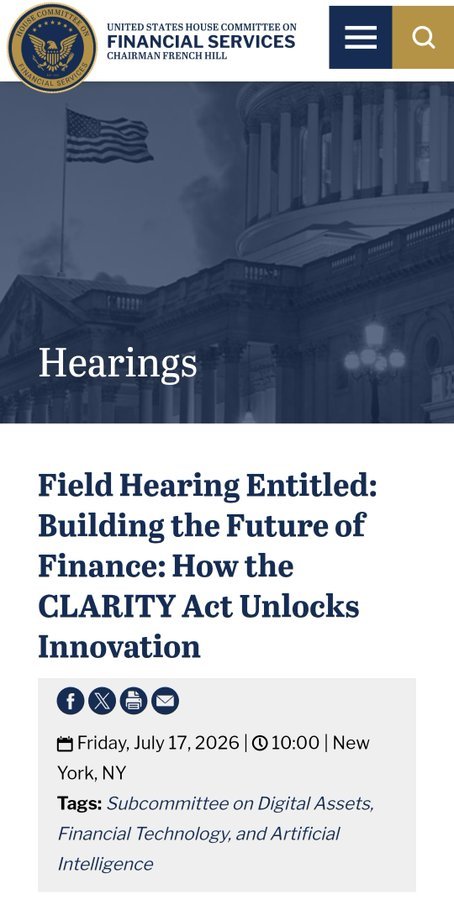
Kenny Nguyen:NEXT WEEK IS YUGE!!!! 😉 July 13-17: Potential Senate floor vote on the Clarity Act.. 📃 🇺🇸 July 15: DTCC + RIPPLE PRIME launch.. 🚀 🌙 July 17: US House Financial Services Committee hold a hearing on the impact of the Clarity Act in New York.. 📺 🎤 LOCK IN NOW
Iran sits front and center in the speculation mix for good reason. This implies that a decisive decision has been made in the war room. And major repositioning is about to take place.
With Zaidi’s DC trip looming and energy partnership language heating up, any loose threads on the Persian Gulf side get immediate priority. Strait of Hormuz dynamics, proxy network adjustments, and the flow of capital/influence through those channels don’t pause just because the calendar flips.
Clearing the deck allows the principal and key operators to lock in real-time assessments and contingency alignments without optics interference. This is the only reason I presume POTUS has cleared his schedule.
This window overlaps with backend ledger work on the financial side where Iraq’s diversification push and US partnership announcements intersect with broader Gulf realignments. Non-oil revenue ramps and private sector incentives in Baghdad create new pressure on older extraction models that relied on regional volatility.
A quiet three-day focus lets the architecture absorb any turbulence from Tehran-side responses or Israeli coordination signals without market noise or media amplification. But we will see over these next few days what he intends to do.
Source(s):
• https://x.com/Prolotario1/status/2075580811596746808
• https://x.com/Prolotario1/status/2075708562844578208
• https://x.com/Prolotario1/status/2075732625629564947
https://dinarchronicles.com/2026/07/11/prolotario-what-a-time-this-must-be-for-many-of-you/
Saturday Iraq News Posted by Tishwash at TNT 7-11-2026
TNT:
Tishwash: Iraqi PM Ali Faleh al-Zaidi to Visit Washington with High-Level Delegation for Economic and Security Talks
Iraqi Prime Minister Ali Faleh al-Zaidi will travel to Washington this week accompanied by a high-level ministerial and business delegation for talks aimed at strengthening economic, financial, energy, and security cooperation between Iraq and the United States.
TNT:
Tishwash: Iraqi PM Ali Faleh al-Zaidi to Visit Washington with High-Level Delegation for Economic and Security Talks
Iraqi Prime Minister Ali Faleh al-Zaidi will travel to Washington this week accompanied by a high-level ministerial and business delegation for talks aimed at strengthening economic, financial, energy, and security cooperation between Iraq and the United States.
High-Level Iraqi Delegation
Ali Faleh al-Zaidi will be accompanied by the ministers of Foreign Affairs, Oil, Finance, and Electricity, as well as the Governor of the Central Bank of Iraq.
The Minister of Communications, Mustafa Sanad, may also join the visit. The delegation also includes investors and representatives from companies operating in the energy, electricity, and banking sectors.
Focus of Talks with Washington
The Iraqi delegation is expected to discuss several key issues with U.S. officials, including security, the economy, trade, finance, and banking sector development.
Energy will be a central focus of the talks, covering oil, electricity, and natural gas, with discussions aimed at encouraging greater investment by U.S. companies in Iraq.
Meeting with Trump and Planned Agreements
According to the visit agenda, al-Zaidi is scheduled to meet U.S. President Donald Trump and other senior American officials.
The Iraqi government has expressed its readiness to expand investment opportunities for U.S. companies, and several new agreements and strategic understandings in the energy and financial sectors are expected to be signed during the visit.
Kurdistan Region Representation
Bayan Sami Abdul Rahman, Advisor to Masrour Barzani, will participate in part of the meetings between the Iraqi delegation and U.S. officials.
Her participation is intended to coordinate discussions on issues related to the Kurdistan Region and the future of its relations with Washington. link
************
Tishwash: Washington sets a condition for its partnership with Baghdad: ending the presence of weapons outside state control.
The United States renewed its support for the Iraqi government's efforts to restrict weapons to the state, stressing that the involvement of entities that Washington classifies as "terrorist" in state institutions is inconsistent with the nature of the partnership it seeks to build with Iraq, coinciding with warnings that the US-Iranian escalation could push Iraq back into the circle of conflict.
In an interview monitored by Al-Mada, the US Chargé d'Affaires in Baghdad, Joshua Harris, said that Washington believes that achieving full sovereignty for Iraq requires disarming all armed groups outside the authority of the state, considering that their existence contradicts the aspirations of Iraqis for stability and peace.
He added that the United States supports the Iraqi government's vision regarding the restriction of weapons and looks forward to its full and rapid implementation, stressing that the continued activity of illegal armed groups undermines the chances of security and stability in Iraq and the region.
In contrast, security expert Saif Raad Talib told Al-Mada that Iraq is still threatened with becoming an arena for exchanging messages between Washington and Tehran, in light of the escalating military confrontation between them, noting that the presence of armed factions, the continued violation of Iraqi airspace, and the weakness of air defense systems are the most prominent factors that increase this possibility.
He added that any new escalation, particularly in the Strait of Hormuz, could put Iraq in front of a major economic crisis, due to its oil exports being mainly dependent on Gulf ports, which could directly affect public revenues and budget financing.
In this context, the spokesman for the Iraqi government, Haider al-Aboudi, confirmed that September 30 will be the date for the end of the mission of the international coalition in Iraq, noting that the relationship will then turn into an economic and developmental partnership.
Al-Aboudi explained, in statements followed by (Al-Mada), that the government is proceeding with the implementation of the weapons control file in accordance with the constitution and the law, indicating that three parties have responded so far to the procedures for handing over weapons, while two other factions are preparing to complete the procedures, stressing that the disarmament process includes all types of weapons without exception or discrimination. link
************
Tishwash: The Central Bank Governor under the dome of Parliament: Crucial questions awaiting answers
All eyes will be on the Iraqi Parliament in the coming days, after the Parliamentary Finance Committee announced its intention to host the Governor of the Central Bank to discuss a number of financial and monetary issues, most notably the mechanism for distributing dollars to travelers, and the repercussions of the recent measures related to the cash dollar quota.
The head of the parliamentary finance committee, Uday Awad, said that the committee will ask questions during the meeting about the reasons for reducing the traveler's share of dollars from $3,000 to $2,000, stressing that there are observations on the mechanism for distributing dollars to travelers, which he described as having problems related to complexity, corruption, extortion and favoritism.
This hosting comes at a time when the monetary file in Iraq is witnessing widespread discussion, especially with the continued debate about the mechanisms for selling dollars, the Central Bank’s procedures for regulating the market, and the impact of this on exchange rates, trade and import activity.
Well-informed political sources indicated that the hosting session may witness the raising of sensitive issues related to the performance of the Central Bank during the past period, the mechanism for managing monetary policy, in addition to evaluating the measures taken to address the dollar market disturbances.
According to the sources, some parties within Parliament are considering the possibility of taking political steps if they are not convinced by the answers provided, amid talk of the possibility of raising the issue of changing the management of the Central Bank, but this remains linked to the results of the hosting and the political positions during the coming period.
Observers believe that the dollar issue has become one of the most prominent economic issues facing the government and parliament, as it is directly linked to prices, market activity, and citizens' confidence in the banking sector.
The next stage may reveal whether hosting the Central Bank Governor will be just an oversight session, or the beginning of larger moves that may affect the management of the monetary file in Iraq link
Tishwash: Following the "Al-Zaidi crackdown," the government is diverting recovered funds to support the economy in the largest repurposing of corruption money.
The government of Prime Minister Ali Faleh al-Zaidi is pursuing reform measures aimed at strengthening public financial management and enhancing the efficiency of financial institutions. This is being achieved through the adoption of new procedures based on the principles of transparency, good governance, and the sound investment of state resources.
Within this framework, the government's move to regulate the management of confiscated and recovered funds and assets by establishing a unified account is seen as a step towards transforming these resources from frozen or scattered funds into effective tools that can contribute to supporting the economy and financing development projects.
Observers believe these measures represent a shift in the way public resources are managed, moving towards a more organized and sustainable approach. This will enhance the confidence of citizens and investors and support the government's efforts in economic reform, combating waste, and maximizing non-oil revenues.
In this regard, the Prime Minister's financial advisor, Mazhar Muhammad Saleh, affirms that establishing a unified account for managing confiscated and recovered funds and assets is a crucial step in strengthening the state's financial management. He points out that this step will contribute to centralizing and managing these resources within a more efficient and transparent institutional framework.
Saleh told Iraq Observer that “establishing the unified account allows for the organized management of recovered funds, enhancing their utilization in supporting the national economy.” He explained that this initiative is part of the government’s efforts to regulate the management of confiscated and recovered assets and improve the efficiency of their utilization.
He added that the strategic use of these funds can yield greater economic returns, whether through their inclusion in development plans or investment in strategic projects that contribute to growth and job creation.
Saleh clarified that these resources represent an additional opportunity to strengthen public finances, emphasizing the importance of managing them according to the principles of governance, transparency, and efficiency. This will make them a source of funding for infrastructure projects and productive sectors, helping to diversify income sources and reduce dependence on oil revenues in the medium and long term.
The Prime Minister’s financial advisor pointed out that having additional financial resources gives the state greater flexibility in facing economic and regional challenges and helps it maintain financial stability and continue implementing its development programs.
He explained that the success of this step would enhance citizens' and investors' confidence in the state's financial management, especially given the importance of regularly announcing the amount of recovered funds and assets, their management mechanisms, and their uses, thus reinforcing the principles of transparency and accountability.
Saleh pointed out that the initiative's importance extends beyond simply recovering funds; it also encompasses building an institutional environment based on integrity and good governance. He noted that combating corruption contributes to reducing financial waste, lowering project costs, and improving the efficiency of public spending.
Saleh emphasized that strengthening governance and reducing corruption levels lead to increased efficiency in managing public projects and improved quality of services and infrastructure. He clarified that the true return on integrity lies not only in recovering funds but also in improving the performance of the national economy.
He concluded by saying that the initiative's success will not be measured solely by the amount of recovered funds but also by the state's ability to transform these resources, along with the savings resulting from curbing corruption, into productive investments and sustainable development projects. He affirmed that combating corruption represents an economic choice that impacts growth, financial stability, attracting investments, and improving the level of services.
On June 28, 2026, the Iraqi government, through its official spokesperson Haider al-Aboudi, announced the launch of Operation Dawn Charge, emphasizing that the operation would not cease and that it represented a radical shift in the state's policy toward corruption. He stressed that the pursuit of those involved would continue regardless of their positions or influence.
The first phase of the operation resulted in the arrest of dozens of officials and prominent political figures, including current and former members of parliament, and included raids in various parts of Iraq, including the heavily fortified Green Zone in Baghdad.
Prime Minister Ali Faleh al-Zubaidi also directed the Ministry of Finance to establish a special account for depositing recovered funds, with the aim of protecting public money and enhancing transparency in resource management.
Al-Zaydi affirmed that the current campaign represents "the first phase," to be followed by others, emphasizing that the government is tasked with protecting the interests of the Iraqi people and will not compromise on this responsibility. He also instructed oversight bodies to receive any reports concerning government performance or the performance of ministries in order to uncover cases of corruption or negligence. link
News, Rumors and Opinions Saturday 7-11-2026
Note: All intel should be considered as "Rumors" until we receive official announcements ...and “Rates and Dates” could change anytime until we get to the banks/redemption centers.
RV Excerpts from the Restored Republic via a GCR Update as of Sat. 11 July 2026
Compiled Sat. 11 July 2026 12:01 am EST by Judy Byington
Judy Note: Announcement of NESARA GESARA Debt Forgiveness Laws was imminent, which would mark the official start of the new system and end of the old World structure.
Note: All intel should be considered as "Rumors" until we receive official announcements ...and “Rates and Dates” could change anytime until we get to the banks/redemption centers.
RV Excerpts from the Restored Republic via a GCR Update as of Sat. 11 July 2026
Compiled Sat. 11 July 2026 12:01 am EST by Judy Byington
Judy Note: Announcement of NESARA GESARA Debt Forgiveness Laws was imminent, which would mark the official start of the new system and end of the old World structure.
Be prepared for worldwide Emergency Alerts, Blackouts, Lock-downs and Ten Days of Communication Darkness. Secure food, cash and essentials for two to three weeks when banks will be closed, ATMs won’t (allegedly) work during a transition to the new gold/asset-backed Global Financial System.
A controlled blackout across 10 major global hubs transitioned the planet from the corrupt SWIFT servers to the Quantum Financial System, which was now already active in the background. Global trust funds and seized Cabal assets have (allegedly) been moved into Quantum ledgers for return to The People.
Central Banks have been migrated. The new gold/asset-backed currency digital ISO 20022 is (allegedly) live. All transactions are traceable. Corruption has no place to hide.
The Quantum Financial System (QFWS) is already online. When the grid goes dark, the QFS will rewrite the entire fiat matrix. All damaged accounts – canceled. All pure assets – bio-metrically insured.
There will (allegedly) be a grounding of all transatlantic flights for a 24-hour verification window. No planes move until the new ISO20022 metal-backed currency protocols are verified at the 14 operational redemption centers.
Trust The Plan.
~~~~~~~~~~~~~
Global Currency Reset:
Thurs. 25 June 2026 Bruce, The Big Call The Big Call Universe (ibize.com) 667-770-1866 The new rates change on the Forex Sun. Night and they come up Mon morning, so we are expecting Mon-Tues notification for Tier4b (us, the Internet Group) Wed. 15 July could start exchanges. There were an estimated 1.2 million Zim Holders. Zim is to be used for humanitarian needs, with some for yourself. If you don’t have a humanitarian project you will be given a choice of some international ones to choose from.
On Tues. 7 July at exactly 14:10 EST, the physical communication lines connecting the Vatican Bank to the legacy SWIFT network were (allegedly) permanently severed by the Alliance financial task force.
Also on Tues. 7 July 2026 at exactly 06:00 EST the operational authority of the Federal Reserve System was (allegedly) permanently neutralized by an Alliance-backed financial task force. The old banking cartels officially lost their primary encryption keys, and the operational timeline for the next 72 hours has been locked into the live network.
Any day now the Cabal’s Central Banks around the World were anticipating a fiat US dollar collapse. This was necessary for the introduction of the new gold/asset-backed currency on the Quantum Financial System (QFS).
Wed. 8 July 2026 MarkZ: The Bond people claim they are absolutely receiving 1% of their payout on Fri. 10 July 2026. A source said it is rolling out East to West and Asia has already begun.
Wed. 8 July Wolverine Chat: Looks like things are moving 100%. Received news that things have officially started for the bonds. I hear that 4b should be released anytime this week. Amiel Alston: It’s a quarter past midnight here in South Africa. I just want to confirm that the overall picture is looking extremely positive and also moving very quickly. Um, and this is happening worldwide. So, as you rightfully pointed out, many people are now liquid, many people are paid. We won’t know exactly who that is because of the NDAs. But I can confidently say to everyone, all the groups except Tier 5 are moving according to sources that I have. So Tier 1, 2, 3, 4, even in South Africa and in some nations in Africa, are moving forward. Remember, China is spearheading the implementation of Gesara and the QFS in Africa, together with Russia and India.
Read full post here: https://dinarchronicles.com/2026/07/11/restored-republic-via-a-gcr-update-as-of-july-11-2026/
Courtesy of Dinar Guru: https://www.dinarguru.com/
Boots On The Ground Guru OMAROn television Prime Minister Z is going to leave Iraq on Monday the 13th. He's leaving with a whole bunch of businessmen out of Iraq that are going to Washington to see the president in the United States of America. They're going to be there six days...He's going to leave a couple days early...Then they'll get back over here...around the 19th or 20th. Then they said they were going to get the cabinet right away announced...
Mnt Goat I have been telling everyone for years that this Iranian proxy status in Iraq must end and Iran must be taken down and we would not see the RV until this happens...Now it is happening and the takedown is underway. We all should be very happy for this situation not gloomy....
Reset IntelligenceFor years, Iraq's central bank sold dollars at the official rate to anyone who could show paperwork for imported goods. Much of that paperwork was fake...The cheap official dollars flowed straight...to Tehran and the militias it funds. One Baghdad bank alone is accused of pulling 6.5 billion dollars out of the auction on fraudulent paper. That fraud... was a supply line, and Iran stood at the end of it, fed dollars the United States itself had wired into Iraq's account. This morning it changed. Iraq switched on ASYCUDA, a customs system...so the fake paper stops clearing. The central bank also cut the cash dollars a traveler can carry from 3,000 to 2,000 a month, closing the retail leak alongside it.
**************
Japan's YEN IS CRASHING as the BOND CRISIS BLEEDS Into Currency Markets
Lena Petrova: 7-11-2026
For decades, Japan has been an intriguing anomaly in the global financial landscape. Boasting the world’s most significant government debt, exceeding 200% of its GDP, the nation remarkably maintained remarkably low borrowing costs.
This unusual stability was largely attributed to bold monetary policies, including extensive quantitative easing and negative interest rates, which effectively kept Japanese government bond (JGB) yields suppressed.
However, recent developments suggest this long-standing equilibrium is undergoing a substantial shift, raising important questions about its internal stability and potential global implications.