
News, Rumors and Opinions Saturday 7-4-2026
Note: All intel should be considered as "Rumors" until we receive official announcements ...and “Rates and Dates” could change anytime until we get to the banks/redemption centers.
Excerpts from the GCR Update as of Sat. 4 July 2026
Compiled Thurs. 2 July 2026 12:01 am ET by Patrick DaCosta
Global Currency Reset:
Fri. 3 July 2026 The ISO 20022 Integration and the End of Legacy Banking: According to recent reports from within the Tier 4B and ISO 20022 community, the migration to the new financial ledger has officially overtaken legacy mainframe systems. The integration is characterized as “complete,” signaling a permanent detachment of debt and mortgage ledgers from the traditional central banking grid. As a result, a “zero-out sequence” is currently running, effectively neutralizing old debt structures.
Note: All intel should be considered as "Rumors" until we receive official announcements ...and “Rates and Dates” could change anytime until we get to the banks/redemption centers.
Excerpts from the GCR Update as of Sat. 4 July 2026
Compiled Thurs. 2 July 2026 12:01 am ET by Patrick DaCosta
Global Currency Reset:
Fri. 3 July 2026 The ISO 20022 Integration and the End of Legacy Banking: According to recent reports from within the Tier 4B and ISO 20022 community, the migration to the new financial ledger has officially overtaken legacy mainframe systems. The integration is characterized as “complete,” signaling a permanent detachment of debt and mortgage ledgers from the traditional central banking grid. As a result, a “zero-out sequence” is currently running, effectively neutralizing old debt structures.
Fri. 3 July 2026 NESARA/GESARA and Rainbow Currency: The reveal of NESARA (National Economic Security and Recovery Act) marks a radical departure from the status quo of the Federal Reserve. The core of this transition is the “Jubilee,” or a total forgiveness of debt, including credit cards and mortgages tied to what are described as illigal banking activities. In a move that would fundamentally reorganize the American economy, the act proposes the abolition of the IRS and the total removal of income tax.
Fri. 3 July 2026MarkZ and the Iraqi Progress: During the July 3rd “Coffee with MarkZ” session, featuring guests like Mr. Cottrell and Wade Holder, the discussion focused on the “rollercoaster” of timing regarding the Revaluation (RV). While there is significant debate among sources—some pointing to a July release and others suggesting a September timeline to coincide with troop withdrawals from Iraq—the consensus remains that a massive “clean-up” operation is underway. The intel highlights significant progress in Iraq, where Prime Minister Ali al-Zaidi has reportedly led an anti-corruption crackdown resulting in the recovery of 3 quadrillion dinars from corrupt officials. There are also reports that Iraqi funds previously frozen by the Federal Reserve have been released, sparking speculation that the Dinar rate is being digitally adjusted behind the scenes. While some prominent voices in the community have gone silent—potentially due to Non-Disclosure Agreements (NDAs)—the general sentiment remains optimistic, with many looking toward the 250th anniversary of the United States as a symbolic window for these historic changes to fully manifest.
~~~~~~~~~~~~~~
Fri. 3 July 2026 NESARA/GESARA Revealed …Web3.0 ISO20022 on Telegram
NESARA implements the following changes:
Zeros out all credit card, mortgage, and other bank debt due to i*****l banking and government activities. This is the Federal Reserve’s worst nightmare:
• A “jubilee” or a forgiveness of debt.
• Abolishes the income tax.
• Abolishes the IRS. Employees of the IRS will be transferred into the US Treasury national sales tax area.
• Creates a 14% flat rate non-essential ‘new items only’ sales tax revenue for the government. In other words food and medicine will not be taxed; nor will used items such as old homes.
• Increases benefits to senior citizens.
• Creates a new U.S. Treasury, ‘rainbow currency,’ backed by gold, silver, and platinum precious metals, ending the bankruptcy of the United States initiated by Franklin Roosevelt in 1933.
• Initiates new U.S. Treasury Bank System in alignment with Constitutional Law.
• Eliminates the Federal Reserve System. During the transition period the Federal Reserve will be allowed to operate side by side of the U.S. treasury for one year in order to remove all Federal Reserve notes from the money supply.
• Restores financial privacy
Read full post here: https://dinarchronicles.com/2026/07/04/dinar-chronicles-via-a-gcr-update-as-of-july-4-2026/
************
Courtesy of Dinar Guru: https://www.dinarguru.com/
Militia Man What we're seeing is real change. It's been building. It's been building out better than I've ever seen in my life in the dinar...I still talk about what I believe in because I know what I own. It's building out in our favor.
Boot-On-The-Ground Guru Omar Prime Minister's legal advisor...said the looted funds have exceeded $2 trillion and public trials are anticipated for the corrupt defendants...They are telling us [$2 trillion] equals 3 quadrillion Iraqi dinars to date have been stolen.
Reset Intelligence Parliament votes on the final 9 ministers Sunday July 5, interior and defense included, with Kurdish support consolidated by a fresh PUK alliance. The White House has confirmed it will host the prime minister in mid-July.
Mnt Goat It is going to happen and it is in the plan for Iraq and part of the bigger RESET picture. These larger notes we hold are going to stay legal tender and used for inter-banking transactions of large amounts, when cash is needed. The CBI told us this many times.
The Real Reason Gold Turned This Week, and Who's Quietly Buying | This Week In Focus
Kitco News: 7-4-2026
Gold just closed its worst quarter in more than 13 years, then roared back above $4,100 as the new Fed chair signaled he may ease off. Is the gold selloff over, and is gold a buy now?
This week in focus: what actually turned gold around, why the world's central banks never stopped buying, and what happens next, with Rick Rule, Jeff Sarti, and Chris Vermeulen.
Plus, Kitco goes live from Rick Rule's Natural Resource Investing Symposium in Boca Raton on Monday. Anchor Jeremy Szafron breaks down the week: gold's worst quarter in 13 years and the sharp reversal, the Warsh comment that JPMorgan said sent the debasement trade roaring back, the soft jobs report that cooled Fed rate-hike bets, the AI and chip selloff that rotated money into defensives and gold, why Western ETF selling met relentless central-bank buying, the gold miners priced as if gold were only $3,350, and the signals to watch from here.
Not investment advice, you decide.
CHAPTERS
00:00 The Comeback
00:40 The Turn: Worst Quarter, Then This
01:30 Why the Fed Blinked
04:00 The Buyers Who Never Left
07:00 Silver and the Miners
10:00 What Comes Next
Iraq Economic News and Points To Ponder Saturday Morning 7-4-26
Government Plans To Raise Non-Oil Revenues To 45% In 10 Years
Money and business Economy News – Baghdad The financial adviser to the Prime Minister, the appearance of Mohammed Saleh, on Friday, that the total public debt of Iraq is still within the limits that can be managed according to international standards, pointing out that the government plans aim to raise non-oil revenues to 45% within ten years.
Government Plans To Raise Non-Oil Revenues To 45% In 10 Years
Money and business Economy News – Baghdad The financial adviser to the Prime Minister, the appearance of Mohammed Saleh, on Friday, that the total public debt of Iraq is still within the limits that can be managed according to international standards, pointing out that the government plans aim to raise non-oil revenues to 45% within ten years.
Saleh said that "talk about the entry of the economy in the danger zone when public debt exceeds 40% of public revenues must be read within a set of financial indicators, and not in isolation from them, because international institutions do not adopt this indicator alone, but also look at the ratio of debt to GDP, the cost of debt service, and the ability of the state to generate and sustain revenues."
He added that "the bulk of the Iraqi debt is internal debt, while the decline in external debt in recent years, which makes the real challenge linked to the nature of public revenues, which depends heavily on oil, which makes public finances vulnerable to fluctuations in oil prices in global markets," noting that "any decline in oil prices raises the debt-to-revenue ratio and increases pressure on the general budget, even if the public debt did not witness a significant increase. "
He pointed out that "the external debt to be paid until 2028 does not exceed about $ 9 billion, and in addition to the internal debt, the total debt represents about 36% of GDP, which is still within the limits that can be managed according to international standards that speak of more than 60%."
He added that "this percentage may decrease further if the settlement of the outstanding amounts within the 2004 Paris Club Agreement, which has not been resolved so far, as these obligations belong to about eight countries, including Gulf countries, and it is expected that their deduction will lead to the write-off of at least 80% of those amounts, and perhaps more, in accordance with the terms of the standard agreement."
Saleh explained that "the internal debt exceeded 100 trillion dinars, equivalent to about 80 billion dollars when calculated in foreign currency, which represents the largest part of the total public debt," pointing out that "the impact of internal debt on the financial independence of Iraq remains limited as long as the external debt within the levels can be managed, especially that the external obligations due until 2028 remain relatively limited. "
He stressed that "the continuation of the fiscal deficit and dependence on borrowing, especially in the event of low oil prices, may reduce the flexibility of fiscal policy and increase the need for reform and financing measures," noting that "the International Monetary Fund confirms that the main challenge for Iraq is not the size of debt as much as it is to contain the fiscal deficit and diversify sources of public revenues."
"The current fiscal policy is working to gradually raise the contribution of non-oil revenues to about 45 percent of total public revenues over the next 10 years, compared to the current situation, in which non-oil revenues do not exceed 10% of total revenues," he said.
He explained that "this is achieved through improving tax and customs collection, automating financial systems, expanding the tax base, revitalizing the private sector and investment, and reforming the banking sector," noting that "these measures need time to be fully reflected on the financial reality, but they represent the most sustainable path to address the problem of liquidity, reduce dependence on oil, and enhance the ability of the Iraqi economy to cope with external shocks and achieve long-term financial stability. "
He pointed out that "there are arrears representing the benefits of the private sector of contractors, farmers and others equivalent to the internal debt, and called (arrears), and if it is not possible to pay it will enter into the internal debt category to be settled fundamentally https://www.economy-news.net/content.php?id=70942
Oil Products: No Manipulation Of The Quality Of Gas Oil (Kaz) Equipped For Residential Generators
Locals Economy News – Baghdad The Oil Products Distribution Company denied on Saturday the existence of any quality manipulation (Kaz) equipped for generators within the free quota.
The company said in a statement received by "Economy News" that it "categorically denies the existence of any manipulation of the quality of gas oil (Kaz) equipped for residential generators within the free quota for the months of July and August."
She added that "the inspections are continuing and that the quantities processed within the required specification."
https://www.economy-news.net/content.php?id=70989
Europe Is Worried About The Development Of Artificial Intelligence
Arab and International Economy News - Follow-up Fears are mounting within Europe that the rapid development of artificial intelligence technologies is outpacing regulatory frameworks, at a time when warnings are mounting of the implications for the financial stability and competitiveness of the old continent.
While artificial intelligence is seen as a key driver for boosting productivity and boosting economic growth, regulators and central banks see its risks evolving faster than its rules and regulations, posing unprecedented challenges for policymakers.
Officials in European central banks and regulators said the legislative preparation cycle was no longer able to keep up with the speed of innovation, especially with the emergence of technologies such as proxy artificial intelligence, which open wide economic horizons, but at the same time raise growing concerns about the safety of markets and the financial system.
At the same time, the gap between Europe and the United States in the race for artificial intelligence is widening, as investors see Europe’s dependence on bank financing as limiting the flow of investment to this sector, compared to the United States, which benefits from capital markets in financing giant technology companies, threatening to reduce European competitiveness in one of the most important strategic sectors.
Financial regulation in Europe has struggled to keep pace with the rapid development of artificial intelligence, according to European policymakers, who are grappling with how to support adoption while containing risks to market integrity and stability.
Nikhil Rathi, Chief Executive of the Financial Conduct Authority of Britain, acknowledged that traditional regulatory tools are no longer enough to keep pace with successive developments, stressing that the pace of innovation in artificial intelligence requires regulators to reconsider the methods of setting rules and supervisory mechanisms.
European Central Bank President Christine Lagarde stressed that artificial intelligence represents a great opportunity to boost productivity and support economic growth, but at the same time warned that it carries risks that may be more complex than traditional cybersecurity threats.
Lagarde pointed out that the speed of development of these technologies exceeds the ability of existing protection tools to contain their risks.
Sarah Breden, deputy governor of the Bank of England, warned that the expansion of the use of proxy artificial intelligence technologies within financial markets may increase volatility during periods of crisis, calling for the development of stricter control mechanisms, including automatic stop-trading systems to reduce the risk of any mistakes that may be made by artificial intelligence models.
In parallel with regulatory concerns, investment concerns are also growing, with European officials seeing the continent as required to accelerate its investment in artificial intelligence, boost its own capabilities and maintain its technological sovereignty, without compromising the requirements of financial stability https://www.economy-news.net/content.php?id=70986
Basrah Crudes Lose Up To 10% Weekly
2026-07-04 02:35 Shafaq News- Basrah Iraq's Basrah crudes posted weekly losses of 1.57% and 10.42%, despite a modest rebound in global benchmark prices during the final trading session.
Basrah Heavy slipped 16 cents, or 0.27%, to close at $60.09 per barrel, bringing its weekly decline to 96 cents. Basrah Medium lost $5.16, or 8.28%, to settle at $57.19 per barrel, widening its weekly loss to $5.96.
International benchmark prices ended higher, with Brent gaining 32 cents, or 0.45%, to $72.12 per barrel, while US West Texas Intermediate advanced 9 cents, or 0.13%, to $68.78 per barrel.
https://www.shafaq.com/en/Economy/Basrah-crudes-lose-up-to-10-weekly
Dollar Falls Against Iraqi Dinar In Baghdad And Erbil
2026-07-04 04:10 Shafaq News- Baghdad/ Erbil The US dollar opened Saturday’s trading lower in Iraq, hovering around 154,000 dinars per 100 dollars.
According to Shafaq News market survey, the dollar traded in Baghdad's Al-Kifah and Al-Harithiya exchanges at 154,250 dinars per 100 dollars, down from the previous session’s 154,750 dinars.
In the Iraqi capital, exchange shops sold the dollar at 154,750 dinars and bought it at 153,750 dinars, while in Erbil, selling prices stood at 154,100 dinars and buying prices at 154,000 dinars.
https://www.shafaq.com/en/Economy/Dollar-falls-against-Iraqi-dinar-in-Baghdad-and-Erbil
Seeds of Wisdom RV and Economics Updates Saturday Morning 7-4-26
Good Morning Dinar Recaps,
U.S. Law Enforcement Group Drops Opposition to CLARITY Act, Clearing Key Legislative Hurdle
The Major County Sheriffs of America (MCSA) has withdrawn its opposition to the CLARITY Act after lawmakers addressed several of the organization's concerns, removing one of the bill's most significant obstacles as the Senate prepares for a potential vote.
Good Morning Dinar Recaps,
U.S. Law Enforcement Group Drops Opposition to CLARITY Act, Clearing Key Legislative Hurdle
The Major County Sheriffs of America (MCSA) has withdrawn its opposition to the CLARITY Act after lawmakers addressed several of the organization's concerns, removing one of the bill's most significant obstacles as the Senate prepares for a potential vote.
Overview
The Major County Sheriffs of America (MCSA) has changed its position on the CLARITY Act from opposition to neutral after revisions addressed key law enforcement concerns.
The shift removes a major obstacle for the legislation as lawmakers continue working toward a full Senate vote.
While supporting the bill's progress, the organization continues to advocate for stronger resources and authority for state and local law enforcement to combat digital asset-related financial crime.
Key Developments
1. Law Enforcement Withdraws Opposition
The Major County Sheriffs of America (MCSA) announced it is no longer opposing the CLARITY Act, stating that several concerns raised earlier regarding the legislation have been addressed through discussions with lawmakers.
2. Blockchain Liability Provisions Remain a Focus
A central concern involved Section 604, which incorporates the Blockchain Regulatory Certainty Act. The provision is designed to protect blockchain developers from liability for illicit activity conducted by users on decentralized networks, provided the developers do not control user transactions.
3. Senate Path Becomes Clearer
The removal of organized law enforcement opposition is viewed by many observers as an important step toward advancing the legislation through the Senate. Lawmakers continue pushing for a floor vote in the coming weeks before the congressional calendar becomes more constrained.
4. Additional Amendments Still Requested
Although adopting a neutral position, the MCSA continues to request amendments that would provide state and local law enforcement agencies with additional training, investigative tools, funding, and participation in federal studies addressing decentralized finance (DeFi) and illicit finance risks.
Why It Matters
The CLARITY Act seeks to establish a comprehensive regulatory framework for digital assets while balancing innovation with consumer protection and financial crime enforcement. Reduced opposition from major law enforcement organizations could improve the bill's chances of advancing through Congress and provide greater regulatory certainty for the digital asset industry.
Why It Matters to Foreign Currency Holders
Although the legislation primarily focuses on digital assets, stronger regulatory clarity for blockchain technology may accelerate the modernization of global financial infrastructure. Investors monitoring digital payment systems, tokenized assets, and future cross-border financial innovation will be watching the legislation's progress closely.
Implications for the Global Reset
Pillar 4 – Technology
Advancing the CLARITY Act supports the development of regulated blockchain infrastructure, clearer digital asset rules, and broader institutional adoption of tokenized financial technologies within the United States.
Future Outlook
The Senate is expected to continue negotiations as lawmakers work toward a full floor vote on the CLARITY Act. While bipartisan support continues to build, additional amendments related to financial crime enforcement and stablecoin regulation could still shape the final version of the legislation. If enacted, the bill would represent one of the most significant updates to U.S. digital asset regulation and could influence global regulatory standards.
This is not just about cryptocurrency—it reflects the United States' continuing effort to modernize financial regulation while balancing innovation, investor protection, and the fight against illicit financial activity.
Seeds of Wisdom Team
Newshounds News™ Exclusive
Sources
~~~~~~~~~~
🌱 A Message to Our Currency Holders🌱
If you’ve been holding foreign currency for many years, you were not foolish.
You were not wrong to believe the global financial system would change.
What failed was not your patience — it was the information you were given.
For years, dates, rumors, and personalities replaced facts, structure, and proof. “This week” predictions created cycles of hope and disappointment that were never based on how currencies actually change.
That is not your failure.
Our mission here is different: • No dates • No rates • No hype • No gurus
Instead, we focus on:
• Verifiable developments • Institutional evidence
• Global financial structure • Where countries actually sit in the process
Currency value changes only come after sovereignty, trade, banking, settlement systems, and fiscal coordination are in place. History and institutions confirm this sequence.
You will see silence. You will see denials. That is not delay — that is discipline.
Protect your identity. Organize your documents. Verify everything.
Never hand your discernment to anyone who cannot show proof.
You deserve truth — not timelines.
Seeds of Wisdom Team
Newshounds News
~~~~~~~~~~
Seeds of Wisdom Team RV Currency Facts Youtube and Rumble
Newshound's News Telegram Room Link
RV Facts with Proof Links Link
RV Updates Proof links - Facts Link
Start Here room with Most Asked Questions Link
Follow the Gold/Silver Rate COMEX
Follow Fast Facts
Seeds of Wisdom Team™Website
Thank you Dinar Recaps
Ariel: How POTUS is Setting the US up for an Asset Backed Economy
Ariel: How POTUS is Setting the US up for an Asset Backed Economy
7-3-2026
The Gold Reset Playbook: How POTUS Is Setting The US Up For A Asset Backed Economy
The eagle on the White House balcony isn’t window dressing. It’s a deliberate callback to a working-class ritual that peaked before the full decoupling from hard assets. Homeowners once nailed up those Freedom Flyer plaques brass or metal eagles over garages and doors the moment the mortgage note got burned.
Paid in full. No more bank leash.
Ariel: How POTUS is Setting the US up for an Asset Backed Economy
7-3-2026
The Gold Reset Playbook: How POTUS Is Setting The US Up For A Asset Backed Economy
The eagle on the White House balcony isn’t window dressing. It’s a deliberate callback to a working-class ritual that peaked before the full decoupling from hard assets. Homeowners once nailed up those Freedom Flyer plaques brass or metal eagles over garages and doors the moment the mortgage note got burned.
Paid in full. No more bank leash.
The practice faded hard after the 1971 gold window slammed shut and fiat debt exploded. Bringing that symbol back onto the executive mansion during the 250th isn’t nostalgia. It’s narrative engineering for a nation supposedly shedding its own chains.
Fort Knox sits at the center. Public calls for a physical audit aren’t theater when the principal has repeatedly signaled knowledge of discrepancies missing bars, unreconciled transfers, the quiet bleed documented in off-books movements across administrations.
The real reserves exceed official tallies if you account for deep-stored holdings, allied custodial arrangements, and recovered assets from historical operations that never hit public ledgers.
An audit confirming mass doesn’t just restore confidence. It detonates the fractional reserve fiction underpinning the note system. When physical gold reprices at multiples of current paper $15k-$25k+ range in full unwind scenarios the separation becomes operational.
The Treasury dollar backed by tangible reserves diverges from the Fed’s debt instrument. Stablecoin rails, already stress-tested in pilot structures, bridge the transition for velocity while gold anchors value.
This isn’t overnight jubilee for the majority of the world. But if you got foreign currency that may definitely be the case for you. Just research what happened with Kuwait. It’s engineered transition with teeth.
Physical verification at Fort Knox forces the narrative.
Repriced gold exposes the note’s debasement.
Gold-stablecoin hybrid rails operationalize the shift.
The eagle flies again as public symbol of what the balance sheet is quietly achieving: freedom from the old debt master.
Read Full Article:
https://www.patreon.com/Prolotario1/posts/gold-reset-how-162746357
Rob Cunningham: The Asset, Collateral, Lending, Liquidity, and Efficiency Flywheel
Rob Cunningham: The Asset, Collateral, Lending, Liquidity, and Efficiency Flywheel
7-3-2026
THE ASSET, COLLATERAL, LENDING, LIQUIDITY & EFFICIENCY FLYWHEEL
If this Flywheel Engine produces a major productivity and velocity shock, a plausible hypothetical Global GDP 5 year growth could elevate a $40T GDP to $56T – $80T GDP over 5 years, or roughly 40% to 100% larger than the original $40T economy.
Rob Cunningham: The Asset, Collateral, Lending, Liquidity, and Efficiency Flywheel
7-3-2026
THE ASSET, COLLATERAL, LENDING, LIQUIDITY & EFFICIENCY FLYWHEEL
If this Flywheel Engine produces a major productivity and velocity shock, a plausible hypothetical Global GDP 5 year growth could elevate a $40T GDP to $56T – $80T GDP over 5 years, or roughly 40% to 100% larger than the original $40T economy.
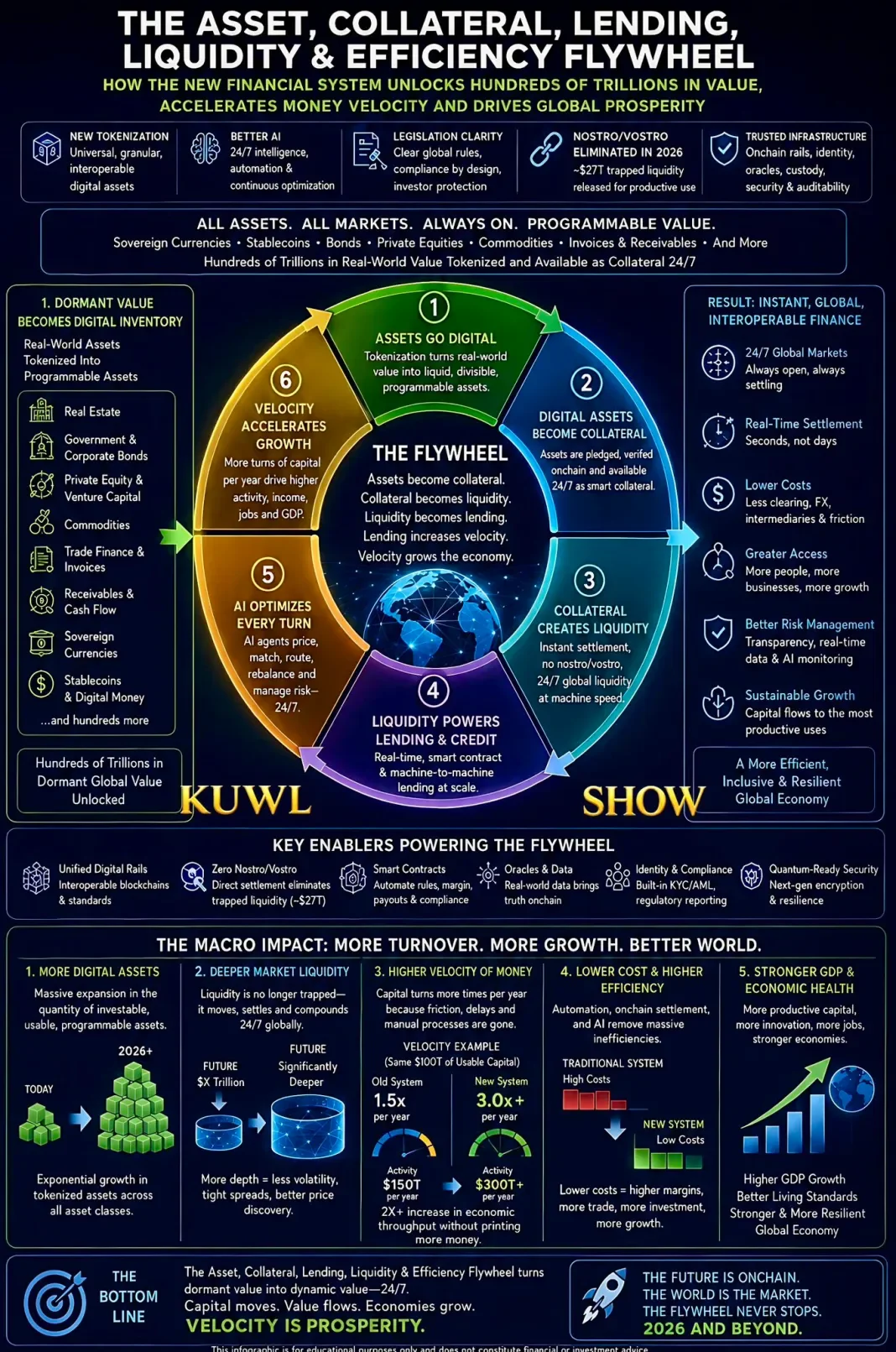
The New Flywheel looks like this:
1. Dormant value becomes digital inventory
Real estate, bonds, private equity, commodities, invoices, currencies and receivables become programmable financial objects.
2. Digital inventory becomes collateral
Assets no longer sit still. They can be pledged, rehypothecated within rules, financed, lent against, settled, and released in real time.
3. Collateral becomes liquidity
Instead of waiting days for custody, settlement, reconciliation, FX, clearing and banking hours, value becomes available 24/7.
4. Liquidity becomes lending capacity
More usable collateral means more credit formation without needing the same amount of new debt-money creation.
5. AI increases turnover
AI agents identify mispriced assets, collateral gaps, funding needs, FX routes and lending opportunities continuously.
6. Lower friction increases velocity
BIS has described tokenized unified ledgers as a next-generation system combining money, deposits and assets on programmable rails, while Deutsche Bank notes tokenized collateral can increase collateral mobility and velocity.
The biggest GDP effect is not “more tokens.” It is less trapped time.
If capital currently turns 1–2 times per year in slow markets, but tokenized settlement, AI routing and instant collateral reuse raise that to 3–6 times, the growth rate of velocity could rise dramatically.
One Clear Example:
$100T of usable collateral
at 1.5x annual velocity = $150T activity
at 3.0x velocity = $300T activity
That is not a 1.5% increase.
That is a 100% increase in turnover capacity.
LOCK IN. History is Happening.
Sound Money on Quantum Steroids has Arrived in 2026 for Global @Freedom250 to Prosper!
Source(s):
• https://x.com/KuwlShow/status/2072829484387221786
Kuwait did this Right Before their Dinar Revalued
Kuwait did this Right Before their Dinar Revalued
The Dinar Den: 7-3-2026
A recent insightful analysis from The Dinar Den offers a compelling comparison between Iraq’s current economic and currency landscape and Kuwait’s experience after the Gulf War in 1991.
The video, presented by Stephen, an investor who has closely followed the Iraqi dinar for over a decade, delves into historical precedents, economic indicators, and recent global developments, suggesting strong parallels that could point towards a significant financial event for the Iraqi dinar.
Kuwait did this Right Before their Dinar Revalued
The Dinar Den: 7-3-2026
A recent insightful analysis from The Dinar Den offers a compelling comparison between Iraq’s current economic and currency landscape and Kuwait’s experience after the Gulf War in 1991.
The video, presented by Stephen, an investor who has closely followed the Iraqi dinar for over a decade, delves into historical precedents, economic indicators, and recent global developments, suggesting strong parallels that could point towards a significant financial event for the Iraqi dinar.
The discussion highlights that Kuwait, following its recovery, didn’t merely revalue its dinar but effectively reinstated its currency to its robust pre-war standing.
This powerful recovery was underpinned by vast sovereign assets, extensive oil reserves, and strategic international corporate partnerships, which collectively solidified the Kuwaiti dinar as one of the world’s strongest currencies.
The video posits that Iraq, too, possesses immense oil and natural gas reserves and is currently engaged in multi-billion-dollar international trade and infrastructure agreements. A notable example cited is a monumental $400 billion U.S.-Iraq energy fund, specifically designed to significantly boost oil production, signaling a foundational shift in Iraq’s economic trajectory.
These substantial developments, the analysis suggests, indicate that Iraq’s current dinar rate, which has largely remained around 1310 dinar per US dollar for more than twenty years, might soon be adjusted to better reflect the nation’s burgeoning economic strength.
Stephen emphasizes a core principle: a nation’s currency value is intrinsically linked to its sovereign assets and its geopolitical relationships.
The video details Iraq’s active steps toward modernizing its banking and financial systems, digitizing its economy, and integrating significant international investments. These initiatives bear a resemblance to the strategic reforms Kuwait undertook prior to its currency reinstatement.
Furthermore, the analysis points to Iraq’s efforts in restructuring its currency notes, including the reported deletion of zeros, which could be interpreted as preparatory groundwork for a revaluation or reinstatement of the dinar.
The presentation further reinforces Iraq’s economic fundamentals by noting its strong central bank reserves. These include nearly $98 billion in foreign currency reserves and approximately $26 billion in gold, providing substantial backing for its currency.
While acknowledging Iraq’s sizable money supply, estimated around $170 billion equivalent, the video underscores how new trade agreements and investments, particularly those involving American and Gulf corporations, are perceived to create a robust foundation for a potentially higher-valued dinar.
Strategic infrastructure projects and geopolitical maneuvers, such as a new pipeline agreement designed to bypass the critical Strait of Hormuz, are also highlighted as key efforts by Iraq to secure uninterrupted revenue flows and enhance economic stability.
The video concludes with an optimistic outlook, suggesting that Iraq appears to be following a similar economic and financial trajectory as Kuwait, implying that a currency reinstatement or revaluation could be a near-future event.
Stephen encourages interested parties to remain well-informed and mentions upcoming community discussions with experts who personally witnessed Kuwait’s currency reinstatement. While the video explicitly offers no financial advice, the presenter conveys a strong personal belief that the Iraqi dinar will experience a significant financial adjustment, presenting what many observers consider an extraordinary potential development.
America Turns 250 At 125, It Looked Like the End
America Turns 250 At 125, It Looked Like the End
Notes From the Field By James Hickman (Simon Black / Sovereign Man) July 3, 2026
On the afternoon of September 6, 1901, President William McKinley stood in a receiving line at the Pan-American Exposition in Buffalo, New York, shaking hands with a crowd of well-wishers.
One of the people in the crowd was a young man named Leon Czolgosz... who was patiently waiting with a revolver wrapped in a handkerchief. When he reached the front, he fired twice into the president's abdomen.
America Turns 250 At 125, It Looked Like the End
Notes From the Field By James Hickman (Simon Black / Sovereign Man) July 3, 2026
On the afternoon of September 6, 1901, President William McKinley stood in a receiving line at the Pan-American Exposition in Buffalo, New York, shaking hands with a crowd of well-wishers.
One of the people in the crowd was a young man named Leon Czolgosz... who was patiently waiting with a revolver wrapped in a handkerchief. When he reached the front, he fired twice into the president's abdomen.
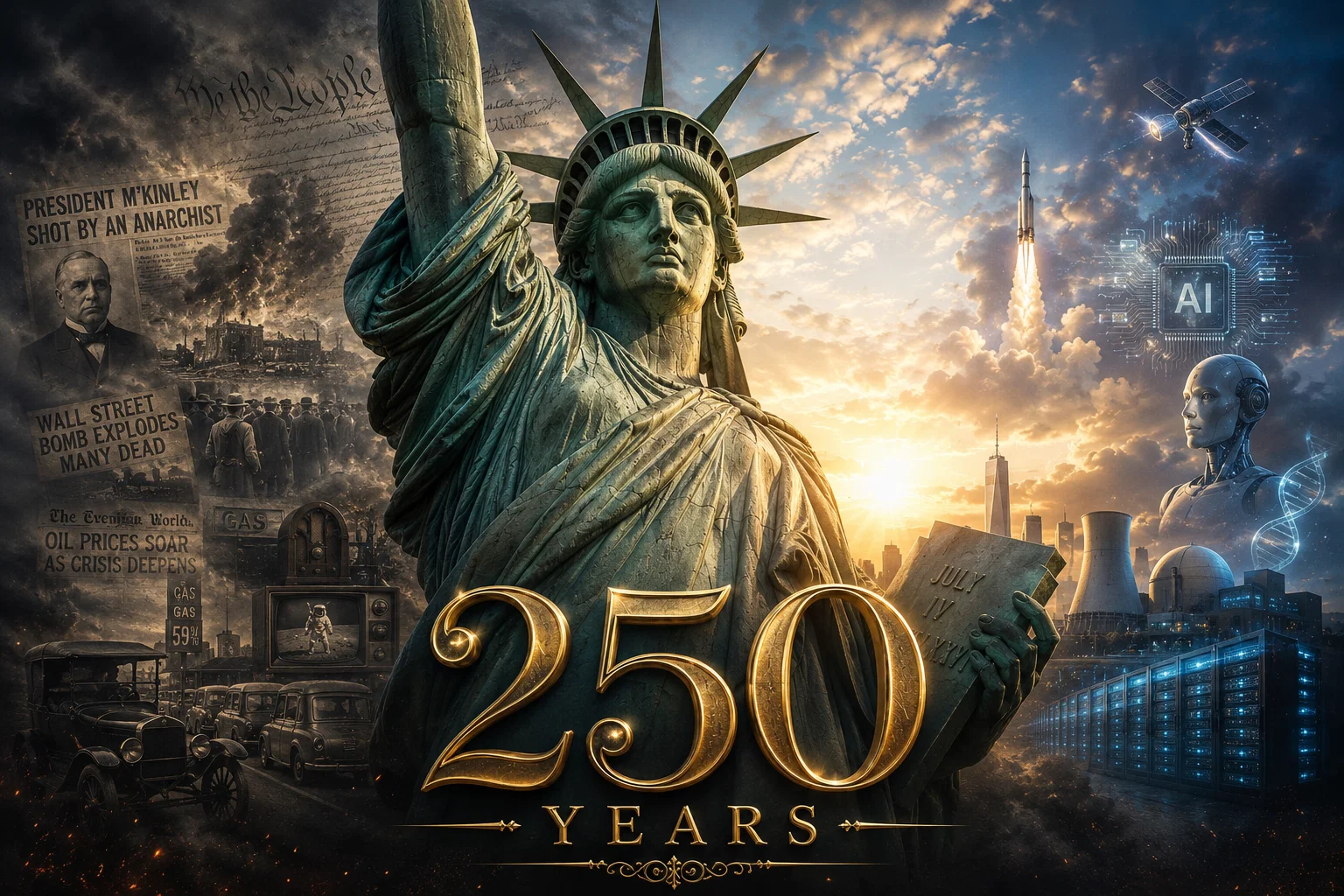
McKinley died eight days later, and, Czolgosz, an unemployed factory worker, went to the electric chair without a trace of remorse. He insisted it was his duty to strike down a symbol of oppression.
Czolgosz wasn’t a crazed madman, but rather a product of his time. The America of 1901 was 125 years into its history— the exact midpoint between the Declaration of Independence and today.
And despite the US economy already being the largest in the world at that point, the year 1901 did not feel like a nation striding confidently into the American Century.
The US financial system lurched from panic to panic, and to a great many observers, the young republic looked less like a rising power and more like a country unraveling.
The rich versus poor divide was growing, and violent socialist movements spread. Political assassinations, terrorism, and bombings became a recurring feature of public life.
The political violence did not end with McKinley’s assassination, either. Followers of the Italian anarchist Luigi Galleani waged a years-long bombing campaign against judges, politicians, and businessmen.
It peaked at noon on September 16, 1920, when a horse-drawn wagon packed with explosives detonated in front of the headquarters of J.P. Morgan on Wall Street, killing thirty people and wounding hundreds more. The case was never solved.
Many of these anarcho-socialists were immigrants, which poured gasoline on the raging blaze of backlash against widespread immigration.
In 1907 alone, more than a million people passed through Ellis Island. Immigrants were arriving faster than anyone knew how to absorb them, and people were getting tired of it.
Congress passed legislation that imposed a literacy test on immigrants, then banned entire countries. At first, people from Asia and the Middle East were shut out. Subsequent legislation set strict quotas, slamming the door on the southern and eastern Europeans who were considered undesirable.
Yet the instability continued... as did the government’s push to consolidate power.
After the Panic of 1907 nearly brought down the financial system, Congress used the scare to establish the Federal Reserve in 1913. This was the first step toward money that could be printed at will.
Also in 1913, the Constitution was amended, giving Congress the power to tax income.
The income tax (16th Amendment) was sold to the American people as a tax on the very rich that would only affect the top 2% of US households. Idiotic socialists at the time believed the lie and supported the amendment; after all, the rich should pay their fair share.
Within decades, three quarters of Americans were paying income tax.
With a new central bank and tax power in place, Washington then raced to join World War I (despite being an ocean away), and borrowed on an unimaginable scale to do it.
Frankly it all looked pretty bleak.
And yet, while all the bad news and turmoil was ongoing, America was simultaneously producing miracles.
Henry Ford put the country on wheels with the Model T and the moving assembly line. Motion pictures went from novelty to industry. Radio turned from a tinkerer's hobby into a machine that could broadcast to every home in the nation.
These were American breakthroughs that rewired the entire global economy and powered better times ahead.
Seventy-five years later, America's 200th birthday looked little better. In 1976, the economy was mired in stagflation that “experts” had previously sworn was impossible.
Oil shocks had humiliated the country at the gas pump. American dominance looked spent in the wreckage of Vietnam, and the nation had watched President Richard Nixon resign in disgrace.
Terrorism was back. Plane hijackings were somewhat commonplace. Crime rampaged across the cities.
And yet what followed was the personal computer, the Internet, the longest peacetime expansion in the country's history, and a comeback almost nobody standing in a gas line in 1976 would have believed.
Which brings us to the 250th birthday, today.
Political violence is back in American life. Immigration is once again a major issue. Fraud and corruption are rampant (and hardly anyone pays the price). And Washington's finances are in worse shape than at any point in the country's history, with the national debt larger than the entire economy.
Yet at the same time, American companies are building artificial intelligence, next-generation nuclear power, robotics, and biotech breakthroughs that could rewire the global economy even more than the assembly line and the Internet did. Chaos and invention have always lived side by side in the US, and they still do.
America was born out of revolution, and it has endured a civil war, two world wars, a depression, a decade of stagflation, and repeated financial panics.
Every one of those episodes brought years of real pain, but every time, the country that looked terminally ill came back stronger than ever.
There is an old saying in politics (usually credited to Winston Churchill, though apparently first quipped by an Israeli diplomat): Americans will always do the right thing... after exhausting all the alternatives.
Apocryphal or not, that is the pattern: the right thing comes eventually, but the pain comes first.
America is not just a country; it is an idea, and it may be the most extraordinary idea human beings have ever assembled. It stands on the shoulders of giants— Greek thought, Roman law, Judeo-Christian values, and free-market capitalism, fused with a conviction about individual liberty balanced by personal responsibility.
Betting against that idea has been the worst trade of the past 250 years.
To be clear, having a Plan B is not a bet against America either. The concept is not to hide in a bunker with canned food and guns because the end is near.
The point of a Plan B is to be honest about the road between here and the recovery: more inflation, higher taxes, and a stretch of instability, and to make sure you have the options available to come at it from a position of strength.
At 250 years, I truly believe the best days are still ahead. But there will be some rough ones in between.
To your freedom, James Hickman Co-Founder, Schiff Sovereign LLC
Seeds of Wisdom RV and Economics Updates Friday Afternoon 7-3-26
Good Afternoon Dinar Recaps,
CLARITY Act Advances as U.S. Senate Prepares Final Bill Text, Boosting Momentum for Crypto Regulation
Senate leaders are expected to release the final CLARITY Act text this week as bipartisan negotiations continue, strengthening expectations that the United States is moving closer to establishing a comprehensive regulatory framework for digital assets.
Good Afternoon Dinar Recaps,
CLARITY Act Advances as U.S. Senate Prepares Final Bill Text, Boosting Momentum for Crypto Regulation
Senate leaders are expected to release the final CLARITY Act text this week as bipartisan negotiations continue, strengthening expectations that the United States is moving closer to establishing a comprehensive regulatory framework for digital assets.
Overview
The U.S. Senate is expected to release the final CLARITY Act legislative text this week, marking another major step toward crypto regulatory clarity.
Growing bipartisan support, along with endorsements from industry and law enforcement organizations, has improved confidence that the legislation could advance later this summer.
If enacted, the CLARITY Act would establish clearer rules for digital assets, helping reduce regulatory uncertainty while encouraging innovation and investor protection.
Key Developments
1. Senate Finalizing Legislative Text
The U.S. Senate is reportedly preparing to release the final version of the CLARITY Act, giving lawmakers, industry participants, and investors their clearest view yet of the proposed digital asset regulatory framework before a Senate vote.
2. Bipartisan Support Continues to Build
Although the legislation still requires 60 Senate votes to advance, recent committee support from several Democratic senators has improved prospects for bipartisan cooperation when Congress returns from its July recess.
3. Law Enforcement Backs the Bill
The National Organization of Black Law Enforcement Executives (NOBLE) has become the first major law enforcement organization to endorse portions of the legislation, arguing that regulatory clarity can strengthen compliance, consumer protection, and public safety.
4. Market Optimism Increases
Analysts report that expectations for passage have improved, with investors viewing the legislation as one of the most significant crypto regulatory proposals ever considered by Congress. Markets are closely watching the release of the final bill for additional details.
Why It Matters
The CLARITY Act represents one of the most significant efforts to establish a comprehensive federal regulatory framework for digital assets in the United States. Clear legislation could reduce years of uncertainty surrounding cryptocurrencies while encouraging institutional investment, innovation, and responsible market growth.
Why It Matters to Foreign Currency Holders
Greater regulatory certainty for digital assets could accelerate institutional adoption of blockchain technology, tokenized assets, and digital payment infrastructure. While the legislation does not directly affect foreign currencies, it reflects the continued modernization of global financial systems that many currency holders are closely monitoring.
Implications for the Global Reset
Pillar 4 – Technology
The CLARITY Act could accelerate the integration of blockchain technology into regulated financial markets by providing clearer legal standards for digital assets, tokenization, and emerging financial infrastructure.
Future Outlook
The Senate is expected to publish the final legislative text shortly before lawmakers return from recess. Debate and amendments are likely to follow before a Senate floor vote, with bipartisan support remaining the key factor determining whether the bill becomes law. If approved, the CLARITY Act could reshape the U.S. digital asset industry by providing long-awaited regulatory certainty for businesses, investors, and financial institutions.
This is not just about cryptocurrency—it reflects the United States' broader effort to modernize financial regulation, support technological innovation, and position itself as a global leader in the rapidly evolving digital economy.
Seeds of Wisdom Team
Newshounds News™ Exclusive
Sources
CoinGape – CLARITY Act Advances as US Senate Eyes Final Text Release This Week
Galaxy Research – CLARITY Act: Lowering Our Odds to 60% as the Senate Calendar Tightens
~~~~~~~~~~
Seeds of Wisdom Team RV Currency Facts Youtube and Rumble
Newshound's News Telegram Room Link
RV Facts with Proof Links Link
RV Updates Proof links - Facts Link
Start Here room with Most Asked Questions Link
Follow the Gold/Silver Rate COMEX
Follow Fast Facts
Seeds of Wisdom Team™Website
Thank you Dinar Recaps
The Death of the Dollar Just Died
The Death of the Dollar Just Died
Heresy Financial: 7-2-2026
TIMECODES
0:00 The dollar's "death" was greatly exaggerated
0:52 What a stronger dollar means for your portfolio
1:28 Bretton Woods: how the dollar took over (1944)
News, Rumors and Opinions Friday 7-3-2026
Note: All intel should be considered as "Rumors" until we receive official announcements ...and “Rates and Dates” could change anytime until we get to the banks/redemption centers.
Majeed KSA: Preparing for the Revaluation
7-2-2026
I just received this news from Iraq.
“I stopped by some currency exchange shops in Baghdad and overheard them saying the dollar has been fluctuating up and down for about a week. I also saw the exchange rates on their display constantly changing, so it seems the market is still unstable and there may be a change coming for the rate.”
Note: All intel should be considered as "Rumors" until we receive official announcements ...and “Rates and Dates” could change anytime until we get to the banks/redemption centers.
Majeed KSA: Preparing for the Revaluation
7-2-2026
I just received this news from Iraq.
“I stopped by some currency exchange shops in Baghdad and overheard them saying the dollar has been fluctuating up and down for about a week. I also saw the exchange rates on their display constantly changing, so it seems the market is still unstable and there may be a change coming for the rate.”
My theory based on this message.
The fluctuation is because of the amount of money being confiscated and returned back to the system and the actual cash got burnt, and the value of it was sent to that account issued by the Prime Minister for the confiscated money.
Preparing for reevaluation.
The fluctuation has high indication of changing the rate.
Source(s):
• https://x.com/majeed66224499/status/2072311399796150469
https://dinarchronicles.com/2026/07/02/majeed-ksa-preparing-for-the-revaluation/
************
Courtesy of Dinar Guru: https://www.dinarguru.com/
Frank26 What is Iraq's banking reform? ...do you think it's to introduce new coins? Do you think it's to introduce a new exchange rate? I think the banking reform is to add value to their currency before they can do anything else. Why come out with coins, why come out with lower notes, when you don't have a new rate for them? Why come out with propaganda information, knowledge about monetary reform of many other countries around them?
Militia Man Article: "ADVISOR MUNIR HADDAD : THE FUNDS LOOTED SINCE 2003 EXCEED TWO TRILLION DOLLARS, AND THE TRIALS OF THE CORRUPT WILL BE PUBLIC" ...There is no doubt this is a wowzer!! This is flat out a huge escalation in the anti-corruption push — both in scale and visibility. Putting an official $2+ trillion figure on the stolen money, promising public trials, and vowing no red lines or timelines shows real seriousness from the top. This builds enormous momentum and credibility right ahead of the Washington visit on the 17th...Amazing!
Mnt Goat ...The basic plan to get to the reinstatement comes directly from a 2011 conference held during Dr Shabibi’s time as the director of the CBI with the US treasury, the World Bank and the IMF. We already have witnessed many pieces to the plan executed, so hang in a bit longer you won’t regret it. Yes, the plan has changed a bit, but Iraq must adapt as this is taking so long and technology changes over time.
Jeff It cannot be more than a tight narrow managed float...It won't float when the rate changes because their budgets are calculated off the currency value. If it had a significant float and the currency has a significant value change, that means the budget is completely miscalculated. So every time the rate changes, they would have to redraft and amend the budget's figures. They're not going to do that. That's why it's a narrow managed float in a tight window.
China Just Shut Down Gold Trading
The Financial Edge: 6-30-2026
China just shut down gold trading—but what does that really mean for investors, central banks, and the global economy?
In this in-depth financial documentary, we investigate the real story behind China's latest actions and explore the potential impact on gold prices, silver markets, inflation, currency stability, and global capital flows.
As geopolitical tensions rise and central banks continue accumulating gold reserves, many investors are asking whether this is a temporary regulatory move or part of a much larger strategic shift.
Could China's decision signal concerns about market stability, liquidity, or future monetary risks? And what might this mean for gold investors, silver holders, and anyone watching the global financial system?
We'll examine the institutional perspective, analyze historical parallels, uncover hidden incentives, and explore what sophisticated investors may already be seeing beneath the headlines.
From central bank policy to commodity markets and global economic trends, this documentary breaks down the evidence and separates facts from speculation.