
News, Rumors and Opinions Wednesday 6-24-2026
KTFA:
Clare: Mustafa Sand announces the recovery of 85 billion dinars that had been embezzled and returned to the ministry's account.
6/23/2026- Baghdad
Communications Minister Mustafa Sand announced on Tuesday that 85 billion dinars that had been embezzled have been recovered and returned to the ministry's account.
Sand said in a post on social media: “I thank the head of the Supreme Judicial Council, Faiq Zaidan, for protecting public funds and returning 85 billion dinars to our ministry’s account and the state treasury.”
KTFA:
Clare: Mustafa Sand announces the recovery of 85 billion dinars that had been embezzled and returned to the ministry's account.
6/23/2026- Baghdad
Communications Minister Mustafa Sand announced on Tuesday that 85 billion dinars that had been embezzled have been recovered and returned to the ministry's account.
Sand said in a post on social media: “I thank the head of the Supreme Judicial Council, Faiq Zaidan, for protecting public funds and returning 85 billion dinars to our ministry’s account and the state treasury.” LINK
Clare: Judiciary: More than 67 billion new dinars seized in the Adnan al-Jumaili case
Baghdad
The Supreme Judicial Council announced on Tuesday the seizure of more than 67 billion new dinars in the case of the detained Undersecretary of the Ministry of Oil for Liquidation Affairs, Adnan al-Jumaili.
The Judicial Council stated in a statement received by “Al-Eqtisad News” that “the investigating judge of the Central Anti-Corruption Criminal Court explained developments in the case of the detained accused Adnan Al-Jumaili, Undersecretary of the Ministry of Oil for Liquidation Affairs, which resulted in the arrest of the former governor of Salah al-Din and current Director of Health in it, Raed Al-Jubouri, based on confessions made by Al-Jumaili during his interrogation.”
He added that “the investigations into this case are ongoing, and as a result of the careful follow-up to seize the financial proceeds resulting from the waste in the projects implemented by the accused and the parties to the case, today cash amounts amounting to more than (67) billion dinars and (one million dollars) were seized, part of which was hidden in the homes of a number of people.”
He continued: “As for the other part, it was hidden underground at a depth of four meters, and it was found after digging the ground with specialized machinery, so that the amount of money seized in the case exceeds (98) billion dinars and (11) million dollars.” LINK
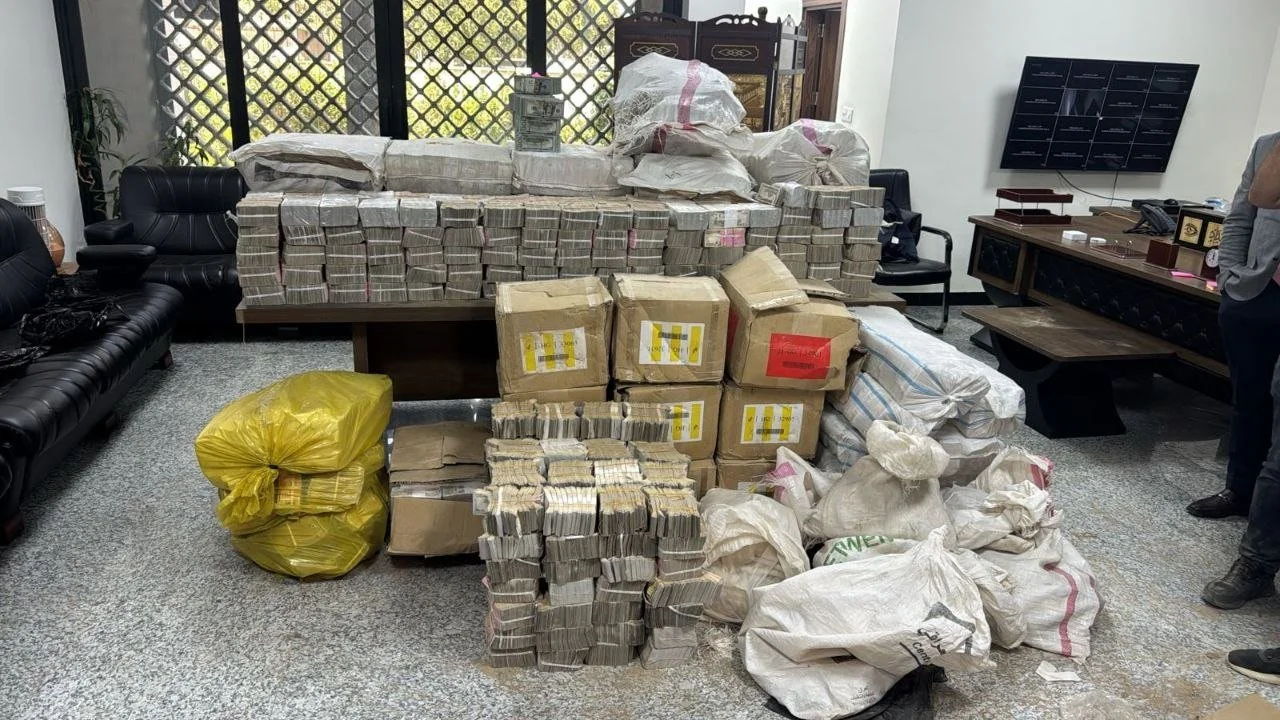
Courtesy of Dinar Guru: https://www.dinarguru.com/
Stephen If you hold Iraqi dinar and you're hoping, speculating that the dinar will revalue in the near future, I don't see how you cannot be excited right now...Stay grounded. Stay steadfast because we are entering uncharted territory. In the last 15 years since I've held Iraqi dinar more has gotten done in the last four months than the entire 15 years combined...We have never seen so much acceleration, so much movement. It's almost like there's a deadline somewhere in the near future.
Frank26 Elon Musk made thousands of millionaires last week for the United States of America's economy....[Iraqi's] currency is about to do the same thing. It is going to explode out GDP power of our economy. The United States of America will explode, which will only benefit many other nations ...We are about to make many millionaires through the Iraqi dinar investment. Same as Musk. Our country is about to explode...You have a new exchange rate coming...Get ready.
Mnt Goat ...there is now a solid benchmark set of at least 45% of the economy generating revenues of non-oil based. If you think about this goal then you can clearly see additional revenues being generated in the future besides what they have today to meet their budgets ....with these surplus revenues, the CBI can then be able hoard more of the surplus oil revenues to put towards its reserves, gold, and other investments bringing Iraq into more light with the international scene...
************
G. Edward Griffin & Lynette Zang LIVE | Debt Crisis, Hyperinflation & the Future of Money
6-23-2026
Join Lynette Zang and special guest G. Edward Griffin LIVE as they discuss the growing debt crisis, the risks of hyperinflation, the future of money, and what these changes could mean for your savings, retirement, and financial freedom.
Iraq Economic News and Points To Ponder Late Tuesday Evening 6-23-26
Iraq And The Dollar: Parallel Market Surges Amid Speculation And Regional Tensions
June 23, 2026Last updated: June 23, 2026 The Independent - The parallel market witnessed a remarkable rise in the dollar exchange rate in recent days, exceeding the 157,000 dinar mark per 100 dollars, amid anticipation and concern in economic and commercial circles regarding the repercussions of regional developments and their impact on local markets.
Iraq And The Dollar: Parallel Market Surges Amid Speculation And Regional Tensions
June 23, 2026Last updated: June 23, 2026 The Independent - The parallel market witnessed a remarkable rise in the dollar exchange rate in recent days, exceeding the 157,000 dinar mark per 100 dollars, amid anticipation and concern in economic and commercial circles regarding the repercussions of regional developments and their impact on local markets.
Financial experts believe that this rise is not related to any change in the official monetary policy or the exchange rate adopted by the state, but rather is due to a set of overlapping factors, most notably speculation, rumors and regional tensions that have led to an increase in demand for foreign currency in the parallel market.
Experts confirm that Iraqi markets are directly affected by political and security developments in the region, especially those related to international trade and energy markets, which is reflected in the behavior of traders, importers, and speculators in the exchange market.
Financial and banking expert Dr. Mustafa Hantoush said that the current rise in the price of the dollar is mainly due to speculation and rumors circulating about the possibility of amending the official exchange rate in the coming period, despite the absence of any official indicators or decisions in this regard.
He explained that the circulation of this news prompted some traders and speculators to increase their demand for the dollar in anticipation of any future changes, which caused a rise in demand in the parallel market and was directly reflected in prices.
He added that these practices negatively affect the national economy by raising import costs and creating pressure on the prices of basic commodities, as well as increasing anxiety and instability in the markets.
Hantoush pointed out that any decision regarding the exchange rate is subject exclusively to the policies of the Central Bank of Iraq, stressing that no official announcement has been issued regarding amending the adopted rate so far, despite talk of future possibilities without a clear basis.
For his part, economist Haider Al-Sheikh said that part of the increased demand for the dollar is related to the rapid regional developments, especially concerns about shipping traffic in the Strait of Hormuz and its potential impact on global trade and supply chains.
He explained that these developments prompted some traders to increase their demand for the dollar as a precautionary measure, in addition to the impact of rumors about the exchange rate, which contributed to a temporary rise in prices in the parallel market.
The Sheikh confirmed that monetary policy in Iraq has not witnessed any change, and that the official price of the dinar remains fixed, predicting a gradual return to stability as psychological pressures in the market subside.
For his part, economic researcher Ahmed Eid explained that the rise of the dollar is due to internal and external factors at the same time, most notably geopolitical tensions and concerns related to the security of navigation and Iraqi oil flows.
He pointed out that these concerns have prompted traders to increase their demand for foreign currency, coinciding with the continuation of some restrictions on external transfers, which widens the gap between the official and parallel exchange rates.
He also pointed out that Iraq’s inclusion on the Financial Action Task Force (FATF) grey list has increased caution among some traders, which has indirectly affected market activity.
Economic estimates indicate that continued speculation and rumors may keep the market in a state of temporary fluctuation, while the central bank’s ability to control the market remains a crucial factor in stabilizing the exchange rate in the coming period. https://mustaqila.com/العراق-والدولار-ارتفاعات-السوق-الموا/
Shenkali Warns Against Raising The Value Of The Dollar And Harming The Poor And Middle Classes.
Information/Baghdad... Former MP Majid Shenkali warned against raising the value of the dollar against the dinar and harming the poor and middle classes.
Shankali said via social media, as reported by Al-Maalomah, that “the difference today between the official and parallel price of the dollar is 250 dinars, meaning that every 100 S bill has a difference of 25,000 dinars, and no one is talking about it under the pretext that the newly formed government.”
He added that "this excuse is completely unacceptable, especially since the government's supporters are praising the Prime Minister's economic and financial expertise and skill," noting that "if the government is serious about reducing the price of the dinar to reduce the budget deficit and bear the expenses, it must first work to ensure that the difference between the official and parallel prices is no more than 10-20 dinars only."
He explained that "raising the dollar's price and maintaining a large gap means destroying the poor and middle classes, both in terms of their livelihoods and the economy." (End of 25)
Actions, Not Words... The US State Department Presents Baghdad With A Clear Equation: Genuine Reforms, Strong Institutions, And Full Sovereignty
Baghdad - One News - 6/23/2026 The US State Department stressed the importance of completing the formation of the Iraqi government and cabinet as soon as possible, in order to enhance the ability of state institutions to implement political, security and economic reforms.
The US State Department, in a statement to One News, said that the selection of security leaders should be based on criteria of competence, professionalism and integrity, stressing the need for these leaders to work under the authority of the state and the constitution, away from any other loyalties or affiliations outside official frameworks.
She added that building professional national security institutions is a fundamental pillar for consolidating Iraq’s sovereignty and enhancing stability, stressing that the state’s success in this path requires independent security institutions capable of performing their duties away from the influence of armed groups.
The US State Department reiterated its support for Prime Minister Ali al-Zaidi's government in its efforts to complete the building of state institutions and enhance their efficiency, which contributes to consolidating the strategic partnership between Baghdad and Washington and supporting the path of reform and stability in the country. https://1news-iq.net/مرحلة-الأفعال-لا-الأقوال-الخارجية-الأ/
The Central Bank Announces The Completion Of The Requirements For Reintegrating Banks Restricted From Dealing In US Dollars
Baghdad - WAA The Central Bank of Iraq announced on Monday the completion of procedures and requirements for the reintegration of a number of banks restricted from dealing in US dollars in foreign currency transfer operations.
The bank stated in a statement received by the Iraqi News Agency (INA): “Within the framework of the Central Bank of Iraq’s efforts to enhance monetary and financial stability, develop the banking sector, and raise its level of integration into the global financial system, the bank continues to implement its reform program in coordination with relevant international institutions, focusing on several key areas.”
The statement added that "the Central Bank of Iraq has completed the procedures and requirements for the reintegration of a number of banks restricted from dealing in US dollars in foreign currency transfer operations, after they met the requirements of the reform plan and the relevant supervisory and technical standards, and strengthened their frameworks for combating money laundering and terrorist financing," explaining that "this file has reached its final stages in preparation for the gradual and organized reintegration, which will enhance the ability of these banks to serve their customers and support the expansion of their foreign correspondent relationships in accordance with best practices and international standards."
He added that “the Central Bank has completed the necessary technical and procedural requirements to raise the limits of electronic payment cards for the category of registered companies and businesses, which contributes to expanding the scope of digital financial services, enhancing financial inclusion, and meeting the needs of various segments of customers with payment tools.
The bank is proceeding with the implementation of the subsequent phases of this project in a gradual and deliberate manner, in a way that ensures the consolidation of regulatory controls that will enhance the integrity and effectiveness of the system, and keep pace with the rapid developments in the financial sector.”
The Central Bank of Iraq, according to the statement, affirmed its commitment to “meeting the demand for the US dollar in accordance with the approved controls and standards, ensuring the smooth flow of transfers and covering the legitimate needs of the public and private sectors, based on strong foreign reserves and effective monetary tools.
This is done with full commitment to compliance requirements and standards for combating money laundering and terrorist financing, and a monetary policy based on the stability of the exchange rate and the integrity of financial channels.”
The bank stressed, according to the statement, that "these measures are part of a comprehensive reform program aimed at addressing existing challenges and resolving priority issues, thereby strengthening confidence in the Iraqi banking sector, supporting the foundations of financial and monetary stability, and backing the country's economic development."
He concluded that he “will continue to take the necessary measures and policies to develop the banking environment, raise the efficiency of the financial system, and provide the necessary elements to support sustainable economic growth, thereby achieving long-term financial stability and preserving the stability of the exchange rate and the integrity of financial channels.”
A Source Reveals to *Al-Mustaqila*: The Government Is Moving Toward Removing Three Zeros From The Iraqi Dinar And Issuing A New Currency
June 21, 2026 — Last Updated: June 21, 2026 *Al-Mustaqila* / An exclusive source told *Al-Mustaqila* that the Iraqi government, headed by Ali Al-Zaidi, is moving toward studying and implementing a major economic project involving the removal of three zeros from the Iraqi currency as part of a package of monetary reforms aimed at restructuring the financial system and facilitating everyday transactions.
According to the source, the project also includes a gradual move toward issuing a new Iraqi currency while maintaining the dinar's real value and purchasing power, should the plan be officially implemented by the Iraqi Central Bank.
Reasons behind the move include:
- Continued heavy reliance on oil revenues
- Exchange rate fluctuations against the U.S. dollar
- Inflation in liquidity and expansion of the money supply in circulation
- Weak confidence in the banking system
Experts believe that the "removal of the zeros" project is generally classified as a currency redenomination. This means it does not change the real value of salaries or prices but instead aims to simplify figures and make daily financial transactions easier.
**International Experiences and Local Concerns**
Experiences from other countries indicate that such measures can technically succeed in simplifying the monetary system. However, they require economic stability and strong confidence in the banking sector to ensure that market disruption does not occur.
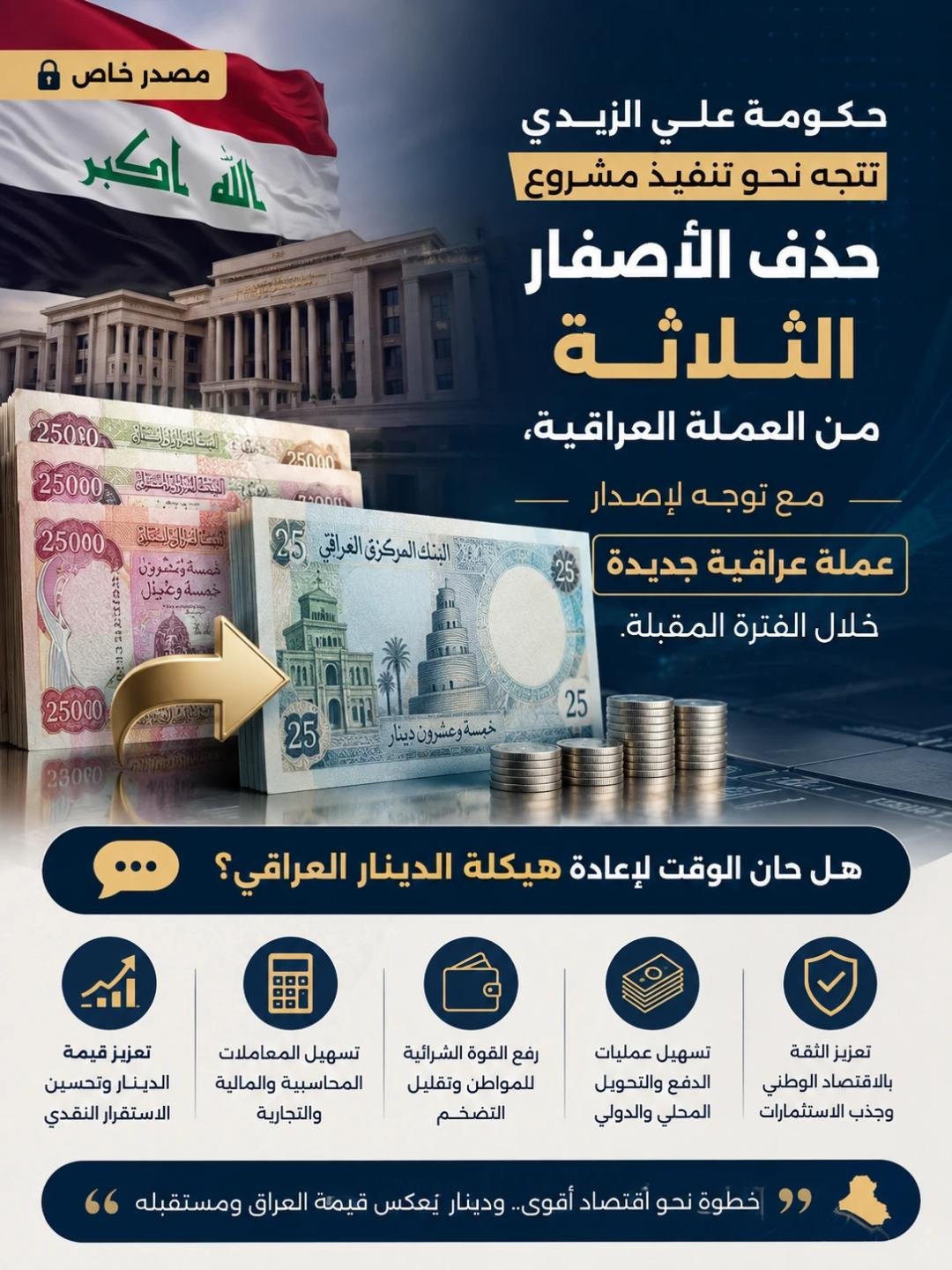
On the other hand, specialists warn that any poorly planned implementation could lead to:
- Confusion over prices during the transition period
- Public concerns about losing value
- Temporary difficulties in controlling the cash market
**Iraq's Economy Between Reform and Pressure**
This discussion comes at a time when Iraq is trying to balance financial reforms with mounting economic challenges, making the currency issue one of the most sensitive topics in the coming period, especially if the country actually transitions to a new currency.
While supporters view the move as "a necessary modernization," opponents see it as "more cosmetic than a fundamental reform." The final decision remains tied to the readiness of financial institutions and their ability to manage the transition without causing economic shocks.
Will this mark the beginning of a real transformation in the Iraqi dinar, or is it simply another discussion within monetary policy circles? https://mustaqila.com/مصدر-يكشف-لـالمستقلة-الحكومة-تتجه/
A Source Denies Any Change In The Exchange Rate And Confirms A Plan To Control The Parallel Market In Iraq.
June 23, 2026Last updated: June 23, 2026 Al-Mustaqilla - An informed source confirmed to Al-Mustaqilla on Tuesday that what has been circulating in recent days regarding the Iraqi Central Bank's intention to raise or change the exchange rate of the dinar against the dollar is "completely untrue," categorically denying any official intention to amend the rate currently adopted in monetary policy.
The source explained that the official exchange rate will remain fixed without any change in the coming period, stressing that there are no decisions or discussions regarding raising or lowering it, as is being circulated in some media outlets and social media sites.
In contrast, the source indicated that the Central Bank, in coordination with the Iraqi government, is working on a new plan aimed at reducing the gap between the official price and the parallel market price, through regulatory and supervisory measures aimed at enhancing market stability and preventing speculation.
He added that the next phase will witness stricter steps towards unregulated transactions in the exchange market, with the aim of reducing the price difference and gradually restoring balance to the financial market in Iraq.
The source emphasized that “all news circulating about an intention to raise the exchange rate is baseless,” urging reliance on official sources regarding monetary policies and cautioning against being swayed by rumors that undermine market stability and public confidence. https://mustaqila.com/مصدر-ينفي-تغيير-سعر-الصرف-ويؤكد-خطة-للس/
Seeds of Wisdom RV and Economics Updates Wednesday Morning 6-24-26
Good Morning Dinar Recaps,
Stocks Stabilize After Tech Selloff as Dollar Climbs to One-Year High
Global markets steadied after a sharp technology-led selloff, while a stronger U.S. dollar and easing oil prices reflected growing investor caution over artificial intelligence valuations, interest rates, and geopolitical uncertainty.
Good Morning Dinar Recaps,
Stocks Stabilize After Tech Selloff as Dollar Climbs to One-Year High
Global markets steadied after a sharp technology-led selloff, while a stronger U.S. dollar and easing oil prices reflected growing investor caution over artificial intelligence valuations, interest rates, and geopolitical uncertainty.
Overview
Global stock markets stabilized after heavy losses in technology shares earlier this week.
The U.S. dollar reached its strongest level in one year as investors sought safety amid geopolitical and monetary policy uncertainty.
Markets remain focused on AI valuations, Federal Reserve policy, and U.S.-Iran negotiations, all of which could shape financial markets in the weeks ahead.
Key Developments
1. Technology Stocks Attempt a Rebound
Technology shares recovered modestly after suffering a broad selloff driven by concerns that artificial intelligence-related companies may have become overvalued following months of rapid gains.
Investors are closely watching Micron Technology's earnings, viewing the semiconductor manufacturer as an important indicator of continued demand for AI infrastructure, data centers, and advanced computing.
While long-term optimism surrounding AI remains intact, markets are becoming increasingly selective as investors evaluate whether corporate earnings can justify current valuations.
2. U.S. Dollar Strengthens as Investors Seek Safety
The U.S. dollar climbed to its highest level in a year, supported by expectations that the Federal Reserve may keep interest rates elevated if inflation remains persistent.
Geopolitical uncertainty surrounding the evolving U.S.-Iran peace negotiations also encouraged investors to move toward traditional safe-haven assets, further strengthening the dollar.
The stronger dollar placed additional pressure on other major currencies, particularly the euro and Japanese yen.
3. Falling Oil Prices Ease Inflation Pressures
Oil prices continued to decline as expectations grew that shipping through the Strait of Hormuz would gradually normalize following recent diplomatic developments.
Lower crude prices could reduce inflationary pressures worldwide by lowering transportation and energy costs, potentially easing some pressure on consumers and central banks.
However, markets remain cautious as negotiations between Washington and Tehran continue to evolve and regional tensions have not been fully resolved.
Why It Matters
Global financial markets are currently being influenced by three powerful forces: artificial intelligence investment, central bank policy, and geopolitical developments.
Technology companies continue to drive much of the market's performance, while interest rate expectations and global conflicts are shaping currency markets, commodity prices, and investor confidence.
Why It Matters to Foreign Currency Holders
Foreign currency holders should continue monitoring U.S. monetary policy, the strength of the U.S. dollar, and geopolitical developments.
A stronger dollar, changing energy prices, and continued progress toward digital financial infrastructure all influence global capital flows, international trade, and long-term monetary policy discussions that remain important to those following future currency realignment developments.
Implications for the Global Reset
Pillar 1: Monetary Policy
Higher interest rates and a stronger U.S. dollar continue influencing global liquidity, capital flows, and international investment decisions.
Pillar 2: Financial Infrastructure
AI investment, digital technologies, and shifting geopolitical alliances are accelerating structural changes across the global financial system that could shape the next generation of finance.
Closing Thought
Markets are increasingly responding not only to economic data, but also to technology innovation, geopolitical negotiations, and central bank policy. The interaction of these forces will likely continue driving volatility while reshaping investment strategies across global markets.
This is not just about stock prices—it reflects the growing connection between technology, monetary policy, and geopolitical developments as the global financial system continues to evolve.
Seeds of Wisdom Team
Newshounds News™ Exclusive
Sources
~~~~~~~~~~
🌱 A Message to Our Currency Holders🌱
If you’ve been holding foreign currency for many years, you were not foolish.
You were not wrong to believe the global financial system would change.
What failed was not your patience — it was the information you were given.
For years, dates, rumors, and personalities replaced facts, structure, and proof. “This week” predictions created cycles of hope and disappointment that were never based on how currencies actually change.
That is not your failure.
Our mission here is different: • No dates • No rates • No hype • No gurus
Instead, we focus on:
• Verifiable developments • Institutional evidence
• Global financial structure • Where countries actually sit in the process
Currency value changes only come after sovereignty, trade, banking, settlement systems, and fiscal coordination are in place. History and institutions confirm this sequence.
You will see silence. You will see denials. That is not delay — that is discipline.
Protect your identity. Organize your documents. Verify everything.
Never hand your discernment to anyone who cannot show proof.
You deserve truth — not timelines.
Seeds of Wisdom Team
Newshounds News
~~~~~~~~~~
Seeds of Wisdom Team RV Currency Facts Youtube and Rumble
Newshound's News Telegram Room Link
RV Facts with Proof Links Link
RV Updates Proof links - Facts Link
Start Here room with Most Asked Questions Link
Follow the Gold/Silver Rate COMEX
Follow Fast Facts
Seeds of Wisdom Team™Website
Thank you Dinar Recaps
Iraq Economic News and Points To Ponder Tuesday Evening 6-23-26
Iraq Purchases $17M In Kuwaiti Non-Oil Goods
2026-06-22 Shafaq News- Baghdad Iraq ranked fifth among the largest importers of Kuwaiti non-oil goods in March 2026, with imports valued at 5.24 million Kuwaiti dinars (about $17.1M), according to data released by Kuwait's Central Statistical Bureau. The figures showed that Saudi Arabia topped the list of importers of Kuwaiti non-oil products, with imports worth 26.52 million Kuwaiti dinars (about $86.6M).
Iraq Purchases $17M In Kuwaiti Non-Oil Goods
2026-06-22 Shafaq News- Baghdad Iraq ranked fifth among the largest importers of Kuwaiti non-oil goods in March 2026, with imports valued at 5.24 million Kuwaiti dinars (about $17.1M), according to data released by Kuwait's Central Statistical Bureau. The figures showed that Saudi Arabia topped the list of importers of Kuwaiti non-oil products, with imports worth 26.52 million Kuwaiti dinars (about $86.6M).
It was followed by United Arab Emirates at 17.14 million dinars (about $56.0M), Jordan at 7.51 million dinars (about $24.5M), and India at 7.47 million dinars (about $24.4M).
Kuwait recorded a trade surplus of 1.768 billion Kuwaiti dinars (about $5.77B) during the first quarter of 2026, a 30.6% decline compared with the same period in 2025, amid decreases in exports, imports, and overall trade volume.
https://www.shafaq.com/en/Economy/Iraq-purchases-17M-in-Kuwaiti-non-oil-goods
Dollar Falls In Baghdad, Erbil Markets
2026-06-23 Shafaq News- Baghdad/ Erbil The US dollar closed Tuesday’s trading lower in Iraq, hovering around 157,000 dinars per 100 dollars.
According to Shafaq News market survey, the dollar traded in Baghdad's Al-Kifah and Al-Harithiya exchanges at 157,000 dinars per 100 dollars, down from the morning session’s 157,250 dinars.
In the Iraqi capital, exchange shops sold the dollar at 157,500 dinars and bought it at 156,500 dinars, while in Erbil, selling prices stood at 156,800 dinars and buying prices at 156,750 dinars.
https://www.shafaq.com/en/Economy/Dollar-falls-in-Baghdad-Erbil-markets-5
Gold Prices Fall In Baghdad And Erbil
2026-06-23 Shafaq News- Baghdad/ Erbil Gold prices fell in Baghdad and Erbil on Tuesday, hovering around 900,000 IQD per mithqal, according to a Shafaq News market survey.
Wholesale prices on Baghdad's Al-Nahr Street recorded a selling price of 905,000 IQD per mithqal (equivalent to five grams) for 21-carat gold, including Gulf, Turkish, and European varieties, with a buying price of 901,000 IQD, down from Monday's 922,000 IQD.
The selling price for 21-carat Iraqi gold stood at 875,000 IQD, with a buying price of 871,000 IQD.
In jewelry stores, the selling price per mithqal of 21-carat Gulf gold ranged between 905,000 and 915,000 IQD, while Iraqi gold sold for between 875,000 and 885,000 IQD, with variation subject to craftsmanship fees and store location.
In Erbil, 22-carat gold was sold at 957,000 IQD per mithqal, 21-carat gold at 915,000 IQD, and 18-carat gold at 783,000 IQD.
https://www.shafaq.com/en/Economy/Gold-prices-fall-in-Baghdad-and-Erbil-3
Oil Ministry: We Aim to Increase Production to 4.3 Million Barrels per Day
Iraqi News Agency INA – Baghdad - 6/22/2026 The Ministry of Oil affirmed on Sunday its commitment to increasing production to approximately 4.3 million barrels per day and working to boost oil exports.
The Undersecretary for Extraction Affairs, Nasir Aziz, stated in a statement received by the Iraqi News Agency (INA) that “one of his top priorities at this stage is overseeing plans to rehabilitate and develop the southern oil fields, whose production declined to varying degrees due to the Gulf War crisis, in line with domestic needs and oil export requirements.”
“I have directed the management of oil companies to reassess the conditions of the fields, expedite production and pumping operations, and address technical and operational obstacles, with the aim of increasing oil exports through the southern ports and ensuring the continued supply of crude oil to national refineries,” he said.
The Undersecretary affirmed that initial plans aim to gradually restore national production to pre-crisis levels, estimated at between 4.2 and 4.3 million barrels per day, while also working to increase oil exports—particularly through the southern ports—to their previous levels of nearly 3.5 million barrels per day, depending on the readiness of the fields and facilities, as well as pumping, storage, and export plans.
“The Ministry is relying on national efforts, in cooperation with international contracting companies, to restore production capacities that declined during the crisis and to gradually increase production over an appropriate period until the targeted levels are reached, despite the significant technical and logistical challenges facing the sector,” Aziz added.
“Among the priorities of the extraction sector are monitoring production at the North Oil Company and enhancing oil transportation operations from the southern fields, which will contribute to supporting oil exports through the Turkish port of Ceyhan and diversifying export outlets in line with the ministry's plans for sustainable production and maximizing national revenues, in addition to overseeing production operations in the central oil fields,” he stated.
“The extraction sector will pay special attention to exploration blocks and oil and gas fields and work to develop them in a manner that strengthens national reserves and increases production capacity. This also includes supporting associated and non-associated gas investment projects, given their strategic importance in securing the needs of the energy and industrial sectors and reducing reliance on imports,” he added.
Aziz emphasized his commitment to strengthening relations with oil companies operating in Iraq and providing an appropriate environment to support their activities.
He also stressed the importance of encouraging reputable investment companies to participate in developing the oil industry, in line with the ministry's plans to improve operational efficiency and expand investment opportunities in the extraction sector.
World Bank Ranks Iraq Among Top Gas-Flaring Countries
2026-06-23 Shafaq News- Washington Iraq ranked alongside Russia and Iran among the world's largest gas-flaring countries in 2025, with the three nations collectively burning about 84 billion cubic meters of gas, nearly half of all gas flared globally, the World Bank reported on Tuesday.
The Bank’s Global Gas Flaring Tracker found that the burned gas quantity rose for the third consecutive year, reaching 167 billion cubic meters, with an estimated market value of $54 billion. Iraq was among nine countries responsible for more than 80% the flaring.
Read more: Iraq's gas flaring paradox: a wealth of resources, a nation in need
The World Bank noted that capturing gas currently burned at oil fields could help strengthen energy security, expand electricity generation, support economic activity, and reduce emissions, adding that reducing flaring depends largely on stronger regulations, investment, infrastructure, and political commitment rather than technological limitations.
https://www.shafaq.com/en/Economy/World-Bank-ranks-Iraq-among-top-gas-flaring-countries
To continue reading, click here.
Global Flaring Rises Three Years In A Row, Undermining Energy Security
Secure Access to Energy is Fundamental to Economic Growth and Job Creation
Washington, D.C., June 23—Global gas flaring rose for the third consecutive year, surging to 167 billion cubic meters (bcm) in 2025 and wasting an estimated $54 billion worth of gas. As many countries, especially the poorest, face energy shortages, capturing this wasted gas could strengthen energy security, generate power, support economic activity that’s key to job creation, and reduce emissions.
The annual Global Gas Flaring Tracker, released today by the World Bank Group, finds flaring volumes in 2025 nearly equal Africa's entire annual gas consumption and exceed annual LNG (liquefied natural gas) volumes transiting the Persian Gulf.
Nine countries, Russia, Iran, Iraq, Venezuela, Mexico, Libya, Algeria, Nigeria, and the United States, account for more than four-fifths of global flaring while accounting for nearly half of the world's oil production.
"At a time when many countries are struggling to increase affordable and reliable energy, the economic development costs of continued flaring are simply too high," said Demetrios Papathanasiou, World Bank Group Global Director for Energy. "The gas currently flared could be captured to power industries and businesses, create jobs, and strengthen energy security."
Many countries import costly gas while also flaring vast amounts of it at their oilfields. Eliminating routine flaring globally would require an estimated $70–100 billion, less than twice the annual value of the gas currently being wasted. Countries facing high import costs and domestic energy shortfalls stand to benefit from increased energy access, new gas revenues, and lower energy bills.
Yet despite the tools needed to end routine flaring being well established, it persists; what holds back progress is not technical but structural — inadequate regulation, insufficient capital, limited market infrastructure, and a failure by operators and governments to treat reduction as a priority.
Where effective policies and regulations, targeted investment, and leadership come together, flaring declines. Governments and operators that act decisively get results. For instance, Kazakhstan has reduced flaring by 87% since 2012, including a further 16% reduction in 2025 alone.
"The technologies, policies, regulations, and financing mechanisms needed to capture and utilize associated gas are available. What is missing, in too many places, is the leadership, prioritization, and governance needed to put these solutions into practice, creating access to markets and infrastructure." said Zubin Bamji, World Bank Manager for the Global Flaring and Methane Reduction (GFMR) Partnership.
“The cost of inaction will be measured in wasted billions in revenue and energy insecurity for millions of people.”
https://www.worldbank.org/en/news/press-release/2026/06/23/global-gas-flaring-rises-energy-security
Seeds of Wisdom RV and Economics Updates Tuesday Evening 6-23-26
Good Evening Dinar Recaps,
CLARITY Act Could Open the Door to Massive Institutional Investment in Crypto, Says Ric Edelman
Industry veteran Ric Edelman believes passage of the CLARITY Act could unlock institutional capital that has remained on the sidelines, potentially accelerating mainstream adoption of Bitcoin and digital assets.
Good Evening Dinar Recaps,
CLARITY Act Could Open the Door to Massive Institutional Investment in Crypto, Says Ric Edelman
Industry veteran Ric Edelman believes passage of the CLARITY Act could unlock institutional capital that has remained on the sidelines, potentially accelerating mainstream adoption of Bitcoin and digital assets.
Overview
Ric Edelman says the CLARITY Act could become the key catalyst that brings institutional investors into the cryptocurrency market.
An estimated 95% of institutions that currently hold no crypto may begin allocating assets once regulatory clarity is established.
Edelman believes Bitcoin could reach $150,000 or higher if favorable legislation and institutional participation continue to expand.
Key Developments
1. Regulatory Clarity Seen as the Missing Piece
Ric Edelman, founder of the Digital Assets Council of Financial Professionals, believes the CLARITY Act represents the most important regulatory milestone for the U.S. digital asset industry. He argues that many institutional investors remain interested in cryptocurrency but have delayed participation because clear federal rules have not yet been established.
According to Edelman, passage of the legislation would remove much of the legal uncertainty surrounding digital assets and provide traditional financial firms with the confidence to enter the market.
2. Institutional Demand Continues to Build
Despite recent market volatility, Edelman says institutional interest has continued to grow behind the scenes.
He noted that major financial firms including BlackRock, JPMorgan, Morgan Stanley, Fidelity, Franklin Templeton, State Street, and Invesco continue expanding blockchain, tokenization, and digital asset initiatives.
Edelman estimates that 95% of institutions that currently do not own cryptocurrency plan to make their first allocation, while roughly three-quarters of existing institutional investors intend to increase their exposure.
3. Bitcoin Could Benefit Significantly
Edelman believes regulatory certainty could trigger a new phase of institutional investment into Bitcoin and other digital assets.
If the CLARITY Act becomes law, he expects many investors to view it as the turning point that finally opens crypto to mainstream institutional capital. Based on that outlook, he projects Bitcoin could rise to $150,000 or higher over time.
He cautioned, however, that any delay or failure to pass the legislation could temporarily weaken market sentiment as investors reassess expectations.
Why It Matters
The CLARITY Act is designed to establish clear regulatory responsibilities for digital assets, providing guidance for financial institutions, investment firms, exchanges, and blockchain companies.
For many institutional investors, regulatory uncertainty—not technology—has remained the largest barrier to entering the crypto market. If Congress delivers a comprehensive framework, significant new capital could flow into digital assets.
Why It Matters to Foreign Currency Holders
Foreign currency holders closely monitor developments that influence global financial infrastructure. Increased institutional adoption of blockchain technology, tokenized assets, and regulated digital currencies could accelerate modernization of international payment systems and capital markets.
While the CLARITY Act does not directly affect foreign currency revaluation, it represents another step toward the broader digital transformation occurring within the global financial system.
Implications for the Global Reset
Pillar 1: Financial Infrastructure
Regulatory clarity could encourage broader institutional adoption of blockchain-based financial services and tokenized assets.
Pillar 2: Capital Markets
Large-scale institutional participation may further integrate digital assets into traditional investment portfolios and reshape global financial markets over time.
Closing Thought
The CLARITY Act is increasingly being viewed as more than cryptocurrency legislation. Its broader significance lies in establishing the regulatory foundation that could connect traditional finance with the rapidly expanding digital asset economy.
This is not just about cryptocurrency—it reflects the continuing transformation of financial infrastructure as governments prepare for the next generation of digital finance.
Seeds of Wisdom Team
Newshounds News™ Exclusive
Sources
~~~~~~~~~~
Seeds of Wisdom Team RV Currency Facts Youtube and Rumble
Newshound's News Telegram Room Link
RV Facts with Proof Links Link
RV Updates Proof links - Facts Link
Start Here room with Most Asked Questions Link
Follow the Gold/Silver Rate COMEX
Follow Fast Facts
Seeds of Wisdom Team™Website
Thank you Dinar Recaps
Tuesday Iraq News Posted by Tishwash at TNT 6-23-2026
TNT:
Tishwash: More than 100 draft laws await action in Iraq’s parliament, lawmaker says
More than 100 draft laws remain pending in Iraq’s parliament awaiting reading, debate and voting, a member of the parliamentary Legal Committee said.
Ibtisam al-Hilali told the Iraqi News Agency on Sunday that the previous government had withdrawn a number of bills from parliament to “amend and redraft some of their provisions.” She expressed hope the current government would resubmit them to complete the legislative process, and called for several to be put to a vote during the second legislative term, scheduled to begin in July.
TNT:
Tishwash: More than 100 draft laws await action in Iraq’s parliament, lawmaker says
More than 100 draft laws remain pending in Iraq’s parliament awaiting reading, debate and voting, a member of the parliamentary Legal Committee said.
Ibtisam al-Hilali told the Iraqi News Agency on Sunday that the previous government had withdrawn a number of bills from parliament to “amend and redraft some of their provisions.” She expressed hope the current government would resubmit them to complete the legislative process, and called for several to be put to a vote during the second legislative term, scheduled to begin in July.
Among the bills she identified were the Popular Mobilization Forces draft law, the Civil Service Law and a draft amendment to the public employee salary scale.
Iraq’s Council of Representatives opened its current legislative term in late December 2025 and elected Haibat al-Halbousi as speaker. link
Tishwash: Parliamentary moves to amend the investment law and activate the private sector
Parliamentary calls have been renewed to amend the investment law, as well as to adopt an effective policy to support the private sector as one of the main solutions to address unemployment and reduce the pressure of absorbing graduates on the government sector.
Member of Parliament Taqi al-Waeli told Al-Sabah newspaper: “There should be laws supporting the private sector, and what was stated in the ministerial program regarding government support for this sector should be translated into concrete measures on the ground.” He explained that most of the current pressure to provide job opportunities falls on the public sector, which cannot absorb the numbers. The large number of graduates.
He added that harnessing these energies requires a clear policy to support the private sector by backing local industries, encouraging investment, and establishing projects capable of absorbing the workforce. He pointed out that the projects exist and the vision is clear, but the problem lies ... In the weakness of activation and implementation.
Al-Waili explained that investors still face many obstacles when entering the Iraqi market, including administrative red tape and complex procedures, as well as cases of extortion that raise the cost of establishing industrial projects, which leads some investors to prefer importing instead of manufacturing inside Iraq.
He stressed the need to review and amend the investment law to facilitate procedures and remove obstacles for investors, noting that supporting national industry requires financial allocations and well-thought-out policies that ensure real results in terms of job creation.
He pointed out that the success of these steps is linked to the existence of a genuine will to address the issue of unemployment and absorb graduates, indicating that launching service projects alone is not enough unless the necessary financial liquidity and capabilities are available to complete them and turn them into productive job opportunities that contribute to revitalizing the national economy. link
************
Tishwash: Zidane and the Central Bank Governor discuss strengthening financial stability
The President of the Supreme Judicial Council, Judge Faiq Zaidan, and the Governor of the Central Bank, Nizar Nasser, discussed matters related to strengthening financial stability on Monday. This comes as the new Governor of the Central Bank officially assumed his duties and emphasized the importance of continuing efforts to consolidate financial and monetary stability.
In a press statement, the Supreme Judicial Council stated that "the President of the Supreme Judicial Council, Judge Faiq Zaidan, received the new Governor of the Central Bank, Nizar Nasser, and congratulated him on assuming his position, wishing him success in his duties." The statement added that "the President of the Supreme Judicial Council discussed with the Governor of the Central Bank a number of issues of mutual interest related to strengthening financial stability and supporting the legal procedures of the Central Bank."
In addition, a statement from the Central Bank indicated that "the new governor, Nizar Nasser, assumed his official duties, accompanied by the former governor, Ali Mohsen Al-Alaq, and they conducted a field tour that included various offices and departments of the Central Bank of Iraq to review the workflow and understand the nature of the tasks and duties carried out by the departments and directorates."
The new governor of the Central Bank of Iraq, Nizar Nasser, emphasized during his tour "the importance of continuing institutional work and enhancing performance efficiency to contribute to achieving the goals of the Central Bank of Iraq and consolidating financial and monetary stability." Nasser also commended "the efforts exerted during the previous phase under the leadership of the former governor, Ali Mohsen Al-Alaq, and the achievements that contributed to developing the banking sector and strengthening the national economy." link
Tishwash: Central Bank of Iraq: Reintegration of dollar-denominated banks is in its final stages
The Central Bank of Iraq confirmed on Monday that the process of reintegrating banks restricted from dealing in US dollars in foreign transfer operations has reached its final stages, while reiterating its commitment to meeting the demand for dollars in accordance with the approved regulations and standards.
The bank stated in a statement received by (Mawazin News) that it continues to implement its reform program in coordination with the relevant international institutions, with the aim of strengthening monetary and financial stability, developing the banking sector and raising its level of integration into the global financial system.
He explained that "the bank has completed the requirements and procedures for reintegrating a number of dollar-denominated banks into foreign currency transfer operations, after they met the reform conditions and regulatory and technical standards, in addition to strengthening anti-money laundering and counter-terrorism financing measures."
He indicated that the process has entered its final stages in preparation for a gradual and organized reintegration. He added that "the bank has also completed the technical and procedural requirements for raising the limits on electronic payment cards for the corporate and business sectors, in a step aimed at expanding digital financial services and enhancing financial inclusion."
Regarding the currency market, the Central Bank affirmed its commitment to meeting the demand for US dollars and covering the legitimate needs of the public and private sectors, relying on strong foreign reserves and effective monetary tools, while fully adhering to compliance standards and anti-money laundering and counter-terrorism financing measures.
The bank stressed that "these measures are part of a comprehensive reform program aimed at strengthening confidence in the Iraqi banking sector, supporting financial and monetary stability, and contributing to achieving sustainable economic development." link
The Truth About Deleting The 3 Zeros From The Dinar
The Truth About Deleting The 3 Zeros From The Dinar
The Dinar Den: 6-22-2026
For over a decade, the Iraqi dinar has remained a subject of intense interest within international currency circles. In a recent detailed analysis, Stephen—a seasoned investor who has followed the Iraqi economy since 2011—shared his insights via The Dinar Den regarding the current trajectory of the Iraqi Central Bank (CBI).
His discussion provides a necessary bridge between complex monetary policy and the practical expectations of those monitoring the region’s financial evolution.
The Truth About Deleting The 3 Zeros From The Dinar
The Dinar Den: 6-22-2026
For over a decade, the Iraqi dinar has remained a subject of intense interest within international currency circles. In a recent detailed analysis, Stephen—a seasoned investor who has followed the Iraqi economy since 2011—shared his insights via The Dinar Den regarding the current trajectory of the Iraqi Central Bank (CBI).
His discussion provides a necessary bridge between complex monetary policy and the practical expectations of those monitoring the region’s financial evolution.
One of the most critical points addressed in the video is the fundamental difference between a redenomination and a revaluation. To the casual observer, “removing the zeros” might sound like a singular event, but Stephen clarifies that these are two distinct economic paths. A redenomination is essentially a neutral event; it involves removing zeros from the currency (for example, replacing a 25,000-note with a 25-note) to simplify accounting and transactions. While this makes the currency easier to manage daily, it does not inherently increase the purchasing power or provide a windfall for investors.
In contrast, a revaluation (RV) involves an actual increase in the currency’s value relative to other global currencies. Stephen notes that while the two processes are different, they often become conflated in public discourse. Understanding this distinction is vital for any investor looking to maintain a grounded perspective on how Iraq’s monetary reform might actually manifest in the global market.
Investors often find themselves frustrated by official statements from the Central Bank of Iraq that appear to deny any upcoming changes to the exchange rate. However, Stephen suggests that these “denials” should be viewed through the lens of strategic communication. In the world of central banking, telegraphing a major currency move can lead to market volatility and speculation.
The CBI’s primary responsibility is to the Iraqi citizenry. By maintaining a public stance of “business as usual,” the bank can focus on educating the local population about new financial systems without triggering a premature international rush. Stephen characterizes these tactics not as deception, but as necessary disinformation designed to maintain stability during a transition period.
To provide context for Iraq’s current situation, the video draws a fascinating parallel to Kuwait’s monetary history in the early 1990s. Following the Gulf War, Kuwait faced a significant challenge: a massive amount of its currency had been stolen or smuggled out of the country. To rectify this and regain control over their money supply, Kuwait invalidated the old, stolen currency and issued new notes.
Stephen suggests that Iraq may be looking at a similar strategy. Given the concerns regarding smuggled and illicitly held dinars, a transition to new currency notes could serve as a “reset” button. This would allow the CBI to shrink the circulating money supply and ensure that only legitimately held funds are recognized in a new economic era.
If Iraq moves forward with a currency change, what does that look like? Stephen outlines several scenarios, with the most probable being a “coexistence” period. In this model, new notes would be introduced alongside the old currency for a set timeframe, allowing for a phased withdrawal of the outdated bills.
This process is expected to be far more rigorous than past currency swaps. With Iraq’s aggressive push toward digitizing its financial sector, the CBI now has the tools for enhanced traceability. Future exchanges may include stringent requirements such as mandatory bank deposits, serial number tracking, and “proof of funds” documentation. These measures are designed to curb money laundering and ensure that the transition benefits the formal economy rather than illicit actors.
The recent appointment of a new Governor of the Central Bank of Iraq is a signal that the government is seeking fresh momentum for its financial reforms. Stephen points out that new leadership often precedes significant policy shifts. As Iraq continues to integrate into the global financial system and strengthen its regulatory frameworks, the coming months could prove to be a pivotal chapter for the dinar.
For those following the Iraqi dinar, the message is clear: stay informed, stay grounded, and look beyond the surface-level headlines. The evolution of a nation’s currency is a marathon, not a sprint, and understanding the underlying mechanics of central banking is the best way to navigate the journey.
Iraq Economic News and Points To Ponder Tuesday Afternoon 6-23-26
The Japanese And US Finance Ministers Hint At "Bold Steps" To Support The Currency.
Money and Business Economy News - Follow-up Currency markets are watching for the possibility of intervention by Japanese authorities to support the yen, following a phone call between the Japanese finance minister and US Treasury Secretary Scott Bisent, in which Tokyo confirmed that both sides are prepared to take "bold steps" if needed in the foreign exchange markets. Japan had spent a record $72.6 billion during previous currency market interventions between April and May, but its impact on the yen remained limited as the dollar continued to strengthen and US yields rose.
The Japanese And US Finance Ministers Hint At "Bold Steps" To Support The Currency.
Money and Business Economy News - Follow-up Currency markets are watching for the possibility of intervention by Japanese authorities to support the yen, following a phone call between the Japanese finance minister and US Treasury Secretary Scott Bisent, in which Tokyo confirmed that both sides are prepared to take "bold steps" if needed in the foreign exchange markets. Japan had spent a record $72.6 billion during previous currency market interventions between April and May, but its impact on the yen remained limited as the dollar continued to strengthen and US yields rose.
The yen is under increasing pressure as a result of the widening interest rate gap between Japan and the United States, in addition to rising energy prices due to the repercussions of the war in the Middle East, which increases the burdens on the energy-importing Japanese economy.
The yen was last trading at 161.59 against the dollar after briefly falling to a two-year low of 161.93 late Monday, as the dollar continued its broad-based gains. A break below 161.96 would push the yen to its weakest level since 1986.
https://www.economy-news.net/content.php?id=70595
The Minister Of Finance Discusses With The Iranian Ambassador The Activation Of The Joint Economic Committee
Money and Business Economy News – Baghdad Finance Minister Faleh Sari received Iranian Ambassador to Iraq Mohammad Kazem Al-Sadegh on Tuesday to discuss ways to develop bilateral relations and expand economic cooperation between the two countries.
During the meeting, "mechanisms for activating the work of the joint Iraqi-Iranian economic committee and increasing the volume of trade exchange" were discussed.
The minister stressed "the importance of developing economic relations based on mutual interests, in a way that contributes to supporting the economic activity of both countries."
For his part, the Iranian ambassador reiterated his country's keenness to expand areas of cooperation with Iraq and enhance coordination between the relevant parties, in a way that serves the common interests of the two neighboring peoples.
https://www.economy-news.net/content.php?id=70605
Iranians Are Anticipating An Economic Breakthrough As Negotiations Between Tehran And Washington Continue.
Arabic and international Iranians are anticipating an improvement in their country's economic situation amid ongoing negotiations between Tehran and Washington, with hopes that these talks will pave the way for lifting sanctions imposed on Iran for years.
These aspirations come at a time when the Iranian economy is under considerable pressure as a result of Western restrictions related to the nuclear program, while Tehran consistently maintains that its program is peaceful in nature.
A number of young Iranians believe that the negotiations could open the door to the return of foreign investment and an improved labor market, while other citizens hope for price stability and a strengthening of the local currency.
Economic experts emphasize that any tangible improvement will depend on the extent to which the agreements are implemented and restrictions are actually lifted, noting that their impact on citizens' lives may take several months.
Interest Rate Pressures Hit Gold And Silver, Causing Prices To Fall Globally
Stock Exchange Gold prices declined during trading on Tuesday, amid a strong dollar and expectations that the US Federal Reserve will raise interest rates this year.
Gold and silver prices fell sharply on Tuesday, hit by a global sell-off in technology stocks as fears of rising interest rates intensified.
Gold futures fell 1.5% to $4,142 an ounce, while silver futures plunged more than 5% to $61.80 before paring losses and settling near $62.25. https://www.economy-news.net/content.php?id=70626
Oil Prices Slump Under Rising Hormuz Shipping
2026-06-23 Shafaq News Oil prices inched down on Tuesday, extending losses from the previous session, as investors looked for clearer signs of progress in restoring crude flows through the Strait of Hormuz following U.S.-Iran peace talks.
Brent crude futures fell 20 cents, or 0.3%, to $77.70 a barrel and U.S. West Texas Intermediate declined to $73.74 a barrel, down 12 cents, or 0.2%, as of 0323 GMT.
Prices fell more than 3% on Monday after the United States granted Iran a 60-day sanctions waiver following initial peace talks, and as officials reported a lull in hostilities in Lebanon under the broader agreement.
"The gradual increase in oil flows through the Strait of Hormuz continues to weigh on the market," said ING analysts in a note.
Two crude tankers with just under 2 million barrels of oil sailed through the Strait of Hormuz on Monday, ship-tracking data showed, in a sign that traffic was picking up following weaker flows on Sunday due to concerns over passage through the waterway.
"Transits over recent days look to have risen sharply, (which) the market will treat as a proxy for both physical oil, perhaps paper oil, and diplomatic progress," said Sparta Commodities' head of research Neil Crosby in a note. "It feels like we will be stuck in this bearish risk-off/optimistic mood until such time as something changes."
The price declines come after a weekend that had appeared to put the week-old accord in jeopardy, including threats from U.S. President Donald Trump to restart the war if Iran disrupted shipping through the Strait of Hormuz after Tehran declared the strategic waterway closed.
"There remains a prevailing dose of market scepticism, rooted in deep-seated mistrust between Washington and Tehran, suggesting that any return to pre-war oil prices is likely to be delayed rather than immediate," said Tim Waterer, chief market analyst at KCM Trade.
Separately, analysts in a Reuters poll expect U.S. crude inventories to have fallen last week, along with distillate and gasoline inventories.
On Monday, government data showed U.S. crude stocks in the Strategic Petroleum Reserve fell to 331.2 million barrels last week, the lowest since June 1983, as supplies tightened in the wake of the U.S.-Iran conflict.
(REUTERS) https://www.shafaq.com/en/Economy/Oil-prices-slump-under-rising-Hormuz-shipping
Basrah Crudes Fall Amid Global Losses
2026-06-23 Shafaq News- Basrah Iraq’s Basrah crude plunged more than 5% on Tuesday as major global benchmarks moved lower.
Basrah Heavy crude fell to $47.73 per barrel, losing $2.75, or 5.45%, while Basrah Medium crude slipped to $49.83 per barrel, down $5.23.
Brent crude edged down to $77.70 per barrel, shedding 20 cents, or 0.3%, and US West Texas Intermediate crude retreated to $73.74 per barrel, down 12 cents, or 0.2%.
Regionally, Murban crude from the United Arab Emirates lost ground to $70.79 per barrel, down 3.86%, while Saudi Arab Light weakened to $80.72 per barrel, down 3.58%.
In contrast, the OPEC basket gained to $83.16 per barrel, up 0.78%, and Russia’s Urals crude advanced to $66.58 per barrel, up 8.81%. https://www.shafaq.com/en/Economy/Basrah-crudes-fall-amid-global-losses-1
South Korea's Iraqi Crude Imports Fall 42% In April
2026-06-23 Shafaq News- Baghdad South Korea's imports of Iraqi crude oil fell 42.4 percent year-on-year in April 2026 to approximately 800,000 metric tons or 5.84 million barrels, according to data from the Korea International Trade Association (KITA), the country's primary trade statistics body.
South Korean crude imports from seven Middle Eastern suppliers —including Saudi Arabia, the UAE, Iraq, Kuwait, Qatar, Oman, and Bahrain— fell sharply, with the region's share of total South Korean crude imports dropping to 53.1 percent in April, down from roughly 70 percent in the months before the regional conflict, which disrupted the shipping through the Strait of Hormuz.
Total South Korean crude imports for April reached 8.46 million metric tons, a 22.8 percent decline compared to the same month in 2025, according to KITA data.
Saudi Arabia, historically Seoul's largest crude supplier, saw export volumes to South Korea fall 37.6 percent to 2.146 million metric tons. Kuwait's deliveries collapsed by 98.2 percent to approximately 10,000 metric tons, while Qatar halted shipments entirely.
UAE crude exports to South Korea rose 81.6 percent to 1.4 million metric tons, while US shipments increased 13.4 percent to approximately 2.145 million metric tons.
South Korea's Ministry of Trade, Industry, and Resources has stated that the country maintains strategic petroleum reserves equivalent to approximately 208 days of crude demand, exceeding mandatory stockpiling requirements.
Seoul has moved to reduce its dependence on Middle Eastern crude, securing alternative supplies from Algeria, Brazil, Ecuador, Gabon, Kazakhstan, the Republic of the Congo, and the United States, cutting its Middle East reliance from 69 percent to 56 percent, according to the presidential office.
https://www.shafaq.com/en/Economy/South-Korea-s-Iraqi-crude-imports-fall-42-in-April
Seeds of Wisdom RV and Economics Updates Tuesday Afternoon 6-23-26
Good Afternoon Dinar Recaps,
US–Iran War Update: Iran & Oman Launch Strait of Hormuz Committee as Oil Prices Retreat
Iran and Oman have established a joint committee to address Strait of Hormuz security while diplomatic progress between Washington and Tehran continues to ease pressure on global energy markets.
Good Afternoon Dinar Recaps,
US–Iran War Update: Iran & Oman Launch Strait of Hormuz Committee as Oil Prices Retreat
Iran and Oman have established a joint committee to address Strait of Hormuz security while diplomatic progress between Washington and Tehran continues to ease pressure on global energy markets.
Overview
Iran and Oman have created a joint committee to coordinate discussions on the future security and navigation of the Strait of Hormuz, one of the world's most important energy shipping routes.
Oil prices continued to decline as investors responded to improving diplomatic signals and reduced fears of a prolonged disruption to global energy supplies.
President Donald Trump said negotiations with Iran are advancing, highlighting continued nuclear discussions and announcing that the planned U.S. naval blockade of the Strait would not move forward under the current framework.
Key Developments
1. Iran and Oman Establish Hormuz Committee
Iranian Parliament Speaker Mohammad Bagher Ghalibaf announced that Iran and Oman have formed a joint committee to oversee discussions concerning the Strait of Hormuz. Additional details are expected in a joint statement from both governments.
The move signals a growing regional effort to maintain stability along the critical maritime corridor through which roughly one-fifth of the world's oil shipments normally pass.
2. Oil Markets Respond Favorably
Global energy markets welcomed the diplomatic progress.
Crude oil prices have fallen more than 20% over the past month, reflecting reduced concerns over supply disruptions as negotiations continue and shipping traffic resumes.
President Trump noted that approximately 19 million barrels of oil successfully transited the Strait of Hormuz, describing it as evidence that energy flows are returning to normal.
3. Nuclear Talks Continue
President Trump stated that Iran has agreed to enhanced long-term nuclear inspections, describing the arrangement as providing greater transparency over Tehran's nuclear activities.
While negotiations remain ongoing and many details have yet to be finalized, both sides continue working toward a broader framework designed to reduce regional tensions.
4. Strait of Hormuz to Remain Open
President Trump also announced that the United States will not proceed with a naval blockade of the Strait of Hormuz under the current agreement.
However, he emphasized that U.S. naval forces will remain in the region and that military options remain available should Iran fail to honor future commitments.
5. Limited Sanctions Relief Under Discussion
According to President Trump, any future sanctions relief would be tightly controlled.
Funds released to Iran would reportedly be placed into U.S.-controlled escrow accounts and restricted primarily to humanitarian purchases such as food, medicine, and agricultural products.
Why It Matters
The Strait of Hormuz remains one of the world's most strategically important energy corridors. Reduced tensions lower the risk of supply disruptions, ease inflationary pressures, and help stabilize global financial markets. Continued diplomatic engagement also decreases the likelihood of broader regional conflict while supporting confidence across commodity and investment markets.
Why It Matters to Foreign Currency Holders
Foreign currency investors continue watching developments closely because greater geopolitical stability often strengthens confidence in international trade, energy markets, and global financial systems. Successful negotiations could support broader monetary cooperation while reducing one of the largest geopolitical risks currently affecting global currencies.
Implications for the Global Reset
Pillar 1: Energy Stability
Reopening and securing the Strait of Hormuz helps restore confidence in global energy trade, supporting international commerce and reducing inflationary pressure.
Pillar 2:Financial Infrastructure
Continued diplomatic agreements, controlled sanctions relief, and coordinated international oversight demonstrate how geopolitical negotiations increasingly intersect with the evolution of the global financial system.
This is not just about oil—it reflects how geopolitical diplomacy, energy security, and financial stability are becoming increasingly interconnected as the global economic system continues to evolve.
Sources
CoinGape – US Iran War Update: Iran & Oman Launch Committee On Strait of Hormuz, Oil Prices Retreat
Truth Social – President Donald Trump Statements on Strait of Hormuz and Iran Negotiations
~~~~~~~~~~
Seeds of Wisdom Team RV Currency Facts Youtube and Rumble
Newshound's News Telegram Room Link
RV Facts with Proof Links Link
RV Updates Proof links - Facts Link
Start Here room with Most Asked Questions Link
Follow the Gold/Silver Rate COMEX
Follow Fast Facts
Seeds of Wisdom Team™Website
Thank you Dinar Recaps
News, Rumors and Opinions Tuesday 6-23-2026
Note: All intel should be considered as "Rumors" until we receive official announcements ...and “Rates and Dates” could change anytime until we get to the banks/redemption centers.
“Release of Gold Backed Currency?” by Danlboon – 6.22.26
As to when will we see the ‘new gold/asset-backed currency’ is still up in the air, the USTN, but it must (allegedly) be announced in the EBS and not wait for Trump to make the announcement on 4 July when he releases other info about the New Republic.
Ten business days left between now and then, so it is coming real quick for everyone to know about it and not just be hearsay or a political issue. The White Hats are pushing the limit for the EBS to be broadcast now and not have the 250th 4 July Anniversary to be in the blackout as well.
Note: All intel should be considered as "Rumors" until we receive official announcements ...and “Rates and Dates” could change anytime until we get to the banks/redemption centers.
“Release of Gold Backed Currency?” by Danlboon – 6.22.26
As to when will we see the ‘new gold/asset-backed currency’ is still up in the air, the USTN, but it must (allegedly) be announced in the EBS and not wait for Trump to make the announcement on 4 July when he releases other info about the New Republic.
Ten business days left between now and then, so it is coming real quick for everyone to know about it and not just be hearsay or a political issue. The White Hats are pushing the limit for the EBS to be broadcast now and not have the 250th 4 July Anniversary to be in the blackout as well.
“On Tues. 16 June 2026 Congress passed a bill that prohibited the Cabal from producing the fiat digital dollar (because the new gold/asset-backed currency was already in place across 209 nations).”
“On Sat. 4 July 2026 President Trump would (allegedly) announce the new gold standard currency.”
If the 209 nations are waiting to use the New USA Republic currency, the USTN, then We The People here in the USA need to know it is real and not another hearsay currency that banks, businesses and customers alike may refuse to use or exchange with.
I have been watching the British Pound and the Euro compared to the exchange rate of the US Dollar and they are both coming closer at a quicker pace than in the past, but they are moving closer for sure, yet they still may not be in that close of rate we want when we all do exchange.
So we should just have a mandated 1:1 exchange rate for the different currencies along with the US Dollar to the New USTN. Just exchange now if you can make a gain for the American Note and not wait for the loss later.
On Mon. 22 June AM rates are:
Pound ₤1,000 = $1,324.21, when it comes to 1:1 you will lose $324.21
Euro €1,000 = $1,145.35, when it comes to 1:1 you will lose $145.35
IQD 1,000 = $0.76, don’t worry with this when it comes to 1:1 as you gain
This is if you have the US Dollar as your primary currency and just happen to use or need the others at that time and have some of them available.
When you make any travels to other countries between now and a week or so after the world wide exchange is made make sure you will have enough available funds to that then 1:1 rate exchange and not what the rates are going for now thinking you will have those extra funds later.
https://dinarchronicles.com/tag/danlboon/
https://operationdisclosureofficial.com/tag/danlboon/
Danlboon
https://dinarchronicles.com/2026/06/22/release-of-gold-backed-currency-by-danlboon-6-22-26/
Courtesy of Dinar Guru: https://www.dinarguru.com/
Frank26 [Iraq boots-on-the-ground report] OMAR: Zaidi said to us on the television we are moving towards implementing the project to delete the three zeros from the Iraqi currency with plans to issue a new Iraq currency in the coming period...This is all over the place... FRANK: it's time to raise the value of the Iraqi dinar because nobody's going to steal it this time... This is the day of miracles. This is what we've been waiting for, for them to make this speech. It comes directly from Zaidi...The time has come for the reality of your new exchange rate...
Jeff Alaq is not being fired. He's being re-positioned. Article quote: "Alaq's efforts during his tenure were praised." Which means he did a damn good job because he prepared for the rate change. He wasn't fired. It's how they're juggling personnel preparing, getting preparation steps done, to completely prepare for the rate change right in front of all of our faces...They're going to get rid of Saleh because he's older than dirt. They're going to put Alaq in there [economic advisor] because they praised his tenure ...while he was the central bank governor...You've got Trump Jr...the prime minister... putting the correct people in the correct spots.
Sandy Ingram We have excellent good news coming in from Iraq...The US is still engaged with Iraq and is laying out conditions rather than announcing sanctions. I don't think we understood that Iraq was that close to being placed under additional sanctions because of the militants who are armed within Iraq. The United States has laid out its demand and has said that the reforms that are being demanded are banking modernization, stronger government control and security improvement. That has to do with the Central Bank of Iraq being able to talk to banks globally. That is an indication that the US is on track to help Iraq adjust its currency...
**************
WATCH: President Trump Announces Major Executive Orders on Quantum Technologies –
Right Side Broadcasting: 06/22/26
President Trump Announces Major Executive Orders on Quantum Technologies
Iraq Economic News and Points To Ponder Late Monday Evening 6-22-26
The Government Comments On Intentions To Change The Dollar Exchange Rate.
{Economic: Al-Furat News} Government spokesman Haider Al-Aboudi confirmed that the government and the Central Bank of Iraq are adopting a flexible economic approach regarding the policy of the dollar exchange rate against the Iraqi dinar, which currently stands at 1557 dinars.
Al-Aboudi explained in a press statement that "this policy is based on achieving the national interest and enhancing economic stability, and it can be described as an exchange rate policy consistent with the requirements of economic growth."
The Government Comments On Intentions To Change The Dollar Exchange Rate.
{Economic: Al-Furat News} Government spokesman Haider Al-Aboudi confirmed that the government and the Central Bank of Iraq are adopting a flexible economic approach regarding the policy of the dollar exchange rate against the Iraqi dinar, which currently stands at 1557 dinars.
Al-Aboudi explained in a press statement that "this policy is based on achieving the national interest and enhancing economic stability, and it can be described as an exchange rate policy consistent with the requirements of economic growth."
He pointed out that this approach seeks to achieve a well-considered balance between the exchange rate and the gross domestic product, reflecting the true strength of the national economy and its structural characteristics, and ensuring the stability of macroeconomic indicators.
He explained that the monetary policy authorized by the Central Bank of Iraq under its law is consistent with the general directions of the government based on promoting economic solutions and activating the tools of sustainable growth.
https://alforatnews.iq/news/الحكومة-تعلق-على-نوايا-تغيير-سعر-صرف-الدولار
Al-Aboudi: The Government And The Central Bank Are Adopting A Flexible Approach To The Exchange Rate.
Economy News – Baghdad Government spokesman Haider al-Aboudi spoke about the most prominent features of the work of Ali Faleh al-Zaidi’s government during its first month, stressing that the initial indicators reflect a clear harmony between the practical steps and the announced government program, especially in the files of restricting weapons and combating corruption, in addition to economic reform and diplomatic openness.
Al-Aboudi explained that the Prime Minister's upcoming visit to Washington in mid-July will be his first official foreign trip, aimed at building a productive economic partnership that serves development in Iraq and deepens strategic relations with the United States in a way that enhances trade and investment. He emphasized that this visit will open the door to broader cooperation between the Iraqi and American private sectors, which will positively impact the national economic environment.
Regarding monetary policy, Al-Aboudi emphasized that the government and the Central Bank are adopting a flexible approach to the exchange rate, based on the national interest and achieving a balance between the exchange rate and GDP, thus ensuring the stability of macroeconomic indicators. As for the budget, the Prime Minister affirmed his rejection of the current formula based on allocations and payments, indicating the need to adopt a "program budget" that directs funding towards productive projects that generate tangible returns and support development initiatives.
As for the fight against corruption, he stressed that the government is determined to protect public funds by all means, and that confronting corruption represents a national and moral commitment that cannot be abandoned.
Al-Aboudi also addressed the policy of diplomatic openness, explaining that the government seeks to strengthen its relations with internationally influential countries, thereby achieving greater economic and political integration and bolstering Iraq's standing in the region and the world. He also noted that the relationship with the Kurdistan Region is managed in accordance with the constitution and laws, and that the government is working to resolve outstanding financial and administrative issues in a way that ensures transparency and fairness for all Iraqis.
Al-Aboudi revealed that the completion of the ministerial cabinet will take place in the first half of next July, stressing that the government is monitoring the performance of ministries and the services file on a daily basis, and that its priorities during the next stage are economic reform, combating corruption, developing the electricity sector, in addition to strengthening Iraq’s role in its regional and international environment.
129 views Added 2026/06/22 - 12:32 PM https://www.economy-news.net/content.php?id=70551
Dinar Destabilized By Reports Of Newly Printed Currency, Devaluation Fears, And CBI Leadership Shift
Daban Mohammed Kaifi Khoshnaw, a spokesperson for the Erbil Currency Market, stated that market rumors are destabilizing the Iraqi dinar, fueled by unverified reports of newly printed dinars in circulation, speculation over an official government devaluation, and a leadership vacuum following the removal of the Central Bank Governor.
The U.S. dollar experienced a sharp surge against the Iraqi dinar in the Kurdistan Region's parallel market on Monday, with the exchange rate climbing toward the 160,000 IQD mark per $100.
Khoshnaw Outlines Rumors Driving Dinar Instability
Addressing the market's exchange rate instability, Khoshnaw told Channel8 that the volatility is driven by widespread rumors. Chief among them, he noted, are unverified reports regarding whether 25 trillion newly printed dinars remain in circulation, adding that "nobody knows if this is true or false."
"The second reason is a rumor that the Iraqi government will raise the dollar, but there is nothing official yet because parliament must convene and vote on it,” he added.
Khoshnaw noted that market instability is also being driven by rumors surrounding the removal of Ali al-Alaq as Central Bank Governor.
Spokesperson: Widening Exchange Rate Gap Could Trigger Public Protests
“Therefore, the situation is somewhat complicated,” he stressed, adding that the Iraqi government is waiting for the new CBI Governor to assume office.
The spokesperson warned that the surging value of the U.S. dollar could trigger public protests due to the widening gap between the official exchange rate (1,320 IQD per $1 USD) and the parallel market rate.
Immediate Government Intervention and Transparency
Khoshnaw stated that the Iraqi government "must step in as soon as possible" to stabilize the currency and prevent public financial losses.
He emphasized that authorities must officially clarify whether an adjustment to the exchange rate has been enacted or provide a transparent update on current monetary policies.
Iraqi PM Calls for Banking Reforms and Global Digital Transformation
Meanwhile, while overseeing the handover ceremony for incoming Central Bank Governor Nizar Nasser Hussein, Prime Minister Ali Faleh al-Zaidi highlighted “the importance of advancing banking reform programs in a manner that contributes to financial stability and provides a favorable economic and investment environment to support development.”
He reiterated the need to align with global digital transformation and adopt international standards across financial operations. https://channel8.com/english/news/60360
The Central Bank Announces The Completion Of The Requirements For Reintegrating Banks Restricted From Dealing In US Dollars
Baghdad - WAA The Central Bank of Iraq announced on Monday the completion of procedures and requirements for the reintegration of a number of banks restricted from dealing in US dollars in foreign currency transfer operations.
The bank stated in a statement received by the Iraqi News Agency (INA): “Within the framework of the Central Bank of Iraq’s efforts to enhance monetary and financial stability, develop the banking sector, and raise its level of integration into the global financial system, the bank continues to implement its reform program in coordination with relevant international institutions, focusing on several key areas.”
The statement added that "the Central Bank of Iraq has completed the procedures and requirements for the reintegration of a number of banks restricted from dealing in US dollars in foreign currency transfer operations, after they met the requirements of the reform plan and the relevant supervisory and technical standards, and strengthened their frameworks for combating money laundering and terrorist financing," explaining that "this file has reached its final stages in preparation for the gradual and organized reintegration, which will enhance the ability of these banks to serve their customers and support the expansion of their foreign correspondent relationships in accordance with best practices and international standards."
He added that “the Central Bank has completed the necessary technical and procedural requirements to raise the limits of electronic payment cards for the category of registered companies and businesses, which contributes to expanding the scope of digital financial services, enhancing financial inclusion, and meeting the needs of various segments of customers with payment tools.
The bank is proceeding with the implementation of the subsequent phases of this project in a gradual and deliberate manner, in a way that ensures the consolidation of regulatory controls that will enhance the integrity and effectiveness of the system, and keep pace with the rapid developments in the financial sector.”
The Central Bank of Iraq, according to the statement, affirmed its commitment to “meeting the demand for the US dollar in accordance with the approved controls and standards, ensuring the smooth flow of transfers and covering the legitimate needs of the public and private sectors, based on strong foreign reserves and effective monetary tools. This is done with full commitment to compliance requirements and standards for combating money laundering and terrorist financing, and a monetary policy based on the stability of the exchange rate and the integrity of financial channels.”
The bank stressed, according to the statement, that "these measures are part of a comprehensive reform program aimed at addressing existing challenges and resolving priority issues, thereby strengthening confidence in the Iraqi banking sector, supporting the foundations of financial and monetary stability, and backing the country's economic development."
He concluded that he “will continue to take the necessary measures and policies to develop the banking environment, raise the efficiency of the financial system, and provide the necessary elements to support sustainable economic growth, thereby achieving long-term financial stability and preserving the stability of the exchange rate and the integrity of financial channels.” https://ina.iq/ar/economie/266486-.html
Central Bank Of Iraq: Reintegration Of Dollar-Denominated Banks Is In Its Final Stages
{Economic: Al-Furat News} The Central Bank of Iraq affirmed on Monday its continued implementation of its comprehensive reform program aimed at strengthening monetary and financial stability, developing the banking sector, and raising its level of integration into the global financial system, in coordination with relevant international institutions, stressing its firm commitment to maintaining the stability of the exchange rate and meeting the legitimate demand for the US dollar in accordance with the approved controls and standards.
The bank explained in a statement received by Al-Furat News that: “Its reform efforts are focused on a number of key areas, foremost among them the file of reintegrating Iraqi banks into foreign transfer operations, as it has completed the procedures and requirements for reintegrating a number of banks restricted from dealing in US dollars into foreign currency transfer operations, after they met the requirements of the reform plan and the relevant regulatory and technical standards, and strengthened its frameworks for combating money laundering and terrorist financing.”
He explained that "this file has reached its final stages in preparation for a gradual and organized reintegration, which will enhance the ability of these banks to provide their services to their customers, and support the expansion of their correspondent banking relationships with foreign financial institutions in accordance with best practices and international standards."
Regarding the development of electronic payment services, the Central Bank of Iraq indicated the completion of the necessary technical and procedural requirements to raise the limits of electronic payment cards for the category of registered companies and businesses, which contributes to expanding the scope of digital financial services, enhancing financial inclusion, and meeting the needs of various segments of customers with modern payment tools.
He added that "work is continuing on implementing the subsequent phases of this project in a gradual and deliberate manner, in order to ensure the consolidation of regulatory controls and the enhancement of the integrity and effectiveness of the financial system, as well as keeping pace with the rapid developments witnessed by the financial sector locally and internationally."
Regarding meeting the demand for US dollars, the Central Bank of Iraq stressed its "continued commitment to providing the needs of the public and private sectors for foreign currency in accordance with the approved legal and regulatory frameworks, and in a way that ensures the smooth flow of external transfers and covers the legitimate requirements of economic and commercial activities, based on strong foreign reserves and effective monetary tools."
The bank affirmed that "the management of this file is carried out in full compliance with the requirements of compliance and standards for combating money laundering and terrorist financing, and in line with the monetary policy that is based on maintaining the stability of the exchange rate and the integrity of financial channels," denying "the existence of any intention to change the exchange rate in light of the stable monetary and financial indicators enjoyed by the Iraqi economy."
He pointed out that "these measures are part of an integrated reform program aimed at addressing existing challenges and resolving priority issues, thereby enhancing confidence in the Iraqi banking sector, strengthening the foundations of financial and monetary stability, and supporting economic development efforts in the country."
The Central Bank of Iraq reiterated its commitment to "continuing to take measures and policies that will develop the banking environment, raise the efficiency of the financial system, and provide the necessary support for sustainable economic growth, thereby achieving long-term financial stability and maintaining the stability of the exchange rate and the integrity of financial channels." https://alforatnews.iq/news/البنك-المركزي-العراقي-إعادة-دمج-المصارف-المقيدة-بالدولار-في-مراحلها-النهائية