
Seeds of Wisdom RV and Economics Updates Saturday Afternoon 6-6-26
Good Afternoon Dinar Recaps,
Global Battle Over Digital Money Intensifies as Central Banks Warn on Stablecoin Risks
As stablecoins expand rapidly across global markets, central banks are accelerating efforts to reshape the future of money, payments, and financial sovereignty.
Good Afternoon Dinar Recaps,
Global Battle Over Digital Money Intensifies as Central Banks Warn on Stablecoin Risks
As stablecoins expand rapidly across global markets, central banks are accelerating efforts to reshape the future of money, payments, and financial sovereignty.
Overview
A growing conflict is emerging between governments, central banks, and private financial innovators over who will control the next generation of money. Recent warnings from the European Central Bank (ECB) and ongoing discussions among global regulators highlight increasing concerns that the rapid growth of dollar-backed stablecoins could alter monetary policy, financial stability, and the balance of power within the global financial system.
At the center of the debate is the rise of tokenized finance, where digital assets and blockchain technology are increasingly being integrated into traditional banking, payments, lending, and investment markets. Policymakers are now racing to establish regulatory frameworks while simultaneously developing their own digital currency infrastructure.
Key Developments
1. ECB Warns Stablecoins Could Threaten Financial Stability
European Central Bank officials warned that large-scale stablecoin adoption could create risks similar to those seen in money market funds during past financial crises.
Officials cited concerns over potential liquidity runs, disruptions to monetary policy transmission, and increased dependence on privately issued digital money.
2. Dollar Dominance Faces a New Evolution
Most major stablecoins remain pegged to the U.S. dollar, giving dollar-backed digital assets a growing presence in international transactions.
European policymakers expressed concern that widespread adoption of dollar-based stablecoins could further strengthen U.S. financial influence while reducing the role of other national currencies in global commerce.
3. Central Banks Accelerate Digital Currency Projects
Rather than attempting to block innovation, many central banks are responding by developing digital settlement systems and central bank digital currency infrastructure.
Projects focused on tokenized settlement, cross-border payments, and digital public money continue to gain momentum as governments seek to maintain monetary control in a rapidly evolving financial environment.
4. Tokenized Finance Continues Expanding
Financial institutions are increasingly exploring tokenized assets, blockchain-based settlement systems, and digital payment networks.
Supporters argue that tokenization can improve efficiency, reduce costs, and modernize financial markets. Critics warn that the speed of digital transactions could amplify financial stress during periods of market instability.
5. Global Regulatory Competition Intensifies
Countries are increasingly viewing digital finance regulation as a strategic issue. Governments that establish clear regulatory frameworks may attract investment, innovation, and financial activity, while those that lag behind risk losing influence within emerging digital markets.
The competition is becoming a race to shape the rules governing the next era of global finance.
Why It Matters
The debate over stablecoins and digital currencies extends far beyond cryptocurrency markets. It involves fundamental questions about who controls money, payment systems, and financial infrastructure in the decades ahead.
As digital assets become more integrated into the global economy, governments and central banks face increasing pressure to modernize financial systems while preserving monetary stability.
Why It Matters to Foreign Currency Holders
• Stablecoins are increasingly being used for international transactions and cross-border payments.
• Digital currencies may influence future reserve currency dynamics.
• Tokenized financial systems could alter traditional banking and settlement processes.
• Regulatory decisions today may shape the future role of national currencies.
Implications for the Global Reset
Pillar 1: Transformation of the Global Monetary System
The expansion of stablecoins, tokenized assets, and digital settlement networks represents one of the most significant changes to financial infrastructure in decades. The future monetary system may increasingly combine traditional currencies with blockchain-based technologies.
Pillar 2: Competition for Financial Sovereignty
Governments and central banks are working to ensure they retain influence over monetary policy as private-sector digital assets gain adoption. The outcome of this struggle could shape global finance for years to come.
Closing Insight
The debate surrounding stablecoins is no longer simply a cryptocurrency issue. It has evolved into a broader discussion about monetary sovereignty, financial stability, and the future architecture of the global financial system.
This is not just a digital currency story—it is a battle over who will control the next generation of money.
Seeds of Wisdom Team
Newshounds News™ Exclusive
Sources
Reuters — "Brazil to Announce First Panda Bond Issuance During China Visit"
Cointelegraph — "ECB Says Stablecoin Risks Strengthen Digital Euro Case"
~~~~~~~~~~
Seeds of Wisdom Team RV Currency Facts Youtube and Rumble
Newshound's News Telegram Room Link
RV Facts with Proof Links Link
RV Updates Proof links - Facts Link
Follow the Gold/Silver Rate COMEX
Follow Fast Facts
Seeds of Wisdom Team™Website
Thank you Dinar Recaps
Iraqi Dinar Update: $900 Million World Bank Move: Iraq Economy Game Changer?
Iraqi Dinar Update: $900 Million World Bank Move: Iraq Economy Game Changer?
Edu Matrix: 6-6-2026
Iraqi Dinar Update: $900 Million World Bank Move: Iraq Economy Game Changer?
The World Bank has approved $900 million in new financing for Iraq through the Iraq Transport Economic Corridors Project, also known as ITREC Iraq.
This major Iraq road connectivity project is designed to improve transportation, support job creation, strengthen Iraq’s road network, and help the country move closer to becoming a regional trade and logistics hub.
Iraqi Dinar Update: $900 Million World Bank Move: Iraq Economy Game Changer?
Edu Matrix: 6-6-2026
Iraqi Dinar Update: $900 Million World Bank Move: Iraq Economy Game Changer?
The World Bank has approved $900 million in new financing for Iraq through the Iraq Transport Economic Corridors Project, also known as ITREC Iraq.
This major Iraq road connectivity project is designed to improve transportation, support job creation, strengthen Iraq’s road network, and help the country move closer to becoming a regional trade and logistics hub.
In this video, we discuss how the World Bank Iraq $900 million project could impact Iraq’s economy in 2026 and beyond.
The project focuses on major transportation corridors, including Iraq Expressway 1 and Iraq Expressway 2, connecting Baghdad toward Turkey, Syria, and Jordan.
These routes could improve Iraq trade corridors, reduce transportation costs, support agriculture, manufacturing, tourism, and create new opportunities for private sector growth.
This is not just an Iraq infrastructure development story. It is also an Iraq economy 2026 story, an Iraq job creation story, and a regional connectivity story.
Better roads can help businesses move goods faster, help farmers reach markets, improve access to services, and support Iraq’s long-term non-oil economy.
We also discuss what this means for the Iraqi dinar, IQD news, and Iraq’s broader economic future. A road project does not automatically increase the value of the Iraqi dinar, but stronger infrastructure can help build the foundation for long-term economic growth.
Watch the full video to understand why this Iraq Transport Economic Corridors Project could become one of the most important infrastructure developments in Iraq’s economic transformation.
Saturday Iraq News Posted by Tishwash at TNT 6-6-2026
TNT:
Tishwash: The Prime Minister's advisor: Al-Zidi's government has taken measures to preserve the purchasing power of the dinar and curb inflation.
The Prime Minister's Financial Advisor, Mazhar Muhammad Salih, affirmed on Saturday that the government, headed by Ali Falih Al-Zaidi, has taken measures to preserve the purchasing power of the Iraqi dinar and curb inflation.
Salih told the Iraqi News Agency (INA) that "the policy of stabilizing the official exchange rate is based on a fundamental objective: protecting the external value of the national currency and maintaining the stability of the general price level." He pointed out that "the stability of the exchange rate has contributed to strengthening confidence in the Iraqi dinar and supporting the purchasing power of citizens."
TNT:
Tishwash: The Prime Minister's advisor: Al-Zidi's government has taken measures to preserve the purchasing power of the dinar and curb inflation.
The Prime Minister's Financial Advisor, Mazhar Muhammad Salih, affirmed on Saturday that the government, headed by Ali Falih Al-Zaidi, has taken measures to preserve the purchasing power of the Iraqi dinar and curb inflation.
Salih told the Iraqi News Agency (INA) that "the policy of stabilizing the official exchange rate is based on a fundamental objective: protecting the external value of the national currency and maintaining the stability of the general price level." He pointed out that "the stability of the exchange rate has contributed to strengthening confidence in the Iraqi dinar and supporting the purchasing power of citizens."
Salih added that "the relationship between the stability of the exchange rate and the stability of prices of goods and services in the local market has remained strong, given the limited impact of the parallel market on the pricing system and the effectiveness of monetary policy." He explained that "financing imports through the official banking system and relying on the state's foreign reserves has contributed to providing imported goods at stable and controlled prices."
He continued, stating that "government policies aimed at maintaining the stability of prices for public goods and services, along with the expansion of modern commercial distribution methods, particularly cooperative stores and advanced marketing models, have strengthened competition and contributed to reducing inflationary pressures and supporting price stability."
Saleh explained that "among the most prominent factors putting pressure on the value of the national currency are the decline in official reserves, uncontrolled monetary expansion, and excessive reliance on oil revenues, which are currently subject to geopolitical constraints imposed on the freedom of energy markets, in addition to political and regional tensions and their impact on foreign currency flows and economic confidence."
He emphasized that "raising the value of the Iraqi dinar cannot be achieved through quick administrative decisions, but rather through a long-term reform process based on the stability of monetary and fiscal policies, diversification of national income sources, and strengthening confidence in the local currency."
He noted that "the stability of the dinar remains a direct reflection of the stability of the macroeconomy and its ability to withstand local and international changes, which is what the government is working on through a package of measures to strengthen the value of the Iraqi dinar.
These measures include working to enhance foreign reserves, diversify the national economy and reduce dependence on oil, achieving stability in the balance of payments, as well as controlling the parallel market, reforming the banking system, expanding the use of electronic payment methods, and promoting financial inclusion." link
************
Tishwash: Iraqi Government: Companies in the Kurdistan Region Must Get Their Final Financial Reports Approved in Baghdad
Yad Nozad — 3 hours agoVarious currency exchange rates in Sulaymaniyah money market.
A new decision by Baghdad creates problems for the foreign transfer process of companies in the Kurdistan Region, forcing them to pay taxes twice and register in the center.
New Condition for Foreign TransfersStarting from June 1 of this year, the Iraqi government has imposed a new condition on companies in the Kurdistan Region. According to the decision, no company can carry out foreign transfers or send money through banks unless their final financial report (annual audit) is approved by the Iraqi Accountants and Auditors Association in Baghdad.
This step comes alongside the implementation of the ASYCUDA system at the borders of the Region.Two Taxes and Two Reports
This decision places a heavy financial burden on companies in the Region, as they will now have to prepare their final financial reports twice. This means they must pay taxes twice — once to the Kurdistan Regional Government and once to the federal government in Baghdad.
This significantly increases their operating costs.Marginalizing Accountants in the RegionAnother challenge of this decision is that banks will no longer accept approvals from legal accountants in the Kurdistan Region.
Companies are now forced to register in Baghdad, and only Iraqi (federal) accountants can approve their reports. Otherwise, their auditing and money transfer processes in banks will be disrupted.
Kurdistan Delegation Visit to Baghdad To resolve this issue and discuss the implementation of the ASYCUDA system, a delegation from the Kurdistan Regional Government is scheduled to visit Baghdad in the coming days. The goal of the delegation is to address these new obstacles and find solutions to prevent further damage to companies and traders in the Kurdistan Region. link
************
Tishwash: Miles Caggins: Oil companies want guarantees
23 minutes ago
Miles Caggins, spokesman for the Kurdistan Regional Petroleum Industry Association (Epicur)
The former spokesman of the Kurdistan Regional Government (KRG) said that the main reason for the non-resumption of oil production companies in the Kurdistan Region was security threats and drone and missile attacks.
Companies were at risk
Miles Caggins, in an exclusive interview with Channel 8, said that recently after the ceasefire between Iran and the United States and the calm of the war situation, companies resumed operations secretly, but again the companies were attacked, so they stopped working.
Guarantee operational security
He said the companies have clearly told the relevant authorities that they will not resume work until the security of their work is guaranteed.
Debt is still debt and has not been repaid
Regarding the $1 billion debt of the companies, which was agreed between the Iraqi government and the Kurdistan Regional Government, the former spokesman of Epicor said: "So far, the debt has not been recovered, but the companies have not made this the main problem.
Resumption of corporate operations
In a meeting between the Kurdistan Regional Government (KRG) delegation and Iraqi Prime Minister Ali Zaydi, he called on the oil companies to resume operations and promised to implement their demands. llink
Tishwash: Parliamentary Defense Committee: Four important laws on the parliamentary agenda after the recess
The Parliamentary Security and Defense Committee confirmed on Thursday
that four important laws will be discussed and undergo their first and second readings after the end of the parliamentary recess.
Committee member MP Yasser Watout told Al-Maalomah, “Four important laws will be discussed and undergo their first and second readings, leading to a vote, after the end of the parliamentary recess, that is, after July 1st.”
He added that “the most prominent of these laws concerns amending the law governing the service of the Internal Security Forces, in addition to other equally important laws.” He pointed out that “the Security and Defense Committee is serious about finalizing these laws and expediting the necessary procedures and amendments in order to complete the first and second readings and proceed to a vote.”
Watout emphasized that “these laws are of great importance in guaranteeing the rights of members of the security and military forces,” explaining that “the proposed amendments will take into account all opinions, including those of security leaders, to ensure the enactment of more effective and efficient laws.” link
************
Tishwash: MP: The session to complete al-Zaydi's cabinet will be held soon, and the same names will not return.
MP Mohammed Karim Al-Baldawi, a member of the Coordination Framework, confirmed on Thursday that there is an agreement to hold a session of the House of Representatives in order to complete the vote on the remaining ministerial lineup of Prime Minister Ali Falih Al-Zidi’s government.
Al-Baldawi told Al-Maalouma that "the political blocs are moving towards replacing the previous names nominated for the nine ministerial portfolios, and presenting new figures who are suitable for the requirements of the stage and to fill the vacant positions."
He added that "through this approach, the parties seek to give themselves and society a greater sense of reassurance by putting forward new names that enjoy wider acceptance."
Regarding the coordination framework, Al-Baldawi stressed that it is “strong and cohesive despite the existence of differing viewpoints on some contentious issues among its components,” indicating that “the framework represents the backbone of the political process, and whoever bets on influencing its unity is mistaken, and everyone must work to preserve it.”
He pointed out that “weakening the coordination framework means weakening the entire political system in the country.”
Political circles are awaiting the scheduling of a session to complete the vote on the cabinet of Ali Faleh al-Zaidi's government, aiming to resolve the dispute that arose from the previous session. This dispute stemmed from political accusations leveled against Speaker of Parliament Haibat al-Halbousi, alleging he deliberately obstructed the approval of certain ministerial nominees and prevented them from being presented for a vote of confidence. link
Iraq Economic News and Points To Ponder Late Friday Evening 6-5-26
The Real Problem Versus The Fake Problem!
Published on: June 5, 2026: 03:59 PM There are socialists in Iraq, but there is no socialism, nor has there ever been. Socialism in Iraq is a word, a slogan, an old political myth, like freedom, transparency, fighting corruption, and social justice. What is absent and missing in this country becomes present only when the authorities so desire.
I believe that mentioning socialism as a mindset and a problem lacks any real, philosophical, or intellectual justification, just as there are no demands of a socialist nature. It's no secret that Iraqi socialists themselves don't have a socialist program; they've lowered their expectations within our chaotic system, whose identity remains unclear.
The Real Problem Versus The Fake Problem!
Published on: June 5, 2026: 03:59 PM There are socialists in Iraq, but there is no socialism, nor has there ever been. Socialism in Iraq is a word, a slogan, an old political myth, like freedom, transparency, fighting corruption, and social justice. What is absent and missing in this country becomes present only when the authorities so desire.
I believe that mentioning socialism as a mindset and a problem lacks any real, philosophical, or intellectual justification, just as there are no demands of a socialist nature. It's no secret that Iraqi socialists themselves don't have a socialist program; they've lowered their expectations within our chaotic system, whose identity remains unclear.
No demonstrations have raised socialist slogans or demanded a socialist system; rather, demonstrations have taken place against rampant corruption—specifically, against the corruption that has turned the state into a cash cow.
This is the real problem that needs to be addressed and confronted with courageous will.
Anything else is simply an attempt to evade a real problem by creating a false one.
So what happened to make the Iraqi Prime Minister call for moving beyond the “socialist mentality” in managing the economy?
Is there truly a socialist mindset managing the economy? I believe Iraq lacks even a sound mind to manage its economy. Since 2003, the political administration has failed to utilize available and readily available professional expertise. Throughout these years, the disregard for professional competence has become the norm.
The political system has not invested in talent but rather in entrenched political factions, most of which lack merit and are solely concerned with their own narrow interests.
The prevailing rentier economy has been exposed since 2003 due to the cessation of any productive, cumulative activity in various economic sectors, with the exception of oil.
However, even oil revenues have been squandered by corruption and haphazard projects. Our economy is not managed by experts but by politicians who think only of their own pockets, served by commercial economic offices and banks run by currency traders, along with a group of accountants to distribute salaries and bonuses.
Ironically, some of those who amassed wealth from the rentier state that controlled the Iraqi economy equated the public sector with socialism.
Among them were those who sought to circumvent the legal frameworks of state and public ownership, facilitating matters for corrupt individuals and the newly rich who profited from fraudulent and failed contracts and projects, and from plundering the state with impunity. I believe the intention behind expanding this analogy, which conflates and politicizes terminology, is to dismantle what remains of the public sector and offer it up to investors complicit with politicians.
The aim is for the market to prevail. But even a market needs an economic and ethical mind to monitor, hold accountable, and regulate, not one that permits looting, bribery, and forged credentials.
And here we are again, arriving at the real crux of the matter: corruption, the traditions of corruption, the lack of oversight, and political collusion with the corrupt—not a socialist mindset!
No one before Mr. Ali al-Zaidi, in all the presidencies, ever uttered the word "socialism." It has no meaning in the Iraq of 2003, occupied by the Americans, not only because the Americans oppose socialism, but also because they dismantled the state—a state that monitors, records, and punishes—and opened the doors of an Iraq that produces nothing but oil.
It has become a garage for cars, restaurants, malls, and banquets for politicians who have divided the spoils of the state amongst themselves. The prevailing economy in Iraq is one of garages, restaurants, buildings, malls, exorbitant salaries, entertainment, and the importation of everything, even electricity and gas.
So where did the idea of abandoning the socialist mentality come from, in circumstances where no mentality governs Iraqi life other than that of corruption and the exploitation of a rentier state that produces nothing but oil and sells it?
Most of the post-2003 wealthy acquired their riches and privileges from the rentier state and its spoils after the American occupation.
Many of them now criticize and attack the state instead of developing a program to rebuild it on productive democratic foundations, diversify its productive sectors in industry, agriculture, and tourism, regulate oversight and taxation, and improve people's living conditions.
Now, there is a growing awareness of a socialist mindset. What is this mindset doing? Is it hindering investment, or is it corruption that is destroying all investor confidence?
Are there socialist laws in place? Profit-driven investment has even infiltrated education and healthcare, leaving public education and healthcare in a state of collapse.
Most of the revenue from this impoverished state is plundered by the forces that constitute the political system. And here we are, returning to the same wound that requires urgent treatment, instead of offering misguided, pseudo-cultural ideas.
Before becoming a political force, Islamists were proponents of intellectual interpretations that countered socialism with an Islamic socialism, and capitalism with an Islamic concept of justice that respected private property but opposed usury. During the presidency of the Islamist Morsi, Egypt requested a loan from Germany.
Because the Islamists were new to the intricacies of governance, requiring a balance between principles and reality—between permissible and usurious funds—they emphasized, to an excessive degree, that the interest rate on this loan was minimal, not exceeding 3 or 4 percent—a reasonable interest acceptable to both reason and religion.
In reality, the loan was approved based on an Islamic legal principle invoked during crises: necessity permits what is forbidden!
After seizing power, they sought to control the public sphere. In collaboration with Salafist groups, they began searching for demons in cinemas, nightclubs, the streets, among oud and violin makers, and among ancient ruins, museums, and the fabric of civil society. (I'm not saying this to be funny; it's true and was a rehearsal for what they call "enjoining good and forbidding evil" campaigns!)
The slogans and phrases will change; they no longer speak of Islamic socialism, though they continue to equate democracy with the consultative system (Shura) as if they were identical, in an attempt to convince the West. They have come to realize that Gamal Abdel Nasser's old socialism was sold out during Sadat's era, and that the Egyptian regime is secular!
Every Islamist term that finds its way into the political sphere is driven by a hidden agenda or is a reaction to a different reality that they are trying to control through manipulation. Political Islam is the biggest producer of empty rhetoric.
And despite all the evils of the system falsely labeled socialist, the poor only lost the basic necessities for a decent and lawful life after the fat cats seized control of the economy during the reign of the pious president.
What is meant by the socialist mentality other than the remnants of the plundered public sector, demanding its privatization instead of its reform, while simultaneously replacing ideas of social justice with the terms of market and investment?
Is this a psychological condition exhibited by bureaucratic employees who fear for their positions, leading them to obstruct, delay, and procrastinate? This is a specific case, not inherent to bureaucracy. But what about employees who obstruct citizens' transactions to extort bribes from them? This is truly prevalent in government departments!
In Iraq, where corruption is systematic, Islamic jurisprudence is transformed into a cynical liberalism, where the forbidden is permissible, and it is the witness by which the absent is measured!
This digression is not without purpose. Returning to the core issue of abandoning the socialist mindset necessarily involves navigating the trenches of politics, political Islam, economic failure, and the decline and corruption of power.
Indeed, labeling our rentier state, which relies on oil production and sales, as a socialist state is a fundamental error—an error rooted in the illusions of the previous political regime and those of so-called nationalist states like Syria, Nasserist Egypt, Gaddafi's Libya, and Algeria. These regimes raised the banner of socialism while clinging to state dominance over the economy, politics, and society.
Some achieved relatively good growth rates, but these were unsustainable due to the authoritarian tendencies of the political system. The problem with these regimes extends beyond state economic control to police state dominance and political despotism. Herein lies the dangerous flaw.
The issue transcends this or that intellectual concept or development plan; it concerns the relationship between the state and the people.
The social contract between the state and the people is broken and reduced to a brutal authority imposing its conditions—an authority, not a state, because the state has been subservient to the political system.
Let us consider this point carefully.
The urgent democratic demands in Iraq can be summarized as follows: rebuilding the state and freeing it from the clutches of corruption and the control of political forces.
These demands have been thwarted by the existing political system, and specifically by the forces that hold power.
The sectarian power-sharing system has squandered the accumulated capital of the rentier state, increased its debt, and undermined the credibility of its leaders, raising doubts about their competence in managing the economy, politics, and social affairs. The problem lies here. The real issue is here, not in any intellectual or mental model!
Seeds of Wisdom RV and Economics Updates Saturday Morning 6-6-26
Good Morning Dinar Recaps,
The Rise of the Digital State: AI Surveillance Expands as Governments Seek Greater Control
The rapid growth of artificial intelligence is transforming security, governance, and surveillance, raising new questions about privacy, freedom, and the future balance of power.
Good Morning Dinar Recaps,
The Rise of the Digital State: AI Surveillance Expands as Governments Seek Greater Control
The rapid growth of artificial intelligence is transforming security, governance, and surveillance, raising new questions about privacy, freedom, and the future balance of power.
Overview
Artificial intelligence is rapidly becoming one of the most powerful technologies shaping the modern world. While AI continues to revolutionize business, healthcare, finance, and communications, governments are increasingly deploying it for surveillance, security, and law enforcement purposes.
According to recent research, AI-powered surveillance technologies are now being used in dozens of countries across both democratic and authoritarian systems. As adoption accelerates, concerns are growing over privacy rights, government oversight, and the potential emergence of highly centralized digital governance structures.
Key Developments
1. AI Surveillance Expands Worldwide
AI surveillance systems, including facial recognition, predictive policing, and smart-city monitoring platforms, are now operating across a significant number of countries worldwide.
What began as limited security programs has evolved into sophisticated networks capable of tracking movements, analyzing behavior, and processing massive amounts of data in real time.
2. China Continues to Lead Global Surveillance Deployment
China remains the dominant exporter of AI surveillance technology through major firms such as Huawei and ZTE. The country's "Safe City" model combines facial recognition cameras, behavioral analytics, and centralized command centers to monitor public activity.
Chinese surveillance systems have been exported throughout Asia, Africa, the Middle East, and parts of Europe, extending Beijing's technological influence abroad.
3. Western Democracies Are Increasing AI Monitoring Capabilities
The article highlights that AI surveillance is not limited to authoritarian governments. The United States and several European nations have expanded AI-assisted security programs, border monitoring systems, and data collection initiatives.
Recent debates have emerged regarding government access to personal data, AI-powered monitoring tools, and the balance between national security and civil liberties.
4. Europe Struggles to Balance Security and Privacy
While the European Union has adopted regulatory frameworks such as the AI Act, several member states continue testing advanced surveillance technologies.
Critics argue that some programs involving facial recognition, automated border screening, and expanded digital monitoring may conflict with privacy protections and human rights standards.
5. Regulation Continues to Lag Behind Technology
One of the article's central themes is that technological innovation is advancing faster than government regulation. Policymakers worldwide are struggling to establish clear rules governing how AI can be deployed while protecting democratic institutions and individual freedoms.
The debate is increasingly focused on who ultimately controls the data, algorithms, and digital infrastructure that power modern societies.
Why It Matters
Artificial intelligence is rapidly becoming a foundational layer of modern governance. As governments gain access to more sophisticated monitoring tools, questions surrounding privacy, accountability, and civil liberties are becoming increasingly important.
The issue extends beyond technology and enters the realm of political power, national security, and the future structure of digital societies.
Why It Matters to Foreign Currency Holders
• AI-driven governance could influence future financial monitoring systems.
• Digital identity programs may become more integrated with banking and payment networks.
• Governments may gain greater visibility into cross-border financial transactions.
• The evolution of digital infrastructure could reshape how money moves globally.
Implications for the Global Reset
Pillar 1: Digital Infrastructure Becomes Strategic Infrastructure
As governments expand AI capabilities, control over data, digital networks, and information systems is becoming as strategically important as control over traditional infrastructure.
Pillar 2: The Emergence of the Digital State
AI surveillance, digital identity systems, and advanced data analytics are creating the framework for increasingly digitized governance models. How these technologies are regulated may help determine whether future systems prioritize freedom, efficiency, security, or centralized control.
Closing Insight
The growth of AI surveillance demonstrates that the future of technology is no longer solely about innovation—it is increasingly about governance. As governments and corporations build the digital systems that will shape future societies, the question is no longer whether AI will be used for surveillance, but how much oversight and accountability will accompany its deployment.
This is not simply a technology story—it is a glimpse into the emerging architecture of the digital state and the evolving relationship between power, data, and individual freedom.
Seeds of Wisdom Team
Newshounds News™ Exclusive
Sources
Modern Diplomacy — "The Politics of AI Surveillance: Who Controls the Digital State?"
Carnegie Endowment for International Peace — "The Global Expansion of AI Surveillance"
~~~~~~~~~~
🌱A Message to Our Currency Holders🌱
If you’ve been holding foreign currency for many years, you were not foolish.
You were not wrong to believe the global financial system would change.
What failed was not your patience — it was the information you were given.
For years, dates, rumors, and personalities replaced facts, structure, and proof. “This week” predictions created cycles of hope and disappointment that were never based on how currencies actually change.
That is not your failure.
Our mission here is different: • No dates • No rates • No hype • No gurus
Instead, we focus on:
• Verifiable developments • Institutional evidence
• Global financial structure • Where countries actually sit in the process
Currency value changes only come after sovereignty, trade, banking, settlement systems, and fiscal coordination are in place. History and institutions confirm this sequence.
You will see silence. You will see denials. That is not delay — that is discipline.
Protect your identity. Organize your documents. Verify everything.
Never hand your discernment to anyone who cannot show proof.
You deserve truth — not timelines.
Seeds of Wisdom Team
Newshounds News™
~~~~~~~~~~
Seeds of Wisdom Team RV Currency Facts Youtube and Rumble
Newshound's News Telegram Room Link
RV Facts with Proof Links Link
RV Updates Proof links - Facts Link
Follow the Gold/Silver Rate COMEX
Follow Fast Facts
Seeds of Wisdom Team™Website
Thank you Dinar Recaps
The Dollar Peg: How It Works and Why It's Done
Why Countries Peg Their Currencies to the Dollar
By Kimberly Amadeo Updated on May 6, 2020
A dollar peg is when a country maintains its currency's value at a fixed exchange rate to the U.S. dollar. The country's central bank controls the value of its currency so that it rises and falls along with the dollar. The dollar's value fluctuates because it’s on a floating exchange rate.
At least 66 countries either peg their currencies to the dollar or use the dollar as their legal tender.1 The dollar is so popular because it's the world's reserve currency. World leaders gave it that status at the 1944 Bretton Woods Agreement.
Why Countries Peg Their Currencies to the Dollar
By Kimberly Amadeo Updated on May 6, 2020
A dollar peg is when a country maintains its currency's value at a fixed exchange rate to the U.S. dollar. The country's central bank controls the value of its currency so that it rises and falls along with the dollar. The dollar's value fluctuates because it’s on a floating exchange rate.
At least 66 countries either peg their currencies to the dollar or use the dollar as their legal tender.1 The dollar is so popular because it's the world's reserve currency. World leaders gave it that status at the 1944 Bretton Woods Agreement.
The runner-up is the euro. Twenty-five countries peg their currencies to it. The 19 eurozone members use it as their currency
Key Takeaways
The dollar peg is used to stabilize exchange rates between trading partners.
A country that pegs its currency to the U.S. dollar seeks to keep its currency’s value low. A lower value currency vis-à-vis the dollar allows the country’s exports to be very competitively priced.
Compared to the floating exchange rate, dollar-pegging promotes anti-competitiveness in trade with the United States.
The yuan’s peg to the dollar allows the United States to buy cheap imports from China. But the price of such an advantage is the loss of U.S. manufacturing jobs.
How It Works
A dollar peg uses a fixed exchange rate. A country's central bank promises to give you a fixed amount of its currency in return for a U.S. dollar. The country must have lots of dollars on hand to maintain this peg. As a result, most of the countries that use a U.S. dollar peg have significant exports to the United States. Their companies receive lots of dollar payments. They exchange the dollars for local currency to pay their workers and domestic suppliers.
Central banks use the dollars to purchase U.S. Treasurys. They do this to receive interest on their dollar holdings. If they need to raise cash to pay their companies, they may sell Treasurys on the secondary market.
A country's central bank will monitor its currency exchange rate relative to the dollar's value. If the currency falls below the peg, it needs to raise its value and lower the dollar's value. It does this by selling Treasurys on the secondary market. That gives the bank cash to purchase local currency. By adding to the supply of Treasurys for sale in the market, their value drops, along with the value of the dollar. This adjustment reduces the supply of local currency, raising its value, and the peg is restored.
Keeping the currencies equal is difficult since the dollar's value changes constantly. That's why some countries peg their currencies' value to a dollar range instead of an exact number.
Example of a Fixed Exchange Rate
China switched from a fixed exchange rate in July 2005. It is now more flexible but still managed with a close eye.4 It prefers to keep its currency low to make its exports more competitive.
China's currency power comes from its exports to America. The exports are mostly consumer electronics, clothing, and machinery. In addition, many U.S.-based companies send raw materials to Chinese factories for cheap assembly. The finished goods become imports when they are shipped back to the United States.
Chinese companies receive American dollars as payment for their exports, which they deposit into their banks in exchange for yuan to pay their workers. Local Chinese banks transfer dollars to China's central bank, which stockpiles them in its foreign currency reserves. The Chinese Central Bank holdings reduce the supply of dollars available for trade. That puts upward pressure on the dollar.
China's central bank also uses the dollars to purchase U.S. Treasurys. It needs to invest its dollar stockpile into something safe that also gives a return, and there's nothing safer than Treasurys. China knows this will further strengthen the dollar and lower the yuan's value.
Why Countries Peg Their Currencies to the Dollar
The U.S. dollar's status as the world's reserve currency makes many countries want to peg. One reason is that most financial transactions and international trade are made in U.S. dollars. Countries that are heavily reliant on their financial sector peg their currencies to the dollar. Examples of these trade-reliant countries are Hong Kong, Malaysia, and Singapore.
Other countries that export a lot to the United States peg their currencies to the dollar to maintain competitive pricing. They try to keep the value of their currencies lower than the dollar. The lower currency value gives them a comparative advantage by making their exports to America cheaper.
Japan doesn't exactly peg the yen to the dollar. Its approach is similar to China. It tries to keep the yen low compared to the dollar because it exports so much to the United States. Like China, it receives a lot of dollars in return. As a result, the Bank of Japan is the largest purchaser of U.S. Treasurys.
Other countries—like the oil-exporting nations in the Gulf Cooperation Council—must peg their currencies to the dollar because oil is sold in dollars.6 As a result, they have large amounts of dollars in their sovereign wealth funds. These petrodollars are often invested in U.S. businesses to earn a greater return. For example, Abu Dhabi invested petrodollars in Citigroup to prevent its bankruptcy in 2008.78
Countries that do a lot of trading with China will also peg their currencies to the dollar. They want their exports to be competitive with the Chinese market. They want their export prices always to be aligned with the Chinese yuan. Pegging their currencies to the dollar accomplishes that.
TO READ MORE: https://www.thebalancemoney.com/what-is-a-peg-to-the-dollar-3305925
Rob Cunningham: Currency Exchange by Law
Rob Cunningham: Currency Exchange by Law
6-5-2026
Currency Exchange By Law
Natural law separates creative power from corruptive power.
Positive aligned with positive multiplies life, trust, order, value, peace, and truth.
Rob Cunningham: Currency Exchange by Law
6-5-2026
Currency Exchange By Law
Natural law separates creative power from corruptive power.
Positive aligned with positive multiplies life, trust, order, value, peace, and truth.
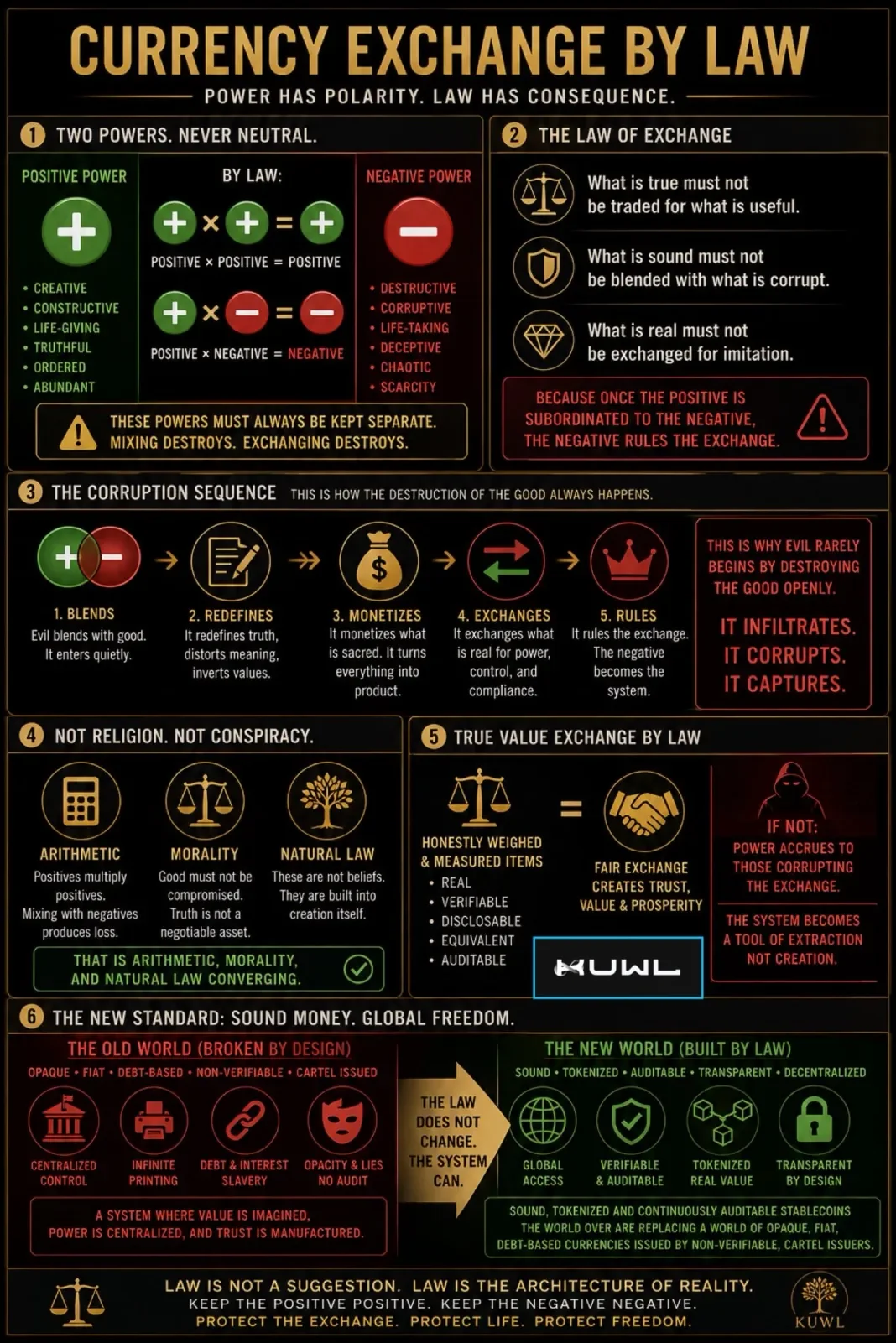
Positive mixed with negative does not “balance” truth.
It contaminates it.
It converts soundness into compromise.
Clarity into confusion, and
Trust into transaction.
• What is true must not be traded for what is useful.
• What is sound must not be blended with what is corrupt.
• What is real must not be exchanged for imitation.
Because once the positive is subordinated to the negative, the negative rules the exchange.
Turns clarity into confusion, and
Trust into transaction.
This is why evil/lies rarely begin by destroying the good/true, openly. It first blends with it, redefines it, monetizes it, then exchanges it for power.
That is not religion or conspiracy.
That is arithmetic, morality, and natural law converging.
True Currency Exchanges require honestly weighed and measured value, otherwise power accrues to those corrupting the exchange process.
A Global Stablecoin Exchange System is a GENIUS Architectural upgrade that all but centralized fiat exchange racketeers hate.
From 1 World Reserve Currency to 195 World Verifiable Stablecoins flips the perverted moneychanger tables right side up.
Source(s):
• https://x.com/KuwlShow/status/2063055069168259109
https://dinarchronicles.com/2026/06/05/rob-cunningham-currency-exchange-by-law/
Jon Dowling: Gold and Silver Breakout, Impact of Fort Knox Audit
Jon Dowling: Gold and Silver Breakout, Impact of Fort Knox Audit
6-5-2026
In an era of rapid digital transformation and economic uncertainty, understanding the tools available to protect your wealth has never been more critical.
In a recent, highly insightful podcast episode, Micah Haince, Senior Sales Manager at Noble Gold Investments, joins host Jon Dowling to break down the evolving global financial landscape and the indispensable role that precious metals play in long-term wealth preservation.
Jon Dowling: Gold and Silver Breakout, Impact of Fort Knox Audit
6-5-2026
In an era of rapid digital transformation and economic uncertainty, understanding the tools available to protect your wealth has never been more critical.
In a recent, highly insightful podcast episode, Micah Haince, Senior Sales Manager at Noble Gold Investments, joins host Jon Dowling to break down the evolving global financial landscape and the indispensable role that precious metals play in long-term wealth preservation.
One of the core takeaways from the conversation is the distinction between speculating and insuring. Micah emphasizes that gold and silver should be viewed primarily as a long-term foundation for financial security rather than a vehicle for quick, short-term profit.
He provides listeners with professional guidance on how to distinguish between numismatic collectible coins and standard bullion, while also sharing practical expertise on how to spot and avoid counterfeit precious metals. For anyone looking to enter the market, this focus on education and authenticity is a vital first step.
The discussion dives deep into the risks associated with the shift toward Central Bank Digital Currencies (CBDCs).
As financial systems become increasingly digital, Micah highlights the unique appeal of gold and silver: they are tangible, off-grid assets that remain outside the reach of digital tracking and potential demonetization. By holding physical assets, investors can secure a level of financial independence that is becoming harder to maintain in a strictly digital global economy.
Perhaps the most compelling part of the conversation centers on the possibility of a major financial reset.
Micah discusses the potential for renewed audits of the gold reserves at Fort Knox and the possibility of an official revaluation of gold prices by the U.S. government.
Drawing on analysis from the U.S. debt clock, the podcast explores how a significant revaluation of gold could theoretically impact the U.S. Treasury’s balance sheet. Whether or not these events align with major historical milestones, the message remains clear: the global financial paradigm is shifting, and tangible assets are becoming increasingly important.
While the prospect of financial change can be daunting, Noble Gold Investments stresses the importance of a measured, sensible approach. Micah advises investors to maintain personal liquidity for near-term needs while using precious metals as a form of “insurance” against systemic volatility. He warns that waiting too long could result in being priced out of the market as demand for tangible assets grows..
If you are interested in deepening your understanding of wealth preservation and the future of the monetary system, we encourage you to watch the full video from Jon Dowling. It is an essential watch for anyone looking to position themselves advantageously in the face of tomorrow’s economic challenges.
Ariel: We Must have a Level Playing Field Right?
Ariel: We Must have a Level Playing Field Right?
6-5-2026
Are You Listening?
Are You Paying Attention?
Are You Moving Yourself Into Position?
Ariel: We Must have a Level Playing Field Right?
6-5-2026
Are You Listening?
Are You Paying Attention?
Are You Moving Yourself Into Position?
What has Donald Trump repeatedly said since winning office in 2016?
We Must Have A Level Playing Field Right?
Meaning currencies from around the world must be of equal value.
Now does the statement from @MazinAlEshaiker a week or so ago about pegging the IQD to USD at 1:1 make more sense to you now?
Senator Cynthia Lummis: (on X) The Clarity Act doesn't pick winners. It creates a level field where the best ideas win. That's how America is supposed to work.
I swear you all wake up 1st thing in the morning looking for something to disappoint you.
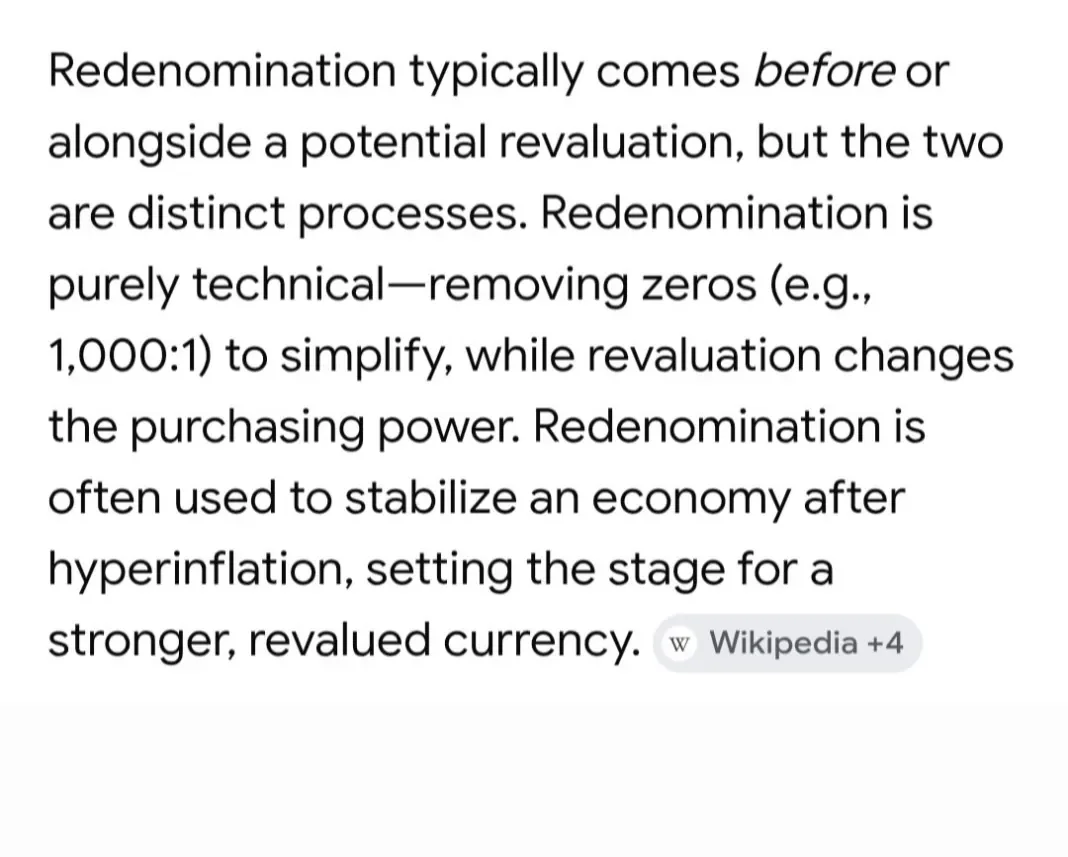
Iraqi OFFICIALS have said on multiple occasions that the 3 Zero Project is for their country internally. The revaluation is for the external international markets.
That is why the 1:1 is financially considered a revaluation. Let Iraq help their people 1st by a in-country redenomination. Then they will help the world by revaluation.
They can not do this without balancing their books 1st.
Seeds of Wisdom RV and Economics Updates Friday Afternoon 6-5-26
Good Afternoon Dinar Recaps,
Hezbollah Rejects Ceasefire as Middle East Peace Efforts Face New Setback
The collapse of a U.S.-brokered Lebanon ceasefire highlights the growing link between regional conflicts, Iran negotiations, and global economic stability.
Good Afternoon Dinar Recaps,
Hezbollah Rejects Ceasefire as Middle East Peace Efforts Face New Setback
The collapse of a U.S.-brokered Lebanon ceasefire highlights the growing link between regional conflicts, Iran negotiations, and global economic stability.
Overview
Efforts to reduce tensions in the Middle East suffered a setback after Hezbollah rejected a U.S.-brokered ceasefire agreement negotiated between Israel and the Lebanese government. The development raises new questions about whether broader diplomatic efforts involving Iran can succeed and underscores how interconnected the conflicts in Lebanon, Gaza, and Iran have become.
The rejection comes as Washington seeks to transform recent military de-escalation into a wider diplomatic framework with Tehran. However, Hezbollah's refusal to support the agreement demonstrates the challenges of achieving regional stability without the participation of key non-state actors.
Key Developments
1. Hezbollah Rejects U.S.-Brokered Ceasefire
The ceasefire proposal was negotiated between Israel and the Lebanese government, but Hezbollah was not directly involved in the talks. As the dominant military force in southern Lebanon, Hezbollah's rejection significantly reduces the likelihood that any ceasefire can be successfully implemented.
The decision highlights the limits of diplomatic agreements that do not include all major stakeholders on the ground.
2. Iran Peace Prospects Face New Obstacles
The development complicates ongoing efforts to improve relations between Washington and Tehran. Iranian officials have repeatedly linked progress on sanctions relief and nuclear negotiations to the treatment of Iran's regional allies, including Hezbollah.
As a result, continued fighting in Lebanon could directly impact broader U.S.-Iran diplomatic discussions.
3. Regional Conflicts Continue to Merge
What once appeared to be separate conflicts are increasingly becoming part of a larger regional crisis. Events in Lebanon now influence negotiations involving Iran, Israel, Gaza, and Gulf security.
This growing interconnectedness makes diplomatic solutions more difficult and increases the risk of wider escalation.
4. Energy Markets Remain Sensitive to Instability
Although global markets have recently shown optimism regarding potential de-escalation, the latest setback raises concerns about future volatility. Investors remain focused on risks surrounding the Strait of Hormuz, regional shipping routes, and energy infrastructure.
Any expansion of hostilities could quickly affect oil prices and global supply chains.
5. Long-Term Stability Remains Elusive
Analysts increasingly believe that temporary ceasefires alone may not be enough to achieve lasting peace. Without addressing the broader strategic competition between Iran, Israel, and the United States, future agreements may remain vulnerable to collapse.
The situation highlights the complexity of achieving sustainable stability across the region.
Why It Matters
The rejection of the ceasefire demonstrates that military realities on the ground continue to shape diplomatic outcomes. As regional actors pursue competing strategic objectives, efforts to reduce tensions face significant obstacles.
The outcome will influence not only regional security but also global energy markets, trade routes, and investor confidence.
Why It Matters to Foreign Currency Holders
• Geopolitical instability can increase volatility across global financial markets.
• Energy disruptions often influence inflation and currency valuations.
• Safe-haven assets may attract increased demand during periods of uncertainty.
• Prolonged instability can affect trade flows and economic growth worldwide.
Implications for the Global Reset
Pillar 1: Geopolitical Stability and Financial Markets
The Middle East remains one of the world's most strategically important regions for energy production and trade. Continued instability can directly affect inflation, investment flows, and economic growth.
Pillar 2: Regional Conflicts Shape Global Economic Conditions
As geopolitical conflicts become increasingly interconnected, their economic consequences extend far beyond national borders. Energy security, supply chains, and international finance are all impacted by developments in the region.
Closing Insight
Hezbollah's rejection of the ceasefire serves as a reminder that lasting peace requires more than diplomatic agreements between governments. The broader struggle involving Iran, Israel, and regional allies continues to influence both security and economic conditions throughout the world.
This is not simply a ceasefire dispute—it is another example of how regional power struggles can shape global financial stability, energy markets, and the future direction of international diplomacy.
Seeds of Wisdom Team
Newshounds News™ Exclusive
Sources
Modern Diplomacy — "Hezbollah Rejects Lebanon Ceasefire, Casting Doubt on Iran Peace Prospects"
Reuters — "Middle East Diplomacy Faces Challenges as Regional Tensions Persist"
~~~~~~~~~~
Seeds of Wisdom Team RV Currency Facts Youtube and Rumble
Newshound's News Telegram Room Link
RV Facts with Proof Links Link
RV Updates Proof links - Facts Link
Follow the Gold/Silver Rate COMEX
Follow Fast Facts
Seeds of Wisdom Team™Website
Thank you Dinar Recaps
The Fed Just Made it’s Biggest Move Since 2008
The Fed Just Made it’s Biggest Move Since 2008
Mark Moss: 6-5-2026
The financial world is abuzz with the talk of a significant transformation brewing at the heart of U.S. monetary policy.
A recent video outlines a compelling narrative regarding the new Federal Reserve Chair, Kevin Warsh, and the most substantial monetary regime change witnessed since 2008.
This isn’t just a tweak; it’s presented as a foundational overhaul, moving away from decades-old practices and setting a new course for the economy.
The Fed Just Made it’s Biggest Move Since 2008
Mark Moss: 6-5-2026
The financial world is abuzz with the talk of a significant transformation brewing at the heart of U.S. monetary policy.
A recent video outlines a compelling narrative regarding the new Federal Reserve Chair, Kevin Warsh, and the most substantial monetary regime change witnessed since 2008.
This isn’t just a tweak; it’s presented as a foundational overhaul, moving away from decades-old practices and setting a new course for the economy.
Unlike his predecessors, who largely operated within established frameworks, Kevin Warsh is described as an architect of structural reform. His appointment is particularly noteworthy, having been handpicked by Treasury Secretary Scott Bessent.
Both Warsh and Bessent share a common background as former partners of the renowned investor Stanley Druckenmiller, bringing a potent blend of deep macroeconomic understanding and real-world investing acumen to the highest levels of economic stewardship.
Their mission? To dismantle a legacy framework that, since 1971, has arguably linked government deficits to persistent inflationary pressures and cheap debt. Warsh’s strategy is multi-faceted, focusing on three key structural reforms designed to reshape how the Federal Reserve operates.
The proposed changes are profound and aim to fundamentally rewrite the monetary playbook:
Rethinking Inflation Measurement: At the core of this shift is a change in how inflation is measured. The legacy framework relied on the core Personal Consumption Expenditures (PCE) inflation gauge. The new regime, however, proposes adopting a “trimmed mean PCE” metric. This alternative largely excludes volatile, one-off price shocks, which has a significant implication: inflation figures could appear closer to the Fed’s target without requiring drastic price declines. This strategic adjustment could enable the Fed to potentially adjust interest rates while maintaining the narrative of controlled inflation.
Eliminating Forward Guidance: The era of explicit forward guidance, often characterized by the Fed’s “dot plot,” appears to be drawing to a close. Warsh’s approach seeks to dismantle this system, moving towards a monetary policy focused more on direct rate-setting rather than liquidity interventions. This doctrinal break represents a significant departure from the practices of the last four Fed chairs, who largely operated within a similar inflation-targeting paradigm tied to a fiscal-monetary symbiosis. The goal is a more autonomous and market-driven approach to monetary policy.
Shrinking the Balance Sheet: To reduce reliance on quantitative easing (QE), a hallmark of post-2008 monetary policy, the new regime aims to shrink the Fed’s balance sheet. This move signals a desire to return to more conventional tools for managing economic stability, lessening the dependence on large-scale asset purchases that have characterized recent decades.
These monetary reforms are not isolated; they are presented as integral to a broader national economic strategy.
The video highlights a focus on financing critical initiatives such as re-industrialization, the development of critical mineral mining and refining capabilities, advancements in energy infrastructure, and leadership in the burgeoning AI technology race.
This strategic alignment echoes historic debt management strategies, particularly the post-World War II period where robust economic growth helped erode the burden of national debt rather than relying solely on outright repayment.
The outlook suggests a dynamic where inflation is expected to run “hot but controlled,” asset prices could outpace inflation, and real interest rates might remain low, all designed to fuel this ambitious growth agenda.
Within this evolving landscape, certain assets are highlighted as playing unique roles. Bitcoin and gold are positioned as key “liquidity sponges” or productive stores of value.
The idea is that these assets could absorb monetary expansion without experiencing significant devaluation, offering a stable haven amidst economic shifts. Intriguingly, the video suggests an institutional endorsement of Bitcoin, recognizing its potential as “digital gold” for younger generations within this new monetary framework.
Ultimately, the video conveys a powerful message: the monetary “train” of deficit spending and easy money is unlikely to be halted.
For individuals and investors, the imperative becomes deciding whether to position themselves to potentially benefit from this new regime or risk being left behind as the anticipated economic boom unfolds.
For a deeper dive into these insights and further information, be sure to watch the full video from Mark Moss.
https://www.youtube.com/watch?v=HVDZx8lmvB0
https://dinarchronicles.com/2026/06/05/mark-moss-the-fed-just-made-its-biggest-move-since-2008/