Iraq Economic News and Points To Ponder Tuesday Evening 5-26-26
Al-Saadawi: Addressing The Monetary Crisis Cannot Be Achieved By Raising The Exchange Rate.
Information/Special.. MP Abdul Hadi Al-Saadawi confirmed on Tuesday that addressing the monetary and economic situation in Iraq requires a comprehensive package of government measures, indicating that raising the exchange rate alone is not enough to achieve financial stability.
Al-Saadawi told Al-Maalouma News Agency, “Addressing the economic crisis must begin with clear government steps, not just by adjusting or raising the exchange rate, but by controlling the markets and preventing price hikes that burden citizens.”
Al-Saadawi: Addressing The Monetary Crisis Cannot Be Achieved By Raising The Exchange Rate.
Information/Special.. MP Abdul Hadi Al-Saadawi confirmed on Tuesday that addressing the monetary and economic situation in Iraq requires a comprehensive package of government measures, indicating that raising the exchange rate alone is not enough to achieve financial stability.
Al-Saadawi told Al-Maalouma News Agency, “Addressing the economic crisis must begin with clear government steps, not just by adjusting or raising the exchange rate, but by controlling the markets and preventing price hikes that burden citizens.”
He added that “the government is required to maintain the real value of the Iraqi dinar and enhance confidence in the local currency, especially with the continued existence of a difference between the dollar exchange rate in the currency selling window and the local markets that exceeds 20 points.”
He noted that “the Central Bank and the government have taken good steps in the past period to address the monetary and financial situation, but the next stage requires greater oversight of the markets and broader support for economic stability.”
Economic expert Nabil al-Ali stated in a previous interview with Al-Maalomah News Agency that the Central Bank should withdraw the newly printed currency from circulation as soon as it is no longer needed, and either destroy or store it instead of recycling it. He emphasized that this measure is the only way to maintain exchange rate stability and prevent monetary inflation that threatens citizens' purchasing power. End/25
https://almaalomah.me/news/132872/economy/السعداوي:-معالجة-الأزمة-النقدية-لا-تتحقق-برفع-سعر-الصرف
Denying The Printing Of Currency, A Financial Advisor Reassures The Public About Iraq's Cash Reserves
25 May The Information Agency / Baghdad... The financial advisor to the Council of Ministers, Mazhar Muhammad Salih, denied on Monday the circulating reports regarding the Central Bank of Iraq printing local currency outside of regulations, stressing that this process is subject to legal mechanisms and strict financial backing.
Salih told the Information Agency, "The talk circulating among the Iraqi public about the Central Bank printing local currency is completely unfounded," explaining that "the currency printing process is governed by two legal mechanisms: the first depends on the actual market need, and the second is to address any shortage of cash liquidity."
He clarified that "these two operations cannot be carried out without full backing in hard foreign currencies and gold," noting that "the function of the Central Bank's reserves is to maintain the stability of the exchange rate, and the current reserves are in very good condition and have never been withdrawn."
In another context, Saleh revealed the fate of the budget, emphasizing that "preparing a budget for the remainder of this year is contingent upon halting the war of aggression against the Islamic Republic of Iran." He noted that "if the war were to cease immediately, the government would be able to prepare an exceptional or indicative budget for the remaining months." End / 25
A Member Of Parliament Warns Of Impending Inflation In The Iraqi Economy And Calls On The Government To Implement Emergency Plans
Information / Baghdad... MP Bassem Al-Gharabi warned on Tuesday of an impending wave of inflation looming over the Iraqi economy due to the financial mismanagement pursued by successive governments, calling on the new Prime Minister to adopt urgent plans to avert the crisis.
Al-Gharabi told Al-Maalouma that “the country’s almost total dependence on oil revenues and the fluctuation of their prices in global markets has caused clear confusion in the formulation of federal budgets in Iraq,” noting that “this one-sided rent has produced successive and cumulative economic crises over the past years.”
He added that "the current stage requires serious government action to change the prevailing financial philosophy and diversify national income sources," stressing "the necessity for the new prime minister to formulate a flexible economic strategy to protect citizens' purchasing power and prevent the country from sliding into inflation." End / 25
PMF Restructuring Plan Prompts Iraq Request For Frozen Funds
2026-05-26 / Shafaq News- Baghdad Iraq’s government plans to seek the release of frozen state funds held abroad to finance the integration of more than 800,000 armed faction members into the Popular Mobilization Forces (PMF) and other security institutions, an informed source told Shafaq News on Tuesday.
The request will cover Iraqi assets frozen in the United States and several European countries, the source indicated, adding that approval from Washington could facilitate the release of Iraqi funds held elsewhere.
“Integrating members of armed groups that have agreed to surrender their weapons and join state institutions will require substantial financial allocations due to their large numbers.” According to the source, most factions have agreed to hand over their weapons, with the exception of Harakat Al-Nujaba and Kataib Sayyid Al-Shuhada.
He also revealed that major changes are expected within the PMF after the integration process is completed and its directorates are reorganized under the institution’s approved structure. “Among the proposals under discussion is the appointment of Ali Miah Al-Zaidi to head the PMF Commission if Abu Fadak is not approved as a successor to Faleh al-Fayyad.”
Coordination Framework (CF) leaders continue to hold meetings aimed at resolving the issue of armed factions operating outside the state’s official structure, the source added.
Earlier this week, a government source told Shafaq News that some political forces and armed groups had shown greater flexibility regarding efforts to place all weapons under state control, adding that any handover process would be implemented according to a specific timetable.
On May 9, an informed source pointed out that the CF and Prime Minister Ali Al-Zaidi had agreed to establish a committee tasked with overseeing the disarmament of armed factions following a call by Sadrist Movement leader Muqtada Al-Sadr.
Read more: Ali Al-Zaidi's incomplete cabinet faces Iraqi armed factions test
https://shafaq.com/en/Iraq/PMF-restructuring-plan-prompts-Iraq-request-for-frozen-funds
Observers: Baghdad's Pledge Of Accountability Is Insufficient If It Does Not Prevent Iraq From Being Used As A Launching Pad For Hostile Acts Against The Gulf
Baghdad - One News 5/26/2026 Observers have confirmed that the growing influence of militias and armed factions within Iraq harms Baghdad before it harms its neighbors, because the increasing power of armed groups weakens the state’s ability to build trust with its Arab and Gulf surroundings, and negatively affects investment, stability and development opportunities.
They pointed out that any country seeking stability cannot accept the presence of weapons operating outside its official institutions, and that neighboring countries cannot be satisfied with political assurances if Iraqi territory is being used to launch drones and threaten civilian and vital facilities.
They added that Iraq faces two choices: either to remain an open arena for the conflicts of others, or to restore its natural position as a responsible national state within its regional environment, stressing that this issue does not concern Baghdad alone, but is directly related to the security of the Gulf and the stability of the region.
Seeds of Wisdom RV and Economics Updates Tuesday Evening 5-26-26
Good Evening Dinar Recaps,
Russia and China Expand Non-Dollar Trade as BRICS Payment Systems Grow
Rising use of the yuan and ruble in bilateral trade reflects a broader push toward alternative global settlement systems.
Good Evening Dinar Recaps,
Russia and China Expand Non-Dollar Trade as BRICS Payment Systems Grow
Rising use of the yuan and ruble in bilateral trade reflects a broader push toward alternative global settlement systems.
Overview
Russia and China continue expanding trade settlements using local currencies instead of the U.S. dollar, reinforcing broader efforts among BRICS nations to develop alternative financial infrastructure. The shift is being driven by energy trade, sanctions-related adjustments, and growing regional payment systems.
Key Developments
1. Russia-China Trade Increasingly Uses Yuan and Ruble
Russia and China’s bilateral trade, valued near $240 billion, is now being conducted primarily in rubles and yuan. Russian officials stated that most settlements between the two countries now bypass the U.S. dollar entirely.
2. Ruble Strengthens Ahead of Putin’s China Visit
Ahead of President Vladimir Putin’s visit to China, the Russian ruble reached its strongest level against the yuan since early 2023. Analysts linked the gains to higher oil revenues and increased foreign currency inflows from exporters.
3. China Continues Expanding Cross-Border Currency Agreements
China has continued building international currency partnerships through swap agreements and expanded usage of its Cross-Border Interbank Payment System (CIPS). These systems are designed to facilitate trade settlement outside traditional Western-controlled financial channels.
4. Energy Trade Remains Central to the Shift
Russia increased oil shipments to China significantly during the first quarter of 2026, strengthening the role of energy-backed trade settlement in local currencies. Growing cooperation between BRICS members continues to support this transition.
Why It Matters
The increased use of local currencies in trade demonstrates how geopolitical tensions and sanctions are reshaping international financial behavior. While the U.S. dollar remains dominant globally, more countries are investing in systems that provide alternatives for cross-border settlement.
Why It Matters to Foreign Currency Holders
Expanding use of regional currencies in commodity trade
Growing development of alternative payment infrastructure
Continued evolution toward a more multipolar financial environment
Implications for the Global Reset
Pillar 1: Alternative Settlement Networks Expand
The development of payment systems outside traditional dollar channels reflects growing interest in financial diversification and settlement independence.
Pillar 2: Energy Trade Drives Currency Realignment
Oil and commodity transactions are increasingly becoming a foundation for non-dollar trade agreements, particularly among BRICS nations and their partners.
Closing Insight
The global financial system is not abandoning the dollar overnight, but the steady expansion of local currency trade and alternative payment systems signals a long-term shift in how international commerce may operate in the future.
This is not a sudden replacement of the dollar — it is the gradual expansion of alternative financial pathways.
Seeds of Wisdom Team
Newshounds News™ Exclusive
Sources
Reuters — "Russian rouble hits over three-year high against yuan ahead of Putin visit"
Watcher.Guru — "BRICS: 80+ Countries De-Dollarize As Yuan, Rupee, Ruble Replace US Dollar"
~~~~~~~~~~
Seeds of Wisdom Team RV Currency Facts Youtube and Rumble
Newshound's News Telegram Room Link
RV Facts with Proof Links Link
RV Updates Proof links - Facts Link
Follow the Gold/Silver Rate COMEX
Follow Fast Facts
Seeds of Wisdom Team™Website
Thank you Dinar Recaps
Who Really Owns the Federal Reserve
From Recaps Archives
Who Really Owns the Federal Reserve
Heresy Financial: 3 years ago
In the year 1910, a secret meeting between some of the world's most powerful private men took place on the secluded island of Jekyll Island.
This is where the idea and the plan to form the Federal Reserve were hatched. This meeting was so secretive that they did not even admit this meeting happened until the 1930s.
From Recaps Archives
Who Really Owns the Federal Reserve
Heresy Financial: 3 years ago
In the year 1910, a secret meeting between some of the world's most powerful private men took place on the secluded island of Jekyll Island.
This is where the idea and the plan to form the Federal Reserve were hatched. This meeting was so secretive that they did not even admit this meeting happened until the 1930s.
Now, given the fact that today the Federal Reserve is number one, the most powerful economic decision maker in the world, number two is not a company. Number three is not a federal agency either. And number four is not accountable to either shareholders or to voters.
It leaves the inner workings of the Federal Reserve shrouded in mystery and suspicion. So, let us find the underlying cause of this. What is the Federal Reserve and who really owns it?
Timecodes
0:00 Introduction
0:55 The Opposition to Central Banking
5:33 The Creation of the Federal Reserve
6:30 The Control and Accountability of the Federal Reserve
7:32 The Federal Reserve's Monetary Policy and the FOMC
12:33 Organizational Structure
14:06 The Federal Reserve's Balance Sheet and Interest Rates
15:48 Can Congress End the Federal Reserve?
Ross: The Golden Age is Right Around the Corner
Ross: The Golden Age is Right Around the Corner
5-26-2026
$XRP makes the Global Currency Reset inevitable.
If you want lightning-speed and damn-near-free transfer of value, your currency better be asset-backed.
Any country still running a hyper-inflated currency won’t be able to participate.
Revalue based on your real assets… or be left behind.
Ross: The Golden Age is Right Around the Corner
5-26-2026
$XRP makes the Global Currency Reset inevitable.
If you want lightning-speed and damn-near-free transfer of value, your currency better be asset-backed.
Any country still running a hyper-inflated currency won’t be able to participate.
Revalue based on your real assets… or be left behind.
It’s that simple.
Why is almost no one in the $XRP community talking about this?
You should be extremely ecstatic about the news coming out of Iraq right now regarding IQD
The Global Currency Reset is unfolding in real time.
Countries are literally racing toward asset-backed currencies to participate in the new financial system before an XRP god candle spawns one day when you least expect it — at the flip of a switch.
Look no further than the timeline of $XRP mass adoption for a clue to when The Global Currency Reset kicks off.
CharuSanXRP:XRP as a Digital Commodity Market cap is a metric for stocks, Not for institutional bridge asset and a liquidity tool. When banks, FX markets, clearing institutions like the DTCC, and Nostro/Vostro accounts and the like start using XRP, the price will be calculated based on the supply within Ripple Payments (ODL). The price is calculated from the "Available Effective Liquidity" not the circulating supply. XRP velocity doesn't replace liquidity depth. You need to consider the simultaneous volume of global transactions. Velocity = 1 XRP can circulate a maximum of 10 times a day. XRP has the deep liquidity pools and high unit value capacity required to eliminate slippage and neutralize volatility risk for banks during transit.Not Financial Advice DYOR
The Golden Age is literally right around the corner.
1. Iran War ends → Peace in the Middle East
The Strait of Hormuz pressure lifts. Oil routes reopen. The old petrodollar chokehold breaks for good.
2. Iraq revalues the dinar.
HCL passes, new government locks in, CBI flips the switch. Reserves + diversified exports finally support a real rate. The 23-year wait ends.
3. The Clarity Act passes (July window)
Trump’s regulatory hammer drops. Tokenized assets and digital rails go from pilot to mandatory.
4. Crypto mass adoption +$XRP price explosion
XRP becomes the bridge asset everyone’s been racing to. Banks, FX, DTCC, Nostro/Vostro — all switch on at once. The god candle is coming.
5. Global Currency Reset kicks off
The timeline we’ve watched for years finally aligns. Currencies RV, XRP velocity explodes, and the new system goes live at the flip of a switch.
6. Rate cuts
Fed forced to slash as liquidity rotates out of the old system and the final chapter of the Fed begins.
7. Asset-backed USD launches (Victory Notes era)
America’s new Treasury architecture replaces the dying fiat rails. July 4th energy hits different in ’26.
8. Uranium retrieved → E******n fraud exposed → E*******s secured → Justice served
The receipts drop. The house of cards from the old guard collapses in real time.
9. AI-induced deflation
Productivity explodes. Costs crash. The new system delivers the opposite of inflation, actual abundance.
I know it seems impossible to have to wait any longer for all of this but remember that the alternative would’ve been who knows how many hundreds or thousands of years of slavery.
Life is good.
Source(s):
• https://x.com/Ross_ptm/status/2058925472525029831
https://dinarchronicles.com/2026/05/26/ross-the-golden-age-is-right-around-the-corner/
Iraq Economic News and Points To Ponder Tuesday Afternoon 5-26-26
Pezeshkian And Al-Zaidi Stress The Importance Of Prioritizing Dialogue And De-Escalation For The Stability Of The Region And The World.
Money and Business Economy News – Baghdad Prime Minister Ali al-Zaidi received a phone call on Tuesday from Iranian President Masoud Pezeshkian.
According to a statement received by "Al-Eqtisad News", the two sides exchanged congratulations on the occasion of the approaching Eid al-Adha, and their wishes that God would bring it back to the Iraqi and Iranian peoples and the entire Islamic nation with abundant goodness and stability.
Pezeshkian And Al-Zaidi Stress The Importance Of Prioritizing Dialogue And De-Escalation For The Stability Of The Region And The World.
Money and Business Economy News – Baghdad Prime Minister Ali al-Zaidi received a phone call on Tuesday from Iranian President Masoud Pezeshkian.
According to a statement received by "Al-Eqtisad News", the two sides exchanged congratulations on the occasion of the approaching Eid al-Adha, and their wishes that God would bring it back to the Iraqi and Iranian peoples and the entire Islamic nation with abundant goodness and stability.
The call also included discussions on bilateral relations and the importance of strengthening bilateral cooperation between the two countries in a way that enhances mutual benefit for the two neighboring peoples.
The two sides also discussed the situation in the region and the need to continue regional and international coordination and cooperation in order to reduce tension and promote dialogue and de-escalation, which contributes to strengthening stability in the region and the world. https://www.economy-news.net/content.php?id=69557
Government Advisor: The Dollar Is The Basis Of Iraq's Cash Reserves.
Money and Business Economy News – Baghdad The Prime Minister's financial advisor, Mazhar Muhammad Salih, said on Tuesday that diversifying Iraq's foreign reserves within a balanced investment portfolio represents a strategic monetary policy aimed at enhancing financial stability and reducing the risks associated with relying on a single asset or currency.
Saleh said that the management of foreign reserves at the Central Bank of Iraq is based on the criteria of liquidity, security and return, explaining that the philosophy of managing reserves is based on achieving a balance between protecting the value of the national currency and ensuring the ability to intervene in the exchange market and finance foreign trade, in addition to reducing sovereign and financial risks resulting from the fluctuations of global markets and geopolitical tensions.
He explained that Iraq, as an economy heavily dependent on oil revenues and foreign imports, keeps the US dollar as a key component of its foreign reserves due to its direct link to foreign trade, noting that the diversification policy also includes other currencies and assets such as the euro, yuan, and gold to enhance flexibility and reduce the risks of monetary concentration.
He added that the distribution of reserves is not limited to foreign currencies, but includes multiple investment instruments such as treasury bonds and sovereign deposits, explaining that the goal is not to achieve high profits as much as it focuses on maintaining security and liquidity while achieving an acceptable return.
He explained that gold is an important component of reserves within global diversification standards, as it provides a safe cover in times of turmoil, but it is not a complete substitute for the rest of the foreign assets because it does not generate a direct return and the costs of storing and securing it are high.
He stressed that the sound management of foreign reserves aims to achieve a balance between exchange rate stability, protecting the national economy, and reducing exposure to international market fluctuations, through building a balanced investment portfolio that provides liquidity, security, and an appropriate return.
https://www.economy-news.net/content.php?id=69548
Tehran Is Negotiating Over Its Frozen Assets; Qatari Mediation Aims To Resolve The Final Obstacle With Washington.
Money and Business Economy News - Follow-up Iran’s Tasnim news agency quoted a source close to the Iranian negotiating team on Tuesday as saying that the release of about $24 billion of frozen Iranian funds is one of the most prominent items on the agenda of the memorandum of understanding being negotiated between Tehran and Washington.
According to the source, Iranian Parliament Speaker Mohammad Baqer Qalibaf traveled to the Qatari capital, Doha, as part of efforts to reach an agreement on the mechanism for releasing these funds, amid intensive Qatari mediation between the two sides.
Tasnim News Agency confirmed that Qalibaf’s visit to Qatar made progress in indirect talks with the United States.
For its part, the Iranian news agency Fars indicated that Qatari mediation is currently working to resolve the issue of frozen Iranian funds, which is considered the "last sticking point" in the negotiations.
Fars reported that understandings between Washington and Tehran are nearing their final stages, after addressing most of the contentious issues, while the discussion is currently focused on the mechanisms for releasing Iranian funds and the conditions for implementing this within the framework of the proposed agreement.
Iran’s frozen funds abroad are estimated at $100 to $120 billion, representing oil sales revenues and Iranian assets held in international banks due to sanctions. These assets are currently at the heart of complex negotiations between Washington and Tehran, with Iran insisting on their release as a prerequisite for any agreements.
Estimates indicate that the most prominent countries holding Iranian financial revenues are China, which holds about $20 billion in oil revenues, in addition to $7 billion in India, $6 billion in Iraq related to electricity and gas revenues, as well as $6 billion transferred by South Korea to Qatar under previous understandings, in addition to other assets distributed in Japan, Luxembourg and the United States.
The roots of the Iranian funds seizure crisis go back to 1979 following the American hostage crisis in Tehran, when the first large batch of Iranian assets was frozen, and the issue later turned into an accumulated and complex file that the past decades have failed to resolve. https://www.economy-news.net/content.php?id=69559
Al-Zaydi Directs Baghdad Municipality To Rationalize Spending And Maximize Revenues
Localities Economy News – Baghdad Prime Minister Ali al-Zaidi directed Baghdad Mayor Ammar Musa Kazim on Tuesday to "rationalize expenditures and maximize revenues."
Al-Zaydi’s office said in a statement received by “Al-Eqtisad News” that the latter received, today, the Mayor of Baghdad and was briefed on the reality of services in the capital, the projects implemented and those under implementation, in addition to the most prominent obstacles facing the progress of work and the proposed solutions to address them.
Al-Zay di listened to a detailed briefing presented by the Mayor of Baghdad regarding the service and infrastructure projects being implemented by the municipality, stressing the importance of completing these projects and raising the level of performance and quality of work in order to improve the services provided to citizens.
The Prime Minister stressed the need for the Baghdad Municipality to adopt a policy of reducing and rationalizing expenditures and maximizing revenues, in order to contribute to strengthening resources and achieving sustainable development.
Energy Police: Seized Approximately 7 Million Liters Of Petroleum Products And Arrested 278 Suspects During 2026
Energy The Director General of the Energy Police, Lieutenant General Dhafer al-Husseini, announced on Tuesday the seizure of approximately 7 million liters of petroleum products and the arrest of 278 suspects during 2026.
Al-Husseini stated that "the General Directorate of Energy Police continues its intensive efforts to combat the smuggling of petroleum products and protect national wealth," explaining that "the Directorate's detachments were able—during this month—to achieve significant security results in various governorates across the country."
He added that "the Energy Police detachments were able—during this month—to arrest (43) suspects and violators in cases of petroleum product smuggling, following meticulous intelligence monitoring and intensive field efforts," noting that "the operations also resulted in the seizure of (47) tankers and vehicles of various sizes that were prepared for smuggling petroleum products in a number of governorates, excluding the Kurdistan Region, where the necessary legal measures were taken against those involved and the seized items were referred to the competent authorities."
He noted that "the Energy Police carried out targeted operations in the Basra and Salah al-Din governorates, resulting in the raiding of five locations used for illegal purposes related to smuggling and storing petroleum products. The contents of these locations were seized according to official procedures."
Al-Husseini explained that "ongoing security efforts resulted in the seizure of approximately 1,327,000 liters of petroleum products this month, reflecting the Directorate's commitment to protecting the national economy and deterring anyone attempting to tamper with the country's resources."
He indicated that "the rate of oil pipeline breaches reached 0%, while the Directorate's measures contributed to reducing smuggling operations by 98%. Four non-compliant gas stations were also recorded during the same period."
He added that "the total number of defendants reached 278, while the quantity of confiscated petroleum products amounted to 6,963,000 liters. In addition, 28 locations and 249 vehicles of various types and sizes were seized during 2026."
Al-Husseini affirmed that "the General Directorate of Energy Police continues to carry out its security duties to protect oil wealth and enhance economic stability in the country." https://www.economy-news.net/content.php?id=69582
Head Of Ports Authority: We Are Ready To Implement The Government Program By Following Governance And Automation In Order To Maximize Revenues.
Localities The head of the Border Ports Authority, Lieutenant General Omar Adnan Al-Waili, affirmed the Authority’s full readiness to implement the contents of the government program related to electronic governance and the automation of procedures within land, sea and air ports, stressing that these steps come in line with the direct directives of the Prime Minister, which represent a fundamental pillar for maximizing non-oil revenues and supporting the budget.
Al-Waeli said: “In response to what the Prime Minister’s government program emphasized regarding following governance and automation in order to maximize non-oil revenues and diversify the Iraqi economy, we will be ready to implement these government programs and programs with a high degree of responsibility.”
He added that "the main goal of these digital transformations is to maximize the state's non-oil revenues, diversify the country's economic resources and not rely entirely on oil," noting that "achieving stable revenue rates by following governance and automation will directly contribute to supporting the Iraqi citizen and bolstering the general federal budget."
Treasury Yields Are At 20-Year Highs. And Almost Nobody Wants Them
Treasury Yields Are At 20-Year Highs. And Almost Nobody Wants Them
Notes From the Field By James Hickman (Simon Black / Sovereign Man) May 26, 2026
There are pools of capital in the world so large that they cannot be parked just anywhere. Pension funds, foreign governments and central banks, giant commercial banks— they are collectively sitting on tens of trillions of dollars worth of capital that they have to invest in a safe, stable asset.
The stock market doesn’t really work— it’s far too volatile. Real estate doesn’t really work either— it’s not liquid.
Treasury Yields Are At 20-Year Highs. And Almost Nobody Wants Them
Notes From the Field By James Hickman (Simon Black / Sovereign Man) May 26, 2026
There are pools of capital in the world so large that they cannot be parked just anywhere. Pension funds, foreign governments and central banks, giant commercial banks— they are collectively sitting on tens of trillions of dollars worth of capital that they have to invest in a safe, stable asset.
The stock market doesn’t really work— it’s far too volatile. Real estate doesn’t really work either— it’s not liquid.
That is where the bond market comes in: it’s both massive (far larger than the stock market), so it can absorb enormous flows of capital. And it’s highly liquid. This allows large investors to quickly move huge sums of money in/out of the bond market.
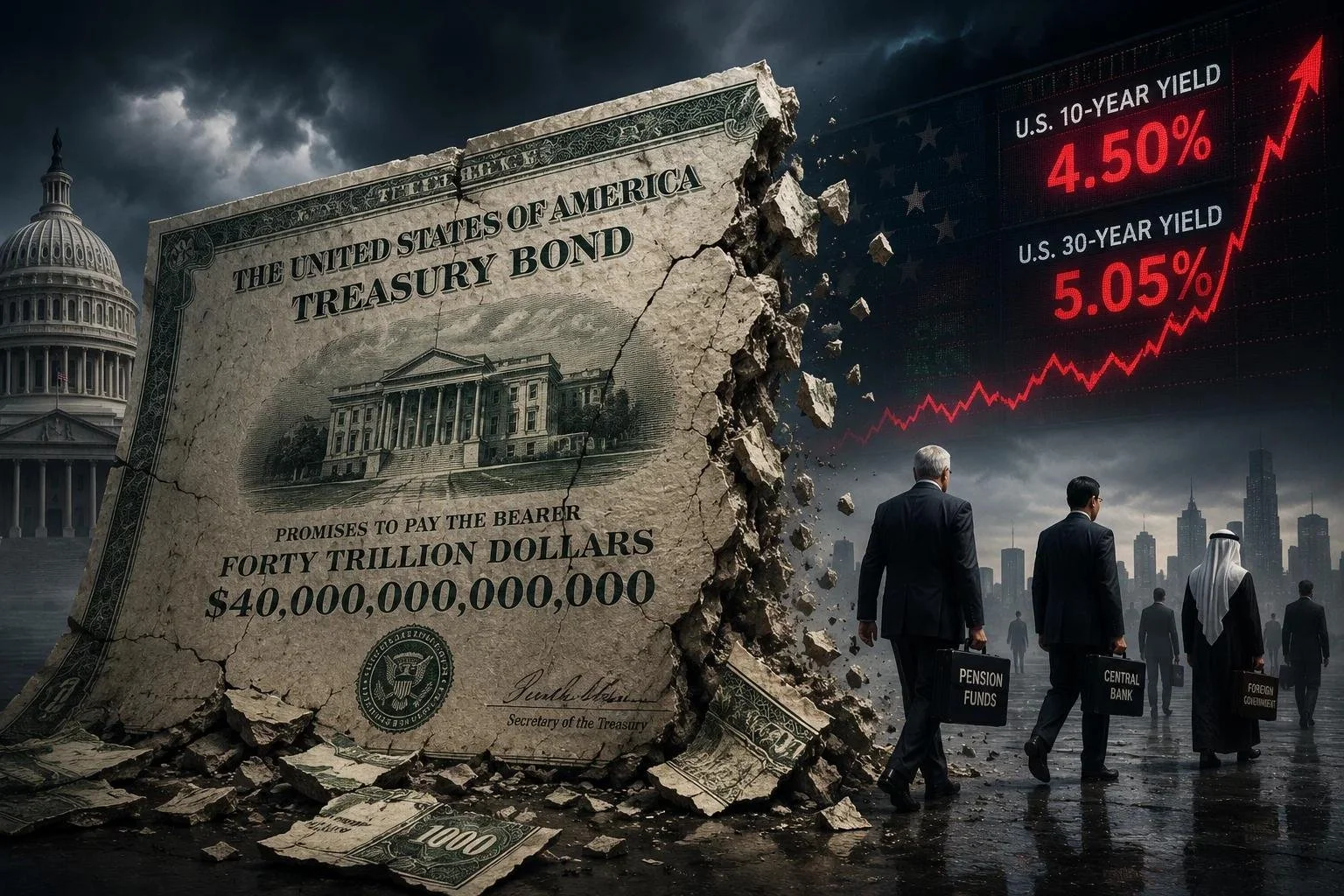
That’s why, for the better part of a century, the single deepest and most trusted piece of that market has been US government bonds. With the US national debt of nearly $40 trillion, this makes America’s bond market REALLY big. And Congress keeps adding to it.
The federal government runs roughly $2 trillion annual deficits— which you could think of as the new ‘supply’ of Treasury securities added to the bond market each year.
In other words, when the government spends more, they have to borrow more money by issuing more Treasury bonds. So the supply of US Treasury securities in the bond market increases.
‘Demand’ for US government bonds, on the other hand, comes from everyone on the planet who buys them. Pension funds, foreign governments and central banks, big corporations, banks, money market funds, etc.
And as any high school economics student can tell you, the ‘price’ is where supply meets demand. In the bond market, we usually think of price as the bond yield, e.g. right now the US 10-year yield is 4.5%, and the 30-year Treasury is over 5%.
To put those yields in a historical context, they haven’t been this high in decades— and it’s a direct result of rising supply and waning demand.
On the supply side, the US government keeps borrowing money at an insane pace, i.e. the Treasury Department keeps flooding the market with more and more bonds, notes, and yields.
But on the demand side, investors are backing off— especially foreigners. Foreign ownership of US government bonds (as a percentage of total public debt) has fallen by roughly HALF since the early 2010s... with a significant drop recorded just over the past twelve months according to the Treasury Department’s own data.
Few people in Congress seem to mind; there is no serious discussion in Washington about slowing the growth of the deficit, i.e. the bond supply, let alone actually shrinking supply by paying off debt.
Ultimately this supply and demand imbalance means that bond yields will continue to rise— which affects just about everything else from auto loans to the 30-year mortgage rate.
And just take a look around the rest of the developed world:
Bond yields in Germany are far lower (by about 1.5%) than US yields. So are yields in Japan, France, Italy, Canada, Singapore, New Zealand, South Korea, and China.
Even GREECE, with its 3.6% 10-year government bond yield, has lower yields than the United States.
You’d think that such attractive yields in the United States compared to the rest of the world would entice a lot more capital into the US bond market. After all, investors generally chase the highest returns.
But buyers are signaling that they don’t think the return is worth the risk— that even a 4.5% yield on a 10-year Treasury note is not worth the risk of holding a US government IOU for an entire decade.
Think about how much has changed over the past decade... and how much more can change over the next decade. Inflation, government shutdowns, debt ceiling showdowns, political theater, war, Social Security’s looming insolvency, etc.
Foreign governments and central banks aren’t willing to lock themselves in for ten years, let alone thirty years, with so much chaos on the horizon.
And with less demand from foreigners in the bond market, it’s likely that bond yields will continue to rise, until the Treasury Department is paying 5, 6, and 7% to borrow money.
With a ~$40 trillion national debt, that’s almost $3 trillion per year just to pay interest— roughly 60% of last year’s tax revenue.
This is why it makes so much sense to have a Plan B... because the most likely ‘solution’ to this problem will be for the Federal Reserve to ‘print’ trillions of dollars of capital.
This approach may succeed in lowering yields. But it will lead to substantially higher inflation, for a lot longer.
To your freedom, James Hickman Co-Founder, Schiff Sovereign LLC
P.S. If the Fed ultimately prints trillions to keep yields down, inflation is the bill— and the best protection is owning the companies that produce the real assets central banks are already loading up on.
Gold is the obvious example, but the same logic applies to every essential input the real economy runs on: energy, fertilizer, industrial metals, uranium, agriculture, shipping.
People still need to eat, drive, heat their homes, build, and farm.
That's why we built Schiff Sovereign's Strategic Assets, our monthly investment research service focused on profitable, well-managed real asset companies.
Iraq News Posted by Tishwash at TNT 5-26-2026
TNT:
Tishwash: Parliamentary committee: The 2026 budget will be based on a "hedging" oil price of around $60.
The Oil, Gas and Natural Resources Committee of the House of Representatives identified 4 features of this year’s budget.
According to the official newspaper, committee member Hawraa Aziz Al-Moussawi said, "This year's budget will probably be based on adopting a lower (hedging) oil price in the 2026 budget, reaching about $60 per barrel, rationalizing spending, increasing non-oil revenues, and reducing complete dependence on oil."
TNT:
Tishwash: Parliamentary committee: The 2026 budget will be based on a "hedging" oil price of around $60.
The Oil, Gas and Natural Resources Committee of the House of Representatives identified 4 features of this year’s budget.
According to the official newspaper, committee member Hawraa Aziz Al-Moussawi said, "This year's budget will probably be based on adopting a lower (hedging) oil price in the 2026 budget, reaching about $60 per barrel, rationalizing spending, increasing non-oil revenues, and reducing complete dependence on oil."
She explained, "There are discussions related to trying to reduce the financial deficit with the decline in global oil price expectations, because any increase in the price of oil supplied to local refineries may gradually affect the citizen." link
Tishwash: 4 pillars for the 2026 budget
The country's fiscal policy faces a critical test in maintaining economic stability, as the parliamentary committee on oil, gas, and natural resources has outlined four key pillars aimed at protecting the 2026 budget from external shocks. This legislative initiative comes amidst a complex regional and international environment, buffeted by oil market volatility and escalating geopolitical tensions in vital waterways, placing Iraq's financial security under exceptional challenges.
Member of the Oil Committee, MP Hawraa Aziz Al-Moussawi, said that the (2026) budget will be based on four main pillars, foremost among them setting a hedge oil price of about (60) dollars per barrel, in addition to rationalizing public spending, increasing non-oil revenues, and reducing dependence on oil as a main source of budget financing.
In her interview with Al-Sabah, she indicated that there are discussions within the committee regarding ways to reduce the financial deficit in light of declining global expectations for oil prices, warning that any change in the prices of oil derivatives may gradually affect the living conditions of citizens.
In the same vein, Dr. Ali Al-Azirjawi, a member of the State of Law Coalition, called for the adoption of an emergency plan similar to the Food Security Law should the 2026 budget not be approved within the constitutional timeframe. He explained that the current circumstances necessitate exceptional measures to ensure the continued and organized functioning of state institutions. He added that Iraq faces economic challenges related to the size of its internal and external debt, in addition to regional tensions that further complicate the overall financial situation.
For his part, economic researcher Bassam Raad considered setting a hedging oil price of (60) dollars per barrel a proactive step aimed at controlling public spending and avoiding the exacerbation of internal debt, but he pointed out that these data may not be sufficient to bridge the gap between revenues and actual expenditures, in light of the continued pressures on the general budget.
For his part, economist Nabil Al-Marsoumi suggested the possibility of postponing the (2026) budget to the year (2027), attributing this to the lack of time, the turmoil in the oil markets, and the fluctuation in export quantities, especially in light of the repercussions of the Strait of Hormuz crisis. link
************
Tishwash: Government advisor: The dollar is the basis of Iraq's cash reserves.
On Tuesday, Mazhar Mohammed Saleh, the financial advisor to the Iraqi Prime Minister, stated that diversifying Iraq's foreign reserves within a balanced investment portfolio represents a strategic monetary policy aimed at enhancing financial stability and reducing the risks associated with relying on a single asset or currency.
Saleh told Shafaq News Agency that the management of foreign reserves at the Central Bank of Iraq is based on liquidity, security and return standards, explaining that the philosophy of managing reserves is based on achieving a balance between protecting the value of the national currency and ensuring the ability to intervene in the exchange market and finance foreign trade, in addition to reducing sovereign and financial risks resulting from global market fluctuations and geopolitical tensions.
He explained that Iraq, as an economy heavily dependent on oil revenues and foreign imports, keeps the US dollar as a key component of its foreign reserves due to its direct link to foreign trade, noting that the diversification policy also includes other currencies and assets such as the euro, yuan, and gold to enhance flexibility and reduce the risks of monetary concentration.
He added that the distribution of reserves is not limited to foreign currencies, but includes multiple investment instruments such as treasury bonds and sovereign deposits, explaining that the goal is not to achieve high profits as much as it focuses on maintaining security and liquidity while achieving an acceptable return.
He explained that gold is an important component of reserves within global diversification standards, as it provides a safe cover in times of turmoil, but it is not a complete substitute for the rest of the foreign assets because it does not generate a direct return and the costs of storing and securing it are high.
He stressed that the sound management of foreign reserves aims to achieve a balance between exchange rate stability, protecting the national economy, and reducing exposure to international market fluctuations, through building a balanced investment portfolio that provides liquidity, security, and an appropriate return. link
************
Tishwash: Ports: An integrated strategy to facilitate trade and protect the national economy
he head of the Border Ports Authority, Omar Al-Waeli, confirmed on Sunday that there has been a noticeable decline in smuggling operations through the ports as a result of tightening control procedures and strengthening field control, noting that these measures have contributed to achieving a clear increase in revenues, while pointing to the implementation of an integrated strategy to facilitate trade and protect the national economy.
Al-Waeli said, “The border crossings are subject to smuggling attempts in various forms, but the volume of these operations has witnessed a noticeable decline in recent years as a result of tightening control procedures and strengthening field control.”
He added that "the Ports Authority has adopted a number of mechanisms to reduce smuggling, most notably automating procedures, activating monitoring systems and cameras, intensifying auditing and detection work, as well as continuous coordination with security and regulatory bodies and activating the principle of the single window, which contributes to reducing cases of manipulation and corruption."
He pointed out that "the Authority adopts an integrated strategy aimed at achieving a balance between facilitating trade, enhancing oversight, and protecting the national economy, through digital transformation, standardization of procedures, raising the efficiency of employees, combating administrative and financial corruption, as well as developing infrastructure and using modern technologies in inspection and detection," explaining that "these measures have resulted in a clear increase in revenues, a reduction in waste and smuggling rates, and faster completion of transactions within the ports."
He pointed out that "there is ongoing coordination between the federal government and the Kurdistan Regional Government regarding the management of border crossings, information exchange, control procedures, and the activation of the ASYCUDA system, given that the border crossings represent a part of the state's economic sovereignty."
He noted that "the last phase witnessed progress in the levels of joint cooperation through the coordination committees, while efforts continue to reach a complete unification of customs and control procedures in all Iraqi ports."
Al-Waeli continued, “Smugglers are subject to penalties based on applicable laws, including financial fines, confiscation of goods and means of transport in some cases, as well as referral to the judiciary and taking the necessary penal measures against violators.” He pointed out that “tightening penalties and activating judicial follow-up has contributed to strengthening deterrence, reducing many smuggling attempts, and raising the level of compliance with laws within border crossings.”
He explained that “the smuggling of drugs, weapons and prohibited materials, as well as organized commercial smuggling that harms the national economy, are among the most dangerous types of smuggling that the state faces,” noting that “the Authority deals with these files as they directly affect national and economic security by strengthening intelligence work, using modern inspection devices, intensifying detection and auditing procedures, and carrying out joint operations with the competent security agencies to reduce these phenomena and prosecute those involved in them.” ink
Tishwash: Iraq is moving towards a post-oil economy as part of its "2035 Plan".
The directives issued by the Prime Minister, Ali Faleh Al-Zaidi, during his recent visit to the Ministry of Finance, have garnered widespread attention in economic and specialized circles, after they included clear indications of the need to reformulate Iraq’s financial policy, reduce dependence on oil, and expand the role of the private sector, in conjunction with the preparation of “Iraq Plan 2035,” which aims to establish a new economic contract that does not patch up the old one but builds a completely different model.
Experts believe that the Prime Minister’s speech revealed a new governmental direction based on moving from the traditional management of the economy to a model that relies on development, production and investment, with a focus on reforming the financial and customs system and stimulating non-oil sectors as a fundamental pillar of economic stability in the next stage .
New economy
Financial expert Dr. Nabil Al-Abadi said: The proposal presented by the Prime Minister reflects a fundamental shift in the state’s financial philosophy from a rentier, distributive mentality to a productive and sustainable economic mentality, explaining that the talk about Iraq’s 2035 plan confirms that we are facing an attempt to establish a new economic contract that does not patch up the old one but builds a completely different model.
economic model
Al-Abadi added to Al-Sabah: “The diagnosis of the budget’s 90 percent dependence on oil is not merely a description of an economic reality, but a clear declaration of the fragility of the existing economic model. The danger lies in the governing and operational expenses that consume the budget without producing a high GDP. The paradox pointed out by the Prime Minister is that the state has a huge budget but does not create a robust economy. The shift towards making the economy manage the state instead of the state managing the economy represents a redefinition of the government’s role to be an organizer and stimulator of the business and investment environment .”
Energies towards production
He pointed out that relying on the private sector is no longer an intellectual option but an economic necessity to stop the inflation of government employment and to redirect energies towards production, noting that the move towards automation and reforming the customs system reflects a deep understanding of the importance of closing the loopholes of financial waste and maximizing non-oil revenues, while he described linking the dues of farmers and contractors to the continuation of the economic cycle as an “advanced awareness” of the importance of liquidity in stimulating the productive sectors .
Formulating fiscal policy
For his part, Jassim Al-Aradi, a member of the Baghdad Economic Forum, believes that the contents of the Prime Minister’s speech reflect a serious governmental direction to reformulate fiscal policy in line with current economic challenges and the requirements of sustainable development in Iraq .
Al-Aradi said that the diagnosis of the budget’s almost total dependence on oil revenues represents a realistic reading of the nature of the Iraqi economy, noting that the next stage requires accelerating the procedures for diversifying national income sources by revitalizing the industrial, agricultural, commercial and service sectors and not being satisfied with traditional solutions related to oil prices .
Modern economies
The spokesperson added that transforming the role of the state from manager of the economy to regulator and supporter of economic activity is one of the most prominent positive indicators, because it gives the private sector a greater opportunity to participate in creating job opportunities and driving investment, stressing that modern economies are based on partnership between the state and the private sector to achieve growth and stability .
Al-Aradi explained that the Prime Minister’s directives regarding automation and control of customs ports represent an important step to address financial waste and reduce cases of revenue manipulation, as well as enhance financial transparency and raise the efficiency of government collection .
Financial challenges
For his part, economist Dr. Murtadha Al-Khafaji described the Prime Minister’s speech as representing an economic roadmap that reflects a clear understanding of the magnitude of the financial challenges facing Iraq in light of regional and international changes and their direct impact on oil prices and public revenues .
Al-Khafaji explained that the Prime Minister’s emphasis on diversifying the economy and reducing dependence on oil represents an important strategic direction, especially since the Iraqi economy still depends heavily on oil revenues, which makes public finances vulnerable to global fluctuations .
Stimulating the productive sectors
He added that the call to make the budget a roadmap for the future reflects a new understanding of the role of fiscal policy in stimulating development and driving productive sectors, noting that supporting the private sector and changing traditional economic concepts are a necessary step to build a more resilient and sustainable economy .
Al-Khafaji stated that investing in Iraq’s geographical location and developing the transport and trade sectors could provide important financial resources outside the oil framework, stressing the importance of automation in customs ports to eliminate manipulation and increase non-oil revenues link
Will Iraq's New Trade Route Force an IQD Currency Adjustment?
Will Iraq's New Trade Route Force an IQD Currency Adjustment?
Edu Matrix: 5-25-2026
Will Iraq's New Trade Route Force an IQD Currency Adjustment? Sandy Ingram discusses the Middle East trade route that could change Iraq's economy.
The News Quietly Changing Iraq’s Economy is now unfolding in real time as Iraq, Syria, and Turkey open a new overland trade corridor that could reshape Middle East shipping routes and strengthen Iraq’s position in global trade.
Will Iraq's New Trade Route Force an IQD Currency Adjustment?
Edu Matrix: 5-25-2026
Will Iraq's New Trade Route Force an IQD Currency Adjustment? Sandy Ingram discusses the Middle East trade route that could change Iraq's economy.
The News Quietly Changing Iraq’s Economy is now unfolding in real time as Iraq, Syria, and Turkey open a new overland trade corridor that could reshape Middle East shipping routes and strengthen Iraq’s position in global trade.
In this video, we explain how the reopening of the Rabia border crossing near Mosul and the first successful Iraq-Turkey transit convoy through Syria may become a major turning point for Iraq’s economy, GDP growth, unemployment reduction, and the future of the Iraqi dinar (IQD).
The Development Road Project, Iraq’s massive $17 billion transportation and logistics initiative, is designed to connect the Grand Faw Port in southern Iraq to the Turkish border through a 1,200-kilometer network of highways and railways.
Analysts say the project could generate more than $4 billion annually, create thousands of jobs, reduce Iraq’s dependence on oil revenue, and position Iraq as a major trade hub connecting the Gulf States, Turkey, and Europe.
But what does this mean for the IQD exchange rate? Will Iraq eventually join global markets and the Forex Market? Could banking reform, increased GDP, IMF requirements, and diversified income streams create the conditions for a future currency adjustment?
In this video, we break down the economic path Iraq may need to follow before any major IQD valuation changes become possible.
We also discuss why economists remain skeptical about a sudden large revaluation, why Iraq may continue managing the dinar rather than allowing a free float, and why investors should focus on realistic opportunities for long-term returns. Plus, we explore another possible scenario many IQD investors are not talking about.
News, Rumors and Opinions Tuesday 5-26-2026
KTFA:
Clare: Tartus port exports its first "transit" sulfur shipment from Iraq
5/26/2026 Damascus - Al-Sa'a Network
On Tuesday, the port of Tartus witnessed the export of the first "transit" sulfur ship loaded with about 10,000 tons, coming from Iraq via Jordan, in a step that reflects the growing transit movement through Syrian ports.
The port authority stated in a statement followed by Al-Sa’a Network that “this shipment is the first of its kind for Iraqi sulfur to arrive via Jordan at the port of Tartus in preparation for exporting it by sea, which demonstrates the growing confidence in the port as a pivotal logistics center on the Mediterranean.”
KTFA:
Clare: Tartus port exports its first "transit" sulfur shipment from Iraq
5/26/2026 Damascus - Al-Sa'a Network
On Tuesday, the port of Tartus witnessed the export of the first "transit" sulfur ship loaded with about 10,000 tons, coming from Iraq via Jordan, in a step that reflects the growing transit movement through Syrian ports.
The port authority stated in a statement followed by Al-Sa’a Network that “this shipment is the first of its kind for Iraqi sulfur to arrive via Jordan at the port of Tartus in preparation for exporting it by sea, which demonstrates the growing confidence in the port as a pivotal logistics center on the Mediterranean.”
The statement added that "the total quantity planned for export through the port is about one million tons, which will contribute to enhancing trade activity and regional transit traffic during the coming period." LINK
Clare: Government advisor: Joining the International Maritime Organization agreement enhances investor confidence in Iraqi ports.
5/26/2026 Baghdad (INA) – Amna Al-Salami –
The Prime Minister's Financial Advisor, Mazhar Muhammad Saleh, affirmed on Tuesday that Iraq's accession to the Convention Establishing the International Maritime Aid Organization (IMAO) enhances investor confidence in Iraqi ports and reduces transportation costs. He pointed out that joining the international organization supports the development of the Faw Port and the diversification of the Iraqi economy.
Saleh told the Iraqi News Agency (INA) that "this accession is not merely a technical or regulatory procedure, but carries significant economic and strategic dimensions that will contribute to modernizing the Iraqi maritime navigation system and raising the efficiency of port and waterway management according to modern international standards. This complements the Faw Port strategy and its importance in the future economic geography of Iraq with the world."
He added that "joining the ICC will contribute to enhancing maritime safety, reducing risks and accidents, and improving the movement of commercial vessels in Iraqi ports, which will positively impact the flow of trade and reduce transportation costs and delays." He pointed out that "adopting international standards for pilotage and navigational aids will increase the confidence of international shipping and investment companies in Iraqi ports, giving Iraq a greater opportunity to attract logistical and commercial investments, especially with the major strategic projects Iraq is working on, most notably the Development Road project."
Saleh explained that "developing the maritime and port sector will contribute to boosting non-oil revenues by increasing port fees, logistics services, and maritime transport, thus supporting the state's drive towards economic diversification and reducing dependence on rentier resources." He indicated that "joining the ICC allows Iraq to benefit from international expertise and technical training and development programs, which will help build specialized national cadres capable of managing a modern and advanced maritime sector."
He emphasized that "this step represents a positive indicator of Iraq's move towards openness with specialized international institutions and organizations and working to build advanced maritime infrastructure that keeps pace with the requirements of the global economy and international trade."
He explained that the International Association of Lighthouse Authorities (IALA) was founded in 1957 as a non-governmental technical organization concerned with developing pilotage and navigational aid systems and standardizing maritime safety standards worldwide, before officially becoming an intergovernmental organization on August 22, 2024, following the entry into force of its convention.
The Cabinet had previously approved a draft law for Iraq's accession to the Convention Establishing the International Association of Lighthouse Authorities and referred it to the Council of Representatives. LINK
************
Courtesy of Dinar Guru: https://www.dinarguru.com/
Sandy Ingram The Development Road Project... which is the transportation corridor that will carry cargo and people from the Grand Port of Fa in southern Iraq near Basra to the Turkish border...will reduce unemployment, improve finances and will provide a consistent $4+ billion in annual revenue. It will automatically boost Iraq's GDP.Will this change the IQD exchange rate? Will there be a currency adjustment? Probably...This new corridor will...connect the Gulf states, Turkey and Europe. This is major.
Jeff Does Iraq have to have a fully completed formed cabinet to change the rate? Possibly. It could be perceived as a level of stability in this.
Reset Intelligence $1B to $3B a year. That's the fuel-oil smuggling economy built on top of the missing HCL. PMF brigades control 70+ oil fields across Nineveh and Salah al-Din. Iranian crude laundered as Iraqi product, sold into Asian markets...Petraeus walked into [Baghdad] 10 days ago with a plan to force the HCL that has been stuck in parliament for 19 years...It does not wait through June...Things are definitely heating up.
Militia Man We're watching history unfold...Over the last 24 hours Iraq has shown remarkable web of coordinated progress... There are a lot of things taking place...It isn't just about Iraq but yet it is about Iraq...Al-Zaidi is not waiting around. He's been executing with a purpose... The convergences we've followed for years are no longer separate threads ...We're in one of the most exciting and important windows I think we've ever seen.
The New Fed Chair's Plan To Reset The Entire Money System — Nobody Is Talking About This!
5-25-2026
The New Fed Chair's Plan To Reset The Entire Money System — Nobody Is Talking About This! New Fed Chair Kevin Warsh, confirmed 54-45 on May 13, 2026, holds a plan never attempted in modern monetary history.
The Federal Reserve balance sheet sits at $6.5 trillion — more than seven times its $900 billion pre-2008 level. Warsh wants to run quantitative tightening — shrinking that $6.5 trillion aggressively — while simultaneously cutting interest rates.
This combination, called QT-for-Cuts, has never been tried by any Fed Chair before. His first FOMC meeting falls on June 16th, 2026.
The vote was 8-4, the most divided in Federal Reserve history. CME FedWatch shows 62% odds of zero cuts in all of 2026. Rate hike odds sit at 39%.
Fiscal Frontier breaks down exactly what Warsh's unprecedented money system reset means for your mortgage, savings, 401k, and the US dollar globally.
Iraq Economic News and Points To Ponder Tuesday Morning 5-26-26
Iraq In 2026: Will US Pressure Lead To Genuine Reform Or Wider Economic Paralysis?
May 24, 2026 Al-Mustaqilla - Iraq enters 2026 under unprecedented financial and banking pressure, with escalating US restrictions on dollar movement, expanding sanctions related to financial and commercial networks, and growing concern within the market about the impact of this on banks, transfers, the exchange rate, and citizens' confidence in the financial system.
Iraq In 2026: Will US Pressure Lead To Genuine Reform Or Wider Economic Paralysis?
May 24, 2026 Al-Mustaqilla - Iraq enters 2026 under unprecedented financial and banking pressure, with escalating US restrictions on dollar movement, expanding sanctions related to financial and commercial networks, and growing concern within the market about the impact of this on banks, transfers, the exchange rate, and citizens' confidence in the financial system.
The crisis is no longer confined to the price of the dollar in the parallel market, but has turned into a broader question concerning the future of the entire Iraqi economy:
Will American pressure push Baghdad towards genuine reform in the financial and banking sector, or will it lead to a wider economic paralysis in a country that depends on oil, imports, the dollar, and currency?
The sensitivity of this stage stems from the fact that Iraq possesses large oil revenues and significant financial reserves, but it still suffers from a fragile banking system, weak public confidence in banks, widespread reliance on cash transactions, as well as a private sector with limited capacity for production and export.
The Dollar: From A Monetary Instrument To A Pressure Tactic
Recent developments have shown that the dollar is no longer merely a monetary issue within Iraq, but has become a tool of political and financial pressure in the relationship between Baghdad and Washington.
In April 2026, Iraqi sources told Reuters that the United States had intercepted a shipment of between $450 million and $500 million destined for Iraq, in a move aimed at pressuring the Iraqi government over the activities of Iranian-backed armed groups.
The sources explained that the action targeted paper currency used to meet the demand for dollars for travel, medical treatment, and education, while electronic transfers for trade and imports remained unaffected, according to an economic advisor to the Iraqi government.
This development reveals the deep interdependence between politics and finance in Iraq. The dollar, which enters the country through a complex system linked to oil revenues and accounts at the Federal Reserve in New York, is no longer guaranteed to flow in the traditional way if political or security disputes escalate between Baghdad and Washington.
Hence, the question becomes more serious:
What happens to a market that depends on the dollar for cash, trade, and transfers if currency shipments and transfers become a tool conditioned on the political and security behavior of the Iraqi government?
Banks Between Compliance And Isolation
In recent years, several Iraqi banks have faced restrictions on dollar transactions as part of declared US and Iraqi efforts to combat money laundering and currency smuggling. Reuters reported in February 2025 that the Central Bank of Iraq was moving to bar five more banks from dealing in dollars after meetings with officials from the US Treasury Department and the Federal Reserve, following a ban on eight banks in 2024.
This path has practically led to a sorting out within the Iraqi banking sector: banks that are able to comply with the requirements of foreign transfers and deal with the international financial system, and other banks that have become restricted or isolated from the dollar, which weakens their ability to serve traders and importers and reduces market confidence in them.
The result is that the banking sector is no longer a monolith. Some banks are attempting to transition to compliance, governance, and digitalization, while others face the risk of marginalization, mergers, or gradual market exit.
This sorting-out may be the beginning of a necessary reform, but it also carries the risk of market disruption if not managed transparently and gradually.
Washington Expands The Circle Of Pressure
American pressure did not stop at banks and transfers. In May 2026, the US Treasury Department announced sanctions as part of a campaign it called Economic Fury, targeting an Iraqi oil official and leaders linked to Iranian-backed factions. It said that Washington was prepared to take economic measures against entities supporting illicit Iranian trade, including imposing secondary sanctions on foreign financial institutions that facilitate Iran's activities.
This American message adds a new dimension to the crisis; It concerns not only banks, but also networks of finance, oil, trade, and politics.
This means that any Iraqi financial institution, company, or commercial intermediary could find itself under scrutiny if its dealings are linked to entities that Washington considers part of networks circumventing sanctions.
Thus, Iraq moves from the stage of monitoring transfers to a more complex stage, the title of which is:
Who has control over the movement of funds? And who can prove that his trade and transfers do not pass through suspicious channels?
The Central Bank Is Trying To Restructure The Sector.
In contrast, the Central Bank of Iraq is attempting to demonstrate a more rigorous reform path. It has launched reform pathways for banks based on options of survival, merger, or exit from the market, within a program that includes requirements related to capital, liquidity, ownership disclosure, governance, and compliance.
Central Bank documents on reform pathways show that banks that choose to remain are required to reach a paid-up capital of 400 billion dinars, comply with liquidity ratios, and provide full disclosure of shareholders and related parties, with the interim evaluation processes to begin in the first half of 2026 and extend over several cycles the end of 2028.
Another path allows banks to merge into stronger entities, while a third path involves an ordered exit or liquidation for those unable to meet reform requirements. The documents confirm that the central bank can redirect banks failing to meet the requirements toward alternative paths, including mergers or exits.
On paper, this plan appears to be an attempt to reform a banking sector that is bloated in terms of numbers and functional weaknesses.
However, it raises a crucial question:
Do Iraqi banks possess the financial, administrative, and technical capacity to meet these standards? Or will the reform lead to the collapse of weaker banks, creating further market instability?
A Cash Economy Resists Reform
The deeper problem is that Iraq suffers not only from weak banks, but also from a widespread cash economy. Citizens and merchants still keep a large portion of their money outside the banking system, preferring to deal in cash, especially dollars, due to a lack of trust and fear of sudden restrictions or complicated procedures.
This makes any banking reform run into a harsh reality:
it is not enough to impose standards on banks if the citizen does not trust them, the trader does not find them an easy and quick channel, and the parallel market is still more flexible than the official system.
Therefore, true reform does not simply mean closing down non-compliant banks, raising capital requirements, or tightening controls on transfers. Reform means building renewed trust between citizens and banks, between merchants and the financial system, and between Iraq and international institutions.
The Broader Economic Risk
If American pressure succeeds in pushing Iraq to reform its financial system, the medium-term outcome could be positive: fewer and stronger banks, more transparent transfers, a decline in the use of fictitious invoices, and a gradual improvement in investor confidence.
But the other scenario is equally plausible. If the pressures escalate into increasing restrictions without effective domestic alternatives, Iraq could face broader economic paralysis. Disruptions to remittances, traders' fear of banks, a widening gap between the official and parallel exchange rates, and the continuation of sanctions are all factors that could put pressure on imports, prices, and investment.
The most serious issue is that Iraq is a country that relies on imports to meet most of its consumer and production needs. Any disruption in financing foreign trade could quickly translate into price pressures, and then into social unrest, especially given that millions of citizens depend on government salaries and fixed incomes.
The Government Faces A Difficult Equation
The Iraqi government finds itself facing a delicate equation:
it must reassure Washington about combating money laundering and adhering to sanctions, reassure the domestic market that the dollar will not turn into an open crisis, convince the banks of the feasibility of reform, and convince citizens that their money is safer inside the banking system than outside of it.
This is not just a technical matter, but also a political one.
American pressure on the dollar and banks is linked to issues of Iranian influence, armed factions, and regional politics, while the crisis internally is linked to banking and commercial interests and financial networks that emerged during years of weak oversight.
Therefore, 2026 could be a pivotal year: either Iraq will use external pressure as an opportunity to rebuild its financial system, or the pressure itself will become a paralyzing factor if reform remains partial and the government lacks a clear plan to protect the market and affected classes.
Iraq in 2026 faces more than just a dollar crisis.
It faces a test of the state's ability to transition from a fragile cash economy to a modern financial system, and from banks seeking quick profits in the currency market to banks that finance the economy and adhere to international compliance standards.
American pressure could be an opportunity for genuine reform if accompanied by a clear Iraqi will, transparency in managing the banking sector, protection of legitimate trade, and a plan to restore public confidence.
However, it could turn into broader economic paralysis if measures remain limited to bans, sanctions, and restrictions, without deep internal reform.
The question that will determine the course of the next phase remains:
Can Iraq transform American pressure into genuine banking and economic reform, or will weak confidence, monetary dominance, and the entanglement of politics and money push it towards a wider crisis?
Seeds of Wisdom RV and Economics Updates Tuesday Morning 5-26-26
Good Morning Dinar Recaps,
Rubio Says Iran Deal Could Take Days as Fresh Strikes Keep Energy Markets on Edge
Ongoing U.S.-Iran negotiations, renewed military operations, and uncertainty surrounding the Strait of Hormuz are intensifying fears of prolonged energy instability and accelerating global discussions about geopolitical realignment and financial restructuring.
Good Morning Dinar Recaps,
Rubio Says Iran Deal Could Take Days as Fresh Strikes Keep Energy Markets on Edge
Ongoing U.S.-Iran negotiations, renewed military operations, and uncertainty surrounding the Strait of Hormuz are intensifying fears of prolonged energy instability and accelerating global discussions about geopolitical realignment and financial restructuring.
Overview
The United States and Iran remain engaged in fragile negotiations aimed at ending months of conflict that have disrupted global energy markets and threatened maritime trade through the Strait of Hormuz. While U.S. Secretary of State Marco Rubio stated that progress is being made, fresh U.S. military strikes in southern Iran highlight how unstable the situation remains.
At the center of negotiations are several critical issues, including reopening the Strait of Hormuz, managing Iran’s enriched uranium stockpile, releasing frozen Iranian assets, and preventing broader regional escalation involving Israel and Hezbollah.
The outcome of these talks could have major consequences for global oil prices, inflation, supply chains, currency markets, and the evolving multipolar financial system.
Key Developments
1. Rubio Signals Progress but Warns Talks Could Still Take Days
Secretary of State Marco Rubio said negotiations with Iran are advancing but cautioned that no immediate breakthrough should be expected. He stressed that the Strait of Hormuz “must remain open,” signaling Washington’s determination to restore maritime stability regardless of negotiation delays.
The comments suggest the White House is balancing diplomacy with continued military pressure while attempting to calm increasingly volatile energy markets.
2. Fresh U.S. Strikes Increase Pressure During Negotiations
Despite ongoing talks, U.S. forces launched new strikes targeting alleged Iranian military positions and naval mine operations in southern Iran.
Iran later claimed its air defense systems intercepted a hostile stealth drone, further escalating tensions and demonstrating how quickly diplomacy could unravel if either side miscalculates.
The simultaneous use of military force and negotiations reflects the increasingly fragile balance between deterrence and diplomacy.
3. Strait of Hormuz Remains the Core Global Economic Risk
The Strait of Hormuz continues to be the single most important issue in negotiations.
Under normal conditions, the waterway handles roughly 20% of global oil and LNG shipments, making it one of the most strategically important trade corridors in the world.
Shipping activity through the strait has sharply declined since the conflict intensified earlier this year, contributing to higher oil prices, rising transportation costs, and renewed global inflation concerns.
Any long-term disruption could significantly impact global trade flows and economic stability.
4. Iran’s Nuclear Program and Frozen Assets Remain Major Obstacles
Negotiators in Doha reportedly focused on Iran’s enriched uranium stockpile, sanctions relief, and the possible release of frozen Iranian financial assets.
Iran continues insisting its nuclear program is peaceful while resisting demands that could weaken its long-term strategic leverage.
Washington, meanwhile, maintains that preventing Iran from developing nuclear weapons remains a non-negotiable objective.
The unresolved nuclear dispute remains one of the largest barriers to any lasting agreement.
5. Israel-Hezbollah Tensions Threaten Wider Regional Escalation
Israeli Prime Minister Benjamin Netanyahu announced expanded operations against Hezbollah in Lebanon, adding another layer of instability to the region.
Even with ceasefires technically in place, military operations continue across multiple fronts, raising fears that any collapse in U.S.-Iran negotiations could trigger a broader Middle East conflict.
Global markets remain highly sensitive to any sign of escalation.
Why It Matters
The negotiations are no longer just about Iran and the United States. They now directly affect global energy security, inflation trends, trade stability, and confidence in the international financial system.
The Strait of Hormuz serves as a critical artery for global commerce. Continued disruption threatens oil-importing economies across Europe and Asia while placing additional pressure on already fragile supply chains.
The crisis also reflects the growing transition toward a more fragmented and multipolar global order where energy corridors, sanctions, currency systems, and geopolitical alliances are becoming increasingly interconnected.
Why It Matters to Foreign Currency Holders
For foreign currency holders, prolonged instability in the Middle East could accelerate pressure on the traditional dollar-based global financial system.
Rising oil prices and inflation fears often strengthen short-term demand for the U.S. dollar, but long-term geopolitical fragmentation may encourage countries to expand alternative trade settlement systems outside traditional Western financial networks.
Nations involved in BRICS expansion and regional trade alliances continue exploring local currency settlement mechanisms, commodity-backed agreements, and alternative payment systems designed to reduce exposure to geopolitical sanctions and energy disruptions.
If Hormuz instability continues, global efforts toward financial diversification, de-dollarization discussions, and multipolar trade restructuring could intensify further.
Implications for the Global Reset
Pillar 1: Energy Security Is Becoming Central to Global Financial Stability
Control over shipping routes, energy supply chains, and commodity pricing is increasingly shaping geopolitical and financial power structures worldwide.
Pillar 2: Multipolar Financial Systems Continue Expanding
As global conflicts expose vulnerabilities in traditional trade systems, more nations are accelerating efforts to build alternative financial and payment networks independent of Western control.
Pillar 3: Geopolitical Risk Is Reshaping Currency and Commodity Markets
Persistent instability in the Middle East is increasing volatility across oil, currencies, shipping, and global bond markets, reinforcing broader concerns about long-term financial restructuring.
This is not just a regional conflict — it is becoming a major test of global energy security, geopolitical power, and the future direction of the international financial system.
Seeds of Wisdom Team
Newshounds News™ Exclusive
Sources
Reuters — "Rubio says Iran deal could take days as U.S. launches fresh strikes"
Modern Diplomacy — "Rubio Says Iran Deal Could Take Days as US Launches Fresh Strikes"
~~~~~~~~~~
🌱A Message to Our Currency Holders🌱
If you’ve been holding foreign currency for many years, you were not foolish.
You were not wrong to believe the global financial system would change.
What failed was not your patience — it was the information you were given.
For years, dates, rumors, and personalities replaced facts, structure, and proof. “This week” predictions created cycles of hope and disappointment that were never based on how currencies actually change.
That is not your failure.
Our mission here is different: • No dates • No rates • No hype • No gurus
Instead, we focus on:
• Verifiable developments • Institutional evidence
• Global financial structure • Where countries actually sit in the process
Currency value changes only come after sovereignty, trade, banking, settlement systems, and fiscal coordination are in place. History and institutions confirm this sequence.
You will see silence. You will see denials. That is not delay — that is discipline.
Protect your identity. Organize your documents. Verify everything.
Never hand your discernment to anyone who cannot show proof.
You deserve truth — not timelines.
Seeds of Wisdom Team
Newshounds News™
~~~~~~~~~~
Seeds of Wisdom Team RV Currency Facts Youtube and Rumble
Newshound's News Telegram Room Link
RV Facts with Proof Links Link
RV Updates Proof links - Facts Link
Follow the Gold/Silver Rate COMEX
Follow Fast Facts
Seeds of Wisdom Team™Website
Thank you Dinar Recaps