
News Posted by Tishwash at TNT Tuesday 4-21-2026
TNT:
Tishwash: Venezuela Replaces Central Bank President Days After Sanctions Lifted
Key Points
—Acting President Delcy Rodríguez announced Thursday that Laura Guerra Angulo — a Maduro family relative who had led the BCV since April 2025 — resigned and was replaced by Vice President Luis Pérez, a career central bank technocrat
—The leadership change came just two days after OFAC General License 57 lifted sanctions on the BCV and three state banks, unlocking approximately US$1 billion in frozen oil revenue and reconnecting Venezuela to the SWIFT international payments system
TNT:
Tishwash: Venezuela Replaces Central Bank President Days After Sanctions Lifted
Key Points
—Acting President Delcy Rodríguez announced Thursday that Laura Guerra Angulo — a Maduro family relative who had led the BCV since April 2025 — resigned and was replaced by Vice President Luis Pérez, a career central bank technocrat
—The leadership change came just two days after OFAC General License 57 lifted sanctions on the BCV and three state banks, unlocking approximately US$1 billion in frozen oil revenue and reconnecting Venezuela to the SWIFT international payments system
—Multiple analysts had flagged the governance overhaul as a precondition for IMF reintegration, which Treasury Secretary Scott Bessent publicly endorsed at the IMF Spring Meetings this week link
Tishwash: Washington has halted dollar shipments to Iraq until a new Iraqi government is formed
Saudi Arabia’s Al-Hadath TV quoted American sources as saying that Washington has decided to halt dollar shipments to Iraq until a new Iraqi government is formed.
Iraq periodically receives shipments of its oil sales proceeds in dollars from the US Federal Reserve, to which these funds are transferred every two months, as part of an Iraqi-American agreement to protect Iraqi funds from claims by international creditors.
Washington is pressing hard to prevent the formation of an Iraqi government loyal to Iran, and US President Donald Trump has officially announced his opposition to the nomination of former Iraqi Prime Minister Nouri al-Maliki.
Iranian Quds Force commander Esmail Qaani publicly visited Iraq just two days before a planned meeting tonight of the coordination framework to nominate the name of the new prime minister. link
**************
Tishwash: Parliament preempts the decision on the prime ministerial candidate... Rashid: There will be no budget for the current year, 2026.
The Iraqi Parliament has settled the debate regarding the fate of the draft federal budget law for the current year, 2026, amidst the ongoing crisis surrounding the nomination of a candidate for the position of Prime Minister, a matter on which political and parliamentary circles are still awaiting a resolution.
MP Ahmed Hama Rashid stated to the Iraqi National News Agency ( NINA ), "There is no budget for the current year, 2026, because the draft budget law must be prepared by mid-May 2025. Therefore, there will be no budget law for the current year."
He explained, "Financial statements will be issued by the Ministry of Finance and sent to the Federal Board of Supreme Audit, and then approved by Parliament later."
He added, "The amended Federal Financial Management Law No. 6 of 2019 addresses this situation to facilitate the annual budget by disbursing expenditures at a rate of 1/12 of all expenditures included in the previous budget. This is a legal procedure that is in practice and adopted by Iraqi state institutions."
Regarding the approval of the final accounts, Rashid explained that "these accounts will be based on official financial statements sent to the Federal Board of Supreme Audit, for preparation, auditing, and reconciliation." link
************
Tishwash: The need to restore Iraq's political and economic independence by settling oil revenues in currencies other than the dollar.
Karim Al-Araj, expert and consultant in international economics
Since 2004, due to US sanctions, Iraq has been unable to independently benefit from its oil revenues. With the start of the war between Iran and the United States, the closure of the Strait of Hormuz, and the imposition of restrictions on oil exports, Iraq can regain its political and economic independence by breaking out of the petrodollar cycle and selling its oil in currencies other than the dollar, for example, settling it in yuan.
Iraq is among the world's largest producers and exporters of crude oil. It possesses over 145 billion barrels of proven oil reserves, ranking fifth after Venezuela, Saudi Arabia, Canada, and Iran.
In addition, it produces approximately 4.4 million barrels of oil per day, ranking sixth among crude oil producers, and with exports of 3.6 million barrels, it ranks fifth among the world's exporters of this product. Annual revenue from these oil exports is estimated at around $110 billion; however, this revenue is indirectly transferred through the Federal Reserve to the Iraqi government and people.
Following Iraq's invasion of Kuwait in 1990, the UN Security Council imposed sanctions on the country and, in Resolution 986, established the Oil-for-Food Program for Iraq. Under this resolution, Iraq was permitted to export its petroleum products, but the proceeds were deposited into an account at the United States Federal Reserve to be used for importing food and medicine.
Following the occupation of Iraq in 2003 and the formation of the Coalition Provisional Government led by the United States within the framework of the multinational forces in that country, the United States effectively assumed, based on Security Council Resolution 1483 of May of the same year, the executive, legislative and judicial responsibilities of the Iraqi government until June 28, 2004. According to Resolution 1483, the Coalition Provisional Government was responsible for managing the Development Fund for Iraq, which in turn replaced the United Nations Oil-for-Food Programme.
Among the tasks of this fund were financing reconstruction, meeting the food and medical needs of the Iraqi people, providing equipment for the security forces, paying the salaries of civilian employees, and covering the expenses of various ministries in the country. However, after the drafting of the constitution and the formation of the Iraqi government in 2007, the United States continued to monitor the fund's revenue sources under various pretexts, such as combating insurgency, al-Qaeda, and terrorism financing.
Based on this, since 2003, the United States has used this tool to control Iraqi oil revenues through its central bank, charging the Iraqi government for this service. This has resulted in the US government effectively controlling Iraq's political and economic independence, forcing the country to spend its oil revenues on imports instead of directing them toward development.
Last month, on February 26, 2026, a war broke out between Iran and the United States in the West Asia region (the Middle East). This attack, imposed on Iran under the pretext of combating nuclear weapons, led to Iran's strategic closure of the Strait of Hormuz, through which more than 20 percent of the world's oil depends, thus depriving Iraq of its ability to export its oil. Although this event represents a significant loss for the Iraqi government, given that 90 percent of its revenues depend on this source, it also presents a historic opportunity for the Iraqi government and people to sell their oil in currencies other than the dollar, such as the yuan, thereby ending US political and economic hegemony over Iraq and restoring its political and economic independence.
Based on this, the Iraqi government can take advantage of this opportunity by moving out of the cycle of selling oil in dollars and converting it to other currencies, for example, the yuan, and thus take an important step towards developing Iraq and restoring its political and economic independence. link
Tishwash: Abu Dhabi hints at using the yuan if the dollar becomes scarce due to the regional crisis.
The Wall Street Journal reported that the United Arab Emirates has begun talks with the United States about obtaining a financial safety net in case a war with Iran leads to a deeper liquidity crisis in the oil-rich Gulf state, according to US officials.
The newspaper quoted officials as saying that "Khaled Mohammed Balama, the governor of the UAE Central Bank, raised the idea of establishing a currency swap line with US Treasury Secretary Scott Bisent and officials from the Treasury Department and the Federal Reserve during meetings held in Washington last week."
The officials added that "the Emirati side stressed during the talks that it has so far avoided the worst economic effects of the conflict, but it may need financial support if the situation worsens."
The newspaper said, "These talks showed the UAE's concern that the war would cause significant damage to its economy and its status as a global financial center, by depleting its foreign reserves and raising concerns among investors who considered it a stable and safe destination for their money."
She added that "the conflict has damaged the UAE's infrastructure in the oil and gas sectors, and disrupted its ability to sell oil using tankers crossing the Strait of Hormuz, depriving it of a major source of dollar revenues."
According to officials, "UAE officials have not submitted a formal request to establish a currency swap line, an arrangement that would allow the UAE Central Bank to access dollars at a low cost to support the currency or boost its foreign exchange reserves in the event of a liquidity crisis."
US officials explained that "the Emiratis presented the idea during recent talks as a preliminary and precautionary proposal."
Some officials added that "the Emirati side argued that Trump's decision to attack Iran had plunged his country into a devastating conflict whose effects may not yet be over."
They said that "Emirati officials informed their American counterparts that if the UAE faced a shortage of dollars, it might have to use the Chinese yuan or other currencies in oil sales and other transactions link
News, Rumors and Opinions Tuesday 4-21-2026
Note: All intel should be considered as "Rumors" until we receive official announcements ...and “Rates and Dates” could change anytime until we get to the banks/redemption centers.
Restored Republic via a GCR Update as of Tues. 21 April 2026
Compiled Tues. 21 April 2026 12:01 am EST by Judy Byington
“Keep your face always toward the sunshine and the shadows will always fall behind you.”
…Walt Whitman
Thurs. APRIL 30. APRIL 30 IS THE (alleged) TRIGGER DATE. Remember this date. Write it down. Burn it into your mind. Everything converges on April 30. They don’t want you to see the pattern. But the pattern is screaming. …Mr. Pool Final Chapter
Note: All intel should be considered as "Rumors" until we receive official announcements ...and “Rates and Dates” could change anytime until we get to the banks/redemption centers.
Restored Republic via a GCR Update as of Tues. 21 April 2026
Compiled Tues. 21 April 2026 12:01 am EST by Judy Byington
“Keep your face always toward the sunshine and the shadows will always fall behind you.”
…Walt Whitman
Thurs. APRIL 30. APRIL 30 IS THE (alleged) TRIGGER DATE. Remember this date. Write it down. Burn it into your mind. Everything converges on April 30. They don’t want you to see the pattern. But the pattern is screaming. …Mr. Pool Final Chapter
Connect Thurs. 30 April 2026:
Gold — $4,879. Heading to $5,000. The old dollar is flatlining.
QFS — 209 nations synced. Waiting for the trigger date.
~~~~~~~~~~~~~~
12 May 2026 Alliance Plan (Military Intelligence follows the Julian Calendar): …Ten Days of Darkness on Telegram
(Rumors)
NESARA/GESARA debt forgiveness will be implemented—freedom from the Deep State’s chains.
QFS will be put in place to crush the financial elites.
Federal Reserve? Dead. IRS? Taken over by the new U.S. Treasury.
A new tax system: only a 14% tax on new items—no taxes on food, medicine, or wages. Finally, real relief for the people.
Unfolding of Events. As the grand spectacle takes shape, a series of remarkable events will transpire:
Bitcoin servers and data centers will face a decisive blow, leading to the fall of 99.5% of crypto-currencies, including China Coins.
ISO20022 Coins, backed by Precious Metals, will emerge as a new financial paradigm.
The Stock Market will crash, reshaping the global financial landscape.
Quantum Systems will come to life.
NESARA/GESARA/RV will pave the way for a new era of prosperity.
Read full post here: https://dinarchronicles.com/2026/04/21/restored-republic-via-a-gcr-update-as-of-april-21-2026/
************
Courtesy of Dinar Guru: https://www.dinarguru.com/
Militia Man Heavy crude topped up about $117 a barrel. That's a big big amount of money over the $70 budget, padding those reserves...They talk about their reserves. They talk about their gold. They talk about all these things. Saleh has been hammering it home. He's been giving reassurances for quite some time. Nothing has changed from that aspect...
Frank26The next step is to give the citizens of Iraq purchasing power. How are you going to give the citizens of Iraq purchasing power? By introducing a new exchange rate followed by redenomination with lower notes because the lower notes would replace the three zero notes...They're not printing a new currency but they are educating the Iraqi citizens about a new currency that they've never dealt with before so it's not a shock to the system. Tomorrow they'll tell them even more.
Jeff June 20, 2021 they set two conditions for deleting the currency. Article "Al-Kazemi's financial advisor: Deleting three zeros from the currency is an option" Quote "The first condition is price stability and global economic growth, and the second is appropriate stability in political life." They clearly tell you from the central bank, political stability is the number one thing you're looking for as a dinar investor to know when they're going to be ready to revalue the currency...That's why Iraq has been telling you they're going implement the banking reforms after the government is formed because they're going to revalue after the government is formed.
BREAKING: Venezuela Sanctions Lifted Iraq Hit With New Sanctions
Edu Matrix: 4-21-2026
BREAKING: Venezuela Sanctions Lifted Iraq Hit With New Sanctions - . What does this mean for the future of both currencies?
In this video, we break down the latest developments as Venezuela sanctions are lifted and how that is helping stabilize the Venezuelan currency over the past two weeks.
With the U.S. Treasury allowing transactions with certain Venezuelan banks, the country now has greater access to U.S. dollars, boosting confidence and supporting short-term economic stability.
We also discuss how Venezuela’s banking system is reopening to international activity, allowing more direct access to oil revenue and global financial systems.
Plus, renewed contact with the IMF (International Monetary Fund) is increasing investor confidence and pushing Venezuelan bonds higher.
At the same time, Iraq sanctions hit hard, targeting individuals connected to the Coordination Framework. We explain what these U.S. Treasury sanctions mean for Iraq’s financial system and how this could impact the Iraqi dinar moving forward.
When comparing the Venezuelan bolívar to the Iraqi dinar (IQD), there are key differences.
Venezuela has struggled with hyperinflation and currency devaluation, while Iraq has maintained relative stability, backed by strong foreign reserves and massive oil wealth.
Key takeaway: When U.S. banks allow transactions and global access improves, currencies can stabilize. The question is—can Iraq follow a similar path?
Seeds of Wisdom RV and Economics Updates Tuesday Morning 4-21-26
Good Morning Dinar Recaps,
European Markets Slide as Middle East Tensions Shake Global Stability
Geopolitical risk surges again as US–Iran conflict fears ripple through energy and financial markets
Good Morning Dinar Recaps,
European Markets Slide as Middle East Tensions Shake Global Stability
Geopolitical risk surges again as US–Iran conflict fears ripple through energy and financial markets
Overview
European markets moved lower as renewed tensions between the United States and Iran disrupted investor confidence and reignited fears of a broader geopolitical escalation. With a fragile ceasefire nearing expiration and diplomatic efforts stalling, markets are now pricing in higher risk across energy, trade routes, and global stability.
Key Points:
European equities declined amid rising geopolitical uncertainty
Oil prices surged sharply, signaling supply disruption fears
Strait of Hormuz risks returned to the forefront of global trade concerns
Safe-haven sentiment increased as investors pulled back from risk assets
Key Developments
1. European Markets React to Rising Tensions
The pan-European STOXX 600 fell 0.8%, while major indices like Germany’s DAX dropped 1% and France’s CAC 40 declined 0.9%. The pullback reflects growing investor concern over escalating geopolitical instability, particularly tied to the Middle East.
2. Sector-Specific Selloff Intensifies
Losses were concentrated in travel, banking, and automotive sectors, which are highly sensitive to economic uncertainty and global trade disruption. Meanwhile, energy stocks surged, benefiting from rising oil prices and supply concerns.
3. Oil Prices Spike on Supply Fears
Brent crude jumped more than 5%, nearing $95 per barrel, as fears mounted over potential disruptions in the Strait of Hormuz, a critical artery for global oil shipments. This signals tightening energy conditions that could ripple through inflation and global growth.
4. Diplomatic Breakdown Raises Escalation Risk
Iran’s rejection of new peace talks, combined with U.S. military action and Tehran’s retaliation threats, has significantly reduced hopes for de-escalation. With ceasefire conditions deteriorating, markets are bracing for prolonged instability.
Why It Matters
This situation highlights how quickly geopolitical shocks can destabilize global financial markets. Energy price spikes feed directly into inflation, while uncertainty disrupts trade and investment flows. The Strait of Hormuz remains one of the most strategically critical chokepoints in the global economy, making any disruption there a systemic risk.
Why It Matters to Foreign Currency Holders
For currency holders, this signals increased volatility in fiat systems tied to oil dependency and geopolitical stability. Rising oil prices often strengthen commodity-linked currencies while pressuring import-heavy economies and weakening purchasing power. This environment can accelerate shifts toward alternative stores of value and reserve diversification.
*****************************
Implications for the Global Reset
Pillar 1: Power Shifting Through Energy Control
Control over energy routes like the Strait of Hormuz reinforces how resource dominance influences global financial power structures. Nations less dependent on these chokepoints may gain strategic advantage.
Pillar 2: Market Instability Driving Systemic Change
Repeated geopolitical shocks contribute to erosion of confidence in traditional financial systems, increasing momentum toward multipolar currency systems and asset-backed alternatives.
This is not just politics — it’s global finance restructuring before our eyes.
Sources
Modern Diplomacy — "European Markets Fall as US–Iran Tensions Reignite and Peace Hopes Fade"
Reuters — "Oil Jumps and Stocks Slip as Middle East Tensions Escalate"
~~~~~~~~~~
A Message to Our Currency Holders
If you’ve been holding foreign currency for many years, you were not foolish.
You were not wrong to believe the global financial system would change.
What failed was not your patience — it was the information you were given.
For years, dates, rumors, and personalities replaced facts, structure, and proof. “This week” predictions created cycles of hope and disappointment that were never based on how currencies actually change.
That is not your failure.
Our mission here is different: • No dates • No rates • No hype • No gurus
Instead, we focus on:
• Verifiable developments • Institutional evidence
• Global financial structure • Where countries actually sit in the process
Currency value changes only come after sovereignty, trade, banking, settlement systems, and fiscal coordination are in place. History and institutions confirm this sequence.
You will see silence. You will see denials. That is not delay — that is discipline.
Protect your identity. Organize your documents. Verify everything.
Never hand your discernment to anyone who cannot show proof.
You deserve truth — not timelines.
Seeds of Wisdom Team
Newshounds News™
~~~~~~~~~~
Seeds of Wisdom Team RV Currency Facts Youtube and Rumble
Newshound's News Telegram Room Link
RV Facts with Proof Links Link
RV Updates Proof links - Facts Link
Follow the Gold/Silver Rate COMEX
Follow Fast Facts
Seeds of Wisdom Team™Website
Thank you Dinar Recaps
The Explosion Of U.S. Debt Is Wiping Out The ‘Safety Premium’ Of Treasury Bonds
The Explosion Of U.S. Debt Is Wiping Out The ‘Safety Premium’ Of Treasury Bonds, And Time Is Running Out For An Orderly Fiscal Solution, IMF Warns
Jason Ma Updated Sun, April 19, 2026
Soaring U.S. debt is causing Treasury bonds to lose their risk advantage over other securities, making it more expensive to borrow money, the International Monetary Fund warned.
Treasuries have long enjoyed the status as the world’s top safe haven asset. But annual budget deficits are now at $2 trillion, rapidly piling on to the $39 trillion national debt total with interest costs alone reaching $1 trillion a year.
The Explosion Of U.S. Debt Is Wiping Out The ‘Safety Premium’ Of Treasury Bonds, And Time Is Running Out For An Orderly Fiscal Solution, IMF Warns
Jason Ma Updated Sun, April 19, 2026
Soaring U.S. debt is causing Treasury bonds to lose their risk advantage over other securities, making it more expensive to borrow money, the International Monetary Fund warned.
Treasuries have long enjoyed the status as the world’s top safe haven asset. But annual budget deficits are now at $2 trillion, rapidly piling on to the $39 trillion national debt total with interest costs alone reaching $1 trillion a year.
That means the Treasury Department must issue more and more fresh debt, testing the appetites of bond investors who have already shown signs of waning demand. The result has been higher yields, with the Iran war and higher defense spending expected to worsen the debt outlook further.
“The increase in the U.S. Treasury security supply is compressing the safety premium that U.S. Treasuries have traditionally commanded—an erosion that pushes up borrowing costs globally,” the IMF said in a report issued this past week.
The emergency lender pointed out that the spread between AAA-rated corporate bond yields and Treasury yields has compressed.
In fact, U.S. debt is competing against a record supply of corporate debt, especially from so-called AI hyperscalers spending hundreds of billions a year, pushing Treasury yields higher.
The IMF also said the international “convenience yield” of Treasuries—meaning their safety and liquidity premium—has actually turned negative recently.
“In other words, Treasuries now offer a higher yield than the synthetic-dollar equivalents for hedged G10 sovereign bonds,” the report said.
The erosion of U.S. debt’s risk advantage can also be seen in other areas of the bond market. While investors have balked at Treasuries recently, demand has surged for debt issued by sovereign, supranational, and agencies (SSA) like the World Bank and the European Investment Bank.
This past week, a $4 billion auction for three-year European Investment Bank bonds drew more than $33 billion of orders, according to the Financial Times. The result was a yield of 3.82%, just 0.04 percentage points above comparable Treasuries.
And in the secondary market, SSA dollar bond yield spreads versus Treasuries have also fallen to a few hundredths of a percentage point recently.
At the same time that the supply of U.S. debt has exploded, demand has also shifted, with global central banks becoming less prominent buyers while hedge funds have taken on bigger roles.
On top of that, the Treasury Department has increasingly relied on short-term debt that needs to be rolled over more frequently, exposing it to sudden changes in market conditions.
“Hedge funds own a record-high 8% of U.S. Treasuries, and with combined repo and prime brokerage borrowing exceeding $6 trillion, any forced unwind of these leveraged positions could send shockwaves through global fixed-income markets,” Apollo chief economist Torsten Slok said in a note on Friday.
In the IMF’s view, the U.S. faces “inescapable” arithmetic and urged Washington to stabilize its debt trajectory by taking action on both its revenue as well as expenditures, including entitlement programs.
U.S. debt is already 100% of GDP and will top 150% by 2055 as Social Security and Medicare outlays jump, according to the Congressional Budget Office.
“The window for orderly fiscal adjustment is narrowing,” the IMF said. “Advanced economies with large debt loads need concrete, well-sequenced consolidation measures, not aspirational medium-term targets.”
This story was originally featured on Fortune.com
https://www.yahoo.com/finance/economy/policy/articles/explosion-u-debt-wiping-safety-192424920.html
Seeds of Wisdom RV and Economics Updates Monday Evening 4-20-26
Good Evening Dinar Recaps,
Gold Accumulation Surge: BRICS Strategy Signals Reserve System Shift
Rising gold purchases and a new trade-backed unit highlight accelerating movement away from traditional reserve structures
Good Evening Dinar Recaps,
Gold Accumulation Surge: BRICS Strategy Signals Reserve System Shift
Rising gold purchases and a new trade-backed unit highlight accelerating movement away from traditional reserve structures
OVERVIEW (KEY POINTS)
Gold prices approaching $4,850 per ounce are being driven in part by aggressive accumulation from BRICS nations, which are rapidly increasing their share of global reserves. Their holdings have risen to 17.4% of global gold reserves, up significantly from just a few years ago.
This shift is happening now as countries respond to geopolitical risk, sanctions exposure, and declining confidence in traditional reserve assets. Gold is being viewed as a neutral, sovereign-controlled store of value in an increasingly uncertain financial environment.
Key players include China, Russia, India, and other BRICS+ members, along with central banks globally that are reassessing reserve strategies. Their actions reflect a broader trend toward diversification and reduced reliance on the U.S. dollar.
The bigger implication is clear: gold is re-emerging as a strategic monetary asset, not just a hedge, signaling deeper structural changes in how global reserves are managed.
KEY DEVELOPMENTS
1. BRICS Gold Reserves Expand Rapidly
BRICS nations are increasing their share of global gold holdings.
Combined reserves grew from 11.2% (2019) to 17.4% (2026)
Central banks within the bloc accounted for over 50% of global gold purchases in recent years
2. Record Central Bank Buying Accelerates
Gold demand from central banks has surged post-2022.
Annual purchases jumped from ~500 tonnes to over 1,000 tonnes
Reflects growing concern over reserve security and accessibility
3. Sanctions Drive Shift Toward Hard Assets
The freezing of sovereign reserves reshaped global strategy.
Roughly $300 billion in reserves were immobilized in 2022
Gold held domestically remained fully accessible and protected
4. BRICS Develop Gold-Backed Trade Instrument
A new system is being tested for cross-border settlement.
The “Unit” pilot combines 40% gold and 60% local currencies
Designed for trade settlement outside traditional financial systems
5. Dollar Dominance Faces Gradual Decline
Global reserve preferences are shifting.
U.S. dollar share has declined to around 57%, down from 71% historically
73% of central banks expect further decline in coming years
WHY IT MATTERS
This trend represents a fundamental shift in reserve management strategy. Gold is no longer just a defensive asset—it is becoming a core component of monetary positioning.
Markets are responding to sustained central bank demand, which supports higher gold prices and reduced reliance on fiat-based reserves. This has implications for currency stability and capital allocation.
For policymakers, the shift introduces new challenges. Traditional tools tied to fiat systems may become less effective as alternative reserve frameworks gain traction.
At the global level, this signals a move toward a more diversified and less centralized financial system, with multiple reserve assets playing a role.
WHY IT MATTERS TO FOREIGN CURRENCY HOLDERS
Currency values may weaken relative to hard assets like gold
Purchasing power could erode if fiat currencies decline in reserve status
Capital flows may shift toward gold-backed or resource-backed systems
Exchange rate dynamics may become less predictable
IMPLICATIONS FOR THE GLOBAL RESET
Pillar 1: Hard Asset Reserve Transition
The increasing role of gold reflects a shift toward tangible, sovereign-controlled reserves. This reduces dependence on external financial systems and supports long-term structural change in reserve composition.
Pillar 2: Parallel Financial Architecture Development
The introduction of a gold-linked trade instrument signals the emergence of alternative settlement systems. These frameworks operate alongside existing systems, contributing to gradual financial decentralization.
CONCLUSION
The continued accumulation of gold by BRICS nations marks a clear and sustained shift in global financial strategy. Rising prices have not slowed demand—instead, they reinforce gold’s role as a strategic asset in uncertain times.
This movement is not isolated. It reflects broader concerns about currency stability, reserve security, and geopolitical risk. As these pressures persist, gold’s importance is likely to grow further.
The development of gold-linked trade mechanisms adds another layer, pointing toward long-term structural evolution in global finance.
Gold is no longer just a hedge—it is becoming a foundation for the next phase of the global financial system.
Seeds of Wisdom Team
Newshounds News™ Exclusive
Sources
Watcher.Guru — "Why BRICS Nations Keep Buying Gold as Prices Hit $4,850"
World Gold Council — "Central Bank Gold Reserves Survey 2025"
~~~~~~~~~~
Seeds of Wisdom Team RV Currency Facts Youtube and Rumble
Newshound's News Telegram Room Link
RV Facts with Proof Links Link
RV Updates Proof links - Facts Link
Follow the Gold/Silver Rate COMEX
Follow Fast Facts
Seeds of Wisdom Team™Website
Thank you Dinar Recaps
Argentina Got This Warning Before Its Collapse. America Just Got It Last Week.
Argentina Got This Warning Before Its Collapse. America Just Got It Last Week.
Notes From the Field By James Hickman (Simon Black / Sovereign Man) April 20, 2026
In early December 2001, ‘normal’ life very suddenly ceased to exist in Argentina— anything that remotely resembled a functional society came to an abrupt end. And that is by no means an exaggeration. The banking system collapsed. Financial transactions ground to a halt. Desperate people looted supermarkets for food, and then grocery shelves emptied. Energy ran short. Riots broke out in the streets, and police were shooting citizens in the face.
Argentina Got This Warning Before Its Collapse. America Just Got It Last Week.
Notes From the Field By James Hickman (Simon Black / Sovereign Man) April 20, 2026
In early December 2001, ‘normal’ life very suddenly ceased to exist in Argentina— anything that remotely resembled a functional society came to an abrupt end. And that is by no means an exaggeration. The banking system collapsed. Financial transactions ground to a halt. Desperate people looted supermarkets for food, and then grocery shelves emptied. Energy ran short. Riots broke out in the streets, and police were shooting citizens in the face.
The crisis raged so much that the President of Argentina fled the country by helicopter. Five presidents rotated through the office in two weeks. Then the country defaulted on $93 billion in sovereign debt— the largest default in history at the time.
Argentina was left in such a deep constitutional crisis that it didn't even have the money or the legal framework to hold an immediate election.
This wasn’t exactly a surprise.
For years leading up to the crisis, Argentina had been struggling. The country was in the midst of a major economic depression. Unemployment was high. GDP was shrinking. Inflation was increasing. Crime was rising.
And yet, even with all of that negativity, life was at least in the ballpark of normal.
Basic services still functioned. Grocery stores had food. Banks were open and had money. And, even though unemployment was high, the vast majority of people still had jobs.
But it all collapsed in the span of three weeks. Poof. All because of too much debt.
To its credit, one of the groups that saw this coming was the IMF, which had warned the Argentine government multiple times about a looming crisis.
Even in early 2001, the same year as the crisis, IMF reports flagged Argentina’s soaring debt-to-GDP ratio, citing its "sharp deterioration in the public finances," and deficits running well above the targets Buenos Aires had agreed to.
Well, the United States just received the same warning from the IMF last week. Even the language in the report is eerily similar.
In its 2026 Article IV consultation on the United States of America, the IMF warned that America's “persistently high fiscal deficits [and] the continued rise in debt‑GDP ratio” creates a "growing financial stability tail risk" for both the US and the global economy.
They stressed "the pressing need to address the US's longstanding fiscal imbalances through a frontloaded fiscal adjustment."
That last part means that Congress must make critical spending cuts NOW. Not later. Time is running out.
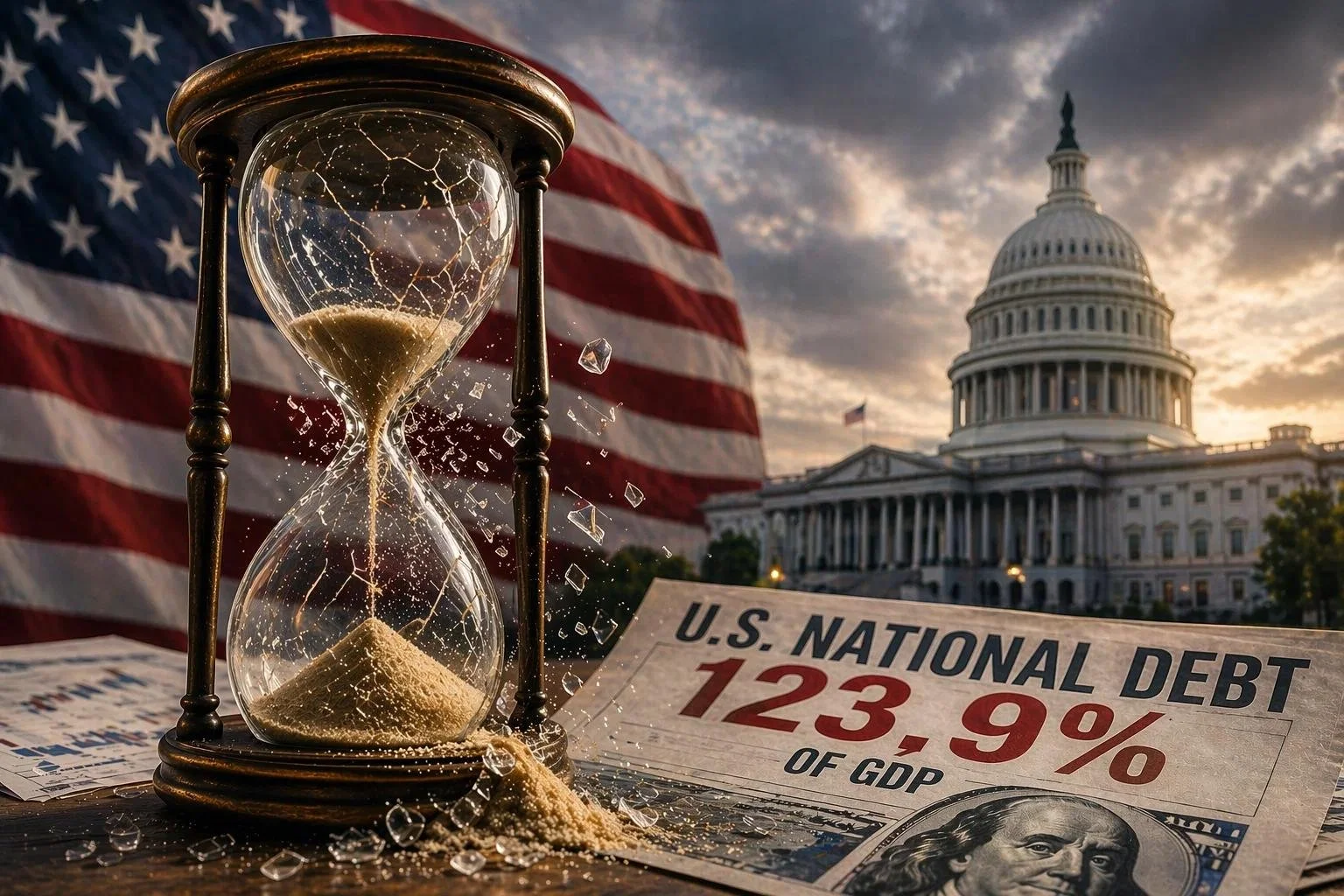
The IMF cites US government debt reaching 123.9% of GDP and deficits equal to 7.5% of GDP. More importantly, they point out that the US government has no credible plan to reduce them.
To be fair, America is not Argentina, and the US boasts major advantages— including one of the world's most innovative economies and the deepest capital markets on earth.
But it’s nearly impossible to argue that the US isn’t heading towards a major debt crisis. The rest of the world has already figured this out— and the data prove it.
For example, in the first quarter of 2026, the share of global foreign exchange reserves denominated in US dollars fell by 2.3 percentage points, down to 56.1%.
That’s an unprecedented move in global reserves. To put that quarterly decline in perspective, the US dollar's reserve share declined by roughly 10 percentage points over the previous decade...
... which means that roughly a quarter of that 10-year decline happened in the past 90 days! That’s evidence of a significant acceleration in the world’s loss of confidence in America.
The SWIFT international payments network tells the same story. The dollar's share of international payments dropped substantially in Q1. In the Middle East, for instance, non-dollar transactions jumped from 18% to 31% in three months. In Asia, from 35% to 42%.
Another data point: the world's central banks now hold more gold than US Treasury securities for the first time since 1996.
This comes as no surprise to our readers. We've been writing about this for the past 17 years.
Back in 2009, we were laughed at for suggesting that the United States could one day face a debt crisis. Today even the IMF is saying it.
We often cite that line from Hemingway's The Sun Also Rises — "How did you go bankrupt?" "Two ways. Gradually, then suddenly." The de-dollarization data suggests we're entering the "suddenly" phase.
To your freedom, James Hickman Co-Founder, Schiff Sovereign LLC
P.S. We've been warning about the US fiscal trajectory for years, long before it was fashionable. For most of that time, these concerns were dismissed as alarmist.
Now it's a mainstream view. And the rest of the world is repositioning.
The sensible course of action is to do the same. International diversification, real assets, a second residency, an offshore bank account — these aren't doomsday preparations. They're rational responses to a fiscal trajectory that is a risk to the global economy.
That is exactly what we cover each month in Plan B Confidential — specific, legal, practical steps to diversify across borders, from second residencies and offshore banking to tax optimization and real asset strategies that make sense regardless of how this plays out.
https://www.schiffsovereign.com/trends/argentina-got-this-warning-before-its-collapse-america-just-got-it-last-week-155037/?inf_contact_key=0e78a2143153df024cd70fe991ce4b0a0610b17be1dd28ffc304ba09276be34a
Iraq has been Ready for 20 Years
Iraq has been Ready for 20 Years
4-20-2026
Twenty Years. That’s How Long Iraq Has Been Ready For The Reset.
By David E. Atterton | Reset Intelligence | @EXIT_FIAT
The infrastructure has been live since 2018. The constitutional framework was signed in 2005. Every technical component for a dinar that reflects Iraq’s actual economy has existed for close to two decades.
The rate didn’t move for one reason. And it is documented in $17.7 billion of signed court records.
Iraq has been Ready for 20 Years
4-20-2026
Twenty Years. That’s How Long Iraq Has Been Ready For The Reset.
By David E. Atterton | Reset Intelligence | @EXIT_FIAT
The infrastructure has been live since 2018. The constitutional framework was signed in 2005. Every technical component for a dinar that reflects Iraq’s actual economy has existed for close to two decades.
The rate didn’t move for one reason. And it is documented in $17.7 billion of signed court records.
If you have been in dinarland for any length of time, you have heard the same question asked ten thousand times. Why is it taking so long?
The answer is not incompetence. Not instability. Not “Iraq isn’t ready.”
Iraq’s banking system was running the largest sanctions evasion and money laundering network in the Middle East on behalf of Iran. You do not move the exchange rate of a currency that is the pipeline for billions of dollars in sanctioned flow. You shut the pipeline down first, then you move the rate.
That shutdown is now on the record. Public. Documented. Finished.
The $17.7 Billion Paper Trail
Between 2009 and 2023, seventeen Western banks paid $17.7 billion in US government fines for processing Iranian money through the dollar system. Not a---------s. Fines paid. Consent orders signed. Statements of Facts admitting specific wire transfers, specific dates, specific Iranian counterparties.
• BNP Paribas – $8.9 billion (2014) – $8.8 billion in sanctioned Iranian, Sudanese, and Cuban transactions over seven years
• HSBC – $1.9 billion (2012) – Iranian and Mexican cartel laundering
• Standard Chartered – $1.1 billion across two settlements – Iranian transactions cleared through New York
• Commerzbank – $1.45 billion (2015) – Iran and Sudan violations
• Société Générale – $1.34 billion (2018) – Iran and Libya sanctions breaches
Every one of those settlements traces back to Iranian counterparties. And a significant portion of those counterparties cleared through Iraqi correspondent accounts at institutions like Trade Bank of Iraq, Al-Bilad, Al-Taif, and Warka Bank.
Iraq’s banking sector was not a bystander. It was the Middle East node of the Iranian dollar workaround. That is why the rate was locked.
Why The IMF Wouldn’t Let It Move
The International Monetary Fund conducts what is called an Article IV consultation with every member country. It is a compliance review. For Iraq, Article IV reviews between 2015 and 2022 consistently flagged the same thing: money laundering and t-------m financing risk tied to the informal banking sector and private bank correspondent relationships.
Stated position of the IMF, repeated in every consultation: Iraq must complete banking sector reform before monetary policy normalization.
Monetary policy normalization. That is the technical term for the thing dinarland has been calling “the RV” for twenty years.
What Got Done
The reform is on paper and in the record:
• Approximately 400 currency exchange houses running hawala for Iranian entities were shut down between 2023 and 2025
• Iraq’s private banking sector was consolidated from 40-plus institutions down to a supervised core
• Electronic payment infrastructure was rolled out to make shadow transactions traceable
• US Treasury and the Central Bank of Iraq signed joint statements in 2023, 2024, and 2025 transitioning from “compliance remediation” to “monetary policy coordination”
• The 2024 IMF Article IV consultation removed the money-laundering-risk language that had been in every prior review since 2015
Each of those is a public document. Each has a date. Each is searchable.
The Signal
Iraq sits on approximately $16 trillion in proven natural resources. Fifth-largest oil reserves on Earth. Second-largest phosphate deposits globally. Gold reserves past $21 billion. Its current exchange rate of 1,310 dinars to the dollar was set by an occupying authority in 2003 and was never designed to be permanent.
What changed in 2024 is not Iraq’s wealth. Iraq’s wealth has been there the entire time. What changed is the sanctioned-money plumbing that required the rate to stay artificial. That plumbing is gone.
When Central Bank of Iraq Governor Ali Al-Alaq and US Treasury officials sit down in the same room in 2025 and talk about “monetary policy coordination,” that is not a throwaway phrase. It is the language that historically precedes an official realignment.
What The Book Walks You Through
Head of the Snake: The Hidden Architecture of Iran, Wealth Extraction, and Global Control is the full sequence. 118 years. Every claim sourced to a public document. No anonymous insiders. No analyst speculation. The receipts themselves, in chronological order.
If you have been tracking the reset through the intel community, this is the documented layer underneath the rumors. The “it’s coming” you have been hearing for twenty years has a documented explanation for why it had to wait, and a documented explanation for why the wait is ending
Follow the daily analysis at x.com/EXIT_FIAT.
David E. Atterton is the author of Head of the Snake and the founder of Reset Intelligence. Compiled from 1,000+ hours of independent research. Father of two. No agency, no publisher, no financial industry ties.
https://dinarchronicles.com/2026/04/20/david-e-atterton-iraq-has-been-ready-for-20-years/
The First Crack in the System: Collateral Doom Loop (Part 1)
The First Crack in the System: Collateral Doom Loop (Part 1)
Lynette Zang: 4-20-2026
A financial crisis doesn’t start with a crash—it starts with a crack.
In Part 1 of this Financial Doom Loop series, Lynette breaks down the Collateral Doom Loop—the hidden mechanism behind every major market collapse.
When collateral values fall, margin calls hit. That triggers forced selling… which pushes prices even lower.
The First Crack in the System: Collateral Doom Loop (Part 1)
Lynette Zang: 4-20-2026
A financial crisis doesn’t start with a crash—it starts with a crack.
In Part 1 of this Financial Doom Loop series, Lynette breaks down the Collateral Doom Loop—the hidden mechanism behind every major market collapse.
When collateral values fall, margin calls hit. That triggers forced selling… which pushes prices even lower.
Once this loop begins, the system starts pulling itself apart from the inside.
From 1987 to 2008 to today, the same pattern keeps repeating—but with bigger consequences each time.
Chapters:
00:00 The Financial System Crack Begins
01:02 Introduction to the Collateral Doom Loop
01:28 How Collateral Collapse Triggers Crisis
02:06 From Gold Standard to a Debt-Based System
03:01 The Engine of Modern Financial Crises
03:39 Black Monday & The First Algorithmic Crash
04:56 1998 Crisis & Derivative Collateral Failure
06:00 2008 Financial Crisis & Frozen Collateral
07:00 Money Markets Break & Capital Lockups
08:04 Margin Calls, Forced Selling & Domino Effect
09:01 Sovereign Debt Crisis & The Rise of Bail-Ins
10:12 Cyprus Bail-Ins & Insider Exits
11:10 2022 Bond Crisis & Pension Fund Collapse Risk
13:06 Market Signals: Stocks, Bitcoin & Liquidations
15:02 Confidence Collapse & Economic Warning Signs
15:39 Silver as the Early Warning “Fuse”
17:35 Gold as the Ultimate Collateral Anchor
19:04 Gold Revaluation & System Reset
21:37 The Repeating Pattern of Every Crisis
22:13 The Final Collapse & System Reset Explained
Seeds of Wisdom RV and Economics Updates Monday Afternoon 4-20-26
Good Afternoon Dinar Recaps,
U.S. Policy Shock & Energy Uncertainty Collide — New Pressure on Global Financial Stability
Regulatory battles, energy shifts, and market reactions are adding fresh strain to an already fragile system.
Good Afternoon Dinar Recaps,
U.S. Policy Shock & Energy Uncertainty Collide — New Pressure on Global Financial Stability
Regulatory battles, energy shifts, and market reactions are adding fresh strain to an already fragile system.
Overview
A significant U.S. Senate vote combined with ongoing global energy instability is reinforcing growing uncertainty across financial markets. While the move appears targeted, the broader implications point to policy fragmentation, shifting energy strategies, and increasing unpredictability in economic direction—all of which are key ingredients in long-term structural change.
Key Developments
1. Senate Blocks California Emissions Authority
The Senate voted 51–44 to overturn a federal waiver that allowed California to enforce stricter vehicle emissions rules and phase out gas-powered cars. This action directly impacts multiple states that follow California’s standards and signals a shift in federal regulatory direction. California has already announced plans to challenge the move in court, setting up a prolonged legal battle.
2. Energy Policy Uncertainty Expands
By halting aggressive emissions mandates, the vote introduces greater uncertainty into the energy transition timeline. Automakers and investors now face a less predictable regulatory environment, while oil and gas demand may remain more resilient than previously expected.
3. Markets React to Policy Fragmentation
The clash between federal authority and state policy highlights deepening political and regulatory divisions. Markets tend to favor stability, and increasing fragmentation can lead to hesitation in long-term investment decisions, particularly in energy and infrastructure sectors.
4. Broader System Stress Signals Continue
This development comes as global markets are already dealing with bond market pressure, persistent inflation concerns, and geopolitical energy risks. The addition of regulatory instability compounds these pressures, contributing to a more fragile financial environment overall.
Why It Matters
Policy inconsistency increases uncertainty for global investors
Energy transition delays can prolong inflation pressures
Legal battles create long-term regulatory instability
Fragmentation weakens coordinated economic strategy
These factors do not trigger immediate systemic change but add to the cumulative stress building within the global financial system.
Why It Matters to Foreign Currency Holders
Currency volatility may rise as policy direction becomes less predictable
Countries tied to energy exports may benefit from prolonged demand
Investment flows could shift as regulatory clarity weakens
Confidence in long-term planning may decline, impacting global capital allocation
Implications for the Global Reset
Pillar 1: Policy Fragmentation
The growing divide between federal and state authority reflects a less unified economic strategy, which can weaken confidence in long-term stability.
Pillar 2: Energy Market Rebalancing
Delays in energy transition efforts reinforce the role of traditional energy sources, reshaping global demand patterns and influencing financial flows.
This is not a reset event — but it is another signal that the system is becoming more fragmented, less predictable, and increasingly pressured from multiple directions.
Seeds of Wisdom Team
Newshounds News™ Exclusive
Sources
Reuters — "U.S. Senate votes to block California 2035 electric vehicle rules"
CalMatters — "California electric car mandate faces rollback after Senate vote"
~~~~~~~~~~
Seeds of Wisdom Team RV Currency Facts Youtube and Rumble
Newshound's News Telegram Room Link
RV Facts with Proof Links Link
RV Updates Proof links - Facts Link
Follow the Gold/Silver Rate COMEX
Follow Fast Facts
Seeds of Wisdom Team™Website
Thank you Dinar Recaps
Iraq Economic News And Points To Ponder Monday Afternoon 4-20-26
Federal Reserve Chairman Candidate Kevin Warsh: Monetary Policy Must Remain Independent
Arabic and international Kevin Warsh, the nominee for chairman of the U.S. Federal Reserve, said on Monday, April 20, that the central bank should have significant independence from political influences, while remaining focused on its core objectives. In remarks to be made Tuesday before the Senate Banking Committee, Warsh expressed his unwavering commitment to fighting inflation, with only one reference to the labor market. The former Federal Reserve governor said: "Quite simply, the independence of the Federal Reserve depends heavily on it."
Federal Reserve Chairman Candidate Kevin Warsh: Monetary Policy Must Remain Independent
Arabic and international Kevin Warsh, the nominee for chairman of the U.S. Federal Reserve, said on Monday, April 20, that the central bank should have significant independence from political influences, while remaining focused on its core objectives. In remarks to be made Tuesday before the Senate Banking Committee, Warsh expressed his unwavering commitment to fighting inflation, with only one reference to the labor market. The former Federal Reserve governor said: "Quite simply, the independence of the Federal Reserve depends heavily on it."
He added: "The Federal Reserve must adhere to the scope of its jurisdiction. Its independence is most at risk when it intervenes in fiscal and social policies over which it has no authority or expertise."
President Donald Trump announced in late January that Warsh would be his choice to succeed current President Jerome Powell.
Since the start of the appointment process, questions have been raised about the ability of Warsh, or any other Trump nominee, to withstand repeated pressure from Trump and other White House officials to lower interest rates.
While Warsh spoke about the importance of political independence, he laid down several conditions.
He said: "I don't think the operational independence of monetary policy is particularly threatened when elected officials, presidents, senators, or members of the House of Representatives, express their views on interest rates."https://www.economy-news.net/content.php?id=68134
Parliament Affirms Its Commitment To Strengthening The Partnership With China.
Money and Business Economy News — Baghdad The First Deputy Speaker of the House of Representatives, Adnan Faihan Al-Dulaimi, affirmed on Sunday the readiness of Parliament to strengthen the partnership with China and activate the development road project.
A statement from his media office, received by “Al-Eqtisad News”, stated that “the First Deputy Speaker of the House of Representatives, Adnan Faihan Al-Dulaimi, received today, Sunday, the Ambassador of the People’s Republic of China to Iraq, Sui Wei, to discuss ways to enhance strategic cooperation between the two friendly countries, and to activate parliamentary communication channels, in addition to discussing the latest local, regional and international developments, and their implications for the paths of joint cooperation.”
According to the statement, Faihan emphasized "the House of Representatives' keenness to develop frameworks for bilateral partnership, in a way that enhances mutual interests and serves the aspirations of the two friendly peoples," noting "the importance of benefiting from advanced Chinese expertise in various sectors to support the development process in Iraq."
He stressed "the need to activate bilateral agreements, and to give the development road project strategic priority, while providing an attractive investment environment that allows reputable Chinese companies to contribute effectively to the development of the service and economic sectors." https://www.economy-news.net/content.php?id=68072
Iraqi Trade Ministry Announces Plan To Develop Non-Oil Exports
Money and Business Economy News — Baghdad Minister of Trade Atheer Dawood Al-Ghurairi affirmed that the ministry is proceeding with the implementation of its programs aimed at developing non-oil exports and expanding the base of local production by activating the role of the Export Support Fund, describing the fund as one of the main pillars in supporting the economy and enhancing the ability of Iraqi products to compete in global markets.
The minister explained that the Export Support Fund's vision focuses on diversifying income sources, enhancing local production, and creating job opportunities that contribute to achieving sustainable economic growth.
He added that the fund provides comprehensive financial and technical support to Iraqi companies and factories, in addition to facilitating their participation in international exhibitions by bearing part of the participation costs, which contributes to opening new markets and finding commercial partners, as well as promoting the national product through the issuance of introductory guides for Iraqi exports for the years 2023, 2024 and 2025. https://www.economy-news.net/content.php?id=68073
Reopening Of The Rabia Border Crossing With Syria
Money and Business Economy News – Baghdad The Director General of the Iraqi Border Ports Authority, Omar Al-Waeli, announced on Monday the opening of the Rabia border crossing with Syria, stressing that it represents an important economic and humanitarian transformation for Nineveh Governorate and Iraq.
Al-Waeli said that the crossing is an important passage within the development road project, and it would support trade and enhance connectivity between Iraq and its regional surroundings.
He added that the opening of the port will contribute to employing thousands of workers and will support the government's efforts to develop the areas west of Nineveh.
He pointed out that the crossing also has a humanitarian dimension, given the presence of interconnected tribes on both sides of the Iraqi and Syrian borders, bound by close social ties.
The Rabia border crossing, located west of Nineveh Governorate, is one of the important land crossings between Iraq and Syria, as it connects Iraqi territory with the Al-Yarubiyah crossing on the Syrian side, giving it commercial and logistical importance in the movement of goods and passengers between the two countries.
The crossing was reopened for trade after years of closure due to security conditions, forming a vital corridor to support economic activity and stimulate import and export between Baghdad and Damascus. https://www.economy-news.net/content.php?id=68122
Iraqi Airways Will Begin Operating Flights Between Baghdad And Delhi On This Date.
Money and Business Economy News – Baghdad The airline announced today, Monday, that it will activate the "Baghdad - Delhi - Baghdad" route within its flight schedule starting next Sunday.
Iraqi Airways said in a press statement today that customers can easily book through official offices or via the online booking website.
Iraqi Airways announced the resumption of several of its international flights from Basra International Airport, noting that flights will operate on the Basra-Dubai-Basra route on Thursday and Saturday, the Basra-Istanbul-Basra route on Wednesday and Friday, and the Basra-Cairo-Basra route every Tuesday, according to the German Press Agency (dpa).
The General Company for Air Navigation Services held an extensive meeting yesterday, Sunday, via video conference with the International Air Transport Association and a number of international airlines.
The company’s general manager, Ahmed Emad Ahmed, said in a press statement that the meeting discussed the latest developments regarding the return of air traffic and the options for using Iraqi airspace by international airlines. Direct air routes within Iraqi airspace were also reviewed, in addition to proposing new routes with important operational advantages for airlines, including reducing flight times, lowering fuel consumption, and limiting carbon emissions in line with international environmental standards. https://www.economy-news.net/content.php?id=68109
News, Rumors and Opinions Monday 4-20-2026
Note: All intel should be considered as "Rumors" until we receive official announcements ...and “Rates and Dates” could change anytime until we get to the banks/redemption centers.
RV Excerpts from the Restored Republic via a GCR Update as of Mon. 20 April 2026
Compiled Mon. 20 April 2026 12:01 am EST by Judy Byington,
Fiat US Dollar Collapsing, Global Currency Reset Activated
And Power Shifting Back To The People
Summary:
According to the latest report from Judy Byington, dated April 20, 2026, the transition from a fiat-based system to a gold-backed Global Currency Reset (GCR) has reached a critical flashpoint.
Note: All intel should be considered as "Rumors" until we receive official announcements ...and “Rates and Dates” could change anytime until we get to the banks/redemption centers.
RV Excerpts from the Restored Republic via a GCR Update as of Mon. 20 April 2026
Compiled Mon. 20 April 2026 12:01 am EST by Judy Byington,
Fiat US Dollar Collapsing, Global Currency Reset Activated
And Power Shifting Back To The People
Summary:
According to the latest report from Judy Byington, dated April 20, 2026, the transition from a fiat-based system to a gold-backed Global Currency Reset (GCR) has reached a critical flashpoint.
The update suggests that the traditional banking corridor, long dominated by the “global elite,” is currently being dismantled as institutions fail to meet Basel III compliance standards—meaning they lack the physical gold or assets necessary to back their holdings.
This has allegedly led to the freezing of over 143,000 individual bank accounts in a single day, prompting urgent warnings for citizens to secure cash reserves before the traditional system becomes inaccessible.
Central to this transition is the implementation of the Quantum Financial System (QFS), which reportedly took control of the global SWIFT system earlier this month.
The report indicates that the QFS is a gold-backed global financial framework that operates outside the reach of corrupt entities.
As the “Old World” structure collapses, 209 nations have supposedly synchronized their currencies with gold, effectively ending the era of fiat slavery.
For the average citizen, this shift is expected to manifest through “Redemption Centers,” where individuals will set up digital wallets on the Starlink Satellite System. These wallets are intended to mirror existing bank balances, though the report emphasizes that personal accounts in the United States must be managed through these specific centers rather than traditional banks.
One of the most significant aspects of this update is the imminent announcement of NESARA and GESARA. These protocols are described as a “Debt Jubilee,” a massive financial reset where illigal mortgages, credit card debts, and student loans are excused.
This redistribution of wealth is reportedly funded by seized “Cabal” assets and global trust funds that have been redirected into the QFS. The report suggests that humanity is moving toward a system of “sovereign fund dashboards,” where every citizen will have access to their own funds and notification of their debt-wipe status via secure texts and emails.
The timeline provided for the remainder of April 2026 is tight and high-stakes. The update warns of a “Ten Days of Darkness” beginning around April 21, during which banks will close, and ATMs and credit cards will cease to function.
This period is intended for the “GESARA wealth drop” and a 48-hour blackout to facilitate the final transition. By April 23, Zim redemptions are expected to flood humanitarian projects, and the QFS is slated to (allegedly)go live for the general public.
This transition is framed as a move toward a sovereign treasury system that eliminates income tax in favor of a simplified 14% sales tax and various tariffs.
For those involved in humanitarian efforts, often referred to in the report as Tier4B, the instructions are specific. Potential “project managers” are encouraged to have their project budgets and impact statements prepared in both fiat and grams of gold.
The report notes that “Green Bar” notifications are already being sent to those who have passed final reconciliation, signaling that appointment slots for currency exchange are being populated.
The overarching message of Byington’s report is one of preparation and vigilance—urging people to move away from traditional banking institutions and toward a new era of digital, asset-backed financial sovereignty.
Read full post here: https://dinarchronicles.com/2026/04/20/restored-republic-via-a-gcr-update-as-of-april-20-2026/
************
Courtesy of Dinar Guru: https://www.dinarguru.com/
StephenThis is a very real investment that I think is going to pay off in a very large way for all of us who are invested. That's why I have stuck in it for so long...I do believe we are closer than ever before for it happening. But stay grounded. Have realistic expectations.
Frank26 Once [Iraqi's] government is formed, then we are going to push for the new exchange rate because we want fairness with the American dollar. If not Trump will leave Iraq. That's the last thing Iraq wants...
Mnt Goat Article: “Minerals and “white gold” put Najaf on the investment map in Iraq” This...article...solidifies to us once again the importance of Iraq and its wealth...get out of their ‘rentier’ economy of sole 95% of oil revenues. Is this part of what we all have been waiting for? Yes... A dinar rate of 132? I don’t think so...silica mining (white gold) and other projects like it in part is what is going to get the reinstatement at a higher rate once it goes back on FOREX. We don’t go the bank until its back on FOREX. Of course, we all know that the reinstatement is being intentionally held back. Iraq could easily sustain a rate of about $3.22 right now as it was prior to the 1991 war...
"The FINAL PHASE Has Started" Dalio's Warning to Americans
Taylor Kenny: 4-20-2026
The headlines focus on war, inflation, and economic uncertainty, but the real story is much bigger.
This video uncovers the big cycle that has brought down reserve currencies and empires, and why the United States may now be approaching that same dangerous turning point.
CHAPTERS:
00:00 The Final Stage of Empire Decline
00:53 The Pattern Behind Every Empire Collapse
01:52 How the Cycle Always Begins
02:19 America’s Rise and the System It Built
03:44 The Illusion of Prosperity
05:32 De-Dollarization and the BRICS Challenge
06:58 Is the U.S. Already in Stage Five?
07:26 War, Iran, and the Bigger Picture
08:25 What Happens When a Currency Fails
09:21 Real Money vs. Paper Currency
10:46 Ray Dalio’s Warning
11:16 Surviving the Reset Webinar