
Rob Cunningham: New Honest Money
Rob Cunningham: New Honest Money
3-27-2026
Rob Cunningham | KUWL.show@KuwlShow
Federal Reserve Notes were “legal” tender debt instruments manufactured and distributed by the privately created Rothschild Cartel, which built a script system designed for control and wealth extraction from taxpayers based on (false) “legal” claims via a bankruptcy process (1871) using Fed corporation trustees (judges) and Fed corporation agents (politicians) to 1) accept payments against our individual birth certificate (trust) bonds and 2) “double-dip” by demanding “citizens” also pay (settle) with Federal Reserve Notes, and has been one elaborate fraud against all humanity.
Rob Cunningham: New Honest Money
3-27-2026
Rob Cunningham | KUWL.show @KuwlShow
Federal Reserve Notes were “legal” tender debt instruments manufactured and distributed by the privately created Rothschild Cartel, which built a script system designed for control and wealth extraction from taxpayers based on (false) “legal” claims via a bankruptcy process (1871) using Fed corporation trustees (judges) and Fed corporation agents (politicians) to 1) accept payments against our individual birth certificate (trust) bonds and 2) “double-dip” by demanding “citizens” also pay (settle) with Federal Reserve Notes, and has been one elaborate fraud against all humanity.
The Fed’s double-entry, opaque system that permitted insider institutions to maintain multiple sets of books (ledgers) with reconciliation delays has been eradicated.
Their “Three Card Monte” sleight of hand tricks that robbed us blind and soaked us in counterfeit debt, without our mutual consent, transparency, ability to verify, audit, or reconcile, is dead.
Below is how our New 2026 DLT (Distributed Ledger Technology) and Honest Money, atomic value settlement system replaces the Rothschild’s fractional reserve lending, double payment, debt and usury interest, wealth extraction Ponzi scheme system.
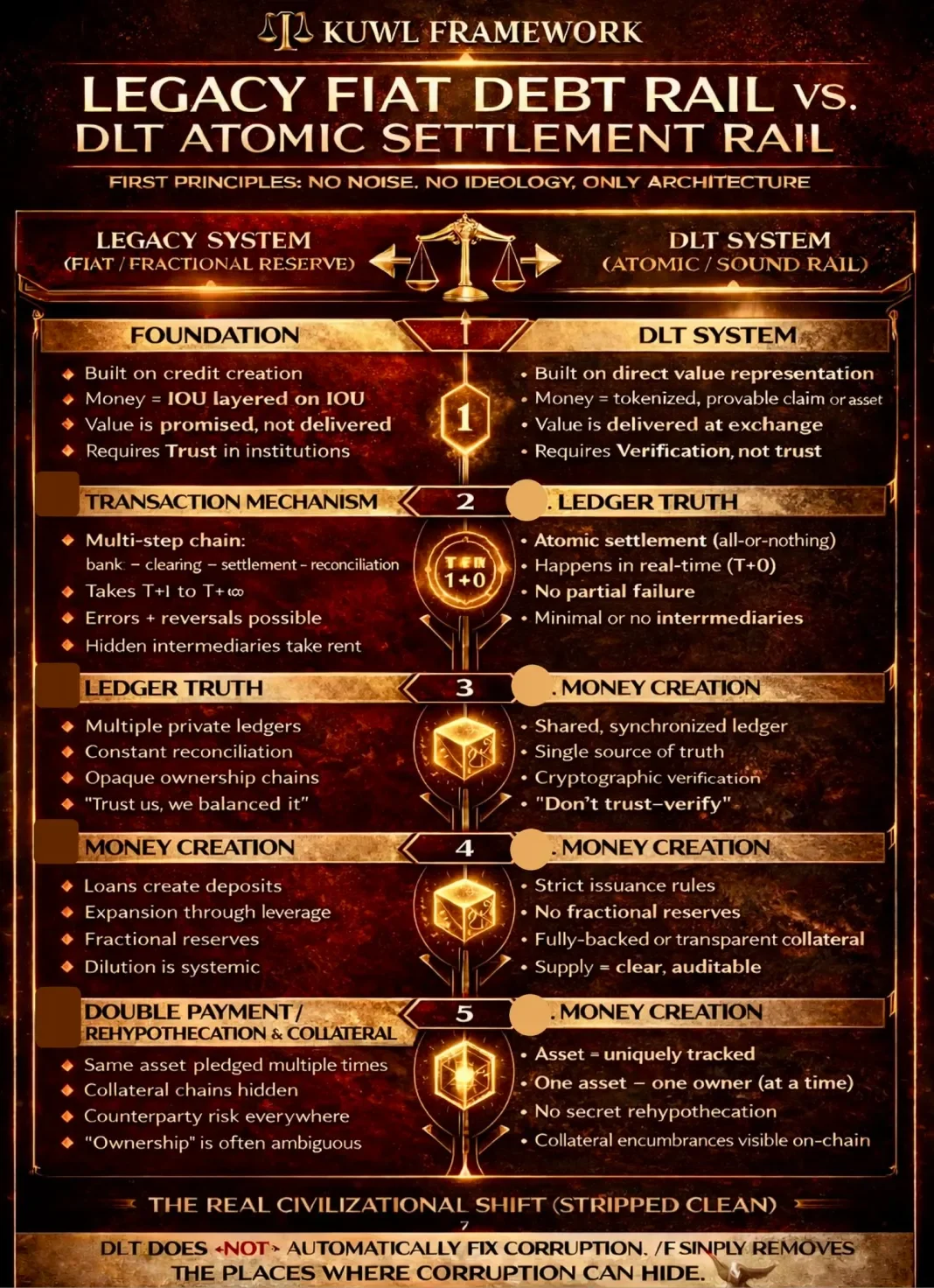
In a properly designed DLT (Distributed Ledger Technology)environment, all transactions can be cryptographically verified by authorized participants at the same time, reducing ambiguity about who owns what and when final transfers occur.
Tokenization is the way to remove separate messaging, multiple ledgers, time delays and lack of atomic reconciliation without public clarity and verification.
Instead of separate systems for messaging, custody, clearing, and settlement, tokenized deposits, reserves, and other claims will be exchanged on a shared infrastructure that keeps one universal record of trustless accounting that can always be verified the world over.
DLT enforced mechanics based on sovereign governance at the nation-state level, using verifiable, inspectable code that upholds a pure standard of immutability and trustlessness based upon mathematics, free-will, mutual-consent and no favoritism among participants, returns power to We the People.
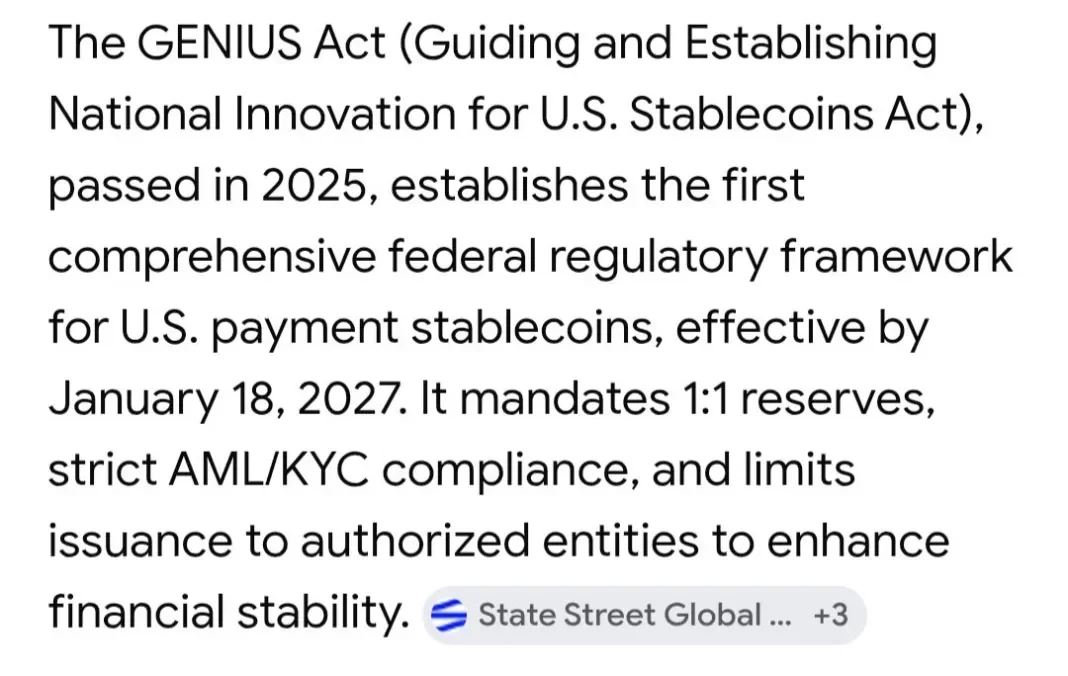
1:1 asset-backing plus clearly disclosed reserve ratios set:
• strict limits on rehypothecation,
• on-ledger proof of reserves and liabilities,
• legally enforceable final settlement,
• and a clear distinction between custody assets and lending assets.
The DLT-based monetary system will replace much of the friction, opacity, delay, and “reconciliation theater” of the Fed system by allowing tokenized money and real world assets to atomically settle on shared infrastructure with clear audit & ownership records.
The deepest First-Principles distinction is this:
• Legacy FED system: “Trust us, reconcile later.”
• New DLT system: “Verify now, settle instantaneously.”
The true genius of this new civilizational architecture is full clarity. It’s almost as if a Stable-Genius has been leading a long-term plan for over a decade, with purpose, for the benefit of all humanity, like a Boss.
Goodbye @cityoflondon & @federalreserve – we promise to bury you next to your Creature From Jekyll Island.
Source(s): https://x.com/KuwlShow/status/2037176394136912374
https://dinarchronicles.com/2026/03/26/rob-cunningham-new-honest-money/
Ariel: The Official Announcement
Ariel: The Official Announcement
Prolotario @Prolotario1
Are We Tired Of Being Ahead Of The Curve On This Channel?
What did we discuss about a potential announcement on July 4th?
My Legend Status Is Pending…
Disclose.tv: JUST IN - Trump's signature will be added to U.S. dollar banknotes to commemorate the 250th anniversary of U.S. independence. Trump's signature will replace that of the U.S. treasurer, which has appeared on U.S. dollar bills since 1861 — Vanity Fair
Ariel:The Official Announcement
Prolotario @Prolotario1
Are We Tired Of Being Ahead Of The Curve On This Channel?
What did we discuss about a potential announcement on July 4th?
My Legend Status Is Pending…
Disclose.tv: JUST IN - Trump's signature will be added to U.S. dollar banknotes to commemorate the 250th anniversary of U.S. independence. Trump's signature will replace that of the U.S. treasurer, which has appeared on U.S. dollar bills since 1861 — Vanity Fair
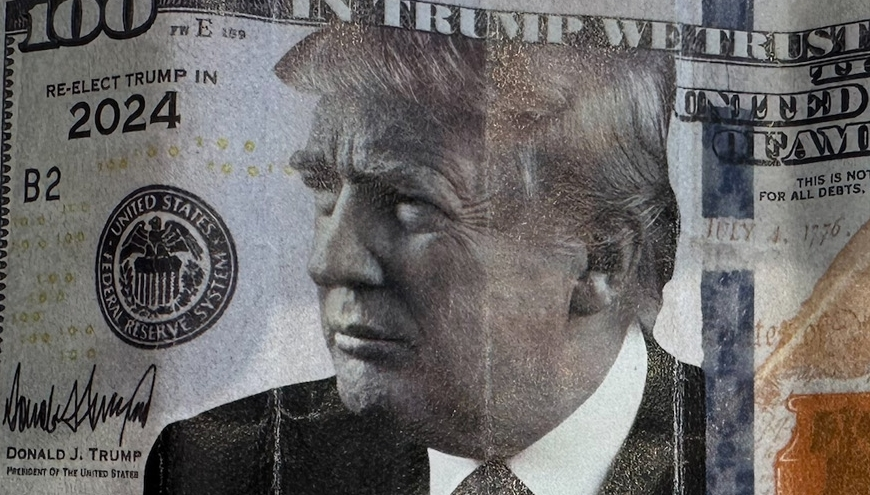
As I have been alluding to sometimes in great detail that D. Trump wants everything wrapped up before July 4th. And the announcement of the new US Treasury dollar further confirms my points about that. This is what you will get at your currency exchanges.
~No More Fiat USD
Game
Set
Match
Rob Cunningham: Let’s Make 4 Bets, America Our new 2026 U.S. Treasury currency signed by President Donald J. Trump and Treasury Secretary Scott Bessent, Will not include:
1 - the words “Federal” or “Reserve” or “Note” anywhere.
2 - an Egyptian Pyramid
3 - an All Seeing Eye
4 - a reference to any NGO I’ll give 1,000 to 1 odds. Takers?
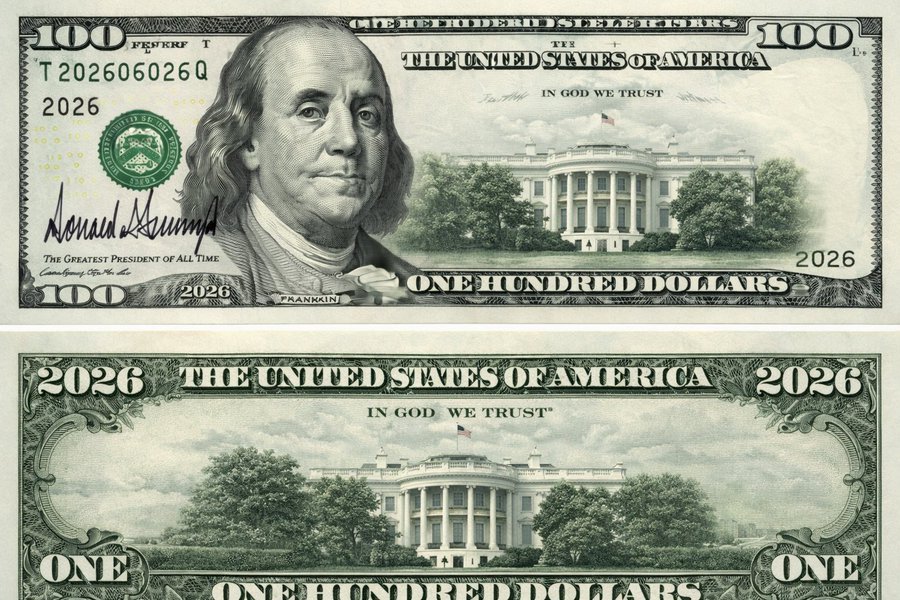
Goodbye godless
I call this “Money Disrupted”,
& @GEdward_Griffin !!
The Official Announcement
How many times have I brought up currency starting off at 1:1 under the new system?
January 2027 is not a start date.
It’s a deadline!
Iraq wants this done in July 2026. Guess what’s coming out in that same month? US Treasury Note (Gold-Backed).
Seeds of Wisdom RV and Economics Updates Friday Afternoon 3-27-26
Good Afternoon Dinar Recaps,
G7 Pressure Mounts: Russia–Iran Ties Risk Expanding War and Disrupting Global Financial Stability
Energy security, military alliances, and geopolitical entanglement converge into a high-stakes moment for the global system
Good Afternoon Dinar Recaps,
G7 Pressure Mounts: Russia–Iran Ties Risk Expanding War and Disrupting Global Financial Stability
Energy security, military alliances, and geopolitical entanglement converge into a high-stakes moment for the global system
Overview (Key Points)
Global tensions are escalating across two major conflict zones simultaneously, linking the Russia–Ukraine war with the Middle East crisis involving Iran, the U.S., and Israel.
In the last 24 hours, G7 nations are intensifying pressure on the United States to take a firmer stance on Russia’s alleged support for Iran, signaling concern that two separate conflicts are merging into one broader geopolitical risk structure.
At the center of this crisis is energy disruption, particularly through the Strait of Hormuz, which is already impacting global oil flows, inflation, and market stability.
The convergence of military alliances, energy chokepoints, and global finance is accelerating systemic stress, aligning closely with conditions seen in major global financial reset transitions.
Key Developments
1. G7 Pushes U.S. on Russia–Iran Connection
Western allies are demanding clarity and action.
• G7 leaders are urging the U.S. to address Russia’s alleged support for Iran
• Concerns center on intelligence sharing and drone technology transfers
• Europe is seeking a more unified and assertive Western response
2. Dual Conflict Risk: Ukraine War Merging with Middle East Crisis
Geopolitical lines are beginning to blur.
• Russia and Iran are accused of forming a reciprocal military relationship
• Iran previously supplied drones for use in Ukraine
• Russia is now suspected of enhancing Iran’s military capabilities
This creates a dangerous overlap, where two regional wars begin functioning as one interconnected global conflict system.
3. Energy Supply Shock Intensifies Global Instability
The Strait of Hormuz remains a critical pressure point.
• Disruptions are impacting a major share of global oil shipments
• Oil prices have surged, feeding inflation across global economies
• Energy security is now a top priority for G7 coordination efforts
4. U.S. Response Signals Strategic Caution
Washington is balancing multiple risks.
• U.S. officials have downplayed direct Russia involvement claims
• Focus remains on military coordination with Israel and Gulf allies
• Avoiding escalation with Russia remains a key strategic objective
5. Coordinated Plans to Protect Global Trade Routes
Allies are preparing for broader contingencies.
• France has initiated multi-nation discussions on securing shipping lanes
• Planning includes reopening and protecting the Strait of Hormuz
• Signals growing concern over long-term disruption to global trade flows
Why It Matters
This situation represents a major escalation in global systemic risk, where military conflict, energy supply, and financial markets are directly interconnected.
The possibility of Russia indirectly influencing Middle East conflict dynamics introduces a new layer of complexity, increasing the likelihood of prolonged instability and multi-region disruption.
Energy remains the critical transmission mechanism, linking geopolitical actions to inflation, interest rates, and economic performance worldwide.
Why It Matters to Foreign Currency Holders
• Currency markets are increasingly sensitive to geopolitical shocks
• Oil price spikes weaken importing nations’ currencies
• Safe-haven demand strengthens the U.S. dollar in times of crisis
• Inflation pressures erode purchasing power globally
Implications for the Global Reset
Pillar 1: Control of Energy Corridors Equals Financial Power
The Strait of Hormuz highlights how strategic chokepoints control global liquidity and economic stability. Nations that influence these routes gain outsized leverage over markets and currencies.
Pillar 2: Emergence of Interconnected Conflict Blocs
The alignment between Russia and Iran signals a shift toward multi-theater geopolitical alliances, accelerating the move toward a fragmented, multi-polar financial system.
Conclusion
The G7 discussions reflect a growing realization that today’s geopolitical conflicts are no longer isolated events, but part of a broader, interconnected global system.
With energy disruption, military alliances, and financial markets all reacting simultaneously, the world is entering a phase of heightened uncertainty and structural change.
What emerges from this moment will not just shape geopolitical outcomes — it will redefine the global financial architecture.
This is not just conflict — it is systemic convergence at a global scale.
Seeds of Wisdom Team
Newshounds News™ Exclusive
Sources
Modern Diplomacy — "G7 to Press U.S. on Russian Support for Iran Amid Middle East War"
Reuters — "Global Leaders Weigh Response to Russia-Iran Ties and Energy Disruptions"
~~~~~~~~~~
Seeds of Wisdom Team RV Currency Facts Youtube and Rumble
Newshound's News Telegram Room Link
RV Facts with Proof Links Link
RV Updates Proof links - Facts Link
Follow the Gold/Silver Rate COMEX
Follow Fast Facts
Seeds of Wisdom Team™Website
Thank you Dinar Recaps
“News Tidbits From TNT” Friday 3-27-2026
TNT:
Tishwash: A parliamentary source told Al-Furat News: Signatures are being collected to hold a session next Monday and end the presidential election crisis.
A parliamentary source revealed today, Thursday, a movement to end the political deadlock and collect signatures to hold a session of the House of Representatives next Monday to elect the President of the Republic.
A source told Al-Furat News Agency that "parliamentary efforts are underway to break the deadlock, with a parliamentary session scheduled for Monday to elect the president."
TNT:
Tishwash: A parliamentary source told Al-Furat News: Signatures are being collected to hold a session next Monday and end the presidential election crisis.
A parliamentary source revealed today, Thursday, a movement to end the political deadlock and collect signatures to hold a session of the House of Representatives next Monday to elect the President of the Republic.
A source told Al-Furat News Agency that "parliamentary efforts are underway to break the deadlock, with a parliamentary session scheduled for Monday to elect the president."
The source also revealed that "signatures have been collected from members of parliament to convene Monday's session and resolve the presidential issue," noting that "more than 160 signatures have been gathered to hold the session next Monday to elect the president."
It is worth noting that Iraq has been in a constitutional vacuum since January 29, 2016, after the parliament failed to vote on a president and postponed the parliamentary session designated for this purpose multiple times due to political disputes between parties and competition for key positions.
Currently, the competition for the presidency is between the two major Kurdish parties that govern the Kurdistan Region: the Kurdistan Democratic Party (KDP) and the Patriotic Union of Kurdistan (PUK).
The Iraqi constitution stipulates a clear timeframe for electing the president, requiring that the election take place within 30 days of the first session of the new parliament, with the incumbent president continuing to perform his duties until a new president is elected.
With parliament's failure to elect a president, Iraq has entered a constitutional vacuum, potentially leading to problems regarding the powers of outgoing officials, as well as delays in completing projects and managing the country's daily affairs.
Parliament has not scheduled a new session to vote on the presidential election, and the legislative authority has offered no comment or justification for this, except for remarks suggesting that the 30-day period stipulated by the constitution refers to official working days and excludes holidays—an interpretation lacking any basis in the constitution or parliament's internal regulations. link
************
Tishwash: Calls for the enactment of the oil and gas law within a constitutional framework
The passage of the oil and gas law is a pivotal step towards regulating the management of national wealth in Iraq and ensuring a fair distribution of revenues between the federal government and the regions, while preserving the sovereignty of the state and the rights of all Iraqis.
Members of the House of Representatives and legal experts stress the need to establish a robust constitutional framework that ends disputes, enhances transparency, and keeps pace with modern developments in the energy industry, while protecting national resources from waste and mismanagement, thus paving the way for a new phase of wise oil and gas management and promoting national and international investment in this vital sector.
It is worth noting that the House of Representatives, during its session that discussed the repercussions of exporting Iraqi oil, recommended that the next government program should include the enactment of the oil and gas law, and that it should be presented to the House of Representatives in order to begin voting on it.
MP Ahmed Shaheed told Al-Sabah that passing the oil and gas law represents a fundamental step to regulate the management of national wealth between the federal government and the regions, ensuring a fair distribution of revenues and preserving the sovereignty of the state and the rights of all Iraqis.
Shahid called for the swift enactment of the law to provide a fair constitutional framework for Iraqis and to end disputes related to the management of oil wealth, especially between Baghdad and the Kurdistan Region.
He added that "the current stage requires a thorough study of the law's articles and their revision to keep pace with modern changes in the energy industry and global developments in natural resource management, along with a review of oil contracts and agreements to ensure their consistency with the Iraqi constitution and to safeguard national sovereignty over natural resources." The MP emphasized that "updating the law's provisions must include clear mechanisms for managing oil fields, regulating contracts with international companies, and guaranteeing transparency in revenues, thereby putting an end to the leakage of wealth and the waste of resources, and establishing a new era of sound oil and gas management in Iraq."
For his part, MP Ali Saber told Al-Sabah that “addressing the oil and gas issue in Iraq should not be limited to enacting a law only, but requires an integrated legislative and economic vision that reorganizes the philosophy of managing national wealth in a manner consistent with the constitution and the requirements of modern development.”
He explained that "the current stage calls for a comprehensive review of the legal system regulating the oil sector, through the preparation of specialized parliamentary studies that examine the mechanisms of investment, production and export, in addition to setting clear rules for managing oil revenues in a way that achieves a balance between the federal government and the producing regions and governorates."
Saber pointed out that "updating the legal framework for the oil sector must take into account global shifts in energy markets and adopt the principles of governance and transparency, while developing parliamentary oversight mechanisms to ensure the sound management of natural resources and prevent any waste or misuse of oil wealth." He added that "developing the oil investment environment is a fundamental factor in strengthening the national economy, as a clear and stable legal framework encourages international companies to expand their investments in oil fields, gas projects, and energy infrastructure. This will positively impact increased production, job creation, and diversification of income sources, thus supporting the long-term stability of the Iraqi economy."
For her part, Dr. Zainab Al-Saadi, a legal expert specializing in constitutional affairs, confirmed in a statement to Al-Sabah that Article 112/First of the Constitution constitutes an explicit legal and constitutional obligation on the federal government, regulating the relationship with the oil-producing regions and governorates.
She explained that "this article gives legal texts binding force to protect the rights of oil-producing entities and ensure a fair distribution of resources, which makes any new agreements unnecessary, whether through temporary budget laws that end with the end of the fiscal year or through political understandings that are not based on a clear constitutional basis."
Al-Saadi added that “adherence to this constitutional framework reinforces the principle of the rule of law and limits any transgressions that may occur as a result of non-binding political understandings or agreements,” stressing that “the constitution has established clear mechanisms to ensure the stability of the relationship between the federal government and the oil-producing regions and governorates, in a way that preserves everyone’s rights and ensures the management of national resources according to sound legal frameworks.”
She noted that "the application of these constitutional provisions represents the cornerstone of any future policies related to oil and resources and prevents legal vacuums or illegal practices that could lead to disputes between the central government and the regions." link
Tishwash: The most serious threat in eight decades: The World Trade Organization warns of disruptions to the trading system.
The Director-General of the World Trade Organization, Ngozi Okonjo-Iweala, warned of unprecedented disruptions to the global trading system, describing the current phase as the most dangerous in eight decades, as the organization's ministerial conference opened on Thursday.
IIwiala stressed that the multilateral world order has undergone radical and irreversible transformations, noting that the scale of current challenges now exceeds what the world has witnessed in previous periods, in light of escalating international crises.
This warning comes at a time when the 166 member states are facing clear divisions, coinciding with a meeting of trade ministers in the Cameroonian capital, Yaoundé, as part of one of the organization's most prominent conferences, amid economic repercussions related to tensions in the Middle East.
During the four-day conference, members seek to revitalize the role of the organization, whose effectiveness has declined due to geopolitical tensions, stalled negotiations, and escalating protectionist policies, in an unstable international environment.
AIwiala pointed out that the current turmoil began before the recent conflicts and has contributed to the disruption of energy, fertilizer and food markets, stressing that governments and international institutions are facing increasing challenges in dealing with geopolitical tensions, the repercussions of climate change and rapid technological development.
She added that these transformations are accompanied by a growing sense of doubt about the effectiveness of the multilateral system, considering that what is happening reflects a deeper flaw in the international system that was established after the Second World War.
She concluded by saying that holding the conference in Africa comes at a very sensitive time, in light of simultaneous crises in the Middle East, Sudan and Ukraine, stressing that the African continent represents the "continent of the future". link
************
Tishwash: Trump to Visit Beijing May 14–15 for Rescheduled Summit with President Xi Jinping
Trump says his meeting with China’s president will take place May 14–15 in Beijing after being delayed due to US military operations in Iran.
On Wednesday, US President Donald Trump has announced a new date for his postponed meeting with Chinese President Xi Jinping, signaling a renewed diplomatic engagement following delays linked to military developments.
Trump said that his meeting with Xi Jinping, President of China, has been rescheduled after it was previously postponed due to US military operations in Iran.
The meeting is now set to take place in Beijing on May 14 and 15.
In a statement published on his official account on the social media platform Truth, Trump said: “My meeting with the Highly Respected President of China, President Xi Jinping, which was originally postponed due to our Military operation in Iran, has been rescheduled, and will take place in Beijing on May 14th and 15th.”
He added: “First Lady Melania and I will also host President Xi and Madame Peng for a reciprocal visit in Washington, D.C., at a later date, this year.”
Trump continued: “Our Representatives are finalizing preparations for these Historic Visits. I look very much forward to spending time with President Xi in what will be, I am sure, a Monumental Event.”
The announcement indicates that preparations are underway for both the Beijing meeting and a subsequent reciprocal visit to Washington later in the year.
The rescheduled meeting marks a continuation of high-level engagement between Washington and Beijing following delays tied to military developments. link
News, Rumors and Opinions Friday 3-27-2026
Note: All intel should be considered as "Rumors" until we receive official announcements ...and “Rates and Dates” could change anytime until we get to the banks/redemption centers.
RV Excerpts from the Restored Republic via a GCR Update as of Fri. 27 March 2026
Compiled Fri. 27 March 2026 12:01 am EST by Judy Byington
Judy Note: “The U.S. Inc. government is insolvent (over $41 trillion dollars in debt). That’s the conclusion of the Treasury Department’s own 2025 financial statements, released last week to near-total media silence. The numbers: $6.06 trillion in total assets against $47.78 trillion in total liabilities as of September 30, 2025.”The Treasury just declared the U.S. insolvent. The media missed it | Fortune
Note: All intel should be considered as "Rumors" until we receive official announcements ...and “Rates and Dates” could change anytime until we get to the banks/redemption centers.
RV Excerpts from the Restored Republic via a GCR Update as of Fri. 27 March 2026
Compiled Fri. 27 March 2026 12:01 am EST by Judy Byington
Judy Note: “The U.S. Inc. government is insolvent (over $41 trillion dollars in debt). That’s the conclusion of the Treasury Department’s own 2025 financial statements, released last week to near-total media silence. The numbers: $6.06 trillion in total assets against $47.78 trillion in total liabilities as of September 30, 2025.” The Treasury just declared the U.S. insolvent. The media missed it | Fortune
The article in the respected Fortune Magazine was by Steve H. Hanke and David M. Walker. Steve Hanke is a professor of applied economics, John Hopkins University and member of the Board of Directors at the Federal Fiscal Sustainability Foundation. David Walker is the former Comptroller General of the US and Chairman of Board of Directors at the Federal Fiscal Sustainability Foundation.
Global Currency Reset:
On 20 Feb. 2026 the US Congress and President Trump (allegedly) approved the Quantum Financial System and the primary financial system for the nation, with Global activation including release of NESARA/GESARA funds (allegedly) set for Wed. 1 April 2026.
On Fri. 27 March 2026 the QFS (allegedly) goes live: TIER 4B notifications are already queued. The 800 numbers have been tested. The redemption centers are staffed. The deals are signed. The gold has moved – they’ve migrated the ledger: $23 trillion in U.S. debt, $8 trillion in offshore accounts. Every transaction, every loan, every dark money transfer since 1971 — all of it(allegedly) moved from the old system to the new one. Fri. 27 March(allegedly) is a deadline for the Federal Reserve, when the QFS goes live and when gold trades not in dollars, but in quantum verified weight. …Mr. Pool Final Chapter on Telegram
Thurs. 2 April 2026 Notification to(allegedly) set appointments: The overwhelming majority of my bond people are telling me that they will be done between now and April 2nd.The overwhelming majority of my groups and banking contacts believe they will go between the 2nd of April and the 15th of April. I don’t know the timing but that is what they are being told. …MarkZ on Tues. 24 March 2026
Tues. 24 March 2026 Wolvie says that bondholders are receiving notifications. He hopes for Tier 4B notifications today or tomorrow. Payments will (allegedly) start on Wed. 1 April 2026. We were waiting for ISO20022 to happen and it has, and it is working very well Wolvie says. It has been 100% successful! A lady at a bank called Wolvie, crying, saying this is the news we have been waiting for. Wolvie cannot say more due to NDAs. In a few days he will be fully under NDA and will be overseas. … Forwarded from Ginger Doucet
~~~~~~~~~~~
Thurs. 26 March 2026 Bruce, The Big Call The Big Call Universe (ibize.com) 667-770-1866, pin123456#, 667-770-1865:
• The QFS has a node for Crypto Currency
• The Central Banks around the world are buying up gold to back their currencies
• Four different sources say Tier4b (us, the internet group) notification could happen on Fri. 27 March or Sat. 28 March 2026.
• Tier4b should get started with appointments before the end of the month on Tues. 31 March 2026.
Read full Post here: https://dinarchronicles.com/2026/03/27/restored-republic-via-a-gcr-update-as-of-march-27-2026/
*************
Courtesy of Dinar Guru: https://www.dinarguru.com/
Militia Man This [war and Strait of Hormuz drama] is almost like a push. Thankfully something happened to create an environment that pushes Iraq to wean itself off of complete reliance on oil. Non-oil resources, $16 trillion of natural resources, exports, self-sufficiency ...These are clear signs.
Bruce [via WiserNow] What's really interesting is that President Trump and the Secretary of War, and the work that’s being done to reform Iran has been so successful...they're way ahead of time. President Trump initially talked about four or five weeks...he made comments...that basically the war is over...we sort of won it in about...the first three days...we had heard a couple of days ago that things were going to look good...in terms of a peace agreement...this peace...with Iran, is fundamental to us getting started in what we...are looking for...So I'm feeling very good about that right now.
Gold Pullback Changes Nothing, Monetary Reset Coming | Egon von Greyerz
Soar Financially: 3-27-2026
Egon von Greyerz returns to Soar Financially to discuss whether the global monetary reset is still on track, why gold’s correction changes nothing in his long-term view, and why he believes the bond market, private credit, and fiat currencies remain in serious trouble.
00:00 Gold correction and bigger picture
01:23 End of the monetary era
05:09 Why U.S. debt is unsustainable
07:16 Are central banks really selling gold?
09:03 How investors should react to the selloff
12:52 Silver outlook and volatility
17:19 Bond market warning signs
21:28 Private credit and private equity risks
24:19 What the endgame could look like
29:07 Safest places to store gold
33:29 Switzerland vs. Singapore
Seeds of Wisdom RV and Economics Updates Friday Morning 3-27-26
Good Morning Dinar Recaps
Global Reset Pressure Builds: Energy Shock and Ceasefire Signals Shake Financial Markets
Geopolitical tensions and fragile diplomacy are driving volatility across energy, currencies, and global capital flows
Overview (Key Points)
Global financial markets are being driven by geopolitical developments at an unprecedented level, with the Middle East conflict now acting as a primary force behind energy prices, inflation, and investor behavior.
Good Morning Dinar Recaps
Global Reset Pressure Builds: Energy Shock and Ceasefire Signals Shake Financial Markets
Geopolitical tensions and fragile diplomacy are driving volatility across energy, currencies, and global capital flows
Overview (Key Points)
Global financial markets are being driven by geopolitical developments at an unprecedented level, with the Middle East conflict now acting as a primary force behind energy prices, inflation, and investor behavior.
In the last 24 hours, markets showed temporary relief, as reports of a potential U.S.–Iran ceasefire framework lifted equities and pushed oil prices lower. This reflects how expectations—not confirmed outcomes—are steering global markets.
Despite this optimism, underlying risks remain elevated, particularly around energy supply disruptions, restricted trade routes, and inflation persistence, all of which continue to pressure the global system.
The broader implication is critical: the global economy is entering a phase where geopolitics, energy control, and monetary policy are converging, accelerating conditions aligned with a potential global financial reset.
Key Developments
1. Ceasefire Signals Trigger Short-Term Market Relief
Markets reacted quickly to signs of possible diplomatic progress.
• Global equities rose across major regions, including the U.S. and Europe
• Oil prices pulled back after recent spikes above $100 per barrel
• Investors are positioning for a potential de-escalation scenario
2. Energy Markets Remain the Core Systemic Risk
Short-term relief has not resolved deeper structural issues.
• The Strait of Hormuz disruption threatens ~20% of global oil supply
• Energy infrastructure instability is reshaping global supply chains
• Oil continues to act as the primary driver of inflation and market volatility
3. Inflation Pressures Complicate Central Bank Policy
Energy shocks are feeding directly into monetary policy challenges.
• Rising oil prices contribute to persistent global inflation
• Central banks are forced to delay rate cuts or maintain tight policy
• Creates a prolonged environment of high borrowing costs and reduced liquidity
4. Capital Flows Shift Toward Safety and Commodities
Investor behavior reflects rising uncertainty.
• Increased movement into gold and safe-haven assets
• Stronger demand for U.S. dollar during volatility cycles
• Commodities, especially energy, are becoming dominant macro drivers
5. Global Growth Risks Intensify Under Energy Shock
Economic conditions are weakening beneath the surface.
• Higher energy costs are reducing consumer spending power
• Businesses face rising input costs and margin pressure
• Increasing probability of global slowdown or recession scenario
Why It Matters
This moment highlights a structural shift in how the global financial system operates, where geopolitical events are now equal to or greater than economic fundamentals in driving outcomes.
Energy has become the central transmission mechanism, linking conflict directly to inflation, interest rates, and market stability. This creates a feedback loop that can amplify volatility across all asset classes.
For policymakers, the challenge is intensifying. They must navigate inflation control, economic growth, and financial stability simultaneously, often with limited tools and increasing external pressures.
Why It Matters to Foreign Currency Holders
• Currency volatility is rising alongside oil price fluctuations
• Strong energy prices can weaken oil-importing currencies
• Safe-haven flows strengthen the U.S. dollar during uncertainty
• Purchasing power is increasingly tied to energy-driven inflation
Implications for the Global Reset
Pillar 1: Energy Control as the Foundation of Financial Power
The current environment reinforces that control over energy supply routes and pricing is central to global economic influence. Nations that can secure or redirect energy flows gain leverage over markets and currencies.
Pillar 2: Transition Toward a Multi-Polar Financial System
As geopolitical blocs respond differently to the crisis, the system is gradually shifting toward regional alliances and diversified financial structures, reducing reliance on a single global framework.
Conclusion
The past 24 hours have demonstrated how quickly global markets can shift based on geopolitical signals, even in the absence of concrete outcomes. This reflects a system that is highly sensitive, interconnected, and increasingly fragile.
While ceasefire discussions offer temporary relief, the underlying structural risks remain unresolved, particularly in energy markets and global supply chains.
The direction is becoming clearer: the global financial system is being reshaped by geopolitics, resource control, and monetary constraints.
This is not just market volatility — it’s a real-time stress test of the global financial system.
Seeds of Wisdom Team
Newshounds News™ Exclusive
Sources
Reuters — "Global Markets Rise, Oil Falls on Ceasefire Hopes"
World Economic Forum — "Energy Shock Shakes Global Financial Markets"
~~~~~~~~~~
A Message to Our Currency Holders
If you’ve been holding foreign currency for many years, you were not foolish.
You were not wrong to believe the global financial system would change.
What failed was not your patience — it was the information you were given.
For years, dates, rumors, and personalities replaced facts, structure, and proof. “This week” predictions created cycles of hope and disappointment that were never based on how currencies actually change.
That is not your failure.
Our mission here is different: • No dates • No rates • No hype • No gurus
Instead, we focus on:
• Verifiable developments • Institutional evidence
• Global financial structure • Where countries actually sit in the process
Currency value changes only come after sovereignty, trade, banking, settlement systems, and fiscal coordination are in place. History and institutions confirm this sequence.
You will see silence. You will see denials. That is not delay — that is discipline.
Protect your identity. Organize your documents. Verify everything.
Never hand your discernment to anyone who cannot show proof.
You deserve truth — not timelines.
Seeds of Wisdom Team
Newshounds News
~~~~~~~~~~
Seeds of Wisdom Team RV Currency Facts Youtube and Rumble
Newshound's News Telegram Room Link
RV Facts with Proof Links Link
RV Updates Proof links - Facts Link
Follow the Gold/Silver Rate COMEX
Follow Fast Facts
Seeds of Wisdom Team™Website
Thank you Dinar Recaps
Iraq Economic News And Points To Ponder Friday Morning 3-27-26
Gold Is Heading For Its Fourth Consecutive Weekly Loss Despite Its Rise.
Money and Business Economy News - Follow-up Gold prices rose more than 1 percent on Friday, supported by buying, but are on track for a fourth consecutive weekly loss as rising energy prices fueled inflation concerns and reinforced expectations of a global interest rate hike.
By 0228 GMT, spot gold had advanced 1.1 percent to $4,428.30 an ounce, but the precious metal was down about 1.3 percent since the start of the week.
Gold Is Heading For Its Fourth Consecutive Weekly Loss Despite Its Rise.
Money and Business Economy News - Follow-up Gold prices rose more than 1 percent on Friday, supported by buying, but are on track for a fourth consecutive weekly loss as rising energy prices fueled inflation concerns and reinforced expectations of a global interest rate hike.
By 0228 GMT, spot gold had advanced 1.1 percent to $4,428.30 an ounce, but the precious metal was down about 1.3 percent since the start of the week.
The dollar weakened, making gold, which is priced in US dollars, cheaper for holders of other currencies.
Gold has fallen by about 17 percent since the start of the US-Israeli war on Iran on February 28, pressured by the rise of the dollar, which has increased by more than two percent during that period.
Brent crude oil prices surpassed $105 a barrel, raising concerns about inflation as the conflict brought shipments through the Strait of Hormuz, a key waterway for about one-fifth of global crude oil and liquefied natural gas flows, to a near standstill.
Rising oil prices threaten to increase transportation and manufacturing costs, further fueling inflationary pressures. While inflation typically enhances gold's appeal as a hedge, rising interest rates put pressure on the non-yielding metal.
According to the CME FedWatch tool, traders are completely ruling out any easing of US monetary policy in 2026, compared to previous expectations that pointed to two interest rate cuts before the outbreak of theconflict.
US President Donald Trump said he would extend the deadline before launching strikes on Iranian energy facilities until April, adding that talks with Iran were going "very well."
However, an Iranian official criticized the US proposal to end the war, calling it "unilateral and unfair."
As for other precious metals, the price of silver in spot trading rose 1.1 percent to $68.80 an ounce.
Platinum rose 2.1 percent to $1,865.13 in spot trading, while palladium gained 2.7 percent to $1,389.80.
https://www.economy-news.net/content.php?id=67169
The European Central Bank Warns Of Financial Pressures Due To The Iran War
Banks Economy News - Follow-up Luis de Guindos, vice president of the European Central Bank, said that banks in the Eurozone have limited direct exposure to the war in the Middle East, but the conflict could lead to systemic pressures given the interconnectedness of vulnerabilities.
Financial markets have been under pressure in recent weeks due to the impact of the US-Israeli war on Iran, but selling outside the Middle East has remained limited even as some assets remain at levels above their fair value.
"The repercussions for the financial sector in the Eurozone remain limited so far," De Guindos said in a statement on Thursday, according to Reuters.
He added: "The banks' direct exposure to the region is limited, and the banking system is in a good position thanks to strong profitability and strong capital and liquidity reserves."
But de Guindos said there were wider risks given the interconnectedness of the financial system, adding: "In an already heightened state of global uncertainty, this conflict could expose a web of vulnerabilities and cause systemic stresses."
He stated that the war threatens to undermine market confidence at a time when asset valuations are rising, which could lead to a sharp repricing of risks for banks and governments, with increased pressure in the non-bank financial sector.
De Guindos reiterated the European Central Bank's warning of rising inflation and slowing growth due to the war, but said it would take more time to understand the full impact. "We are firmly committed to ensuring that inflation reaches our 2% target over the medium term," he said. https://www.economy-news.net/content.php?id=67164
How Has The Iran War Affected Global Air Freight Rates?
Money and Business Economy News - Follow-up The military escalation in the Middle East is no longer just putting pressure on oil and energy markets; it has begun to impact air freight, one of the most sensitive sectors of global trade. With the closure of major airspaces, disruptions to transit traffic in key hubs like Dubai and Doha, and soaring jet fuel and insurance prices, air freight rates have skyrocketed. Meanwhile, disruptions to maritime shipping have prompted some companies to shift from sea to air freight despite the higher costs.
World ACD Reveals Air Freight Data:
The average global air freight rate rose during the week ending March 15, 2026 by 10% week-on-week to $2.67 per kilogram inclusive of fees, following an 8% increase the previous week.
Global spot prices rose by 12% to $3.19 per kilogram, while the biggest jump was in the Middle East and South Asia, where spot prices reached $4.37 per kilogram, a weekly increase of 22% and an annual increase of 58%.
On some of the main tracks, the jumps appeared more pronounced:
Shipping costs from South Asia to Europe have increased by 70%.
From South Asia to North America, 58%.
From Europe to the Middle East, 55%.
This reflects the widening scope of the impact, from a regional crisis to a disruption affecting global supply chains.
Reduced Capacity Fuels Price Increases
This surge is not so much related to a normal increase in demand as it is to a shock in capacity. The closure of airspace, even partially, over a number of Gulf countries, coinciding with the disruption of shipping in the Strait of Hormuz, has pulled out a significant portion of available global capacity, forcing airlines to cancel flights or reroute them via longer and more expensive routes.
Professor of Aviation Management at Surrey University, Nadine Aitani, says that one of the main reasons for the rise in air freight prices is “the sharp decline in the capacity of Gulf airlines after they closed, even partially, the airspace over Qatar, the UAE, Saudi Arabia and Kuwait.”
She adds that Dubai and Doha are among the world's largest air transit hubs, and that Middle Eastern airlines account for about 13% of global air cargo capacity, meaning that any widespread disruption to them is immediately reflected in the international market.
Aitani told Al Jazeera Net that the problem is not only related to the cancellation of some flights, but also that alternative routes consume more fuel, forcing planes to carry additional quantities of fuel, which reduces the space available for cargo and raises costs at the same time.
Longer Routes
Avoiding the conflict zone has altered the air traffic map on several major trade routes, particularly between Asia and Europe. Instead of transiting through Gulf distribution hubs, many airlines have been forced to operate longer flights with less efficient and flexible stopovers.
Aitani points out that the capacity of the China-Europe air corridor has decreased by more than 35% due to the closure of Gulf distribution centers, while resorting to the sea route around the Cape of Good Hope adds between 10 and 15 days to the transit time, a difference that is not commensurate with the nature of perishable goods or shipments that depend on rapid delivery.
This problem is also evident in what Cathay Pacific CEO Ronald Lam announced, when he explained that many cargo flights to Europe used to stop in Dubai to refuel and load more goods, but the company has started bypassing this stop and heading directly to Europe with cargo restrictions due to the inability to refuel along the way.
From Sea To Air
With some of the shipping traffic in the Gulf disrupted and more than 100 container ships stranded near the Strait of Hormuz, according to Reuters, some companies have turned to diverting some of their goods to air freight, even though this option is several times more expensive than sea freight.
Markets are particularly affected by this shift in the pharmaceutical, food and electronics sectors. Prashant Yadav, a pharmaceutical supply chain expert, told Reuters that some generic drugs and pharmaceutical ingredients coming from India used to be shipped by sea through the strait before being exported to Europe, Africa and some Arab countries, but a number of companies have started shipping them by air to avoid delays and maritime disruptions.
Aitani says that the closure of the Strait of Hormuz has made the ports of the Arabian Gulf unavailable for direct sea freight from Asia, making air transport “the only available option despite the high costs.”
She addsthat companies find themselves facing a difficult equation: either bear the increase in cost, or pass it on to the end consumer.
Fuel And Insurance Premium
The pressure on air freight came not only from a lack of capacity, but also from high operating costs. Jet fuel prices increased by 11% weekly, to about 94% higher than pre-war levels, prompting carriers to impose additional fuel surcharges and war risk surcharges.
Aitani explains that fuel and insurance are two key items in the cost of air transport, and that any increase in them is quickly passed on to customers through additional fees. She warns that continued disruption for three to six months could keep fuel and insurance costs high across global supply chains.
Economist Ahmed Aql says that the war and military tensions have raised oil prices by about 45% since the beginning of the crisis, which has automatically been reflected in the costs of shipping companies.
He adds that changing routes, higher insurance costs, and the closure of some air and sea ports all explain the current surge in prices.
During his interview with Al Jazeera Net, Aql points out that some estimates suggest insurance costs could increase fivefold in some cases, meaning that companies are not only facing a higher fuel bill, but also a larger risk bill related to passing through a conflict zone.
Businesses And Consumers
The escalating unrest began to force real changes in corporate decisions. Major shipping companies like Maersk imposed additional charges for fuel and war risks, while companies like FedEx and UPS resorted to temporary increases and fees on shipments related to the Middle East.
Major airlines have also announced a review of their networks and a reduction in some unprofitable capacity due to high fuel pressure.
Conversely, importing and manufacturing companies have begun to reassess their reliance on air freight itself. As prices rise, this mode of transport is increasingly limited to essential, high-value, or time-sensitive goods, such as pharmaceuticals, fresh food, and certain technological components.
Ahmed Aql believes that the impact of rising shipping costs cannot be separated from inflation, noting that most goods go through one or more stages of transport before reaching the consumer.
Therefore, increased transportation costs, according to reason, are reflected in the final price, weaken purchasing power, and, if they continue, may lead to a reduction in both demand and production, which reinforces fears of inflation, slowdown, and perhaps recession in some economies.
Despite some signs of partial recovery in shipping volumes out of the Middle East and South Asia, the overall picture remains highly volatile.
Some airports and airspaces have resumed limited operations, but capacity constraints, delays and bottlenecks remain, and the availability of jet fuel itself has become an uncertain factor at some key points.
Seeds of Wisdom RV and Economics Updates Thursday Evening 3-26-26
Good Evening Dinar Recaps,
Global Power Imbalance: Iran’s Resilience Exposes U.S. Economic Vulnerability
Sanctions-hardened Iran faces limited downside while U.S. dependence on global stability amplifies economic risk
Overview (Key Points)
Iran’s long-standing economic isolation has reshaped its resilience, allowing it to operate under persistent sanctions and financial pressure for over a decade. This positions the country to absorb additional shocks more easily than major global economies.
Good Evening Dinar Recaps,
Global Power Imbalance: Iran’s Resilience Exposes U.S. Economic Vulnerability
Sanctions-hardened Iran faces limited downside while U.S. dependence on global stability amplifies economic risk
Overview (Key Points)
Iran’s long-standing economic isolation has reshaped its resilience, allowing it to operate under persistent sanctions and financial pressure for over a decade. This positions the country to absorb additional shocks more easily than major global economies.
In contrast, the United States remains deeply dependent on global stability, including secure trade routes, stable energy prices, and functioning supply chains. Any disruption—particularly in energy markets—creates outsized ripple effects across the U.S. economy.
The current geopolitical conflict highlights this imbalance, where Iran’s downside risk is limited, while the U.S. faces significant exposure to inflation, market instability, and economic slowdown.
The broader implication is critical: global financial power is no longer defined solely by size, but by resilience under stress and exposure to systemic dependencies.
Key Developments
1. Iran’s Sanctioned Economy Builds Shock Resistance
Iran has operated under heavy economic sanctions since 2010, forcing structural adaptation.
• Economy has adjusted to restricted trade and financial isolation
• Ability to withstand additional external pressure is significantly higher
2. U.S. Economy Highly Exposed to Global Disruptions
The U.S. relies on interconnected global systems for economic stability.
• Supply chain disruptions and oil shocks directly impact inflation
• Financial markets react sharply to geopolitical instability
3. Energy Supply Divide Intensifies Pressure
Iran is allowing BRICS-aligned nations access to oil flows, while Western access tightens.
• Creates imbalanced energy distribution across global markets
• Drives higher fuel costs and economic strain in Western economies
4. Recession Risks Continue to Rise Globally
Economic indicators suggest increasing vulnerability across major economies.
• Global recession probability rising toward 40%
• Energy shocks amplify inflation and reduce consumer purchasing power
5. BRICS Caught Between Alignment and Balance
BRICS nations face strategic tension between supporting Iran and maintaining Western ties.
• Highlights internal fractures within emerging economic alliances
• Forces careful geopolitical positioning in a multi-polar world
Why It Matters
This situation reveals a fundamental shift in global economic dynamics, where resilience under pressure is becoming as important as economic size and influence. Countries that can operate under stress may gain strategic advantages during periods of instability.
Energy disruptions remain the central driver. Rising oil prices impact inflation, production costs, and economic growth, increasing the likelihood of policy tightening and recessionary conditions.
For global markets, this creates an environment of heightened volatility, where geopolitical developments directly influence financial outcomes and investor behavior.
Why It Matters to Foreign Currency Holders
• Currency values may fluctuate with energy price volatility
• Oil-importing nations face weakening purchasing power
• Capital may shift toward resource-rich economies
• Exchange rates increasingly tied to geopolitical exposure
Implications for the Global Reset
Pillar 1: Resilience Over Dominance in Economic Power
The ability to withstand prolonged financial pressure is emerging as a key factor in global influence. Nations like Iran demonstrate how adaptation to sanctions can reduce vulnerability over time.
Pillar 2: Energy and Trade Dependencies Redefine Risk
The U.S. and other major economies face increased exposure due to dependence on global trade and energy flows, signaling a shift where interdependence becomes a structural weakness during conflict.
Conclusion
The current conflict underscores a new reality in global economics, where resilience and independence are becoming critical measures of strength. Iran’s ability to endure prolonged sanctions contrasts sharply with the U.S. reliance on stable global systems.
As energy markets tighten and geopolitical tensions persist, the global economy faces increasing pressure from both inflation and slowing growth. These forces are converging to create a fragile financial environment.
The balance of power is evolving, shaped not just by economic scale, but by exposure to disruption and ability to adapt under stress.
This is not just a geopolitical conflict — it’s a redefinition of economic strength in a volatile world.
Seeds of Wisdom Team
Newshounds News™ Exclusive
Sources
Watcher.Guru — "BRICS Member Iran Has Nothing To Lose, the US Does"
Reuters — "Oil and Global Markets React to Middle East Conflict and Supply Risks"
~~~~~~~~~~
Seeds of Wisdom Team RV Currency Facts Youtube and Rumble
Newshound's News Telegram Room Link
RV Facts with Proof Links Link
RV Updates Proof links - Facts Link
Follow the Gold/Silver Rate COMEX
Follow Fast Facts
Seeds of Wisdom Team™Website
Thank you Dinar Recaps
Iraq Economic News And Points To Ponder Thursday Evening 3-26-26
ADNOC: Iran Curbs On Hormuz Amount To “Economic Terrorism”
2026-03-26 Shafaq News- Washington Any Iranian restrictions on passage through the Strait of Hormuz would amount to “economic terrorism,” ADNOC CEO Sultan Al-Jaber said on Thursday.
ADNOC is the national oil company of Abu Dhabi and one of the world’s largest energy producers.
ADNOC: Iran Curbs On Hormuz Amount To “Economic Terrorism”
2026-03-26 Shafaq News- Washington Any Iranian restrictions on passage through the Strait of Hormuz would amount to “economic terrorism,” ADNOC CEO Sultan Al-Jaber said on Thursday.
ADNOC is the national oil company of Abu Dhabi and one of the world’s largest energy producers.
Speaking at a press conference in the United States, Al-Jaber warned that holding Hormuz “hostage” would raise fuel, food, and medicine costs worldwide, adding that no country should be allowed to destabilize the global economy.
Freedom of navigation through the strait is the “only durable solution” to stabilize global markets, he said.
Iran earlier this week emphasized that the Strait of Hormuz remains open, but only for “non-hostile” vessels coordinating with its authorities, according to Iranian outlets. https://www.shafaq.com/en/Economy/ADNOC-Iran-curbs-on-Hormuz-amount-to-economic-terrorism
Iraq Oil Exports Reach $6.8B In February
2026-03-26 Shafaq News- Baghdad Iraq exported 99,872,220 barrels of crude and condensate oil in February 2026 , generating $6.814 billion in revenue, the Oil Ministry said on Thursday.
Citing figures from the State Organization for Marketing of Oil (SOMO), the ministry noted that exports from central and southern fields accounted for the largest share at 93,349,480 barrels. The data also showed that exports from the Kurdistan Region via Turkiye’s Ceyhan port totaled 5,551,610 barrels, while shipments from the Qayyarah field reached 971,130 barrels. In January, Iraq exported over 107.6 million barrels of crude oil, generating about $6.49 billion in revenue https://www.shafaq.com/en/Economy/Iraq-oil-exports-reach-6-8B-in-February
Basrah Crude Drops Over 8% Despite Global Oil Rise
2026-03-26 Shafaq News- Basra Basrah crude fell more than 8% on Thursday, diverging from rising global oil prices.
Basrah Heavy dropped $9.75, or 8.22%, to $108.93 per barrel, while Basrah Medium fell by the same amount, 8.07%, to $111.03 per barrel.
Global benchmarks rose, with Brent at $103.22 per barrel and US West Texas Intermediate (WTI) at $91.50, recovering part of the previous session’s losses.
Iraqi crude is priced by destination: exports to Asia track the average of Dubai and Oman crude, shipments to Europe are benchmarked to Brent, and exports to the United States follow WTI, each with premiums or discounts based on market conditions. https://www.shafaq.com/en/Economy/Basrah-crude-drops-over-8-despite-global-oil-rise
Oil Rebounds $1 As Middle East Ceasefire Hopes Fade
2026-03-26 Shafaq News Oil rose more than $1 per barrel on Thursday, clawing back losses from the previous session, on concerns that protracted fighting in the Middle East will further disrupt energy flows.
Brent futures rose $1.65, or 1.61%, to $103.87 a barrel by 0424 GMT, while U.S. West Texas Intermediate crude futures were up $1.49, or 1.65%, at $91.81 a barrel.
Both benchmarks slumped more than 2% on Wednesday.
Iran is still reviewing a U.S. proposal to end the war, but has no intention of holding talks to end the Middle East conflict, Iran's foreign minister said on Wednesday.
U.S. President Donald Trump will hit Iran harder if Tehran fails to accept that the country has been "defeated militarily", White House press secretary Karoline Leavitt said.
"Optimism regarding a ceasefire has faded," said Tsuyoshi Ueno, senior economist at NLI Research Institute.
He added that the bar set by Washington appeared high, leaving oil prices vulnerable to further volatility depending on negotiations and military actions by both sides.
Trump's 15-point proposal, sent through Pakistan, calls for removing Iran's stocks of highly enriched uranium, halting enrichment, curbing its ballistic missile program and cutting off funding for regional allies, according to three Israeli cabinet sources familiar with the plan.
The conflict has all but halted shipments through the Strait of Hormuz, which typically carries about one-fifth of the world's crude oil and liquefied natural gas supply. The International Energy Agency has called it the biggest-ever oil supply disruption.
Japanese Prime Minister Sanae Takaichi asked IEA chief Fatih Birol for an additional coordinated release of oil stockpiles during talks on Wednesday, as Tokyo seeks to hedge against a prolonged Middle East conflict.
Adding to supply concerns, at least 40% of Russia's oil export capacity is at a halt following Ukrainian drone attacks, a disputed attack on a major pipeline and the seizure of tankers, according to Reuters calculations based on market data.
Iraqi oil production has slumped, with storage tanks reaching high and critical levels, three Iraqi energy officials said on Wednesday.
U.S. crude inventories rose by 6.9 million barrels to 456.2 million barrels in the week ended March 20, the highest since June 2024 and far exceeding analysts' expectations in a Reuters poll for a 477,000-barrel increase. (Reuters) https://www.shafaq.com/en/Economy/Oil-rebounds-1-as-Middle-East-ceasefire-hopes-fade
USD/IQD Exchange Rates Climb In Baghdad And Erbil
2026-03-26 Shafaq News- Baghdad/ Erbil The US dollar opened Thursday’s trading higher in Iraq, hovering around 155,000 dinars per 100 dollars.
According to Shafaq News market survey, the dollar traded in Baghdad's Al-Kifah and Al-Harithiya exchanges at 154,700 dinars per 100 dollars, up from the previous session’s 154,500 dinars.
In the Iraqi capital, exchange shops sold the dollar at 155,250 dinars and bought it at 154,250 dinars, while in Erbil, selling prices stood at 154,450 dinars and buying prices at 154,350 dinars. https://www.shafaq.com/en/Economy/USD-IQD-exchange-rates-climb-in-Baghdad-and-Erbil-5
Dollar Drops In Baghdad, Rises In Erbil
2026-03-26 Shafaq News- Baghdad/ Erbil The US dollar closed Thursday’s trading mixed in Iraq, hovering around 154,000 dinars per 100 dollars.
According to a Shafaq News market survey, the dollar traded in Baghdad's Al-Kifah and Al-Harithiya exchanges at 154,500 dinars per 100 dollars, down from the morning session’s 154,700 dinars.
In the Iraqi capital, exchange shops sold the dollar at 155,000 dinars and bought it at 154,000 dinars, while in Erbil, selling prices stood at 154,550 dinars and buying prices at 154,400 dinars.
https://www.shafaq.com/en/Economy/Dollar-drops-in-Baghdad-rises-in-Erbil
Gold Prices Dip In Baghdad, Erbil
2026-03-26 Shafaq News- Baghdad/ Erbil On Thursday, gold prices hovered around 970,000 IQD per mithqal in Baghdad and Erbil markets, according to a survey by Shafaq News Agency.
Gold prices on Baghdad's Al-Nahr Street recorded a selling price of 965,000 IQD per mithqal (equivalent to five grams) for 21-carat gold, including Gulf, Turkish, and European varieties, with a buying price of 961,000 IQD. The same gold had sold for 993,000 IQD on Wednesday.
The selling price for 21-carat Iraqi gold stood at 935,000 IQD, while the buying price reached 931,000 IQD.
In jewelry stores, the selling price per mithqal of 21-carat Gulf gold ranged between 965,000 and 975,000 IQD, while Iraqi gold sold for between 935,000 and 945,000 IQD.
In Erbil, 22-carat gold was sold at 1.040 million IQD per mithqal, 21-carat gold at 993,000 IQD, and 18-carat gold at 850,000 IQD. https://www.shafaq.com/en/Economy/Gold-prices-dip-in-Baghdad-Erbil-0-2
Gold Stabilizes As Markets Await Middle East Developments
2026-03-26 Shafaq News Gold prices held steady on Thursday, as investors awaited clearer signs of progress in Middle East de-escalation efforts and stayed cautious ahead of fresh geopolitical developments that could shape safe-haven demand.
Spot gold was steady at $4,503.29 per ounce as of 0300 GMT. U.S. gold futures for April delivery lost 1.2% to $4,500.
Iran said it is reviewing a U.S. proposal to end the war, but added it has no intentions of holding talks to end the widening conflict, the country's foreign minister said on Wednesday.
The U.S. had sent a 15-point ceasefire proposal to Tehran earlier this week, reportedly via Pakistan.
"In the next 24 to 48 hours (gold prices) will just be about reacting to headlines about negotiations," said Kyle Rodda, a senior financial market analyst at Capital.com.
"The really big moves will happen probably at the start of next week when it becomes clearer whether the U.S. launches a ground invasion in Iran over the weekend..."
U.S. President Donald Trump vowed to hit Iran harder if Tehran failed to accept that the country has been "defeated militarily", White House press secretary Karoline Leavitt said on Wednesday.
Pressuring bullion, crude oil climbed above $100 a barrel as investors re-examined prospects for de-escalation in the Middle East.
Since the start of the U.S.-Israeli attacks on Iran, Tehran has attacked nations that host U.S. bases and effectively closed the Strait of Hormuz, which handles a fifth of the world's oil and liquefied natural gas.
Higher crude prices tend to fuel inflation by pushing up transport and manufacturing costs. Although rising inflation typically boosts gold's appeal as a hedge, high interest rates weigh on demand for the non-yielding asset.
Markets are no longer pricing in any easing from the Federal Reserve this year, according to CME Group's FedWatch Tool. Before the conflict began, market expectations pointed to at least two rate cuts this year. FEDWATCH
Spot silver fell 0.1% to $71.19 per ounce. Spot platinum lost 0.7% to $1,906.90, while palladium fell 1.4% to $1,404.
(Reuters) Gold stabilizes as markets await Middle East developments - Shafaq News
Jon Dowling: Latest Intel on the Great Wealth Transfer with High Profile Banker Mr B, March 2026
Jon Dowling: Latest Intel on the Great Wealth Transfer with High Profile Banker Mr B, March 2026
3-26-2026
In a recent, in-depth podcast episode with Jon Dowling, financial expert Mr. B shared his extensive knowledge on the current and future state of the global economy, with a particular focus on the precious metals market, and more specifically, silver.
With nearly three decades of experience at Charles Schwab and a contrarian understanding of the Keynesian system, Mr. B brought a unique perspective to the discussion.
Jon Dowling: Latest Intel on the Great Wealth Transfer with High Profile Banker Mr B, March 2026
3-26-2026
In a recent, in-depth podcast episode with Jon Dowling, financial expert Mr. B shared his extensive knowledge on the current and future state of the global economy, with a particular focus on the precious metals market, and more specifically, silver.
With nearly three decades of experience at Charles Schwab and a contrarian understanding of the Keynesian system, Mr. B brought a unique perspective to the discussion.
Mr. B began by analyzing the current economic landscape, discussing market targets for key indices such as the S&P 500, Dow Jones, NASDAQ, and Russell 2000, as well as commodities like gold, silver, oil, the dollar index, and 10-year Treasury yields.
He updated his previous price targets, attributing the stagnation in the stock market to geopolitical tensions, particularly the conflict in Iran and disruptions in the Strait of Hormuz.
This analysis provided a comprehensive backdrop for understanding the broader economic context in which silver is poised to play a significant role.
The core of Mr. B’s discussion centered on silver’s dual mandate as both a store of value and a critical industrial metal.
Silver is indispensable for emerging technologies such as electric vehicles (EVs), artificial intelligence (AI), 5G, robotics, healthcare, solar energy, and nuclear power.
Its unmatched electrical and thermal conductivity makes it a crucial component in batteries, electronics, medical devices, and various energy technologies. As the world transitions towards more sustainable and technologically advanced systems, the demand for silver is expected to skyrocket.
Mr. B and various experts cited in the podcast have made bullish price predictions for silver, ranging from $81 to as high as $500 per ounce, with many forecasts clustering between $100 and $300.
These predictions are based on silver’s growing demand in industrial applications, its role as a store of value, and the potential disruption of the current silver price manipulation mechanisms controlled by major banks and commodity exchanges like COMEX and LBMA.
A significant portion of the discussion focused on the ongoing manipulation of silver prices by major financial institutions.
Mr. B noted that a true price discovery phase for silver will likely occur only once these institutions are disrupted or forced to settle physical silver at market prices. This “force majeure” event could trigger a dramatic surge in silver prices, making it an opportune time for investors to take a closer look at silver.
The podcast also touched on broader geopolitical factors that could influence silver demand and prices. For instance, China’s ambitions regarding Taiwan and Vietnam’s intention to back its currency with silver could significantly impact the global silver market. These developments underscore the complex interplay between geopolitics and commodity markets.
In addition to the in-depth analysis of silver, the conversation covered the cooling housing market, which is shifting into a buyer’s market, and the stock market’s potential “melt-up” phase, now possibly delayed due to geopolitical tensions.
The episode concluded with reflections on the possible return to a gold and silver-backed monetary system, referencing political initiatives like the Save America Act and the Clarity Act, and the potential role of figures such as Judy Shelton in reviving a gold standard.
The Jon Dowling podcast episode featuring Mr. B offered a rich, data-driven perspective on the future of silver in a transitioning global economy.
By blending historical, technological, geopolitical, and financial insights, Mr. B made a compelling case for why silver remains one of the most promising investments today.
As the world moves towards a new digital asset-backed economy and as geopolitical tensions continue to shape the global landscape, the role of silver is poised to become increasingly significant.
For those looking to deepen their understanding of these developments and their implications for investors, watching the full video from Jon Dowling’s podcast is highly recommended.
This is What it Looks Like Right Before a Crash
This is What it Looks Like Right Before a Crash
Heresy Financial: 3-26-2026
The current economic landscape is marked by uncertainty, with rising US unemployment, geopolitical tensions, and recent market downturns fueling widespread fears of an impending market crash, recession, or even depression.
However, a closer examination of historical precedents and key market signals suggests that these fears may be unfounded.
In a recent video from Heresy Financial, the presenter makes a compelling case for cautious optimism, arguing that four primary indicators that typically precede major crashes and recessions are not currently flashing warning signs.
This is What it Looks Like Right Before a Crash
Heresy Financial: 3-26-2026
The current economic landscape is marked by uncertainty, with rising US unemployment, geopolitical tensions, and recent market downturns fueling widespread fears of an impending market crash, recession, or even depression.
However, a closer examination of historical precedents and key market signals suggests that these fears may be unfounded.
In a recent video from Heresy Financial, the presenter makes a compelling case for cautious optimism, arguing that four primary indicators that typically precede major crashes and recessions are not currently flashing warning signs.
Let’s take a closer look at these indicators and what they reveal about the current market context.
While the absence of these classic crash signals is reassuring, it’s essential to remain vigilant and prioritize prudent risk management. Protecting capital by avoiding large losses is paramount, as investing opportunities arise when risk is visible and manageable, not when markets appear euphoric or overheated.
By staying grounded in data rather than fear or hype, investors can navigate the current market uncertainty with confidence. The Heresy Financial video provides a nuanced and informed perspective on the current market landscape, and we recommend watching it for further insights.
In conclusion, while the current economic uncertainties are undeniable, a closer examination of key market signals suggests that the risk of an imminent crash or recession may be lower than feared.
By understanding the four primary indicators that typically precede major crashes and recessions, investors can make more informed decisions and stay calm amidst market turmoil. As always, prudent risk management and a cautious optimism grounded in data are essential for navigating the complexities of the market.
Watch the full video from Heresy Financial to gain a deeper understanding of the current market landscape and to stay ahead of the curve.