
Seeds of Wisdom RV and Economics Updates Wednesday Afternoon 1-14-26
Good Afternoon Dinar Recaps,
U.S. Trade Deficit Nearly Halved — Markets Take Notice
CNBC highlights a rare contraction in America’s trade gap
Good Afternoon Dinar Recaps,
U.S. Trade Deficit Nearly Halved — Markets Take Notice
CNBC highlights a rare contraction in America’s trade gap
Overview
Newly released U.S. trade data shows a dramatic narrowing of the trade deficit.
The gap fell from roughly $136 billion earlier in the year to about $29.4 billion in the most recent report.
CNBC analysts discussed the figures live, noting the change reflects shifts in trade flows and policy enforcement.
Based on available records, this marks the smallest reported U.S. trade deficit in nearly two decades.
Key Developments
Imports declined sharply, while exports held firmer, tightening the overall balance.
Trade enforcement measures and tariffs were cited as altering import behavior.
Market observers flagged the report as an unusual data point amid long-running deficit trends.
Why It Matters
Trade balances directly influence currency flows and capital movement.
A smaller deficit means fewer dollars exiting the U.S. system to pay for imports.
Sustained improvement could signal structural adjustment, not just statistical noise.
Why It Matters to Currency Holders
Dollar leakage slowed: Reduced outflows ease downward pressure on the dollar supply.
Trade mechanics at work: When imports fall faster than exports, currency dynamics shift — a signal closely watched by currency holders.
What this does not mean: This is not a payout, RV trigger, or instant economic win. It is a verified accounting change, not a promise or timeline.
Key Takeaway
Currencies reflect flows, not hype.
This trade data shows a real, measurable shift worth monitoring — but conclusions must remain grounded in confirmed reports, not speculation.
Implications for the Global Reset
Pillar 1: Dollar Flow Containment
A sharply reduced U.S. trade deficit signals less dollar outflow into the global system, tightening offshore dollar liquidity.
When fewer dollars leak abroad through imports, global dollar availability contracts, forcing trading partners and financial institutions to adjust funding, settlement, and reserve strategies.
This supports a re-centralization of dollar power, reinforcing U.S. leverage even as de-dollarization narratives persist elsewhere.
Pillar 2: Trade Enforcement as a Monetary Tool
The data underscores how trade policy and enforcement now function as indirect monetary instruments.
By reshaping import behavior, tariffs and compliance measures influence currency flows without central bank action, shifting power from purely monetary authorities toward executive and trade-policy frameworks.
This marks a structural shift in global finance, where trade mechanics increasingly drive currency outcomes, a key feature of an emerging reset phase.
Trade balances don’t make headlines often — until they suddenly do.
Seeds of Wisdom Team
Newshounds News
Sources
~~~~~~~~~~
BRICS Unit Stalls as India and China Reject a Shared Currency
Internal resistance exposes limits of de-dollarization ambitions
Overview
Momentum toward a unified BRICS settlement currency (“BRICS Unit”) is facing growing resistance.
India and China, two of the bloc’s largest economies, have both declined to support a single common currency.
The pushback highlights deep internal divisions and raises questions about whether BRICS can move beyond bilateral, local-currency trade arrangements.
Key Developments
India firmly rejected the idea of sharing a currency with China, citing economic stability and policy independence.
China continues to prioritize internationalizing the yuan, rather than backing a collective BRICS currency.
The lack of consensus is slowing BRICS de-dollarization efforts and limiting progress on multilateral settlement systems.
India Draws a Clear Line
At the IT-BT Round Table 2025, India’s Commerce Minister stated that a shared BRICS currency is “impossible to think of.”
India’s External Affairs Minister has repeatedly emphasized that abandoning the dollar is not part of India’s policy.
Officials argue the dollar remains critical for financial stability and global trade continuity, especially during periods of turbulence.
China Chooses an Independent Currency Path
China has focused on expanding yuan usage globally through swap lines and payment infrastructure.
Its Cross-Border Interbank Payment System (CIPS) now includes hundreds of participants across more than 160 countries.
Beijing appears to see greater strategic value in yuan internationalization than in supporting a shared BRICS instrument.
Structural Barriers Inside BRICS
Analysts point out that BRICS lacks the foundations required for a common currency:
No common market
No unified trade policy
Divergent geopolitical priorities
Even Russia has acknowledged that talk of a single BRICS currency is premature, despite advocating reduced reliance on the dollar.
Rio Summit Signals a Pause
The July 2025 BRICS Summit in Rio produced a 126-point declaration that made no mention of a BRICS currency or de-dollarization plan.
Trade cooperation remains largely bilateral, relying on local currencies rather than a unified system.
Member states continue to prioritize economic stability over symbolic monetary shifts.
Why It Matters
The resistance underscores how difficult it is for major economies with competing interests to align on monetary policy.
Without consensus from India and China, a BRICS-wide currency alternative to the dollar remains theoretical, not operational.
Why It Matters to Foreign Currency Holders
Expectations of a rapid BRICS-led dollar replacement appear overstated.
Currency realignments, if they occur, are more likely to emerge through gradual bilateral trade changes, not a sudden bloc-wide reset.
Stability — not confrontation — continues to guide decision-making among key BRICS members.
Key Takeaway
BRICS de-dollarization is fragmented, cautious, and internally constrained.
The bloc is adjusting around the dollar, not uniting against it.
A currency union fails fast when national interests refuse to bend.
Seeds of Wisdom Team
Newshounds News
Sources
Watcher.Guru — BRICS Unit Hits Resistance as Major Economies Say No
Reuters — BRICS nations play down prospects of a shared currency
~~~~~~~~~~
🌱 A Message to Our Currency Holders🌱
If you’ve been holding foreign currency for many years, you were not foolish.
You were not wrong to believe the global financial system would change.
What failed was not your patience — it was the information you were given.
For years, dates, rumors, and personalities replaced facts, structure, and proof. “This week” predictions created cycles of hope and disappointment that were never based on how currencies actually change.
That is not your failure.
Our mission here is different: • No dates • No rates • No hype • No gurus
Instead, we focus on:
• Verifiable developments • Institutional evidence
• Global financial structure • Where countries actually sit in the process
Currency value changes only come after sovereignty, trade, banking, settlement systems, and fiscal coordination are in place. History and institutions confirm this sequence.
You will see silence. You will see denials. That is not delay — that is discipline.
Protect your identity. Organize your documents. Verify everything.
Never hand your discernment to anyone who cannot show proof.
You deserve truth — not timelines.
Seeds of Wisdom Team
Newshounds News
~~~~~~~~~~
Seeds of Wisdom Team RV Currency Facts Youtube and Rumble
Newshound's News Telegram Room Link
RV Facts with Proof Links Link
RV Updates Proof links - Facts Link
Follow the Gold/Silver Rate COMEX
Follow Fast Facts
Seeds of Wisdom Team™ Website
Thank you Dinar Recaps
News, Rumors and Opinions Wednesday 1-14-2026
Ariel: Tomorrow will be a Crossover Event
1-14-2026
Tomorrow Will Be A Crossover Event:
– SCOTUS might force massive tariff refunds, hitting Treasury hard. Which will not bold well for reserves of course.
– Trump’s Plan B ready to offset that cash drain fast. And he may just have to act on that ASAP.
– Iraqi Dinar reval at 1:1 or better could flood trillions in value.
Ariel: Tomorrow will be a Crossover Event
1-14-2026
Tomorrow Will Be A Crossover Event:
– SCOTUS might force massive tariff refunds, hitting Treasury hard. Which will not bold well for reserves of course.
– Trump’s Plan B ready to offset that cash drain fast. And he may just have to act on that ASAP.
– Iraqi Dinar reval at 1:1 or better could flood trillions in value.
Another point to contend with here.
– Venezuela’s oil surge under U.S. control drops global prices quick. Remember China & Russia will have to buy from US.
– China and Russia forced back to USD oil payments soon.
– Midterms looming, so Trump needs fast wins to shut critics up. He doesn’t want to give any ammo away.
– Iran’s proxies weakened big time, clearing path for Iraq’s move. This will embolden Iraq to strike with monetary moves.
– Trump is no longer interested in talking to any Iranian officials which to me implies he’s ready to strike.
– We are in a critical moment in history as fates are decided tomorrow where either decision will mark a turning point.
– Not to mention the Clarity Act is about to be voted on in a few days. Which will further speed up things.
Do you all see how everything is perfectly lined up to make people wealthy across multiple domains?
Watcher.Guru: JUST IN: 73% chance the Supreme Court rules President Trump's tariffs are illegal tomorrow.
Source(s): https://x.com/Prolotario1/status/2011164782984872330
https://dinarchronicles.com/2026/01/14/ariel-prolotario1-tomorrow-will-be-a-crossover-event/
*************
Courtesy of Dinar Guru: https://www.dinarguru.com/
Frank26 Nobody knows the date. Nobody knows the rate. But we do know they're going through a monetary reform process. It doesn't take a Five Beta Kappa, it doesn't take Sumakum Laude, it doesn't take my brain to figure this out. I'm going to miss you because our days are coming to an end.
Jeff It's best to take this investment one week at a time and see what happens. They're not going to give us the date as to when the rate's going to change. We have to sit back, observe and study it.
Jeff There's 4 steps in their government formation. Parliament is one. Presidents are two. Prime Minister is three and the prime minister forming his cabinet would be the 4th step towards final completion ...Sudani's got this...The next major thing I'm looking for...is to know when they're going to...complete the president. That's going to give me a better idea as to how soon they might finish forming the government allowing them to revalue. In other words, is there a possibility we have a change for January or will it go into February...They have until January 29th to complete the president. I don't think it'll take that long. They could have the president done this week...They're not far out on that.
“We're in Serious Trouble” - Signal Shows Gold Headed to $9,000, Silver $375
Daniela Cambone: 1-12-2026
“We’re in Serious Trouble” – Signal Shows Gold Headed to $9,000, Silver $375. In today’s interview with Daniela Cambone, macro strategist Tom Bradshaw issued a stark warning, declaring that surging precious metals are flashing a classic signal of deep economic stress.
“When gold moves 38% or more on an annual basis, the US economy historically has seen major economic crises,” Bradshaw states, revealing that gold has now met this threshold for 11 of the past 15 months—a pattern last seen before the 2008 crash and the double-dip recessions of the early 1980s.
“The longest lead time we’ve had on this indicator is nine months. So a recession could well be imminent if not already underway.”
Iraq Economic News and Points To Ponder Wednesday Morning 1-14-26
Gold Rises 1% And Silver Surpasses $90 An Ounce
Money and Business Economy News - Gold prices rose to new record highs on Wednesday, while silver jumped to an all-time high above $90 an ounce, supported by weaker-than-expected US inflation readings that boosted bets on interest rate cuts. Gold rose 1.02% in spot trading to reach $4,634.40 an ounce.
US gold futures for February delivery also rose 0.9% to $4,643.80. The data showed that the US consumer price index rose 0.2% month-on-month and 2.6% year-on-year in December, driven by higher rent and food costs.
Gold Rises 1% And Silver Surpasses $90 An Ounce
Money and Business Economy News - Gold prices rose to new record highs on Wednesday, while silver jumped to an all-time high above $90 an ounce, supported by weaker-than-expected US inflation readings that boosted bets on interest rate cuts. Gold rose 1.02% in spot trading to reach $4,634.40 an ounce.
US gold futures for February delivery also rose 0.9% to $4,643.80. The data showed that the US consumer price index rose 0.2% month-on-month and 2.6% year-on-year in December, driven by higher rent and food costs.
This increase came as the impact of some distortions related to the government shutdown, which had put pressure on inflation in November, eased, but it remained below analysts' expectations of a rise of 0.3% monthly and 2.7% annually.
US President Donald Trump welcomed the inflation figures, renewing his pressure on Federal Reserve Chairman Jerome Powell to cut interest rates.
Investors and major brokerage firms, including Goldman Sachs and Morgan Stanley, expect two interest rate cuts of 25 basis points each this year, with the first possible cut in June.
On the geopolitical front, Trump on Tuesday called on Iranians to continue the protests, saying that “help is on the way,” amid the largest wave of protests in Iran in years.
As for other precious metals, silver surged in spot trading, surpassing $90 an ounce for the first time ever. Platinum climbed 3.5% to $2,405.30, its highest level in a week, after hitting a record high of $2,478.50 on December 29. Palladium rose 1.8% to $1,873. https://economy-news.net/content.php?id=64561
Iraq Is The Largest Importer Of Iranian Goods, With A Value Of $10 Billion.
Money and Business Economy News – Baghdad Middle East News reported on Wednesday that Iraq tops the list of countries importing Iranian goods, with purchases amounting to about $10 billion between April 2024 and January 2025, followed by the UAE with about $6 billion, and then Turkey with $5.5 billion.
According to official data from the Iranian Customs Administration, the volume of non-oil trade between Iran and its fifteen neighboring countries reached $13.42 billion during the period from March 20 to June 21 of last year, with the exchange of about 23 million tons of goods.
In terms of exports, Iraq remained the primary destination for Iranian goods, with a value of $1.9 billion, followed by the UAE at $1.6 billion, then Turkey at $940 million, Afghanistan at $510 million, and Oman at $437 million. Imports from neighboring countries reached $6.8 billion, with the UAE topping the list of countries supplying Iran with over $3.9 billion, followed by Turkey at $1.98 billion, then Russia at $353 million, and Oman at $223 million.
According to the same data, the volume of non-oil trade between Iran and neighboring countries continued to rise, recording an increase of 21% year-on-year until March 19, 2025, reaching $74.32 billion, with exports rising to $36.01 billion compared to imports of $38.31 billion.
Despite concerns expressed by Iraq, the UAE, and Oman regarding the impact of the US tariffs, the decision has not yet included clear details on the implementation mechanism or any potential exemptions. In this context, the UAE Minister of Foreign Trade, Thani Al Zeyoudi, stated that his country is monitoring the situation to determine the extent of the decision's impact on food imports.
Turkey is also facing a state of confusion as its trade with the United States expands from $30 billion to $100 billion, but it knows how to deal with such situations without a direct clash with Washington, according to analyst Taha Aydinoglu.
In contrast, China, the largest buyer of Iranian oil, continues to protect its interests and oppose any unilateral sanctions, while European economies such as Germany and Switzerland, along with India and Uzbekistan, also appear to be exposed to the impact of this tariff, reflecting the widening commercial reach of Iran across different continents.
In recent days, the United States announced that any country that conducts trade with Iran will face a 25% tariff on its trade with the United States, a move that could include Iraq, which is among the Arab countries most closely linked to trade with Tehran.
The US decision comes at a time when Iran is witnessing its largest anti-government protests in years, within the context of a series of sanctions imposed by Washington on Tehran for years. https://economy-news.net/content.php?id=64562
Oil Prices Jump, With Brent Rising Above $65 Per Barrel
INA-Baghdad Oil prices rose in global markets on Tuesday, with Brent crude trading above $65 a barrel, while US crude also posted gains. Data from the global oil market, reviewed by the Iraqi News Agency (INA), showed that Brent crude futures rose by 1.70% to reach $65.08 a barrel. The data also indicated that West Texas Intermediate (WTI) crude futures climbed by 2.65% to reach $60.60 a barrel. https://ina.iq/en/economy/44793-oil-jumps-above-65-per-barrel.html
CBI Foreign Currency Reserves Decline
2026-01-14 06:03 Shafaq News– Baghdad Iraq’s foreign currency reserves declined by the end of October 2025, according to figures released by the Central Bank of Iraq (CBI) on Wednesday.
Official data showed the reserves stood at 126.857 trillion Iraqi dinars ($97.582B) as of October 31, easing from 127.601 trillion dinars ($98.155B) at the end of September.
Despite the monthly decline, the data showed an increase compared with August, when reserves totaled 123.033 trillion dinars ($94.641B).
The figures also pointed to a broader downward trajectory from the same period in 2024, when reserves stood at 130.347 trillion dinars ($100.267B), as well as from 2023, when they reached 145.257 trillion dinars ($111.736B).
https://www.shafaq.com/en/Economy/CBI-foreign-currency-reserves-decline-8
Dollar Rises In Baghdad, Erbil Markets
2026-01-14 03:47 Shafaq News– Baghdad/ Erbil The US dollar rose at the opening of Wednesday trading against the Iraqi dinar in Baghdad and Erbil markets.
According to a Shafaq News correspondent, the dollar climbed at Baghdad’s Al-Kifah and Al-Harithiya central exchanges to 147,500 dinars per $100, up from 146,400 dinars recorded on Tuesday.
Exchange shops in the capital also reported higher rates, with the selling price reaching 148,000 dinars per $100 and the buying price standing at 147,000 dinars. In Erbil, the dollar followed the same upward trend, selling at 147,550 dinars per $100 and buying at 147,450 dinars. https://www.shafaq.com/en/Economy/Dollar-rises-in-Baghdad-Erbil-markets
Precious Metals Surge To Historic Milestone
2026-01-14 Shafaq News Gold climbed on Wednesday to again hit a record, while silver surpassed the never-before-seen $90 mark, as softer-than-expected U.S. inflation readings cemented bets on interest rate cuts amid ongoing geopolitical uncertainty.
Spot gold rose 1% to $4,633.40 per ounce as of 0525 GMT, after hitting a record high of $4,639.42 earlier in the session. U.S. gold futures for February delivery rose 0.8% to $4,640.90.
Spot silver jumped 4.2% to $90.59 per ounce after breaching $90 for the first time, having shot up nearly 27% already this year.
"U.S. CPI figures showed that inflation remained relatively contained at 2.6% (year-on-year), and risk assets may be hoping for a similarly benign PPI reading to keep expectations alive for further monetary policy easing," said Tim Waterer, KCM Trade's chief market analyst.
The U.S. core Consumer Price Index rose 0.2% month-on-month and 2.6% year-on-year in December, falling short of analysts' expectations of a 0.3% and 2.7% increase, respectively. U.S. core Producer Price Index data for December is due later in the day.
U.S. President Donald Trump welcomed the inflation figures, reiterating his push for the U.S. Federal Reserve Chair Jerome Powell to cut interest rates "meaningfully."
Global central bank chiefs and top Wall Street bank CEOs lined up in support of Powell on Tuesday after news of the Trump administration's decision to investigate him drew condemnation from former Fed chiefs as well.
Analysts say worries around Fed independence and trust in U.S. assets added to safe-haven demand for the yellow metal. Investors expect two 25-basis-point rate cuts this year, with the earliest in June.
Non-yielding assets tend to do well in a low-interest-rate environment and during geopolitical or economic uncertainty.
ANZ expects gold to trade above $5,000/oz in the first half of 2026, the bank said in a note on Wednesday.
For silver, the next big figure was the $100 mark and high two-digit percentage gains for the metal seem likely this year, said GoldSilver Central managing director Brian Lan.
Elsewhere, spot platinum climbed 4% to $2,415.95 per ounce, a one-week high. It hit a record $2,478.50/oz on December 29. Palladium was up 3.3% at $1,899.44 per ounce. https://www.shafaq.com/en/Economy/Precious-metals-surge-to-historic-milestone
“Tidbits From TNT” Wednesday Morning 1-14-2026
TNT:
Tishwash: The Ministry of Interior announces the arrest of 91 individuals manipulating the dollar exchange rate.
The Ministry of Interior announced on Tuesday the arrest of 91 people manipulating dollar prices.
Ministry spokesman Miqdad Miri told Al-Eqtisad News that "security forces were able to arrest 91 people on charges of manipulating dollar prices."
He pointed out that "the ministry was also able to arrest 147 people manipulating the prices of food and medicine," indicating that "the Ministry of Interior has contracted for 100 fixed and mobile radars to monitor external roads
TNT:
Tishwash: The Ministry of Interior announces the arrest of 91 individuals manipulating the dollar exchange rate.
The Ministry of Interior announced on Tuesday the arrest of 91 people manipulating dollar prices.
Ministry spokesman Miqdad Miri told Al-Eqtisad News that "security forces were able to arrest 91 people on charges of manipulating dollar prices."
He pointed out that "the ministry was also able to arrest 147 people manipulating the prices of food and medicine," indicating that "the Ministry of Interior has contracted for 100 fixed and mobile radars to monitor external roads link
Tishwash: An economist explains the budget and spending mechanism (1/12) under the caretaker government.
Economic expert Salah Nouri explained on Tuesday the legal foundations for submitting and approving the federal general budget, and the financial disbursement mechanisms adopted in the event of its non-approval, especially in light of the caretaker government situation.
Nouri pointed out in his statement to Al-Furat News Agency that “Article (11) of the Federal Financial Management Law No. (6) of 2019 stipulated that the draft federal general budget law be submitted by the Council of Ministers to the House of Representatives before the middle of October of each year.”
He explained that “Article (13), Paragraph Three, dealt with the situation of the House of Representatives not approving the draft budget law until 12/31 of the fiscal year, as the final financial statements for the previous year are considered the basis for the financial statements for the current year, and are submitted to the House of Representatives for the purpose of approving them.”
He added that "the current situation is that the government is a caretaker government, and therefore paragraph one of Article (13) is applied, which allows spending at a rate of 1/12 of the total actual expenditures of the previous year, after excluding non-recurring expenditures for the current and investment budgets." link
************
Tishwash: Warnings of escalating public anger following tax and customs duty hikes
Economic expert Ahmed Al-Tamimi warned on Monday (January 12, 2026) of the possibility of escalating public anger in Iraq due to the government's decisions to raise taxes and customs duties, coinciding with rising prices of basic commodities in the markets, which increases the pressure on the living standards of citizens, especially those with limited income.
Al-Tamimi told Baghdad Today: “Any increase in taxes or customs duties, if not accompanied by clear social protection measures, will directly affect the prices of goods and services, because the merchant and the importer will pass on the cost of the increase to the end consumer, while the Iraqi citizen is already suffering from the erosion of income as a result of inflation and the high cost of living.”
He added that “the Iraqi public is sensitive to economic decisions that affect livelihoods, and such measures could turn from an economic issue into a social and perhaps political crisis if they are not managed wisely and transparently.”
He pointed out that “raising customs duties may be financially justified to support non-oil revenues, but the current timing is not appropriate due to weak market control and the absence of local alternatives capable of meeting market needs, which leads to higher prices without a tangible improvement in services or income levels.”
Al-Tamimi stressed that “continuing this approach without societal dialogue or governmental clarification will increase public discontent, especially with citizens feeling that the economic burdens fall on them alone, in light of the absence of real reforms to combat waste and corruption and improve financial management.”
For his part, economist Ziad Al-Hashemi believes that implementing the new customs system and imposing customs duties, along with regulating remittances through a unified governance system, represents a correct and initial step in the right direction, but he stressed that the problem lies in the implementation mechanism and the state’s management of the transition process from the previous situation to the new system.
Al-Hashemi explained in a statement to “Baghdad Today” on Sunday (January 11, 2026) that “the rapid and comprehensive application of the system has led to confusion in Iraqi markets and has directly affected citizens,” noting the need for “the government to reassess the implementation mechanism, and perhaps introduce amendments to mitigate the damage caused by the speed of implementation.”
He added that "the solution lies in adopting a phased implementation mechanism, starting with focusing on specific priority goods, reviewing the customs duties imposed on them, and monitoring the repercussions of this phase before moving on to other goods, so that the process is carried out in several stages that allow for absorbing the change and reducing the damage to society, markets and traders, in addition to its impact on supply and demand."
Al-Hashemi stressed that “the gradual approach helps the government achieve its goals in controlling remittances and commercial operations and achieving non-oil revenues that support public finances, while at the same time giving traders an opportunity to rearrange their situations and the volume of goods, and sparing the consumer the shock of a sudden rise in prices in the markets.”
He concluded by saying that "this well-thought-out approach will ensure a smooth transition to the new system," expressing his hope that the government will adopt this path during the next phase to ensure market stability and protect the citizen. link
Mot: But Mommie!!!!!
Mot: Now Tell Me... Who Is the Most Encouraging!!!

Seeds of Wisdom RV and Economics Updates Tuesday Evening 1-13-26
Good Evening Dinar Recaps,
Trump’s $2,000 Tariff Checks in 2026: Status and Outlook
Tariff revenue promises collide with legal and practical reality
Good Evening Dinar Recaps,
Trump’s $2,000 Tariff Checks in 2026: Status and Outlook
Tariff revenue promises collide with legal and practical reality
Overview
Former President Donald Trump has renewed talk of sending $2,000 “tariff dividend” checks to Americans funded by tariff revenue.
The timing is uncertain: administration statements now target “toward the end of 2026.”
Implementation hinges on legislation from Congress and the outcome of a critical Supreme Court decision on the legality of the tariffs themselves.
Latest Signals
Trump appeared to momentarily forget his own promise in a recent interview, later reaffirming plans for checks by end of 2026.
The White House has not released a detailed, concrete roadmap for the program.
Treasury Secretary Scott Bessent stated that tariff rebates would require new legislation, adding uncertainty to execution.
Constraints and Challenges
The tariff revenue Trump cites has been widely questioned; available funds are far short of early estimates required to support $2,000 payments at scale.
Congressional approval is essential — executive action alone won’t deliver the checks.
Why It Matters
If implemented, these checks could stimulate consumer spending and redistribute tariff-generated revenue — a politically powerful but economically debated policy.
Failure to secure legal footing for the underlying tariffs directly jeopardizes the revenue base imagined for these checks.
Tariff dreams meet the hard wall of legal and legislative reality.
Seeds of Wisdom Team
Newshounds News
Sources
People — Trump appears unsure about $2,000 tariff checks but suggests late-2026 payout
Forbes — Treasury says $2,000 tariff checks need congressional approval
~~~~~~~~~~
Supreme Court and Tariffs: Ruling Pending, Stakes Very High
Justices weigh executive power, congressional authority, and economic fallout
Overview
The U.S. Supreme Court is expected soon to rule on whether broad tariffs imposed by Trump under the International Emergency Economic Powers Act (IEEPA) were lawful.
Lower courts previously held that the tariffs exceeded presidential authority and were illegal.
Trump’s Response
Trump warned that a ruling against tariff legality would leave the U.S. “screwed,” potentially requiring hundreds of billions (or even trillions) in refunds to companies and trading partners.
The president described the fallout as a “complete mess.”
Treasury’s Comment
Treasury Secretary Scott Bessent says that if the Supreme Court strikes down the tariffs, the Treasury has sufficient funds to issue refunds, though the process could take weeks to a year.
Judicial Timing
The Supreme Court has not yet released a decision on the tariffs, leaving markets and policymakers in suspense.
Why It Matters
A ruling against the tariffs would be a significant judicial check on executive economic power, reaffirming Congressional authority over trade policy.
Substantial refunds could reshape Treasury finances and alter fiscal forecasts.
The outcome directly affects the viability of the $2,000 tariff check idea since those payments are premised on tariff revenue.
When the judiciary weighs in, both trade policy and fiscal strategy are on the line.
Seeds of Wisdom Team
Newshounds News
Sources
Reuters — U.S. tariffs at risk of refunds exceeding $133.5 B if Supreme Court rules against legality
AFP via Yahoo Finance — Trump says U.S. could be ‘screwed’ if Supreme Court strikes tariffs down
~~~~~~~~~~
Economic and Policy Implications
Three potential pathways shaping the U.S. fiscal landscape
Scenario A: Tariffs Upheld
Tariffs remain a significant revenue source.
The Trump administration could attempt to formalize $2,000 tariff checks via legislation.
Confidence in executive economic policy might strengthen, though legal debate persists.
Scenario B: Tariffs Overturned
The Supreme Court invalidates the tariff authority under IEEPA.
The Treasury may refund hundreds of billions, dampening revenue projections.
The $2,000 check plan loses much of its funding foundation, likely killing or reshaping it entirely.
Scenario C: Mixed Ruling
The Court limits certain tariffs but allows others.
Revenue streams may shrink but not vanish, prompting partial redistribution strategies or alternative tax incentives.
The legal fight over tariffs is not just about trade — it’s about who controls fiscal policy and how the government finances major programs.
Seeds of Wisdom Team
Newshounds News
Source
The Independent — Tariff rebate checks hinge on Supreme Court ruling and revenue outlook
https://www.the-independent.com/news/world/americas/us-politics/trump-tariff-rebate-checks-2026-b2886295.html
~~~~~~~~~~
Seeds of Wisdom Team RV Currency Facts Youtube and Rumble
Newshound's News Telegram Room Link
RV Facts with Proof Links Link
RV Updates Proof links - Facts Link
Follow the Gold/Silver Rate COMEX
Follow Fast Facts
Seeds of Wisdom Team™ Website
Thank you Dinar Recaps
Iraq Economic News and Points To Ponder Tuesday Evening 1-13-26
The Ministry Of Interior Is Pursuing Dollar Speculators
First 2026/01/14 Baghdad: Sorour Al-Ali The Ministry of Interior intensified its efforts to protect economic security and pursue those manipulating the dollar exchange rate, taking action against (91) accused persons, in parallel with strengthening traffic control and developing roads, which contributed to reducing accidents by (33%) and organizing data for more than (12) million cars through a modern national electronic database.
The Ministry Of Interior Is Pursuing Dollar Speculators
First 2026/01/14 Baghdad: Sorour Al-Ali The Ministry of Interior intensified its efforts to protect economic security and pursue those manipulating the dollar exchange rate, taking action against (91) accused persons, in parallel with strengthening traffic control and developing roads, which contributed to reducing accidents by (33%) and organizing data for more than (12) million cars through a modern national electronic database.
The Ministry's spokesman, Brigadier General Miqdad Miri, said in a joint press conference held yesterday, Tuesday, with the Director General of the Traffic Directorate, Lieutenant General Dr. Uday Samir: that the legal procedures to prosecute those manipulating the price of the dollar included (91) defendants in various governorates, in addition to monitoring (104) activities related to imported food items to ensure consumer protection and market control.
On the traffic front, the Ministry confirmed that the efforts of the General Directorate of Traffic contributed to a 33% decrease in accidents during 2025 compared to 2024, along with a reduction in traffic fatalities through monitoring common violations, most notably using a mobile phone while driving and inattentiveness. The measures included regulating traffic on internal and external roads through 473 traffic centers and 1,354 field vehicles, addressing accident black spots, and designating safer lanes.
As part of the digital transformation, information on more than (12) million vehicles was registered and standardized in the national database and linked to the national system, in addition to activating electronic booking and issuing license plates through (27) traffic sites, which contributed to improving discipline and facilitating procedures.
For The Citizens.
The Director General of Traffic, Lieutenant General Uday Samir, confirmed that all these steps aim to enhance economic and traffic security, raise awareness of the laws, and ensure the safety of citizens on the roads, while continuing to follow up on violators firmly. https://alsabaah.iq/126442-.html
Experts: The Rise In The Parallel Market Exchange Rate For The Dollar Is Temporary.
Economic 2026/01/07 Baghdad: Hussein Thagab and Anwar Ayed The parallel exchange market in Iraq witnessed a significant increase in the dollar exchange rate against the dinar in recent days, reaching around 149,000 dinars per 100 dollars, which had a "slight" impact on the prices of various goods and materials.
Despite the rise in “parallel exchange rates”, specialists confirm that these surges are “temporary” and do not pose any economic concerns at all, especially with the precautionary measures taken by the “monetary authority” to absorb the severity of the rise.
The Prime Minister’s financial advisor, Dr. Mazhar Muhammad Saleh, had previously described the fluctuation in the exchange rate as “temporary” and not reflecting a structural imbalance, especially since it had practically become detached from the level of income and consumption.
Structural Factors
Economic and financial expert, Dr. Nabil Al-Abadi, believes that this phenomenon is not a coincidence or the result of a single factor, but rather the result of a complex interaction between a number of structural and circumstantial factors, internal and external, which can be analyzed into three reasons: internal structural and institutional factors, market behaviors and speculation, and external restrictions and influences.
Al-Abadi explained in an interview with Al-Sabah that, with regard to internal structural and institutional factors, the Iraqi economy is a mono-type economy, as oil revenues constitute the main source of hard currency, noting that this framework makes the balance of payments and the exchange rate highly vulnerable to the fluctuations of global oil markets.
Single Economy
Al-Abadi added that, on the monetary front, policies aimed at de-dollarization, which are essential for long-term monetary sovereignty, are being implemented rapidly. However, this implementation has been accompanied by stricter controls on dollar sales and remittance channels, leading to a reduction in supply through semi-official channels and pushing a significant portion of demand towards the parallel market.
Furthermore, the weakness of the private productive sector, whether industrial or agricultural, means the absence of an alternative domestic source of foreign currency beyond oil revenues, depriving the economy of a crucial lever for exchange rate stability.
In addition, recent developments in the customs system, particularly the requirement for prior documentation under the ASYCUDA system to obtain dollars at the official rate, have disrupted normal trade flows. He explained that this complexity and delay have driven a number of traders, especially medium-sized ones, to resort to the parallel market to finance their urgent transactions, thus increasing actual demand there.
Market And Speculation
Al-Abadi added that, regarding market behavior and speculation, in the absence of attractive and effective regulatory investment channels, a portion of local liquidity tends to be used for exchange rate speculation as a means of achieving quick profits. He explained that this speculation is often fueled by information noise and rumors, which amplifies short-term volatility. Informal practices have also been observed within the parallel market itself, such as price discrimination between different denominations of the same US dollar, indicating distortions in the market's operational mechanisms.
Regarding the third factor, “external restrictions and influences,” the financial and economic expert said that currency transfers through official Iraqi banking channels are facing increasing difficulties, especially when it comes to neighboring countries subject to international sanctions regimes.
He noted that this reality pushes the commercial sector’s need to transfer through these channels to the parallel market, creating additional structural demand. Moreover, the impact of the general regional and international geopolitical climate cannot be ignored, as any tensions lead to an increase in demand for hard currencies as a safe haven, which is reflected in the markets of fragile countries.
The impact of rumors
Al-Abadi added that in response to this analysis, official bodies are presenting a different narrative, focusing on the transient nature of this rise, as government officials describe it as “emergency and temporary,” and a result of rumors that can be contained, while emphasizing the stability of the official price at 1320 dinars to the dollar as a basic anchor. It is also believed that the reform measures in customs and the banking sector will soon begin to show their positive results.
He stressed that from a professional point of view, the official view, despite the necessary reassurance it provides, deals with the apparent symptoms more than it addresses the root causes, emphasizing that circumstantial factors such as new procedures and rumors play a stimulating role, but the roots of the crisis lie in that dangerous mix of a rentier, mono-economic economic structure, chronic weakness in domestic production, and the complexities of the geopolitical environment.
Repeated Cycles
He stated that without addressing this triad, the Iraqi economy and its currency exchange rate will remain vulnerable to repeated cycles of instability, with crises appearing intermittently and then temporarily disappearing before returning in other forms. He explained that the solution to the exchange rate dilemma does not lie in limited technical intervention to balance the parallel market or simply blaming speculators, despite the importance of these short-term measures.
The spokesperson stressed that a real and sustainable solution requires a comprehensive economic policy that aims to diversify sources of national income, stimulate the productive private sector through a supportive investment and legislative environment, and restructure the financial sector to be more efficient and inclusive.
He pointed out that these structural reforms are the only way to create an economy that is less dependent on the outside and more resistant to shocks, which in turn will reflect on the strength and stability of the national currency in the medium and long term.
Official Price Remains Stable
For his part, Haider Ghazi, the media officer of the Central Bank of Iraq, confirmed that there has been no change in the exchange rate of the dollar against the dinar, and it remains fixed at 1,320 dinars per dollar, explaining that what is being circulated as an exchange rate is only the demand of the unofficial market for dollars outside the system of banks licensed to work in foreign transfers through correspondent banks.
In an interview with Al-Sabah, Ghazi attributed the main reason for the rise in the parallel market to the customs duty due to demand outside the banking system, noting that the application of the prior customs duty for transfer purposes may have put significant pressure on those seeking cash dollars, and was behind the rise in demand for the dollar against the dinar in local markets.
He explained that traders are required to bring the customs declaration (customs statement) from the ASYCUDA system before the bank transfer is made to them, adding that on many occasions the Central Bank of Iraq stated that the ways to obtain dollars are through: First, external transfers through banks in a systematic and documented manner with all parties, and second, through the traveler's dollar after depositing an amount in Iraqi dinars with companies of categories A and B, and it is received through outlets inside Iraqi airports, as the bank set the traveler's share per month at $3,000.
Supply And Demand
In addition, a number of traders reported that the rise in the dollar price led to fluctuations in the price of goods, especially imported ones. While they indicated that some commercial activities witnessed a temporary slowdown while awaiting the stabilization of the exchange rate, money exchange shop owners explained that the demand for the dollar had increased during the past few days, compared to a relative decline in supply, which contributed to the rise in the price in the parallel market.
Iraq’s economy is mainly dependent on oil revenues, which represent the largest share of the general budget resources. The local market also depends largely on imports to secure basic goods, making exchange rates an influential factor in the cost of imports and the prices of materials in the market.
Government Procedures
On a related note, economist Mustafa Faraj believes that fluctuations in the dollar exchange rate directly impact the local market, given the nature of the Iraqi economy. He stressed the importance of taking regulatory measures when the exchange rate rises, including controlling the market and regulating trade, as well as ensuring the regular distribution of the food basket to reduce the impact of price changes in basic commodities.
Faraj added that oil prices and geopolitical factors in the region play a role in influencing economic performance, noting that the general budget was built on specific oil price estimates, and with any change in these prices, challenges arise in managing spending.
He suggested that the recent rise in the dollar's price was temporary, linked to the implementation of new mechanisms for regulating trade at the beginning of the year.
Trade Finance Mechanisms
For his part, Professor of International Economics, Nawar Al-Saadi, said that the recent rise in the price of the dollar in the parallel market reflects imbalances in the mechanisms for financing foreign trade and managing the demand for foreign currency, more than it is an indication of weakness in the country’s dollar resources.
Al-Saadi explained that part of the demand for the dollar is related to trade outside official banking channels, in addition to the impact of speculation and psychological factors in the market, stressing that the continued gap between the official price and the parallel market price limits the ability of monetary policies to achieve stability.
Meanwhile, economist Ahmed Eid believes that the rise in the dollar's price came as a result of the convergence of several factors at the same time, including increased commercial demand at the beginning of the year, in addition to psychological and hedging factors among some market participants.
Eid added that these developments do not currently indicate a structural monetary crisis, unless the pressures continue for a longer period or are accompanied by broader economic changes.
Given these circumstances, local market participants are awaiting government measures to control exchange rate activity, amid expectations that the dollar's price trajectory in the coming period will be determined by the balance of supply and demand and trade financing mechanisms.
Ariel: SCOTUS Tariff Ruling Risks and Currency Revaluation as Repatriation
Ariel: SCOTUS Tariff Ruling Risks and Currency Revaluation as Repatriation
1-13-2026
SCOTUS & The Tariffs Revenue: What We Are Not Being Told (The Potential Alternative)
Evaluation of SCOTUS Tariff Ruling Risks and Currency Revaluation as Repatriation
The assessment that a Supreme Court ruling against Trump’s tariff potentially mandating refunds of up to $150 billion in collected duties would logically pivot to currency revaluations, starting with the Iraqi Dinar at 1:1 parity or higher, holds substantial merit when dissected from geopolitical, economic, and strategic angles, though it carries nuances of timing, execution risks, and broader global dependencies.
Ariel: SCOTUS Tariff Ruling Risks and Currency Revaluation as Repatriation
1-13-2026
SCOTUS & The Tariffs Revenue: What We Are Not Being Told (The Potential Alternative)
Evaluation of SCOTUS Tariff Ruling Risks and Currency Revaluation as Repatriation
The assessment that a Supreme Court ruling against Trump’s tariff potentially mandating refunds of up to $150 billion in collected duties would logically pivot to currency revaluations, starting with the Iraqi Dinar at 1:1 parity or higher, holds substantial merit when dissected from geopolitical, economic, and strategic angles, though it carries nuances of timing, execution risks, and broader global dependencies.
Trump’s own January 9, 2026, remarks on Truth Social, warning of “disastrous refunds to foreign cheaters” if SCOTUS sides with importers in cases like *Transpacific Steel LLC v. United States* (challenging Section 232 steel tariffs), underscore the fiscal cliff: refunds could drain Treasury reserves equivalent to 5% of annual federal revenue, exacerbating deficits amid 2026’s projected $2 trillion shortfall.
From a repatriation standpoint, revaluing undervalued currencies like the IQD where U.S. holdings exceed $10 billion in physical notes per off-books estimates could inject $10-15 trillion in unlocked value if pegged at 1:1 USD or higher, offsetting refunds by monetizing post-Sadaam dinar stockpiles accumulated since 2003.
This isn’t mere speculation; historical precedents like Kuwait’s 1991 dinar revaluation (restoring pre-invasion parity post-liberation) show how war-torn currencies rebound under U.S. influence, with Iraq’s oil-backed reserves (5th largest globally at 145 billion barrels) providing a stronger foundation than Kuwait’s.
Geopolitically, China’s and Russia’s shift to paying U.S. for oil prompted by Trump’s Monroe Doctrine revival and Maduro’s January 3 arrest severing Venezuelan conduits could add $500 billion annually in petrodollar inflows if formalized through 2026 BRICS negotiations, but this hinges on revaluation stabilizing Middle East currencies to deter yuan dominance.
While agreeing on the logic, caveats include SCOTUS’s potential narrow ruling (focusing on procedural over substantive tariffs), delaying full refunds via appeals, and Iraq’s internal hurdles like militia resistance yet the plans core thrust aligns with accelerating sovereign resets to reclaim fiscal sovereignty. Which I am sure you are privy to as this point.
Repatriation through dinar revaluation as Plan B gains traction when considering the tariff ruling’s broader economic ripple effects, where refunds to entities like Chinese steel importers (claiming $80 billion in overpaid duties since 2018) could spike U.S. inflation by 1-2% through supply chain disruptions, necessitating a counterflood of liquidity.
Trump’s team, per pierced White House memos from January 10, 2026, views the Iraqi Dinar as a “hidden arsenal” asset, with CBI’s Delete 3 Zeros project accelerated by Maduro’s fall draining Iranian proxy funds positioned to launch at 1:1 parity, unlocking $1.5 trillion in revalued holdings for U.S.-aligned investors and Treasury backstops.
Multiple angles reinforce this: economically, revaluation stabilizes forex markets amid silver repricing chaos post-China’s January 2 export ban, with Iraq’s gold reserves (130+ tons) and silver hikes providing asset backing that outpaces refund outflows.
Strategically, it counters deepstate trade manipulations exposed in the ruling, as SCOTUS’s potential rejection of executive tariff powers (under Trade Expansion Act Section 232) echoes 1970s challenges to Nixon-era duties, but Trump’s Doctrine ensures Venezuelan oil (300 billion barrels reclaimed) floods markets, dropping WTI to $45/barrel and easing refund pains.
Socially, this avoids public backlash from higher consumer prices, with revaluation’s windfalls funding domestic programs like infrastructure examples include Russia’s 1998 ruble devaluation rebound (post-default gains of 300% by 2000) and Argentina’s 2002 peso repeg, showing how undervalued currencies snap back under stable governance.
Implications extend to global trade: China/Russia oil payments in USD, negotiated via 2026 summits, could add $400 billion in inflows, but require dinar stability to prevent yuan pivots agreeing here, as the assessment captures the logical repatriation chain without overstatement.
Read Full Article: https://www.patreon.com/posts/scotus-tariffs-148072214
Swisher1776: IQD Revaluation, Banks are Ready
Swisher1776: IQD Revaluation, Banks are Ready
1-13-2025
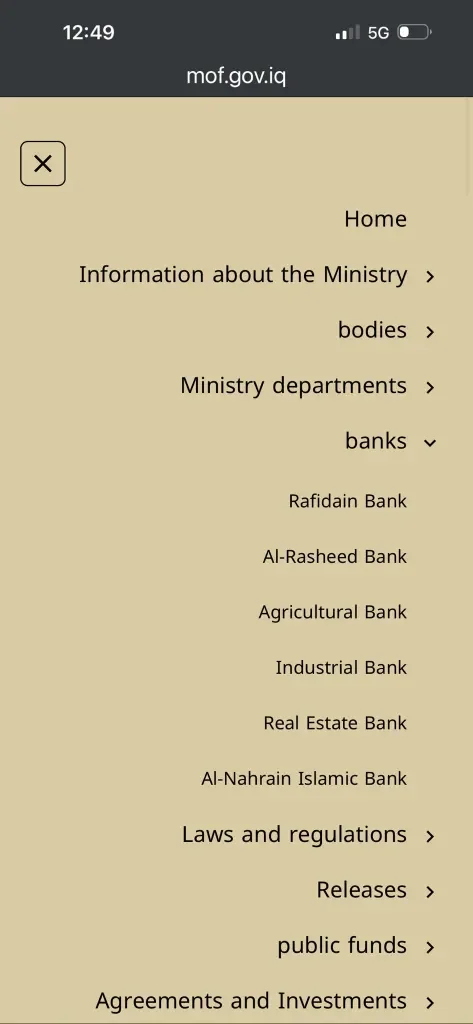
IQD RV: BANKS ARE READY. ANCHOR BANKS ALIGNED UNDER MOF AND CBI
The Ministry of Finance has formally listed Iraq’s state banks under a single “Banks” tab, confirming centralized oversight and coordinated reform.
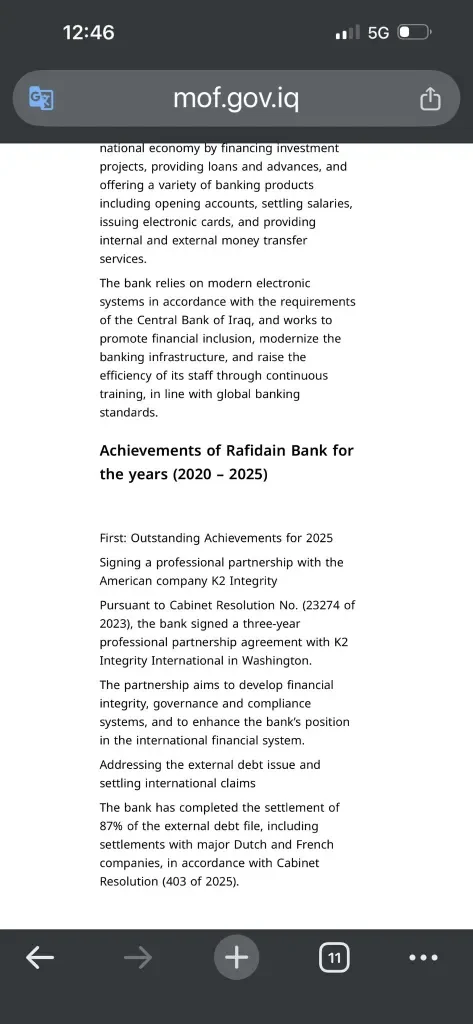
Rafidain Bank is now clearly positioned as the lead institution. The bank is operating under Central Bank of Iraq requirements, has adopted modern electronic banking systems, and is aligned with global banking standards.
Swisher1776: IQD Revaluation, Banks are Ready
1-13-2025
IQD RV: BANKS ARE READY. ANCHOR BANKS ALIGNED UNDER MOF AND CBI
The Ministry of Finance has formally listed Iraq’s state banks under a single “Banks” tab, confirming centralized oversight and coordinated reform.
Rafidain Bank is now clearly positioned as the lead institution. The bank is operating under Central Bank of Iraq requirements, has adopted modern electronic banking systems, and is aligned with global banking standards.
In 2025, Rafidain entered a three year professional partnership with the US firm K2 Integrity to strengthen governance, compliance, and financial integrity. The bank has also completed settlement of 87 percent of its external debt, including international claims.
Rasheed Bank is aligned alongside Rafidain and historically moves in parallel, particularly in government accounts, salary payments, and trade finance.
The Agricultural Bank and Industrial Bank are development banks. They do not set rates but operate under the national monetary framework, meaning alignment of systems and compliance is what matters, not pricing leadership.
The Real Estate Bank is domestically focused on housing finance and long term lending. Its role depends on currency stability rather than foreign exchange exposure.
Al Nahrain Islamic Bank operates under Islamic finance principles but remains fully integrated into national payment, compliance, and settlement systems.
This structure shows that Iraq’s banking system is being aligned hierarchically. Anchor banks first, development and specialty banks aligned operationally, all under centralized Ministry of Finance oversight and Central Bank standards.
This is not cosmetic. This is infrastructure.
Banks do not lead a rate change. Banks must be ready to receive the rate change. THEY ARE READY.
Seeds of Wisdom RV and Economics Updates Tuesday Afternoon 1-13-26
Good Afternoon Dinar Recaps,
Fed Independence Shock: Powell Probe Sends Tremors Through Global Finance
Dollar confidence tested as political pressure meets monetary authority
Good Afternoon Dinar Recaps,
Fed Independence Shock: Powell Probe Sends Tremors Through Global Finance
Dollar confidence tested as political pressure meets monetary authority
Overview
A criminal investigation involving Federal Reserve Chair Jerome Powell has triggered immediate market unease.
Investors are reacting to perceived threats against U.S. central bank independence, a cornerstone of global monetary trust.
The development is rippling through currencies, metals, and risk sentiment worldwide.
Key Developments
U.S. prosecutors are examining Powell’s congressional testimony related to a Federal Reserve building renovation.
Former central bank officials and economists warn that politicizing the Fed could undermine policy credibility.
Markets responded quickly, reflecting heightened sensitivity to institutional stability.
Why It Matters
The Fed’s independence underpins global dollar confidence and international capital flows.
Any erosion of that independence increases systemic risk and volatility across asset classes.
Why It Matters to Foreign Currency Holders
Instability at the Fed can accelerate diversification away from the dollar, boosting interest in alternative currencies and stores of value.
For those positioned for a future currency reset, this represents a structural pressure point rather than a short-term headline.
Implications for the Global Reset
This event strikes at Pillar One: trust in monetary institutions.
Even the perception of interference can catalyze long-term shifts in reserve strategy by governments and central banks.
When confidence in the referee falters, the entire financial game changes.
Seeds of Wisdom Team
Newshounds News
Sources
Reuters — Dollar reels on criminal probe into Fed Chair Powell
Financial Times — Gold hits record high as Fed independence worries mount
~~~~~~~~~~
Dollar Weakens as Markets Question U.S. Monetary Authority
Currency volatility resurfaces amid political and policy uncertainty
Overview
The U.S. dollar softened sharply following news tied to the Powell investigation and broader policy uncertainty.
Currency markets are signaling reduced tolerance for political risk at the heart of U.S. monetary governance.
Key Developments
The dollar fell against major peers as traders reassessed policy credibility and future rate decisions.
Analysts note rising demand for non-dollar hedges amid uncertainty over institutional independence.
Volatility metrics ticked higher, reflecting fragile confidence.
Why It Matters
The dollar remains the world’s primary reserve and settlement currency.
Even temporary weakness can reprice global trade, debt servicing, and capital flows.
Why It Matters to Foreign Currency Holders
Periods of dollar stress historically precede currency realignments and revaluations elsewhere.
Holders of foreign currencies often benefit when markets anticipate reduced dollar dominance.
Implications for the Global Reset
This aligns with Pillar Two: gradual erosion of single-currency reliance.
Not a collapse — but a measured rebalancing signal watched closely by global investors.
Dollar dominance doesn’t vanish overnight — it frays at the edges first.
Seeds of Wisdom Team
Newshounds News
Sources
~~~~~~~~~~
Gold Hits Record High as Investors Flee Fiat Risk
Safe-haven demand surges on dollar and policy fears
Overview
Gold prices surged to record highs as investors sought safety amid U.S. monetary uncertainty.
The move reflects deepening concern over fiat currency stability, not just short-term trading flows.
Key Developments
Gold rallied sharply following dollar weakness and Fed independence headlines.
Institutional demand increased as markets priced in longer-term confidence risk.
Other safe havens, including silver, also attracted inflows.
Why It Matters
Gold remains a core reserve asset for central banks globally.
Rising prices often signal structural stress within the fiat system, not just inflation hedging.
Why It Matters to Foreign Currency Holders
Strength in gold historically correlates with currency system transitions.
Precious metals often lead before currency repricing or monetary restructuring occurs.
Implications for the Global Reset
Gold’s surge reinforces Pillar One: asset-backed confidence over paper promises.
Central banks may accelerate reserve diversification strategies, reshaping the global monetary map.
Gold doesn’t chase headlines — it responds to trust breaking down.
Seeds of Wisdom Team
Newshounds News
Sources
~~~~~~~~~~
Seeds of Wisdom Team RV Currency Facts Youtube and Rumble
Newshound's News Telegram Room Link
RV Facts with Proof Links Link
RV Updates Proof links - Facts Link
Follow the Gold/Silver Rate COMEX
Follow Fast Facts
Seeds of Wisdom Team™ Website
Thank you Dinar Recaps
“Tidbits From TNT” Tuesday 1-13-2026
TNT:
Tishwash: Trade: 15 Memoranda of Understanding and a number of agreements to be signed with Morocco next month
The Ministry of Trade announced on Sunday that a preparatory meeting of the Iraqi-Moroccan Joint Committee was held to discuss the signing of fifteen memoranda of understanding and several agreements during the committee's meetings in Baghdad on February 18-19.
The ministry stated in a press release received by the Iraqi News Agency (INA) that "the Iraqi-Moroccan Joint Committee held its preparatory meeting in Baghdad, chaired by the Iraqi Deputy Chairman of the Committee, Administrative Undersecretary of the Ministry of Trade, Sattar al-Jabri, in preparation for the joint committee meetings scheduled to be held in Baghdad on February 18-19."
TNT:
Tishwash: Trade: 15 Memoranda of Understanding and a number of agreements to be signed with Morocco next month
The Ministry of Trade announced on Sunday that a preparatory meeting of the Iraqi-Moroccan Joint Committee was held to discuss the signing of fifteen memoranda of understanding and several agreements during the committee's meetings in Baghdad on February 18-19.
The ministry stated in a press release received by the Iraqi News Agency (INA) that "the Iraqi-Moroccan Joint Committee held its preparatory meeting in Baghdad, chaired by the Iraqi Deputy Chairman of the Committee, Administrative Undersecretary of the Ministry of Trade, Sattar al-Jabri, in preparation for the joint committee meetings scheduled to be held in Baghdad on February 18-19."
The statement added that "the meeting discussed the Iraqi side's report on preparations for the upcoming meeting with the Moroccan side, with the participation of representatives from relevant ministries and government agencies, as well as representatives from the private sector."
It continued, "The meeting addressed approximately fifteen memoranda of understanding and several agreements slated for signing with the Moroccan side during the joint committee meetings, which will contribute to strengthening bilateral cooperation in various fields."
The statement indicated "the Iraqi side's keenness to open up broader horizons for joint cooperation and build strategic partnerships, as well as to sign memoranda of understanding that serve the mutual interests of the two brotherly countries, which are united by solid diplomatic relations and important economic and developmental commonalities." link
Tishwash: Government advisor: The price of a barrel of oil in the 2026 budget is between $55 and $62.
The Prime Minister’s financial advisor, Mazhar Muhammad Saleh, predicted on Monday that the average price of a barrel of oil in the 2026 budget would range between $55 and $62, noting that these estimates are subject to change due to several factors.
Saleh said that “global forecasts, based on OPEC analyses and the context of the global oil market, as well as estimates from a number of international financial institutions, indicate that the average price of a barrel of global oil (Brent crude) expected for 2026 may move within an approximate range of between $55 and $62 per barrel, with an average tendency of approximately $61 in a considerable number of market estimates.”
He pointed out that "these estimates are based on market analyses and informal research related to OPEC forecasts and supply and demand balances in the global economy, and do not represent an official price figure announced by the organization."
He added that "these estimates remain subject to change depending on a number of influencing factors, most notably developments in geopolitical conflicts, changes in the pace of global energy demand growth, production policy decisions within the framework of 'OPEC+', as well as the accelerating shift towards renewable energy and climate policies." link
*************
Tishwash: Sudani meets with Oliver Wyman to discuss debt rescheduling and improving borrowing costs.
On Monday, January 12, 2026, caretaker Prime Minister Mohammed Shia al-Sudani discussed debt rescheduling and improving borrowing costs during a meeting he held with representatives of the financial auditing firms "Oliver" and "Wyman," in the presence of the Minister of Finance, the Governor of the Central Bank, and a number of financial and economic advisors.
A statement from the office of Prime Minister Mohammed Shia al-Sudani, a copy of which was received by Al-Jabal, stated: “Prime Minister Mohammed Shia al-Sudani chaired a meeting today, Monday, dedicated to discussing financial organization, scheduling, and management of public debt, both external and internal, in the presence of the Minister of Finance, the Governor of the Central Bank of Iraq, a number of financial and economic advisors, as well as representatives of the global financial auditing firm Oliver Wyman.”
The statement added, "The meeting witnessed a comprehensive and detailed presentation of the plans and programs adopted in scheduling public debts, and the priorities of financial treatments, in accordance with the most appropriate reform steps, and scientific paths based on similar successful global experiences, taking into account the particularity of the Iraqi experience and relying on developing the strong and reliable characteristics of the Iraqi economy."
During the meeting, according to the statement, Al-Sudani pointed to "the government's completion of the financial and economic reform process, and the benefit of the expertise of major international companies in scheduling public debts, both local and foreign, and the importance of adopting medium-term strategies in accordance with the nature of the debts, the credit rating and global indicators in this field, with the importance of emphasizing the development of budgets based on a realistic assessment of the availability of financing and the ability to implement."
The statement continued, “Al-Sudani also stressed the need to achieve the desired benefits from public debt management and employ them within the framework of promoting economic growth, easing pressure on the national currency, improving borrowing costs, and maintaining the financial reputation of the Iraqi economy and its strengths, while emphasizing the stages of diagnosis, improvement, and developing successful strategies for implementation within the steps of managing and scheduling public debt, in line with long-term economic reform.”
The statement concluded, "Al-Sudani directed the Ministry of Finance, the Central Bank, and financial advisors to continue communicating and following up with Oliver Wyman in order to develop the best executive formulas and financial mechanisms for dealing with public debt, within the framework of sound financial indicators that contribute to the goal of developing the Iraqi economy." link
Mot: Seeeeeeeeeeeeee -- Told Ya So!!!!!

Mot: .. Just aDriving down the road!!!!

Iraq Economic News and Points To Ponder Tuesday Morning 1-13-26
An Economist Explains The Budget And Spending Mechanism (1/12) Under The Caretaker Government.
Time: 2026/01/13 {Economic: Al-Furat News} Economic expert Salah Nouri explained on Tuesday the legal foundations for submitting and approving the federal general budget, and the financial disbursement mechanisms adopted in the event of its non-approval, especially in light of the caretaker government situation.
An Economist Explains The Budget And Spending Mechanism (1/12) Under The Caretaker Government.
Time: 2026/01/13 {Economic: Al-Furat News} Economic expert Salah Nouri explained on Tuesday the legal foundations for submitting and approving the federal general budget, and the financial disbursement mechanisms adopted in the event of its non-approval, especially in light of the caretaker government situation.
Nouri pointed out in his statement to Al-Furat News Agency that “Article (11) of the Federal Financial Management Law No. (6) of 2019 stipulated that the draft federal general budget law be submitted by the Council of Ministers to the House of Representatives before the middle of October of each year.”
He explained that “Article (13), Paragraph Three, dealt with the situation of the House of Representatives not approving the draft budget law until 12/31 of the fiscal year, as the final financial statements for the previous year are considered the basis for the financial statements for the current year, and are submitted to the House of Representatives for the purpose of approving them.”
He added that "the current situation is that the government is a caretaker government, and therefore paragraph one of Article (13) is applied, which allows spending at a rate of 1/12 of the total actual expenditures of the previous year, after excluding non-recurring expenditures for the current and investment budgets." From... Ragheed LINK
Interior Ministry Announces Arrest of 91 Individuals for Manipulating Dollar Exchange Rates
Baghdad – INA The Ministry of Interior announced on Tuesday the arrest of 91 individuals on charges of manipulating U.S. dollar exchange rates.
The ministry’s spokesperson, Major General Miqdad Miri, said during a press conference attended by the Iraqi News Agency (INA) that security forces had succeeded in arresting 91 persons accused of manipulating dollar prices.
He added that the ministry had also arrested 147 individuals for manipulating the prices of food commodities and medicines, noting that the Ministry of Interior has contracted for 100 fixed and mobile radar units to monitor external highways.
Interior Ministry: Those Manipulating Food And Dollar Prices Apprehended... Traffic Directorate Reveals The Number Of Cars In Iraq
Time: 2026/01/13 11:51:13 Reading: 180 times {Local: Al-Furat News} The Ministry of Interior announced on Tuesday the arrest of a number of people manipulating the prices of food, medicine and the dollar exchange rate, while the Director of the General Traffic Directorate revealed that more than 8 million vehicles have been registered in Iraq since 2003, as part of efforts to enhance control and safety on the roads.
Traffic Director General, Lieutenant General Uday Samir, said at a conference of the Ministry of Interior, which was followed by Al-Furat News, that “the Traffic Directorate has developed specialized curricula for primary, intermediate and preparatory school students, and the Ministry of Education has been contacted to include these curricula in the teaching curriculum.”
He added that "there were random processes in reviewing registration departments, and this has been organized electronically through registration in the Ain Iraq application, and the use of a single window to complete transactions."
Samir pointed out that "27 sites have been built in Baghdad and the provinces, and there are 8 sites under construction, with work being done to ensure that these sites are fully integrated," indicating that "the production capacity in the panel factory has been increased, as the daily production was previously 5,000 panels."
He continued, saying: "Today, production has increased to 25,000 paintings per day, with a total production of 5 million paintings, of which one million are in storage."
Samir pointed out that "in 2025, more than one million license plates were produced, and the import of vehicles, which was previously managed haphazardly by companies, was organized."
Regarding the imposition of violations, Samir confirmed that "currently, violations are imposed on vehicles, but in the future, violations will be on the driver's license, as a system of driver violation will be adopted, and points will be deducted from the driver's balance, and the matter may reach the point of withdrawing the license and preventing him from driving the vehicle."
He pointed out that "the number of vehicles registered since 2003 has reached more than 8 million vehicles, while the number of vehicles registered since 2010 within the national project has reached more than 4 million vehicles, in addition to more than 600,000 wheels."
For his part, the Director of Media at the Ministry of Interior, Brigadier General Miqdad Miri, said during the same conference that “things are proceeding very smoothly, and we have not recorded any violations regarding the Rajab visit. The security and traffic plan is well-prepared, and tomorrow, Wednesday, will be of the utmost necessity.” He explained that “the plan is flexible and did not include any road closures, except for some limited closures in the Kadhimiyah and Adhamiyah areas, and the city of Kadhimiyah has been declared a weapons-free zone.”
He added that "some markets witnessed abnormal movements in the dollar exchange rate, as we observed attempts by some people to manipulate the currency and prices," noting that "91 people involved in currency manipulation, 113 people manipulating the prices of basic commodities, and 34 accused of manipulating medicines were arrested, and a pledge was taken from 1,300 people, including pharmacy and store owners, as the campaign continues to apprehend violators."
He stressed that "fines are imposed on violators, and the movement of life is proceeding in an organized and ideal manner. The fines have recently included many details, and have been linked to updates on the Ain Iraq application."
Regarding vehicle traffic and traffic accidents, Miri pointed out that “in 2025, the General Traffic Directorate issued 14 statements focusing on regulating vehicle traffic, with a focus on points where accidents occur. The directorate was also supplied with modern patrols with 818 Toyota Cruise vehicles and 473 other vehicles, to be used in the outer sections, bringing the total number of vehicles in these sections to 1,354 vehicles.”
He continued: “The directorate was also supplied with 20 mobile vehicles for distributing traffic signs, and traffic barriers were created on the external roads. Additionally, a contract was signed for 100 fixed and mobile radars to monitor the external roads from Basra to Nineveh.”
Miri confirmed that "the cameras and radars have been started operating in Baghdad, distributed across 109 intersections and highways, which will contribute to reducing traffic accidents, and the first phase, which includes 40 intersections, will be completed."
Miri pointed out that "877 affiliates were appointed on a contractual basis, and this number had a clear and positive impact on the street and traffic."
He stressed that “all the procedures and points mentioned contributed to the decrease in the accident rate in 2025, as the accident rate in Iraq decreased compared to 2024 to 5.9, which is a rate that is considered better than other countries.” LINK
Dollar opens lower in Baghdad, Erbil markets
2026-01-13 02:48 Shafaq News– Baghdad/ Erbil The US dollar opened Tuesday’s trading at a lower rate in Baghdad and Erbil markets, according to a Shafaq News market survey.
In Baghdad, the dollar opened at 146,400 Iraqi dinars per 100 dollars, down by 400 dinars from the previous session, when it closed at 146,800 dinars per 100 dollars at the Al-Kifah and Al-Harithiya exchanges.
Local exchange shops in the capital sold the dollar at 147,000 dinars per 100 dollars, while buying prices stood at 146,000 dinars.
In Erbil, the dollar edged lower at the opening of trading, with selling prices reaching 145,950 dinars per 100 dollars and buying prices at 145,850 dinars. https://www.shafaq.com/en/Economy/Dollar-opens-lower-in-Baghdad-Erbil-markets
Gold prices slide in Baghdad, Erbil markets
2026-01-13 04:00 Shafaq News– Baghdad/ Erbil On Tuesday, gold prices edged lower in Baghdad and Erbil markets, according to a survey by Shafaq News Agency.
Gold prices on Baghdad's Al-Nahr Street recorded a selling price of 940,000 IQD per mithqal (equivalent to five grams) for 21-carat gold, including Gulf, Turkish, and European varieties, with a buying price of 936,000 IQD. The same gold had sold for 943,000 dinars on Monday.
The selling price for 21-carat Iraqi gold was 911,000 IQD, with a buying price of 907,000 IQD.
In jewelry stores, the selling price per mithqal of 21-carat Gulf gold ranged between 940,000 and 950,000 IQD, while Iraqi gold sold for between 910,000 and 920,000 IQD.
In Erbil, 22-carat gold was sold at 987,000 IQD per mithqal, 21-carat gold at 941,000 IQD, and 18-carat gold at 807,000 IQD. https://www.shafaq.com/en/Economy/Gold-prices-slide-in-Baghdad-Erbil-markets-1
Iraq Ranks Third Among US Oil Suppliers In December At 7M+ Barrels
2026-01-13 06:21 Shafaq News– Baghdad/ Washington Iraq, OPEC’s second-largest oil producer, exported 7.533 million barrels of crude oil to the United States in December 2025, according to data released Tuesday by the US Energy Information Administration (EIA).
During the month, Iraqi crude shipments averaged 306,000 barrels per day (bpd) in the first week, 181,000 bpd in the second, 357,000 bpd in the third, and 129,000 bpd in the fourth week. The figures showed a decline from November, when exports totaled more than 7.9 million barrels.
Iraq, EIA affirmed, ranked third among oil suppliers to the US during December, behind Canada and Saudi Arabia.
Among Arab exporters, Iraq placed second, after Saudi Arabia, which shipped 9.796 million barrels, while Libya came third with 2.139 million barrels. https://www.shafaq.com/en/Economy/Iraq-ranks-third-among-US-oil-suppliers-in-December-at-7M-barrels
Finance Ministry: Iraq Achieved The Second Highest Level Of Improvement Globally In International Governance Indicators.
Money and Business Economy News – Baghdad The Ministry of Finance announced on Tuesday that Iraq has achieved the second highest level of improvement globally in international governance indicators.
The ministry said in a statement received by “Al-Eqtisad News”, that “Iraq has achieved a new international accomplishment within the World Governance Indicators (WGI) report issued in December 2024, according to Fitch and Standard & Poor’s agencies, as Iraq recorded the second highest improvement score globally on an annual basis, reflecting the success of the reform steps adopted by the government in state institutions.”
She noted that “official data from global indicators revealed a tangible improvement in Iraq’s global governance scores, rising from 29.5 points in 2023 to 32.5 points in 2024. This increase represents a positive indicator of the effectiveness of the financial and administrative policies adopted to enhance transparency and efficiency.”
She explained that "according to the report, the largest annual gains were concentrated in three vital sectors, namely: Government efficiency: which recorded an increase of (+4.6 points), Anti-corruption: which made progress of (+4.3 points), Regulatory quality: which increased by (+4.0 points)."
She explained that “progress was not limited to administrative aspects only, but governance indicators pointed to a remarkable and comprehensive improvement in several key areas, which enhances the confidence of the international community, donors and investors in the Iraqi environment, namely: freedom of expression and accountability, political stability and absence of violence, efficiency of government performance, in addition to organizational quality, the rule of law and combating corruption.”
The report indicated that "this remarkable progress came as a result of the commitment to the economic reform program, working to automate financial procedures and strengthen the principles of e-governance, as well as continuing efforts to maintain this positive outcome in a way that serves the supreme national interest and enhances Iraq's position in international indicators." https://economy-news.net/content.php?id=64508