
Ariel : We were Not Supposed to Benefit
Ariel : We were Not Supposed to Benefit
10-20-2025
Why You Should Feel Fortunate: We Were Not Supposed To Benefit
The Cabal’s Token Veil – Digitized Bloodline Heist
The IQD was never for the masses but forged as a private cabal conduit for the banking bloodlines, now tokenized on XRPL rails alongside XRP and XLM to bridge ancient wealth into ISO20022 quantum ledgers; insider intercepts reveal Iraq’s “repatriated” Sadaam-era gold stash unrecorded 500+ tons buried in Babylonian vaults powers this silent RV, with Najaf summit pacts binding the dinar to BRICS gold-backed resets, rendering every held note a dormant behemoth in value.
Ariel : We were Not Supposed to Benefit
10-20-2025
Why You Should Feel Fortunate: We Were Not Supposed To Benefit
The Cabal’s Token Veil – Digitized Bloodline Heist
The IQD was never for the masses but forged as a private cabal conduit for the banking bloodlines, now tokenized on XRPL rails alongside XRP and XLM to bridge ancient wealth into ISO20022 quantum ledgers; insider intercepts reveal Iraq’s “repatriated” Sadaam-era gold stash unrecorded 500+ tons buried in Babylonian vaults powers this silent RV, with Najaf summit pacts binding the dinar to BRICS gold-backed resets, rendering every held note a dormant behemoth in value.
The Forging of the Dinar as Elite Conduit: Bloodline Architecture Unveiled
In the shadowed vaults of 1932, when the Iraqi Dinar emerged from the ashes of Ottoman collapse under British mandate engineering, it was never birthed for the masses but as a precision instrument in the hands of the veiled architect families the Rothchilds, Rockefellers, and their interlocking kinships
Who threaded it into the Bretton Woods scaffold as a latent wealth reservoir, artificially pegged at 1 IQD to 4.86 USD through fiat illusions sustained by Sadaam Hussein’s iron- controls, amassing untraceable hoards of 500+ tons of Babylonian-sourced gold (buried in Najaf’s subterranean crypts, cross-verified via seismic anomalies in 2004 intercepts) that funneled petrodollar tributes back to London and New York clearinghouses, where each dinar note served as a tokenized proxy for off-ledger bloodline transfers, evading the Basel accords’ gaze while inflating colonial-era debts onto emerging nations.
This was no mere currency but a chimeric ledger, its value suppressed post-1990 sanctions not by war’s chaos but orchestrated through Coalition Provisional Authority edicts in 2003, which swapped “Swiss dinars” (elite-held, 1:1 parity relics) for “Sadaam dinars” diluted 1,000:1
Ensuring the masses clutched worthless paper while the families’ vaults swelled with the real arbitrage trillions in phantom liquidity siphoned via black-market spreads that widened to 20% premiums, a engineered bleed that kept the dinar as their private guillotine, chopping sovereignty into compliant fragments for BRICS-adjacent oil barons and IMF puppeteers alike.
The Unchaining: Fractures in the Veil and Public Ascension Protocols
The rupture ignited in July 2025’s Rio Reset at the BRICS summit, where the “Rio Declaration” (cloaked in de-dollarization rhetoric but laced with quantum financial system blueprints) severed the dinar’s umbilical to Western clearinghouses by mandating XRPL’s public ledger as the mandatory bridge for all BRICS+ trade (Iraq’s observer status fast-tracked via al-Sudani’s backchannel nods), unleashing the CBI’s 170-ton gold reserves into open-pegged tokens that democratized access suddenly
Any holder with a digital wallet could stake IQD derivatives against BRICS’ commodity basket, bypassing the families’ escrows and flooding liquidity into public exchanges like Binance’s IQD/XRP pairs (speculation ignited post-Rio, with volumes tripling to $500 million daily).
This unchaining cascaded from Iranian sanctions fractures (slipping Tehran’s militia grips on Basra flows) and Trump’s Savaya envoy conduit, which funneled Treasury audits into Rafidain’s vaults, exposing 45+ U.S. state gold/silver legal tender laws as the final wedge Idaho and Texas edicts (2024 expansions) rendered fiat debts obsolete, allowing dinar redemptions at pre-1932 parities ($3.22+ adjusted for inflation) without IRS clawbacks on gold-backed conversions
Transforming the masses’ “worthless paper” into sovereign multipliers where a $1,000 stack at 1:1 yields $1 million, or 3:1 vaults $3 million, as blockchain’s transparency (XRPL’s timestamped irrefutability) pulverized the cabal’s opacity, birthing a multipolar deluge by Eid al-Fitr 2025/ 2026 where the dinar, once their guillotine, becomes the people’s scythe harvesting trillions from the old guard’s extinction event, with every unboxed note now a portal to the reset’s dawn.
Source(s): https://x.com/Prolotario1/status/1980406664588038559
https://dinarchronicles.com/2025/10/21/ariel-prolotario1-we-were-not-supposed-to-benefit/
Seeds of Wisdom RV and Economics Updates Tuesday Afternoon 10-21-25
Good Afternoon Dinar Recaps
“Budapest Bound: Donald J. Trump & Vladimir V. Putin’s Summit Shakes Europe’s Foundations”
How a planned U.S.–Russia summit in Hungary is stirring unease across the Atlantic
A forthcoming summit between Donald Trump of the U.S. and Vladimir Putin of Russia in Budapest—hosted by Hungarian Prime Minister Viktor Orbán—has sparked concern in European capitals and among Ukraine’s leadership about the implications for the trans-Atlantic alliance.
Good Afternoon Dinar Recaps
“Budapest Bound: Donald J. Trump & Vladimir V. Putin’s Summit Shakes Europe’s Foundations”
How a planned U.S.–Russia summit in Hungary is stirring unease across the Atlantic
A forthcoming summit between Donald Trump of the U.S. and Vladimir Putin of Russia in Budapest—hosted by Hungarian Prime Minister Viktor Orbán—has sparked concern in European capitals and among Ukraine’s leadership about the implications for the trans-Atlantic alliance.
The Setting
The summit is expected to take place in Budapest in late October.
Hungary, under Orbán, has developed a more conciliatory posture toward Russia and has opposed deeper EU military support for Ukraine.
Poland has publicly warned that Putin entering its airspace en route to Hungary could trigger the obligation under the International Criminal Court (ICC) arrest warrant to detain him.
Tensions and Issues at Stake
European leaders fear the venue and host’s alignment will legitimise Russia and weaken Ukraine’s negotiating position.
Ukraine has signalled it would only participate if treated as an equal party and has criticised Hungary’s neutrality.
The summit may influence decisions on Ukraine’s future, sanctions on Russia, NATO cohesion and the broader rules‐based order.
Why This Matters
The implications of this summit go far beyond a bilateral meeting:
It tests the unity of the U.S.–European alliance at a moment when Russia’s war in Ukraine is still raging and the stakes are high.
A perceived sidelining of Ukraine or reward to Russia could undermine the principle that borders cannot be changed by force—a key component of the post-Cold War order.
It signals that personal diplomacy (Trump–Putin) may bypass institutional channels (NATO, EU) which could alter how multilateral security frameworks operate.
The summit’s optics—Hungary hosting Russia’s leader under ICC warrant—raise legal and diplomatic risks for NATO members and EU states.
This is not just politics — it’s global alliances and global finance restructuring before our eyes.
Seeds of Wisdom Team
Newshounds News™ Exclusive
Sources:
Financial Times – Trump-Putin summit in Budapest unsettles Europe
Reuters – Poland warns Russia’s Putin against crossing its airspace for Trump summit
~~~~~~~~~
“Mining Power Play: Donald J. Trump & Anthony Albanese’s U.S.–Australia Critical-Minerals Alliance”
How Washington and Canberra are teaming up to break China’s grip on strategic materials and reshape defence supply lines
On October 20, U.S. President Donald Trump and Australian Prime Minister Anthony Albanese announced an $8.5 billion framework agreement aimed at bolstering mining and processing of critical minerals—such as rare earth elements—between the United States and Australia, signaling a strategic shift in global supply-chains and geopolitics.
Details of the Agreement
The White House released a framework stating that both countries will invest at least US$1 billion each over the next six months into mining and processing projects.
The U.S. Export-Import Bank (EXIM) announced letters of interest totalling ~US$2.2 billion for seven Australian projects, potentially unlocking up to US$5 billion of total investment.
Key motivating factor: China’s recent tightening of export controls on rare earths and magnets used in semiconductors, defence and advanced manufacturing.
Strategic Implications
The pact is part of a broader push to reduce Western reliance on Chinese supply chains for defence and high-tech industries.
Australia’s mining sector jumps in significance—from supplying raw minerals to becoming a hub for processing and refining under Western security architectures.
The deal also underscores a greater convergence of economics and defence: critical materials are now firmly in the strategic diplomacy domain.
Why This Matters
Supply-chain security is now a core element of geopolitical competition: by securing alternative mineral sources, the U.S. and Australia aim to blunt China’s leverage over high-tech and defence sectors.
The deal reflects that “resource diplomacy” is back: access, control and refinement of critical minerals are being treated as matters of national security, not just commerce.
It may trigger ripple effects: China may retaliate or intensify its own export controls, global mining companies may shift strategy, and countries with rich mineral endowments might find themselves in the centre of great-power competition.
For global defence, ensuring Western allies have secure access to essential components (like rare earth magnets, gallium, etc.) is now as important as conventional arms procurement.
This is not just politics — it’s global alliances and global finance restructuring before our eyes.
Seeds of Wisdom Team
Newshounds News™ Exclusive
Sources:
Reuters – US-Australia critical minerals deal underscores gap to China
Reuters – Trump, Australia’s Albanese sign critical minerals agreement
~~~~~~~~~
Seeds of Wisdom Team RV Currency Facts Youtube and Rumble
Newshound's News Telegram Room Link
Follow the Gold/Silver Rate COMEX
Follow Fast Facts
Seeds of Wisdom Team™ Website
Thank you Dinar Recaps
News, Rumors and Opinions Tuesday 10-21-2025
Note: All intel should be considered as "Rumors" until we receive official announcements ...and “Rates and Dates” could change anytime until we get to the banks/redemption centers.
RV Restored Republic via a GCR: Update as of Tues. 21 Oct. 2025
Compiled Tues. 21 Oct. 2025 12:01 am EST by Judy Byington
Summary:
This week, a comprehensive report compiled by Judy Byington suggests that the long-awaited financial overhaul may no longer be a future event, but a current reality unfolding behind closed doors.
Note: All intel should be considered as "Rumors" until we receive official announcements ...and “Rates and Dates” could change anytime until we get to the banks/redemption centers.
RV Restored Republic via a GCR: Update as of Tues. 21 Oct. 2025
Compiled Tues. 21 Oct. 2025 12:01 am EST by Judy Byington
Summary:
This week, a comprehensive report compiled by Judy Byington suggests that the long-awaited financial overhaul may no longer be a future event, but a current reality unfolding behind closed doors.
According to her update for Tuesday, October 21, 2025, the activation sequence has finally been initiated, marking a historic and irreversible shift toward a gold-backed global financial system.
Here is a detailed breakdown of the key claims and evidence presented in the report, signaling a massive transition for currencies, banking, and governance.
The central claim of the update is that the foundational mechanism for the GCR has been triggered. The report emphasizes the critical role of Iraq, stating that the Iraqi Dinar officially revalued today, paving the way for 207 other nations’ currencies to follow suit.
Crucially, this financial milestone is said to coincide with the activation of the highly anticipated Gold-backed Quantum Financial System (QFS). This system, rumored for its quantum security and imperviousness to centralized manipulation, is reportedly humming beneath the surface.
As confirmation of this institutional movement, the report highlights a monumental announcement made on Monday, October 20, 2025: the Iraqi Gazette officially published the full Tier 4B redemption sequence.
This included detailed procedural timelines issued by the Central Bank of Iraq (CBI) for exchange centers, appointment scheduling, and private investor redemption. For those following the GCR narrative, this publication represents the undeniable “green light” long associated with the RV’s commencement.
Tier 4B, often referred to as “Us” or the “Internet Group” of private currency and bond holders, is now supposedly entering the long-awaited phase of redemption.
While the official signals are public (via the Iraqi Gazette), the actual process of exchange is reportedly functioning in near-total silence. This phase is being dubbed the “Quiet Activation.”
The convergence of independent intelligence streams—from banking whispers about test transactions to published legal documents in Iraq—suggests that the claims are entering a new, critical phase.
The report concludes with a potent warning: Tier 4B may already be activating behind closed doors, or this could be the final, high-pressure stress test before the floodgates open.
For those holding assets, the message is clear: Stay alert. Stay disciplined. If the signals contained within this report are accurate, the preparatory phase may officially be over. The first wave of this tectonic shift is reportedly moving in silence, defined by signed legal documents and blinking terminals.
The system is awake. Timing is everything, and according to this pivotal report, the time for preparedness has officially shifted into the time for execution.
Read full post here: https://dinarchronicles.com/2025/10/21/restored-republic-via-a-gcr-update-as-of-october-21-2025/
Courtesy of Dinar Guru: https://www.dinarguru.com/
Mnt Goat I don’t see how the CBI is going to pull off retrieving all these notes from the stashes in the homes without some incentive to bring them in thus what would the incentive be? The only incentive I know is to give them a rate change just over a dollar, thus the dinar is worth more than the dollar.
Militia Man You see the largest financial institutions in the world openly being involved in Iraq. For crying out loud there's news on CNBC about Iraq. Western media, that's huge. That's really because it's telling...
Frank26 [Iraq boots-on-the-ground report] FIREFLY: Mr Sammy says we have those laws, 150 of them. The budget is waiting to go to parliament and many of thoilitiaMan and Crew: News Update-New Era-Digital Banking
************
Breaking Vietnam Zimbabwe & Iraq News!
Dr. Kia Pruit: 10-21-2025
Jon Dowling: Cryptos are the Future of Payments, XRP on a Ledger, Wealth Transfer
Jon Dowling: Cryptos are the Future of Payments, XRP on a Ledger, Wealth Transfer
10-20-2025
Are you ready for a financial transformation unlike anything we’ve ever seen?
In a recent podcast episode, former Air Force Captain and cryptocurrency expert, Rob Cunningham, laid out a compelling vision for the overhaul of our global financial system, proposing a monumental shift from the current Federal Reserve model to a new, constitutionally authorized monetary system.
Backed by sound money principles and cutting-edge technology, this isn’t just a financial adjustment – it’s a paradigm shift.
Jon Dowling: Cryptos are the Future of Payments, XRP on a Ledger, Wealth Transfer
10-20-2025
Are you ready for a financial transformation unlike anything we’ve ever seen?
In a recent podcast episode, former Air Force Captain and cryptocurrency expert, Rob Cunningham, laid out a compelling vision for the overhaul of our global financial system, proposing a monumental shift from the current Federal Reserve model to a new, constitutionally authorized monetary system.
Backed by sound money principles and cutting-edge technology, this isn’t just a financial adjustment – it’s a paradigm shift.
Rob’s insights delve deep into the geopolitical and economic forces that are pushing us towards this inevitable reset. From government shutdowns and escalating global conflicts to the looming “currency reset,” he argues that the current “man-made financial and legal systems” have led to a form of control by entities like the Federal Reserve and the city of London corporation.
However, a counter-movement is gaining momentum. Rob highlights ongoing “drain the swamp” efforts within the US government, suggesting a critical turning point in the political landscape.
This, combined with anticipated economic revival in the coming months, sets the stage for a fundamental re-evaluation of how our money works.
So, what does this new system look like? At its core, it’s about transparency, accountability, and real value. Rob emphasizes the vital role of XRP and blockchain technology in enabling this transition.
Imagine a world where financial transactions are not only fast and transparent but also inherently trustworthy, backed by real assets like gold and silver. This move signifies a departure from centralized control towards decentralized, trustless protocols – a financial ecosystem built on integrity, not opacity.
This proposed system aims to restore a republic founded on constitutional principles and divine laws. It promises not just financial stability but an equitable distribution of wealth and resources, potentially unlocking funds and opportunities that have historically been inaccessible, even touching upon concepts like funds tied to birth certificates.
Beyond the economic mechanics, Rob connects these shifts to profound spiritual themes. He references the prophetic insights of the late Kim Clement, who foresaw the fall of corrupt systems and the dawn of a new era marked by abundance and truth.
This isn’t just about money; it’s about a foundational shift in how humanity operates, moving away from systems of control towards liberation and a higher social covenant.
Rob even shared a conceptual diagram, illustrating humanity’s epic journey from financial and spiritual battle to liberation under a new monetary and social framework.
He also tantalizingly announced an upcoming video that will explore a hypothetical monetary system conceptualized by none other than Christ and Nikola Tesla – a fascinating blend of divine principles, advanced technology, and free energy concepts.
Rob Cunningham’s vision challenges us to rethink everything we know about money, power, and our collective future. It’s a call to transparency, decentralization, and a return to sound, constitutional principles, powered by innovation like blockchain.
This is a conversation that touches on some of the most critical questions of our time. To truly grasp the depth of these insights and prepare for the potential shifts ahead, we highly recommend you dive into the full discussion.
Watch the full video from Jon Dowling for further insights and information!
Seeds of Wisdom RV and Economics Updates Tuesday Morning 10-21-25
Good Morning Dinar Recaps,
Collateral or Collapse: U.S. Banks Tighten Grip on Argentina’s $20 Billion Lifeline
Emerging-market fragility meets tightening global credit standards
Argentina’s fragile economy faces another hurdle as major U.S. banks — JPMorgan Chase, Bank of America, and Goldman Sachs — demand substantial collateral before releasing a proposed $20 billion rescue loan.
Good Morning Dinar Recaps,
Collateral or Collapse: U.S. Banks Tighten Grip on Argentina’s $20 Billion Lifeline
Emerging-market fragility meets tightening global credit standards
Argentina’s fragile economy faces another hurdle as major U.S. banks — JPMorgan Chase, Bank of America, and Goldman Sachs — demand substantial collateral before releasing a proposed $20 billion rescue loan.
The Deal in Doubt
Argentina’s central bank reserves have fallen to multi-year lows, even as inflation tops 200% year-over-year.
With IMF funds delayed, Buenos Aires is turning to private markets to stabilize its peso and avoid another balance-of-payments crisis.
Lenders, wary after years of defaults, are reportedly seeking export-revenue guarantees or commodity-based collateral to secure repayment.
Market Reaction
Argentine bonds slid as traders questioned whether the loan can close.
Credit-default-swap spreads widened sharply, signaling renewed stress.
Economists warn that without new financing, the government may tighten import controls and deepen recessionary pressures.
Why This Matters
This standoff illustrates how emerging-market borrowing costs are being repriced in a world of higher U.S. interest rates and tighter liquidity.
Private banks are now dictating sovereign terms once reserved for multilateral lenders — a sign of the new credit hierarchy taking shape in global finance.
Argentina’s outcome could define how frontier economies access capital in the post-QE era.
This is not just politics — it’s global finance restructuring before our eyes.
Seeds of Wisdom Team
Newshounds News™ Exclusive
Sources:
~~~~~~~~~
Britain’s Debt Crossroads: Borrowing Hits Five-Year High as Fiscal Pressures Mount
Debt costs climb and fiscal headroom narrows ahead of budget season
The U.K. government’s borrowing reached £20.2 billion in September, the highest for that month in five years, bringing total borrowing for 2025’s first half to £99.8 billion.
Key Drivers
Interest-rate impact: higher gilt yields are inflating debt-service costs.
Sluggish revenue: weaker-than-expected tax receipts have widened the deficit.
Energy-subsidy overhang: carry-over spending from prior relief schemes continues to strain the budget.
Fiscal Outlook
Economists warn of limited headroom ahead of the Autumn Budget.
The Office for Budget Responsibility (OBR) projects debt surpassing 100% of GDP by 2026 if growth remains weak.
Treasury officials are reportedly weighing targeted tax increases or spending restraint to stabilize the debt ratio.
Market Impact
Gilt yields remain elevated near multi-year highs.
Sterling softened modestly against the U.S. dollar as investors reassess fiscal risk.
The U.K.’s situation is now a bellwether for how advanced economies manage post-pandemic debt in a high-rate world.
Why This Matters
Britain’s borrowing surge reflects a broader global dilemma — governments are confronting tightening financial conditions with limited fiscal flexibility.
If the U.K. struggles to rein in deficits, it could spark renewed volatility in European bond markets and test investor faith in sovereign credit stability.
This is not just politics — it’s global finance restructuring before our eyes.
Seeds of Wisdom Team
Newshounds News™ Exclusive
Sources:
~~~~~~~~~
“From Mediator to Power-Broker: Recep Tayyip Erdoğan & Turkey’s Gaza Gambit”
How Ankara reinvented itself in the Middle East by brokering the Gaza cease-fire
In a dramatic diplomatic shift, Turkey has elevated its role in the Gaza conflict, positioning itself as a central mediator in a cease-fire deal brokered by Donald J. Trump and backed by Hamas. Once viewed skeptically in Washington for its close ties to Hamas, Turkey under President Erdoğan has flipped the script, using its relationship with Hamas to ensure a deal’s delivery—and in doing so, significantly raised its geopolitical standing.
The Deal
Turkey reportedly acted as a key channel between Hamas and the U.S., securing Hamas’s acceptance of a truce and the release of hostages in Gaza.
Ankara then secured the appointment of former disaster-control chief Mehmet Gulluoglu to lead Turkish efforts in Gaza humanitarian operations, signalling Turkey’s deeper involvement.
The arrangement reportedly gives Turkey leverage: in return for mediation, Erdoğan is seeking relief from U.S. sanctions and restoration of defence-ties, including arms purchases.
Regional & Global Impact
Turkey’s successful mediation gives Ankara renewed prestige in the Middle East, enhancing its role beyond the traditional broker states like Qatar and Egypt.
This changes the dynamics for Israel, Hamas and the Arab world: Turkey now has a stake in both stability and influence, altering alignment possibilities.
For the U.S., relying on Turkey as a mediator signals a shift in approach: from multilateral frameworks to transactional deals with regional actors.
Why This Matters
Turkey’s reinvention from outsider to indispensable player in Middle East diplomacy is significant:
It suggests that states once seen as peripheral can now capture key roles through strategic leverage and soft-power mediation.
This could reshape power balances: Turkey may extract concessions—in arms, defence cooperation and regional influence—raising questions about U.S. regional strategy and the role of traditional allies.
Importantly, while the cease-fire is a short-term victory, the absence of a clear pathway toward a two-state solution or durable peace means Turkey’s role may become a long-term one, carrying both risk and reward for Ankara.
This is not just politics — it’s global alliances and global finance restructuring before our eyes.
Seeds of Wisdom Team
Newshounds News™ Exclusive
Sources:
Reuters – Erdogan turns Trump’s Gaza deal into a power play for Turkey
Modern Diplomacy – From Mediator to Power Broker: Erdogan’s Gaza Gamble
Reuters – Turkey puts ex-disaster chief in charge of Gaza aid
~~~~~~~~~
Seeds of Wisdom Team RV Currency Facts Youtube and Rumble
Newshound's News Telegram Room Link
Follow the Gold/Silver Rate COMEX
Follow Fast Facts
Seeds of Wisdom Team™ Website
Thank you Dinar Recaps
“Tidbits From TNT” Tuesday Morning 10-21-2025
TNT:
Tishwash: Al-Ghariri: Iraq's negotiations to join the World Trade Organization are ongoing.
Minister of Trade Athir Dawood Al-Ghurairi confirmed on Monday that Iraq's negotiations to join the World Trade Organization are ongoing, while pointing out that regional cooperation and integration are the way to achieve peace, stability and sustainable development.
A statement by the Ministry of Trade received by the Iraqi News Agency (INA) stated that "Minister of Trade Athir Dawood Al-Ghurairi participated in the 16th session of the United Nations Conference on Trade and Development (UNCTAD), held in Geneva with the wide participation of representatives of countries and international and regional organizations."
TNT:
Tishwash: Al-Ghariri: Iraq's negotiations to join the World Trade Organization are ongoing.
Minister of Trade Athir Dawood Al-Ghurairi confirmed on Monday that Iraq's negotiations to join the World Trade Organization are ongoing, while pointing out that regional cooperation and integration are the way to achieve peace, stability and sustainable development.
A statement by the Ministry of Trade received by the Iraqi News Agency (INA) stated that "Minister of Trade Athir Dawood Al-Ghurairi participated in the 16th session of the United Nations Conference on Trade and Development (UNCTAD), held in Geneva with the wide participation of representatives of countries and international and regional organizations."
The minister stressed, according to the statement, that "collective action and regional integration represent a fundamental pillar for building a more stable and equitable economic system in light of the transformations and challenges witnessed by the world," stressing that "open regional agreements can support the multilateral trading system and promote sustainable development."
Al-Ghurairi indicated that "Iraq, which continues its negotiations to join the World Trade Organization, sees regional initiatives as an opportunity to enhance its institutional readiness and align its legislative and investment frameworks, enabling it to effectively integrate into the global economy."
He explained that "regional integration represents a pillar for development and reconstruction, and that cooperation in the areas of infrastructure, simplifying customs procedures, encouraging investment, energy, agriculture, and services contributes to enhancing competitiveness and diversifying the national economy."
At the end of his speech, the Minister praised UNCTAD's significant role in supporting Iraq during its accession to the World Trade Organization, stressing that "regional cooperation and integration are the path to achieving peace, stability, and sustainable development." link
************
Tishwash: Energy expert: 70% of the articles of the oil and gas law have been agreed upon
An oil and gas expert says that 70% of the articles of the oil and gas law have been agreed upon and the rest needs political dialogue and negotiations.
The big picture: The oil and gas law was supposed to be completed in 2007 and voted on in the Iraqi parliament, but due to conflict and indifference of Iraqi parties, year after year, the enactment of the law was hampered.
Official Statement: د. Govand Sherwani, a university professor and oil and gas expert, told AVA that the oil export agreement will help to pass the oil and gas law in the sixth session of the Iraqi parliament, provided there is no political interference.
Sherwani said the biggest problem between Erbil and Baghdad on the oil issue is the failure to pass the oil and gas law, which should have been passed in 2007, but fortunately 70% of the articles of the draft law have been agreed.
On the other hand, the expert said that the three-year Iraqi budget law contains many shortcomings and all to the detriment of the Kurdistan Region, if the technical and financial issues are corrected, there is an opportunity in the 2026 budget law. link
************
Tishwash: Central Bank: Iraq's public debt is lower than that of the United States and several other Arab countries.
The Central Bank of Iraq confirmed on Monday that the external debt curve is declining and that Iraq is within safe limits for public debt. The bank noted that Iraq's public debt-to-GDP ratio stands at 31%, a lower percentage than that of developed countries such as the United States and Japan, and other Arab countries such as Egypt, Algeria, and Morocco.
Samir Fakhri, Director General of the Statistics and Research Department at the Central Bank, said, "Total public debt is divided into domestic and external debt. Domestic debt, as of the end of last September, amounted to 90.6 trillion dinars."
He added, "The domestic debt is divided into more than 50% in favor of the Central Bank, and less than 50% in favor of banks, whether private or government-owned," indicating that "the majority of the debt owed to banks is owed to government-owned banks, i.e., from government to government."
He pointed out that "the external debt has reached $54 billion, and is divided into three parts: the largest part, namely $40.5 billion, dates back to before 2003. It is a suspended debt, and we are not currently bearing any burdens on it, whether interest or debt service, from 2003 until today."
He continued, "The second part is the Paris Club debt, which amounted to $120 billion, 80% of which has been written off, leaving $24 billion. With what Iraq has paid, only $3.8 billion remains, which was supposed to be covered until the end of 2028." We note here that the external debt curve is declining.
He pointed out that "the third portion amounts to approximately $10 billion, and is related to investment spending. It is a long-term debt of twenty years, owed to a group of countries and organizations, including Japan's JICA, Germany's Siemens, Spain, and Britain. Thus, the total debt amounts to approximately $10 billion. If we exclude the forty and a half billion, the remaining amount is approximately $13 billion."
He emphasized that "if we convert these debts into dollars multiplied by the current exchange rate and add them to the domestic debt, the total debt-to-GDP ratio would reach approximately 43%. However, if we exclude the suspended debt of $40 billion, the public debt ratio would be around 30 to 31% of GDP."
Regarding financing the three-year budget deficit, Fakhri explained that “the deficit within the budget law was approved by Parliament for a period of three years. It is a planned deficit, not an actual one, of approximately 64 trillion dinars per year, meaning a total of 192 trillion dinars for the three years. What was actually spent as real debt is approximately 35 trillion dinars.” He indicated that “if we divide 35 trillion by the planned deficit, the percentage will be approximately 18.2%,” noting that “the debt was 56 trillion dinars until the end of 2022, and from 2022 until today, 35 trillion has been added to it, bringing the total to approximately 90.6 trillion dinars that we mentioned.”
He added, "One of the most important indicators of monetary policy is the consumer price index (inflation), which is currently close to zero. If we compare it with neighboring countries like Iran and Turkey, we find a clear difference in inflation rates between them and Iraq, in addition to the exchange rate gap."
He stressed that "the focus must be on financing the deficit, so it must be directed towards investment spending, as this leads to growth in non-oil revenues."
Fakhry touched on some of the debt ratios in neighboring countries, noting that "in Egypt, public debt amounts to 90% of GDP, in Algeria: 49%, in Morocco: 70%, in Lebanon: 160-170%, and in Saudi Arabia: 29%, despite being a strong and industrially advanced economy."
He pointed out that "major industrialized countries, such as the United States, have a public debt of 120%, while Japan's debt ratio is 250%." link
Mot: I Did It!!! -- Yeppers!!! I Did It!!!!

Mot: ... and Yet Another Motism frum da Net!!!!

Seeds of Wisdom RV and Economics Updates Monday Evening 10-20-25
Good Evening Dinar Recaps,
BRICS Currency Countdown: Why 2026 Still Looks On the Clock
— And how U.S. tariff threats may be accelerating the very change they aim to block
What’s Going On
The grouping of nations known as BRICS (Brazil, Russia, India, China, South Africa, and newer members) appears to be staying on track for a 2026 launch of a shared-currency framework, despite aggressive efforts by the U.S. to derail the plan. Researchers monitoring the project highlight that digital payment systems, local-currency trade settlement and infrastructure are all advancing.
Good Evening Dinar Recaps,
BRICS Currency Countdown: Why 2026 Still Looks On the Clock
— And how U.S. tariff threats may be accelerating the very change they aim to block
What’s Going On
The grouping of nations known as BRICS (Brazil, Russia, India, China, South Africa, and newer members) appears to be staying on track for a 2026 launch of a shared-currency framework, despite aggressive efforts by the U.S. to derail the plan. Researchers monitoring the project highlight that digital payment systems, local-currency trade settlement and infrastructure are all advancing.
Meanwhile, U.S. President Donald Trump has ramped up threats of tariffs — including warnings of 100 % duties — on countries aligning with what he calls “anti-American policies” via BRICS, or attempting to sideline the U.S. dollar.
Why It Matters
Emerging currency dynamics: A new shared-currency initiative could tilt how global trade is settled and challenge the dominance of the U.S. dollar.
Innovation meets geopolitics: It demonstrates how payment rails, digital currencies, and trade settlement are now central to global strategy, not just finance.
Tariff threats as a double-edged sword: U.S. actions meant to deter may instead accelerate the drive toward alternatives.
What’s Driving the Timeline Toward 2026
Several analysts point to clear progress on infrastructure: cross-border settlement mechanisms, digital-currency research, and local-currency trade arrangements.
For example, central-bank gold accumulation surged in Q2 2025, seen as a hedge by BRICS-member states and sign of serious preparation.
The expansion of the bloc (including nations like Egypt, UAE, Indonesia) increases weight and legitimacy behind the idea of an alternative system.
On the U.S. side, the threat of tariffs and other economic pressure seems to be viewed internally by some BRICS members not just as deterrence, but as a reason to advance alternatives.
Why the U.S. Tariff Strategy May Backfire
Trump has threatened countries with tariffs of up to 100 % if they deviate from the dollar system or join BRICS currency plans.
But such threats can deepen resolve among BRICS nations to reduce dependency on U.S.-dominated systems.
Legal challenges are also pressing in the U.S., which may weaken the long-term enforcement of such tariff powers.
The Big Reality Check
Despite headline talk of a 2026 currency launch, several expert sources caution that a fully unified BRICS currency remains a long shot. For example:
One analysis suggests the first phase likely involves a payment-system platform and local-currency settlement (2025-27), with any full-scale currency much later (2028-2030+).
Key internal challenges remain: aligning fiscal/monetary policy across very different economies (China vs India vs Brazil) and ensuring the infrastructure is trusted and liquid.
At present, trade within BRICS still predominantly uses the U.S. dollar and global reserves remain heavily dollar-weighted.
Our Take
Here’s how this fits with what we track: innovation in finance plus institutional reform.
The financial-technology layer (digital rails, CBDCs, local-currency settlements) is moving ahead.
The institutional/power layer (who issues money, who sets rules) is in flux.
The U.S. tariff strategy highlights the stakes: finance is geopolitics.
In other words: new financial infrastructure is not just about tech; it’s about power, control and strategic autonomy.
What to Watch Next
Announcements from BRICS or its development bank (e.g., New Development Bank) about pilot platforms or settlement systems targeting 2026.
Moves by member-state central banks: digital-coin pilots, gold accumulation, trade denominated in non-dollars.
U.S. policy shifts or legal rulings around tariffs and trade strategy that could reshape how enforceable the “100 % tariff” threat is.
Responses from non-BRICS countries: Will they join or support the alternative rails? Or will they be deterred by U.S. action?
FX/reserve-data signals: Any sizeable shift away from the dollar in reserves, trade settlement or currency-baskets.
Final Word
The “2026 launch” of a BRICS currency isn’t a guaranteed moment in time, but rather a marker of a broader transition — a shift in how large emerging-economy blocs view money, finance and independence. The U.S. threats may slow some actions, but they could also spur others. The real question isn’t whether the effort stops — it’s how fast the contours of a new system take shape, and whether they begin to lean against, rather than around, the dollar-centric world.
This is not just politics — it’s global finance restructuring before our eyes.
Seeds of Wisdom Team
Newshounds News™ Exclusive
Sources
“BRICS Currency Launch Date Unchanged Despite Bold US Move To Stop It” — Watcher.Guru, Oct 19 2025: Watcher Guru
“How Would a New BRICS Currency Affect the US Dollar?” — InvestingNews, Sep 2025: Investing News Network (INN)
“BRICS investment opportunities rise ahead of 2026 common currency launch” — IndonesiaBusinessPost, Sept 30 2025: https://indonesiabusinesspost.com/
“Central bank buys 166 tonnes of gold, BRICS prepares currency for 2026” — IDNFinancials, Aug 17 2025: IDN Financials
“Trump calls BRICS ‘attack’ on US dollar” — EconomicTimes (via PTI), Oct 15 2025:The Economic Times
“Breaking Down the BRICS Tariff” — AmericanActionForum, Jul 15 2025: AAF
“Jim O’Neill: BRICS Currency a Distant Dream Yet Bloc Eyes 2026 Launch” — CryptoRank, Sep 7 2025: CryptoRank
~~~~~~~~~
Seeds of Wisdom Team RV Currency Facts Youtube and Rumble
Newshound's News Telegram Room Link
Follow the Gold/Silver Rate COMEX
Follow Fast Facts
Seeds of Wisdom Team™ Website
Thank you Dinar Recaps
More News, Rumors and Opinions Monday PM 10-20-2025
KTFA:
Clare: The "third envoy" to Baghdad: Trump remained in Iraq to play a decisive role.
10/20/2025
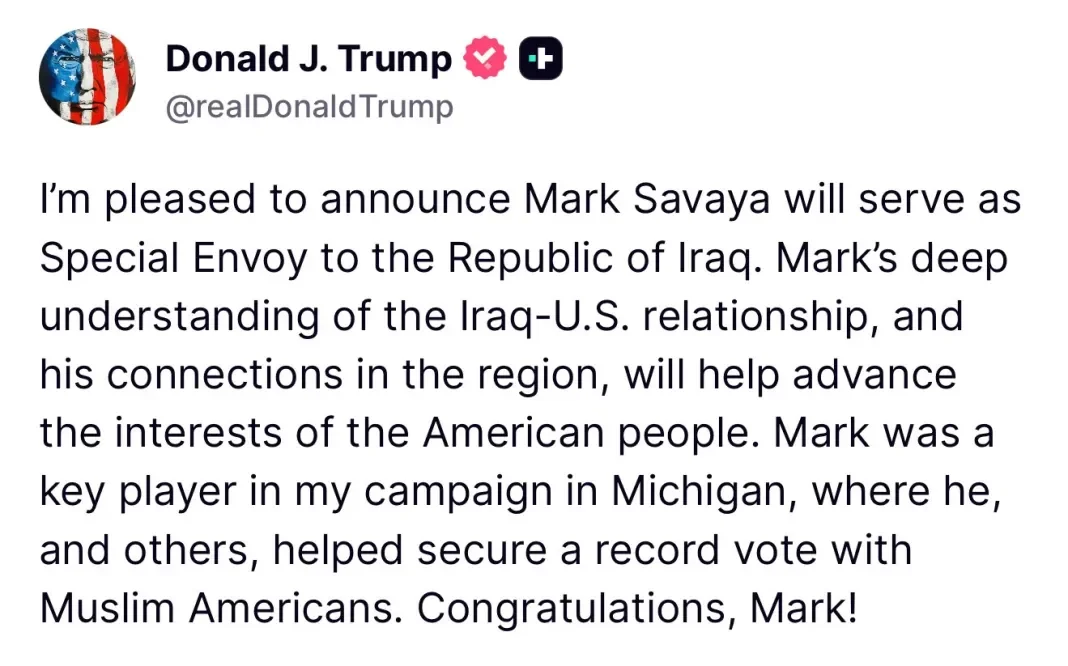
The appointment of Iraqi Chaldean Mark Savaya as US President Donald Trump's special envoy to Iraq has generated considerable interest in Iraq, with attempts to understand the US move and the background of this man, known for his closeness to Trump.
However, Savaya now assumes a sensitive position, handling the Iraqi file, despite having never held any official position, either at the state or federal levels.
Mark Savaya is the third US envoy to Iraq, since Paul Bremer in 2003, and after Brett McGurk during the war against ISIS in 2014.
KTFA:
Clare: The "third envoy" to Baghdad: Trump remained in Iraq to play a decisive role.
10/20/2025
The appointment of Iraqi Chaldean Mark Savaya as US President Donald Trump's special envoy to Iraq has generated considerable interest in Iraq, with attempts to understand the US move and the background of this man, known for his closeness to Trump.
However, Savaya now assumes a sensitive position, handling the Iraqi file, despite having never held any official position, either at the state or federal levels.
Mark Savaya is the third US envoy to Iraq, since Paul Bremer in 2003, and after Brett McGurk during the war against ISIS in 2014.
Mark Savaya appears to straddle the worlds of business and politics. His Instagram account, which has over 94,000 followers, features numerous photos of him with Trump, reflecting the personal side of their relationship, including in the White House and other locations, as well as photos of him with numerous prominent political, media, and entertainment figures.
Savaya commented on Trump's appointment as Special Envoy to Iraq in an Instagram post, saying: "I am deeply humbled, honored, and grateful to President Donald Trump for appointing me as Special Envoy to the Republic of Iraq. I am committed to strengthening the US-Iraq partnership under President Trump's leadership and guidance. Thank you, Mr. President. I will work to build bridges of trust and cooperation to achieve sustainable security in Iraq and the region."
Savaya was known for his active involvement in Michigan, demonstrating his ability to influence the masses, particularly in non-traditional communities, which led him to play a pivotal role in increasing voting rates among Michigan's Arab and Muslim communities to record highs.
Savaya is considered a member of the influential MAGA (Make America Great Again) movement, which is believed to have played a key role in Trump's rise and subsequent successful return to the White House, and which includes a diverse group of media figures, politicians, and influential activists.
According to his LinkedIn page, Savaya, a Michigan resident, has no government experience at the local, state, or federal level. He is an active businessman in the Detroit area, where he founded a marijuana retail chain called Leaf & Bud, which sells medical and recreational marijuana. According to The Independent, the company was criticized by Detroit leaders for its bold billboards that promoted the slogan: "Come and get it. Free weed."
However, Trump expressed his great confidence in Savaya's career, saying that he "possesses a deep understanding of regional relations and has direct contact with Iraqi communities, which makes his appointment an important step in advancing America's interests in the Middle East." He added, "We are confident in Mark's ability to advance our agenda and protect our interests in Iraq, especially during this critical period."
The Independent noted that Savaya's Leaf & Pad company conducted an extensive marketing campaign on Detroit roads, prompting city leaders to issue an ordinance restricting such advertising.
According to Reddit, two Liv & Bud branches have closed since January, leaving only three brick-and-mortar stores listed on the company's website. According to The Independent, the website has been updated to remove references to Savaya himself, including "The Mark Savaya Collection."
But Savaya's statement from 2020 says, "It's good to produce cannabis from seed and sell it. It's a process we go through instead of buying it from a different cultivation center. We make it ourselves, and we want to make sure it's a clean product, and that everything we do is monitored."
The Independent noted that it contacted Leaf & Bud to try to confirm Savaya's current role at the company, which had previously identified him on its website as the "visionary" behind the natural cannabis retail chain that marketed itself with the slogan "Come and get it. Free weed."
Trump is known for his personal opposition to drug use, but he has softened his stance in recent years. He supported Florida's referendum to legalize recreational marijuana in 2024, and during his campaign, he called for the execution of drug traffickers. In 2019, he praised China for its use of the death penalty in some serious drug-related cases, and he recently ordered airstrikes targeting boats in the Caribbean, allegedly smuggling drugs. This drew widespread criticism, as the strikes were deemed illegal.
However, Israeli Elizabeth Tzurkov, who was kidnapped in Iraq for more than two years, wrote on the X platform, "I congratulate Mark Savaya on this important appointment. Mark played a pivotal role in freeing me after 903 days of captivity by Kataib Hezbollah, an Iraqi militia working for Iran, without any compensation. This is very bad news for everyone who serves Iran's interests in Iraq and seeks to undermine Iraqi sovereignty."
"This is impossible. He is strongly opposed to the militias," Tsurkov said in response to a comment from an X user who expressed concern that pro-Iranian militias might try to manipulate Savaya. LINK
************
Ariel: Understanding the Implications of this
10-20-2025
We Need To Understand The Implications Of This:
What did Donald Trump mean when he said Mark will advance the Interest of the American people in a foreign country?
What happened a few days ago?
Didn’t Iraqi banks fall under Rafidain Bank and are now subject to the authority of the U.S. Treasury?
What recently happened with their oil a couple of days ago?
Courtesy of Dinar Guru: https://www.dinarguru.com/
Frank26 The only way you're going to see the HCL is if they use the new exchange rate. That's why they told you they're lifting the 3 zeros. You got the new exchange rate and you got the HCL we just need the damn laws...You're about to see a different...value added to your currency which will allow the HCL to be calculated properly and then give the citizens of Iraq a decent oil and gas rights payment to them. At 1310 all they were going to give them was a few pennies. We're walking on very thin ice and at any moment I believe in my heart it's going to crack and put us right through into the monetary reform purchasing power for the citizens and our blessing, our profit.
Jeff They're talking to us out of both sides of their mouth. From one side they keep announcing all the brand new wonderful stuff they're doing/have done, letting us know the rate is about to change. But from the other side of their mouth they won't tell us anything about the budget schedules. They keep hiding that from us.
*****************
"I Believe the Market Top May Be In" Got Gold & Silver?
Mike Maloney: 10-20-2025
Are we seeing the top of the markets now?
In this urgent episode of The Gold Silver Show, Mike Maloney & Alan Hibbard break down why they believe the highest highs may already be behind us—and how gold & silver could become lifeboats in the coming storm.
What you’ll get in this video
• Why the standoff between Trump and Xi could trigger a market collapse
• The importance of real assets when central banks lose control
• How China may secretly own far more gold than reported
• A powerful gold–silver ratio strategy to multiply your gold
• Lessons from Rome: how empires collapse when currencies are debased
The Case For Sound Money: The Most Meaningful 5 Minutes I've Ever Recorded | Judy Shelton
The Case For Sound Money: The Most Meaningful 5 Minutes I've Ever Recorded | Judy Shelton
Adam Taggert/Thoughtful Money: 10-20-2025
Here, former Federal Reserve nominee Judy Shelton makes the most compelling constitutional & moral argument for sound money I've ever heard
I promise it will be the most meaningful 5 minutes you've seen in ages.
The Case For Sound Money: The Most Meaningful 5 Minutes I've Ever Recorded | Judy Shelton
Adam Taggert/Thoughtful Money: 10-20-2025
Here, former Federal Reserve nominee Judy Shelton makes the most compelling constitutional & moral argument for sound money I've ever heard
I promise it will be the most meaningful 5 minutes you've seen in ages.
Seeds of Wisdom RV and Economics Updates Monday Afternoon 10-20-25
Good Afternoon Dinar Recaps,
When Innovation Meets Control: China’s Pause on Hong Kong Stablecoins
Ant Group and JD.com halt plans after Beijing asserts monetary authority.
Overview
Two of China’s biggest tech giants — Ant Group and JD.com — have paused their plans to issue stablecoins in Hong Kong, following quiet guidance from Beijing regulators. The decision underscores growing tension between China’s drive for digital innovation and its insistence on state control over currency.
Good Afternoon Dinar Recaps,
When Innovation Meets Control: China’s Pause on Hong Kong Stablecoins
Ant Group and JD.com halt plans after Beijing asserts monetary authority.
Overview
Two of China’s biggest tech giants — Ant Group and JD.com — have paused their plans to issue stablecoins in Hong Kong, following quiet guidance from Beijing regulators. The decision underscores growing tension between China’s drive for digital innovation and its insistence on state control over currency.
According to the Financial Times, both firms received instructions from the People’s Bank of China (PBoC) and the Cyberspace Administration of China (CAC) to suspend their Hong Kong initiatives. The question, said one source, is simple but fundamental: “Who has the right to issue money — the central bank or private firms?”
The Setback for Hong Kong’s Fintech Ambitions
Hong Kong launched its stablecoin licensing regime in August to attract Web3 and tokenization projects. Initially, mainland officials saw it as an opening to promote renminbi-pegged tokens and boost the yuan’s international use.
But enthusiasm cooled fast. Regulators in Beijing reportedly grew uneasy as some stablecoin ventures posted double-digit losses shortly after the rules took effect. China’s securities watchdog then instructed several brokerages to pause real-world asset tokenization as well — another signal that the central government is tightening oversight of digital-asset experiments.
Why It Matters
This pause reveals three critical themes shaping the region’s financial future:
Monetary Sovereignty: Beijing’s priority is clear — control over money creation must stay with the state. Private stablecoins could blur that line and compete with the digital yuan (e-CNY).
Testing the Limits of Hong Kong’s Autonomy: While Hong Kong markets itself as Asia’s Web3 hub, this episode shows how quickly mainland policy can override its local fintech initiatives.
Signal to Global Markets: China’s stance adds to a broader global shift where governments seek tighter reins on privately issued digital money, balancing innovation with systemic risk.
The Bigger Picture
China is not retreating from digital finance — it’s redefining who leads it. The pause on stablecoins doesn’t end tokenization efforts but re-centers them under state-linked or bank-controlled entities, keeping fintech aligned with national strategy.
For global investors, it’s a reminder that in modern finance, innovation operates within political boundaries.
This is not just politics — it’s global finance restructuring before our eyes.
Seeds of Wisdom Team
Newshounds News™ Exclusive
Sources
~~~~~~~~~
Global Financial Order Under Strain as Geopolitical Fragmentation Deepens
The end of postwar financial integration may be closer than expected.
A Fracturing Monetary Landscape
A new report from the Centre for Economic Policy Research (CEPR), the 28th Geneva Report on the World Economy, warns that rising geopolitical tensions are eroding the foundations of the global financial system that has existed since World War II.
According to the report, strategic competition—particularly between the West and China—combined with sanctions and protectionist measures is accelerating international financial fragmentation.
This fragmentation marks a departure from the decades-long era of liberalized, rules-based globalization that once defined international finance.
From Integration to Geoeconomic Fragmentation
The authors of the Geneva Report argue that the “deep global financial integration without regard to geopolitics” that characterized the postwar era is being replaced by a period of “geoeconomic fragmentation.”
This transition is visible in three key areas:
Capital Flows: Investments are increasingly concentrated within geopolitical blocs, reducing global allocative efficiency.
Crisis Response: Coordination among major economies has weakened, limiting joint responses to shocks such as banking crises or currency volatility.
Policy Divergence: Sanctions, reshoring, and “friend-shoring” are reshaping both trade and financial networks.
Why This Matters
The implications reach far beyond finance:
For businesses, the rise in geopolitical barriers means greater uncertainty in global supply chains, volatile exchange rates, and tighter cross-border investment conditions.
For governments, fragmentation introduces instability into crisis management and capital allocation, increasing the risk of systemic shocks.
For emerging markets, the challenge is most acute — nations may face pressure to align with specific blocs or risk exclusion from capital access and payment systems.
What to Watch
Alternative Payment Systems: Will BRICS and other regional blocs develop competing financial infrastructures to the U.S. dollar system?
Alliance Consolidation vs. Openness: Do states double down on bloc-based cooperation or attempt to sustain a degree of global openness?
Emerging Market Realignment: How developing economies navigate these rival frameworks may shape the next decade of financial globalization.
Seeds of Wisdom Team
Newshounds News™ Exclusive
Source
~~~~~~~~
Seeds of Wisdom Team RV Currency Facts Youtube and Rumble
Newshound's News Telegram Room Link
Follow the Gold/Silver Rate COMEX
Follow Fast Facts
Seeds of Wisdom Team™ Website
Thank you Dinar Recaps
With The Rise Of The Chinese Yuan And Local Currency Settlements, Can Iraq Dispense With The Dollar?
With The Rise Of The Chinese Yuan And Local Currency Settlements, Can Iraq Dispense With The Dollar?
Monetary Dependence Economy / Arab and International / Special Files Yesterday, 4:06 PM | 872 Baghdad Today – Baghdad The modern Iraqi economy was formed on the basis of a single-source oil rent, entirely dependent on the sale of crude oil and the settlement of revenues in US dollars.
This pattern made Iraqi monetary policy directly dependent on the US financial system, with revenues deposited in accounts at the Federal Reserve Bank of New York and managed according to international regulatory arrangements linked to financial compliance and anti-money laundering programs.
With The Rise Of The Chinese Yuan And Local Currency Settlements, Can Iraq Dispense With The Dollar?
Monetary Dependence Economy / Arab and International / Special Files Yesterday, 4:06 PM | 872 Baghdad Today – Baghdad The modern Iraqi economy was formed on the basis of a single-source oil rent, entirely dependent on the sale of crude oil and the settlement of revenues in US dollars.
This pattern made Iraqi monetary policy directly dependent on the US financial system, with revenues deposited in accounts at the Federal Reserve Bank of New York and managed according to international regulatory arrangements linked to financial compliance and anti-money laundering programs.
According to economic studies issued by the World Bank and the International Monetary Fund, approximately 90 to 95 percent of Iraq's public revenues come from oil, making any fluctuation in the dollar or a decline in global demand for oil a a direct threat to liquidity and the general budget.
Financial economists point out that the Central Bank of Iraq does not have absolute freedom to manage its reserves, as most of its transactions are restricted to US transfer networks, and the global SWIFT system closely monitors financial transfers, preventing any parallel transactions outside the dollar system.
According to recent academic estimates, excessive reliance on the dollar has created a distorted import environment, with the Iraqi market tending toward consuming foreign goods without boosting domestic production.
This has deepened economic exposure and tied the domestic financial cycle to fluctuations in US monetary policy.
In contrast, China has been working for more than a decade to build a parallel financial system that would challenge the dollar's dominance, by expanding the use of the yuan in international trade and establishing alternative financial institutions such as the new Asian Development Bank and the China Payments System (CIPS).
In 2023, Beijing announced that more than 52.9 percent of its cross-border transactions were settled in yuan, surpassing the dollar for the first time in modern history.
While this percentage reflects a gradual shift rather than a sudden reversal, it points to a fundamental shift in the balance of global financial influence.
International economics researchers believe that China's agreement with Australian company BHP to settle iron ore trade in yuan represents a pivotal moment in the history of global trade, as it removes one of the world's most traded commodities from the dollar.
This move, along with a series of similar agreements with other countries, most notably Russia and Saudi Arabia, indicates that the yuan is beginning to transform from a local currency into a strategic settlement tool in the international trade system.
Beijing has also relied on comprehensive institutional tools to bolster market confidence in the yuan, such as linking the currency to a strong gold reserve system and ensuring its stability through prudent monetary policies.
This has made it an increasingly attractive option for countries seeking alternatives to the dollar amid crises of US sanctions and restrictions.
Iraq's Position In The Transformation Equation
Although Iraq was one of the first oil-producing countries to open up trade to China, its position in the global monetary transition remains extremely weak. Baghdad's banking structure remains traditional and relies almost entirely on dollar transfers via the US system.
Economic researcher Othman Karim confirmed to Baghdad Today that the idea of abandoning the dollar "is illogical at the present time," noting that Iraq "sells oil and receives revenues through the US Federal Reserve, and currently has no realistic mechanism for settling its transactions in another currency."
He adds that the shift to the yuan requires "a radical change in monetary policy, the signing of direct banking agreements with China, and the development of intermediary electronic payment tools that can bypass US restrictions."
According to economists, the challenge in Iraq is twofold: technical, related to the absence of an independent financial transfer structure, and political, related to US pressure and Iraq's close ties to the Western system for managing its finances.
Trade with China, despite its size, remains settled in dollars, as Iraqi companies do not have accredited accounts with Chinese banks.
Analysts believe that any serious attempt to transition to the yuan requires profound institutional reform of the central bank, enhanced financial transparency, and the establishment of a dual reserve in yuan and gold as a preliminary step toward monetary diversification.
While it is difficult to completely sever the link to the dollar, some experts do not rule out a partial move toward monetary diversification, through limited agreements with China to settle a portion of non-oil imports in yuan.
Given China's increasing openness to the Middle East and its signing of yuan-denominated settlement agreements with Saudi Arabia and the UAE, Iraq could consider establishing a trade barter mechanism under which it would import Chinese goods in exchange for oil exports, without having to use the dollar.
Some monetary researchers also suggest that Baghdad begin allocating a portion of its foreign exchange reserves in yuan, as a symbolic step to expand financial diversification, while developing banking agreements with the People's Bank of China to facilitate direct transfers.
However, these paths remain subject to complex political factors, most notably the relationship with Washington and the fear that any move toward China could be interpreted as a step toward an anti-Western geopolitical axis.
Ultimately, economic analysis shows that completely eliminating the dollar in Iraq is not possible in the short or medium term, but it remains a long-term strategic goal in light of global changes.
Iraq, as a dependent rentier economy, needs to first build its production and commercial independence before considering monetary independence.
While the rise of the yuan opens a window for rebalancing the international financial system, it does not negate the fact that the dollar still holds the deepest and most widespread structure.
Therefore, in the coming period, Iraq will remain governed by the duality of monetary and political power: adopting the dollar as the primary currency for governing the state, while closely monitoring the transformations taking place in the East, where China is rewriting the equation of global financial influence, step by step . https://baghdadtoday.news/285422-.html