
Podcast: Even at $4,000 Gold the Miners Are Ridiculously Cheap
Podcast: Even at $4,000 Gold the Miners Are Ridiculously Cheap
Notes From ther Field By James Hickman (Simon Black) October 8, 2025
Yesterday we wrote that with gold topping $4,000, it’s time to step back and look at the big picture—and the fundamentals haven’t changed.
Foreign governments and central banks hold about $10 trillion in US denominated reserves. But for years they’ve been trading this paper for gold— because it is their only realistic alternative.
Podcast: Even at $4,000 Gold the Miners Are Ridiculously Cheap
Notes From ther Field By James Hickman (Simon Black) October 8, 2025
Yesterday we wrote that with gold topping $4,000, it’s time to step back and look at the big picture—and the fundamentals haven’t changed.
Foreign governments and central banks hold about $10 trillion in US denominated reserves. But for years they’ve been trading this paper for gold— because it is their only realistic alternative.
Why are they searching for an alternative? Because they are losing confidence in the US government.
The debt, the political dysfunction, the weaponization of the dollar— these all make them less excited about loaning money to the US government.
And their steady buying of gold is what pushed it to these levels.
Those catalysts have not gone away, and if anything, are stronger than ever.
When a few hundred billion in demand can double the price of gold, imagine what happens if even a small portion of the remaining trillions rotate into gold.
Does 5% of dollar reserves shifting into gold translate to $10,000 gold? 20% re-allocation to $20,000 per ounce?
We don’t know exactly, but these numbers are not fantastical. There’s still enormous room for upside.
In the short term, of course, we can see plenty of noise.
Markets respond to headlines—like the new prime minister of Japan openly calling for more money-printing. Any environment like that naturally drives gold higher.
But at the same time, we’re seeing signals that a correction could be near—a stampede of new individual investors, record inflows into large gold ETFs, and a drop off in jewelry sales.
There are some classic signs of a short-term top.
But we don’t focus on short term trading. We always look at the long term big picture. And the long-term trend remains solidly intact.
So does the most important story of all right now: the much ignored mining sector.
Even after a massive run, many gold miners are still deeply undervalued relative to the long-term intrinsic value of their businesses.
One company featured in our premium investment research is up 5x in the past year. Yet even if gold fell back to $3,000, it would still be turning enough profit to trade at just four times earnings.
It’s debt-free. It pays a dividend. And it offers massive downside protection.
So while no one has a crystal ball—and we can’t tell you what happens tomorrow—the reality is that the mining, drilling, and service companies behind this bull market remain absurdly cheap.
That’s an opportunity to take seriously.
We dug into all of this in our latest podcast which you can listen to here.
For the audio-only version, check out our online post here.
Finally, you can find the podcast transcript for your convenience, here.
To your freedom, James Hickman Co-Founder, Schiff Sovereign LLC
More Money, Literally More Problems: Unique Estate Planning Concerns for the Ultra Wealthy
More Money, Literally More Problems: Unique Estate Planning Concerns for the Ultra Wealthy
Patrick Villanova, CEPF® Thu, September 21, 2023
In the realm of personal finance, estate planning stands as a paramount consideration for those who have amassed substantial wealth. For ultra-high-net-worth individuals – people with over $30 million in investable assets – the complexities and implications of legacy planning become even more pronounced. While it’s often tempting to delay such discussions, proactively managing your wealth’s future distribution is essential to ensure a seamless transition for your beneficiaries. A financial advisor may be able to help you manage your wealth and create an estate plan tailored to your needs.
More Money, Literally More Problems: Unique Estate Planning Concerns for the Ultra Wealthy
Patrick Villanova, CEPF® Thu, September 21, 2023
In the realm of personal finance, estate planning stands as a paramount consideration for those who have amassed substantial wealth. For ultra-high-net-worth individuals – people with over $30 million in investable assets – the complexities and implications of legacy planning become even more pronounced. While it’s often tempting to delay such discussions, proactively managing your wealth’s future distribution is essential to ensure a seamless transition for your beneficiaries. A financial advisor may be able to help you manage your wealth and create an estate plan tailored to your needs.
Importance of Proper Estate Planning
Estate planning is a powerful gear in the engine of wealth management and preservation. It establishes mechanisms like trusts, which cater not only to the future needs of heirs but also ensure your assets are distributed according to your wishes. A well-drafted plan clearly outlines the distribution of assets, minimizing the chance of disputes and legal battles. This not only preserves family relationships but also reduces stress during an already challenging time.
Without precise planning, heirs could also face taxing burdens and legal puzzles that can whittle down the value of their inheritance.
Additionally, estate planning offers a chance to express one’s healthcare preferences through documents like living wills and medical powers of attorney. These documents ensure that an individual’s medical wishes are respected, even when they are unable to communicate their desires.
Unique Estate Planning Concerns for the Wealthy
If you’re ultra-wealthy, the complexity of your wealth demands a more intricate plan than what the average person or even high-net-worth individual may require.
Ultra-high-net-worth individuals often possess wealth that spans multiple generations. Ensuring this wealth endures and thrives requires strategic estate planning. Structures like family limited partnerships (FLPs) and generation-skipping trusts can be employed to efficiently pass assets to grandchildren, avoiding excessive taxation while maintaining family control over assets.
Many affluent individuals also hold a deep commitment to philanthropy. Establishing charitable foundations or trusts can allow you to leave a lasting impact on causes dear to your heart.
Collections of art, rare cars or other unique assets may require special attention. Estate planning must account for their valuation, distribution and potential capital gains implications. Proper planning can ensure these assets are handled with care and integrated into the overall estate plan, underling the importance of this process.
Tip #1: Save By Gifting
Rather than being just a kind gesture, gifting is a proven strategy that enables you to transfer wealth during your lifetime, reducing the size of your estate and potential estate tax. In 2023, the IRS permits you to gift up to $17,000 ($34,000 for married couples) to as many people as you want per year. Individual gifts that exceed this annual limit count against your lifetime gift and estate tax exemption, which stands at $12.92 million in 2023.
Estates larger than $12.92 million are subject to the federal estate tax, which ranges from 18% to 40%. While the average estate won’t be subject to this tax, the estates of the ultra-wealthy often are, underscoring the importance of strategic gifting.
TO READ MORE: https://finance.yahoo.com/news/more-money-literally-more-problems-135446685.html
This Is the Top Reason You Go Broke After the Holidays
This Is the Top Reason You Go Broke After the Holidays
Cindy Lamothe Tue, October 7, 2025 GOBankingRates
The holidays have a way of sneaking up on your budget. Between shopping for the perfect gifts, splurging on fancy dinners, decorating the house and booking last-minute travel, it all feels justified in the spirit of celebration.
But then January rolls around, the glitter fades and suddenly your bank account looks a little scarier than the holiday credit card bill itself. According to CNBC, Americans are “wired” to overspend during the holidays.
This Is the Top Reason You Go Broke After the Holidays
Cindy Lamothe Tue, October 7, 2025 GOBankingRates
The holidays have a way of sneaking up on your budget. Between shopping for the perfect gifts, splurging on fancy dinners, decorating the house and booking last-minute travel, it all feels justified in the spirit of celebration.
But then January rolls around, the glitter fades and suddenly your bank account looks a little scarier than the holiday credit card bill itself. According to CNBC, Americans are “wired” to overspend during the holidays.
If you’ve ever wondered why it feels so easy to go broke right after the holidays, you’re not alone. And while overspending on gifts plays a role, there’s another factor that harms your finances — and it might not be what you expect.
Credit Card Minimum Payments Eat Up Your Budget
If you’re paying for lots of holiday costs with credit cards, that could catch up with your budget come January. That could be especially the case if you’re making only minimum payments.
The spending feels fun in the moment, according to Ashley Akin, CPA, a tax consultant specializing in tax compliance services and senior contributor at CEP DC, but when the bills arrive in January, reality sets in.
“People often underestimate how fast interest adds up and how much of their monthly budget gets eaten by minimum payments,” he said.
What felt like a few extra gifts or one big trip can take months to pay off.
It’s Not Just About the Balance
Akin noted that the financial wreck happens because credit card debt is not just about the balance. “It pushes other expenses aside, creates stress and makes it harder to save,” she said.
If a family is already stretched thin, those extra bills can trigger late fees, overdrafts or borrowing from one card to pay another. That cycle is what breaks budgets.
The Way Out Starts Before the Season
TO READ MORE: https://www.yahoo.com/lifestyle/articles/top-reason-broke-holidays-124807296.html
10 Genius Things Warren Buffett Says To Do With Your Money
10 Genius Things Warren Buffett Says To Do With Your Money
September 21, 2025 by Elyssa Kirkham
Warren Buffett is commonly referred to as the most prophetic and respected investor of all time. He is also known for his folksy charm and memorable quotes about the art of investing. As the “Oracle of Ohama” has an estimated net worth of around $150 billion, the proof is in the pudding.
10 Genius Things Warren Buffett Says To Do With Your Money
September 21, 2025 by Elyssa Kirkham
Warren Buffett is commonly referred to as the most prophetic and respected investor of all time. He is also known for his folksy charm and memorable quotes about the art of investing. As the “Oracle of Ohama” has an estimated net worth of around $150 billion, the proof is in the pudding.
When you’re aiming to reach the top of the mountain and want a competitive advantage, it’s usually wise to follow the footprints of those who have successfully made the climb before you, to the tune of billions of dollars. Your odds of investing success can increase exponentially if you learn and apply Buffett’s best investing tips.
Never Lose Money
One of the most popular pieces of Buffett advice is as follows: “Rule No. 1: Never lose money. Rule No. 2: Never forget rule No. 1.” If you’re working from a loss, it’s that much harder to get back to where you started, let alone to earn gains.
Get High Value at a Low Price
Another key principle Buffett has shared is, “Price is what you pay; value is what you get.” Losing money can happen when you pay a price that doesn’t match the value you get — such as when you pay high interest on credit card debt or spend on items you’ll rarely use.
Instead, live modestly, or in the case of stocks Buffett recommends when approaching your investment strategy, start by looking for opportunities to get more value at a lower price. “Whether we’re talking about socks or stocks, I like buying quality merchandise when it is marked down,” he wrote.
Form Healthy Money Habits
In an address at the University of Florida, Buffett said, “Most behavior is habitual, and they say that the chains of habit are too light to be felt until they are too heavy to be broken.” Work on building positive money habits — and breaking those that hurt your wallet.
Avoid Debt, Especially Credit Card Debt
Buffett built his wealth by getting interest to work for him — instead of working to pay interest, as many Americans do. “I’ve seen more people fail because of liquor and leverage — leverage being borrowed money,” Buffett said in a 1991 speech at the University of Notre Dame. “You really don’t need leverage in this world much. If you’re smart, you’re going to make a lot of money without borrowing.”
Buffett is especially wary of credit cards. His advice is to avoid them altogether. “Interest rates are very high on credit cards,” Buffett once said. “Sometimes they are 18%. Sometimes they are 20%. If I borrowed money at 18% or 20%, I’d be broke.”
Keep Cash on Hand
TO READ MORE: https://www.gobankingrates.com/money/financial-planning/10-best-money-tips-warren-buffett-all-time/?hyperlink_type=manual
$4,000 Gold: Is It Time To Sell?
$4,000 Gold: Is It Time To Sell?
Notes From the Field By James Hickman (Simon Black) October 7, 2025
You’d think Charles de Gaulle would have been a little bit more grateful to America.
As head of the Free French Forces during World War II, de Gaulle was essentially a leader in exile, and he had to base himself in England for the majority of the war after the Nazis took Paris.
It was only because of the sacrifices made by American troops-- and exceptional generosity from US general Dwight Eisenhower-- that de Gaulle was allowed to enter Paris on August 25, 1944.
$4,000 Gold: Is It Time To Sell?
Notes From the Field By James Hickman (Simon Black) October 7, 2025
You’d think Charles de Gaulle would have been a little bit more grateful to America.
As head of the Free French Forces during World War II, de Gaulle was essentially a leader in exile, and he had to base himself in England for the majority of the war after the Nazis took Paris.
It was only because of the sacrifices made by American troops-- and exceptional generosity from US general Dwight Eisenhower-- that de Gaulle was allowed to enter Paris on August 25, 1944.

America had already done all the fighting. But de Gaulle marched through the streets in triumph as if he had personally won the war.
The US government then went on to cement his power, so de Gaulle became head of France’s post-war provisional government, then later French president. France also received billions in aid from the Marshall Plan, courtesy of US taxpayers.
The guy pretty much owed his entire political career, not to mention the liberation and economic solvency of his country, to the United States.
But de Gaulle’s ego was far greater than his sense of gratitude; in fact in his own memoirs he compared himself to Joanne of Arc. He even whined that he didn’t receive enough US support.
The ultimate disrespect came on February 4, 1965. De Gaulle called a press conference to criticize America’s “exorbitant privilege” in global finance, concluding that the world needed to return to a classical gold standard.
Ever since July of 1944, the world had been on the “Bretton Woods” system. Every currency was pegged to the US dollar, and the US dollar was pegged to gold at a price of $35 per ounce.
Having the global reserve currency meant that America could finance its government deficits by simply printing more money. This is still the case today. De Gaulle was jealous of this benefit, so he tried wrecking the financial system.
In addition to demanding a return to the classical gold standard, de Gaulle also insisted that the US government redeem France’s dollar reserves for gold.
The idea caught on. Governments around the world, along with financial speculators and investors, started paying attention… and many began trading their dollars for gold as well.
This trend picked up steam over the next several years until, finally, in 1971, Richard Nixon shut it down… announcing that the United States would no longer redeem US dollars for gold.
The gold price naturally started to rise. Within a few months, gold was already above $40, up 13.5%. It reached $60 in 1972 (up 42%), nearly $100 in 1973 (up 66%), and $180 in 1974 (up 80%).
It’s not hard to understand why. Inflation was soaring. The world was a geopolitical hot mess. Then there was the Nixon political scandal at home. Uncertainty abounded, and gold was the remedy.
But then something interesting happened: Congress passed a law finally allowing private ownership of gold.
It seems crazy today, but ever since 1933, it had actually been illegal for Americans to own gold. Congress reversed this in 1974.
So just imagine you’re an average American in the 1970s watching gold rise more than 5x, from $35 to $180… but you can’t do anything about it because it’s illegal to buy. Then suddenly the law changes. Almost overnight, US investors started aggressively investing in gold.
Back then, of course, people didn’t have brokerage accounts, let alone access to futures exchanges. And there were no ETFs.
So instead people bought physical gold coins-- Krugerrands, Eagles, etc. And there was booming demand for a while.
But right around this time, large investors, hedge funds, etc. started feeling like gold was overbought… and that the price had risen too far, too fast. So they started selling. In fact many funds were selling as small retail investors were buying.
And as you can imagine, the gold price soon started to fall; in fact the correction lasted roughly 18 months. Gold eventually hit a low of ~$100 in August 1976-- a drop of more than 40% from its record high in 1975.
Yet even though speculators were selling, the fundamentals of gold had not changed.
Specifically, foreign governments and central banks were still seeking to diversify from their US dollar holdings. And more importantly, the US government financial condition was still atrocious.
So after an 18-month hiatus, the gold price started rising again in August 1976… from ~$100 to $800+ in December 1979.
So even though gold had reached a record high in 1974, people who understood the long-term fundamentals, i.e. why the gold price was going higher, saw an additional 4x return. People that were smart enough to buy more when the price fell did even better-- 8x in less than four years.
And people who sold their gold in 1975 missed the rise from $185 to $850.
Gold just hit $4,000 today. It’s up more than 50% in a year, and up 100% in two years. So is it time to sell?
In our view, this is like 1975 again. Gold may be overbought now; after all, nothing is supposed to go up (or down) in a straight line.
We’re also seeing interesting data from ETFs. The “GLD”, for example, the world’s largest gold ETF, is seeing record inflows, including more than $2 billion in a single day last month.
This is a sign that, just like 1975, individual investors are piling in to gold after sitting on the sidelines for the past few years.
Strong, sudden retail demand is often a top signal, at least temporarily. And it’s possible that there could be a short-term correction.
But even if that happens, it doesn’t change the fundamental story of gold. Just like the 1970s, foreign governments and central banks today are aggressively diversifying their US dollar holdings, and gold is the most convenient asset for them to buy.
We don’t believe this has changed at all. Foreign governments and central banks might pull back on their purchases temporarily to see what happens in the market. But long-term they are still strong buyers of gold thanks to the US government’s terrible fiscal trajectory.
And despite any short-term corrections, this is what will ultimately drive gold prices higher over the next several years.
To your freedom, James Hickman Co-Founder, Schiff Sovereign LLC
Where Should Americans Keep Cash Now That The Fed Is Cutting Rates?
Where Should Americans Keep Cash Now That The Fed Is Cutting Rates? The answer is a lot simpler than you think
Vishesh Raisinghani Sat, October 4, 2025 Moneywise
In September, the Federal Reserve Open Market Committee delivered a long-anticipated cut to the federal funds rate. The benchmark interest rate is now in the range of 4%-4.25%. The board also signalled further rate cuts ahead, and the market now expects the rate to drop as low as 3.25%-3.50% by 2026, according to Morningstar. [1]
Where Should Americans Keep Cash Now That The Fed Is Cutting Rates? The answer is a lot simpler than you think
Vishesh Raisinghani Sat, October 4, 2025 Moneywise
In September, the Federal Reserve Open Market Committee delivered a long-anticipated cut to the federal funds rate. The benchmark interest rate is now in the range of 4%-4.25%. The board also signaled further rate cuts ahead, and the market now expects the rate to drop as low as 3.25%-3.50% by 2026, according to Morningstar. [1]
Simply put, we’ve entered an easing cycle which should benefit borrowers across the country. But if you’re a saver or lender, these rate cuts mark the end of an exceptionally lucrative era. If you’re a retiree or someone living off passive income, it may no longer be easy to generate high returns.
However, the simple truth is that you should probably keep cash in the same places you should have kept them before. Your emergency fund and other savings that you want easy access to should always be kept in safe, low-risk, liquid assets. Money that you won’t need in the short-term can go towards long-term investments that earn higher returns, like stocks.
If you haven't been optimizing your savings based on your needs, there are a wealth of options beyond simple savings accounts worth investigating for higher rates.
As of October 2, it’s still possible to get a 5% yield on a high-yield savings account at some online banks like AdelFi and Varo. This is an attractive yield for any cash you need to park temporarily, but the rate could decline if the Fed continues to cut rates.
If you’re looking for attractive interest rates for your cash savings, here are some other assets you should consider.
TO READ MORE: https://www.yahoo.com/finance/news/where-americans-keep-cash-now-123000264.html
11 Overlooked Risks That Could Ruin Your Financial Stability
11 Overlooked Risks That Could Ruin Your Financial Stability
By Claire Conway Jun-12-2024
Financial pitfalls can throw a monkey wrench into even the most responsible person, which is why everyone should be aware of hidden threats that can derail your financial security. People reveal what unexpected life changes can turn your life upside down. Have you experienced any of these hidden financial threats?
11 Overlooked Risks That Could Ruin Your Financial Stability
By Claire Conway Jun-12-2024
Financial pitfalls can throw a monkey wrench into even the most responsible person, which is why everyone should be aware of hidden threats that can derail your financial security. People reveal what unexpected life changes can turn your life upside down. Have you experienced any of these hidden financial threats?
1. All Homeowner-related Expenses
Where do I begin? Owning a home comes with endless potential repairs, from heat and water pumps to air conditioning, flooring, and roof repairs (and everything in between). Although owning a home is a significant life milestone, even the most frugal homeowner confesses that the expenses quickly pile up and easily turn a secure financial situation upside-down.
2. Missing a Credit Card Payment
In school, you learn about world history, calculus, and home economics, but you aren’t taught one of the most important life lessons: Paying your credit card payments on time. One of the most severe financial penalties you can face is failing to make the minimum monthly payment on your debt, causing interest rates to spike and your credit score to plummet. For many Americans, missing a credit card payment is catastrophic.
3. Car Loans
If you’re ever applying for an auto loan, always focus on the out-the-door cost of the vehicle you want to buy. The dealership will always push you toward lowering your monthly payment, even if there are better ways to navigate the loan. The longer your loan is, the more you’ll pay in the long run for your vehicle. Don’t fall for the “lower monthly payment” trick because it will cost you far more money in the end.
4. Losing Your Job
Nobody plans on ever losing their job, but sometimes, the unexpected happens. Getting laid off greatly affects your income, but nobody ever plans for it. After all, we misguidedly believe it will never happen to us. But trust me, your life can change in the blink of an eye when your “steady income” is suddenly ripped away! Obviously, an emergency fund is handy in times of unemployment, but that’s another aspect of financial wellness that many people underestimate.
5. Your Spouse’s Pension Ending
Unfortunately for married people, when one person passes away, their financial benefits cease to exist as well. One woman specializing in finding work for older Americans knows how hard it can be. “I’ve seen firsthand too often when the husband dies, the pension stopped,” one woman attests. “It sucked helping older women find jobs, especially when they had no experience in any job. We had to provide training in soft skills, too, like showing up at an exact time.”
To Read More: https://investedwallet.com/11-overlooked-risks-that-could-ruin-your-financial-stability/
Shutdown Or Not, Government Dysfunction = Higher Gold Prices
Shutdown Or Not, Government Dysfunction = Higher Gold Prices
Notes From the Field By James Hickman (Simon Black) September 30, 2025
All eyes are on Washington to see if the government shuts down when the clock strikes midnight tonight.
Funny thing is, most people aren’t really going to care—because all of the “essential” services will keep running. (Which makes you wonder: why do non-essential government services exist on the taxpayer’s dime in the first place?)
Shutdown Or Not, Government Dysfunction = Higher Gold Prices
Notes From the Field By James Hickman (Simon Black) September 30, 2025
All eyes are on Washington to see if the government shuts down when the clock strikes midnight tonight.
Funny thing is, most people aren’t really going to care—because all of the “essential” services will keep running. (Which makes you wonder: why do non-essential government services exist on the taxpayer’s dime in the first place?)
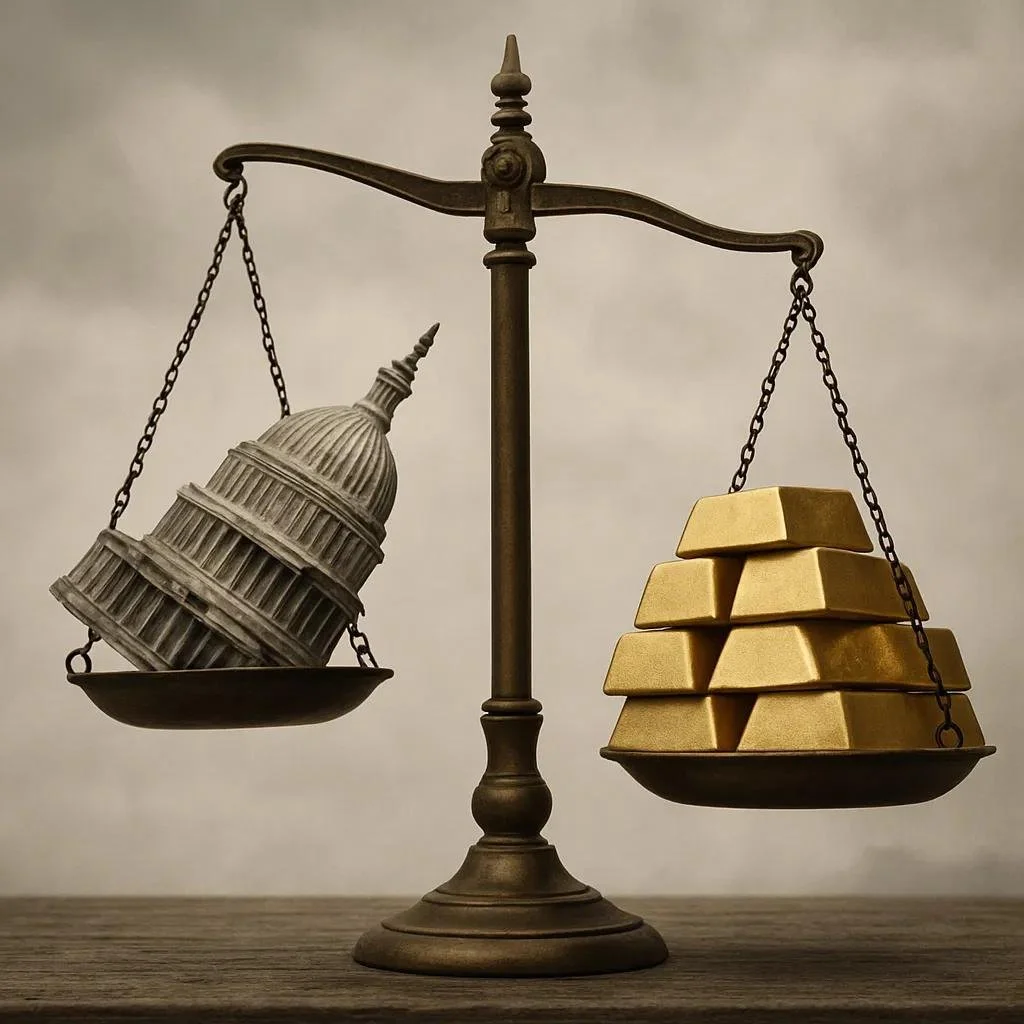
But today is also the end of the fiscal year. And based on the data, we can see that the US will end the fiscal year with around $37.5 trillion in debt. That means, for Fiscal Year 2025, the debt will have increased by another $1.8 trillion.
Taken as a whole, this is an obvious testament to why foreign governments and central banks are rapidly losing confidence in the US government.
It doesn’t even matter whether the government shuts down tonight— it is the fact that it always comes so close. That Congress can’t even manage to pass a basic budget.
And the “solution” on the table is just another short-term patch— a continuing resolution that keeps the government funded for less than two months, until November 21st.
America looks like exactly what it is: a dysfunctional government that can’t even pass a budget.
Frankly, it’s embarrassing.
On top of that, you’ve got this $37.5 trillion debt growing by leaps and bounds—faster than the US economy and faster than tax revenue.
At a certain point, these foreign governments and central banks, who collectively own trillions upon trillions of dollars worth of US government bonds, start wondering: why should I continue to own these securities? Why continue to lend money to the US government?
They can’t even pass a routine budget, let alone the kind of budget that would actually reassure foreign governments and central banks—a truly controversial one that makes deep, necessary cuts to runaway spending.
Then there’s another problem—one that isn’t new. It started under the Bush administration, Obama elevated it, and Biden perfected it: the weaponization of the US dollar, the financial system, and US Treasury bonds.
This gives foreign governments and central banks obvious concern: if they do something the US doesn’t like, they’re going to be frozen out of the dollar system—out of their Treasury holdings, and out of dollar-denominated assets altogether.
And these are all reasons why we believe, over the long run, gold will continue to march higher: central banks will continue to buy gold as an alternative to US dollars.
Why gold?
It’s an independent asset. It’s not controlled by any government. No country is worried that America will freeze its gold holdings. Millions of troy ounces of bars and bullion stored around the world can’t be frozen with the click of a button.
Gold is universally accepted by every other country and central bank. There’s a global market for it. And it’s an asset class large enough to absorb billions of dollars— or even tens, or hundreds of billions—over time.
You can’t say that about most other asset classes.
Gold has already had an astonishing run—especially this year. But we think that, over the long run, as more foreign central banks allocate an increasing percentage of their strategic reserves into gold instead of dollars, that excess demand will continue to push the gold price much higher.
Gold is like anything else—subject to the laws of supply and demand. Demand for physical gold by governments and central banks around the world has been very strong.
And based on the data we’re seeing, that continues to be the case.
The Chinese central bank has bought another 21 tons of gold this year, marking ten consecutive months of purchases.
And it’s not just China. It’s all over the world— Poland, Turkey, Czech Republic, Kazakhstan and many other countries are buying literal tons of gold.
In fact, 95% of central bank reserve managers said they expect global official gold holdings to increase over the next 12 months, according to the 2025 World Gold Council Central Bank Gold Reserves Survey.
There are, however, short-term price risks. For example, the gold price is also impacted by demand for jewelry, as well as industrial use.
Given current record-high prices, jewelry demand is much weaker.
And that can have an adverse impact on gold prices.
Another factor to consider is supply. At a certain point, mining companies are going to take advantage of these high prices and ratchet up production, eventually resulting in oversupply in the market. That, too, could weigh on gold prices.
But we think these are shorter-term factors that don’t change anything about the long-term driver of gold prices—and that is central bank demand.
What we are seeing literally today— government shutdowns and $1.8 trillion deficits—just underscores how widespread that central bank demand is—and why it simply isn’t going away.
To your freedom, James Hickman Co-Founder, Schiff Sovereign LLC
PS: While gold has hit all time highs, the share prices of many top quality gold producers has lagged far behind. That is starting to change, but there is still opportunity before the gap closes.
The 6 Most Important Pieces Of Financial Advice
The 6 Most Important Pieces Of Financial Advice
Michelle Mastro Sun, September 28, 2025 Business Insider
I've worked in global banking for 25 years. These are the 6 most important pieces of financial advice I tell family and friends.
Racquel Oden has worked in global banking for over two decades.
Some of the advice she gives family and friends is to focus on retirement as soon as possible.
She also says to prioritize investments over student loan debt and CDs over regular savings accounts.
This as-told-to essay is based on a conversation with Racquel Oden, US head of wealth and private banking at HSBC. It has been edited for length and clarity.
The 6 Most Important Pieces Of Financial Advice
Michelle Mastro Sun, September 28, 2025 Business Insider
I've worked in global banking for 25 years. These are the 6 most important pieces of financial advice I tell family and friends.
Racquel Oden has worked in global banking for over two decades.
Some of the advice she gives family and friends is to focus on retirement as soon as possible.
She also says to prioritize investments over student loan debt and CDs over regular savings accounts.
This as-told-to essay is based on a conversation with Racquel Oden, US head of wealth and private banking at HSBC. It has been edited for length and clarity.
I've worked in global banking for HSBC, JPMorgan Chase & Co., Merril Lynch, and many more. Over the years, I've given my clients plenty of advice on saving, budgeting, investing, retirement, and financial planning.
When it comes to my family and friends, the most important financial advice I give them is to start putting away money as soon as possible.
You're never too young to start saving or investing — and there are many things that even Generation Z could be doing now to help themselves reach their financial goals, whether that's saving up for a down payment for a house, a dream trip abroad, a lavish wedding, or even an early retirement.
If You're Working, You Should Be Focused On Retirement And Your Personal Savings
I know it sounds far away, but you should always be saving for retirement by paying into your 401(k).
Simultaneously, you should also be getting to the point where you have enough in your personal savings account to support your living expenses for the next six months in case you happen to lose your job for whatever reason. This money is what I call short-term cash on hand, what you can use to pay your basic needs — things like your apartment rent, car payments, grocery bills, etc.
You're Ready To Invest Once You Have More Than Short-Term Cash On Hand
I think for a lot of young investors, they're unsure of when to start investing. We often think, "I need to have all this money to invest."
I want to take that stigma away. Any amount of money will work better for you in money markets than in a savings account, which doesn't provide much or any interest. Once you have more than short-term cash on hand, you can create another account in preparation for investing.
Create A Financial Plan With The Help Of A Financial Advisor
What's great about sitting down with a financial advisor is that most banks do not initially charge for this service.
TO READ MORE: https://finance.yahoo.com/news/meet-rich-retired-boomers-now-154502996.html
8 Ways Lifestyle Creep Keeps You From Building Your Wealth
8 Ways Lifestyle Creep Keeps You From Building Your Wealth
Joel Lim Sun, September 28, 2025 GOBankingRates
You’re making decent money. You don’t feel like you overspend. And you don’t have a ton of bills. So, you wonder, why aren’t you building more wealth? You should be doing much better right now than you feel like you are, you figure. So what’s happening?
You’re not alone. Only 22.1% of Americans have more than $100,000 invested and it is at that financial point that your wealth really starts to grow, according to 24/7 Wall St.
Read on to explore the everyday actions you’re taking or not taking, that are holding you back from joining that 22%.
8 Ways Lifestyle Creep Keeps You From Building Your Wealth
Joel Lim Sun, September 28, 2025 GOBankingRates
You’re making decent money. You don’t feel like you overspend. And you don’t have a ton of bills. So, you wonder, why aren’t you building more wealth? You should be doing much better right now than you feel like you are, you figure. So what’s happening? You’re not alone. Only 22.1% of Americans have more than $100,000 invested and it is at that financial point that your wealth really starts to grow, according to 24/7 Wall St.
Read on to explore the everyday actions you’re taking or not taking, that are holding you back from joining that 22%.
You Increase Your Cost of Living Every Time You Get a Raise
It’s tempting — so tempting — to move into a bigger apartment, get a better car or start shopping at Whole Foods instead of Food 4 Less as you start to make more money. It makes sense. You’re tired of living frugally when you’re not, in fact, at that financial level anymore.
But this mistake is probably the biggest reason you’re not accumulating more wealth, even though you’re technically “doing better.”
How To Change: You don’t have to put every extra dollar you make into investments, but you do have to put some of it in there. As you first start getting raises and promotions, aim to contribute at least 50% of your raise to your investment portfolio, which is what Poor Swiss suggested. As your lifestyle improves, contribute a great percentage of each raise to investments until you reach your desired goal.
You Make Luxury Your Normal
If you look at most genuinely wealthy people in the United States, they don’t live wild and flashy lives. They tend to live simple lives with simple items for their necessities. They prioritize financial security over “things.” It’s a good approach to take to your lifestyle.
You don’t need the most expensive shoes, jacket or watch. And chances are, you don’t need a massive house with more bedrooms than you have family members. But you do need to add to your investment portfolio, where your investments can earn you 12% in returns, according to Ramsey Solutions. Your Chanel bag won’t get you there.
How To Change: Make a deal with yourself that you’ll treat yourself on occasion and the rest of your money will go toward necessities and growing your wealth. It’s a mindset shift you need to make to prioritize financial security.
You Try To Live Like an Influencer
TO READ MORE: https://www.yahoo.com/lifestyle/articles/8-ways-lifestyle-creep-keeps-220446580.html
Rachel Cruze: 4 Reasons Why Many High Earners Live Paycheck to Paycheck
Rachel Cruze: 4 Reasons Why Many High Earners Live Paycheck to Paycheck
Ashley Donohoe August 28, 2025 GOBankingRates
The Ramsey Solutions “State of Personal Finance in America” study noted that 53% of Americans lived paycheck to paycheck, including 72% of individuals with incomes below $50,000. More surprisingly, this financial struggle was also a reality for 36% of six-figure earners.
In a recent video, personal finance expert and author Rachel Cruze broke down why so many high earners still struggle to live on their incomes and build wealth.
Regardless of how much you make, you can use Cruze’s insights to become more financially secure.
Rachel Cruze: 4 Reasons Why Many High Earners Live Paycheck to Paycheck
Ashley Donohoe August 28, 2025 GOBankingRates
The Ramsey Solutions “State of Personal Finance in America” study noted that 53% of Americans lived paycheck to paycheck, including 72% of individuals with incomes below $50,000. More surprisingly, this financial struggle was also a reality for 36% of six-figure earners.
In a recent video, personal finance expert and author Rachel Cruze broke down why so many high earners still struggle to live on their incomes and build wealth.
Regardless of how much you make, you can use Cruze’s insights to become more financially secure.
Increased Cost of Living
Higher basic living expenses are an issue for many Americans. Cruze cited a 2024 U.S. Bureau of Labor Statistics report, which showed that the average household spent $77,280 in 2023. More recent BLS data for the second quarter of 2025 showed that the median income was $62,712 per year ($1,206 per week). Even if expenses hadn’t risen since 2023, there would be a gap.
Cruze explained that location plays a major role, as you’ll likely pay more for your housing, food and other essentials in popular cities than in smaller towns. She also said that the number of children and incomes you have in your family will affect how you manage your expenses.
If you’re struggling to get by on your salary, considering relocating to a more affordable area or changing jobs may be worth it. Cruze suggested trying out this cost-of-living calculator to estimate the potential savings and the salary you’d need.
Lifestyle Creep
Whether you get a promotion, change jobs or simply receive a raise, that extra income can lead you to make unwise decisions that may leave even high earners financially struggling.
TO READ MORE: https://finance.yahoo.com/news/rachel-cruze-4-reasons-why-165634667.html