
8 Ways Lifestyle Creep Keeps You From Building Your Wealth
8 Ways Lifestyle Creep Keeps You From Building Your Wealth
Joel Lim Sun, September 28, 2025 GOBankingRates
You’re making decent money. You don’t feel like you overspend. And you don’t have a ton of bills. So, you wonder, why aren’t you building more wealth? You should be doing much better right now than you feel like you are, you figure. So what’s happening?
You’re not alone. Only 22.1% of Americans have more than $100,000 invested and it is at that financial point that your wealth really starts to grow, according to 24/7 Wall St.
Read on to explore the everyday actions you’re taking or not taking, that are holding you back from joining that 22%.
8 Ways Lifestyle Creep Keeps You From Building Your Wealth
Joel Lim Sun, September 28, 2025 GOBankingRates
You’re making decent money. You don’t feel like you overspend. And you don’t have a ton of bills. So, you wonder, why aren’t you building more wealth? You should be doing much better right now than you feel like you are, you figure. So what’s happening? You’re not alone. Only 22.1% of Americans have more than $100,000 invested and it is at that financial point that your wealth really starts to grow, according to 24/7 Wall St.
Read on to explore the everyday actions you’re taking or not taking, that are holding you back from joining that 22%.
You Increase Your Cost of Living Every Time You Get a Raise
It’s tempting — so tempting — to move into a bigger apartment, get a better car or start shopping at Whole Foods instead of Food 4 Less as you start to make more money. It makes sense. You’re tired of living frugally when you’re not, in fact, at that financial level anymore.
But this mistake is probably the biggest reason you’re not accumulating more wealth, even though you’re technically “doing better.”
How To Change: You don’t have to put every extra dollar you make into investments, but you do have to put some of it in there. As you first start getting raises and promotions, aim to contribute at least 50% of your raise to your investment portfolio, which is what Poor Swiss suggested. As your lifestyle improves, contribute a great percentage of each raise to investments until you reach your desired goal.
You Make Luxury Your Normal
If you look at most genuinely wealthy people in the United States, they don’t live wild and flashy lives. They tend to live simple lives with simple items for their necessities. They prioritize financial security over “things.” It’s a good approach to take to your lifestyle.
You don’t need the most expensive shoes, jacket or watch. And chances are, you don’t need a massive house with more bedrooms than you have family members. But you do need to add to your investment portfolio, where your investments can earn you 12% in returns, according to Ramsey Solutions. Your Chanel bag won’t get you there.
How To Change: Make a deal with yourself that you’ll treat yourself on occasion and the rest of your money will go toward necessities and growing your wealth. It’s a mindset shift you need to make to prioritize financial security.
You Try To Live Like an Influencer
TO READ MORE: https://www.yahoo.com/lifestyle/articles/8-ways-lifestyle-creep-keeps-220446580.html
Rachel Cruze: 4 Reasons Why Many High Earners Live Paycheck to Paycheck
Rachel Cruze: 4 Reasons Why Many High Earners Live Paycheck to Paycheck
Ashley Donohoe August 28, 2025 GOBankingRates
The Ramsey Solutions “State of Personal Finance in America” study noted that 53% of Americans lived paycheck to paycheck, including 72% of individuals with incomes below $50,000. More surprisingly, this financial struggle was also a reality for 36% of six-figure earners.
In a recent video, personal finance expert and author Rachel Cruze broke down why so many high earners still struggle to live on their incomes and build wealth.
Regardless of how much you make, you can use Cruze’s insights to become more financially secure.
Rachel Cruze: 4 Reasons Why Many High Earners Live Paycheck to Paycheck
Ashley Donohoe August 28, 2025 GOBankingRates
The Ramsey Solutions “State of Personal Finance in America” study noted that 53% of Americans lived paycheck to paycheck, including 72% of individuals with incomes below $50,000. More surprisingly, this financial struggle was also a reality for 36% of six-figure earners.
In a recent video, personal finance expert and author Rachel Cruze broke down why so many high earners still struggle to live on their incomes and build wealth.
Regardless of how much you make, you can use Cruze’s insights to become more financially secure.
Increased Cost of Living
Higher basic living expenses are an issue for many Americans. Cruze cited a 2024 U.S. Bureau of Labor Statistics report, which showed that the average household spent $77,280 in 2023. More recent BLS data for the second quarter of 2025 showed that the median income was $62,712 per year ($1,206 per week). Even if expenses hadn’t risen since 2023, there would be a gap.
Cruze explained that location plays a major role, as you’ll likely pay more for your housing, food and other essentials in popular cities than in smaller towns. She also said that the number of children and incomes you have in your family will affect how you manage your expenses.
If you’re struggling to get by on your salary, considering relocating to a more affordable area or changing jobs may be worth it. Cruze suggested trying out this cost-of-living calculator to estimate the potential savings and the salary you’d need.
Lifestyle Creep
Whether you get a promotion, change jobs or simply receive a raise, that extra income can lead you to make unwise decisions that may leave even high earners financially struggling.
TO READ MORE: https://finance.yahoo.com/news/rachel-cruze-4-reasons-why-165634667.html
It’s Like Buying Gold For $1,000 An Ounce
It’s Like Buying Gold For $1,000 An Ounce
Notes From the Field By James Hickman (Simon Black) September 25, 2025
Gold just hit another all-time high this week, briefly touching $3,800 per ounce... which means it has more than doubled in the last two years.
When any asset continues hitting all-time highs, most people who haven’t bought it yet naturally believe that they missed out... or that they should wait for a pullback.
Of course, many people believed that when gold hit $2,400 in spring of 2024... and then $2,800 early this year... and $3,400 in April.
It’s Like Buying Gold For $1,000 An Ounce
Notes From the Field By James Hickman (Simon Black) September 25, 2025
Gold just hit another all-time high this week, briefly touching $3,800 per ounce... which means it has more than doubled in the last two years.
When any asset continues hitting all-time highs, most people who haven’t bought it yet naturally believe that they missed out... or that they should wait for a pullback.
Of course, many people believed that when gold hit $2,400 in spring of 2024... and then $2,800 early this year... and $3,400 in April.
As gold has continued its rise, however, we continued to suggest that this is still early days... and that the gold price could continue to surge much, much higher.
It’s not hard to understand why.
Foreign governments and central banks around the world are rapidly losing confidence in the US government... and by extension, in the US dollar.
The national debt is $37.5 trillion and rising. Deficits total $2 trillion each year, and there seems to be no appetite to cut spending. Worst of all, Congress can’t even manage to pass a budget... risking yet another government shutdown at the end of this month.
If that weren’t bad enough, the US federal government has also gotten in the habit of freezing assets of any foreign country that it doesn’t like.
At the moment, those same foreign governments (and foreign central banks) hold trillions worth of US dollar assets. So naturally any sensible foreign official is thinking about diversifying away from the US, and from the US dollar.
Unfortunately there simply aren’t too many options. No one trusts the Chinese Communist Party, so the yuan is out. Europe is its own economic basket case, so euro-denominated assets and European government bonds are not much better.
Out of the universe of options available, gold is one of the few assets that can solve this problem for foreign governments and central banks.
Gold isn’t controlled by any single government. No one can freeze them out of their gold or confiscate their holdings. Gold will hold its value against inflation. And the gold market is large enough that sovereign nations can purchase hundreds of billions of dollars worth.
This is why gold is at an all-time high: foreign governments and central banks have been buying it by the metric ton. And that extreme gold demand has pushed prices higher and higher.
We have been talking about this for 2+ years, since gold was below $2,000. And throughout gold’s rise, we kept saying that this trend will continue, i.e. foreign governments and central banks will buy more.
We still believe this is true, especially if you have a longer-term view over the next few years.
But we also presented an alternative to gold.
We wrote that the main demand driver for gold was from central banks. But central banks only buy physical gold. They do not buy gold stocks.
And we pointed out that while gold was at all time highs, the share prices of companies producing the gold were ridiculously low.
In January, for example, one gold company we follow was trading at roughly 1x forward earnings.
And we practically screamed from the rooftops that this opportunity would not last— people would realize how undervalued these businesses were, while their revenue was literally denominated in gold at all time high prices.
Well, the gold companies’ earnings reports starting rolling in this year, and the market saw just how much money these companies were making.
Investors finally woke up. And by April, that same gold company had doubled its January share price— but was still only trading at about 2x earnings.
Gold kept ripping higher, and so did this company’s profits— after all, the cost to mine gold didn’t increase, and this company was still pulling it out of the ground for about $1,000 an ounce.
So its profit margin went from $800 per ounce two years ago, to over $2,500 per ounce today.
Production costs have been flat. But their revenue per ounce has soared, up 50% this year alone.
Now, it’s share price has doubled again— 4x higher than in January.
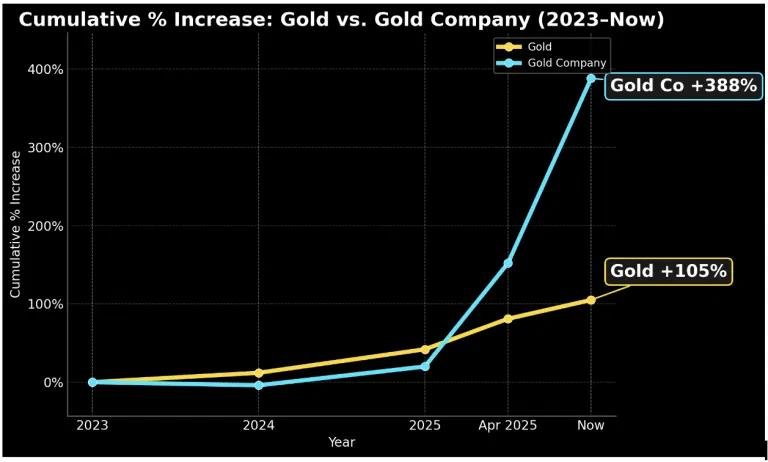
And next month it will release Q3 results, a period it could sell gold as high as $3,700 per ounce. Its profits could be simply ridiculous.
Here’s the crazy part: even though the share price has quadrupled this year, the company is making so much money that it is STILL only trading for 2x earnings.
Which is why we think, despite already multiplying by four this year, the share price is poised for even higher growth once Q3 earnings are released in a few weeks.
In other words, gold companies are STILL cheap compared to gold, and offer leverage beyond physical gold.
If you own shares in a company that can produce gold at $1,000 per ounce, in a way its like buying gold at $1,000 per ounce. And that’s a pretty fantastic deal these days.
Right now it’s still possible to buy into these gold companies at cheap valuations, delivering gains that could far outpace gold.
So we really want to encourage you to check out our premium investment research— it’s called The 4th Pillar, where we feature these undervalued gold companies... along with other real asset businesses ranging from silver to platinum to oil to industrial metals to agriculture.
Many of our picks are up 2-4x just this year alone, and based on our analysis, we think there’s scope for them to go much higher over the next few months based on Q3 earnings (which will be released in a few weeks).
We’re offering a limited time promotional discount to The 4th Pillar, along with our iron-clad money back guarantee. So definitely take a few minutes to learn more about it and consider joining.
To your freedom, James Hickman Co-Founder, Schiff Sovereign LLC
Avoid These 4 Common Mistakes When You Get Rich Overnight
Avoid These 4 Common Mistakes When You Get Rich Overnight
September 4, 2025 by Laura Bogart GoBankingRates
You’re about to score a financial touchdown. Maybe you’ve crushed it at work and landed a sweet promotion. Perhaps you’ve won a lottery or stumbled into a side hustle that suddenly pays off. As you near the end zone, heart pounding, head full of dreams, you can’t afford (literally) to fumble. Whether you’re blindsided by unexpected taxes or tripped up by bad financial advice, you have a lot to lose if you drop the ball.
If there’s one thing Brandon Copeland, former NFL linebacker turned financial expert, knows, it’s how not to fumble good fortune — whether that’s a game-changing play or a sudden influx of cash. As founder of Copeland Media and Athletes.org, and the author of “Your Money Playbook,” Copeland now dedicates his time to making financial education more accessible for everyone, from high earners to those just trying to get a handle on their first paycheck.
Avoid These 4 Common Mistakes When You Get Rich Overnight
September 4, 2025 by Laura Bogart GoBankingRates
You’re about to score a financial touchdown. Maybe you’ve crushed it at work and landed a sweet promotion. Perhaps you’ve won a lottery or stumbled into a side hustle that suddenly pays off. As you near the end zone, heart pounding, head full of dreams, you can’t afford (literally) to fumble. Whether you’re blindsided by unexpected taxes or tripped up by bad financial advice, you have a lot to lose if you drop the ball.
If there’s one thing Brandon Copeland, former NFL linebacker turned financial expert, knows, it’s how not to fumble good fortune — whether that’s a game-changing play or a sudden influx of cash. As founder of Copeland Media and Athletes.org, and the author of “Your Money Playbook,” Copeland now dedicates his time to making financial education more accessible for everyone, from high earners to those just trying to get a handle on their first paycheck.
His financial expertise, shaped both by personal experience and by watching fellow NFL players navigate big contracts, has taught him what to do — and, crucially, what not to do — when you come into some money. As part of GOBankingRates’ Top 100 Money Experts series, he answers Question #16: Why do so many people fumble a windfall, and what moves should I make if it ever happens to me?
1. Not Taking the Time To Learn About Money
When Copeland is outside tossing the pigskin with his five-year-old son, the little guy doesn’t catch it every time. And despite being a force on the field himself, Copeland doesn’t expect his son to be perfect — after all, he’s still learning. He sees a clear parallel to how most of us approach money.
“Most things in life take practice, and unfortunately when it comes to money, many of us never had the chance to learn or practice those skills,” he said. “We just start earning it. So, it’s not absurd to think, ‘Hey, I’m not going to be perfect at this.'”
To Copeland, a windfall doesn’t just reveal your financial blind spots — it magnifies them. That’s why he’s so passionate about financial education, both in the classroom and through his foundation.
“My goal is to help a younger version of myself,” he said. “I think of the problems I had growing up, where I wanted money, but nobody taught me about it. I was blessed to have a high school football coach who ran a hedge fund and invited me to intern with him.”
That mentorship gave Copeland his first real playbook for success in life — and in finance. It’s one he would carry into teaching financial literacy at the University of Pennsylvania, as well as the nonprofit he started with his wife, Beyond the Basics.
2. Giving in to the Urge To Splurge
“Treat yourself” has become a cultural mantra — and sometimes it’s well-deserved. But Copeland warns that reacting too quickly to a windfall can be a fast way to lose it.
Once the money comes in, it’s only natural to think about all those fancy shiny things you’ve always wanted or to want to buy your family truly spectacular gifts, like that house for your mom or that new car for your cousin.
“But you should figure out how this windfall can become a life-changing event — forever — before you start to spend,” he said.
TO READ MORE: https://www.gobankingrates.com/money/wealth/avoid-common-mistakes-get-rich-overnight/?hyperlink_type=manual
11 Genius Things Rachel Cruze Says To Do To Become Wealthy
11 Genius Things Rachel Cruze Says To Do To Become Wealthy
Terence Loose Tue, September 23, 2025 GOBankingRates
Rachel Cruze, money expert and daughter of financial guru Dave Ramsey, has made a name for herself by giving people solid, actionable advice on how to make an achievable budget, control spending and build wealth. She’s the author of “Know Yourself, Know Your Money,” host of “The Rachel Cruze Show,” and a prominent influencer on social media channels.
Here are 11 of her top tips that GOBankingRates pulled from her YouTube channel on how to manage your money to live better, save more and achieve financial freedom.
11 Genius Things Rachel Cruze Says To Do To Become Wealthy
Terence Loose Tue, September 23, 2025 GOBankingRates
Rachel Cruze, money expert and daughter of financial guru Dave Ramsey, has made a name for herself by giving people solid, actionable advice on how to make an achievable budget, control spending and build wealth. She’s the author of “Know Yourself, Know Your Money,” host of “The Rachel Cruze Show,” and a prominent influencer on social media channels.
Here are 11 of her top tips that GOBankingRates pulled from her YouTube channel on how to manage your money to live better, save more and achieve financial freedom.
Live Debt-Free
Growing up in a household that had experienced bankruptcy fostered a deep fear of debt in Cruze, especially high-interest credit card debt. It influenced all of her financial decisions, and she insists that a debt-free existence is possible for almost anyone and is your best bet to becoming wealthy. Her advice: pay off small amounts first to gain momentum, which is also known as the debt snowball method.
Live Below Your Means
When it comes to saving money, Cruze advocates for making a budget that is well within — i.e., below — your means and sticking to it with military discipline. Living below your means gives you the ability to create an emergency fund as well as invest for the future or retirement.
Stop Eating Out
Cruze revealed that dining out sometimes busted her budget. She’s likely not alone. According to a U.S. Foods study, as of last year, Americans spent an average of just under $200 a month dining out. That’s nearly $2,400 a year — not exactly healthy for the bottom line.
Pay Off Your Mortgage Early
If you have a mortgage, chances are it’s your largest monthly expense. Cruze advocated paying it off early, which will be extremely financially liberating and dramatically increase your net worth. She said that most people find they can do it within 10 years if they are dedicated. Use a mortgage payoff calculator to help strategize.
Never Compare Yourself
There’s a saying that “comparison is the thief of joy.” Cruze believes comparing your lifestyle to others can also be the thief of wealth. Always remember that you — and your financial reality and goals — are unique to you. Make decisions with that in mind, budgeting for your dreams, not someone else’s.
Prioritize the ‘Four Walls’
TO READ MORE: https://www.yahoo.com/finance/news/11-genius-things-rachel-cruze-210122575.html
Why High-Earning ‘Henrys’ Don’t Feel Any Richer Despite Six-Figure Salaries
Why High-Earning ‘Henrys’ Don’t Feel Any Richer Despite Six-Figure Salaries
Jessica Wong August 24, 2025 5 min read Moneywise
They pull in six-figure salaries but don’t think they’re rich. More money, same exact problems —
HENRYs, or “High Earners, Not Rich Yet,” are a surprisingly large class of Americans who pull in big bucks but still feel financially strapped.
Why High-Earning ‘Henrys’ Don’t Feel Any Richer Despite Six-Figure Salaries
Jessica Wong August 24, 2025 5 min read Moneywise
They pull in six-figure salaries but don’t think they’re rich. More money, same exact problems —
HENRYs, or “High Earners, Not Rich Yet,” are a surprisingly large class of Americans who pull in big bucks but still feel financially strapped.
Some have liabilities matching their assets. Even with annual incomes topping $200,000, they’re living paycheck to paycheck and battling credit card debt.
Others are dedicated savers who only experience their wealth through a number in their bank account.
“Earning doesn’t actually make you feel rich; spending it does,” clinical psychologist Sabrina Romanoff shared with CNBC in July.
“If most people spent 99% of their paycheck, they’d feel quite rich. And it’s the paradox here. When we’re in accumulation mode, it’s very difficult to feel rich.”
Wealthy But Financially Unhealthy
Over 25% of high-earning households — pulling in between $200,000 and $300,000 per year — are unhappy with their finances, according to research by Matt Killingsworth, a senior fellow at the University of Pennsylvania.
“Even people who are doing pretty well aren’t maybe as satisfied as we might imagine,” Killingsworth told The Wall Street Journal.
Marie Incontrera is a 39-year-old Manhattan-based entrepreneur whose income soared from $15,000 a year as a professional musician to an expected $300,000 to $400,000 from her digital marketing consulting business. Her company is projected to generate $1.4 million in 2025.
“I would have thought back then that the amount of money I have in the bank right now, I would be rich, right? ... And I don’t feel that way,” she told CNBC. “I have more money anxiety, almost, now than I ever did in my 20s.”
Certainly, rising prices are making a six-figure salary less impressive than it used to be.
But many HENRYs also experience lifestyle creep and funnel their money into things like daycare, organic food or a home in a nicer neighborhood.
These can quickly feel like essentials and not luxuries, leaving high earners feeling like they don’t have much more disposable income than before.
How HENRYs can get a grip on their finances
TO READ MORE: https://finance.yahoo.com/news/more-money-same-exact-problems-103000817.html
7 Key Signs You’re Wealthier Than You Think
7 Key Signs You’re Wealthier Than You Think
Caitlyn Moorhead Mon, September 22, 202 GOBankingRates
Controversial but consummately successful podcaster Joe Rogan once said he felt like he’d “made it” financially when he had enough money to eat at a restaurant at night without feeling guilty and stressed about what it cost the following day.
Rogan’s net worth is now estimated at $200 million, which is all the money in the world — unless you’re Elon Musk. Rogan’s $200 million fortune he made bloviating opinions is less than 0.05% of Musk’s $395 billion fortune he made building cars and rocket ships.
7 Key Signs You’re Wealthier Than You Think
Caitlyn Moorhead Mon, September 22, 202 GOBankingRates
Controversial but consummately successful podcaster Joe Rogan once said he felt like he’d “made it” financially when he had enough money to eat at a restaurant at night without feeling guilty and stressed about what it cost the following day.
Rogan’s net worth is now estimated at $200 million, which is all the money in the world — unless you’re Elon Musk. Rogan’s $200 million fortune he made bloviating opinions is less than 0.05% of Musk’s $395 billion fortune he made building cars and rocket ships.
The point is that how you feel about wealth is subjective and can come from many sources. In a country where more than half of all six-figure earners reportedly live paycheck to paycheck, how do you know if you’re rich, or at least richer than you think? Here are seven key signs you may be wealthier than most Americans.
You Make More Than the Median Earner
Your salary, of course, plays a significant role in your ability to accumulate wealth and has a lot to do with how you measure up to the masses.
“The median household income in the U.S. is around $75,000,” said Joel Ohman, certified financial planner and CEO of Clearsurance. “So, if you make more than that, your income is higher than half the people in the country.
“Of course, how far $75,000 takes you will depend on where you live. For example, you have a lot more buying power with $75,000 a year in Glendive, Montana, than you would in Orange County, California.”
Since the cost of living varies so dramatically from one place to the next, area median income (AMI) is a more accurate yardstick to measure your comparative wealth.
HUD Loans by commercial property financing firm Janover offers a state-by-state AMI breakdown with metro, non-metro and total AMI variants. Fannie Mae has a map-based AMI lookup tool that allows for much more granular and local detail.
You’ve Met the Standard Saving Milestones
Even the most impressive income is no indication of wealth if you spend more of it than you make, which so many high earners seem to do. The more accurate barometer, then, is how much you have in the bank.
TO READ MORE: https://www.yahoo.com/finance/news/signs-wealthier-think-152349259.html
10 Genius Things Warren Buffett Says To Do With Your Money
10 Genius Things Warren Buffett Says To Do With Your Money
Elyssa Kirkham Sun, September 21, 2025 GOBankingRates
Warren Buffett is commonly referred to as the most prophetic and respected investor of all time. He is also known for his folksy charm and memorable quotes about the art of investing. As the “Oracle of Ohama” has an estimated net worth of around $150 billion, the proof is in the pudding.
When you’re aiming to reach the top of the mountain and want a competitive advantage, it’s usually wise to follow the footprints of those who have successfully made the climb before you, to the tune of billions of dollars. Your odds of investing success can increase exponentially if you learn and apply Buffett’s best investing tips.
10 Genius Things Warren Buffett Says To Do With Your Money
Elyssa Kirkham Sun, September 21, 2025 GOBankingRates
Warren Buffett is commonly referred to as the most prophetic and respected investor of all time. He is also known for his folksy charm and memorable quotes about the art of investing. As the “Oracle of Ohama” has an estimated net worth of around $150 billion, the proof is in the pudding.
When you’re aiming to reach the top of the mountain and want a competitive advantage, it’s usually wise to follow the footprints of those who have successfully made the climb before you, to the tune of billions of dollars. Your odds of investing success can increase exponentially if you learn and apply Buffett’s best investing tips.
Never Lose Money
One of the most popular pieces of Buffett advice is as follows: “Rule No. 1: Never lose money. Rule No. 2: Never forget rule No. 1.” If you’re working from a loss, it’s that much harder to get back to where you started, let alone to earn gains.
Get High Value at a Low Price
Another key principle Buffett has shared is, “Price is what you pay; value is what you get.” Losing money can happen when you pay a price that doesn’t match the value you get — such as when you pay high interest on credit card debt or spend on items you’ll rarely use.
Instead, live modestly, or in the case of stocks Buffett recommends when approaching your investment strategy, start by looking for opportunities to get more value at a lower price. “Whether we’re talking about socks or stocks, I like buying quality merchandise when it is marked down,” he wrote. https://www.youtube.com/watch?v=dyKeZ6ogcpU
Form Healthy Money Habits
In an address at the University of Florida, Buffett said, “Most behavior is habitual, and they say that the chains of habit are too light to be felt until they are too heavy to be broken.” Work on building positive money habits — and breaking those that hurt your wallet.
Avoid Debt, Especially Credit Card Debt
Buffett built his wealth by getting interest to work for him — instead of working to pay interest, as many Americans do. “I’ve seen more people fail because of liquor and leverage — leverage being borrowed money,” Buffett said in a 1991 speech at the University of Notre Dame. “You really don’t need leverage in this world much. If you’re smart, you’re going to make a lot of money without borrowing.”
Buffett is especially wary of credit cards. His advice is to avoid them altogether. “Interest rates are very high on credit cards,” Buffett once said. “Sometimes they are 18%. Sometimes they are 20%. If I borrowed money at 18% or 20%, I’d be broke.”
Keep Cash on Hand
TO READ MORE: https://www.yahoo.com/finance/news/10-genius-things-warren-buffett-190031207.html
Worth 1,000 Words
Worth 1,000 Words
Adam M. Grossman | Aug 2, 2025
IN THE ANCIENT WORLD, before the invention of the printing press, the most common way to retain information was to build what’s known as a memory palace. The idea was to link words to images, because images are easier to remember.
I’ve found that this strategy works well in personal finance, and earlier this year I described some of the images that I rely on most. Below are several more.
Worth 1,000 Words
Adam M. Grossman | Aug 2, 2025
IN THE ANCIENT WORLD, before the invention of the printing press, the most common way to retain information was to build what’s known as a memory palace. The idea was to link words to images, because images are easier to remember.
I’ve found that this strategy works well in personal finance, and earlier this year I described some of the images that I rely on most. Below are several more.
1. Back in 2011, an Illinois man named Wayne Sabaj was in his yard when something caught his eye. Upon closer inspection, it turned out to be a package containing a large amount of cash—about $150,000. Sabaj never found out who had buried these funds or why. This sort of thing is not uncommon. Homeowners doing renovations regularly find cash hidden in backyards, basements and bedroom walls.
For me, this is a reminder that many financial decisions are subjective and in the eye of the beholder. To be sure, most people hold their money in the bank, where it’s safe and can earn interest. But not every financial decision has to be strictly optimal.
As I often say, there are two answers to every financial question: what the numbers say and how you feel about it. In my view, as long as a financial decision doesn’t carry undue risk, we shouldn’t worry what someone else might think.
2. You may remember the name Keith Gill, or his alter ego, Roaring Kitty. Gill is the day trader who gained fame in 2021 when he helped drive up the share price of the failing retailer GameStop. That, in turn, caused the failure of a multi-billion-dollar hedge fund which had been betting against GameStop. Gill accomplished all of this from his basement in suburban Boston.
This, in my mind, illustrates a growing phenomenon in the market. It’s what hedge fund manager Cliff Asness refers to as the “less efficient market hypothesis.” The internet, and social media in particular, have spawned what he calls “a coordinated clueless and even dangerous mob.”
That’s in contrast to the long-held belief that investors should benefit from having more information. This year’s resurgence of so-called meme stocks suggests that Asness may be right. This less-than-rational behavior is another reason to take the long view in investing.
3. Tax rules are complicated and change frequently. But there’s one rule that’s easy to remember, thanks to a hapless fellow named Alvan Bobrow. In 2014, Bobrow, a tax attorney, came to the attention of the IRS when an audit revealed he’d taken advantage of the rules governing IRA rollovers. These rules allow an investor who wants to transfer the balance of a 401(k) or IRA to hold the funds temporarily in his or her checking account—but only for 60 days.
TO READ MORE: https://humbledollar.com/2025/08/worth-1000-words/
What We Lose When We Retire
What We Lose When We Retire
Jonathan Clements | Aug 26, 2023
WHEN WE RETIRE, we win back control over our daily life. Gone is the boss, the expectation that we’ll be at work at a certain hour, the worry about what the next office email will bring. We have a degree of freedom that, in many cases, we last knew when we were students contemplating a long summer vacation.
But even as we gain that freedom, there’s also much that we lose. If we’re to be happy retirees, we need to think hard about how we’ll cope with these losses. For some, what’s lost won’t seem all that bad. But for me—someone for whom work has been so central to my life—the seven losses below loom large.
What We Lose When We Retire
Jonathan Clements | Aug 26, 2023
WHEN WE RETIRE, we win back control over our daily life. Gone is the boss, the expectation that we’ll be at work at a certain hour, the worry about what the next office email will bring. We have a degree of freedom that, in many cases, we last knew when we were students contemplating a long summer vacation.
But even as we gain that freedom, there’s also much that we lose. If we’re to be happy retirees, we need to think hard about how we’ll cope with these losses. For some, what’s lost won’t seem all that bad. But for me—someone for whom work has been so central to my life—the seven losses below loom large.
1. Income. This is the most obvious loss, we all know it’s coming—and yet many folks are left anxious by the disappearance of their paycheck, even if they have ample savings. Moreover, with that paycheck gone, not only do we lose the ability to save, but also our financial life goes into reverse, with savings coming out of our nest egg instead of going in.
Given that, it’s hardly surprising that studies suggest retirees tend to be happier when they have ample predictable income, such as from a pension. Don’t have a pension? To ease the anxiety of retirement, consider delaying Social Security to get a larger monthly check and perhaps also purchasing immediate fixed annuities. I plan to do both.
2. Identity. When we meet folks for the first time, one of the questions is almost always, “So, what do you do?” Instead of “engineer” or “lawyer,” you’ll be saying, “I’m retired.”
How does that answer sit with you? For some, it’ll be just fine. But others will hunger for an answer that lets them reclaim the pride they felt when they described their old profession. Even now, I tell people, “I used to work for The Wall Street Journal,” resting on those old laurels, even though my last Journal byline was more than eight years ago.
3. Purpose. Our new identity will be tied to the meaningful things we choose to do with our retirement years. It might be volunteering, helping family or a “hobby.” I put hobby in quotation marks because the word can suggest something that’s little more than a way to while away the hours.
But to give us a sense of purpose, a retirement hobby has to be more than that. It needs to be something we feel we’re good at, find challenging and fulfilling, and which strikes us as important. As I scale back my work in the years ahead, HumbleDollar will be the “hobby” that provides that sense of purpose, and I know that’s also the case for many of the site’s writers.
4. Structure. I’ve worked for myself for the past nine years, and I regularly worked from home for more than a dozen years prior to that. I lack many talents, but self-discipline isn’t one of them.
For others, however, saying goodbye to the workweek’s predictable rhythm could leave them feeling lost and unsure how to allocate their time, even if there’s plenty they want to do. I suspect the vast majority of retirees soon settle into a new routine that feels not unlike their old workweek. Indeed, many retirees tell me that weekends continue to feel distinctly different from weekdays. But until you find your daily rhythm, don’t be surprised if there are some uncomfortable weeks or months.
TO READ MORE: https://humbledollar.com/2023/08/what-we-lose/
The Fed Just Became the World’s #1 Gold Salesman..
The Fed Just Became the World’s #1 Gold Salesman...
Notes From the Field By James Hickman (Simon Black) September 18, 2025
To the surprise of absolutely no one, the Federal Reserve announced its decision yesterday to cut interest rates… and kept the door open to further rate cuts in the future.
The funny thing is that we’ll never truly know why.
Sure, it’s possible that Fed officials honestly felt that the economy needs lower rates (despite obviously persistent inflation risks).
The Fed Just Became the World’s #1 Gold Salesman...
Notes From the Field By James Hickman (Simon Black) September 18, 2025
To the surprise of absolutely no one, the Federal Reserve announced its decision yesterday to cut interest rates… and kept the door open to further rate cuts in the future.
The funny thing is that we’ll never truly know why.
Sure, it’s possible that Fed officials honestly felt that the economy needs lower rates (despite obviously persistent inflation risks).
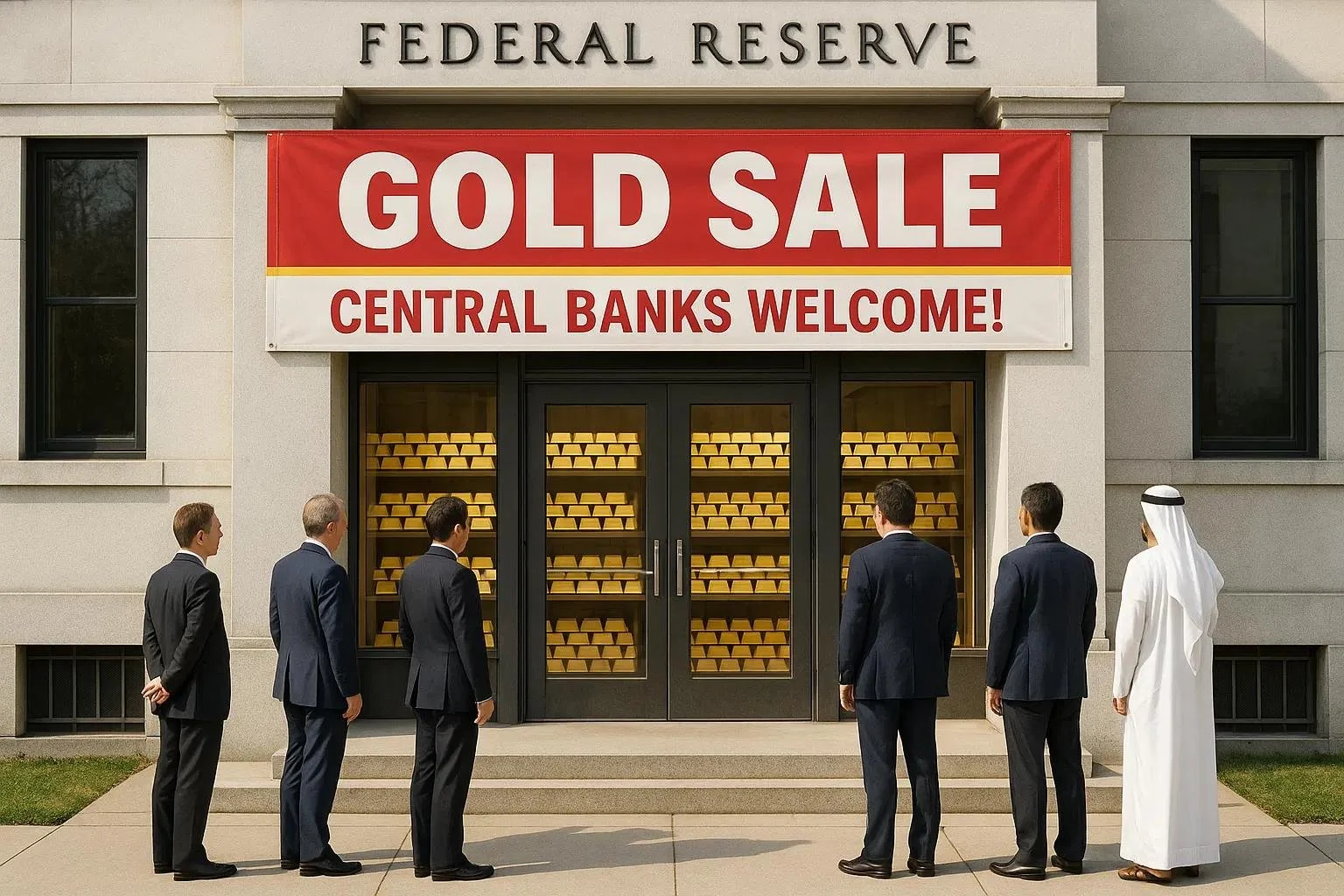
Of course, it’s also possible that Fed Chairman Jerome Powell finally caved to all the insults and pressure from the President.
Or that the rest of the FOMC members looked at what’s happening with Lisa Cook and submitted to inevitability, fearing that they too would be investigated for mortgage fraud (or some other criminal matter) if they didn’t cut rates.
Again, we may never know their real motivations. But it’s clear that the White House has gotten its way.
The President and Treasury Secretary believe that lower rates will stimulate the economy, raise wages, raise asset prices, improve housing affordability, and broadly create conditions for economic prosperity… and they’ve been pushing hard for rate cuts.
Lower rates will also help bail out the US government— whose national debt is so gargantuan that the Treasury is set to spend $1.2 trillion this Fiscal Year (which ends on September 30) just to pay interest.
The Trump administration sees lower rates as the key to slashing that annual interest bill.
Of course, a better solution would be to cut spending, bring the budget closer into balance, and reduce America’s debt-to-GDP ratio.
Putting America’s fiscal house in order would also attract investment in US government bonds the old-fashioned way— by restoring confidence that the US Treasury can pay back its debts through growth, strength, and prestige.
But making such cuts is politically difficult. Even the party that claims to be fiscally conservative isn’t really that interested in meaningful spending cuts.
So, they’re going with Plan B-- push the Fed to lower interest rates.
But as we’ve argued before, they’re setting themselves up for disappointment.
Remember what happened last year— between September and December 2024, the Fed cut rates three times for a total of 1%. Yet over that same period, US government bond yields actually INCREASED by 1%.
This proves that the Fed can’t just snap its fingers and force interest rates lower simply by having a committee meeting.
Interest rates are ultimately determined by supply and demand for money. So if they Fed really wants to see lower rates, they’re going to have to intervene directly in the bond market.
They’ve done this many times before-- this is when the Fed ‘prints’ money, i.e. what they call “quantitative easing”. And the most recent example was during the pandemic when the Fed created about $5 trillion of new money.
They used that money to buy government bonds-- essentially creating artificial demand for Treasurys that pushed yields down to record lows.
And life felt pretty good for a while-- people were able to buy homes and finance mortgages at rates lower than 3%. The government was able to sell 10-year debt for less than 0.5%.
But all those trillions of dollars of new money from the Fed came at a consequence: inflation soared to 9%— the highest in decades.
This is the major tradeoff that the Fed is facing right now: the White House wants lower interest rates. And the Fed seems to be capitulating to the pressure.
But for interest rates to get really low (and remain there), the Fed will almost certainly have to engage in more Quantitative Easing… and that means more inflation.
That alone is going to push a lot more capital into the gold market.
For the past few years, foreign governments and central banks have been selling off their US dollar reserves and funneling that money into gold; this has been the primary reason why gold has soared to all-time highs.
And with the Fed’s capitulation on rates, this trend will continue.
It’s also very likely that pension funds, insurance funds, and other long-term institutional investors will seek refuge in gold as well, driving the price even higher.
To be clear, this isn’t a prediction that gold is going to go up every day, or every month, or even every year.
But if you take a longer-term view—say, 8 to 10 years when the US national debt hits $60 trillion and Social Security runs out of funds— the case for owning gold becomes even more compelling.
I don’t hold this view because I’m a “gold bug”. I’m not fanatical about a hunk of metal. But I do understand these long-term trends, and in my view, we’re still in the early innings.
Another option is to buy gold-related companies, which can offer powerful leverage to the metal itself.
Central banks buy physical gold. They do not buy shares of gold companies. That’s why, even as gold surged, many of the companies we researched traded at dirt-cheap valuations—as low as 2-3x earnings in some cases.
But investors are starting to catch on and pay attention to these deeply undervalued businesses; in fact, we’ve seen several companies in our portfolio gain up to 4x, some even just over the last few months.
Given that Q3 earnings are coming up just around the corner, we believe that some of these gold (and related silver and platinum) companies are about to post record earnings and could see their share prices soar even more.
If you’re interested, we publish all of this investment research, including detailed analysis of deeply undervalued gold companies, in our premium service.
To your freedom, James Hickman Co-Founder, Schiff Sovereign LLC