
How To Save Money and Still Enjoy Life
How To Save Money and Still Enjoy Life
Did you know that it’s possible to make great financial progress while you spend money on things you enjoy? Yep, you read that right. You can figure out how to save money and still enjoy life.
It might be surprising to hear this in the financial space, but you worked hard to get to where you are. You already know saving money as a doctor is important. But you also deserve to enjoy some of the spoils and riches of all of the work you put in to go through college, medical school, and residency.
How To Save Money and Still Enjoy Life
Did you know that it’s possible to make great financial progress while you spend money on things you enjoy? Yep, you read that right. You can figure out how to save money and still enjoy life.
It might be surprising to hear this in the financial space, but you worked hard to get to where you are. You already know saving money as a doctor is important. But you also deserve to enjoy some of the spoils and riches of all of the work you put in to go through college, medical school, and residency.
In the physician finance blogosphere, financial gurus will paint a dichotomous picture of only two possible money management options. Either you eat ramen for five years after you finish residency so you can meet your financial goals. Or you fall into the camp of YOLO hedonism, living it up, spending every dime and not saving anything.
This black-and-white approach skips the view that you can do a little bit of both.
You can be financially responsible for those first three to five years and for every year after that. AND, at the same time, you can actually enjoy life.
Saving money as a doctor is all about balance
I saw author Ramit Sethi speak before he made it famous on Netflix, and he’s all about “living the rich life.” Yet he teaches people important personal finance principles. These aren’t mutually exclusive concepts.
It’s possible to take care of your personal finance needs by paying your future self first. And you can also live the rich life as Ramit would say, or spend guilt-free as I would say.
It can be hard sometimes to find the line between “I actually can spend this money” or “Nope, I should have saved it”, but if you have a certain percentage diverted to your separate accounts first(investments, savings etc.), then it helps you know what’s safe to spend and enjoy that portion of your money.
I preach balance and moderation because I’ve seen too many doctors start judging themselves for their financial decisions, for not “saving enough.” Eventually, they become doctors who refuse to take vacation with their family because the cost of the trip added to the cost of taking time away from work feels like too much spending and not enough saving.
To continue reading, please go to the original article here:
America Has Less Than A Decade To Turn Itself Around
America Has Less Than A Decade To Turn Itself Around
Notes From the Field By Simon Black June 20, 2023
Well, that didn’t take long.
From the time the US government managed to sign the debt ceiling resolution, it took just thirteen days for the national debt to soar by nearly $600 billion. At that pace, they added over $500,000 to the national debt every second. The US national debt has now breached $32 trillion… meaning America’s debt-to-GDP ratio is now 121%. Historically, advanced nations tend to get into trouble when debt-to-GDP reaches around 90%. The US is way past that threshold — but I’ll return to that point in a moment.
America Has Less Than A Decade To Turn Itself Around
Notes From the Field By Simon Black June 20, 2023
Well, that didn’t take long.
From the time the US government managed to sign the debt ceiling resolution, it took just thirteen days for the national debt to soar by nearly $600 billion. At that pace, they added over $500,000 to the national debt every second. The US national debt has now breached $32 trillion… meaning America’s debt-to-GDP ratio is now 121%. Historically, advanced nations tend to get into trouble when debt-to-GDP reaches around 90%. The US is way past that threshold — but I’ll return to that point in a moment.
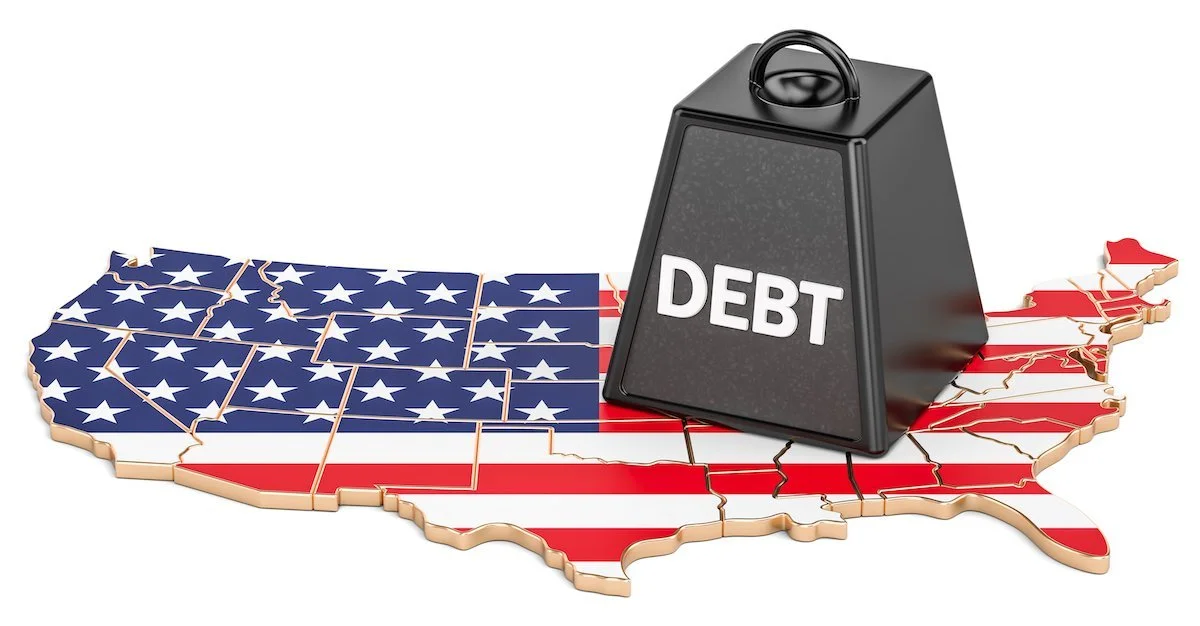
First, any time there’s a discussion about the national debt, invariably some idiot says something stupid like “the debt doesn’t matter because we owe it to ourselves.”
This is one of these irrational aphorisms (like “silence is violence”) that people like to repeat over and over again until they believe it to be true. But it’s not true. The debt matters. But let’s first examine who owns it:
Foreign governments like China, Japan, and Saudi Arabia hold a combined $7.4 trillion of US debt.
The Federal Reserve owns $5.1 trillion of US debt.
Social Security owns another $2.7 trillion of US debt, which of course is money owed to American retirees. Similarly, the Military Retirement Fund holds about $1.36 trillion.
State and local governments hold about $1.55 trillion combined in US debt.
Mutual funds own another $2.84 trillion.
Banks own trillions worth of the national debt. Banks buy US government bonds with their depositors’ money, i.e., YOUR money.
JP Morgan Chase alone owns about $300 billion worth of US government debt. Silicon Valley Bank famously held about $120 billion of US government debt before they went bust.
Even the Federal Deposit Insurance Corporation, which is supposed to guarantee bank deposits up to $250,000, owns about $128 billion worth of US government debt.
Then there are countless businesses and individuals around the world who own US government debt, simply because Treasury Bonds are considered “risk free”.
Now, when people say that “we owe it to ourselves”, they mean that most of the debt is NOT owed to foreigners. And this is true. Foreigners own just under 25% of the debt.
But does that make it OK to default on the other 75%? Is it somehow acceptable to default on banks across America, which bought US Treasuries with their customers’ money? Is it OK to default on 50+ million Social Security recipients? Or military retirees?
That’s why the “we owe it to ourselves” crowd is completely delusional. They seem to think that it doesn’t matter if the government defaults on, say, the Federal Reserve, or Social Security. But doing so would cause disastrous consequences — global economic meltdown, national social crisis, etc.
So, in order to avoid a major catastrophe, the debt needs to be repaid.
But with the national debt at 121% of GDP, is repaying it even possible anymore?
Technically, yes. And it all comes down to growth.
Back in the 1980s and 1990s, the US economy grew an average of 3.3% per year after adjusting for inflation; economists call this ‘real’ GDP growth.
But real GDP growth since 2000 has been much lower, averaging just 2%. And it turns out that the 1.3% difference in growth has had an enormous impact.
To give you an example, if real US economic growth had remained at 3.3% for the past 20 years, government tax revenue (which averages ~18% of GDP) would have grown substantially.
Along with some very modest spending restraint, budget deficits would have melted away over the past two decades, and America’s debt-to-GDP ratio would today be less than 50%… and falling.
And by 2033, the US national debt would be zero. Social Security would be completely funded. The US would have no financial challenges whatsoever. And the US dollar’s dominance would be sacrosanct.
Economic life today would be a completely different reality… if the US economy had only grown more quickly.
It’s not like an additional 1.3% growth isn’t achievable; again, the US consistently hit this number for decades.
You’d think that politicians would understand something so obvious, and that they’d do everything in their power to maximize growth. They’d embrace capitalism, cut red tape, create incentives for production, support small businesses, make taxes more efficient, etc.
Or at a minimum, they’d simply stay out of the way.
But instead, they do the opposite. They paid people to stay home and not work. They single out critical sectors (like energy companies) and punish them.
They constantly threaten businesses, invent new regulatory burdens, stifle innovation, and attempt to systematically destroy capitalism, brick-by-brick.
So, no, based on current trajectory, it looks like the debt problem will keep getting worse… until the catastrophes of default are unavoidable.
The federal government has already acknowledged that Social Security’s trust funds will run out of money in about 10 years. This means that, at best, America has less than a decade to turn itself around.
Again, technically this IS possible. But time is running out. And this is why it makes so much sense to have a Plan B.
To your freedom, Simon Black, Founder Sovereign Man
https://www.sovereignman.com/trends/america-has-less-than-a-decade-to-turn-itself-around-147721/
20 Tips To Stay Financially Healthy Without Sacrificing What You Want
20 Tips To Stay Financially Healthy Without Sacrificing What You Want
Cameron Huddleston Tue, Jun 20, 2023,
If you're trying to live on a budget, you might not feel like you can have the things you want.
But you don't have to resign yourself to living a bare-bones existence if your budget is tight -- it's possible to live on a budget and get some of the stuff you want.
Create a Budget That Prioritizes Needs
If your income is limited, make sure it covers your needs first. "Food, shelter, clothing and utilities are needs," said Donna Freedman, author of "Your Playbook For Tough Times. "The rest is just a series of wants."
20 Tips To Stay Financially Healthy Without Sacrificing What You Want
Cameron Huddleston Tue, Jun 20, 2023,
If you're trying to live on a budget, you might not feel like you can have the things you want.
But you don't have to resign yourself to living a bare-bones existence if your budget is tight -- it's possible to live on a budget and get some of the stuff you want.
Create a Budget That Prioritizes Needs
If your income is limited, make sure it covers your needs first. "Food, shelter, clothing and utilities are needs," said Donna Freedman, author of "Your Playbook For Tough Times. "The rest is just a series of wants."
Creating a budget can help. List the expenses you have to pay to survive. Add them up, and then subtract them from your income. If there's not much left over, you might have to make some sacrifices. Don't think of cutting out wants to cover needs as deprivation, though -- think of it as a smart use of available funds, Freedman said.
Build an Emergency Fund
If you're living on a budget, you might not think you can afford to set aside money each month in an emergency fund. But would you be able to afford an unexpected cost without savings?
"The thing that keeps you out of debt is to find room in your budget to grow your savings," McClary said. You won't be able to build your savings quickly, but if you can stash away a little each month, you can fall back on your emergency fund rather than go into debt when something unexpected happens.
Take Our Poll: What Kind of Money Advice Would You Most Trust From a Celebrity Expert Such as Warren Buffett, Mark Cuban or Suze Orman?
Tackle Your Debt in Smart Ways
When you're struggling with debt, you don't want to just keep paying the minimum balance on what you owe. However, you may not be able to afford much larger payments, so you should look at other smart ways to tackle your debt. A personal loan could consolidate that debt into one set regular monthly payment.
Take Advantage of Tax Breaks
If you're a low-wage worker, take advantage of tax breaks when you file your tax return -- such as the earned income tax credit. To qualify for the 2022 tax year, your income must fall below certain limits: from $16,480 if you're filing as single, head of household or widowed with no children, to $59,187 if you're married filing jointly with three or more children.
If the credit you receive is more than the taxes you owe, the IRS will refund you the difference. That tax refund can be used to help pay off debt, build an emergency fund or cover additional expenses.
Eat at Home
To continue reading, please go to the original article here:
https://finance.yahoo.com/news/20-tips-keep-finances-order-173104250.html
Millennial Money: Should You Financially Support Adult Kids?
Millennial Money: Should You Financially Support Adult Kids?
Elizabeth Ayoola of NerdWallet Mon, June 19, 2023
Some parents will tell you firsthand there’s no expiration date on this raising kids gig. For some, that means they extend financial help to their kids into adulthood. When I was 21 and got into a master’s program at a college of my dreams, my mom swooped in to help me pay for my degree. Many parents have been kind enough to do this and more.
When I say “many,” I’m backed up by a 2023 survey from Savings.com that found 45% of parents with a child 18 or older spend an average of over $1,400 per month supporting their kids financially, excluding adult kids with disabilities.
Millennial Money: Should You Financially Support Adult Kids?
Elizabeth Ayoola of NerdWallet Mon, June 19, 2023
Some parents will tell you firsthand there’s no expiration date on this raising kids gig. For some, that means they extend financial help to their kids into adulthood. When I was 21 and got into a master’s program at a college of my dreams, my mom swooped in to help me pay for my degree. Many parents have been kind enough to do this and more.
When I say “many,” I’m backed up by a 2023 survey from Savings.com that found 45% of parents with a child 18 or older spend an average of over $1,400 per month supporting their kids financially, excluding adult kids with disabilities.
But is this financial support always a good idea? A certified financial planner and a therapist who both have experience in this department share their thoughts.
Why Parents Support Adult Kids
There are many reasons a parent may choose to support their adult kids. Disabilities and wanting to help them achieve major life milestones are a couple. Shelmeshia Hill-Brown, the CEO of Wholistic Resolutions LLC in Chesapeake, Virginia, is a social worker and therapist who works with parents who financially support their adult kids. A major theme she sees is parents helping pay for school, especially since the pandemic. Buying a home and exploring infertility treatments are other reasons her clients financially support their kids.
While some parents offer financial support because they want to, others feel obligated even when it’s financially inconvenient. Sometimes, the obligation stems from guilt of not preparing their kids for financial independence early on, Hill-Brown says.
“They didn’t do that one-on-one time with them, to sit down and actually teach them,” she says. “But a lot of that also stemmed from, it never (being) done with them, as well, so they were learning along the way, and it made it a little bit more challenging to sit down and come up with a plan to implement with their own children.”
Risks Of Supporting Adult Children
Supporting your kids can be satisfying, but it also may be detrimental if you’re not financially secure. It also can affect retirement savings, which many Americans already have concerns about. Fidelity’s 2023 Retirement Savings Assessment tells us 52% of American households may not be able to cover essential expenses in retirement. And roughly 50% even plan to work during retirement.
To continue reading, please go to the original article here:
https://www.yahoo.com/lifestyle/millennial-money-financially-support-adult-012416588.html
It Takes A Lot Less Money To Feel Wealthy Than To Be It, Survey Finds
It Takes A Lot Less Money To Feel Wealthy Than To Be It, Survey Finds
Dylan Croll Mon, Jun 19, 2023
It takes more than $2 million to be wealthy, according to a new survey of everyday Americans. But it takes just a quarter of that figure for them to feel wealthy themselves. That’s one takeaway from Charles Schwab’s seventh annual modern wealth survey, which polled 1,000 Americans about saving, spending, investing, and wealth.
When asked what amount they considered wealthy, the survey respondents came back with an average of $2.2 million. Yet, among the 48% of Americans who already see themselves as rich, their average net worth was $560,000, survey found.
It Takes A Lot Less Money To Feel Wealthy Than To Be It, Survey Finds
Dylan Croll Mon, Jun 19, 2023
It takes more than $2 million to be wealthy, according to a new survey of everyday Americans. But it takes just a quarter of that figure for them to feel wealthy themselves. That’s one takeaway from Charles Schwab’s seventh annual modern wealth survey, which polled 1,000 Americans about saving, spending, investing, and wealth.
When asked what amount they considered wealthy, the survey respondents came back with an average of $2.2 million. Yet, among the 48% of Americans who already see themselves as rich, their average net worth was $560,000, survey found.
The results reveal the public’s shifting perception of what being rich means, with many associating wealth with wellbeing rather than simple net worth. But financial planning still plays a role in feeling wealthy, however one defines it, experts said.
Valerie Daval reacts to receiving a $100 bill from Secret Santa, right, a man from Kansas City who prefers to remain anonymous, at a Salvation Army thrift store in Los Angeles’ Lincoln Heights neighborhood on Friday, Dec. 13, 2013. He is a wealthy businessman who goes around anonymously at Christmas time, handing $100 bills to people he spies in places such as thrift stores, laundromats, health clinics, assistance centers and shelters. He gives away tens of thousands of dollars each year with no tax benefits. (AP Photo/Nick Ut)
Valerie Daval reacts to receiving a $100 bill from Secret Santa, right, a man from Kansas City who prefers to remain anonymous, at a Salvation Army thrift store in Los Angeles’ Lincoln Heights neighborhood on Friday, Dec. 13, 2013. (AP Photo/Nick Ut)
"People define wealth differently when they're asked about how to define a dollar amount or when they're asked what it means to be wealthy," Rob Williams, managing director of financial planning, retirement income and wealth management at Charles Schwab, told Yahoo Finance. "I think the actionable point that we would suggest is to think carefully about what wealth means to you comprehensively."
THE TAKEAWAY
When asked what they considered wealthy, Americans surveyed by Charles Schwab came back with an average of $2.2 million.
More than 3 in 5 Americans said having a healthy relationship with loved ones is a better way to describe wealth than “having a lot of money.” The survey also found that 40% of Americans mentioned "well-being" when asked about wealth, versus 32% who responded with "money" and 26% who said "assets".
For instance, when asked to describe what money means to them, 70% of Americans said "enjoying experiences" over "owning nice things." Also, 69% of Americans chose "having a healthy work-life balance," while less than half that share — 31% — selected maximizing their earnings. Around 63% chose good health, while 37% chose being successful.
"I think COVID probably caused some of this," Williams said. "[We’ve] all reevaluated what it means to be healthy, to be wealthy, to be confident about our financial lives, and a little bit more about our current lifestyles."
To continue reading, please go to the original article here:
The Most Important Companies In The World Are Absurdly Cheap
The Most Important Companies In The World Are Absurdly Cheap
Notes From the Field By Simon Black June 19, 2023
1866 was not an auspicious year to start a business in the United States.
America had just been devastated from a five year long civil war-- one of the bloodiest conflicts in US history. Plus the country was in the midst of a severe economic recession.
1866 was also the year that a major investment firm in London went bankrupt, triggering a worldwide financial panic. Capital was scarce. Interest rates were high. And overall business conditions were pretty dismal.
The Most Important Companies In The World Are Absurdly Cheap
Notes From the Field By Simon Black June 19, 2023
1866 was not an auspicious year to start a business in the United States.
America had just been devastated from a five year long civil war-- one of the bloodiest conflicts in US history. Plus the country was in the midst of a severe economic recession.
1866 was also the year that a major investment firm in London went bankrupt, triggering a worldwide financial panic. Capital was scarce. Interest rates were high. And overall business conditions were pretty dismal.
But despite such obvious challenges, 36-year old Hiram Bond Everest of Rochester, New York still saw tremendous opportunity in the burgeoning oil sector, and he started a business called Vacuum Oil Company.
Oil was primarily used for lighting in kerosene lamps at the time. But Everest, a former science teacher, conducted extensive experiments with vacuum distillation and discovered a way to produce a special heat-tolerant oil that was incredibly effective as a machine lubricant.
He called it ‘Gargoyle’ as a play on the word ‘oil’, and it took the market by storm.
The Industrial Revolution was still going strong in the 1860s, and businesses were constantly trying to find ways to improve their machinery’s output. But traditional lubricants like vegetable oils and animal fats were prone to smoking and overheating, which often caused machines to jam or break down.
Everest’s breakthrough product solved this problem; ‘Gargoyle’ could operate at very high temperatures and keep even the most complex machine parts running smoothly.
In fact Gargoyle was so effective that inventors were able to design far more advanced engines, including those used in automobiles and airplanes. Even the Wright Brothers relied on Vacuum Oil’s products for their historic first flight.
The company became wildly successful. In fact Vacuum Oil Company still exists today… though after a series of mergers and acquisitions over more than a century, it is now known as ExxonMobil.
No doubt there are countless activists who probably wish that Hiram Bond Everest had been a miserable failure… and that ExxonMobil didn’t exist at all. Big energy companies have long been the target of climate fanatics whose “science” is defined by Greta Thunberg.
Don’t misunderstand me-- I recognize that the climate is changing. It’s obvious. I also want my children to enjoy clean air and clean water, and I’ve invested pretty heavily in projects that benefit the environment.
But I’m also a practical, independent-minded person, and I reject irrational hysteria.
Many leading climate fanatics, for example, refuse to acknowledge the obvious economic and environmental benefits of nuclear power.
Instead their solution is to take away our gas stoves, force feed inefficient energy solutions like wind and solar onto the world, and destroy companies like ExxonMobil which produce conventional energy.
And the climate fanatics almost succeeded.
Two years ago, in fact, a climate activist hedge fund called ‘Engine No. 1’ managed to take over ExxonMobil’s Board of Directors after winning support from key investors. And their primary mission is to turn ExxonMobil green.
This victory opened the floodgates. Suddenly the climate fanatics thought that they were unstoppable and could take over every company in the world.
We’ve seen this attitude everywhere; over the past few years, woke fanatics felt empowered to take over everything-- mainstream media, major corporations, the education system, government, and more.
And frankly it’s been worrisome to see their relentless march.
But, finally, the sane people in the world are starting to say ‘enough is enough’.
We’ve seen entire school boards get voted out, and replaced with rational, non-woke citizens. We’ve seen people push back against idiotic brands like Target and Bud Light who feel the need to thrust social issues in their customers’ faces.
Cable news ratings are laughably low because nobody trusts them and people have tuned them out.
There are even signs of students pushing back against mandatory pride events at their schools; the kids aren’t intolerant, they just don’t want to be subjected to propaganda.
And now finally even investors have had enough.
Akio Toyoda is the Chairman of the Board for Toyota. And last year he committed the most obscene heresy when he defended gasoline engines and said that automakers shouldn’t ONLY produce electric vehicles.
Ever since then he’s been in the climate fanatics’ cross-hairs. And they recently tried to oust him at Toyota’s annual meeting last week.
But the climate fanatics failed miserably. Akio Toyoda won nearly 85% of the vote.
Similarly, a group of fanatical hedge funds also tried to push through a proposal that would require the company to jump through all sorts of silly climate hoops “to reduce risks for the company from climate change.”
But Toyota's shareholders shot this one down too.
This is more proof that rational people are really starting to push back.
It’s not about climate change, or any other social issue for that matter. It’s about rejecting a tiny, hysterical, out of touch elite who thinks they should dictate how the rest of us ought to live.
This trend is still nascent, but it’s growing. And that may make for an interesting opportunity ahead.
Thanks to these woke climate fanatics (plus their friends in government and media), shares of oil and gas companies are at laughably cheap levels.
Bear in mind that energy companies produce one of the world’s most critical resources, so these businesses are essential to the global economy.
Most of them are also highly profitable. Out of 51 large exploration and production companies (with a market cap over $1 billion), 49 of them are profitable.
But because the climate fanatics have made them so unpopular, their valuations are incredibly low, with an average P/E of just 5.8.
By comparison, Coca Cola stock trades at 27x earnings. Nike stock trades at 32x earnings. Even AB In Bev (Bud Light) stock trades at 20x earnings.
In contrast, energy companies are absurdly cheap. But if this trend continues and the climate fanatics keep getting rejected, they might not stay cheap for long.
To your freedom, Simon Black, Founder Sovereign Man
Americans’ 5 Favorite Cash Hiding Places — How Much Should You Keep at Home?
Americans’ 5 Favorite Cash Hiding Places — How Much Should You Keep at Home?
Nicole Spector Sun, June 18, 2023
For roughly the past 100 years, there has been an element of consumer distrust around banks. During the Depression, 9,000 banks failed. There was no FDIC insurance back then (that arose with the New Deal), and some $7 billion in customer deposits vanished. People were left penniless. Those depositors had more than enough reasons to justify their skepticism, disappointment and devastation when it came to banks.
Americans’ 5 Favorite Cash Hiding Places — How Much Should You Keep at Home?
Nicole Spector Sun, June 18, 2023
For roughly the past 100 years, there has been an element of consumer distrust around banks. During the Depression, 9,000 banks failed. There was no FDIC insurance back then (that arose with the New Deal), and some $7 billion in customer deposits vanished. People were left penniless. Those depositors had more than enough reasons to justify their skepticism, disappointment and devastation when it came to banks.
In the wake of the collapse of Silicon Valley Bank, Signature Bank and First Republic Bank, wariness toward banks has risen again. Scrutiny of and lack of trust in a bank’s security has been particularly strong with Gen Z, who are generally newer to banking than older generations.
A popular way to avoid keeping some (or all) of your money in the bank is to keep it at home. A recent survey from American Express Spending and Savings Tracker determined that 43% of Americans keep their savings in cash. Another survey, by Life And My Finances, found that 91.5% of Americans keep cash at home.
Where Americans Hide Their Cash
Additionally, the Life And My Finances survey found that Americans have a few favorite spots for hoarding their cold hard cash. Here’s where they’re most likely to stash it:
In a safe: 63.3%
Inside the refrigerator: 13.3%
In a suitcase: 6.1%
In a closet: 5%
In a water tank: 4%
What do finance experts think of these hiding spots and of keeping cash at home in general? And what’s their opinion on the ideal amount of cash to have on hand for emergency purposes and/or in the event they can’t get to their bank? Let’s find out.
There’s Only One Smart Spot for You To Keep Cash at Home
To continue reading, please go to the original article here:
https://www.yahoo.com/finance/news/americans-5-favorite-cash-hiding-130032728.html
The Awesome Dad Cheat Sheet
The Awesome Dad Cheat Sheet: 18 Fatherhood Tips They Should’ve Handed Out at the Delivery Room
Editor’s note: This is a guest post from Leo Babauta of Zen Habits, a father of six children.
Being a father can be a wonderful thing, once you get past all the gross stuff, all the stressful events, the loss of privacy, and the bewildering numbers of ways you can screw it up. But other than those few things, fatherhood is wonderful. Every dad has fears that he won’t be a great dad, that he’ll mess up, that he’ll be a failure. It comes with the job.
Unfortunately, what doesn’t come with the job is a simple set of instructions. As guys, we often will skip the manual, figuring we can wing it … but when things go wrong, it’s nice to have that manual to go back to. Fatherhood needs that manual.
The Awesome Dad Cheat Sheet: 18 Fatherhood Tips They Should’ve Handed Out at the Delivery Room
Editor’s note: This is a guest post from Leo Babauta of Zen Habits, a father of six children.
Being a father can be a wonderful thing, once you get past all the gross stuff, all the stressful events, the loss of privacy, and the bewildering numbers of ways you can screw it up. But other than those few things, fatherhood is wonderful. Every dad has fears that he won’t be a great dad, that he’ll mess up, that he’ll be a failure. It comes with the job.
Unfortunately, what doesn’t come with the job is a simple set of instructions. As guys, we often will skip the manual, figuring we can wing it … but when things go wrong, it’s nice to have that manual to go back to. Fatherhood needs that manual.
And while, as the father of six children, you might say that I’m qualified to write such a manual, it’s not true — I’m winging it like everyone else. However, I’ve been a father for more than 15 years, and with six kids I’ve learned a lot about what works and what doesn’t, what’s important and what you can safely ignore (unlike that odd grating sound coming from your engine).
What follows are the fatherhood tips I wish they’d passed out to me upon the delivery of my first child. It would have helped a ton. I hope they’ll help you become an even more awesome dad than you already are — feel free to refer back to them as a cheat sheet, anytime you need some help.
Cherish your time with them. One thing that will amaze you is how quickly the years will fly. My oldest daughter is 15, which means I have three short years with her before she leaves the nest.
That’s not enough time! The time you have with them is short and precious — make the most of it. Spend as much time as you can with them, and make it quality, loving time. Try to be present as much as possible while you’re with them too — don’t let your mind drift away, as they can sense that.
It gets easier. Others may have different experiences, but I’ve always found the first couple of months the most difficult, when the baby is brand new and wants to feed at all hours of the night and you often have sleepless nights and walk around all day like zombies. It gets easier, as they get a regular sleeping pattern.
The first couple of years are also a lot more demanding than later years, and as they hit middle school they become almost functioning, independent adults. It gets easier, trust me.
Don’t look at anything as “mom” duties — share responsibilities. While there are a lot of good things from our grandparents’ day that we should bring back, the traditional dad/mom split of parenting duties isn’t one of them. Some men still look at certain duties as “mom” duties, but don’t be one of those dads.
To continue reading, please go to the original article here:
https://www.artofmanliness.com/articles/18-tips-for-being-a-great-dad/
The Best Financial Advice From 7 Real Dads
The Best Financial Advice From 7 Real Dads
Jordan Rosenfeld
Learning how to earn, manage and invest money isn’t something that kids are typically taught in school. In fact, according to Youth.gov, many kids lack basic financial knowledge of everyday situations, from budgeting to reading an invoice. In one financial survey, high school seniors only scored an average of 48% correct, revealing a need for financial education. Who better to get money advice from, then, than dads with financial expertise? Here’s what seven fathers with real-life wisdom shared.
Adopt a Growth Mindset
Jonathan Sanchez, father of two, a real estate investor and co-founder of Parent Portfolio, teaches his kids to think beyond just how much something costs.
The Best Financial Advice From 7 Real Dads
Jordan Rosenfeld
Learning how to earn, manage and invest money isn’t something that kids are typically taught in school. In fact, according to Youth.gov, many kids lack basic financial knowledge of everyday situations, from budgeting to reading an invoice. In one financial survey, high school seniors only scored an average of 48% correct, revealing a need for financial education. Who better to get money advice from, then, than dads with financial expertise? Here’s what seven fathers with real-life wisdom shared.
Adopt a Growth Mindset
Jonathan Sanchez, father of two, a real estate investor and co-founder of Parent Portfolio, teaches his kids to think beyond just how much something costs.
“I give my kids the money advice to not think that they cannot afford anything, such as a toy or a game. Instead, I encourage them to ask themselves, how can they afford it? This question promotes a growth mindset that [they] can use in all aspects of life, including finances, such as having a savings goal.”
When his 7-year-old son wanted to subscribe to an online learning game, the boy came up with the idea of selling his unused toys to help him reach his goal.
Maximize Your Retirement by Starting Early
For young people, retirement is a theoretical idea that will happen “someday.” But according to dad David Steiner, a principal of Zebulon Tax Advisory LLC, the earlier you start putting money away for that day, the more likely you won’t have to worry about money in retirement. For example, he ran the numbers on a 401(k).
The math is simple: “$20,000 (limit is $19,500) per year for 20 years is $400,000, and with growth at 6% (which is really low, the market averages 9-11%), it will turn into about $865,000. If you increase the rate of return to 8%, the amount is now about $1.2 million. Not bad. If held for 40 years at 6% — $3.4 million, 8% — over $6 million — one can retire on that comfortably.” The same goes for an IRA.
Pay Yourself First, but Live Below Your Means
Bryce Welker, owner and CEO of CPA Exam Guy, an e-learning and course review resource for CPA exam candidates, tells his kids two main things:
“One would be pay yourself first, the second would be live below your means. The first is an inducement to save money. Whenever you get paid, whether that’s through investing or employment income, prudent financial planning for the future involves setting aside money for your savings account first before spending money on anything else. The next budgetary allocation would be to your bills, followed by discretionary spending.”
To continue reading, please go to the original article here:
https://finance.yahoo.com/news/best-financial-advice-7-real-110000968.html
15 Money Truths Your Successful Friends Won’t Tell You
15 Money Truths Your Successful Friends Won’t Tell You
Dan Ketchum Fri, Jun 16, 2023,
Are you tired of working the same job you've sworn to quit countless times? You might be stuck in a rut -- and your more successful friends have noticed. You might envy their Saturday morning hikes and large retirement accounts, but it might simply be a result of not approaching problems or opportunities like they do.
If you're wondering what your successful friends are thinking about the way you manage work and money, take a seat because here is what they're not telling you.
15 Money Truths Your Successful Friends Won’t Tell You
Dan Ketchum Fri, Jun 16, 2023,
Are you tired of working the same job you've sworn to quit countless times? You might be stuck in a rut -- and your more successful friends have noticed. You might envy their Saturday morning hikes and large retirement accounts, but it might simply be a result of not approaching problems or opportunities like they do.
If you're wondering what your successful friends are thinking about the way you manage work and money, take a seat because here is what they're not telling you.
You Need To Budget
You know that friend you're always hitting up for money? Well, that friend thinks you'd really benefit from a budget. Fortunately, making one just takes a little commitment.
"Find an app or system that works well for you, such as Mint, You Need A Budget or just an Excel spreadsheet," said Kate Holmes, a certified financial planner and Belmore Financial founder. "Import the last few months of all checking, debit and credit card transactions, and see where things are at. You'll likely be surprised by some of the category totals."
Holmes encourages you to consider how much happiness each budget item brings you, as means of tracking down unnecessary expenses. Here's a breakdown she recommends:
50% of your take-home pay for food, housing and necessities
30% for discretionary spending
20% for paying off debt and building savings
You Don't Save Enough
Bad news for those dreaming of retirement: Most of us won't be retiring in style if we rely solely on Social Security benefits. In 2023, the average monthly Social Security check is just $1,751 for retirees. So, what can you do to prevent tarnished golden years?
Utilize your workplace retirement plan and take advantage of your employer's matching program, said consumer finance expert Kevin Gallegos, vice president of Phoenix operations for Freedom Financial Network. Gallegos recommends saving 10% to 15% of your gross pay for retirement. If you can't swing that, just start with what's manageable for you.
You Have Too Much Credit Card Debt
The financially savvy see credit cards as a convenience, not a debit account. A GOBankingRates survey found that 50% of Americans have credit card debt. If you carry a high balance month to month and have high interest rates, you're paying a premium for the same purchases your debt-free friends make.
Dodge debt and avoid using credit cards except in emergencies. "Few, if any, investments will return as much," Gallegos said. "Having no credit card debt provides a financial cushion itself." If you're having trouble doing this, you can consider some ways to avoid or get out of credit card debt.
You Don't Invest
To continue reading, please go to the original article here:
https://finance.yahoo.com/news/15-money-truths-successful-friends-130126236.html
Case Closed & Lessons Learned
Case Closed & Lessons Learned
Robert C. Port | Mar 8, 2023
EVERYTHING I KNOW about managing money I learned in court. As part of my legal practice, I represent people involved in disputes over money or property. These can include claims against financial advisors for alleged misconduct, contested wills and trust disputes, and family members at odds over a family business.
These disputes can teach us important personal finance lessons. Here are four lessons—learned the hard way—from four cases my firm handled. All are based on an actual case, though names and details are changed to protect the litigants’ privacy.
Case Closed & Lessons Learned
Robert C. Port | Mar 8, 2023
EVERYTHING I KNOW about managing money I learned in court. As part of my legal practice, I represent people involved in disputes over money or property. These can include claims against financial advisors for alleged misconduct, contested wills and trust disputes, and family members at odds over a family business.
These disputes can teach us important personal finance lessons. Here are four lessons—learned the hard way—from four cases my firm handled. All are based on an actual case, though names and details are changed to protect the litigants’ privacy.
Case No. 1: Life insurance goes to the ex-spouse. Jane and John’s divorce was bitter. Even after their divorce was final, Jane had to go back to court asking that John be held in contempt for failing to pay child support. Imagine, then, Jane’s surprise when 15 years later she received a letter from a life insurance company expressing its condolences on John’s death—and enclosing the forms necessary to claim his $1 million policy.
Jane was listed as the beneficiary of John’s life insurance policy, which the insurance company was obligated to follow under state law. John’s widow promptly sued to try to prevent Jane from getting the payment. Still, the court awarded the $1 million policy proceeds to Jane, along with a small bank account, for which Jane was also listed as a joint owner at John’s death.
Lesson learned: If you’re contemplating divorce, identify all financial assets which have a survivorship or beneficiary designation. These can include life insurance, and bank, brokerage, and retirement accounts. Discuss with your divorce attorney how they should be addressed.
In some states, a divorce automatically prevents an ex-spouse from being the beneficiary of a life insurance policy or receiving the financial accounts of an ex-spouse. In others states, however, the divorce decree must specifically disclaim all future rights. If it doesn’t, the law treats written beneficiary directives that are in effect at death as the deceased’s final wishes for where assets should go—even if it’s to the ex-spouse.
Case No. 2: A widow is sold unsuitable annuities and life insurance.
To continue reading, please go to the original article here: