
How Do You Know If You’re Frugal Or Just Ridiculous?
How Do You Know If You’re Frugal Or Just Ridiculous?
The Frugal Girl November 9, 2022
A reader question: How do you know if you’re frugal or just ridiculous? There seems to be a thin line. For example, is it frugal or ridiculous to postpone shopping for new undergarments for a year because new undergarments are not necessary for survival?
In the years that I have been reading content about frugality, I have noticed that this is a common theme/question/issue. How frugal is TOO frugal? What’s sensible, and what’s just cheap?
Where’s the line between frugality and deprivation?
How Do You Know If You’re Frugal Or Just Ridiculous?
The Frugal Girl November 9, 2022
A reader question: How do you know if you’re frugal or just ridiculous? There seems to be a thin line. For example, is it frugal or ridiculous to postpone shopping for new undergarments for a year because new undergarments are not necessary for survival?
In the years that I have been reading content about frugality, I have noticed that this is a common theme/question/issue. How frugal is TOO frugal? What’s sensible, and what’s just cheap?
Where’s the line between frugality and deprivation?
I’ll write down a couple of principles I use to guide me, and then I’d love to hear your thoughts!
A few notes:
I’m writing this from the perspective of the most frugal household member since that’s always been my role
I have in mind people who are choosing to be frugal, not people who will literally go hungry if they don’t save every penny possible
Everyone gets to decide this for themselves
Since we all have different backgrounds, priorities, and sets of expectations, the answer to these questions is going to vary from person to person.
One person’s frugal might be another person’s deprivation, for example.
As long as a person’s frugal choices aren’t harming another person or harming themselves, I think they should be left in peace, even if others might happen to view their choices as too extreme.
A lot of us don’t live by ourselves, though, so…
You should compromise with other household members
The odds of everyone in your household having the exact same standards for frugality are very low.
And since some frugalities do not just affect you, you need to consider other people’s comfort levels as well. Frugality is important, but so are relationships!
This means that if a fellow household member is miserable if you keep the heat at 65 degrees, you should compromise.
Or if you don’t mind using raggedy bath towels, but a family member hates it, you should probably get some new bath towels for that person to use, even if you continue to use the raggedy ones.
And hopefully, the less-frugal members of your family will also compromise and humor you. Flexibility on both sides is key! Most cheapness is selfish I think the line between frugal and cheap often comes down to a selfishness issue.
When your money-saving efforts affect just you, and they don’t cause harm to anyone else, that’s frugal.
When your money-saving efforts hurt or deprive someone else, that’s when you’ve crossed the line into cheap.
To continue reading, please go to the original article here:
https://www.thefrugalgirl.com/how-do-you-know-if-youre-frugal-or-just-ridiculous/
Where Do Billionaires Keep Their Money?
Where Do Billionaires Keep Their Money?
Andrew Dehan Sunday, December 25, 2022
Billionaires have been able to not only acquire wealth but most have gradually built it over time. This means that many have had successful investments, which makes it natural for everyone else to wonder where they are investing or keeping their money in order to see that growth. We’ve compiled a list of some of the most common investments that billionaires make when looking for sustained growth of their money over time.
Keep in mind, though, that billionaires don’t typically manage their own money and instead choose to work with a financial advisor to help with their asset allocation.
Where Do Billionaires Keep Their Money?
Andrew Dehan Sunday, December 25, 2022
Billionaires have been able to not only acquire wealth but most have gradually built it over time. This means that many have had successful investments, which makes it natural for everyone else to wonder where they are investing or keeping their money in order to see that growth. We’ve compiled a list of some of the most common investments that billionaires make when looking for sustained growth of their money over time.
Keep in mind, though, that billionaires don’t typically manage their own money and instead choose to work with a financial advisor to help with their asset allocation.
1. Cash and Cash Equivalents
Cash and cash equivalents are common places where billionaires keep of some their money. Though not often thought of as an investment, cash is a liquid asset, meaning you can use it in a variety of ways as needs or desires arise. In a crisis, having cash on hand gives you the flexibility to respond. That’s why billionaires keep a significant portion of their money in cash and cash equivalents.
However, with current rates of inflation, cash has less of an emphasis. Inflation causes the value of money to drop, so having too much of it on hand during an inflationary period can mean you lose significantly.
2. Commodities
Commodities are often another piece of a billionaire’s portfolio, and having such assets can help hedge against risk, inflation and volatility. For instance, in a scenario where inflation is causing difficulty for the rest of the market, having investments in raw materials whose price is rising can help protect you if other parts of your portfolio are suffering. People and economies depend on commodities, and inflation makes them worth more money.
Raw materials and agricultural products – like precious metals, industrial metals like copper, oil and natural gas, coffee, corn, pork bellies and soy beans – are popular types of commodities held and traded by billionaires or their agents.
3. Foreign Currencies
To continue reading, please go to the original article here:
https://news.yahoo.com/8-places-billionaires-keep-money-130030395.html
7 Wealth Building Tips Learned From Football
7 Wealth Building Tips Learned From Football
By Billy B Mind, Money
I fell in love with NFL football 15 years ago, and it has inspired me in many ways on how to build wealth. Once I understood the mentality, strategy, and toughness it takes to win games on Sundays, I was hooked. A football game is much more than mindless buffalo-sized men running into each other. It is a beautiful chess match with human beings that move like coordinated pieces. Building wealth, like football, is a thinking person’s game. Here are seven secret wealth building tips I have found hidden inside the game of football:
7 Wealth Building Tips Learned From Football
By Billy B Mind, Money
I fell in love with NFL football 15 years ago, and it has inspired me in many ways on how to build wealth. Once I understood the mentality, strategy, and toughness it takes to win games on Sundays, I was hooked. A football game is much more than mindless buffalo-sized men running into each other. It is a beautiful chess match with human beings that move like coordinated pieces. Building wealth, like football, is a thinking person’s game. Here are seven secret wealth building tips I have found hidden inside the game of football:
1) Wealth Building Tip #1: Be Patient: Life is long. It’s Ok to make mistakes, and it takes a lot of plays to win the game and build your wealth. There are 60 minutes in a football game, and there’s 60+ years in a normal life. You don’t have to win or be perfect in the first quarter or half to win. Great football teams and players take their time, feel out the challenges that are coming at them, and then when they know what they’re doing, they strike to put points on the board.
Great wealth builders have the same mentality. They’re patient. They’re always learning, preparing, and planning for what’s coming ahead, and when they see opportunities to build wealth, they strike. Great NFL teams also make mistakes during a game, but they learn from them and come back to fight again. Financial mistakes happen to all of us. Learn from them. Don’t let your perfectionism get in the way. (Click here to read an article on overcoming perfectionism) Then get back up, learn from the mistakes, and fight to do better next time.
2) Wealth Building Tip #2: It takes a team to win a championship, not just individual effort. Football teams win championships by using all 53 men that are on their rosters. Each player contributes different skills to create a powerful team that rises above the sum of their parts. Wealthy people think the same way. They are always looking to expand their network of skilled people who push, teach, and inspire them.
Happiness is not real unless shared with others. People who build wealth know how valuable relationships are in their life. It’s not about how smart, skilled, or strong you are as an individual. Building wealth is all about how smart, skilled, and strong your TEAM of friends around you is.
Wealthy people invest a large portion of their time building teams of awesome relationships who help inspire them to be better. Grow your network of friends to include incredible people who inspire you, and you will take a massive step forward on the path to build wealth.
To continue reading, please go to the original article here:
Top Wealth Management Firms
Top Wealth Management Firms
By Mark Kolakowski Updated on September 2, 2022
When you're in the process of selecting the best wealth management firm to work for, some factors to narrow the field is to focus on the top firms in to look at profitability, wealth manager head count and outlook for the wealth management business shared by the management.
What Is a Wealth Management Firm?
Top Wealth Management Firms
By Mark Kolakowski Updated on September 2, 2022
When you're in the process of selecting the best wealth management firm to work for, some factors to narrow the field is to focus on the top firms in to look at profitability, wealth manager head count and outlook for the wealth management business shared by the management.
What Is a Wealth Management Firm?
Wealth management firms offer a wide range of financial and investment advisory services, typically, to high networth clients. Although the definition of the wealth market is a highly elastic one and it can vary by firm, a generally accepted variant includes clients with at least $1 million in financial assets, but many firms set the bar lower.
Here's a look at some of the big named wealth management firm, in no particular order.
UBS
In 2021, UBS generated roughly $4.8 billion in pre-tax profit from wealth management activities, representing a little over 50% of $9.48 billion pre-tax profit for the firm as a whole.1
While UBS is known for its aggressive cost and headcount-cutting, at the end of 2021, UBS had more than 9,300 financial and wealth advisors.2
Note: In January 2022, UBS agreed to acquire digital wealth management company Wealthfront in a push to attract Gen Z and millennial wealth management client. The deal will add more than 470,000 clients with over $27 billion in assets to UBS.3
Bank of America
Many people know Bank of America as their friendly neighborhood Bank offering senior citizens free checking. Actually, Bank of America is the parent company of Merrill Lynch, and it also includes its Bank of America Private Wealth Management divisions in its segment reporting for Global Wealth and Investment Management.
In 2021, the net income for Bank of America's global wealth management business, clocked nearly $4.33 billion. At the end of 2021, the company had a huge roster of more than 18,800 wealth advisors.4
Wells Fargo
Wells Fargo offers diverse wealth management services. For 2021, Wells Fargo's wealth and investment management business segment reported net income of over $2 billion, which represents around 9% of the the firm's total $21.5 billion net income for the year.5
To continue reading, please go to the original article here:
https://www.thebalancemoney.com/top-wealth-management-firms-1287460
What Does Financially Independent Mean?
What Does Financially Independent Mean?
Financial Independence Explained
By Miriam Caldwell Updated on July 1, 2022
For most people, it is hard to reach financial independence without a job that allows them to be self-sufficient. But it's taking young people longer to reach this milestone than it did in the past. Forty years ago, most people were able to get a job that made them financially independent in their 20s. Today, according to a study from the Georgetown University Center on Education and the Workforce (CEW), it takes most young adults until their 30th birthday to get a job that allows them to support themselves fully.1
What Does Financially Independent Mean?
Financial Independence Explained
By Miriam Caldwell Updated on July 1, 2022
For most people, it is hard to reach financial independence without a job that allows them to be self-sufficient. But it's taking young people longer to reach this milestone than it did in the past. Forty years ago, most people were able to get a job that made them financially independent in their 20s. Today, according to a study from the Georgetown University Center on Education and the Workforce (CEW), it takes most young adults until their 30th birthday to get a job that allows them to support themselves fully.1
Even if you are still searching for a job that allows you to be economically self-sufficient, you can still take steps to work towards becoming financially independent. Learn more about financial independence and how you can take steps to get there more quickly.
Key Takeaways
To be financially independent, you must have enough income to cover your own bills and expenses.
Many young adults struggle to be financially independent of their parents due to the rising cost of living.
To work towards financial independence, begin saving to move out on your own, pay down debt, and manage your money with a budget.
Being financially independent also means planning for the future. Invest for retirement, build an emergency fund, and work toward other long-term financial goals.
What Does It Mean To Be Financially Independent?
If you are financially independent, you are responsible for your own expenses. You no longer rely on a parent, guardian, or another family member to provide money for you or cover your bills. You are paying your daily expenses and planning for the future, and you are able to meet your basic needs.
Reaching financial independence will take longer for some than for others. It will also depend on your own lifestyle and needs. For example, if you need to pay for college or graduate school, you may consider living at home for a while to save money. In this case, financial independence would be a few years away.
Note: Financial independence can also be the point where you no longer need to work in order to cover your daily expenses. For most people, this won't occur until retirement.
When To Become Financially Independent
Working towards financial independence may mean different things depending on the cultural and social environment that you grew up in. Some families may expect adult children to fully support themselves beginning at age 18. For others, it may be expected that adult children will continue to live at home or receive assistance from their parents, even once they are working full-time.
To continue reading, please go to the original article here:
https://www.thebalancemoney.com/when-should-i-become-financially-independent-2385820
What Is Wealth Management?
What Is Wealth Management?
Definition & Examples of Wealth Management
By Tim Lemke Updated on June 8, 2022
Wealth management is a kind of financial advisory service for accredited investors and others with high net worth. Wealth managers provide advice about investing, estate planning, taxes, and anything else that can help grow a client's wealth. Understanding how wealth management works and how it compares to asset management can improve your financial picture.
What Is Wealth Management?
Definition & Examples of Wealth Management
By Tim Lemke Updated on June 8, 2022
Wealth management is a kind of financial advisory service for accredited investors and others with high net worth. Wealth managers provide advice about investing, estate planning, taxes, and anything else that can help grow a client's wealth. Understanding how wealth management works and how it compares to asset management can improve your financial picture.
Definition and Example of Wealth Management
People who have a high net worth may need more services than those offered by traditional financial advisors. Those with millions—perhaps even billions—of dollars may have complex portfolios, complicated tax situations, and other needs that are unlikely to apply to average investors.
Wealth managers often have access to a wider range of financial products and services. Clients pay a fee, but they receive strategies designed with their finances in mind. Services offered by wealth managers may include:
Investment management and advice, including retirement planning
Accounting and tax services
Review of health care and Social Security benefits
Charitable giving plans
Help with starting or selling a business
You likely don’t need a wealth manager if you don't have a high net worth. You may instead prefer to pay for a financial or investment advisor who can help you grow your money over time.
Note: A financial advisor may be able to help you build your wealth. But a wealth manager can help you manage your money when you’ve already achieved a high net worth.
How Does Wealth Management Work?
Like most financial advisors, wealth managers earn their income by taking a percentage of the assets they manage. These fees can vary among firms and even across different types of accounts within the same firm. You can expect to see fees start around 1% of assets under management.
Breaking into wealth management is a good career move for financial advisors. A wealth manager would earn $50,000 in commissions in a year from one client if they were to charge a fee of just 0.50% to a client with $10 million in their portfolio. The more clients a wealth advisor has, the more those fees add up.
To continue reading, please go to the original article here:
What Is Wealth?
What Is Wealth?
By Amanda Page Updated on December 30, 2021
Wealth is an individual’s or household’s net worth, which consists of assets such as money in savings and investment accounts minus debts like loans and mortgages.
Definition and Examples of Wealth
Wealth is often regarded as household net worth, which is the total value of assets minus any debt (“liabilities”). Therefore, if an individual or household owns an asset, then they have the potential for wealth, depending on the size of their debt, and their own perception of how much money it takes to be “wealthy.”
What Is Wealth?
By Amanda Page Updated on December 30, 2021
Wealth is an individual’s or household’s net worth, which consists of assets such as money in savings and investment accounts minus debts like loans and mortgages.
Definition and Examples of Wealth
Wealth is often regarded as household net worth, which is the total value of assets minus any debt (“liabilities”). Therefore, if an individual or household owns an asset, then they have the potential for wealth, depending on the size of their debt, and their own perception of how much money it takes to be “wealthy.”
“You can value wealth in many different ways,” Matthew Ricks, a certified financial planner and president of Haystack Financial Planning, told The Balance by email. “For some, it’s being free of a mortgage. [Others] will say it takes owning $1 million. Some say multi-millions. It’s so individual.”
Ricks went on to note that income and wealth are not the same things; just because you earn a lot of money doesn’t mean you’re wealthy.
“Look at all the singers and athletes who go bankrupt,” Ricks said. “They made a lot and then spent even more.”
Note
There is subjectivity in how individuals define “wealth.” For instance, in a survey of 1,000 Americans, brokerage firm Charles Schwab learned that most believe an average of $1.9 million in personal net worth is necessary to be considered “wealthy” in 2021, but the previous year’s respondents said “wealthy” was $2.6 million in net worth.1
How Wealth Works
In most cases, wealth is inherited or self-made. To develop wealth, you must first define what wealth means to you. Once you’re aware of your own definitions, you can begin to gather information and make a plan to build wealth.
“You really have to think about what you want out of it,” Ricks said. “Do you want to work specific hours or make [a] specific [amount of] money? Do you want to own a successful business or have the freedom to buy time?”
To begin building wealth, it helps to calculate your net worth: Subtract your assets from your debt. You can then develop a wealth plan, which has key components that include saving, investing, paying down debt, and protecting the assets you accumulate.
To continue reading, please go to the original article here:
The Best Banks for Millionaires
The Best Banks for Millionaires
By The Balance Editors Updated on November 30, 2022
Banks are essential for everybody, but millionaires and other high-net-worth (HNW) customers need to be especially choosy about the banks they choose. With more money at stake—and more money at the disposal of the bank—the experience is quite different for wealthy individuals.
Many HNW individuals choose to work with a private bank—either a stand-alone company or the private banking division of a larger banking corporation—that focuses on the management of wealth.
The Best Banks for Millionaires
By The Balance Editors Updated on November 30, 2022
Banks are essential for everybody, but millionaires and other high-net-worth (HNW) customers need to be especially choosy about the banks they choose. With more money at stake—and more money at the disposal of the bank—the experience is quite different for wealthy individuals.
Many HNW individuals choose to work with a private bank—either a stand-alone company or the private banking division of a larger banking corporation—that focuses on the management of wealth.
Account Features for HNW Customers
Banks stand to earn more off of their relationships with HNW clients, so they’re eager to reward you and compete for your business. As you shop for private banks and other companies you feel could meet your needs, compare these features.
Higher APY: With a significant savings account balance, you should be eligible to earn more—a higher annual percentage yield (APY)—on your deposits. Evaluate how much banks pay at different levels and shop around. But you may find that, even as a millionaire, online banks are the best place for idle cash.1
Dedicated customer service: Most financial institutions have specialized departments for HNW customers, and it pays to work with those teams. You get access to experienced individuals who have excellent customer service skills and are more empowered to solve problems for high-priority clients.2
Free services: Although you can afford to pay $35 for a wire transfer, it’s nice to get things for free. With a sizable account balance, you should automatically enjoy no monthly fees, free cashier’s checks, free stop payment requests, a safety deposit box, and more. ATM rebates are more or less standard for HNW customers.3
Higher payment limits: Standard bank rules may be inconvenient for millionaire customers, who often need to move large sums. But private banking arrangements typically allow for much larger debit card purchases, higher ATM withdrawal limits, and generous ACH transfers.4
Better borrowing: Look for lower interest rates on loans, but don’t expect free money. Still, banks are willing to waive origination fees and other closing costs, as well as move your application through underwriting quickly.5 They might even make exceptions when you don’t fit the standard profile.
Cash management accounts: Some firms that traditionally served brokerage needs now want your banking business. Cash management accounts, with competitive interest rates and ATM rebates, are ideal for millionaires who prefer to manage their finances themselves.
Plus, cash management accounts can spread funds among multiple banks to provide more than $250,000 of FDIC insurance in a single account. For example, the Fidelity Cash Management account uses bank partnerships to place up to $1,250,000 in FDIC-insured accounts.6
If you choose to use a cash management account, read all of the details to ensure all of your money is protected.
Setting Your Priorities
To continue reading, please go to the original article here:
https://www.thebalancemoney.com/top-accounts-used-by-millionaires-4165695
It’s Okay to Be in Debt, Just Not Okay to Stay in Debt
It’s Okay to Be in Debt, Just Not Okay to Stay in Debt
Ever since college, I always thought I was good with money. At least, that’s what I’d tell myself in my 20s. At the age of 25, I was completely debt-free! Yet, we somehow managed to accumulate nearly $200,000 in debt by age 30.
Most purchases were relatively normal in this day and age: a house, student loans, newer cars, a wedding, a condo at the lake. Oh wait, a lake house is not typical, but it happened. While getting into debt was not ideal, I don’t regret any of it, and thankfully we had the financial means to dig out. I know not everyone is as fortunate. Regardless, this is our story.
It’s Okay to Be in Debt, Just Not Okay to Stay in Debt
Ever since college, I always thought I was good with money. At least, that’s what I’d tell myself in my 20s. At the age of 25, I was completely debt-free! Yet, we somehow managed to accumulate nearly $200,000 in debt by age 30.
Most purchases were relatively normal in this day and age: a house, student loans, newer cars, a wedding, a condo at the lake. Oh wait, a lake house is not typical, but it happened. While getting into debt was not ideal, I don’t regret any of it, and thankfully we had the financial means to dig out. I know not everyone is as fortunate. Regardless, this is our story.
Going Nearly $200,000 in Debt
After graduating from college with a master’s degree at the age of 25, I started life with a clean slate. I had a little bit of savings in the bank that I could scrape together over the years. My “college fund” was a total of $6,000, and since I never had to use it, my parents gave it to me after graduating.
In addition, I had managed to save a few thousand dollars more over the years from my job, waiting tables and bartending in college. So at age 25, I had no debt and a decent amount of money to start my life.
If I could do it all over again, there are things I would do differently. Regardless, by my 30th birthday, we had managed to accumulate nearly $200,000 in debt. How did this happen?
Our road to accumulating this debt is not all that uncommon. Many life events can take place soon after graduating from college.
First was the newer car “needed” since I had a better-paying job and could afford it. That, of course, came with a five-figure loan.
Next was planning for a wedding. This included purchasing an engagement ring and paying for our wedding. In total, this cost us somewhere between $20,000 and $25,000. We mostly paid with savings, but it still set us back financially.
Along the way, Mrs. FP decided to go back to school to get her teaching certificate. Unfortunately, we stared at almost $50,000 in student loan debt once she graduated.
Then, of course, we needed to live somewhere. We purchased my grandparents’ old house shortly after my grandmother passed away. The house was purchased below market value though we still ended up with a $100,000 mortgage and a home that needed to be completely renovated. We are still spending money renovating this house ten years later.
And last but not least, we ended up buying a lake house with family. This also included buying a wave runner and chipping in to buy a boat. My parents paid for the down payment, and for nearly ten years, we’ve split the monthly payments along with my two other brothers.
Shortly after agreeing to buy the lake house, we found ourselves in a bank lobby taking out a home equity loan because two bathrooms were leaking into our basement.
More debt.
And yes, we went in on the lake house purchase already nearly $200,000 in debt. I’m a terrible personal finance blogger, I know.
Drowning in Debt
At that moment in the bank lobby back in 2011, we decided enough was enough. It was time to face the fact that we were slowly going down a path of debt accumulation that would be difficult to unwind if we continued pressing forward. Next would have been an even bigger house and nicer cars. But, instead, we decided that day to face our debt and begin paying it off.
Here’s the thing: besides the lake house purchase, all of those events are relatively normal in today’s society. Maybe not in the financial independence community, though definitely in this day and age. I’m not saying it’s right or wrong, but that’s reality.
To continue reading, please go to the original article here:
How Many Gifts Should a Child Get for Christmas?
How Many Gifts Should a Child Get for Christmas?
By One Frugal Girl
How many gifts should you give your kids for Christmas? Is there a magic number of presents? The perfect amount that makes kids feel happy, satisfied, and grateful?
In most instances, I think four is enough. After choosing something they want, something they need, something to wear, and something to read, you’ve got your kids covered.
But not everyone agrees with this approach. After reading about my four-gift rule for Christmas, a long-time reader told me she didn’t like my gift-giving advice.
How Many Gifts Should a Child Get for Christmas?
By One Frugal Girl
How many gifts should you give your kids for Christmas? Is there a magic number of presents? The perfect amount that makes kids feel happy, satisfied, and grateful?
In most instances, I think four is enough. After choosing something they want, something they need, something to wear, and something to read, you’ve got your kids covered.
But not everyone agrees with this approach. After reading about my four-gift rule for Christmas, a long-time reader told me she didn’t like my gift-giving advice.
“Limiting the number of gifts takes the fun out of Christmas,” she said. “Christmas should be filled with stacks of presents and happy children ripping into wrapping paper.”
Will Limiting Gifts Ruin Christmas?
I love when readers voice their opinions, so I dove into the insightful list of thoughts and questions.
Can Christmas be Christmas without lots of presents?
Can the holidays feel magical with fewer gifts?
And most importantly:
Won’t limiting gifts ruin Christmas?
Christmas Magic Doesn’t Exist in Boxes
I understand her misgivings because I once felt them myself.
For years, I convinced myself that Christmas lived in big boxes; the bigger the box, the better! But, in truth, it’s not the quantity or size of gifts that makes Christmas magical.
Thank back on your childhood. How many unique gifts do you remember? I bet most years are a blur. But do you remember decorating the house, searching for Christmas lights, eating Christmas dinner, or the warm feeling of sitting around the tree with your family?
Growing up, Christmas was the one day of the year when we woke up early and gathered together. My dad cooked pancakes while we watched from the kitchen table. We slathered those pancakes with butter and syrup and giggled at his Swedish Chef impersonation.
Magic didn’t come from the mountain of gifts I can no longer remember. It came from a stress-free morning, sitting in our pajamas and enjoying each other’s company. When I think back to the cozy holidays of my youth, it’s not the gifts I remember. It’s the sound of my dad’s laughter.
How Many Christmas Gifts Per Child?
How many gifts should a child get for Christmas? There are all sorts of rules for gift-giving. The three-gift rule, the four-gift rule, the seven-gift rule, and even the ten-gift rule, but for me, the ideal amount is the number of presents my children will use and appreciate.
To continue reading, please go to the original article here:
https://www.onefrugalgirl.com/how-many-christmas-gifts-per-child/
Why Housing is More Important Than the Stock Market
Why Housing is More Important Than the Stock Market
Posted May 27, 2022 by Ben Carlson
I know a lot of finance people want to blame the Fed for everything these days but central banks aren’t the sole culprit of the inflationary environment we find ourselves in.
The pandemic seriously screwed up global supply chains and the labor market. Governments around the world spent trillions of dollars to keep the global economy afloat while we put things on ice for a while. Consumers began spending money en masse on goods because they stopped spending on experiences and had nothing else to do.
Why Housing is More Important Than the Stock Market
Posted May 27, 2022 by Ben Carlson
I know a lot of finance people want to blame the Fed for everything these days but central banks aren’t the sole culprit of the inflationary environment we find ourselves in.
The pandemic seriously screwed up global supply chains and the labor market. Governments around the world spent trillions of dollars to keep the global economy afloat while we put things on ice for a while. Consumers began spending money en masse on goods because they stopped spending on experiences and had nothing else to do.
And yes, the Federal Reserve was extremely loose with monetary policy to keep the credit markets functioning and bring the unemployment rate down.
Even though it wasn’t completely their fault, it seems like the Fed is now the only one trying to clean up the inflationary mess by tightening monetary policy.
They’re doing this in two ways:
(1) By raising interest rates and unwinding quantitative easing (bond purchases).
(2) Signalling to the financial markets they may have to throw the economy into a recession to slow inflation.
The Fed cannot fix supply chains but they can raise rates high enough that it cools demand.
Former New York Fed chair Bill Dudley says one way to do this is through the wealth effect:
In contrast to many other countries, the U.S. economy doesn’t respond directly to the level of short-term interest rates. Most home borrowers aren’t affected, because they have long-term, fixed-rate mortgages. And, again in contrast to many other countries, many U.S. households do hold a significant amount of their wealth in equities. As a result, they’re sensitive to financial conditions: Equity prices influence how wealthy they feel, and how willing they are to spend rather than save.
Effectively, Dudley is saying the Fed needs to raise interest rates high enough that stock market investors don’t feel as wealthy, and thus, stop spending as much money.
I get what he’s saying.
They don’t tell you this in the textbooks, but so much of what goes on in the economy and markets is based more on faith, trust and psychology rather than data, fundamentals and statistics.
It would make sense that households who see their net worth plummeting would start to reconsider their financial standing and spending habits.
But I think Dudley overestimates the importance of stock market wealth on American households.
For years we’ve been hearing about wealth inequality and for good reason. The top 10% of households own the majority of financial assets:
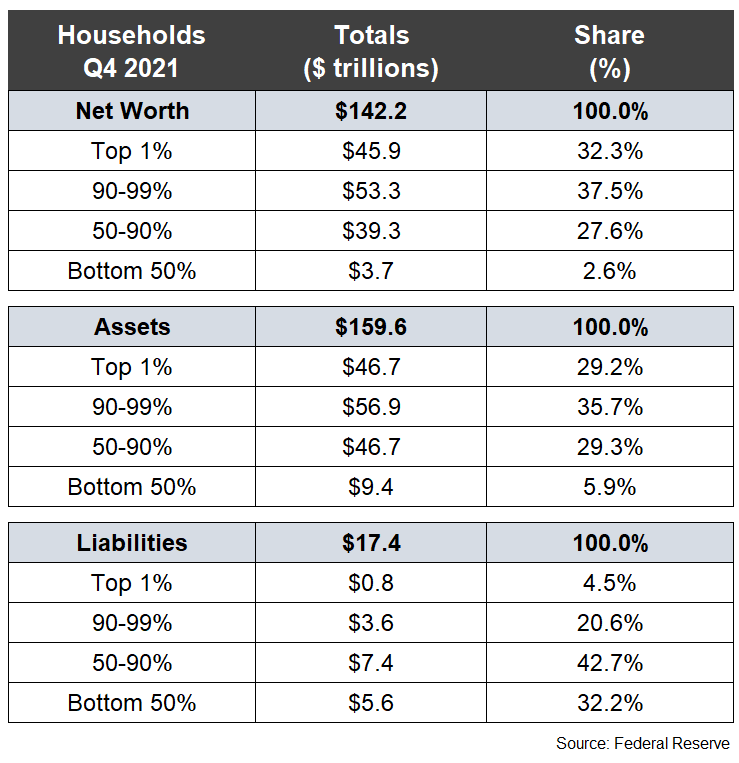
The top 10% holds 70% of the net worth in this country while the bottom 90% accounts for 75% of the debt.
There is a reason for this disparity. The top 10% owns most of the financial assets while the bottom 90% has more of their net worth tied up in real estate.
To continue reading, please go to the original article here:
https://awealthofcommonsense.com/2022/05/why-housing-is-more-important-than-the-stock-market/