
What Is Wealth?
What Is Wealth?
By Amanda Page Updated on December 30, 2021
Wealth is an individual’s or household’s net worth, which consists of assets such as money in savings and investment accounts minus debts like loans and mortgages.
Definition and Examples of Wealth
Wealth is often regarded as household net worth, which is the total value of assets minus any debt (“liabilities”). Therefore, if an individual or household owns an asset, then they have the potential for wealth, depending on the size of their debt, and their own perception of how much money it takes to be “wealthy.”
What Is Wealth?
By Amanda Page Updated on December 30, 2021
Wealth is an individual’s or household’s net worth, which consists of assets such as money in savings and investment accounts minus debts like loans and mortgages.
Definition and Examples of Wealth
Wealth is often regarded as household net worth, which is the total value of assets minus any debt (“liabilities”). Therefore, if an individual or household owns an asset, then they have the potential for wealth, depending on the size of their debt, and their own perception of how much money it takes to be “wealthy.”
“You can value wealth in many different ways,” Matthew Ricks, a certified financial planner and president of Haystack Financial Planning, told The Balance by email. “For some, it’s being free of a mortgage. [Others] will say it takes owning $1 million. Some say multi-millions. It’s so individual.”
Ricks went on to note that income and wealth are not the same things; just because you earn a lot of money doesn’t mean you’re wealthy.
“Look at all the singers and athletes who go bankrupt,” Ricks said. “They made a lot and then spent even more.”
Note
There is subjectivity in how individuals define “wealth.” For instance, in a survey of 1,000 Americans, brokerage firm Charles Schwab learned that most believe an average of $1.9 million in personal net worth is necessary to be considered “wealthy” in 2021, but the previous year’s respondents said “wealthy” was $2.6 million in net worth.1
How Wealth Works
In most cases, wealth is inherited or self-made. To develop wealth, you must first define what wealth means to you. Once you’re aware of your own definitions, you can begin to gather information and make a plan to build wealth.
“You really have to think about what you want out of it,” Ricks said. “Do you want to work specific hours or make [a] specific [amount of] money? Do you want to own a successful business or have the freedom to buy time?”
To begin building wealth, it helps to calculate your net worth: Subtract your assets from your debt. You can then develop a wealth plan, which has key components that include saving, investing, paying down debt, and protecting the assets you accumulate.
To continue reading, please go to the original article here:
The Best Banks for Millionaires
The Best Banks for Millionaires
By The Balance Editors Updated on November 30, 2022
Banks are essential for everybody, but millionaires and other high-net-worth (HNW) customers need to be especially choosy about the banks they choose. With more money at stake—and more money at the disposal of the bank—the experience is quite different for wealthy individuals.
Many HNW individuals choose to work with a private bank—either a stand-alone company or the private banking division of a larger banking corporation—that focuses on the management of wealth.
The Best Banks for Millionaires
By The Balance Editors Updated on November 30, 2022
Banks are essential for everybody, but millionaires and other high-net-worth (HNW) customers need to be especially choosy about the banks they choose. With more money at stake—and more money at the disposal of the bank—the experience is quite different for wealthy individuals.
Many HNW individuals choose to work with a private bank—either a stand-alone company or the private banking division of a larger banking corporation—that focuses on the management of wealth.
Account Features for HNW Customers
Banks stand to earn more off of their relationships with HNW clients, so they’re eager to reward you and compete for your business. As you shop for private banks and other companies you feel could meet your needs, compare these features.
Higher APY: With a significant savings account balance, you should be eligible to earn more—a higher annual percentage yield (APY)—on your deposits. Evaluate how much banks pay at different levels and shop around. But you may find that, even as a millionaire, online banks are the best place for idle cash.1
Dedicated customer service: Most financial institutions have specialized departments for HNW customers, and it pays to work with those teams. You get access to experienced individuals who have excellent customer service skills and are more empowered to solve problems for high-priority clients.2
Free services: Although you can afford to pay $35 for a wire transfer, it’s nice to get things for free. With a sizable account balance, you should automatically enjoy no monthly fees, free cashier’s checks, free stop payment requests, a safety deposit box, and more. ATM rebates are more or less standard for HNW customers.3
Higher payment limits: Standard bank rules may be inconvenient for millionaire customers, who often need to move large sums. But private banking arrangements typically allow for much larger debit card purchases, higher ATM withdrawal limits, and generous ACH transfers.4
Better borrowing: Look for lower interest rates on loans, but don’t expect free money. Still, banks are willing to waive origination fees and other closing costs, as well as move your application through underwriting quickly.5 They might even make exceptions when you don’t fit the standard profile.
Cash management accounts: Some firms that traditionally served brokerage needs now want your banking business. Cash management accounts, with competitive interest rates and ATM rebates, are ideal for millionaires who prefer to manage their finances themselves.
Plus, cash management accounts can spread funds among multiple banks to provide more than $250,000 of FDIC insurance in a single account. For example, the Fidelity Cash Management account uses bank partnerships to place up to $1,250,000 in FDIC-insured accounts.6
If you choose to use a cash management account, read all of the details to ensure all of your money is protected.
Setting Your Priorities
To continue reading, please go to the original article here:
https://www.thebalancemoney.com/top-accounts-used-by-millionaires-4165695
It’s Okay to Be in Debt, Just Not Okay to Stay in Debt
It’s Okay to Be in Debt, Just Not Okay to Stay in Debt
Ever since college, I always thought I was good with money. At least, that’s what I’d tell myself in my 20s. At the age of 25, I was completely debt-free! Yet, we somehow managed to accumulate nearly $200,000 in debt by age 30.
Most purchases were relatively normal in this day and age: a house, student loans, newer cars, a wedding, a condo at the lake. Oh wait, a lake house is not typical, but it happened. While getting into debt was not ideal, I don’t regret any of it, and thankfully we had the financial means to dig out. I know not everyone is as fortunate. Regardless, this is our story.
It’s Okay to Be in Debt, Just Not Okay to Stay in Debt
Ever since college, I always thought I was good with money. At least, that’s what I’d tell myself in my 20s. At the age of 25, I was completely debt-free! Yet, we somehow managed to accumulate nearly $200,000 in debt by age 30.
Most purchases were relatively normal in this day and age: a house, student loans, newer cars, a wedding, a condo at the lake. Oh wait, a lake house is not typical, but it happened. While getting into debt was not ideal, I don’t regret any of it, and thankfully we had the financial means to dig out. I know not everyone is as fortunate. Regardless, this is our story.
Going Nearly $200,000 in Debt
After graduating from college with a master’s degree at the age of 25, I started life with a clean slate. I had a little bit of savings in the bank that I could scrape together over the years. My “college fund” was a total of $6,000, and since I never had to use it, my parents gave it to me after graduating.
In addition, I had managed to save a few thousand dollars more over the years from my job, waiting tables and bartending in college. So at age 25, I had no debt and a decent amount of money to start my life.
If I could do it all over again, there are things I would do differently. Regardless, by my 30th birthday, we had managed to accumulate nearly $200,000 in debt. How did this happen?
Our road to accumulating this debt is not all that uncommon. Many life events can take place soon after graduating from college.
First was the newer car “needed” since I had a better-paying job and could afford it. That, of course, came with a five-figure loan.
Next was planning for a wedding. This included purchasing an engagement ring and paying for our wedding. In total, this cost us somewhere between $20,000 and $25,000. We mostly paid with savings, but it still set us back financially.
Along the way, Mrs. FP decided to go back to school to get her teaching certificate. Unfortunately, we stared at almost $50,000 in student loan debt once she graduated.
Then, of course, we needed to live somewhere. We purchased my grandparents’ old house shortly after my grandmother passed away. The house was purchased below market value though we still ended up with a $100,000 mortgage and a home that needed to be completely renovated. We are still spending money renovating this house ten years later.
And last but not least, we ended up buying a lake house with family. This also included buying a wave runner and chipping in to buy a boat. My parents paid for the down payment, and for nearly ten years, we’ve split the monthly payments along with my two other brothers.
Shortly after agreeing to buy the lake house, we found ourselves in a bank lobby taking out a home equity loan because two bathrooms were leaking into our basement.
More debt.
And yes, we went in on the lake house purchase already nearly $200,000 in debt. I’m a terrible personal finance blogger, I know.
Drowning in Debt
At that moment in the bank lobby back in 2011, we decided enough was enough. It was time to face the fact that we were slowly going down a path of debt accumulation that would be difficult to unwind if we continued pressing forward. Next would have been an even bigger house and nicer cars. But, instead, we decided that day to face our debt and begin paying it off.
Here’s the thing: besides the lake house purchase, all of those events are relatively normal in today’s society. Maybe not in the financial independence community, though definitely in this day and age. I’m not saying it’s right or wrong, but that’s reality.
To continue reading, please go to the original article here:
How Many Gifts Should a Child Get for Christmas?
How Many Gifts Should a Child Get for Christmas?
By One Frugal Girl
How many gifts should you give your kids for Christmas? Is there a magic number of presents? The perfect amount that makes kids feel happy, satisfied, and grateful?
In most instances, I think four is enough. After choosing something they want, something they need, something to wear, and something to read, you’ve got your kids covered.
But not everyone agrees with this approach. After reading about my four-gift rule for Christmas, a long-time reader told me she didn’t like my gift-giving advice.
How Many Gifts Should a Child Get for Christmas?
By One Frugal Girl
How many gifts should you give your kids for Christmas? Is there a magic number of presents? The perfect amount that makes kids feel happy, satisfied, and grateful?
In most instances, I think four is enough. After choosing something they want, something they need, something to wear, and something to read, you’ve got your kids covered.
But not everyone agrees with this approach. After reading about my four-gift rule for Christmas, a long-time reader told me she didn’t like my gift-giving advice.
“Limiting the number of gifts takes the fun out of Christmas,” she said. “Christmas should be filled with stacks of presents and happy children ripping into wrapping paper.”
Will Limiting Gifts Ruin Christmas?
I love when readers voice their opinions, so I dove into the insightful list of thoughts and questions.
Can Christmas be Christmas without lots of presents?
Can the holidays feel magical with fewer gifts?
And most importantly:
Won’t limiting gifts ruin Christmas?
Christmas Magic Doesn’t Exist in Boxes
I understand her misgivings because I once felt them myself.
For years, I convinced myself that Christmas lived in big boxes; the bigger the box, the better! But, in truth, it’s not the quantity or size of gifts that makes Christmas magical.
Thank back on your childhood. How many unique gifts do you remember? I bet most years are a blur. But do you remember decorating the house, searching for Christmas lights, eating Christmas dinner, or the warm feeling of sitting around the tree with your family?
Growing up, Christmas was the one day of the year when we woke up early and gathered together. My dad cooked pancakes while we watched from the kitchen table. We slathered those pancakes with butter and syrup and giggled at his Swedish Chef impersonation.
Magic didn’t come from the mountain of gifts I can no longer remember. It came from a stress-free morning, sitting in our pajamas and enjoying each other’s company. When I think back to the cozy holidays of my youth, it’s not the gifts I remember. It’s the sound of my dad’s laughter.
How Many Christmas Gifts Per Child?
How many gifts should a child get for Christmas? There are all sorts of rules for gift-giving. The three-gift rule, the four-gift rule, the seven-gift rule, and even the ten-gift rule, but for me, the ideal amount is the number of presents my children will use and appreciate.
To continue reading, please go to the original article here:
https://www.onefrugalgirl.com/how-many-christmas-gifts-per-child/
Why Housing is More Important Than the Stock Market
Why Housing is More Important Than the Stock Market
Posted May 27, 2022 by Ben Carlson
I know a lot of finance people want to blame the Fed for everything these days but central banks aren’t the sole culprit of the inflationary environment we find ourselves in.
The pandemic seriously screwed up global supply chains and the labor market. Governments around the world spent trillions of dollars to keep the global economy afloat while we put things on ice for a while. Consumers began spending money en masse on goods because they stopped spending on experiences and had nothing else to do.
Why Housing is More Important Than the Stock Market
Posted May 27, 2022 by Ben Carlson
I know a lot of finance people want to blame the Fed for everything these days but central banks aren’t the sole culprit of the inflationary environment we find ourselves in.
The pandemic seriously screwed up global supply chains and the labor market. Governments around the world spent trillions of dollars to keep the global economy afloat while we put things on ice for a while. Consumers began spending money en masse on goods because they stopped spending on experiences and had nothing else to do.
And yes, the Federal Reserve was extremely loose with monetary policy to keep the credit markets functioning and bring the unemployment rate down.
Even though it wasn’t completely their fault, it seems like the Fed is now the only one trying to clean up the inflationary mess by tightening monetary policy.
They’re doing this in two ways:
(1) By raising interest rates and unwinding quantitative easing (bond purchases).
(2) Signalling to the financial markets they may have to throw the economy into a recession to slow inflation.
The Fed cannot fix supply chains but they can raise rates high enough that it cools demand.
Former New York Fed chair Bill Dudley says one way to do this is through the wealth effect:
In contrast to many other countries, the U.S. economy doesn’t respond directly to the level of short-term interest rates. Most home borrowers aren’t affected, because they have long-term, fixed-rate mortgages. And, again in contrast to many other countries, many U.S. households do hold a significant amount of their wealth in equities. As a result, they’re sensitive to financial conditions: Equity prices influence how wealthy they feel, and how willing they are to spend rather than save.
Effectively, Dudley is saying the Fed needs to raise interest rates high enough that stock market investors don’t feel as wealthy, and thus, stop spending as much money.
I get what he’s saying.
They don’t tell you this in the textbooks, but so much of what goes on in the economy and markets is based more on faith, trust and psychology rather than data, fundamentals and statistics.
It would make sense that households who see their net worth plummeting would start to reconsider their financial standing and spending habits.
But I think Dudley overestimates the importance of stock market wealth on American households.
For years we’ve been hearing about wealth inequality and for good reason. The top 10% of households own the majority of financial assets:
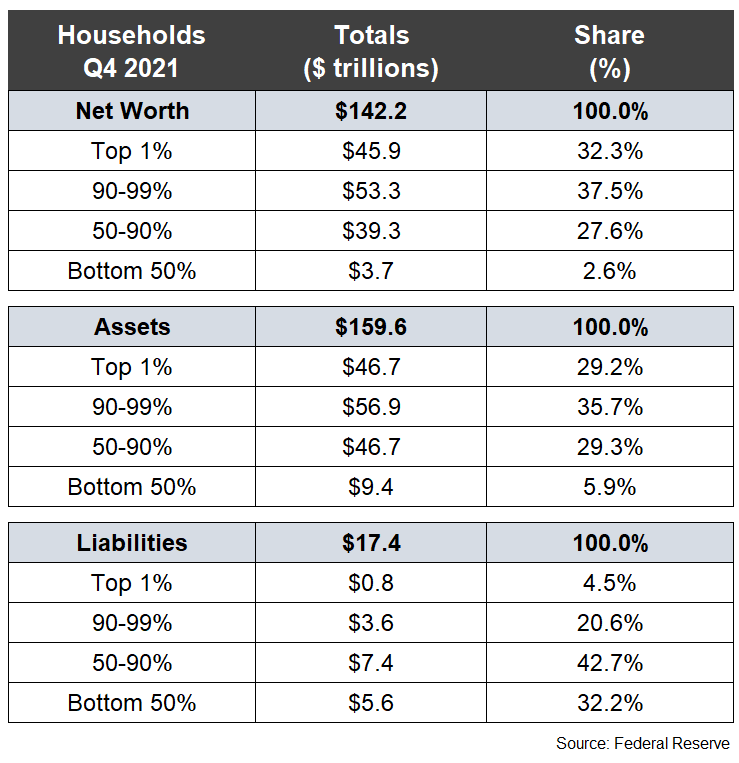
The top 10% holds 70% of the net worth in this country while the bottom 90% accounts for 75% of the debt.
There is a reason for this disparity. The top 10% owns most of the financial assets while the bottom 90% has more of their net worth tied up in real estate.
To continue reading, please go to the original article here:
https://awealthofcommonsense.com/2022/05/why-housing-is-more-important-than-the-stock-market/
What Caused the Great Depression?
What Caused the Great Depression?
December 2, 2014 by Ben Carlson
The price of oil is down nearly 40% in five months, a swift fall in one of the most important and visible commodities in the world. After seeing such a crash in price, investors and pundits are quick to trot out the specific reasons for the decline.
I’ve heard many people this week give the singular reason that oil has fallen so hard so fast. While it makes for a better narrative after the fact, markets rarely move because of a single variable or data point. That would be far too easy. Usually it’s a confluence of events that gets magnified by leveraged investors and a herd mentality as everyone heads for the exits at once.
What Caused the Great Depression?
December 2, 2014 by Ben Carlson
The price of oil is down nearly 40% in five months, a swift fall in one of the most important and visible commodities in the world. After seeing such a crash in price, investors and pundits are quick to trot out the specific reasons for the decline.
I’ve heard many people this week give the singular reason that oil has fallen so hard so fast. While it makes for a better narrative after the fact, markets rarely move because of a single variable or data point. That would be far too easy. Usually it’s a confluence of events that gets magnified by leveraged investors and a herd mentality as everyone heads for the exits at once.
Even after the fact it’s difficult to know exactly why the markets behave the way they do. Complex adaptive systems don’t follow a set script.
The biggest case in point of all-time is the Great Depression and the stock market crash of 1929-1932. Consider the stat sheet from this colossal downturn:
The unemployment rate hit nearly 25%
GDP contracted almost 27% (for comparison purposes, it was down only 4.3% in the most recent crisis)
The stock market fell in excess of 85%
This period has been studied by scholars, economists and historians for decades, yet we still can’t find a good answer to the question: Did the stock market crash cause the Great Depression or did the Great Depression cause the stock market crash?
Here’s a list of the most heavily cited reasons:
There was a huge increase in consumer debt in the 1920s as technological innovation advanced at a rapid pace. For the first time ever, people could buy radios, fridges, cars or clothes on credit. It’s estimated that by the end of the 1920s over one-eighth of all retail sales were made on credit.
Margin debt in the stock market was out of control. Speculators had basically taken over the market with an excessive use of leverage. Almost 20% of the total market of listed stocks was purchased on margin loans by 1929.
The Federal Reserve’s overly restrictive monetary policies (Ben Bernanke studied these policies and wasn’t going to repeat their mistakes during the Great Recession).
Declining commodity prices from overproduction due to World War I, which led to tariffs and currency devaluations across the globe.
To continue reading, please go to the original article here:
https://awealthofcommonsense.com/2014/12/caused-great-depresssion/
Do I Have To Pay a Relative's Taxes After They Die?
Do I Have To Pay a Relative's Taxes After They Die?
Lee Huffman Sat, December 17, 2022
When a loved one passes away, it can be an emotional experience. Unfortunately, handling the deceased’s finances can add to this stress. While most people know that you need to file a final tax return for the deceased, most people don’t know how to handle income received after the person has died. This income is known as “income in respect of a decedent” (IRD), and it has its own special rules. Consider working with a financial advisor as you prepare an estate plan or implement a loved one’s estate plan.
Do I Have To Pay a Relative's Taxes After They Die?
Lee Huffman Sat, December 17, 2022
When a loved one passes away, it can be an emotional experience. Unfortunately, handling the deceased’s finances can add to this stress. While most people know that you need to file a final tax return for the deceased, most people don’t know how to handle income received after the person has died. This income is known as “income in respect of a decedent” (IRD), and it has its own special rules. Consider working with a financial advisor as you prepare an estate plan or implement a loved one’s estate plan.
What Is Income in Respect of a Decedent?
Income in respect of a decedent (IRD) is the income received after someone dies but not included in the person’s final tax return. When beneficiaries take over a deceased person’s finances, the situation can be complicated. This is especially true if they owned a business, had many types of bank and investment accounts, or were unorganized.
Examples of IRD include:
Uncollected salary, wages, bonuses, commissions and vacation or sick pay
Distributions from deferred compensation
Stock options exercised
Taxable distributions from retirement accounts
Interest on bank accounts
Dividends and capital gains from investments
Accounts receivable paid to a small business owned by the decedent (cash-basis only)
This is a good reminder that people should have a detailed list of financial accounts and investments for beneficiaries to refer to. This will give them a to-do list to notify them of your death and to avoid any accounts getting lost in the shuffle.
How Is IRD Taxed?
IRD is income that would have been included in the deceased’s tax returns had they not passed away. If this income was not included in the final tax return, then it is considered IRD. Where IRD is reported depends on who received the income. If paid to the estate, it should be included on the fiduciary return. When IRD is paid directly to a beneficiary, then the beneficiary should include it in their tax return.
To continue reading, please go to the original article here:
https://news.yahoo.com/pay-relatives-taxes-die-130012175.html
How To Financially Cope When Even 47% of Six-Figure Incomes Are Living Paycheck to Paycheck
How To Financially Cope When Even 47% of Six-Figure Incomes Are Living Paycheck to Paycheck
Nicole Spector Fri, December 16, 2022
It wasn’t long ago when making six figures in the U.S. meant one was doing pretty alright — great, even. Now, amid inflation, a person making that salary may just barely be getting by.
According to a recent report from LendingClub, 63% of Americans were living paycheck to paycheck as of November 2022 — up from 60% in October. Of those pulling in more than six figures a year, 47% reported living paycheck to paycheck, up from October’s 43%.
How To Financially Cope When Even 47% of Six-Figure Incomes Are Living Paycheck to Paycheck
Nicole Spector Fri, December 16, 2022
It wasn’t long ago when making six figures in the U.S. meant one was doing pretty alright — great, even. Now, amid inflation, a person making that salary may just barely be getting by.
According to a recent report from LendingClub, 63% of Americans were living paycheck to paycheck as of November 2022 — up from 60% in October. Of those pulling in more than six figures a year, 47% reported living paycheck to paycheck, up from October’s 43%.
So how can Americans who are just scraping by paycheck to paycheck cope? They can start by taking control of their finances through the following steps:
1. Itemize Assets and Debts
People living paycheck to paycheck should make a list of all of their assets and debts. This is so they can get a picture of exactly what they have and what they owe.
2. Redo Budget
If a budget was made before these times of heavy inflation, it may need to be looked at again and revamped. Consider areas that can be trimmed down, such as subscriptions to services that are not essential. Be honest about wants versus needs.
To continue reading, please go to the original article here: LINK
5 Things Millionaires Do With Their Money That Normal People Don’t
5 Things Millionaires Do With Their Money That Normal People Don’t
Heather Taylor Fri, December 16, 2022
We’ve all heard stories about the many things wealthy individuals do with their money which those with much more modest incomes do not. Many of these stories tend to revolve around extravagant purchases, like superyachts, private islands and having an unlimited budget for extraneous purchases like glitter.
Much less obvious, however, are the subtle ways those with extreme wealth treat spending and saving money. Here are some things millionaires do with their money that you would be hard-pressed to see a normal person doing.
5 Things Millionaires Do With Their Money That Normal People Don’t
Heather Taylor Fri, December 16, 2022
We’ve all heard stories about the many things wealthy individuals do with their money which those with much more modest incomes do not. Many of these stories tend to revolve around extravagant purchases, like superyachts, private islands and having an unlimited budget for extraneous purchases like glitter.
Much less obvious, however, are the subtle ways those with extreme wealth treat spending and saving money. Here are some things millionaires do with their money that you would be hard-pressed to see a normal person doing.
They Don’t Talk About Money
In a now-viral Reddit thread about non-obvious signs of wealth, a Reddit user named ragnarkar wrote that individuals possessing extreme wealth rarely discuss money.
“There’s a saying that there’s an inverse correlation between how wealthy someone is and how often they mention money, but it’s not that easy or obvious to gauge how often someone actually talks about money without interacting with them a lot,” the Reddit user wrote.
Those without money can’t help but talk about money with others or think about it on a regular basis. Someone with extreme wealth, however, would not bring up the topic in an everyday conversation. This is not to say they don’t pay attention to their overall financial picture. It’s just not a topic for discussion.
They Have Credit Cards That Are Different Colors and Weights Than the Average Person
A regular person likely doesn’t think twice about the color of their credit card. Their focus is usually just on making sure the balance is paid in full each month. Someone with extreme wealth, however, can make their wealth known with a nonverbal cue: the color and heft of their credit card.
A since-deleted Reddit user wrote in the viral thread how wealthy individuals will often receive great service from staff once the staff sees their credit card. Another user named illinois_smith confirmed they were a service industry worker and the nice credit cards do get noticed, especially the ones made of heavy metal.
Getting these specific credit cards typically requires a certain amount of heavy spending from the cardholder. The number of people given these cards will often be pretty limited as well.
The Ultra-Wealthy Take Portfolio Diversification to the Next Level
Those with great wealth have several assets, tangible and intangible alike, which make up their overall investment portfolio. Popular physical assets include real estate, jewelry, rare artwork, vintage vehicles and cash or cash equivalents like money market mutual funds. Less intangible assets include stocks, bonds and exchange-traded funds (EFTs).
To continue reading, please go to the original article here:
https://news.yahoo.com/5-things-millionaires-money-normal-200024351.html
Money Lessons From The White Lotus
Money Lessons From The White Lotus
Posted December 16, 2022 by Ben Carlson
I loved the first season of The White Lotus
It was the perfect pandemic show at the perfect time, allowing us to escape to an exotic locale and enjoy the quirks of some wonderfully written characters.
Season two just wrapped on HBO and I enjoyed it even more than the first one.
The murder mystery aspect of the show was tremendous but my finance brain couldn’t help but notice a number of money and behavioral psychology lessons from this season’s cast.
I know what you’re thinking: Ben, these are TV characters. Are you really going to do this?
Money Lessons From The White Lotus
Posted December 16, 2022 by Ben Carlson
I loved the first season of The White Lotus It was the perfect pandemic show at the perfect time, allowing us to escape to an exotic locale and enjoy the quirks of some wonderfully written characters.
Season two just wrapped on HBO and I enjoyed it even more than the first one.
The murder mystery aspect of the show was tremendous but my finance brain couldn’t help but notice a number of money and behavioral psychology lessons from this season’s cast.
I know what you’re thinking: Ben, these are TV characters. Are you really going to do this?
You’re xxxx right I’m going to do this.
And creator Mike White even said in an interview all of these characters are based on people he knows or has interacted with in the entertainment industry. The show was satirical but nailed a lot of tried and true money truths.
Here are some of my favorites from The White Lotus resort in Sicily:
[WARNING: SPOILERS GALORE TO FOLLOW]
Keeping up with the Joneses can get you into trouble in a lot of different ways. My favorite dynamic on the show was the interplay between two couples traveling to Sicily together — Ethan & Harper and Cameron & Daphne.
Each married couple was unhappy in their own way.
Ethan and Cameron were old college roommates but Cameron hit it big first, making some dough as a finance bro.
Just before their getaway, Ethan and Harper earned untold millions selling his tech firm. They told themselves the money wasn’t going to change them but earning a big payday does change how other people perceive you.
Caeron told Ethan once you become fabulously wealthy, it’s OK to cheat on your wife:
Cameron: Now, that you’re a big shot, people must be slipping into your DMs left and right.
Ethan: No. What good would it do me if they were? I mean, I’m married.
Cameron: Dude, everyone cheats, E.
Ethan: No, they don’t. Come on! They do?
Cameron: Yeah!
And even though his big payday gave Ethan more money, he was in constant competition with his old roommate.
Newfound wealth led to jealousy, resentment, trust issues, cheating and more baggage than Tanya brought with her to the resort.
A lot of people assume keeping up with the Joneses is all about spending more money to keep up. That is part of it but it can also change your behavior in ways you might not appreciate.
More money might not change who you are but it changes who you think you should be and how other people think you should act.
To continue reading, please go to the original article here:
https://awealthofcommonsense.com/2022/12/money-lessons-from-the-white-lotus/
16 Money Rules That Millionaires Swear By
16 Money Rules That Millionaires Swear By
Gabrielle Olya Fri, December 16, 2022
Being a millionaire or billionaire -- especially a self-made one -- usually requires being disciplined about saving and spending, as well as investing wisely. Although the super-rich can splurge on lavish vacations and fancy cars, some eschew a luxurious lifestyle for one that allows them to maintain their wealth over the long term.
So, if you want to live like a millionaire yourself, you'll have to follow the money rules of the wealthy.
16 Money Rules That Millionaires Swear By
Gabrielle Olya Fri, December 16, 2022
Being a millionaire or billionaire -- especially a self-made one -- usually requires being disciplined about saving and spending, as well as investing wisely. Although the super-rich can splurge on lavish vacations and fancy cars, some eschew a luxurious lifestyle for one that allows them to maintain their wealth over the long term.
So, if you want to live like a millionaire yourself, you'll have to follow the money rules of the wealthy.
Kristen Bell: Take Advantage of Coupons When Shopping
Net worth: $40 million
"Frozen" star Kristen Bell still clips coupons despite her multi-million-dollar wealth.
"I almost exclusively shop with coupons," she said on "Conan," sharing that her personal favorite place to shop with coupons is Bed Bath & Beyond. "It's the best one because they've got 20% off, and if you go and buy a duvet or an air conditioner or whatever, you could be saving upwards of $80."
Sara Blakely: Create and Maintain a Nest Egg
Net worth: $1 billion
Spanx founder Sara Blakely kept her day job while starting her shapewear company to make sure she'd be able to maintain a healthy nest egg.
"It's really important to save money and create a nest egg, become comfortable for yourself with what the nest egg is, and don't touch it," she told Business Insider. "Leave it there. I always had a portion of my paycheck put into savings, and that was an easy automatic way ... I didn't quit my job until I'd already landed Neiman Marcus and Saks Fifth Avenue. I was so careful, I [worked on Spanx] at night and on the weekends because I didn't not want to have income coming in."
Warren Buffett: Think of Investing as a Long-Term Strategy Net worth: $99.8 billion
Billionaire investor Warren Buffett isn't a proponent of active stock trading.
"When we own portions of outstanding businesses with outstanding managements, our favorite holding period is forever," he wrote in his 1988 Berkshire Hathaway shareholders letter. "We are just the opposite of those who hurry to sell and book profits when companies perform well."
Grant Cardone: Save $100K and Invest the Rest Net worth: $600 million
To continue reading, please go to the original article here:
https://news.yahoo.com/16-money-rules-millionaires-swear-171052150.html