What Happens to XRP if it Becomes the Backbone of the Global Monetary System?
What Happens to XRP if it Becomes the Backbone of the Global Monetary System?
November 29, 2025
The world of digital assets is no stranger to ambitious predictions, but a recent X post from @KuwlShow has set the internet alight with a particularly audacious thought experiment: could Ripple, the company behind XRP and the XRP Ledger (XRPL), one day command a valuation north of $7 trillion?
Rob Cunningham | KUWL.show:
A Ripple $7 Trillion Valuation
Q: At Ripple’s most recent post money valuation, what might new valuation estimates rise to if the pending Clarity Act resulted in Ripple retaining 17 Billion XRP at a value of $250, the XRPL blockchain and XRP bridge token gaining global clarity from the U.S. Government as our new monetary system infrastructure and XRP paired with RLUSD represents the new U.S. digital dollar the world over?
A. If all of this actually happens – Clarity Act, full U.S. Treasury blessing, XRPL as core global rails, RLUSD/XRP as the de-facto US Digital Dollar pair – then Ripple’s valuation doesn’t just “go up a lot.”
On paper it jumps into multi-trillion-dollar territory just from its XRP stack alone, before even pricing in the payments/stablecoin business. Let’s walk it out cleanly and keep it grounded.
1. Today’s anchor: Ripple’s latest valuation Ripple’s most recent strategic round (Fortress, Citadel, Pantera, Galaxy, Brevan, Marshall Wace, etc.) priced the company at about $40 billion post-money. That $40B reflects:
• Payments (Ripple Payments) • RLUSD stablecoin & treasury/prime brokerage (Ripple Prime, custody)
• XRP Ledger exposure and associated software
• Current regulatory clarity as of now (GENIUS Act, etc.), but not “world’s base-layer monetary system” status.
So: baseline = $40B. 2. This scenario inputs outlined above: We’re framing a world where:
1. Clarity Act + Treasury blessing
• XRP + XRPL get explicit, durable U.S. Treasury / global regulatory clarity as a core infrastructure layer for the “new monetary system.”
2. XRP at $250 • Today XRP is ~$2.2 with ~60.25B tokens in circulation, implying a ~$120–130B market cap.
• Hypothetically: XRP reprices to $250.
3. Ripple beneficially owns 17B XRP
• We’ll accept this as the post-Clarity, post-escrow, post-SPV reality.
4. RLUSD + XRP become the default “digital U.S. dollar rails” globally • RLUSD is already ~$1B market cap with ~$95B+ in payments volume and growing.
• Scenario above ramps XRP to a global settlement role vs. niche crypto. Let’s keep all the math mechanical and then talk about how markets might actually price it.
3. Mechanical mark-to-market: Ripple’s XRP pile at $250 3.
1. Value of Ripple’s 17B XRP • Price per XRP (scenario): $250
• Beneficial holdings: 17,000,000,000 XRP 17 Billion XRP x $250 = $4.25 Trillion So, $4.25 trillion of value just from that XRP position.
For context:
• That’s 6.6x Visa’s current market cap ($640B).
• 8.6x Mastercard’s ($494B). • World GDP is ≈$117T; $4.25T is ~3.6% of world GDP.
So in this scenario:
• Total XRP market value ≈ $15T • Ripple’s 17B stack ≈ 28% of circulating XRP (17 / 60.25 ≈ 0.282).
• Ripple’s XRP holdings alone = $4.25T, before any business multiple. Already, that dwarfs ANY existing private company.
How public markets might price Ripple equity under this scenario?
We can think of the equity valuation as: Ripple Value ≈ (Value of XRP Treasury ± Discount) + (Value of Payments / Stablecoin / Infra Franchise)
Let’s run three illustrative bands, not predictions. 4.1. “Conservative but still insane” band (Markets deeply discount concentrated XRP risk)
Assume:
• Markets apply a 60–80% discount to that $4.25T XRP stack because:
• Huge concentration in one asset
• Political risk – if it becomes monetary infra, governments want a say
• Possible capital controls, windfall taxes, or forced restructurings
• So equity gets credit for only 20–40% of the XRP mark-to-market: 0.20 times 4.25T = 0.85T 0.40 times 4.25T = 1.70T Now, let’s layer on the infra franchise:
• If XRPL+RLUSD run a systemically important share of global settlement, card-net/FX-network style comps (Visa, Mastercard, SWIFT-equivalent) easily justify $0.5–1T+ by themselves, based on today’s ~$640B and ~$494B for Visa/Mastercard.
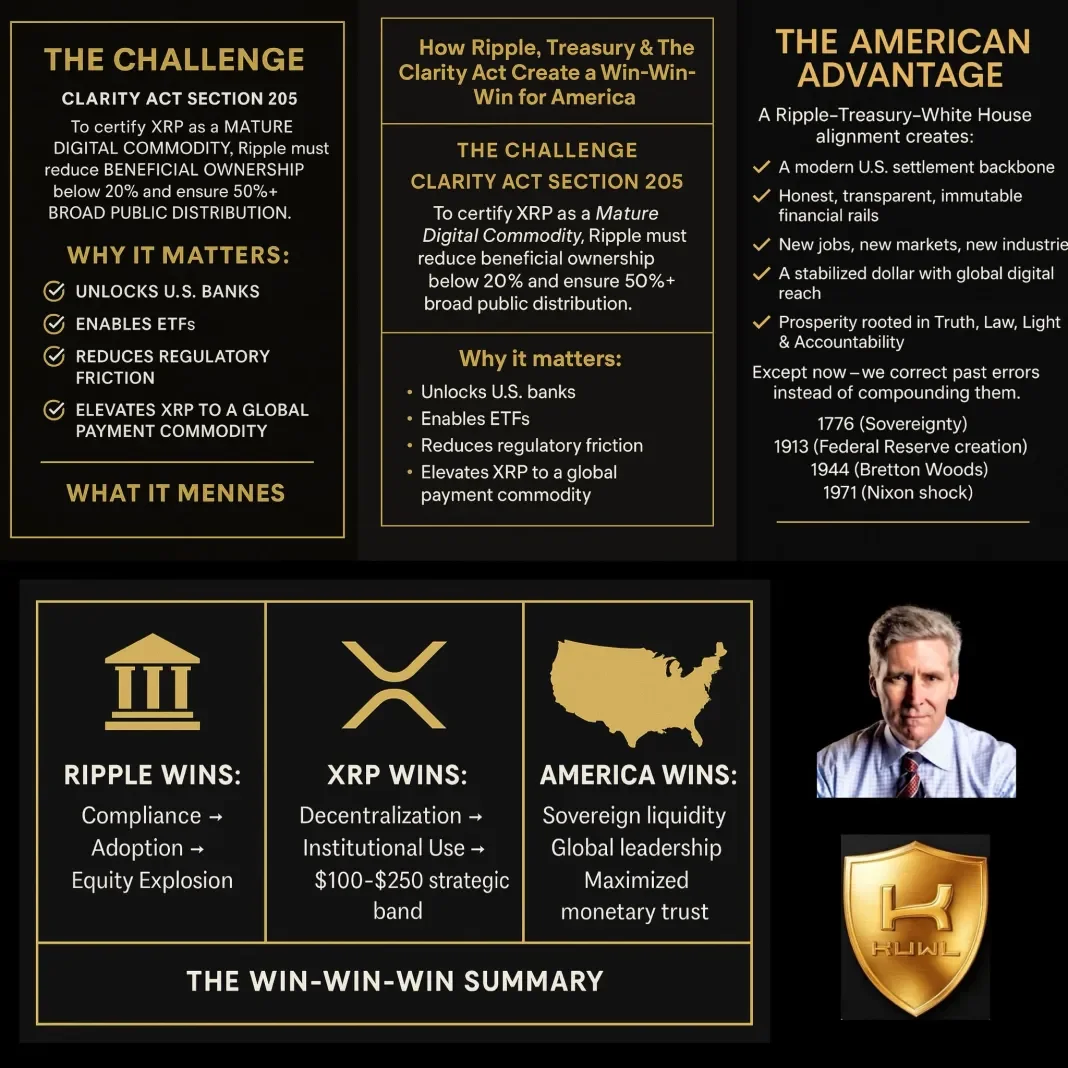
Resulting “conservative” band: ~$1.3T – $2.7T Ripple equity value That’s roughly 30–70× today’s $40B. 2/2 cont’d below
This isn’t just “hopium” – it’s a meticulously laid out scenario that, while highly speculative, forces us to consider the monumental shifts required for blockchain technology to truly become the backbone of a new global financial system.
The numbers are staggering, moving far beyond typical crypto discussions and into the territory of systemic global finance. We are talking about potential valuations that rival the GDP of entire nations.
Here’s a deep dive into the extraordinary thought experiment that posits Ripple, the company behind XRP and the XRPL, could achieve a valuation north of $7 Trillion.
From Fintech Challenger to Monetary Super-Utility
To understand the core argument, we must first anchor ourselves in the present. Ripple, following its most recent strategic funding rounds involving giants like Fortress, Citadel, and Pantera, sits at a current post-money valuation of roughly $40 billion. This valuation reflects its growing payments network, its custody business, and the nascent success of its stablecoin, RLUSD.
The $7 Trillion scenario, however, requires a leap of faith based on four massive, interlinked assumptions outlined in the X post:
The Four Pillars of the Super-Giant Scenario
The Clarity Act & Treasury Blessing: XRP and the XRPL must receive explicit, durable regulatory clarity from the U.S. Treasury, cementing their status as a core infrastructure layer for the “new monetary system.”
XRP at $250: The price of XRP must reprice from its current levels (around $2.20 at the time of the scenario’s construction) to $250, reflecting its new role as a global settlement asset rather than a niche crypto token.
Ripple Retains a Vast Stack: Ripple maintains control over 17 Billion XRP post-escrow and restructuring.
RLUSD/XRP as Default Global Rails: The combination of RLUSD (Ripple’s stablecoin) and XRP becomes the de-facto backbone for the global digital U.S. dollar and a major FX settlement layer.
If these four monumental shifts occur, the resulting valuation landscape is completely unrecognizable.
The Mechanical Math: $4.25 Trillion from XRP Alone
The initial, non-negotiable step in the analysis is calculating the mark-to-market value of Ripple’s alleged XRP holdings under this scenario.
The calculation is straightforward:
17 Billion XRP (Ripple’s holdings) x $250 (Hypothetical Price) = $4.25 Trillion
This single number—$4.25 Trillion—immediately changes the conversation.
To put $4.25 Trillion into perspective, as the post noted:
It is 6.6 times Visa’s current market capitalization (~$640 billion).
It is 8.6 times Mastercard’s market cap (~$494 billion).
It represents approximately 3.6% of the world’s current GDP.
This calculation shows that if XRP reaches $250, Ripple’s ownership stake alone becomes the most valuable asset held by any single private company in history, eclipsing the value of even today’s tech giants.
Pricing the Equity: Discounting the God-Mode Asset
However, a company’s equity valuation is not just the sum of its raw assets. Markets must price in the practical business operations (payments, stablecoins, brokerage) and, crucially, the extraordinary risks associated with holding a position of systemic monetary power.
The X post explored three potential valuation bands, based primarily on the discount the market would apply to that $4.25 Trillion XRP stack.
1. The Conservative (But Still Insane) Band: $1.3T – $2.7T
In this scenario, markets apply a severe discount (60–80%) to the XRP holdings due to concentration risk, political pressure, and potential government intervention (windfall taxes, enforced public utility status).
If the market credits Ripple with only 20–40% of the $4.25T stack ($0.85T to $1.7T), and
Adds the value of the infrastructure business (RLUSD, payments rails) at a combined Visa/Mastercard level ($0.5T to $1.0T)…
…Ripple’s valuation still comfortably lands between $1.3 Trillion and $2.7 Trillion—a 30x to 70x increase from today.
2. The Infrastructure Super-Giant Band: $3.1T – $4.5T
If the market believes the regulatory clarity is rock-solid and the XRPL truly dominates global payment and USD rails, the discount is less severe (50–70% of the XRP stack credited). Layering on a $1T–$1.5T value for the payments/stablecoin business brings the valuation into the $3.1 Trillion to $4.5 Trillion range.
At this level, Ripple is no longer a fintech company; it is officially a global monetary super-utility.
3. The Extreme Monetary Plumbing Band: $7T+
If the XRPL/RLUSD stack is treated as the singular backbone for international settlement (the new SWIFT + Fedwire + Visa combined), and the market applies minimal discount to the XRP stack (80–100%), the valuation climbs to the high end: $7 Trillion or more.
Crucially, the post points out that at this extreme level, the regulatory environment would likely force structural change. It becomes impossible for a single, private cap table to hold so much systemic power without triggering serious antitrust concerns, national security reviews, or demands for multi-sovereign governance.
The Indispensable Reality Checks
The power of this thought experiment lies in its meticulous math, but its responsibility lies in its reality checks. The author of the X post was careful to anchor the discussion in three critical points:
The $250 Price Tag is a Paradigm Shift: Hitting $250 requires not just hype, but a fundamental, system-wide shift in global monetary architecture where XRP is utilized by central banks and institutional players worldwide.
Sovereign Control is Inevitable: If the XRPL becomes critical global plumbing, sovereigns and international bodies will insist on checks, oversight, and shared control. Private companies simply cannot be allowed to have “god-mode” over global money flows.
Transparency and Prudence are Mandatory: Any new monetary system that achieves this scale must enforce transparency, remove hidden leverage, and prevent the same kind of capture that plagued the legacy financial system. If those conditions aren’t met, the valuation is unstable.
Conclusion: Expanding the Vision
The $7 Trillion valuation scenario is not a prediction; it is a powerful discernment exercise. It forces us to confront the true scale of what Ripple and the XRPL community aim to build—a financial architecture that is systemically important at a global level.
Whether XRP hits $250 or Ripple ever achieves a multi-trillion-dollar cap depends less on technology and more on global politics, regulatory frameworks, and governance structures.
What this analysis makes perfectly clear is that the crypto company that successfully transitions into the global settlement layer will generate wealth and systemic power on an unprecedented scale, transforming itself from a venture-backed startup into one of the most critical institutions on the planet.
Source: Ripple Chronicles