“Tidbits From TNT” Monday 1-19-2026
TNT:
Tishwash: Al-Sudani: We are proceeding with the implementation of reform plans
Prime Minister Mohammed Shia' al-Sudani affirmed on Sunday his commitment to implementing reform and development plans and completing projects.
A statement from his media office, received by Al-Rabia, stated that "Al-Sudani received a group of members of the 'I Will Take My Right' movement to review developments in the country and the government's program for achieving development and economic progress."
He affirmed his commitment to "proceeding with the implementation of reform and development plans and completing projects," praising the movement's stances and its support for the process of construction and development, and its essential role as an important member and partner in the Reconstruction and Development Coalition.
The Prime Minister also stressed the importance of unity and strengthening partnership and cooperation among national forces, in order to expedite the completion of constitutional requirements and combine everyone's efforts to improve the living conditions and services for citizens to meet their aspirations and fulfill their needs. link
Tishwash: Financial advisor: Fixing the exchange rate in the budget is a coordinating decision and enhances market stability.
The Prime Minister's financial advisor, Mazhar Muhammad Salih, stated that the exchange rate in Iraq is subject to a fixed official rate system based on integrated coordination between monetary and fiscal policy, and is not an arbitrary decision.
In an exclusive statement to Al-Mirbad, Salih explained that while the exchange rate is a tool of monetary policy, in practice it is the result of an agreement between the Ministry of Finance and the Central Bank of Iraq and is clearly stipulated in the annual budget.
He added that the reported adoption of an exchange rate of 1,300 dinars per dollar in the 2026 budget represents a significant positive indicator that will contribute to strengthening stability, calming the market, and curbing speculation in the black market and parallel market.
He indicated that the Central Bank sent an official letter to the Ministry of Finance to establish this rate as a fixed element of the general budget, noting that setting the exchange rate is essential given that oil revenues constitute approximately 90 percent of public revenues, which are in foreign currency.
He confirmed that the rate currently in effect is the one announced, pending the finalization of the draft budget upon its official release and submission to Parliament for discussion and approval. link
************
Tishwash: Hassan Ali Al-Daghari: Investment is a fundamental pillar in building the Iraqi economy.
Spokesperson Hassan Ali Al-Daghari affirmed that investment is a cornerstone of building the Iraqi economy and enhancing its capacity to achieve sustainable development. He pointed out that the current phase necessitates creating an attractive environment for both local and foreign capital.
Al-Daghari stated that supporting investment projects contributes to revitalizing various productive sectors, providing genuine job opportunities, and playing a vital role in stimulating the economy and reducing reliance on single resources.
He clarified that investment is not limited to the financial aspect alone, but also encompasses the transfer of expertise and technology and the development of infrastructure.
Al-Daghari emphasized the need to simplify administrative procedures and ensure legislative stability, thereby bolstering investor confidence and encouraging the expansion of the investment base in the country.
He noted that achieving economic development requires concerted efforts between the public and private sectors to build a strong economy capable of confronting challenges. link
Tishwash: Predictions regarding Savaya's plan: Closing all banks except for four... and targeting rebel factions.
With increasing reports of the arrival, or imminent arrival, of Mark Savaya, US President Donald Trump's envoy to Baghdad, a key question arises in political circles: Will he be an adversary or a partner to the ruling group in Iraq?
The answer, according to initial indications, appears complex. Since assuming his post about three months ago, the US envoy has declared a hardline stance against groups cooperating with Tehran and armed factions. However, information circulating in Baghdad suggests the formation of a new relationship between Savaya and the "coordination framework" in its "disarmed" version, which anticipates his arrival as a potential partner in the coming phase.
During the height of the unusual US escalation against Iran, contacts described as "strange and rare" were recorded, involving Iraqi groups that had declared their disarmament attempting to mediate with Tehran for the release of Western detainees. Political sources say that this new relationship will have "scapegoats," namely the few remaining factions that refuse to disarm and relinquish their military and economic capabilities.
According to reports, the US envoy is expected to implement a package of decisions, exclusively published by Al-Mada newspaper last year, concerning the closure of most Iraqi banks, leaving only a limited number—no more than four to six—operating. This is part of a strict US campaign to combat money laundering and cut off Iranian funding sources.
Sources indicate that Savaya's rapid activity, since assuming his duties as special envoy to Iraq last November, stems from the presence of an "Iraqi team ready to cooperate." These sources, who requested anonymity, do not rule out that this activity is linked to the formation of the next government, pointing to signals from Nouri al-Maliki, leader of the State of Law Coalition and the leading candidate so far for prime minister, regarding openness to cooperation with Washington.
Four days ago, during his meeting with the US Chargé d'Affaires in Baghdad, Joshua Harris, Maliki emphasized the necessity of "monopolizing weapons in the hands of the state" and expressed Iraq's desire to "expand the partnership with the United States by activating the Strategic Framework Agreement," according to an official statement issued by his office.
Sources indicate that the "Coordination Framework" is prepared for full cooperation with Savaya on the issue of armed factions, leaving the choice of how to deal with groups refusing to disarm—whether through military force or economic activities—to the United States.While Washington escalated its threats against Tehran, brandishing "very strong" military options before later backing down, the Iraqi resistance factions in Baghdad were preoccupied with other types of conflicts, related to the distribution of positions in the upcoming government and shaping the post-disarmament phase.
For the first time in five years of US-Iranian tension, these groups do not appear poised for large-scale intervention in any potential US strike against Iran, except for limited actions. However, Kataib Hezbollah emerged alone with an escalatory tone, threatening to retaliate against any attack on Iran and describing war as "no picnic." This was followed by another, less well-known group called Saraya Awliya al-Dam (Brigades of the Guardians of Blood).
Four armed groups had previously announced their decision to disarm in exchange for being allowed political participation. All eyes are now on Savaya.
Meanwhile, Savaya shuttled between the US Treasury and Defense Departments, coinciding with intensive diplomatic activity by the US chargé d'affaires in Baghdad, who met with most Iraqi leaders, including Maliki. Official statements from Washington and Baghdad indicate that the two main issues on the table are preventing the participation of armed factions in the next government and cutting off their funding sources and Iran's access to hard currency.
These statements reinforce what Iraqi sources suggest: that Savaya's mission will focus on implementing decisions related to the closure of at least 96 banks. Currently, 37 Iraqi banks are under US sanctions, with expectations that the number will rise to 69, amidst leaks about a US request to seal the banks shut, leaving only a limited number—between four and six—operating.
In this context, Savaya held a meeting on Friday at the White House with US Secretary of Defense Pete Hegseth and Director of Counterterrorism Sebastian Gorka to discuss the details of his upcoming visit to Iraq. In a statement, he said, “The issues discussed will be raised during the upcoming visit, in communication with decision-makers, in a way that serves the interests of the Iraqi people.”
Last Wednesday, US President Donald Trump praised his special envoy’s performance, saying he “did a fantastic job in Iraq.” Meanwhile, rumors continue to circulate in Baghdad that Savaya received five million dollars from Iraqi entities before assuming his duties, amid allegations of “buying American favor,” though these claims remain unconfirmed.
Independent politician and former MP Mithal al-Alusi expressed his pessimism regarding the US envoy’s mission, stating that Savaya and his team “are dealing with a failed state and politicians accused of corruption and crimes.”
Speaking to Al-Mada, al-Alusi warned that the US demands for “a government without militias” and economic sanctions, while essentially Iraqi demands, could be used at the expense of the integrity of the political process. He pointed to recent worrying attempts, including US contacts with Iraqi factions to help secure the release of Westerners detained in Iran during the height of the escalation. He concludes by saying that ignoring the reform of the political process and the protection of freedoms means accepting a more chaotic Iraq, with the Americans content to manage the scene through the embassy, which portends further disintegration of the Iraqi state. link
Mot: But I'm aTrying!!!

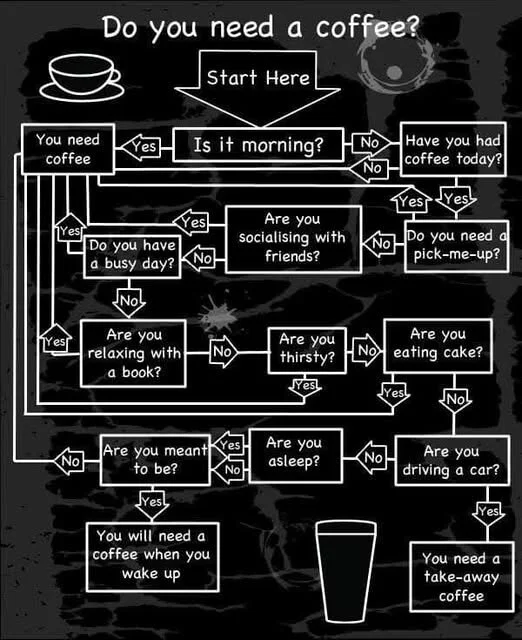
Mot: . The definitive flow chart for coffee!