Surprising Secrets of The Cheapskates Next Door
Written by GUEST AUTHOR| Published: 28 July 2010 – Updated: 29 August 2020
This is a guest post from Jeff Yeager, author of the newly-published The Cheapskate Next Door. Yeager calls himself the Ultimate Cheapskate — and his wife agrees. Yeager is also a contributor at Wise Bread and on the Early Retirement forums.
The Cheapskate Next Door“Sure, we could afford to spend more, but why would we? It wouldn't make us any happier.” — Those are the words I've spent the last two-and-a-half years traveling the country to hear. It's a simple but rare statement, given that nearly half of all Americans say that they literally live paycheck-to-paycheck and have little if any savings.
How can some people live not only within their means, but substantially below their means — even when their incomes are often less than the national average? And here's the biggest question of all: How can some of those same people insist that they're happier — joyous, really — because of their thrift and frugality?
I traveled thousands of miles — nearly 3,000 of them by bicycle! — and surveyed more than 300 of my beloved “Miser Advisers” to find the answers. In my new book, The Cheapskate Next Door, I share what I discovered about people and families — many of them just like you — who not only know how to stretch their money, but who are more content and happier because of it. The book also includes hundreds of their practical, money saving tips — ideas that anyone can use every day.
Some of what I found may not surprise you. These frugal folks:
Despise debt and have found creative ways to eliminate it from their lives. Differentiate between “needs” and “wants,” and between “affordability” and “borrow-ability”. And, yes, most own and still wear at least one article of clothing dating back to the Carter administration (or earlier).
But other findings surprised even me, The Ultimate Cheapskate.
For example, only about 10% of the thrifty people I talked to have a written household budget (“we live our budget — it's second nature — we don't waste time writing about it,” one cheapskate said). While they have savings in the bank, less than 15% have a formal “emergency fund” (“an emergency fund is for people who don't have their financial house in order otherwise,” another cheapskate said). And more than nine out of ten say that they think, worry, and stress-out about money less — not more — than their non-cheapskate peers.
The Cheapskates Next Door are 100+ times more likely to have a dog or cat adopted from a shelter than one purchased from a pet store, are far more likely to own a crock-pot (or several) than an IPod or flat-screen TV, and they divorce at less than half the national average.
To continue reading, please go to the original article here:
https://www.getrichslowly.org/surprising-secrets-of-the-cheapskate-next-door/
Powerball Winner Wished He 'Tore Up Ticket' After $315m Jackpot Destroyed Him
Story by Liam McInerney
The world's largest lottery is launching in the UK this week - offering a fortunate British player the chance to become more than £300million ($400m) wealthier. Powerball, an American lottery game, awards massive jackpots that are distributed over a 30-year period.
Today (July 23) marks the inaugural UK draw with an estimated top prize exceeding £300m - the biggest jackpot ever made available in Britain. Allwyn, which operates the National Lottery, has opened the game to UK participants, who will be entering alongside American players.
No Such Thing as Enough Money
Jacob Schroeder Oct 27, 2021
How much money is enough?
It’s a philosophical money question that often arises out of discontent. We see someone of substantial means, like a celebrity, live a troubled life. Or, we ourselves experience great fortune yet feel unhappy.
It makes us wonder where the finish line is, the point when you can stop striving for more and settle into a life of satisfaction.
The Relationship Between Money and Marriage
Jacob Schroeder Oct 12, 2021
I love scotch; she hates it.
There are many things my wife and I don't agree on, but money isn't one of them. We are intentional spenders, buying only what mutually aligns with our needs or values. For instance, disinterested in paying for the trappings of an ostentatious wedding, we tied the knot at New York's City Hall; our reception was watching our first son play at a public playground in the East Village on a warm fall afternoon.
We've been happily together for 16 years, which makes me wonder: Does love make the financial side of marriage work, or is it the other way around?
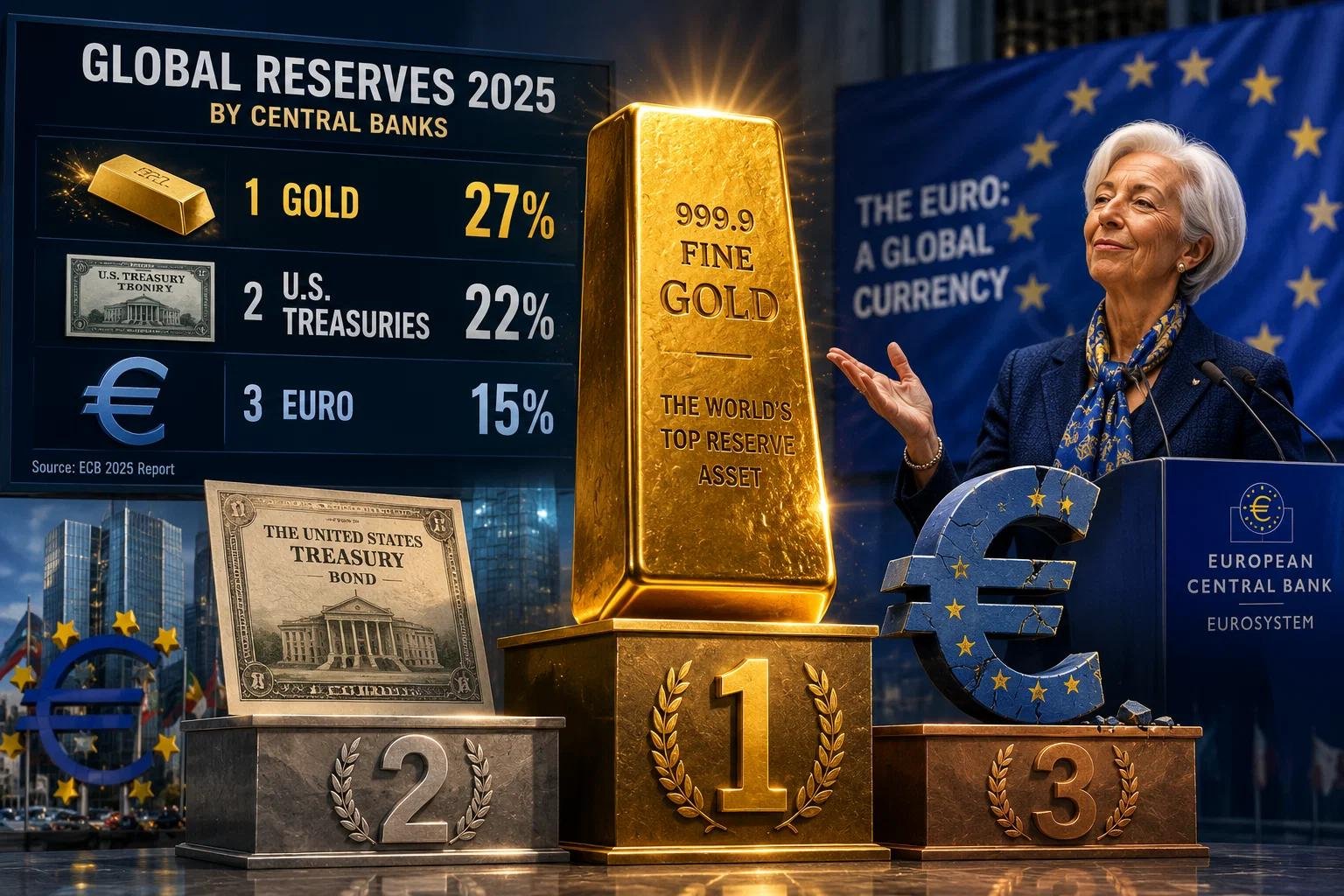
Europe Just Bragged About Losing to Gold
Notes From the Field By James Hickman (Simon Black / Sovereign Man) June 4, 2026
When the euro launched on January 1, 1999, it was sold as the future. It would be a single currency to knit Europe together — to wipe out the exchange-rate friction between member states, complete the continent's single market, and bind a dozen squabbling nations into one economic bloc with one money.
And in the grander ambitions of its architects, it was meant to do something more: to grow up into a true global currency, the first serious rival the US dollar had faced since World War II.
Experts Say This Is A Key Sign You Have An Unhealthy Relationship With Money
By Natalia Lusinski
When it comes to money and budgeting, it’s often easier said than done. You may have the best of intentions — you’ll eat out less this month and put the money into your savings account instead. But then life happens. Just like working through any other life, fitness, or wellness issue, a little introspection is often the ticket. If you want to get your finances back in order, a financial psychologist or money mindset coach can help. It all starts with getting your head in the right place.
Green Policy is Deadlier Than Guns
Notes From the Field By James Hickman (Simon Black / Sovereign Man May 29, 2026
Every year around this time, a silent killer sneaks its way onto European shores and slaughters people by the tens of thousands. Last year, it killed more people in just three months than the number of civilians killed in the war in Ukraine all year. It killed three times as many people as traffic accidents do. And it killed FOUR times more Europeans than gun violence killed in America. I'm not talking about COVID. Or even the legions of migrants invading the continent.
4 Bad Habits That Could Affect Your Money More Than Tariffs and Inflation
Written by Chris Adam GoBankingRates
The Trump administration’s discussions about tariffs and inflation have led many consumers to question how well they’re prepared for the future regarding their finances. After all, some experts have raised concerns that tariffs could lead to higher prices on products and services people use each day.
But there may be a way to protect personal finances that has little to do with moves by the White House.
Expert Issues Warning Over US Bank Accounts Sitting Idle
Rudro Chakrabarti Mon, April 20, 2026
Money Can Now Be Turned Over To State. Secure your money ASAP
Katelyn Fugate thought she was doing something nice for her young son. A few years back, she opened a savings account for him — a small starter fund he could build on one day. Recently, she decided to check in on it.
The balance was zero. Fugate told Scripps News she went to check the balance hoping to start adding to it again. Instead, she found the account empty. (1) The bank had declared it dormant after five years of inactivity, closed it and shipped the money off to the state's unclaimed funds department. Worse, when Fugate went looking for it, she couldn't find the money at the bank or the state.
Argentina Got This Warning Before Its Collapse. America Just Got It Last Week.
Notes From the Field By James Hickman (Simon Black / Sovereign Man) April 20, 2026
In early December 2001, ‘normal’ life very suddenly ceased to exist in Argentina— anything that remotely resembled a functional society came to an abrupt end. And that is by no means an exaggeration. The banking system collapsed. Financial transactions ground to a halt. Desperate people looted supermarkets for food, and then grocery shelves emptied. Energy ran short. Riots broke out in the streets, and police were shooting citizens in the face.
There Is No "Fair Share" — There Is Only “More”
Notes From the Field By James Hickman (Simon Black / Sovereign Man) April 16, 2026
In April 1971, Keith Richards loaded his family and his Bentley onto a cross-Channel ferry and drove south until he hit the Mediterranean. He rented a 19th-century villa called Nellcôte on a hillside above Villefranche-sur-Mer, and converted the basement into a recording studio.
The $13,000 Apartments the Government Won't Let You Buy
Notes From the Field By James Hickman (Simon Black/Sovereign Man) April 14, 2026
On May 20, 1862, Abraham Lincoln signed the Homestead Act into law, and it essentially said: here's 160 acres of land. It's yours. For free. All you have to do is live on it and improve it. And between 1862 and 1934, the federal government distributed 270 million acres under the program — roughly 10% of all the land in the United States.
Even as far back as the American Revolution, the Founding Fathers understood that property ownership made people more engaged, more productive citizens. Ownership meant that you had a vested financial interest in your community... and your country.
‘Let’s not be naive’: Ray Dalio says economic world order ‘is gone’ — warns of US ‘civil war.’ Preserve your wealth now
Jing Pan Sun, April 12, 2026 Moneywise
In the wake of the World Economic Forum in Davos, Switzerland, billionaire and founder of Bridgewater Associates, Ray Dalio, sounded a global fire alarm, and it’s starting to look like he was right.
The short version? The old economic world order is gone, and it’s likely not coming back any time soon.
“Let’s not be naive, ok, and say: Oh, we’re breaking the rule-based system,” Dalio said in an interview with Fortune at the WEF (1). “It’s gone. It’s going.” Dalio was referring to the current global balance of power between nations, which has hinged on relatively predictable U.S. foreign policy.
How Do I Manage This Much Money?
Moneywise Fri, April 3, 2026
My mom was much richer than I realized, and left me more than I could have imagined. How do I manage this much money? During the next 20 years or so, Americans will inherit an estimated $105 trillion as older Americans pass down their accumulated wealth to younger generations, in a phenomenon that has been dubbed the Great Wealth Transfer (1). That means there will be a lot of people who are surprised — even if pleasantly so — to be inheriting money and unsure about how best to manage it.
5 Subtly Genius Things All Wealthy People Do With Their Money — That You Should Do, Too
These moves don’t have to be reserved for the super rich.
t can feel like the super wealthy have access to some secret money playbook the rest of us never got. And in a way, that’s true. They have connections and access that most of us simply will never have.
But there’s good news: A lot of things the ultra wealthy do with their money are perfectly accessible to us — we just have to be smart enough to take advantage.
5 Pieces of Financial Advice to Avoid at All Costs
Suze Orman on the commonly accepted money tips it pays to ignore.
By Suze Orman
Bad financial information doesn't come only from scammers; even our loved ones can unwittingly steer us wrong. That's why knowing what not to do with your money is often your biggest asset. In general, there are two little words that should set off everybody's suspicion meter: Trust me. Anyone who gives you this line—whether a financial adviser or your significant other—is disrespecting you.