Sunday Iraq News Posted by Tishwash at TNT 6-28-2026
TNT:
Tishwash: Breaking | Entrances and exits to the Green Zone closed; footage circulating shows raids as part of a wide-ranging campaign launched by President al-Zaidi to pursue the big fish of corruption in Iraq.
Since the early hours of today (Sunday), videos and pictures have been circulating showing a heavy security presence and raids in the Green Zone in central Baghdad.
Activists and media accounts report raids and arrests carried out by elite forces led by Prime Minister and Commander-in-Chief of the Armed Forces Ali Faleh al-Zaidi, with the support of the Iraqi judiciary, to arrest politicians accused of major corruption cases as part of ongoing investigations into some of those recently arrested
Iraqis followed the news of this surprise attack on the hornet's nest, which they thought would be a haven for those who had turned the Green Zone into a large prison, until the early hours of the morning.
Activists circulated the hashtag #TakeItOff, Your Excellency, in support of President al-Zaidi's arrest of the corrupt figures. An official government statement with details is expected. link
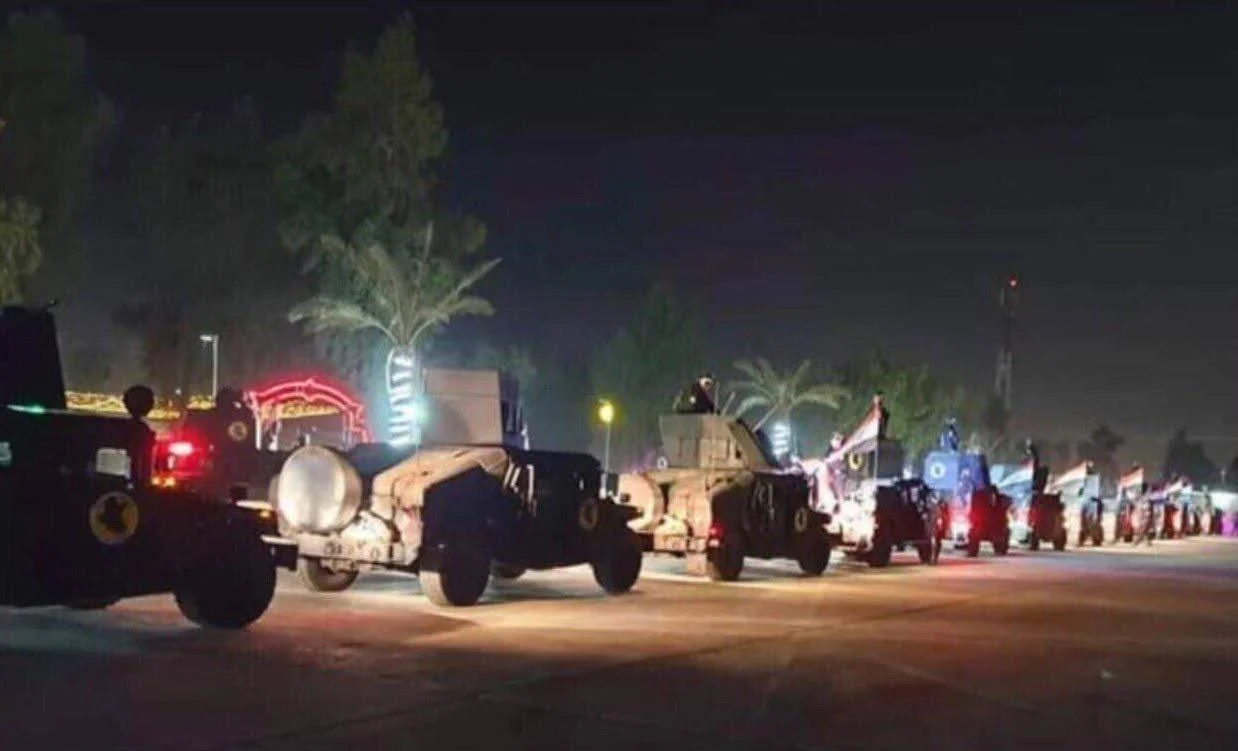
Another version
A security source reported on Sunday that special security forces were deployed inside the Green Zone in central Baghdad, coinciding with news of arrests targeting senior political officials and security personnel involved in corruption cases.
The source told Shafaq News Agency that special forces were deployed around a number of sensitive headquarters inside the Green Zone, with security measures being tightened at some entrances and roads leading to them.
He added that the security deployment coincided with information about arrests carried out according to judicial orders, targeting figures, officials and security personnel whose names appeared in files related to corruption and abuse of power.
*************
Tishwash: Mass Arrests in Baghdad’s Green Zone Amid Anti-Terror and Anti-Corruption Operation
In a joint anti-terror operation, the army and other security forces in Baghdad’s Green Zone arrested a number of current and former parliamentarians, political leaders, and advisors. Arrest warrants and travel bans were also issued for others.
Tension in the Green Zone
On Sunday morning, June 28, Baghdad’s Green Zone, home to government headquarters, foreign embassies, and residences of many officials, witnessed clashes between security forces and the guards of certain officials and parliamentarians, after years of relative calm.
https://twitter.com/Channel8English/status/2071155679260299315?s=20
Armed Confrontation During Arrests
Channel8’s Baghdad correspondent reported that during attempts to arrest several officials, armed confrontations broke out. The Green Zone became tense, some individuals with arrest warrants were detained, and the operation has not yet concluded.
Strict Security Measures
Channel8 also reported that in connection with the operation, strict security measures were imposed around the Green Zone. All entrances were closed to traffic, and large numbers of security forces were deployed across Baghdad’s streets.
Seizing Weapons and Confiscating Assets of Corrupt Officials
Iraqi PM Ali Faleh al-Zaidi stated that the operation aims to seize weapons held by the state and confront corruption. In recent months, Adnan Jumaili, a former Oil Ministry official, was arrested, and billions of dinars, houses, and properties were confiscated in Baghdad, Salahaddin, and Erbil.
https://twitter.com/Channel8English/status/2071128495980175521?s=20
Largest Anti-Corruption Operation in Iraq
Today’s operation is described as the largest ever against corruption in Iraq. For the first time, high-ranking officials and leaders, previously considered untouchable, have been arrested on corruption charges.
International Assessment of Corruption in Iraq
For years, Iraq has ranked internationally among the countries with the highest levels of corruption. This operation is seen as part of judicial and governmental efforts to hold senior officials accountable. link
Tishwash: The optimal weight of gold in foreign reserves: A look at the security and return equation
Dr. Haitham Hamid Mutlaq Al-Mansour
Calls to increase the share of gold in central banks' foreign reserves are made from time to time, particularly during periods of geopolitical instability, high inflation, and currency market volatility. These calls are often based on gold's historical status as a safe haven and a sovereign asset that retains its value in times of uncertainty.
However, managing foreign reserves cannot be based solely on choosing between "good assets" and "bad assets," but rather on defining the economic and monetary function of each asset within the reserve portfolio. Foreign reserves are not an investment portfolio aimed at maximizing profits, nor are they a store of wealth in the traditional sense. Instead, they are a tool of monetary policy designed to maintain monetary stability, strengthen confidence in the national currency, and provide the necessary external liquidity for intervention in the foreign exchange market and fulfilling international obligations.
For this reason, reserve management is based on three principles, ranked in order of priority: safety, liquidity, and return, not the other way around. Consequently, the evaluation of reserve components should be based on each asset's contribution to achieving these objectives collectively, not solely on the criterion of financial return.
In this context, gold performs a function radically different from that of government bonds, deposits, or securities. Gold represents a sovereign asset free from counterparty risk, as it is not dependent on the creditworthiness of any government or financial institution, nor is it linked to the possibilities of default, bankruptcy, or restructuring.
It also provides a high degree of protection in cases of instability in the international monetary system, escalating geopolitical risks, and a loss of confidence in reserve currencies. However, these advantages come at a clear economic cost.
Gold does not generate periodic cash flows, nor does it yield current returns; its returns are limited to capital gains. This is due to changes in its market value. Therefore, its contribution to the growth of foreign reserves depends entirely on gold price trends, which are characterized by a high degree of volatility and uncertainty.
In contrast, sovereign debt instruments and deposits with international financial institutions generate two types of returns: current returns in the form of interest or periodic returns, and capital returns derived from changes in their market prices. Furthermore, these instruments are highly liquid, easily reinvested, and have flexible maturities. Therefore, they constitute the primary source of income generated from foreign reserves at most central banks.
Therefore, the choice between gold and bonds is not a choice between two competing investment assets, but rather between two different functions within foreign reserves. Gold serves as a hedge against systemic and sovereign risks, while bonds and deposits serve to generate income and maintain operational liquidity. Substituting one for the other, therefore, disrupts the functional balance of the reserve portfolio.
Recent international developments, particularly the increased use of financial sanctions and the freezing of sovereign reserves, have demonstrated that the concept of a "safe asset" is no longer limited to low credit risk, but also encompasses independence from political and legal risks. This development has revived gold's status as a sovereign asset offering a degree of protection that traditional financial instruments cannot provide.
However, this does not justify increasing the relative weight of gold to levels that negatively impact the efficiency of foreign reserves. A higher gold content increases the market value of reserves to fluctuations in the gold market, reduces the average current yield, and diminishes the flexibility of liquidity management, particularly in economies that rely on foreign reserves to finance daily interventions in the foreign exchange market.
Therefore, the optimal decision is not to absolutely maximize or reduce the share of gold, but rather to determine the optimal strategic weight that achieves a balance between the functions of the various reserves, based on portfolio management models, stress tests, scenario analysis, and the risk structure faced by each central bank.
Therefore, this issue acquires added importance in the central bank's monetary policy, given the link between monetary stability and the stability of oil revenues, and the bank's reliance on foreign reserves to support exchange rate stability and bolster confidence in the dinar. Consequently, reserve management policy should be based on a long-term strategic perspective that balances liquidity, return, and hedging requirements, moving beyond short-term responses to fluctuations in gold prices or waves of optimism and pessimism in global markets.
In short, gold should not be viewed as an asset solely for maximizing returns, nor should bonds be considered a substitute for gold. Each has a distinct function within foreign reserves. The efficiency of reserve management lies in the ability to balance security, liquidity, and return, ensuring that each asset fulfills its role within an integrated risk management framework. Gold, in its essence, is not a tool for generating profit, but rather a means of ensuring the ability to maintain a nation's financial and monetary stability. link
************
Tishwash: Iraqiji will be in Baghdad tomorrow... What does his visit hold?
Iranian Foreign Minister Abbas Araqchi will arrive in Baghdad on Sunday at the head of a high-level diplomatic delegation, on an official visit aimed at discussing bilateral relations and regional developments, coinciding with the continuation of political and security consultations between the two countries.
The Iranian Foreign Ministry stated in a statement followed by (Al-Mada) that Araqchi will head to Iraq at the head of a high-level diplomatic delegation to conduct a series of meetings with senior Iraqi officials.
In the same context, Mukhtar al-Moussawi, a member of the Foreign Relations Committee in the House of Representatives, said in a statement followed by (al-Mada) that Araqchi’s visit comes at an important time, and will include talks with Iraqi officials on developing bilateral relations and strengthening political, security and economic coordination.
He added that the visit's agenda includes discussions on joint security issues, cooperation in combating terrorism and organized crime, strengthening border control and preventing smuggling and infiltration operations, as well as following up on the implementation of security agreements signed between Baghdad and Tehran.
Al-Moussawi indicated that regional developments would be at the forefront of the discussions, particularly efforts to reduce tensions and end the war permanently, stressing that Iraq continues its diplomatic efforts to support dialogue and bring viewpoints closer together in a way that contributes to strengthening security and stability in the region. link