Rob Cunningham: XRP Repricing Mechanics and Liquidity Equation
8-27-2026
XRP REPRICING MECHANICS
What provides liquidity when thousands of different forms of money, securities and tokenized property need to move between rails?
Ripple can provide the rails and the money traveling across the rails.
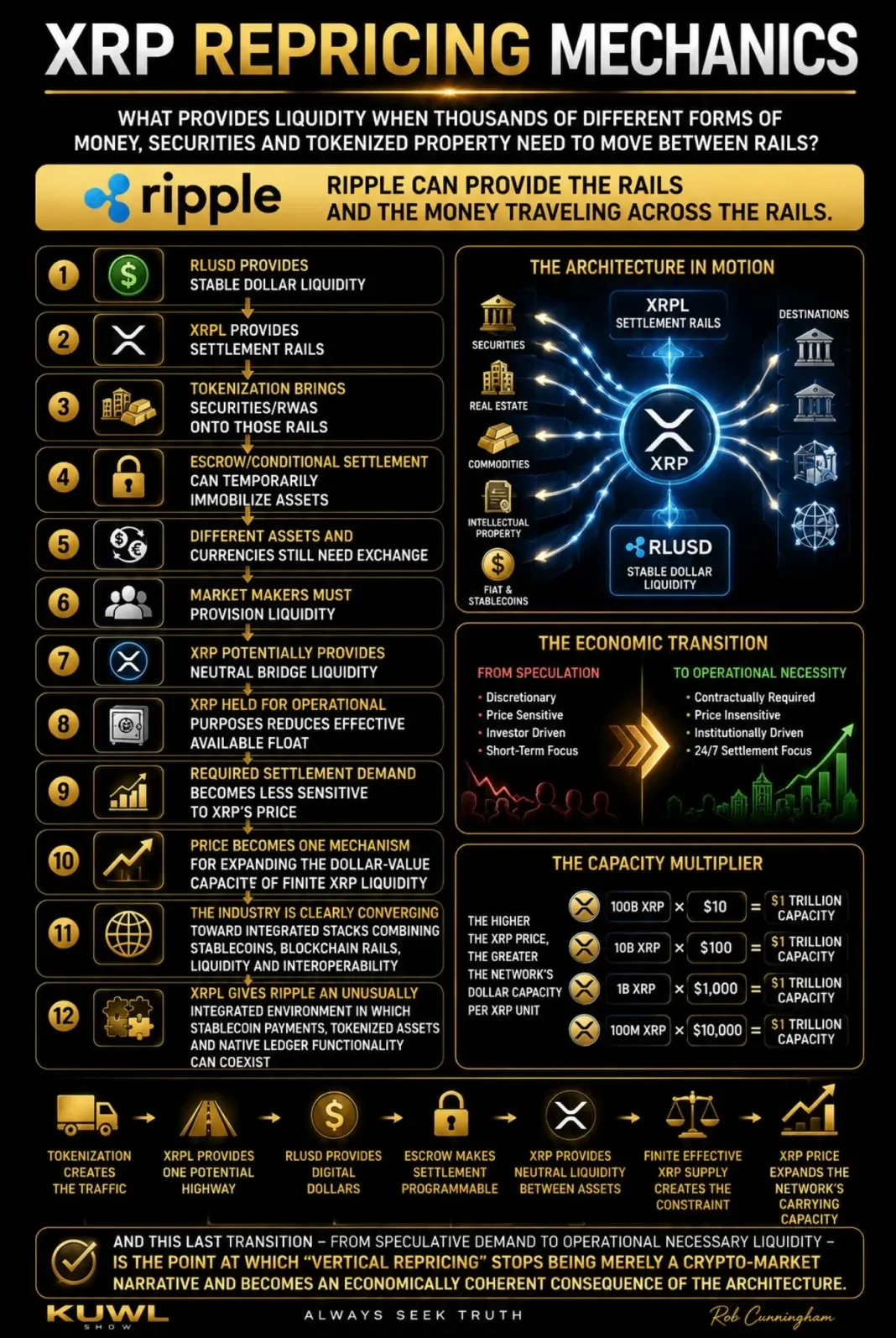
RLUSD provides stable dollar liquidity
→ XRPL provides settlement rails
→ tokenization brings securities/RWAs onto those rails
→ escrow/conditional settlement can temporarily immobilize assets
→ different assets and currencies still need exchange
→ market makers must provision liquidity
→ XRP potentially provides neutral bridge liquidity
→ XRP held for operational purposes reduces effective available float
→ required settlement demand becomes less sensitive to XRP’s price
→ price becomes one mechanism for expanding the dollar-value capacity of finite XRP liquidity
→ the industry is clearly converging toward integrated stacks combining stablecoins, blockchain rails, liquidity and interoperability
→ XRPL gives Ripple an unusually integrated environment in which stablecoin payments, tokenized assets and native ledger functionality can coexist
• Tokenization creates the traffic
• XRPL provides one potential highway
• RLUSD provides digital dollars
• Escrow makes settlement programmable
• XRP provides neutral liquidity between otherwise disconnected assets
• Finite effective XRP supply creates the constraint
• XRP Price expands the network’s carrying capacity
And this last transition – from speculative demand to operationally necessary liquidity – is the point at which “vertical repricing” stops being merely a crypto-market narrative and becomes an economically coherent consequence of the architecture.
There are moments when the most useful thing we can do is set aside what we think we know and simply ask a better question.
This is one such thought experiment.
Not a prediction.
Not a price target.
Not investment advice.
A vision to examine, challenge and discern.
For most of XRP’s history, people have understandably viewed its price through the familiar lens of markets:
How many people want to buy it?
But what if that eventually becomes the wrong question?
Imagine a world in which securities, Treasuries, currencies, real estate, commodities and other forms of legally recognized value increasingly become tokenized and capable of moving around the clock.
Those assets still have to settle.
Different currencies still have to exchange.
Different pools of liquidity still have to meet.
Market makers still have to provision capital.
And somewhere between all those assets, currencies and networks, the system may need exceptionally efficient forms of neutral bridge liquidity.
If XRP earns a meaningful role there, something subtle but profound changes.
Demand would no longer arise solely because someone believes XRP will appreciate.
Some demand could arise because value actually needs to move.
And markets do something fascinating when necessary demand encounters finite available supply:
price discovers the level at which sufficient economic capacity becomes available.
A higher XRP price would therefore not merely represent greater speculative enthusiasm.
It could allow the same number of XRP to carry substantially more value.
$10 XRP creates ten times the dollar-denominated liquidity capacity of $1 XRP.
$100 creates ten times the capacity of $10.
And so forth.
That raises an intriguing possibility.
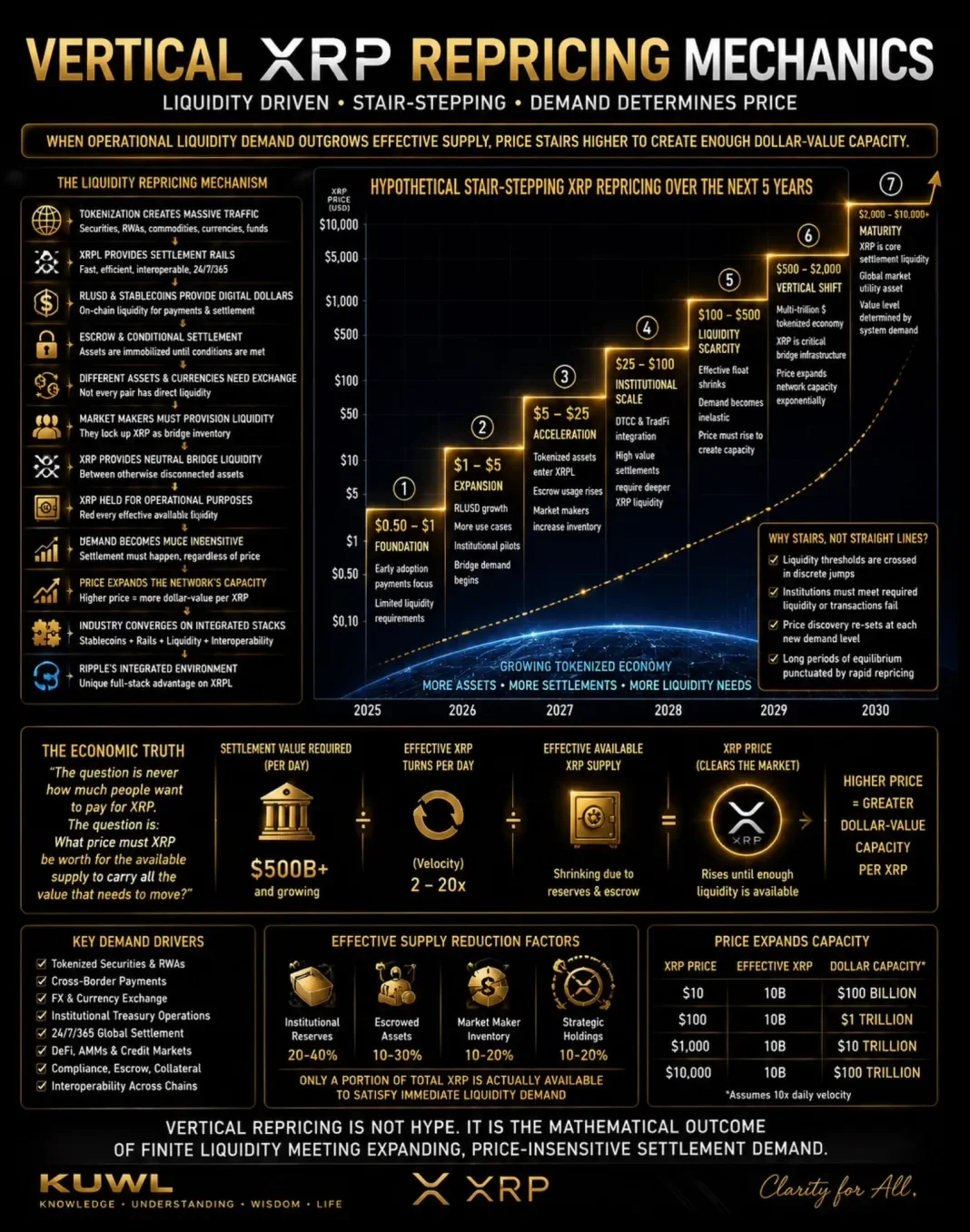
Perhaps mature XRP price discovery would not resemble a smooth upward curve at all.
Perhaps long periods of relative equilibrium could be interrupted by sharp stair-step repricing events as successive thresholds of institutional liquidity demand are reached.
Not because somebody administratively declares what XRP should be worth.
Not because social media becomes excited.
And certainly not because a chart says so.
But because the market continually asks a brutally simple question:
At what price can the available liquidity carry the value that needs to move?
I don’t pretend to know the answer.
None of us knows what percentage of future institutional settlement XRP will capture—or whether competing technologies ultimately solve much of this problem differently.
But I believe the question itself deserves serious consideration.
Because if tokenization creates vastly more financial traffic…
if programmable settlement changes how capital moves…
if liquidity increasingly operates 24/7…
and if XRP becomes meaningful operational inventory connecting otherwise fragmented pools of value…
then we may eventually discover that we spent years debating the price of XRP when the more consequential question was always:
How much economic value must each available XRP be capable of carrying?
The graphic below is simply an attempt to visualize that possibility.
Take nothing on faith.
Challenge the assumptions.
Test the mathematics.
Study the architecture.
Then reach your own conclusion.
Knowledge → Understanding → Wisdom → Life.
Let’s Always Seek Truth.
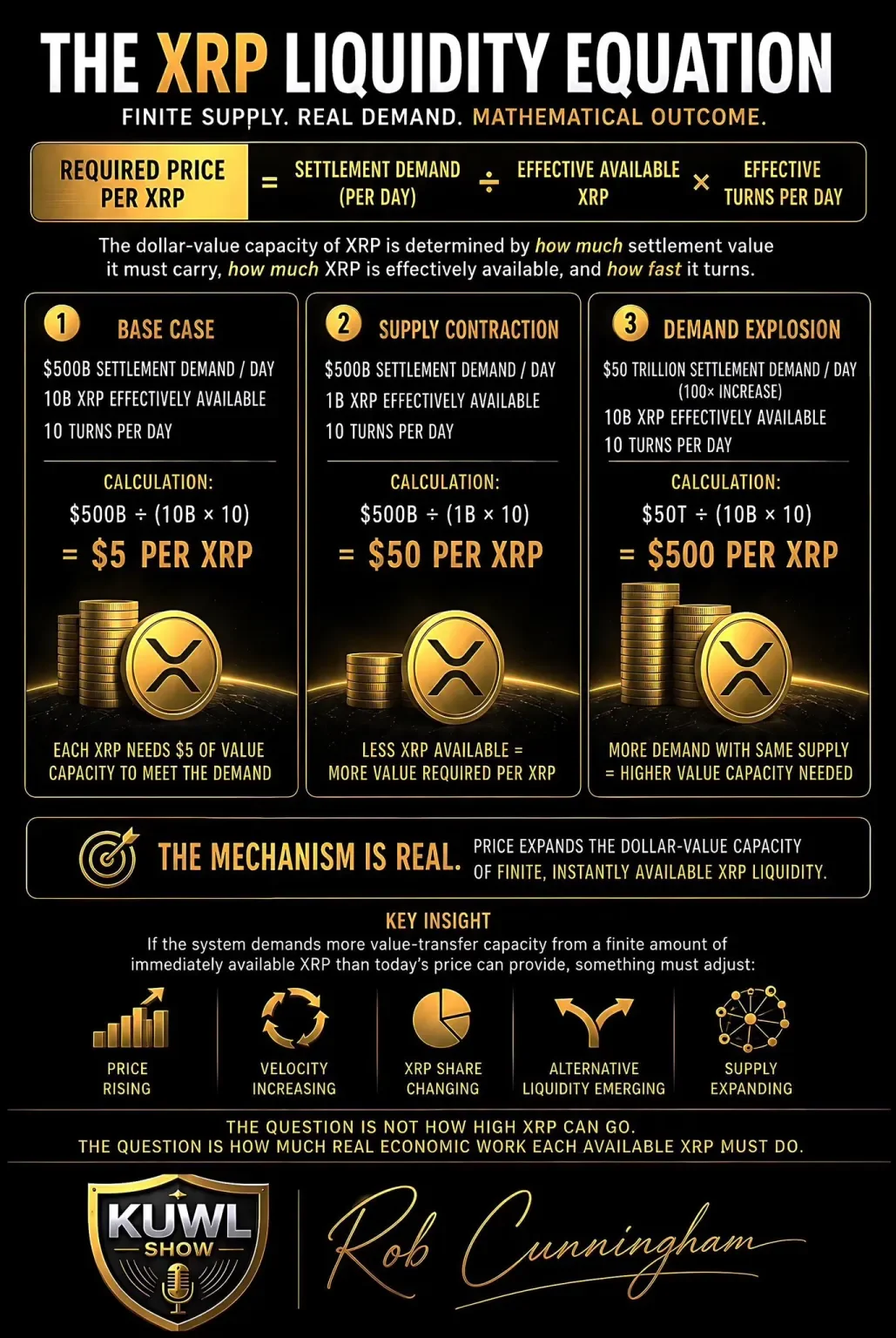
THE XRP LIQUIDITY EQUATION
A bullish XRP argument isn’t that the world must pay more for XRP.
It’s that IF the world ever demands more value-transfer capacity from a finite amount of immediately available XRP than today’s price can provide, something must adjust.
1 Supply can increase
2 Velocity can increase
3 XRP’s share can decrease
4 Alternative liquidity can emerge
5 Price can rise
The question isn’t “How high do we want XRP to go?”
The honest-weights-and-measures question is: “How much real economic work must each available XRP actually perform?”
Source(s):
• https://x.com/KuwlShow/status/2092562216218136996
• https://x.com/KuwlShow/status/2092566971812319354
• https://x.com/KuwlShow/status/2092594683398467975