Final signing at the White House... Al-Zaidi to launch a "second Iraq" in mid-July
TNT:
Tishwash: Final signing at the White House... Al-Zaidi to launch a "second Iraq" in mid-July
Barak's plan: Baghdad as the heart of a "new Middle East"
Ali al-Zaidi is close to setting a political precedent that could make him one of the fastest Iraqi prime ministers to reach the White House after assuming office.
His anticipated visit to Washington in mid-July is not seen as a mere protocol visit, but rather as an attempt to inaugurate a new phase in the relationship between Baghdad and Washington, more than two decades after the 2003 regime change in Iraq.
Political assessments suggest that the visit represents an opportunity to restructure the relationship between the two countries on different foundations, transcending the legacy of past years and opening the door to broader cooperation on energy, economic, and security issues.
However, according to observers, this path will not be without obstacles, given the continued influence of Iran and armed factions in the Iraqi landscape.
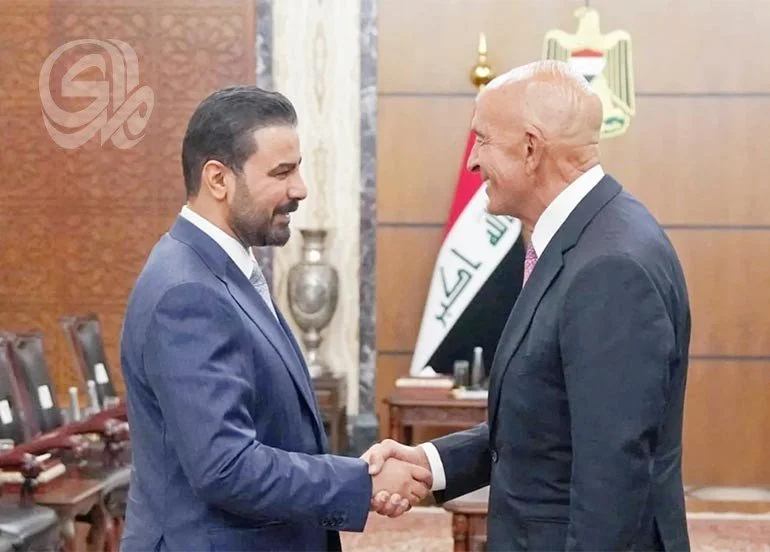
The Iraqi government announced last Monday that al-Zaidi would visit Washington in mid-July at the invitation of US President Donald Trump, shortly after US envoy Tom Barrack's visit to Baghdad, which was accompanied by leaks that sparked widespread interest regarding issues of weapons, corruption, and the future relationship between the two sides.
Academic and political analystMohammed Naanaa believes that Tom Barrack's meeting with al-Zaidi was a crucial step in preparing for the anticipated visit.
Naanaa told Al-Mada that the details of the visit were discussed during the meeting, including the issues mentioned in the Prime Minister's office statement. These issues pertain to the complete disarmament of Iraqis, the consolidation of all armed groups under the command of the Commander-in-Chief of the Armed Forces, the expansion of the American presence in Iraq, particularly for companies operating in the southern oil fields, and the granting of significant licenses to Starlink.
He added that these indicators, in his opinion, reflect an Iraqi alignment with the American vision for the future of the relationship between the two countries. He considers al-Zaidi's visit to be pivotal and the culmination of a series of contacts, dialogues, and reciprocal visits led by Barrack and the US Chargé d'Affaires in Baghdad, leading to what he describes as "the final signing of the new relationship between the two sides."
But Naanaa believes this path will not be without its challenges. He argues that any stability Tehran achieves will prompt it to revitalize its influence within Iraq, and that armed factions may return to exert greater pressure on the power structure, either directly or through their political representatives in parliament and the government.
The researcher emphasizes that Iraq should consider what it stands to gain from this burgeoning relationship, which is expected to culminate in the White House meeting on July 15. He stresses the importance of securing clear American support in three key sectors: banking, energy, and defense. According to Naanaa, Baghdad needs American assistance in acquiring air defense systems to protect the country, and support that will help liberalize the Iraqi monetary system, reduce exchange rate volatility, and mitigate the impact of the parallel dollar on citizens' livelihoods.
Furthermore, assistance is needed to resolve the gas import crisis for electricity generation through alternative solutions, including floating power platforms. The issues of weapons and sovereignty were also discussed. During their recent meeting in Baghdad, al-Zaidi and Barak emphasized the importance of building a strong and mutually beneficial Iraqi-American partnership.
According to the official statement, the two sides discussed a shared vision for building a "brighter, terrorism-free" future, implementing plans for complete disarmament, dissolving all armed groups and formations operating outside the authority of the state, and ensuring that weapons are solely in the hands of the state and that full sovereignty is established.
They also stressed the need to keep Iraq out of regional conflicts and prevent its territory from being used by any party to threaten security and stability in the region, emphasizing the urgent need to fully achieve these goals.
Iraq at the heart of a new Middle East.
Former diplomat Ghazi Faisal, however, views the visit from a broader perspective that transcends the bilateral relationship between Baghdad and Washington.He tells Al-Mada that the new American initiative, which emerged after Tom Barrack was assigned the Iraq portfolio, is based on major strategic projects, including strengthening coordination and economic integration between Iraq and Syria, ultimately aiming to build a nucleus of regional cooperation that may later include Cairo, Amman, and Beirut, in addition to Baghdad and Damascus.
Faisal believes the region is facing a new phase, especially after what he calls the "historic agreement" to resolve long-standing crises with Iran dating back to 1979. He considers this agreement a precursor to a new Middle East map based on development rather than wars and conflicts.
He adds that Iraq is at the heart of these transformations, and that al-Zaidi's visit could be a starting point for the country's transition from the security, political, and economic chaos that has accompanied the post-2003 era to building a truly democratic state.
He emphasizes that the visit could lay the foundation for deeper economic and investment relations, because, as he describes it, investment is what creates jobs and stimulates the economy, while currently, about 75% of the budget goes to salaries at the expense of development and investment.
Faisal also expects the United States to support Iraq's efforts to combat corruption within ministries, banks, and companies, and to pursue networks involved in smuggling and money laundering.
He points out that the environment created by armed factions and financial corruption in recent years has driven companies and investors to leave Iraq or freeze their projects, which necessitates providing new security and political guarantees to restore confidence in the Iraqi economy.
The visit he concludes, represents an opportunity to review the mistakes made by Washington and Iraqi political parties over the past two decades, and to move Iraq from a failing and declining state to a more stable one, better able to integrate into its regional environment. According to political sources who spoke to Al-Mada, Tom Barrack only arrived in Baghdad after Washington received initial positive signals regarding several demands it had previously conveyed to the Iraqi government.
The sources describe Barrack's visit as pivotal in the course of Iraqi-American relations, considering it the foundation for a new phase, distinct from the period following 2003, based on clear commitments and mutual interests. The most prominent American demands, according to these sources, include the disarmament of all armed factions without exception, preventing their participation in the government, and completing the integration of the Popular Mobilization Forces (PMF) into official security institutions after removing leaders affiliated with armed factions.
The sources indicate that these issues are still under discussion and have not yet been definitively resolved.
The American demands also include closing more than ten banks accused of smuggling dollars and involvement in money laundering, restructuring other financial institutions, expanding anti-corruption measures, and opening the door to broad American and Gulf investments.
According to sources, Washington links the success of these measures to the influx of major investments that Baghdad needs in the energy, infrastructure, and services sectors.
If these conditions are not met, Barak informed Iraqi officials, according to the same sources, that "all options are open," and that the United States will act in accordance with its interests.
Compared to his predecessors, if the visit takes place as scheduled, al-Zaidi will be one of the fastest Iraqi prime ministers to reach the White House.
Only Nouri al-Maliki rivals him in this regard, having visited Washington four times during two terms, with his first visit coming just two months after assuming the premiership. In contrast, Mohammed Shia al-Sudani waited about 17 months before meeting former US President Joe Biden, amid American reservations and internal complications.
For his part, Ahmed al-Yassiri, an Iraqi political analyst residing in Australia, believes that focusing on the speed or timing of the visit does not reflect its true importance.
He tells Al-Mada that al-Zaidi did not request the visit, but rather received an invitation from the US administration. Therefore, linking its significance to the time elapsed since his assumption of office is inaccurate.
He adds that the visit's true importance lies in providing the Iraqi political system with American backing during a sensitive regional period, and in restructuring the relationship between Baghdad and Washington amidst the ongoing transformations in the region, particularly concerning the Iranian issue and the redrawing of security and political alliances.
Al-Yassiri, who also heads the Arab-Australian Center for Strategic Studies, believes the visit will also exert internal pressure on the Iraqi government to present a realistic program regarding investment and the entry of American companies, in addition to ensuring the continued flow of Iraqi funds and preventing the country from being exposed to the risks of US sanctions.
He emphasizes that these issues will shape the features of the next phase, regardless of al-Zaidi's ability to achieve quick results or immediate breakthroughs.
Political support or practical results?
Munqith Dagher, Middle East and North Africa director and a member of the board of directors of Gallup International, views the visit as more of a message of political support than an exceptional event.
He tells Al-Mada that the visit carries a ceremonial dimension for al-Zaidi and represents an American attempt to demonstrate its support for the Iraqi Prime Minister, especially since Washington—in his estimation—played a key role in his rise to power through Tom Barrack.
Dagher believes the timing might have been better had it been delayed slightly, but he acknowledges that American motives dictated the visit's timing. He adds that it wouldn't be a negative development if al-Zaidi succeeds in using the opportunity to raise important Iraqi issues and secure greater American support on vital matters.
He concludes by saying that the true measure of the visit will depend on its actual outcomes: will it remain within the realm of protocol and political messaging, or will it become a starting point for genuine progress on the outstanding issues between Baghdad and Washington? link